




Abstract
The aim of the study is to reveal the relationships between prospective teachers’ awareness of reducing ecological footprint, their sustainable consumption behaviours and their behaviours towards sustainable environmental education by using Structural Equation Modelling (SEM). In the study, a cross-sectional survey model was adopted, and the sample consisted of 533 prospective teachers studying in Science, Preschool, Primary School and Social Studies Teacher Education programmes of state universities located in three different provinces in eastern Türkiye. As a result of the data analysis, it was determined that there was a moderate positive relationship between ecological footprint awareness and sustainable consumption behaviour, a moderate positive relationship between ecological footprint awareness and behaviour towards sustainable environmental education, and a high positive relationship between sustainable consumption behaviour and behaviour towards sustainable environmental education. SEM results show that awareness towards reducing ecological footprint has a weak but significant indirect effect on behaviour towards sustainable environmental education and sustainable consumption behaviour plays a partial mediating role in this effect. In addition, the total effect of awareness towards reducing ecological footprint on behaviour towards sustainable environmental education was found to be positive and statistically significant. In addition, awareness towards reducing the ecological footprint explains 85% of sustainable consumption behaviour. Together with sustainable consumption behaviour, awareness towards reducing ecological footprint explains 14.6% of the behaviour towards sustainable environmental education. These results indicate that increasing prospective teachers’ awareness of the ecological footprint can play an important role in improving their sustainable consumption behaviours and their behaviours towards sustainable environmental education.
Plain language summary
The aim of the study is to reveal the relationships between prospective teachers’ awareness of reducing ecological footprint, their sustainable consumption behaviours and their behaviours toward sustainable environmental education by using Structural Equation Modeling (SEM). As a result of the data analysis, it was determined that there was a moderate positive relationship between ecological footprint awareness and sustainable consumption behaviour, a moderate positive relationship between ecological footprint awareness and behaviour toward sustainable environmental education, and a high positive relationship between sustainable consumption behaviour and behaviour toward sustainable environmental education. SEM results show that awareness toward reducing ecological footprint has a weak but significant indirect effect on behaviour toward sustainable environmental education and sustainable consumption behaviour plays a partial mediating role in this effect. In addition, the total effect of awareness toward reducing ecological footprint on behaviour toward sustainable environmental education was found to be positive and statistically significant. In addition, awareness toward reducing ecological footprint explains 85% of sustainable consumption behaviour. Together with sustainable consumption behaviour, awareness toward reducing ecological footprint explains 14.6% of the behaviour toward sustainable environmental education. These findings reveal that increasing prospective teachers’ ecological awareness and supporting their sustainable consumption behaviours can play a critical role in developing their behaviours toward sustainable environmental education.
Keywords
Introduction
The difference between the amount of natural resources available worldwide, the rate at which individuals living on earth consume these resources, and the ecological value required for nature to tolerate the wastes generated after consumption leads to ecological gaps. These ecological gaps put pressure on nature. According to today’s studies, with the developing technology and economy, the pressures caused by excessive consumption and environmental pollution are gradually increasing in the world (Mızık & Yiğit Avdan, 2020). With the global increase in environmental problems, searching for solutions to meet current needs without harming future generations’ resources has become critical. Ensuring economic development through unlimited use of natural resources is criticized due to the limited capacity of the ecosystem, and concerns for the future are expressed (Erden Özsoy & Dinç, 2016). Human activities are one of the most critical factors that cause damage to ecosystems. In order to protect the ecosystem in terms of sustainable life, it is necessary to take an active role in activities that require social responsibility, such as the economic consumption of resources, the use of environmentally friendly products, the use of renewable energy sources, recycling, and the use of public transportation and to raise social awareness (Yener & Yılmaz, 2019).
It is essential for tomorrow’s generations and a sustainable world that humanity, which depends on nature for all resources, finds solutions to these problems. This search for solutions will result positively in efforts towards people’s knowledge and value judgments. For this reason, it is essential to include the concept of ecological footprint in educational activities as a tool that shows how much of nature we use with our consumption habits and how much space we need to recover what we consume (Üçüncü & Yılmaz, 2019). As with everything else, education is the key to making sense of the world and ensuring a sustainable life without harming it. The main reason for the emergence of ecological literacy is the ecological footprint left by human beings in the world (Arıca & Kağar, 2018).
The concept of ecological footprint is that measures the water and land area that a country’s citizens need according to their consumption habits. In order to achieve a sustainable future, the ecological footprint needs to be balanced with biological capacity, and society needs to embrace this responsibility and participate in decision-making processes (Kaypak, 2013). The sustainable use of resources such as air, water, and food that individuals need and protecting the natural environment requires an ecological perspective. In order to be able to approach nature from this perspective, it is of great importance to have basic knowledge and awareness about ecology and ecology-related fields of study (Saraç, 2021). In this context, ecological footprint awareness is a concept that concretely shows the effects of individuals’ consumption habits on the environment. For individuals to realize the damage to nature, it is necessary to develop ecological intelligence that supports sustainable lifestyles and purchasing habits (Deniz Çakıroğlu, 2023).
As issues that threaten the socio-environmental balance continue to emerge and evolve, it has become imperative for education to adapt to a rapidly changing world. In this context, teacher education plays a critical role in guiding progress towards a more sustainable future (United Nations [UN], 2020). Because teachers have a significant role in spreading ecological awareness and transforming sustainable life principles into students’ behaviours. In order to fulfill this role, prospective teachers, who will be the teachers of the future, should have knowledge and awareness about the concept of ecological footprint (Keleş et al., 2008). Sustainable environmental behaviours aim to raise individuals’ awareness of environmental problems, develop solutions, and exhibit environmentally sensitive behaviours. At the heart of these behaviours lies the motivation to increase individuals’ awareness of their ecological footprint and minimize their environmental impacts (Mızık & Yiğit Avdan, 2020). In other words, the ecological footprint is a measure that shows the impact of an individual’s consumption habits and lifestyle on ecosystems around the world.
Sustainable consumption refers to the use of natural, environmentally friendly, and recyclable resources to meet social needs while protecting the environment, improving quality of life, and ensuring that future generations can also meet their basic needs (Guo, 2024). In this context, it is thought sustainable consumption behaviour builds an important bridge between behaviours towards sustainable environmental education and ecological footprint awareness, enabling individuals to fulfill their environmental responsibilities at both personal and societal levels. Similarly, it is possible to say that individuals’ ecological footprint awareness plays a crucial role in developing sustainable environmental behaviours and adopting a more sustainable lifestyle.
Considering the role of teachers as individuals who educate future generations, it is of great importance to examine the relationship between ecological footprint awareness, sustainable consumption behaviours, and sustainable environmental education behaviours among teacher candidates. Prospective teachers with ecological awareness shape their behaviour through environmentally friendly actions and, as role models for their future students, help to promote the adoption of sustainable lifestyles in society.
This study, therefore, aims to explore the relationships among prospective teachers’ ecological footprint awareness, sustainable consumption behaviors, and behaviors towards sustainable environmental education through the application of structural equation modelling (SEM). By analyzing these relationships, the study seeks to provide critical insights for both educational practice and policy development aimed at fostering a more sustainable future.
Literature Review
Terminology and Conceptual Clarification
In this study, three distinct yet related constructs are examined: ecological footprint awareness, sustainable consumption behaviour, and behaviour towards sustainable environmental education.
Ecological footprint awareness refers to individuals’ understanding of how their consumption habits affect the planet’s ecological limits, and their ability to reflect on the consequences of these actions. Ecological footprint awareness refers to understanding the environmental impact of individual consumption, including the land and sea area required to support one’s lifestyle. It encourages individuals to consider sustainable practices to reduce their ecological footprint and promote environmental protection (Geldi et al., 2024). Thus, ecological footprint awareness is not limited to knowledge acquisition, but also includes developing environmental responsibility and decision-making skills aimed at reducing personal ecological impact.
Sustainable consumption behaviour refers to consumer practices that prioritise environmental protection and responsible resource use. It encompasses attitudes and actions influenced by corporate social responsibility that aim to reduce environmental harm and combat climate change through conscious purchasing decisions (Mahadeva et al., 2024). Sustainable consumption behaviour is defined as patterns of consumption that meet basic needs and improve life quality while minimizing the use of natural resources, toxic materials, and emissions, ensuring that future generations can also meet their needs (Jackson, 2005).
Behaviour towards sustainable environmental education focuses on the environmentally responsible daily practices of individuals, such as conserving resources, reusing materials, and selecting environmentally friendly alternatives, as indicators of their environmental responsibility and readiness to act as role models. Behavior towards sustainable environmental education involves gaining awareness of environmental issues, adopting certain values and attitudes, and engaging in positive actions that contribute to sustainability, ensuring present needs are met without compromising future resources (Demirci Güler & Afacan, 2012).
Each construct is defined and operationalized based on relevant literature and is used consistently throughout the manuscript to maintain conceptual clarity.
Ecological Footprint Awareness
Human activities destroy and degrade vital ecosystems such as forests, grasslands, and wetlands, jeopardizing human well-being. Over the past decade, 75% of the land surface has been severely altered, much of the oceans have been polluted, and more than 85% of land area has been lost (Almond et al., 2020). According to World Wide Fund for Nature’s (WWF) Living Planet Report, the world’s biological capacity and ecological footprint have revealed that our demand for natural resources has doubled in the last 40 years, and biodiversity has decreased by 30% on a global scale. This means we will need two planets in 2030 and 2.8 planets in 2050 to survive (WWF, 2020; cited in Mercan, 2022). Over the last 50 years (1970–2020), the average size of monitored wildlife populations has shrunk by 73%. This is based on population trends of around 35,000 and 5,495 species of amphibians, birds, fish, mammals, and reptiles. Freshwater populations experienced the most significant decline, 85%, followed by terrestrial (69%) and marine populations (56%) (WWF, 2024).
Due to the increasing demands on ecosystems, achieving sustainable development has become a critical issue on a global scale, and the threats to the world have increased over the last half century as natural resources have become more limited (Bastianoni et al., 2020; Mancini et al., 2016). Therefore, humanity is responsible for ensuring sustainability, in other words, meeting our own needs without jeopardizing the needs of future generations (Lopez et al., 2021). In order to ensure a sustainable life, every individual and society in the world should take responsibility and take the necessary steps in cooperation. For people to play an active role in this process, they need to be informed about the factors that directly or indirectly affect sustainable living (Bayraktar, 2020). Sustainability indicators play an important role in concretizing sustainability. These indicators quantify the effects of consumption on the world and help to identify environmental problems. They also help us understand the measures that need to be taken to reduce sustainability problems and how they will be implemented. Thus, a critical step is taken in preventing environmental problems (Haberl et al., 2004). In this context, the ecological footprint concept is a critical indicator of sustainable living.
The ecological footprint is a key indicator that measures the environmental impact of human activities by assessing the pressure individuals or societies place on natural resources and whether this consumption exceeds the Earth’s biological capacity (Wackernagel & Rees, 1996). Developed in the early 1990s by Mathis Wackernagel and William Rees, the concept calculates the biologically productive area required to meet demands such as resource production, CO2 absorption, and infrastructure needs (WWF, 2012). It offers a realistic view of ecological sustainability and is essential for sustainable development, aiming to enhance human well-being while staying within ecological limits (Wackernagel et al., 1999). Ecological footprint measurements are also valuable for raising awareness of environmental issues and helping individuals understand their roles and attitudes towards sustainability (Günal et al., 2018). Although the ecological footprint is an indicator for evaluating individual awareness and behavioural tendencies towards sustainability, it has also been criticized for its conceptual and methodological limitations. As highlighted in previous studies, the ecological footprint tends to emphasize individual responsibility while overlooking broader systemic and structural environmental issues, including dimensions of social inequality (Blomqvist et al., 2013; Van den Bergh & Grazi, 2014). In this context, Hui and Choi (2024) state that environmental policies are of vital importance for achieving sustainability goals. Ecological footprint, as one of the indicators of sustainable living, stands out as a more effective educational tool in changing our attitudes and behaviours towards the environment positively compared to the criticisms. This study examines the role of ecological footprint awareness in influencing individuals’ sustainable behaviours.
Ecological footprint awareness is considered an important tool in promoting sustainable consumption behaviour and sustainable environmental behaviour. It reflects individuals’ sensitivity to environmental problems through their consumption habits and use of resources and contributes to the development of sustainability in educational settings (Konu Kadirhanoğulları & Vural Aydın, 2023). Ecological footprint awareness, although mostly addressed in terms of attitudes and values, is also closely related to environmental knowledge. In particular, effectiveness knowledge, that is, knowledge about the actual environmental consequences of certain behaviours (Frick et al., 2004), plays an important role in the formation of this awareness. This type of knowledge enables individuals to understand the impact of their daily behaviours on ecological systems and thus forms the cognitive basis for meaningful awareness. Moreover, understanding the ecological footprint allows individuals to analyze how their lifestyles impact ecological capacity and motivates them to make responsible choices that reduce their overall footprint (Karaarslan Semiz & Çakır Yıldırım, 2019).
Determining ecological footprint awareness is very important because it highlights human-induced environmental impacts, promotes sustainability, and encourages responsible behaviour. This awareness is necessary to address environmental issues and promote effective solutions through education and community participation (Küçükbaş Duman & Atabek Yiğit, 2022). In this study, the “Scale for Reducing Ecological Footprint” developed by Tekindal et al. (2021) was used. This scale was designed as a measurement tool to develop environmental responsibility awareness in line with increasing environmental problems. The purpose of the scale is to provide a tool to help individuals become aware of the need to reduce environmental damage and to enable them to understand the effects of the ecological footprint on human activities. The scale aims to help individuals recognise the personal and social measures they can take to minimize the damage they cause to nature. In this regard, the scale encourages individuals to take conscious steps to change their environmental behaviour.
Ecological footprint awareness can be expressed as an important level of consciousness that directs individuals towards more sustainable consumption habits. It enables them to understand that natural resources and the pressure of consumption activities on the environment are limited. Therefore, it is possible to say that sustainable consumption behaviours are a natural result of ecological footprint awareness.
Sustainable Consumption Behaviour
The concept of sustainable consumption entered the literature as the 21st agenda item at the Earth Summit held in Rio in 1992. At the summit, it was emphasized that consumption patterns should be changed to ensure reduce the impacts of negative human activities on the environment and sustainable development. This concept has started to be seen as an essential component of environmental policies reflected in the business world and consumers (Hayta, 2009). Sustainable consumption is defined as a form of consumption that provides a better quality of life while meeting basic needs, minimizes the use of natural resources and toxic materials, and does not jeopardize the needs of future generations (Organisation for Economic Co-Operation and Development [OECD], 2002). The most common sustainable consumption behaviours include buying organic and local products, using locally produced foods, composting, recycling glass, preferring recycled paper products, buying fair trade products, using long-lasting shopping bags instead of plastic bags, using electricity and water economically, and donating unused items (İnci & Ergen, 2019). The main components of sustainable consumption are to increase the likelihood of a better quality of life for individuals on the planet through the equitable distribution of natural resources, to balance the needs of future generations with patterns of prudent reduction of natural resources, and to reduce the negative impacts of overconsumption and consumer culture significantly. These efforts are important for minimizing ecological damage (Dermody et al., 2015).
On the other hand, sustainable consumption behaviours appear as actions that shape the behaviours towards sustainable environmental education, with the development of individuals’ awareness of making environmentally sensitive choices. The key elements of sustainable consumption are consumer behaviours, lifestyles, and consumption culture, which determine the extent of resource consumption (Jackson, 2014). In this respect, examining attitudes and behaviours towards the environment and transforming these attitudes and behaviours into positive ones within the scope of a sustainable environment is very important for the sustainability of resources. Therefore, sustainable consumption behaviours can support the development of sustainable environmental behaviours by helping individuals and communities to reduce their environmental impact and adopt a more sustainable lifestyle. Diksaç (2019) stated that students’ preferred lifestyles and environmentally conscious behaviours are effective in sustainable consumption behaviours. In the literature, there are no studies directly examining the relationship between sustainable consumption behaviour and behaviours towards sustainable environmental education. However, Tatar (2021) stated that there is a statistically significant positive and strong relationship between sensitivity to environmental problems and sustainable consumption behaviour variables. In other words, it has been observed that as sensitivity to environmental problems increases, sustainable consumption behaviour increases strongly.
Although sustainable consumption behaviours are often associated with individual efforts, the literature also includes critical perspectives emphasizing that individual action alone is insufficient for achieving systemic sustainability. Akenji (2014) emphasizes that “green consumption” will occur alongside transformations in political, social, and economic dimensions. He also states that consumer responsibility increases the burden on individuals in ensuring sustainability and that the role of systemic and institutional elements is, therefore, overlooked. Nevertheless, the present research deliberately focuses on the individual dimension of sustainable consumption behaviours, particularly in the context of prospective teachers, aiming to better understand how personal awareness and choices contribute to sustainable environmental behaviours.
Identifying sustainable consumption behaviour is crucial because it helps determine the social factors that influence such behaviour, enabling governments and organizations to design effective strategies that promote environmental sustainability, economic benefits, and social well-being, and ultimately foster a more responsible consumption culture (Figueroa-García et al., 2018). In this study, the “Sustainable Consumption Behaviour Scale” developed by Doğan et al. (2015) was used to measure individuals’ sustainable consumption behaviours. This scale was developed to assess the extent to which individuals behave in accordance with a sustainable consumption understanding that includes environmental, ethical, and economic dimensions. The focus of the study is to determine individuals’ sensitivity to the environmental impacts of their sustainable consumption habits and to examine the relationship between these behaviours and ecological footprint awareness and sustainable environmental education behaviours. Additionally, this study examines the mediating role of ecological footprint awareness in the relationship between sustainable consumption behaviour and sustainable environmental education behaviour.
Behaviour towards Sustainable Environmental Education
To create a more sustainable world and achieve the sustainability goals outlined in the Sustainable Development Goals (SDGs), individuals must become pioneers of this transformation. Individuals must be equipped with the necessary skills, knowledge, attitudes, and values to actively contribute to sustainable development.in this process education plays an important role In this context, Education for Sustainable Development (ESD) enables learners to act responsibly and make informed decisions for environmental protection, economic sustainability, and social justice today and in the future (United Nations Educational, Scientific and Cultural Organization [UNESCO], 2017). Education for Sustainable Development (ESD) views education as crucial for achieving global development goals. It teaches individuals to make informed decisions and take both individual and collective action to improve society and protect the planet. ESD provides people of all ages with the knowledge, skills, values, and abilities to address challenges like climate change, biodiversity loss, resource overuse, and inequality. ESD promotes learning that is cognitive (enhancing understanding), socio-emotional (developing social skills and empathy), and behavioural (encouraging positive actions). It is a transformative and lifelong learning process that is central to quality education (UNESCO, 2024). The United Nations Environment Programme (UNEP) (2025) states that environmental and sustainable development education plays a critical role in achieving the Global Goals by fostering environmentally conscious, planet-loving young people. With government support, the aim is to help young people adopt sustainable lifestyles through environmental education and to empower them to become future leaders.
Since human activities are considered to be the source of environmental problems, raising awareness among people through education (which aims to equip individuals with the necessary attitudes, values, and behaviours) is fundamental to sustainability (Summers et al., 2000). This shows that behaviours aimed at sustainable environmental education are critical for addressing environmental problems and achieving sustainability goals. Due to the fact that the daily habits and behaviours of modern society cause more damage to the environment than expected, it is necessary to establish and maintain environmentally friendly behaviours in order to protect the values of nature and sustain human-environment interaction in an efficient manner (Şandor, 2024). The aim of sustainable environmental education is not only to teach individuals cognitive and scientific concepts but also to enable them to respond to environmental problems in a sensitive manner, to imagine different dimensions of development, and to support them in acting responsibly within these dimensions (Hansman, 2009; Jensen & Schnack, 2006).
Sustainable environmental education behaviours refer to sustainable actions adopted by individuals in response to environmental problems, based on their knowledge and awareness of these problems. In other words, in the context of sustainable environmental education, behaviour refers to actions taken by individuals to protect the environment and resources based on their awareness of sustainability. It is shaped by their awareness and understanding of environmental problems (Demirci Güler & Afacan, 2012). In this research, the concept of behaviours towards sustainable environmental education is approached from a behavioural standpoint rather than a curricular or instructional one. The “Behaviour Scale Toward Sustainable Environmental Education” developed by Demirci Güler & Afacan (2012) is used to assess environmentally responsible daily practices of prospective teachers, such as minimizing resource consumption, reusing materials, and choosing sustainable products. Rather than focusing on their instructional intentions, the study investigates the extent to which prospective teachers personally adopt sustainability-oriented behaviours, which are crucial indicators of their readiness to act as role models for future generations (Chawla & Cushing, 2007).
This approach aligns with contemporary environmental education frameworks that emphasize action-oriented learning and behaviour change as central to achieving sustainability goals (Olsson et al., 2016; UNESCO, 2017). It also responds to calls in the literature to move beyond knowledge transmission towards transformative, lived experiences of sustainability (Barth & Rieckmann, 2016; Evans et al., 2017).
Relationships among Ecological Footprint Awareness, Sustainable Consumption Behaviour, and Sustainable Environmental Education Behaviour
The aim of the study is to reveal the relationships between prospective teachers’ awareness of reducing ecological footprint, their sustainable consumption behaviours and their behaviours towards sustainable environmental education by using Structural Equation Modelling (SEM). In light of the literature, no study has examined the relationship between prospective teachers’ ecological footprint awareness, sustainable consumption habits, and sustainable environmental behaviours together. Examining this relationship in depth within the scope of the research will enable teachers who will provide environmental education in the future to raise students who are conscious about their ecological footprint and sustainable consumption behaviours, and show sustainable environmental behaviour. Determining prospective teachers’ awareness and behaviour levels on this issue will pave the way for integrating innovative approaches to increase ecological awareness into the curriculum and teaching strategies.
There are a limited number of studies that directly examine the relationship between ecological footprint awareness and sustainable consumption behaviours. In this context, this research will significantly contribute to the literature regarding the results to be obtained. Gökşan (2023) stated that ecological footprint awareness significantly affects sustainable consumption behaviour. As awareness of the ecological footprint concept increases, sustainable consumption behaviours are expected to increase. In Karaman’s (2024) study, which examined the relationship between ecological footprint awareness and consumption selfishness and it was determined that individuals’ consumption selfishness has a moderately negative effect on ecological footprint awareness. This result indicates that individuals with high levels of consumption selfishness tend to have lower levels of ecological footprint awareness.
In the literature, no studies directly examine the relationship between ecological footprint awareness and behaviours towards sustainable environmental education. In Şimşek’s (2020) study, significant relationships were found between ecological footprint awareness and environmentally friendly behaviours. In particular, it was determined that the ecological footprint awareness of students who received environmental education increased, and they exhibited more environmentally friendly behaviours. Weinberg & Quesenberry (2010) presented students with key concepts on global and local sustainability and provided training on ecological footprint. As a result of the study, it was revealed that students grasped the importance of sustainable living, understood how individual and national ecological footprints are created, and learned how information and communication technologies can be used to reduce consumption. Grigoryeva (2010) emphasized in her study that using ecological footprint in ecology education is an effective tool for individuals to evaluate their impact on the environment and plan their behaviour. Çetin et al. (2017) emphasized in their study that ecological footprint training improved students’ environmental behaviours and emphasized the importance of environmental education in increasing ecological awareness.
In addition, examining the levels of sustainable consumption and sustainable environmental behaviour of prospective teachers will enable them to be more effective in raising environmental awareness among their students in the long term. Hanss & Böhm (2012) stated that individuals started to prefer more environmentally friendly products with the increase in their environmental awareness and that this awareness leads to sustainable consumption habits. In addition, examining the relationship between prospective teachers’ ecological footprint awareness, sustainable consumption habits, and sustainable environmental behaviours with structural equation modelling will make important methodological and theoretical contributions to the literature. Direct or indirect effects between variables will be revealed more clearly by examining the relationships between these three variables in more depth with structural equation modelling. The results to be obtained from this research will allow for the determination of the effect of prospective teachers’ ecological footprint awareness on sustainable consumption habits on the one hand and how these habits are reflected in sustainable environmental behaviours on the other hand. In this context, the modelling results are expected to provide a more concrete understanding of the strengths and weaknesses of ecological footprint awareness, sustainable consumption habits, and sustainable environmental behaviours, as well as reveal the relationship patterns missing in the literature.
The main idea of this study is to reveal the relationships between “prospective teachers” ecological footprint awareness, sustainable consumption behaviours, and sustainable environmental education behaviours. In addition, the mediating role of sustainable consumption behaviour between awareness of reducing the ecological footprint and sustainable environmental education behaviours is investigated.
Structural Model of the Research
In the research model, prospective teachers’ behaviours towards sustainable environmental education and its three sub-dimensions as the dependent variable, their awareness towards reducing the ecological footprint and its six sub-dimensions as the independent variable, and sustainable consumption behaviours and its four sub-dimensions as the mediating variable. In this context, the study investigates the relationships between prospective teachers’ behaviours towards sustainable environmental education, awareness towards reducing the ecological footprint and sustainable consumption behaviours, and the mediating role of sustainable consumption behaviour. In line with the purpose of the research, the following hypotheses were investigated, and the hypothetical model of the research is given in Figure 1.
Hypothesis 1: There is a significant relationship between prospective teachers’ sustainable consumption behaviours and their behaviours towards sustainable environmental education.
Hypothesis 2: There is a significant relationship between prospective teachers’ awareness towards reducing the ecological footprint and sustainable consumption behaviours.
Hypothesis 3: There is a significant relationship between prospective teachers’ awareness towards reducing their ecological footprints and their behaviours towards sustainable environmental education.
Hypothesis 4: Prospective teachers’ sustainable consumption behaviours mediate the relationship between their awareness towards reducing the ecological footprint and their behaviours towards sustainable environmental education.

Hypothetical model.
Method
Research Design
The cross-sectional survey model, one of the quantitative research models, was used in this research. The cross-sectional survey model is an approach that enables measurements to be made in a certain period in order to obtain data from the variables under investigation (Fraenkel et al., 2012). Cross-sectional research is observational, involves looking at a snapshot of data collected from a group over a certain period, and is descriptive (Wang & Cheng, 2020). Although the cross-sectional survey model has limitations in examining changes over time, it has been an effective method in achieving the aim of this study, as it allows data to be collected from large samples in a short period and provides a descriptive understanding of the current situation (Creswell, 2017; Fraenkel et al., 2012).
In this research, Structural Equation Modelling (SEM) was preferred to simultaneously test the theoretical relationships among variables. Compared to traditional statistical methods, SEM is methodologically suitable as it allows for the concurrent analysis of multiple dependent and independent variables, the modelling of latent constructs, and the comprehensive examination of both direct and indirect (mediating) effects. Additionally, considering the complexity of the proposed model and the potential mediating relationships among variables, SEM provides the most appropriate and robust analytical approach for the theoretical framework of this study (Kline, 2015).
Sample
The research sample consisted of a total of 533 prospective teachers studying in three different state universities’ Science Teacher, Preschool Teacher, Primary School Teacher, and Social Studies Teacher Education departments in the spring semester of the 2023 to 2024 academic year. The prospective teachers included in the sample were determined based on the criterion sampling method, one of the purposive sampling methods. Criterion sampling is defined as examining situations that correspond to a set of criteria determined before the research. In the criterion sampling method, the criteria or criteria related to the sample subject to the research are determined by the researcher or by using a pre-established list of criteria (Marshall & Rossman, 2014).
When examining education faculties in Türkiye, it is observed that environmental studies are offered in only a few departments. Research indicates that environmental education is generally offered as an elective course and is mostly limited to theoretical knowledge in terms of content (Tufaner et al., 2020). The criterion of this research was determined as prospective teachers studying in departments that have environmental education courses in their undergraduate education programs. Undergraduate higher education programs were examined in this framework, and it was determined that the “Environmental Education” course was included in the Departments of Science Teacher, Preschool Teacher, Primary School Teacher, and Social Studies Teacher Education. These departments were found to offer courses, either elective or mandatory (Higher Education Council, 2018). In the Science Teacher Education program, the “Environmental Education” course is compulsory in the seventh semester (beginning of the fourth year), so students in the seventh semester and above have taken it, while earlier semester students have not. In the Preschool Teacher Education program, the course titled “Early Childhood Environmental Education” is compulsory in the sixth semester (end of the third year), meaning students in the sixth semester and above have completed it. The Primary School Teacher Education program offers “Environmental Education” as a compulsory course in the second semester, so students from the second semester onward have taken it. In the Social Studies Teacher Education program, “Environmental Education” is an elective course, and whether students have taken it depends on their personal choice.
The research data were sent to the prospective teachers via Google Forms, and the data of the prospective teachers who answered the questionnaires were analyzed.
Table 1 presents the frequencies and percentages of the sample by university, department, gender, and grade level (It refers to the grade level of study of the prospective teacher’s; e.g., first year, second year, etc).
Demographic Information.

The distribution by department reveals that the highest proportion of participants were enrolled in the Social Studies Teacher Education (F = 173, 32.5%) and Primary School Teacher Education (F = 171, 32.1%) programs. In contrast, the number of participants from the Preschool Teacher Education (F = 101, 18.9%) and Science Teacher Education (F = 88, 16.5%) programs was relatively lower.
With regard to gender, the majority of participants were female (F = 432, 75.4%), while male participants accounted for 24.6% (F = 131). In terms of grade level, most of the participants were first-year (F = 192, 36.0%) and second-year (F = 167, 31.3%) students, followed by those in the fourth (F = 101, 18.9%) and third years (F = 73, 13.7%).
Data Collection Tools
Scale for Reducing Ecological Footprint (SREF)
This scale was developed by Tekindal et al. (2021) to measure ecological footprint awareness levels of individuals’ to emphasize the increase in ecological problems and the critical role of the concept of environmental responsibility. The scale aims to raise awareness about reducing the damage to the environment. As a result of validity and reliability studies, Cronbach’s alpha coefficient of the scale was found to be .96, and it was determined to have high validity and reliability values. The scale, comprising six sub-dimensions and 30 items, uses a five-point Likert-type evaluation system. Scale items: Energy (En): Items 1 to 8, Under the Laws (UL): Items 9 to 12, Recycling (Rc): Items 13 to 17, Transportation (Tp): Items 18 to 22, Food (Fo): Items 23 to 26 and Water Consumption (WC): Items 27 to 30. Definitions and examples related to the sub-dimensions of the scale are provided below (Tekindal et al., 2021).
Sustainable Consumption Behaviour Scale (SCBS)
The scale was developed by Doğan et al. (2015) to measure sustainable consumption behaviours of individuals’. SCBS is a measurement tool with validity and reliability studies. Cronbach’s alpha coefficient above .70 indicates that the scale is reliable. The scale consists of 17 items and four sub-dimensions, including Environmental Awareness (EA) (items 1–5), Unneeded Consumption (UC) (items 6–10), Savings (Sv) (items 11–14) and Reusability (Ru) (items 15–17). Definitions and examples related to the sub-dimensions of the scale are provided below (Doğan et al., 2015).
The Behaviour Scale Towards Sustainable Environmental Education (BSTSEE)
This scale was developed by Demirci Güler & Afacan (2012) to determine the behavioural levels of individuals towards sustainable environmental education. The scale consists of 29 items in total and three sub-dimensions. The Cronbach’s alpha coefficient of the five-point Likert-type scale is .944. The sub-dimensions of the scale are: Behaving in an Energy-Saving Way (BESW) (items 1–15), Following Environmental Publications or Broadcasts and Reacting to People Who Damage the Environment (FEPRPDE) (items 16–23) and Using Environmentally-Friendly and Recyclable Products (UEFRP) (items 24–29). Definitions and examples related to the sub-dimensions of the scale are provided below (Demirci Güler & Afacan, 2012).
The scoring of the averages obtained from the scales, in other words, which level they correspond to, was made according to the criteria for scoring the scale items used by Demirci Güler (2013) in his study. Accordingly, “(5)—Always: 4.20–5.00,”“(4)—Frequently: 3.39–4.19,”“(3)—Sometimes: 2.58–3.38,”“(2)—Rarely: 1.77–2.57,”“1—Never: 1.16–1.76”.
Analyzes
SPSS 22 and Mplus 8.3 were used to analyze the research data, and Structural Equation Modelling (SEM) was applied to test the relationships among variables. Descriptive statistics, including frequency, percentage, mean (M), and standard deviation (SD), were calculated to analyze participants’ demographic characteristics and scale dimensions. Correlation analysis was conducted to examine relationships between the study variables. The correlation coefficient ranges from −1 to 1, where 0 indicates no relationship, 1 indicates a perfect positive relationship, and −1 indicates a perfect negative relationship (Pallant, 2020). According to Cohen (1988), r = –.29 indicates a weak, r = .30 to .49 a moderate, and r = .50 to 1.0 a strong correlation.
To assess potential common method bias due to self-report measures, Harman’s single-factor test was conducted. All observed variables were subjected to an exploratory factor analysis constrained to one factor. Results showed that the single factor accounted for 27% of total variance, well below the 50% threshold (Podsakoff & Organ, 2012), indicating that common method variance was not a significant issue. Prior to the main analyses, data assumptions were evaluated. Mardia’s multivariate skewness and kurtosis tests indicated significant deviations from multivariate normality (Skewness: b = 1392.795, z = 123,494.484, p < .001; Kurtosis: b = 6918.039, z = 104.860, p < .001). Therefore, the robust maximum likelihood estimator (MLR) was used to adjust standard errors and chi-square statistics for non-normality (Muthén & Muthén, 2017).
A confirmatory factor analysis (CFA) was conducted to ensure construct validity. Composite Reliability (CR) and Average Variance Extracted (AVE) were calculated, with CR > AVE and AVE > .50 considered evidence of convergent validity (Hair et al., 2016). All scales met these criteria. SEM was carried out in two stages: first, testing the measurement model via CFA, followed by analyzing the structural model (Hayduk et al., 2007). SEM enables testing hypotheses involving observed and latent variables as predictors or outcomes (Kline, 2015). The sample size (N = 533) exceeded the recommended guidelines (10–20 participants per estimated parameter), supporting the model’s reliability. Direct and indirect effects were tested using bootstrapping with 5,000 resamples (Hayes & Preacher, 2014; Preacher & Hayes, 2008). Model fit indices, path coefficients, and explained variance (R2) were reported.
Model fit was evaluated using multiple indices. A χ2/df ratio < 2 indicates a good fit, while 2 ≤ χ2/df ≤ 5 indicates an acceptable fit (Kline, 2015). SRMR and RMSEA values ≤.05 suggest excellent fit, .06 to .08 acceptable fit, and values > .08 indicate poor fit (Hayduk, 1987). CFI and TLI values ≥ .90 indicate a good fit (Hair et al., 1995). Results from second-order CFA showed that all model fit indices for the scales were within acceptable ranges (see Table 2).
Fit Statistics of the Questionnaires.

Bootstrapping with 5,000 samples, which is used to test the significance of indirect effects (Preacher & Hayes, 2008; Tofighi, 2020), is a computer-based resampling procedure applied in SEM (Kline, 2015). Bootstrap analysis was performed in this context, and the confidence interval was calculated as a 95% CI. If the entire observed relationship between the dependent and independent variable is due to the mediating variable, it is called full mediation, and if it reflects part of this observed relationship, it is called partial mediation (Baron & Kenny, 1986; Hayes & Preacher, 2014).
Results
Descriptive Statics
The CR and AVE values for the scales (see Table 3) confirmed the structure of the scales and indicated that the scales were valid. The results show that the constructs in the measurement model can be used in second-order CFA and SEM analyses.
Means, Standard Deviations, and Correlation Among Variables.

Note.** indicates the correlation value between variables.
Examining Table 3, it is evident that the CR values exceed the recommended threshold of .70, and the AVE values exceed the acceptable level of .50. These results indicate that the constructs used in this study are robust and suitable for further analysis in second-order CFA and SEM. Furthermore, the measurement model fit values confirm that the relationships between the variables can be adequately assessed using SEM. The CR and AVE values also meet the conditions of convergent and discriminant validity, ensuring that the constructs are both internally consistent and distinct from each other, which is critical to the integrity of the model (Fornell & Larcker, 1981; Hair et al., 2019). As shown in Table 3, the mean score for the BSTSEE was 3.76 (SD = 0.459), the mean score for the SCBS was 3.41 (SD = 0.544), and the mean score for SREF was 3.86 (SD = 0.658). These results suggest that prospective teachers have relatively high levels of both ecological footprint awareness and sustainable environmental education behaviours. However, sustainable consumption behaviours are somewhat lower, suggesting that further improvement is possible.
In addition, correlation analysis revealed significant positive relationships: a moderate positive correlation (r = .401, p < .01) between SREF and SCBS, a moderate positive correlation (r = .346, p < .01) between SREF and BSTSEE, and a strong positive correlation (r = .668, p < .01) between SCBS and BSTSEE. These results suggest that increased awareness of ecological footprint reduction is associated with more sustainable consumption habits and greater engagement in sustainable environmental education behaviours.
Model Testing
Figure 2 shows the SEM testing the hypothesized effect of ecological footprint awareness on sustainable environmental behaviour, mediated by sustainable consumption behaviour.
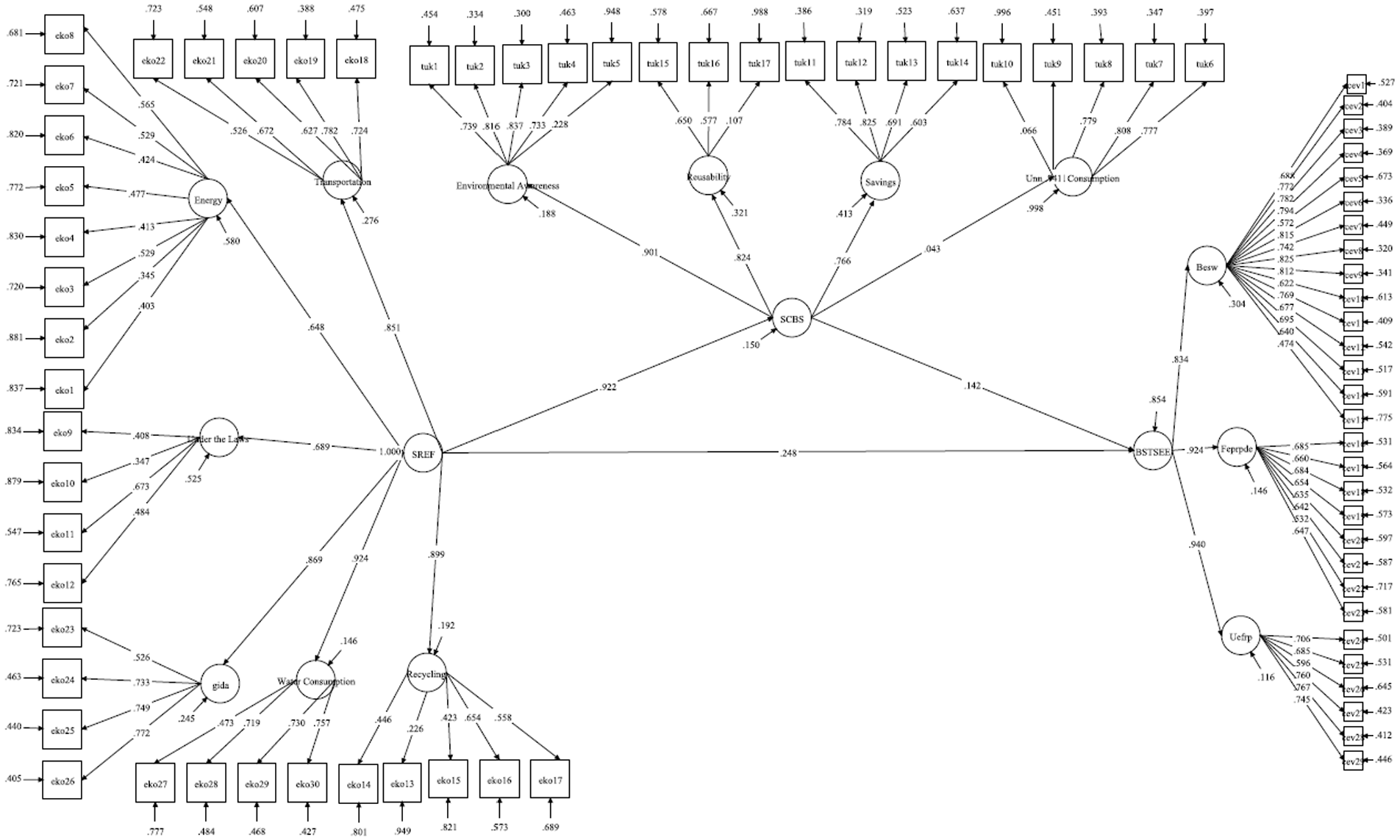
Structural equation modeling of the research.
According to the bootstrapping analysis, prospective teachers’ awareness of reducing ecological footprint positively and significantly predict their sustainable consumption behaviours (β = .922; p < .01) and their behaviours towards sustainable environmental education (β = .248; p < .01). It is also seen that sustainable consumption behaviours positively and significantly predict the behaviour towards sustainable environmental education (β = .142; p < .01) (Figure 2).
The direct, indirect, and total effects of the model and model fit values are presented in Table 4. According to Table 4, it is seen that the structural equation model yielded good fit indices (χ2/df = 2.92; RMSEA = .060, SRMR = .07, CFI = .92, TLI = .91), indicating that the hypothesised relationships between ecological footprint awareness, sustainable consumption behaviour, and sustainable environmental education behaviour are statistically supported. These fit values are consistent with commonly accepted thresholds in the SEM literature (Hu & Bentler, 1999).
Structural Equality Model Results.

The bootstrapping analysis revealed that prospective teachers’ awareness of reducing ecological footprint has a strong and statistically significant direct effect on sustainable consumption behaviours (β = .922; p < .01). This result underscores the critical role of ecological awareness in shaping environmentally responsible consumption habits, which has been emphasized in previous studies (Gökşan, 2023). Furthermore, awareness of reducing ecological footprint also significantly predicts behaviours towards sustainable environmental education (β = .248; p < .01), albeit with a smaller effect size, suggesting that while ecological footprint awareness is a key driver, its translation into sustainable environmental educational behaviour may be influenced by additional contextual factors (e.g., pedagogical, socio-cultural, and systemic). In addition, sustainable consumption behaviour was found to significantly predict sustainable environmental education behaviour (β = .142; p < .01). This finding supports the idea that environmentally responsible consumption can serve as a foundational habit that extends to broader pro-environmental behaviours, including educational initiatives (Zeng et al., 2023).
According to the results of the SEM analysis, the indirect effect of prospective teachers’ awareness of reducing their ecological footprint on their behaviour towards sustainable environmental education was positive but weak (β = .131; p < .01), indicating a partial mediation effect of sustainable consumption behaviour. This finding suggests that awareness alone does not fully translate into behaviour; rather, sustainable consumption practices act as a bridge in this transformation process. This is consistent with the findings of Zehui (2023) and Linder et al. (2021), who emphasized that pro-environmental behaviour often requires not only awareness but also actionable behavioural pathways, such as consumption habits, to be fully manifested in daily practice. In addition, the overall effect of ecological footprint awareness on pro-environmental behaviour was found to be statistically significant and moderate (β = .378; p < .01), suggesting that increasing awareness can contribute meaningfully to the development of sustainable environmental educational behaviour. This finding is supported by Birand’s (2016) study, which reveals a positive relationship between ecological footprint awareness and environmentally friendly behaviour.
Furthermore, ecological footprint awareness was found to explain 85% of the variance in sustainable consumption behaviour (R2 = .85), indicating an extremely strong predictive relationship. This is in line with Gökşan (2023) who reported that ecological awareness significantly affected sustainable consumption behaviour. Together with sustainable consumption behaviour, ecological footprint awareness explained 14.6% of the variance in sustainable environmental education behaviour (R2 = .146). Although this ratio seems relatively low, it shows that cognitive factors (awareness) and behavioural mediators (consumption behaviour) jointly contribute to changing behaviour towards sustainable environmental education (Balińska, 2022; Ullegaddi et al., 2023).
Conclusions and Discussion
This research examined the effects of prospective teachers’ awareness of reducing the ecological footprint on their sustainable consumption behaviour and their behaviour towards sustainable environmental education using structural equation modelling (SEM). The results of the research are as follows:
The results of the study revealed that prospective teachers have a high level of awareness regarding reducing ecological footprint (M = 3.86). This suggests that prospective teachers have a high level of awareness and sensitivity towards reducing their ecological impact and are aware of the importance of reducing their ecological footprint. The findings suggest that being in a higher education environment can encourage the development of greater ecological awareness, even among prospective teachers. This result is consistent with the study by DurmuşŞenyapar et al. (2024), which reported that academic titles significantly influence ecological footprint awareness, with the highest level of awareness observed among professors. However, Temizkan & Ceyhanlı (2020) found that prospective tourism teachers had low awareness of their ecological footprint and pointed to the influence of the different demographic characteristics (income levels and parents’ education levels) of the prospective teachers’ parents. Moreover, Güngör & Cevher-Kalburan (2022) emphasized that parental education levels significantly affect children’s ecological footprint awareness. This underscores that ecological awareness is not solely a product of formal education but may also be shaped by broader sociocultural factors, which could also influence prospective teachers’ baseline awareness when entering teacher education programs.
The results indicated that prospective teachers’ sustainable consumption behaviours were high (M = 3.41). This finding suggests that prospective teachers generally exhibit positive attitudes and practices towards sustainable consumption. On the other hand, Torkar (2021) states that prospective teachers’ perceptions of sustainable consumption are not sufficiently developed, that more effort should be made to strengthen this perception and that many prospective teachers prioritize convenience and practicality over sustainability when making choices. In a similar vein, Rioux et al. (2017) discovered that first-year student teachers demonstrated reduced levels of sustainable consumer behaviour in comparison to third-year students and university staff. This finding suggests that sustainable consumption behaviours may be strengthened as individuals progress through their educational journey and become more integrated into campus culture, which functions as a socialization environment for sustainability values. Furthermore, Guzmán Rincón et al. (2021) revealed that although Colombian consumers demonstrated environmental concern, economic factors served as a barrier to the adoption of sustainable consumption behaviours. This finding suggests that economic pressures have the capacity to compromise sustainable intentions, a factor that may also apply to prospective teachers despite their high awareness levels.
The results showed that prospective teachers’ behaviour towards sustainable environmental education was high (M = 3.76). This result reveals that prospective teachers generally demonstrate positive behaviours towards encouraging and supporting sustainable environmental education. Similar findings are frequently encountered in the literature, Demirci Güler (2013) found that academics exhibited high levels of sustainable environmental behaviour, supporting the idea that individuals in educational settings tend to develop strong environmental practices. In addition, Afacan (2020) reported that prospective science teachers exhibited high levels of sustainable environmental behaviour, supporting the current finding that prospective teachers tend to integrate sustainability principles into educational contexts. However, Gıcır et al. (2020) found that individuals from different generations (X, Y, and Z) showed moderate environmental behaviour, highlighting the need to accelerate and increase the efficiency of studies on education in line with the principle of sustainable lifelong learning.
According to the results obtained from the correlation analysis, it was determined that there is a moderately positive relationship between prospective teachers’ awareness of reducing the ecological footprint and their sustainable consumption behaviours. This result shows that increasing ecological awareness has a positive contribution to sustainable consumption behaviours. However, awareness alone may not always reflected in behaviours. Kırvanoğlu Altın & Kırçova (2024) found that awareness of environmental sustainability, including awareness of reducing ecological footprints, has a significant effect on sustainable consumption behaviour. High levels of awareness highlight the role of ecological consciousness in promoting sustainable consumption and increase the likelihood of individuals adopting sustainable practices. Similarly, the bootstrapping analysis showed a strong positive effect (β = .922) of ecological footprint awareness on sustainable consumption behaviors, suggesting that awareness is a critical driver of sustainable consumption habits. Despite the paucity of studies analogous to the research findings in the extant literature, it was determined that sustainable consumption behaviours and ecological footprint awareness had been examined separately (Ardoin et al., 2020; Çam & Menteşe, 2024; Demirkol & Aslan, 2021; Lavuri et al., 2023; Lee et al., 2015; Tong et al., 2023; Wang et al., 2023). Although few studies have directly examined this relationship, there are relevant findings in the literature. Gökşan (2023) determined that future physicians’ ecological footprint awareness had a strong effect on their sustainable consumption behaviors, aligning with the strong relationship found in this study. Furthermore, Yıldız et al. (2023) found that while health sciences students had high levels of ecological footprint awareness and environmental literacy, the relationship between these two variables was weak but positive, implying that other factors might mediate or moderate this relationship. Additionally, Kapucu et al. (2024) emphasized a positive correlation between university students’ sustainable development awareness and ecological footprint awareness, suggesting that broader sustainability consciousness strengthens environmentally responsible behaviours, including sustainable consumption.
The correlation analysis results revealed a moderate positive relationship between prospective teachers’ awareness of reducing the ecological footprint and their behaviours towards sustainable environmental education. In line with this result, it can be said that increasing awareness of the ecological footprint supports their behaviours towards sustainable environmental education. However, there may be limitations before this awareness is transformed into behaviour change. While awareness of the ecological footprint can guide sustainable behaviour, it may not always be sufficient. Some people may have a high level of awareness but engage in unsustainable practices due to various barriers, such as economic constraints or lack of access to sustainable options (İncedal Irgat et al., 2024). Studies show that students exposed to environmental education programmes have significantly higher levels of environmental awareness, a deeper commitment to sustainability, and greater participation in environmentally friendly activities than their peers without such exposure (Stergiou & Armakolas, 2022). Increasing the impact of education programs can transform awareness into behaviour more strongly. In addition in the bootstrapping analysis it was concluded that prospective teachers’ awareness of reducing ecological footprint positively and significantly predicted their behaviours towards sustainable environmental education. Although this relationship was determined with a lower β value (.248), it is possible to say that awareness of reducing ecological footprint significiantly predicts behaviours towards sustainable environmental education. This result suggests that awareness contributes to behaviour change processes, but different practices are needed for stronger and lasting effects. Although no direct study in the literature specifically examines this relationship, related research offers supportive evidence. Çetin et al. (2017) found that ecological footprint education practices aimed at sustainable living effectively changed students’ attitudes and behaviours towards environmental problems, indicating that increasing awareness can lead to more sustainable education-related behaviours. In parallel, Günşen (2023) found that activities carried out within the scope of environmental education significantly increased pre-school prospective teachers’ awareness of the ecological footprint and their interest in the environment. In addition, it suggested that education-based interventions could be effective in closing the gap between awareness and action. In addition, Engin et al. (2023) reported moderate positive relationships between teachers’ ecological footprint awareness and their environmentally friendly behaviors, as well as the implementation of eco-friendly activities in classrooms. Supporting these findings, Deniz Çakıroğlu (2023) emphasized that enhancing the ecological intelligence of young consumers increases their ecological footprint awareness, which in turn can foster environmentally responsible behaviors. These studies emphasize that raising awareness of the ecological footprints, particularly through well-structured educational programes, can lead to more positive and effective behaviour towards sustainable environmental education. The findings of the present study also support this.
In the correlation analysis, it was concluded that there was a high level of a positive relationship between prospective teachers’ sustainable consumption behaviours and their behaviours towards sustainable environmental education. In line with this result, it can be said that sustainable consumption habits can directly and strongly predict the behaviours towards sustainable environmental education. This strong relationship suggests that developing environmentally friendly consumption behaviours can play an critical role in exhibiting sustainable environmental behaviours and can be an effective tool in creating behavioural change. Researches have shown that sustainable consumption behaviour is closely related to sustainable environmental behaviour because it includes practices that minimize environmental impacts, such as waste reduction, recycling, and renewable energy use (Garbyal & Gupta, 2024). Similarly, in the bootstrapping analysis, it was concluded that prospective teachers’ sustainable consumption behaviours positively and significantly predict their behaviours towards sustainable environmental education. With a β value of .142, it is possible to conclude that the effect of this relationship is low but still noteworthy. In line with this result, it is possible to say that sustainable consumption habits can increase the effectiveness of sustainable environmental behaviours and play a triggering role in sustainable environmental behaviour change. In the literature, no studies examine the relationship between sustainable consumption behaviours and behaviours towards sustainable environmental education Al-Nuaimi & Al-Ghamdi (2022), emphasized that increased environmental knowledge through education significantly enhances pro-environmental attitudes, enabling individuals to engage in more sustainable consumption practices. They argue that education can create a virtuous cycle where pro-environmental attitudes foster sustainable behaviors, which in turn positively reinforce environmental education efforts. Furthermore, Zeng et al. (2023) observed that environmental knowledge and environmental risk perception are positively related to environmental concerns, which in turn are significantly related to pro-environmental behaviours. According to this finding, individuals’ awareness of environmental information and risks leads them to feel concerned about the environment. This concern, in turn, encourages them to engage in environmentally friendly behaviour. In other words, it can be said that information and awareness play an important role in increasing environmentally friendly behaviour.
The SEM analysis concluded that the indirect effect of prospective teachers’ awareness of reducing the ecological footprint on their behaviours towards sustainable environmental education was weak (β = .131) but positive and statistically significant. In line with this result, it can be interpreted that as prospective teachers’ awareness regarding reducing their ecological footprint increases, there is a gradual but positive change in their sustainable environmental education behaviours. Although the indirect effect was weak, the total effect of awareness on behaviour (β = .378) was found to be positive and moderately strong, indicating that awareness of reducing ecological footprint has a considerable influence on promoting sustainable environmental actions among prospective teachers.
Furthermore, it was revealed that the sustainable consumption behaviours of prospective teachers partially mediate the relationship between their awareness of reducing the ecological footprint and their sustainable environmental education behaviours. This mediating role suggests that sustainable consumption habits act as a bridge: awareness of ecological footprint alone may not directly translate into sustainable environmental behaviour change unless supported by sustainable consumption practices. In other words, prospective teachers’ awareness of reducing ecological footprint fosters sustainable consumption behaviours, which in turn reinforces their sustainable environmental education behaviours. This result is consistent with Birand’s (2016) study, which showed a positive relationship between environmentally friendly behaviour and ecological footprint awareness. It also shows that increased ecological awareness increases environmentally conscious behaviour.
The SEM model showed that prospective teachers’ awareness of reducing ecological footprint explained 85% of the variance in their sustainable consumption behaviours, demonstrating a very strong effective relationship. This result shows that ecological footprint awareness explains prospective teachers’ sustainable consumption behaviours to a large extent, that is, this level of awareness strongly determines whether prospective teachers consume sustainably or not. This implies that focusing on enhancing ecological footprint awareness could be an effective strategy for increasing prospective teachers’ sustainable consumption behaviours. Consumers with a high level of environmental awareness are more likely to participate in sustainable consumption practices because they acknowledge the environmental impact of their choices (Kırvanoğlu Altın & Kırçova, 2024). Frick et al. (2004) state that individuals’ awareness of the environmental consequences of their behaviour has an impact on their environmental behaviour. Accordingly, awareness of environmental impacts increases individuals’ tendency to translate this knowledge into environmentally sensitive behaviour. This highlights the potential for cognitive awareness to influence behaviour; therefore, individuals with a high level of ecological footprint awareness are more likely to make sustainable consumption choices consistent with this awareness. This is in line with Gökşan (2023), who reported that ecological awareness significantly affected sustainable consumption behaviour.
In addition, awareness of reducing the ecological footprint and sustainable consumption behaviours together explained 14.6% of the variance in sustainable environmental education behaviours. This result shows that ecological footprint awareness and sustainable consumption behaviour together explain prospective teachers’ sustainable environmental education behaviour in a meaningful way, albeit to a limited extent. This highlights the importance of addressing these two factors together to encourage prospective teachers’ behaviour towards sustainable environmental education. Although this rate is low, it underlines the importance of fostering intermediary variables like sustainable consumption to strengthen sustainable environmental behaviours. At this point, attention should be drawn to a phenomenon known as the attitude-behaviour gap in the literature (Kollmuss & Agyeman, 2002). Research emphasizes that although individuals may hold strong environmental attitudes and sustainability values, these attitudes do not always translate into corresponding behaviours. Various factors such as habits, emotional states, and cognitive processes (e.g., self-control and awareness) may inhibit the transformation of environmental attitudes into sustainable consumption practices (Şandor, 2024). Stern (2000) stated that environmental behaviour is influenced not only by attitudinal factors such as values and beliefs but also by individual abilities, contextual factors, and individuals’ routines and habits. Particularly, personal values are activated when an individual perceives that something they value is threatened by environmental conditions and believes they can take effective action to mitigate the threat. Aydın (2025) revealed that green consumption values have a strong and positive effect on green purchasing behaviour. It was also stated that social influence positively affects these behaviours, but the direct effects of prosocial attitudes and perceived behavioural control are limited. This inconsistency may explain the relatively weak indirect effect observed in this study. Previous research supports the interconnectedness of environmental awareness, consumption behaviour, and education. For instance, Kaiser et al. (1999) emphasized that ecological behaviour is closely tied to both knowledge and behavioural intention, and that interventions aimed at promoting pro-environmental behaviour must address both cognitive and behavioural aspects. Similarly, Otto & Pensini (2017) stated that environmental awareness is seen as a fundamental component of environmental education and a necessary prerequisite for ecological behaviour; however, he pointed out that this awareness has very little effect on actual behaviour.
A review of the existing literature reveals that there is a lack of studies that simultaneously examine the relationship between prospective teachers’ awareness of reducing their ecological footprint, sustainable consumption behaviours, and sustainable environmental education behaviours through a comprehensive statistical model such as SEM. This research, employing SEM, not only analyzes the direct and indirect relationships among these constructs but also elucidates the mediating role of sustainable consumption behaviours in the pathway from ecological footprint awareness to sustainable environmental education behaviours. This will provide a more detailed understanding of how awareness can be transformed into behavioural change for future educators, who will play an important role in developing sustainability awareness among younger generations.
Limitations
The results obtained from this study provide valuable information on the relationship between prospective teachers’ ecological footprint awareness, sustainable consumption behaviours, and sustainable environmental education behaviours. In addition, there are some limitations to the study.
First, the constructs of ecological footprint awareness, sustainable consumption behaviours, and sustainable environmental education behaviours were assessed using self-reported measures, which may be subject to response biases, such as inaccurate recall or social desirability. Second, the sample consisted solely of prospective teachers from three provinces in eastern Türkiye, which may limit the generalizability of the findings to other cultures, regions, or educational contexts. Third, although Structural Equation Modelling (SEM) was employed to explore the relationships between variables, the cross-sectional design of the study restricts the ability to infer causality. The absence of longitudinal data also prevents conclusions regarding the evolution of ecological footprint awareness on sustainable consumption behaviours and sustainable environmental education behaviours over time. Finally, the study did not examine external variables that influence prospective teachers’ ecological awareness, sustainable consumption behaviours and sustainable environmantal education behaviours. Socio-economic status, institutional policies, and cultural values may interact with prospective teachers’ levels of ecological awareness and play a role in shaping their environmental behaviour.
Recommendations
Future research could address these limitations by employing experimental designs or longitudinal to better establish causal relationships and assess behavioural changes over time. Expanding the sample to include individuals from diverse demographic backgrounds (e.g., in-service teachers, students at other educational levels, or participants from other countries and regions) would enhance generalizability. In addition, qualitative methods such as interviews or focus group discussions may help uncover underlying motivations, challenges, and contextual influences shaping sustainable behaviour. Researchers are encouraged to develop comprehensive models that examine the effects of socio-economic status, institutional policies, and cultural values on ecological awareness, sustainable consumption, and sustainable environmental education behaviours.
Footnotes
Acknowledgements
None.

Ethical Considerations
This study was approved by the Ethics Committee of Fırat University Social and Human Sciences Research (Approval No: 2024/03) on 01 February 2024.
Author Contributions
Authors contributed to the study conception and design. Method, material preparation, data collection, data analysis and results was performed by [Ayten ARSLAN] and introduction, conceptual framework, discussion and recommendation was performed by [Esen DURMUŞ]. The first draft of the manuscript was written by [Ayten ARSLAN] and all authors commented on previous versions of the manuscript. All authors read and approved the final manuscript.
Funding
The author(s) received no financial support for the research, authorship, and/or publication of this article.
Declaration of Conflicting Interests
The author(s) declared no potential conflicts of interest with respect to the research, authorship, and/or publication of this article.
Data Availability Statement
Data sharing not applicable to this article as no data sets were generated or analyzed during the current study.