




Abstract
Young consumers are the stylish shoppers who have a strong tendency to follow the latest fashion. With the rapid changes in the fashion trends, the overconsumption of clothing has had a significant environmental impact on society. Hence, there is a need to understand how young fashionable consumers are disposing their unwanted clothes. The survey was conducted among 205 young respondents, and the results show that clothing disposal behavior is affected by philanthropic awareness and mediated by the attitude toward clothing disposal. Interestingly, environmental economic factors only influence clothing disposal behavior through the attitude toward the disposal of clothing. The findings provide a valuable insight into the government and related authorities or organizations in developing strategies to encourage young consumers to increase their clothing-recycling rate, and, thus, eliminate the environmental issues in near future.
Keywords
Introduction
With the growing affluent lifestyle and purchasing power, the fast-fashion trend in which fashion styles become quickly obsolete has escalated and is aggravating the phenomena of the throwaway culture. Unused clothes are being discarded as waste, which is causing harm to the environment. Hence, there is a need to study consumers’ clothing disposal behavior. Clothing disposition practice is defined by Chun (1987) as “discontinued wear and disposal of a clothing item by giving it to others, throwing it away, using it for another purpose than wearing apparel, or selling it at used clothing stores or garage sale” (p. 7).
“Here today, gone tomorrow” is the strategic view of the current fast-fashion retailers to increase the store visitation rate with customers disposing of their clothes more frequently, and increasing their revenue (Bhardwaj & Fairhurst, 2010). Many famous fashion retailers produce new apparel lines every 2 to 3 weeks with very low prices. This strategy stimulates the consumer’s impulse to purchase (Foroohar & Stabe, 2005). As a result, trendy young consumers, who wish to keep up with latest fashion trends, will purchase any garment that has been launched. This results in excessive clothing consumption, and, hence, the overconsumption rate will lead to the disposal of superfluous clothing. Therefore, as the phenomenon of fast fashion is growing rapidly, there is concern regarding the methods used by these young consumers to dispose of their seasoned clothing, as the constant change in fashion leads to over clothing consumption and the underutilization of some clothes, which will only be worn a few times (Birtwistle & Moore, 2007).
As many of the consumers are still unaware of the sustainable consumption and disposal methods, the ineffective disposal of textiles is now becoming an increasingly serious problem in many parts of the world (Birtwistle & Moore, 2007; Young Lee, Halter, Johnson, & Ju, 2013). Research shows that high volumes of waste textiles are ending up in landfill sites every year, which produce high levels of pollution and present chemical dangers in the form of emissions, pesticides, and dye waste (Treloar, Crawford, Treloar, Thomas, & Burry, 2003). This has become an environmental issue that needs to be addressed urgently. However, the practice of sustainable fashion development is limited, especially in developing countries, such as Malaysia.
In Malaysia, the National Solid Waste Management Department (NSWMD) found that Malaysia is producing an estimated 8.4 million tons of waste per year. From the 10th Waste Management Conference and Exhibition in 2012, the Minister of Natural Resources and Environment estimated that Peninsular Malaysia alone generates 25,000 metric tons of municipal solid waste daily (YB Dato Sri Douglas Uggah Embas, 2012). Textile waste constitutes 4% of the total waste, which is equivalent to about 1,000 metric tons of textile waste per day and the number is continuously increasing (Fauziah & Agamuthu, 2013).
As a consequence, the landfill problems are becoming more serious because the synthetic materials found in some of the clothing decompose slowly. The decomposition of woolen garments produces methane, which contributes to global warming (Waste Online, 2006). In Malaysia, although more than 60% of current wastes are recyclable (Fauziah & Agamuthu, 2010; Saeed, Hassan, & Mujeebu, 2009), 95% of generated wastes are still sent to landfills for disposal (Fauziah & Agamuthu, 2013). Hence, to create a more sustainable future, the attitude of consumers toward sustainable fashion and their clothing disposal behavior need to be studied on an urgent basis.
The rationale for undertaking this research is that the efforts to preserve the environment can only be realized if the citizens are well informed, and are aware of and fully committed to improving the quality of the environment. Based on this motivation, the main research objective is to gain knowledge concerning the consumers’ attitude toward sustainable fashion and to investigate the clothing disposal behavior among young consumers in Malaysia. This study examines the factors that influence the consumers’ attitude toward sustainable fashion and clothing disposal behavior from two angles—environmental economics factor and philanthropic awareness factor. These two factors are among the most important factors for determining clothing disposal behavior—the environmental economics factor measures the consumer’s awareness of environmental issues in clothing disposition practices whereas the philanthropic awareness factor measures the consumer’s altruism in clothing disposal practices and their willingness to help the needy.
Literature Review
Sustainable issues in fashion are not a new concept in research and industry. During the 1970s and 1980s, marketing scholars undertook extensive research regarding the effect of environmental issues on consumer behavior (Anderson & Cunningham, 1972; Doane, 2001). The issue has received intensive discussion later and one of the main topics for discussion was sustainable consumption (Jackson, 2004), which is defined as “consumption that supports the ability of current and future generations to meet their material and other needs, without causing irreversible damage to the environment or loss of function in natural systems” (Jackson & Michaelis, 2003, p. 14).
According to Shim (1995), there is general consensus that the consumption process comprises three stages—acquisition, consumption, and disposition. Similarly, Jacoby, Berning, and Dietvorst (1977) explained that prepurchase, purchase, and postpurchase components are the elements that form the complete consumption process. The three stages are significantly and equally important to achieve sustainable consumption phrase. However, previous scholars were more concerned about the decision-making process pertaining to the product acquisition and consumption stages (Lin & Chang, 2013); little was known about the product disposition stage (Ha-Brookshire & Hodges, 2009). Hence, this study is mainly focused on the consumer attitude and behavior during clothing disposition stage.
Research on the product disposal stage has to be approached with caution as previous research on the general recycling behavior was found to differ from clothing-recycling behavior (Laitala, 2014; Shim, 1995). There are two types of clothing differentiation: absolute and relative obsolescence (Cooper, 2004). Absolute applies to clothing that is no longer usable; whereas, relative obsolescence refers to clothing that is still functional but is disposed of for some other reason. This study will focus on relative obsolescence to examine the fast-fashion clothing disposal behavior.
In general, previous studies concerning clothing disposal provided positive results in that consumers tended to reuse or recycle their unwanted clothing instead of binning them (e.g., Birtwistle & Moore, 2007; Domina & Koch, 1999; Ha-Brookshire & Hodges, 2009). A review of recent studies concerning clothing disposal showed that the focus was on four main issues: (a) disposal methods (Bianchi & Birtwistle, 2012; Ekström & Salomonson, 2014; Meyer, 2014), (b) motivations in disposal channel selection (Joung & Park-Poaps, 2013; Koukouvinos, 2012; Lee, Halter, Johnson, & Ju, 2013), (c) reasons for disposal (Laitala & Boks, 2012), and (d) the demographics of consumers practicing clothing disposal (Ekström & Salomonson, 2014; Joung, 2013; Lang, Armstrong, & Brannon, 2013). This study focuses on the factors that influence consumers in sustainable clothing disposal behavior, which will be discussed in the next section.
Clothing Disposal Behavior
A consumer’s disposition behavior is explained as the consumer’s behavior and decision making during his or her unused product disposition stage. Laitala (2014) defined disposal as “the act of getting rid of something, i.e. the end of life stage of the clothing with the present owner, regardless of whether the clothing is discarded of as waste or delivered to recycling or reuse” (p. 444). The product disposition stage has received more attention from scholars since Jacoby et al. (1977) developed a conceptual framework on the consumer’s disposition behavior, called Disposition Decision Taxonomy. According to Jacoby’s Disposition Decision Taxonomy, the consumer’s disposition behavior can be categorized into three categories: (a) keep the product, (b) permanent disposal, and (c) temporary disposal. This has become a key research topic for some researchers (Birtwistle & Moore, 2007; Domina & Koch, 1999; Hiller, 2010; Shim, 1995).
Based on their studies, there are several ways for consumers to dispose of their clothing—donation to charity, give away to family or friends, resell it, or discard in rubbish bins. Specifically, donation to charities and give away to family and friends are the most common methods for sustainable clothing disposal (Birtwistle & Moore, 2007; Hiller, 2010). These two methods save a lot of cost in the disposal process and benefit the needy. Some disposal methods, such as reuse and redesign, help to prolong the life of the clothing.
According to Shim (1995), consumers with a proenvironmental sense tend to dispose of their unwanted clothing in a sustainable way to reduce environmental issues arising from the ineffective disposal of the clothing. In addition, the donation of used garments to developing countries for charity purposes is a usual option for disposal by developed countries such as the United States, while superior-quality garments are sold to secondhand garment shops (Fletcher, 2013). Clothing redesign is also found to be a main disposal method and some recyclers prefer to reuse or redesign their old clothes, instead of converting them into rags (Domina & Koch, 1999). However, due to the differences across the countries in terms of culture and industrialization, the main influential factors for the clothing disposal methods by consumers in Malaysia remain unsolved. Hence, this study aims to shed some insight into the factors that affect the clothing disposal behavior among young consumers in Malaysia.
Environmental Economics Factor
The environmental economics factor is a measure of the consumer’s attitude on environmental consequences on economic activities (Hanley, Shogren, & White, 2013). It is a combination of a consumer’s environmental and economic sense in the decision-making process. Research shows that concern and public awareness regarding environmental issues have been growing since the 1970s (Anderson & Cunningham, 1972), and that the recycling rate is on the rise due to increasing awareness concerning environmental issues. A previous study by Morgan and Birtwistle (2009) found that consumer awareness of the environment is significantly positive with clothing disposal behavior. This result explained that consumers who are concerned about environmental issues would make an effort to dispose of their used clothes through environment-friendly methods. However, despite the many campaigns promoting environmental issues in society, the consequences to the environment because of ineffective clothing disposal behavior are still not adequately understood by consumers. Some consumers discard their unwanted clothes in dustbins because they do not understand that this irresponsible behavior has a direct effect on their everyday life. In addition, many studies found a weak relationship between environmental attitudes and environmentally responsible behavior (Kim & Damhorst, 1998).
Next, the environmental economic factor consists of the economic value that the consumer places on the decision-making process. Studies reveal that some U.S. students tend to resell their unwanted clothing to gain economic value and money (Shim, 1995). Selling unwanted but reusable textiles to merchants provides a potential source of revenue while reducing the cost of waste disposal and helps to protect the environment.
Previous research demonstrated that Malaysians are less likely to participate in green activities, especially in recycling activities although they are aware of the environmental degradation issue in Malaysia (Lim, 2012). Therefore, the aim of this study is to determine the relationship between the environmental economic factor and clothing disposal behavior among young consumers in Malaysia, because the previous literature, which was related to environmental economic influences, did not draw any conclusions, and there is still a lot of uncertainty concerning the environmental economic factor in influencing clothing disposal behavior. The following hypotheses are posited:
Philanthropic Awareness Factor
Philanthropy is defined as “a social relation governed by a moral obligation that matches a supply of private resources to a demand of unfulfilled needs and desires that are communicated by entreaty” (Schervish, 1998, p. 600). Studies indicated that consumers who present philanthropic awareness and intend to contribute to charities would donate their unused clothing to charities. A study by Shim (1995) also found that charity-motivated donations have a significant influence on the U.S. consumer clothing disposal behavior. Based on these previous studies, helping the needy will make the consumers feel better (Shim, 1995). A study conducted in the United States stated that altruistic concern (helping others) is the primary motivation for donations among consumers (Joung & Park-Poaps, 2013).
There are many charity houses in Malaysia that provide the service of recycling used garments to the public and they also provide a door-to-door pick-up service to collect the used items, whereas other charity houses place collection boxes at certain locations, usually near housing areas or shopping malls to dispose of or recycle used items. These services make it more convenient for the consumers compared with them having to take the used items to the charity house.
The research by Campbell, Gulas, and Gruca (1999) showed that personal attitude positively influences the giving behavior. In addition, Joung’s study in the United States found that concerns about charity influence and motivate donation behavior and the convenience of the discarding behavior (Joung & Park-Poaps, 2013). As most of the research relating to philanthropic awareness and its influence on clothing disposal behavior was conducted in developed countries, this study aims to identify the relationship between philanthropic awareness and clothing disposal behavior in Malaysia. Therefore, the third and fourth hypotheses are as follows:
Attitude Toward Clothing Disposal
Past research showed that the attitudinal factor affects the recycling behavior. Research also found that the convenience factor, acceptance of recycling activities, perception of the benefits and problems of recycling influence consumers’ attitude and behavior toward recycling (Barr, Ford, & Gilg, 2003). The research by Tang, Chen, and Luo (2011) stated that attitude toward recycling significantly influences the recycling behavior. The recycling behavior is found to be very much dependent on the convenience of the recycling drop-off sites; recyclers tend to recycle more if they are familiar with the drop-off sites (Sidique, Lupi, & Joshi, 2010). Inconvenience and time constraints are the major barriers to recycling activities and are related to the level of change required in the existing behaviors to participate within a particular recycling scheme. This moves the concrete concept of sustainable clothing disposal intention to a more abstract concept in which the attitudinal factor mediates the clothing disposal behavior from the environmental economic and the philanthropic perspectives. This suggests the provision of specific goals in future efforts to educate consumers in sustainable clothing disposal by determining the consumers’ attitude toward clothing disposal. Past research concerning the attitude-behavior gap is inconclusive; hence, based on the previous literature, the following hypotheses have been developed:
Based on literature reviews, a research framework is developed as shown in Figure 1.

Research framework.
Method
The unit of analysis (sample) of this study comprised individuals aged 18 to 30 years old in Malaysia. The instrument used was a self-administered questionnaire. The data were collected through the nonprobability convenience sampling method using online social media based on researcher and respondent’s convenience. More than 400 questionnaires were linked to the Facebook accounts of the individuals, but only 205 questionnaires were usable, with a response rate of 51.25%. The usable questionnaires recorded in this study meet the rule of thumb where the minimum number of respondents is 10-to-1 ratio of the number of latent variables to be tested.
SmartPLS 2.0 software was used to evaluate the relationship among the constructs of the research model by conducting partial least square (PLS) analysis. The analysis was analyzed by following the guidelines of Hair, Hult, Ringle, and Sarstedt (2013) in reporting the Partial Least Square- Structural Equation Modeling (PLS-SEM) approach.
Scale of Measurements
The measurement items used for the questionnaire were identified from previous literature. The environmental economic factor was adapted from Shim (1995) to measure the consumer’s awareness on environmental and economic factors. Next, items of philanthropic awareness factor were also adapted from previous research (Campbell et al., 1999; File & Prince, 1998; Shim, 1995). This section is aims to measure the consumer sense of philanthropy in implementing charity works. The measurement items of attitude toward clothing disposal were adapted from Shim (1995) and Tang et al. (2011) to measure the consumer attitudinal factor which might affects their clothing disposal behavior. Last but not least, the items for clothing disposal construct were adapted from Shim to measure consumer’s actual behavior in clothing disposal. The questionnaires were measured using 5-point Likert-type scale, ranging from 1 (strongly disagree) to 5 (strongly agree). Table 1 indicates the source and validity of the scale items, which shows all alpha coefficient with value above .7.
Instrument and Sources Validity.

Results
Respondent Profiles
A total of 205 usable questionnaires were gathered from young consumers aged between 18 and 30 years old in Malaysia. There were no missing data in the responses as data collection was undertaken through an online survey. Of the 205 respondents, 179 respondents (87.3%) were aged 18 to 24 years old, followed by 26 respondents (12.7%) aged 25 to 30 years old. A total of 83 respondents (40.5%) were male and 122 respondents (59.5%) were female. The education level of the respondents was high with 44.9% (92 respondents) holding a bachelor’s degree. Thirty-one respondents (15.1%) were Malaysian Certificate of Education (SPM) leavers, 75 respondents (36.6%) completed the Malaysian Higher School Certificate (STPM)/matriculation/diploma or equivalent, and seven respondents (3.4%) held a master’s degree. In terms of employment status, 153 respondents (74.6%) were students, 39 respondents (19.0%) were employed, five respondents (2.4%) were self-employed, and eight respondents (3.9%) were currently unemployed. With respect to personal income, 161 respondents (78.5%) earned less than RM1,500 per month; 26 respondents (12.7%) earned an income in the range of RM1,501 to RM3,000 per month; 14 respondents (6.8%) earned RM3,001 to RM5,000; and four respondents earned an income above RM5,000 per month.
A further profiling of the respondents showed that 106 respondents (51.7%) reused their unwanted clothes for other purposes, 10.2% (21 respondents) redesigned their unwanted clothes, and 21 respondents (10.2) sold their unwanted clothes. The two most popular clothing disposal behaviors among the 205 respondents were as follows: 163 respondents (79.5%) liked to donate their unwanted clothes to charity houses and 162 respondents (79.0%) gave their unwanted clothes to others. The clothing disposal behavior of the respondents is shown in Table 2.
Respondents’ Clothing Disposal Behavior.

Measurement Model
This section shows the confirmatory factor analysis (CFA). The measurement model with reflective indicators was modeled using SmartPLS (Ringle, Wende, & Will, 2005). The measurement model was evaluated by examining the reliability of the individual items, internal consistency or construct reliability, average variance extracted analysis, and discriminant validity. A measurement model has satisfactory internal consistency reliability when the composite reliability (CR) of each construct exceeds the threshold value of .7.
The indicator reliability of the measurement model is measured by examining the items loadings. A measurement model is said to have a satisfactory indicator reliability when the loading of each item is at least .7 and is significant at least at the level of .05. Based on the analysis, all the items in the measurement model exhibited loadings that exceed .694, ranging from a lower bound of .694 to an upper bound of .918. All the items are significant at the .01 level. Table 3 shows the loading for each item. Based on the results, all the items used for this study have demonstrated satisfactory indicator reliability.
Measurement Model.
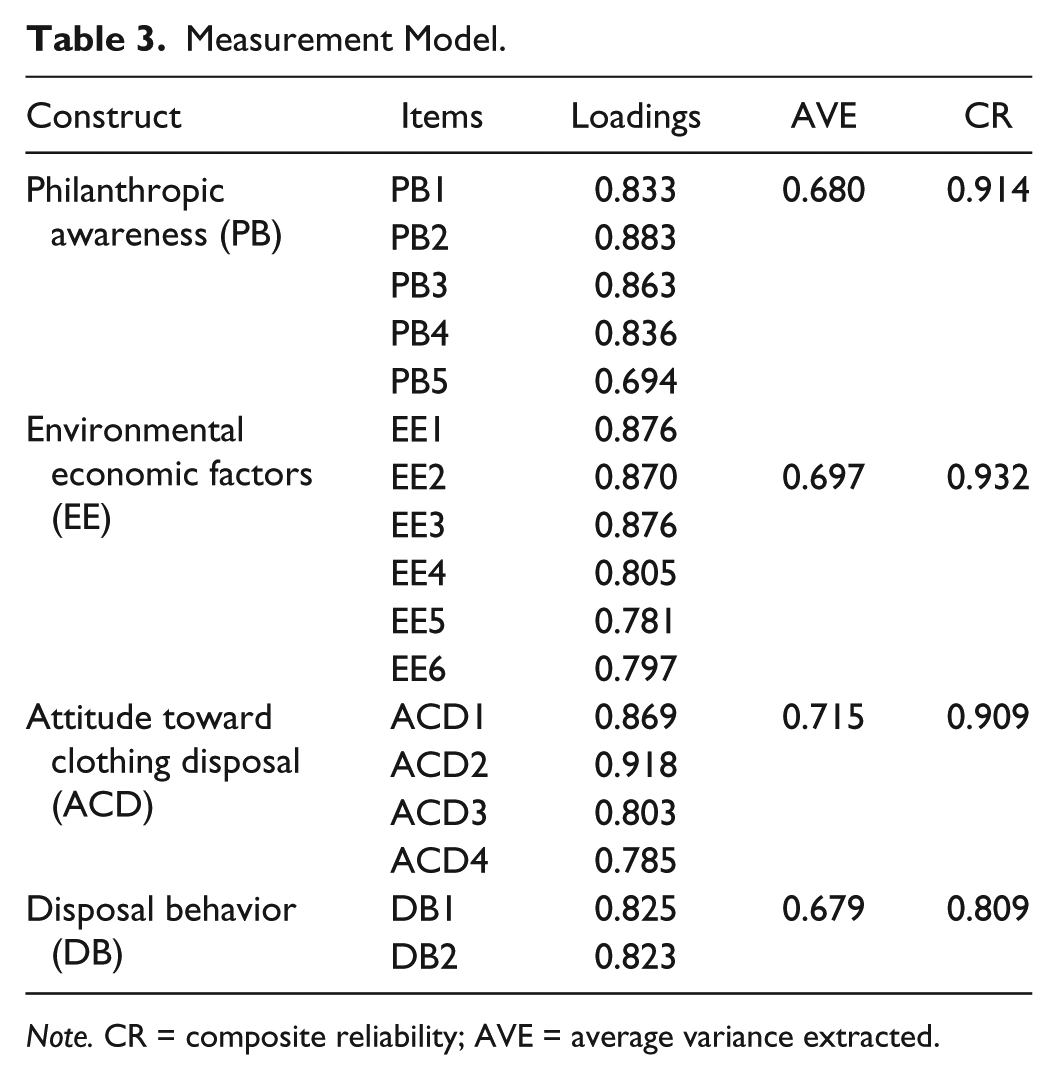
Note. CR = composite reliability; AVE = average variance extracted.
Discriminant Validity
In this study, the measurement model’s discriminant validity is assessed by the Fornell and Larcker (1981) criterion. A measurement model has discriminant validity when the square root of the AVE exceeds the correlations between the measure and all other measures. Thus, to determine the first assessment of the measurement model’s discriminant validity, the AVE value of each construct is generated using the SmartPLS algorithm function. Then, the square roots of the AVE are calculated manually. Based on the results, all the square roots of the AVE exceeded the off-diagonal elements in their corresponding row and column. The bolded elements in Table 4 represent the square roots of the AVE and the nonbolded values represent the intercorrelation value between the constructs. Based on Table 4, all the off-diagonal elements are lower than the square roots of the AVE (bolded on the diagonal). Hence, the results confirmed that the Fornell and Larcker’s criterion is met.
Discriminant Validity.

Note. Values in the diagonal (bolded) are the square roots of the average variance extracted (AVE) while the off-diagonals are correlations.
Overall, the reliability and validity tests conducted on the measurement model are satisfactory. All the reliability and validity tests are confirmed where all indicators that are used in the measurement model for this study is valid and fit to be used to estimate the parameters in the structural model.
In addition, standardized root mean square residual (SRMR) was run to test the model fit. Although there are many measures of model fit, the only one which is available in SmartPLS is the SRMR. The SRMR is an absolute measure of fit and is defined as the standardized difference between the observed correlation and the predicted correlation. A value less than .08 is generally considered a good fit (Hu & Bentler, 1999). We calculated the SRMR value for our model and the SRMR was .071 indicating that the model has a considerably good fit.
Structural Model
The following subsections discuss the tests used to assess the validity of the structural model for this study. The validity of the structural model is assessed using the coefficient of determination (R2) and path coefficients. In addition, this study also assesses the mediation relationships that are being proposed in the research model.
Coefficient of determination (R2)
The beta value indicates the amount of variance in the dependent variables that is explained by the independent variables. Thus, a larger R2 value increases the predictive ability of the structural model. In this study, the SmartPLS algorithm function is used to obtain the R2 values, while the SmartPLS bootstrapping function is used to generate the t-statistics values. For this study, the bootstrapping function generated 500 samples from 205 cases. The results of the structural model are presented in Figure 2.

Measurement model.
From Table 5, the relationship between the Environmental Economic Factors → Attitude Toward Disposal (β = .346, p < .01), and Philanthropic Awareness → Attitude Toward Disposal (β = .344, p < .01) were positively related to attitude toward disposal with an R2 of .254 indicating that 25.4% of the variance in attitude can be explained by the two constructs. Hence, H1 and H3 are supported. Attitude Toward Disposal → Clothing Disposal Behavior (β = .236, p < .01), Philanthropic Awareness → Clothing Disposal Behavior (β = .561, p < .01) were positively related to clothing disposal behavior, whereas Environmental Economic Factors → Clothing Disposal Behavior (β = .044, p > .01) was not significant. All these three variables showed an R2 of .481 indicating that 48.1% of the variance in the clothing disposal behavior can be explained by these three constructs. Thus, H1, H3, H4, and H5 were supported, whereas H2 was not supported.
Path Coefficient.

p < .05. **p < .01.
Next, we ran a bootstrapping procedure with 500 resamples and calculated the standard errors. The calculation led to the results as presented in Table 5. The bootstrapping analysis showed that the indirect effect of β = .082 was significant with a t value of 3.386 and that the second indirect effect of .081 was also significant with a t value of 3.255. In addition, as indicated by Preacher and Hayes (2008), the indirect effect of .082, 95% boot confidence interval (CI): [.034, .129], and .081, 95% boot CI: [.032, .130], do not straddle a 0 in between indicating that there is mediation. Thus, we can conclude that the mediation effect is statistically significant, thus supporting H6 and H7.
Discussion
In this article, we identified that the specific drivers for the clothing disposal methods preferred by the respondents are donation to charity houses (79.5%) and give away to others (79%). This indicated that philanthropic factors are the most preferred clothing disposal option of young consumers in Malaysia. According to respondents, they often donate their unwanted clothing to orphanage homes or nongovernment organizations (NGOs) who provide drop-off recycling bin and doorstep collection service. However, some respondents prefer to give their unwanted clothing to families and friends. In general, the sustainable clothing disposal behavior among young consumers in Malaysia shows a satisfactory stage. However, more specific motivational factors should be identified to investigate the consumers’ attitude and behavior on clothing disposition practices.
The influential factors of sustainable clothing disposal are important to build a sustainable environment. The results from structural modeling indicated that philanthropic awareness positively influences clothing disposal behavior, which supports H2. This result is in line with previous literature, which showed that charity factors have a positive influence on clothing disposal behavior (Birtwistle & Moore, 2007; Joung & Park-Poaps, 2013; Shim, 1995). Similarly, Bianchi and Birtwistle (2012) stated that clothing disposal methods are more related to helping others or sharing valuable belongings rather than recycling behavior. This study establishes that philanthropic awareness affects attitude toward clothing disposal, and, hence, influences clothing disposal behavior. In this study, the respondents agreed that the donation of clothes brings enjoyment to people and that it is important to donate unwanted clothes to help the needy. The philanthropic action is motivated by plenty of clothing donation activities organized by NGOs and some drop-off recycling centers in Malaysia, and the collected clothing will be donated to charity houses and the needy. Therefore, the authorities should promote effective clothing disposal methods by focusing on philanthropic awareness to educate more consumers about the benefits of clothing donation, as more than 79% of the respondents reported that they often give away their unwanted clothes to others or donate them to charity houses. Charity is perceived to be an important way of preserving our community values and is considered to be the responsibility of a good citizen, as the authorities in Malaysia are intensively promoting charity awareness. It is worthy to note that philanthropy value significantly influences an individual’s attitude and behavior to sustainable conduct. Thus, authorities could add in philanthropic element in the promotional materials related to sustainable practices, such as clothing donation or recycling.
Next, the environmental economic factor influences the attitude toward clothing disposal but does not directly influence clothing disposal behavior. This finding explains that the environmental economic factor will not directly affect an individual’s disposal behavior, but when an individual has a positive attitude toward clothing disposal, they will behave accordingly and dispose of their unwanted clothing in sustainable ways. The result is consistent with the previous research by Shim (1995), which indicated that environmental attitude is an influential factor of clothing disposal. This could be because consumers who are aware of environmental issues are not necessarily willing to embrace a sustainable fashion; the essence of effective clothing disposal behavior is the consumers’ attitude toward clothing disposal (Birtwistle & Moore, 2007; Kim & Damhorst, 1998). Therefore, to build up effective clothing disposal behavior, we must first cultivate a positive attitude toward clothing disposal. Before an effective method for clothing disposal is developed, consumers must understand that incorrect methods could have adverse consequences on the environment. It suggests that related authorities should organize more educational program to build the consumer positive attitude toward clothing disposal, and thus to increase the sustainable disposal rate.
Through this study, we can conclude that one’s attitude toward clothing disposal, which is a cognitive aspect of environmentalism, acts as a mediating factor for the disposal of clothing. This finding is in line with previous research, which indicates that consumers’ acceptance of recycling activities and their perception of the benefits and problems of recycling affect their clothing disposal behavior (Sidique et al., 2010; Barr et al., 2003). The attitudinal factor influences recycling behavior as consumers are more likely to recycle if the recycling options are to their convenience. The recycling rate is low as some of the consumers perceived recycling as a time-consuming behavior and unbeneficial. Hence, consumers need to be educated so that they can develop sensitivity toward environmentalism and the benefits of philanthropy as well as the consequences of incorrect disposal rather than just be encouraged to recycle. Moreover, authorities should provide more recycling facilities for consumers to encourage their sustainable clothing-recycle behavior.
Implications and Recommendations
This study brings some valuable theoretical contributions regarding the clothing disposal phenomenon in Malaysia, which is currently under research. In addition, this study included a new measurement factor—philanthropic awareness—as previous scholars stated that philanthropy is the more important factor in influencing clothing disposal behavior rather than the environmental factor (Ekström & Salomonson, 2014); however, little attention has been given to the philanthropic motivation of disposal. This study provides some important insights to the authorities and practitioners regarding the influential factors of clothing disposal behavior. The implications of this study can be examined from a managerial perspective to form an effective strategy to encourage an increase in the clothing-recycling rate among young consumers in Malaysia. From this study, we can conclude that charity factors have a strong positive relationship to attitude toward clothing disposal and clothing disposal behavior; whereas, the environmental economic factor directly influences the attitude toward clothing disposal but does not directly affect the clothing disposal behavior. To increase the clothing-recycling rate, the authorities should focus on these two factors as a means to motivate consumers to dispose of their unwanted garments effectively.
The basic barriers that have stopped respondents from recycling their unwanted clothing are the lack of awareness of effective clothing disposal methods, the nonavailability of effective clothing-recycling methods, and the perception of consumers toward sustainable fashion and clothing recycling. These barriers can be overcome by promoting the benefits of and methods for the effective disposal of unwanted clothing. In addition, this effort should be undertaken with the collaboration of the government, NGOs, environmentalists, and the community. An effective clothing disposal method and channel should be established to promote a high clothing-recycling rate.
In addition, some consumers do not know how to recycle. Hence, the knowledge and understanding of an effective clothing disposal method is important to increase the recycling rate. For instance, the authorities should educate consumers about the recyclable and nonrecyclable items. In addition, consumers should be made aware of where, how, and when to recycle. Therefore, the essence of having effective clothing disposal behavior is to educate consumers concerning the right attitude toward clothing disposal. The cognitive aspect of clothing disposal is important to enhance a sustainable fashion. Consumers must have the proper attitude and motivation to recycle to establish a recycling routine. In the long run, this approach may have a more positive impact on the development of a future sustainable fashion.
An effective clothing disposal method and channel should be established to promote an increase in the clothing-recycling rate. It was suggested that more clothing collection points, such as home collection services, recycle box, drop-off and pick-up services, will encourage an increase in the clothing-recycling rate. According to a research by Denton (2012), 84% of the not-committed recyclers strongly agreed or agreed that a reminder would motivate them to recycle more. Therefore, recycling service providers can provide an option for their customers to sign up for regular electronic reminders to inform them about any related recycling activities. This would be an effective way to encourage a regular recycling routine. Furthermore, the authorities should promote the concept of sustainable fashion to young consumers to increase their awareness of sustainable fashion so that consumers can lengthen the lifetime of their clothing and be knowledgeable about the effective clothing disposal methods. In addition, both the manufacturer and retailer are responsible for furthering sustainability in the fashion industry (Hill & Lee, 2012). The concept of sustainable fashion should start from the clothing manufacturers, as some fabrics cannot be recycled. If the manufacturers are aware of recyclable fabrics, it makes clothing disposal easier and more effective. Manufacturers are encouraged to use eco-friendly fabrics in producing their clothing (Caniato, Caridi, Crippa, & Moretto, 2012; Turker & Altuntas, 2014).
Conclusion
The growth in fast-fashion retailing has led to the disposal and destruction of large volumes of clothing. To protect the environment, consumers must take responsible decisions to practice a sustainable method for clothing disposal. Consumers dispose of unwanted clothing in different ways based on the different motivational factors. The results of this study indicated that attitude toward disposal and philanthropic awareness strongly influence the clothing disposal behavior. In simple words, consumers’ clothing disposal behavior is motivated by attitudinal factors pertaining to charity issues. The findings show some differences to research from other countries in that Malaysian consumers are not widely exposed to environmental concerns. Hence, authorities should treat this issue urgently while dealing with the environmental problems in Malaysia. This research showed that the basic barriers that stopped consumers from recycling their unwanted clothes are the lack of awareness of sustainable fashion and the knowledge of how and where to dispose of their unwanted clothes. Despite the useful findings, this study has its own limitations as it only concentrates on young consumers; therefore, it cannot be generalized to the whole of Malaysia. We suggest that future research should examine other factors that influence clothing disposal behavior and expand the research model so that it could be generalized to a wider population.
Footnotes
Declaration of Conflicting Interests
The author(s) declared no potential conflicts of interest with respect to the research, authorship, and/or publication of this article.
Funding
The author(s) disclosed receipt of the following financial support for the research and/or authorship of this article: The authors thank Universiti Sains Malaysia for funding this research under the Research University Grant 1001/PMGT/816203.