




Abstract
As artificial intelligence continues to evolve, its application in the realm of design through Artificial Intelligence Generated Content (AIGC) has seen a marked increase. However, limited research exists on the effects of technostress and task-technology fit on designers’ sustained usage intentions toward AIGC. This study aims to identify key factors influencing designers’ continuous intention to use AIGC. It integrates the Unified Theory of Acceptance and Use of Technology (UTAUT) with the Task-Technology Fit (TTF) model and introduces technostress as a moderating variable. A theoretical framework was constructed to explain the continuous intention of using AIGC among designers. The research utilized a stratified purposive sampling method to enlist participants, gathering data from 443 design students and professional designers in China. Data were analyzed using structural equation modeling. The results reveal that: (a) designers’ performance expectancy from AIGC has a strong positive effect on continuous intention; (b) both technology and task characteristics substantially enhance task-technology fit, which in turn indirectly augments continued intention via user satisfaction; (c) an interaction between UTAUT and TTF models enhances performance expectancy through task-technology fit; (d) technostress negatively moderates the impact of performance and effort expectancy, along with social influence and user satisfaction, on continuous intention. These results provide actionable insights for the design industry to facilitate the effective and durable adoption of AIGC. Additionally, the study offers strategic recommendations for AIGC developers and managers to optimize user experience and sustain user engagement.
Plain Language Summary
Artificial Intelligence (AI) is becoming more common in the design world, especially through tools that generate content automatically, known as AI-generated content (AIGC). While these tools can be powerful, it is important to understand what makes designers want to keep using them over time. This study explores the main reasons why designers choose to continue using AIGC tools, focusing on how well these tools match the designers’ tasks and whether they cause stress (called technostress). We surveyed 443 design students and professionals in China to find out more. The results show that designers are more likely to keep using AIGC tools if they believe these tools will help them do a better job. Additionally, if the tools are well-suited to the specific tasks designers need to complete, they are more satisfied and more likely to stick with them. However, if the tools cause too much stress, it can reduce designers’ willingness to keep using them. These findings suggest ways for the design industry to improve AI tools and make them more user-friendly, helping designers to use them effectively and for a longer period.
Introduction
The escalating fascination with Artificial Intelligence Generated Content (AIGC) is poised to reshape content creation workflows significantly. Utilizing a blend of AI, NLP, and computer vision, AIGC can autonomously produce textual, visual, and auditory content, as detailed by Lin et al. (2023). This technology not only creates and modifies design content but also enhances design languages and expressions, potentially catalyzing transformative impacts within the design industry (Hou & Xu, 2021). AIGC primarily aims to streamline the content production process, offering tailored content creation services to individuals (Cao et al., 2023). In conclusion, AIGC is in a high demand and has many purposes and benefits, including creating individualized content quickly and its use in different media and fields.
Many benefits will accrue to design professionals as a result of AIGC. An empirical study on large-scale information and machine-made product planning also shows that the major changes in design occur when the system is guided by AI combined with computers (Quan et al., 2023). This is in agreement with another study that has identified key technological tools in this field and also stressed the significance of AI in design planning (Sein et al., 2011). Prior literature on intelligence amplification shed light on how AI applications are pivotal in the design process, especially in its early stages, to facilitate and organize communication and ideas with the stakeholders (Sebastian Piest et al., 2022). AI applications have rapidly developed in environmental design, profoundly transforming design tools and methods, and enriching design content, further supporting the potential of AIGC in the design industry (Hou & Xu, 2021). Additionally, the use of AI in cultural, creative, and design industries has been described as transformative, indicating how it changes production and operation methods in these industries (Zhao & Zhang, 2023).
Current research related to AIGC is oriented towards three major directions: (i) the theoretical feasibility and technical advantages of AIGC applied to the design industry. Yang et al. (2021) demonstrated the efficiency and feasibility of intelligent product form design based on design cognitive dynamics and a cobweb structure, providing practical evidence supporting the viability of AIGC in product design. Jian et al. (2021) analyzed the impacts of AI on teaching design, offering insights into the paradigm shift and connotation analysis of teaching design under AI technology; (ii) the potential risks and shortcomings associated with AIGC. For example, safety issues of AIGC were not included in standard design practices, raising questions about whether AIGC could address these problems in the construction industry (Gambatese et al., 2005). Furthermore, the rapid progress of AIGC has raised significant concerns about service latency, security, and trustworthiness, which are crucial in the design industry (Y. Liu et al., 2023). Moreover, despite the increasing need for new technologies and materials, industry reports reveal that most design firms retain legacy workflows due to institutional inertia and high retraining costs (Statista, 2023). This stagnation in methodological evolution attributed to resistance to disruptive technologies and fragmented AIGC adoption (Xu et al., 2023) may also be an indication of AIGC’s limitations.
Menon et al. (2023) proposed the study based on the Unified Theory of Acceptance and Use of Technology (UTAUT) model to investigate the factors that affect the acceptance of ChatGPT. P. Zhou et al. (2023) focused on the impact of anthropomorphism in AI voice assistants on the consumer’s cognitive responses and their long-term usage intentions. In a related study, Jo (2023) explored the factors affecting the users’ behaviors toward AI applications such as ChatGPT, and observed significant differences in the roles of personalization-satisfaction, perceived utilitarian value of the application and word of mouth (WOM) recommendation, as well as the relationship between behavioral intentions and WOM among students and professionals. Nonetheless, the scope of research focusing on designers’ propensity to engage with AIGC remains sparse. While AIGC’s technical feasibility is well-documented (Cao et al., 2023; Yang et al., 2021), scant research examines its sustained adoption among designers—a gap highlighted by recent critiques (Li, 2024). Current studies predominantly focus on risks like output inconsistency (Gambatese et al., 2005) or ethical concerns (Zhou et al., 2023), neglecting the psychological and task-contextual barriers explored here.
This study aims to construct a comprehensive model to interpret designers’ intentions for the continuous use of AIGC. The term “comprehensive” here refers to the integration of two established theoretical frameworks—the Unified Theory of Acceptance and Use of Technology (UTAUT) and the Task-Technology Fit (TTF) model—while introducing technostress as a novel moderating variable. By combining UTAUT (which focuses on users’ perceptions of technology utility and social influence) with TTF (which emphasizes the alignment between technology capabilities and task requirements), our model addresses both the psychological drivers of adoption (e.g., performance expectancy, effort expectancy) and the contextual fit of technology to specific design tasks. Furthermore, the inclusion of technostress as a boundary condition extends prior research by accounting for the psychological barriers that may counteract the benefits of AIGC adoption. This multi-dimensional approach enables a holistic understanding of designers’ sustained engagement with AIGC, bridging gaps between technology acceptance theories and task-environment dynamics.
While many designers are attracted to AIGC, a significant number have discontinued its learning and use. Therefore, it is essential to explore the factors influencing designers’ continuous intention to use AIGC. We consider technostress as a boundary factor, which, combined with the UTAUT and TTF models, helps to more comprehensively understand and predict the factors and mechanisms that determine designers’ acceptance and continuous intention to use AIGC.
The notion of continuous intention is typically associated with the propensity to persist in using information technology systems, as explained by Venkatesh et al. (2003).reconciled eight theoretical models, including TAM, TPB, and IDT, to build a new theoretical model—the UTAUT. While UTAUT demonstrated superior explanatory power in users’ continuous intention for information systems, accounting for seventy percent of users’ intentions, it has its limitations (Venkatesh et al., 2003). For instance, even if designers find AIGC useful and easy to use, they may still choose not to utilize it if it does not fit the task requirements of designers and design students. Therefore, the TTF model is also introduced in this study.
The TTF model asserts that the adoption and sustained use of technology are primarily influenced by how well the technology’s features correspond to the users’ task demands (Goodhue, 1995). Numerous studies integrating the UTAUT with the TTF model have examined the adoption of informational services, including e-learning in healthcare, smart home healthcare services, and mobile banking systems (Alkhwaldi et al., 2022; Kang et al., 2022; Oliveira et al., 2014). These investigations reveal that the combination of factors from both models significantly affects users’ decisions to adopt technologies. Consequently, this research aims to create an enhanced conceptual framework by merging the UTAUT and TTF models to explore the determinants and mechanisms influencing designers’ intentions to utilize AIGC.
Technostress, as identified by Brod (1984), is an adjustment disorder stemming from the challenges individuals face when attempting to adapt to new technologies in a manner that promotes well-being. This has become worse for employees today because of the dynamism in the advancements of Information and Communication Technologies (ICTs). Technology stress which is defined as the pressure that ICT users face when trying to learn and operate with new technology has been widely investigated (Ragu-Nathan et al., 2008). This stress includes physical, mental, and behavioral reactions to present and future technological requirements (Hagemann & Klug, 2022). Also, the use of digital tools lead to stress which negatively impacts job satisfaction (Suh & Lee, 2017). In conclusion, technostress is a serious problem due to fears from different sources, technology, its correct utilization, or the shift in technology and advancements. The role of technostress as a barrier to adopting and effectively employing novel technologies is increasingly recognized. Research such as that by Yener et al. (2020) has illustrated that factors like technological self-efficacy and effective time management can influence technostress, subsequently impacting employee performance with burnout serving as a mediating variable. Additionally, Zhang et al. (2022) investigated how technostress might mediate the propensity for knowledge concealment among R&D staff in the era of digitalization. Based on these insights, this paper posits technostress as a moderating variable and assesses its potential moderating influence.
While existing studies have explored initial adoption factors of AI tools in creative industries, there remains a critical gap in understanding the mechanisms driving designers’ long-term commitment to AIGC systems. Prior research has predominantly focused on technical capabilities and immediate usability metrics, overlooking two pivotal dimensions: the congruence between technological features and design-specific task requirements, as well as the psychological barriers induced by rapid technological evolution. The current literature provides limited insights into how the interplay of task-technology alignment and technology-induced stress jointly shape sustained usage patterns in professional design contexts. This study addresses these underexplored areas by developing an integrated theoretical framework that bridges technological acceptance theories with human-computer interaction stressors. Specifically, we investigate how performance expectations shaped by task-technology fit interact with technostress to influence designers’ continuous engagement, offering novel perspectives on sustaining AI adoption in creative workflows.To systematically investigate these dynamics, we formulate the following research questions:
Subsequently, an examination of prior studies focusing on AIGC, technostress, and the sustained usage intentions of designers regarding AIGC will be conducted. This will be followed by an elaboration of the research methodology employed, the analysis of the data collected, and the outcomes achieved. A comprehensive discussion on these results will conclude this section. The final part of the article will summarize our research findings and propose future research areas. This research focuses on designers’ continuous intention of using AIGC, providing a conceptual framework and practical recommendations for its further application in the design industry. Additionally, this research incorporates technostress to investigate designers’ acceptance and apprehension of new technologies. Within the UTAUT and TTF models, we examine how technostress and task-technology fit work together to influence designers’ continuous intention of using AIGC. Understanding these relationships helps AIGC developers and business managers strategically improve user experience and promote continuous intention of using AIGC.
Theoretical Background and Hypotheses
AIGC
AIGC employs AI technology for content creation based on user requirements. This technology shows significant promise with numerous applications (Ballardini et al., 2019). Initially, AIGC primarily assisted in content generation using fixed templates, particularly in professional scenarios such as video production, entertainment, and modeling. It has since evolved into a cutting-edge technology that revolutionizes various industries through the automation of content creation with advanced machine learning algorithms. A pivotal moment occurred in 2014 when Goodfellow et al. (2020) proposed Generative Adversarial Networks (GANs), which use adversarial learning to generate data. In 2015, Alexander Mordvintsev discovered that neural networks could be trained in reverse, enabling the generation of synthetic graphics and the recognition of real ones. This led to the creation of Deep Dream, a psychedelic computer vision program that significantly impacted the art world (Miller, 2019). Mahajan et al. (2018) achieved accelerated training of models, such as VirTex, ICMLM, and ConVIRT, using accelerators on millions to billions of images, reducing training time to days for 1 to 200,000 images. In 2021, Radford et al. (2021) developed the CLIP (Contrastive Language-Image Pre-Training) algorithm, which excels in learning visual features and enabling multi-modal pre-training. Nichol and Dhariwal (2021) demonstrated that diffusion models, which are likelihood-based with stationary training objectives, surpass GANs in sample quality. Furthermore, Ho et al. (2020) developed a diffusion model for graph generation using forward diffusion and reverse generation processes. Following these advancements, AIGC applications have expanded into digital twins, digital modeling, and artistic creation.
AIGC is widely used in the design industry, encompassing advertising, animation, graphics, web, and product design. Designers have incorporated AI tools and algorithms to enhance creativity, expedite workflows, and generate new content. AIGC technology has transformed the creation process by enabling the efficient production of high-quality content. It opens opportunities for designing intelligent buildings, environmental design, and arts and crafts. AI in design extends beyond traditional fields and includes applications in Chinese handicraft designs (Xiang et al., 2022). The future of AI in design is promising, with the advent of AI-driven information ecosystems and AI-assisted design systems (Guo, 2020). Research into the potential challenges and future developments of AI in design also highlights the importance of AI-assisted physical layer design in wireless systems, which is expected to emerge soon, and the integration of AI with art and design (Hu et al., 2020).
AIGC is regarded as a popular creative method among designers. They employ textual keywords and models to generate design outcomes. AIGC empowers designers to explore diverse design concepts from novel perspectives. By fostering serendipitous discoveries, these tools expand creative capabilities beyond conventional means. These tools facilitate data manipulation and provide innovative solutions to challenging issues. AIGC tools such as DALL-E 2, Midjourney, and Stable Diffusion are increasingly employed in design disciplines. Developed by OpenAI, DALL-E 2 merges natural language processing with computer vision technologies to transform textual descriptions into visual outputs (Radford et al., 2021). This capability makes it particularly valuable for applications spanning from design and illustration to broader artistic endeavors (Hanafy, 2023). Another commonly used AIGC tool is Midjourney. In this tool, users input content, which is then converted into the corresponding image by an AI program. This tool serves multiple purposes, helping artists and creators quickly visualize their ideas and assisting those with reading difficulties by visually representing written content (V. Liu & Chilton, 2022). Stable Diffusion, a free tool initiated in 2022 by Stability AI, CompVis, and Runway, is available for public use. Following the concept of DALL-E 2, Stable Diffusion is a robust tool for modeling stable structures and mixing processes. It is widely used in various industries and research centers for designing and visualizing objects such as buildings or bridges without actual construction (Al-Hammadi et al., 2022). Additionally, this software promotes environmentally sustainable practices, aiding professionals in business and academia in developing long-term sustainable designs (Oyedeji et al., 2018). It has also been employed to study stable diffusion and image classification through brain functions, demonstrating its versatility across different fields (Raglin & Basak, 2023).
Despite the availability of numerous AIGC products developed for the design industry, many users are dissatisfied with the resulting designs. Although AIGC can deliver efficient results, a significant gap between the output and the designer’s expected results greatly reduces user satisfaction, thereby diminishing the intention to continue using AIGC. For some designers, the appeal lies in the simplicity of operation, low learning cost, and user-friendliness of AIGC. Conversely, other designers perceive it as conflicting with their conventional design logic and creative process, leading to their reluctance to adopt AIGC. Related research has demonstrated that the diffusion and widespread application of new technology largely depend on users’ perceived usefulness. Typically, the initial engagement with AIGC by designers and design students is driven by this perceived usefulness. The principal impetus for the advancement of AIGC resides in the sustained interest of its users. Numerous designers and students within the design discipline are drawn to the novel, creative potentials facilitated by AIGC. Nonetheless, the continuation of utilizing this technology hinges not only on personal or contextual influences but also on the extent to which the technology and the specific tasks are congruent in delivering the anticipated results.
UTAUT Model
Introduced by Venkatesh et al. (2003), the UTAUT provides a comprehensive framework for assessing and predicting the acceptance and utilization of innovative technologies. The framework posits that four core constructs—performance expectancy, effort expectancy, social influence, and facilitating conditions—critically influence an individual’s intent to adopt a technology. Extensively applied in research on technology adoption, the UTAUT model has facilitated numerous studies. For instance, in 2021, Cabrera-Sánchez et al. (2021) utilized this model to investigate the factors influencing Spanish consumers’ adoption of artificial intelligence applications, highlighting significant determinants of technology acceptance. Their results indicated that the variables proposed in the UTAUT model significantly influenced five different behavioral aspects, moderated by techno-fear and consumer trust. Du et al. (2023) proposed an extended UTAUT model highlighting three additional factors: design focus, AI anxiety, and AI quality. Despite the UTAUT model’s popularity, limited research has used it to test the continuous intention of using AIGC.
Following Venkatesh et al. (2003), continuous intention is defined as the sustained willingness to use a technology post-adoption, distinct from initial intention, which captures pre-adoption expectations. This distinction is critical, as discontinuation often arises from post-adoption dissonance between expectations and reality (Davis & Venkatesh, 1996).
Performance expectancy in this study is defined as the extent to which designers anticipate that using AIGC will improve their design efficiency. As AIGC enhances this efficiency, it is anticipated that designers’ motivation to persist with its use will increase proportionally. Effort expectancy is related to the amount of effort required by designers to master and employ AIGC effectively. It is hypothesized that when AIGC is perceived as user-friendly, simple to learn, and easy to access, there will be a greater propensity among designers to continue its use. Social influence encompasses the effects that peers, mentors, and colleagues have on a designer’s decision to keep using AIGC, as their opinions and attitudes can significantly sway such decisions. Xu et al. (2023) observed that AIGC is still in its early stages in China, facing widespread misuse and quality issues. Its application is often unstable and unsustainable. Many commercial AIGC tools, while providing easy access, fail to offer a satisfactory user experience, resulting in the loss of professional designers. Due to these factors, facilitating conditions proved challenging to assess accurately in this study. Consequently, this research excludes facilitating conditions. Following the UTAUT framework, facilitating conditions (e.g., technical support, infrastructure) are critical for technology adoption. However, in the context of AIGC adoption among Chinese designers, two key considerations led to the exclusion of this construct:
Early-stage technology maturity: AIGC tools in China are predominantly in a nascent phase, with limited institutional or organizational support systems (e.g., standardized technical assistance, training programs). As reported by Xu et al. (2023), most commercial AIGC platforms in China currently lack stable technical infrastructure, making facilitating conditions inconsistent across users.
Focus on individual-level drivers: This study prioritizes individual perceptions (e.g., performance expectancy, effort expectancy) and task-context alignment (TTF) as primary determinants of continuous intention. Including facilitating conditions would shift the focus to organizational or environmental factors, which are beyond the scope of this research.
Future studies may incorporate facilitating conditions once AIGC ecosystems in China mature and standardized support mechanisms emerge.
Our study acknowledges that individual differences also impact the relationships in the UTAUT model. While UTAUT traditionally includes age and gender as moderators, their exclusion in this study is justified by two factors. First, the integrated model’s complexity (nine latent variables and thirteen hypotheses) prioritizes parsimony to avoid overfitting (Hair et al., 2006). Second, prior meta-analyses (Venkatesh et al., 2003) indicate that demographic variables often yield weaker explanatory power compared to core constructs like performance expectancy. Additionally, our sample exhibited homogeneity in age (64.56% aged 21–30) and gender (55.76% female), reducing their potential moderating effects (Table 1). Future studies could explore these variables in extended models with larger, diversified samples (Figure 1).
Statistics of Respondents.


The hypothetical model.
Accordingly, the study formulates these hypotheses:
TTF Model
The TTF model suggests that technology can enhance job performance significantly when aligned with the specific demands of a task (Goodhue & Thompson, 1995). Its core assertion holds that technology yields optimal results when tailored to the precise needs of a job. On the other hand, discrepancies between technology capabilities and job requirements can lead to inefficiencies. The TTF model delineates three pivotal elements that determine technology adoption: characteristics of the task, attributes of the technology, and their alignment, termed task-technology fit. Renowned within the domain of information systems, this model serves as an essential theoretical framework for assessing and selecting information systems. In their study, Wan et al. (2020) explored the determinants of college students’ ongoing engagement with MOOCs and revealed an indirect influence of TTF on sustained usage intentions via satisfaction, attributing this to the interplay between user satisfaction, performance expectancy, and TTF. Similarly, Zhou et al. (2010) merged TTF with the UTAUT model to devise a conceptual framework for mobile banking adoption, pinpointing performance expectancy, TTF, and social influence as key drivers of technology uptake. Despite its widespread application across various research domains, TTF’s utilization in the field of AIGC remains limited. Our study seeks to leverage the TTF model to augment the thoroughness of our research.
Based on the TTF model, a favorable task-technology fit is expected to increase designers’ acceptance of AIGC and contribute to perceived satisfaction. For instance, even if AIGC boasts technical appeal or functional advantages, designers may still exhibit dissatisfaction and discontinue use if they perceive a misalignment with their task requirements or find the desired task difficult to achieve. We hypothesize that task-technology fit affects designers’ perceived satisfaction with AIGC and indirectly affects their continuous intention. Additionally, task-technology fit may positively impact designers’ performance expectancy, as a superior task-technology fit is likely to enhance designers’ performance expectancy for AIGC.
Therefore, we list the following research hypotheses:
User Satisfaction
User satisfaction encompasses individuals’ evaluations of a system or service, focusing on its usefulness, and effectiveness in achieving its designated goals (Lee, 2013). This satisfaction is a multifaceted concept influenced by factors such as perceived ease of use, perceived usefulness, and perceived control (Amalia & Fahrudi, 2021). It reflects the attitudes and perceptions individuals hold toward specific systems or products (Phan et al., 2016). Although direct assessments of user satisfaction are absent from the UTAUT model, they are derivable through performance expectations and the effort required to utilize the technology. Research by various scholars has also highlighted the significance of user satisfaction in the continued usage of diverse technologies. For example, Ashfaq et al. (2020) observed that satisfaction with a Chatbot’s support positively influences the ongoing trust users place in the Chatbots. In a similar vein, Roca et al. (2006) devised an e-learning acceptance model and observed that ongoing usage depends on satisfaction with the learning approach. It is crucial to acknowledge the influence of user satisfaction on designers’ ongoing engagement with AIGC. From these observations, the following hypotheses are posited:
Technostress
Introduced by Brod (1984), the concept of technostress refers to the anxiety and strain individuals experience when adapting to new technological environments. It highlights the negative impact of technology on both the personal and professional aspects of life. Defined by Tarafdar et al. (2017), technostress manifests as psychological and emotional distress caused by technological demands at work. These elements not only jeopardize mental well-being, leading to disorders such as anxiety and depression, but they also contribute to physical health issues, including sleep disruption, and chronic fatigue (Galluch et al., 2015). Further studies by Tarafdar et al. (2010) suggest that technostress can diminish satisfaction with ICT and adversely affect the decisions regarding the adoption and continued use of technology (Chen et al., 2019; Joo et al., 2016). Hsiao (2017) supports the view that high technostress negatively influences the continued use of technology. According to Verkijika (2019), an elevated stress level from technology use inversely affects the perceived value of digital books and users’ intentions to utilize them. In essence, heightened technostress reduces the perceived benefits of online resources, thereby decreasing the likelihood of their adoption. The complex nature of technostress and its implications for long-term technology usage remains underexplored, highlighting the need for further investigation into how technostress and related factors such as fatigue influence the cessation of technology use (Maier et al., 2015).
Considering the potential impact of technostress from AIGC as a moderating factor influencing designers’ continuous intention to use AIGC, two opposing scenarios are hypothesized: Thus, if designers are able to control their technostress it may minimize or eliminate their usage of AIGC. However, if they were to effectively manage technostress, their ongoing intention to use AIGC would be boosted.
Therefore, we propose the following research hypotheses:
Critical Perspectives on Technology Adoption Frameworks
While the Unified Theory of Acceptance and Use of Technology (UTAUT) and Task-Technology Fit (TTF) models offer robust frameworks for analyzing technology adoption, emerging scholarship has raised critical concerns regarding their applicability in creative domains such as design. Firstly, the utilitarian orientation of UTAUT’s performance expectancy construct (Venkateshet al., 2003) fails to adequately encapsulate designers’ aesthetic evaluation processes. Empirical evidence from architectural design studies (Mazzone & Elgammal, 2019) demonstrates that creative professionals prioritize expressive potential over efficiency metrics—a dimension conspicuously absent in conventional adoption models.
Secondly, the TTF model’s presumption of static task-technology alignment (Goodhue & Thompson, 1995) contradicts the iterative essence of design workflows. The data shows that some designers make multiple revisions when adjusting the output of artificial intelligence-generated content (AIGC; Brynjolfsson & McAfee, 2017), thereby suggesting dynamic rather than fixed task-technology relationships.
Thirdly, existing models predominantly disregard power dynamics inherent in organizational technology adoption. Within design firms, junior designers’ utilization of AIGC frequently reflects managerial directives rather than autonomous choice (Yin et al., 2023), thereby contravening UTAUT’s foundational assumption of voluntarism. Such institutional coercions may artificially elevate continuance intention metrics while obscuring underlying resistance.
Materials and Methods
Participants and Data Collection
In the initial part of the questionnaire, we included a question to determine eligibility: “Have you currently used AIGC?” This question helped exclude those who had not engaged with AIGC. Respondents who answered “no” were not included in the survey tally. The primary mode of the survey was digital, complemented by printed questionnaires. Digital surveys were disseminated through social media platforms, including QQ and WeChat, whereas their article counterparts were handed out in the classrooms of students. Mueller (1997) posited that a sample size should ideally range from 10 to 15 times the quantity of observed variables. For the 31 variables in the present study, the sample size was determined to be between 310 and 465 to maintain statistical robustness.
To ensure the ethical integrity of our research, the study was approved by the ethics committee of the authors’ institution. The study design minimized potential risks of harm to participants, as it only involved an anonymous, non-invasive survey. The potential benefits of this research for both the design industry and AIGC developers are significant, outweighing the negligible risks to participants. All participants were furnished with detailed information before gathering data and their consent was obtained in writing. They were assured that they could exit the study at any point without facing any negative consequences, in alignment with the recommendations of the ethics committee.
Participants were recruited through stratified purposive sampling. First, the target population was divided into two strata: (1) design students from universities across China and (2) professional designers from multiple provinces. Questionnaires were distributed via university instructors and design firms, leveraging their access to relevant populations. To ensure relevance, only respondents who confirmed prior use of AIGC tools (via the screening question, “Have you currently used AIGC?”) were included in the final sample. The majority of respondents in our survey were aged between 21 and 40. Survey data from September 2023 indicated that approximately 68% of the early adopters of AIGC applications in China were born in the 1980s to 1990s (Statista, 2023). Therefore, the age distribution of our sample aligns well with the target demographic.
Instruments
The survey is structured into two distinct sections. The first section is dedicated to collecting demographic information from participants, including their gender, age, occupation, area of academic focus, and prior engagement with AIGC technologies. The subsequent section involves a series of items crafted to evaluate the core aspects of the study’s theoretical framework. A structural model underpins the design of the questionnaire, featuring nine measurement constructs, each encompassed by 31 items. These constructs are as follows: performance expectancy, which includes three items; effort expectancy, which comprises four items; social influence and task characteristics, each detailed by four items; technology characteristics, task-technology fit, and continuous intention, each described through three items; along with user satisfaction and technostress, each delineated by four and three items respectively. For additional details, the Appendix is available for consultation. The items for this part of the survey have been adapted from existing surveys that leverage the UTAUT model, as noted in the work of Escobar-Rodríguez et al. (2014), the TTF model as documented by W. T. Lin and Wang (2012), and the synthesis of UTAUT and TTF models in the studies by Cai et al. (2023), Oliveira et al. (2014), Wan et al. (2020), as well as technostress, explored by Pirkkalainen et al. (2019). A 5-point Likert scale, from 1, indicating “strongly disagree,” to 5, indicating “strongly agree,” is utilized for capturing responses in this segment.
Data Analysis
Data analysis was performed using SPSS version 27 and AMOS version 24. The reliability of the dataset was evaluated through the computation of Cronbach’s alpha coefficient with SPSS, while statistical descriptions were also generated. These descriptions revealed an average age range of 21 to 35 years among the 443 participants surveyed. A single-sample t-test, with results showing t(442)4= .029, p 29.977, indicated that the mean age of participants aligns with the average age of the population, suggesting an absence of age-related non-response bias. The cohort consisted of 196 males and 247 females. The Chi-square test, χ2 (1, N 1,443)4= 5.87, p = .15, confirmed that the sample’s gender distribution mirrors that of the general population, implying no gender-based non-response bias. To address potential Common Method Bias (CMB), the Harman single factor test was applied, revealing that the largest factor explained only 33% of the total variance, well below the 50% threshold, which indicates a minimal influence of CMB on the data. In addition to the Harman single factor test, we further assessed the potential for common method bias by employing the CFA-based unmeasured latent variable (UMLV) technique, as recommended by Podsakoff et al. (2023) . This approach involved a three-model comparison: (A) a baseline CFA model (Trait-only Model 1), (B) a Harman’s single-factor model (Method-only Model 2), and (C) an UMLV model (Method-and-Trait Model 3), introducing a single factor that links to all the indicators of the substantive correlated constructs. Further analytical procedures were carried out using AMOS, including confirmatory factor analysis to ascertain both reliability and validity of the measurement model and structural equation modeling to examine the research hypotheses.
Results
The Measurement Model
Before conducting measurement and structural model analyses, a normality test was performed for each variable. Data are considered normally distributed when the values of kurtosis and skewness fall between |3| and |10|, respectively (Moorthy et al., 2019). The results, as presented in Table 2, indicate that the kurtosis values range from −1.307 to 3.627, and skewness values from −.885 to .325. Based on these findings, the data are determined to be adequately normally distributed.
Results of Construct Validity, Reliability Analysis, and Normality Testing.
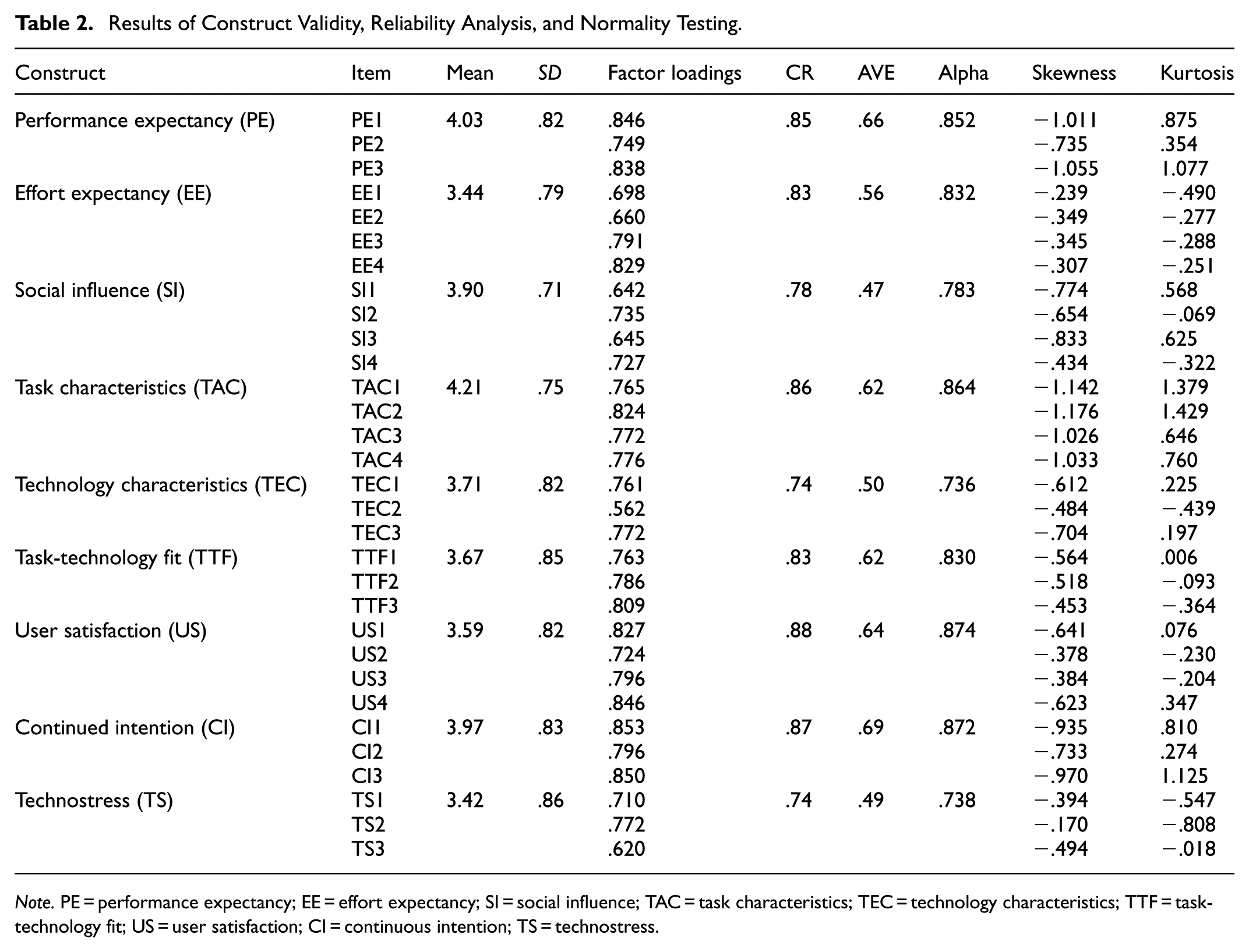
Note. PE = performance expectancy; EE = effort expectancy; SI = social influence; TAC = task characteristics; TEC = technology characteristics; TTF = task-technology fit; US = user satisfaction; CI = continuous intention; TS = technostress.
To further address the potential for Common Method Bias (CMB), we conducted a CFA-based unmeasured latent variable analysis, comparing three models to robustly evaluate the data’s integrity.
Model 1 (trait-only): The baseline CFA model, where indicators loaded onto their specified substantive constructs, showed a good fit with the data. The goodness-of-fit indices were: CMIN/DF FI2.223, CFI = .934, TLI = .924, RMSEA = .053, and AIC = 1,082.695.
Model 2 (method-only): The Harman’s single-factor model, where all items were forced to load onto a single latent factor, demonstrated a significantly poorer fit. The goodness-of-fit indices were: CMIN/DF = 17.087, CFI = .000, TLI = .000, RMSEA = .191, and AIC = 8,007.656.
Model 3 (method-and-trait): The UMLV model, which introduced a common method factor in addition to the substantive constructs, showed an improved fit over Model 1. The goodness-of-fit indices were: CMIN/DF = 1.572, CFI = .972, TLI = .964, RMSEA = .036, and AIC = 835.087.
We compared Models 1 and 3 using a Chi-square difference test. The results showed a significant improvement in model fit (Δχ2 = 405.608, ΔDF = 129, p 29.001). While Model 3 provided a better fit, the improvement was not substantial enough to suggest that a common method factor is the primary driver of the relationships, especially given that the majority of the variance is still explained by the substantive constructs. The factor loadings for the substantive constructs in Model 3 remained significant and largely similar to those in Model 1, confirming that the relationships are not an artifact of common method bias. Therefore, our multi-pronged approach, combining the Harman single factor test and the CFA-based UMLV analysis, provides robust evidence that common method bias is not a significant concern in this study.
According to the results displayed in Table 2, the model’s structure is confirmed to be reliable, with all indices for Cronbach’s α and composite reliability surpassing the .70 benchmark (Segars,1997). Additionally, Table 2 reveals a high degree of overall reliability and strong internal consistency within each item cluster.
Considering the diversity of our designer sample, with their varied backgrounds, objectives, needs, and AIGC experiences, evaluating the uniformity of the variables was crucial. To conduct a test of homogeneity, an Analysis of Variance (ANOVA) was utilized, with 31 items ranging from PE1 to TS3 serving as independent variables, and “profession” as a primary factor. The analysis revealed homogeneity across the dataset, with only TEC2 and TS2 showing significance levels below .05. Moreover, ANOVA was employed to explore potential discrepancies in the data obtained from digital versus physical survey modalities, as well as among different designer groups, where findings indicated minimal disparities across the majority of items. For evaluating construct validity and reliability as per Fornell and Larcker (1981a), three criteria were used: factor loadings, Composite Reliability (CR), and Average Variance Extracted (AVE). The factor loadings assess how well the observed indicators reflect the latent constructs they intend to measure, with higher values suggesting a closer representation. CR indicates the consistency of indicators within a test, with higher values suggesting greater reliability. AVE measures the extent to which a construct is represented by its indicators relative to the measurement error involved. The outcomes of these assessments are meticulously detailed in Table 2.
The analysis confirmed that all standardized factor loadings exceeded the threshold of .70, consistently suggesting robust validity and reliability of the constructs, which facilitated further analysis of the structural model. Discriminant validity was also verified, where Table 3 displays that the square root of each construct’s AVE was higher than its correlations with other constructs, affirming the strong discriminant validity of the survey instrument as noted by Zhou et al. (2010; Table 4).
Correlations and Square Roots of AVEs (Shown on Bold at Diagonal).

HTMT (Heterotrait–Monotrait Ratio of Correlations) Values.

In addition to the Fornell–Larcker test (Fornell & Larcker, 1981b), Hair et al. (2006) recommended using the HTMT as a specific measure for assessing discriminant validity. According to this methodology, discriminant validity is considered adequate if the HTMT value does not exceed the threshold of .9. Utilizing Smart PLS, Table 6 indicates that the HTMT value for the PE-CI relationship reaches up to .889, thus confirming good discriminant validity between the latent variables.
The Structural Model
The analysis was performed using AMOS software, with Figure 2 depicting the R 2 values and path coefficients. The significance level was established at p = .05. Table 5, which presents standardized path coefficients, confirms the validation of nine hypotheses. The findings show that performance expectancy (β = .47, p < .001) and social influence (β = .46, p < .001) significantly influence continuous intention, corroborating H1 and H3. In contrast, effort expectancy does not positively influence continuous intention (β = −.09, p < .05), leading to the rejection of H2. Additionally, both task and technology characteristics positively impact task-technology fit (β = .24, p < .001 and β = .73, p < .001, respectively). This fit significantly boosts user satisfaction (β = .93, p < .001), endorsing H4 and H5. Moreover, task-technology fit positively influences performance expectancy (β = .67, p < .001), confirming H6. However, performance expectancy’s impact on user satisfaction, although present, is not substantial (β = .01, p < .05), leading to the dismissal of H8. The data also demonstrate that user satisfaction significantly affects continuous intention (β = .33, p < .001), endorsing H9.

Path analysis.
The Results Hypotheses Test.

p < .001. **p < .01. *p < .05.
Table 6 shows that reducing technostress notably strengthens the effect of performance expectancy, effort expectancy, social influence, and user satisfaction on continuous intention (effect = .721, p < .001; effect = .423, p < .001; effect = .82, p < .001; effect = .695, p < .001). Conversely, with an increase in technostress, the influence of these factors on continuous intention diminishes (effect = .542, p < .001; effect = .043, p < .001; effect = .516, p < .001; effect = .383, p < .001). These outcomes robustly support hypotheses H10, H11, H12, and H13 and vividly illustrate the moderating effects, as depicted in Figure 3a–d.
Moderating Effect of Technostress.
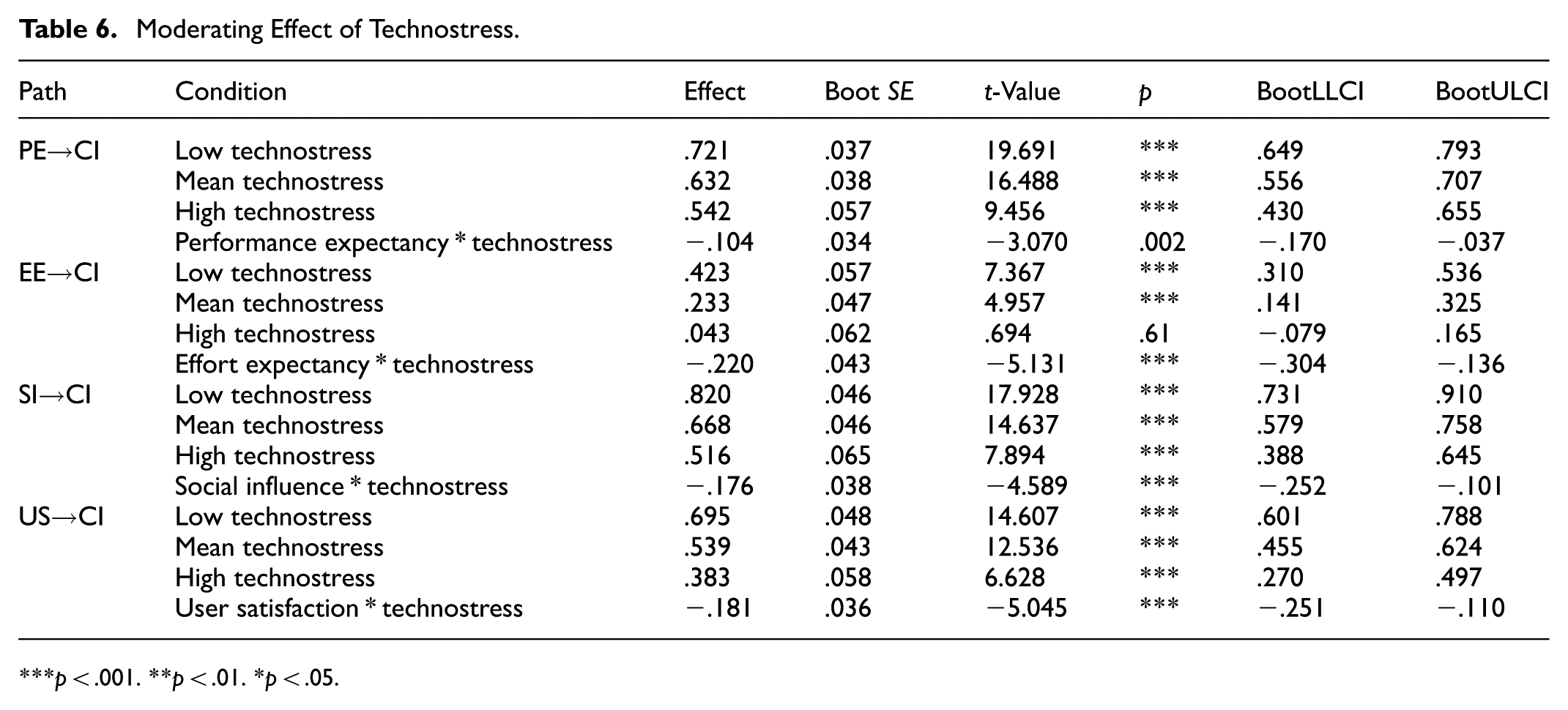
p < .001. **p < .01. *p < .05.
Figure 2 reveals that continuous intention is significantly influenced by four key variables: performance expectancy, effort expectancy, social influence, and user satisfaction. With an R 2 value of .758, this indicates that these variables collectively explain 75.8% of the variance in continuous intention. Similarly, task-technology fit accounts for 73.5% of the variance in user satisfaction, while task characteristics and technology characteristics contribute to 61.5% of the variance in task-technology fit. Detailed information regarding the standard total effects on these constructs is presented in Table 5. According to the data in Table 6, a decrease in technostress markedly strengthens the influence of the aforementioned factors (performance expectancy, effort expectancy, social influence, and user satisfaction) on continuous intention (effects being .721, .423, .82, and .695 respectively, all p < .001). Conversely, an increase in technostress leads to a reduction in the effects of these factors on continuous intention (effects being .542, .043, .516, and .383 respectively, all p < .001).
Discussion
Our findings underscore the value of a comprehensive model that integrates UTAUT, TTF, and technostress. By simultaneously examining how user perceptions (UTAUT), task-technology alignment (TTF), and Technostress interact, this study advances a nuanced understanding of AIGC adoption that transcends the limitations of single-theory approaches. For instance, while prior research has separately highlighted the role of performance expectancy (Venkatesh et al., 2003) or task-technology fit (Goodhue & Thompson, 1995), our model reveals how these factors jointly operate—and how technostress may attenuate their positive effects. This holistic perspective is essential for designing interventions that address both functional and psychological barriers to sustained AIGC use.
The structural model clarifies the mediating mechanisms between task-technology fit (TTF), user satisfaction (US), and performance expectancy (PE), and Task-Technology Fit is a latent construct.
User satisfaction as an intervening variable: Hypothesis H7 (TTF → US) is validated (β = .93, p < .001), confirming that TTF directly enhances user satisfaction. User satisfaction further significantly influences continuous intention (H9: β = .33, p < .001), indicating its full mediating role between TTF and continuous intention (CI). However, hypothesis H8 (PE → US) is not supported (β = .01, p = .799), suggesting that designers prioritize AIGC’s functional utility over affective satisfaction when forming continuous intentions.
Performance expectancy as an intervening variable: TTF significantly enhances performance expectancy (H6: β = .67, p < .001), which in turn drives continuous intention (H1: β = .47, p < .001). This establishes PE as a partial mediator between TTF and CI, highlighting the dual mechanism where task-technology alignment improves both perceived utility and sustained adoption.
Latent nature of task-technology fit (TTF): TTF is modeled as a second-order latent construct, validated through three reflective indicators (TTF1–TTF3) with factor loadings >.70 (Table 2). Its composite reliability (CR = .83) and AVE (.62) confirm robust convergent validity, capturing the dynamic interplay between task requirements and technology capabilities.
Performance Expectancy, and Social Influence have a Positive Effect on the Continuous Intention of Using AIGC
As presented in Table 5, using standardized path coefficients, our study demonstrates significant effects of performance expectancy (H1: .47), social influence (H3: .46), and effort expectancy (H2: −.09) on the continuous intention to use AIGC. Among the three factors influencing continuous intention, performance expectancy and social influence exhibit relatively stronger effects.
Rahi et al. (2018) and Reyes-Mercado (2018) also agreed that performance expectancy has a positive relationship with adoption intention. The two constructs that have the greatest influence on designers’ intentions are the achievement and the social relevance expected from AIGC tools (Li, 2024). In the preliminary stage of IS adoption, the relationship between performance expectancy and adoption intention is stronger than the relationship with social influence as postulated by previous studies (El-Masri & Tarhini, 2017). This paper reveals that designers engage with AIGC most often when they realize its relevance in design activities and its potential to enhance design productivity.
This research also shows that in the case of the study, a designer’s consistent intention to use AIGC is affected by people in their environment including family, teachers, classmates, and colleagues. This study reveals that the support, respect, and assistance received from the stakeholders make them have a continuous intention to use AIGC. Performance expectancy is a result of designers’ internal need for AIGC while social influence is a result of external needs and demand. Also, the findings suggest that the relationship between performance expectancy and continuous intention is slightly stronger than that of social influence.
Effort Expectancy Does Not Significantly Positively Impact Continuous Intention of Using AIGC
Our research is consistent with some findings, Sun et al. (2022) observed no significant role of effort expectancy in predicting continuance intention within the context of Online-to-Offline Commerce Services (OTOCs). Moreover, research conducted by Mensah et al. (2019) on the continuance intention among college students for Didi mobile car-sharing services found that effort expectancy lacks a significant impact on their persistence in using these services. The potential reason for these findings may be that current platforms are very user-friendly.
Currently, AIGC platforms and tools are also in such a state. The non-significant effect of effort expectancy (H2: β = −.09, p < .05) may reflect the ‘digital native’ profile of participants, who exhibit inherent ease with technology (Prensky, 2001). For instance, AIGC tools like Midjourney employ intuitive interfaces (e.g., text-to-image prompts), which may universally lower effort barriers. Alternatively, cultural factors in China’s design education system—emphasizing rapid software proficiency—could normalize effort expectations (Wang, 2024). This finding contrasts with studies in contexts with older or less tech-savvy populations (Oliveira et al., 2014). Future research should validate these results in cohorts with diverse technological literacy.
The Influence of Both Task Characteristics and Technology Characteristics on Task-Technology Fit is Substantial and Positive
As delineated in Table 5 of our study, where task characteristics exhibit an effect size of .24 (H4) and technology characteristics a more pronounced effect size of .73 (H5). These findings corroborate earlier research, highlighting a robust relationship between task-technology fit and the levels of task and technology characteristics. Specifically, Alam et al. (2022), Kang et al. (2022), and Zaremohzzabieh et al. (2022) have previously identified a positive correlation between task characteristics and task-technology fit. Similarly, Ratna et al. (2018) observed that both task and technology attributes are crucial in enhancing task-technology alignment, suggesting that elevated characteristics are associated with improved fit.
The Relationship Between the UTAUT and TTF Model is Mainly Reflected in the Influence of Task-Technology Fit on Performance Expectancy
An empirical analysis reveals that TTF contributes positively to performance expectancy with a coefficient of .67 (H6: .67). Evidence from our study aligns with findings by Zhou et al. (2010), demonstrating a robust effect of TTF on the performance expectations of designers. Previous research has demonstrated that a good alignment between technology and tasks, as well as team composition, is associated with enhanced performance outcomes (Fuller & Dennis, 2009; Zigurs & Buckland, 1998). This could be attributed to designers perceiving AIGC as a cutting-edge AI creation technology that can expedite the creative process, inspire design ideas, and address complex design issues. Consequently, AIGC effectively addresses designers’ task characteristics concerns, establishing a link between task characteristics and task-technology fit.
Task-Technology Fit, In Turn, Also Exerts a Significant Positive Effect on User Satisfaction. User Satisfaction Positively Influences Designers’ Continuous Intention
Our findings indicate that task-technology fit positively influences user satisfaction (H7: .93). Moreover, the alignment of designers’ task characteristics with the technology characteristics provided by AIGC directly affects their expectations of the design results produced by AIGC. When users perceive a high level of task-technology fit, their user satisfaction improves. This technology alignment manifests in three ways: (i) AIGC provides high-quality design resources and inspiration; (ii) AIGC offers convenient access and logging via various platforms, including mobile devices and the web; (iii) AIGC can quickly produce a variety of design outcomes. Additionally, AIGC’s technology characteristics are continually evolving. A strong task-technology fit contributes to increased user satisfaction with AIGC among designers.
We found that user satisfaction positively influences designers’ continuous intention to use AIGC (H9: .33). The results show a positive and significant effect of user satisfaction on continuous intention, as demonstrated by many other relevant studies (Hong et al., 2017; Roca et al., 2006). User satisfaction is a critical motivator for designers to continue using the tool because it reflects their perceptions of the performance and experience provided by the technology and whether it fulfills their expectations. Satisfied and well-supported users are more likely to persist in using AIGC.
Our research indicates that the hypothesis proposing a positive effect of effort expectancy on user satisfaction is not supported (H8: .01). Firstly, users are likely to prioritize other attributes of AIGC tools, such as functionality and ease of use, over the effort required to utilize them. Secondly, even if users acknowledge that using AIGC may demand a certain level of effort, their satisfaction with the tool may remain high if they perceive the benefits as outweighing the effort. Additionally, an abundance of support resources for AIGC, including training and familiarity with related tools, is readily available online. These resources can mitigate users’ perceptions of the effort involved, thus enhancing overall satisfaction. Consistent with our findings, Lee et al. (2021) observed that effort expectancy does not significantly influence user satisfaction.
Negative Moderating Effect of Technostress
This research uncovers a notable negative moderating impact of technostress, as depicted in Figure 3a, consistent with our hypotheses (H10, H11, H12, H13). The trend shows that continuous intention increases with an increase in performance expectancy; however, this effect is more pronounced among individuals with lower levels of technostress compared to those experiencing higher levels. Similar moderating effects of technostress on additional factors such as effort expectancy, social influence, and user satisfaction are observed, as demonstrated in Figure 3b–d. The study identifies a substantial negative moderating role of technostress in the relationship between performance expectancy, effort expectancy, social influence, user satisfaction, and the continuous intention to use AIGC. Notably, as these factors increase, individuals with higher technostress show a reduced continuous intention to engage with AIGC. Designers’ reluctance to adopt new technologies may stem from concerns about whether these technologies can meet their performance expectations and the potential adverse impact of this uncertainty on their work efficiency. Thus, additional efforts needed from AIGC can cause dissatisfaction among the users and decrease their probability of making the service permanent. Technostress could potentially affect designers’ interactions with their peers in various ways; in particular the impact of colleagues’ opinions might be more significant. The technostress anxiety can result to user technology dissatisfaction which in turn may affect their future motivation to use it.

(a) to (d) Moderating effect of technostress diagram.
Technostress, as characterized in prior studies, manifests as an adverse psychological response linked to utilizing or the possibility of using novel technologies. This condition typically precipitates anxiety, cognitive exhaustion, skepticism, and feelings of incompetence, adversely affecting performance expectations (Saleem et al., 2021). Research by Su and Chao (2022) investigated the factors influencing nurses’ inclination towards mobile learning, revealing that technostress detrimentally impacts effort expectancy. According to Verkijika (2019), technostress directly hampers the initial and subsequent adoption of digital textbooks, undermining their perceived usefulness and consequently diminishing user satisfaction. Furthermore, research by Kader et al. (2022) determined that technostress diminishes the influence of social factors on the continuous intention to engage in online learning, suggesting a mitigation of social impact on persistent online learning behaviors.
Conclusion and Implications
We integrated the UTAUT model, the TTF model, and user satisfaction in order to investigate the determinants influencing designers’ continuous intention of using AIGC. The findings demonstrate that performance expectancy emerges as the most crucial predictor of continuous intention. Furthermore, social influence and user satisfaction significantly encourage the sustained engagement with AIGC. While performance expectancy, social influence, and user satisfaction positively correlate with continuous intentions, effort expectancy does not show a positive correlation with these intentions.
Focusing on the persistence of intent to use AIGC, the study underscores the importance of the task-technology fit, which impacts user satisfaction and mediates its effect on usage intentions. Notably, task-technology fit significantly influences performance expectancy and is a critical determinant of continuous intent to use AIGC. Additionally, the integration of UTAUT and TTF models introduces technostress as a moderating variable, which negatively influences the relationship between task-technology fit and continuous intention, partially mediating this interaction.
The theoretical contributions of this research are manifold. Primarily, it expands the understanding of AIGC application in design processes and fosters the development of novel theories and methodologies to explore technology usage intentions. Constructing and Implementing an Integrated Model: This research is distinguished by its application of the UTAUT model, TTF model, and user satisfaction to forge a new theoretical framework. The framework uniquely utilizes performance expectancy, effort expectancy, social influence, and task-technology fit to assess user satisfaction and ongoing intent. This model provides a comprehensive view of designer acceptance and continuous use of AIGC, establishing a theoretical base for future TAMs. Identifying Technostress as a Moderating Factor: The study contributes to the academic discourse by pinpointing technostress as a significant moderating element. It demonstrates that despite a high task-technology fit, technostress can mediate designers’ intentions to continue using AIGC. The current study uncovers the underlying psychological mechanisms of technostress in technology acceptance and usage and sheds new light on the designers’ psychological stress and coping when it comes to the new technologies. These theoretical contributions help to explain the factors that make AIGC acceptable. Practically, AIGC developers should invest in adaptive interfaces that align with task-specific workflows (e.g., modular templates for industrial vs. graphic design) and integrate stress-reduction features like real-time tutorials. Theoretically, future studies should extend this framework to non-Chinese contexts (e.g., European design industries) and incorporate facilitating conditions as AIGC infrastructure matures. Longitudinal designs could further unravel causal relationships between technostress and abandonment phases.
The practical contribution of this study has the following aspects. Tailoring Services to Different Designer Groups: Some designers have different views on their sustained desire to employ AIGC than others of the group. The study highlights the need to increase task-technology fit in order to provide value-added services. Thus, design students may prioritize the range of functionalities, whereas more professional designers may focus on the quality, technical reliability, and usability of the output provided by AIGC. When AIGC services are delivered in accordance with the requirements of the users’ tasks, it will help boost the users’ continuous intention to use the AIGC services of the providers. Reducing Technostress: Thus, the study reveals the effects of technostress on outcomes in various settings. Besides, task-technology fit, AIGC researchers and service providers should also invest resources on minimizing the level of perceived technostress, thus improving users’ continuous intention to use AIGC.
Limitations and Future Research
Each study has its limitations. Our research focuses on Chinese designers who use AIGC, which limits its generalizability to other regions or individuals with different experiences and educational backgrounds. As a result, the implications of our findings may be restricted. Future research should collect data from various locations and compare the outcomes with ours to identify potential disparities. Additionally, it is important to note that our research model did not account for certain demographic variables, such as gender, age, and experience with AIGC. These factors, integral to the original UTAUT model, may influence designers’ continuous intention to use AIGC. Lastly, differences in professional domains or AIGC platforms and tools may elicit distinct responses from designers. While facilitating conditions (e.g., technical support) are recognized as influential in technology management (Venkatesh et al., 2003), their exclusion in this study aligns with the current state of AIGC adoption in China. The lack of standardized institutional support for AIGC tools (Xu et al., 2023) implies that designers primarily rely on personal adaptability rather than external infrastructure. This contextual specificity underscores the relevance of our focus on individual and task-technology factors. Future research should revisit facilitating conditions as AIGC ecosystems evolve. In conclusion, individual differences, regional disparities, and specific characteristics of AIGC fields could positively or negatively affect designers’ continuous intention to use AIGC. Therefore, future studies should include these variables in an optimized research framework to evaluate the continued validity of the model.
Footnotes
Appendix

| Construct | Items | Measures | References |
|---|---|---|---|
| Performance expectancy (PE) | PE1 | I think AIGC is useful for design creation | Escobar-Rodríguez et al. (2014), Khechine et al. (2014), Thomas et al. (2013) |
| PE2 | I think AIGC is good for design creation | ||
| PE3 | I think AIGC can improve the efficiency of design creation | ||
| Effort expectancy (EE) | EE1 | I think AIGC is very simple to operate | Venkatesh et al. (2003), Escobar-Rodríguez et al. (2014), Khechine et al. (2014), Thomas et al. (2013) |
| EE2 | I think learning to use AIGC is easy | ||
| EE3 | I think the AIGC interaction is simple and easy to understand | ||
| EE4 | It is very easy for me to use AIGC proficiently | ||
| Social influence (SI) | SI1 | I think using AIGC is a fashionable and popular way to design | Escobar-Rodríguez et al. (2014), Khechine et al. (2014), Thomas et al. (2013) |
| SI2 | I find that designers or design students around me are using AIGC | ||
| SI3 | I found that many designers and design students on the Internet are using AIGC | ||
| SI4 | The leaders of my design firm or design school think AIGC is useful | ||
| Task characteristics (TAC) | TAC1 | I need to access AIGC related learning resources | Guo et al. (2016), Oliveira et al.(2014), Lu and Yang (2014) |
| TAC2 | I need to use AIGC quickly and easily | ||
| TAC3 | I need the work done using AIGC to be of high quality | ||
| TAC4 | I need the work done using AIGC to meet my expectations | ||
| Technology characteristics (TEC) | TEC1 | AIGC can provide high quality design data | Guo et al. (2016), Lu and Yang (2014), Oliveira et al.(2014) |
| TEC2 | AIGC is easily accessible via mobile devices | ||
| TEC3 | AIGC can deliver design results quickly | ||
| Task-technology fit (TTF) | TTF1 | The service provided by AIGC can meet my needs | Lin and Wang (2012), McGill and Klobas (2009) |
| TTF2 | AIGC offers features that meet my needs | ||
| TTF3 | The quality of AIGC output works meets my requirements | ||
| User satisfaction (US) | US1 | I am very happy with the features offered by AIGC | Dağhan and Akkoyunlu (2016), Lin and Wang (2012) |
| US2 | I am very satisfied with the service provided by AIGC | ||
| US3 | I am very satisfied with the quality of the AIGC output | ||
| US4 | Overall, I am very satisfied with the AIGC usage | ||
| Continuous intention (CI) | CI1 | I intend to continue to use AIGC to assist my design creation | Dağhan and Akkoyunlu (2016), Guo et al. (2016), Lin and Wang (2012), B. Wu and Chen (2017) |
| CI2 | I will be using AIGC more and more in the future | ||
| CI3 | In general, I will continue to use AIGC | ||
| Technostress (TS) | TS1 | The appearance of AIGC makes me feel that my work and study are threatened | Pirkkalainen et al. (2019) |
| TS2 | I was forced to change my design habits to accommodate AIGC | ||
| TS3 | I found that other designers or fellow design majors knew more about AIGC than I did |
Acknowledgements
I would like to express my heartfelt gratitude to the School of Design of Jiangnan University for their invaluable support and contributions to this research. I am also deeply thankful to Professor Weifeng Hu of Jiangnan University for his support. Special thanks go to the participants, whose cooperation and insights were crucial to the completion of this study. Additionally, I extend my appreciation to the teachers, students, and designers from Ningbo University, the Central Academy of Fine Arts, the China Academy of Art, Luxun Academy of Fine Arts, Jiangsu University, Guangzhou University, and various design industry institutions for their constructive feedback and encouragement throughout the research process.

Ethical Considerations
This study received ethical approval from the ethics committee of the authors’ institution. The research was conducted in accordance with the ethical principles for human research.
Consent to Participate
All participants were fully informed about the purpose of the study and their right to withdraw at any time without negative consequences. Written informed consent was obtained from all participants prior to data collection. The study design, involving a non-invasive, anonymous survey, posed minimal risk of harm to the participants, and the potential benefits to the academic community and industry were deemed to outweigh these risks. Informed consent to participate in this study was obtained from all participants. The purpose and use of the survey were communicated to the participants both online and offline, and they provided their consent to participate in the research.
Consent for Publication
Not applicable. This manuscript does not contain any data from individual persons, including individual details, images, or videos.
Author Contributions
Lu Feng conducted 90% of the work, including the research design, data collection, analysis, and drafting of the manuscript. WeiFeng Hu, as the corresponding author, was responsible for reviewing and revising the manuscript, providing critical feedback and suggestions for improvement.
Data Availability Statement
The datasets used and analyzed during the current study are available from the corresponding author on reasonable request.