




Abstract
Although learning with mobile educational applications (apps) has become popular in higher education, the factors accounting for students’ voluntary continuous usage have not yet been investigated fully. This study aims to understand art students’continuance intention by combining the expectation-confirmation model (ECM) and the effect of technostress. A research model was proposed and verified with a sample of 339 undergraduates who majored in art from two Chinese universities. The results of structural equation modeling indicated that: (a) both perceived usefulness and satisfaction directly predict continuance intention, while perceived usefulness indirectly predicts continuance intention through the mediating effect of satisfaction; (b) Technostress has a direct negative effect on both perceived usefulness and continuance intention, but has no direct effect on satisfaction; (c) Technostress indirectly influence students’continuance intention through the mediator of perceived usefulness and satisfaction. The theoretical and practical implications based on the findings are discussed.
Plain Language Summary
Purpose: This study aims to understand art students’ continuance intention by combining the expectation-confirmation model (ECM) and the effect of technostress. Methods: A research model was proposed and verified with a sample of 339 undergraduates who majored in art from two Chinese universities. Conclusions: The results of structural equation modelling indicated that: (a) both perceived usefulness and satisfaction directly predict continuance intention, while perceived usefulness indirectly predicts continuance intention through the mediating effect of satisfaction; (b) Technostress has a direct negative effect on both perceived usefulness and continuance intention, but has no direct effect on satisfaction; (c) Technostress indirectly influence students’ continuance intention through the mediator of perceived usefulness and satisfaction. Implications: This finding provides practical implications for practitioners related to mobile educational apps. The positive influences of perceived usefulness and satisfaction suggested that mobile apps must provide their potential learners with useful content and a pleasant environment. Specifically, app developers can improve learners’ perceived usefulness and satisfaction by improving load speed, reducing response time, and providing potential users with what they most need to learn. Based on the negative effect of technostress, it is suggested that the developers of mobile apps should take technostress into account in their decision-making process. For instance, they should be wary of the potential increased technostress when they add more features and functionality to their apps to attract learners’ continuous use. In addition, educational institutions also have to pay more attention to guiding students to deal with technostress actively to reduce its negative effect. For instance, teachers should encourage art students to combine other activities, such as face-to-face communication and sports activities, with mobile learning to alleviate technostress. Limitations: Despite the promising findings, this study also has some limitations. Firstly, in this study, the sample was limited to art students from Chinese universities. Considering the cultural differences, we should be cautious about the generality of the findings to learners of different cultures. Future research could verify these associations with participants from different cultural backgrounds. Secondly, this study only examined the mediating effects of perceived usefulness and satisfaction on the impact of technostress on continuance intention. Future research could investigate the mediating effect of other variables in this association, such as learning burnout. Thirdly, we only employed self-reported measurement to collect data. Future research can combine the self-report method with qualitative research methods to obtain more objective data.
Keywords
Introduction
Mobile educational applications (apps) are those developed specifically to teach a specific knowledge and are popular among university students (Hoi, 2020). They have various advantages including portability, context sensitivity, flexibility, accessibility, and individuality (C. Chen, 2018; Sung et al., 2015). In recent years, a large number of mobile educational apps have been developed, which provide learners a broader choice and enable them to learn at any time and place convenient to them. To promote learning, some apps are specifically designed, such as embedding engagement mode, situational mode, gamification design, and recommendation service (C.P. Chen, 2018; Godwin-Jones, 2011; Reinders & Pegrum, 2017). These mobile educational apps provide a great convenience for art students to learn for various purposes, such as postgraduate entrance examination preparation, English learning, work preparation, and so on.
Coupled with the popularity of mobile educational apps, several studies have been performed to examine their effectiveness (J.S. Lee & Sylvén, 2021; Papadima-Sophocleous et al., 2012). Take mobile English learning apps for example, many researchers reported that mobile learning is helpful to learners’ pronunciation and reading (Cao & Deng, 2019); vocabulary learning (Klimova, 2021; J.S. Lee & Drajati, 2019; Saran et al., 2012); writing (Li & Hegelheimer, 2013), and communication skills (J.S. Lee & Sylvén, 2021; Papadima-Sophocleous et al., 2012). From the findings above mentioned, there is no doubt that mobile learning brings a lot of benefits to learners, a reason why many individuals hold positive attitudes toward it (Yang & Wang, 2019). However, the fact is that some learners still prefer learning with non-tech tools, such as physical books (Nie et al., 2020), arising the question that equipping mobile devices with mobile apps and previous learning experiences may not necessarily lead to learners’continuance intention of using mobile apps. This study strives to investigate the factors influencing art students’ continuance intention regarding mobile educational apps. The value of the research is twofold. On the one hand, it will promote developers to create educational apps that are more palatable to art students, and on the other hand, it will also provide valuable evidence for educational institutions to guide art students to use the educational apps effectively.
The expectation-confirmation model (ECM) is one of the most widely used theories to explain individuals’continuance intention of using a given technology (Mouakket, 2018; Stone & Baker-Eveleth, 2013). According to ECM, perceived usefulness and satisfaction are two essential constructs associated with users’ intention to use a given information system continuously. In the context of learning technology usage, substantial research has confirmed that perceived usefulness predicts individuals’satisfaction, which in turn, leads to a higher level of continuance intention (Joo, Lee, & Ham, 2014; Joo, Lim, & Kim, 2011). In addition, technostress, as a negative consequence of technology use, is reported to have a negative impact on users’ cognitive evaluation, satisfaction, and continuance intention. Although both ECM and technostress are considered to be linked to the continuance intention of a given technology closely, to our knowledge, there is no study has combined them to explain an individual’s continuance intention. Therefore, this study intends to propose and test a research model to explain art students’continuance intention by employing ECM combined with the influence of technostress. Specially, we will examine the relationships among technostress, perceived usefulness, satisfaction, and continuance intention of art students’ using mobile educational apps.
Literature Review and Hypotheses Development
Mobile Educational Apps
Mobile educational apps aim to provide convenience for learners to obtain certain knowledge (Hoi, 2020). In recent years, a growing number of learners are using mobile educational apps for various learning purposes (C.P. Chen, 2018; Nie et al., 2020). Among them, university students are the largest group to some extent (Liu et al., 2021). In China, it is reported that up to 93% of university students are using (or have used) various mobile educational apps (Bian & Liu, 2017). As art students, to improve their professional knowledge and general knowledge level, they usually study with mobile educational apps. However, a phenomenon that can not be ignored is that when they have used apps for some time or the request is cancelled, they stop using or even refuse to continue using them (Nie et al., 2020). Although substantial research has examined the effectiveness of using mobile educational apps (C.P. Chen, 2018; Li & Hegelheimer, 2013) and the factors impacting learners’ initial acceptance (Bian & Liu, 2017; Chung et al., 2015; Nie et al., 2020), few studies concerned the continuous use. As it is known to all, learners’ continuous use is crucial to their knowledge acquisition and the development of mobile apps. As per the suggestions of previous literature (Bhattacherjee, 2001; Khlaif et al., 2023), the ECM and technostress have good explanatory power for the users’ behavior intention of a given technology. This study strives to understand art students’ continuous use of mobile educational apps using the ECM and the role of technostress.
Expectation-Confirmation Model
The expectation-confirmation model (ECM) was adapted by Bhattacherjee (2001) from the expectation-confirmation theory widely used to understand consumers’ post-purchase behavior. The ECM was considered a solid theory more suitable to explain the continuance intention of technology adoption than other well-known models, such as the technology acceptance model (TAM) and the unified theory of acceptance and use of technology (UTAUT) (Ambalov, 2018). Figure 1 presents the four constructs and relationships in ECM.

The expectation-confirmation model.
According to the ECM, perceived usefulness and satisfaction are two essential constructs associated with users’ intention to use a given information system continuously (Bhattacherjee, 2001). Specifically, perceived usefulness focuses on an individual’s evaluation of the benefits of information technology use, especially in improving performance outcomes (Scherer et al., 2019). It is a key predictor of technology adoption, because it not only directly predicts continuance intention, but also through the mediating effect of satisfaction (Bhattacherjee, 2001). Satisfaction reflects an individual’s affect response after using an information system, which is more realistic, stable, and unbiased than his/her initial attitude toward technology in the pre-adoption phase, a reason why it is dominant for continuance intention. Since the ECM has been employed to explain users’continuance intention in many different technology usage contexts, it is reasonable to employ it to predict art students’continuance intention of using mobile apps.
In addition, as technostress was considered to be linked with perceived usefulness, satisfaction, and continuance intention closely, this study proposed technostress as another factor influencing art students’continuance intention of using mobile apps.
Perceived Usefulness, Satisfaction, and Continuance Intention
According to the ECM, there are positive associations among perceived usefulness, satisfaction, and continuance intention. Many subsequent empirical studies have also confirmed the direct effect of perceived usefulness and its indirect effect on continuance intention through satisfaction (S.C. Chen et al., 2018; Thong et al., 2006). Several empirical studies also confirmed the positive influences of perceived usefulness and satisfaction on continuance intention in the context of MALL (García Botero et al., 2018; Kim & Lee, 2016). Therefore, this study formulated the following hypotheses:
H1: Art students’perceived usefulness is positively associated with their satisfaction with mobile educational apps.
H2: Art students’perceived usefulness is positively associated with their continuance intention of using mobile educational apps.
H3: Art students’satisfaction is positively associated with their continuance intention of using mobile educational apps.
Technostress
Originally, technostress was coined by Brod (1984), who defined it as “a modern disease of adaptation caused by an inability to cope with new computer technologies in a healthy manner.” Coupled with the proliferation of digital technologies and their wide penetration into life and work, technostress has attracted increasing concern of researchers from various fields including psychology, management, information technology, business, and education (Suh & Lee, 2017; X. Zhao et al., 2020; G. Zhao et al., 2022). In recent literature, technostress was broadly defined as an individual’s overall stress resulting from his/her ongoing use of technology (X. Wang et al., 2020). In this study, technostress concerns the stress that art students experience due to the usage of mobile educational apps.
The antecedents and consequences of technostress are a highly concerning issue in the relevant literature, which has been studied both in organizational and personal technology usage contexts (Maier, Laumer, Weinert, et al., 2015; Tarafdar et al., 2007). For the antecedents, Tarafdar et al. (2007) concluded five technostress creators including techno-complexity, techno-invasion, techno-overload, techno-insecurity, and techno-uncertainty, while Maier, Laumer, Weinert, et al. (2015) categorized six stressors. In terms of the consequences of technostress, many studies found that technostress will bring adverse consequences. For instance, Tarafdar et al. (2010) confirmed that technostress may lead to the reduction of users’satisfaction and performance in workplace, while some research in the field of education found that technostress may predict teachers’ discontinuance intention of technology adoption (Khlaif et al., 2023). Some other studies reported that students who experience higher levels of technostress are more likely to experience learning burnout and get decreased academic performance (Yao & Wang, 2023; G. Zhao et al., 2022). However, few studies have concerned technostress and its consequences for art students when using mobile educational apps.
Technostress and Perceived Usefulness
Perceived usefulness is considered a crucial predictor of intention in different contexts of technology use (Ambalov, 2018; Joo, Lee, & Ham, 2014; Joo, Lim, & Kim, 2011; Khlaif et al., 2023; Yang & Wang, 2019). In this study, perceived usefulness refers to art students’ perception of the extent to which the usage of mobile educational apps will improve their academic performance. It is an individual’s cognitive evaluation of a given technology, which may be negatively biased by negative psychological states such as technostress (Steelman & Soror, 2017). Similarly, Ayyagari et al. (2011) also proposed that technostress creators are linked to technology characteristics such as usefulness and complexity. In addition, Verkijika (2019) found that an individual’s technostress level has a significant negative influence on one’s attitude toward digital textbooks, while Khlaif et al. (2023) empirically verified that technostress negatively predicts teachers’perceived usefulness and attitudes toward mobile technology.
In terms of mobile technology usage, studies reported that although smartphones have become more useful, the increase in use may lead to higher technostress (Boonjing & Chanvarasuth, 2017; Y.K. Lee et al., 2014; Yao & Wang, 2023). Similarly, G. Zhao et al. (2022) and X. Wang et al. (2020) also found that students suffer from technostress in technology-enhanced learning activities. One of the possible consequences of technostress is that individuals may choose other non-tech alternative tools rather than smartphones to complete tasks. In this regard, the possible technostress resulting from mobile educational apps may also influence their cognitive evaluation of it. Therefore, this study formulated the following hypotheses:
H4: Art students’technostress negatively predicts their perceived usefulness of mobile educational apps.
Technostress and Satisfaction
Satisfaction originally refers to an individual’s pleasant or positive state when appraising his/her job, which was introduced into the field of information technology usage by Bhattacherjee (2001). In the context of information technology use, satisfaction is defined as “the extent to which individuals are satisfied with the apps that they use” (Tarafdar et al., 2010). Users with higher levels of satisfaction are more likely to continue to use it (Bhattacherjee & Lin, 2015). In this study, satisfaction concerns art students’ pleasurable state resulting from their usage of mobile educational apps.
The negative association between technostress and satisfaction was first concerned by Tarafdar et al (2010), who empirically verified that technostress may lead to end-users decrease in satisfaction in the workplace. Subsequent studies confirmed that technostress is negatively associated with job satisfaction in the context of both teleworkers (Suh & Lee, 2017) and novice teachers (Q. Wang & Yao, 2023) working with information technology. They argued that users’ negative cognitions of technology use such as insufficient social interaction, dependence on technology, and the demands for constant adapting to newly emerging technologies, are possible reasons for their decrease of satisfaction (Suh & Lee, 2017). In the context of mobile learning, learners’ possible negative cognitions including eye strain and extensive technology dependence may also lead to dissatisfaction with mobile apps. Therefore, this study formulated the following hypotheses:
H5: Art students’technostress negatively predicts their satisfaction with mobile educational apps.
Technostress and Continuance Intention
Continuance intention refers to the individuals’ willingness to continuously use a given information technology (Huang, 2019), which seems to be one of the most concerned issues in the field of technology adoption. As a negative outcome of technology use, technostress is negatively associated with users’ initial and continuance intention of a given information technology (Khlaif et al., 2023; Maier, Laumer, Eckhardt, et al., 2015; Steelman & Soror, 2017; Verkijika, 2019). For instance, Chou and Chou (2021), and Khlaif et al. (2023) found that technostress shows a negative effect on teachers’ intention to continue using online teaching and mobile technology, respectively. Similarly, Steelman and Soror (2017) also confirmed that technostress may predict an individual’s continuous usage intention of consumer technologies negatively. Based on these previous findings, it is plausible to expect that art students who experience high technostress resulting from mobile learning may be less willing to use it continuously. Therefore, this study formulated the following hypotheses:
H6: Art students’technostress negatively predicts their continuance intention to use mobile educational apps.
The research model of this study was shown in Figure 2.
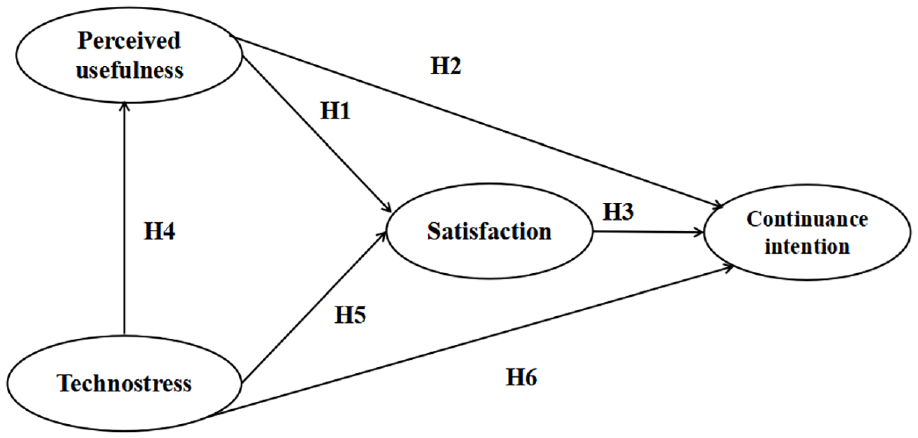
The research model.
Method
Instruments Development
In the first part of the survey, six items were designed to collect participants’ demographic information and their experiences of using mobile educational learning apps. In the second part, 13 items were designed to collect data for the four constructs in the research model. All the items were revised from existing instruments with satisfactory good reliability and validity, and were presented in the form of a 5-point Likert scale.
Specifically, to measure art students’technostress when learning with mobile apps, four items were used from the instrument developed by Chou and Chou (2021). A sample item includes “I feel drained from learning with mobile apps.”Perceived usefulness was measured employing three items developed by Venkatesh et al. (2012). A sample item is “Using mobile educational apps improves my academic performance.” To measure art students’satisfaction, three items were developed with reference to the instrument used by Limayem et al. (2007). A sample item includes “I’m very satisfied with using mobile educational apps.”Continuance intention to use mobile educational apps was measured employing three items revised from Venkatesh et al. (2012). An example item includes “I intend to continue using mobile educational apps in the future.”
Participants
In China, the accessibility of mobile devices and the popularity of mobile learning for students at different universities do not vary much. Therefore, this study used the method of convenience sampling to select two public universities in Zhejiang Province and Jiansu Province respectively for data collection. We contacted several student counselors at both universities to recruit participants. The counselors made a brief introduction of this study in face-to-face classes and invited the students who were using (or had used) educational learning apps including English Liulishuo, Xueyibao, Baicizhan, etc. to participate in the survey voluntarily and anonymously.
A total of 339 valid responses were received. All the respondents were students who had at least 1 week of experience learning through mobile apps. The demographic information of the participants and their mobile app usage experiences were shown in Table 1.
Information of Participants.

Data Analysis
Data analysis was performed with AMOS (version 24.0) and SPSS (version 24.0), which included two steps. First, a confirmatory factor analysis (CFA) was performed to examine the reliability and validity of the measurement model. Then, structural equation modeling (SEM) was performed to test the proposed hypotheses.
Results
The Measurement Model
This study employed five key indicators to evaluate the measurement model, including standardized factor loadings, Cronbach’s alpha coefficients, convergent validity, discriminate validity, and the goodness of model fit.
The calculation results of CFA (shown in Table 2) revealed that the standardized factor loadings of all items were higher than .50 (ranging from .698 to .965), meeting the criterion that items’ standardized factor loadings should not be less than .50 (Schumacker & Lomax, 2004). Additionally, Cronbach’s alpha coefficients of the four constructs are all above .70.
Results of Construct Validity and Reliability Analysis.

The convergent validity was examined by the coefficients of composite reliability (CR) and average variance extracted (AVE). In this study, the coefficients of CR were higher than 0.90 and the coefficients of AVE were higher than 0.70. These results met the criteria that the CR coefficients should not be less than 0.7 and the AVE coefficients should not be less than 0.5 (Fornell & Larcker, 1981), suggesting an acceptable convergent validity.
In this study, the square root of the AVE of each latent variable is greater than its correlation coefficients with other variables (shown in Table 3), indicating an acceptable discriminant validity (Chin, 1998). Finally, the fitness of the measurement model was acceptable with χ2/df = 2.161, AGFI = 0.921, TLI = 0.976, CFI = 0.985, RMR = 0.021, RMSEA = 0.051 (Hu & Bentler, 1999).
Discriminate Validity.

Note. The bold values in the diagonal row are the square roots of the average variance extracted for the constructs in the research model.
The Structural Model
The results of SEM (Table 4) indicated that the fitness of the research model was also acceptable. The results of hypothesis testing (Table 5) revealed that students’perceived usefulness is positively associated with satisfaction (β = .805, p < .001) and their continuance intention (β = .383, p < .001) to adopt mobile educational apps, supporting H1 and H1. Additionally, students’satisfaction is positively associated with their continuance intention (β = .296, p < .001), which supports H3. As for the effects of technostress, the results indicated that technostress is negatively associated with perceived usefulness (β = −.183, p < .005) and continuance intention (β = −.165, p < .001), supporting H4 and H6. However, technostress has no significant effect on satisfaction (β = −.070, p > .05), rejecting H5. The research model with its standardized coefficients was shown in Figure 3.
The Goodness of Fit Indices for the Measurement Model and Research Model.

The Results Hypotheses Test.

Note. TS = Technostress; PU = Perceived usefulness; SA = Satisfaction; CI = Continuance intention.
p < .001. **p < .01.

The research model with its standardized coefficients.
Direct, Indirect, and Total Effects among the Variables
The direct, indirect, and total effects among the variables of perceived usefulness, satisfaction, technostress, and continuance intention were calculated (Table 6). Some noteworthy results were that technostress has indirect effects weighting of −0.135 on learners’continuance intention mediated together by perceived usefulness and satisfaction with mobile educational apps, and the total effects weight of technostress on continuance intention is −0.300, which is at a moderate level. Additionally, the total effects weight of technostress on satisfaction is −0.217 with the indirect effect mediated by perceived usefulness.
Direct, Indirect, and Total Effects among the Variables.
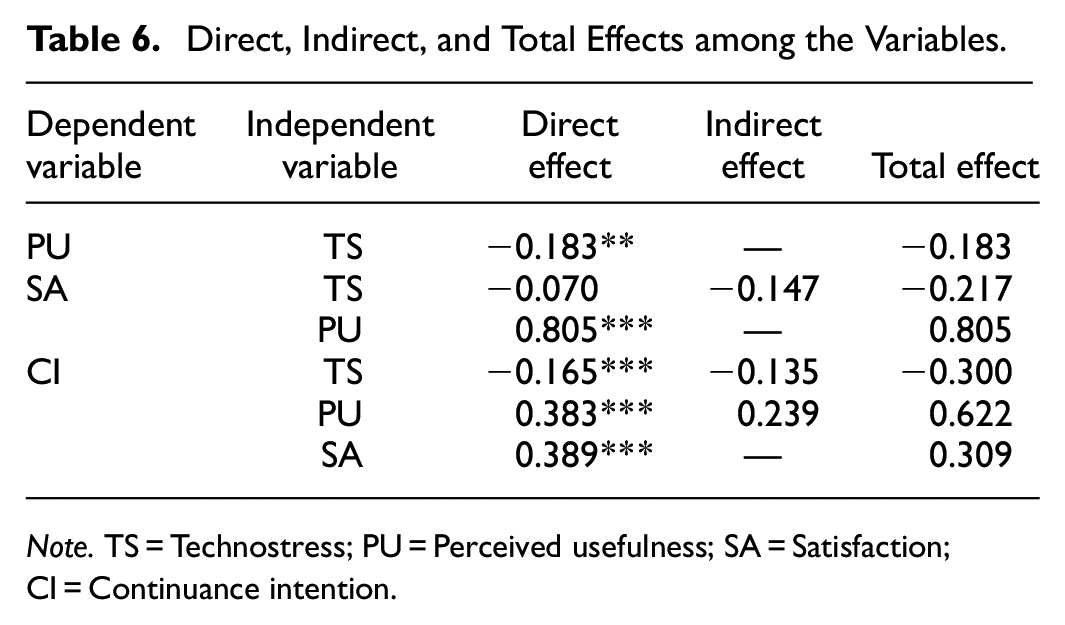
Note. TS = Technostress; PU = Perceived usefulness; SA = Satisfaction; CI = Continuance intention.
Discussion, Contributions, and Implications
Discussion
This study examined art students’continuance intention of using mobile apps by combining CEM and the role of technostress. A research model was proposed and verified by the survey data of 339 students who have experience of using mobile educational apps. Some noteworthy findings were discussed in the following part.
ECM Explains the Continuance Intention of Mobile Educational Apps Well
The results indicated that both perceived usefulness and satisfaction directly predict continuance intention. In addition, perceived usefulness has an indirect positive on continuance intention through the mediating effect of satisfaction. These findings support the assumptions of ECM and in line with previous studies which reported positive associations between these three constructs (Ambalov, 2018; Barnes & Böhringer, 2011). The findings revealed the crucial role of perceived usefulness and satisfaction in predicting art students’ continuous use of mobile apps. In other words, students with higher levels of perceived usefulness and satisfaction are more likely to adopt mobile educational apps continuously.
Technostress Negatively Predicts Perceived Usefulness and Continuance Intention
In terms of the influence of technostress, the results indicated that technostress has a direct negative effect on both perceived usefulness and continuance intention, which is in line with previous findings that reported the technostress’ negative effect on perceived usefulness and continuance intention (Chou & Chou, 2021; Khlaif et al., 2023; Steelman and Soror, 2017; Verkijika, 2019). However, this finding is contrary to that of Maier, Laumer, Weinert et al. (2015), which found that individuals tend to use SNS continuously even when they get stressed by it. The potential explanation for these conflicting findings is that, unlike mobile learning which aims to acquire knowledge, SNS use usually provides individuals with pleasurable experiences such as emotional communication and information sharing, which may lead to their dependence and addiction. Therefore, the negative effect of technostress on continuance intention may be reduced in the context of SNS use. The findings of this study imply that technostress resulting from mobile educational apps may lead to a decrease in art students’ usefulness evaluation and continuance intention of them.
Additionally, technostress also indirectly influences students’continuance intention through the mediator of perceived usefulness and satisfaction, and the total effect of technostress on continuance intention is stronger (β = −.300). The finding suggested that technostress may lead to a decrease in learners’ willingness to use mobile apps continuously through negatively bias their cognitive evaluation (i.e., perceived usefulness) and affect response (i.e., satisfaction). This finding provides a possible explanation for the phenomenon that some students still prefer non-tech learning even if they have noticed the benefits of mobile learning (Nie et al., 2020).
Technostress has no Significant Effect on Satisfaction
However, the results also indicated that technostress has no direct effect on satisfaction, which is contrary to the findings of existing studies, which found that technostress negatively predicts users’satisfaction (Suh & Lee, 2017; Tarafdar et al., 2010; Q. Wang & Yao, 2023). The different characteristics of the samples, such as social role and technology usage contexts, may account for the conflicting findings to a certain extent. The participants of the previous three studies are employees or teachers who are required to use technologies for work purposes, while in this study the participants are art students who use technology for learning voluntarily. Since art students can freely choose educational apps based on their preferences, the impact of technostress on satisfaction may be reduced. To better understand the influence of technostress on satisfaction, further studies, whose sample is especially students, are necessary.
Contributions and Implications
The present study at least has three contributions. Firstly, to our knowledge, this is the first research to investigate art students’ voluntary use of mobile educational apps by combining ECM and the role of technostress, which provides a new theoretical framework for further study of relevant technology continuous adoption. It reminds researchers to pay attention to the impact of individuals’ psychological reactions to technology adoption. Second, by examining the relationships between technostress, learner’s cognitive evaluation (i.e., perceived usefulness), satisfaction, and continuance intention, this study clarified these interrelationships and helps to bridge the existing research gap in technostress literature. Last but not least, by investigating the effect of technostress, this study provided evidence that there is a necessity to further explore the generality of some conclusions about technology use, such as “People are likely to continue to use a given technology as long as it meets their expectations (Khlaif et al., 2023).”
This findings also provide practical implications for practitioners related to mobile educational apps. The positive influences of perceived usefulness and satisfaction suggested that mobile apps must provide their potential learners with useful content and a pleasant environment. Specifically, app developers can improve learners’perceived usefulness and satisfaction by improving load speed, reducing response time, and providing potential users with what they most need to learn. Based on the negative effect of technostress, it is suggested that the developers of mobile apps should take technostress into account in their decision-making process. For instance, they should be wary of the potential increased technostress when they add more features and functionality to their apps to attract learners’ continuous use. In addition, educational institutions also have to pay more attention to guiding students to deal with technostress actively to reduce its negative effect. For instance, teachers should encourage art students to combine other activities, such as face-to-face communication and sports activities, with mobile learning to alleviate technostress.
Limitations and Future Work
Despite the promising findings, this study also has some limitations. Firstly, in this study, the sample was limited to art students from Chinese universities. Considering the cultural differences, we should be cautious about the generality of the findings to learners of different cultures. Future research could verify these associations with participants from different cultural backgrounds. Secondly, this study only examined the mediating effects of perceived usefulness and satisfaction on the impact of technostress on continuance intention. Future research could investigate the mediating effect of other variables in this association, such as learning burnout. Thirdly, we only employed self-reported measurement to collect data. Future research can combine the self-report method with qualitative research methods to obtain more objective data.
Conclusion
This study explored art students’continuance intention of using mobile educational apps by employing the ECM and the role of technostress. Although technostress has no significant effect on satisfaction, it has a direct negative effect on both perceived usefulness and continuance intention, and even indirectly influences continuance intention through the mediator of perceived usefulness and satisfaction in the context of art students’ mobile app usage. Therefore, developers of mobile educational apps should take users’perceived usefulness, satisfaction, and technostress into account in their decision-making process. Educational institutions should also take effective measures to help students manage technostress and increase the continuous usage of mobile education apps.
Footnotes
Acknowledgements
The authors would like to thank all the students who participated in the study.
Declaration of Conflicting Interests
The author(s) declared no potential conflicts of interest with respect to the research, authorship, and/or publication of this article.
Funding
The author(s) disclosed receipt of the following financial support for the research, authorship, and/or publication of this article: This study was partially funded by Presidential Fund of Minnan Normal University, Project Number (Project Number: sk20017).

Data Availability Statement
Data sharing not applicable to this article as no datasets were generated or analyzed during the current study.