




Abstract
This study tries to propose a unified model integrating the unified theory of acceptance and use of technology (UTAUT) model, task–technology fit (TTF) model, and user satisfaction to investigate the determinants that affect university students’ continued intention of using massive open online courses (MOOCs). Based on the data of a survey on 464 respondents, structural equation modeling is adopted to assess the model. The results reveal that performance expectancy, effort expectancy, social influence, and user satisfaction are the crucial predictors of university students’ continued intention. TTF has an indirect influence on continued intention through user satisfaction. Performance expectancy is affected both by effort expectancy and TTF. Facilitating conditions do not directly influence continued intention; however, they present indirect influences in that they play a mediating role for user satisfaction. The findings help researchers and practitioners to attain a better understanding of university students’ continued usage intention of MOOCs. The implications and limitations of this study are also described.
Introduction
Massive open online course (MOOC) is an innovative educational model that experiences a development in the past 8 years (Huang et al., 2017). To some extent, it can change the mode of teaching and learning of traditional university classrooms and facilitate the revolution of instruction paradigm, teaching method, learning technology, and so on. With the advancing of MOOC, its driving force on higher education gradually reveals. Universities all over the world have been involved in the MOOC movement, and various MOOC projects and platforms have been launched (Jung & Lee, 2018). According to the latest statistical data published by the Chinese Ministry of Education, more than 10 MOOC platforms in China were established by universities or associated organizations; more than 3,200 MOOC courses offered by more than 460 universities or colleges were available on the online platforms; the courses were used by 55 million students inside or outside the university and more than 6 million university students have acquired MOOC credits.
For a university student, an MOOC certificate can be a valuable step to earn course credits and credentials (Hyman, 2012). Furthermore, enrolling and engagement in an MOOC is considered a fashionable way of learning. However, not all MOOC learners seem to be interested in completing the courses in which they enroll (Wang & Baker, 2018). Low rate participant retention or continued usage is a widely existing phenomenon. Although some learners enroll in an MOOC and gain certain knowledge from it, a large number of the learners would finally drop out before finishing the whole course. Breslow et al. (2013) reported that there were less than 5% of the students who signed up completing the MOOC named 6.002x. Jordan (2014) collected a variety of public data about MOOC enrolment and completion. The findings suggested that the completion rates in most courses are less than 10%. A case study in China also reported that the completion rate of online course was only around 3.7% in the MOOC platform—Icourse (Shao, 2018).
Thus, the underlying reasons for this drop off need to be explored. Most studies focus on the students’ initial participation in MOOCs (Barak et al., 2016; Littlejohn et al., 2016; Zhang, 2016), whereas a limited amount of studies pay attention to the students’ continued usage behavior. Relevant researches have proven that the popularization and wide usage of a new technological system or educational resource platform are greatly determined by the user’s perceived usefulness. Generally, learner’s initial participation is the first step of successful implementation of an MOOC program. The crucial motivation for its final success is user’s continued participation and usage. For example, although plenty of students are attracted by the new instruction paradigm and perfect functions of MOOCs and decide to enroll and then acquire the related knowledge, they somehow drop out or quit learning due to personal or environmental factors, which lead to an overall low completion rate.
The concept of continued usage is mainly used to describe user’s continued usage mode and intention in a context of information technology system. Studies concerned about this issue in the recent years are basically carried out through two approaches. One is based on the Technology Acceptance Model (TAM), which is a famous theoretical foundation for the research of user’s continued intention and behavior. It holds that the perceived usefulness and perceived ease of use are the determinants influencing usage intention. The other approach draws on the expectation confirmation theory (ECT). The ECT is a crucial one to explore user’s repurchasing intention. It makes use of confirmation—the comparison between user expectation and perceived performance—to judge whether the user is satisfied with the service or product, and the satisfaction is used as a reference of repurchasing or reuse (Oliver, 1977, 1980). Bhattacherjee (2001) introduced the ECT into the research about user’s adoption of information system (IS) and he brought up the expectation confirmation model of IS continuance (ECM-ISC). This model includes four core variables: perceived usefulness, confirmation, satisfaction, and IS continuance intention. It assumes that user’s continued usage intention of the IS decided by their previous satisfaction and perceived usefulness of the whole system (Bhattacherjee, 2001). Researchers have conducted a few studies to investigate the factors and mechanisms affecting user’s continued intention in the MOOC context based on the two approaches. Joo et al. (2018) involved perceived usefulness, perceived ease of use, self-determination, and satisfaction in a proposed model to learn how such factors influence learners’ continuous intention of K-MOOCs. J. Zhou (2017) used ECM as the theoretical foundation to explore certain factors of continued intention in MOOCs. Yang et al. (2017) built a theoretical model by integrating the information systems success (ISS) model and the TAM to explore learners’ continuous usage intention in MOOCs.
Most of the empirical research results show that the results reflected by the TAM model just explain 40% to 60% of the changes in user’s intention (Venkatesh & Davis, 2000). Specifically, TAM explains typically about 40% of the variance in usage intentions and the extended TAM, referred to as TAM2, explains up to 60% of the variance in the driver of usage intentions (Venkatesh & Davis, 2000). Therefore, Venkatesh et al. (2003) tried to integrate eight theoretical models such as TAM, theory of planned behavior (TPB), and innovation diffusion theory (IDT) together to establish an updated model—the unified theory of acceptance and use of technology (UTAUT). Related researches have shown that, although the UTAUT model can better and more precisely explain user’s continued usage intention of IS, which can explain up to 70% of the users’ usage intention (Venkatesh et al., 2003), there are still certain limitations. For example, even if the students consider MOOC useful and easy to use, if it is unfit to the students’ learning requirements or cannot improve the students’ learning performances, they may still give up using it. The task–technology fit (TTF) model holds that users will adopt and reuse a technology according to the fit between the technology characteristics and task requirements (Goodhue, 1995; Goodhue & Thompson, 1995). A few studies combine UTAUT model and TTF model to explain user’s adoption of information service such as mobile banking and library information service (Oliveira et al., 2014; Vongjaturapat et al., 2015; T. Zhou et al., 2010). Their results indicated that user’s adoption behavior is indeed significantly influenced by factors in both the models. To precisely identify factors and the mechanism that affect university students’ continued intention of using MOOCs, this study will integrate the UTAUT model and the TTF model to build an optimized conceptual model. We try to address two research questions:
Theoretical Background
Characters of MOOCs
MOOCs are different from other traditional e-learning systems and have made an achievement that other online courses have not attained yet (Evans et al., 2015). The most representative feature of MOOCs is “massive” (Shao, 2018). MOOCs are able to benefit a large number of learners located in different areas, whereas a traditional online learning platform is generally provided for a limited number of users. The second feature is “openness” (Shao, 2018). Learners can access the platform freely anytime and anywhere. MOOCs also have other significant characteristics such as automated assessment and flexible peer assessments, which lead to an interesting and meaningful learning experience (Duderstadt, 2012). Besides, the lectures in MOOCs are almost delivered by top tier universities and in the form of micro-videos combined with constructive quizzes that can be easily accessed through a wide variety of technology devices (Daniel, 2012; LeCounte & Johnson, 2015).
The UTAUT Model
There are four core variables in the UTAUT model to determine user’s behavioral intention (BI) of using a technology, which are “performance expectancy (PE), effort expectancy (EE), social influence (SI) and facilitating conditions (FC)” (Venkatesh et al., 2003, p. 447). The model also includes four key moderating variables: experience, voluntariness, gender, and age. The UTAUT model is widely used in the research area of technology acceptance in recent years. Bibliometric analysis shows that the founding paper of the UTAUT model has been cited more than 12,000 times. Although the model is so popular, the studies using this model to investigate learners’ adoption and acceptance of MOOCs are limited. The typical studies are as follows: Fianu et al. (2018) used UTAUT model to explore factors that influence MOOC usage by student users in certain Ghanaian universities. The findings show that MOOC usage intention is influenced by performance expectancy. Social influence and effort expectancy do not have a significant influence on it. Mulik et al. (2018) examined the adoption of MOOC by extending UTAUT model with an addition of perceived value construct.
The results indicated that all the four factors and perceived value have a significant influence on intention to use MOOC. Nordin et al. (2015) investigated technology acceptance toward MOOCs in Malaysia on ethnic relations based on UTAUT and non-UTAUT factors. Results revealed that positive results were gained for all the four factors of UTAUT.
The TTF Model
TTF model considers technology a positive tool to promote individual performance and it can be utilized if its capabilities match the tasks that users should finish (Goodhue & Thompson, 1995). The model uses three core determinants to predict user’s utilization and performance impacts: technology characteristics, task characteristics, TTF. TTF has been used to investigate how it influences technology adoption and utilization. Although a number of researches have investigated TTF in various contexts, only a few researches have been conducted in the setting of MOOCs. As the TTF model does not consider the influencing factors in social aspect, it may limit the ability for predicting social characters of continued usage intention. These studies more or less integrated other factors related to social aspect. B. Wu and Chen (2017) proposed a unified model that combines the TAM, the TTF model, the features of MOOCs, and social motivation. They found that perceived ease of use and TTF play important roles in predicting continuance intention of MOOCs. Ouyang et al. (2017) combined TTF and ECM to discuss the factors affecting students’ continuing use of MOOCs. Perceived usefulness, satisfaction, and TTF are proved to be key precedents of the continued intention to use MOOCs. Khan et al. (2018) examined the factors influencing students’ adoption of MOOCs by applying an integrated framework that incorporates the TTF model, self-determination theory, and social motivation. The findings demonstrate that TTF positively influences BI to adopt MOOCs. But there is no study that combines the TTF model with UTAUT factors until now.
User Satisfaction
User satisfaction is the overall feeling of the user when using a system or service. It is determined by user’s subjective usage perceptions such as usefulness and effectiveness (Lee, 2013). Most of the user satisfaction studies are based on the confirmation/disconfirmation paradigm (Bae, 2018; Jacobs, 1995). When the perception of a system or service exceeds our expectations, we will feel satisfied. A number of research findings reveal that user satisfaction is positively related to reuse intention of e-learning systems and MOOCs (Hong et al., 2017; Kaewkitipong et al., 2016; Ouyang et al., 2017; Roca et al., 2006). Hong et al. (2017) explored factors relevant to users’ continued intention of using the government e-learning system. The results reflect that the user-perceived satisfaction with the design of content and interface is positively related to their continued usage intention. Roca et al. (2006) put forward an acceptance model in the e-learning service context, and the results showed that users’ continuance intention was positively influenced by satisfaction. Ouyang et al. (2017) found that satisfaction is an important factor to predict the continued intention of using MOOCs.
Research Model and Hypothesis
From the above review, we can see that as the typical theoretical models predict the factors that influence continued usage intention of ISs, both UTAUT and TTF models have advantages and disadvantages. User satisfaction can be considered as an intermediary to link the two models with continued intention. We proposed a conceptual research model that combines UTAUT, TTF, and user satisfaction to explore the factors that influence university students’ continued intention of using MOOCs. The relationships among these constructs are depicted in Figure 1.

The research model.
The UTAUT
In our study, performance expectancy specifically refers to students’ perception of how MOOCs improve their learning performance and provide relative advantages, which is similar to perceived usefulness in TAM. Effort expectancy particularly points to students’ efforts of obtaining and using MOOCs, which is similar to the perceived ease of use in the TAM model. When the user perceives that the MOOC is easy to access and acquire, they have high expectancy for the continued usage. Social influence (SI) refers to an individual’s perceived influence from surrounding groups, including subjective norms and social factors (Venkatesh et al., 2003). In this study, it specifically indicates students’ perceived recognition from influential persons on the continued use of MOOCs, that is, the students will care about the attitude and opinion from their important friends, classmates, and teachers. Their attitude and opinion will influence students’ adoption tendency and continued intention. Facilitating conditions (FC) particularly indicates students’ perception about the convenience degree of accessing and using MOOCs as well as the completeness and compatibility of various technological supports. If the facilities and technological condition do not support common access or use of MOOCs, it is barely possible for them to choose it. Facilitating conditions may positively influence students’ perceived satisfaction and continued intention during the use of MOOCs. Besides, effort expectancy may also lay positive influence on the performance expectancy, which means that, if the learner considers MOOCs easy to use, their expectancy about the usefulness of MOOCs will increase. Moreover, in the original version of the UTAUT model, the relationship between PE, EE, SI, FC, and BI can be moderated by individual differences such as gender, age, experience, and voluntariness of use (Venkatesh et al., 2003). In this study, the individual differences may also have impacts on the relationship of TTF model. Because we already have nine latent variables and 11 hypotheses in the research model, if we involve the four individual difference variables in the research model, the number of research hypotheses will increase sharply. The inclusion of these four variables will also make the research model become much more complex and harder to be verified. Based on this consideration, these variables are not included in the research model. The following research hypotheses are proposed:
The TTF
Compared with traditional digital educational resources and web-based courses, MOOCs have much stronger technological strengths in the aspects of convenient access, openness, and ease of use. Such technological advantages can better satisfy students’ learning requirement and improve their learning performance. In the TTF model, technologies are seen as the tools utilized by individuals to finish their task. Task characteristics may motivate a user to use certain technology. According to the TTF model, a good degree of TTF will promote students’ adoption of MOOCs and their perceived satisfaction. For instance, even the MOOCs have plenty technological charms or functional merits, if the learner does not have such learning requirement or feels it difficult to realize it, they still feel unsatisfied and will give up MOOCs services. We assume that the TTF will influence learner’s perceived satisfaction of MOOCs and indirectly affect their continued intention. The TTF may also lay positive influence on learner’s performance expectancy because higher fit degree leads to stronger perception of MOOCs usefulness. Therefore, we put forward the following research hypotheses:
User Satisfaction
Considering the influence of students’ satisfaction on continued intention to use MOOCs, it is generally recognized that students’ satisfaction will directly affect the continued intention. The higher the satisfaction is perceived, the stronger the continued intention will be. Thus, the research hypothesis below is proposed:
Research Method and Procedure
We used a survey to check the hypotheses for the generalizability issue (Dooley, 2001). The questionnaire is made up of two components: the first contains general items of the participants, including gender, age, education background, and MOOC platform in use and so on; the second consists of items that measure the basic constructs of the research model, and they are arranged to test students’ performance expectancy (four items), effort expectancy (four items), social influence (five items), facilitating conditions (five items), task characteristics (four items), technology characteristics (five items), TTF (four items), user satisfaction (five items), students’ continued intention (five items; see the appendix). All the items in the second part were adapted from surveys of typical studies that focus on the UTAUT model, TTF model, or user satisfaction to guarantee the validity of the constructs (Attuquayefio & Addo, 2014; Dağhan & Akkoyunlu, 2016; Escobar-Rodríguez et al., 2014; Guo et al., 2016; Khechine et al., 2014; Lin & Wang, 2012; Lu & Yang, 2014; McGill & Klobas, 2009; Oliveira et al., 2014; Thomas et al., 2013; B. Wu & Chen, 2017). The second part of the questionnaire adopts the 5-point Likert-type scale anchored on 1 = strongly disagree and 5 = strongly agree.
One item used to check that the validity of the participant was arranged at the beginning of the questionnaire: Are you using MOOCs currently? This question can filter out university students who are not using MOOCs at present. If the respondents choose “No,” their responses will not be recorded. The survey was mainly conducted through the internet although printed (paper) questionnaire was also adopted as a supplement. We sent online surveys to the participants through the social network software such as QQ and WeChat. The paper questionnaires were collected in students’ classes.
According to Mueller (1997), the ratio of the samples size to the number of observed variables should be between 10:1 and 15:1 (Mueller, 1997; Thompson, 2000). In our study, there are 41 observed variables, so the sample size should be in the range from 410 to 615. Simple random sampling was adopted as the sampling method. The participants were selected randomly from three Chinese universities, which are located in three different provinces. The target respondents included undergraduates, and candidates with master’s and doctor’s degrees who are using MOOCs now. A total of 489 responded questionnaires were received, which exclude the respondents who do not use MOOCs currently; 68.9% of the responses were gathered through online filling and the rest are filled in face-to-face environment. We finally got 464 valid questionnaires. The invalid questionnaires are all in paper format. They are eliminated for incomplete or incorrect responses. For example, some participants filled out the questionnaires without conforming to the guidelines. Among all the respondents, males accounted for 36.4% and females accounted for 63.6%. The respondents were mainly undergraduates and master’s students, who occupied 92.9% of the total number. Among all the MOOCs platforms in use, the most frequently utilized were iCourse and Netease Opencourse. A few respondents participated in two to three MOOCs platforms.
Data Analysis
We made use of structural equation modeling (SEM) to assess the research model. First, the reliability and validity of the data were tested. Then, we examined the relationships among the constructs.
Reliability and Validity Tests
Cronbach’s alpha is adopted for assessing reliability. The corresponding latent variables of 41 observed variables are checked. Data in the table show that the Cronbach’s alpha of each latent variable is greater than .7, thus verifying a high overall reliability for each group of observed variables. During reliability test, if Cronbach’s alpha becomes higher after a specific variable is deleted, the deleted variable may be different from other variables and it should be deleted from the variables (M. Wu, 2010). From the test value, the observed variable TEC1 “technology characteristics” should be deleted because the Cronbach’s alpha slightly grows after the deletion of TEC1. After such testing and operation of all related variables, Table 1 shows that the items for each group have a high overall reliability and a good internal consistency.
Reliability Test.

Besides, because we use a mix of sample from undergrads to doctoral students who have different backgrounds, purpose, needs, and learning experiences with MOOC, the test of homogeneity of the variables is quite necessary. By using the function of homogeneity of variance test in one-way analysis of variance (ANOVA), we set the 40 items (PE1 to CI5) as the independent variables and “education” as the factor, the test results show that except for TAC3 and PE3, the significance of the other items are all greater than .05. It indicates that though the sample is from quite a range of students, they still have a relatively high homogeneity.
We also used ANOVA to test whether there is any difference between online and offline responses and whether there is any difference between the responses from the three different universities. The test results show that for most of the items, there are no differences between online and offline responses, or between responses from different universities.
Factor loadings, composite reliability (CR) and average variance extracted (AVE) are selected as the three factors to conduct validity and reliability analyses (M. Wu, 2010). The larger the factor loading, the higher relevance between the observable indicator and latent variable. If the factor loading in measuring the model reaches significant level, it means the measured variable (the indicator) of the measurement can effectively reflect the latent variable to be tested. If CR has high value, there is high internal coherence among the testing indicators. AVE represents the reflection level of latent variables by the testing indicator’s variable when compared with testing error variable. The result of the test is illustrated in Table 2. Based on the data, all standardized factor loadings of observed variables are greater than .7. CR values of constructs are all above the standard .70, AVE of constructs are all above the standard .50. All these data prove that all constructs are of good reliability and validity and structural model analysis can be conducted (Fornell & Larcker, 1981; Hair et al., 2006; Oliveira et al., 2014; T. Zhou et al., 2010). Discriminant validity was also tested in this study. As shown in Table 3, the square root of AVE for each construct is greater than the correlations with all other constructs, thus the survey instrument has good discriminant validity (T. Zhou et al., 2010).
Reliability and Convergent Validity Analyses.

Note. PE = performance expectancy; EE = effort expectancy; SI = social influence; FC = facilitating conditions; TAC = task characteristics; TEC = technology characteristics; TTF = task–technology fit; US = user satisfaction; CI = continued intention; CR = composite reliability; AVE = average variance extracted.
p < .001.
Correlations and Square Roots of AVEs (Shown on Bold at Diagonal).
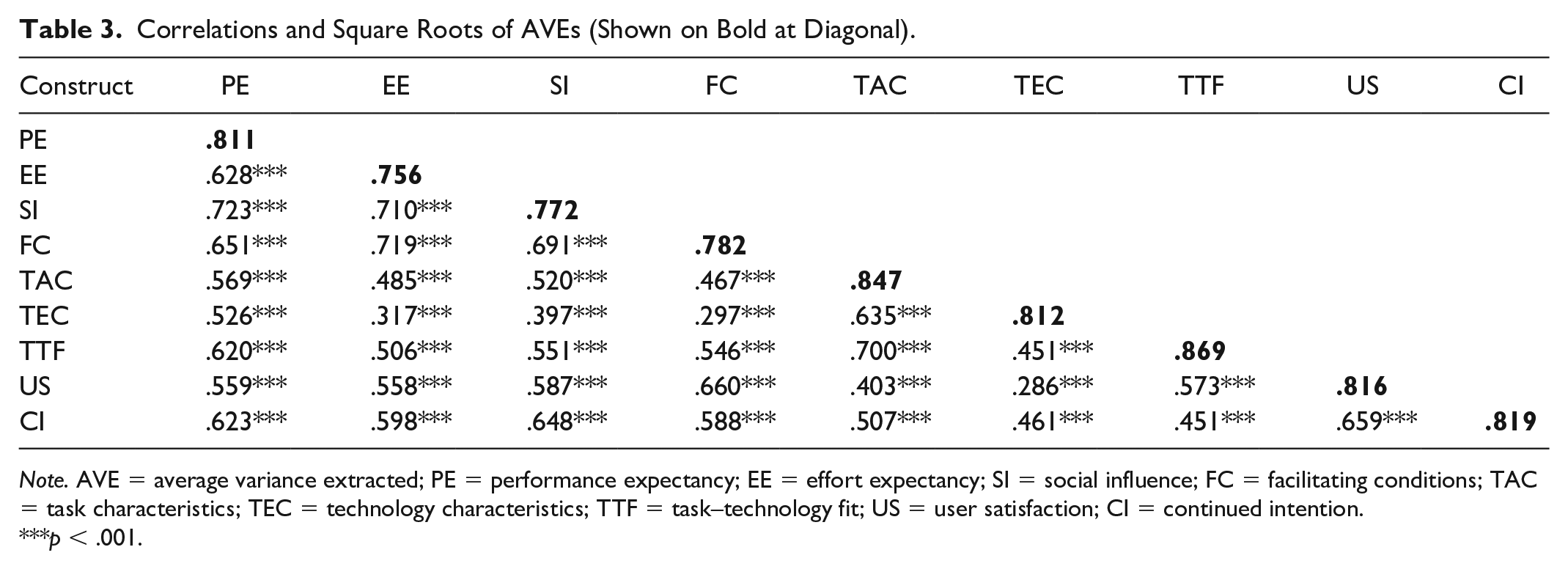
Note. AVE = average variance extracted; PE = performance expectancy; EE = effort expectancy; SI = social influence; FC = facilitating conditions; TAC = task characteristics; TEC = technology characteristics; TTF = task–technology fit; US = user satisfaction; CI = continued intention.
p < .001.
Goodness of Fit
Goodness of fit is tested to measure how well the model represented the data. Chi-square test is a common method to check the model–data fitness but chi-square values can be affected by the sample size (Bentler & Bonett, 1980). Because this research has a relatively large sample size, several fitness indexes such as root mean square residual (RMR), root mean square error of approximation (RMSEA), goodness-of-fit index (GFI), normed fit index (NFI), relative fit index (RFI), comparative fit index (CFI), parsimony goodness-of-fit index (PGFI), parsimony normed fit index (PNFI), and incremental fit index (IFI) were selected in the test. The testing results show that except GFI, which is slightly smaller than the recommend value, the other indexes all conform to fit standards. The model is of good fitness.
Hypotheses Testing
AMOS is adopted for the analysis. Figure 2 displays the value of R2 and the path coefficients. We used p = .05 as the significant level. According to the standardized path coefficient values in Table 4, nine of the hypotheses have been verified. Meanwhile, the standardized path coefficients show that all the relationships between latent variables and related observed variables have been verified, proving that all the observed variables can effectively reflect the characteristics of latent variables. Figure 2 indicates that continued intention is significantly determined by four variables, which are performance expectancy, effort expectancy, social influence, and user satisfaction, resulting an R2 of .644. It indicates that these four variables explain 64.4% of the construct continued intention. Likewise, facilitating conditions and TTF explain 53.6% of the construct user satisfaction. Technology explains 64.6% of the construct TTF. Effort expectancy and TTF explain 64.4% of the construct performance expectancy.

Path analysis.
The Results of Standardized Path Coefficient.

Note. CR = composite reliability; PE = performance expectancy; CI = continued intention; EE = effort expectancy; SI = social influence; FC = facilitating conditions; US = user satisfaction; TAC = task characteristics; TTF = task–technology fit; TEC = technology characteristics.
p < .05. **p < .01. ***p < .001.
The standard total effects on constructs are illustrated in Table 5. Students’ continued usage intention is mainly affected by technology characteristics (TEC), social influence (SI), effort expectancy (EE), TTF, user satisfaction (US), and performance expectancy (PE). Among these factors, US has the greatest influence on CI, followed by PE and SI. In addition to having a direct impact on CI, PE also has an indirect effect on CI through PE. TEC, EE, and TTF have a significant effect on PE. The influence of EE (0.744) is greater than TTF (0.213) and (0.172). US is influenced by TEC, TTF, and facilitating conditions (FC). FC has the greatest impact on US.
The Standard Total Effects on Constructs.

Note. TEC = technology characteristics; TAC = task characteristics; FC = facilitating conditions; SI = social influence; EE = effort expectancy; TTF = task–technology fit; US = user satisfaction; PE = performance expectancy; CI = continued intention.
Discussion
The UTAUT
According to the results of path analysis, performance expectancy (β = .210, p < .01), effort expectancy (β = .174, p < .05), and social influence (β = .281, p < .05) have positive effects on continued intention. This result is consistent with previous findings in the field of e-learning (El-Masri & Tarhini, 2017; Tan, 2013) and MOOC contexts (Mulik et al., 2018; Nordin et al., 2015). Among all the three factors affecting continued intention, the effects of performance expectancy and social influence are relatively greater. It reflects that as long as university students realize the usefulness of MOOCs on effective completion of learning tasks, improvement of learning performances, and expanding their physical skills as a result of the course, they will be inclined to use MOOCs continuously. Performance expectancy is student’s internal demand of MOOCs, whereas social influence comes from external requirement and perception of MOOCs.
The result indicates that students’ continued usage intention will be influenced by acquaintances around them, such as family members, teachers, classmates, and friends. Their classmates’ continued usage behaviors, teacher’s recommendations and support, the sense of personal recognition, as well as feeling of belonging to the learning communities after the enrollment and participation will all contribute to their continued intention of using MOOCs. In addition, the result also illustrates that social influence has a slightly greater significant influence on continued usage intention than performance expectancy. Some previous researches indicate that at the initial stage of adopting a new IS, the performance expectancy has greater influence on adoption intention than social influence (Attuquayefio & Addo, 2014; El-Masri & Tarhini, 2017; Thomas et al., 2013). These findings are opposite to our result. The reason may be that the above studies focus on the adoption of the IS but we focus on the continued usage behavior. After using MOOCs for a period, students’ perception and attitude toward MOOCs will be more susceptible to the attitudes and comments of the classmates and the social recognition from the online learning communities.
Although the influence of effort expectancy on continued intention is weaker than performance expectancy and social influence, effort expectancy is still a significant factor determining the continued intention. The reason may be that the present MOOC platform looks pretty good. Its interface is being more and more friendly while the usage becomes much easier. The learners do not need to pay much effort to master it. From the perspective of learners, the respondents basically belong to the “digital natives or digital generation.” They are generally equipped with good information literacy and excellent internet usage skills. In other words, there are no technical barriers for university students in using MOOCs to conduct learning. Therefore, the influence of effort expectancy on continued intention will be naturally reduced. Effort expectancy also has a significant positive influence on performance expectancy (β = .774, p < .001), indicating that when students pay less efforts or time to adapt to the operation and use of the MOOCs, their beliefs about the usefulness and value of MOOCs become stronger. The result is supported by a few similar studies, which prove that effort expectancy has a positive impact on performance expectancy (Joo et al., 2018; Shao, 2018; B. Wu & Chen, 2017; T. Zhou et al., 2010).
Facilitating conditions mainly refer to various software or hardware conditions that enable learners to access or use MOOCs. For example, the bandwidth of the internet can ensure watching the lectures smoothly; students can connect the campus Wi-Fi at any time, use portable terminal devices to visit the MOOC platform anywhere at any time. They can get effective support and solutions from the platform when problems occurred in MOOCs. The results show that facilitating conditions have no direct effect on continued intention, which is opposite to the result of Oh and Yoon (2014) and T. Zhou et al. (2010). This result may due to the fact that in most of the universities, it is very convenient for students to use various devices to log in to the MOOC platforms. However, facilitating conditions have an indirect effect on continued intention through user satisfaction. It means that, under good facilitating conditions, the learners will feel more satisfied when using MOOCs.
The results also demonstrate that user satisfaction will lay positive influence on continued usage intention, which has been proved by many other related studies (Hong et al., 2017; Hu & Zhang, 2016; Kaewkitipong et al., 2016; Roca et al., 2006). When students feel satisfied with the MOOC, they will keep firm loyalty to it and continuously use it.
The TTF
Hypotheses 7 to 10 address the relationship toward the TTF model. Technology characteristics are positively related to TTF (β = .808, p < .001), and TTF has a significant positive effect on user satisfaction (β = .305, p < .001). It proves that the technological attribute of MOOC platform works positively on TTF. Such technological advantages are mainly reflected from three aspects: The first is individualized interface, in some MOOC platforms, the students can configure the properties of the interface according to their personal preferences, such as the style, theme, color and so on; the second is customized content, that is, some MOOC platforms can push and show learning contents to the students based on their past learning experiences and personalized learning preferences; the third is diversified functions, that is, the MOOC platform can provide dynamic and interactive modules such as multiple-choice exams, programmed tests, in-video quizzes, and annotation tools. Meanwhile, a good TTF helps to promote students’ perceived satisfaction of MOOCs.
The influence of task characteristics on TTF is not significant. It is contrary to the findings of Yu and Yu (2010) and D’Ambra et al. (2013). This is possible due to the university students’ attitude or view toward the use of MOOCs. They generally consider it as an auxiliary approach which is mainly used for extending their knowledge about the course, collecting of literature, solution of difficult questions, and so on. Therefore, the crucial characteristics and values of MOOCs have not been fully explored and students fail to connect the characteristics of the task with TTF without in-depth perception of task characteristics.
Joint Effects Between UTAUT and TTF
Relationship between UTAUT and the TTF model is mainly reflected from the influence of TTF on performance expectancy. According to the results, the TTF has a significant positive influence on performance expectancy (β = .213, p < .001). It means that TTF have a positive influence on learner’s performance expectancy. This finding is also in accordance with T. Zhou et al. (2010). The fit between students’ learning requirements and the technologies provided by the MOOC platform will directly influence students’ expectation of the learning performances. The higher the fit degree is, the more useful the MOOC is considered to be perceived. Besides, both the facilitating conditions in the UTAUT model and the TTF in the TTF model have a significant positive effect on user satisfaction, and the facilitating condition has even greater influence than TTF.
Conclusion and Implications
Conclusion
We attempt to combine the UTAUT model, the TTF model, and user satisfaction together to explore the determinants that influence university students’ continued intention to use MOOCs. The results indicate that technological factors such as performance expectancy and effort expectancy are crucial predictors of continued intention. TTF has an indirect influence on continued intention through user satisfaction. It means, when examining the factors influencing students’ continued usage intention, we not only need to focus on perceptions toward technologies based on the theoretical model but also should pay attention to the matching degree of task and technology (T. Zhou et al., 2010). In addition, social factors (social influence) and user satisfaction should also be considered valuable determinants for explaining the continued usage behavior in MOOCs.
Theoretical Implications
First, the findings identify that the proposed theoretical model can explain the factors that affect university students’ continued intention of using MOOCs very well. Performance expectancy, effort expectancy, and social influence are important determinants of continued intention. However, facilitating conditions did not directly influence continued intention in the MOOCs, but indirectly affect continued intention with a mediating role for user satisfaction. Altogether, the above results are basically in line with the presupposition of the UTAUT model, presenting that the UTAUT model is suitable to the continued usage intention analysis in the MOOC context.
Second, the proposed theoretical model shows that the fit degree of functionalities of MOOCs and specific learning tasks will enable students to perceive higher level of satisfaction. With regard to continued intention, the results present that, students are more inclined to expend effort to reuse and are more satisfied with the course content and related service if they feel that it is beneficial for them to carry out their individual learning tasks (Yu & Yu, 2010). It also provides an understanding of the relative influence between technological and functional characteristics of MOOCs and learning task characteristics.
Third, the study enriches our understanding of the interaction between technology perceptions and TTF. The findings indicate that performance expectancy is affected by effort expectancy as well as the TTF. To increase students’ perceived usefulness of MOOCs, the design and organization of MOOCs should not merely focus on the perception of ease of use, sufficient up-to-date content and excellent learning support services that can fit students’ needs should also be provided (Yu & Yu, 2010). Meanwhile, we should attach great importance to performance expectancy, which is more often investigated from a technology perception and adoption perspective (T. Zhou et al., 2010).
Practical Implications
First, as technology characteristics have a positive influence on TTF, we should optimize the technological characteristics of the MOOC platform to make the using process easier, more intelligent, and more personalized. For example, we should make sure that all the webpage links within the MOOC platform are safe and accessible, the platform can be compatible with different terminal devices and operating systems, and the learners can configure the properties and styles of the interface by themselves. To summarize, the platform should excavate and identify students’ interests and preferences and provide comfortable and personalized usage experience.
Second, because TTF has a significant positive effect on user satisfaction and indirectly affects continued intention, it is necessary to develop specific technical solutions that meet the learning tasks and requirements of the learners, so they can participate with emotions, cognitions, and operations (Cho, 2015). The MOOC platform shall accurately acquire and present students’ needs from the perspectives of establishing student’s learning model, collecting the data of learning behaviors, and analyzing the data automatically. What is more, the platform should be able to push proper learning materials that suit the students’ individual characteristics and learning demands. It is suggested to optimize and coordinate the course content allocation pattern, so that the course supplying mode and students’ demand can highly fit.
Third, as social influence is the most important factor to predict continued intention to use MOOCs, it is necessary to expand the social influence of the MOOC platform through various approaches. It is important to improve the credibility and authority of the MOOC platform to expand the social effects to the latent participants. The teachers and course designers should ensure the high performance and usefulness of the course, which are connected with reputation and quality communicated to the students. The course designers are also suggested to stimulate and strengthen students’ interactions by establishing various online learning communities in the MOOCs. This does not only help to foster the students’ sense of belonging to the community and loyalty to the platform but also help to stimulate continued intention of other students in the learning community.
Limitations and Future Research
Any research may have its limitations, so does this one. Our study has the following limitations that should be addressed in the future.
First, this research just involves Chinese university students who enroll in MOOCs. They tend to have some common features in personal experience and education background. Therefore, it is possible that our research may have certain degree of particularity so that it may hard to be generalized to other districts or regions (Yang et al., 2017). It should be possible for future researchers to collect information and data from different locations and make a comparison with this research to check any difference.
Second, we did not take some variables concerning personal individualities—sex, age, and use experience—into consideration when we design the research model. However, these external demographic variables are included in the original UTAUT model and may also play a moderating role for the continued intentions of students. Future research should integrate these variables as well as psychographic variables (e.g., usage motives, lifestyles, and values) to test whether the research model is still valid (Oh & Yoon, 2014).
Third, in this study, the completeness of MOOCs may vary from major to major, and the MOOC courses that students participate in may also be different, which may affect the students’ responses. From the above consideration, the differences of majors and the characters of the courses may also have positive or negative influences on the students’ continued intention to use MOOCs. Future study should consider these two factors and let them be involved in the optimized research model.
Footnotes
Appendix
Survey Items.

| Construct | Items | Measures | References |
|---|---|---|---|
| Performance expectancy (PE) | PE1 | I would find MOOCs useful in my studies | Escobar-Rodríguez et al. (2014), Thomas et al. (2013), Khechine et al. (2014) |
| PE2 | Using MOOCs would help me solve problems in my studies | ||
| PE3 | Using MOOCs would enable me to accomplish tasks more quickly. | ||
| PE4 | The use of MOOCs increases the efficiency of my study | ||
| Effort expectancy (EE) | EE1 | It is easy for me to operate MOOCs skillfully | Escobar-Rodríguez et al. (2014), Thomas et al. (2013), Khechine et al. (2014) |
| EE2 | It is easy for me to learn how to use MOOCs | ||
| EE3 | I find MOOCs easy to use | ||
| EE4 | I have no difficulty in using MOOCs | ||
| Social influence (SI) | SI1 | People who are important to me think that I should use MOOCs. | Escobar-Rodríguez et al. (2014), Thomas et al. (2013), Khechine et al. (2014), Attuquayefio & Addo (2014) |
| SI2 | I find that using MOOCs is a fashionable and popular way to study in universities. | ||
| SI3 | All my classmates are using MOOCs | ||
| SI4 | Professors in my institution have been helpful in the use of MOOCs. | ||
| SI5 | Using MOOCs makes me feel that I belong to the learning community. | ||
| Facilitating conditions (FC) | FC1 | It is convenient for me to study in an MOOC platform | Escobar-Rodríguez et al. (2014), Thomas et al. (2013), Khechine et al. (2014), Attuquayefio & Addo (2014) |
| FC2 | I have the hardware necessary to use MOOCs | ||
| FC3 | I have the knowledge necessary to use MOOCs | ||
| FC4 | MOOCs are compatible with other learning resources I use | ||
| FC5 | Support from the platform is available when problems are encountered in MOOCs. | ||
| Task characteristics (TAC) | TAC1 | I need to acquire online learning resources related to the courses I study. | Guo et al. (2016), Oliveira et al. (2014), Lu & Yang (2014) |
| TAC2 | I need to access MOOCs conveniently and quickly | ||
| TAC3 | The contents of MOOCs should be of high quality | ||
| TAC4 | The contents of the online courses should meet my learning requirement. | ||
| Technology characteristics (TEC) | TEC1* | MOOC platform has the function of resource acquisition and sharing. | Guo et al. (2016), Oliveira et al. (2014), Lu & Yang (2014) |
| TEC2 | MOOC platform provides social interaction services | ||
| TEC3 | MOOC platform provide high-quality learning materials. | ||
| TEC4 | MOOC platform is convenient to access through various mobile devices. | ||
| TEC5 | MOOC platform provides multiple evaluation functions | ||
| Task–technology fit (TTF) | TTF1 | MOOCs can meet all aspects of my learning requirement | Lin & Wang (2012), McGill & Klobas (2009) |
| TTF2 | The services provided by MOOCs can meet my requirement. | ||
| TTF3 | The functions of MOOC platform can meet my requirement. | ||
| TTF4 | The quality of MOOCs can meet my requirement | ||
| User satisfaction (US) | US1 | I am satisfied with the functions provided by the MOOCs | Lin & Wang (2012), Dağhan & Akkoyunlu (2016) |
| US2 | I am satisfied with the services provided by the MOOCs | ||
| US3 | I am satisfied with the contents of MOOCs | ||
| US4 | I am satisfied with the quality of MOOCs | ||
| US5 | Overall, I am satisfied with the MOOCs I use | ||
| Continued intention (CI) | CI1 | I intend to continue to use MOOCs for assisting classroom learning. | Lin & Wang (2012), Dağhan & Akkoyunlu (2016), Guo et al. (2016), B. Wu & Chen (2017) |
| CI2 | I intend to continue to use MOOCs for enriching my knowledge. | ||
| CI3 | I will continue using MOOCs increasingly in the future | ||
| CI4 | I will recommend other people to use MOOCs | ||
| CI5 | Overall, I intend to continue to use MOOCs in the future |
Note. The items marked with * were deleted in the final analysis. MOOC = massive open online course.
Declaration of Conflicting Interests
The author(s) declared no potential conflicts of interest with respect to the research, authorship, and/or publication of this article.
Funding
The author(s) received no financial support for the research, authorship, and/or publication of this article.
