




Abstract
This study employs a multi-period DID model based on Chinese urban panel data from 2006 to 2022. It innovatively constructs a theoretical analytical framework for the “local-global” environmental regulation policy combination between urban development units and overall development, exploring the synergistic pollution reduction and carbon emission reduction effects of LCCPP and the NEVPAS. This framework reveals the “theoretical black box” of how policy combinations influence urban green development. The results indicate that, first, compared to control cities, pollution emissions and carbon emissions in “dual pilot” cities decreased by an average of 2.86% and 4.89%, respectively, and the synergistic effects of the “dual pilot” policy were better than those of the “single pilot” policy. Second, the positive impact of the “dual pilot” policy on pollution reduction and carbon emission reduction is more pronounced in eastern regions, non-resource-based cities, and areas with high environmental regulation intensity. Third, mechanism tests show that the “dual pilot” policy can positively influence pollution reduction and carbon emission reduction through three mechanisms: energy conservation and emission reduction, innovation induction, and economic agglomeration. Additionally, the “dual pilot” policy exhibits significant spatial spillover effects, not only effectively reducing local pollution and carbon emissions but also exerting a notable inhibitory effect on neighboring areas. Further research reveals that when the “dual pilot” policy exerts its pollution reduction and carbon emission reduction effects, it can enhance regional green output levels, strengthen property rights protection, and effectively promote regional green high-quality transformation without sacrificing economic growth.
Introduction
Since the reform and opening-up, China has experienced rapid industrialization and urban expansion, which have significantly contributed to economic development but also led to escalating environmental degradation. Data from the Ministry of Ecology and Environment indicate a consistent decline in carbon dioxide (CO2) emissions per unit of GDP since 2017. Nevertheless, between 2011 and 2021, China’s average annual absolute increase in carbon emissions reached 2.46 ppm, based on statistics from the China Ecological and Environmental Status Bulletin (2015–2022). Although the average PM2.5 concentration in 2022 was reduced by 42% relative to 2015 levels, 25.4% of cities still failed to meet air quality standards. Additionally, the national average temperature in 2022 rose to 10.71°C, an increase of .61°C compared to 2007 (calculated according to the Statistical Bulletin of National Economic and Social Development [2007–2022]). President Xi Jinping addressed the 75th United Nations General Assembly and committed China to peaking carbon emissions by 2030 and achieving carbon neutrality by 2060 on September 22, 2020. This strategic direction was reaffirmed in the report of the 20th National Congress of the Communist Party of China.
According to the changing trend in the proportions of CO2 and sulfur dioxide (SO2) emissions across different sectors in China (as shown in Figure 1), on the one hand, from 1990 to 2021, CO2 emissions from China’s transportation and electricity production sectors not only exhibited a clear upward trend, but also remained persistently high in the industrial and construction sectors, indicating that the Chinese government continues to face severe pressure in reducing carbon emissions. On the other hand, SO2 is a major source of air pollution, primarily generated from vehicle exhaust and coal combustion. However, during the period from 1990 to 2020, SO2 emissions from China’s industrial, residential, and transportation sectors all increased to varying degrees, with the industrial sector’s share of sulfur dioxide emissions surging from 40% in 1990 to 53% in 2020. To accelerate the achievement of the “dual-carbon” targets, significantly improve air quality, and create a livable environment, the Chinese government, because the transportation, electricity production, and industrial construction sectors are major sources of greenhouse gas emissions and significant contributors to air pollution, has taken action from the transportation sector, by introducing the new energy vehicle promotion and application strategy (NEVPAS) to accelerate the green transformation of transportation, and from the broader perspective of urban development across all fields of economic and social life by launching the low-carbon city pilot policy (LCCPP) to comprehensively promote green transformation. Among them, the core objective of the NEVPAS is to incentivize market actors to substitute electricity and other clean energy sources for traditional fossil fuels through administrative subsidies and related measures. This approach directly reduces the use of fossil fuels and consequently decreases the emissions of sulfur compounds and carbon compounds from the transportation sector at the source. Meanwhile, the core meaning of the LCCPP lies in minimizing emissions of greenhouse gases and harmful pollutants and achieving green urban development.

Proportional shares of CO2 and SO2 emissions by sector in China.
Therefore, the environmental regulation policy NEVPAS and LCCPP both ultimately aim to reduce carbon emissions and pollutant discharges. Existing studies have also shown that both the NEVPAS and the LCCPP can independently promote regional green and sustainable development (Guo & Ren, 2024; Su et al., 2021). However, only when policies are reasonably combined and applied in coordination can they exert their maximum effect. As a result, the combination of these two policies forms a local-global environmental regulation framework that may produce environmental development outcomes that surpass the effects of individual policies, thereby releasing the potential of policy synergy. Policy synergy refers to a situation in which the combined outcome generated by multiple policy tools working in coordination significantly exceeds the sum of the outcomes produced by each policy implemented separately. For example, the Chinese government encourages investment in green sectors by providing subsidies or tax incentives for renewable energy. At the same time, it imposes strict carbon tax policies to increase the cost of using fossil energy, creating economic constraints. These are further complemented by green finance and other credit policies to guide capital allocation. Under the joint influence of economic incentives, market mechanisms, and environmental regulations, such coordinated measures can promote emission reductions and green transition more effectively than any single policy alone. In this context, whether the dual pilot policies of the NEVPAS and the LCCPP can generate a “greater than the sum of its parts” policy synergy remains rarely discussed in academic research. Moreover, since environmental pollution and carbon dioxide emissions share the same root causes and exhibit high consistency in control concepts and management measures, achieving joint reduction of pollution and carbon emissions is feasible. Therefore, it is necessary to explore the combined effect of the NEVPAS and the LCCPP on pollution and carbon emission reduction, as well as the implementation plans and sequencing of the policies. Such analysis can provide action-oriented guidance for promoting coordinated pollution and carbon reduction and achieving a green and low-carbon transformation. In conclusion, this article attempts to apply qualitative analysis to elaborate the logical relationships among the research themes and construct a theoretical analytical framework. It then proceeds to adopt quantitative methods by manually collecting and organizing data on policy pilot implementation and emission statistics at the city level in China. A multi-period DID model is constructed to identify the causal relationship between the dual pilot policy and urban carbon and pollutant emissions. Furthermore, robustness checks including heterogeneous robust DID estimators, PSM-DID, and instrumental variable regression methods are employed to ensure the rigor and reliability of the research conclusions.
The marginal contributions of this paper are as follows. First, by combining the NEVPAS with the LCCPP, this paper constructs an integrated policy synergy analytical framework and explores the coordinated effects of the two policies on pollution and carbon reduction. This not only enriches the theoretical understanding of policy mix and externalities but also provides guidance for pollution and carbon reduction. Second, starting from the dimensions of energy conservation and economic agglomeration, this paper examines the mechanisms through which the two policies jointly influence pollution and carbon reduction, strengthens the causal relationship between the two policies and pollution and carbon reduction, and reveals the theoretical black box of how these policies promote green urban development. Third, by identifying the sources of heterogeneity in the synergistic effects of the two policies, this article offers theoretical insights and decision-making references for different regions to maximize the pollution and carbon reduction potential of the dual pilot policies.
Institutional Background and Literature Review
Institutional Background
In the early stages of ecological civilization construction in China, the government adopted a separate governance approach for pollution control and carbon reduction. However, environmental pollutants and carbon emissions exhibit a high degree of consistency in terms of origin and spatial distribution, as their primary sources are all rooted in fossil energy consumption. The “Opinions of the Central Committee of the Communist Party of China and the State Council on Comprehensively Promoting the Construction of a Beautiful China” explicitly call for accelerating the implementation of coordinated pollution and carbon reduction projects and initiating pilot programs for coordinated innovation across multiple sectors and levels. As the transportation, energy production, and industrial sectors are major sources of greenhouse gas and pollutant emissions in urban areas, the Chinese government has accordingly introduced the NEVPAS and the LCCPP to promote green and low-carbon urban development. On one hand, the NEVPAS, through financial subsidies, supporting infrastructure, and industrial assistance, encourages market actors to adopt electricity and other clean energy sources as substitutes for conventional fossil fuels. This directly reduces the consumption of fossil fuels dominated by coal and petroleum and fundamentally decreases harmful vehicle emissions from the transportation sector. On the other hand, the LCCPP, through holistic institutional design and structural transformation at the city level, uses diversified governance tools to promote industrial structure optimization, low-carbon allocation of production factors, and upgrading of green consumption. This leads to a fundamental restructuring of the urban development pattern, with the ultimate goal of achieving coordinated carbon reduction and pollution control. In summary, the NEVPAS and the LCCPP share a common policy objective. Through the clean transformation of urban energy use and the embedded application of green technologies, these policies facilitate the formation of a coordinated pathway for pollution and carbon reduction that integrates structural mitigation with source reduction. The following section introduces the two policies in more detail.
(1) LCCPP: The LCCPP aims to achieve high-quality economic development while simultaneously reducing energy consumption and carbon emissions. It focuses on five key tasks: optimizing the energy structure, advancing low-carbon industrial development, improving energy conservation and efficiency, increasing carbon sinks, and promoting low-carbon and green lifestyles and consumption patterns. In 2010, the National Development and Reform Commission designated the first batch of pilot areas, including five provinces such as Shaanxi and Yunnan, and 8 cities including Xiamen and Shenzhen. At the end of 2012, a second batch was launched covering 28 provinces and cities such as Hainan, Jilin, and Suzhou. In 2017, the third batch was designated, involving 41 cities such as Shenyang and Nanjing, and 4 counties. These pilot areas were intended to lead, demonstrate, and promote nationwide low-carbon development. To date, low-carbon pilots have covered 31 provinces in China (excluding Hong Kong, Macao, and Taiwan due to data unavailability). Pilot provinces and cities have undertaken substantial work in areas such as institutional improvement, industrial restructuring, energy efficiency enhancement, and public awareness, exploring green and low-carbon development pathways suited to local realities.
(2) NEVPAS: In 2013, the State Council issued the “Air Pollution Prevention and Control Action Plan” also known as the “Ten Measures for Air,” which clearly emphasized the need to strengthen pollution control from mobile sources and vigorously develop new energy vehicles. Reducing pollution and carbon emissions from the automotive sector once again became an urgent policy agenda. In September 2013, the Ministry of Finance, the Ministry of Science and Technology, the Ministry of Industry and Information Technology, and the National Development and Reform Commission jointly issued the “Notice on Continuing the Promotion and Application of New Energy Vehicles.” By February 2014, after 2 rounds of promotion and application efforts, a total of 88 cities, including Beijing, Tianjin, Taiyuan, Jincheng, and Dalian, were selected to take the lead in implementing the strategy. This initiative laid a solid foundation for the development of the NEV industry.
Literature Review
Evaluation of the Effects of Single Pilot Policies on Pollution and Carbon Reduction
Chinese government has introduced a series of measures aimed at reducing carbon emissions and improving air quality since 2008. Based on the differences in implementing entities, these measures can be categorized into micro-level environmental regulatory policies targeting individual enterprises’ green transformation and macro-level environmental regulatory policies focusing on the green transformation of entire urban regions. For enterprise-level policies, the primary mechanism lies in constraining individual firms’ production behaviors to reduce environmental pollution. While urban pollution originates also from fossil fuel consumption in energy production and transportation sectors. Therefore, in order to advance the green transformation of the economy and society, the Chinese government has also adopted macro-level approaches, including the promotion and application of NEVs to promote cleaner urban transportation, and the implementation of LCCPP to facilitate comprehensive urban green upgrading. These two policies have consequently become integral components of China’s urban green development framework.
Currently, research on the effects of carbon and pollutant reduction is abundant, but the majority of these studies focus on single policies or single emission reduction targets. The NEVPAS, as a core policy instrument for achieving China’s “dual-carbon” goals, has opened new pathways for emission reduction through the rapid development of its industry. To promote NEVs, the government has implemented both fiscal and non-fiscal policy tools, such as vehicle purchase subsidies (Chen et al., 2021), free special license plates (Li et al., 2019), and subsidies for charging infrastructure (Li et al., 2017). These research have affirmed the positive impact of NEVs in reducing carbon emissions and improving environmental quality. Furthermore, upgrading industrial structures, optimizing energy consumption patterns, and improving energy efficiency are key mechanisms through which NEVs contribute to energy saving and emission reduction (Su et al., 2021; Wang et al., 2022). Guo and Ren (2024), using a progressive DID model, examined the significant carbon-reduction effects of the LCCPP. Zhang (2020) found that the policy had significant carbon mitigation effects, especially in western cities. Zheng and Guo (2022) analyzed the spatial spillover effects of the policy and observed that it significantly reduced carbon emissions in neighboring non-pilot cities.
The emergence of environmental externalities stems from their nature as public goods. A typical case of negative environmental externality arises when the private cost of production borne by firms or individuals does not match the social cost caused by pollution, resulting in market inefficiency (Owen, 2004). As the economy and society increasingly move toward cleaner and low-carbon development, the concept of positive environmental externalities has become more salient. For instance, the promotion and use of green technologies such as new energy vehicles represent such positive externalities. Kwon (2015) argued that green technologies can substitute for conventional technologies and thus reduce environmental damage, thereby producing positive environmental externalities. However, due to the production cost of new energy vehicles and the private costs borne by manufacturers tend to exceed the social cost. If the positive external benefits of new energy vehicle producers are not compensated, high production costs become barriers to market entry, and the resulting positive externalities may vanish (Owen, 2006). Market failure creates a necessary condition for government intervention (Claassen, 2016). In economics, regulatory tools available to the government include quantity control and price control. However, the effective implementation of both approaches depends heavily on government capacity, which increases the difficulty of regulation and may lead to government failure. The goal of government regulation is to internalize externalities. Among the most prominent methods for externality internalization are Pigouvian taxes and the Coase theorem. Baumol and Oates (1971) argued that in the absence of transaction costs, both approaches can effectively resolve externality problems. The former relies on administrative instruments to compensate for the gap between private and social costs, while the latter emphasizes property rights clarification to facilitate price discovery (Simpson, 1996). The NEVPAS and LCCPP serve as vivid examples of government regulation in practice. In particular, the promotion strategy relies on government subsidies to bridge the gap between private and social costs, effectively unleashing the environmental positive externalities of NEVs and opening up China’s market for their adoption. The implementation of the LCCPP further demonstrates that government regulation is an effective means of internalizing externalities.
Although the academic community generally recognizes the positive environmental externalities of the NEVPAS and the LCCPP, some debates remain. On one hand, some studies argue that new energy vehicles still rely on electricity generated from conventional thermal power plants. Using linear optimization techniques, some scholars have found that an increased proportion of electric and hybrid vehicles raises the load on thermal power generation, leading to further increases in carbon and pollution emissions (Holland et al., 2016). On the other hand, the existence of the energy rebound effect suggests that low carbon city initiatives may also experience rebounds in carbon and pollutant emissions (Li et al., 2023).
Synergistic Emission Reduction Effects of Policy Combinations
To tackle pressing environmental challenges, China has implemented a wide array of environmental regulatory measures. Recently, scholarly attention has progressively shifted toward the investigation of interactive and synergistic outcomes arising from policy combinations. Existing research on policy synergy in the environmental domain falls into two major categories. The first focuses on evaluating how different policy types, when implemented together, influence environmental outcomes. For instance, Xian et al. (2024) explored the interplay between carbon reduction and pollution control policies, revealing that the effectiveness of combined emission reduction strategies varies by sector, pollutant type, and carbon dioxide emissions. Similarly, Zhu and Yu (2023) assessed the joint impact of emission trading schemes for both pollution and carbon, constructing three policy scenarios to analyze their effectiveness in pollution mitigation and policy alignment. They found that combined policies are more effective in reducing sulfur dioxide emissions, carbon trading alone proves more efficient for lowering carbon dioxide emissions compared to either pollution trading or policy integration. In another study, Guo and Ma (2023) investigated the combined effects of the Broadband China strategy and the LCCPP on environmental quality. Their findings suggest that dual pilot policies outperform single-policy interventions in reducing pollution levels and generate significant spatial spillover effects.
The second strand of research concentrates on the aggregated effects of multiple policy instruments within a single policy domain. Han et al. (2023) investigated the joint implementation of two innovation-oriented initiatives—the national independent innovation demonstration zone and the innovative city pilot policy—to evaluate their combined influence on carbon emissions. The results indicate that dual pilot policy yield superior outcomes in terms of both reducing carbon emissions and enhancing carbon efficiency. These findings highlight that policy bundling may lead to overlapping effects, and that constructive interaction between market mechanisms and governmental regulation constitutes a critical pathway for enhancing policy performance.
While existing research has extensively examined the economic and social effects of the NEVPAS and the LCCPP, it remains unclear whether each policy individually achieves coordinated carbon and pollution reduction. Furthermore, do the two policies conflict or complement each other in the same city? How can their effects be maximized? These questions require further exploration.
Theoretical Analysis and Research Hypothesis
Basic Mechanism of the Dual Pilot Policy Empowerment
Overall, the low-carbon transition of the transportation sector, when combined with environmental policy, can generate synergistic effects that promote coordinated pollution and carbon reduction in pilot cities. At the policy objective level, the NEVPAS aligns with the development goal of the LCCPP by advancing the green and low-carbon transformation of transportation. At the policy implementation level, the NEVPAS activates green consumption potential and facilitates urban consumption structure transformation through subsidy incentives, which corresponds directly to the green consumption upgrading strategy. The LCCPP promotes a green revolution in lifestyle, while simultaneously placing institutional constraints on firms’ emissions behavior. These efforts provide institutional guarantees for improving the ecological environment of innovation-oriented pilot cities and for stimulating the intrinsic momentum of various market entities toward green and low-carbon transformation (Han et al., 2024). The two pilot policies complement each other. The NEVPAS fosters a solid foundation for green consumption and renewable energy use, thereby creating stable preconditions for the development of clean energy in the LCCPP. Meanwhile, the environmental regulations under the LCCPP ensure that key resources are directed toward green production activities. Through joint implementation, the two policies promote coordinated pollution and carbon reduction. Specifically, the LCCPP sets carbon reduction targets and development plans, guiding and advancing urban low-carbon construction through various methods. It is characterized by relatively soft constraints, sectoral specificity, and a composite policy structure (Xu & Cui, 2020). The NEVPAS accelerates the substitution of new energy vehicles for traditional fuel vehicles through subsidies and other means, thus reducing the dependence on non-renewable energy.
Although the implementation mechanisms of the NEVPAS and the LCCPP differ, they share the same fundamental goal. Moreover, the LCCPP provides complementary low-carbon development policies that support the implementation of the NEVPAS. In addition, cities implementing both policies face greater pressure to reduce carbon emissions, leading to higher levels of government attention. Firms may increase investments in research and development, improve carbon productivity and energy efficiency through technological innovation to meet environmental regulatory requirements. In this way, dual policy implementation can produce an additive effect where the whole is greater than the sum of its parts. Based on this, this paper proposes hypothesis 1:
Transmission Mechanisms of the Dual Pilot Policy Empowerment
Energy-Saving Effect
Under the coal-dominated energy structure, China continues to face considerable pressure in advancing its energy transition (He et al., 2023). The implementation of the dual pilot policies can effectively promote the transformation of urban energy consumption patterns, facilitating coordinated pollution and carbon reduction. On one hand, the substitution of traditional fuel-powered vehicles by NEVs can increase the input of clean energy. On the other hand, low carbon city pilot regions are required to promote a functional transition from industrial-based urban structures to service and commercial-oriented urban systems to meet the prescribed policy targets. Therefore, the dual pilot policies can promote regional pollution and carbon reduction by driving a green transformation in energy consumption.
Innovation Effect
The construction of the dual pilot policy requires technological progress as a key supporting foundation (Guo & Ma, 2023). On one hand, the NEVPAS can exert pressure on related industries and the energy production sector to achieve technological upgrading (Wang, Sun, et al., 2024). This process facilitates coordinated innovation in green technologies, enabling technological substitution, and upgrading in the transportation and energy sectors. As a result, it reduces resource and energy waste and strengthens the green development capacity of all relevant production sectors. This also encourages the innovation of business models, compelling firms to optimize the utilization and allocation of resources and thus realize green and low-carbon development (Llopis-Albert et al., 2021; Moretti & Biancardi, 2020). On the other hand, existing studies widely acknowledge that technological progress is an effective approach to addressing environmental pollution. According to the Porter hypothesis, technological innovation can offset the costs associated with environmental regulation and thereby improve environmental quality. Moreover, technological innovation can exert a strong inhibitory effect on environmental pollution. Therefore, the dual pilot policy can accelerate urban pollution and carbon reduction through its innovative effects.
Agglomeration Effect
The dual pilot policy accelerates economic agglomeration through policy incentives, financial support, and talent attraction. Specifically, the LCCPP alleviates financing constraints and innovation risks for the low-carbon sector, stimulates demand for low-carbon innovation talent and fosters the rapid growth of low-carbon industries, creating new urban growth poles. Meanwhile, the NEVPAS leverages policy incentives such as fiscal subsidies to boost investment, R&D, and production enthusiasm among new energy vehicle enterprises, thereby accelerating the expansion of the industry in pilot cities. Furthermore, economic agglomeration is a crucial pathway for carbon reduction. Industrial and talent clusters enable efficient knowledge sharing and reduce communication costs, promoting the integration of academia, industry, and research. Based on this, this paper proposes hypothesis 2:
This paper constructs a logical framework following the analytical approach of “policy shock-behavioral process-implementation outcome” (as illustrated in Figure 2). The NEVPAS and the LCCPP can be coupled to form a transmission chain of “technology-biased progress, agglomeration, and energy efficiency improvement.” Overall, the NEVPAS plays the role of driving the optimization of local energy consumption structure through a localized and sector-specific approach. And the LCCPP provides technological, financial, and institutional spillovers to local pilot cities. These two policies are contributing to the coordinated advancement of pollution and carbon reduction goals in pilot regions. Therefore, the dual pilot strategy aligns with the institutional design principle of “tiered coordination” commonly observed in multi-level governance systems. The subsequent analysis in this article will be developed based on this logical framework.
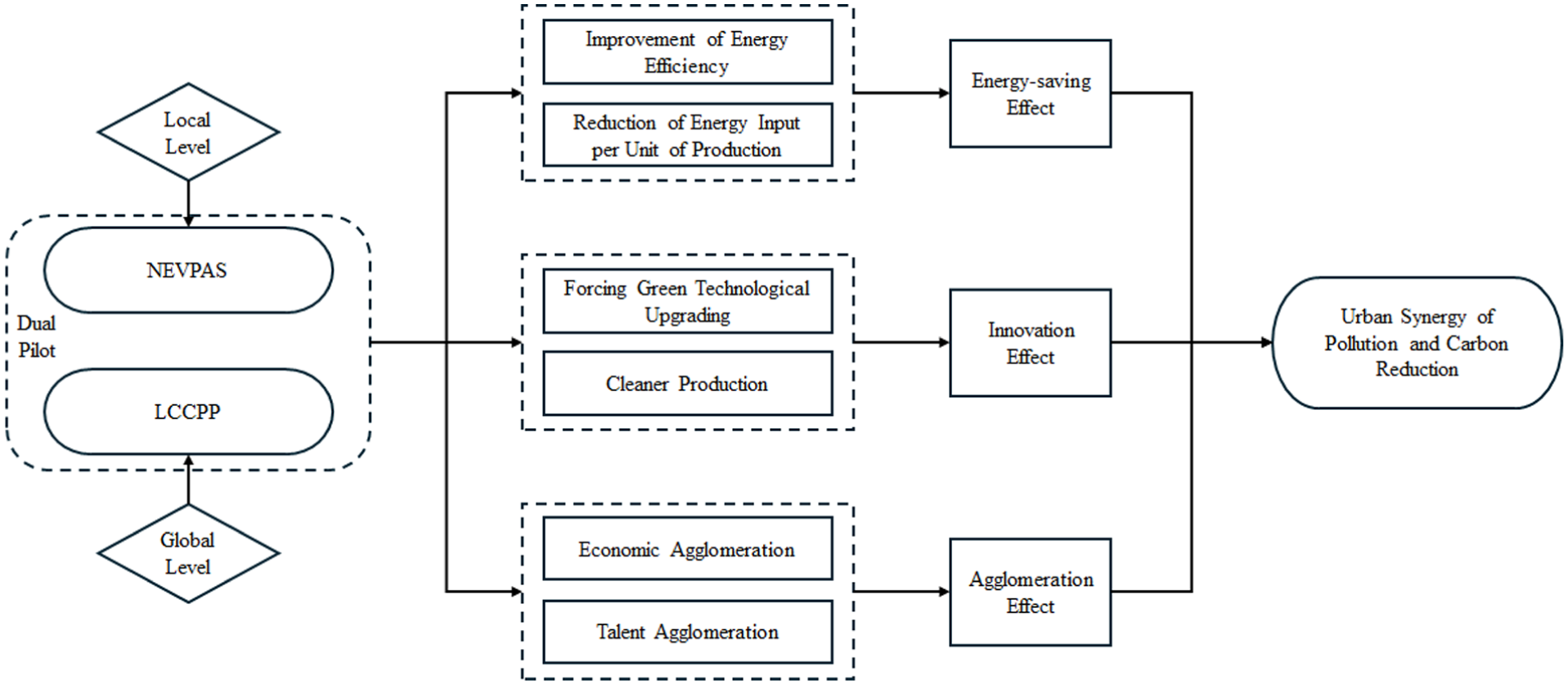
Analytical framework of the dual pilot policy logic.
Model Construction and Variable Selection
Model Specification
This study employs the DID model to evaluate the effects of the NEVPAS and the LCCPP dual pilot policy. The econometric model is specified as follows:

In this model, Yit denotes the dependent variables, encompassing both pollution emission levels and carbon emission levels. The key independent variable, EVLC it , is a binary indicator capturing whether the dual pilot policy has been implemented. It takes the value of 1 if a city has adopted both policies in the given year or any subsequent year, and 0 otherwise. Xit represents a vector of control variables, which will be described in detail later. μi captures individual (city-specific) fixed effects, while time fixed effects are also included. εit denotes the stochastic error term. The coefficients α1 and α2 reflect the estimated effects of the explanatory variables on the Yit.
Variable Selection
Dependent Variables
This study selects city-level PM2.5 concentration to represent pollution emission scale (PM2.5) and city-level carbon dioxide emissions to represent carbon emission scale (CO2).
Independent Variable
The NEVPAS and the LCCPP dual pilot policy (EVLC). This study constructs the variable using the interaction term of treat i and after it , where treat i represents the grouping dummy variable, assigned 1 if the city is designated as a dual pilot policy implementer, otherwise 0. after it , represents the time dummy variable, assigned 1 for the year when the city begins policy implementation and subsequent years, otherwise 0. Similarly, the heterogeneity analysis and the single pilot city variable are defined using the same approach.
Control Variables
Drawing on the methodologies of Yi et al. (2022) and Xian et al. (2024), this study incorporates a set of control variables to account for factors potentially influencing the outcomes. These include regional economic development level (pGDP), industrial scale (Industrial), level of social consumption (Consumption), urban population density (Density), local government fiscal strength (Fiscal), foreign direct investment (FDI), urban carbon sink capacity (GL), and environmental regulation (ER). Detailed descriptions of data sources and variable definitions are provided in Table 1.
Variable Names, Symbols, Definitions, and Data Sources.

Mechanism Variables
(1) Energy-saving effect: Following Shao et al. (2022), this is measured by the ratio of regional GDP to total energy consumption (lnEGDP). Considering that changes in unit GDP energy consumption may also be influenced by GDP output, log-transformed per capita energy consumption (lnEnergy) is used as a robustness check.
(2) Innovation effect: In line with the approach of Wang, Wang, and Liu (2024), this study measures green technology innovation (GTI) by calculating the share of green patent applications relative to the total number of regional patent applications. To assess the robustness of the results and capture the quality dimension of green innovation, the proportion of green invention patent applications within total regional invention patent applications (GTIQ), as proposed by Li and Zheng (2016), is also employed.
(3) Agglomeration effect: According to Hao et al. (2023), economic agglomeration is commonly measured by employment density and economic density. Following Zeng et al. (2023), this study adopts log-transformed employment density, measured as the ratio of total employment to administrative land area (lnEmploydens), and log-transformed economic density, measured as the ratio of regional GDP to administrative land area (lnEcondens).
Due to data availability, this study excludes cities such as Lhasa and Shigatze, as well as Hong Kong, Macau, and Taiwan. The final sample comprises panel data from 254 cities for the period 2006 to 2022. Missing data is supplemented using interpolation methods. To eliminate dimensional differences, log transformation is applied to non-dummy and non-percentage variables among the dependent and control variables. Variable names, symbols, definitions, and data sources are presented in Table 1.
Regression Results and Analysis
Benchmark Regression Results Analysis
Table 2 reports on the baseline regression outcomes regarding the pollution and carbon mitigation impacts of the dual pilot policy. Columns (1) and (4), which exclude all control variables, show that the estimated coefficients for the dual pilot policy on pollution emissions and carbon emissions are both negative and statistically significant at the 1% level. Columns (2) and (3), as well as columns (5) and (6), present the results after incorporating control variables. When accounting for time fixed effects, and subsequently both city and time fixed effects, the estimated policy coefficients are −.0489 and −.0286, respectively, each significant at the 1% level. These findings suggest that the dual pilot policy, comprising the LCCPP and the NEVPAS, contributes significantly to reducing both pollution and carbon emissions. Moreover, the cities implementing the dual pilot policy experienced an average reduction of 4.89% in carbon emissions and 2.86% in pollutant emissions compared to the control group cities. In essence, the policy plays a facilitating role in advancing the realization of the dual carbon objectives. The empirical evidence thus supports hypothesis H1.
Benchmark Regression Results.

Note. Y = yes; N = no.
, **, * represent statistical significance at the 1%, 5%, and 10% levels, respectively, with robust standard errors in parentheses.
Parallel Trend Test
This study adopts the methodological framework of Kong et al. (2022) by employing an event study approach to assess the dynamic effects of “dual pilot” policy on urban green development. The following two-way fixed effects DID (TWFE-DID) model is specified:

Where the subscript j represents the time interval between year t when the city was selected for the dual pilot program and the year t + j. EVLCi,t + j is assigned a value of 1 when the city is in the j-th year after being selected for the program, and 0 otherwise. To avoid multicollinearity issues, the base period is set at j = −1. Other settings are consistent with Equations 1.
Figures 3a and 4a illustrate that, prior to the implementation of the “dual pilot” city, there were no statistically significant differences in carbon and pollutant emissions between treated and control cities, thereby validating the parallel trends assumption. Following the policy intervention, the coefficients of EVLCi,t + j (for j ≥ 0) become significantly positive at the 10% level, indicating that the integrated “low-carbon city + green transportation” dual pilot policy exerts a lasting and favorable impact on reducing urban pollution and carbon emissions. To address the potential bias in the traditional staggered DID model, this study uses heterogeneity-robust DID estimators as proposed by Borusyak et al. (2022), Sun and Abraham (2021), and Butts and Gardner (2021). Figures 3b–d and 4b–d show the regression results using these three heterogeneity-robust DID estimators. It can be observed that the coefficient of EVLC i,t gradually turns from negative to positive after the dual pilot policy is implemented, and the effect becomes stronger. These results indicate that after mitigating heterogeneity treatment effects, the “low carbon city + green transportation” policy synergy continues to have a robust and sustained positive effect on urban pollution reduction and carbon emission reduction.
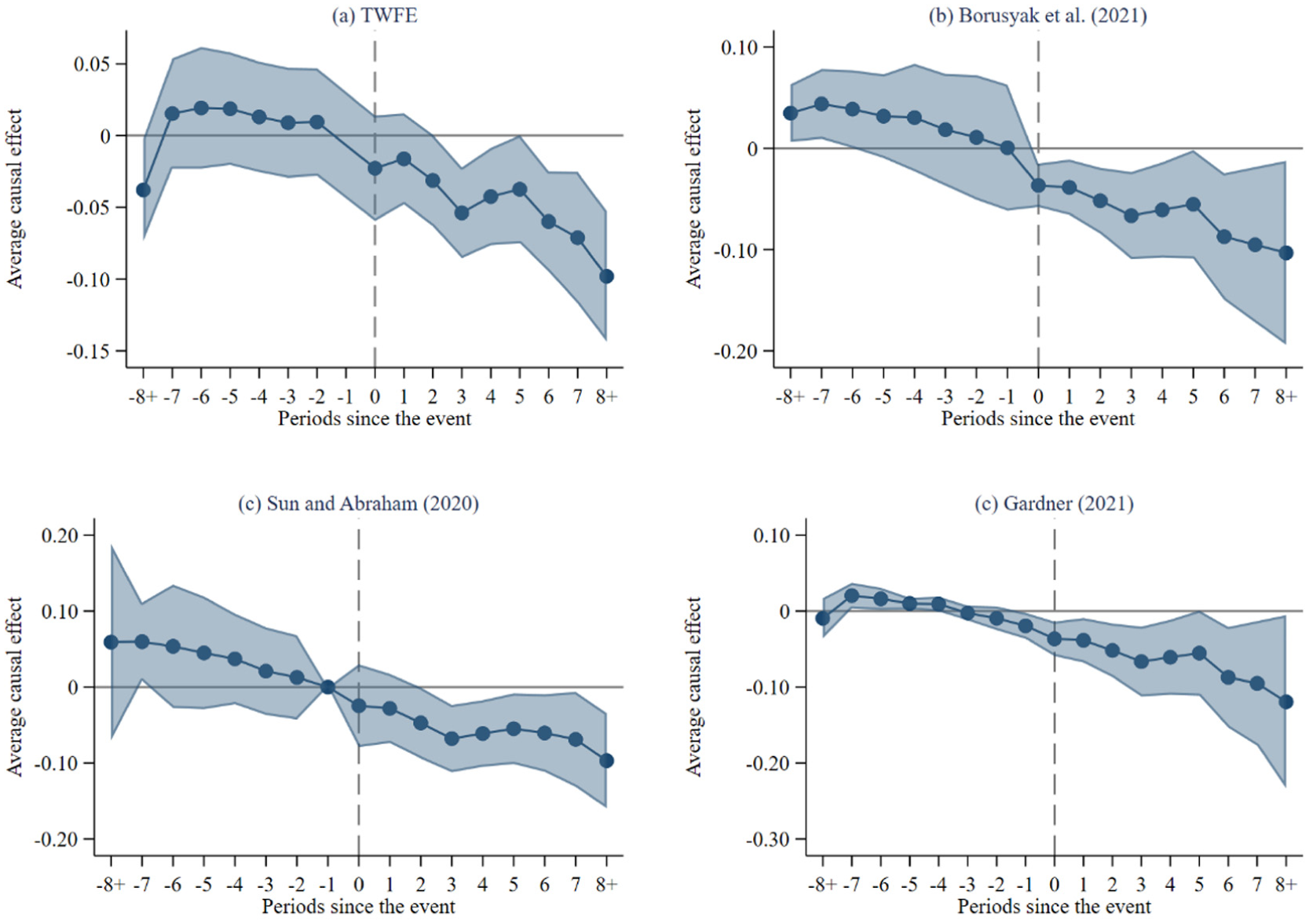
Parallel trend test (lnCO2).

Parallel trend test (lnPM2.5).
Placebo Test
To further verify whether the observed effects of the dual pilot policy on pollution and carbon reduction are attributable to the policy itself rather than random external factors, this study conducts a placebo test. The test involves randomly assigning both the pilot cities and the implementation years of the dual pilot policy, repeating this process 500 times to generate a distribution of pseudo-policy effects. The results are presented in Figure 5a and b, where the estimated coefficients are approximately normally distributed and centered around zero. When compared to the actual regression coefficients from column (3) and column (6) in Table 2 (−.0489 and −.0286), the differences are pronounced, with only a small number of p-values falling below the 5% significance threshold. These findings suggest that the empirical results are not driven by chance but rather reflect the genuine effect of the dual pilot policy, as confirmed by the placebo test.

Placebo test. (a) CO2, (b) PM2.5.
Robustness Check
PSM-DID
This study adopts the methodological framework proposed by Liu et al. (2022), utilizing the PSM-DID approach to further mitigate potential biases arising from sample selection. In line with Abadie et al. (2004), three matching techniques are applied to construct a comparable control group for the treated cities: 1:4 nearest neighbor matching, radius matching, and kernel matching. Based on the approach of Quan and Li (2022), the following covariates are selected for matching: economic level, industrial scale, social consumption level, urban size, government fiscal capacity, foreign direct investment, urban carbon sink capacity, and environmental regulation. Additionally, a balance test is conducted on the selected covariates to ensure the rationality of the covariate selection (as shown in Table 3). The test results indicate that the propensity score matching process in this study effectively alleviates sample self-selection bias, making it reasonable to use the matched sample for subsequent empirical analysis.
Balance Test (U is Represented as Unmatched; M is Represented as Matched).

Table 4 presents the relevant regression results. The coefficient for the dual pilot policy variable (EVLC) consistently remains significantly negative, thereby validating the robustness of the primary conclusion that the implementation of the “low-carbon city-green transportation” dual pilot strategy plays a significant role in advancing urban pollution control and carbon emission reduction.
PSM-DID Test.

Note. Y = yes.
, **, * represent statistical significance at the 1%, 5%, and 10% levels, respectively, with robust standard errors in parentheses.
Adjusting Sample Structure and Instrumental Variable Regression
(1) To eliminate potential interference from “single pilot” cities that did not participate in the “dual pilot” policy, this study excludes those observations and re-estimates the model using “non-pilot” cities as the control group and “dual pilot” cities as the treatment group. The regression outcomes are presented in Table 5, columns (1) and (2), where the estimated coefficients remain significantly negative at the 1% level. These results further reinforce the conclusion that the dual pilot policy exerts a stable and substantial effect in lowering both urban pollution and carbon emissions.
(2) To accurately estimate the net effect of the dual pilot policy, following the approach of Han et al. (2024), this study excludes new energy demonstration cities (NEDC), smart city pilots (SC), and carbon emission trading pilot cities (ETS). Table 5, columns (3) and (4), present the regression results, showing that the coefficient of EVLC remains significantly negative at the 1% level. Moreover, the magnitude of the coefficient exhibits no substantial change compared to that reported in columns (3) and (6) of Table 2, further reinforcing the stability and reliability of the estimated policy effect.
(3) Given that the impact of COVID-19 may have caused fluctuations in regional carbon emissions and pollution levels after 2020, this study limits the time window 2006 to 2019 for regression and controls for the interaction of city and year to reduce the influence of region-specific time-varying factors. Table 5, columns (5) and (6), present the regression outcomes after accounting for additional control variables and incorporating the potential influence of external events on policy effectiveness. The findings indicate that the core conclusion regarding the dual pilot policy’s synergistic impact on pollution and carbon reduction remains robust and statistically valid.
(4) Considering the potential issues of reverse causality between the dual pilot policy and urban carbon and pollutant emissions, as well as the possible influence of unobservable variables that may lead to estimation bias, this study further employs the instrumental variable (IV) approach using two-stage least squares (2SLS) regression to address endogeneity concerns. In selecting the instrumental variable, this paper draws on the methodology of Cao et al. (2021) and Yi et al. (2025) and chooses the natural logarithm of the interaction term between annual average temperature and per capita green space in each city as the instrument. On the one hand, battery performance is known to be affected by extreme environmental temperatures, including reduced energy density and shortened driving range. This makes cities with moderate temperatures more likely to be selected as pilot cities for promoting NEVs, thereby facilitating early market development. Thus, there exists a plausible correlation between annual average temperature and the likelihood of a city being chosen for the pilot program. From the perspective of exogeneity, annual average temperature is generally considered a random factor that is not subject to human control or policy intervention. Moreover, temperature fluctuations are typically independent of socioeconomic conditions, policy dynamics, or market behavior, making them less likely to be correlated with unobservable variables. On the other hand, cities that place greater emphasis on environmental sustainability are more likely to voluntarily apply for and be approved as low-carbon pilot cities, which supports the relevance condition of the instrument. However, the development of urban green spaces does not directly affect the actual levels of carbon or pollutant emissions, thereby also satisfying the exogeneity condition required of an instrumental variable. In summary, this paper uses the interaction between regional annual average temperature and per capita green space as an instrumental variable to re-estimate the baseline model and mitigate potential endogeneity issues in Equation 1. The relevant data are sourced from the National Centers for Environmental Information (NCEI) under the United States National Oceanic and Atmospheric Administration (NOAA), as well as the EPS Database. Columns (7) to (9) of Table 5 report the first-stage and second-stage estimation results of the 2SLS regressions. The F-statistic from the weak instrument test exceeds the critical value of 16.38 at the 10% level, indicating that the weak instrument problem does not exist. Additionally, the test for underidentification is significant at the 1% level, rejecting the null hypothesis of insufficient instrument identification. These results fully confirm the validity of using the interaction term between average annual temperature and per capita green space as an instrumental variable. As shown in columns (8) and (9), after addressing the endogeneity problem, the dual pilot policy remains significantly effective in promoting urban pollution and carbon reduction, thereby confirming the robustness of the main findings in this study.
Robustness Test of Changing Sample Structure.

Note. Y = yes; N = no. Critical value for weak-instrument F-test at 10% size is reported in parentheses
, ** represent statistical significance at the 1% and 5% levels, respectively, with robust standard errors in parentheses.
Heterogeneity Analysis
Drawing on the preceding analysis, the joint implementation of the NEVPAS and the LCCPP demonstrates notable effectiveness in reducing pollution and carbon emissions. This prompts a further inquiry: are these effects conditioned by factors such as the regional distribution of cities, their classification, and variations in environmental regulatory intensity? To address this, the current section conducts a heterogeneity analysis from three dimensions: geographic location, resource endowment, and the stringency of environmental regulation.
First, following the regional classification standards of the National Bureau of Statistics, the sample cities are categorized into eastern and central/western regions to examine whether the effects of the dual pilot policy exhibit regional heterogeneity. According to Huang and Guo (2024), this study introduces an interaction term, EVLC × Region into the regression model to capture potential regional heterogeneity. The estimation results, presented in Table 6, columns (1) to (4), indicate that the carbon reduction effect of the dual pilot policy is significantly more pronounced in eastern cities compared to those in the central and western regions. This outcome may be explained by the relatively advanced economic development and more robust infrastructure in eastern cities, as well as their heavier reliance on energy imports from the central and western parts of the country, such as the “West-East Electricity Transmission” project, which provides a solid foundation for low-carbon economic transformation. Moreover, eastern cities' early advantages and technology accumulation have facilitated the adoption of new energy vehicles, further driving green and low-carbon transformation. Additionally, the study finds that the dual pilot policy has a weaker effect on PM2.5 reduction in central/western cities compared to eastern cities. These results suggest that the dual pilot policy’s pollution and carbon reduction effects exhibit significant spatial heterogeneity.
Heterogeneity Analysis Results.

Note. Y = yes.
, **, * represent statistical significance at the 1%, 5%, and 10% levels, respectively.
Second, resource-based cities, as the main contributors to pollutant emissions in China, face significantly greater pressures in terms of both economic transition and environmental pollution compared to non-resource-based cities due to path dependence. In 2013, the State Council issued the “National Sustainable Development Plan for Resource-Based Cities (2013–2020)” (NSDPRBC), which defined resource-based cities as those whose leading industries are centered on the extraction and processing of local natural resources such as minerals and forests. Whether resource endowment serves as a “blessing” or a “curse” in these cities for sustainable development remains an open question. In this context, based on the official city classification list in the “NSDPRBC,” this article divides the sample into resource-based cities and non-resource-based cities. An interaction term, EVLC × ResCity, is constructed for regression analysis. The estimation results are reported in models (5) through (8) of Table 6. The results show that the negative effects of the dual pilot policy on both carbon emissions and pollutant emissions are greater in non-resource-based cities than in resource-based ones. A possible explanation is that although resource-based cities, which are typically dominated by secondary industries and have a high dependence on energy, may benefit from the policy dividends of the dual pilot strategy and experience some alleviation of environmental pressure, their long-standing development inertia makes it difficult to shift away from extensive growth models. As a result, the suppressive effects of the NEVPAS and the LCCPP on carbon emissions and environmental pollution cannot be fully realized in these cities. This finding also provides empirical support for the “resource curse” hypothesis.
Third, governments in different regions, depending on their development levels, impose different environmental targets to constrain enterprises' investment and production behavior (Yan et al., 2018). If a city’s economic development model lacks natural environmental constraints, local governments may opt for high-energy-consuming, high-emission industries to achieve economic growth, while long-term innovative behaviors may be temporarily sidelined (Han et al., 2020). To examine the heterogeneity of the dual pilot policy’s effects based on regional environmental regulation strength, following the approach of Zhang and Chen (2021), this study divides cities into high and low environmental regulation groups and constructs the EVLC × Regul interaction term to estimate the policy’s heterogeneity effects. The results in Table 6, columns (9) to (12), show that the dual pilot policy demonstrates a stronger pollution and carbon reduction effect in cities with stricter environmental regulations.
Mechanism Analysis
Drawing on the above theoretical assumptions, this study adopts the empirical approach of Jiang (2022) to conduct a mechanism analysis. The detailed estimation outcomes are reported in Table 7.
Impact Mechanism Test.

Note. Y = yes.
, ** represent statistical significance at the 1% and 5% levels, respectively, with robust standard errors in parentheses.
Energy-Saving Effect
The findings from column (1) reveal that the implementation of the dual pilot policy leads to a marked improvement in the energy efficiency of designated cities, as evidenced by a decline in energy consumption per unit of GDP. Column (2) further substantiates this by indicating that the policy effectively lowers regional energy use while enhancing overall efficiency. In essence, energy efficiency plays a pivotal role in facilitating carbon emission reductions. By restructuring the regional energy mix, traditionally centered on high-carbon sources such as coal and oil, the policy achieves a direct reduction in emissions associated with industrial activity and everyday energy use, thereby indirectly reinforcing its combined effect on pollution control and carbon mitigation.
Innovation Effect
The estimation results from column (3) indicate that the dual pilot policy has a significant positive effect on stimulating green technology innovation activity in the pilot cities. However, column (4) shows that the policy has not yet produced a statistically significant improvement in the quality of such innovation. This suggests that while the dual pilot initiative contributes to pollution and carbon reduction by promoting green technological development, it has so far been more effective in increasing the quantity of innovation rather than enhancing its overall quality.
Agglomeration Effect
The results reported in column (5) suggest that the adoption of the dual pilot policy significantly promotes regional economic agglomeration. Furthermore, the coefficient of lnEcondens remains relatively consistent, implying that the policy stably supports the agglomeration effect. Economic agglomeration plays a pivotal role in facilitating the concentration of human capital, promoting industrial specialization, and enhancing production efficiency (Han et al., 2024). Through its diffusion mechanism, agglomeration contributes to the widespread adoption of low-carbon and environmentally sustainable production and lifestyle practices, thereby amplifying the dual pilot policy’s integrated impact on reducing both pollution and carbon emissions.
Policy Synergy Effect Analysis and Spatial Heterogeneity Analysis
Policy Synergy Effect Analysis
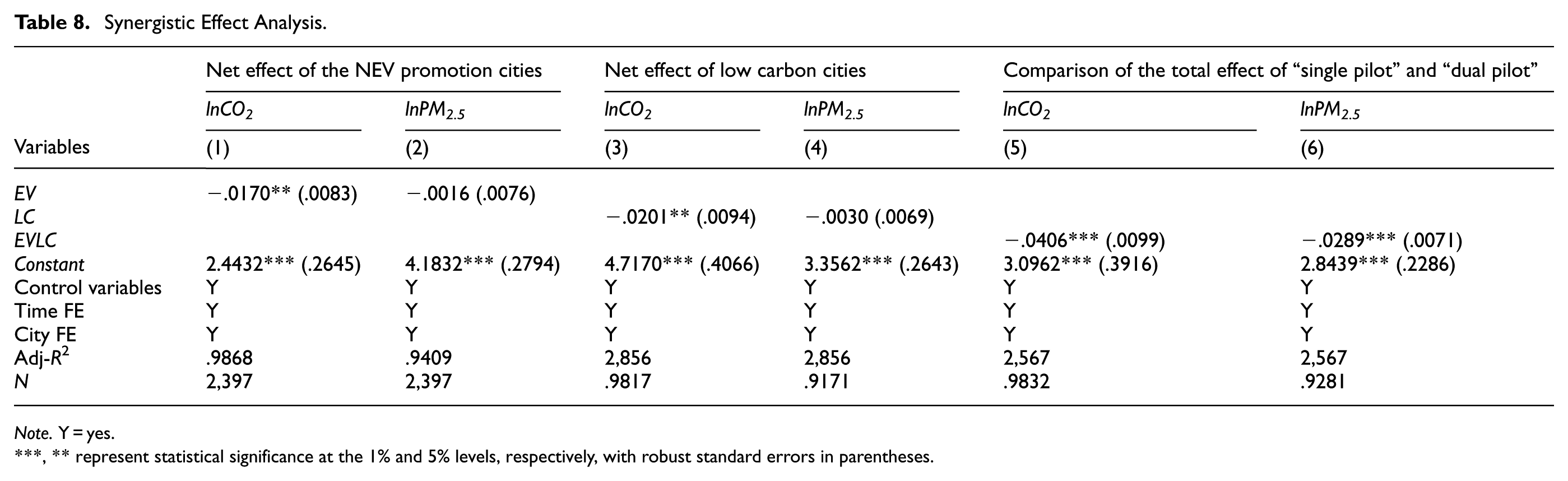
To further validate the synergistic effect of the NEVPAS and the LCCPP, this study first tests the single-pilot pollution reduction effects of each policy. To achieve this, the sample of low-carbon cities is excluded, and only the sample of cities with the NEVPAS is retained, along with the control group from the baseline regression. This allows us to isolate the net impact of the NEVPAS on urban environmental pollution. As shown in Table 8, columns (1) and (2), the coefficient for NEVPAS (EV) is significantly negative for carbon emissions at the 5% level, indicating a significant carbon reduction effect. However, the effect on PM2.5 is negative but not significant, as the primary source of PM2.5 is industrial production processes, and the electrification of the transportation sector has not yet fully shown its effect on PM2.5 suppression.
Synergistic Effect Analysis.
Note. Y = yes.
, ** represent statistical significance at the 1% and 5% levels, respectively, with robust standard errors in parentheses.
Similarly, after excluding the sample of cities with the NEVPAS, we obtain the net effect of the LCCPP on urban environmental pollution, as shown in Table 8, columns (3) and (4). The low carbon city pilot (LC) also only has a significant suppressing effect on carbon emissions, while its effect on PM2.5 is negative but not significant. This suggests that when the LCCPP is implemented alone, it has a significant carbon reduction effect but does not fully exhibit its pollution reduction effect.
Therefore, when compared to the individual effects and estimated coefficients of the two standalone pilot policies on urban pollution and carbon reduction (.0371 and .0046, respectively), the corresponding coefficients for the dual pilot policy in Table 2 are notably larger (.0489 and .0286), suggesting the presence of a synergistic effect wherein the combined implementation of low-carbon city construction and green transportation yields results greater than the sum of their parts, that is, a “1 + 1 > 2” effect.
Subsequently, a comparative analysis is conducted to evaluate the differential policy effects between the dual pilot and single pilot initiatives. Cities that did not participate in any pilot programs are excluded from the sample. Within the remaining dataset, dual pilot cities are designated as the treatment group, while single pilot cities serve as the control group. A multi-period DID regression is employed, with the detailed estimation results reported in Table 8, columns (5) and (6). The findings indicate that the dual pilot policy exerts a more pronounced effect on reducing both pollution emissions and the scale of carbon emissions.
To further examine the presence of heterogeneous treatment effects between the “dual pilot” policy and distinct types of “single pilot” policies, this study conducts a re-estimation using two separate control groups: the NEVPAS “single pilot” sample and the low-carbon city “single pilot” sample, with the “dual pilot” cities serving as the treatment group. According to the coefficients of EV1 and LC1 reported in columns (1) to (2) and columns (3) to (4) of Table 9, the results reveal that the dual pilot policy demonstrates a stronger synergistic effect when compared against the low-carbon city “single pilot” group. In particular, the effect is more pronounced when the low-carbon city pilot is launched first, followed by the implementation of the NEVPAS, suggesting that the sequential adoption of “low-carbon city-green transportation” policies enhance the joint outcomes in pollution and carbon emission reduction.
Synergistic Effect Analysis.

Note. Y = yes.
, ** represent statistical significance at the 1% and 5% levels, respectively, with robust standard errors in parentheses.
Spatial Heterogeneity Analysis
Policy pilot programs serve a demonstrative and guiding function for cities or regions with similar characteristics (Wang & Ge, 2022). At the same time, pollutant and carbon emissions within a single city tend to display temporal persistence, while spatial correlations in emission levels may exist across different cities (Zhao & Sun, 2022). Drawing on the methodological framework of Shao et al. (2019), this study employs a geographical adjacency matrix (W1) and constructs a SDM that incorporates both temporal and spatial fixed effects, aiming to further examine the spatial spillover effects of the dual pilot policy. The model is specified as follows:

Where α is the constant term, ρ is the spatial autocorrelation coefficient, ranging from [−1, 1], ωit is the spatial weight matrix, θ is the corresponding coefficient vector, and ci is the spatial fixed effect. The meanings of other variables are as explained above. The regression results are presented in Table 10. To improve the robustness of the findings, this study also reports the estimation outcomes from the SEM and the SAR alongside those of the SDM.
Spatial Spillover Effect Analysis Results.

Note. Y = yes.
, **, * represent statistical significance at the 1%, 5%, and 10% levels, respectively, with robust standard errors in parentheses.
As shown in Table 10, across columns (1) to (3) and columns (4) to (6), the coefficient capturing spatial dependence (ρ/lamda) is significantly positive in all three model specifications, SEM, SAR, and SDM. Additionally, both the direct and spillover effects of the dual pilot policy variable (EVLC) on carbon emissions and PM2.5 concentrations are significantly negative. These findings not only confirm the robustness of the baseline regression results but also underscore that the dual pilot policy contributes meaningfully to pollution and carbon emission reductions within pilot cities while simultaneously producing favorable spillover effects that extend to surrounding areas. Moreover, results from the LR spatial lag test and the Wald test in column (1) to (3) and column (4) to (6) indicate that the SDM does not simplify to either the SAR or SEM models. The Hausman test further supports model specification, with p-values below the 1% significance level. Therefore, the spatiotemporal two-way fixed effects SDM employed in this study are both appropriate and robust.
Further Discussion
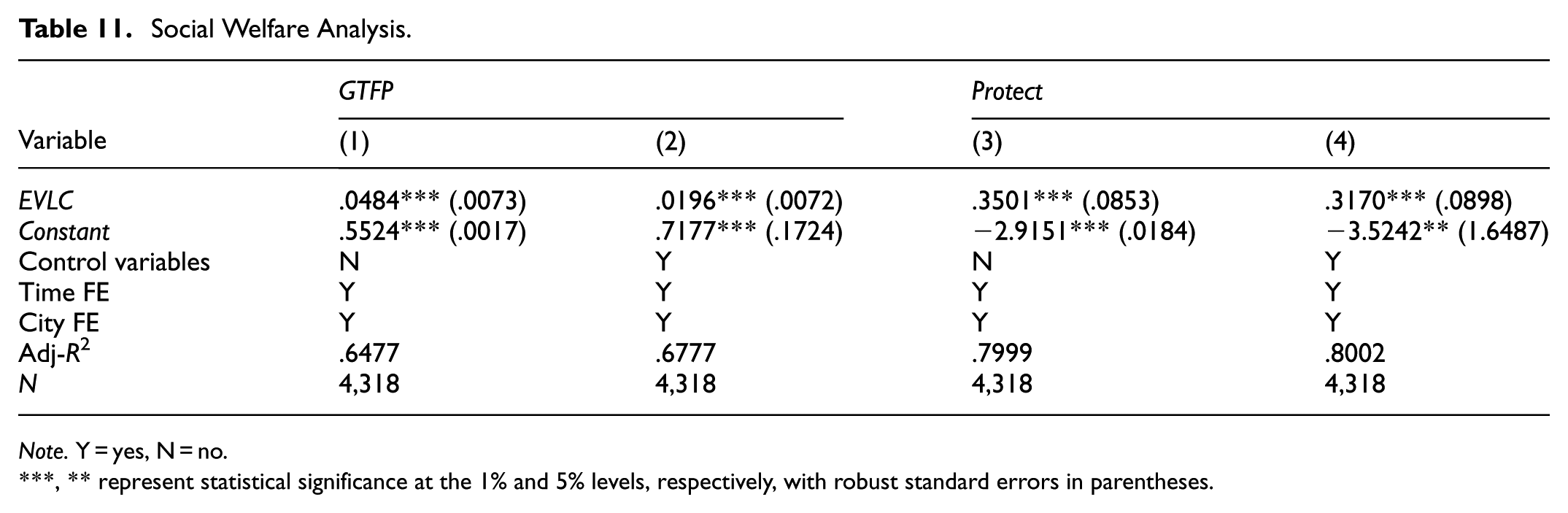
The aforementioned studies have not examined the potential welfare effects brought about by the dual pilot policy. On the one hand, this policy, while promoting pollution and carbon reduction, may generate significant positive externalities. To further explore whether the dual pilot policy can enhance desired outputs while reducing undesired outputs, this article replaces the dependent variable in Equation 1 with regional green total factor productivity (GTFP) and re-estimates the model to investigate the economic consequences of the policy. On the other hand, the previous sections have confirmed the role of the dual pilot policy in driving green technological innovation. Thus, the positive impact of the dual pilot policy on green development is largely built upon improvements in regional innovation capacity. Based on Romer’s (1986) conclusion, the green empowerment effect of the dual pilot policy also depends on the innovative atmosphere in each region. The intellectual property rights (IPR) protection system is a critical institutional safeguard for promoting regional technological innovation. Therefore, it is reasonable to expect that the dual pilot policy would also encourage local governments to strengthen the IPR environment, providing institutional support for the continued realization of pollution and carbon reduction outcomes.
In the following analysis, this article characterizes the welfare effects of the dual pilot policy from two perspectives: improvements in GTFP and the strength of IPR. GTFP is calculated using an input-oriented super-efficiency CCR-DEA model, following the methods of Zhang et al. (2004) and Wang and Liu (2015). IPR protection is measured following the approach of Wang, Sun, et al. (2024), using the natural logarithm of the number of concluded IPR judicial cases per ten thousand people in each region. These two indicators are used as dependent variables in re-estimations of Equation 1. Table 11 columns (2) and (4) show that the coefficients for the dual pilot policy are significantly positive. First, this finding indicates that the policy contributes to green economic transformation without sacrificing economic growth. Second, as an environmental regulatory instrument, the dual pilot policy involves a dual externality problem under the framework of the weak version of the Porter hypothesis. Therefore, local governments in regions implementing the dual pilot policy are likely to strengthen IPR protection to balance the objectives of environmental protection and economic growth (Sun et al., 2022). In sum, intellectual property protection is key to unlocking the long-term green development potential of the dual pilot policy. In this sense, the implementation of environmental regulation policies must be coupled with institutional improvements in intellectual property protection to advance regional economic and social transformation toward green and high-quality development.
Social Welfare Analysis.
Note. Y = yes, N = no.
, ** represent statistical significance at the 1% and 5% levels, respectively, with robust standard errors in parentheses.
Conclusion and Policy Implications
Conclusion
Based on panel data from 254 cities in China (2006–2022), this study uses the dual pilot policy of LCCPP and NEVPAS as a quasi-natural experiment. A multi-period DID model analyzes the synergistic effects, mechanisms, and heterogeneity of the policy’s impact on pollution and carbon reduction. The main conclusions are as follows:
First, the baseline regression shows that the dual pilot policy, combining LCCPP and NEVPAS, significantly reduces pollution and carbon emissions. This conclusion is held after robustness tests. Synergy analysis indicates that the combined implementation of the dual pilot policy is more effective than single pilot policies. Implementing the LCCPP first, followed by the NEVPAS, leads to stronger synergistic effects. Second, heterogeneity analysis shows that the effect of the dual pilot policy on pollution and carbon reduction varies by geographic location, resource endowment, and environmental regulation level. The policy’s effect is stronger in eastern cities, non-resource-based cities, and cities with high environmental regulation. Third, the mechanism analysis shows that the dual pilot policy promotes pollution and carbon reduction through energy-saving, innovation, and agglomeration effects. It reduces energy intensity, drives green technology innovation, and strengthens economic agglomeration, improving operational efficiency. Fourth, the dual pilot policy generates positive spatial spillover effects, achieving “local-neighbor” collaborative pollution and carbon reduction. It also promotes green economic development by raising the overall level of green development and strengthening intellectual property protection without sacrificing economic growth.
Policy Implications
First, strengthen policy coordination, particularly in regions with the necessary conditions. Cities already designated as low carbon city should further promote transportation electrification. Second, local governments should develop new energy plans tailored to regional realities, accelerating the transition of thermal power generation from base load to peak shaving support. Simultaneously, subsidies and policy incentives for green technological innovation should be enhanced to ensure steady implementation of the green innovation-driven development strategy. Implement policies to attract investment and talent, driving industrial and economic agglomeration. Third, central and western regions should accelerate the cultivation of new productive forces to advance industrial upgrading toward higher-level and greener development. Introduce diverse environmental regulations to prevent short-sighted profit-seeking behaviors. Resource-dependent cities should promote new energy and develop strategic emerging industries. Fourth, strengthen regional cooperation on carbon emissions and pollution prevention to foster a win-win mindset, forming a green economic development model where neighbors become partners.
Research Limitations and Future Directions
First, due to data availability constraints, this study could not compare the pollution reduction and carbon emission reduction effects of environmental regulatory policy packages with those of other countries globally, thereby limiting the generalizability of its findings. Second, this study did not further examine the impact of the “dual pilot” policy on public health, which warrants future refinement. Additionally, mechanisms such as energy-saving effects, innovation effects, and agglomeration effects were analyzed only at the regional macro level, potentially obscuring industry-specific variations and micro-level dynamics at the enterprise level. Future research should incorporate micro-level analysis to clarify the micro-pathways through which environmental regulatory policy packages influence regional pollution reduction and carbon emission reduction.
Footnotes

Ethical Considerations
This article does not contain any studies with human or animal participants. There are no human participants in this article and informed consent is not required.
Funding
The authors received no financial support for the research, authorship, and/or publication of this article.
Declaration of Conflicting Interests
The authors declared no potential conflicts of interest with respect to the research, authorship, and/or publication of this article.
Data Availability Statement
The datasets generated during and/or analyzed during the current study are available from the corresponding author on reasonable request.