




Abstract
Entrepreneurship, as one of the important factors to promote industrial innovation, is closely related to the development of the regional economy. Based on the methods of Kernel density and standard deviation ellipse, this article presents the spatio-temporal patterns of entrepreneurship and innovation performance. The article also examines the spatial spillover mechanism of entrepreneurship on innovation performance by establishing spatial Durbin models. The heterogeneous results of the spatial regression models in six clusters are also discussed. The final results show that the spatio-temporal patterns of entrepreneurship are gradually presenting three major hot spots and two secondary hot spots while the spatio-temporal patterns of innovation performance are presenting four major hot spots and a secondary hot spot; the spatial distribution of both entrepreneurship and innovation performance are changing regularly; the spillover effects of entrepreneurship and innovation performance are both significant; the spatial spillover mechanisms in six automobile industrial clusters are different. The results can provide empirical support for decision-making in the automobile industry in China in the future.
Introduction
Entrepreneurship is an important indicator to measure the economic vitality of a country or a region. It is a comprehensive reflection of the local legal environment, market environment, innovation and entrepreneurship environment, and business environment, which are closely related to the development of the regional economy (Estrin et al., 2006). In 2017, the State Council of China issued the guidelines on building a healthy growth environment for entrepreneurs, promoting excellent entrepreneurship, which clearly pointed out that it is of great significance to promote entrepreneurship. At present, China is faced with many problems, including great downward pressure of the macro-economy, the weak ability of independent innovation of the manufacturing industry, and the urgent need for transformation and upgrading of the whole industrial system. The cultivation and promotion of entrepreneurship is an effective way to solve these problems and realize economic development (Estrin et al., 2006, 2019).
China’s central and local governments have issued a series of policies to boost industrial innovation and positive spillover. To improve China’s scientific and technological innovation ability, the central government has formulated long-term national science and technology development plans, such as “spark plan,” “973 Plan,” “863 Plan,” and so on. Increasing financial investment has been put into related industries to provide material guarantee for scientific and technological innovation. A series of measures have been formulated to ensure the core position of enterprises in innovation activities. Meanwhile, the local government has issued a series of subdivision policies, including creating a good business environment, formulating supporting policies for talents, and providing free office space for start-ups.
In the past decades, China’s automobile industry has made great progress. Since 2009, China has become the world’s largest automobile production and marketing country. More than 28 million automobiles were sold in China in 2018 (L. Zhao, 2019). However, there are still many problems in China’s automobile industry: In recent years, the growth rate of automobile sales has slowed down, and even shown negative growth (L. Zhao, 2019). Most of the profits are taken away by foreign enterprises. The R&D investment is insufficient to cover a long period, and the R&D expenditure ratio of local brand enterprises is far lower than that of international mainstream automobile enterprises, such as Toyota and Volkswagen; the core technology of the automobile industry in China is still very lacking, and numerous core parts are still dependent on imports. Only by promoting entrepreneurship and improving the independent innovation ability of the automobile industry can the automobile industry in China realize substantial development. Therefore, it is necessary to study the promotion mechanism of entrepreneurship on innovation.
However, there may be complex correlation mechanisms between entrepreneurship and innovation performance (Grimpe & Hussinger, 2013; Guan & Chen, 2010). The existing studies mainly focused on the direct effect of entrepreneurship on innovation performance (Grimpe & Hussinger, 2013; S. Li et al., 2019), and the spatial dependence of the two variables (Chen, 2017; J. Li et al., 2010; W. Yang et al., 2019; Y. Yang et al., 2014; Zhang & Li, 2007); seldom do papers pay attention to the spatial spillover mechanism of entrepreneurship on innovation performance based on spatial econometric models. Meanwhile, the automobile industry is highly dependent on industrial agglomeration. There are few existing studies on the evolution of the spatio-temporal patterns of China’s automobile industry, which are insufficient to provide support for future development.
In this article, we first utilized two methods—Kernel density and standard deviation ellipse—to analyze the spatio-temporal patterns of entrepreneurship and innovation performance. Then, we established non-spatial regression models and spatial regression models to determine the spatial relationship between entrepreneurship and innovation performance. In addition, we discussed the heterogeneous results of the spatial regression models in six clusters. The robust test shows that these results are reliable. Finally, we found that the spatio-temporal patterns of entrepreneurship are gradually presenting three major hot spots and two secondary hot spots while the spatio-temporal patterns of innovation performance are presenting four major hot spots and a secondary hot spot; the spatial distribution of both entrepreneurship and innovation performance are changing regularly; the spillover effects of entrepreneurship and innovation performance are both significant; the spatial spillover mechanisms in six automobile industrial clusters are different.
The contributions of this article are as follows. First, we verified the spatial spillover mechanism of entrepreneurship and innovation performance based on spatial Durbin model (SDM); second, we proposed the spatio-temporal patterns of entrepreneurship and innovation performance of automobile industrial clusters in China; third, we found that the Northeast area stepped into the dilemma of innovation, which urgently needs profound and thorough reform; and fourth, this article sheds light on the decision making of the automobile industry in China in the future.
The rest of this article is structured as follows. The “Literature Review and Hypotheses” section provides a review of relevant papers on entrepreneurship and innovation performance. The section “Study Cluster, Data, and Methodology” introduces the study clusters, data, and methodologies, including Kernel density, standard deviation ellipse, and spatial econometrics. The “Results” section includes the analysis results, including spatio-temporal patterns of entrepreneurship and innovation performance, non-spatial regression, exploratory spatial data analysis, spatial regression, heterogeneity analysis of six automobile industrial clusters, and a robust test. The “Conclusions and Discussion” section includes the conclusions and discussion. Implications and limitations are drawn in the section “ Implications and Limitations.”
Literature Review and Hypotheses
Entrepreneurship
Entrepreneurship was first proposed by Schumpeter, who believed that entrepreneurs, mainly engaging in innovative activities, are very few individuals who can discover new resource combinations and market opportunities (Schumpeter, 1939). Therefore, individuals can be called entrepreneurs, and their psychological motivation is entrepreneurship. Afterward, entrepreneurship has gradually become a research focus. Entrepreneurship is a multi-level concept. Due to this characteristic, a widely accepted unified concept has not yet been formed. Existing research elaborates on entrepreneurship from the enterprise level and regional level.
From the perspective of enterprise level, entrepreneurship is a kind of ability for entrepreneurs to organize and coordinate resources in innovation and entrepreneurship activities, and a key factor for enterprises to maintain a competitive advantage. Existing studies focus on entrepreneurial traits and their psychological motivation, including initiative spirit (Cruz et al., 2009; Schumpeter, 1939), adventure spirit (Schultz, 1980; J. Zhao et al., 2018), mission spirit (Abu-Saifan, 2012; Wong, 2017), and innovation spirit (Glaeser, 2007; Zhai et al., 2018).
From the perspective of regional level, entrepreneurship is the embodiment of the overall level of innovation and entrepreneurship activities in a region, and the core motive of regional economic development. A large number of studies shows that entrepreneurship has a significant role in promoting economic growth (Acs et al., 2018; Acs & Szerb, 2007; Carree & Thurik, 2010; Wennekers & Thurik, 1999). In these studies, scholars generally used an aggregated regional indicator of innovation activities to represent entrepreneurship (Y. Li & Zeng, 2019), instead of measuring entrepreneurship at the enterprise level one by one. This approach can reduce the difficulty of measurement and simplify the research.
The measurement methods of entrepreneurship are also divided into enterprise level and regional level. The measurement methods at the enterprise level include two subcategories, one is to use maturity scales to measure Entrepreneurship (Hornsby et al., 2002; Palacios-Marqués et al., 2019; Yan & Yan, 2016); the other is to use some indicators of enterprises as proxy variables of entrepreneurship, such as R&D expenditure, proportion of R&D investment, and proportion of intangible assets (W. He et al., 2019; Xie & Zhang, 2019).
The measurement of entrepreneurship at the regional level includes a variety of aggregation indicators, including the number of private enterprises in certain regions (Glaeser, 2007; Glaeser et al., 2015), the employment proportion of employees in private enterprises in certain regions (H. Li et al., 2009; Salas-Fumás et al., 2014), the number of new enterprises in certain regions (S. Li et al., 2019; Youssef et al., 2018), the number of new enterprises per capita in certain regions (Audretsch et al., 2010; B. He et al., 2010), and the entry rate and exit rate of enterprises in certain regions (Bosma et al., 2011; Foster et al., 2006). In this article, the number of new enterprises in China’s automobile industrial clusters over the years is selected as the proxy indicator to measure entrepreneurship.
Innovation Performance
Innovation performance is also a multi-level concept, which can be explained in terms of enterprise level and regional level. From the perspective of enterprise level, enterprise innovation performance reflects the final innovation output of a series of innovation activities. From the perspective of regional level, regional innovation performance reflects the overall output and results of regional innovation activities (Ahuja & Morris Lampert, 2001; Freeman, 1991).
The measurement methods of innovation performance are also divided into enterprise level and regional level. The measurement of innovation performance at the enterprise level includes several indicators, such as the number of patents of enterprises (Cloodt et al., 2006), the proportion of new product income out of the overall income of enterprises (Kafouros et al., 2008; Pellegrino et al., 2012; J. C. Wang & Tsai, 2004), related maturity scales (Hagedoorn & Cloodt, 2012), and the proportion of R&D expenses out of the business revenue of enterprises (W. Li et al., 2016). Scholars often utilized the total number of patents in a certain region to measure regional innovation performance (Acs et al., 2002; Atanassov et al., 2007; Bettencourt et al., 2007). Therefore, in this article, the number of new patents of China’s automobile industrial clusters over the years is selected as the proxy indicator to measure innovation performance. Meanwhile, the number of new patents per capita is selected as the proxy indicator to test the robustness of the regression results of the spatial econometric models.
Entrepreneurship and Innovation Performance
Through the literature review, this article found that numerous studies verified that the direct effect of entrepreneurship on innovation performance is significant, as is the spatial dependence of entrepreneurship and innovation performance. It is seldom that papers pay attention to the spatial spillover mechanism of entrepreneurship on innovation performance based on spatial econometric models.
Direct Effect of Entrepreneurship on Innovation Performance
Many scholars have verified the significant direct effect of entrepreneurship on innovation performance from different perspectives. From the perspective of enterprise level, some scholars found that entrepreneurship has a significant role in promoting technological innovation performance, new product innovation performance, and business model innovation of enterprises (Grimpe & Hussinger, 2013). Some other scholars found that regional entrepreneurship can improve the regional overall innovation performance, including the transformation of regional innovation achievements, the shaping of regional innovation culture, and the improvement of regional innovation efficiency (S. Li et al., 2019). Hence, the hypothesis is as follows:
Spatial Interactive Effect of Entrepreneurship and Innovation Performance
Anselin (2013) pointed out that spatial data often have spatial dependence (Anselin, 2013), which is ignored by traditional econometrics methods. In recent years, testing and analyzing spatial interaction effects has become an indispensable step to study spatial data (S. Li et al., 2018). Relevant studies have shown that the spatial dependences of both entrepreneurship and innovation performance are proven to be significant. Some scholars found that there is a significant spatial dependence of provincial entrepreneurship in China (Chen, 2017; Yang et al., 2014). The spatial dependences of innovation performance are also verified by some studies (J. Li et al., 2010; W. Yang et al., 2019; Zhang & Li, 2007). However, it is seldom that studies explore the spatial interactive effect by building a spatial econometric model. Hence, the hypotheses are as follows.
Study Cluster, Data, and Methodology
Six Automobile Industrial Clusters in China
There are six automobile industrial clusters in China (see Figure 1), namely, the Northeast automobile industrial cluster (NA), Beijing–Tianjin–Hebei automobile industrial cluster (BTHA), Yangtze River Delta region automobile industrial cluster (YRDA), Pearl River Delta region automobile industrial cluster (PRDA), Central area automobile industrial cluster (CA), and Chengdu–Chongqing area automobile industrial cluster (CCA; X. Wang & Liu, 2018). The NA includes eight cities of Jilin province, namely, Changchun city, Jilin city, Siping city, Liaoyuan city, Tonghua city, Baishan city, Songyuan city, and Baicheng city. The BTHA includes Beijing city, Tianjin city, and 11 cities of Hebei province, namely, Shijiazhuang city, Tangshan city, Handan city, Baoding city, Cangzhou city, Xingtai city, Langfang city, Chengde city, Zhangjiakou city, Hengshui city, and Qinhuangdao city. The YRDA includes the Shanghai city; nine cities of Jiangsu province, namely, Nanjing city, Wuxi city, Changzhou city, Suzhou city, Nantong city, Yancheng city, Yangzhou city, Zhenjiang city, and Taizhou city; eight cities of Zhejiang province, namely, Hangzhou city, Ningbo city, Jiaxing city, Huzhou city, Shaoxing city, Jinhua city, Zhoushan city, and Taizhou city; and eight cities of Anhui province, namely, Hefei city, Wuhu city, Maanshan city, Tongling city, Anqing city, Chuzhou city, Chizhou city, and Xuancheng city. The PRDA includes 21 cities of Guangdong province, namely, Guangzhou city, Shenzhen city, Foshan city, Dongguan city, Zhongshan city, Zhuhai city, Jiangmen city, Zhaoqing city, Huizhou city, Shantou city, Chaozhou city, Jieyang city, Shanwei city, Zhanjiang city, Maoming city, Yangjiang city, Shaoguan city, Qingyuan city, Yunfu city, Meizhou city, and Heyuan city. The CA includes 13 cities, namely, Wuhan city, Huangshi city, Shiyan city, Yichang city, Xiangyang city, Ezhou city, Jingmen city, Xiaogan city, Jingzhou city, Huanggang city, Xianning city, Suizhou city, and Enshi city. The CCA includes Chongqing city; 21 cities of Sichuan province, namely, Chengdu city, Mianyang city, Zigong city, Panzhihua city, Luzhou city, Deyang city, Guangyuan city, Suining city, Neijiang city, Leshan city, Ziyang city, Yibin city, Nanchong city, Dazhou city, Ya’an city, Guang’an city, Bazhong city, Meishan city, and three autonomous prefectures of Sichuan province.
In the era of the planned economy, according to the conditions of the industrial base in different regions and the needs of the national industrial system layout, the Chinese government successively established six major automobile groups in the above six regions, namely, First Automobile Works (FAW), Beijing Automobile Group (BAIC), Shanghai Automobile Group (SAIC), Guangzhou Automobile Group (GAC), Dongfeng Motor Corporation (DFM), and Changan Automobile Group (CCAG). In 2018, the above six groups accounted for about 73% of China’s total auto sales.

Spatial distribution of six automobile industry clusters in China.
Study Data
Three types of data were used in this study, namely, the data of new automobile enterprises from 1987 to 2017, the data of new patents of automobile enterprises from 1987 to 2017, and the data of China city statistical yearbook from 2000 to 2017. The historical data of new automobile enterprises and new patents are shown in Figure 2.
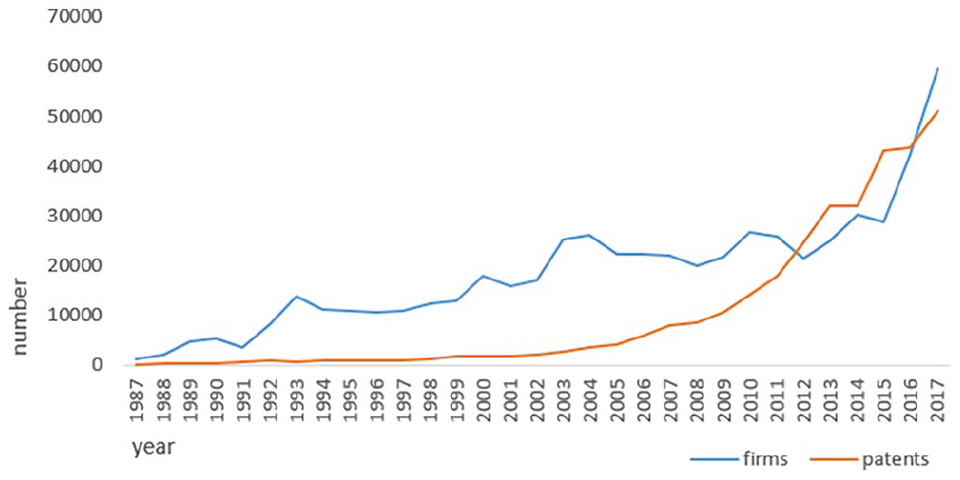
The historical data of new automobile enterprises and new patents.
The data of new automobile enterprises are from the database of industrial and commercial enterprises provided by Qichacha.com, including 579,525 point data with enterprise address and other relevant information. The longitude and latitude coordinates of each enterprise were identified by Xgeocoding, a tool of geographic coordinate transformation, using the API provided by the Baidu map open platform. Then, all the data were aggregated into city level.
The data of new patents of automobile enterprises are from CNKI, including 319,274-point data with enterprise address and other relevant information. The longitude and latitude coordinates of each enterprise were identified by Xgeocoding, using the API provided by the Baidu map open platform. Then, all the data were aggregated into city level.
The data of the China city statistical yearbook are from the China National Bureau of Statistics, which are used as control variables in spatial econometric models.
Methodology
Kernel density, standard deviation ellipse, and the spatial econometric model are utilized in this article. Kernel density can be used to measure the density of a certain characteristic in different regions. The density of point (x, y) is calculated as follows:

For di < r, i = 1, 2, 3, . . ., n; i is relevant input point; wi is the weight of point i; di is the distance between point i and point (x, y); r is the bandwidth.
Standard deviation ellipse, proposed by Lefever (1926), is a popular method to reveal spatial distribution patterns (Duranton & Overman, 2005; Niu et al., 2019). The relevant calculation formulas are as follows:
The calculation formulas of the weighted mean center are

where x, y are the coordinates of the element; ω i is the weight of element i.
The calculation formula of azimuth angle θ is

where
The calculation formulas of the standard deviation of the coordinate axis are

where STDx and STDy are the standard deviations of the coordinate axes.
Spatial econometric models are utilized to verify the relationship between entrepreneurship and innovation performance in this article. Spatial econometrics, first proposed by Paelinck (1978), is used to solve the problem of the inaccuracy of classical econometric regression when spatial dependence and spatial heterogeneity exist (Anselin, 2013). After its development by many scholars (Anselin, 2013, 2019; Elhorst, 2014; Lee & Yu, 2010; LeSage, 1999; LeSage & Pace, 2009), the theory of spatial econometrics has made great progress. In the recent years, scholars generally believe that using panel data to build the spatial panel econometric model is an important research direction (Anselin et al., 2008; Ciccarelli & Elhorst, 2018; Shi & Lee, 2017). In this article, we established the spatial autoregressive model (SAR), spatial lagged X model (SLX), and SDM. The formula of SDM is as follows:

where

In the formula, i means city; t means time; τ, ρ, β1, β2, β3 are regression coefficients; α i is individual effect; γ t is time effect; vit is residual term; uit is random disturbance term; PATit is the proxy variable of innovation performance; W is spatial adjacency weight matrix; FIRit is the proxy variable of entrepreneurship; Xit is the set of control variables, which are selected according to Acs et al. (2002), Atanassov et al. (2007), Bettencourt et al. (2007). Specifically, POP is population; GDP is GDP (gross domestic product); EMP is employment; SIR is proportion of secondary industry; TIR is proportion of third industry; SER is proportion of secondary industry employment; TER is proportion of third industry employment; STU is number of college students; POD is density of population; AIP is aggregate value of regional industry; FII is fixed assets investment; FDI is foreign direct investment; LFE is local financial expenditure; SCE is science expenditure; and EDE is education expenditure.
If ρ = 0, the model is converted to be the SLX model. If β2 = 0, the model is converted to be the SAR model.
Results
Spatio-Temporal Patterns of Entrepreneurship and Innovation Performance
Kernel density of entrepreneurship
From the perspective of kernel density of entrepreneurship from 2000 to 2016 (see Figure 3), three major hot spots were gradually formed in Beijing–Tianjin–Hebei region, Yangtze River Delta region, and Pearl River Delta region; two secondary hot spots were formed in the Central area and Chengdu-Chongqing area; however, there is no obvious hot spot in the Northeast area. The spatial pattern of the density of entrepreneurship presents three major hot spots and two secondary hot spots.

Spatio-temporal patterns of entrepreneurship in 2000, 2004, 2008, 2012, and 2016. Density means the kernel density.
Standard deviation ellipse of entrepreneurship
The shape and position of the standard deviation ellipse of entrepreneurship are constantly changing (see Figure 4). The mean center of the standard deviation ellipse keeps moving from north to south, which shows that the center of gravity of entrepreneurship is gradually approaching the southern area of China. That is to say, compared with the northern region, the southern region has cultivated more new enterprises. The major axis of the ellipse is becoming shorter and the minor axis is becoming longer, which shows that the north–south difference in the number of new enterprises is increasing, while the east–west difference is decreasing. The azimuth distribution of ellipse changes from northeast–southwest to north–south and the northeast area is gradually becoming further away from the center of entrepreneurship.

Standard deviation ellipses of entrepreneurship from 1987 to 2017.
Kernel density of innovation performance
From the perspective of kernel density of innovation performance from 2000 to 2016 (see Figure 5), four major hot spots were gradually formed in Beijing–Tianjin–Hebei region, Yangtze River Delta region, Pearl River Delta region, and the Chengdu–Chongqing area; a secondary hot spot was formed in the Central area; however, there is still no obvious hot spot in the Northeast area. The spatial pattern of the density of innovation performance presents four main hot spots and a secondary hot spot. The Northeast area is not only a lack of entrepreneurship but also a lack of innovation performance.

Spatio-temporal patterns of innovation performance in 2000, 2004, 2008, 2012, and 2016. Density means the kernel density.
Standard deviation ellipse of innovation performance
The shape and position of the standard deviation ellipse of innovation performance is also constantly changing (see Figure 6). The mean center of the standard deviation ellipse keeps moving from north to south, which shows that the center of gravity of innovation performance is gradually approaching the southern area of China. That is to say, compared with the northern region, the southern region has more new patents. The major axis and the minor axis of the ellipse are both becoming shorter, which shows that both the north–south difference and the east–west difference in the number of new patents is increasing. The azimuth distribution of the ellipse slightly changes from northeast–southwest to north–south. The northeast area is gradually becoming further away from the center of innovation performance.

Standard deviation ellipses of innovation performance from 1987 to 2017.
Non-Spatial Regression
Table 1 includes the ordinary least squares (OLS) model, fixed effect model (FE), and random effect (RE) model using panel data. The coefficients of entrepreneurship on innovation performance are all positively significant, which supports H1. To further verify which model is more accurate, the following tests were utilized. First, we used the F test to determine whether the fixed effect model using panel data is better than the pooled OLS model or not. The outcome of the F test is significant (p = .000), which indicates that the fixed effect model is better (L. Zhao & Wu, 2018). Second, we used the Breusch-Pagan test to determine whether the random effect model using panel data is better than pooled OLS model or not (Breusch & Pagan, 1980). The outcome of the BP-LM test was significant (p = .000), which illustrates that the random effect model is better. Third, we used the Hausman test to determine whether the fixed effect model is better than the random effect model or not. The outcome of the Hausman test was significant (p = .000), which illustrates that the fixed effect model is the best (Arellano & Bond, 1991; L. Zhao & Wu, 2018). According to the above results, the fixed effect model should be selected for further analysis.
Non-Spatial Regression.

Note. The number in brackets is the t value. FIR = proxy variable of entrepreneurship; POP = population; OLS = ordinary least squares; GDP = gross domestic product; EMP = employment; SIR = proportion of secondary industry; TIR = proportion of third industry; SER = proportion of secondary industry employment; TER = proportion of third industry employment; STU = number of college students; POD = density of population; AIP = aggregate value of regional industry; FII = fixed assets investment; FDI = foreign direct investment; LFE = local financial expenditure; SCE = science expenditure; EDE = education expenditure; FE = fixed effect model; RE = random effect model.
p < .1. **p < .05. ***p < .01.
Exploratory Spatial Data Analysis
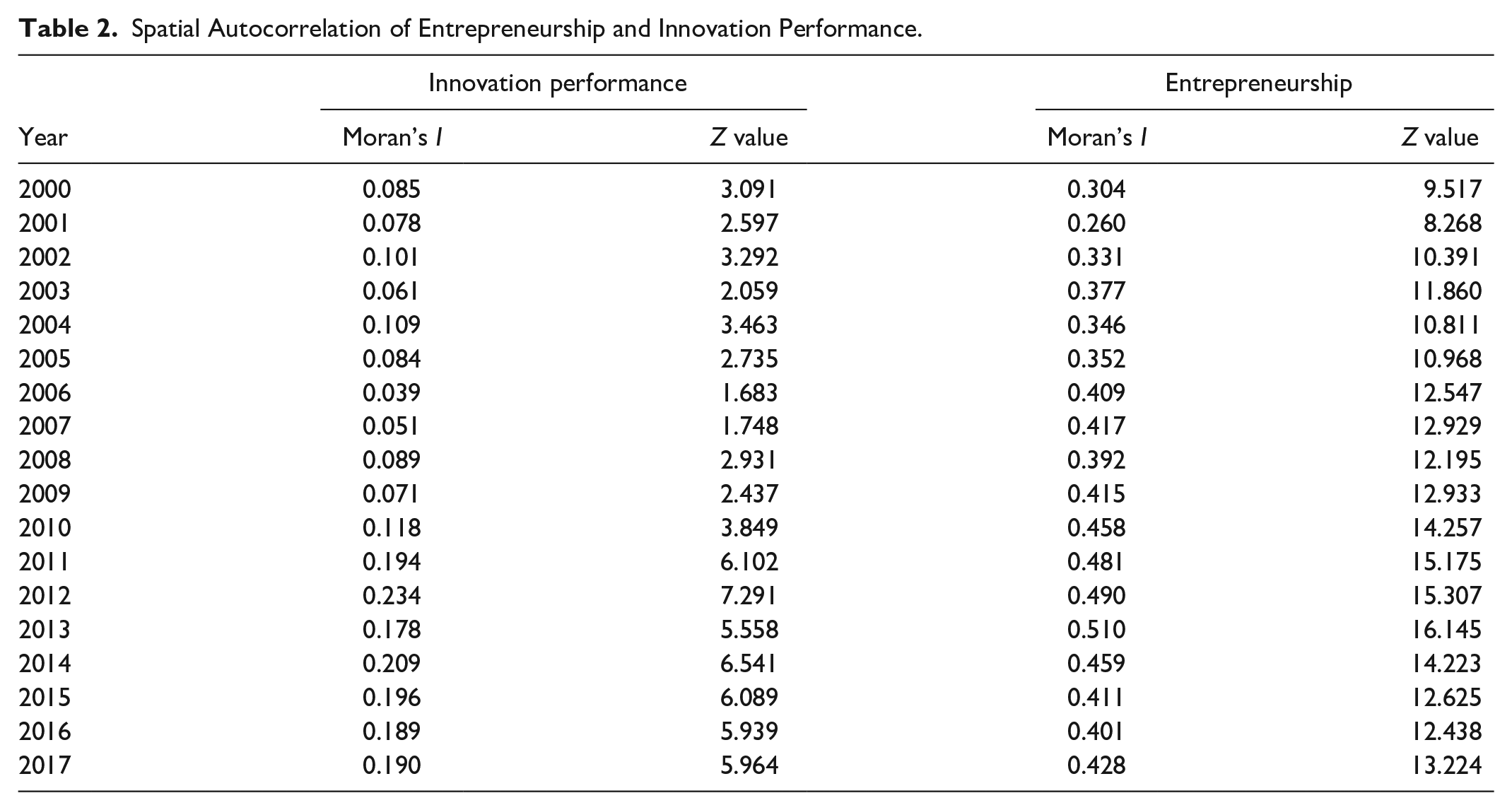
According to the first law of geography, the closer the geographical space is, the stronger the correlation is between two things (Tobler, 1970). The classical regression model does not consider spatial dependence. If there is spatial autocorrelation in a variable, classical regression will lead to serious endogenous problems due to omitted variables (LeSage & Pace, 2009). Moran’s I, first proposed by Moran (1950), is an important indicator to measure spatial autocorrelation. Therefore, we selected global Moran’s I to measure the spatial autocorrelation of entrepreneurship and innovation performance (see Table 2). The outcome shows that both entrepreneurship and innovation performance have positive significant spatial autocorrelation, which supports H2. Hence, spatial econometric models are needed for further analysis.
Spatial Autocorrelation of Entrepreneurship and Innovation Performance.
Spatial Regression
Based on the fixed effect model using panel data, we established a SAR, SLX, and SDM in this article (see Table 3). From the outcomes of the Wald test, all the spatial terms in these three models were significant, which shows that the establishment of the spatial econometric models was correct.
Spatial Regression.

Note. The number in brackets is the t value. SAR = spatial autoregressive model; SLX = spatial lagged X model; SDM = spatial Durbin model; FIR = proxy variable of entrepreneurship; POP = population; GDP = gross domestic product; EMP = employment; SIR = proportion of secondary industry; TIR = proportion of third industry; SER = proportion of secondary industry employment; TER = proportion of third industry employment; STU = number of college students; POD = density of population; AIP = aggregate value of regional industry; FII = fixed assets investment; FDI = foreign direct investment; LFE = local financial expenditure; SCE = science expenditure; EDE = education expenditure; W = spatial adjacency weight matrix; PAT = proxy variable of innovation performance.
p < .1. **p < .05. ***p < .01.
In the SAR, the coefficient of entrepreneurship was 0.159 (t = 9.79, p < .01), which indicates that entrepreneurship has a significant positive effect on innovation performance. Therefore, this outcome supports H1. The coefficient of the spatially lagged values of innovation performance was 0.103 (t = 5.47, p < .01), which indicates that the spillover effect of innovation performance is positively significant and partly supports H3.
In the SLX, the coefficient of entrepreneurship was 0.130 (t = 7.34, p < .01), which indicates that entrepreneurship has a significant positive effect on innovation performance. Therefore, this outcome supports H1. The coefficient of the spatially lagged values of entrepreneurship was 0.209 (t = 5.37, p < .01), which indicates that the spillover effect of entrepreneurship is positively significant and partly supports H3.
In the SDM, the coefficient of entrepreneurship was 0.128 (t = 7.24, p < .01), which indicates that entrepreneurship has a significantly positive effect on innovation performance. Therefore, this outcome supports H1. The coefficient of the spatially lagged values of innovation performance was 0.081 (t = 4.14, p < .01), which indicates that the spillover effect of innovation performance is positively significant and partly supports H3. The coefficient of the spatially lagged values of entrepreneurship was 0.163 (t = 4.03, p < .01), which indicates that the spillover effect of entrepreneurship is positively significant and partly supports H3. The above results support H3. The outcomes of the Wald test of spatial terms show that the SDM is the best.
Heterogeneity Analysis of Six Automobile Industrial Clusters
To test the heterogeneity of the outcomes of the SDMs in the six automobile industrial clusters, we separately used the data of six clusters to establish the SDMs (see Table 4).
Heterogeneity Analysis of Six Automobile Industrial Clusters.

Note. The number in brackets is the t value. The coefficients of control variables are omitted. NA = Northeast automobile industrial cluster; BTHA = Beijing–Tianjin–Hebei automobile industrial cluster; YRDA = Yangtze River Delta region automobile industrial cluster; PRDA = Pearl River Delta region automobile industrial cluster; CA = Central area automobile industrial cluster; CCA = Chengdu–Chongqing area automobile industrial cluster; FIR = proxy variable of entrepreneurship; W = spatial adjacency weight matrix; PAT = proxy variable of innovation performance.
p < .1. **p < .05. ***p < .01.
The outcomes of different clusters were heterogeneous. The results in the YRDA and PRDA were similar to the overall model above. That is to say, the coefficients of entrepreneurship, the spatially lagged values of innovation performance, and the spatially lagged values of entrepreneurship were all positively significant. The results in other clusters were all different from the overall model above. The results in the NA are contrary to the overall model above. That is to say, the coefficients of entrepreneurship, the spatially lagged values of innovation performance, and the spatially lagged values of entrepreneurship were all negatively significant. The results in the BTHA show that the coefficient of entrepreneurship is not significant, the coefficient of the spatially lagged values of innovation performance is negatively significant, and the coefficient of the spatially lagged values of entrepreneurship is positively significant. The results in the CA show that the coefficient of entrepreneurship is positively significant, but the coefficients of the spatially lagged values of innovation performance and entrepreneurship are not significant. The results in the CCA show that the coefficient of entrepreneurship is positively significant, the coefficient of the spatially lagged values of innovation performance is positively significant, but the coefficient of the spatially lagged values of entrepreneurship is not significant.
Robust Test
To test the robustness of spatial regression models, the number of new patents per capita was selected as the proxy indicator of innovation performance. The outcomes of the overall model and the spatial models in six clusters were all consistent with previous values (see Tables 5 and 6). Therefore, the regression results are robust.
Robust Test of Overall Model.

Note. The number in brackets is the t value. The coefficients of control variables are omitted. SDM = spatial Durbin model; FIR = proxy variable of entrepreneurship; W = spatial adjacency weight matrix; PAT = proxy variable of innovation performance.
p < .1. **p < .05. ***p < .01.
Robust Test of the Spatial Models in Six Clusters.

Note. The number in brackets is the t value. The coefficients of control variables are omitted. NA = Northeast automobile industrial cluster; BTHA = Beijing–Tianjin–Hebei automobile industrial cluster; YRDA = Yangtze River Delta region automobile industrial cluster; PRDA = Pearl River Delta region automobile industrial cluster; CA = Central area automobile industrial cluster; CCA = Chengdu–Chongqing area automobile industrial cluster; FIR = proxy variable of entrepreneurship; W = spatial adjacency weight matrix; PAT = proxy variable of innovation performance.
p < .1. **p < .05. ***p < .01.
Conclusions and Discussion
The conclusions and discussion are as follows.
First, the spatio-temporal patterns of entrepreneurship are gradually presenting three major hot spots and two secondary hot spots, while the spatio-temporal patterns of innovation performance are presenting four major hot spots and a secondary hot spot. Obviously, the evolution of spatio-temporal patterns of six clusters is quite different. The three most developed regions in China—the Beijing–Tianjin–Hebei region, Yangtze River Delta region, and Pearl River Delta region—attract numerous new enterprises to enter the automobile industry, and the majority of innovation achievements are formed there every year. Although the number of new enterprises in the Chengdu–Chongqing area, the only cluster in the western region in China, is not the largest, the number of innovation achievements is still outstanding. The central area is in the middle level among the six clusters. Unfortunately, the Northeast area not only attracts the fewest new enterprises but also the innovation achievements are the least. The Northeast area, once called the eldest son of China because it had the best policy support and the best industrial foundation, is becoming the “Rust Belt” of China. To become one of the core regions again, the Northeast area needs to realize a rejuvenation through a series of industrial and institutional transformations. The integration of new technologies and automobile industry is an opportunity to realize the transformation and upgrading of automobile industry in the Northeast area. The Northeast area should formulate effective measures as soon as possible to improve the welfare of relevant talents in the automobile industry. Also, the Northeast area can strengthen publicity and improve the image by a series of measures to reshape the national automobile brand image.
Second, the spatial distribution of both entrepreneurship and innovation performance are changing regularly. Both the mean centers of two standard deviation ellipses keep moving from north to south. The major axes of the ellipses are becoming shorter. The minor axis of the standard deviation ellipse of entrepreneurship is becoming longer while the minor axis of the standard deviation ellipse of innovation performance is becoming shorter. The results indicate that the southern region is the core of the automobile industry, and that more and more new enterprises are being established in the western region, which may be due to regional balance strategies and the significant role of a large number of supportive policies for innovation and entrepreneurship. However, the number of patents is increasingly concentrated in the eastern region. The “Rust Belt” area is moving increasingly further away from the core area. The southern region is becoming more and more important in the automobile industry because of its favorable business environment. Hence, the northern region should pay more attention to improving the business environment. Although many new enterprises are established in the western region, the innovation ability of these enterprises is relatively low. So, these enterprises should participate in the manufacturing of non-core parts, not in R&D activities.
Third, the spillover effects of entrepreneurship and innovation performance are both significant, which expand on existing studies (Chen, 2017; J. Li et al., 2010; W. Yang et al., 2019; Y. Yang et al., 2014; Zhang & Li, 2007). Both regional entrepreneurship and innovation performance will have significant positive effects on neighboring regions, which shows that the automobile industry in a certain area not only needs to constantly improve its ability but also needs to be embedded within good neighbors. Considering that the development of the automobile industry highly depends on industrial agglomeration, more cluster policies to promote innovation and entrepreneurship should be introduced, which should not only focus on separate regions, but also stress the cooperation across different regions. Many policies should be taken to utilize the spillover effect. Different regions should give full play to the important role of industry associations and other intermediate organizations in the construction of local industry network and the establishment of inter-enterprise communication mechanism. The local government should optimize the spatial layout of the automobile industry chain and promote the collaborative layout of more upstream and downstream enterprises with industrial chain links.
Fourth, the spatial spillover mechanisms in six automobile industrial clusters are different. The spatial spillover effects of innovation performance and entrepreneurship are both positively significant in the Yangtze River Delta region (YRDA) and Pearl River Delta region (PRDA), which shows that the innovation cooperation among different regions within the cluster is very effective. To some extent, these results can explain why these two clusters are developing very well. The direct effect of entrepreneurship on innovation performance in the BTHA is not significant, and the spatial spillover effect of innovation performance is negatively significant. This result may be because some new manufacturing enterprises are no longer allowed to enter Beijing as it is too crowded. In addition, most innovative enterprises and headquarters with numerous patents are only located in Beijing to get more resources. The spillover effect of entrepreneurship is positively significant. The increase of new enterprises in the surrounding areas could provide a labor pool for Beijing, which could also optimize value chain matching to promote more forms of innovation in Beijing. The two spillover effects in the CA are not significant, which indicates that the cooperation among different regions is not effective and needs to be enhanced. The spatial spillover effect of innovation performance in the CCA is positively significant, but the effect of entrepreneurship is not significant. Considering that there are not so many new enterprises in this area, it has a very limited role in promoting the surrounding areas. Fortunately, the spillover effect of innovation is satisfactory, which may be because the level of industrial chain cooperation in this region is high. The NA is once again disappointing. Both of the spillover effects are negatively significant and even the direct effect of entrepreneurship on innovation performance is negatively significant. The Northeast area has arrived at the dilemma that it is difficult to produce innovation even if more new enterprises are attracted. Different regions in this cluster even restrain each other. We should state again that profound and thorough reform is urgently needed.
Implications and Limitations
This article has many implications. First, we verified the spatial spillover mechanism of entrepreneurship and innovation performance based on the SDM, while existing studies only focus on their spatial dependence (Chen, 2017; J. Li et al., 2010; W. Yang et al., 2019; Y. Yang et al., 2014; Zhang & Li, 2007). Second, we proposed the spatio-temporal patterns of entrepreneurship and innovation performance of automobile industrial clusters in China, which can help the government to formulate policies to promote cluster innovation. Third, we found that the Northeast area stepped into the dilemma of innovation, which urgently needs profound and thorough reform. Fourth, this article sheds light on the decision making of the automobile industry in China in the future. However, this article has many limitations. The first is that the empirical study is based at the city level; whether the county level is better or not needs further verification. The second is that more indicators are needed to enrich this empirical research, such as the exit enterprises, which could be used as the alternative proxy variable for entrepreneurship. The last is that more targeted policies need to be put forward in the next step.
Footnotes
Declaration of Conflicting Interests
The author(s) declared no potential conflicts of interest with respect to the research, authorship, and/or publication of this article.
Funding
The author(s) disclosed receipt of the following financial support for the research, authorship, and/or publication of this article: This research was funded by NSFC Grant 71872101 and SDSSFC Grant 17BGLJ08.
