



Abstract
Encouraging the shift from fossil-fuelled vehicles to electric alternatives is a path towards the establishment of a circular economy in transportation. This study focused on modelling the intention to accept electric bikes (EBs) among older persons in emerging countries, taking Hanoi, Vietnam, as a typical case study. The data gathered from 420 persons aged at least 55 were employed to empirically analyse a theoretical model formed based on the Model of Goal-Directed Behaviour (MGDB), Theory of Planned Behaviour (TPB), Risk theory (RT), and some socio-demographics. The relationships among variables were analysed using the methods of partial least squares structural equation modelling (PLS-SEM) and propensity score matching (PSM). We found that perceived risk was contributed most by perceived crash risk (β = 0.385, p = .000) and perceived explosion & fire risk (β = 0.304, p = 0.000) and least by perceived financial risk (β = 0.103, p = .001). Additionally, perceived risk was not only a barrier to the desire to adopt EBs but also negatively moderated (β = −0.087, p = .048) the positive association between positive anticipated emotions and desire. Besides attitude (β = 0.565, p = .000) and injunctive norms (β = 0.197, p = .000), anticipated (either positive [β = 0.130, p = .000] or negative [β = −0.109, p = .001]) emotions were found to significantly determine the desire, and thus intention of EB’s acceptance. Policymakers should provide subsidized or free training courses, actual stories of the benefits of EBs for older persons, but should not focus on advertising the environmental role of EBs. Promotion strategies of EBs, should be integrated into the master circular economy establishment plan to benefit from more economic, labour, and political resources.
Introduction
Transportation is a major contributor to severe environmental challenges (e.g., air and noise pollution, global warming, melting ice caps, and rising sea levels) due to GHG emissions from the heavy use of fossil fuels. This sector is responsible for approximately two-thirds of the total oil consumed worldwide, of which over three-quarters is used by road transportation (De Abreu et al., 2022). Consequently, a quarter of direct CO2 emissions in fuel combustion come from transportation – road travel accounts for about 75% of that total (IEA, 2021). The attempts in response to the detrimental impacts of fossil-fuelled mobility have increasingly been indicated in the context of the development of the circular economy (CE). A technical report of the Circular Economy Initiative Deutschland (2020) sets the employment of electric vehicles’ battery technologies as a typical example of the close connection between CE and(e-)mobility. The review of De Abreu et al. (2022) concludes that the emergence of electric vehicles is a best practice for triggering CE phases when road transportation is considered an important socio-economic sector. In many developed countries, the establishment of e-mobility is suggested as a pillar of CE development, whose principles seek solutions to promote both economic growth and sustainable management of resources – particularly natural ones such as oil (Leal Filho et al., 2021). However, the same is not true for developing economies, where the development of CE and electrifying daily travel is in its infancy. These contradicting phenomena are mirrored in the academics, wherein most published studies of e-vehicles in CE are based in developed countries and concentrate upon the policy-specific initiatives and innovations in infrastructure and energy-related technologies (Dinh & Nguyen, 2024; Mhatre-Shah et al., 2023; Mulvaney et al., 2021; Seroka-Stolka & Ociepa-Kubicka, 2019). So far, the understanding of the determinants of the adoption of electric vehicle types, which serve as CE solutions, has not yet received sufficient attention, particularly for e-bikes (EBs) in developing countries. Previous quantitative studies of EBs have been mainly set in Austria, Australia, Denmark, Israel, and Norway using well-established theories such as the unified theory of acceptance and use of technology, the technology acceptance model, the theory of planned behaviour, and the norm activation model (Elias & Gitelman, 2018; Haustein & Møller, 2016; Johnson & Rose, 2015; Nguyen, et al., 2023a; Simsekoglu & Klöckner, 2019; Wolf & Seebauer, 2014; Wurster et al., 2020). As such, the literature may need more empirical research on EBs in emerging countries based on the new combinations of various theories.
In CE, there should not be any population segments, especially the vulnerable groups like the older, left behind. Older persons, who make up an increasing share of the population in many countries (i.e., ageing population) (Van Cauwenberg et al., 2019), may end up with declines in physical and cognitive abilities and health matters (e.g., depression, social isolation, diabetes, obesity, and high blood pressure), probably leading to reduced mobility. Besides, due to reduced hearing, vision, and capacity to react to sudden traffic situations, older persons tend to shift from high-speed modes like cars and motorcycles to EBs (Johnson & Rose, 2015; Ryan et al., 2016). As such, older persons can be essential contributors to the promotion of CE by choosing EBs. Until now, unfortunately, research on factors of accepting EBs for people in later life has been relatively rare compared to that for adults and teenagers (Haustein & Møller, 2016; Nguyen et al., 2023a, 2024c; Simsekoglu and Klöckner, 2019). Older persons are the subject of only the work set in Australia, done by Johnson and Rose (2015).
In the case of Vietnam – an emerging country in Southeast Asia, economic activities have gradually been transforming from the “take-make-dispose” model (i.e., a linear economy) to the “make-use-recycle” one (i.e., CE). Only recently, the national development plan on a circular economy was approved in June 2022. Promoting CE is considered a smart strategy supporting the government’s commitment to attain net-zero emissions by 2050 at COP26 through bringing about dual benefits for both the economy and the environment. Moving away from reliance on fossil fuels is critical to lowering emissions, particularly in transportation. As such, encouraging electric vehicles such as EBs is of interest to policy-makers and scholars (Nguyen et al., 2023a, 2024c). The concept of electric-power-assisted bicycles was first introduced in Vietnamese cities in the late 2000s. Currently, the road rule considers EBs to be conventional bicycles; thus, no registration is required for using this mode, leading to no official statistics on the penetration of EBs. While EBs manufactured in China are the most common, Vietnamese brands (e.g., Pega, DKBike, and Kymco) account for increasing shares. The VAMM’s report shows that 500,000 electric two-wheelers (EBs and electric motorcycles) were sold in 2017, 30% higher than the 2016 sales. EBs are accepted as a suitable mode of transport and are preferred by older persons (Le et al., 2021). However, to the best of our knowledge, little is known about the antecedents of the adoption intention of EBs among these persons.
This study focused on modelling the intention to accept EBs among older persons in emerging countries, taking Hanoi, Vietnam, as a typical case study. The data gathered from 420 persons aged at least 55 years old were employed to empirically analyse a theoretical model formed based on the Model of Goal-Directed Behaviour (MGDB), Theory of Planned Behaviour (TPB), Risk theory (RT), and some socio-demographics. The method of partial least squares structural equation modelling (PLS-SEM) was applied as it can examine various (i.e., direct, indirect, and moderating) paths among constructs, leading to an in-depth understanding of the roles of factors in shaping the acceptance intention of EBs. The propensity score matching (PSM) approach was utilized to better explore the effects of socio-demographics on the intentional choice of EBs. The threshold of 55 years old was determined for considering an individual as an older person in that it is the normal retirement age for female workers in Vietnam. There is no universal definition of older persons. Some authors propose the threshold of 50 for developing (African) countries (Kowal & Dowd, 2001), 60 for the United Nations, and 65 for Australia or Canada (Ravensbergen et al., 2021)
This paper continues with Section “Related Studies and Research Framework Establishment,” which presents the creation of the research framework before Section “Data and Methods” provides data collection and analytical methods. Subsequently, results and discussions are offered in Section “Results and Interpretation.” Final section concludes this article.
Related Studies and Research Framework Establishment
To account for the antecedents of the potential acceptance of EBs among older persons, a conceptual framework based on the combination of the MGDB, TPB, and RT is formulated. In this section, we review the related literature to demonstrate the appropriateness of including the abovementioned theories and the proposed hypotheses (see Figure 1).

Adopted research architecture.
Model of Goal-Directed Behaviour (MGDB) and Theory of Planned Behaviour (TPB)
Several theories have been adopted and deployed as a theoretical basis to test intervening variables in transportation-specific literature. Ajzen (1991) proposed the TPB as an extension of the theory of reasoned action that includes two chief predictors (i.e., attitude and subjective norms) of behavioural intention. The extension is related to the addition of perceived behavioural control, enabling the TPB to examine internal and external obstacles when explaining the decision-making process. Conceptually, attitude is defined as a person’s positive or negative evaluation of implementing a specific activity (Armitage & Conner, 1999). Subjective norms (also called injunctive norms) are perceived as a type of social pressure that links to the significant persons’ judgement and opinion (e.g., relatives, friends, or colleagues). Perceived behavioural control is a non-volitional factor related to an individual’s confidence in the sufficient ability and resources required to conduct a behaviour. In an endeavour to improve the TPB, Perugini and Bagozzi (2010) proposed the MGDB that considers both motivational and affective processes by incorporating desire and the two anticipated emotions. Desire, which is defined as the mind’s motivational state wherein appraisals and reasons for performing an activity are transformed into a motivation to do so (Perugini & Bagozzi, 2010), is posited as the most proximal predictor of intention (i.e., how willing a person is to implement an action). The addition of desire is demonstrated to strengthen the explanation of intention considerably. Since behaviour is indicated as a way to obtain a goal, anticipated affective reactions corresponding to goal achievement or non-achievement appear appropriate for explaining behaviour adoption (Chiu et al., 2018). Therefore, the MGDB incorporates positive and negative anticipated emotions of goal success and failure (Song et al., 2012).
Due to the shared constructs, the combination of MGDB and TPB has been adopted to successfully account for the usage intention of products and services in various fields, such as tourism, online shopping, health, and education (Chiu et al., 2018; Perugini & Bagozzi, 2010; Song et al., 2012; Van Bavel et al., 2017), but not for the transportation sector. As such, integrating the two models has the potential to account better for the travel mode choice among older adults from various perspectives of personal attitudes, social pressure, and a sense of behavioural control into an affective and motivational process.
As regards the relationships among constructs, in the integrated theoretical frameworks of the TPB and the MGDB, desire is the direct antecedent of intention and mediates the impact of other predictors (e.g., attitude, subjective norms) on the intention (Perugini & Bagozzi, 2004). Much empirical evidence has consistently demonstrated that attitude, subjective norms, and perceived behavioural control directly and significantly affect desire (Chiu et al., 2018; Song et al., 2012; Van Bavel et al., 2017). Less research has reported the findings related to anticipated emotions. In fact, individuals tend to feel pre-negative or pre-positive towards a future activity. Such feelings exist simultaneously and significantly affect the desire to perform the behaviour as they represent the hedonic motive of triggering a favourable situation and avoiding a severe one (Leone et al., 2004). Earlier analyses have suggested that emotional values can be the determinants of the acceptance of electric vehicles; therefore, it is reasonable to hypothesize that the two anticipated emotions, considering the emotional consequences of both riding EBs and not riding EBs, may impact the desire towards this mode.
Based on the above synthesis, a series of hypotheses is suggested.
External Factors: Descriptive Norms and Environmental Concerns
A shortcoming of the TPB is to insufficiently consider the social pressure when modelling the intention to do an activity (Gelfand & Harrington, 2015; Rivis & Sheeran, 2004) since the subjective norms cover only how other people think rather than how they do. The narrow conceptualization of subjective norms is reported to contribute to the weak explanation of intention (Armitage & Conner, 2001). Therefore, the inclusion of descriptive norms that serve as a behavioural rule reflected by what most people do is suggested by Cialdini et al. (1990). This is supported by the highlight of Richter et al. (2018) regarding the importance of distinguishing the two types of norms. The formulation TPB+MGDB+DN (i.e., descriptive norms) is highly suggested (Esposito et al., 2016) because adding description norms helps significantly promote the total explained variance in desire and intention – the target variable. Descriptive norms have been demonstrated to be valuable for predicting the use of electric vehicles (Nguyen et al., 2023b) and predicting the desire in the TPB and MGDB-based studies (Chiu et al., 2018).
Environmental concerns, which refer to unfavourable perceptions of environmental issues and significant attitudes towards environmental protection, are recommended as a key component that should be integrated to look at the decision-making procedure of selecting environmentally friendly products or services (Crosby et al., 1981; Song et al., 2012). More consciousness of ecological matters has been found to encourage the desire and the adoption (intention) of pro-environmental behaviours such as using electric vehicles as a replacement for conventional ones (Adnan et al., 2017; Ha et al., 2023). However, to the best of our knowledge, this construct has rarely been included in a quantitative analysis of EBs, although green values offered by this mode can serve as a facilitator, based on some qualitative evidence (Plazier et al., 2017).
Risk Theory
Perceived risk involves subjectively evaluating the possibility of undergoing a negative situation or consequences of generating a specific behaviour (Kaplan & Garrick, 1981). As a coin has two sides, utilizing any products, particularly a technological travel mode like e-bikes, involves benefits and uncertainties. As such, considering risks when modelling the choice of electric vehicles has been highly advised (Nguyen et al., 2024b; Pelletier et al., 2016). Unfortunately, the classic versions of both TPB and MGDB have not covered the roles of risks that are widely considered meaningful attributes to sort options before making a decision (Pollatsek & Tversky, 1970). Consequently, some previous authors have integrated risk theory into their theoretical foundations, including TPB and/or MGDB, to explain behavioural intentions effectively (Amaro & Duarte, 2016; Maria Gstaettner et al., 2017; Nguyen et al., 2023a). For instance, Kim et al. (2020) identify the underlying reasons for selecting a destination during a risky situation (e.g., protest) in Hong Kong based on the combination of Risk Theory and MGDB. Perceived risk has always been incorporated into the extensions of TPB to predict better behavioural intention, particularly for the adoption of electric two-wheelers (Bhat & Verma, 2023; Biresselioglu et al., 2018; Nguyen et al., 2023a, 2023b).
It is widely accepted that perceived risk deters intention (Chen et al., 2022; Featherman et al., 2021; Mitchell, 1992; Ngoc et al., 2023; Nguyen et al., 2022, 2024b). Besides, the moderating effects of perceived risk on the links from the determinants (e.g., beliefs, norms, and hedonic values) to intention have recently attracted more attention from scholars (Campbell & Goodstein, 2001; Habibi & Rasoolimanesh, 2021; Huy Tuu et al., 2011; Nguyen et al., 2024a; Nguyen & Pojani, 2024; Ozyer et al., 2014). The study based in Taiwan (Lu et al., 2016) found that subjective norms have a more substantial effect on the intention to participate in leisure travel for those with higher perceived risk (than the lower perceived risk group); however, perceived risk does not moderate the impact of perceived behavioural control and attitude on the intention. Accordingly, the following hypotheses are proposed.
According to the RT, perceived risk is a multi-faceted construct attributable to various risk types occurring when performing a particular behaviour. Consequently, a growing body of literature has considered simultaneously various risks to examine the choice of products (Featherman & Pavlou, 2003; Lee, 2009; Lu et al., 2016; Martins et al., 2014; Thuy Linh & Thanh Chuong, 2024; Wu et al., 2017). Notably, it is unnecessary to examine all risk dimensions detected in earlier research; instead, the risk profile should be selected flexibly based on the characteristics of the target behaviour or product. Featherman et al. (2021) suggested considering seven risk dimensions (performance, social, time, financial, psychological, privacy, and safety) when exploring an intention to adopt electric vehicles. Meanwhile, M. H. Nguyen et al. (2023a) only tested crash, functional, and financial risks as barriers to the intention to permit teenagers to use EBs. Based on the empirical evidence on the significant risks of electric two-wheeled vehicles (Choe et al., 2021; Ha et al., 2023; Le et al., 2024; Nguyen et al., 2023a; Nguyen-Phuoc et al., 2024; Sun et al., 2020), four significant risk dimensions are considered in the current research, as follows.
Perceived crash risk involves the older persons’ detection of and worry about the likelihood of experiencing a crash due to riding by an EB.
Perceived functional risk involves the likelihood of experiencing technical matters related to batteries and maintenance.
Perceived explosion and fire risk involves the concern about the possibility of fire and explosion incidents during the operation and charging process, and traffic accidents.
Perceived financial risk involves the likelihood of money loss due to the purchasing and maintenance of an EB.
Unlike most prior studies that included many risk types as separate constructs with direct links to other latent constructs, the present paper treats perceived risk as a second-order construct established by the four abovementioned dimensions. This method enables a formulation of a more parsimonious structural model and an evaluation of the importance of risk dimensions in forming perceived risk (Duarte & Amaro, 2018).
Control Variables
Individual socio-demographics are considered important antecedents of electric mode choices but usually with mixed findings, thus resulting in a need for more investigations (Biresselioglu et al., 2018; Hieu, 2021; Hoffmann et al., 2017). Some previous studies have proposed gender, age, job, monthly household income, and living area as the potential predictors of the EBs’ prevalence (Simsekoglu & Klöckner, 2019; Wolf & Seebauer, 2014). However, the existing knowledge on the relationships between control variables and intention is inconsistent. For example, age and income are correlated to the intention to adopt e-cars (Nguyen et al., 2024b), but such variables are not associated with the continuance of using e-motorcycles (Nguyen et al., 2024a). As such, this research hypothesises that.
Data and Methods
Questionnaire
Given the proposed theoretical model, a structured questionnaire was formulated with three main sections, as follows.
The first section comprised some introduction of the study, the EB’s definition, and the indication of the eligible survey subjects, which should be those aged 55 years old or older.
The second section encompassed indicators used to measure the conceptual framework’s latent constructs, including adoption intention (3 items), injunctive norms (2 items), descriptive norms (3 items), perceived behavioural control (3 items), attitude (3 items), desire (4 items), perceived crash risk (2 items), positive anticipated emotions (3 items), negative anticipated emotions (3 items), perceived functional risk (2 items), perceived explosion & fire risk (3 items), and perceived financial risk (3 items), and environmental concerns (3 items) (see Appendix 1). These items were adopted and adapted based on referencing the existing related literature to fit the context of EBs (Adnan et al., 2017; Ajzen, 1991; Beatson et al., 2021; Cialdini et al., 1990; Featherman & Pavlou, 2003, 2003; Ha et al., 2023; Nguyen et al., 2023a, 2023b; Nguyen-Phuoc et al., 2024; Perugini & Bagozzi, 2010; Popovich et al., 2014; Song et al., 2012; Van Bavel et al., 2017). Using multiple items to measure latent factors enabled the cover of multiple facets of these constructs, thus enhancing the validity of the questionnaire. All indicators were evaluated using a five-point Likert scale, ranging from (1) = “strongly disagree” to (5) = “strongly agree.”
The last section queried background information of the respondents, including gender (male or female), age (55-70, 71+), household monthly income (under 20 million VND, 20+ million VND), occupation status (employed, unemployed/retired), and living area (urban, non-urban).
Since the relevant literature exists in English, the questionnaire was prepared in this language before being translated into Vietnamese. Five travel behaviour experts were requested to review and refine the questionnaire, particularly for the preliminary translated attitudinal statements, to attain its validity and ensure that it was appropriate for studying EBs in the local context. Next, the improved version was employed to carry out a pre-test with five older persons. Only some wording issues were detected and handled to finalize the form used for the official survey.
Survey and Sample
During a 2-week period from 13 to 27 January 2025, we conducted a wealth of interviews with older persons in Hanoi – a megacity with about 8.3 million inhabitants. Mobility there relies primarily on motorcycles (making up about 80% of daily trips). The modal split of the subsidized bus-based public transport system is approximately 8% (Nguyen et al., 2025a, 2025b). Cycling and walking are limited due to the lack of dedicated infrastructure and built environment, coupled with unfavourable weather conditions (Nguyen & Pojani, 2024). Hanoi is mainly flat with minimal steep gradients, thus conducive to e-bike usage; however, its tropical climate with high humidity and rainy seasons impedes e-bike use (Nguyen et al., 2019). Currently, EBs are used predominantly by younger users, but the number of older users of this mode is increasing considerably (Le et al., 2021).
Five undergraduate students specializing in Transportation and Travel experienced careful training before accessing public places, such as department stores, parks, markets, and lakes, to recruit respondents at least 55 years old. When detecting a potential candidate, our surveyor presented an invitation after referencing the age criterion (i.e., ≥55 years old). The survey was carried out upon the older person’s signed consent to participate based on their sufficient understanding of the research objective, scope, and procedures through our detailed description. Respondents either completed the form by themselves or provided answers that were noted by our staff. A reward of 25,000 VND (approximately $1) was given to the participant who completed the questionnaire. At the end of the survey, of 440 gathered responses, 20 were eliminated due to missing information and unreliable matters, resulting in a final sample of 420 responses coded for in-depth analyses. Based on the 10-times rule – a heavily utilized guideline to calculate the minimum sample size required for PLS-SEM (Kock, 2018), our sample size should be larger than 10 times the largest number of structural paths directed at a particular latent construct (i.e., desire) in the inner model (i.e., 8*10 = 80). As such, our sample size of 420 was sufficient (Table 1).
Sample Profile (N = 420).

Note. 1 USfdethinsp;= 23,000 VND.
Table 2 depicted that the gender ratio of the sample was nearly balanced, with slightly more older female persons (50.24%). Two-thirds of respondents were younger than 70 years old. Over 60% of the persons interviewed declared a monthly household income of less than 20 million VND. More than half (55.48%) were either retired or unemployed. Nearly equal percentages of respondents lived in urban and non-urban districts, respectively. The distribution based on the living area was nearly balanced.
Criteria to Evaluate the Results of PLS-SEM.

Methods
The collected data were initially analysed utilizing partial least squares structural equation modelling (PLS-SEM) – a statistical method that has been increasingly utilized in various research on marketing and transportation (e.g., the usage intention of electric vehicle types and shared travelling services) (Ghasemy et al., 2020; Ha et al., 2023; Hair, 2017; Nguyen et al., 2023a). Empirical evidence has demonstrated that PLS-SEM is a powerful and effective tool for accounting for complex interrelationships among many unobservable constructs in conceptual models (Ghasemy et al., 2020; Kock, 2018). Furthermore, as a non-parametric technique, it does not require multivariate normality, making it more robust, even when confronting small sample sizes and non-normal data (Avkiran, 2018). Additionally, this approach has been broadly deployed in predictive research, particularly for those developed based on well-established theoretical models (Hair et al., 2019). For the above-indicated reasons, the choice of PLS-SEM using the professional software SmartPLS 3.0 to test the adopted model was a sound methodological choice for this study.
A two-stage assessment process was applied for the results of PLS-SEM, including:
Step 1. Assessment of measurement (outer) models through running Confirmatory Factor Analysis. According to Hair et al. (2019), the measurement models are assessed by examining four criteria, including indicator reliability (through factor loadings of indicators), internal consistency (through Cronbach’s Alpha and Composite Reliability), convergent validity (through Average Variance Extracted), and discriminant validity of the constructs (through Heterotrait-Monotrait Ratio) (see Table 2).
Step 2. Assessment of structural (inner) model. According to Hair et al. (2019), it is critical to examine the potential collinearity issue (through Variance inflation factor values), the predictive capacity (through R2 value and Q2 value) and the fit (through Standard root mean square residual) of the structural model before assessing the statistical significance of relationships among constructs (i.e., hypotheses) though the inner weights and the corresponding p values (see Table 2).
After gaining the results of PLS-SEM, the propensity score matching (PSM) method was run to assess socio-demographics’ effects on the acceptance intention. Because assessment research (like our study) always relies upon observational data, wherein the assignment of treatment may not be random. In this sense, subjects in the treatment pool are inclined to differ systematically from those in the control pool. When facing that case, as reviewed by Kane et al. (2020), the PSM is a recommended solution because it can estimate causal impacts effectively in observational research where the benefit of randomization is impossible. It aims to reduce the effects of confounders (if they exit) through matching treated subjects with control units that exhibit a similar propensity for treatment based on pre-existing covariates that affect treatment selection (Caliendo & Kopeinig, 2008). The method, with its advantages of simplicity and utility, works primarily on binary treatments and has increasingly been utilized in the transportation field (Cao et al., 2010; Dai et al., 2024; Park et al., 2018). The methodological procedure of PSM can be found in Li, (2013) and implemented in this study using the statistical commercial software STATA 15.0. The dependent variable was adoption intention, which was derived from confirmatory factor analysis in PLS-SEM and treated as a continuous variable with a mean and standard deviation of 0 and 1, respectively.
Research Limitations
While the present study was carefully designed and implemented, it was subject to several shortcomings that should be considered when discussing and comparing its findings. First, readers should be aware that our definition of older person (≥55 years old) may be different from those (e.g., ≥60 years old [Kowal & Dowd, 2001] or ≥65 years old [Ravensbergen et al., 2021]) adopted by earlier authors. Second, to keep the questionnaire from being too long, we ignored some demographical variables (e.g., the respondents’ vehicle ownership status and education) whose relationships with the likelihood of choosing active transport and technological applications have been found statistically inconsistent (Berkowsky et al., 2018; Chiu & Liu, 2017; Limtanakool et al., 2006). Third, due to the use of convenience sampling, our sample may not be sufficiently representative of the population of older persons. Notwithstanding, this problem was identified and mitigated by collecting a large sample (with over 400 observations) in various districts of Hanoi. The sample is diverse in terms of gender, age, income, and job characteristics. Eventually, Hanoi is a motorcycle-oriented city with poor infrastructure for micro-mobility. Thus, the results may not be entirely transferable for car- or transit-oriented settings (e.g., Singapore, Hong Kong, the US, and European countries) where e-bikes are always considered a recreational mode (Haustein & Møller, 2016; Nguyen et al., 2024c). Future research should adopt a better data collection strategy by applying a probabilistic sampling method based on the understanding of the population of older adults. As well as this, since the findings in travel behaviour analyses are context-specific (Delbosc et al., 2019), more research on the potential acceptance of EBs among older persons in other contexts (e.g., developed countries) should be carried out to validate and extend our results.
Results and Interpretation
Measurement Model Evaluation
As regards the first-order measurement models, the estimated values (see Appendices 2 and 3) of FL (ranging from 0.725 to 0.949), CA (ranging from 0.783 to 0.919), CR (ranging from 0.860 to 0.948), and AVE (ranging from 0.675 to 0.896) fell within the recommended values summarized in Table 2. These results implied that the outer models’ reliability and convergent validity were satisfied. The results (Appendix 3) suggested all the ratios of between-construct correlations to within-construct correlations were below 0.85, confirming the discriminant validity (Hair et al., 2019).
As regards the second-order measurement model of perceived risk – that was hypothesized to be formatively formulated by Perceived crash risk (PCR), Perceived explosion & fire risk (PEFR), Perceived financial risk (PFR), and Perceived functional risk (PFR), Table 3 indicated that the weights of the four risk dimensions were large enough (i.e., >0.1) and statistically significant (i.e., p < .05) (Hair, 2017; Lohmöller, 1989). These results confirmed the hypothesis of perceived risk formulation. The collinearity risk was found insignificant (i.e., VIF < 3) (Hair et al., 2019). Among the four dimensions, the strongest contributors were perceived crash risk (β = 0.385***) and perceived explosion & fire risk (β = 0.304***), whereas the weakest one was perceived financial risk (β = 0.103**).
Results of Evaluating the Second-Order Model of Perceived Risk.

Note. Std = standard deviation; *p < .05. **p < .01. ***p < .001.
Structural Model Evaluation
The SRMR value of 0.063 was smaller than the 0.08 threshold, validating the fit between the data used and the structural model (Henseler et al., 2015). Besides, the R2 levels of desire and adoption intention were 0.649 and 0.510, suggesting a moderate predictive accuracy (Hair et al., 2019). The finding also showed that Q2 of desire and adoption intention were 0.472 and 0.434, implying an appropriate predictive relevance. The VIF values (see Appendix 4) were under 3, thus indicating that the risk of collinearity was relieved.
The results of hypothesis testing were attained by evaluating the weights of paths among constructs (Table 4). In line with H1, desire (β = 0.657***) was found to significantly contribute to the adoption intention of EBs (Figure 2). Desire towards EBs was positively influenced by injunctive norms (β = 0.197***), attitude (β = 0.565***), and positive anticipated emotions (β = 0.130***), validating H2, H4, and H5. The negative effects of negative anticipated emotions (β = −0.109**) and perceived risk (β = −0.146**) on desire were demonstrated, leading to the acceptance of H6 and H9a. Incongruent with our initial expectations, the associations of perceived behavioural control, environmental concerns, and descriptive norms with desire were insignificant, resulting in the rejection of H3, H7, and H8. Among control variables, only age and occupation were found to be predictors of intention to use EBs among the surveyed older persons. Specifically, the respondents older than 70 were less likely to adopt EBs, while those currently having a part-time/full-time job tended to have a stronger intention. So, H10 was accepted partially.
Results of Direct, Indirect, Moderating, and Total Effects.

Notes. Std = standard deviation; Mod_Eff = moderating effect; AI = adoption intention; Att = attitude; DM = descriptive norms; Des = desire; EC = environmental concerns; NAE = negative anticipated emotions; PBC = perceived behavioural control; PR = perceived risk; PAE = positive anticipated emotions; IN = subjective (injunctive) norms.
p < .05. **p < .01. ***p < .001.

Graphical results of hypothesis testing (*p < .05; **p < .01; ***p < .001; insignificant moderating effects are not shown).
Among a series of tested moderation effects of perceived risk, only the path from positive anticipated emotions to desire was negatively moderated by that construct (β = −0.087*) – confirming H9e. As such, a respondent perceiving the use of EBs at a higher risk level was likely to have a weaker correlation between positive anticipated emotions and desire (Figure 3).

Moderating effect of perceived risk.
The results suggested that all constructs that had significant effects (either positive or negative) on desire exerted mediating impacts on intention (via desire). Based on the total effects, adoption intention was facilitated substantially by desire (β = 0.657***), followed by attitude (β = 0.371***), injunctive norms (β = 0.197***), and positive anticipated emotions (0.130***); however, deterred by perceived risk (β = −0.096**) and negative anticipated emotions (β = −0.072**).
Propensity Score Matching Analyses
The findings of propensity score matching (Table 5) confirmed the results of PLS-SEM. The average treatment effects of gender, income, and area were statistically insignificant, while those for age and job were significant. For age, the adoption intention of older persons aged over 70 tended to be 0.341 points less than that of younger ones. The intention for employed respondents tended to be 0.327 higher than that for unemployed or retired ones. That is, if a randomly chosen respondent changed their occupation status from unemployed to employed, we expect a rise of 0.327 in adoption intention.
Effects of Socio-Demographics on Adoption Intention.
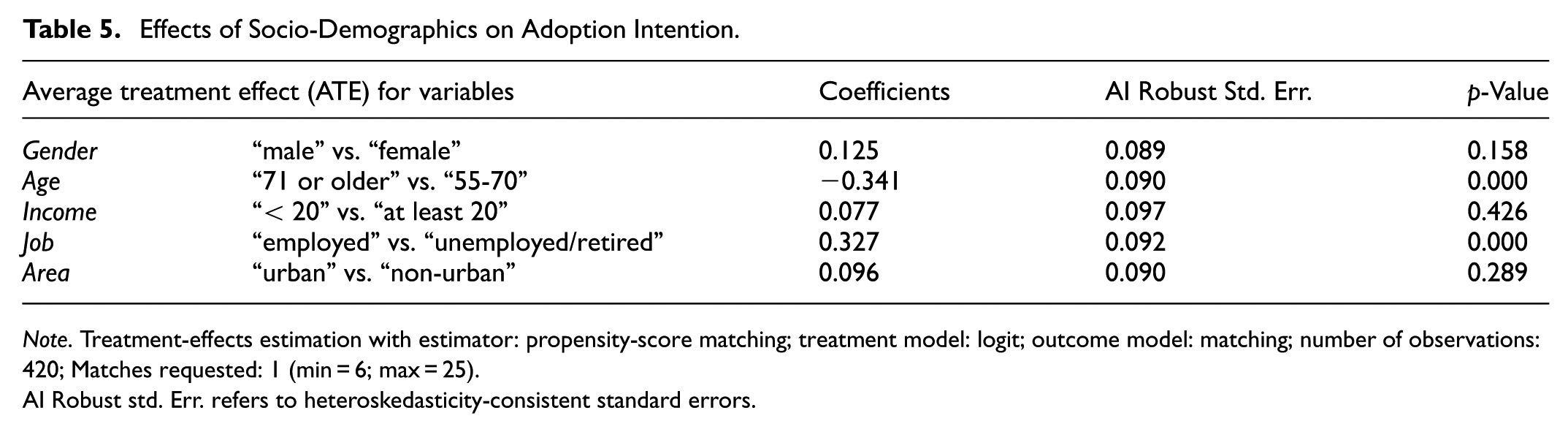
Note. Treatment-effects estimation with estimator: propensity-score matching; treatment model: logit; outcome model: matching; number of observations: 420; Matches requested: 1 (min = 6; max = 25).
AI Robust std. Err. refers to heteroskedasticity-consistent standard errors.
Results Interpretation
The R2 values of desire (0.649) and intention (0.510) in the present study were comparable to those in most related studies (Beatson et al., 2021; Song et al., 2012; Van Bavel et al., 2017). Hence, the modelling results are reasonable. Aligning with the rich empirical evidence (e.g., Esposito et al., 2016), desire was proven to be a powerful predictor of adoption intention. Similarly, attitude was a strong impetus in predicting adoption intention (Van Bavel et al., 2017).
This study found contradicting results in terms of the effects of two types of norms (i.e., descriptive and injunctive) on desire. While the impact of the latter was relevant, the same was not true for the former. These findings confirmed the importance of including two norm types separately in behaviour analyses (Cialdini et al., 1990; Ham et al., 2015; Ru et al., 2018), at least for older persons. They also challenged the recommendation of some safety research that two norms should be considered as one construct (Collins et al., 2011; Nguyen et al., 2023b). Interestingly, based on the combination of the findings of some earlier analyses (Esposito et al., 2016; Van Bavel et al., 2017) with ours, it seems that descriptive norms rather than injunctive norms have significant effects on the desire of young adults; notwithstanding, an opposite pattern seems true for older persons. The significant positive effect of injunctive norms found in this study can be explained as a result of convenient and easy communications among older persons through free and friendly-user applications in Vietnam, like Zalo, which allow creating groups of relatives, colleagues, or neighbours to share news and stories and make video calls freely. Whereas the limited number of older persons using EBs may be a reason for the insignificant impact of descriptive norms. For another probable reason, older people tend to be (more) careful; therefore, they are more inclined to collect much information/advice and be affected by the views and opinions of other significant persons rather than straightforwardly follow others’ behaviours.
The insignificant effect of perceived behavioural control on the desire for EB adoption was in agreement with the study of the drinking desire (Fry et al., 2014). Theoretically, the confidence in the ability to perform a behaviour (i.e., perceived behavioural control) is correlated more with the willingness or the intention rather than a motivational function (i.e., desire). Another possible explanation is related closely to the research subject. Older persons always have savings and pensions, not to mention possibly receiving financial support from their children (adult persons) and having no responsibility for looking after others; therefore, they tend to be free of financial pressure. Furthermore, from the position of the oldest persons in the family, the respondents in this study can make independent decisions.
The current study validated the prior qualitative EB-specific studies that indicated that emotional elements are both significant impetus and impediments to the choice of EBs (Plazier et al., 2017). However, we found that the effects of the two emotional factors were not equal. The emotional delights of riding an EB caused more impact in shaping desire than the emotional disappointment of not riding an EB.
Incongruent with our initial expectations, environmental concerns were not a predictor of desire. Several points can be discussed from this finding. First, an older person usually places high emphasis on environmental issues due to these threats to their health (Chen et al., 2022; Shoval et al., 2010). Consequently, they tend to make attempts to select solutions to protect themselves from the environmental risks, but unnecessarily protect the environment. Additionally, the green value of EBs may not be so large that people can appreciate it, at least compared to e-cars (Plazier et al., 2017). Moreover, based on prior studies set in Vietnam, the adoption intention of green travel modes or services has barely depended (directly) on environmental concerns or consciousness (Nguyen & Pojani, 2023; Nguyen-Phuoc et al., 2022).
Our findings corroborated the earlier reports of the negative predictive effect of perceived risk on the intention to adopt electric vehicles (Featherman et al., 2021; Ngoc et al., 2023; Nguyen et al., 2024c; Nguyen-Phuoc et al., 2024) – however, the found contributions of risk types to the overall perceived risk did provide some novel insights. Congruent with a study of EBs among parents of teenagers (Nguyen et al., 2023a), the crash, functional, and financial risks were demonstrated to formulate the perceived risk. Moreover, perceived explosion & fire risk, which is always ignored in previous quantitative studies of electric vehicles (Haustein & Møller, 2016; Johnson & Rose, 2015; Wolf & Seebauer, 2014), was the second strongest facilitator of the perceived risk for older persons when it comes to thinking about the choice of EBs. The high weight of perceived explosion & fire risk found in our case, on the one hand, could come from a specific incident wherein the explosion and fire of the batteries of EBs are blamed for the fire of a residence with over 50 deaths (Vietnam.vn, 2023). On the other hand, our findings suggested that more attention should be placed on this risk, particularly when the fire of vehicles’ batteries is on the rise worldwide (CBS News, 2023). Another interesting finding of perceived risk was its moderating negative impact on the positive link from positive anticipated emotions to desire. Several prior studies suggested that perceived risk plays as a mediator between emotions and behavioural intention (i.e., a possible outcome of desire) (Ma & Wang, 2009). As such, a more comprehensive understanding (not only mediating but moderating also) of the severe impact of perceived risk on desire (thus on intention) was attained. It can be interpreted that older persons always pay close attention to risk compared to benefits (Wang et al., 2023). Hence, the higher concerns about the likelihood of crashing, functional issues, financial loss, explosion and fire may distract older persons more from the role of potential emotional benefits of riding EBs in shaping desire.
A respondent aged at least 71 years old was less intent to accept an EB than a younger counterpart. Possible explanations are involved in the reduced travel demand and health issues that prevent independent mobility (Buehler et al., 2024). At that age (i.e., >70), using transportation services such as taxis and/or being accompanied by relatives would be a safer and more attractive alternative to owning an EB. Being supported by the suggestion of (Johnson & Rose, 2015), we found that older persons who have a (either part-time or full-time) job were more likely to seek a lower-speed replacement (i.e., EBs) of motorized modes (e.g., the motorcycle).
Implications
As regards theoretical implications, in support of the recommended combination between TPB and MGDB in the literature (Esposito et al., 2016; Song et al., 2012), the current research suggested the theoretical integration between the TPB-MGDB and the RT to explore the intention to accept to use an EB among older persons. The empirical results offered some novel insights into the formulation of perceived risk related to EBs and its moderating effect on the relationship between desire and positive anticipated emotions. Besides, our findings provided the mechanism of how emotional factors exert effects on desire. Older persons tend to focus more on positive anticipated emotions than negative ones. Other results, such as insignificant roles of environmental concerns or perceived behavioural control, were not really new; however, they were confirmed for the case of older persons’ intention to use EBs.
As regards managerial implications, our findings of factors suggested that it may be beneficial for manufacturers to build on a favourable attitude towards EBs and positive anticipated emotions when riding an EB. A relevant strategy to do so is to provide the actual stories of the benefits of EBs for older persons, based on comparing before and after adopting this mode (Bartholomew Eldredge et al., 2016).
In parallel, the feeling of enjoyment, freedom, and happiness when travelling by EB should be concentrated in advertisement and promotion messages/clips. The findings on the positive role of injunctive norms suggested an interesting implication for salespeople. During the consulting process given to an older person having a notice on purchasing an EB, the focus should be placed more on the views and encouragement to use EBs from their relatives, colleagues, and friends, possibly helping to trigger their desire and thus their intention to adopt this mode.
Perceived risk was found to play an inverse role in creating desire and thus intention; therefore, it is essential to reduce it through providing subsidized or free training courses for older persons. These programs should teach older persons how to mount/dismount, brake, turn, and navigate safely. The organization of these courses may reference impactful worldwide related campaigns such as “Cycling Without Age,” which was introduced in Copenhagen in 2012 with active chapters in 41 countries and 43,000 trained cycle pilots (Cycling Without Age, 2025). Manufacturers should be in partnership with doctors and physiotherapists who can recommend e-bikes for safe, joint-friendly, low-impact exercise.
Recent empirical evidence stressed that it is critical for manufacturers to establish an effective commitment to information on electric vehicles like EBs; however, the risk of information overload coming from the substantial provision of (abundant) information should be taken into consideration, particularly in developing countries (Cheng et al., 2020; Ha et al., 2023). Given this point in mind, since environmental concerns were found not to be a significant facilitator of the desire towards EB use, manufacturers should not focus on informing and advertising the role of this mode in environmental protection (although this mode actually emits (nearly) zero noise and zero emissions).
The promotion of EBs among older adults from the governmental perspective may involve a range of economic considerations, from initial subsidies or incentives for consumers, infrastructure investment (e.g., charging station) in order to attain potential savings of healthcare and environmental costs (Van Cauwenberg et al., 2019). For many developing countries in the first steps of formulating CE in transportation, the promotion strategies of EBs, particularly for older persons, should be integrated into the master CE establishment plan. As such, the development of EBs can benefit from more economic, labour, and political resources.
Conclusions
The current research examined intentions to adopt EBs among older persons based on a theoretical architecture formulated based on TPB, MGDB, and RT together with two external constructs (environmental concerns and descriptive norms) and some socio-demographics. Among decisional determinants of desire – an imperative predictor of adoption intention, attitude was the strongest factor, while the impact of injunctive norms and positive anticipated emotions was similar at a (much) lower level. Meanwhile, the desire of older persons was not affected by their environmental concerns and descriptive norms. Explosion and fire, together with crash risks, were the main dimensions of perceived risk that not only deteriorated the desire but also moderated the path from positive anticipated emotions to the desire. Based on the insights into the facilitators and deterrents of EB usage intention, some managerial implications for promoting EBs among older persons as a path towards establishing CE in transportation have been proposed.
Footnotes
Appendices
Variance Inflation Factor (VIF).

| AI | Att | DM | Des | EC | NAE | PBC | PR | PAE | IN | |
|---|---|---|---|---|---|---|---|---|---|---|
| Adoption intention (AI) | ||||||||||
| Attitude (Att) | 1.692 | |||||||||
| Descriptive norms (DM) | 1.240 | |||||||||
| Desire (Des) | 1.124 | |||||||||
| Environmental Concerns (EC) | 1.041 | |||||||||
| Negative anticipated emotions (NAE) | 1.115 | |||||||||
| Perceived behavioural control (PBC) | 1.236 | |||||||||
| Perceived risk (PR) | 1.477 | |||||||||
| Positive anticipated emotions (PAE) | 1.344 | |||||||||
| Subjective (injunctive) norms (IN) | 1.239 | |||||||||

Ethical Considerations
Participants agreed that their data would only be used for research purposes, and they were informed that they could leave the research whenever they wanted, without negative impacts. They signed informed consent before participating in the survey. Their participation was voluntary and anonymous, with a reward received after completing the questionnaire. This paper is part of a research project that was ethically evaluated and approved by the Department of Science and Technology, University of Transport and Communications, under the number T2025-KT-009, signed on 18 December 2024.
Author Contributions
Thi Thuy Dung Nguyen: Conceptualization, Methodology, Software, Formal analysis, Writing – Original draft, Writing – Reviewing and Editing, Funding acquisition.
Thanh Tung Ha: Formal analysis, Writing – Original draft, Writing – Reviewing and Editing.
Minh Hieu Nguyen: Conceptualization, Methodology, Software, Formal analysis, Writing – Original draft, Writing – Reviewing and Editing.
All authors have read and agreed to the published version of the manuscript.
Funding
The authors disclosed receipt of the following financial support for the research, authorship, and/or publication of this article: This research is funded by University of Transport and Communications (UTC) under grant number T2025-KT-009.
Declaration of Conflicting Interests
The authors declared no potential conflicts of interest with respect to the research, authorship, and/or publication of this article.
Data Availability Statement
The data that support the findings of this study are available from the corresponding author upon reasonable request.