



Abstract
This study aims to determine the structure and measure the level of monetary policy impact on the transition to a circular economy in Vietnam. Primary data is synthesized from a survey of 321 experts with knowledge and experience in the fields of economics, finance, and banking. Partial Least Squares—Structural Equation Modeling (PLS-SEM) is used to identify the structure and level of impact of monetary policies on financial intermediaries and the circular economy in Vietnam. Research results have determined the structure and level of monetary policies impact on Vietnam’s transition to the circular economy. First, commercial banks and non-bank credit institutions were treated as moderators of the impact of the central bank’s monetary policy on the players of the transition to the circular economy. Second, our study fills in this research gap by examining the impact of monetary policy on the transition to a circular economy in Vietnam in three scenarios expansionary monetary policy, contractionary monetary policy, and stable monetary policy. Third, our research has broadened and advanced our understanding of the role of commercial banks and non-bank credit institutions in the various mechanisms, that monetary policy can influence in the transition to a circular economy in Vietnam. These findings are the premise for the Government and the State Bank of Vietnam to consider to promulgate monetary policies to foster the Vietnam’s transition to a circular economy.
Keywords
Introduction
Circular economy is an economic model which has emerged and been deployed in developed economic countries, especially in European countries. The European Parliament defines a circular economy as a production and consumption model that emphasizes sharing, leasing, reusing, repairing, refurbishing, and recycling materials and products for as long as possible. A circular economy seeks to minimize pollution at every stage of a material’s lifecycle, from manufacturing to disposal, to minimize the depletion of finite natural resources and the harm that comes with their extraction and processing. Reducing the quantity of waste materials and raising resource utilization productivity and efficiency are the main ways to accomplish this. Governments are currently placing a great deal of emphasis on implementing the trend of moving developing and rising nations from linear economies to circular economies. These countries, with high economic growth and populations, generate a huge amount of waste and put additional strain on depleted resources.
The initiatives implemented by developed countries cannot be simply applied or scaled up to these economies (Patwa et al., 2021). As part of a system-wide approach to resource usage, the shift to a circular economy will call for new business models that incorporate reverse logistics, remanufacturing, and closed-loop supply chains to prolong the life of the product. These business models must be financially viable, but there are already a number of obstacles in their way. Removing these will necessitate significant adjustments to the economic environment in which they function, adjustments that must be carried out through a variety of governmental initiatives in addition to adjustments in their structure.
In Vietnam, the orientation toward a transition to a circular economy is officially incorporated into the National Assembly of Vietnam (2020), which came into effect on 1 January 2022. In fact, since 1991, the Government of Vietnam has issued the National Environmental and Sustainable Development Plan for the period 1991 to 2000 (Decision No. 187-CT), which approved the Strategic Orientation for Sustainable Development in Vietnam according to 2004 and 2012. In 2012 and 2021, respectively, the Vietnamese government approved the National Green Growth Strategy for Vietnam, laying the groundwork for sustainable growth. Several studies on the circular economy in Vietnam have also been published, such as Nam and Hanh (2019), Schneider et al. (2017), and Tran and Nguyen (2023). These studies have offered several policy recommendations for the Vietnamese Government to expedite the shift from a linear economy to a circular economy.
One key policy suggested by researchers is the implementation of flexible financial, monetary, and credit policies to foster green growth, a circular economy, a green economy, and ultimately sustainable development. Monetary policy, one of the primary macroeconomic tools, is crucial to a nation’s economic development. An economic indicator that the Central Bank actively manages on a daily basis through its monetary policy tools is referred to as the operational target of monetary policy (Bindseil & Fotia, 2021). In practice, the transmission of monetary policy differs across countries due to variations in economic structures, financial market developments, and the exchange rate regimes in place. The main query that emerges in this situation is how monetary policy decisions made by central banks affect the shift toward a circular economy in emerging and developing countries, especially Vietnam. Several studies on the impact of monetary policy on the global economy have been carried out globally, including the Braun (2021) the impact on the economic growth of a country like John and Nwekemezie (2019) and Mehar (2022); studying monetary policy affecting other economic and financial activities such as Karahan and Bayır (2022); studying the impact of monetary policy on financial intermediaries such as Chinedu and Ezekwe (2021); studying monetary policy affecting the green economy and sustainable development such as Wang et al. (2021), Abbass et al. (2022); research on how monetary and fiscal policy might promote the circular economy (Hamdan & Hussein, 2020). The research team has not, however, come across any studies on how monetary policy affects the shift to a circular economy. From this research gap, we have chosen the research topic “The impact of monetary policy on the Vietnam’s transition to a circular economy - The mediating role of commercial bank and non-bank credit institutions.” Our goals and reasons for doing this research are to quantify the influence of monetary policy on Vietnam’s shift to a circular economy and to understand the underlying mechanism behind it. hence suggesting policy ramifications for the State Bank of Vietnam, the Government, and governance ramifications for economic entities involved in this shift.
The structure of the article is as follows: Section 2 contains the literature review. While Section 4 contains the research data, Section 3 outlines the research process. While Section 6 gives the conclusions, Section 5 describes the research findings.
Literature Review
Theoretical Background
British economist John Maynard Keynes developed the economic theory known as “Keynesian economics” in the 1930s. The theory places significant emphasis on the myriad functions of government intervention in maintaining economic stability and fostering growth. Keynes argued that money indirectly affects economic variables through its influence on interest rates, investments, and cash holdings. According to Keynes, an increase in the money supply would boost aggregate demand, leading to higher spending, increased employment, and economic growth. Keynes’s view was that during an economic downturn, businesses and households tend to cut spending, which reduces demand and employment. Keynes suggested using fiscal policy—which modifies taxes and spending—as well as monetary policy—which modifies interest rates and the money supply—as means of government intervention to combat this. The significance of aggregate demand—that is, the total amount of demand in an economy for products and services —is another point of emphasis in Keynesian economics. Keynes believed that to maintain full employment and steady economic growth, the government should actively manage aggregate demand through its policy instruments (Keynes, 1936).
New Keynesian economics is a modern adaptation of Keynesian theory that emerged in the 1980s and 1990s, based on the research of several economists, including Joseph Stiglitz, Olivier Blanchard, and Stanley Fischer. The idea highlights how conflicts and flaws in the market affect the economy, which can lead to fluctuations in output and employment. Unlike traditional Keynesian economics, New Keynesian economics incorporates the concept of rational expectations, assuming that economic agents have reasonable expectations about future economic conditions. A vital contribution of New Keynesian economics is the concept of price stickiness. According to this theory, prices within an economy do not immediately adapt to shifts in supply or demand. Instead, prices “stick” and can take time to adjust, creating market inefficiencies and leading to unemployment and other economic problems. To address these issues, New Keynesian economists propose a variety of policy tools, including monetary and fiscal policy. Monetary policy can be used to control inflation by adjusting interest rates, while fiscal policy can be employed to stimulate demand through government spending or tax cuts.
The practice of modern monetary policy is built upon several influential theoretical developments. These include the quantity theory of money, Phillips’s curve, the time inconsistency problem, the reasonable expectations hypothesis, and the rate of natural unemployment (Mishkin, 2017). Collectively, these developments have shaped the prevailing belief among scholars as well as the central banks that should be adhered to a reliable rule of thumb by monetary policy in order to achieve a stable and low inflation environment. By employing such a reliable rule, central banks can effectively manage public expectations and focus on maintaining monetary stability, rather than attempting to drive the unemployment rate below its natural level.
Circular Economy and the Transition to a Circular Economy
Hitherto, there have been many studies on circular economy conducted by scientists, international organizations and governments. Kirchherr et al. (2017) have compiled a comprehensive collection of 114 definitions of the circular economy and methodically analyzed them using a coding framework. This analysis aims to provide transparency regarding how is current understanding of circular economy. The definition of circular economy model is therefore as “an economic system that replaces the concept of “shelf life” with the reduction, reuse, recycling, and recovery of materials in manufacturing/distribution and consumption processes.” Researchers have stood on many different angles to circular economy’s study: Kirchherr et al. (2017) and Fullerton et al. (2022) research about circular economy in general; Patwa et al. (2021), Hartley and Kirchherr (2023) and Khan et al. (2022) study on transition process to a circular economy; Zara and Ramkumar (2022), Aloini et al. (2020) and Ryen and Babbitt (2022) research on important issues in transition to a circular economy to be addressed; P. K. Ozili (2021), Alves (2022) and Schröder and Raes (2021) on the circular economy transition’s funding.
Green growth, green economy, circular economy are in fact not interchangeable terms according to Hai et al. (2020). However, these terms are not contradictory but interrelated with each other and all agree with the goal of sustainable development. Specifically, green growth emphasizes the goal of sustainable economic growth, by avoiding pressures that disrupt the balance of the ecological environment. The green economy shows greater inclusiveness as it extends its goals to both human happiness and social justice. Notably, the purpose’s approach of the green economy constitutes that taking care of the economy and the environment from the perspective of the ecosystem first, and then use that as the foundation to promote human prosperity. With respect to current context of resource depletion as well as increased waste challenges, circular economy transition represents to a particular along with mutually beneficial approach to green growth. It aims to disrupt the traditional association between economic development, importantly economic growth as well as environment’s adverse impacts, relied on the philosophy of recovery and regeneration. The main term, orientation with regard to development focused in general and economic development focused in particular is still sustainable development in nations. However, green growth and a circular economy are necessary contributions to building a green economy, followed by a green economy as an indispensable foundation for sustainable development. According to Vu et al. (2021), to achieve sustainable and rapid development, harmonize a rapport between environment and economy, specifically economic growth associated to environmental protection, it is crucial to transition toward an environmentally friendly circular economy. This transition aims to “without trade-off” between economic growth and pollution as well as degradation’s environment. Embracing toward circular economy represents the right direction for fostering a harmonious relationship between economic growth and environmental sustainability.
Vietnam’s transition toward a circular economy has seen numerous significant changes. In order to make this shift, the growth model must be modified to incorporate the circular economy model’s tenets and greener the economy’s sectors. Key elements include the efficient and sustainable utilization of natural resources and energy, leveraging scientific and technological advancements, embracing the digital era, and prioritizing the development of sustainable infrastructure. These initiatives seek to improve growth quality, capitalize on competitive advantages, and lessen negative environmental repercussions, as outlined in Decision No. 1658/QD-TTg dated October 01, 2021.
The Vietnamese government has also established specific policies to strongly implement green credit, green economy, and circular economy to achieve sustainable development goals. These policies encourage financial institutions to participate in sustainable development by providing finance, mobilizing enterprises to invest resources in environmental protection, landscape protection, historical and cultural relics, ecosystems, and biodiversity. They also emphasize the importance of paying fees for wastewater, emissions, solid waste collection, and treatment, and contributing to environmental protection funds at all levels, in accordance with Decision No. 153/2004/QD-TTg dated August 17, 2004.
To effectively mobilize and utilize official development assistance (ODA) and necessary social investments, and to secure funding from domestic and international corporations and individuals, the government is developing vital mechanisms and policies. These are meant to incentivize financial institutions, companies operating in all spheres of the economy, and private citizens to fund and invest in projects that advance sustainable development objectives, as per Decision No. 432/2012/QD-TTg dated April 12, 2012.
One of the most important routes to attaining sustainable development is recognized as being green growth. It immediately lowers greenhouse gas emissions and, over time, clears the path for an economy that is carbon neutral. This includes investing in technological advancements, promoting digital era transformation, and developing smart and sustainable infrastructure. By embracing green growth, there is a significant impetus for personal investment, which plays an increasingly essential role in advancing the green economy, as highlighted in Decision No. 1658/QD-TTg dated October 01, 2021.
Monetary Policy and Transmission Mechanism
According to Bindseil and Fotia (2021) The tool used to control the money supply and interest rates is called monetary policy. The central bank is mostly in charge of carrying out a country’s monetary policy, which comprises a deliberate combination of measures to alter the price, supply, and value of money in accordance with the anticipated level of economic activity. The fundamental objectives of monetary policy in the majority of economies are to stabilize prices, attain a balanced balance of payments, lower unemployment (which in turn creates jobs), encourage output growth, and uphold a sustainable development trend. These goals play an essential role in achieving a balance between internal and external economic factors, and they promote long-term economic development.
Monetary policy is transmitted through a combination of direct and indirect means. The quantity theory of money, which posits a systematic relationship between inflation and money supply increase and is formally described through the “Exchange equation,” represents the direct mechanism. Interest rate channels, exchange rate channels, asset price channels, credit channels, anticipation channels, and risk tolerance channels are examples of indirect processes.
Most countries have experienced a diversity of transmission channels through which monetary policy has tremendous impact on economic activities as well as these transmissions have been generally considered by the monetarist and Keynesian schools of thought. Monetarists argue about a money supply’s modification has a primarily causal regading a shift in the money’s actual value (Onyeiwu, 2012). The depicted mechanism of transmission and state which the central bank’s open market expansion increases the amount of money reserves, which also causes to a surge in the reserves of commercial banks along with ability to generate credit and thus the money supply’s rise as a result of an effect of compounding. With a purpose to decline their portfolios’ amount of money, securities which possess characteristics that is a sold type of the Central Bank is bought by non-banks as well as banks, thereby encouraging activity within the factual field. Advocated perspective by Tobin (1978) who surveyed the pass-through influence with regard to asset portfolio selection in which asset conversion between equity, bond bills, commercial paper and bank deposits is activated by monetary policy. He said that there are a numerous of rigid monetary policy’s influences on liquidity features and banks’ lending ability, thus restricted loans in an attempt to main borrowers as well as trading companies to eliminate mortgage loans and consumer spending, thereby narrowing demand and efficient investment.
Keynesians debate that innovations in the quantity of money facilitate activities in financial markets, which in turn affect interest rates, investment, output, and employment. Their examination of the use of non-bank and bank funds as a result of monetary tightening is exemplified by Oliner et al. (1994) They observe that while there may not be significant changes in the usage process of these funds, larger firms tend to crowd out smaller firms during similar periods. This supports the viewpoint that small businesses face impaired borrowing capabilities under firm monetary policy operations and are more detrimentally impacted by changes in banking, such as an expanding money supply.
The Impact of Monetary Policy on the Economy
An important function of monetary policy acts as an element in the macroeconomic managing process of open market economies. Via affecting macro variables, monetary policy contributes to sustaining stability and motivating economic development. According to Mishkin (2017), the US Federal Reserve (Fed) controls the money supply and interest rates during normal times through the employment of three monetary policy tools known as conventional monetary policy tools: reserve requirements, discount lending, and open market operations. However, the employment of traditional monetary policy tools is constrained when the economy is hit by a full-blown financial crisis, such as the one that occurred from 2007 to 2009. Consequently, novel monetary policy instruments arose, such as the injection of liquidity, acquisition of assets, and pledges to undertake subsequent monetary policy measures.
Relying on each specific circumstance, central banks worldwide will apply monetary policy tools in three scenarios: expansionary monetary policy, contractionary monetary policy, and stable monetary policy. Mishkin (2017) also reckoned that economic well-being is significantly influenced by the correct implementation of monetary policy. Overly expansionary monetary policy primarily causes price increases, diminishes economic efficiency, and hinders economic development. Conversely, excessively tight monetary policy can create a severe downturn, leading to decreased production and increased unemployment. It can also lead to devaluation and a long-term decline in price levels, as seen in the United States during the Great Recession and in the more recent economic situation in Japan.
To regulate the government’s funds and money within a certain economy, monetary policy serves as a crucial support mechanism. Several research works have examined how monetary policy affects a country’s overall economy (John, 2019), as well as on financial intermediaries (Chinedu & Ezekwe, 2021; Harun et al., 2005). Furthermore, studies have looked at the different ways that monetary policy affects other financial and economic activity (T. N. Nguyen et al., 2017) and its impact on the green economy and sustainable development (Abbass et al., 2022; Teresienė et al., 2021). The monetary policy of the central bank has a direct and effective effect on macroeconomic variables in industrialized countries, such as the GDP, the rate of unemployment, and balance of payments, as certain experimental studies have confirmed (John, 2019; Precious & Palesa, 2014). Research by Tien et al. (2019) in Vietnam, covering the period from 2000 to 2016, illustrates that the primary channel of influence is the interest rate channel, which has a powerful impact on economic expansion. Additionally, economic growth in Vietnam responds quickly to changes in exchange rates, foreign exchange reserves, and stock price indexes. Sang (2019) evaluated economic development based on the impact of monetary policy tools by using time series data collected between 2009 and 2018 and the VAR approach. The findings from Vietnam point to a particular connection between monetary policy and economic expansion.
About the connection between the circular economy and monetary policy, Murshed et al. (2020) investigated how monetary policy affected consumption-based CO2 emissions (CBC) and territory-based CO2 emissions (TBC). According to their findings, monetary policy may be a useful tool for long-term emission reduction in the Gulf Cooperation Council (GCC). However, Hamdan and Hussein (2020) examined how monetary and fiscal policies might support Iraq’s shift to a circular economy. The authors suggested that the Iraqi government use monetary policy techniques and fiscal tools to support and fund circular economy projects. They stressed how crucial it is to work with the private sector to take advantage of prospects for the circular economy as the economy expands. In both studies, monetary policy plays a crucial role by facilitating the implementation and operation of fiscal and monetary measures aimed at advancing the circular economy agenda. Given the current global economic integration, the direct influence of monetary policy on capital flows across nations underscores its significant role in shaping economic development policies effectively.
In Vietnam, according to the Law-2010 on the State Bank of Vietnam, the State Bank operates as a ministerial-level agency directly controlled by the government, tasked with administering monetary policy. The primary objective of monetary policy is to regulate the money supply, which is crucial for the functioning of the economy. This objective is pursued not only through credit operations but also through the activation of open market operations and management of the foreign exchange market, aimed at fine-tuning the overall money supply level. The State Bank of Vietnam is empowered to employ various monetary policy tools to influence economic actors. Refinancing, interest rates, exchange rates, reserve requirements, open market operations, and any other required actions are some examples of these tools. This precision in monetary policy implementation highlights its significant impact on the economy. Just as blood circulates through the human body, the movement of money throughout the economy is essential for its proper functioning and growth. This framework underscores the State Bank’s pivotal role in ensuring monetary stability, fostering economic growth, and adapting to changing economic conditions through effective policy measures.
Research Methodology
The following variables are used in this study: economic content based on the Law-2020 on Environmental Protection; bank and non-banking credit institution operations under the Law-2010 on Credit Institutions, the Amended Law-2017 on Credit Institutions, and monetary policy tools applied under the State Bank of Vietnam’s managerial function in order to administer monetary policy (in accordance with the Law-2010 on State Bank of Vietnam):
We offer three scenarios to examine and assess: expansionary monetary policy, contractionary monetary policy, and stable monetary policy. These are made possible by the theoretical framework and empirical research on the circular economy, the transition to a circular economy, and the impact of monetary policy on economic actors. The following are research theories about how monetary policy may affect Vietnam’s move to a circular economy:
Expansionary Monetary Policy Impacts on the Operation of Commercial Banks (EMP-CB)
Increased lending and borrowing activity can result from expansionary monetary policy, which typically entails lowering interest rates and increasing the money supply. Banks profit from this increased revenue generated by loan fees and interest income. Thereby boosting economic growth and stimulating demand for financial services. However, lower interest rates can also reduce the profitability of banks, especially if they have high fixed-rate deposits. In addition, increased lending activity can also increase default risk and reduce asset quality in a bank’s loan portfolio, leading to losses and negatively impacting the financial stability of banks. Furthermore, expansionary monetary policy can also contribute to asset bubbles, especially in the real estate sector, increasing systemic risk and potentially leading to a financial crisis if not properly managed. In general, expansionary monetary policy has a positive effect on commercial banks’ operations, the negative effects are mainly due to subjective factors in the management of commercial banks and other economic entities (T. N. Nguyen et al., 2017; H. H. Nguyen et al., 2022; D. T. Nguyen & Nguyen, 2021). Thus, the following theory is put out as follows:
Expansionary Monetary Policy Impacts on the Operation of Non-bank Credit Institutions (EMP-NBI)
The demand for financial services, particularly those offered by non-bank credit institutions (NBIs) such financial institutions and financial leasing businesses, can rise in response to expansionary monetary policy, which can also boost economic growth. This increased demand will benefit NBIs by increasing their revenue and profits. In addition, lower interest rates will lower borrowing costs, improving margins and the overall financial health of NBIs. However, growing demand for financial services could also attract new entrants into the market, which could increase competition and potentially erode NBIs’ market share and profitability. Furthermore, a low interest rate environment can encourage risk-taking behavior among NBIs, as they may seek to earn higher returns by investing in riskier assets. Overall, the State Bank Vietnam’s influence of a kind monetary policy so-called “Expansionary monetary policy” on the NBIs could be positive in terms of increased demand and lower borrowing costs, but could also be risky in terms of increased competition and risk-taking behavior. As a consequence, the hypothesis as follows is formulated:
Expansionary Monetary Policy Impacts on the Transition to a Circular Economy (EMP-CE)
In order to facilitate the shift to a circular economy, expansionary monetary policy can boost investment in innovation and infrastructure as well as economic development. Lower interest rates could encourage borrowing as well as investment, facilitating companies and organizations that are transitioning to more sustainable practices. On the other hand, increased economic activity due to expansionary monetary policy could also lead to increased consumption and waste generation, which could undermine the goals of the circular economy. Circular economy investment projects often have high investment costs and long payback periods, which can also lead to businesses focusing on traditional industries rather than sustainable ones, delaying the circular economy’s transition. Overall, influence regarding the State Bank of Vietnam’s expansionary monetary policy on the circular economy’s transition constitutes positive. Several resulting negative effects can be mitigated by strengthening supportive policies of the government and related industries (Astuti & Udjianto, 2022; Hussein & Hamdan, 2020; Srithilat et al., 2022). As a result, we formulated the hypothesis as follows:
Contractionary Monetary Policy Impacts on the Operation of Commercial Banks (CMP-CB)
Lower credit demand and slower economic growth might result from contractionary monetary policy, which raises interest rates and reduces the money supply. Lending activities throughout banks may decrease and may face higher borrowing costs from the central bank. In addition, increasing competition in raising capital can lead to higher deposit interest rates, further reducing the bank’s profit and profitability. Furthermore, a contractionary monetary policy can be primarily causal regarding an upsurge in defaults and bad debts, as businesses and individuals may realize it hard to repay their loans due to a drop-in economic activity. This can lead to banks experiencing increased credit risk, which can affect the stability and financial health of banks (Harun et al., 2005). However, contractionary monetary policy can also help control inflation and prevent asset bubbles, which can benefit the long-drawn health of the economy and the banking industry. Thus, we formulated the hypothesis as follows:
Contractionary Monetary Policy Impacts on the Operation of Non-bank Credit Institutions (CMP-NBI)
Similar to commercial banks, The State Bank of Vietnam’s contractionary monetary policy on NBIs is also complex and may depend on a number of factors, including policies that were implemented, the balance between economic stability and growth objectives, as well as the overall financial health and risk management strategies of the NBIs. Therefore, we formulated the hypothesis as follows:
Contractionary Monetary Policy Impacts on the Transition to Circular Economy (CMP-CE)
Contractionary monetary policy can lead to reduced economic activity and investment, slowing making the transition to a circular economy. Reduced economic activity may result in lower demand for goods and services, which may in turn result in less innovation in sustainable practices and less production of those goods and services. Higher interest rates may discourage borrowing and investment, limiting the ability to finance sustainable initiatives and projects. Furthermore, a reduction in monetary policy may lead to an increase in unemployment, which impedes the shift toward a sustainable circular economy by diminishing the ability of economic actors to allocate resources toward sustainable endeavors. In addition, a drop in customer demand for commodities and services may result in a drop in the market for recycled materials and other circular economy-related commodities. However, contractionary monetary policy can also help control inflation and prevent asset bubbles, which can help the economy’s long-term health and the transition to a circular economy. In general, The State Bank of Vietnam’s contractionary monetary policy has a detrimental impact on the transition to a circular economy (Hussein & Hamdan, 2020). The benefits can be used to reduce the influence of an expansionary monetary policy. Consequently, we put up the following theories:
Stable Monetary Policy Impacts on the Operation of Commercial Banks (SMP-CB)
Stable monetary policy, including keeping inflation rates low and interest rates stable, can help create a predictable business environment for banks. This predictability can lead to greater stability for banks, as they can better plan their lending and investment activities. In addition, a stable monetary policy can reduce uncertainty in the market, which can attract more foreign investment and improve the overall economic environment. Furthermore, the profitability of banks can also benefit from a stable monetary policy. Stable interest rates make borrowing and lending costs more affordable, making it easier for banks to plan financial operations and generate stable profits. In general, a stable monetary policy can make the environment for banks to do business improving the stability and profitability of banks (D. T. Nguyen & Nguyen, 2021). Therefore, we suggest the following hypotheses:
Stable Monetary Policy Impacts on the Operation of Non-bank Credit Institutions (SMP-NBI)
Stable monetary policy can create a favorable business environment for non-bank credit institutions (NBIs). Such an environment can enhance prospects for stability and growth, allowing NBIs to better plan and execute their operations. For example, stable interest rates can enable the NBIs to provide credit and lend at a lower cost, thereby making credit more accessible to borrowers, leading to growth and profitability for the NBIs. Furthermore, stable monetary policy can increase investor confidence, leading to more investment in NBIs. In turn, this could provide NBIs with access to more capital, allowing them to invest in new projects and expand their businesses. Overall, a stable monetary policy can create a favorable business environment for NBIs, improving their stability and growth prospects (D. T. Nguyen & Nguyen, 2021). As a result, we state the following as hypothesis:
Stable Monetary Policy Impacts on the Transition to Circular Economy (SMP-CE)
A crucial element in achieving the goals of the circular economy can be found in the State Bank of Vietnam’s stable monetary policy. Stable monetary policy promotes investment in sustainable industries by providing a favorable economic environment for businesses that focus on sustainable practices. Stable interest rates and inflation can encourage businesses to invest in renewable energy, sustainable agriculture, and other industries essential to a circular economy. This could result in the growth of sustainable businesses, which can lead to job creation and economic growth. Furthermore, a stable monetary policy can also reduce dependence on non-renewable resources by discouraging investment in industries that depend on such resources, such as fossil fuels (Hussein & Hamdan, 2020). This can encourage businesses to switch to renewable energy and other sustainable practices. Vietnam’s shift to a circular economy is generally aided by the State Bank of Vietnam’s stable monetary policy, which increases investment in sustainable sectors and lessens reliance on non-renewable resources. As a result, we formulate the hypothesis as follows:
Operations of Commercial Banks Impact on the Transition to Circular Economy (CB-CE)
The transition to a circular economy necessitates a sizable investment in environmentally friendly methods and tools. Banks may significantly aid in this shift by giving companies that implement sustainable practices financial support. Banks have the ability to offer loans, grants, and other financial instruments to companies that make investments in sustainable agriculture, renewable energy, and other industries that are essential to the circular economy. This may result in the growth of environmentally friendly companies that support economic development by generating new employment opportunities. By including sustainability criteria in their lending decisions, banks can also hasten the transition to a circular economy (Wang et al., 2021). Banks may require businesses to meet certain sustainability standards before providing them with loans or other financial services. That way, banks can incentivize businesses to adopt sustainable practices and reduce reliance on non-renewable resources. In addition, banks can also collaborate with more parties, including governmental and non-governmental entities, to develop innovative financial solutions that support the circular economy (P. K. Ozili, 2021; Zhelyazkova, 2020). For example, banks can work with government agencies to provide financial support to businesses developing circular economy initiatives or to support research and the creation of environmentally friendly technologies. So, we offer the hypothesis:
Operations of Non-bank Credit Institutions Impact on the Transition to Circular Economy (NBI-CE)
When it comes to offering financial services to both consumers and businesses, non-bank credit institutions (NBIs) such as finance companies and financial leasing companies are just as significant. The NBIs can aid in the shift to a circular economy by offering several funding options to companies and individuals who embrace sustainable practices. One way the NBIs invest in environmentally friendly and sustainable financial products can aid in the transitioning to a circular economy. For example, they can participate in investing in green credit projects, environmentally sustainable projects. By making these expenditures, companies can become less dependent on non-renewable resources and embrace sustainable practices. NBIs can also provide alternative funding sources for businesses that invest in sustainable practices. They can provide venture capital, private equity, or other alternative forms of funding to businesses focused on sustainable industries such as renewable energy, circular economy initiatives and agriculture (Wang et al., 2021). This can help close the financing gap for businesses adopting sustainable practices and help them scale up. Furthermore, by taking environment, sociality, and governance (ESG) factors into account when making investment decisions, NBIs can also promote the adoption of sustainable practices. The NBIs can incentivize sustainable practices and reduce reliance on nonrenewable resources by assessing the sustainable performance of the businesses in which they invest (P. K. Ozili, 2021). Therefore, we advance the hypotheses as follows:
The hypothesized model is shown in Figure 1 along with the relationships between the relevant variables of interest.

Hypothesized model.
Research Approach
Vietnam is just starting to make the transition from a linear to a circular economy. Conjunction with green credit, the circular economy will be the foundation for green economic development and ultimately sustainable development. Therefore, statistics on green credit, green economy and circular economy on a national scale are not available. This is a challenge that keeps us from employing quantitative research techniques based on temporal data and a vector regression model (VAR) to examine how monetary policy affects the economy like Phan (2021) and Srithilat et al. (2022), late distributed auto-regression (ARDL) models such as Twinoburyo and Odhiambo (2018), autoregressive vector structure models (SVARs), generalized estimation models (GMMs) such as H. H. Nguyen et al. (2022) In addition, some researchers use qualitative methods to study the impact or role of monetary policy such as deductive methods, explanatory, comparison, analysis, synthesis, induction, and inference methods ( D’Souza & Voll, 2021; Vu et al., 2021).
This study uses a mixed research strategy to measure and evaluate the influence of monetary policy tools on Vietnam’s transition to a circular economy. An investigative approach known as “mixed method research” blends or integrates quantitative and qualitative research techniques. This method came into being in the late 1980s and early 1990s, drawing from the research of academics in a variety of disciplines, including sociology, education, assessment, management, and health sciences. There have been several stages in its development, expansion, and continued progress. In general, mixed methods were selected to reduce the limitations associated with both qualitative and quantitative research approaches. In practice, mixed methods provide a sophisticated research methodology that attracts researchers who are at the forefront of innovative research methodologies (Creswell & Creswell, 2018). Whereby the theoretical underpinnings and empirical research on monetary policy, the circular economy, and several other relevant topics are systematized through the application of the qualitative method. On the basis of primary data from an expert survey, quantitative research methods are used to analyze the structure and test the relationship of the effect of monetary policy on the circular economy transition taking place in Vietnam.
In order to gather information from experts in the domains of economics, finance, and banking in Vietnam, a survey questionnaire with a 5-point Likert scale was developed. The employment of monetary policy tools including reserve requirements, exchange rates, refinancing and rediscounting, reserve requirements, and open market operations in relation to the shift to a circular economy are all covered by the survey questions. Partial Least Square - Structural Equation Modeling (PLS-SEM) was used to evaluate the data in order to look into any possible connections between monetary policy and Vietnam’s shift to a circular economy. The PLS- SEM model has been widely used in a number of research areas, including management (Tharenou et al., 1994), and in the investigation of developing and emerging nations’ move toward a circular economy (Patwa et al., 2021). In this research, variables are monetary policy (5 observed indicators), commercial bank operations (3 observed indicators), non-banking credit institution operation (3 observed indicators) and circular economy (4 observed indicators) and structure is the effect of monetary policy on the transition to a circular economy. Three scenarios of monetary policy were assumed to occur for research hypotheses development.
The variables’ measurement is presented in the Table A1 in Appendix 1.
Research Procedure
In our research, every indicator that is seen is a formative indicator, so following Hair et al. (2019), our research methods including these steps:
Preliminary Considerations
Sample Size
PLS (Partial Least Squares) is typically recommended for situations where the sample size is small, though it also performs effectively with large sample sizes, including secondary data. For PLS-SEM, the minimum sample size needs to be more than or equal to the following: Either 10 times as many formative indicators as there are to measure a single construct, or 10 times as many structural paths as there are in the structural model that target a specific latent construct (Hair et al., 2011).
Distributional Assumptions
Many scholars suggest that the lack of distributional assumptions is a key reason for selecting PLS-SEM. This is a notable advantage in social science research, where data are frequently non-normal. PLS-SEM exhibits greater robustness with non-normal data. However, it is important to note that non-normal data can still impact PLS-SEM results, such as causing bootstrapping procedures to produce peaked or skewed distributions.
Statistical Power
The characteristic of higher statistical power in PLS-SEM is particularly beneficial for exploratory research that investigates emerging or less developed theories. While PLS-SEM is well-suited for exploratory research, it is also effective for confirmatory research.
Goodness-of-Fit
Model fit is a key component in CB-SEM, whereas it is less important in PLS-SEM. The balance between theory testing and prediction is emphasized by PLS-SEM, and results should be confirmed in line with this. In this context, scholars have recently suggested new evaluation procedures tailored to PLS-SEM’s focus on prediction, including measures of “Goodness of Fit.”
Evaluation of Partial Least Squares-Structural Equation Modeling Results
Our research followed the Guidelines for Using PLS-SEM from Hair et al. (2019) for assessing formative measurement models and evaluating structural models.
Data
Primary data of this research was collected from the survey from Feb 21, 2023 to Apr 20, 2023. The survey questionnaire including 9 independent variables (45 observed indicators), 2 intermediate variables (6 observed indicators), and a dependent variable (4 observed indicators). Every item in our survey was scored on a five-point Likert scale, with 1 denoting “strongly disagree” and 5 denoting “strongly agree.” It was designed then send online and directly to experts with knowledge and/or experience in economics, finance and banking in Vietnam. The survey was first sent to 30 experts with a master’s degree or higher and with more than 10 years of working experience at State Bank of Vietnam, commercial banks and universities in Vietnam. After receiving feedback and evaluation from the respondents, the research team edits and supplements to complete the survey questionnaire and send it to the experts for evaluation based on the judgment sampling method. 450 survey questionnaires were sent to experts, the number of respondents we received was 330. There are 321 qualified responses remained after the unqualified votes were filtered out. Statistics of respondents showed that: In terms of education, 49.7% of the respondents are post graduates, the rest are university graduates. Regarding employment professional in finance, banking, economics, 70.5% have worked for more than 10 years, while the remaining 5% have worked for less time.
Results
Measurement Model Assessment
The construct reliability and convergent validity of the measurement model are assessed using the values of VIF and outer weights of each item, together with the related p values, which are shown in Table 1. Every item weight in the table is statistically significant (p ≤ .05) and have accounted of the variation of the examined construct (Benitez et al., 2019). Furthermore, VIF readings below 3 indicate that the model has no collinearity ( Hair et al., 2019).
VIF and Outer Weights of the Measurement Model.
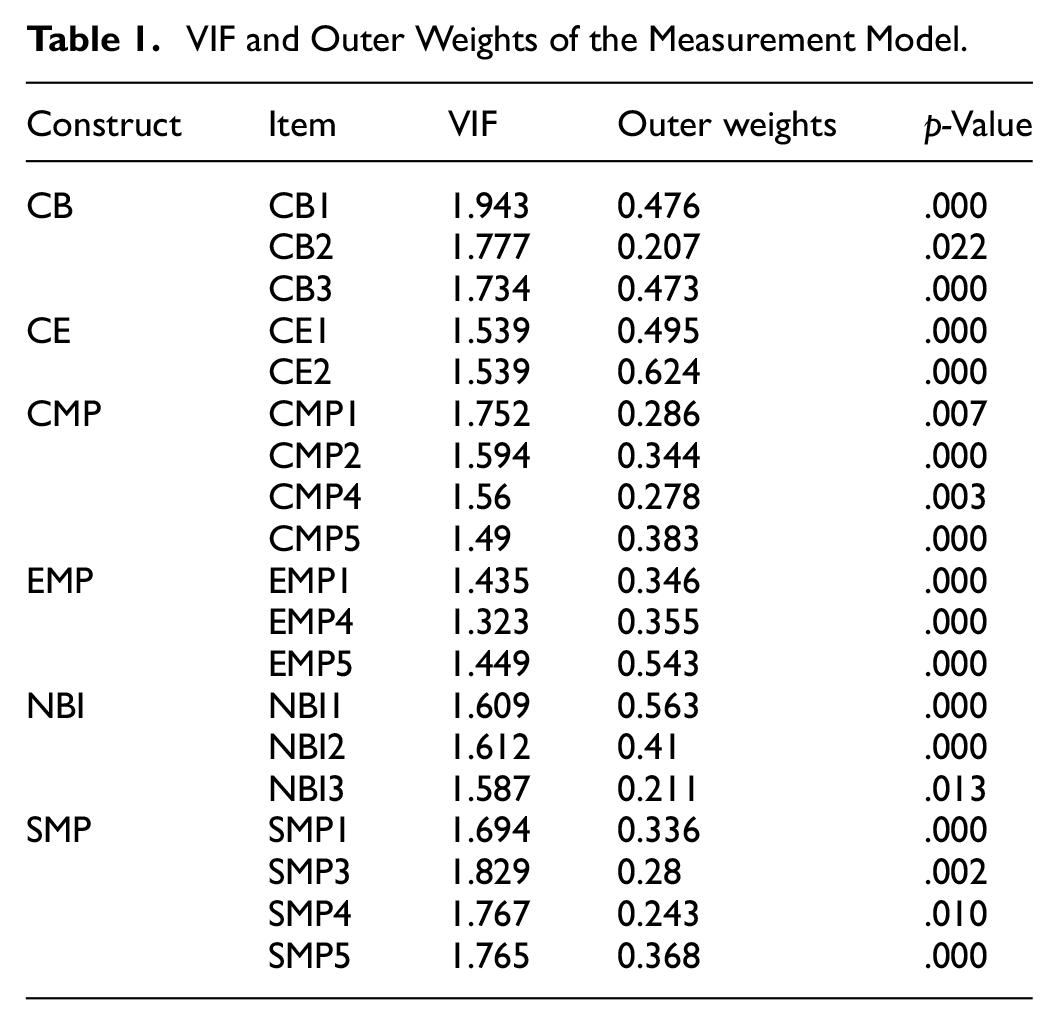
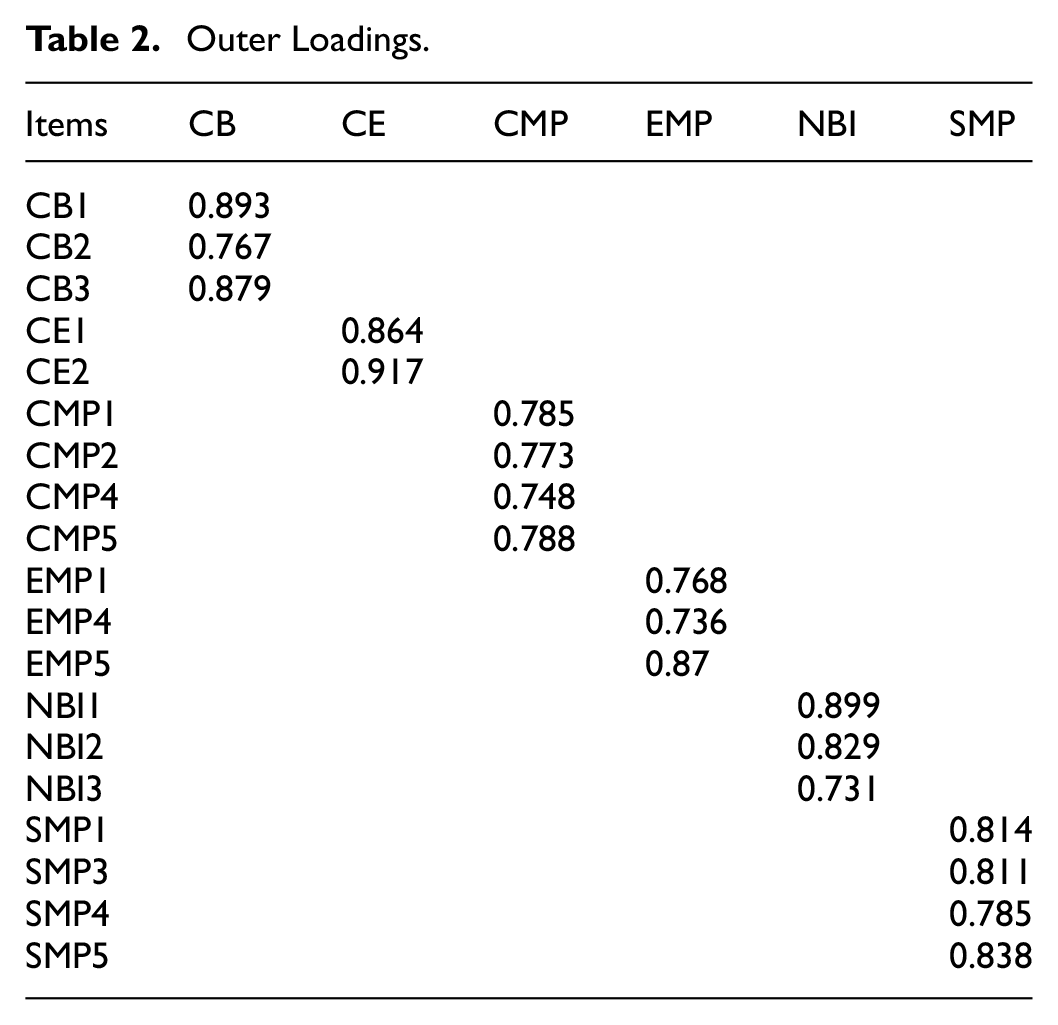
Table 2 shows the outer loadings results of all items. All loadings of items are larger than 0.50 that are statistically significant are considered relevant which shows the relevance of indicators with a non-significant weight.
Outer Loadings.
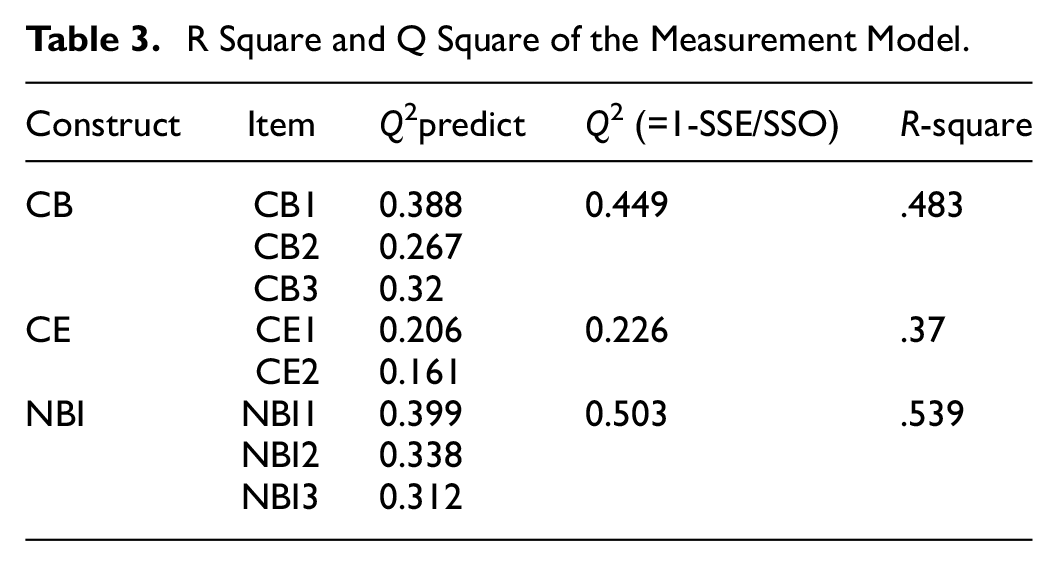
The R square and Q square results are shown in Table 3. The CB, CE, and NBI have moderately high R2 values of .483, .37, and .539. The Q2 values of CB, CE, and NBI are 0.449, 0.226, and 0.503, respectively, indicating medium to high prediction accuracy of the PLS path model. All Q2 values are more than zero, indicating significance. All of the items’ Q predict values are greater than zero, which means the model performs better than the most basic benchmark.
R Square and Q Square of the Measurement Model.
Path Coefficients Analysis
The route coefficients found by the SmartPLS 4 program’s bootstrapping technique are examined in this stage. 5,000 bootstrap samples were generated by the algorithm to guarantee accurate results. The research model’s path coefficient results are shown in Table 4. First, contractionary monetary policy has a positive impact on the shift to a circular economy (correlation coefficient: 0.158**), while stable and expansionary monetary policy have significantly smaller effects (correlation coefficients: −0.028 and −0.035, respectively). All other monetary policies have little effect on this transition. Furthermore, when examining the influence of monetary policy on the operations of commercial banks, contractionary monetary policy, expansionary monetary policy, and stable monetary policy all have a positive effect on commercial banks, with correlation coefficients of .139***, .115***, and .511***, respectively. Similarly, the positive and significant impact of both three types of monetary policy (CMP, EMP, and SMP) on the operations of non-bank credit institutions, with correlation coefficients of .173***, .258***, .402***, equivalent. Furthermore, there are significant and strong correlations between CB, NBI with CE (0.295***; 0.299***).
Path Coefficients for the Research Model.

Indirect Effects Analysis
The results of the indirect effect for the research model are presented in Table 5, which is the result of analyzing the route coefficients that were acquired using the bootstrapping method with the use of SmartPLS 4 software. For this reason, 5,000 bootstrap samples in total were created.
Indirect Effects for the Research Model.
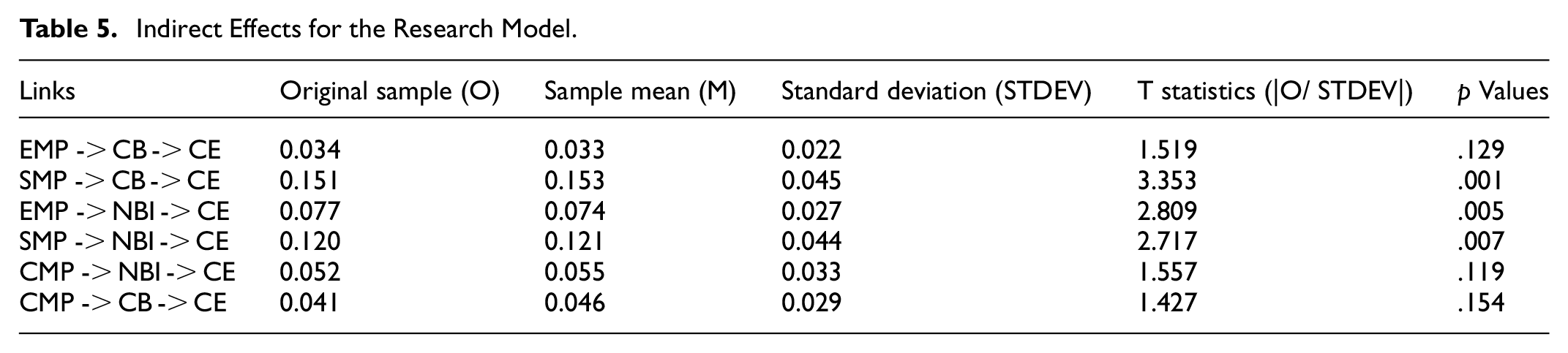
There are positive indirect effects of (SMP -> CB -> CE), (SMP -> NBI -> CE), and (EMP -> NBI -> CE) with coefficients of 0.151***, 0.120***, and 0.077***, respectively, which indicate the mediating roles of commercial banks as well as non-bank credit institutions in the transition to a circular economy under stable monetary policy. Furthermore, non-bank credit institutions also act as mediators during the application of expansionary monetary policy for the transition to a circular economy. Nevertheless, throughout the contractionary monetary policy period, we were unable to locate any evidence to bolster the regulatory role that commercial banks and non-bank lending organizations played in accelerating the shift to a circular economy.
Structural Model Assessment
The theories were then put to the test using the structural model. The goodness-of-fit (GoF) indices, which include SRMR = 0.035, d_ULS = 0.353, d_G = 0.171, and NFI = 092, demonstrated that the structural model fit the data.
A statistical confirmation of all expected relationships (p < .05) was obtained, with the exception of H3, H4, H5, H6, and H9. Table 6 presents the results of the structural model, and Figure 2 illustrates the study model’s conclusions.
Results of Structural Model Testing.

***p < .001. **p < .05; ns: not significant at p < .05.

Research result model.
The shift to a circular economy model may be impacted when the central bank adopts a contractionary monetary policy, which involves hiking interest rates and reducing the amount of money in circulation. An economic concept known as the “circular economy” seeks to reduce waste, advance sustainable lifestyles, and increase resource efficiency. Interest rates rise, making borrowing more costly for both individuals and enterprises. This results in less money being spent on projects and non-essential things, which may diminish consumption levels. Reducing waste and prolonging the life cycle of items are the main goals of a circular economy. Because things are used for longer when consumers consume less and make more thoughtful purchases, waste can be produced at a lower rate. The study by Wang et al. (2024) yielded similar findings regarding the link between economic policy and CO2 emissions through contractionary monetary policy. Conversely, the rise in interest rates, which increases costs, prompts domestic businesses to explore alternative energy sources, as observed in the research on alternative power generation by Inglesi-Lotz and Ajmi (2021).
Conclusion
Theoretical Contributions
From our research results, three theoretical contributions are brought out. First, financial institutions were thought to act as moderators of how the monetary policy of the central bank affected the players in the shift to a circular economy. These included commercial banks and non-bank lending institutions. Monetary policy has not been considered in prior research as a factor influencing the transition from a linear to a circular economy. Moreover, our research offers a theoretical framework for future studies on the structure of the Central Bank’s monetary policy impact on the transition to a circular economy. Consequently, in the nations that have released the circular economy measurement criteria, researchers can employ the quantitative technique to examine how monetary policy affects the shift toward a circular economy. Second, our study addresses this research gap by investigating the impact of monetary policy—encompassing five monetary policy tools outlined in the National Assembly of Vietnam (2010) —on the transition to a circular economy in Vietnam. Three possible outcomes are examined: stable monetary policy, contractionary monetary policy, and expansionary monetary policy. The previous research mainly examined the impact of monetary policy, including interest rates and money supply, on commercial banks, economic growth, and the overall economy, usually in relation to expansionary and contractionary monetary policies. Third, our research has expanded and advanced understanding of the role of commercial banks and nonbank credit institutions in the various mechanisms that monetary policy can influence in the transition to a circular economy in Vietnam, based on the findings of the moderating role of these institutions between monetary policy and the transition to a circular economy.
Managerial Implications
Along with the theoretical contributions, our research has two managerial implications for credit institutions and enterprises in Vietnam. First, our results demonstrate the complete mediating role of commercial banks and non-bank credit institutions in the connection between the shift to a circular economy and monetary policy. These organizations are essential parts of the conduit through which monetary policy is transmitted, and they have a major impact on Vietnam’s transition to a circular economy. So that, these financial institutions have to perceive their mediating role to have effective operations, mobilizing enough money to supply the demand of funds of other players in the economy. Especially supplying preferential loans to green projects and products in order pushing up the transition to the circular economy. Second, the contractionary, expansionary and stable monetary policies positively impact to the transition to circular economy. Consequently, whenever the State Bank of Vietnam applies contractionary, expansionary, stable monetary policies, business and service companies with projects or products. In order to obtain green credits, companies that prioritize reusing, recovering, and recycling raw materials in their production, distribution, and consumption operations should communicate with nearby commercial banks and non-bank credit organizations on a regular basis. These often are preferential loans in terms of interest rates and loan terms with the support from government or other organizations. Moreover, the medium and large enterprises maybe permitted to issue green bond to finance the green projects that relating to the transition to the circular economy in Vietnam.
Limitations and Future Research
It’s critical to acknowledge the study’s shortcomings, especially with regard to its emphasis on the Vietnamese setting, which may limit how broadly the results may be applied. Given the unique characteristics of Vietnam’s economic landscape, including its specific monetary policy framework and the nascent development of green and circular economy initiatives, the applicability of the study’s conclusions to other countries or regions may be limited.
A key limitation is the lack of secondary data on the circular economy in Vietnam, which constrained use of quantitative research methods. The Vietnamese government’s recent implementation of green and circular economy policies, starting from 2020, has resulted in a scarcity of established statistical criteria for measuring circular economy performance at both macro and micro levels. Due to these limitations, the study’s conclusions should be interpreted cautiously. They also emphasize the significance of conducting similar research on related subjects in various settings in the future. In addition, future studies can take a comparative method to assess how well monetary policy tools support the shift to a circular economy in different nations or areas.
Since the beginning of 2024, the Vietnamese government has directed relevant ministries to draft regulations on statistical criteria for measuring the circular economy at both macro and micro levels. Therefore, in order to analyze and evaluate the effects of monetary policy on the shift to a circular economy, future research should make use of secondary data, paying special attention to the roles played by commercial banks and non-bank lending organizations. Additionally, researchers should validate the results of their studies using this secondary data.
Footnotes
Appendix 1
Variables’ Measurement.

| Latent variable | Items | Description | Reference |
|---|---|---|---|
| EMP | EMP1 | The State Bank of Vietnam increased outstanding loans for refinancing and rediscounting. | Ngo et al. (2023) |
| EMP2 | The State Bank of Vietnam reduced lending interest rates of refinancing and rediscounting. | ||
| EMP3 | The State Bank of Vietnam announced an increase in the central exchange rate between VND/USD. | ||
| EMP4 | The State Bank of Vietnam reduced the required reserve ratio. | ||
| EMP5 | The State Bank of Vietnam buys more valuable papers than it sells. | ||
| CMP | CMP1 | The State Bank of Vietnam reduced outstanding loans of refinancing and rediscounting. | Ngo et al. (2023) |
| CMP2 | The State Bank of Vietnam increased lending rates of refinancing and rediscounting. | ||
| CMP3 | The State Bank of Vietnam announced a reduction in the central exchange rate between VND/USD. | ||
| CMP4 | The State Bank of Vietnam increased the ratio of required reserves. | ||
| CMP5 | The State Bank of Vietnam sells valuable papers than buys. | ||
| SMP | SMP1 | The State Bank of Vietnam stabilizes outstanding loans for refinancing and rediscounting. | Ngo et al. (2023) |
| SMP2 | The State Bank of Vietnam stabilizes outstanding loans for refinancing and rediscounting. | ||
| SMP3 | The State Bank of Vietnam announced the stabilization of the central exchange rate between VND/USD. | ||
| SMP4 | The State Bank of Vietnam stabilizes the required reserve ratio. | ||
| SMP5 | The State Bank of Vietnam buys and sells valuable papers equally. | ||
| CB | CB1 | The capital mobilization source of the bank positively influences the transition process towards a circular economy. | Chinedu & Ezekwe, 2021), (T. N. Nguyen et al., 2017 |
| CB2 | The bank’s loan portfolio positively influences the transition process towards a circular economy. | ||
| CB3 | The banking sector’s service activities positively impact the transition process towards a circular economy. | ||
| NBI | NBI1 | The capital mobilization sources of non-banking credit institutions positively influence the transition process towards a circular economy. | Chinedu & Ezekwe, 2021), (T. N. Nguyen et al., 2017 |
| NBI2 | The loan portfolio of non-banking credit institutions positively influences the transition process towards a circular economy. | ||
| NBI3 | The service activities of non-banking credit institutions positively impact the transition process towards a circular economy. | ||
| CE | CE1 | Businesses are aware of and actively engage in sharing, leasing, reusing, repairing, refurbishing, and recycling of pre-existing materials and products. | Ngo et al. (2023) |
| CE2 | Individuals engage and encourage sharing, renting, reusing, repairing, refurbishing, and recycling of pre-existing materials and products. | ||
| CE3 | The sharing, leasing, reusing, mending, refurbishing, and recycling of pre-existing materials and products is encouraged by state administrative entities, who also put it into practice. | ||
| CE4 | Social organizations are aware of and actively participate in the sharing, leasing, reusing, mending, refurbishing, and recycling of pre- materials and products. |
Data Availability Statement included at the end of the article

Ethical Considerations
This study was done ethically, with privacy, consent, and appropriate reporting of people who participated in the study in mind.
Funding
The author(s) received no financial support for the research, authorship, and/or publication of this article.
Declaration of Conflicting Interests
The author(s) declared no potential conflicts of interest with respect to the research, authorship, and/or publication of this article.
Data Availability Statement
The primary data for this article emanate from a survey involving experts and business operators who participated in the transition to a circular economy. The authoring team is committed to sharing this dataset for subsequent research endeavors. For inquiries regarding access to the data, please contact the corresponding author.