




Abstract
Against the backdrop of the prevailing ESG trend, the imperative for green innovation has become increasingly salient, functioning as a critical strategy for enterprises to address environmental regulatory pressures. From the perspective of externalities, this study empirically examines the impact of controlling families on green innovation. Utilizing data from Chinese listed family firms spanning 2016 to 2020, the research finds that the positive externalities associated with green innovation exacerbate family firms’ perceptions of risk and loss. Furthermore, there exists a negative correlation between family ownership and green innovation. This relationship is reinforced by the involvement of family executives but alleviated by the presence of state ownership. This study clarifies the influence of positive externalities on green innovation in Chinese family firms, as well as two distinct forces that amplify and attenuate this externality effect.
Plain language summary
Using the data from listed family firms in China from 2016 to 2020, the research identifies that positive externality associated with green innovation heighten family firms’ perceptions of risk and loss. Moreover, there is a negative relationship between the family ownership and green innovation. This relationship is strengthened by the involvement of family executive but mitigated by the presence of state ownership.
Introduction
Against the contemporary prominence of Environmental, Social, and Governance (ESG) principles, the impetus for green innovation has crystallized as a core approach for corporations to address external pressures (Huo et al., 2024; Sabando-Vera et al., 2025; Xie & Teo, 2022). While green innovation generates substantial social benefits, these advantages transcend firm boundaries, embodying positive externalities (Amore & Bennedsen, 2016; Van den Bergh, 2010). Notably, the Chinese government acts as a pivotal driver in advancing green technological innovation and facilitating the upgrading of industrial structures nationwide (Du et al., 2021). Playing a crucial part in conforming to government plans, state-owned enterprises (SOEs) contrast with private companies—which enjoy greater autonomy—and thus face decisions in this matter (Huo et al., 2024; K. Wang & Jiang, 2021). However, how can the green innovation intentions of private companies be strengthened? Family control emerges as the dominant governance model among private enterprises (Bennedsen et al., 2015). The controlling family within these entities exerts a significant influence on resource allocation behavior, strategic decision-making (Ben-Shahar et al., 2023), and perceptions of the externalities associated with green innovation (Xie & Teo, 2022). Consequently, examining green innovation in private enterprises—particularly those with family involvement in their governance structures—is essential for understanding the dynamics shaping sustainable practices in emerging economies (Qiu et al., 2020; Wu et al., 2024). This focus is critical not only for comprehending the incentives that drive private enterprises to adopt eco-friendly innovations but also for identifying how familial governance structures impact green innovation in these firms (Miroshnychenko et al., 2025; Xie & Teo, 2022).
In studies examining green innovation within family firms, attention is directed both at macro-level driving forces and at the necessity of supplementing existing theories and viewpoints (Huo et al., 2024; Sabando-Vera et al., 2025). Research exploring green innovation in family enterprises tends to focus on macro-level influencing factors, such as institutional pressures (Qi et al., 2021), environmental regulations (Qiu et al., 2020), and the effects of other relevant factors on companies’ adoption of green innovation strategies (Liu et al., 2021; Sabando-Vera et al., 2025). Family firms that pursue green innovation strategies generally need substantial resources for research and development (R&D) as well as employee training (Cainelli et al., 2015). The aims of such initiatives encompass not only satisfying consumers’ demand for green products but also adhering to environmental regulatory standards (Lin et al., 2014), in turn fostering their distinctive competitive strengths in the green industry. Furthermore, a number of scholars have explored the connection between green innovation and sustainability in family firms from the resource-based perspective (Khanra et al., 2022).Nevertheless, in studies on green innovation within family enterprises, existing macro-level analyses tend to neglect the key feature of green innovation as a type of positive externality characterized by “social benefits versus private costs” (Xie & Teo, 2022). This phenomenon is not only present among family firms worldwide but also particularly pronounced in the specific context of Chinese family enterprises, where the link between green innovation and corporate performance remains complex and ambiguous (D. Li et al., 2017). Studies on family firms across various countries all demonstrate comparable uncertainty and context dependence, underscoring the nuance of this relationship (Aiello et al., 2021; Dangelico et al., 2019; Miroshnychenko et al., 2025). The Porter Hypothesis highlights the compensating impact of environmental regulations on innovation (Ambec et al., 2013; Porter & van der Linde, 1995), yet it falls short of thoroughly explaining why family firms often adopt an evasive stance when confronted with the positive externality inherent in green innovation. Traditional family firm theories, while focusing on the driving role of “Social Emotional Wealth (SEW)” in corporate environmental strategies (Gomez-Mejia et al., 2011), yet it fails to fully account for why family firms frequently take an evasive position when faced with the positive externality that is intrinsic to green innovation (Redding, 2013), relevant studies have proposed that externalities cause family shareholders to perceive “spillover losses of benefits,” thereby inhibiting green innovation. This conclusion adds to the research results of Dangelico et al. (2019), which note that family firms attach greater importance to long-term economic interests and cultural inheritance. It further expands the application scenarios of SEW theory within the domain of green innovation in family enterprises.This conclusion supplements the research findings of Dangelico et al. (2019) that family firms pay more attention to long-term economic interests and cultural inheritance, further enriching the application scenarios of the SEW theory in the field of green innovation in family firms.
Green innovation research is derived to solve environmental problems (Takalo & Tooranloo, 2021). Externality is a situation in which the behavior of an individual economic unit impacts society or other individual sectors (such as environmental pollution) without incurring corresponding obligations or rewards, also known as external costs, external effects, or spillover effects (Laffont & Martimort, 2009; Van den Bergh, 2010; Xie & Teo, 2022). The positive externality of green innovation is defined as enterprises’ inability to capture the social benefits it brings, which originates from the fundamental characteristics of externalities in neoclassical economics. Specifically, green innovation generates non-excludable social benefits such as environmental improvement and industry-wide technological spillovers, which have the attribute of public goods, making it difficult for enterprises to fully internalize these benefits through market price (Aguilera et al., 2007; Bottazzi & Peri, 2003). In Chinese family firms, the insecurity of controlling families—rooted in institutional uncertainty and weak formal protections (Redding & Witt, 2009)—drives an intense focus on firm survival and financial returns. This insecurity shapes a decision-making logic that prioritizes short-term stability over long-term strategic investments (Duran et al., 2016; Gomez-Mejia et al., 2011). Green innovation, though beneficial from a societal perspective, is characterized by substantial positive externalities (Ali et al., 2025; Qi et al., 2021). This interplay gives rise to a perceived imbalance between internal expenditures and externalized gains, prompting the controlling family to view green innovation as conflicting with their risk-avoidant, finance-driven goals (Duran et al., 2016; Le Breton–Miller & Miller, 2013). Consequently, their inclination to participate in green innovation diminishes—even if these initiatives could boost the company’s legitimacy or strengthen its long-term ability to withstand challenges (Miroshnychenko et al., 2025; Yang et al., 2024).
Drawing on key research gaps pinpointed in existing studies, this paper tackles three central issues. For one thing, there remains a consistent rift between policy drivers at the macro level and governance mechanisms operating at the micro level. The American business landscape is distinguished by a pronounced focus on formal institutional trust and individualistic values, in contrast to China’s business environment, which is shaped by informal institutional arrangements, interpersonal trust, and other comparable traits (Witt & Redding, 2013). Owing to variations in regulatory climates and market frameworks, the Porter hypothesis—along with its empirical research rooted in the United States—cannot be directly transplanted into China (Ambec et al., 2013; Porter & van der Linde, 1995). Chinese private firms prefer to adopt a mercantile, project-based transactional mentality rather than invest in illiquid assets unless in a predictable, fair, and secure regulatory environment (Redding & Witt, 2009). Sharing of benefits and knowledge in Chinese organizations also has a personalized and relational character, and sharing and ceding towards unspecified objects is inherently contrary to the attributes of the dominant business culture (Redding, 2013; Redding & Witt, 2009). The Chinese government seeks to resolve the contradiction between economic development and environmental protection through green innovation, a strategy that hopes to invest in green technologies for the benefit of unspecified segments of society and the future of humanity (Xie & Teo, 2022). The positive externalities of green innovation are clearly incompatible with the basic rationality of certain Chinese private firms that pursue private and family interests (Ma et al., 2022; Miroshnychenko et al., 2025).
Second, the decision-making patterns behind family firms’ green innovation efforts have been insufficiently examined (Huo et al., 2024; Miroshnychenko et al., 2025). Distinct institutional and cultural contexts give rise to unique types of family enterprises (Qi et al., 2021; Redding, 2002), with a sense of insecurity standing out as a defining characteristic of Chinese family firms (Redding & Witt, 2009). The family is the dominant coalition and power center of the firm (Ben-Shahar et al., 2023), and their goals and preferences determine the behavior and direction of the firm (Ben-Shahar et al., 2023). From the perspective of economic interests, accumulating family wealth and protecting the security of family wealth are the main goals of Chinese business families (Faure, 2006; Redding & Witt, 2009). As a national strategy initiated by the government, green innovation demands that enterprises pour substantial resources into responding to its requirements (Cheng et al., 2022; Khanra et al., 2022). Given the presence of positive externalities and spurred by a feeling of insecurity, Chinese family enterprises are prone to regarding green innovation as a government-mandated task rather than an inherent strategic objective (D. Li & Zhao, 2021; K. Wang & Jiang, 2021; Xie & Teo, 2022).
Third, the contextual variability within emerging economies has received insufficient scholarly attention (Liu et al., 2021; Yang et al., 2024). In spite of unique institutional logics—including state capital involvement in private enterprises and robust policy interventions—studies on green innovation in family firms lean excessively on Western theoretical models (Aguilera et al., 2021; Sabando-Vera et al., 2025). The unique influence exerted by state-business ties and market inadequacies in reconfiguring how family firms respond to externalities calls for empirical verification within local settings.
This paper aims to unravel the connection between family ownership and green innovation. Moreover, it seeks to investigate the moderating roles, with a particular focus on the impacts of family executives and state involvement. Drawing on data from Chinese listed family firms covering the years 2016 to 2020, this study puts forward a firm-level dynamic perspective to address the research question, “how does family ownership shape the perception of positive externalities in green innovation through internal governance structures in emerging economies, and can macro-level institutional forces mitigate this positive externality dilemma?”
Theoretical Background and Hypothesis
The connection between environmental objectives and industrial competitiveness has typically been perceived as entailing a tradeoff between societal benefits and private expenses (Porter & van der Linde, 1995). Positive externality refers to the spillover effect that occurs when an individual or enterprise’s behavior brings indirect benefits to third parties, but the individual or enterprise does not receive full compensation (Bottazzi & Peri, 2003; Xie & Teo, 2022). The social benefits of green innovation exceed the profit scope of enterprises themselves, forming a “benefit spillover” (Sabando-Vera et al., 2025; Van den Bergh, 2010). From the perspective of positive externality, this paper studies the impact of family firm governance structure on the micro-mechanism of green innovation externality: the insecure psychology of families (Redding, 2013), prioritizing economic interests over non-economic considerations, such as reputation of green innovation. Therefore, green innovation is regarded as a “policy-oriented behavior” rather than a strategic goal (D. Li & Zhao, 2021), which will exacerbate the inhibitory effect of positive externality (Aiello et al., 2021). State ownership weakens the effect of positive externality through resource compensation and policy signaling mechanisms (D. Li & Zhao, 2021; Xie & Teo, 2022). While the government eases the pressure on enterprises’ R&D expenditures by providing policy and technical support, offsetting the benefit losses arising from positive externalities (Du et al., 2021; Liu et al., 2021). On the other hand, state-owned enterprises are required to respond to the green development strategy, integrate positive externalities into their governance goals, and mitigate families’ exclusive focus on short-term economic gains (Cheng et al., 2022).
The number of the dominant family’s shares in the firm represents the share of the family’s interest and the corresponding proportion of the positive externalities of green innovation (Ali et al., 2025; Shleifer & Vishny, 1986; Yang et al., 2024). Wealth accumulation is the main way for Chinese families to achieve status and harmony (Redding, 2002), as well as the main goal of business operations (Redding & Witt, 2009). Family firms set their corporate agenda based on the goals of dominating the alliance (Chrisman et al., 2004). The controlling shareholders have a strong incentive to satisfy the demands of other shareholders without compromising their own interests (Huang et al., 2009). Ownership is the foundation and key of corporate governance (Jensen & Meckling, 1976). Since the positive externality of green innovation is treated as an unearned gain and a benefit loss, the higher the shareholding, the greater the perceived benefit loss (Jensen & Meckling, 1976; Porter & van der Linde, 1995). When a family holds a small stake in a firm, its shareholders may even develop a free-rider mindset, perceiving a weaker sense of benefit loss stemming from the positive externalities of green innovation (Ali et al., 2025; Yang et al., 2024).
The positive externality of green innovation means that when enterprises carry out green innovation activities, they need to bear the R&D costs and technology transformation expenses by themselves. However, the environmental benefits (such as emission reduction effects and ecological protection value) and social values (such as green technology diffusion and improvement of industry environmental protection standards) generated by innovation will spill over to other enterprises or the social level (Porter & van der Linde, 1995), and enterprises cannot fully obtain these spillover benefits through market mechanisms (Bottazzi & Peri, 2003). The agency problem of family firms is mainly manifested as the “second type of agency problem” (Chrisman et al., 2004). In other words, when family controlling shareholders hold the actual control of a company, they might stray from the enterprise’s overall interests or the interests of minority shareholders, driven by the pursuit of their own family’s gains (Gomez-Mejia et al., 2011, 2014). This interest deviation will affect the strategic choices of enterprises through behaviors such as decision-making inclination and resource allocation (Chrisman et al., 2004; Laffont & Martimort, 2009).
When the positive externality of green innovation meets the agency problem of family firms, it will significantly inhibit the green innovation decisions of family firms. From the perspective of cost and benefit accounting logic, the positive externality of green innovation leads to “private benefits being lower than social benefits,” while the agency problem of family firms makes the core of decision-making focus on “economic interests that the family can directly control” (Duran et al., 2016). Family controlling shareholders are apt to form a distinct awareness: while the enterprise must take on the R&D expenditures incurred by green innovation, the spillover gains emanating from such innovative endeavors elude conversion into wealth at the family’s disposal (Ali et al., 2025; Miroshnychenko et al., 2025; Wu et al., 2024). At the same time, the revenue recovery cycle of green innovation is relatively long, and some benefits caused by positive externalities are uncontrollable (Ali et al., 2025; Dangelico et al., 2019). Furthermore, the “disregard for non-economic objectives” embedded in family agency conflicts serves to further undermine the impetus for decision-making (Dou et al., 2022; W. Zhang et al., 2025). Even when green innovation is capable of generating non-economic values like social reputation, it will still be perceived by the family as “cost outlays unrelated to family interests” if it fails to be translated into government subsidies or market premiums (Ali et al., 2025; Jensen & Meckling, 1976). Finally, in the decision-making link of green innovation, they choose to reduce the investment intensity or abandon the core innovation direction (Ali et al., 2025; Cheng et al., 2022). Accordingly, the present study formulates the following hypothesis.
H1: Family ownership negatively affects firms’ green innovation activities.
Compared to state-owned shareholders, family shareholders bear less responsibility for political responsibilities, and their strategic decisions are less likely to deviate from economically rational tendencies (Stan et al., 2014). When green innovation is not a mandatory or necessary option, decision-making of controlling family in green innovation is deeply influenced by positive externalities for profit-maximization. Their institutional and cultural context differs from Western style, and the family firms tend to be involved in business management in a personified manner. The cultural and institutional systems provide a business environment where Chinese family firms rely on personalized trust to compensate for the lack of institutionalized trust (Redding, 2002). In this legal environment lacking robust property rights protections, Chinese private firms tend to adopt a project-based, transactional, profit-seeking view rather than a professional view based on long-term considerations and the efficient use of invested capital to drive productivity gains (Redding & Witt, 2009). Consequently, family firms generally appoint relatives to executive roles to safeguard family interests and secure channels for their realization. The personalized participation of family members in management further intensifies the tendency to shun green innovation.
The participation of family executives in green innovation constitutes a multifaceted process spanning both governance and management dimensions. The separation of decision-making and risk-taking generates agency costs (Fama & Jensen, 1983). As family members share common interests, having family members in executive positions can reduce these agency costs (Chua et al., 2003). Nonetheless, in firms with a family identity characterized by a high degree of top management involvement, the discursive power of family executives is strengthened, rendering them more inclined to prioritize family wealth accumulation (Sciascia et al., 2013). When non-family executives engage in decisions, they do not need to bear the corresponding costs, nor do they strongly perceive the loss of benefits from positive externalities. They might even enhance their professional reputation through green innovation, which is highly attractive. For family executives, since the family holds shares in the enterprise, both economic and non-economic benefits are closely related to it (Sciascia & Mazzola, 2008). Owing to the perception of benefit loss, these executives may develop a loss-averse attitude. Accordingly, family members may regard short-term performance as a vehicle for establishing their own authority, which could lead to a reduction in green innovation activities given their externalities and relatively high failure risks. To sum up, the participation of family executives is likely to further curtail such activities with the aim of mitigating this perceived loss of benefits. Therefore, this study put forward the following hypothesis,
H2: The involvement of family executives reinforces the negative relationship between family ownership and firms’ green innovation activities.
The Chinese government exerts influence on corporate agendas through various forms of state involvement. Political power, a crucial factor influencing the green innovation activities of enterprises (Takalo & Tooranloo, 2021). Within China’s economic framework, the government retains control over substantial resources (Redding, 2013; K. Wang & Jiang, 2021). Proximity to the government can yield tangible benefits for firms and their controlling shareholders (Qi et al., 2021), while serving as a conduit through which state authorities influence corporate agendas. When state forces participate in family firms, these enterprises are compelled to demonstrate active alignment with national strategies via strategic initiatives, and the advancement of green innovation constitutes one such form of signaling (Sabando-Vera et al., 2025; Wu et al., 2024). On the other hand, such state involvement can endow firms with resources and prestige that are hardly attainable through market transactions, thereby offsetting the positive benefits lost due to the spillover effects of green innovation (Porter & van der Linde, 1995; Redding, 2002). These two mechanisms—the signaling effect and the compensatory effect—function as incentives prompting family firms to engage in more green innovation initiatives. State involvement can manifest itself in various ways, such as establishing Communist Party branches in private firms, and state capital taking shares in private firms, etc (Miroshnychenko et al., 2025; Yang et al., 2024). This study examines the changes in green innovation in family firms when there is state capital involvement.
State intervention exerts a significant influence on enterprises’ green innovation strategies. Firstly, the existence of state-owned shares provides additional resource support for enterprise green innovation (Qi et al., 2021; Qiu et al., 2020). Given that state-owned shares signify the state’s partial ownership and control over an enterprise, the government is able to offer support in the form of policies, funds, and technologies, thereby facilitating enterprises’ engagement in green innovation activities (Chen et al., 2024; Hu et al., 2023). This is particularly evident in industries incentivized by government policies, where the backing derived from a state-owned affiliation can expedite the execution of green innovation initiatives. Secondly, the state-owned shares also provide political support. As a shareholder of the enterprise, the state may encourage the enterprise to carry out green innovation by implementing relevant policies and regulations (K. Wang & Jiang, 2021; Yu et al., 2022). The government has a clear policy orientation on environmental protection, energy saving and emission reduction, and enterprises with state-owned shares more likely to receive government support and inclination in policy formulation, resource allocation, market development (C. Zhang et al., 2022). Therefore, there is more conducive to enterprise engaging in green innovation (Hu et al., 2023). Thirdly, the existence of state-owned shares can also mitigate the inhibitory impact of family ownership on green innovation. In family-owned enterprises, family shareholding is frequently associated with the self-interested tendencies of family members, who may prioritize familial interests over green innovation initiatives (Miroshnychenko et al., 2025; Sabando-Vera et al., 2025). The presence of state-owned shares is likely to alter a firm’s decision-making mechanisms and interest distribution patterns, mitigate the “controlling shareholder-minority shareholder” agency conflict within family enterprises, and diminish the influence of family interests on green innovation. State-owned share participation can steer family firms toward aligning their objectives with the government’s social goals, thereby prompting them to attach greater importance to national interests and social responsibilities (B. Li et al., 2022). Therefore, this study develops the following hypothesis,
H3: The involvement of state-owned shares weakens the negative relationship between family ownership and firms’ green innovation activities.
Although green patents represent firm-level innovation outputs, family shareholders’ perception of positive externality spillovers—where societal benefits exceed private returns—intensifies their investment reluctance. This perception-based externality lens complements institutional perspectives (e.g., state ownership) by revealing cognitive barriers to green transitions. Drawing on the foregoing analysis, the theoretical model of this paper is presented in Figure 1.
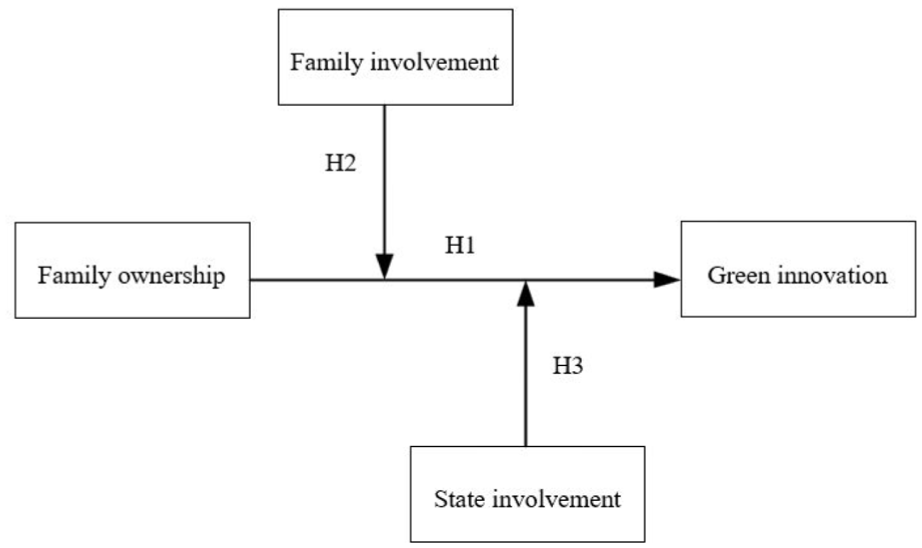
Theoretical framework.
Method
Sample
This study selects listed family firms from the CSMAR Family Firm Database for the period 2016 to 2020. The choice of 2016 as the starting point stems from the fact that the 18th National Congress of the Communist Party of China (CPC) in 2015 proposed the concept of green development, which set forth new requirements for enterprises’ sustainable development. To ensure data accuracy, this study has meticulously processed the data in the following ways. First, family firms were selected in accordance with the criterion that, in addition to the actual controller, at least one family member with kinship ties holds ownership in, manages, or controls the listed company or its controlling shareholder company. Second, firms operating in the finance and insurance sectors were excluded. Third, enterprises designated as ST, SST, *ST, and other such special-treated cases were eliminated. Ultimately, 1,226 enterprises were identified, resulting in a total of 4,820 observation samples. Patent data were retrieved from the China Research Data Service Platform (CNRDS). Family ownership data were manually compiled by members of the research team based on the annual reports of listed companies, whereas other data sources were derived from the CSMAR database.
Measurements
Green Innovation (GP)
Following Hall and Harhoff (2012), this study employs the number of green patent applications—defined as the sum of green invention patents and green utility model patents filed in the current year, plus one—as a logarithmic measure of a firm’s green innovation activity. The reason for choosing this indicator is that green patents are granted with a time lag, whereas green patents are put into use during the application process, thus reflecting enterprises’ true green technological innovation capacity in a more reliable and timely manner (Tong et al., 2014).
Family Ownership (FO)
Referring to Liang et al. (2013), in this study, the family is treated as an integrated entity, and family ownership is measured by the proportion of equity held collectively by the actual controller and their family members. The specific calculation procedures for this method are outlined below. First, the shareholding ratio of the actual controller is calculated by studying the annual reports and holding charts of listed companies. Second, the equity stakes held by family members among the top 10 controlling shareholders—those not specified in the shareholding structure diagram—are incorporated into the calculation to derive the final family ownership percentage.
Family Management Involvement (FM)
Referring to Liang et al. (2013), this study measures family management involvement by the proportion of family executives, which reflects the family’s direct participation in the firm’s internal management. Specifically, family management involvement is operationalized as the percentage of family members within the firm’s executive team.
State Involvement (State)
To evaluate the balance between state-owned equity and family control, this study incorporates the dimension of state involvement (State). Specifically, the ratio of state-owned shares to the shares held by the controlling family is adopted as a proxy variable to measure the extent of state involvement.
Control Variables
The selection of control variables is based on a review of prior literature on the determinants of green innovation. Guided by the principles of theoretical necessity and methodological rigor, the justification for the control variables in this study is as follows. Firm age is included to account for differences in innovation behavior between mature and younger firms. Mature firms may exhibit innovation inertia stemming from competency traps, whereas younger firms tend to have a stronger inclination toward exploratory innovation (Sørensen & Stuart, 2000); Firm size captures scale economies affecting innovation resource allocation capacity (Cohen & Klepper, 1996); ROA reflects profitability-driven flexibility in innovation investment (Brown & Petersen, 2011); Leverage constrains R&D capacity through debt burdens (Aghion et al., 2004); R&D intensity directly controls innovation input disparities (Hall et al., 2013); the marketization index is employed to account for institutional heterogeneity in terms of innovation incentives (Y. Wang et al., 2016); and the Herfindahl-Hirschman Index (HHI), a measure of industry concentration, is used to capture the inverted U-shaped relationship between market competition and innovation (Aghion et al., 2005). Descriptions of the variables involved in this study are presented in Table 1.
Definition of Variables.

Research Model
This study investigates the relationship between family ownership and green innovation, and on this basis, explores the moderating roles of family management involvement and state involvement. To test Hypothesis H1, the following regression model is formulated as shown in Equation 1:

To test Hypothesis H2, the interaction term between family ownership and the moderating variable (family management involvement) is added to Equation 1, resulting in Equation 2 as follows:

To test Hypothesis H3, this paper adds an interaction term between family ownership and the moderating variable country involvement to Equation 1, as shown in Equation 3:

GPit represents the level of green innovation of firm i in year t. Control
it
represents each control variable. Year
it
represents a year dummy variable to control for the possible effect of year on green innovation, and
Results
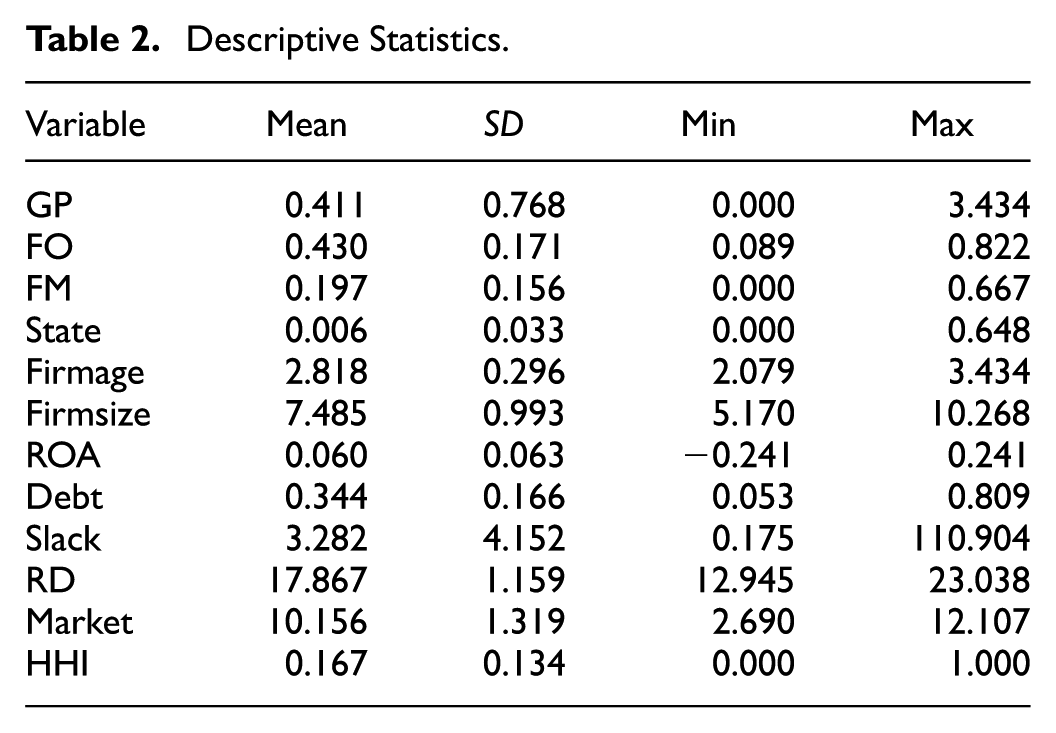
Descriptive statistics for the key variables are presented in Table 2. As indicated in Table 2, the mean value of green innovation—operationalized as the number of green patent applications—is 0.411, with a standard deviation of 0.768. This suggests that the overall level of green innovation among family firms remains relatively low, and there is significant variability across firms. The mean value of family ownership stands at 0.430, reflecting that the average proportion of family shareholding in the sample is 43.0%. The mean proportion of family executives is 0.197. For state involvement, the mean value is 0.6%, with a maximum of 64.8%, indicating that in certain family firms, state equity participation serves as a critical counterbalance to the controlling family.
Descriptive Statistics.
This study also tested the correlation coefficients among the key variables, with the results presented in Table 3. A significant negative correlation is observed between family ownership (FO) and green innovation (GP), which provides initial support for the core hypothesis of this study. Additionally, a Variance Inflation Factor (VIF) test was conducted, revealing that the VIF values of all variables range from 1.01 to 2.06. This indicates that there is no significant multicollinearity issue among the variables.
Correlation Analysis.

p < .1. **p < .05. ***p < .01.
Hypothesis Tests
To ensure the validity of model estimation, the data in this study were processed as follows prior to regression analysis. First, the main continuous variables are subjected to shrinking at the 1% and 99% levels. Second, the continuous variables entering the interaction term are centered to avoid the effect of multicollinearity. The explanatory variable of this paper, the number of green patent applications, has a considerable number of samples with a value of 0 or the number of undisclosed green patent applications, and the Tobit model is used considering that this variable is a truncated data with a minimum value of zero. This paper first verifies the relationship between family ownership and green innovation, and the regression results of all models are shown in Table 4.
Regression Model Results.

p < .1. **p < .05. ***p < .01.
In this case, model 0 is the base model with only control variables put in, and model 1 tests the direct effect of family control on green innovation, and the results show that the coefficient of family ownership is significantly negative (β = −.832, p < .01). This indicates that the higher the family ownership, the less willing firms are to engage in green innovation, validating H1.
Table 4 presents the results of the moderating effects of both family management involvement as well as state involvement, with Model 4 being the full model. Based on Model 1, Model 2 is used to test the moderating effect of family management involvement, and the results show that the coefficient of the interaction term between family ownership and family management involvement is significantly negative (β = −.076, p < .1), which indicates that family management involvement strengthens the negative relationship between family ownership and green innovation, validating H2.
Meanwhile, model 3 is used to test the moderating effect of state involvement, and the results show that the coefficient of the interaction term between family ownership and state involvement is significantly positive (β = .070, p < .1), which indicates that state involvement weakens the negative relationship between family ownership and green innovation, and H3 is verified.
Robustness Tests
In order to ensure the robustness of the results, this paper conducts the following robustness tests, and the test results are shown in Table 5. Firstly, this paper adopts the way of lagging explanatory variables by one period to conduct the robustness test, which is also a common method for endogeneity test. The test results are shown in Model 1 of Table 5, and the negative relationship between family ownership and green innovation is still verified after the explanatory variables are lagged one period (L.FO; β = −.735, p < .05).
Robustness Tests.

p < .1. **p < .05. ***p < .01.
Second, family firms are redefined in a narrower way. Referring to the way Gomez-Mejia et al. (2010) define family firms, the sample of family firms with family ownership greater than or equal to 10% and with at least two family members serving as directors of the firm is screened and re-run the regression analysis. Model 2 in Table 5 shows that the correlation coefficient of family ownership is −.838 and passes the test of significance at the 5% level, consistent with the previous findings.
Finally, this paper uses the ratio of the number of green patent applications per year of the company to its number of all patent applications in that year (GPpercent) as a proxy variable for green innovation (Chen et al., 2021). The test results, as shown in Model 3 of Table 5, indicate that family ownership has a significant negative effect on green innovation (β = −.804, p < .1), so the findings of the previous study have validity.
Discussion
This study underscores the critical role of positive externalities in shaping family firms’ green innovation behaviors. Greater family ownership leads to heightened sensitivity to benefit spillovers, thereby reducing innovation engagement. Family executive involvement amplifies this effect, while state involvement provides compensatory political and resource-based incentives that alleviate it. This study responds to Aguilera et al. (2021)’s call for concurrent assessment of multi-governance actors. This challenges the proposition that family-controlled business demonstrates greater willingness to pursue reputation-enhancing activities (Berrone et al., 2010; Gómez-Mejía et al., 2007). Moreover, complementary evidence shows that family firms prioritize internal stakeholder pressures over regulatory/market forces in green innovation (Dangelico et al., 2019). In contrast to prior studies, this research innovatively employs a positive externality lens to decode family firms’ risk calculus (Berrone et al., 2010), extending SEW and institutional moderation theories by demonstrating how state ownership offsets their innovation reluctance, thus furthering the comprehension of the green innovation paradox within family-owned enterprises. At the same time, this research provides initial empirical support for the “sense of insecurity” in family businesses (Redding, 2013), which manifests as an inherent tendency of such firms to shy away from national agendas in strategic decision-making, except when these agendas are conducive to advancing the interests of the dominant family. This serves as a crucial factor contributing to the inadequacy of intrinsic motivation for green innovation in emerging economies. Three main implications can be derived from this.
First, positive externalities stand as a critical factor shaping green innovation in family-owned enterprises. In contexts where environmental regulations lack sufficient rigor, private firms are more prone to embrace a transactional, business-oriented mindset, rendering institutional pressures ineffective as a strong enough impetus for enterprises to pursue green innovation initiatives (Qi et al., 2021; K. Wang & Jiang, 2021). Under such circumstances, the calculation of a firm’s self-interest becomes the primary basis for decision-making. Given that green innovation generates positive spillover effects, the controlling family perceives these effects as undermining their own interests, thereby tending to curtail green innovation activities (D.Li & Zhao, 2021). Therefore, the positive externalities of green innovation and its related factors need to be fully emphasized.
Second, family managerial involvement and state participation exert countervailing influences on corporate green innovation. The presence of family executives amplifies the controlling family’s sensitivity to profit spillovers, as these managers generally place greater emphasis on family wealth and the firm’s internal interests (Dou et al., 2022; W. Zhang et al., 2025). Conversely, state engagement provides an alternative impetus that prompts firms to take proactive steps in green innovation. In particular, state involvement—exemplified by state-owned equity holdings—endows enterprises with both economic and reputational incentives to pursue green innovation endeavors, thus mitigating the controlling family’s perceived losses arising from profit spillovers (Chrisman et al., 2004; Gomez-Mejia et al., 2014). The simultaneous operation of these two opposing forces implies that the traditional family-state isomorphism fails to apply in green innovation practices (Redding, 2013). On the contrary, family firms’ engagement in green innovation activities is better characterized as a strategic weighing between the family’s interest claims and state authority (Huo et al., 2024; Miroshnychenko et al., 2025; Redding, 2013).
Third, State involvement can partially substitute for environmental regulatory pressures, serving as a feasible approach for countries with imperfect regulatory systems to enhance green innovation. Establishing a sound environmental regulatory system and enforcement system requires a long period of national capacity and rule of law building (Shleifer & Vishny, 1986; K. Wang & Jiang, 2021). In the current era of frequent environmental crises, for transitioning nations such as China, interim measures, such as state ownership, can be employed to address deficiencies in regulatory systems and facilitate green innovation (Wu et al., 2024; Xie & Teo, 2022). Such mechanisms enable the state to intervene more directly in corporate governance, provide resource support to firms, and mitigate family business governance problems. Hence, state involvement—regarded as a practical avenue—is projected to accelerate the rollout of green innovation strategies within family firms in the short run (Jiang et al., 2023), in turn generating more supportive conditions for the sustainable development of enterprises and society alike.
This research offers three theoretical advancements. First, earlier studies have largely concentrated on the motivations behind firms’ involvement in green innovation (Huo et al., 2024)—with particular attention to economic gains (Khanra et al., 2022) and environmental constraints (Soewarno et al., 2019). This investigation adopts a unique externality-oriented perspective. It probes into the link between the controlling family and green innovation by utilizing the framework of green innovation value capture. In doing so, it unveils a previously disregarded yet significant negative incentive effect stemming from family ownership. Second, the conventional perspective in China perceives green innovation as a strategic action primarily characterized by family-state isomorphism. However, this study challenges established views and contributes to the understanding of the conflicting roles played by family executive and state power. Third, the study systematically examines the green innovation practices and compares the response patterns of controlling family such as captured value, spillover value, and environmental factors. In doing so, the study sheds light on the complex trade-offs that family firms negotiate between economic and non-economic gains, offering meaningful perspectives on the strategic decision-making mechanisms that underpin their green innovation practices.
Combining relevant research and China’s practices, we supplement policy recommendations to enhance the incentive compatibility for family businesses’ green innovation. Specifically, tax incentives can reduce private green innovation costs, such as offering higher additional deductions for green patent R&D expenses in family businesses and allowing loss-making enterprises to carry forward credits retroactively. Accelerating the depreciation of environmental protection equipment, like increasing the first-year depreciation rate of low-carbon equipment purchases to 50%, can alleviate family businesses’ investment hesitation due to long-term return uncertainties. Shifting from traditional equipment subsidies to innovation achievement-oriented subsidies linked to carbon emission reduction addresses the “emphasis on declaration over transformation” issue. Additionally, providing green supply chain collaboration subsidies to family businesses leading green supply chain establishment can leverage cluster innovation, capitalizing on their focus on relationship networks.
Conclusions and Future Research Directions
This research examines the association and moderating effects of family ownership on green innovation within Chinese listed family firms. We find that family ownership exerts a negative influence on corporate green innovation. The involvement of family executives intensifies this relationship, while the presence of state ownership serves as a mitigating factor.
These findings have important implications for firms seeking to enhance their green innovation initiatives by adopting an externality perspective. The theoretical underpinnings of this study—specifically, the externalities of green innovation—can be further explored using qualitative methodologies, such as case studies. Interviewing key decision-makers, for example, would provide direct evidence of how and to what extent externalities are considered in their green innovation practices, thereby clarifying their influence on innovation implementation. In the meanwhile, this study did not directly measure environmental institutional pressure or firm isomorphism. Future research could: (a) Quantify institutional pressure using the frequency of industry environmental penalties; (b) Test isomorphism effects by analyzing the similarity of environmental disclosures in annual reports through text analysis. While this study indirectly demonstrates externality’s role through the behavioral chain, future research should calibrate externality using quantified social benefits from corporate environmental reports.
In exploring the relationship between family ownership and green innovation, this study is potentially confronted with challenges arising from endogeneity issues. First, reverse causality may exert a potential influence. Green innovation activities could, conversely, shape the ownership structure of family firms. To illustrate, once a firm reaps substantial social benefits via green innovation, family shareholders might adjust their ownership proportions or bring in state-owned capital—a scenario that could potentially cause the model to overestimate the adverse impact of family ownership on green innovation. Second, omitted variable bias poses a concern. Even after controlling for firm-specific characteristics and environmental factors, unobserved latent variables, may concurrently impact both family ownership proportions and green innovation investments, thus giving rise to biased coefficient estimates. Third, measurement errors and sample selection bias. Green innovation, measured by green patent application data, may fail to reflect the true innovation level due to the influence of enterprises’ information disclosure strategies; moreover, the sample, which consists of Chinese listed family businesses from 2016 to 2020, excludes unlisted family businesses, which may limit the generalizability of the conclusions.
The development of family businesses may generate compensatory effects of non-economic goals on the positive externalities of green innovation economic benefits. Although this study posits that current Chinese family businesses primarily focus on accumulating family wealth, scholarship on family firms indicates that they possess non-economic emotional objectives, which exert a more significant influence on their decision-making processes and strategic directions. Future studies could investigate whether, across different stages of corporate or family development, families’ attention to non-economic goals—such as reputation—surpasses their emphasis on accumulating family wealth.
Footnotes
Acknowledgements
We would like to thank Shi Jing, a talented graduate student from Ningbo University, for her hard work in data processing.
Funding
The authors disclosed receipt of the following financial support for the research, authorship, and/or publication of this article: This work was supported by National Social Science Funds of China (23GLB04648), the National Natural Science Foundation of China (71972042; 71802114), the National Natural Science Foundation of Fujian (2025J01453), Special Undergraduate Practical Teaching Reform Project of Ningbo University (No. JYSJZX-JD-2025001).
Declaration of Conflicting Interests
The authors declared no potential conflicts of interest with respect to the research, authorship, and/or publication of this article.
Data Availability Statement
The datasets generated and analyzed during the current study are available in CSMAR repository, accessible via  . All data used to support the findings of this study, including both primary data collected specifically for this research and secondary data reused from other sources, are included in this public repository. This ensures transparency and allows interested researchers to access and potentially replicate the analysis.