




Abstract
Digital technology is gradually penetrating into all kinds of business of green innovation and green development. However, China’s industrial Internet technology foundation is weak. Scholars’ researches on the impact of digital green strategic orientation (DGSO) on digital green innovation performance (DGIP) and the intermediary role of digital green business model innovation (DGBMI) is relatively backward. Therefore, it is particularly important to divide the dimensions of DGSO from the perspective of DGBMI to describe the mechanism of DGIP. In this study, multiple regression approach was used to test the effect of DGSO on DGIP. The mediating role of DGBMI was explored through 562 questionnaires. In addition, the study divides the DGSO into three dimensions: green market orientation (GMO), digital green technology orientation (DGTO), and government orientation. DGBMI is divided into two dimensions: efficiency type and integration type. The results are as follows. (1) GMO, DGTO and government orientation all have positive effects on the improvement of DGIP. (2) GMO has a greater impact on integration DGBMI (IDGBMI). The influence of DGTO on efficient DGBMI (EDGBMI) is more significant. (3) Government orientation has a positive impact on EDGBMI. The influence of DGSO on DGIP can be realized through the intermediary role of EDGBMI and IDGBMI. The essence of this research is to help enterprises understand the characteristics of internal and external environment and make digital-green strategy-oriented choices to improve their DGIP. This study has a certain theoretical contribution to elucidating the influence of DGSO on DGIP and the mediating role of DGBMI. This study also provides a practical basis for enterprises’ digital green innovation practice based on their own environmental optimization and matching of DGSO to improve competitiveness.
Keywords
Introduction
The outbreak of COVID-19 since 2020 has had a strong impact on the global economic and political landscape, making the market environment rapidly changing. The external impact of the epidemic has led to problems such as irregular production stoppage, labor shortage, shrinking demand, and limited industrial chain. Enterprises are facing unprecedented challenges (Abbass, Begum, Alam, Awang, Abdelsalam, et al., 2022). The outbreak of the epidemic has directly increased the difficulty of the production and operation of enterprises’ digital green products, and the resumption of production of enterprises, the demand of digital green market, and the sales channels of digital green products have been restricted to a certain extent. After the impact of the COVID-19 pandemic, the global economy is gradually recovering from the downturn (Abbass, Niazi, Qazi, Basit, & Song, 2022; Abbass et al., 2023). In the context of the global economic downturn, how to accurately and quickly find the power of China’s enterprises to explore the new start of economic development has become a very important thing (Abbass et al., 2021). China is trying to promote the high-quality development of digital green transformation and innovative business models to improve the performance of enterprises.
With 5G networks, big data, cloud computing and other technologies highly integrated with industries, the Chinese economy is undergoing a green transition from high-speed growth to high-quality development. In recent years, some Chinese manufacturing enterprises have explored digital transformation through “Internet +” and innovative application of digital twin, artificial intelligence, big data and other digital technologies, such as new intelligent manufacturing factories, new models of platform-based organizations, new digital products, and new business models (Yin, Zhang, Ullah, & Gao, 2022). This has accelerated the strategic pace of “co-frequency resonance” between Chinese enterprises’ innovation practices. Despite the continuous implementation of the innovation-driven development strategy and mass entrepreneurship and innovation, and the emergence of new business forms, the most eye-catching is business model innovation. This makes the business model that continuously creates performance for enterprises become the key path for enterprises to obtain advantages under the background of continuous compression of strategic cycle (F. Zhou et al., 2019). At the same time, resource integration, competitive advantage, integration and sharing, and value enhancement have become the key practices of business model innovation, and promote the speed of innovation, and gradually extend the application field (Tian et al., 2018). With the gradual promotion of digital green innovation practices, the company will adopt different digital green innovation strategies for different business units. Business model and its impact on the benefits of digital green innovation have attracted the attention of some scholars. Existing studies have shown that business model plays an important role in benefiting enterprises from digital green innovation.
Most scholars have found that business model innovation, as a key creative activity at the strategic level of enterprises, is closely related to its innovation realization process and the strategic factors of the organization (Zhou et al., 2020). Different understanding of their own advantages under different strategic guidance affects the process of business model innovation (Markides & Sosa, 2013). Research shows that not only the business model but also the strategic choice of the organization plays a key role in corporate performance. And the degree of matching between the two can determine the level of enterprise performance. Reasonable strategic positioning enables enterprises to calmly cope with the market competition and the volatile and changing industry environment. Enterprises can fully obtain the existing resources and break through the current resource constraints. Venkatraman (1989) first proposed the concept of strategic orientation, which he defined as a kind of behavior. This behavior aims to implement the enterprise strategy and believes that the key factor for the success or failure of an organization is strategic orientation. Since then, the research related to strategic orientation has entered a booming stage. In the current economic transition period of China, the external environment is relatively uncertain, and digitalization tends to be borderless. In this context, enterprises must have a pattern of thinking and can accurately grasp the strategic orientation if they want to highlight the siege and remain invincible. For enterprises, strategic orientation has social complexity, reticence and irreplaceability (Zhang & Wang, 2021). Precise strategic guidance can enable enterprises to get a reasonable allocation of resources, enhance their competitive advantages, drive the birth of new products and new technologies, and improve corporate performance. Therefore, the influence of strategic orientation on firm performance has become a research hotspot in the field of strategic management. More and more studies recognize the positive role of strategic orientation in improving the innovation capability and performance of enterprises (Han et al., 2020). Scholars’ enthusiasm and attention to different types of strategic orientation are uneven. Most scholars focus their research on the relationship between strategic orientation and firm performance on the impact of a single type of strategic orientation on firm performance. However, enterprise strategy and behavior are not only driven by one strategic orientation, but also influenced and driven by a variety of strategic orientations (Anees-ur-Rehman & Johnston, 2019). Therefore, when discussing the relationship between strategic orientation and firm performance, it is urgent to consider the combined effects of various strategic orientations closely related to the firm.
In addition, existing researches generally adopt the paradigm of “strategic orientation—organizational innovation—firm performance,” and have fully proved that organizational innovation can improve firm performance (Shih, 2018). However, the intermediate mechanism of the influence of strategic orientation on enterprise digital green innovation performance (DGIP) is still controversial. At present, scholars mainly focus on market orientation (Hernández-Linares et al., 2021; Yu et al., 2019), entrepreneur orientation (Habib et al., 2020; Yin, Dong, Li, & Gao, 2022) and technology orientation (Dong et al., 2022), and analyze the antecedents of these orientations and their impact on enterprise performance. What is rarely considered is the many ways in which the Chinese government influences the operations and innovative practices. Therefore, government, as an important subject in the external environment of enterprises, should be concerned about its potential influence, that is, to establish government orientation (Wang et al., 2021). For the research of business model innovation types, scholars mainly focus on the efficiency and novel business model innovation, and rarely consider the integration business model innovation.
This paper introduces the intermediary variable of business model innovation to construct the theoretical framework of “strategic orientation—business model innovation—enterprise DGIP.” By integrating business model innovation into this framework, the key role of efficiency and integrated business model innovation in the process of strategic orientation on the DGIP is deeply analyzed. This study mainly discusses how digital green strategic orientation (DGSO) affects the DGIP of enterprises and how digital green business model innovation (DGBMI), as an intermediary variable, regulates the influence mechanism of strategic orientation on DGIP. In many aspects of DGSO, we find that enterprises’ correct understanding and choice of green market orientation (GMO), digital green technology orientation (DGTO) and government orientation all promote their DGIP. At the same time, through the intermediary effect test, it is found that the innovation of efficiency and integrated digital green business model plays a positive role in regulation. This study has reference significance for enterprises to select and formulate digital green strategic guidance for implementing digital green innovation in the future, and provides a new way of thinking for enterprises to improve the performance of digital green innovation. It further improves and enhances the explanatory power of strategic orientation to the change of enterprise performance. This deepens the research on the mechanism of strategic orientation on corporate performance, thus guiding and inspiring Chinese enterprises to explore digital green innovation.
The purpose of this study is to further study the intermediate mechanism of the impact of DGSO on enterprises’ DGIP based on the perspective of DGBMI under the background of digital green. It is particularly important to divide the dimensions of DGSO to describe the mechanism of DGIP. At present, it is far from enough for enterprises to rely only on internal technology research and development and innovation departments to improve the performance of digital green innovation. The purpose of this study is to help enterprises understand the characteristics of internal and external environment and make digital green strategy-oriented choices to improve their DGIP. This study provides a theoretical basis for enterprises to match their own environmental optimization and DGSO in the process of digital green innovation practice. At the same time, it has practical value for enterprises to improve their competitiveness, better survival and development process under the current environment.
The structure of this paper is as follows. Section 2 describes and constructs the research framework of digital green innovation, and defines related concepts according to the theoretical basis. Section 3 puts forward the research hypothesis. Section 4 is the research design, including sample selection, data collection, variable determination and data analysis tools used. Section 5 describes the process of empirical test and analyzes the results. The conclusion and outlook will be introduced in Section 6.
Theoretical Basis and Literature Review
Digital Green Strategic Orientation
Strategic orientation is a way to ensure that the enterprise always works efficiently (Abell, 1999). Strategic orientation is diffused in the strategic posture of the whole enterprise. It is not only the managers’ cognition and reaction to the external environment but also the pointer to the future operation and development of the enterprise. Tian et al. (2018) pointed out that strategic orientation is regarded as a collective behavior and strategic choice pursued by enterprises to achieve sustained high performance. Under the background of the rapid development of digital technology and the mainstream of green innovation, the DGSO refers to the reasonable integration of internal and external resources according to the enterprise’s own organizational structure and digital green knowledge, the establishment of the enterprise’s future development direction, and the efficient operation of the enterprise in the digital green innovation. Based on this, an enterprise’s doing style and its future development direction can be insight through its DGSO.
The current research on enterprise strategic orientation mainly defines and diversifies its elements through case analysis or empirical research, such as market orientation (Abbass et al., 2021), technology orientation (Zhou, 2021), employee orientation (Han & Gao, 2022), entrepreneurial orientation (Liu et al., 2022), product orientation (Yin et al., 2019). From a macro perspective, the relevant policies and development directions formulated by the government can affect the decision-making and R&D direction of enterprises (Abbass, Sharif, Song, Ali, Khan, & Amin, 2022; Abbass, Qasim, Song, Murshed, Mahmood, & Younis, 2022; Yin & Zhao, 2024). From the micro point of view, it is divided into internal and external two parts. The external connection of enterprises is the changing market, while the internal connection is the technical level of enterprises themselves (Li & Zhu, 2020) These three levels belong to the same dimension and have a greater impact on enterprises respectively. Therefore, we can describe and characterize the selected strategic orientation from three aspects: government orientation, market orientation and technology orientation. However, in recent years, the explosion of digital technologies led by cloud computing, big data, Internet of Things, artificial intelligence and 3D printing has brought about great changes in enterprises’ green innovation activities. The borderless, interconnected and uncertain features of digital environment fill the internal and external environment of enterprise green innovation. Focusing only on traditional strategic orientation such as market orientation and technology orientation is not in line with the current development direction. Considering the current background of digital economy, enterprises’ green innovation activities can be viewed from all aspects and only by formulating reasonable DGSO can DGIP be measured from multiple perspectives (Ardito et al., 2021). DGSO not only has a clear guiding role in the digital green development direction of enterprises, the choice of digital green innovation behavior, the allocation of digital green resources and other aspects. The strategic orientation of digital green plays a key role in the antecedent variables that drive enterprises’ digital green innovation activities. DGSO can help enterprises better adapt to, respond to and reshape the environment, and improve the efficiency of organizations’ digital green innovation activities through rational allocation of digital green resources, thus promoting the improvement of DGIP. In fact, in the current period of digital transformation, the choice of DGSO not only reflects the strategic direction of enterprises in digital green innovation activities. It also reflects the enterprise’s ability to integrate and update digital green resources and adapt or change the external environment. The choice of strategic orientation is very important for enterprises to carry out innovation activities (Li et al., 2021). Some scholars point out that enterprises should not blindly restrict the situation of lack of endowment resources, but should be highly sensitive to the changes of external environment and have the ability to adapt and change the environment. For external enterprises, the primary task is to choose appropriate digital green strategy guidance to guide enterprises’ digital green innovation behaviors and activities, so that organizations can timely acquire relevant digital green knowledge and experience and quickly adjust organizational structure and plan when facing external high-intensity innovation competition. To achieve the effect of flexible response. Therefore, the reasonable choice of DGSO provides the possibility for enterprises to cope with the competition of digital green market and the volatile and changing industry environment, obtain the existing digital green resources and break through the current constraints of digital green resources.
In the era of explosive growth of digital economy and the new background of increasingly obvious characteristics of variability, uncertainty, complexity and fuzziness, it is difficult for enterprises to “stay alone.”Hai & Jia (2019) pointed out that the strategic thinking of enterprises should not remain unchanged, and they should cultivate pattern thinking and have insight, foresight and originality. Enterprises that adopt GMO can meet the potential demand of green market by acquiring, spreading and responding to green market information and using digital technologies such as big data and the Internet of Things to build new trading methods. Enterprises that adopt DGTO build efficient green trading network by innovating traditional industrial technology and adopting advanced digital technology. To create the user value of green products, and further optimize and expand the digital green innovation industry ecosystem. Government-oriented enterprises can build a good digital green intellectual property protection system and optimize the allocation of digital green innovation resources. This also reduces the R&D costs of enterprises in digital green innovation activities and promotes enterprises to carry out digital green innovation practices. Therefore, this paper draws on the comparative study of strategic orientation (market orientation, technology orientation and government orientation) and environmental factors on breakthrough innovation (technology-based and market-based) and enterprise innovation drive constructed by Zhou et al. (2005) and Li & Wang (2015). It mainly selects three key dimensions of DGSO: GMO, DGTO and government orientation. However, the focus on the DGSO tends to be the influence of the three different directions on the enterprise’s DGBMI (DGBMI) and the improvement process of DGIP.
Existing research conclusions on the mechanism of DGSO on DGIP differ. Some researchers believe that DGSO can help enterprises quickly focus on the positioning of themselves and green product users, optimize the allocation of digital green resources, and integrate digital green resource systems (Muafi, 2020). Therefore, they believe that corporate strategic orientation has a positive impact on improving corporate performance (Han et al., 2020). At the same time, other researchers have come to a different conclusion. They point out that the relationship between DGSO and DGIP cannot be considered only. The development mechanism of digital green innovation is too complex, and the general dynamic situation is a factor that cannot be ignored. In different situations, the influence of DGSO on the performance of digital green innovation is negatively correlated (Valos et al., 2019). The research on the relationship between GMO, DGTO and government orientation on corporate DGIP is fragmented. Few scholars have studied and analyzed the synergy of GMO, DGTO and government orientation on corporate DGIP. This paper will conduct in-depth research and discussion on how to truly implement and implement the DGSO to improve the performance level of enterprises’ digital green innovation.
Digital Green Business Model Innovation
A business model is a conceptualized model in which an organization uses business opportunities to create value for the enterprise and its stakeholders. It describes the internal logic of an organization to create value, deliver value and acquire value (Dong & Wang, 2022). Digital economy plays an important role in promoting the digital transformation of traditional industries and the construction of new industrial system. Its penetration and derivative effects can be deeply integrated with traditional industries to produce a new form of business with low energy consumption and low pollution. At the same time, digital transformation can promote enterprises to innovate their business models, force them to improve traditional production technologies, adopt current advanced digital technologies, and force polluting industries to develop towards environmental protection and green innovation (Vaska et al., 2020). Digital green technology innovation also accelerates the rational use of resources and emission reduction. This reduces the negative externalities of enterprise production and improves high-quality green development. In this context, DGBMI comes into being. DGBMI refers to the activity that changes the basic logic of the enterprise’s digital green innovation value creation to enhance the user value of digital green products and the digital green competitiveness. At the same time, it is also an important tool for enterprises to realize the established digital green strategy. It is the general term for a series of value activities formulated according to the digital green strategy of enterprises.
Although scholars have different understandings of the connotation of DGBMI from different perspectives. However, it is agreed that DGBMI can indeed enhance the digital green core competitiveness of enterprises. Therefore, enterprises need to continue to innovate digital green business models to cope with external environmental changes. Only when the innovation of digital green business model induces the new advantages of digital green competition can the innovation of digital green business model succeed. As for the division of elements of DGBMI, some scholars define and classify them based on different situations (Clausen & Rasmussen, 2013) or internal and external driving factors of enterprises (Fang & Xiang, 2022). But in the digital environment, digital technology breaks the original organizational boundaries. This makes the previously stable and impermeable boundary between the various subjects in the environment become more and more blurred and unstable. Companies are also facing an increasingly uncertain and unpredictable environment. Enterprises have realized two-way, continuous and real-time digital green information interaction with customers, suppliers and competitors in the external environment. Businesses are facing a more open and dynamic environment. Therefore, the research on the innovation type of digital green business model cannot just continue the traditional research, but should be discussed in the new environment and new background of the enterprise. Therefore, this paper draws on Chen et al. (2017) and Yan & Wang (2018) for research and analysis on the dimension division based on the general characteristics of business model innovation elements. The DGBMI is divided into efficiency type and integration type. Efficient DGBMI (EDGBMI) refers to various digital green innovation activities in which enterprises creatively implement green transaction efficiency through various digital technology means, such as cloud computing and artificial intelligence. EDGBMI not only emphasizes on improving the efficiency of enterprises’ digital green innovation itself, but also focuses on reducing the complexity of digital green transactions between enterprises and all participants. By reducing the digital green information asymmetry between digital green trading activities and various stakeholders and reducing the errors in the process of green trading, the cost of green trading in the commercial ecosystem can be reduced, so as to make the members of the ecosystem profit. Different from the EDGBMI, the integration DGBMI (IDGBMI) will gather stakeholders in the digital green business ecosystem to fully integrate and utilize various digital green resources in order to maximize the system value. This model emphasizes the full exploitation of all kinds of values related to digital green innovation to achieve win-win development. The IDGBMI not only emphasizes the digital green value creation of platform enterprises, but also pays more attention to the overall value of enterprise digital green innovation system.
The current research focuses on the mediating role of DGBMI, integration ability and enterprise performance (Pang et al., 2015), open innovation and new venture growth. However, few scholars have studied the impact of EDGBMI and IDGBMI on DGIP. Therefore, clarifying the mechanism between them plays a key role in promoting the DGIP and gaining competitive advantages. This has practical guiding significance for enterprises to successfully implement DGBMI. At the same time, due to the existing research results on the relationship between DGSO and DGIP have some differences. Therefore, it is necessary to introduce the intermediary variable of DGBMI to deeply explore the mechanism of DGSO on DGIP.
To sum up, exploring the mechanism of DGSO on DGIP is of great value for expanding relevant theories of DGSO and guiding enterprises’ digital green strategic choice practice. However, when enterprises are faced with complex changes in the external environment, how to choose the appropriate DGSO? At the same time, can and how can different types of DGBMI achieve better value creation and value acquisition by strengthening the implementation quality of different DGSO? These are the key problems that need to be solved in this paper. For the convenience of readers, the relevant variables and their representations are shown in Table 1.
Relevant variables and their representations.

Hypothesis
The Relationship Between DGSO and DGIP
Corporate DGSO is characterized by social complexity and reticence. The effective and accurate DGSO determines the competition mode and future development direction of enterprises. At the same time, based on advanced digital technology, the strategic orientation of digital green encourages enterprises to rationally allocate digital green resources to enhance their competitive advantages and drive the emergence of new products, new services and new technologies. First of all, green market oriented enterprises emphasize the corporate culture of creating outstanding value for customers. This type of enterprise can quickly notice the current green market information related to customers, competitors and environmental factors. They attach importance to creating more customer value by means of the value concept within the organization and the behavior norms of members, so as to improve the organizational performance. It can capture market information more quickly. On the one hand, GMO can help enterprises strengthen the new concept of creating user value of digital green products and guide enterprises’ strategic behaviors. At the same time, GMO encourages enterprises to carry out systematic analysis and adjust their strategies to adapt to and make use of changes. On the other hand, GMO is beneficial for enterprises to search and accumulate green market information. Enterprises integrate the collected knowledge to fully understand the current market information. Furthermore, according to the green market information, the new technology and new means are used to develop new digital green products to meet the needs of customers, effectively reduce the threat of external competition (Xue et al., 2022), and achieve the strategic goal of improving the performance of digital green innovation of enterprises. Secondly, digital green technology-oriented enterprises need to use high-end technologies in the development process of digital green new products. On the one hand, DGTO can integrate diversified resources and knowledge of new technologies, enterprises can keep abreast of the latest trends and development trends of digital technologies. In this way, we can design better, more novel and better functional digital green products for customers. On the other hand, DGTO can effectively promote the flow of digital technology knowledge across organizational boundaries among multiple countries. At the same time, it makes full use of and integrates the international knowledge and technical information brought by the international research and development intensity. The continuous improvement of the integration speed of new digital technologies also creates important conditions for the continuous development of new products and services (Slater et al., 2014). Finally, government-oriented enterprises advocate good relations with the government. On the one hand, government support plays an important role in the allocation of digital green innovation resources. By formulating policies conducive to enterprises’ digital green innovation activities and allocating innovative digital green resources, the Chinese government can greatly promote the improvement of Chinese enterprises’ digital green innovation capability. At the same time, the government provides financial support and tax subsidies for enterprises’ digital green innovation activities, which reduces the R&D costs of enterprises’ digital technologies and new digital green products. On the other hand, government-oriented enterprises are more conducive to accurately grasp the development trend of the government’s digital green innovation activities policy, understand the development trends of the green market, and quickly adjust their digital green innovation activities. So as to make the most of the policy preferences or opportunities provided by the government. Therefore, based on the above analysis, this study proposed the following hypothesis:
The Relationship Between DGSO and DGBMI
The relationship between GMO and DGBMI
In recent years, based on digital technology application and data drive, green market-oriented enterprises tend to use advanced digital technology to quickly absorb green market information to effectively perceive the change of market environment and understand the degree of customer demand for digital green products. Targeted optimization of the existing digital green products, services and information portfolio, to promote DGBMI to provide a more solid information foundation. Compared with other enterprises, such enterprises have relatively rich and extensive green market knowledge. When enterprises are faced with new opportunities for the development of green market, they pay more attention to carry out digital green information search activities in the current digital green field or across industries. They can predict in advance, focus on the current demand situation of customers, and carry out dynamic follow-up. In this way, enterprises can understand and master the key advantages, core capabilities and development strategies of their competitors in digital green innovation, which lays a solid foundation for enterprises to cultivate new competitive advantages. Secondly, enterprises focusing on GMO can obtain the required digital green external resources, get to know new partners in the field of digital green, and capture more market opportunities. In the process of DGBMI, the internal communication of green market information is the basis for enterprises to effectively integrate digital green resources to meet the market demand, and can meet the customer demand in a targeted way. This can not only reduce the time cost of customers to choose products, but also improve the operation efficiency of enterprises. At the same time, the dissemination and absorption of new ideas, new methods and new ideas within the enterprise is also inseparable from the information sharing among members. The GMO promotes the exchange and communication between various functional departments of the enterprise, and strengthens the close cooperation between departments to meet the value needs of customers. The rapid circulation and absorption of digital green information can greatly improve DGIP, and then affect enterprises’ DGBMI.
Specifically, for EDGBMI, green market-oriented enterprises will devote most of their human, material and financial resources to the research and analysis of green information in the market. To gain more competitive advantages, enterprises tend to focus on and quickly capture customers’ demand for digital green products in the green market and seize market opportunities, so as to flexibly deal with the complex and changeable market. On the one hand, enterprises will reflect on the current green resources and combination schemes that do not meet the market demand, and integrate the new green information captured from the market to reduce the transaction costs of enterprises. Enterprises also will improve the production and operation process of enterprises to enhance the value of the transaction and activity process. On the other hand, enterprises attract cooperative trading partners through the first-hand digital green information obtained in the market, promote the transaction efficiency of enterprises and partners, effectively integrate and optimize the allocation of internal and external digital green resources, and further promote EDGBMI. For IDGBMI, green market-oriented enterprises advocate platform enterprises to gather stakeholders in the digital green business ecosystem, integrate and utilize all kinds of digital green resources, fully tap all kinds of values, maximize the system value, and achieve multi-win-win development. On the one hand, this can promote enterprises to cooperate with new partners in the field of digital green innovation to carry out extensive digital green cooperation, and constantly provide a portfolio of digital green new products or services to tap and meet the needs of the market and consumers. On the other hand, green market oriented enterprises share the digital green knowledge information they acquire with their partners and stakeholders throughout the digital green business ecosystem. When the oriented enterprise obtains the digital green competitive advantage, other stakeholders will also follow the pace of the enterprise, follow the market trend, seize the market opportunity, and enhance their own value. Therefore, not only the value of the platform enterprise but also the overall value of the digital green business ecosystem is enhanced. Therefore, based on the above analysis, this study proposed the following hypothesis:
The relationship between DGTO and DGBMI
With the wide application of artificial intelligence, blockchain, cloud computing, big data and other digital technologies, the digital business ecosystem, a new collaborative organization network based on digital technology, has gone beyond the traditional industry boundaries and promoted enterprises to rely on digital technology to interact with entities (Xie et al., 2022). DGTO is a strategic behavior of enterprises through a series of digital green technology research and development, innovation to launch digital green new products to occupy the consumer market. This orientation advocates that enterprises should continue to learn, enrich the existing technical knowledge reserve, enhance the diversity of digital green technology and enhance the ability of enterprises to use digital green technology (Z. Xu et al., 2020). In fact, the level of digital green technology is the core competitiveness of an enterprise compared with its competitors. DGTO not only helps enterprises to update and design the portfolio of digital green technology, but also helps enterprises to improve the process of digital green new products and production services. At the same time, it can absorb, improve and use the existing digital green technology innovation enterprise activities (Abbass et al., 2022). In the process of DGBMI, DGTO can promote enterprises to search for and understand more technical knowledge to make adequate preparation for updating and applying new digital green technologies. In this process, enterprises not only improve their ability to obtain valuable technical information and integrate it into their enterprises, but also deepen their understanding of the overall technical development level of the industry in the field of digital green innovation. DGBMI has become an important carrier to obtain the benefits brought by the change of digital green technology (Snihur & Wiklund, 2019). DGTO improves the ability of enterprises to perceive and focus on opportunities, logical reasoning and problem solving in dynamic environment. This will help enterprises to extract key digital green information from the fuzzy environment, analyze and make decisions rationally, and finally promote business model innovation and increase the possibility of enterprises to achieve excellent performance.
Specifically, for EDGBMI, the technological changes brought by the orientation of digital green technology enable enterprises to creatively implement various activities to obtain transaction efficiency. On the one hand, for example, the enterprise changed the traditional value proposition, key activities, distribution channels, profit model and other elements of digital green business model connection and coordination mode. At the same time, innovation industrial process reengineering, improve internal control and provide customers with more digital green technology solutions. On the other hand, enterprises introduce new digital green technologies, connect more with the Internet of Things and adopt data-centric equipment and deliverables, optimize the control of internal links, achieve fine management, improve and innovate the original value chain structure in the process of value creation and acquisition (Lv et al., 2021). Continuous investment and acquisition of digital green technology, digital green data information of enterprises can be quickly and correctly fed back in various departments, which promotes enterprises to reduce transaction costs and improve transaction efficiency. To promote the enterprise DGIP to achieve a qualitative breakthrough. For the IDGBMI, the investment and use of digital green technology not only optimize the internal structure of enterprises, help enterprises effectively integrate complex human capital and rationally plan capital investment, create high-quality digital green products and high-quality relationship with customers, and increase the value of enterprises themselves. Digital green technology can also be used to integrate multi-stakeholder information to expand, update and extend the existing industrial digital green ecosystem. At the same time, it promotes the two-way, continuous and real-time information interaction between enterprises and stakeholders outside the organization, so as to promote the value of the whole digital green business ecosystem. Therefore, based on the above analysis, this study proposed the following hypothesis:
The relationship between government orientation and DGBMI
In China’s economic transition period, the government plays a more prominent role in the process of promoting enterprise innovation under the background of the transition economy (Li & Wang, 2015). The Chinese government influences the operation and innovation practices of Chinese enterprises in many ways. China’s 14th Five-Year Plan calls for “accelerating digital development and building a digital China,” making clear plans for building a digital economy, a digital society, a digital government and a sound digital ecology. The government work report also made “promoting the development of the digital economy” a key work this year, and stressed “promoting the digital transformation of industries.” In this context, government-oriented enterprises advocate maintaining a good relationship with the government. A good relationship between enterprises and the government can not only improve the political legitimacy of enterprises, establish a positive and good corporate image, and bring indirect support to enterprises, but also reduce the R&D costs of enterprises’ digital green innovation activities through the funds provided by the government for enterprises’ digital green innovation activities and relevant tax subsidies (Dou & Gao, 2022). In the process of DGBMI, enterprises should re-screen the elements of the original digital green business model, remove the dross and select the essence, and make timely changes to maintain the uniqueness of the existing digital green business model with core competitive advantages. As government-oriented enterprises attach great importance to the relationship between them and the government, they will pay timely attention to the country’s attitude towards their own development fields and strictly abide by the relevant laws and regulations promulgated by the state and the government. Therefore, government orientation helps enterprises to carefully study the development trend of the country, the government and the industry, gain timely insight into the direction of the government towards the development of the industry, and make flexible responses to the changes of the external complex environment (Dong et al., 2023). Specifically, for the EDGBMI, government orientation can shape enterprises’ cognition of the current or potential market and its development trend. Through the use and extension of existing digital green technologies and knowledge, enterprises can fully understand the development trends of government policies, and give full play to the various government subsidies for enterprises’ digital green innovation activities, so as to break through the resource constraints in the turbulent environment. Therefore, on the premise of complying with the relevant policies of digital green innovation activities issued by the government, it is helpful for enterprises to standardize the current trading mechanism and operation process, and reduce the pressure of the government on enterprises and the obstacles to the implementation of innovation. So as to enhance the efficiency of the transaction between enterprises and partners, and promote the realization of EDGBMI (Xu, 2019). For IDGBMI, on the one hand, government-oriented enterprises will make full use of the government’s support for digital green innovation by establishing various digital green innovation funds. It provides subsidies, tax incentives and financial policies for enterprise research and development, and leads the establishment of industry-university-research platforms and government procurement. In this process, the government plays an intermediary role, enabling enterprises to integrate multi-industry and multi-field digital green innovation knowledge, technology and other key elements of implementing digital green innovation activities, and promote enterprise IDGBMI. On the other hand, government-oriented enterprises will timely and accurately grasp the development trend of government policies and the effective information provided by the government, such as policy preferences or opportunities, to share in real time with suppliers, contractors and other stakeholders in the external environment of enterprises, and quickly adjust the digital green innovation activities of enterprises and the whole supply chain enterprises, so as to achieve the effect of overall value growth (Pappas et al., 2018). Therefore, based on the above analysis, this study proposed the following hypothesis:
The mediating role of DGBMI
Research on strategic orientation, business model innovation and corporate performance shows that DGSO can directly or indirectly affect the change of corporate DGIP through some intermediary factors. Enterprise digital green strategy-oriented choice can not only provide direction for the practice of DGBMI, but also become the theoretical basis of DGBMI to explain the internal mechanism of enterprise value transformation (Yin, Wang, & Xu, 2022). The important step for enterprises to achieve excellent DGIP is the innovation of digital green business model. For enterprises, the realization of any goal and plan is inseparable from effective actions. The same is true for the impact on DGIP. Only by implementing actions can DGSO play a role. Therefore, in order to explore the differences between enterprises in DGIP, we must rely on the organic combination of DGSO and DGBMI, so as to study the influence of DGSO on DGBMI behavior in the enterprise DGIP mechanism (Li et al., 2021). DGSO broadens the channels for enterprises to obtain digital green information, and can help enterprises to obtain more abundant digital green resources and support. All these are conducive to improving the internal and external integration ability of digital green knowledge, information and technology, and provide more available resources and opportunities for DGBMI. This also increases the possibility of successful innovation of digital green business model. Zott & Amit (2008) pointed out that not only an enterprise’s digital green strategy choice plays a key role in its DGIP, but also the digital green business model elements have the same impact on its DGIP. And the degree of matching between them has an important impact on the level of performance.
The matching of enterprise strategic orientation and business model is conducive to the improvement of enterprise performance. Faced with the complex and changeable environment outside the organization, enterprises can quickly integrate the organizational structure, formulate effective solutions to calmly cope with the challenges, and even create a new environment more suitable for the survival of enterprises by matching the strategic orientation and business model (Yang & Gao, 2020). On the one hand, DGBMI provides an application context for value realization in the process of helping enterprises research and development, improving production processes, products and services, and creating customer value, thus promoting the improvement of DGIP. At the same time, improving the process of value creation can attract more customers for enterprises, cultivate more trading relationships, and make the transaction volume of enterprises reach a qualitative breakthrough. On the other hand, DGBMI increases the bargaining power of enterprises in the field of digital green innovation (Höse et al., 2022). In the process of digital green activity trading between enterprises and relevant partners of digital green innovation activities, due to the improvement of the bargaining power of enterprises, it is difficult for the other party to quickly find a replacement for the enterprise, which makes the enterprise gain the initiative. Thus, it promotes the construction of competitive barriers and sustainable profitability of enterprises (Wang et al., 2020). Therefore, enterprises need to match their DGSO with digital green business model, improve the efficiency of business process and improve their profit model, so as to continuously form core capabilities that are difficult to be imitated or surpassed by competitors (Zhang et al., 2020).
On the one hand, the advantage of EDGBMI is to effectively reduce transaction costs within the system by improving and optimizing the business ecosystem architecture (Lee et al., 2023). EDGBMI holds that the premise of reducing the development and transaction costs of digital green technology and products and improving efficiency is the symmetry of digital green information between partners. However, because of the embeddedness and reticence of digital green knowledge, a special mechanism must be established to realize information sharing. Therefore, Ren & Gao (2020) believed that the EDGBMI is conducive to reducing transaction costs by creating an information sharing environment, which can drive the play of innovation ability. In addition, improving the flow efficiency of digital green knowledge within the organization will also create a good organizational cultural atmosphere and communication mechanism, and promote the integration, sharing and creation of digital green knowledge within the organization (Laukkanen & Tura, 2020). In this way, through the implementation of digital green information sharing, the digital green information island between enterprises and other stakeholders can be reduced, and the search cost and transaction failure probability of digital green knowledge between partners can be reduced. At the same time, the reduction of transaction costs between enterprises and external digital green activities not only attracts more users of digital green products to conduct transactions with enterprises, improves the frequency of transactions between existing customers and enterprises, and increases the total transaction volume of enterprises (Li et al., 2021). In addition, it will increase the bargaining power of enterprises in the field of digital green innovation, so that enterprises can gain the initiative in the process of transaction negotiation, and help enterprises to carry out the external commercialization of digital green technology and knowledge. EDGBMI can also reduce the digital green information asymmetry to avoid opportunistic behavior of partners, improve the trust of both partners to break these barriers, for enterprises to introduce new digital green resources, connect new customers and open new green market. By improving the level of digital green information sharing among participants, the transaction uncertainty and complexity of digital green activities can be reduced, and the degree of mutual trust between participants can be improved. EDGBMI greatly reduces the transaction risk of enterprises in the large-scale trading environment. When the transaction uncertainty of digital green activities is high and the frequency of repetition is high, the enterprise will form the association mechanism of various activities, according to which the enterprise can effectively identify, screen and integrate the external resources conducive to the development of digital green innovation, and use the efficient mechanism to quickly identify business opportunities and discover new green markets. Output of new digital green product technologies that meet the demand of the green market, so as to accelerate the launch of digital green innovation and increase the revenue of digital green innovation. Therefore, Yang et al., (2021) believed that EDGBMI has a positive effect on innovation performance. On the other hand, the convergent digital green business model emphasizes cross-boundary, cross-domain cooperation and dynamic innovation. Under the premise of business ecosystem theory, IDGBMI focuses on the system value formed by the platform enterprise as the center. IDGBMI can not only improve the profitability of members in the digital green business ecosystem, but also develop new value propositions, design new trading mechanisms of digital green activities, bring revolutionary changes in trading methods, and realize the innovation of digital green business model. IDGBMI not only realizes the integration of enterprises, but also integrates the supply-side activities, platform enterprise value activities and sales side activities in the digital green business ecosystem. These kinds of fusion influence each other, interact with each other, develop cooperatively and co-evolve, promote the realization of the value of digital green business system and promote the sustainable and healthy development of digital green business ecosystem (Ma et al., 2018). The IDGBMI is an important part of the digital green business system to achieve a win-win value. It plays a key role in obtaining the economic benefits of digital green innovation and realizing the social value. Therefore, this paper proposes the following hypothesis:
Zhou et al. (2020) innovatively introduced business model innovation as an intermediary variable and deeply analyzed the key role of efficiency and novel business model innovation in the process of strategic orientation’s impact on enterprise performance by constructing the theoretical framework of “strategic orientation—business model innovation—firm performance.” Based on this theoretical basis, this paper constructs the theoretical framework of “DGSO - DGBMI - enterprise DGIP” as shown in Figure 1. This paper aims to analyze the mechanism by which different DGSOs, such as GMO, DGTO, and government orientation, directly affect the DGIP of enterprises, or indirectly affect the DGIP of enterprises by promoting the innovation of efficient and integrated digital green business models. By integrating efficiency and integrated DGBMI into this framework, the key role of efficiency and integrated business model innovation in the process of DGSO’s impact on enterprise DGIP is deeply analyzed, and the explanatory power of strategic orientation for enterprise performance changes is further improved and enhanced. It also deepens the research on the mechanism of strategic orientation on corporate performance, thus guiding and inspiring the exploration of digital green innovation in Chinese enterprises.

Theoretical model.
Study Design
Data
In this study, scientific and technological start-ups are selected as the research object, and sample data were collected by questionnaire survey (Valos et al., 2019). Questionnaires were distributed through field distribution, electronic questionnaire link, E-mail, etc. In order to ensure the authenticity and comprehensiveness of the research and to take into account the actual distribution, the respondents were mainly distributed to enterprises in Beijing, Tianjin, Hebei, Henan, Zhejiang, Anhui, Heilongjiang, Jiangsu, Fujian and other regions of China (Spanjol et al., 2011). Questionnaires are mainly filled out by enterprise founders or senior managers, who are familiar with the development strategy and business performance of enterprises and can objectively evaluate the status quo of enterprises, thus ensuring the validity of data. A total of 562 questionnaires were collected from 881 enterprises, with a recovery rate of 63.79%. Part of the questionnaires were excluded due to incomplete filling and excessive default values, and 428 valid questionnaires were finally collected, with an effective rate of 76.16%. In the process of questionnaire measurement, the program control of common method bias effect, including anonymous measurement and balanced item order (Cooper, 1984), was carried out (Aguirre-Urreta & Hu, 2019). In this study, Harman’s one-factor test was used to test the common method variation of the data. The results of unrotated principal component factor analysis showed that the explained total variation was 62.568%. The first factor accounted for 33.209% of the total variation, indicating that there was no single factor that could explain most of the variation, and the common method variation of the data in this study was well controlled.
In this study, the sample data were analyzed according to the characteristics of enterprise age, industry category, enterprise nature and enterprise size. From the perspective of enterprise age, the sample covers enterprises of different ages from less than 3 years to more than 10 years. From the perspective of industry category, the sample includes high-tech industry, traditional manufacturing industry, transportation and many other industries. Among them, the manufacturing industry, high-tech industry and other industries are the most distributed, and the other industries are more evenly distributed. From the nature of enterprises, state-owned holding enterprises accounted for 64.49%. From the scale of enterprises, the number of employees under 2000 accounted for 50.23% of the total sample. The characteristics of sample enterprises are shown in Table 2.
Sample firm characteristics.

Scale
In this paper, the scale was selected based on the scale literature widely recognized and cited at home and abroad and the situation of this study. At the same time, the formal measurement scale was formed after the questionnaire items were revised according to the pre-test analysis. (1) GMO mainly refers to the relevant studies of Gatignon & Xuereb (1997), Kumar et al. (1998), Gul et al. (2021), and Rana (2022). Measurement was conducted from two dimensions of competitor orientation and cross-department coordination, with a total of five questions. The five questions of GMO are sharing information about competitors’ strategies within enterprises. Managers often discuss competitors’ advantages and strategies in the green market compared with the enterprise. The various departments of enterprises react very quickly to the competitive behaviors threatening enterprises in the green market. Frequent exchange of experience with customers among departments to obtain information in the green market. Departments often work together to create value for customers in green markets. (2) DGTO mainly refers to the scale of Spanjol et al. (2011), Al-Henzab et al. (2018) and Laouti & Bensefiane (2021) with a total of five questions. DGTO items are enterprises actively develop new digital green technologies. The use of advanced digital technology in new green products. Enterprises often try to use immature and risky digital green technologies. Enterprises often send professionals to visit and learn other lectures or conferences that do not touch digital green technology. Companies keep an eye on the digital green technologies adopted by their competitors. (3) Government orientation mainly refers to the relevant studies of Li (2017), Li & Wang (2015), and measures from two dimensions of building a good relationship and using policies, with a total of five questions. The government-directed questions are: businesses pay close attention to various government policies on green innovation and digital technology. Corporate executives often discuss the impact of government policies on digital green products. Companies work together to keep the government happy. Enterprises pay attention to maintaining their own image in the heart of the government. Enterprises are most likely to take advantage of the policy benefits or opportunities provided by the government. (4) DGBMI mainly refers to the EDGBMI scale designed by Zott & Amit (2007) and the IDGBMI designed by Yan & Wang (2018), with a total of 11 questions. The questions of EDGBMI include the business model of the enterprise can simplify the transaction with the customer. In the process of transaction execution, the business model of the enterprise rarely occurs error. An enterprise’s business model can reduce transaction costs. In the decision-making process, a company’s business model can make participants more informed. On the whole, the business model of the enterprise has high transaction efficiency. An enterprise’s business model can execute transactions quickly. The innovative items of the integrated business model include: the enterprise gives full play to the maximum value of the stakeholders. The enterprise can integrate multiple information, resources and use. Information, technology and resources integration between enterprises and different industries. Enterprises integrate the needs of market, consumers, partners and suppliers to optimize resource allocation. Enterprise integration of a variety of technologies to build a new value creation process. (5) Enterprise DGIP mainly refers to the scale developed and modified by Zhang et al. (2014), Zhang & Li (2009), Yin & Yu (2022), and Yang et al. (2022), and measures enterprise DGIP from two dimensions of financial performance and growth performance, with a total of six questions. The questions of enterprise DGIP are: increase of market share of digital green innovation products. Increased sales of digital green innovative products. The production of digital green innovative products increased. Enterprise digital green innovative products lead the industry to a higher level of development. Enterprise digital green products have a good development prospect. Enterprise customers are more satisfied with digital green innovative products. All of the above items were designed using a seven-point Likert scale, ranging from 1 (strongly disagree) to 7 (strongly agree). (6) Enterprise age, industry category, enterprise nature, and enterprise scale are taken as control variables. From the establishment of the enterprise to 2018, the age of the enterprise is calculated and divided into 1 to 3, 3 to 5, 5 to 10, and >10 year, with 1 to 4 points according to the number of years of establishment. The industry categories are mainly different from high-tech enterprises and non-high-tech enterprises, and are coded as “1” and “0” respectively. The nature of enterprises is mainly different from state-owned enterprises and non-state-owned enterprises, and the code is “1” and “0” respectively. Take the natural logarithm of the number of full-time employees of an enterprise as the size of the enterprise.
Methods
In regression analysis, if there are two or more independent variables, it is called multiple regression. Multiple regression analysis is a regression analysis method to study the relationship between multiple variables. According to the quantitative correspondence between dependent variables and independent variables, it can be divided into regression analysis of one dependent variable to multiple independent variables (referred to as “one-to-many” regression analysis) and regression analysis of multiple dependent variables to multiple independent variables (referred to as “many-to-many” regression analysis). According to the types of regression models, it can be divided into linear regression analysis and nonlinear regression analysis. In fact, a phenomenon is often associated with multiple factors, and it is more effective and practical to predict or estimate the dependent variable by the optimal combination of multiple independent variables than by using only one independent variable. Therefore, the practical significance of multiple linear regression is greater than that of single linear regression. Therefore, this paper adopts multiple regression analysis to study the impact of DGSO (including three levels) on enterprises’ DGIP, and the impact of DGBMI (including two levels) on enterprises’ DGIP (Abbass et al., 2021).
In this study, SPSS 21.0 was used for factor analysis, Amos 24.0 was used for data model analysis, and research conclusions were drawn based on the analysis results (Zhang & Yang, 2021). The sample data were substituted into SPSS 21.0 software, and the hypotheses were verified by descriptive analysis, reliability and validity test and regression analysis respectively. In the descriptive analysis, the basic statistics of the sample data are carried out, and the results show that the sample data conforms to the normal distribution characteristics and the sample data is relatively stable. Reliability and validity test: Cronbach’s α coefficient was used to determine the consistency of measurement results.
Results
Reliability and Validity Analysis
Before examining the relationship between variables, we first tested the reliability and validity of the data to ensure the validity and reliability of the research conclusions. In this paper, Cronbach’s α coefficient (Peterson, 1994) and Composite Reliability (C.R.) were used to test the reliability of data. The analysis of Table 1 shows that the Cronbach’s α coefficient of the scale is above .803 and greater than .7 (Bagozzi & Yi, 1988), and the combination reliability is C.R. All of them are above .8, larger than the benchmark value .7, and deleting any other item will reduce the consistency index, which indicates that the measurement of variables in this study has a good internal consistency.
In the process of forming the final questionnaire, on the one hand, by comparing and screening the widely recognized and cited scale literature, the scale that fits the research content of this paper is selected. On the other hand, contact academic experts and senior managers of enterprises to listen to and adopt their suggestions. At the same time, based on the reliability and validity analysis results and feedback in the pre-test stage, this study repeatedly modified and improved the questionnaire items. In addition, the exploratory factor analysis of each scale item in the pre-test stage showed that the factor loading coefficient of each item was greater than .7, and the cumulative explanatory variance was greater than 50%. There was no cross-load problem for each item, and the structural validity of each scale was good.
In terms of polymerization validity, confirmatory factor analysis (CFA) and average variance extracted (AVE) are used to calculate the extracted polymer validity in this study. The confirmatory factor analysis of each latent variable shows that the standardized factor loading of all questions is higher than the critical value 0.5, and the path coefficients pass the significance test. The AVE values of the average variance precipitation were all above 0.56 and higher than the critical value 0.5 (Anderson & Gerbing, 1988). The combined reliability C.R is higher than the critical value 0.8.
Reliability and validity analysis results (N = 428).

Note. All loading values are significant at the 1% level; “CR” is the combination reliability coefficient; “AVE” is the extraction amount of mean variance.
Correlation Analysis and Hypothesis Testing
The regression results are shown in Table 4. As can be seen from Table 4, GMO, DGTO, government orientation and EDGBMI, IDGBMI, and enterprise digital green performance all show significant positive correlation. At the same time, EDGBMI and IDGBMI also show a significant positive correlation with enterprise DGIP, and the level is significant at .01. In addition, in order to ensure the stability and reliability of regression model analysis results (Oczkowski & Farrell, 1998), The variance inflation factor (VIF) index and DW value of each model were calculated using the sample data. The results showed that VIF were all greater than 0 and less than 10, DW values were all close to 2, and the scatter plots of each model were disordered, so it was considered that there were no multicollinearity, sequence correlation, and heteroscedasticity problems among variables.
Descriptive statistics and correlation analysis results.
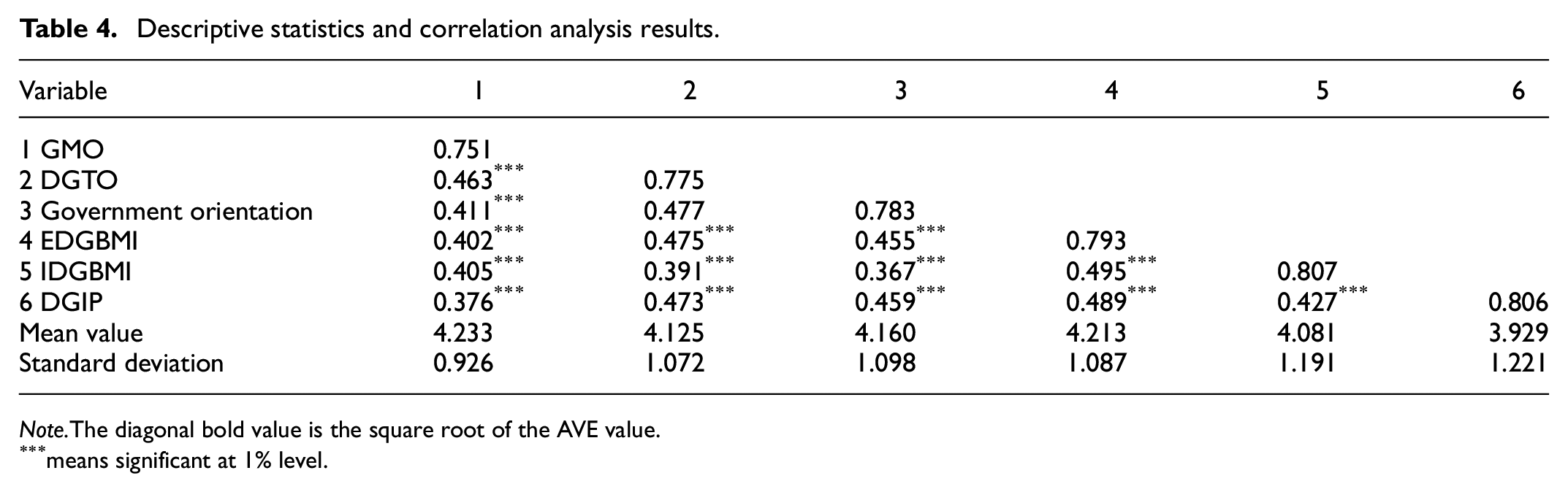
Note.The diagonal bold value is the square root of the AVE value.
means significant at 1% level.
The hypotheses are tested by SPSS21.0. Among them, Model 1 in Table 5 examined the influence of control variables on the DGIP of enterprises, and found that the control variable that passed the test for significance level was enterprise age (β = .185, p < .01), indicating that the longer the enterprise was established, the more conducive to the accumulation of experience and the deployment of digital green resources, and the improvement of enterprise DGIP.
Regression analysis and mediating effect of EDGBMI on enterprise DGIP.

Note. The regression coefficients in the table are non-standardized values.
means significant at 1% level. **means significant at 5% level.
Model 2 in Table 5 examines the impact of DGBMI on enterprises’ DGIP, and finds that both efficiency-oriented DGBMI (β = .421, p < .01) and convergent business model innovation (β = .236, p < .01) have significant positive effects on enterprises’ DGIP. Hypothesis H5 and hypothesis H6 are supported. In addition, the influence of GMO on EDGBMI (β = .198, p < .01) is smaller than that of fusion DGBMI (β = .314, p < .01), and DGTO and government orientation on EDGBMI (β = .288, p < .01; β = .249, p < .01) was more important than the IDGBMI (β = .212, p < .01; β = .188, p < .01);
Model 4 in Table 5 examines the impact of DGSO on the innovation of efficiency-oriented digital green business models, and finds that GMO (β = .198, p < .01), DGTO (β = .288, p < .01), government orientation (β = .249, p < .01) has a significant positive impact on the innovation of efficiency-oriented digital green business model. Hypothesis H2a, hypothesis H3a and hypothesis H4a are supported.
Model 2 in Table 6 examines the impact of DGSO on the innovation of integrated digital green business model, and finds that GMO (β = .314, p < .01), DGTO (β = .212, p < .01), government orientation (β = .188, p < .01) has a significant positive impact on the innovation of integrated digital green business model. Hypothesis H2b, hypothesis H3b and hypothesis H4b are supported;
Regression analysis and mediating effect of IDGBMI on enterprise DGIP.
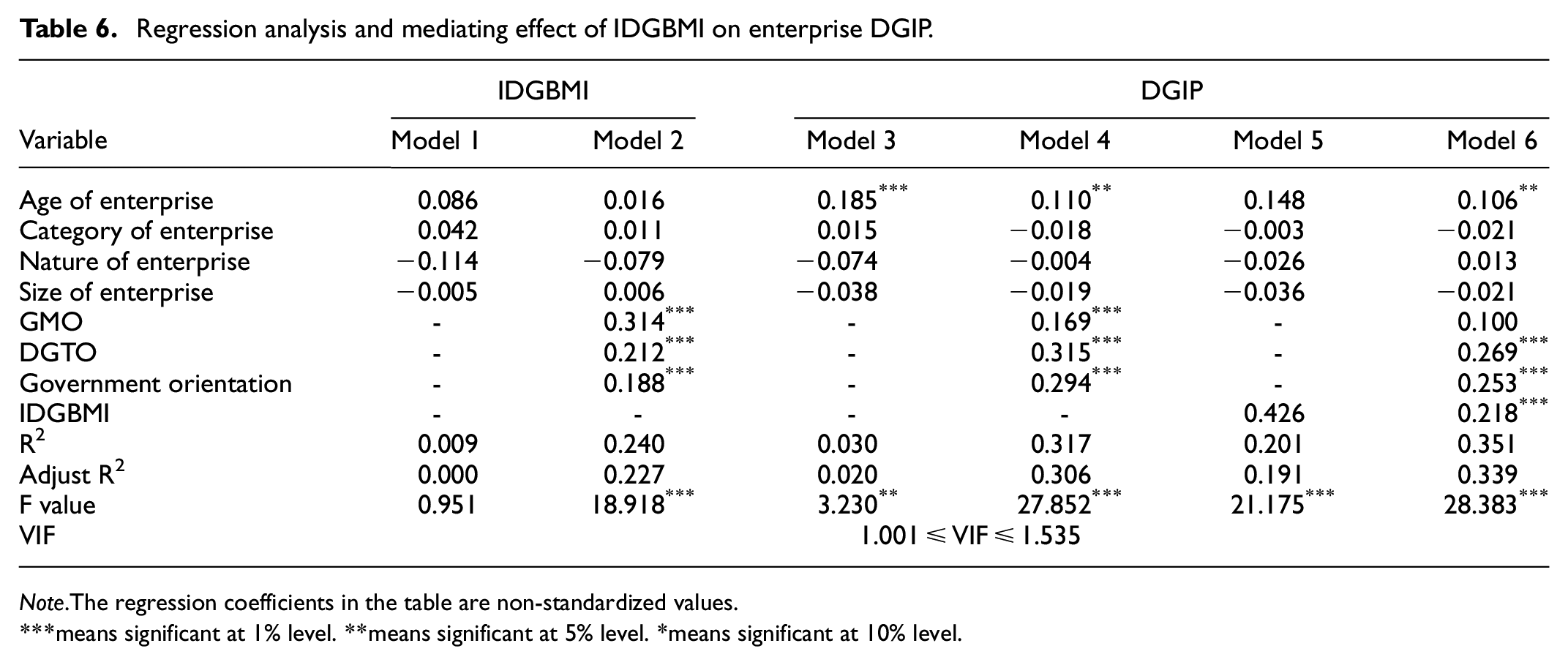
Note.The regression coefficients in the table are non-standardized values.
means significant at 1% level. **means significant at 5% level. *means significant at 10% level.
Model 6 in Table 6 examines the impact of DGSO on enterprises’ DGIP, and finds that GMO (β = .169, p < .01), DGTO (β = .315, p < .01), government orientation (β = .294, p < .01) have a significant positive impact on enterprise DGIP. Hypothesis H1a, hypothesis H1b and hypothesis H1c are supported; Moreover, the correlation coefficient of the impact of DGTO on enterprise DGIP is greater than that of GMO and government orientation, so the impact of DGTO on enterprise DGIP is greater than that of GMO and government orientation.
This study uses the research of Zhou et al. (2020) to test the mediating effect of DGBMI. That is, the stepwise method was adopted (Baron & Kenny, 1986). Verify whether the hypothesis model meets the conditions for the existence of intermediary effect: First, verify whether the independent variable (GMO/DGTO/government orientation) has a significant effect on the dependent variable (enterprise DGIP); Secondly, verify whether the independent variable (GMO/DGTO/government orientation) has a significant effect on the intermediary variable (EDGBMI/IDGBMI); Then, verify whether the intermediary variable (EDGBMI/IDGBMI) has a significant effect on the dependent variable (enterprise DGIP); Finally, when the independent variable and the intermediary variable enter the regression model at the same time, whether the role of the independent variable on the dependent variable is reduced (partial mediation effect) or becomes no longer significant (full mediation effect).
Based on the analysis of the above intermediary effect verification steps by Model 8 in Table 5 and Model 6 in Table 6, it is concluded that efficient-oriented DGBMI plays a partial intermediary role between GMO and enterprise DGIP, DGTO and enterprise DGIP, and government orientation and enterprise DGIP. So hypothesis H5a, hypothesis H5b, hypothesis H5c are supported. The IDGBMI plays a partial mediating role between GMO and enterprise DGIP, DGTO and enterprise DGIP, and government orientation and enterprise DGIP. Therefore, hypothesis H6a, hypothesis H6b and hypothesis H6c are supported.
Discussion and Future Research Directions
Discussion
With the acceleration of the popularization of the new generation of information technology in the world, digital technology has changed the basic form of the original product, the way of the production process of the new product, the business model and the organizational form, and even subverted the basic assumptions of many innovation theories (Nambisan et al., 2017). Under the global concept of low-carbon and environmental protection development, green innovation has become the new trend of enterprise innovation. Introducing the green concept of green innovation into different levels of enterprise management can realize the optimal allocation of enterprise material resources. This enables enterprises to make full, reasonable, scientific and effective use of existing resources to form the maximum value creation ability. DGSO is related to the business objectives, development direction and action plan of enterprises. Whether to be more radical or more stable is a practical issue that enterprises need to consider to achieve high-quality development. Exploring the enterprise’s digital green strategy-oriented motivation and making appropriate strategic decisions have attracted the common attention of both the practice and the academic circles. Under the guidance of digital green strategy, enterprises can implement more scientific and reasonable strategies according to the changes of the environment and greatly improve the efficiency of resource allocation and market competitiveness. However, in its related research, the paradigm of “strategic orientation—organizational innovation—enterprise performance” is still the main one. This paper focuses on the basic research proposition of “How enterprises promote the performance improvement of digital green innovation through DGSO choice.” Through the empirical research on the theoretical framework of “DGSO—DGBMI—enterprise DGIP,” this research clarifies the internal relationship among DGSO, DGBMI and enterprise DGIP. Therefore, it is particularly important to explore the impact of digital green strategy-oriented choice on the improvement of corporate DGIP. In order to improve the survival and development of enterprises, the mediating effect of DGBMI on DGSO and enterprise DGIP is deeply discussed in this study. In order to clarify the internal relationship among DGSO, DGBMI and enterprise DGIP, this study constructs a theoretical framework of DGSO—DGBMI—enterprise DGIP and conducts an empirical study. The results of this paper are as follows.
First of all, GMO, DGTO and government orientation all have a positive impact on the improvement of DGIP. GMO focuses on the search and accumulation of green market information. By integrating knowledge and understanding market information, enterprises can use new technologies and new means to develop new digital green products that meet customer needs, improve their competitiveness and achieve the strategic goal of improving their DGIP. Digital green technology oriented enterprises emphasize the use of high-end technology in the development process of digital green new products. Through the integration of new technology diversified resources and knowledge, for customers to design better, more novel, better functional digital green products. Government-oriented companies advocate good relations with the government. The government provides financial support and tax subsidies for enterprises’ digital green innovation activities, which reduces the cost of R&D for enterprises’ digital technologies and new digital green products. Enterprises should consider their own development status, organizational form and external environment to choose different digital green strategies. Different digital green strategy-oriented enterprises should make different digital green strategic management activities. However, no matter which dimension of DGSO is, it aims to expand market share by enhancing its own competitive advantages, so to some extent, it can promote the improvement of DGIP.
Secondly, the three dimensions of DGSO have different influences on each dimension of DGBMI, which can be concretely shown as follows: (1) GMO has a significant impact on both EDGBMI and IDGBMI levels, and the impact on IDGBMI is more significant. GMO focuses on the search and accumulation of green market information. This orientation encourages enterprises to pay more attention to and maintain existing markets rather than focus their strategic focus on the development of new markets. Therefore, the influence of enterprise GMO on the innovation of EDGBMI and IDGBMI is different in different degrees. Specifically, green market oriented enterprises have strong ability to explore, understand and predict market demand. The enterprise integrates all kinds of digital green resources to fully tap all kinds of values and maximize the value of the system. This will help enterprises to design efficient digital green business models with efficiency and cost reduction as the core. However, IDGBMI advocates extensive digital green cooperation and information sharing among partners in order to explore and meet market and consumer demand. At the same time, a GMO encourages companies to share their digital green knowledge and information with partners and stakeholders throughout the digital green business ecosystem. Therefore, as GMO prompts enterprises to focus more on the attention and maintenance of the existing market, they are more inclined to develop IDGBMI rather than EDGBMI in the process of strategic focus shift and resource optimization allocation. (2) DGTO has a significant impact on EDGBMI and IDGBMI, and has a greater impact on the EDGBMI. Enterprise DGTO enables enterprises to creatively implement various activities to obtain transaction efficiency. Based on the guidance of digital green technology, enterprises can innovate industrial process reengineering, improve internal control and provide customers with more digital green technology solutions. Digital green technology oriented enterprises advocate the introduction of new digital green technology. Through the introduction and use of digital green technology to optimize the internal control of each link, improve and innovate the original value chain structure in the process of value creation and acquisition. Continuous investment and acquisition of digital green technology, digital green data information of enterprises can be quickly and correctly fed back in various departments, which promotes enterprises to reduce transaction costs and improve transaction efficiency. In order to promote the EDGBMI. (3) DGTO has a significant impact on EDGBMI and IDGBMI, and has a greater impact on the EDGBMI. Enterprise DGTO enables enterprises to creatively implement various activities to obtain transaction efficiency. Based on the guidance of digital green technology, enterprises can innovate industrial process reengineering, improve internal control and provide customers with more digital green technology solutions. Digital green technology oriented enterprises advocate the introduction of new digital green technology. Through the introduction and use of digital green technology to optimize the internal control of each link, improve and innovate the original value chain structure in the process of value creation and acquisition. Continuous investment and acquisition of digital green technology, digital green data information of enterprises can be quickly and correctly fed back in various departments, which promotes enterprises to reduce transaction costs and improve transaction efficiency. In order to promote the EDGBMI.
Thirdly, the influence of DGSO on DGIP can be realized through the intermediary role of EDGBMI and IDGBMI. In other words, different DGSOs such as GMO, DGTO and government orientation can directly affect the performance of enterprises’ digital green innovation. In other words, the influence of different digital green strategies on DGIP is realized through the EDGBMI and the IDGBMI. These are the two ways that DGSO has an effect on enterprise DGIP. The specific performance is as follows: (1) GMO directly affects the change of DGIP. This indicates that green market-oriented enterprises attach importance to creating more customer value by means of internal value concepts and members’ norms of behavior, so as to improve organizational performance. This type of enterprise can capture market information more quickly. GMO pushes enterprises to carry out systematic analysis and adjust strategies to adapt to and take advantage of changes. Enterprises should also achieve resource acquisition through green market-oriented advantages, and carry out organic coordination according to the changes of market environment and internal environment, so as to establish and maintain competitive advantages for enterprises, so as to achieve the strategic goal of improving the performance of digital green innovation of enterprises. (2) DGTO directly affects the change of DGIP. This indicates that DGTO can prompt enterprises to use high-end technology in the development process of digital green new products. Through technological progress to bring customers more innovative design, better function of the product, enhance the competitive advantage and further improve performance. At the same time, the new digital green technology can effectively promote the flow of digital technology knowledge across organizational boundaries. By changing the value chain structure, enterprises can improve the transaction efficiency, add value to obtain potential resource value, and thus achieve the goal of improving the performance of digital green innovation of enterprises. (3) Government orientation directly affects the change of DGIP. This indicates that government orientation plays an important role in the allocation of digital green innovation resources. By formulating policies conducive to enterprises’ digital green innovation activities and allocating innovative digital green resources, the government can greatly promote the improvement of Chinese enterprises’ digital green innovation capability. Government orientation enables enterprises to accurately grasp the development trend of the government’s policies on corporate digital green innovation activities, understand the development dynamics of the green market, and quickly adjust their digital green innovation activities. It is conducive to better performance in the future innovation practice.
Implication
This paper takes DGBMI as the intermediary variable to discuss its important role in the mechanism of the influence of DGSO on DGIP. The theoretical contribution mainly focuses on three aspects.
First, this paper explores the different processes in which GMO, DGTO and government orientation affect the change of DGIP, and makes clear the mechanism of enterprises’ digital green strategy-oriented selection based on internal and external environmental characteristics to achieve superior performance acquisition. This is helpful to clarify the internal logic of DGSO on the improvement of DGIP. Existing research conclusions on the mechanism of strategic orientation on corporate performance differ: some scholars point out that strategic orientation has a significant positive impact on improving organizational performance (Adams et al., 2019; Gao & Wang, 2021). However, some studies have pointed out that there may be some differences in the impact of strategic orientation on firm performance in some specific situations. This paper focuses on three different DGSOs (GMO, DGTO and government orientation), and explores the influence of DGSO on the improvement process of DGIP. The research points out that under the guidance of different digital green strategies, enterprises have different judgments of internal and external environmental characteristics, which leads to different choices of competitive strategy and resource allocation and use mode. Therefore, we can understand the difference of the effect mechanism of DGSO on DGIP, and provide useful insights for enterprises’ practice of building competitive advantages.
Second, this paper discusses the influence of different DGSO on different types of DGBMI. The contribution of this study lies in the analysis of the internal mechanism of how DGSO fits better with DGBMI process to achieve value acquisition, and expands the theoretical boundary of the research on the mechanism of DGSO to DGBMI. Previous studies mostly focused on a specific orientation (F. Zhou et al., 2019) or divided strategic orientation into GMO, technology orientation and entrepreneurial orientation to explore the relationship between strategic orientation and the construction of business model innovation. In the context of the rapid development of digital information, the influence of concepts such as digital technology and green innovation on strategic orientation and business model innovation is ignored, and the internal logic of different choices of business model innovation achieved by different strategic orientation is ignored. This paper clarifies the relationship between three important DGSO dimensions, namely GMO, DGTO and government orientation, on EDGBMI and EDGBMI, and clarifies the difference of influence between different DGSO and DGBMI. This provides a new theoretical perspective for understanding the innovation practice of choosing the innovation type of digital green business model under the guidance of different digital green strategy.
Thirdly, the innovation point of this paper is to introduce DGBMI into the theoretical research framework as an intermediary variable to explore the influence of different types of DGBMI on the relationship between GMO, DGTO, government orientation and enterprise DGIP. This further deepens the research on the mechanism of DGSO on DGIP. This paper analyzes the mediating effect of EDGBMI and IDGBMI, which, to a certain extent, provides theoretical reference support for further research on the in-depth understanding of DGBMI as the internal mechanism of value transformation. And contribute to the deepening of the research on the effect of DGSO on the change process of DGIP.
At the same time, the practical enlightenment mainly focuses on three aspects: First, digitalization brings enterprises into the era of high-frequency competition. From the perspective of the decision-making mechanism of an organization, the decision-making mechanism of an organization defines the operation mode of the program. This requires enterprises to pay attention to the market environment and the characteristics of resource endowment when making strategy-oriented choices. Only enterprises can respond to changes by quickly responding to demands. Second, as a new form of innovation, business model innovation has attracted widespread attention, and its importance is even no less than that of technological innovation. It is believed that it can bring strategic competitive advantages and is a key capability that enterprises should have in the new era. If an enterprise wants to be successful, it must start with developing a successful business model. It is a key path to achieve superior value acquisition to build core competitiveness through EDGBMI and IDGBMI. Thirdly, through reasonable matching of digital green strategy and DGBMI behavior of enterprises, strategic initiative and better value can be obtained in market competition, so as to enhance competitive advantage to the greatest extent.
Limitations and Future Research Directions
Although the research tries to issue and recover questionnaires through various ways, and the research samples involve enterprises of different sizes, industry categories and property rights, the scope of questionnaire survey is limited, which may affect the stability of the research results. In this paper, government orientation is studied from the perspective of digital green innovation. However, with the rapid development of digital green technology, government orientation is not studied from the perspective of digital green technology innovation, which may affect the research on enterprises’ DGIP. When the paper studies the strategic orientation of government orientation, there is no unified measurement standard to measure the relationship between enterprises and the government and the compliance with policies, which may affect the accuracy of the research. In future, scholars can consider a new presentation of related research, carrying out an analysis of the results based on the characteristics of the company, the category of the industry, the nature of the company and the size of the company, to establish best practices between industries. In addition, subsequent studies should further explore the influencing factors of enterprises’ choice of DGSO, and analyze under what circumstances enterprises will form different GMO, DGTO and government orientation. The dimension of digital green technology innovation is added to the research variables of government orientation, and relevant reflection indicators are created to further study the impact of DGSO on enterprises’ DGIP. At the same time, when studying government orientation, subsequent scholars can start from the standard system of establishing the cooperative relationship between enterprises and the government and complying with policies, and conduct quantitative processing on this part of the content to improve the accuracy of the research.
Footnotes
Author Contributions
Conceptualization, Y.S. and Z.N.; methodology, Y.S.; software, Y.S. and Z.N.; validation, Y.Y.Y and Y.S; writing—original draft preparation, Y.Y.Y.; writing—review and editing, Y.S. All authors have read and agreed to the published version of the manuscript.
Declaration of Conflicting Interests
The author(s) declared no potential conflicts of interest with respect to the research, authorship, and/or publication of this article.
Funding
The author(s) disclosed receipt of the following financial support for the research, authorship, and/or publication of this article: This research was funded by Philosophy and Social Sciences Planning Project of the Ministry of Education grant number [21YJCZH203].
Ethical approval
All procedures performed in this study were in accordance with the ethical standards of the university. Ethical clearance and approval were granted by Hebei Agricultural University.
Informed consent
Informed consent was obtained from all individual participants included in the study

Data Availability Statement
The data presented in this study are available on request from the corresponding author.