




Abstract
Many people around the globe are aiming to learn the Arabic language, even though it is difficult to learn. Therefore, many online institutions are offering the service of teaching Arabic as a second language to non-native speakers, but these institutions always encounter different issues in enhancing their performance. Thus, this study aimed to highlight the factors that can enhance the performance of online or e-coaching institutions teaching Arabic as a second language to non-native speakers. These factors include big data analytical capability and strategic agility. The data were gathered from managers of online institutions providing services of learning Arabic to non-native speakers, and it was analyzed by using Smart Pls 4. The results demonstrate that the performance of these institutions depends upon big data analytical capability and strategic agility. Moreover, big data analytical capability can lead to strategic agility. Furthermore, strategic agility can significantly mediate the relationship between big data analytical capability and institutional performance.
Plain language summary
Though it is a difficult language to learn, Arabic is in demand around the world. Because of this, many online institutions offer Arabic courses tailored for non-native speakers. However, these institutions often encounter numerous challenges that affect their productivity. This particular study aims to find the concepts that help in optimizing the productivity of institutions coaching Arabic as a second language. Crucial concepts include the capacity to analyze vast amounts of data and strategic agility. The results demonstrate that the performance of these institutions relies on their strategic agility and big data analytical capabilities. Furthermore, strategic agility is significantly influenced by big data analysis. It is essential that strategic agility is present to mediate the relationship between institutional performance and big data analytical capability.
Keywords
Introduction
Teachers always emphasize different technology-based teaching tools that can help students’ engagement and help them acquire better learning skills and experiences. Therefore, the teaching process of Arabic as a second language is significantly influenced by innovation and technology diffusion. However, there is limited literature, particularly on the demerits of technology infusion in ASL (Moghazy, 2021a, 2021b). In 2020, the educational system dramatically changed due to the COVID-19 pandemic. Educational institutions shifted their mode of education from face-to-face to online or remote learning (Almelhes, 2021). In this era, many academies started to teach Arabic as a second language online. These e-coaching websites use different proactive learning strategies that can help students of Arabic learning courses to achieve learning objectives (Alasraj & Alharbi, 2014). However, such websites are unable to maintain their performance because they are unable to develop agility and manage the data. Many e-coaching institutions teach Arabic as a second language to non-native speakers, but their performance is lower than that of physical institutions. Literature has revealed the antecedents of the institutional performance of physical institutions. However, the area of e-coaching institutions always remained unexplored.
Nowadays the rise in ICT has compelled educational institutions to shift towards using web technologies for the promotion and improvement of learning to cover a huge number of learners, but the significant increase in the number of learners has also increased the volume of data that cannot be processed with traditional database management, thus there is need of big data technologies to deal with this big data in real-time to make good decisions and develop agility (Dahdouh et al., 2018). Moreover, online learning systems are now facing many challenges for their long-term survival; these challenges include a diversity of e-educational institutes and their resources, technological turbulence, a large amount of data for storage and manipulation, and a significant increase in the number of learners. To overcome the challenges, e-learning platforms should update their data processing and storing mechanisms, and it can be possible with big data because it is the most useful paradigm for data-efficient data processing. Moreover, it can help e-learning platforms improve their data collection, storage, analysis, processing, optimization, and visualization capabilities (Dahdouh et al., 2018), enabling them to develop strategic agility and enhance performance.
Big data technologies provide guidelines for creating proactive e-learning systems to develop new and useful insights from available data (Otoo-Arthur & Van Zyl, 2020). Moreover, online learning systems (i.e., e-learning) can improve their performance with the help of big data as it enhances system quality (Dahdouh et al., 2018). Educational institutions can develop strategic decisions with the help of big data because it can rectify educational problems and predict future performance (Birjali et al., 2018). Chakhari (2015, p. 70) defined big data technologies as “a new generation of technologies, architectures, tools, and techniques designed for extracting value from very large volumes of a wide variety of data, allowing a high speed of capture, discovery and/or analysis.” Whereas National Institute of Standards and Technology (NIST) (2015) explained big data as “the inability of traditional data architectures to handle efficiently the new datasets. It consists of extensive datasets - primarily in the characteristics of volume, variety, velocity, and/or variability - that require a scalable architecture for efficient storage, manipulation, and analysis.” Further, Dahdouh et al., (2018) defined big data in the context of e-learning as “the data that is produced by learners during the learning process, including the data created while they are taking an online course or training module” (p. 2784). Further, they highlighted that big data includes profiles of learners, details of enrollments, student preferences, and essential chats and comments by students and instructors. In addition, student activities about courses while interacting in an online learning session, the progress of the student in the course, results of assessments, social sharing, teaching techniques, collaboration of learners with their classmates, feedback provided by the learner, and any data generated by learner of instructor is big data.
Big data analytics play an important role in achieving competitive advantage and enhancing business performance (Al-Khatib, 2022; Ferraris et al., 2019; Hao et al., 2019; Maroufkhani et al., 2019; Maroufkhani, Tseng, et al., 2020; Mikalef et al., 2019; Wamba et al., 2017; Yasmin et al., 2020). In the last few years, many businesses have started to adopt big data analytics due to its agile and performance-based outcomes (Hariri et al., 2019; Limna et al., 2021; Maroufkhani, Wan Ismail, et al., 2020; Mohamed & Weber, 2020). In the educational sector, big data analytical capability can help institutions to develop efficiency and effectiveness of students in learning and enhancing their knowledge retention ability (Birjali et al., 2018); thus, it can help in increasing the performance of online institutes teaching Arabic as a second language.
Important technologies such as big data analytics can enable organizations to develop agility in volatile market conditions (Cetindamar et al., 2021; Hyun et al., 2023). Strategic agility is the capability of an organization to think and act creatively to do business more proactively (Doz & Kosonen, 2017). It can also help organizations adapt to new changes by continuously adjusting the organizational strategic decision according to the demands of the environment or market (Vecchiato, 2015). Moreover, strategic agility enables companies to promptly adapt to the volatile business environment by investigating, determining, and capturing the latest market trends and approaches to conducting business (Nejatian et al., 2019), thus it is conceptualized as dynamic capability comprising different organizational meta-capabilities that can help in achieving flexibility (Shams et al., 2021). Dynamic capabilities are not self-sufficient to enhance organizational performance (Cetindamar et al., 2021) and they require digital technologies or big data capabilities to manage a large volume of data gathered or developed by an organization (Davenport, 2014) that can help in enhancing performance because big data capability being lower order capability facilitates in shedding light on the ambiguous relationship between agility and performance (Cetindamar et al., 2021).
A few studies have examined the role of big data analytical capabilities on the performance of educational institutions (Ashaari et al., 2021) but there is a dearth of literature in the context of ASL institutions. Particularly, there is a lack of investigation on the online institutes teaching Arabic as a second language to non-native speakers. Therefore, this research has answered the following research questions:
The first section of this research is based on the introduction. The section provides a literature review on big data analytical capabilities, strategic agility, and institutional performance. Moreover, it has explained the relevant theory. The third section discusses the methodology that was used for the research. The fourth section provides the results of the data along with the interpretation. The fifth section has discussed the results. The sixth section provided implications, and the last section (i.e., seventh section) has highlighted the limitations and recommendations.
Literature Review
Dynamic Capability View
The research has used the theoretical lens of the dynamic capability view (DCV). Day (2011) argued that dynamic capability never provides prompt solutions for any problem, but it enables organizations to develop different skill sets and knowledge to survive in dynamic environments. Moreover, it helps organizations synchronize with dynamic market changes. Therefore, Behl (2020) highlighted the dynamic capability view (DCV) as the most appropriate theory to explain digital startups, as they are more dynamic in comparison to offline ventures. This theory explains how organizations should develop essential capabilities or abilities to remain competitive in the highly volatile and dynamic business environment (Teece et al., 1997). Dynamic capabilities enable enterprises to develop, combine, and reshape external and internal resources or capabilities according to the rapidly changing market patterns (Ashrafi et al., 2019; Dahlstedt, 2019; Sharifi & Zhang, 1999). DCV recognizes the significance of possessing intangible and tangible resources because the roots of this theory are embedded in the Resource-based view (RBV) (Teece et al., 1997).
The performance of an organization and its tendency to gain competitive advantage depends upon its ability to organize rare, valuable, and hard-to-imitate resources for capturing value (Yadav et al., 2017). RBV generally emphasizes static resources and capabilities, but the dynamic capability view postulates organizational competence of adapting to a dynamic business environment (Teece, 2012) by sensing and seizing upcoming opportunities (Gebauer, 2011). Therefore, strategy agility is the best fit for a dynamic capability framework (Alyahya et al., 2023). Further, Al-Darras and Tanova (2022) highlighted that in today’s business world, organizations can develop dynamic capabilities with the help of big data analytical capabilities.
Big Data Analytical Capabilities and Strategic Agility
In the current era of technology and digitalization, big data analytical capabilities are conceptualized as an essential organizational resource (Al-Darras & Tanova 2022). Big data analytical capability is an organizational capability to use technology and talent of human resources, particularly for capturing, storing, and data analyzing to generate valuable insights (Gupta & George, 2016; Mikalef et al., 2020). Garmaki et al., (2016, p. 301) defined it as “the organizational ability to utilize data assets in combination with physical IT assets and human resources to create competitive advantages.” Nowadays, many organizations are emphasizing investing in big data analytical capabilities to enhance their agility (Al-Darras & Tanova 2022). Alyahya et al. (2023) argued that these capabilities enable organizations to forecast upcoming market demand/opportunities, develop an action plan for responding to dynamic market conditions, and reduce manufacturing lead time. Thus, big data analytical capabilities help organizations in developing strategic agility. Similarly, Turi et al. (2023) focused on highlighting the role of big data analytics and organizational agility in accelerating firm performance and explained that the emphasis of organizations on big data analytical capabilities reduces their chance of failure and helps them in improving strategic decision-making ability. In addition, Khaw and Teoh (2023) claimed that in private higher educational institutions, big data analytics technology capabilities help in developing strategic agility. Many prior studies emphasized examining the influence of big data analytics on organizational agility (Al-Darras & Tanova 2022; Barlette & Baillette, 2022; Hammouri et al., 2022; Turi et al., 2023), manufacturing agility (Awan et al., 2022), and customer agility (Hassna & Lowry, 2016), but still there is paucity of research linking big data analytical capability with agility (Xie et al., 2022) and institutional performance.
Previously the studies on big data or big data analytical capabilities focused on performance of banks (Al-Dmour et al., 2023; Ali et al., 2020; Gupta et al., 2019), SMEs (Iqbal et al., 2018; Lutfi et al., 2022; Maroufkhani et al., 2023; Moonen et al., 2019), healthcare (Dash et al., 2019; Galetsi & Katsaliaki, 2020; Wang et al., 2015, 2018), but now the researchers are keen to learn about implications of these capabilities in education sector (Ashaari et al., 2020; Daniel, 2015, 2019; Sekli & De La Vega, 2021). Despite of increasing interest of researchers in big data within the educational sector, still there is a paucity of research on big data analytics capability in the context of education (Ashaari et al., 2021) or e-learning. The adoption of big data analytical capabilities by online institutes teaching Arabic as a second language to non-native speakers can help them predict future problems and develop potential strategies accordingly. Thereby, organizations can enhance their performance. Therefore, we proposed the following:
Strategic Agility and Institutional Performance
The current dynamic business environment can be explained with the “white water rapid metaphor” where organizations must adopt change at every step or change their strategies. Moreover, digitalization, the advancement of technology, the race for innovation, and high competition among rivals are diverting the attention of organizations to achieve competitive advantage and enhance their performance by developing strategic agility (Lungu, 2020). However, many organizations around the globe face the challenge of maintaining superior performance in the long run. Moreover, it is becoming difficult for managers to constantly achieve organizational goals in this digital era due to poor strategic insight and lack of agility (Arokodare & Asikhia, 2020). The concept of agility has been discussed in different contexts such as marketing (e.g., Abbas & Ali, 2024a, 2024b), operational agility (e.g., Mao et al., 2023), and supply chain agility (e.g., Nazempour et al., 2020) but all these types of agilities are mainly linked with strategic agility. Alyahya et al. (2023) interpreted strategic agility as the ability of a firm to adapt rapidly to new changes in the market or production. Al-Azzam et al. (2017) mentioned that it is the most critical technique for strategic orientation and helps develop the most relevant strategic substitutes. Being strategically agile influences human performance and enhances technology adoption and process efficiency. Further, they defined strategic agility as “tactfully sightseeing and acting responsively with ease, high speed, and dexterity to environmental changes and challenges” (p. 8).
Strategic agility is an organizational ability to respond promptly to a volatile business environment, and firms possessing this dynamic capability are efficient in predicting upcoming threats and developing strategies to overcome them. Therefore, strategic agility can help service firms to accelerate their performance (Gerald et al., 2020). Similarly, many studies aimed to highlight the influence of strategic agility on the organizational performance of the service sector (e.g., Al-Azzam et al., 2017; AlTaweel & Al-Hawary, 2021; Clauss et al., 2019; Nurjaman et al., 2021) but there is a dearth of literature in the context of the education sector, and particularly on e-coaching platforms. Khaw and Teoh (2023) emphasized on private higher education sector, and through the lens of DCV and RBV argued that strategic agility significantly influences the performance of private higher educational institutions. Many studies have linked strategic agility with institutional performance. However, there is a lack of literature highlighting the impact of strategic agility on the performance of e-coaching institutes teaching Arabic as a second language. Strategic agility can enable them to adapt to the environment. The e-coaching institutes teaching Arabic as a second language to non-native speakers can also develop strategic agility to improve their performance. Thus, it is hypothesized that:
Strategic Agility as a Mediator
In this dynamic technological era, every educational institution requires strategic agility to cope with challenges (Lyn Chan & Muthuveloo, 2021). Agility is considered an important organizational trait that can help in improving operational strategies, and performance (Ashrafi et al., 2019). It can facilitate the institutes offering open, distance, and e-learning to adapt to different technological platforms (Nyoni, 2022). It is evident from prior studies that performance of companies is linked to strategic agility (AlTaweel & Al-Hawary, 2021; Lyn Chan & Muthuveloo, 2021; Muthuveloo & Koay, 2023; Ofoegbu & Akanbi, 2012; Palanisamy et al., 2022; Yildiz & Aykanat, 2021) but the literature has neglected to highlight the antecedents of strategic agility. The knowledge about them can help in developing strategic agility leading to organizational performance (Lyn Chan & Muthuveloo, 2021). Hyun et al. (2023) highlighted that big data analytics can generate organizational agility. Thus, big data analytical capability can be the antecedent of strategic agility.
Big data analytics enable organizations to be agile or increase their agility because it’s valuable to sense the market predict upcoming opportunities or threats, and simultaneously develop strategic decisions while seizing the benefits (Barlette & Baillette, 2022). Therefore, big data analytical capabilities directly and indirectly (i.e., with the influence of strategic agility) can enhance the performance of an organization. ZareRavasan (2023) found agility as a significant mediator between big data analytics usage and innovation performance. Moreover, Alyahya et al. (2023) highlighted the partial mediation of strategic agility between big data analytics and sustainable performance. Furthermore, Khaw and Teoh (2023) also found the significant mediating effect of strategic agility between big data analytics technological capabilities and the performance of private higher educational institutions. These studies have either focused on big data analytics or big data analytics technological capabilities. However, there is limited literature on strategic agility as a mediator between big data analytical capabilities and the performance of e-coaching institutions. Therefore, to reveal the mediation of SA between BDAC and institutional performance, the following hypothesis is developed:
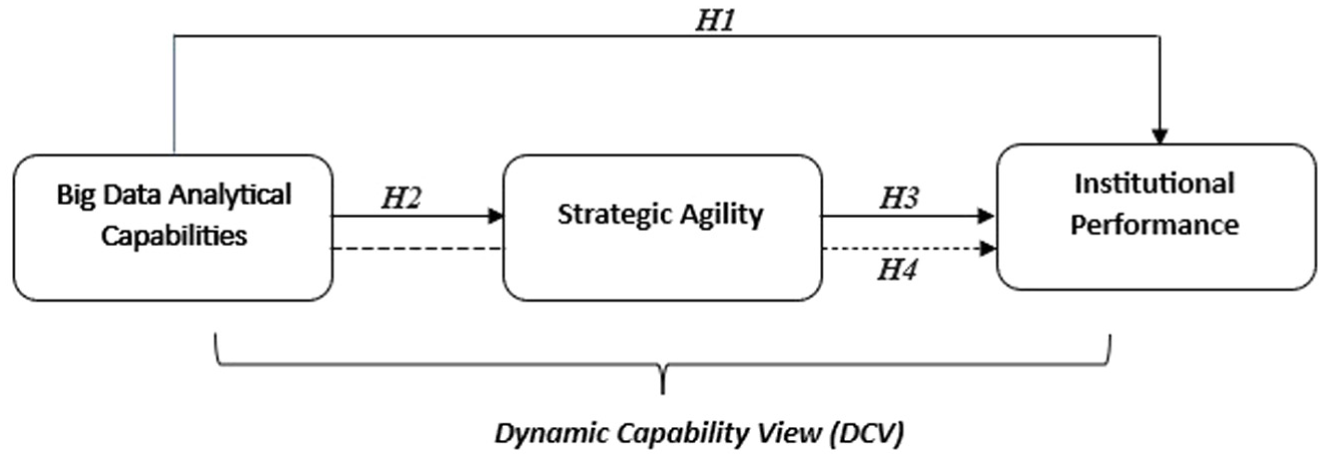
The discussion given above has highlighted the literature on theory and variables. Based on this literature review, a conceptual model is put forward (see, Figure 1). In this research model, the mediating role of strategic agility is highlighted between big data analytical capabilities and institutional performance.
Research model.
Methodology
The methodology is divided into two sections. The first section discusses the research instrument and measurements, and the second section provides information about the population, sample size, and sampling technique.
Research Instrument and Measurements
The study has focused on previous literature highlighting big data analytical capabilities, strategic agility, and institutional performance to find the most relevant scales. The scale for big data analytical capability is adapted from Al-Khatib (2022), who developed it by following El-Kassar and Singh (2019), Shamim et al. (2020), and Singh and Singh (2019). The scale developed by Al-Khatib (2022) was adapted in the context of this research. Strategic agility is measured with a scale based on eight items adapted from Queiroz et al. (2018) and Haider and Kayani (2020) in the context of Arabic as a second language. The dependent variable institutional performance of e-coaching institutions teaching Arabic as a second language to natives was measured with a 5-item scale adapted from the study of Chen et al. (2007). To ensure face validity, the questionnaire was sent to two subject experts, two industrial experts (i.e., working in e-coaching institutions teaching Arabic as a second language), and two researchers. Their comments were followed for developing the final questionnaire (i.e., given in Appendix I). There were two sections of the questionnaire, in the first section, the demographic information was inquired, and in the second section, the questions were related to the big data analytical capabilities, strategic agility, and institutional performance in the context of e-coaching institutions offering services of teaching Arabic as a second language to non-native speakers.
Population and Sample
Based on this study’s main objective to investigate the effect of big data analytical capabilities on the performance of e-coaching institutions offering services of teaching Arabic as a second language to non-native speakers, and to identify the mediation of strategic agility between big data analytical capabilities and institutional performance, “quantitative-deductive” approach has been used because its most suitable for causal studies (Lowry & Gaskin, 2014). This quantitative research aimed to evaluate four hypotheses. The first hypothesis was developed to determine the influence of big data analytical capabilities on institutional performance. The second aimed to examine the influence of big data analytical capabilities on strategic agility. The third investigated the relationship between strategic agility and institutional performance. The fourth evaluated the mediating role of strategic agility in the relationship between big data analytical capabilities and institutional performance.
A purposive sampling technique was used for data collection, as the respondents were managers of e-coaching institutions. In purposive sampling the data is gathered from the respondents who possesses the relevant information and best fit to fulfill the research purpose. Front-line employees, teachers, middle-level administration staff, and web developers or managers are not aware of big data analytical capabilities and strategic agility. Thus, it was aimed to gather data from relevant managers, as they are the only ones who can fulfill the purpose of the research.
The questionnaire was designed online, and its link was shared with managers of e-coaching institutions offering services of teaching Arabic as a second language to non-native speakers. The whole process of data collection to 10 days, from 11th November to 22nd November 2023. There is no exact information about e-coaching institutions offering services of teaching Arabic as a second language to non-native speakers around the globe, thus, the sample size of 385 was considered appropriate for the research because it’s applicable when the population is unknown (Krejcie & Morgan, 1970). The demographic information about respondents is shown in Table 1.
Demographics.

Results
The study has followed the structural equational modeling technique (SEM) to analyze the data by using Smart Pls 4 because it not only eliminates the intermediacy problems that occur in other modeling techniques but is also helpful in a thorough investigation of complex models (Asghar et al., 2021). In comparison to CB-SEM, PLS-based SEM is more appropriate, flexible, and robust for analyzing small sample sizes and generating high efficiency while estimating parameters (Asghar et al., 2021). The analysis of data was done in two steps. In the first step, the psychometric properties (i.e., internal consistency and validity) of every item were disclosed and ensured by driving the measurement model. Moreover, the common method bias (CMB) was determined to ensure the quality of data based on criteria (i.e., less than 3) suggested by (Kock & Lynn, 2012). Whereas, in the second step, testing of hypotheses was done after developing the structural model. Moreover, it was ensured that there should be no outliers.
The internet consistency in the measurement model is ensured by determining composite reliability (i.e., internal consistency of constructs), and Cronbach alpha (i.e., composite reliability). Moreover, the measurement model also evaluates the Average Extracted Variance (AVE) whose value should be a minimum 0.50. Whereas the minimum threshold for reliability and outer loading is 0.70 and 0.40 respectively (Darsono et al., 2019). These thresholds were also suggested by many studies (e.g., Hair, 2014; Wilujeng 2022). The findings revealed that loadings of all variables are greater than 0.6 except for two items, one item of strategic agility (i.e., 0.587) and one item of institutional performance (i.e., 0.307); therefore, they were removed from the final measurement model. The AVE values shown by the measurement model were also more than 0.5. Moreover, the VIF values were ensured for checking CBM and ensuring multicollinearity, and results showed that all values were below 3 (Hair et al., 2021). The values of Cronbach’s alpha, Average Extracted Variance (AVE), VIF, and loadings of all items of big data analytical capabilities, strategic agility, and institutional performance are given in Table 2. The Figure 2 shows the measurement model.
AVE, Loadings, and Cronbach’s Alpha.

These items were removed for final analysis as loadings were below 0.6.

Measurement model.
To determine the discriminant validity the study focused on the HTMT ratio and Fornell-Larcker criterion. The results highlighted that all values for the HTMT ratio were less than 0.85 as suggested by Hair et al. (2021). Moreover, the square roots of the AVE values for all the constructs were higher than the inter-construct correlations, thus, Fornell-Larcker criterion was also met (Fornell & Larcker, 1981). HTMT ratio and Fornell-Larcker criterion are presented in Tables 3 & 4.
HTMT Ratio.


Note. Table shows the values of the HTMT criterion. The values are below 0.850, which highlights the discriminant validity.
Fornell-Larcker Criterion.


After determining the measurement model, the second step was evaluating the structural model to test proposed hypothetical statements. Therefore, bootstrapping with 5,000 iterations was used to test the significance of each proposed relationship. The summary of results is given in Table 5, and relationship significance is demonstrated in Figure 3.
Results Summary.


Structural model.
Discussion
Arabic language is critical in Islamic education and Islamic studies because it enables the students to read, learn, and conceptualize the material from books written particularly in Arabic (Zahidi, 2021). It can also help the students learn academic material and access useful knowledge (Marie-Sainte, 2019). In the current era, Arabic is not merely trending in the Islamic generation or important for studying religious knowledge, but now it is recognized globally to gain knowledge about working spectrums and world affairs and to work on certain missions (Keshav et al., 2022). Today, Arabic is considered one of the strategic languages because many non-natives, particularly Americans, are inclined toward learning this language to learn more about Arab culture because of instability and politics in the Arab region (Abedalla, 2015). Moreover, many people are learning Arabic as a second language for business and other purposes. Almelhes (2021, p. 40) explained the process of Arabic as a second language learning as “the process by which a speaker who has another language as his or her first language learns Arabic.” Arabic as a second language is conceptualized as an upcoming social exploration area around the globe (Alfataftah & Jarrar, 2018), but practically it’s difficult for non-native speakers to learn this language because of its lexical sophistication, syntactic complexity, and different scripts (Abedalla, 2015). Therefore, there is a dearth of literature on Arabic as a second language, and learning or teaching ASL has also become a controversial subject (Moghazy, 2021a).
The updated technologies can make it easy for instructors and students. Moreover, they can attract students aiming to learn Arabic (Keshav et al., 2022). However, currently, there is a paucity of literature on technologies used in learning Arabic (Abedalla, 2015) and platforms offering services of teaching Arabic to non-native speakers. In the current digital world, the emergence of updated technologies has changed the mode of communication and altered the learning and teaching approaches. Now, preference is given to online activities supporting distance learning or hybrid courses. However, there is a lack of research on the understanding and use of the technological platforms by Arabic instructors (El Omari, 2015) or online/ e-coaching institutes offering services for teaching Arabic as a second language.
The education sector is rapidly adopting e-learning systems because it has redefined learning and teaching practices. This system is continuously providing efficient approaches to learning and teaching (Otoo-Arthur & Van Zyl, 2020), thus, many language teaching institutions are also adopting it for their long-term survival. Therefore, this study aimed to investigate the role of big data analytical capabilities on the performance of online/ e-coaching institutes offering services of teaching Arabic as a second language to non-native speakers. Moreover, it has investigated the mediating role of strategic agility in the relationship between big data analytics capabilities and institutional performance. The first hypothesis (H1) was designed to determine the influence of big data analytics capabilities on the institutional performance of e-coaching institutes offering services of teaching Arabic as a second language. The results highlighted the relevance of studying big data analytical capabilities in the context of Arabic language e-coaching institutions. Big data equips organizations with a set of technologies including distributed storage, predictive analytics, and parallel processing which can used to process to analyze the data generated from learners. Moreover, it offers a lot of benefits to accelerate the quality and efficiency of distance learning platforms (Dahdouh et al., 2020). Similarly, the findings of the current study have revealed that big data analytical capabilities can significantly influence the performance of e-coaching institutes offering services of teaching Arabic as a second language. Thus, online institutes teaching Arabic to non-natives can enhance their performance by focusing on the data of learners and teachers they obtained through the e-learning system. Moreover, the performance of these institutions is linked with the development of big data analytical capabilities. These capabilities can be developed by investing in specialized software designed for big data analytics, building strong IT infrastructure with integration of big data technology, and developing administrative resources capable of driving valuable insights from big data analytics. In addition, the big data analytical capabilities of e-coaching institutes teaching Arabic to non-natives can lead to learners’ satisfaction, profitability, competitive positioning, and sales growth.
The second hypothesis (H2) was developed to highlight the influence of big data analytical capabilities on strategic agility. The results revealed that strategic agility is significantly influenced by big data analytical capabilities. Thus, H2 was supported. The findings are in line prior study by Turi et al., (2023) who argued big data analytical capabilities as an antecedent of organizational agility. Similarly, Khaw and Teoh (2023) mentioned that in the education sector, big data analytics technology capabilities enable organizations to develop strategic agility for long-term survival in a dynamic environment. Therefore, online Arabic language institutions should also develop strategic agility because it can help them to develop dynamic capabilities for survival in a volatile environment. The investment in big data analytics software and resources ensuring on-time availability of data can facilitate the e-coaching institutes teaching Arabic to non-natives in responding to changes in the learners’ demands, providing customized services to the learners, and adopting the new technologies. Thus, big data analytical capabilities can enable institutions to develop strategic agility.
The third hypothesis (H3) was developed to determine the influence of strategic agility on institutional performance. The results revealed that strategic agility significantly influences the performance of online institutes teaching Arabic to non-natives. Many studies supported the fact that organizations always need strategic agility as it is an important capability (Arokodare & Falana, 2021; Arokodare et al., 2019; De Diego & Almodóvar, 2022). Similarly, Lyn Chan and Muthuveloo (2021) highlighted that strategic agility can help educational institutes accelerate their performance. Therefore, online institutes teaching Arabic as a second language can emphasize strategic agility to enhance their performance. The fourth hypothesis (H4) was designed to highlight the mediating effect of strategic agility in the relationship between big data analytical capabilities and institutional performance. The findings supported the hypothesis by revealing that besides big data analytical capabilities, strategic agility is also needed by online institutes teaching Arabic as a second language to enhance their performance in turbulent business environments. These results are supported by Khaw and Teoh (2023), who argued that big data analytics technological capabilities can directly and indirectly (i.e., in the presence of strategic agility) lead to higher performance of educational institutions. Thus, the findings demonstrated that online institutes teaching Arabic as a second language should focus on data they gathered from e-learning systems and develop strategic agility to boost their performance. The investment of online institutes teaching Arabic as a second language in software specialized in big data analytics, their focus on information technology infrastructure, their investment in processes that ensure the availability of timely high-quality data, and their capability to employ people with knowledge and experience in big data analytics can enable them to respond to changes in learners’ demand, customize their services according to the needs of an individual non-native speaker learning Arabic as a second language, react to new technologies, introduce new pricing schedules, and expand different Arabic language teaching programs available to learners to purchase online. Furthermore, these capabilities will enhance the overall performance of online institutes teaching Arabic as a second language.
Implications
Theoretical Implications
The research has considered factors that can enhance the performance of online institutes teaching Arabic as a second language to non-native speakers. Thus, it has provided several theoretical and practical implications. Theoretically, the study has extended the literature on big data analytical capabilities, strategic agility, and institutional performance in the context of online institutes teaching Arabic as a second language to non-native speakers. Previously, there was limited literature on considering Arabic as a second language (Moghazy, 2021a), and there was a paucity of information on technology adoption by Arabic language instructors (El Omari, 2015). Thus, the study has discussed how big data analytical capabilities and strategic agility can enhance institutional performance. Moreover, the research findings can guide academic researchers who are focusing on e-coaching language institutes.
Practical Implications
Regarding practical implications, the study has suggested that Arabic e-coaching institutions should emphasize the data they gathered from e-learning systems to develop strategic agility because this dynamic capability can enhance their performance. Currently, the world is stepping into a 5.0 technological era, and to cope with the challenges of this era, every educational institution should be technologically agile to develop better learning and teaching strategies. The technology adoption in this era can facilitate the learning process, particularly learning the Arabic language, because it is difficult to understand, and non-native speakers consider it boring because of its rigid learning process (Keshav et al., 2022) (therefore, search for relevant technology). Therefore, this study has provided information on how e-coaching institutes can generate useful insights from data and be strategically agile by adopting the latest technologies that can enhance the capabilities of teachers and non-native Arabic language learners. The perfect use of data and efficiently classified insights from it not only enhance the capabilities of teachers and learners but will help in developing strategic agility that is antecedent to performance.
Limitations and Recommendations
The study has provided a comprehensive framework to understand factors affecting the performance of Arabic language-based e-coaching institutions. However, it has several limitations that future studies can consider. First, the research has emphasized only online or e-coaching institutions teaching Arabic as a second language to non-native speakers, but future studies can focus on physical institutions or consider non-language coaching centers. Secondly, the study did not rely on e-coaching institutions in a specific country; it focused on all available online teaching institutions. Thus, in the future, the studies can be specific to e-coaching institutions of any country. Thirdly, the study has highlighted big data analytical capability as the only antecedent of strategic agility. However, future studies can consider determining other antecedents because once an organization knows the factors leading to strategic agility, it can deploy its other valuable resources to be strategically agile (Lyn Chan & Muthuveloo, 2021). Moreover, future studies can investigate the mediation of business model innovation as it also depends on big data analytical capabilities (Ciampi et al., 2021) and helps organizations to develop strategic agility and increase their performance.
Footnotes
Appendix I

Funding
The authors received no financial support for the research, authorship, and/or publication of this article.
Declaration of Conflicting Interests
The authors declared no potential conflicts of interest with respect to the research, authorship, and/or publication of this article.
Data Availability Statement
The research has been gathered data via a questionnaire. The response sheet is available, and it can be provided upon request.