




Abstract
With the escalating significance of big data analytics, firms are contemplating strategies to incorporate the transformative effects of these digital technologies into their competitive frameworks. However, the persistent ‘IT productive paradox’ phenomenon highlights that the issue of how firms implement and manage big data analytics remains unresolved. Drawing on resource orchestration theory and organizational inertia theory, this paper aims to explore the relationship between big data analytics capability and corporate entrepreneurship. The research data are collected from 206 Chinese firms engaged in big data analytics activities. The hierarchical regression and bootstrap analysis results indicate a positive relationship between big data analytics capability and corporate entrepreneurship, with organizational slack plays a partial mediating role in this relationship. Additionally, organizational flexibility can strengthen the positive relationship between big data analytics capability and organizational slack, while performance aspiration matching can weaken the positive relationship between organizational slack and corporate entrepreneurship. The findings offer new insights into how and when big data analytics capability can create value. Overall, this study provides a crucial theoretical foundation for firms to leverage big data analytics technology in executing digital transformation and achieving business upgrading.
Keywords
Introduction
Big data is driving the transformation of decision management across the social sector, creating immense value for organizations (George et al., 2016). The importance of data elements has been consistently emphasized in global government reports and validated in the practices of numerous firms (Huynh et al., 2023). Existing research confirms that firms with advanced big data analytics capability (BDAC) can achieve high organizational performance (Akter et al., 2016; Gupta & George, 2016; Shamim et al., 2020; Wamba et al., 2017) and foster innovative behaviors (Ciampi et al., 2021; Mikalef et al., 2019; Mikalef et al., 2020). However, in reality, many big data projects encounter difficulties or failures, leading to the frequent emergence of ‘IT productivity paradox’ phenomenon (Grover et al., 2018; Mikalef et al., 2020). This contradiction between theory and practice highlights that existing research only identifies BDAC as a necessary but not sufficient condition for firms to gain competitive advantages from a technological enabling perspective (Gupta & George, 2016; Huynh et al., 2023). However, the crucial role of applying and managing big data analytics, which directly affects organizational outcomes, is neglected (Chen et al., 2015). Therefore, there is an urgent need to explore the specific impact mechanisms underlying BDAC (Mikalef et al., 2020; Olabode et al., 2022).
Scholars have confirmed that BDAC plays a decisive role in a series of short-term performance (Akter et al., 2016; Mikalef et al., 2019; Huynh et al., 2023; Wamba et al., 2017). However, in the VUCA era, as global competition intensifies, it becomes increasingly imperative to explore how firms can establish sustainable competitive advantages. Although, some studies have explained the influence of BDAC on certain innovative behaviors (Huynh et al., 2023), the process of achieving success from technology to market still needs to bridge the gap from innovation to entrepreneurship (Niu et al., 2023). Therefore, as a collection of innovation, strategic renewal and transformation (Zahra, 1996), corporate entrepreneurship can aptly capture the overall situations wherein firms reconstruct their competitive advantages (Zhang et al., 2022). Along with the development of digital technology, numerous firms rely on big data analysis to bridge resources, develop opportunities, and foster corporate entrepreneurship to envelop the market in the form of the overall ecological corps, such as Haier, Cisco, Apple, Huawei, and Xiaomi (Li & Ma, 2020; Nambisan, 2017; Zhang et al., 2022). Nevertheless, research on the pathway mechanism of BDAC-driven corporate entrepreneurship is still in its infancy (Zhang et al., 2022).
On the other hand, prior studies have demonstrated that BDAC-driven value transformation can be achieved by promoting internal integration, improving decision quality, and enhancing dynamic capability (Ashaari et al., 2021; Awan et al., 2021; Liu et al., 2022). These studies primarily focus on the horizontal and progressive process by which firms collect, analyze, and integrate big data from networks to decision-making applications (Shamim et al., 2020), without considering dynamic iteration factors. In fact, by leveraging BDAC, firms can not only construct a complex network for resource exchange with multiple subjects (Cai et al., 2019), alter resource endowments (Bhatti et al., 2022), continuously cultivate high-order dynamic capability (Mikalef et al., 2019), constantly reconstruct cognition (Cheng et al., 2023), but also can utilize resources for developing opportunities that facilitate strategic change. Resource orchestration theory explains a series of processes through which firms manage resources to build or alter capabilities in order to create new value (Sirmon et al., 2007). This theory provides a suitable theoretical foundation for analyzing the BDAC-driven value transformation mechanism, that is, to explain how BDAC facilitates organizations to accumulate slack resources and how these slack resources are subsequently reused through organizational bundling to ultimately promote entrepreneurial development.
Furthermore, BDAC-driven value transformation is intricately related to the characteristics of organizational management (Liu et al., 2022; Mikalef et al., 2020; Shamim et al., 2020). According to Gilbert (2005), firms that fail to implement managerial change within the organization in response to discontinuous technological adoption practices are destined for decline. To promote such organizational reform, two aspects must be considered. Firstly, it’s imperative to overcome “routine rigidity” by altering existing organizational processes during technology adoption to achieve internal flexibility and coordination. Secondly, overcoming “resource rigidity” requires a shift in existing resource utilization patterns for optimal resource allocation (Gilbert, 2005; Mikalef et al., 2020; Shamim et al., 2020; Titus et al., 2022). This paper proposes organizational flexibility as a metric for evaluating a firm’s ability to overcome ‘routine rigidity,’ and performance feedback as a measure for assessing its capacity to surmount ‘resource rigidity.’ In summary, this paper intends to integrate the resource orchestration theory and organizational inertia theory in addressing the following three questions: (a) How does BDAC affect corporate entrepreneurship? (b) What mediating role does organizational slack play between BDAC and corporate entrepreneurship? (c) What moderating role do organizational flexibility and performance feedback play in shaping these mechanisms?
The remainder of this paper are structured as follow: Section Literature Reivew provides a comprehensive review of the existing literature on big data analytics capability, corporate entrepreneurship and organizational slack. In Section Research Hypotheses, the main hypotheses are described. The methodology details, the results of hierarchical regression analysis regression analysis and bootstrap analysis are presented in Section Methodology. Finally, Section Discussion summarizes the conclusion, discusses the theoretical and practical implications, limitations and future research direction.
Literature Review
Big Data Analytics Capability
The concept of BDAC derived from IT capability is broadly defined as the ability of a firm to intertwine the use of digital infrastructure, management skills and talent skills to develop business insights (Akter et al, 2016; Mikalef et al, 2019). Appendix A provides a systematically summary of the representative research on BDAC. Prior research has primarily explained the mechanism of BDAC based on the following theoretical frameworks. Resource-based theory argues that BDAC enables organizations to acquire VRIO resources and establish competitive advantages (Akter et al., 2016; Ashaari et al., 2021; Bhatti et al., 2022; Mikalef et al., 2020; Wamba et al., 2017). Dynamic capability theory contends that BDAC empowers firms to capture real-time environmental demands and reshape their value propositions accordingly (Behl, 2022; Ciampi et al., 2021; Egwuonwu et al., 2023; Mikalef et al., 2019; Wamba et al., 2017). Knowledge-based view posits that BDAC facilitates the efficient utilization of knowledge for creating competitive advantages (Awan et al., 2021; Olabode et al., 2022; Shamim et al., 2020). Organizational information processing theory suggests that BDAC assists firms in adapting to escalating information processing demands (Ashaari et al., 2021; Liu et al., 2022). However, a systematic and dynamic theoretical perspective on resource management is still neglected when considers the BDAC-driven value transformation process.
In terms of outcomes, prior research focuses on the impact of BDAC on existing processes, products, and services. These studies employ short-term performance and innovation indicators to assess effectiveness, including firm performance (Akter et al., 2016), market performance, operational performance (Gupta & George, 2016), decision making performance (Shamim et al., 2020), financial performance (Egwuonwu et al., 2023), as well as incremental innovation (Mikalef et al., 2019). However, scholars are beginning to recognize the profound significance of BDAC for new business ventures and overall strategic deployment within firms. As a result, extensive research has been conducted to explore the impact of BDAC in various domains, including radical innovation (Mikalef et al., 2020), business model innovation (Ciampi et al., 2021), circular economy performance (Awan et al., 2021), and strategic business value (Persaud et al., 2023). Nevertheless, the BDAC literature still needs to consider broader strategic indicators to assess its impact.
In terms of mechanisms, prior research focuses on exploring the impact of BDAC from a horizontal and static perspective, such as dynamic capability (Wamba et al., 2017), decision making (Ashaari et al., 2021), internal integration (Liu et al., 2022), and absorptive capacity (Persaud et al., 2023). However, big data analytics is an ongoing process, where certain data may experience a dormant period after initial structured storage until the organization accumulates sufficient resources and reconstructs cognition to awaken its value (Cheng et al., 2023). Therefore, there is an urgent need to assess the impact of big data analytics on resource management from a spatial and dynamic perspective (Behl, 2022; Liu et al., 2022). Additionally, previous studies focus on discussing the situational role of environmental factors (Egwuonwu et al., 2023; Mikalef et al., 2019) and organizational culture (Behl, 2022; Liu et al., 2022; Shamim et al., 2020), neglecting the exploration of other organizational factors.
Corporate Entrepreneurship
Intrapreneurship is a combination of complex activities at different levels, mainly involving entrepreneurial behaviors at the firm, individual and new business levels (Covin et al., 2018; Ireland et al., 2009; Parker, 2011). In order to comprehensively capture entrepreneurial behaviors at the firm level, we focus on the study of corporate entrepreneurship. Zahra (1996) defined the corporate entrepreneurship as the sum of corporate innovation, venturing and strategic renewal. Existing research mainly examines the antecedents of corporate entrepreneurship in terms of environmental and intra-organizational characteristics. The former considers the impacts of ‘opportunities arising from environmental abundance’ and ‘'pressures to maintain competitive advantage arising from environmental hostility’ on corporate entrepreneurial behavior. The latter considers the role of factors such as resource endowment, existing business prospects and firm size in relation to corporate entrepreneurship (Kreiser et al., 2021).
In general, corporate entrepreneurship is traditionally viewed as the behavioral response of firms to available opportunities and resources (Nambisan, 2017). However, the emergence of informational and digital technologies brings about a transformative shift in the inherent generative trajectory of corporate entrepreneurship (Amit & Han, 2017; Cao et al., 2023). This transformation leverages the value of big data by reshaping both the structure of firms’ external network cooperation and the mode of firms’ internal network operation. As a result, it enables firms to proactively explore unknown opportunities and facilitates the assembly of new types of resources, thereby accelerating the development of corporate entrepreneurship (Cai et al., 2019; Xia et al., 2023). Nevertheless, existing studies have not yet adequately explored the evolutionary process underlying BDAC-driven corporate entrepreneurship (Zhang et al., 2022).
Organizational Slack
Cyert and March (1963) first proposed the concept of organizational slack, defining it as an untapped and available resource within the organization that can facilitate successful adaptation to both internal and external pressures for change, thereby instigating strategic transformations. Although organizational slack is a fundamental component in the behavioral theory of the firm and strategy management literature, it is generally acknowledged as a prerequisite or contributor to organizational behavior outcomes such as performance and corporate entrepreneurship (Bentley & Kehoe, 2020; George, 2005). However, existing studies lack an exploration of its antecedent variables (Titus et al., 2022).
The differences between previous studies and this study are summarized in Table 1. Drawing on the resource orchestration theory’s views on resource structuring, bundling, leveraging, and the organizational inertia theory’s views on organizational change management, this paper analyzes the application mechanism of BDAC. First, it provides a more comprehensive interpretation of the BDAC-driven resource management process compared to previous studies that focus on resource and capability perspectives with a simpler rationale (Cao et al., 2023). Second, it extends beyond the short-term, specific, horizontal and static path mechanism to analyze the evolutionary mechanism of ‘BDAC—organizational slack—corporate entrepreneurship’ from long-term, overall, spatial and dynamic perspective. Finally, it shifts the focus from exploring situational factors in the external environment to specific internal managerial behaviors.
The Differences Between Previous Studies and This Study.

Research Hypotheses
Impacts of BDAC on Corporate Entrepreneurship
Resource orchestration theory explains a series of value creation processes within firms, including resource reuse, exploitation of market opportunities and initiation of entrepreneurial strategies through effective resource management (Sirmon et al., 2007). Specifically, resource management involves three sequential processes: resource structuring, bundling and leveraging (Sirmon et al., 2011). Structuring entails acquiring external resources and storing them internally. Bundling plays a crucial role in integrating resources to modify existing resource and capability endowments. Leveraging aims to reconfigure resources to create new value (Sirmon et al., 2007). BDAC facilitates corporate entrepreneurship by enabling firms to systematically engage in profound resource orchestration tasks, as exemplified by the following processes.
First, during the resource structuring stage, the technical characteristics of BDAC enable firms to capture intricate data from diverse channels (e.g., platforms, websites, communication devices, etc.), diverse objects (e.g., as consumers, suppliers, investors, employees, etc.), and multiple categories (e.g., transactions, click streams, video, audio, text, etc.) (George et al., 2016). Through the lens of big data, firms can mitigate information asymmetry, environmental uncertainty and opportunism in transactions (Cai et al., 2019), thereby transcending organizational boundaries, establishing connections with multiple stakeholders, and expanding the depth and breadth of resource acquisition (Xia et al., 2023). Ultimately, the acquired resources are structurally stored within the firms to support subsequent resource management activities, further promoting corporate entrepreneurship.
Second, during the resource bundling stage, firms with robust BDAC can utilize structured data to conduct comprehensive and sophisticated analyses, while extracting valuable insights related to customer preferences, market trends and internal operations (Akter et al., 2016). These enable firms to identify opportunities and threats, strengths and weaknesses, and optimize existing organizational processes and business model, thereby facilitating the internal extraction and reorganization of slack resources into new resource endowments (Mikalef et al., 2019). Furthermore, as a foundational dynamic capability, BDAC can facilitate the development of advanced dynamic capabilities, such as process orientation capability (Wamba et al., 2017), technology capability (Mikalef et al., 2019), market capability (Ciampi et al., 2021), and knowledge integration capability (Liu et al., 2022), through organizational learning during the big data analysis process.
Finally, during the resource leveraging stage, the slack resources previously bundled by BDAC play a crucial role in providing essential human and material support for corporate entrepreneurship (Egwuonwu et al., 2023; Gupta & George, 2016). Simultaneously, the complex dynamic capabilities enriched by BDAC contribute to enhancing firms’ acuity and precision in identifying entrepreneurial opportunities (Ghasemaghaei, 2019; Ma et al., 2023). Under the synergistic effect of resources and capabilities, firms can promptly seize opportunities to initiate corporate entrepreneurship at once, while also promoting cognitive reconstruction to explore potential application scenarios of dormant data for sustainable ventures. Therefore, the following hypothesis is proposed:
H1: BDAC positively affects corporate entrepreneurship.
Impacts of BDAC on Organizational Slack
Organizational slack refers to potential resources that can be reallocated or redirected toward the achievement of organizational goals, and typically includes unabsorbed slack with high discretion, such as financial resources, and unabsorbed slack with low discretion, such as human capital resources and operational resources (Tan & Peng, 2003; Voss et al., 2008). By leveraging digital technologies and managing structured data, BDAC has a significant impact on optimizing and restructuring prevailing operational models and business ventures (Mikalef et al., 2019), thereby squeezing and creating slack resources within firms to facilitate the transition from resource structuring to bundling.
In terms of operational activities, first, BDAC enhances the product design process. Specifically, firms can integrate user transaction and communication data to achieve collaborative research conducted by consumers and enable adaptive product upgrades (Xiao et al., 2020). This enables the generation of slack resources through reduced research and development costs as well as improved human resources utilization. Second, BDAC strengthens the implementation of lean management in production processes. Through the application of information systems, digital twins and other digital technologies, firms can immerse themselves in an intelligent realm characterized by the digitalization of resources, the standardization of data and the interconnectivity of processes. It facilitates the substitution of human labor with machines while generating optimal production scheduling plans (Wei et al., 2022; Xiao et al., 2021), thereby reducing labor costs and shortening production cycles. Finally, BDAC transforms the organization into a platform-based architecture (Lyytinen et al., 2016). This organizational structure fosters openness and transparency in internal processes, integrates information from different departments, facilitates effective proposal evaluation, clarification of responsibilities and continuous performance monitoring (Wei et al., 2021), and ultimately generates slack resources by reducing coordination time and capital costs.
In terms of business activities, BDAC promotes the upgrading of business models, thus accelerating the accumulation and generation of slack resources. Specifically, through dynamic analysis of market data, firms can continuously monitor the industry landscape and competitors in real-time, effectively evaluate the competitive position of their existing model, explore new scenarios (Cheng et al., 2023; Wei et al., 2021), and successfully identify the optimal business model to ensure consistent financial slack accumulation. By modelling analyzed product and user data, firms can formulate precise product positioning and personalized marketing recommendations (Tidhar & Eisenhardt, 2020). At the same time, by aligning analyzed productivity and environmental data, firms can efficiently place orders using dynamic models (McAfee, 2012), leading to improved sales revenue growth and expanded financial slack accumulation. Therefore, the following hypothesis is proposed:
H2: BDAC positively affects organizational slack.
Mediating Role of Organizational Slack
Coordinating the allocation of slack resources to create new value is central to resource leveraging. Corporate entrepreneurship entails significant risks and therefore requires careful integration into the overall strategy of the firm (Kreiser et al., 2021). In this regard, Kreiser et al. (2021) declare that the internal environment of an organization must foster entrepreneurial activities, while organizational slack serves to mitigate operational tensions and facilitate corporate entrepreneurship.
On the one hand, slack acts as an inducement (Tan & Peng, 2003), providing sufficient resources to initiate projects and secure internal commitment from employees (Bentley & Kehoe, 2020). This allows firms to overcome resource constraints and engage in more innovative activities (Teirlinck, 2020). At the same time, managers tend to reassess the value of slack resources and allocate resources to a broader spectrum of business activities, driven by cost pressures associated with excess slack resources (Ma et al., 2011). On the other hand, slack can be utilized as a buffer that enhances controllability over threats to business development while fostering an organizational culture of experimentation and learning from mistakes (Simsek et al., 2007). Finally, it will steer managerial decision-making away from efficiency considerations toward the embrace of risky entrepreneurial endeavors.
Based on the analysis of hypothesis 2, BDAC facilitates firms to gain distinctive insights through structured integration and analysis of comprehensive external and internal information, which leads firms to optimize and improve their existing operating mode and business ventures, thus generating organizational slack. This behavior exemplifies the specific process of resource structuring to resource bundling, which is the initial stage of resource management. Furthermore, when firms dispose of slack resources and align them with suitable opportunities, it enables the realization of resource leveraging and corporate entrepreneurship activities. Therefore, the following hypothesis is proposed:
H3: Organizational slack mediates the impact of BDAC on corporate entrepreneurship.
Moderating Role of Organizational Flexibility
Although numerous firms are currently investing in big data analytics, the majority of them have encountered failure. Gilbert (2005) notes that incumbent firms face challenges in achieving organizational change due to a phenomenon known as ‘routine rigidity,’ even when they are aware of opportunities and invest in new ventures. Organizational flexibility refers to the ability of an organization to rapidly adapt its structure to new business requirements in a turbulent environment, thereby optimizing the use of internal resources (Bag et al., 2021). This capability is crucial to overcoming ‘routine rigidity.’
Firms exposed to big data analytics investment practices, coupled with high levels of organizational flexibility, have more comprehensive knowledge systems and coordination capabilities (Srinivasan & Swink, 2018). As a result, they can quickly and effectively leverage insights derived from big data analytics to identify necessary organizational changes and guide the creation of slack resources. Furthermore, these firms can flexibly coordinate various functional departments for the purpose of resource reallocation and redeployment, which ultimately succeeds in generating additional slack resources (Zhu et al., 2020). Therefore, the following hypothesis is proposed:
H4: Organizational flexibility positively moderates the impact of BDAC on organizational slack.
Moderating Role of Performance Feedback
As a psychological balance, aspirations serve as a basis for individuals to perceive the boundaries of success and failure, and act as a catalyst for doubt and conflict in decision-making processes (Greve, 1998). Consequently, according to the behavioral theory of the firm, the relationship between performance and aspirations, that is, performance feedback, is a key component of organizational change (Titus et al., 2022). Specifically, firms present as ‘being poor, thinking of change, and being rich, thinking of peace’. When performance exceeds aspirations, firms often encounter another form of inertia known as ‘resource rigidity’ as proposed by Gilbert (2005).
In this situation, managers tend to maintain the status quo and struggle to allocate slack resources toward new ventures with uncertain prospects (Titus et al., 2022), thus impeding the emergence of corporate entrepreneurship. On the contrary, when performance falls short of aspirations, managers tend to enhance the efficiency of utilizing idle redundancy in response to unsatisfactory outcomes and are motivated to allocate slack resources to activities such as developing new product or exploring new business opportunities that could potentially improve performance (Bentley & Kehoe, 2020; Titus et al., 2022), thus facilitating the emergence of corporate entrepreneurship. In summary, the following hypothesis is proposed:
H5: Performance above aspiration negatively moderates the impact of organizational slack on corporate entrepreneurship.
In summary, the conceptual model proposed in this paper is shown in Figure 1.

Conceptual model.
Methodology
Sampling and Data Collection
This study conducts a survey among Chinese firms to empirically test the proposed conceptual model, taking into account China’s expansive digital market where firms are actively leveraging digital technologies such as digital platforms and big data for value extraction (Wang et al., 2022). To ensure an adequate sample size and response validity, invitations were emailed in September 2022 to 342 MBA students graduating in 2020 or 2021 who meet the requirements for leadership positions from the school’s MBA alumni address book. A total of 298 responses were received. After excluding low quality questionnaires with abnormal completion time, failure to pass the reverse item test and no difference in response scores, a final count of 206 valid questionnaires is obtained, resulting in an overall response rate of 69.127%. The descriptive statistics of the samples are presented in Table 2.
The Descriptive Statistics of Samples.

Variable Measurement
The measurement items of all variables are adapted from Likert 5-point scale that have been tested and validated in the existing literature, including the BDAC (Mikalef et al., 2019), organizational slack (Tan & Peng, 2003), corporate entrepreneurship (Zahra, 1996), organizational flexibility (Bag et al., 2021), performance feedback (Lages et al., 2008) (see Appendix B). In addition, we also control for four variables (Akter et al., 2016; Mikalef et al., 2019), including firm age, firm size, industry (high-tech, manufacturing versus services, others), and firm experience with the big data analytics.
Reliability and Validity
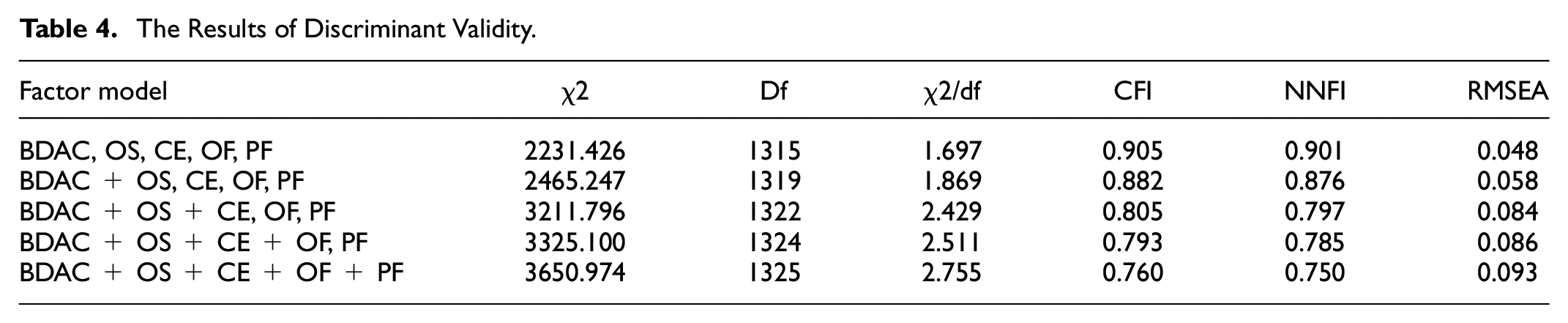
In order to ensure the model’s reliability and validity, we conduct Cronbach’s α test and confirmatory factor analysis (CFA) of variable measurement by using SPSS 25.0 and AMOS 24.0 software. The empirical results show that the Cronbach’s α and combined reliability (CR) values of each variable are higher than .8, the average variance extracted (AVE) values are higher than .5, and the factor loading coefficient (λ) values range from .634 to .880, indicating that the research model used has good internal consistency reliability and convergent validity (see Table 3). In addition, the fit of the five-factor model is the highest compared to other factor models and meets the criteria (χ2 = 2231.426, χ2/df = 1.697, CFI = 0.905, NNFI = 0.901, RMSEA = 0.048) (see Table 4), and the arithmetic square root of the AVE of each variable is greater than the correlation coefficients of the variables in the same ranks at the location (see Table 5), indicating that our model has good discriminant validity.
The Results of Reliability and Convergent Validity.

The Results of Discriminant Validity.
The Results of Correlation Analysis.

(1) Industry 1 = high-tech, Industry 2 = manufacturing versus services, Industry 3 = others. (2) N = 206. (3) **p < .01, *p < .05 (two-tailed). (4) the bolded font on the diagonal is the arithmetic square root of AVE.
Correlation Analysis and Common Method Bias
The results of the Pearson correlation coefficients, means, and standard deviations show that there is a significant correlation between each variable (see Table 5), which provides a preliminary basis for the hypotheses validation.
In order to avoid the problem of common method bias that arises when the questionnaires are all completed by managers, we conduct the Harman one-way test for analysis. The results show that the number of factors drawn is greater than 1, the tall variance explained is 68.11%, and the variance explained by the first factor is 26.43%, which is less than 40% of the overall variance explained, indicating that there is no serious problem of common method bias in our research.
Normality Testing
Before parametric tests, we conduct the Kolmogorov-Smirnov and Shapiro-Wilk normality tests to examine skewness and kurtosis. The results in Table 6 show that the index of all variables is statistically significance, allowing the subsequent empirical tests to be carried out.
The Results of Normality Testing.

p < .001 (two-tailed).
Hypotheses Testing
First, we conduct hierarchical regression analysis to account for mediating paths. As shown in Table 7, after fixing the control variables, BDAC is positively associated with corporate entrepreneurship (β = .762, p < .001, see M2), supporting H1. BDAC is positively associated with organizational slack (β = .734, p < .001, see M6), supporting H2. Next, when organizational slack is added to M2, the results show that organizational slack is positively associated with corporate entrepreneurship (β = .424, p < .001, see M3), and the effect of BDAC on corporate entrepreneurship is reduced but still significant (β = .461, p < .001, see M3), indicating that organizational slack plays a partial mediating role and H3 is partially supported.
The Results of Hierarchical Regression Analysis.

p < .001, **p < .01, *p < .05 (two-tailed).
Second, to further test the mediating effect, we conduct a bootstrap analysis using the SPSS macro syntax PROCESS v4.1 developed by Andrew f. Hayes, employing MODEL 4. The results show that the total effect of BDAC on corporate entrepreneurship is 0.789 with a 95% confidence interval of [0.674,0.904], and the interval does not contain 0, indicating that the total effect is significant. The direct effect of BDAC on corporate entrepreneurship is 0.439 with a 95% confidence interval of [0.309,0.568], and the interval does not contain 0, indicating that the direct effect is significant. The indirect effect of BDAC through organizational slack on corporate entrepreneurship is 0.350 with a 95% confidence interval of [0.242,0.470], and the interval does not contain 0, indicating that the indirect effect is significant. In summary, organizational slack plays a partially mediating role between BDAC and corporate entrepreneurship.
Third, to test the moderating effect of organizational flexibility and performance feedback, we add organizational flexibility and its interaction term with BDAC based on M6 to obtain M7, and the results of Table 7 show that this interaction term had a significant positive effect on organizational slack (β = .221, p < .001, see M7), thus H4 is supported. Then, M4 was obtained by adding the performance feedback and its interaction term with organizational slack to M3, and the results show that this interaction term has a significant negative effect on corporate entrepreneurship (β = −.126, p < .01, see M4), supporting H5. The moderating effects can be observed more clearly in Figure 2.
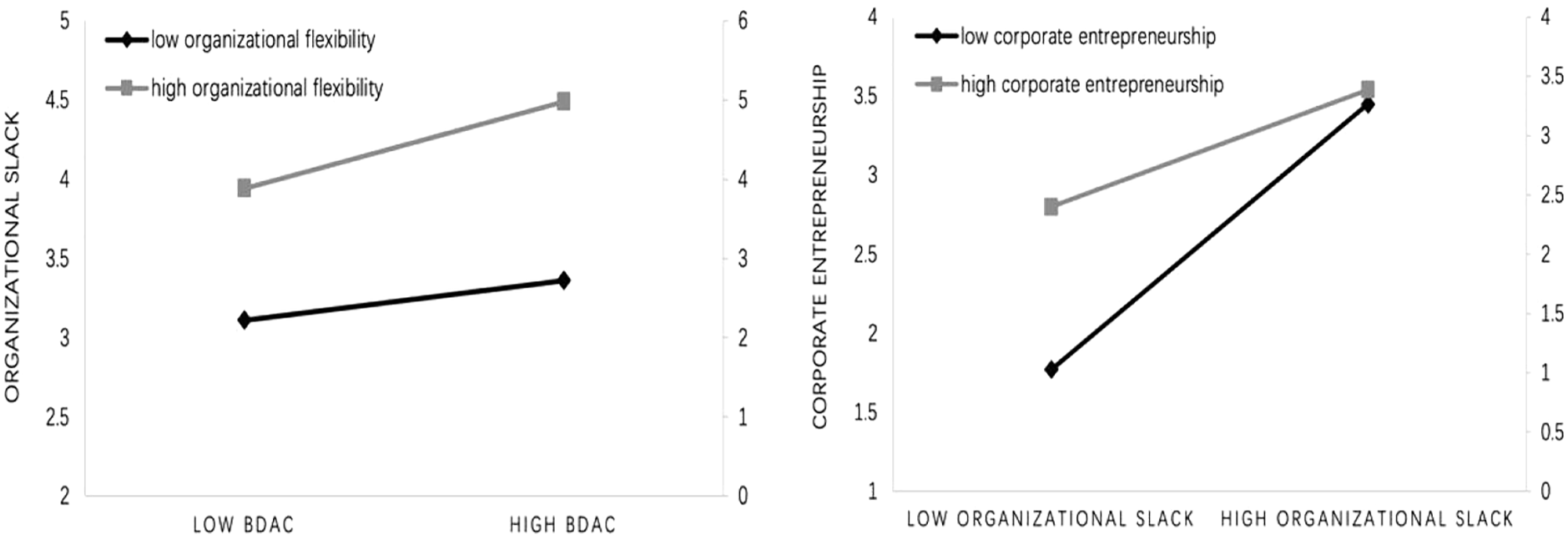
Graphing of the moderating effects.
Finally, we conduct bootstrap analysis using the SPSS macro syntax PROCESS v4.1 developed by Andrew f. Hayes while employing MODEL 1 to strengthen the validation of the moderating effect. The results are shown in Table 8. For organizational flexibility, when it is at low level (M-1SD), the 95% confidence interval is [0.042, 0.321], and the interval does not contain 0. When it is at high level (M+1SD), the 95% confidence interval is [0.342, 0.651], and the interval does not contain 0. This indicates that organizational flexibility plays a significant moderating effect between BDAC and organizational slack. For performance expectation matching, when it is at low level, the 95% confidence interval is [0.672, 0.934], and the interval does not contain 0. When it is at high level, the 95% confidence interval is [0.357, 0.693], and the interval does not contain 0, indicating that performance feedback plays a significant moderating effect between organizational slack and corporate entrepreneurship.
The Bootstrap Analysis Results of the Moderating Effect.

Discussion
Conclusion
This research reports several major findings. First, BDAC facilitates the development of organizational slack and corporate entrepreneurship. Meanwhile, organizational slack plays a partial mediating role between BDAC and corporate entrepreneurship. Furthermore, the higher the level of organizational flexibility, the stronger the moderating effect of BDAC on organizational slack. In addition, when performance arises above aspiration, the facilitating effect of organizational slack on corporate entrepreneurship is inhibited.
Theoretical Implications
This research extends the understanding of the mechanisms underlying the role of BDAC in two ways. First, in contrast to previous studies that examine the mechanism of BDAC-driven value transformation through lenses such as resource-based view, dynamic capability theory, knowledge-based view, and organizational information processing theory (Huynh et al., 2023), this paper adopts a perspective rooted in resource orchestration theory and organizational inertia theory to demonstrate how BDAC facilitates the generation of slack resources. Furthermore, it elucidates how firms can leverage these bundled slack resources for a series of fission developments, thereby broadening our understanding of the subsequent relationship involving BDAC. Moreover, previous studies focus on exploring the mechanism of BDAC-driven value transformation in a short-term, specific and static perspective (Akter et al., 2016; Ashaari et al., 2021; Mikalef et al., 2020; Wamba et al., 2017). In contrast, this paper adopts a long-term, overall and dynamic perspective to shed light on the previously unexplored role of BDAC in corporate entrepreneurship. In doing so, this study addresses the research gap regarding the examination of corporate entrepreneurship through a digital lens (Nambisan, 2017; Zhang et al., 2022). Moreover, it is widely acknowledged by scholars that resources and capabilities play a pivotal role in driving corporate entrepreneurship (Kreiser et al., 2021). This study specifically examines how BDAC can enhance corporate entrepreneurship by altering organizational resource endowments. Future research could further investigate the impact of BDAC on corporate entrepreneurial behavior of firms through changes in organizational capability endowment, taking into account the fundamental differences between the mechanisms proposed by the resource view and the capability view.
Second, previous studies extensively examine various characteristics of the external organizational environment, such as environmental dynamics, environmental heterogeneity, and environmental hostility in relation to the moderating effect of BDAC-driven value transformation (Egwuonwu et al., 2023; Mikalef et al., 2019; Mikalef et al., 2020), there is a lack of discussion on the internal organizational management characteristics. Only a few studies analyze the moderating effect of general organizational culture and data-driven culture (Behl, 2022; Liu et al., 2022; Shamim et al., 2020). This paper applies the viewpoint of organizational inertia theory proposed by Gilbert (2005) to examines internal management factors that promote the value transformation of BDAC from a holistic perspective. Specifically, this paper selects two variables, organizational flexibility and performance feedback, to conduct scenario discussions that examine the ability of organizations to adapt to change. It highlights the crucial role of organizational flexibility in addressing “routine rigidity” and provides insights into how BDAC can seamlessly integrate with organizational processes for value creation. Furthermore, it also emphasizes the significance of performance feedback in mitigating “resource rigidity” and offers guidance on effectively leveraging slack resources generated by BDAC. In addition, recent studies have underscored the significant impact of diverse organizational cultures on the role of BDAC (Behl, 2022; Liu et al., 2022). However, these explore the suitability of specific organizational cultures for different types of firms, which could be a potential avenue for future research.
Managerial Implications
First, firms should regard big data analytics as an important technical tool and knowledge resource, and strengthen their own absorption of external knowledge and integration of internal knowledge, with a view to identifying more potential business, new products and customer opportunities. Second, firms should strengthen the application of big data analytics in transforming organizational operation and upgrading strategies, such as applying big data analytics to improve product design, the production process, and management and update the business model, with the aim of enabling firms to squeeze, create and reserve more financial, human, equipment, etc., resources that can be redeployed by the organization. Third, in order to promote the value of big data analytics within the enterprises, on the one hand, firms need to ensure the flexibility of organizational operations to adapt to the ever-changing and complex data analytics tasks—specifically, they can strengthen the development of individual employees’ digital literacy, and coordinate the communication and cooperation between data analysts and employees in other departments to form efficient decision-making judgments. On the other hand, firms need to further plan for long-term development when they perform well, and strive to develop potential business to promote the utilization of slack resources.
Limitations and Future Research
There are still some limitations in this research. Firstly, this paper only collects data at a single time point and a small sample size, and focuses on solely on individual managers of the firm, resulting in diminishing the persuasiveness of the empirical findings. Future research should enhance the experimental design by collecting more logically validated cross-sectional data at multiple-time points and multi-source evaluation data. Secondly, this paper only demonstrates that organizational slack plays a partial mediating role between BDAC and corporate entrepreneurship, implying there are may exist other meaningful mediating mechanisms not considered in this study. Future research could explore potential differences among various dimension based on heterogeneity of core variables while investigating different perspectives to uncover key mechanisms related to BDAC. Finally, this paper solely examines the influence of certain organizational management characteristics on BDAC-driven value transformation, without delving into the contextual role of specific organizational behavior differences in the data management process. We urge scholars to consider more comprehensive organizational data management characteristics in future research, including characteristic variables related to structured, process and relationship governance.
Supplemental Material
sj-pdf-1-sgo-10.1177_21582440241305326 – Supplemental material for Corporate Entrepreneurship Driven by Big Data Analytics Capability: A Perspective Based on the Generation and Utilization of Slack Resources
Supplemental material, sj-pdf-1-sgo-10.1177_21582440241305326 for Corporate Entrepreneurship Driven by Big Data Analytics Capability: A Perspective Based on the Generation and Utilization of Slack Resources by Yadan Zheng and Lihua Dai in SAGE Open
Supplemental Material
sj-pdf-2-sgo-10.1177_21582440241305326 – Supplemental material for Corporate Entrepreneurship Driven by Big Data Analytics Capability: A Perspective Based on the Generation and Utilization of Slack Resources
Supplemental material, sj-pdf-2-sgo-10.1177_21582440241305326 for Corporate Entrepreneurship Driven by Big Data Analytics Capability: A Perspective Based on the Generation and Utilization of Slack Resources by Yadan Zheng and Lihua Dai in SAGE Open
Supplemental Material
sj-sav-3-sgo-10.1177_21582440241305326 – Supplemental material for Corporate Entrepreneurship Driven by Big Data Analytics Capability: A Perspective Based on the Generation and Utilization of Slack Resources
Supplemental material, sj-sav-3-sgo-10.1177_21582440241305326 for Corporate Entrepreneurship Driven by Big Data Analytics Capability: A Perspective Based on the Generation and Utilization of Slack Resources by Yadan Zheng and Lihua Dai in SAGE Open
Footnotes
Acknowledgements
The authors would like to gratefully acknowledge the constructive comments and suggestions from the editor and anonymous reviewers.
Declaration of Conflicting Interests
The author(s) declared no potential conflicts of interest with respect to the research, authorship, and/or publication of this article.
Funding
The author(s) received no financial support for the research, authorship, and/or publication of this article.
Ethics Statement
The authors declare that this work does not involve any unethical research practices.

Data Availability Statement
Data sharing not applicable to this article as no datasets were generated or analyzed during the current study.
Supplemental Material
Supplemental material for this article is available online.
References
Supplementary Material
Please find the following supplemental material available below.
For Open Access articles published under a Creative Commons License, all supplemental material carries the same license as the article it is associated with.
For non-Open Access articles published, all supplemental material carries a non-exclusive license, and permission requests for re-use of supplemental material or any part of supplemental material shall be sent directly to the copyright owner as specified in the copyright notice associated with the article.
