




Abstract
The development and promotion of entrepreneurial behavior is an important ingredient in developing entrepreneurship ventures. This study examined the factors influencing college students’ intention to engage in entrepreneurial activities. Applying the Theory of Planned Behavior as the theoretical foundation the structural equation modeling technique through Smart PLS 3.0 was used to analyze the hypothesized relationship in this study. The results indicate that all the proposed research hypotheses were statistically supported. Specifically, entrepreneurial attitude, subjective norm, and perceived behavioral control were all significant in determining college students’ entrepreneurial intentions. Furthermore, it was demonstrated that entrepreneurial self-efficacy, entrepreneurial education, and student internship motivation (SIM) were also positive and significant predictors of college students’ entrepreneurial intention. The implications of these findings on the development of entrepreneurial programs and activities that will have a positive influence and encourage students to engage in entrepreneurial activities are discussed.
Keywords
Introduction
Governments, policymakers, and business practitioners have paid much attention to entrepreneurship because of its strategic importance to sustaining and promoting economic and social development, creating and retooling new and existing jobs, innovation, and productivity. Entrepreneurship is thus seen as an essential economic force and catalyst in the development and vigor of the world economy (Gieure et al., 2020; Guo et al., 2016; Morris et al., 2013; Tleuberdinova et al., 2021). It is viewed as an emerging global practice that can be depended on to reducing unemployment and enhancing social development and economic growth (Acs & Audretsch, 2006; Coulibaly et al., 2018; Gieure et al., 2020). The nature of entrepreneurship in any country can be associated with the level of economic development in such countries (Chukwu et al., 2019; Morris et al., 2013). The development of entrepreneurship culture can reduce unemployment and thus contributing to achieving social development and economic growth (Gieure et al., 2020). Entrepreneurship is defined as the capacity to create and identify business opportunities and take advantage of them to create value and profit (Ohanu & Ogbuanya, 2018; Shane & Venkataraman, 2000). It is also considered as an evolutionary and innovative process of the capacity and professional skills toward the creation of new organizations (Chukwu et al., 2019; Gartner, 1988; Gieure et al., 2020). Entrepreneurship is also seen as a consolidated action obtained from innovation, creativity, or a new vision of something which already existed (Galvão et al., 2017). The entrepreneur is considered as someone who identifies a need or gap in a society and prepares to take measures to satisfy that need (Chukwu et al., 2019; Faisal & Anthoni, 2021).
Furthermore, an entrepreneur is defined as an individual who starts or establishes a business/enterprise and manages it and thus the entrepreneur is seen as a starter, a driver, accountable, and responsible (Dickel & Eckardt, 2021; Ohanu & Ogbuanya, 2018). The entrepreneur as a starter is seen as the initiator, a challenger, and a driver of the main concept and ideas of the new venture while as an entrepreneur (as a driver) is perceived as the person in charge, the leader/boss, and the person that must show leadership and responsibility for the destiny and prospects of the new enterprise (Ohanu & Ogbuanya, 2018). Persons or individuals who engage or become entrepreneurs are driven by the drive to get wealth, create job opportunities, earn a living, and so on (Ohanu & Ogbuanya, 2018). The intention of the entrepreneur is vital since vast research has demonstrated that the intention is instrumental in the decision of the entrepreneur to begin a new business entity (Ozaralli & Rivenburgh, 2016). Countries and government bodies can influence and encourage young people to aspire or to become entrepreneurs only when they are much aware of the variety of elements connected with entrepreneurial intention in diverse cultural settings (Ozaralli & Rivenburgh, 2016). Understanding the factors impacting the entrepreneur to undertake entrepreneurship will not only lead to the accelerated development of the entrepreneurial process but importantly will shape the individual entrepreneurial intention in practice and theory (Hu et al., 2018). Also unearthing the formation process of entrepreneurial intention is fundamental to promoting entrepreneurial endeavors (Carsrud & Brännback, 2011).
In the past three decades, entrepreneurship in China has seen significant development since China’s economic transition from a planned economy to a market economy during its reform and opening up in 1978 (He et al., 2019). The current soaring of entrepreneurship activities in China can be linked to the removing or lowering of institutional barriers to market entry and private business development in the period of China’s economic reforms (He et al., 2019). Three phases can be used to describe entrepreneurship development during the transition stages (Yang & Li, 2008). The first phase is the period during the transition when the market role is underdeveloped which allowed Chinese entrepreneurs to concentrate on acquiring the needed financing to begin new businesses (Yang & Li, 2008). At this stage, the informal institutions in the form of social networks, called guanxi in China were vital to the success of new ventures (He et al., 2019). The second phase is the period in which market rules and regulations were established which enabled entrepreneurs to build a competitive advantage for their businesses through cost reduction (Yang & Li, 2008). Finally, the third stage is the period in which market rules were fully in place which empowered entrepreneurs to understand that innovation can promote competitive advantage (Yang & Li, 2008). This awareness led to the active development of new products, services, and technology (He et al., 2019). Currently, entrepreneurship development in China since 2015 has entered has reached its peak where “mass entrepreneurship and innovation” is considered as the new national economic development strategy (He et al., 2019). This national economic development strategy has led both central and local governments in China to provide a large amount of funding and resources to promote and finance new start-up businesses that exhibit innovation (He et al., 2019).
College and university students are one special group of interest when it comes to the development of entrepreneurship policy programs and activities. Policy programs are thus put in place according to Ambad and Damit (2016) empower and encourage students to get into entrepreneurship and most importantly consider entrepreneurship as a long-term career option. Students for the long-term future are considered as the vital source of blossoming entrepreneurship and for that matter measures to instill entrepreneurial spirit among university students are crucial regardless of their chosen area of study (Ambad & Damit, 2016). Understanding students’ entrepreneurial intention to start a new business or engage in any entrepreneurship activity is, therefore, an important step that can contribute measures to instill an entrepreneurial spirit in them. It has been indicated that individual student’s discernment on the entrepreneur as a career choice is a major decider for them after they leave school and thus influences their entrepreneurship behavior or intention in the future (Verheul et al., 2012; Wibowo, 2017). The objective of this study is therefore to explore the factors that will influence college students’ entrepreneurial intentions. Entrepreneurial intention is defined as an individual’s intention to take part in activities and programs that lead to the development of new business ventures (Syed et al., 2020). The formation of entrepreneurial intentions is an important step toward becoming an entrepreneur, to starting and developing new ventures and businesses (Baron & Hmieleski, 2018; Biraglia & Kadile, 2017; Jeraj, 2014; Van Stel et al., 2005).
While acknowledging that previous and recent studies have examined the issues affecting students’ entrepreneurial intentions the vast majority of these studies have, however, failed to experiment on the critical factor of student internship motivation (SIM) on the development of students’ entrepreneurial intention. For instance, in an attempt to understand university students’ intention to undertake entrepreneurial activities in Turkey, it was established that factors such as educational and structural support were instrumental in influencing the entrepreneurial intention of students (Turker & Selcuk, 2009). Others revealed that motivations of personal achievements, cognitive interest, attitude toward entrepreneurship, subjective norms (SNs), perceived behavioral control, empathy toward others, perceived community support, and perceived self-efficacy demonstrated a positive effect on the entrepreneurial intention of students (Bazan et al., 2020; Kim & Park, 2019; Lingappa et al., 2020). Hence, the inclusion of this important element of SIM among the variables considered in this study is the major contribution of this study to entrepreneurship literature, particularly in the context of China. The main research question to be investigated is: What are the factors determining college students’ entrepreneurial intention? The conduct of this study seeks to contribute to the entrepreneurship literature and importantly as indicated by Ambad and Damit (2016) to assist government bodies and agencies, academic, entrepreneurial educators, consultants, and advisors to offer the appropriate solutions to foster entrepreneurship in universities and the society at large.
The rest of our paper is structured as follows: The theoretical background and research hypotheses development, research model, research methodology, results and analysis, discussion, conclusions, and limitation of the study.
Theoretical Background and Research Hypotheses Development
Theory of Planned Behavior
In the domain of entrepreneurship studies and research, Ajzen’s (1991) theory of planned behavior (TPB) is considered as the most widely used theory to explain and understand entrepreneurial intentions. The TPB is an extension of the theory of reason action (Ajzen & Fishbein, 1980; Fishbein & Ajzen, 1975). The TPB indicates that the individual’s intention to engage in a particular behavior is influenced by attitudes of such individuals toward the user behavior to perform that action (Ajzen, 1991). In other words, the main factor in the TPB is the individual’s intention to engage in a given task or behavior (Ajzen, 1991). According to this theory, individual intentions are the outcome of attitudes developed through experience and personal characteristics (Ajzen, 1985, 1991). The intentions are made up of the motivational factors that influence individual behavior and illustrate how people remain determined and willing to try to get an action or behavior performed (Ajzen, 1991). According to Ajzen (1991) the stronger the individual intention to perform or undertake a particular behavior, the more possibility that it will be performed. The TPB postulates that intention to act and engage in any behavior is dependent on three factors namely attitude toward behavior (ATB), SN, and perceived behavioral control (PBC) (Ajzen, 1991). The theory also states that the performance of an action or behavior is a joint function of intentions and perceived behavioral control (Ajzen, 1991).
The TPB within the context of entrepreneurial studies has been applied to past and recent studies that sought to understand entrepreneurial intentions (Doanh & Bernat, 2019; Hsu et al., 2014; Shreevastava et al., 2020; Yuan et al., 2019). For instance, in the context of Pakistan, it was demonstrated based on the TPB that there was a positive relationship between prior work experience and entrepreneurial intention (Yuan et al., 2019). Also in Vietnam, it was showed that through TPB, SNs did not have a direct effect on entrepreneurial intention but rather had a strong indirect impact on entrepreneurial intention through entrepreneurial self-efficacy, attitude toward entrepreneurship, and perceived behavioral control (Doanh & Bernat, 2019). Besides, while the study showed that the relationship between self-efficacy and entrepreneurial intention was mediated by attitude toward entrepreneurship and perceived behavioral control, it further validated the direct impact of attitude toward entrepreneurship on entrepreneurial intention among Vietnamese students (Doanh & Bernat, 2019).
Entrepreneurial Attitude (EA)
Attitude is defined as the tendency to respond or react positively or negatively to an object, people, institutions, or moments (Ajzen, 1991, 2005). An entrepreneurial attitude is considered as a tendency of people to react or respond either positively or negatively to entrepreneurship (Kusmintarti et al., 2014). An entrepreneurial attitude is the students’ tendency to engage in entrepreneurship (Kusmintarti et al., 2014). It has been postulated that students who demonstrate internal locus control turn to develop and grow positive attitudes toward entrepreneurship (Hatten & Ruhland, 1995). Therefore, students that have positive attitudes and aspirations to develop and own their own start-up business would be much inclined to have to develop the intention to engage in entrepreneurial activities. College students are a critical stage of their life formation and development, hence the formation of the right mind-set and attitudes toward entrepreneurship are vital. Prior studies have demonstrated that entrepreneurial attitude has a direct significant impact on entrepreneurial intention (Dheer & Lenartowicz, 2019; Doanh & Bernat, 2019; Gieure et al., 2020; Jena, 2020; Mahfud et al., 2019). Accordingly, H1 was proposed.
Subjective Norm (SN)
Subjective norm plays an important role in the determination of entrepreneurial attitudes. The SN is the normative beliefs held by individuals toward entrepreneurship as a career choice which is weighted by the motivation to act per these normative beliefs (Leroy et al., 2009). Subjective norm is considered as the perception of social pressure either from family, friends, and important personalities on the individual to undertake or perform a particular behavior (Ajzen, 1991). The SN is the most conflicting element in the TPB for it has been theorized that persons with higher SNs will, in turn, have higher levels of entrepreneurial intentions (Luc, 2018). College students suffer from this element of the SN where family, friends, and teachers expect some level of behavior or attitudes based on suggestions on issues that may shape their decisions such as to engage in entrepreneurial activities. It was revealed that the perceived lack of support from important social contacts impacts negatively on entrepreneurship (Kautonen et al., 2010). Studies have shown that there is a positive and significant impact of SNs on entrepreneurial intention (Ahmed et al., 2020; Gieure et al., 2020; Koe et al., 2012). Consequently, H2 was proposed.
Perceived Behavioral Control (PBC)
The perceived behavioral control is defined as the perceived acceptance of difficulties associated with the undertaking or performing a particular behavior (Ajzen, 1991; Ajzen & Fishbein, 1980). Perceived behavioral control is the individual personal belief of his or her capability and ability to complete or perform a particular work/action (Luc, 2018). In the context of entrepreneurship intention studies, it is explained that perceived behavioral control is considered as one of the strongest determinants of the intention to engage in entrepreneurial behavior (Luc, 2018). College students may have some perceived challenges associated with their decision to develop new enterprises and businesses. Studies have validated the positive and significant impact of perceived behavioral control on entrepreneurial intention (Ahmed et al., 2020; Koe et al., 2012; Luc, 2018). H3 was therefore proposed.
Entrepreneurial Self-Efficacy (ESE)
Self-efficacy is defined as the strong individual personal belief in his or her skills and abilities to undertake initiate and complete a task successfully (Bandura, 1977). The perception associated with self-efficacy can be a motivating factor for individuals to exhibit entrepreneurial behavior which can be influenced by contextual factors like education and past experiences (Hollenbeck & Hall, 2004; Markman et al., 2002). Education is fundamental to improving students’ entrepreneurial self-efficacy which provides them with the right attitudes, knowledge, and skills to withstand and cope with the challenges and complexities that come with entrepreneurial activities such as opportunity seeking, resource assembling, and providing leadership for business to succeed (Wilson et al., 2007). The enhancement of college students’ entrepreneurial efficacy empowers them to endure longer, persist in the face of challenges, and map up plans and strategies to obtain greater entrepreneurial objectives (Shane et al., 2003). Individuals with higher levels of entrepreneurial efficacy have a higher possibility of becoming an entrepreneur (Segal et al., 2005). Prior studies have demonstrated that entrepreneurial efficacy has a direct positive and significant impact on entrepreneurial intention (Ahmed et al., 2020; Dheer & Lenartowicz, 2019). Accordingly, H4 was proposed.
Entrepreneurship Education (EE)
Entrepreneurship education is a critical and vital component of creating and developing entrepreneurial attitudes/intentions (Pihie & Akmaliah, 2009; Thompson & Kwong, 2016). Entrepreneurship education involves interactive learning that is linked to business and community approach to ensure experience-based learning methods (Boon et al., 2013; Ratten & Usmanij, 2020). The ultimate objective of entrepreneurial education is to ensure the change of students’ mind-set when it comes to innovation and risks taking in business ventures (Jones et al., 2014). It should create affective outcomes that will drive changes in attitudes concerning craving the desire to want to start a new business venture or being innovative in an already existing enterprise (Kyro, 2008). The appropriate entrepreneurship education should not teach students how to start a business but as indicated by Nowiński et al. (2019) it should rather focus on enabling students to identify and recognize entrepreneurial opportunities and how to develop digital business. The provision of quality entrepreneurship education to college students is the greatest way to developing entrepreneurial spirits in these students and thus will have the highest tendency to engage in developing new businesses. The significant impact of entrepreneurship education on entrepreneurial intention has been demonstrated by previous studies (Hussain & Norashidah, 2015; Iwu et al., 2019; Li & Wu, 2019). Accordingly, H5 was proposed.
Students Internship Motivation (SIM)
Students’ engagement in internship activities during holidays can influence the entrepreneurship capabilities of students. Internship equips students with a vehicle for transforming the knowledge and skills acquired in class into the working environment (Madigan et al., 2019). An internship can also contribute hugely to the practical application of new knowledge and skills development (Yi, 2018). A student internship is considered as a voluntary, temporary work placement by students who are enrolled at the university and college (Coco, 2000). Internship programs should be geared toward creativity, innovation, multidisciplinary and process-orientated approaches, and theory-based practical application (Dobratz et al., 2014). Improving student internship quality has the potential to increase students’ entrepreneurial desirability and feasibility which will also impact positively on students’ entrepreneurial intentions (Yi, 2018). Previous studies have shown that there is a positive and significant impact on students’ internships on student entrepreneurial intention (Botha & Bignotti, 2016; Yi, 2018). Accordingly, H6 was proposed.
Research Model
The research model to be explored based on the hypothesis developed above is depicted in Figure 1.

Research model.
Research Methodology
Since the focus of this study was based on students, a research questionnaire approach was adopted as the research strategy to collect data from the students for the data analysis. The study chose students as the object of this study because, as young and energetic students in their youth, they have fertile minds and the right environment that can enable them to engage in entrepreneurship ventures. We adopted questionnaire variables from previous studies after a thorough literature review but were modified to conform to the context of this current study. The variables were adopted as follows: entrepreneurship attitudes (Nabi et al., 2008; Pihie & Akmaliah, 2009), SNs (Arranz et al., 2019), perceived behavioral control (Arranz et al., 2019), entrepreneurial self-efficacy (Danish et al., 2019; Gaumer et al., 2016; Pihie & Akmaliah, 2009), entrepreneurship education (Byabashaija & Katono, 2011; Fayolle & Gailly, 2015; Rasmussen & Sørheim, 2006), SIM (self-developed item), and entrepreneurship intention (Arranz et al., 2019; Pihie & Akmaliah, 2009; Urban & Kujinga, 2017). The questionnaire items were measured on a five-point Likert-type scale ranging from 1 = strongly disagree (SD) to 5 = strongly agree (SA). The questionnaire items used are attached as Appendix A. The targeted populations of this study are university students who are enrolled in three different universities in the City of Ganzhou. The city of Ganzhou is one of the fastest developing cities located in Jiangxi Province in China and has three universities/colleges. The universities from which the data were collected are Jiangxi University of Science and Technology (33,000 students population), Gannan Normal University (21,400 student population), and Gannan Medical University (12,518 student population). Fellow teachers in these universities were contacted who then assisted in the sharing of the online questionnaire to the students in their respective universities. The total estimated population of these three universities put together amounted to 66,918 students. Whether the students were enrolled in entrepreneurship programs/courses or not, was not a criterion for students to participate in the research survey. This was because a student does not necessarily have to enroll in an entrepreneurship course before he or she can become or aspire to become an entrepreneur. Hence, the research survey was open to all students (from any discipline or course) who were enrolled at the university.
The questionnaire was first prepared in the English language and was translated into the Chinese language. This was done since the targeted respondents are Chinese students. To ensure that the questions in the questionnaires were free from any ambiguity, the instrument was piloted and tested to a cross-section of the targeted population for this study. After the successful piloting and testing, the questionnaire was hosted (administered) online for about 2 months (September and October 2019). The created link was then shared randomly on the popular Chinese social networking platform (WECHAT) for the intended respondents to complete the survey. The convenience sampling technique was thus applied in this study to reach the respondents. Convenience sampling is considered a form of non-probability or non-random sampling where members of the targeted population that conform to stipulated standards like easy accessibility, geographical proximity, availability at a given time and the readiness to take partake in given research (Dornyei, 2010; Battaglia, 2008; Pabst et al., 2021). May also be seen as the studying of subjects of a population that are easily accessible to the researcher in terms of its been situated spatially or administratively closer to the place the researcher is undertaking the data collection (Etikan et al., 2016; Given, 2008). The convenience sampling was used due to its affordability, ease, and readily available of the subjects. After hosting, a total of 873 valid responses were received. The study decided to proceed with the 873 valid responses received because the minimum number of samples needed was 382. The minimum sample required (382) was determined by using these indicators such as confidence level (95%), the margin of error (5%), and estimated student population size (three universities) of 66,918 (Qualtrics, 2020). The received valid responses were checked and captured for the data analysis. The analysis was conducted using SPSS and Smart PLS 3.0 by undertaking the structural equation modeling technique.
Common Method Bias (CMB)
The common method bias analysis is conducted to eliminate errors that may occur as a result of the constructs (independent and dependent) been used in the study is examined with the same research instrument. Common method bias if present in studies but not addressed may have a substantial influence on the constructs’ validity and reliability in addition to the co-variation between latent constructs (MacKenzie & Podsakoff, 2012). The CMB in our study was interrogated by the application of Harman’s single-factor analysis. Harman’s technique indicates that if one factor explains more than 50% of the variance then the issue of common method bias can be said to be present (Eichhorn, 2014). The analysis shows that a single construct explains 29.1% of the total variance. This value (29.1%) is less than the 50% threshold recommended for the non-existence of common method variance/bias (Lee et al., 2014). Based on this, the study concluded that there is not one dominant factor in our data and thus evidence that the challenge of CMB does not exist in data samples used.
Results and Data Analysis
Demographic Statistics Respondents
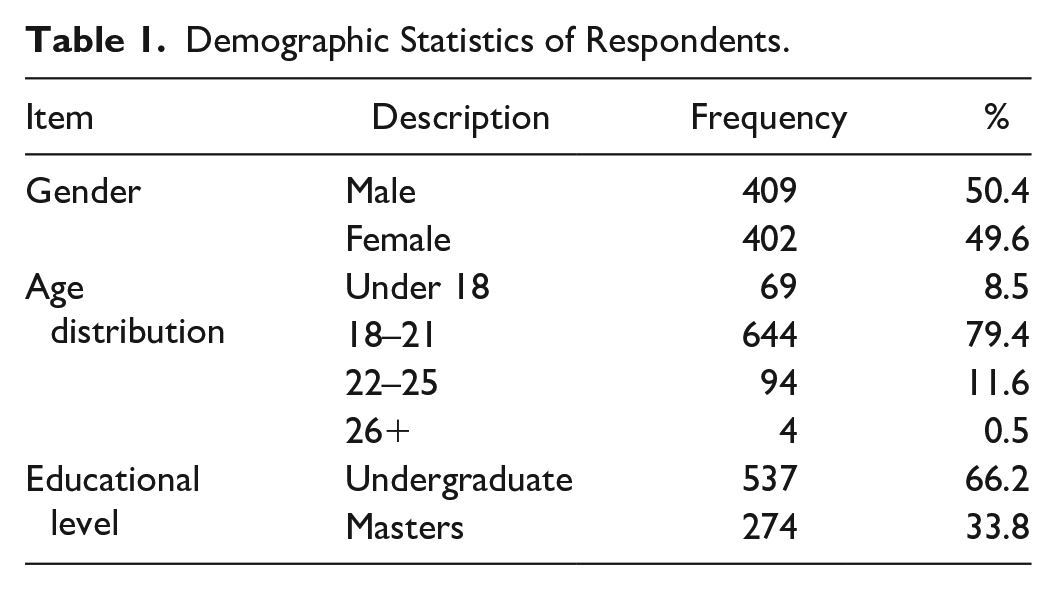
The demographic statistics of the respondents are shown in Table 1. The male respondents represented 50.4% while the female respondents were 49.6%. In terms of the age distribution, the majority of the respondents were between the ages of 18 to 21 years which represents 79.4%. The educational level statistics indicate that 66.2% of the respondents were undergraduate students.
Demographic Statistics of Respondents.
Measurement Model
The factor loading and reliability indicators such as composite reliability, Cronbach’s alpha, and average variance extracted were used to assess the measurement model. The results of the measurement model are shown in Table 2. Composite reliability and Cronbach’s alpha are recommended to be above 0.70 (Hair et al., 2010, 2012). Furthermore, the average variance extracted should have values not less than 0.50 (Fornell & Larcker, 1981; Hair et al., 2010, 2012, 2013). As shown in Table 2, all the recommended reliability values were met which demonstrate the convergent validity of the measures. Also, we assessed the discriminate validity using the Fornell-Larcker criterion and Heterotrait-Monotrait (HTMT) ratio. The results of the discriminate validity are shown in Table 3. The first criterion states that the square root of the AVE should be higher than the correlations between the constructs and the second stipulates that the factor loading of variables should be higher than all the cross-loadings (Chin, 1998; Fornell & Larcker, 1981). All these two principles were met which demonstrates the discriminant validity of our measures. In addition, the result of the HTMT ratio is shown in Table 4. The results demonstrate that all the constructs were found to have HTMT ratios below the threshold value of 0.85 (Hair et al., 2016; Leguina, 2015) and thus does confirm again the discriminate validity of the model used.
Measurement Model.
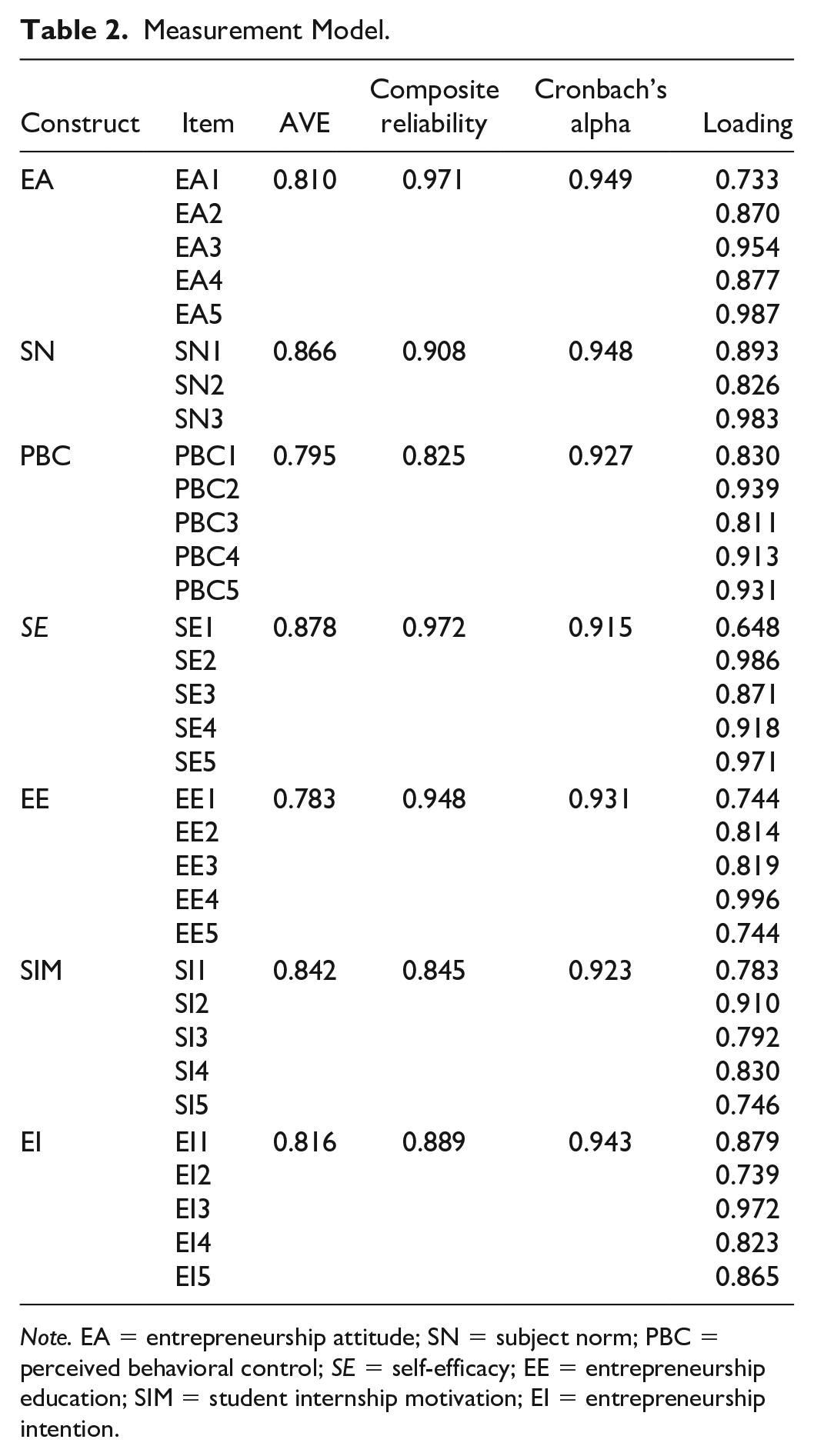
Note. EA = entrepreneurship attitude; SN = subject norm; PBC = perceived behavioral control; SE = self-efficacy; EE = entrepreneurship education; SIM = student internship motivation; EI = entrepreneurship intention.
Discriminant Validity (Fornell-Larcker Format).

Note. The diagonal elements (bold) are the square root of AVE. EA = entrepreneurship attitude; SN = subject norm; PBC = perceived behavioral control; SE = self-efficacy; EE = entrepreneurship education; SIM = student internship motivation; EI = entrepreneurship intention.
Discriminant Validity (Heterotrait-Monotrait [HTMT] Raito).
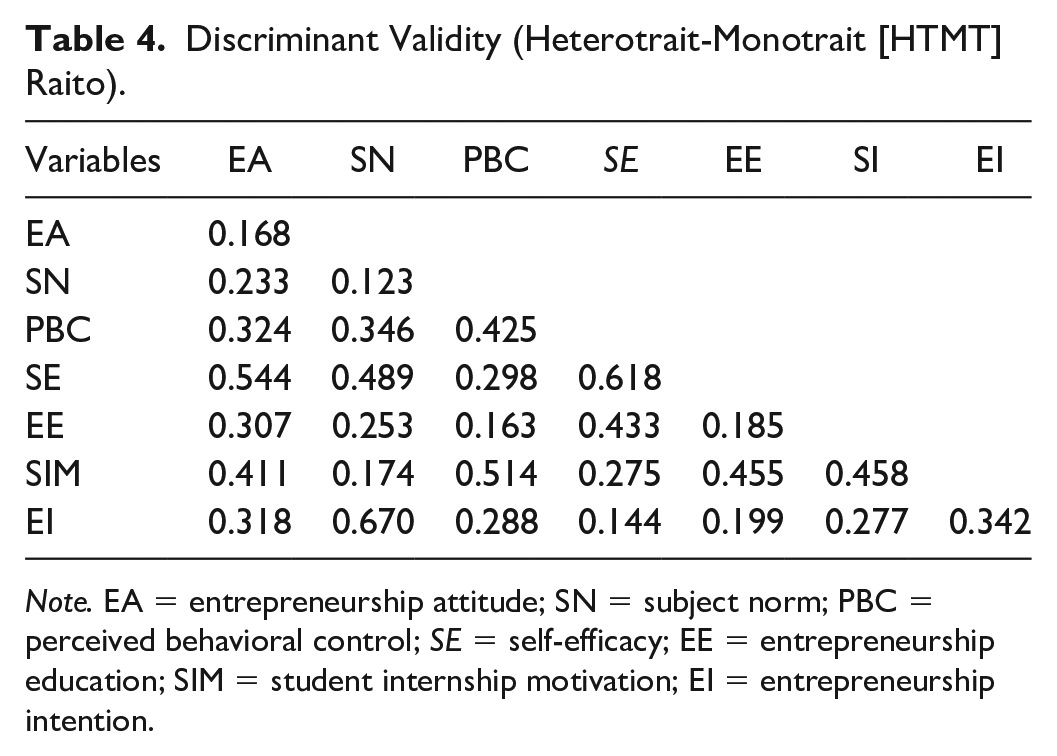
Note. EA = entrepreneurship attitude; SN = subject norm; PBC = perceived behavioral control; SE = self-efficacy; EE = entrepreneurship education; SIM = student internship motivation; EI = entrepreneurship intention.
Structural Model
The results of the structural model (research hypotheses) are shown in Table 5. The results indicate that entrepreneurship attitude (β = 0.264, p < .05) and SN (β = .126, p < .05) both have a positive and significant impact on the college students’ entrepreneurship intentions. Accordingly, H1 and H2 were supported. In addition, perceived behavioral control (β = .231, p < .05) and entrepreneurial self-efficacy (β = 0.170, p < .05) were significant in determining the college students’ entrepreneurship intentions. H3 and H4 were therefore supported. Also, entrepreneurship education (β = 0.066, p < .05) and student internship (β = 0.145, p < .05) were both positive and significant predictors of the intention to engage in entrepreneurship. Consequently, H5 and H6 were statistically supported. The graphical depiction of the validated structural model is depicted in Figure 2.
Results of Hypotheses Tested (Structural Model).
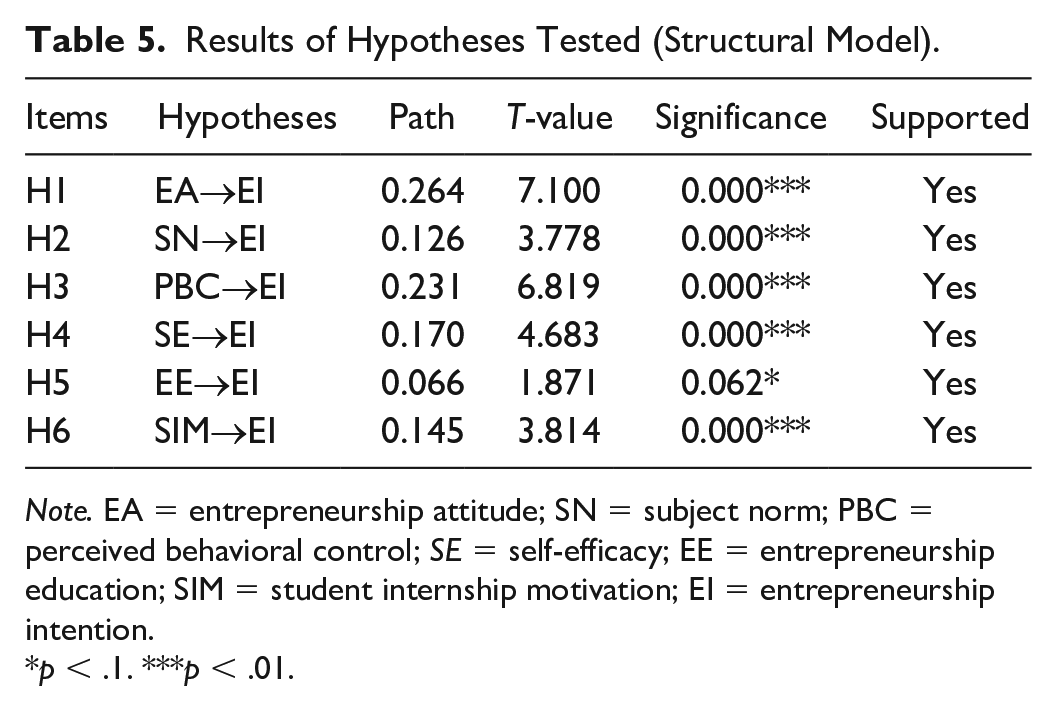
Note. EA = entrepreneurship attitude; SN = subject norm; PBC = perceived behavioral control; SE = self-efficacy; EE = entrepreneurship education; SIM = student internship motivation; EI = entrepreneurship intention.
p < .1. ***p < .01.

Validated research model.
Discussion
This study examined the factors determining college students’ entrepreneurial intentions. Universities, private and government institutions have continued to develop and initiate programs to encourage the development of entrepreneurial behaviors in consolidated efforts to create more entrepreneurs who can drive the establishment of new business ventures. This creation of new enterprises by entrepreneurs can create sustainable jobs and employment and thereby reducing the rate of unemployment. Most of these entrepreneurial programs often are targeted at students at the university and college levels. What will then influence college students to take up or engage in entrepreneurial behavior? Through our data analysis, the results have confirmed that all the proposed hypotheses were statistically supported. Specifically, it was shown that entrepreneurial attitude and SN were both significant in influencing college students’ decision to engage in entrepreneurial activities. This implies that putting in programs and measures to embolden college students with the right mind-set toward entrepreneurial activities will improve their attitude toward entrepreneurship. That is arming students with the right beliefs, thought processes, behaviors, and experiences about entrepreneurship can positively impact their entrepreneurial intention. Also, the significant impact of SN on the college students’ entrepreneurial intention is an indication that the perception of college students that is their reference groups including family, friends, relatives, and other important persons like teachers would approve their decision to venture into a new enterprise will have an impact toward driving up their intention to engage in entrepreneurial activities. The findings on the positive impact of entrepreneurial attitude and SN on entrepreneurial intention support previous studies that also showed that attitude and the SN is a positive and significant predictor of entrepreneurial intention (Do & Dadvari, 2017; Lingappa et al., 2020; Nguyen et al., 2019).
In addition, it was demonstrated that perceived behavioral control and entrepreneurial self-efficacy were also significant predictors of college students’ entrepreneurial intentions. The positive and significant impact of perceived behavioral control on the student entrepreneurial intention means that the student confidence in startup skills, available and enriched knowledge, and opportunities in their surrounding can influence their decision to engage in entrepreneurial activities. The validated impact of perceived behavioral control on the student entrepreneurial intention is corroborated by previous studies that showed that perceived behavioral control is a predictor of the intention to engage in entrepreneurial activities (Brännback et al., 2018; Doanh & Bernat, 2019; Greene & Brush, 2018; Shabbir et al., 2016; Yang, 2013). In addition, the positive impact of entrepreneurial self-efficacy on college students’ entrepreneurial intention is a testament that engaging students in entrepreneurial activities/tasks have the potential to develop students’ self-efficacy toward entrepreneurial intention. Education and training activities are a good environment to instill confidence and ability in the college students toward demonstrating the needed self-efficacy when it comes to entrepreneurship. Previous studies have also confirmed in line with our findings that entrepreneurial self-efficacy is directly associated with entrepreneurial intention (Ciuchta & Finch, 2019; Doanh & Bernat, 2019; Greene & Brush, 2018; Pollack et al., 2019).
Furthermore, entrepreneurship education and SIM were also found to be positive and significant determinants of college students’ entrepreneurial intention. The positive impact of entrepreneurial education on college students’ entrepreneurial intention is a strong indication that a well-structured and tailored entrepreneurship education and programs can stimulate the greater interest of students to engage in entrepreneurship. The provision of relevance, innovation, and adequacy in the design and development of entrepreneurship courses and curriculum will in no doubt have a cumulative direct impact on the student entrepreneurial intention. To increase the students’ entrepreneurial intention, the development of entrepreneurship education should be more inclined toward practical and hands-on sections rather than academic and theoretical content. Entrepreneurship education should be directed at motivating students to learn how to exploit and take advantage of opportunities within their surroundings and markets (Iwu et al., 2019). The finding on the positive significant impact of entrepreneurial education on entrepreneurial intention is in line with previous studies that also confirmed this relationship between education and entrepreneurial intention (Ahmed et al., 2020; Hussain & Norashidah, 2015; Iwu et al., 2019; Jena, 2020).
Also, the significant impact of SIM on the college students’ internship implies that encouraging students to take up internship programs while in school will go a long way to improve their intention to engage in entrepreneurial activities. Student internship motivation provides opportunities for students to enhance practical and skills development and it is more significant than any other forms of learning which create higher confidence in students’ potential and character building in entrepreneurship (Gault et al., 2000; Hecimovich & Volet, 2012; Ko & Sidhu, 2012; Yi, 2018). The nature and quality of SIM programs can determine students’ career paths and development (Gamboa et al., 2014) as well as the desire to engage in entrepreneurial activities. The finding on the positive impact of SIM on student entrepreneurial intention is similar to studies that also confirmed the potential impact of SIM on developing students’ interest in entrepreneurship (Yi, 2018).
Theoretical Implication
Through the application of the TPB, this study has theoretically shown that the constructs experimented with accounted for about 52.5% of the factors determining the college students’ entrepreneurial intention. Therefore this means that entrepreneurial attitude, entrepreneurial self-efficacy, perceived behavioral control, entrepreneurial education, and entrepreneurial internship can altogether explain 52.5% of the variance in the students’ entrepreneurial intentions. Thereby theoretically meaning that there are other constructs (47.5%) which our study has not factored or considered in our model and would be grounds for future research to broaden and include other constructs such as perceived access to finance, perceived desirability, perceived feasibility, entrepreneurial policy and regulations and perceived levels of economic development.
Practical Implications
In addition to the theoretical implications, this study has some practical implications for the development and promotion of entrepreneurial behavior and intention not only for college students but for the general population as well. First, the government, policymakers, and universities must pay attention to the entrepreneurial attitude and SN since we have demonstrated that these two factors are a predictor of college students’ intention to engage in entrepreneurial activities. Universities and policy-makers should put in strategies and measures to inculcate into students the right mind-set and attitudes toward entrepreneurial behavior. This mind-set formation can encourage students to develop innovation, desire to accomplish more, and venture into unknown territory, and expectation of positive outcomes of anything engaged. This formation of the right mind-set and attitudes would make students perceive entrepreneurial ventures as favorable, valuable, and beneficial. Also, providing support and a congenial environment for the development of students’ entrepreneurial skills and knowledge will contribute to improving the SN of the students. Moreover, this will, in turn, increase their intention to take up entrepreneurial activities.
Second, the factor of perceived behavioral control and entrepreneurial self-efficacy is a very important validation of this study that could be of much concern to policy-makers and practitioners. This implies programs and activities to be put in place to build and bolster the confidence of college students toward entrepreneurial activities. Early training and courses in entrepreneurship are vital to building the needed confidence in college students which will in turn impact positively on their intention to engage in entrepreneurial activities.
Third, entrepreneurship education and SIM were also validated to have a direct significant impact on college students’ entrepreneurial intentions. This is an important finding and has serious implications for the development of both entrepreneurship education and student internship programs in universities and colleges. Government institutions, university authorities, and policy-makers should put in measure to change the current too much focus on theory to a more education based on practical learning. In addition, students should be encouraged to take up internship work while in school particularly during the holiday seasons. The provision of a more formidable entrepreneurship education coupled with intensive and quality internship programs will contribute to increasing college students’ intention to participate in an entrepreneurial venture.
Conclusion
This study investigated factors that will determine college students’ intention to engage in entrepreneurial activities. The findings have revealed that the intention of college students to engage in entrepreneurial activities is influenced by entrepreneurial attitude, entrepreneurial education, perceived behavioral control, entrepreneurial self-efficacy, and SIM. These findings have demonstrated that to encourage more college students to take up entrepreneurial activities these factors examined in this study are very vital and crucial that can be factored in the development of the right entrepreneurial policy and regulations for college students. The development and creation of more college entrepreneurs through a well-thought-out and structured entrepreneurship program will not only be beneficial to college students themselves but will contribute to job creation and thereby reducing the huge unemployment challenges faced locally and globally.
Limitation and Future Research
First, the research setting including the model applied may be used in another study but the results may not conform to the findings of this study. Second, the sample size may not be representative and hence caution should be exercised when interpreting and generalizing the results of this study. Third, the study only examines the intention of students toward entrepreneurship but does not examine the entrepreneurial capacity and outcomes of students. Fourth, the concept or definition of entrepreneurship education used in this study does not include potential sources of entrepreneurial education such as family business and parent’s occupation but rather academic courses at the university. In addition to that, the variance explained in this study is about 50% which means that other factors determining the entrepreneurial intentions were not considered in this study. Future studies will therefore seek to expand the sample size and integrate other factors such as perceived access to finance, entrepreneurial policy, and regulations, perceived desirability, perceived feasibility, and level of economic development on the entrepreneurial intention of college students. More so, it will be interesting to empirically test the moderating and mediation impact of student internship on the relationship between the factors examined in this study (Entrepreneurship Attitude, Subject Norm, Perceived Behavioral Control, Self-efficacy, Entrepreneurship Education, Student Internship Motivation), and Entrepreneurship Intention.
Footnotes
Appendix A
Declaration of Conflicting Interests
The author(s) declared no potential conflicts of interest with respect to the research, authorship, and/or publication of this article.
Funding
The author(s) disclosed receipt of the following financial support for the research, authorship, and/or publication of this article: This research was supported by Jiangxi University of Science and Technology, Special Funds for High-Level Talent Research (No. 205200100470).
