



Abstract
The purpose of this study is to examine the relationship between common rationality (as a factor of convergence of employees and managers), collective decision-making (as one of the important methods of participation), and productivity (as an important indicator of organizational success). Structural equation modeling (SEM) is used to investigate the strength of these relationships. After the distribution of 98 questionnaires among organizational experts we used Smart PLS 2.0 to analyze the data. The results show that the indirect relationship between common rationality and productivity through a mediating variable of collective decision-making is stronger than the direct effect of common rationality on productivity. It means that common rationality as a substantial asset for an organization could be used to improve productivity but if managers want to utilize this asset, they should apply it through another mediator which is collective decision-making. Collective decision-making could facilitate the relationship between common rationality and productivity by creating synergy among employees, reducing biases, increasing decision quality, and reaching the optimal decision.
Plain Language Summary
One of the goals that managers and employees of organizations pursue is the issue of productivity because productivity leads to the success of the organization. The basic questions in this field are how to create purposeful participation in practice among the employees of an organization and lead them to participate in decision-making, how to provide the basis for employee participation in decision-making, and what indicators and methods should be used. This article examines the consequences of collective decision-making on productivity in an organization. Due to the high importance and practicality of the issue of collective decision-making and its effect on productivity, a conceptual model of research on this issue was designed and analyzed by structural equation modeling. The results show that common rationality affects productivity through the mediating variable of collective decision-making. Therefore, managers must pay enough attention to collective decision-making to increase productivity in the organization.
Keywords
Introduction
Productivity is a measure for evaluating the performance of organizations and determining their success or failure in achieving their goals (Abdelwahed & Doghan, 2023). It is an established and important concept that increasing the productivity of employees and managers plays an important role in the sustainable success of the organization (Fenizia, 2022; Karam & Tasmin, 2020). Consequently, in today’s competitive environment, organizations highly prioritize productivity and many authors analyze the factors affecting the productivity of their employees and managers (Singh et al., 2022).
Managers mainly focus on factors such as increasing wages, providing more welfare facilities, and closing long-term contracts to increase employee productivity (Cirillo & Ricci, 2022; Güngör, 2011). Methods that may become less effective after a short time, while there is another less expensive method that can be highly effective and managers ignore it. One of the effective and low-cost factors in productivity is the decision-making style of managers (Low & Mohr, 2001; Sinnaiah et al., 2023).
Although top managers are the main decision-makers in their organizations, little research has been conducted on how managers’ decision-making styles affect organizational productivity (Kruse et al., 2023). The research conducted so far in this field confirms that employee participation in the decision-making of managers greatly helps to increase productivity and support it (Dionne et al., 2019; Emerson & Nabatchi, 2015; Hertz et al., 2016; S. J. Wu & Paluck, 2022) and leads to the success of the organization (Dionne et al., 2019; A. J. Xu et al., 2023).
This claim is proved by various reasons, for instance, employee participation in decision-making can provide more information to deal with organizational problems and thus improve efficiency (Mann, 2018), or through participating in decision-making, employees will obtain more awareness, which can lead to better implementation of decisions (Dionne et al., 2019). Vanderslice et al. (1987) identify three motivational reasons for participation leading to increased productivity. These three reasons include reducing resistance to change, increasing commitment to the goal, and setting higher goals (Vanderslice et al., 1987).
This research is in line with studies that have introduced the creation of participation as one of the successful approaches to increasing productivity (Dionne et al., 2019; Hertz et al., 2016; Kruse et al., 2023; Vink et al., 2006). However, the gap that exists in the previous research is that they did not clarify the process of constructing participation and how to create participation. The basic questions in this field are how to create purposeful participation in practice among the employees of an organization and lead them to participate in decision-making, how to provide the basis for employee participation in decision-making, and what indicators and methods should be used. This research fills this gap and tries to identify and evaluate the path of setting the ground for participation to achieve productivity and its related indicators in an integrated manner.
In this study, collective decision-making is used as a factor to increase participation in the organization. Also, achieving common rationality is introduced as a basis for collective decision-making as it converges and directs different people with various attitudes, personalities, and opinions (Birkeland et al., 2020; Bisset et al., 2020; Yilmaz & Kafadar, 2020). Rationality is a set of arguments that every person and every society has for their “beliefs, actions and behavior” (Jagau & Perea, 2022; Perea, 2022).
Thus, we use common rationality as an underlying factor that influences collective decision-making. If the positive impact of collective decision-making on productivity is elucidated, and how to create this effect is clarified, it can recommend an important strategy to managers to use collective decision-making on various issues to increase productivity. In this regard, using content analysis, the most important effective indicators of common rationality, collective decision-making, and productivity are identified, and then the relationship between them is measured using interviews with experts and the method of structural equation modeling.
Literature Review
The main constructs of our model are common rationality, collective decision-making, and productivity as independent, mediator, and dependent variables, respectively. Thus, we review the literature on these three constructs in the following sections.
Common Rationality
Rationality is a set of abstract characteristics of a person’s attitudes, which can include preferences, desires, intentions, beliefs, and values. Rationality is highly dependent on people’s attitudes, and if beliefs, preferences, and intentions change, rationality changes. Rationality is related to the arguments that people use for their decisions and based on that, they analyze their environment (Jagau & Perea, 2022; Perea, 2022). There is widespread acceptance that rationality plays an important role in decision-making (Amidu et al., 2019).
Rationality refers to the set of arguments that each individual has for his actions and behavior. It is about being wise in what we believe in and what we like to do. For this reason, common rationality guides normativity in different people (Barilan, 2022). A group needs to have common rationality to reach a single decision in the organization (Zha et al., 2023). In collective decision-making, common knowledge is created, and common rationality can be the basis of such common knowledge (Schmidt, 2021).
Also, common rationality is the basis for collective coordination to reach a common decision. Because harmonization does not require homogenization, it requires common rationality and selects certain approaches over others as the basis of harmonized regulatory frameworks (Lanier-Christensen, 2021). Rationality has a clear interpretation in individual decisions but is not easily understood in interactive decisions (such as collective decision-making). Because interactive decision-makers cannot maximize their expected benefits without strong assumptions about how other stakeholders behave (Colman, 2003).
Regarding rationality, a theory has been stated that evaluates cases of reasoning as irrational, rational, and partially rational. Rationality theory can be classified as consequentialist and rule-based. Consequentialist theories say that rational reasoning tends to produce good consequences. Rule-based theories say that rational reasoning conforms to certain rules (e.g., probability or logic) (Sosis & Bishop, 2014). The rationality principle, which was embedded by Max Weber as a conventional methodological rule, states that social scientists can understand and explain social actions, social actors, and their motivations through their reasons for actions (Mody et al., 2016). Based on this principle, Weberian Verstehen sociology claims that “the behavior of a social actor is always understandable.” The rationality principle, along with the assumption of the rationality of social agents, provides the basis for the understanding of others (Rusu, 2013).
Rationality exists among all human cultures, and common rationality forms the basis on which people with different cultures and attitudes can understand each other (Rusu, 2013). Common rationality means how much a group has been able to reach a common understanding of problems and solutions. When common rationality is created, common thoughts and common goals are created in the community (Palmiero et al., 2020; Tongo, 2015). Attention to collectives raises important questions about human rationality. For example, there are contexts (such as voting) where we may value collective rationality more than individual rationality (Hahn, 2022). The rationality of a collective is somehow dependent on the rationality of its members (Vareman, 2011). To the extent that common rationality increases in a society, different and conflicting opinions among its members decrease (Benassi & Gentilini, 1999).
Collective Decision-Making
Decision-making can be identified as a mental process that leads to the selection of an option from a set of possible options (B. Wu et al., 2017). Collective decision-making is a process in which each person has an opportunity to influence and decide on their work and group tasks (Z. Xu et al., 2022). Collective decision-making involves two or more actors who seek to improve their stance on a particular issue and coordinate the goal they want to achieve. In the process, they want to express their preferences and beliefs on the issue and reach a single decision (Marks et al., 2019).
Collective decision-making is the process by which the members of a group decide by thinking about an action (De Oca et al., 2011). Collective decision-making involves two or more actors who aim to improve their situation and coordinate on a particular issue by achieving their goal (Gerrits & Marks, 2017). In Collective decision-making, individuals usually express their views, despite some restrictions and preferences, toward a certain set of possible decisions, and then one decision is selected (Rossi, 2014). In the following, we divide the literature on collective decision-making into three parts of necessity process, applications, and models.
Necessity of Collective Decision-Making
People face collective decision-making situations everywhere in their daily lives (Veen, 2011). The study of collective decision-making covers various areas such as the brain and behavioral sciences, economics, management sciences, and artificial intelligence, and focuses in particular on the question of how decision-makers can make optimal choices from multiple options (Hasegawa et al., 2017; Horsevad et al., 2022). The main task of groups is to provide effective solutions to the complex problems they face. This is a very relevant aspect of the behavior of social groups, because “collective wisdom” can be qualitatively beyond the behavior of individuals (Zafeiris et al., 2017).
Due to the rapid changes in the environment, the decision-maker should have complete mastery of all issues, sciences, and technologies to be able to find the best solution to solve the problem or make good use of the situation (X. Chen et al., 2021). But few people know everything, have all the qualifications, and master all the sciences and technologies within the framework of their managerial duties. So, using collective decision-making can greatly help them find the optimal solution. The social feature of changing the structure of society today is such that without the participation of managers and employees in the process of management decision-making and their implementation procedures, they cannot reach the optimal decision (Prigozhin, 1991).
Having calculated the inevitable variation in the accuracy of individual decision-making, further improvement in collective decision-making is indispensable (Bose et al., 2017) and the learning of members increases with collective decision-making (Zhang & Hsu, 2021). Studies show that when people’s voices are heard and people can respectfully participate in the decision, they are more willing to accept a collective decision, even if the outcome is against their wishes (Šerek et al., 2022). The study of collective decision-making is necessary for many group or participatory systems along with the development of the internet, electronic communications, knowledge-based economics, and information technology (B. Wu et al., 2017).
Process of Collective Decision Making
In general, a collective decision-making system can be composed of (1) Situations, goals, beliefs, or preferences of agents, (2) The ability of agents to influence the positions, preferences, and opinions of other agents, or the result of the final decision (3) Interpersonal interactions and groups that arise from these interactions and (4) the wider context in which a group is located (Zellner et al., 2014). Collective decision-making processes emerge from social feedback networks within a group (Planas-Sitjà et al., 2015). In collective decision-making, individuals usually express their views despite some restrictions and preferences, then one consensus decision is made (Rossi, 2014).
In collective decision-making, in addition to people who generally make their decisions in a particular field, competent employees who are generally not directly involved in decision-making, participate on an equal basis (Prigozhin, 1991). Khaluf et al. (2019) examine the relationship and interaction among two components namely (1) Individual (microscopic) and (2) System-level (macroscopic). For collective decision-making, we highlight two types of important information that should be obtained by the system, and we recall them as forgotten parts of the decision process: (I) stimuli, and (II) a set of choices (options) that are available for a particular decision. Different features of stimuli and options, such as their amount and distribution, affect the output of the decision-making process (Khaluf et al., 2019).
In groups with a high level of communication and appropriate conditions, participation can quickly lead to an agreement at the group level. The behavior of the members of the group is also part of the formation of the collective decision-making mechanism (Ward et al., 2011). When a collective decision fails, participants in a “group issue” need to start bargaining or negotiating until a consensus is reached (Bui, 1987).
Applications of Collective Decision-Making
Collective decision-making is a widespread and practical phenomenon among organisms (Watzek et al., 2021). Collective decision-making is a major topic not only in economics and social choice theory, but also in communication, computer science, machine learning, game theory, and control theory (Parrondo et al., 2007). It can be seen in many organizations including the cabinet, the central bank, etc. (Veen, 2011). Collective decision-making is growing increasingly which is mainly due to the increase in many IT-enabled environments in which people interact and share information with others (Rossi, 2014). The introduction of technology into collective decision-making can also help organizations cross physical, social, and psychological boundaries (Slevin et al., 1998).
Thus, collective decision-making is increasingly playing an important role in today’s societies and organizations. As for advanced technologies, the number of engineers involved in designing a product can be hundreds or even a thousand, which goes far beyond the capacity of any engineer (Dionne et al., 2019). Collective decision-making is seen in a wide range of natural and artificial collective systems. In the case of natural systems, individuals in a group need to make collective decisions to get the best solution. In the field of artificial systems, collective decision-making can be considered a principle for robotic collective behaviors (Prasetyo et al., 2019).
Just as individuals in a group may prefer to participate in collective decision-making in which all individuals seek agreement on a result or are functionally integrated, this may also be the case for a group of social insects (Bonabeau, 1996). Research on other organisms may provide new insights into the basic principles of collective decision-making in social groups (Bose et al., 2017).
So far, a lot of research is done on applications of collective decision-making in other organisms such as insects (Frank & Linsenmair, 2017; Sasaki & Pratt, 2018), ants (Mallon et al., 2001; Robinson et al., 2011; Sasaki et al., 2015, 2019; Stroeymeyt et al., 2011, 2014; Stuttard et al., 2016), spiders (Saffre et al., 1999), bees (Detrain & Deneubourg, 2008; Seeley et al., 2012; Szopek et al., 2013), bison (Ramos et al., 2015), monkeys (Rowe et al., 2018), robots (Vigelius et al., 2014; Wessnitzer & Melhuish, 2003), birds (Bhattacharya & Vicsek, 2010; Farine et al., 2014; Santos et al., 2016), microbes (Ross-Gillespie & Kümmerli, 2014; Yusufaly & Boedicker, 2017), bacteria (Pratt & Sumpter, 2006; Weitz et al., 2008), etc.
Models of Collective Decision-Making
To define and develop effective collective decision-making systems, we need efficient and flexible techniques to help agents both model and present their preferences and calculate their collective decision-making (Rossi, 2014). Bui (1987) presents five different structures of collective decision-making including hierarchical, star, wheel, honeycomb, and multi-connected. It is found that, in general, star configuration seems to be the most effective for solving structured and ill-structured problems, while wheel configuration seems to be a little more appropriate for creative or unstructured decision-making situations (Bui, 1987).
In another model, collective decision-making consists of four main parts (B. Wu et al., 2017):
(1) Opinion Collecting Module: First, we should consider the comments and direct settings of all users as basic data that can be collected through a questionnaire. This section includes one process: Get original comments.
(2) Opinion Processing Module: User comments may be changed by the influence of others. So, after getting direct feedback from users, the second part is to share information with everyone and then help them make new decisions after being influenced by other users. Many methods can be used, such as voting and auctions. Also, different decisions are made by different people with different voting weights. Therefore, this section consists of two processes: the voting process and the weight calculation process. These processes may be repeated several times to reach a final decision.
(3) Negotiation Module: To support collective decision-making, we must consider not only the opinion of the individual but also the whole group. So, users are categorized into different groups by analyzing their opinions, and then, they discuss with each other and rearrange the results. This section includes three processes: user grouping, negotiation, and the process of ranking with the voting result. After the discussion, a balance point must be found to make the final decision. Therefore, the negotiation process must be repeated several times, and feedback on the data related to the opinion processing section must be sent.
(4) Consensus: The last step is to reach a consensus. After discussing the negotiation process, the weight of the voting results must be recalculated and rearranged. If the weight of the first opinion is higher than the threshold (average), it can be considered the final collective decision.
In another model proposed by McHugh et al. (2016), collective decision-making includes individual characteristics (i.e., intelligence and knowledge), collective characteristics (i.e., collective intelligence, participative leadership, and inspiration), work structure (i.e., collaboration method), and the characteristics of the work (i.e., task complexity). They have validated this model with two methods of factor-based simulation and coded field study data.
Productivity
The word “productivity” was first used by Quesnay (1766). So far, various definitions of productivity have been presented, for instance, productivity is defined as the sum of effectiveness and efficiency (Bukar et al., 2012); Productivity is the ability to perform activities better continuously; Productivity is the economic output per unit of input; Increasing productivity means reducing labor costs per production unit or increasing output (Gidwani & Dangayach, 2017; Sukmaningrum et al., 2022). The focus is on increasing productivity to meet requirements of quality, cost, time, and flexibility issues (Gidwani & Dangayach, 2017).
Productivity is an important and vital issue at the level of the factory, organization, and even the country (T. Chen et al., 2021). Productivity is the relationship between goal achievement (output) and resources consumed (input) (Pawar & Kunte, 2022; Thorelli, 1960). Massy and Wilger (1995) define productivity as the ratio of outputs to inputs or benefits to costs (Fairweather, 2002). Although many factors affect the increase or decrease of productivity, predicting the most important factors affecting the productivity of an organization or factory is a challenging task (T. Chen et al., 2021).
Productivity is the key to the success and growth of companies and any industry, and for this reason, large companies usually set objectives to achieve the desired level of productivity (Rust & Huang, 2012). Productivity can support the company’s sustainability, which is one of the company’s goals (Sukmaningrum et al., 2022). Higher productivity benefits every individual, regardless of their job, which in turn leads to national prosperity. Some researchers point out that productivity growth is the only acceptable way to raise the standard of living and is therefore a measure of welfare. The relationship of growth is less meaningful if it does not affect productivity and thus the standard of living (Gidwani & Dangayach, 2017).
Governments worldwide are striving to increase productivity to obtain more output from fewer resources. (Eom et al., 2022). The undeniable importance of productivity has prompted experts to further investigate factors affecting productivity (Rosid et al., 2022). Many factors affect productivity, but to maximize productivity, manufacturers must organize and empower their workforce to be more efficient and effective in their work (Moon et al., 2022). Hence, factors related to productivity empowerment are important, such as cognitive and decision-making skills (Adhvaryu et al., 2023).
One of the factors affecting productivity is the way managers make decisions, which may be individually or with the participation of employees (collectively) (Low & Mohr, 2001; Sinnaiah et al., 2023). If managers’ decisions are collective, productivity indicators will improve (Dionne et al., 2019; Hertz et al., 2016; Kruse et al., 2023).
Theoretical Framework
In this section, we aim to construct the theoretical framework of the study by extracting indicators of common rationality, collective decision-making, and productivity. These indicators are obtained through content analysis of related articles and books, and its purpose is to determine the purposeful participation process among employees. These indicators are identified to answer research questions about how to create a basis for participation among the employees of an organization, what indicators to consider, and what methods to use. In the following, to ensure the validity of the analysis and to determine the structures and logical connections between the indicators, the method of interviewing experts and examining factor loading is used.
Common Rationality
Common rationality indicators are briefly explained below but are not limited to these.
Common thoughts
Thinking means the logical and methodical movement of information toward the discovery of unknowns to find answers or solutions to problems (Palmiero et al., 2020). Different people have different inputs of emotions and cognitive abilities when making judgments and decisions, and differences in individuals may be related to people’s thinking styles. Therefore, thinking style influences the type of decision-making (Liang et al., 2021). Without a common rationality factor, there is little reason to expect that, despite individual differences in general intelligence, people’s thoughts will generally align in the same direction (Burgoyne et al., 2023).
Common goals
Each decision-maker has personal goals that reflect the values and level of desire of the individual. Because of personal differences, individuals’ goals are different, and the outcome of individual decision-making—as opposed to the collective decision-making outcome in which the group seeks to reach a joint decision—often varies from one decision-maker to another (Bui, 1987; Klein et al., 2022). But, to reach a collective decision, individuals must reach commonalities to be able to achieve common goals inadvertently. Because, the motivation for collective decision-making is largely related to common goals (Assuad, 2020; Tongo, 2015; Zellner et al., 2014).
Common benefits
Human first imagine something and then examines whether it is useful and expedient for them, which is called the “conception of benefit.” Individuals in the collective see themselves as part of the whole and see themselves as partners in the benefits of the collective (Bui, 1987). If a collective achieves the right common goals, it can also achieve common benefits (Ekwoaba et al., 2019). Profit corporations (BC) have reached the maturity that their goal is not only individual profit but also to create common benefit for all stakeholders so that they can maintain consensus and cohesion in the company (Marchini et al., 2023).
Common interests
Interest means a desire and inclination toward something. Interest in humans creates a pull toward a decision or action. Interest is the satisfaction and maximization of a trait that describes people when searching for the optimal option (Miceli et al., 2018). After verification of the benefit, people become interested in that decision, and as a result, an emotion called “enthusiasm” arises for them Interest is a necessary condition for great achievements and decisions (Elster, 2021). A common interest in the group can help reduce their deviation from the set goals (Havard et al., 2023).
Collective Decision Making
Collective decision-making indicators are briefly explained below but are not limited to these.
Voting
Participation in collective decision-making can take the form of voting. Voting rules in decision-making bodies are generally considered to be an important issue (Van Deemen & Rusinowska, 2010). Voting is a mechanism for collective decision-making (Ciná & Endriss, 2016). Voting has become the most common formal method for collective decision-making (Iaryczower et al., 2018; McHugh et al., 2016; B. Wu et al., 2017; Y. Xu, 2019), and it can maximize the number of good decisions (Szapiro & Kacprzyk, 2022).
Information Sharing
When collective members have the opportunity to talk to each other, they can share their specific information and reach a better collective decision (Iaryczower et al., 2018). Information sharing in collective systems is achieved through direct and indirect interaction among agents (Dionne et al., 2019; Khaluf et al., 2017; Sueur et al., 2011; B. Wu et al., 2017). Information sharing facilitates collective decision-making and helps people to actively use the information and make perfect decisions with more knowledge (Neef et al., 2023).
Meeting
A group meeting provides an opportunity for decision-makers to discuss a particular issue side by side (Bui, 1987; Oliver et al., 2022; Tropman, 2003, 2013). Holding a meeting can encourage members to participate more actively in decision-making (Moayerian et al., 2022). These meetings can be face-to-face or online. Holding a meeting is one of the factors that facilitate reaching a certain result (Adla et al., 2011). The specific result of a decision session can include the number of decisions made or the decision time (Zeyda et al., 2023).
Consultation
Any polls and consultations in some way affect the decision-maker, and it cannot be claimed that the individual’s decision before and after consultation is the same (Bui, 1987). If we accept the effective role of information in decision-making since consultation changes the amount of information, it can easily be seen that it will have directional effects in decision-making. Thus, consultation creates a kind of collective decision-making, even if the decision-maker does not have to act on the advisors’ suggestions and opinions (Mann, 2018). Consultation is an integral part of collective decision-making (Iaryczower et al., 2018).
Productivity
The most important productivity indicators are as follows but are not limited to these.
Reduced bias
Bias means leaning toward a particular direction in decision-making and not considering all aspects. Individuals reduce bias and engage in deeper discussions and better integration of ideas when they discuss and make collective decisions (Bond et al., 2016; Dionne et al., 2019; Jordão et al., 2020; McShane et al., 2013). If consultants and stakeholders with a collective decision-making method can recognize potentially biased decisions and create explanatory warnings for managers through collective decision-making, judgment errors caused by some cognitive biases can be reduced (McShane et al., 2013). Eliminating biases allows for the correct use of data and rational decision-making, leading to increased productivity (Lozano-Vivas & Humphrey, 2002; Veliziotis & Vernon, 2023).
Increased decision quality
Managers’ reasoning capacity is limited and is affected by cognitive biases and hidden errors (Tweed et al., 2013). For these reasons, in situations with difficulty and anxiety, a large amount of information can weaken the information-processing capabilities of managers and interfere with their understanding of the problem (S. Roy, 2016). Individual decisions increase mistakes, and wrong decisions reduce the quality of decision-making and managers’ behavior (Jordão et al., 2020). The wider reasoning capacity and more knowledge that a group has than an individual greatly increase the quality of decision-making in complex tasks (Dionne et al., 2019; Khaluf et al., 2019; Mann, 2018; McHugh et al., 2016). Therefore, the opinions of others should be given more importance, and the manager should not make all decisions alone, especially on sensitive and important issues (Jordão et al., 2020).
Achieve the optimal decision
Due to the rapid changes in the environment, the decision-maker should have complete mastery of all issues, sciences, and technologies to be able to find the best solution to solve the problem or make good use of the situation (X. Chen et al., 2021). But few managers know everything, have all the qualifications, and master all the sciences and technologies within the framework of their managerial duties. So, using collective decision-making can greatly help them find the optimal solution. The social feature of changing the structure of society today is such that without the participation of managers and employees in the process of management decision-making and their implementation procedures, they cannot reach the optimal decision (Prigozhin, 1991). Collective decision-making seeks to make an optimal decision by sharing knowledge, and information, and being aware of the needs of others (Bose et al., 2017; Carbone & Giannoccaro, 2015; Hong et al., 2022; Khaluf et al., 2019).
Conceptual Model
To determine the structures and examine the relationship between common rationality, collective decision-making, and productivity, first, related sources are collected. In the next step, these sources are reviewed and their contents are analyzed and form the theoretical framework section. By content analysis, 11 indicators are identified in three main structures. To ensure the validity of the analysis and logical connections between the indicators, in addition to the explanations provided in the theoretical framework section, interviews are conducted with 32 experts in this field.
In each meeting, the interviewee introduced several other experts who could help enrich the research. Interviews with experts are conducted until no data is added to the previous findings and theoretical saturation occurs. This method of obtaining a sample is called the “snowball method” in methodological literature. In this study, to reach theoretical saturation and ensure sufficient data collection, the interviews continued with 32 experts. These experts include 42% being university faculty members, 31% being managers, and 27% being employees of organizations involved in collective decision-making.
According to the content analysis of related articles and books and the opinions of experts, a conceptual model is extracted according to Figure 1. In this proposed conceptual model, the three main constructs of common rationality, collective decision-making, and productivity are determined. Common rationality is located in the conceptual model as the independent variable and the basis for reaching collective decision-making (Birkeland et al., 2020; Bisset et al., 2020; Yilmaz & Kafadar, 2020). In turn, collective decision-making is considered a mediator variable that affects productivity (Dionne et al., 2019; Hertz et al., 2016; Vink et al., 2006).
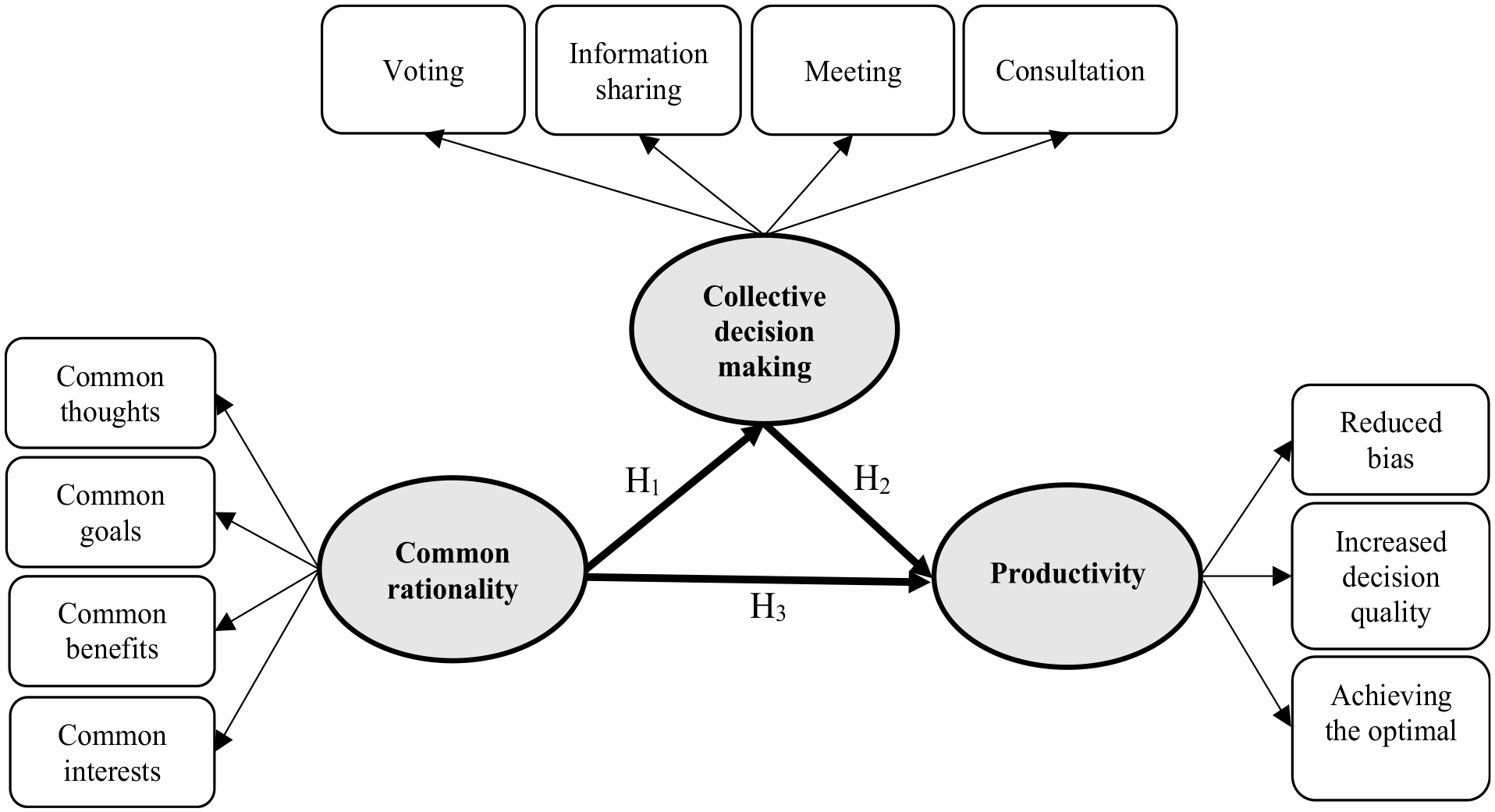
Proposed conceptual model.
In the conceptual model, common rationality includes four indicators (common thoughts, common goals, common benefits, and common interests), collective decision-making includes four indicators (voting, information sharing, meeting, and consultation) and productivity includes three indicators (reduced bias, increased decision quality and achieve the optimal decision).
Based on the proposed conceptual model of the research we have three hypotheses as follows:
H1: Common rationality has a positive and significant influence on collective decision-making.
H2: Collective decision-making has a positive and significant influence on productivity.
H3: Common rationality has a positive and significant influence on productivity.
Research Methodology
The method of this research is descriptive and analytical, and the collecting information method is library sources for the theoretical framework section and the questionnaire method for examining the sample opinions. Individuals are considered part of the statistical community who are familiar with the research subject or have experience in this field. Therefore, due to the specialization of the subject, purposive sampling is performed (A. S. Roy et al., 2023) and the number of samples is determined based on Cochran’s formula (Dana et al., 2022; Song & Wassell, 2003).

n: number of samples
e: desired level of precision, the margin of error
p: the fraction of the population (as a percentage) that displays the attribute
z: the z-value, extracted from a z-table.
According to Morgan’s table (Krejcie & Morgan, 1970), the questionnaire is distributed among 115 academic and organizational experts and after checking returned questionnaires, 98 of them were filled and appropriate for statistical analysis. The questionnaire is designed with three main components and a total of 11 questions based on the five-step Likert scale, and the score of respondents’ agreements with the question is adjusted from very low to very high. Demographic variables including age, level of education, and gender are considered to be control variables of the study.
Structural equation modeling is used to analyze the data obtained from the questionnaire and examine the relationship between the indicators and constructs and determine the contribution of each of them in the conceptual model. SEM is a comprehensive statistical approach to test hypotheses about the relationships between observed and latent variables. Through this approach, the validity and reliability of theoretical models in specific contexts can be tested (Devika et al., 2020). In many fields of scientific research, SEM has become a standard tool for analyzing complex relationships between variables (Sarstedt et al., 2020).
The purpose of using the SEM method is to check the validity of the indicators and relationships extracted in the content analysis of the theoretical framework and to determine the predictive value of the designed structure (Chegini & Islam, 2021; Nazari et al., 2019; Quaschning et al., 2013). Therefore, the SEM is used to determine the type of relationship between the three constructs of “common rationality”, “collective decision-making” and “productivity” and 11 identified indicators and the validity of the conceptual model of the research.
To assess the reliability of the questionnaire, Cronbach’s alpha method is used, and to assess the validity of the questionnaire, content validity, and convergent validity are used. To check the validity of the content, before distributing the questionnaires, the opinions of some university professors and experts in the field of collective decision-making were received and the necessary corrections were applied to the questionnaire. For a valid questionnaire, the p-value must be less than 0.05, and the T-value must be greater than 1.96 (Hair et al., 2013; Karimi & Emami, 2022).
The R2 criterion is also used, which expresses the coefficient of determination shows the explanatory power of the model and explains the accuracy of the prediction of dependent variables by independent variables. Another criterion used in data analysis is factor loading. Factor loading determines the intensity of the relationship between a latent variable and the corresponding observed variables during the path analysis process, which should be above 0.4 in the optimal case (Kiani et al., 2020; Sarstedt et al., 2021).
Another important criterion is the overall model fit, which includes two parts: the measurement model and the structure. The goodness-of-fit (GOF) criterion is used to evaluate the overall model fit (Abri et al., 2022; Sarstedt et al., 2021).

The value
Results
Excel, SPSS, and Smart PLS 2.0 were used for data analysis. Using Smart PLS 2.0, the conceptual model of research is analyzed, which is shown in Figure 2.

Path coefficient of the model.
As shown in Figure 2, common rationality is considered an independent variable, productivity is a dependent variable, and collective decision-making is a mediating variable. Evaluation criteria can be used to determine whether the designed model is supported by the collected data. If the model is not approved by the fit criteria, it must be modified. The obtained criteria for fitting the conceptual model are shown in Table 1.
Conceptual Model Evaluation Criteria.

According to the values shown in Figure 2 and Table 1, the p-value for the relationships between the variables “common rationality → collective decision-making” and “collective decision-making → productivity” is less than .05 and the T-value is more than 1.96 and these values show that the relationship between these variables is significant at the error level of .05. However, the p-value for the relationships between the “common rationality → productivity” variables is more than 0.05 and the T-value is less than 1.96. Therefore, the relationship between the variables of common rationality and productivity is not significant.
Also, the regression coefficient between the variables “common rationality → collective decision-making” is 0.700, and between the variables, “collective decision-making → productivity” is 0.668, which shows a positive and direct relationship between these variables. However the regression coefficient between the variables “common rationality → productivity” is 0.056, which indicates a weak relationship between these two variables. Therefore, it can be said that common rationality is only through collective decision-making that can lead to increased productivity and directly plays a small and negligible role.
For the two variables of “collective decision making” and “common rationality,” the R2 criterion has two values of .490 and .502, which indicates the relatively good predictive accuracy of these two mediating and dependent variables. In the following, factor loading is used to measure the relationship between observed variables and latent variables in the model. Factor loading of research model indices is given in Table 2.
Factor Loading of Model Indices.

As explained, the values shown in Table 2 represent the factor loading between the observed variables and latent variables and variables with a factor loading of less than 0.4 should be removed from the model. In the performed calculations, the factor load of all indicators is greater than 0.4, so all indicators are valid and none of them are removed from the model.
To measure the reliability and validity of the questionnaire, Cronbach’s alpha coefficient, Composite Reliability coefficient, and Average Variance Extracted (AVE) are used and the obtained values are shown in Table 3.
Reliability and Validity Coefficients of Model Variables.

Based on the results of Table 3, the Average Variance Extracted (AVE) is used to measure convergent validity and is acceptable when it is higher than 0.5. Given that the (AVE) for all three variables is higher than 0.5, therefore the validity of the questionnaire is acceptable. The questionnaire has appropriate reliability when Cronbach’s alpha coefficient and composite reliability coefficient are greater than .7. According to Table 3, all values are greater than 0.7, so the reliability of the questionnaire is acceptable. Another important criterion in the predictive power of the model is Q2. The values obtained in the Q2 column are higher than 0.3, which indicates a good fit for the model prediction.
To obtain the overall model fit, the goodness-of-fit (GOF) criterion is used the resulting value of which is 0.555. Because the obtained value is higher than 0.36, the overall model fit is appropriate (Abri et al., 2022; Sarstedt et al., 2021).

Also, to measure the robustness of questionnaire results, reliability is used in a parallel way, which checks the reliability and heteroskedasticity of variance. Measurement errors and heteroskedasticity between two equivalent forms of the test reduce reliability (Webb et al., 2006).
Based on the results of Table 4, the internal correlation of the questions is .333, so the correlation of the endogenous variables is between .2 and .4, and the endogenous correlation of the questions is acceptable. The reliability of the questionnaire and the unbiased reliability of the questionnaire are 0.846 and 0.851, respectively. Both reliabilities are greater than 0.7, so the reliability of the questionnaire is suitable.
Reliability Coefficients of the Questionnaire.

Discussion
This study investigated how employee participation in decision-making can be used to increase productivity. According to the explanations provided, using common rationality between employees and managers as an important organizational asset is critical for reaching participation (Rogers, 2006; Rusu, 2013). Common rationality is characterized by indicators such as common thoughts, common goals, common benefits, and common interests. As shown in Figure 2, we observe that the direct pass from common rationality to productivity has a very low path coefficient (0.056), but the indirect pass-through collective decision-making has higher pass coefficients (0.7 and 0.668). These values show that although common rationality is a significant asset for an organization if a manager wants to use it to reach productivity, they should apply it through collective decision-making.
Indeed, collective decision-making plays a remarkable mediator role between common rationality and productivity. So, if managers want to use their organizational common rationality to increase productivity, they should not ignore collective decision-making. Because collective decision-making helps to use the capacity of common rationality to increase productivity (Hung et al., 2006). According to Dionne et al. (2019) and Mann (2018), collective decision-making is one of the most important parameters in increasing productivity. Because collective decision-making can increase employee motivation, which is known to be the most important factor in increasing productivity (Al-Abbadi & Agyekum-Mensah, 2022).
Therefore, the more employees participate in decision-making, the better; because it increases their learning (Kidambi & Crosson, 2023) and thus increases the motivation and better performance of employees and leads to greater productivity (Skaggs, 1985; Tian & Zhai, 2019). Also, Collective decision-making leads to reducing the bias of decisions through collective wisdom and helps to quality upsizing of decisions and reaching an optimal decision (Jordão et al., 2020).
Collective decision-making has many positive effects on the performance of managers and employees that justify its usage and supports the claim of the effect of collective decision-making on productivity, such as collective alliance (McHugh et al., 2016), increased comprehensive information (Carbone & Giannoccaro, 2015; Mann, 2018), higher awareness and knowledge (Carbone & Giannoccaro, 2015; Mann, 2018), better motivation (McHugh et al., 2016), increased collective wisdom (Zafeiris et al., 2017), increased employees commitment (Khaluf et al., 2019), higher accuracy of the decision (Bose et al., 2017; Khaluf et al., 2019), increased collective intelligence (McHugh et al., 2016), reduced mistakes (McHugh et al., 2016), and avoiding instability and intractability (Fu et al., 2020).
Also, the findings of the study show that using the capacities of employee participation in practical decisions is an important strategy for the manager (Ohly et al., 2023). Because, employee participation in decision-making strengthens the positive social exchange relationship between the manager and employees and makes employees more active, and they try to play a greater role in the implementation of the decisions that have been made (Liu & Yin, 2023).
Collective decision-making has two important advantages over individual decisions that provide the basis for increased productivity: synergy and shared information. Synergy is the idea that the whole is greater than the sum of its parts. When a group makes a decision collectively, its judgment can be more accurate than the judgment of its members. Through discussion, questioning, and collaboration, group members can identify more complete and robust solutions and recommendations (Akram et al., 2023). Also, collective decision-making promotes information sharing and can increase job satisfaction and commitment to organizational decisions, all of which can lead to beneficial outcomes such as increased productivity (Hung et al., 2006; Vanderslice et al., 1987).
Looking at indicators of latent variables in this study is important. Common rationality, collective decision-making, and productivity are three latent variables and each of them has some indicators that measure them. In this study, we used four indicators for common rationality in the group, including common thoughts (Liang et al., 2021), common goals (Tongo, 2015), common benefits (Ekwoaba et al., 2019), and common interests (Elster, 2021). Collective decision-making can be measured through several indicators including voting (Y. Xu, 2019), information sharing (Dionne et al., 2019), meetings (Bui, 1987), and consultation (Iaryczower et al., 2018). To measure productivity in an organization, indicators of reduced bias (Dionne et al., 2019), increased decision quality (Khaluf et al., 2019), and achieved optimal decisions (Hong et al., 2022) were used. All factor loadings of indicators are at an appropriate level showing their appropriateness for measuring the three latent variables.
This article has tried to show the relationship between these constructs and can create an incentive for managers to go for collective decision-making as a method for utilizing the common rationality of the organization to achieve greater productivity. Analysis of structures shows that from the three hypotheses of this study, H1 and H2 are confirmed but H3 is rejected. H1 and H2 show the indirect pass from common rationality to productivity through collective decision-making as a mediator and emphasis on the significance of participation among the group. However, H3 is the direct influence of common rationality on productivity and is rejected due to ignorance of collective decision-making. Some studies such as (Dionne et al., 2019; Hertz et al., 2016) confirm our findings regarding the impact of collective decision-making on productivity.
This study can contribute a lot to the research field of managers’ decision-making and productivity. For this, we presented a comprehensive conceptual model to show the way to achieve greater productivity through collective decision-making. Achieving greater productivity by involving employees in decision-making is an effective method and will have far lower costs than other methods of increasing productivity, such as increasing wages, closing long-term contracts, and providing more welfare facilities. The results of this study are subject to the following limitations.
First of all, the time limit made the data to be collected only one period of time. While it is possible to experimentally measure the impact of collective decision-making on increasing productivity in different periods. The second limitation is about understanding the concept of collective decision-making. In some cases, the concept of collective decision-making is not well understood among managers, and this misconception may make them fall for a cognitive bias.
Conclusion
One of the goals that managers and employees of organizations pursue is productivity because it leads to the success of the organization. This article examines the effects of common rationality as an important organizational capital on productivity through collective decision-making. The relationships between these constructs are investigated with the SEM using a questionnaire gathered from 98 organizational experts.
According to the results, the relationships between common rationality and collective decision-making, as well as collective decision-making and productivity are significant, but the direct relationship between common rationality and productivity is not significant. This is a remarkable result of this study and it shows that having common rationality as an asset for an organization is not adequate for higher productivity and success. This valuable asset should be applied through collective decision-making. In other words, if common rationality doesn’t trigger collective decision-making to produce higher levels of participation of employees in decisions, the asset would be useless and couldn’t increase productivity.
Having the two research hypotheses confirmed and one of them rejected, it can be said that this research has presented the factors affecting collective decision-making and its consequences by examining the theoretical foundations and surveying experts’ opinions. In this model, common rationality affects productivity through the mediating variable of collective decision-making. Therefore, although common rationality is a significant asset for an organization, a manager who wants to use it to increase productivity must activate this asset through collective decision-making.
Using collective decision-making as a managerial attitude is a suitable tool to increase productivity and advance organizations toward their goals. The research in this area could be extended in future studies to investigate its other dimensions. The following three suggestions are presented for future studies. First, a cross-cultural analysis of the acceptance or rejection of collective decision-making methodology among managers in different societies could be studied. Second, researchers could carry out further research on barriers to collective decision-making such as individual bias. Third, researchers could carry out further research on moderating variables that influence collective decision making such as gender, age, and experience of managers.
Footnotes
Appendix

| Questionnaire of the collective decision-making | ||||||
|---|---|---|---|---|---|---|
| Questions | Strongly agree | Agree | Uncertain/not applicable | Disagree | Strongly disagree | |
| 1. | I seem to have close thoughts with other collective members on various issues. | □ | □ | □ | □ | □ |
| 2. | Most of the time, I feel that my goals in various issues are common with the goals of other collective members. | □ | □ | □ | □ | □ |
| 3. | All members share in the failure or success of the collective. | □ | □ | □ | □ | □ |
| 4. | I feel that the other members also like many things that I like. | □ | □ | □ | □ | □ |
| 5. | So far, voting has been done many times to make a decision. | □ | □ | □ | □ | □ |
| 6. | We talk about various issues and problems that arise (Information exchange). | □ | □ | □ | □ | □ |
| 7. | If an important issue arises, a meeting is held with the other members (in-person meeting or virtual). | □ | □ | □ | □ | □ |
| 8. | Usually, no important decision is made without consulting others. | □ | □ | □ | □ | □ |
| 9. | I think that because of the different viewpoints that exist in the collective, prejudice and mental mistakes in judgments will decrease. | □ | □ | □ | □ | □ |
| 10. | In collective decision-making, more decision aspects are considered (the decision becomes richer). | □ | □ | □ | □ | □ |
| 11. | It is more likely to reach the best decision in a collective. | □ | □ | □ | □ | □ |
Declaration of Conflicting Interests
The author(s) declared no potential conflicts of interest with respect to the research, authorship, and/or publication of this article.
Funding
The author(s) received no financial support for the research, authorship, and/or publication of this article.

Data Availability Statement
Data sharing not applicable to this article as no datasets were generated or analyzed during the current study.