




Abstract
Throughout the past decade, evaluating teachers’ success has become a crucial issue due to the increased motivation on teacher accountability. In view of that the purpose of the present study is to determine EFL (English as a foreign language) teachers’ success in the Iranian institutional context based on students’ perspectives. More specifically, the present study surveyed any significant correlation between teachers’ practices of continuing professional development (CPD) strategies and teachers’ success. For this purpose, a CPD model was suggested and verified using partial least squares structural equation modeling (PLS-SEM), to examine CPD factors contributing to EFL teachers’ success. A total of 316 English-major institutional teachers in Iran completed the CPD questionnaire. Besides, about 30% of their students, 828 students, are asked to fill in teachers’ success questionnaire, which intended to check students’ opinions on how successful they measured their teachers in teaching. Findings specified that practice of CPD strategies had a strong direct predicting power on EFL teachers’ success. It was illustrated that “updating” construct strongly affects both “collaborating” and “reflecting.” Moreover, “reflecting” moderately influence “collaborating” and “collaborating” intensely affects “decision making.” The results, specifically, highlight the fact that one to be a successful teacher in the field of EFL should be a good decision maker in the field too.
Keywords
Introduction
Measures of teachers’ success have become a key research and policy issue as a result of the increased focus on teacher accountability during the past decade (Kane & Cantrell, 2010). Moreover, growing concerns about the variability in the quality of teaching and knowledge expansion led researchers to study for more rigorous measures of teachers’ success (Duta & Rafaila, 2014). Besides, providing an efficient means of supporting and retaining teachers is crucial to creating a quality learning environment for learners and a helpful work atmosphere for teachers (C. Smith, Hofer, Gillespie, Solomon, & Rowe, 2003). Moreover, policy makers gradually focused on enlightening the educational system through the application of school accountability measures that focused on teacher qualifications (Lau, 2004).
Thus, one of the pedagogical expectations in the educational setting is that teachers, to be successful, should be highly qualified. Research displayed the influence that effective and qualified teachers had on learners’ learning (Berry, Hoke, & Hirsh, 2004; Besharati & Mazdayasna, 2017; Lau, 2004). Therefore, teachers need intense, high-quality professional development to advance their instructional capability and that of the schools’ (Miles, Odden, Fermanich, & Archibald, 2004). Accordingly, “If teachers feel better about themselves, they will feel better about their learners; so their learners feel better about their teachers” (Bolitho, 2016).
Teachers’ success in the second or foreign language is the theme that describes different constructs relating to whatever makes a teacher move toward improvement, which could be considered as an individual difference variable that has been recently studied by many researchers (Guskey, 2002; Malik Omar, 2016; Seyf, 2008). Accordingly, during the past decade, an increasing number of studies critically examined the traditional views of second/foreign language teacher education and discussed the need for a reconceptualization of the field (Freeman & Johnson, 1998; Freeman & Richards, 1996; Richards & Nunan, 1990; Schulz, 2000). The field has pointed the need to create criteria for the content of language teacher education with the aim of developing new possibilities and effective teacher educational models (Guntermann, 1993), which has been one of the most important concern of educators, teachers, and trainers.
To this aim, teachers are supposed to be knowledgeable enough to effectively assist their learners in achieving their goals, and to help the school run efficiently, which required schools’ and policy makers’ constant support to continuing learning, consistent with teacher continuing professional development (CPD).
There has been a growing harmony in the literature concerning the features of effective professional development for teachers. In a simple term, CPD can be defined as ongoing learning programs and approaches through which teachers advance their teaching skills to ensure them to remain competent (Speck & Knipe, 2005). It is also referred to a “results-driven, standards-based” package that is “embedded in the teachers’ daily work” (Sparks & Bransford, cited in Jackson & Davis, 2000, p. 110). CPD concerns with the concept of “reflective practice” which centers around the notion of reflection on what a teacher is performing, as a critical part of one’s improvement process (Diaz-Maggioli, 2004). Moreover, Diaz-Maggioli (2004) stated that CPD programs provide teachers with the time and materials to reflect together on teaching methods, and help them to share their teaching experiences, and as a result, teaching will be effectively happened and developments take place.
It is also defined by Lambert (2003) as “learning opportunities that can be found in collegial conversations, coaching episodes, shared decision-making groups, reflective journals, parent forums, or other such occasions” (p.22).
A need for classroom instruction and learning-based practice seems to be crucial in nonnative English or foreign language setting, which consequently, make it a pressing concern to improve the quality of teachers through professional development. Accordingly, as Riazi (2005) states, different private and language institutions provide their learners with different levels of English teaching, however, not many of these language schools have been successful in meeting teachers and students’ needs to learn English communicatively (Talebinezhad & SadeghiBeniss, 2005). In this regard, Leather and Motallebzadeh (2015) in a study investigating the current teacher training programs at private schools in Iran, claims that the “major principles underlying such programs are based on the EFL teachers’ and teacher trainers’ preferences,” and such curriculums highlight the improvement of good EFL (English as a foreign language) teachers. He also maintains that teacher training programs have little room for students’ or trainees’ needs and follow a trainer centered mode.
Very recently, in a study of the effect of instructional leadership practice on teachers’ reflective practices using partial least squares structural equation modeling (PLS-SEM), Amzat (2017) reported that providing motivations for teaching and learning by a principal had a strong effect on teachers’ awareness of their students’ background, hobbies, interest, and so on.
Some empirical studies investigated the paths that link CPD, teachers’ knowledge, and teaching practice (Banilower, Heck, & Weiss, 2007; Garet, Porter, Desimore, Birman, & Yoon, 2001; Heck, Banilower, Weiss, & Rosenberg, 2008). Using path analysis (Garet et al., 2001) showed that main features of the Professional Development Program such as content focus, and active learning had a significant relationship with teachers’ knowledge and skills. Using a structural equation model (Banilower et al., 2007; Heck et al., 2008) also found that teachers’ approaches in standards-based teaching are significant in the relationship between CPD and investigative teaching practice.
Moreover, in a study of investigating the relationship between teachers’ knowledge of subject matter (mathematics) and their pedagogical content knowledge and their learning needs within a CPD program using SmartPLS, Tajudin, Chinnappan, and Saad (2017) stated that the results of path analysis showed the direct effect of subject matter on CPD, mediating by pedagogical content knowledge.
To sum up, professional development of teachers is shown in the relevant literature in various ways. However, almost always main point of such studies is the understanding that professional development is about teachers learning, learning how to learn, and transforming their knowledge into practice for the benefit of their students’ growth (Avalos, 2011). Therefore, as few models in EFL settings using PLS-SEM has addressed a blended model of CPD and teachers’ success, the purpose of the present study is validation of a practical model for EFL teachers’ success in accordance with CPD programs to provide a guide for teachers’ success, and administrators who wish to conduct and implement teacher professional development programs. The model has four constructs for CPD and their variables together with the seven constructs for teachers’ success and their variables proposed; which form the basis for the theoretical framework for the current study together with the hypothesized model.
Gathering data based on teachers CPD programs provides valuable information for future needed educational packages which help in reforming curriculum for major development. Consequently, the study addressed the following research question:
Proposed Model
To examine any significant relationship between the designated variables (i.e., Teachers’ success and CPD), a structural model is suggested. For model specification, the researchers hypothesized a path from “updating” construct to “reflecting” construct of CPD, which is in accordance with Gong (2008) and Jiang (2016) who stated that teachers’ knowledge and their ongoing experiences, directly affect on decision and reflection that they make in a diverse educational setting. Learning new skills and knowledge can help teachers to be reflective teachers in their teaching practice. Accordingly, Mok (1994) considered teachers’ ways of understanding and how they progressed through reflective practice. The results displayed that teachers’ reflections and their ways of knowing were shaped by several factors, such as theory, practice, background knowledge, and interactions.
Teachers’ sense of collaboration is one of the important skills that can be motivated by experiencing new knowledge and technology. In this regard, learning is described as a social collaboration (Dooly & Sadler, 2013; Tanghe & Pask, 2016). Moreover, it is stated that teachers and students success that greatly depend on needs are not something which changes as fashions come and go; rather, it is continuing and an acceptable process of building collaboration (Darling-Hammond & Ball, 1997; Elmore, 2002). In addition, learning processes, design, collaboration, and research are among the standards which are effective for the development (DuFour & Eaker, 1998; Stein, 1998). Therefore, another path from “updating” construct to “collaborating” construct is nominated by the researchers.
Besides, McKay (2005) declared that reflective teaching supports teachers in dealing with different educational settings and helps them to collaborate with each other and assess their knowledge to discover solutions that work well in their teaching environment.
Literature in the area of teacher decision making has asserted that educated teachers make fairly different decisions from the way inexperienced teachers do (Breen, Hird, Milton, Oliver, & Thwaite, 2001; Nunan, 1992). Rosenholtz (1989), and Louis (1998) stated that teachers’ professional development is facilitated by the level of collaboration and teachers’ decision making which is in accordance with Farkas, Johnson, Foleno, Duffett, and Foley (2000) and T. Smith and Rowley (2005). In view of that “collaborating” construct was connected to “decision making.” Moreover, research showed that teachers know they should work collaboratively (Loucks-Horsley, Hewson, Love, & Stiles, 1998; National Commission on Teaching and America’s Future, 1996; Wenger, 2001) and know that “communities of practice,” which involve working closely with groups of people who share a concern or need can lead them to better teaching (Wenger, 1998, 2001; Wenger, McDermott, & Snyder, 2002).
Finally, the researcher theorizes a path from “decision making” to “teachers’ success,” according to Sarafidou and Chatziioannidis (2013) who asserted that more participation of teachers in decisions, regarding teacher issues, was connected to teachers’ insights of better leadership in schools, and act as the strongest predictor of both teachers’ sense of success and job satisfaction. In addition, Seyf (2008) indicates being a successful teacher requires having the ability to decide how to manage the class and having the necessary knowledge on manipulating the appropriate teaching methodologies. Moreover, Ghaith and Shaaban (1999) stated that how successfully the teachers behave and the methodologies they use in their teaching depend highly on their ideology, their vision and mission.
The postulated model is presented in Figure 1. Circles represented latent variables, while the rectangles are indicators of the hypothesized model. It means that, for example, latent variable “decision making” has three indicators (survey item numbers = 12, 13, 16).

CPD and teachers’ success model.
Method
Study Design
The purpose of this study was to examine teacher opinions on the extent to which professional development they received during the last 2 years contributed to their own success and positively affected their classroom practices. To place the puzzle pieces of four constructs of CPD and their connection with how successful, students evaluate their teachers, this study involved the analysis of quantitative and qualitative data from two researcher-made questionnaires and open-ended questions based on an ex post facto design. Mixed method research undertaking in this study was done concurrently with a focus on quantitative side, because just a few of participants were taking part in answering open-ended questions.
In case of teachers, purposeful sampling was used, that is, just EFL institutional teachers were selected. Also student participants who fill out the “teachers’ success” questionnaire were selected randomly from among each teacher’s class.
Data from the interviews and written comments were meant to support the study’s data, to pursue in-depth information around a topic, and to allow respondents to elaborate more reflectively on professional development programs and needs in general.
Participants and Setting
A total number of 316 Iranian EFL teachers participated in this study, including 125 males (39.6%) and 191 females (60.4%). Of these teachers, 17% stated that their participation in CPD programs was compulsory, 35% voluntarily, and 48% both, depends on the situation. All the participants had university education (associated degree [AA] 4%, bachelor 33%, master 50%, or PhD degree 13%). The most participation of teachers was from Mashhad by 44% participation, 31% were living in Tehran, and the other 25% were from other cities such as Bandar Abas, Yazd, and Esfahan. Moreover, Table 1 represents other demographic information of the teachers.
Demographic Profile of Respondents (Teachers).

Note. TEFL = teaching English as a foreign language.
Furthermore, about 30% of each EFL teacher’s students were randomly and voluntarily asked to fill out the “teacher’s success” questionnaire. A total number of 828 Iranian students studied English in different language institutions of Iran participated in this study to provide us with their perspectives on their teachers’ success. They were 375 males (45%) and 453 females (55%) and from different age groups ranged below 20 to above 40, the mean age was 19 (SD = 0.9; Table 2).
Demographic Profile of Respondents (Students).

Instrumentation 1
CPD Questionnaire
In this study, a CPD model concerning four main constructs was proposed by the researchers, which accordingly the researcher-made CPD questionnaire was designed to find out the extent of teachers’ experience and knowledge about CPD. The validity of the questionnaire was checked by several ELT (English language teaching) experts.
The questionnaire measures reflecting strategies (three items such as “formal peer observation and coaching”), collaborating strategies (seven items such as “share new teaching ideas and learning experiences with colleagues”), updating strategies (seven items such as “qualification program in EFL such as a degree program”), and decision-making strategies (three items such as “attend staff meetings to discuss the vision and mission of the school/institute”). Factor analysis was used to organize items. A 5-point Likert-type scale from no impact to a large impact was applied to rate the items. Reliability of the questionnaire was 0.9, using Cronbach’s α.
Teachers’ Success Questionnaire
Teachers’ success questionnaire was used to investigate students’ perspectives on a successful teacher. It is a 40-item survey, which consisted of different principles for evaluating teachers’ success on a variety of constructs, namely, (a) ELT competencies (including six items such as “the teacher communicates the subject matter clearly in front of the students”), (b) teachers’ delivery of instruction/goals and accountability (consists of 11 items such as “the teacher selects proper teaching aids beforehand”), (c) interpersonal relationships with students and colleagues (includes three items such as “the teacher creates a positive environment for student learning and involvement”), (d) examination/evaluation (includes five items such as “the teacher uses the scores as one of the major sources to check students’ understanding”), (e) class attendance, management, and commitment (consists of four items such as “she or he always tries to be punctual”), (f) attitude, motivation, and confidence (consists of eight items such as “she or he controls the class confidently and has enough self-confidence and autonomy”), and (g) teacher’s self-awareness (consists of three items such as “the teacher has complete knowledge of individual differences”). Factor analysis was used to classify each construct’s items. Each item is rated on a 5-point Likert-type scale from never to always. This questionnaire was designed in Persian to make it easier for students to respond and, consequently, to increase the return rate. It took about 5 min to be completed. Cronbach’s α analysis was conducted and an acceptable value of .86 was shown. Moreover, its validity was confirmed through the Rasch model using WinSteps 3.73 (Tabatabaee Yazdi, Motallebzadeh, Ashraf, & Baghaei, 2018). Table 3 illustrates the Cronbach’s α internal consistency reliability coefficient of the scales.
Internal Reliability of the Scales, Cronbach’s Alpha Coefficients (α).
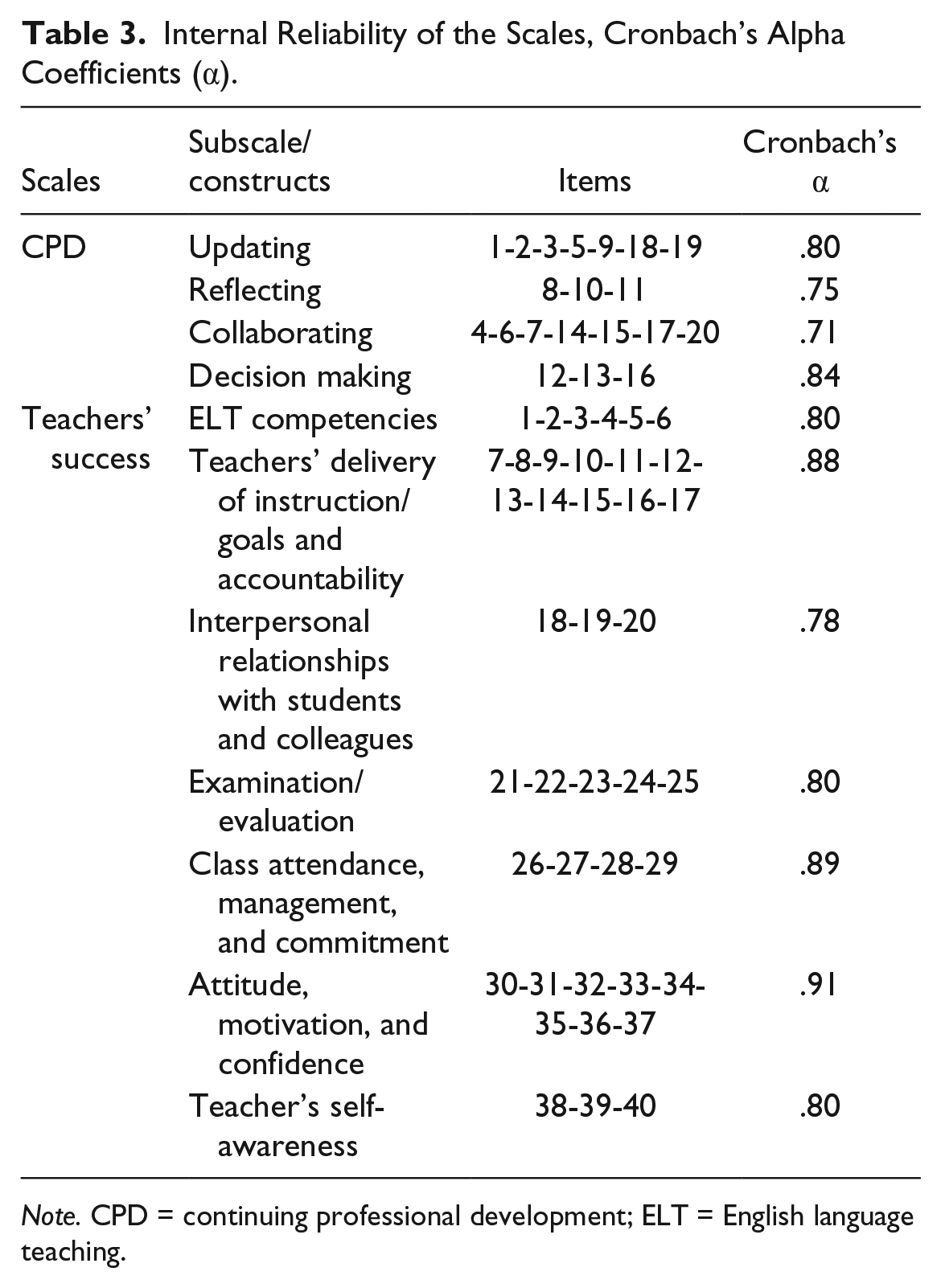
Note. CPD = continuing professional development; ELT = English language teaching.
Procedure
A total number of 316 Iranian EFL teachers and 828 students were voluntarily asked to participate in this study to discover any significant relationship between students’ perspectives of teachers’ success and the amount of impact teachers receive by participating CPD programs. Each teacher then receives the average mean of his or her students’ ideas on each statement. Moreover, the teachers were asked to mention (written or in oral form) any other ideas regarding CPD programs in Iran. Only 11 teachers (four oral and seven written) participated in this part of the study.
About 90% of the survey was done in a paper-based format because generally, a 30% response rate for web-based surveys is expected (Saunders, Lewis, & Thornhill, 1997). Furthermore, pairing received questionnaires of teachers and students through Google Drive was not easy. Therefore, researchers decided to conduct the survey mostly in a paper-based format.
Data Analysis
Quantitative Analysis
Once the data was obtained, it was then entered into SPSS 16, then various statistics for the data were calculated and summarized using descriptive statistics techniques. To confirm the model, PLS-SEM which is a structural equation modeling (SEM), and used as an exploratory technique, was used. The software is used by the researchers as an alternative to SEM, as it works efficiently with a large number of indicators and variables (Lowry & Gaskin, 2014), small sample sizes and complex models that contain latent variables, series of effects, and multiple group comparisons of these more complex relationships (Hair, Hult, Ringle, & Sarstedt, 2014; Lowry & Gaskin, 2014; Rezaei, 2015; Rezaei & Ghodsi, 2014; Shahijan, Rezaei, Preece, & Ismail, 2014; Vinzi, Trinchera, & Amato, 2010). Moreover, it is more fitting where there is not much conceptual theory. It is largely used to develop models in exploratory research (Ravand & Baghaei, 2016; Rönkkö & Evermann, 2013).
The first phase in assessing SEM is validating the model by analyzing the measurement models (Baghaei & Tabatabaee Yazdi, 2016). To this aim, the loadings of the latent variables’ items, the composite reliability score, the average variance extracted (AVE) and the discriminant validity should be measured (Ringle, Sarstedt, & Schlittgen, 2010).
All variables of this study were considered as explanatory variables (Figure 1). After bootstrapping analysis, the study considered just indicators, latent variables, and paths that reached the significance level of .05. Bootstrapping measures the distribution of sample by the use of random sampling methods (Varian, 2005). PLS-SEM does not assume the data as normally distributed data, which is parametric significance tests cannot be applied to test whether coefficients such as outer weights, outer loadings, and path coefficients are significant. As an alternative, PLS-SEM runs a nonparametric bootstrap procedure (Davison & Hinkley, 1997) to test the significance of probable path coefficients in models.
Results
The study’s model assessed the correlation among CPD programs (within four constructs of “updating activities,” “reflective activities,” “decision-making activities,” and “collaborative activities”) and teachers’ success by performing the PLS-SEM approach using SmartPLS (3.2.4) software.
Measurement Model
Reliability and validity of the proposed model were evaluated and established by the researchers before starting to analyze the structural model of the study. Next, the impacts evaluate the reflective measurement model, outer loadings, composite reliability, AVE, and discriminant validity were calculated. The evaluation standards for the model are demonstrated via Tables 4 and 5 and Figure 2.
Total Effects.

Criteria for the Evaluation of the Models (Reliability and Validity).

Note. Loadings between 0.4 and 0.7 are acceptable; <0.7 is high. Composite reliability should be 0.7 or higher. R2 of .75 is substantial, 0.50 is moderate, and 0.25 is weak. AVE should be 0.5 or higher. AVE = average variance extracted.
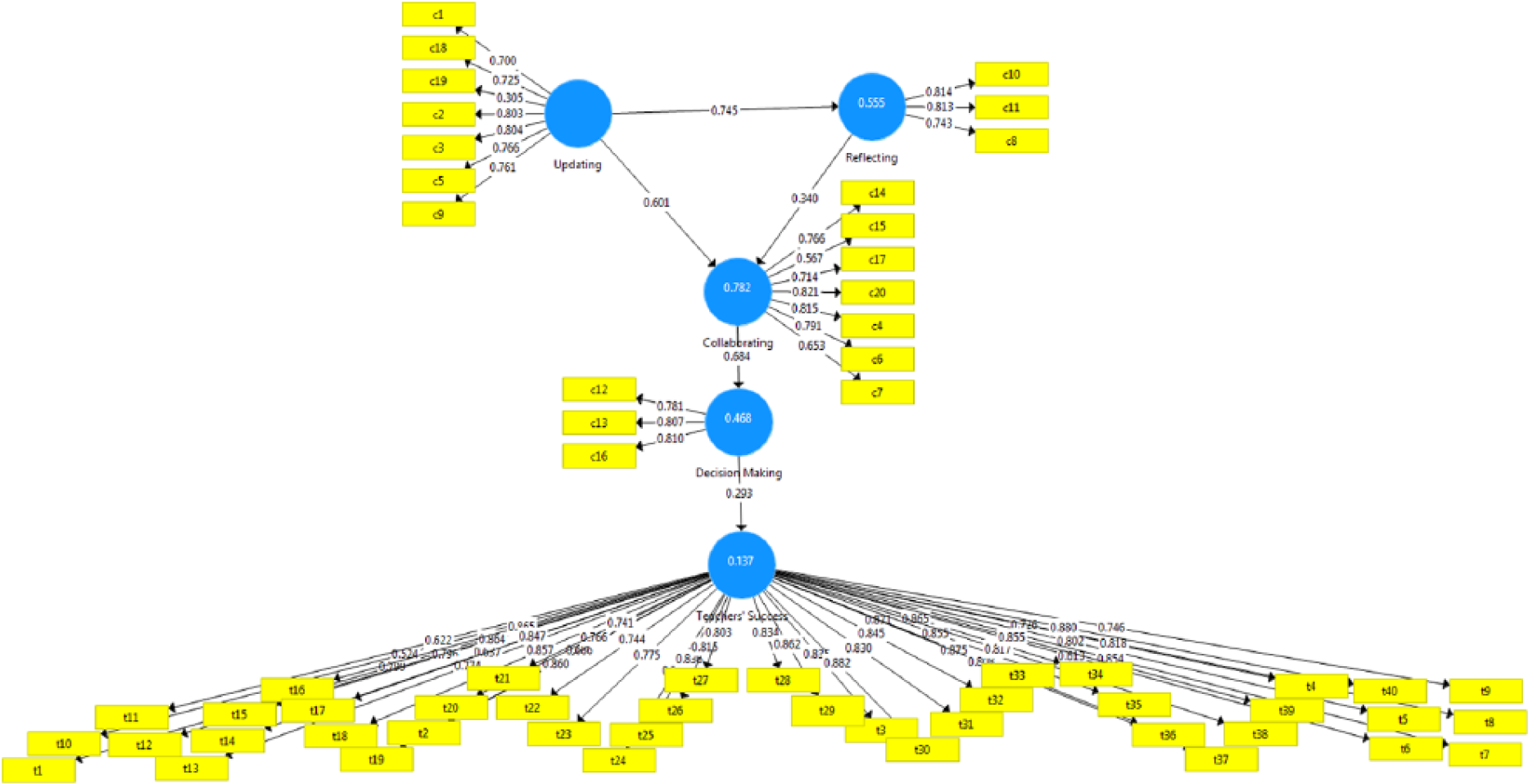
Items loading, path coefficient and R2.
Latent variables’ outer loadings examination specifies that loadings are between 0.61 and 0.88. Although, because removing indicators below 0.7 does not increase overall reliability, they were not deleted from the model. Moreover, as Table 5 illustrated, composite reliability scores and the AVE points out a good reliability and validity for the model.
As a final point for assessing the measurement model, Table 6 presented the discriminant validity based on Fornell and Larcker (1981) principle. The off-diagonal values in the matrix in Table 6 suggest the relationships among the latent variables, which means there is discriminant validity between all the components according to the cross loadings criterion.
Discriminant Validity.

Note. Bold values are loadings for each item which are above the recommended value of 0.5; and an item’s loadings on its own variable are higher than all of its cross loadings with other variables.
Structural Model
When reliability and validity of the construct measurements were confirmed, the structural model was examined to observe the model’s predictive capabilities and the associations among components of the proposed model. The results emphasized that the structural model and all the beta paths are statistically significant (p < .05). Moreover, standardized root mean square residual (SRMR), which is defined as the difference between the observed association and the model implied correlation matrix, was shown to be 0.08 which is considered a good fit. A value less than 0.10 or of 0.08 (Hu & Bentler, 1998) are said to be a good fit. Moreover, Henseler et al. (2014) introduce the SRMR as a goodness of fit measure to avoid model misspecification in PLS-SEM.
Furthermore, normed fit index (NFI) or Bentler and Bonett index was reported 0.854 which is considered as a good fit. NFI or Bentler and Bonett index is one of the first fit measures used in the SEM literature which is proposed by Bentler and Bonett (1980). It computes the chi-square value of the proposed model and compares it against a meaningful yardstick. The NFI values between 0 and 1. The closer the NFI to 1, the better the fit. NFI values above 0.9 usually represent acceptable fit. In addition, all of the indicators’ variance inflation factors (VIFs) were shown to be below 5.0, signifying sufficient construct validity. If any of the indicators scores higher than 10, they should be eliminated from the study (Lowry & Gaskin, 2014).
Finally, the model examined the RMS_theta which is defined as the root mean squared residual covariance matrix of the outer model residuals (Lohmöller, 1989). The RMS_theta weighs the degree to which the outer model residuals show a relationship. RMS_theta values below 0.12 indicate a well-fitting model, whereas higher values indicate a lack of fit (Henseler et al., 2014). RMS_theta values in the current study was shown to be 0.111.
Target Endogenous Variance
As Figure 2 illustrates, numbers within the blue circles (the coefficient of determination, R2) explained how much the variance of each latent variable is being explained by the latent variables. In this study, the coefficient of determination, R2, is .137 for the “teachers’ success” endogenous latent variable which specified that the latent variable “decision making” slightly explains 13% of the variance in “teachers’ success.”
Inner Model Path Coefficient Sizes and Significance
Path coefficients, numbers on the arrows, explained how strong variables effect on each other. Furthermore, the loading of each path coefficients consents the researchers to identify variables’ statistical significance.
The study’s inner model enlightened that “collaborating,” with a loading of 0.684, has an intense impact on “decision making.” Accordingly, “collaborating” received almost moderate impact from “reflecting,” 0.340, and “updating,” 0.601. The inner model also proposed that “updating” has a considerable influence on “reflecting” component. Thus, “teachers’ success” endogenous latent variable was shown to be influenced directly by the “decision making” construct and indirectly by the three other variables.
Therefore, according to the path coefficient sizes and significance, which should be higher than 0.2 (Lowry & Gaskin, 2014; Wong, 2013), the researchers can conclude that the paths among the variables are statistically significant.
Outer Model Loadings
Proposed model in this study demonstrated that all the connections between the latent variable and their indicators are significant except for eight indicators which their loadings are shown to be less than 0.70. Consequently, one of these indicators is removed from the study (No. 19 in “updating” with loading of 0.305), however, the others (No. 7 and 15 in “collaborating” construct, 2, 6, 9, 10, and 14 in “teachers’ success”) are not eliminated from the model, because eliminating them does not change overall reliability.
Looking more closely to the result, it can be cleared that in reflecting construct, indicators 10 (discuss events in my teaching with others to learn from them.) and 11(engaging in informal dialogue with my colleagues on how to improve your teaching.) gained higher loadings than indicator 8 which was concerned with “formal classroom observation.” It could be concluded that teachers feel more improvement in their teaching practice while engaging in one to one or group discussions rather than merely observing a class.
In case of updating construct, the indicators loadings illustrated similar results. It means that teachers received more positive impact by participating in “education conferences and seminars” or “qualification program in EFL such as university programs” rather than “visiting digital communities related to teaching” and “reading professional materials such as journals, books, and thesis.”
This is clearly in agreement with the high loadings of these two constructs on collaborating construct, which highly emphasized on “networking,” “collaborative research on a topic of interest,” and “exchanging teaching materials with colleagues.”
Decision-making construct showed very close loadings regarding its indicators. All its three indicators (“attend staff meetings to discuss the vision and mission of the school/institute,” “discuss and decide on the selection of instructional materials such as textbooks, exercise books, lesson study,” and “work in small groups to come up with a joint solution to a problem”) illustrated high loadings which highlight the importance of decision-making concept in educational settings.
Finally, one-way repeated measure ANOVA was run to analyze and compare the significant differences in teachers’ rating on different components of teachers’ success. The results showed that Iranian EFL teachers’ ratings on different components of teachers’ success significantly differ, Wilks’s Lambda = 0.61, F(6, 310) = 33.69, p < .000, multivariate partial eta squared = 0.97. 2 According to the commonly used guidelines proposed by Cohen (1988), partial eta squared effect size showed a very strong effect. Accordingly, post hoc comparison using Bonferroni test indicated that the mean score of each component is different from the other components significantly (significance = 0.00 < 0.05).
According to mean differences among different constructs of teachers’ success, the results showed that in “class attendance, management, and commitment” construct received the highest rating (M = 4.12, SD = 0.044). Moreover, the lowest score was shown to be for “evaluation” construct (M = 3.83, SD = 0.041; Table 7).
Descriptive Statistics for Teachers’ Success Components.
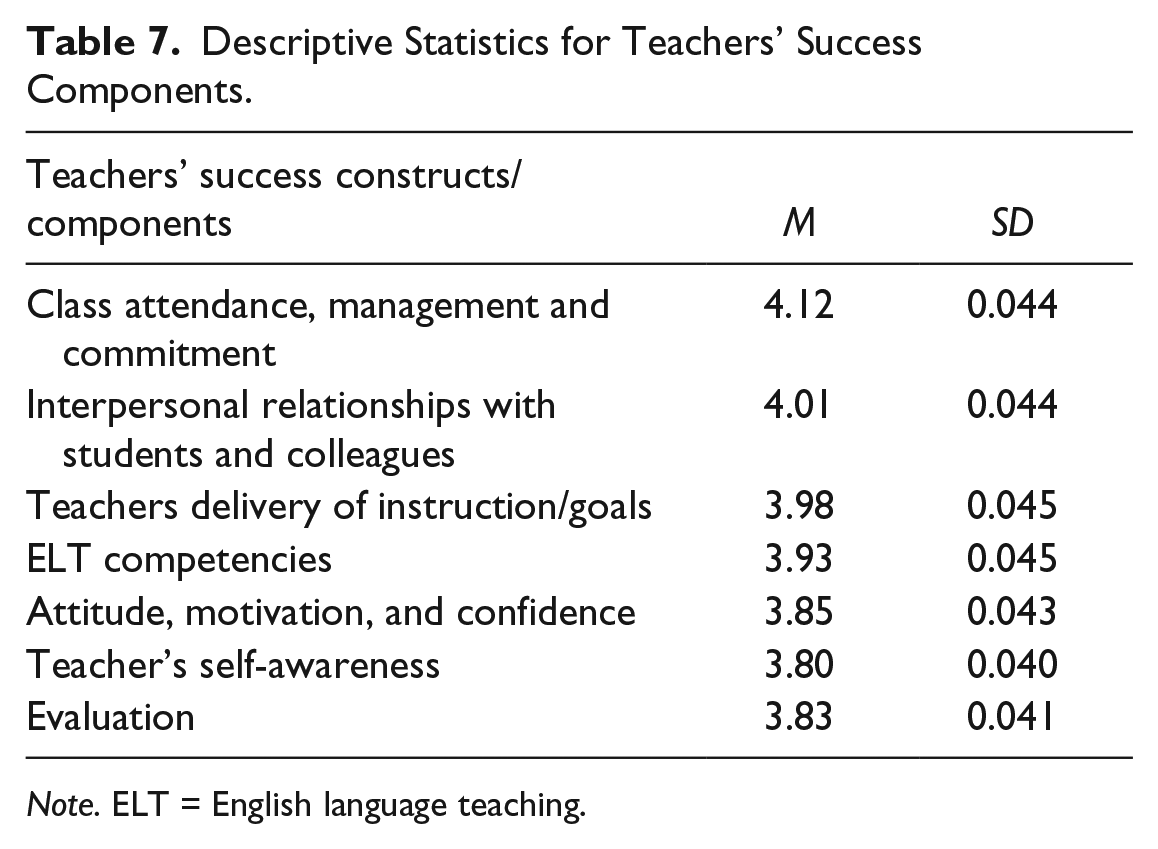
Note. ELT = English language teaching.
In addition, bootstrapping procedure was run to study the significance of the path coefficients of the inner model (“t statistics”). The path coefficients are significant if the t statistics is larger than 1.96 (using a two-tailed t test with a significance level of 5%). In the present study, it can be seen that all the relationships are significant statistically (Table 8).
Bootstrapping Results.
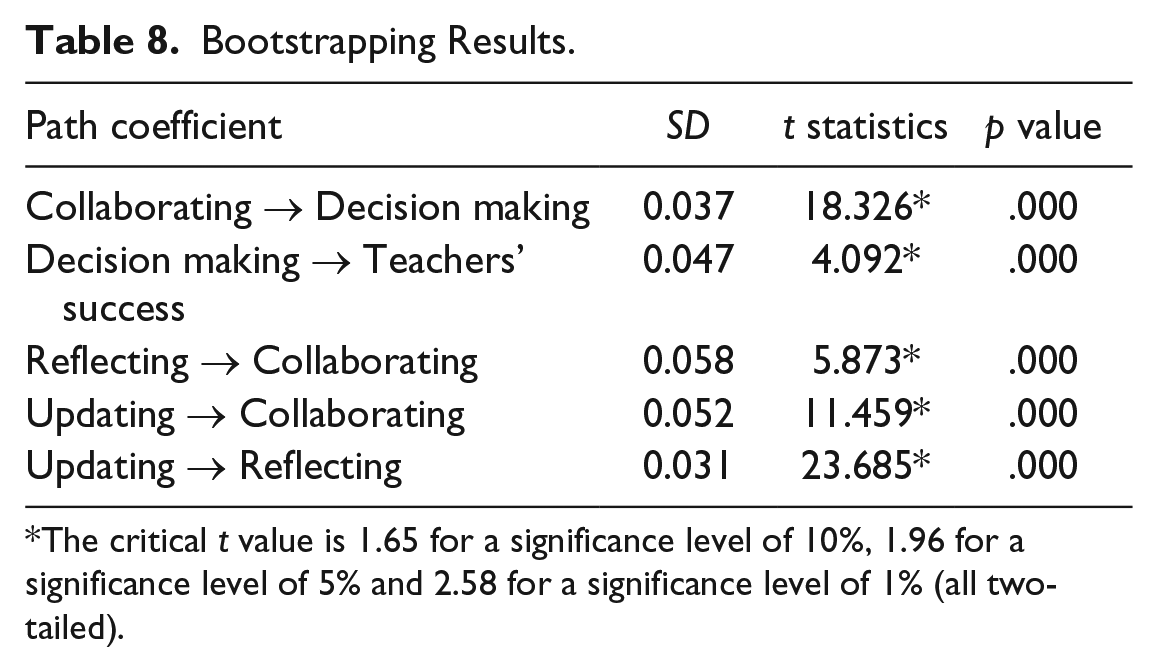
The critical t value is 1.65 for a significance level of 10%, 1.96 for a significance level of 5% and 2.58 for a significance level of 1% (all two-tailed).
The model’s effect size (f2), showed a very small contribution of exogenous latent variable to the endogenous latent variable’s R2 (Table 9). In our model, teachers’ success received an effect size of 0.059, showing a small effect; however, even small effects indicate important model relationships (Chin, Marcolin, & Newsted, 2003).
Effect Sizes of the Structural Model (F Square).

Note. Effect size of 0.02, 0.15, and 0.35 indicates small, medium, and large effect, respectively (Marcoulides & Saunders, 2006).
Qualitative Analysis
At the time of administration of CPD questionnaire, the researchers asked the teachers to mention (written or in oral form) any other ideas regarding CPD programs in Iran. Eleven teachers participated in this part of the study. Their participation was completely voluntarily.
Almost most of the teachers agreed that they will attend a CPD program if that program cares about both new theories and practice at the same time.
A. The important thing for me is that such a program could expose us to novel theories and concept while they are providing us with opportunities to experience them in the real world.
B. These programs are mostly concentrated on repeated concept . . . They are not announced to teachers in appropriate ways (some teachers are not aware that such programs are being held). Some of them suffer from appropriate materials or facilities to run the session.
C. I believe that it’s better to hold these programs online, because of different problems that may teachers encounter these days. Time is an important impeding factor!
D. I have been teaching English for more than 20 years. I am absolutely familiar with these strategies. However, the most important issue is not running and participating in such programs. The important thing is that we are not able to apply most of the things that we get or learn!! Society, culture, beliefs, and facilities are always concepts that make the way/this way/moving toward reformat in our educational setting, difficult.
As it is discussed in the section “Results,” one of the items was removed from the study’s model because of very low loading. This item was related to concept of the “mentoring.” During the administration period, the researchers came to this conclusion that many teachers were not familiar with the concept of the mentoring. This was also one of the facts that one of the teachers pointed in his questionnaire.
E. I think that CPD is started too soon in Iran! Or better to say, Iranian teachers are behind the schedule to follow what may happen in these courses or programs. Many of my TEFL learners cannot differentiate between “mentor” and “supervisor.” Then how can we expect them to experience mentoring?
Two teachers complained about the fees for these courses or programs. Moreover, teachers highly agreed that the courses should not be obligatory. It is also believed that the time of the programs should be suitable enough to participate.
Furthermore, regarding Item 15, which is concentrated on “joint/team teaching,” a teacher stated that “our society and our people suffer from the absence of ‘cooperating-spirited’ people and teachers!”
Discussion
This study is considered to be among the few attempts to explore the relationship of different components of CPD and their impacts on Iranian teachers’ success. In view of that and based on the existing literature, a model was proposed by the researchers and tested by the application of PLS-SEM using SmartPLS. The data has fitted the model greatly, which gains support for the suggested hypothetical model.
Outcomes showed the significance and the degree to which CPD syllabi might influence teachers’ success in educational settings, through decision making, collaborating, reflecting, and updating. It was illustrated that collaborating and updating have the strongest loadings. Collaborating intensely impacts decision making, which reveals that teachers’ decision making is in direct relationship with the extend teachers cooperate with their colleagues. It is in accordance with Breen et al. (2001), who pointed out that educated teachers make fairly different decisions from the way inexpert teachers do. Moreover, McKay (2005) and Farrell (2008) stated that teamwork among teachers positively effects on the way they decide about important issues.
Results also revealed that reflecting moderately influence collaborating, which is in agreement with Hagen, Loughran, and Russell (2006, cited in Yanping & Jie, 2009) and Sharifi and Abdolmanafi Rokni (2014) who believed that reflective teaching can act as stimuli for working together and collaboration. Moreover, Cajkler, Wood, Norton, Pedder, and Xu (2015) stated that CPD courses inspire teachers to create a team and share their knowledge and teaching experiences, and accomplish cooperative tasks. Thus, they can support each other in teaching/learning practices and as a final point create a greater success. Therefore, it is highlighted by the results that taking part in activities, helping other teachers to solve their teaching problems, and team teaching all can be dependent on the extent teachers involve themselves in reflective activities. Besides, according to the qualitative part of the study, one of the participants believed that cooperation is one of the strategies that should be strengthened among Iranian teachers to assists them in their teaching practices as well. Thus, it could be concluded that to be a good decision maker in teaching and educational settings, a teacher requires to be more collaborating and reflecting. These are concerns that should be considered in planning, developing and implementing teacher and teaching curricula.
Furthermore, updating strongly affects both collaborating and reflecting. This means that when teachers learn new things and try to improve their knowledge, they have a tendency to team up with their coworkers and reflect more on their teaching practices. That is, teachers move toward sharing their new knowledge by creating a social professional network and seeking each other’s opinions and advice. This is also in line with Tanghe and Pask (2016), who specified that learning happens through collaborating in social and cultural setting. Accordingly, CPD strategies focus on cooperative activities among teachers (Matoba & Sarkar Arani, 2005). Therefore, it could be concluded that teachers who are eager for taking part in collaborative activities are most likely those teachers who like to learn new things. In this regard, this fact should be taken into account that some new terms are very novel for Iranian teachers. As it is discussed in the section “Results,” some teachers were not aware of the meaning of “lesson study” and “mentoring” or the differences between “mentoring” and “supervising.” Thus, as an updating and reflecting strategy, it is nice to invite teachers to formal or informal meetings to discuss and practice these new topics.
In addition, the study showed that decision making affects teachers’ success variable. Although the weights of this arrow, compared with the weights of other components, is not so big, it is noteworthy and significant. This asserted that contribution of teachers in decisions, regarding teacher and teaching matters, acts as a significant predictor of teachers’ sense of success. This is in line with Sarafidou and Chatziioannidis (2013), McKay (2005), and Farrell (2008). It clearly highlights the point that to be a successful teacher, one should have the ability to decide on important issues and the way to manage the class and teaching practices.
Moreover, some of the participants asserted that for planning and implementing CPD programs and courses, and to determine the applicability of the program, different factors such as need analysis, required material and facilities, an appropriate place for running the courses, and so on, should be taken into account. Accordingly, it is expected that CPD curricula provide teachers with opportunities regarding commitment, participation, and everyday accomplishments.
Regarding the analysis of teachers’ success questionnaire which aimed at investigating students’ viewpoints of their teaching success, the person-item evaluation showed that Items 7, 27, and 33 were the items most likely to be endorsed (i.e., “my teacher has full mastery over the subject she or he is teaching,” “she or he always tries to be punctual,” and “she or he is respectful in students’ point of view”). Alternatively, the least likely to be endorsed items and so those that required being cared more by the teachers were Items 11, 23, 13, and 22 (i.e., “students receive frequent feedback about their performance,” “the teacher tries to relate language forms, functions and vocabulary to contexts relevant to students’ interest,” “the teacher reviews with the students the homework they have prepared,” and “throughout the course, the teacher uses/develops appropriate quizzes and tests to evaluate students’ progress and increase motivation”).
These finding revealed that “class attendance, management, and commitment” is one of the scale’s constructs which is easily endorsed. This means that teachers are really successful regarding indicators related to their management and commitment. However, “examination/evaluation” is the construct which its indicators less likely to be endorsed (Tabatabaee Yazdi et al., 2018).
Finally, it should be noted that like any other research, the current study may suffer from some research biases, which might have different kinds of impacts on measurement and structural models (Schwarz, Rizzuto, Carraher-Wolverton, Roldán, & Barrera-Barrera, 2017). The most important method bias of this study could be the transient mood state of the respondents (students). Transient mood or halo effect are among biases that largely occur in quantitative educational research, where students answer the provided questions emotionally and sympathetically, which can ultimately lead to imprecise assessment of the materials (Utami, Kusuma, Gudono, & Supriyadi, 2017). In this study, the students filled the questionnaires in an area without the presence of their teachers, and they were told that their answers remain confidential and anonymous. Moreover, the students were selected in a complete random order.
Conclusion
The EFL setting of Iran is ethnically, socially, and politically different from other contexts around the world (Safari & Rashidi, 2015). All syllabi and resources are suggested by the Ministry of Education and teachers do not have much choice except working with the prescribed materials. Accordingly, Ahmady, Changiz, Brommels, Gaffney, and Masiello (2009) endorse that these curricula usually suffer from great implications for teachers and students because they do not involve teachers in active empirical learning through reflection, discussion, practical evaluation, and action research. At the same time, there is a need regarding novel and better practical teaching methodologies and concepts for language teachers who, despite any shortcoming and demerits of educational setting, are supposed to regularly update their knowledge and skills.
In view of that and to deal with the changing context of ELT in Iran, the present study aimed at studying any significant effect of the proposed model of CPD strategies on Iranian EFL teachers’ success. A number of implications were highlighted by the results. The most important one was not large but significant impact of teachers’ decision making on the extent they were evaluated as successful teachers by their students. It is confirmed the study’s model which theorized CPD strategies are in relation with making a better decision makers in the field of language teaching. Therefore, it is clearly revealed by the result that one to be a successful teacher in the field of EFL should be a good decision maker in the field too. It is in accordance with Farkas et al. (2000), who commented that teachers teaching practices and commitment are facilitated by the level of collaboration and teachers’ decision making.
It is also highlighted that trying to be up to dated teachers is significantly in relation with the degree teachers collaborate with their colleagues and reflect on their teaching.
The result specifies the fact that for planning any CPD courses, policy makers should care about the strategies and programs which best fit the needs of the teachers. Teachers’ motives in team working and reflection should be considered. Teachers should be provided with an appropriate authentic context and opportunities to practically practice new teaching ideas and methodologies. Moreover, teachers should be encouraged and aid to be better decision makers in the field. Meanwhile, their decision and opinions should be respected and taken into consideration.
Limitation and Future Research Directions
One of the limitations of this study might be the fact that this study was centered on Iranian institutional EFL teachers and students. Future research could validate the instruments within university settings and other contexts to generalize the findings. Moreover, administrators and researchers can consider the results of this research to work on planning and designing any appropriate relevant courses for the proposed model.
Footnotes
Declaration of Conflicting Interests
The author(s) declared no potential conflicts of interest with respect to the research, authorship, and/or publication of this article.
Funding
The author(s) received no financial support for the research, authorship, and/or publication of this article.