




Abstract
Real-time bidding (RTB), which holds bids for advertisers to choose when and where to display their advertisements with desired budgets, is one way to improve effectiveness. We proposed supply side platform (SSP) and demand side platform (DSP) to integrate supplier side and demand side as solution. The proposed method combines two digital technology service, gamified RTB and mobile location-based analysis (LBA). In order to make target customers make interactions actively with the advertisement contents, the idea of gamification is employed to increase customer participation. By the coupons in the gamifying RTB App, it have increased the coupon usage rate of 16.7% and 11.6% in the restaurant and apparel industries. It is a successfully digital transformation marketing service for retail industries. The gamified RTB plays an important role in making old business circles accept new technologies for the renewal of promotion strategies and help find the business directions in the future.
Keywords
Introduction
In terms of gross domestic product (GDP) according to the research from The International Bank for Reconstruction and Development (IBRD) and The International Development Association (IDA), the service sector accounts for 77% in the United States, 72% in Canada, 78% in the United Kingdom, 73% in Germany, and 92% in Hong Kong, making it the world’s leading service provider. Please refer to IBRD Web site (https://data.worldbank.org/indicator/NV.SRV.TOTL.ZS). And the retail industry is the largest industry in the service sector. In addition, information from the Statistics Department in the R.O.C. shows that Taiwan’s department store industry has an annual turnover of more than 200 billion dollars, and the output value of the surrounding shopping areas is nearly 100 billion dollars. Please refer to Statistics Department in the R.O.C. Web site (https://www.moea.gov.tw/Mns/dos/home). However, in recent years, under the influence of the rise of e-commerce showed an overall decline. Strengthening the competitiveness of physical retail stores through digital transformation is very important.
The rise of e-commerce has led to a decline in the performance of physical retail stores, and the digital transformation of physical retail stores has become increasingly important. Business competitiveness is based on integration and innovation. The ability to innovate and integrate determines the competitiveness of business, and innovation and integration require digital capabilities. Therefore, large international retail invest resources in developing digital services integrated marketing services. The Global Retail Trends 2020 reports from Klynveld Peat Marwick Goerdeler (KPMG) shows that the trend of digital transformation of retail industry is to introduce digital marketing model in physical retail store. Please refer to KPMG Web site (https://home.kpmg/xx/en/home/insights/2020/05/global-retail-trends-2020-preparing-for-new-reality.html). On the one hand, it brings better shopping experience to customers. For example, Macy’s, Target, Bestbuy, etc. (Loranger & Greene, 2020). It also increases the rate of customer pickup and return visits. This is the digital transformation of the retail industry. This study proposes a gamified RTB digital marketing service; it will bring the most important benefits to the retail industry. It is to increase the rate of customer visits. In other words, they visit the store when they receive a digital marketing message.
Literature Review
The most important thing in the industry of digital transformation is the design or redesign of intelligent services. Designing intelligent services from the demand side is the future. It’s called the Customer-to-Business (C2B) model (Lee et al., 2020). There are many researches in all fields. Gao et al. (2019) proposes a collaborative mechanism. The push and pull-type smart collaborative networks, mentioned by Mladineo et al. (2018). It is a special optimization problem known as the partner selection problem (PSP) occurs. You and Wu (2019)proposes a framework for the enterprise integrated data platform (EIDP) to share the data. The application of EIDP in data sharing most often discussed is digital advertising. Online advertising is one of the most fast growing area in information technology (IT) industry. It is also a very important service for the digital transformation of the physical retail industry. RTB (Chen et al., 2011; Yuan et al., 2013) is one of an application of programmatic buying, which is a technique of display ads. According to the market research agency-eMarketer, the cost on advertisers using the RTB technology will be over 90 million. Apart from RTB, there are two kinds of online advertising methods, which are programmatic RTB and non-programmatic methods. Please refer to eMarketer Web site (https://www.emarketer.com/Article/US-Programmatic-Ad-Spend-Tops-10-Billion-This-Year-Double-by-2016/1011312). Marketing is an important key to business success, and advertising plays an important role (Adikari & Dutta, 2019). There are several factors for effective advertisement, such as choosing the right target audience, and deployment at the appropriate time and location. In order to make the investments on advertisements meaningful, real-time bidding, abbreviated as RTB, is proposed to help advertisers to correctly use their budgets for advertisements at the right time and location (Zhang et al., 2016). In other words, the RTB aims at efficient deployment of advertisements to specific digital billboard or signage (Dennis et al., 2010; Yuan et al., 2014).
Rajendran and Sundarraj (2021) use the user preferences to realize recommend system. It is a Gamification-like marketing method on movies and restaurants domains. Gamification is a model that combines customer experience and advertising services. It is also the fastest digital transformation marketing model for the brick-and-mortar retail industry. Gamification is another issue that encourages users to attend some activities through gaming (Want & Schilit, 2012). Our daily activities, such as walking, jogging, meeting, learning, and shopping, can be fun through gamification. With the widespread of mobile devices, gaming can be held everywhere; therefore, the next business trend would be gamification. Gamification is the application of game-design elements and game principles in non-game contexts. Now more than half of innovating enterprises have applied the idea of gaming into their working flow. RTB also used for online advertising applications (Lee et al., 2013; Perlich et al., 2012; Yuan et al., 2013), and agent is a RTB common application technology (Jin et al., 2018). Verma et al. (2021) refer that to explore the meaning in the big data holds immense marketing transformation potential, especially artificial intelligence (AI). It also includes two platforms for marketing data: demand-side platform (DSP) and supply-side platform (SSP). DSP and SSP platforms commonly use text prospecting technology to obtain many valid messages and digitize of business models. Kushwaha et al. (2021) has surveyed a list of many applications using text prospecting technology, including business model innovation. Gupta et al. (2021) explored the value co-creation model of ecosystems, and RTB is also an ecosystem. The RTB model is a digital transformation of retail marketing through value co-creation. In Figure 1, premium advertisers and publishers now choose to work with ad exchanges through DSP and SSP to take the advantage of RTB (Trofimov et al., 2015; Zhou & Huang, 2012).

The RTB model.
Gamification has brought three influences in our life. First, gaming has been a daily behavior of our daily life; second, the “online to offline” marketing, which combines virtual and reality, has been a success; third, the companies devoted to gamification has grown rapidly and received much investments. However, not all activities are interesting to all users; an intelligent system must sort out the target audience to make advertisements efficient.
Location based advertising, abbreviated as location-based analysis (LBA), is an idea that only recommends activities to users who meets the conditions of the targets. Reward is a key incentive for user participation (Hofacker et al., 2016). Users may exchange rewards through location verification to make sure that they have completely take part in the promotion activity. Gamification system deployment needs some cost, but small stores may not have the budget. Therefore, we proposed an idea of business circle unification.
In this paper, we introduce how to deploy advertisements efficiently with the concept of real-time bidding, gamification, and location based advertising. Moreover, we give the conclusions and possible future works in the final section.
Intelligent Real-Time Bidding Model
In this section, we introduce the mathematical model of real-time bidding. The processed of real-time bidding can be optimized in two aspects, such as display optimization using linear programing and can be applied to online bid optimization. The optimization are described as follows:
The display optimization through linear programing, in basic setting, impressions are valuated and allocated individually, and the demand-side constraints are given in terms of impression delivery goals. This formulation shall capture all theoretical concerns, and practical nuances are discussed below. The real-time bidding is an optimization algorithm, which includes many parameters, such as budget, bid price, market price, expected cost, and so on.
Principal of Real-Time Bidding
We define the bidding function as
Winning probability: When

Utility: The utility function of the given CTR is denoted as

Suppose the KPI is the net profit, and

3. Cost: The expected cost if win a given bid

The expected cost for second price auction is:

We use
Bid Optimization
Non-budget constraint optimization
For non-budget bid optimization, only

where
Take the gradient of net profit

which derives

In this case, the optimal bid price is the impression value. As a result, the optimal strategy for non-budget bidding is always telling the truth.
Budget Constrained Optimization
To maximize the key performance indicators (KPI)

subject to
The Lagrangian of the optimization the above problem is:

where λ is the Lagrangian multiplier. The Euler-Lagrange condition of

which is
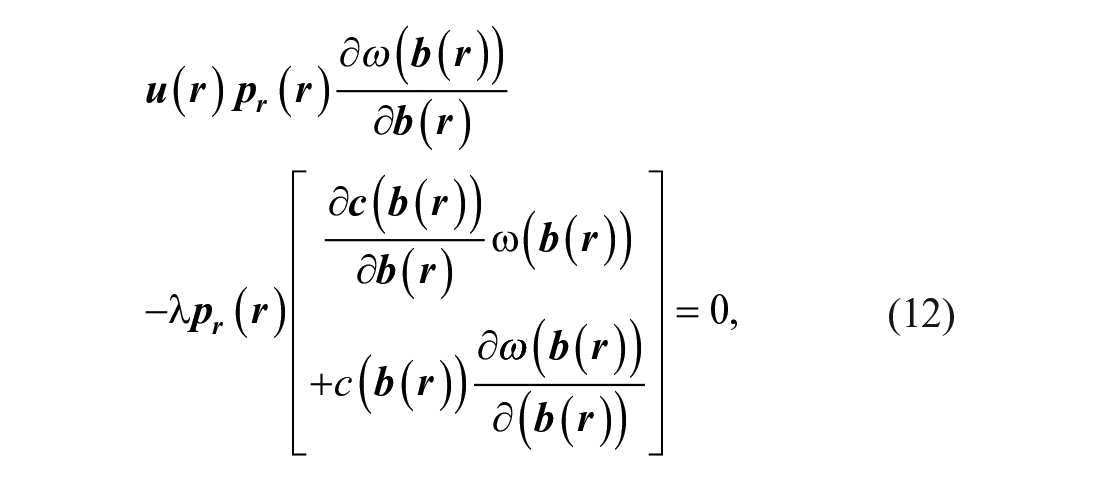
which derives:

With the winning function
Price Auction
First price auction
With cost function
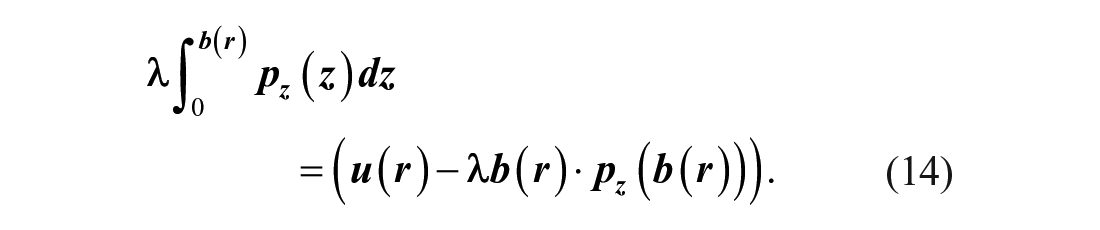
With the market price distribution

Taking

Second price auction
Taking the winning function

which derives

and

To solve λ, we take

With the equation, it is easy to find a numeric solution of λ such that when λ increases, both
In this section, we also detail our method of first revisit the smooth delivery constraint and explain how we control the spending rate adaptively when each ad request comes sequentially. Afterwards, we discuss how we can iteratively apply the spending information to select ad requests and adjust their bid price to optimize the objective function.
Gamified RTB Schemes With LBA
In this section, a RTB scheme integrated with the concept of gamification is proposed. In order to focus on the target audiences, location based advertising is also applied to the proposed scheme. The proposed schemes are described as follows.
RTB Digital Signage
Digital signage RTB, abbreviated as DS RTB, which uses a digital billboard to display scheduled advertisements. There are three problems in DS RTB. First, the cost is high for building signage; second, the passing customers may not be interested in the displayed contents; third, the passing customers may not be the target audience.
Therefore, we proposed SSP and DSP as solutions. The people flow in front of the digital signage is the key of the solution, which is detected by a camera installed on a signage.
In the supplier part, the monthly advertisement bandwidth of each signage must be determined first. The intelligent vision analyzer (IVA) server sends human flow information on receiving RTB request, and the bidding price is calculated accordingly. The detail process is shown in Figure 2.

Diagram for DS RTB from supplier side.
In the demand part as Figure 3, the sales input the bidding strategy into the RTB system. Subsequently, the RTB system searches the advertisement which meets the conditions of the strategy, and send the bidding price to the trading center. The trading center sells the bandwidth to the bidder with the highest bidding price, and display the advertisement on the corresponding signage. On display, the IVA simultaneously capture the human flow as a feedback for future reference.

Diagram of DS RTB from demand side.
O2O Gamification
The online to offline (O2O) model aims at guiding online customers to physical stores, which can be accomplished by giving discounts and rewards at physical stores through online advertisements (Li & Mo, 2015). However, the effectiveness is evaluated through click through rate (CTR) and message push count, and there are three shortcomings. First, the advertisers cannot see the effectiveness immediately; second, some discounts such as “5% off” are not appeal to customers; third, small stores individuals have limited budget.
To solve the above issue, a gamification platform can be employed with a business region, local associations, rather than business individuals. When gamification is employed, the individual stores gains customers without any cost; the customers enjoy the gaming process rather than receiving unwanted advertisements; for the APP developers, their products can be promoted without any cost. The gamification will be realized through mobile to off-line (M2O).
From O2O to M2O
O2O is a model that brings people from online to offline and connects physical retail stores with e-commerce (Du & Tang, 2014). With the popularity of smartphones, Hsieh (2018) explores the impact of mobile services on O2O. Location and pricing will affect consumers’ willingness to consume (He et al., 2016). So through the mobile devices, online and offline businesses can be initialized through mobile devices, and thus the idea of M2O rises (Sun et al., 2015). On the other hand, Provost et al. (2015) believe that the trend is to find similar consumers through mobile. M2O stands for Mobile to Online/Offline model, which promotes online or offline business from advertisement in mobile devices.
The M2O framework is a model that combines O2O and mobile devices, and Wu et al. (2015) also proposed a study related to M2O in the restaurant industry. A complete M2O environment is composed of heterogeneous units, and a gamified RTB platform is established for M2O purpose. The organization for the RTB gamification platform, including RTB platform developers, gaming APP developers, business circles, and marketing planners, are illustrated in Figure 4 and described as follows.
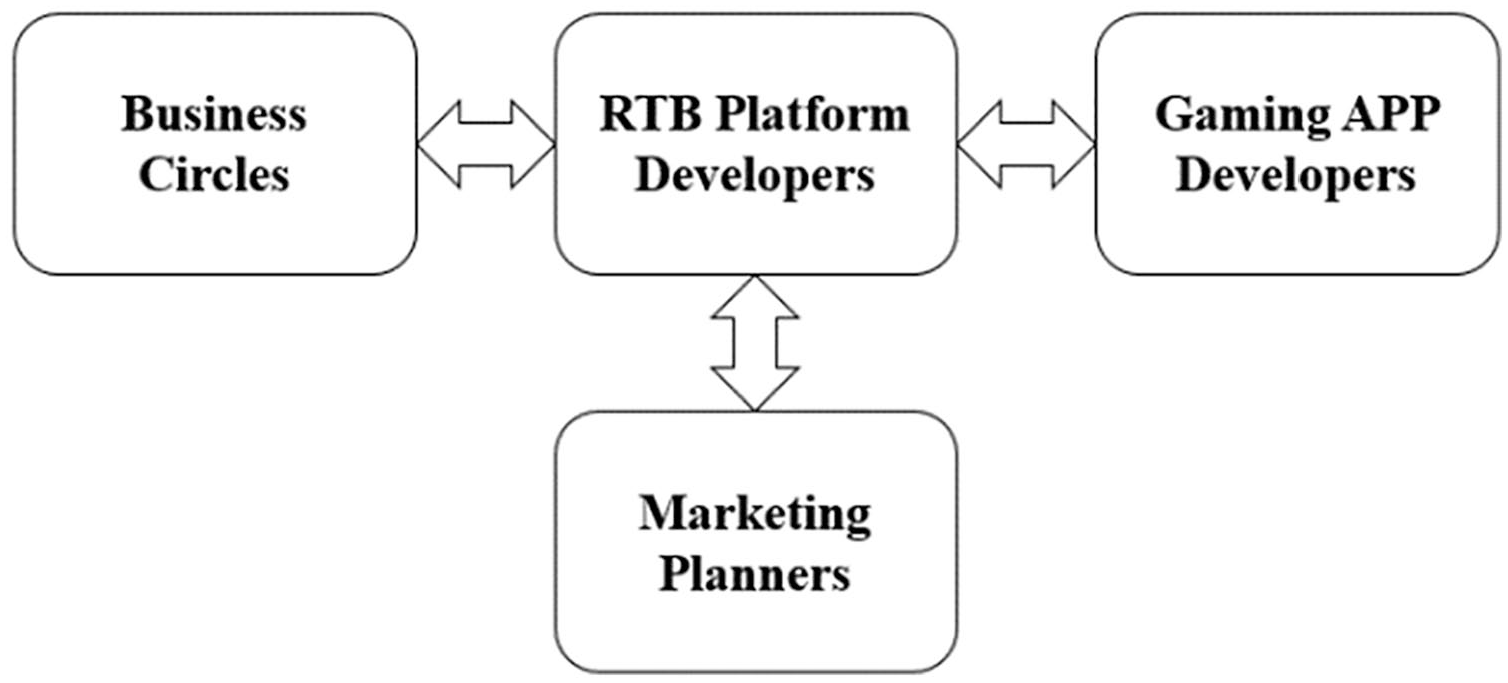
Primary members of gamification platform.
First, the RTB platform developers works primarily on system integrations, which provides bandwidth, promotes the cooperation on APPs, and introduces mobile advertisements. The RTB platform developer belongs to the supplier side. Second, choose the gaming APP developers from experienced game companies, which perform development, promotion, and management of their gaming systems. The gaming developer is the key for gamification of RTB platform. Third, a business circle is comprised of traditional physical stores which runs similar industries, and is on the demand side of the RTB platform; the marketing planners works as an agent between above units, which also designs the process of gamification, preparing rewards, perform promotion activities, and search for cooperation.
M2O and LBA push
LBA stands for Location-based advertising, which is an advertising method that integrated with mobile devices (Schade et al., 2018). The M2O can be utilized via LBA push. LBA is a form of direct marking that allows markets to find their specified target audiences (Kölmel & Alexakis, 2003). In LBA push, the mobile device receives location-specific advertisements on their mobile devices. Generally, there are four types of LBA push, namely messaging, display, searching, and product replacement.
There are two types of LBA, push-based and pull-based (Unni & Harmon, 2007). In push-based LBA, the users submit their personal information, and the LBA system provides the users with geographically based offers and incentives. The users receive advertisements in a passive way, and no activations is required. On the other hand, the pull-based LBA needs activation from the users. The pull-based LBA displays advertisements while user browsing or searching contents. The displayed advertisement is chosen according to the browsed contents (Bruner & Kumar, 2007).
The gamification process is as Figure 5. First, the users install the APP that receives LBA PUSH. When the user enters into a business region, send the push notification and ask if the user is willing to participate in the gaming activity. When the user decided to join the activity, send a location of an E-ticket with specific reward to the user. The E-ticket is exchanged through iBeacon technology, which a beacon device is located at the E-ticket location. The iBeacon also works as a verification tool to check whether the user has actually attended the appointed location. After verification, the price is exchanged for the user.

Gamification with reward exchanging through iBeacon and e-ticket service.
The detail of the price exchanging is as follows. First, the user performed three steps, which are open the Bluetooth, open the App, and sense the iBeacon sequentially, and an event is triggered. Subsequently, the system receives the iBeacon signal sent by the App, and send the reward collection notification through E-Ticket verification system. The E-ticket verification system uses the App ID, device ID, and iBeacon ID to match with the personal identification E-ticket. The system sends the exchanging notification to the user’s App. The user shows the notification to the store clerk to complete exchanging.
LBA push improvement
Currently, most LBA push mechanism gives notification to any user who enters into the specified region, which caused many problems. First, the users often receive unwanted messages as they pass through specific regions; second, most notification push are ineffective because they are uncorrelated to the received users (Figure 6).

Diagram of LBA push.
Generally, there are three types of locations essential for LBAs, which are shopping locations, home locations, and office locations. These locations are obtainable through setting up some parameters in the LBA analytics system. The parameters for finding these locations are stay time, stay date, and stay frequency. To prevent from misdetections, set up a displacement tolerance for accuracy.
The user locations can be translated into semantic words. For example, users around global positioning system (GPS) location 40.707040, −73.781950 in weekends but not on workdays can be deemed as shoppers in New York City.
The collected user positions can be used to efficiently deploy advertisement to target audiences who are possibly interested in the received contents. The LBA also helps target on the right users to save advertisement cost.
Digital Transformation Performance Evaluation
In the past, the physical retail store is unable to grasp the browsing trend and potential demand of customers. It lacks the data to analysis personalized experience. In this evaluation, we use gamified RTB application helps large-scale retail to realize their marketing digital transformation and enhance the effectiveness of their marketing. The as-is/to-be comparison by proposed method as a performance demonstration be shown below and will be evaluated in cooperation with physical retail stores (Figure 7).

The as-is/to-be comparison by proposed method.
The large-scale retail made the product marketing through physical coupons. In the proposed model, the gamified RTB make large-scale retail accept new technologies for the renewal of digital transformation. We are conducting evidence in a large -scale retail space.
Locating Consumer Geographic Information with iBeacon.
Gamification is used to guide users explore the products in the store.
Encourage consumers to share information on social networking sites, for example, Facebook.
Finally, advertise to consumers based on the results of the retailer’s bidding, and make consumers into the retail store and increasing average order value (AOV).
The client is implemented as an App on a mobile device. We also install iBeacon in the retail space, and collect information about iBeacon UUID, Major ID, and Minor ID. The Data send to backend system via Internet.
We proposed a digital service for marketing and coupon delivery through gamification RTB App. This is a digital transformation of retail marketing, including:
✓ Replacing physical coupons with digital coupons
✓ Customer FB log data analysis
✓ Analyze customer journeys and preferences
✓ Potential consumer profiling
The implementation of the gamified RTB App using proposed method was effective in increasing the visitor rate. The experimental service period is December 2019 and there is a significant increase in the number of people who log in to Facebook and share through the gamified RTB App (Figure 8).

The number of people who log in to Facebook and share through the gamified RTB app.
The number of users in this service has been increasing during the evidence period due to increased consumer willingness to PLAY the service due to gamification (Figure 9).

The number of users in this service during the evidence period.
A comparison of physical coupons and the gamified RTB App coupon, click ratio for both increased significantly (Table 1).
Comparison of Physical Coupons and the Gamified RTB App Coupon.

We validate the digital transformation marketing service to the restaurant and clothing industry by pushing advertisements to consumers on the gamified RTB App.
Two satisfaction questionnaire were conducted on the stores that participated in the game-based RTB App marketing. The first questionnaire period was in mid-December and the second questionnaire period was in late December. The two questionnaires were conducted by means of a google form questionnaire, and according to the results of the content of the questionnaire, they filled in the google form to data statistics. The satisfaction score of the first questionnaire is 68.12, and the satisfaction score of the second survey was 81.88. The conclusion is that the satisfaction rate of the second time is 20.19 higher than the first time. Statistics are shown in Table 2. It shows that the digital transformation of the proposed RTB gamification method has a positive effect on the retail industry.
Merchant Satisfaction Statistics.

Discussion
In the methods mentioned in the existing literature, although the effectiveness can be improved by choosing the right target audiences, customers may not interact with the advertisement well. From this study, we found and contribute that with the popularity of mobile devices, APPs is a new media for RTB systems, and gamification is possible. It is the digital confluence platform (DCP) to implement O2M business model which is a customer-centric service design (CCSD).
The gamification is implemented by integrating advertisement with mobile game APPs, and ask customers to exchange rewards at advertiser’s physical stores. Locating the target audiences is essential for choosing the candidates for gamified activity push, and avoid unnecessary deployments of advertisements. The LBA is used to find candidate users for gamified activates by their locations. To help small businesses without sufficient budge join the gamification advertising, we propose to share the budget within a business circle rather than individual, and the cost can be distributed fairly within the group.
At the same time, there are four primary finding for brand integrating advertisement through gaming in this study:
Involvement
One of the most important goal of gamification is user involvement, which makes users check the brand news and related information frequently.
Interaction
By analyzing users’ interaction during gaming, marketers can adjust the rewards and actions to enhance the user involvements in some areas.
Intimacy
The intimacy is produced during gaming. Good design of interaction improves the favorability of brands. In a gaming environment, the distance between a user and a brand is shortened.
Influence
Gamification enables users to share the brands. When users have gained some awards from games, they would share it with their friends in social networks.
The applying the concept of real-time bidding systems, a Real-time Bidding Gamification Service is a systematic approach to increase the percentage of a website’s visitors that can convert into customers in internet marketing. And this is also an important key to digital transformation.
Conclusion
From the literature discussed in this paper, it is clear that data from DSP and SSP can enhance business operations. And consumer experience can strengthen the consumers’ willingness to consume. In addition, the literature presented in this study shows that the evolution of M2O from O2O is the trend of marketing. We combine the above two concepts above to propose a customer experience RTB scheme that combine two digital technology services of gamified RTB and mobile LBA. In the proposed scheme, we improve the LBA Push method to make it easier to find the target audience through the advertiser’s geographic relationship. This study will conceptualize the validation in a large integrated retail. According to empirical results, when the proposed scheme is applied to restaurants and clothing stores in large shopping malls, the click ratio of the shopping apps of these stores has increased significantly. This is also the basis for digital transformation.
This study convergence several advanced digital technologies to enabler for retail industry digital transformation. It includes LBA analysis technique with iBeacon proximal sensing. Proposed method also integrate SSP and DSP to develop a gamified RTB model. This study creates a demonstration application of digital transformation in the retail Internet of Things. In this paper, we have introduced and proposed digital transformation methods for efficient advertising, including real-time bidding (RTB), gamification, location-based analysis (LBA), and budget sharing business circles, gamification, location-based analysis, and budget sharing business circles. The model plays bring up old business circles accept digital service for the renewal of technology promotion, and help predict and find best customer experience in the business directions. Through gamification, the customers participate in the activities more and are willing to know more about the detail of the promotion actively. The proposed scheme helps enterprises efficiently deploy their advertisements at the right time and the right place, and on the right target audiences’ mobile devices. The new and innovation gamified RTB help the tradition business circles external market strategy and internal organization through combinations of information, computing, and communication technologies. Gamification for Real-Time Bidding systems are found to have changed the perception of customer value and experience. The gamified RTB is the right paths to achieve transformation results for old business circles. We also assist the small business owners within traditional circles accept the idea of real-time bidding gamification by advertisement budget sharing within a circle.
The proposed schema plays an important role in making old business circles which having lesser interaction with customers undergo Digital Transformation, to accelerate digital transformation, and help predict and find the business directions.
Footnotes
Declaration of Conflicting Interests
The author(s) declared no potential conflicts of interest with respect to the research, authorship, and/or publication of this article.
Funding
The author(s) received no financial support for the research, authorship, and/or publication of this article.
