




Abstract
This study contributes to the literature by providing an empirical analysis on the impact of information technology on the U.S. unemployment rate using macroeconomic data level. It develops a theoretical framework and uses three complementary econometric methods: Traditional ARDL, Dynamic ARDL, and the Frequency Domain Causality Test, to ensure robustness and reliability of the findings over the period 1990: Q1 to 2020: Q1. The results show that information technology and economic growth have a statistically significant negative effect on unemployment in both the short and long run, suggesting that information technology generally contributes to job creation or reduction in joblessness. However, this study also finds that the interaction between information technology and economic growth has a positive and significant effect on unemployment rate, implying that information technology may still displace certain job types, even during periods of economic expansion. These findings align with prior survey-based studies, reinforcing the dual nature of technological progress: while it drives productivity and growth, it can also lead to structural job shifts or losses in specific sectors. From a policy perspective, this study emphasizes the importance of strategic planning and workforce adaptation to fully join the benefits of innovation without exacerbating unemployment. Simultaneously, policymakers can mitigate the adverse effects of information technology by focusing on a national strategy for workforce reskilling and strengthen unemployment insurance.
Keywords
Introduction
Technological progress, such as information technology, is a significant input on microeconomic and macroeconomic levels because it increases output by enhancing total factor productivity. Researchers, that is, Oliner and Sichel (2000), Jorgenson and Stiroh (2000), Jorgenson (2001), Jorgenson et al. (2004), referred to information technology’s role in improving the United States (U.S.) labor productivity in the second half of the 1990s, thus boosting the U.S. economic growth. On the firms’ level, Kudyba and Diwan (2002) studied 500 U.S. firms using information technology over the period (1994–1997) and concluded that investment in information technology increases the firms’ productivity. Similarly, Fueki and Kawamoto (2009) examined the link between information technology and total factor productivity in Japanese industrial firms. They confirmed the information technology’s ability to explain the expansion in Japanese industrial productivity. Escribá-Pérez and Murgui-García (2018) concluded that both regional technological and regional human capital have a positive influence on the growth of total factor productivity in the European economies. In the same context, Bolli and Pusterla (2022) reached that the relationship between digitalization and job satisfaction is positive because it increases productivity. Carnoy (1997) stated that the new information technology would affect all nations’ employment, wages, and economic growth. It will accelerate the integration of national economies into the world economy. Besides, collecting, treatment, and dissemination of information enhances productivity and quality control and creates the possibility of producing new goods and services. Recently, Ten Berge and Dekker (2025) explored the workers’ anticipations regarding the influence of new technology on the quality of their work by examining the impact on job security and the psychological and physical job demand. Moreover, they investigated how the labor organizations can shape these expectations.
Information technology is defined based on the Merriam-Webster dictionary as “the technology involving the development, maintenance, and use of computer systems, software, and networks for the processing and distribution of data.” The world is witnessing a race toward creating a new generation of technologies, that is, Big Data, 5G telecommunications, and Artificial Intelligence, that might change the world economy structure and competitiveness among nations. These significant anticipated roles have raised debates about future job openings (Dunlop, 2016; Review, 2019). Brynjolfsson and McAfee (2014) considered the world is entering a new machine era, which is different from the previous period. The world’s technological status is at an inflection point where the curve starts to bend steeply. We cannot ignore that the world lives in a unique and rapid digital technology progress, processing power, and greater data availability. It makes the expectations high and different from the previous technologies’ waves. Relatedly, Ford (2015) considered the relationship between technological progress and employment the most significant challenge for human beings today because it might lead to mass unemployment.
The current research noticed that the different empirical works in this research area used different proxies to represent technological progress, such as robots, automation, digitalization, and artificial intelligence. Thus, the independent variables could have different designations, but overall, it highlights the effect of using machines on employment.
Many studies explored the future of job creation given the development in the information technology area, that is, Hunt et al. (2022), Bessen et al. (2019), Balsmeier and Woerter (2019), Frey and Osborne (2017). But all these studies were conducted using surveys. Moreover, the literature discusses the challenges or shortcomings of measuring the impact of technological progress on the employment rate. These shortcomings are similar among regions and have four common dimensions. First, the availability of data to link information technology and job creation; for example, Europe does not have an institutional dataset or constitutional survey devoted to the influence of information technology on jobs at the organizational level. Besides, the available datasets on job-technology-innovation associations do not have adequate in-depth information to explore this relationship professionally (Hunt et al., 2022). Second, the current modeling process relies on subjective judgments about technology capabilities because it relies on conducting surveys. Usually, these decisions are notably optimistic (Arntz et al., 2016; Hunt et al., 2022). Third, the modeling process focuses only on the technology’s technical capabilities and ignores economic factors (Brynjolfsson et al., 2018; Manyika et al., 2017). Fourth, some studies, that is, Mastrostefano and Pianta (2009), pointed out the business stealing effect, which means that the rise in the employment level appears on the firm level but not on the industry level. It indicates that new technological progress reallocates workers among firms.
The current study is motivated by the abovementioned weaknesses, mainly the absence of evidence on the macroeconomic level. Thus, its primarily goal is to explore the connection between information technology and the unemployment rate, and contribute to the existing literature from two dimensions. First, while much of the previous research relies on firm-level data or survey-based studies, this study uniquely investigates the impact of information technology on the unemployment rate using macroeconomic data. Recently, Asravor and Sackey (2023) extracted evidence on the relationship between technology innovation and job destruction and creation in Ghana. The current research assumes that the microeconomic level (firm-level) behavior should spill over to the macroeconomic level. As a rule of thumb, let the data speak for itself. Exploring this crucial research topic on the macroeconomic level provides an aggregate picture because it reflects the whole behavior on the microeconomics level. Second, the current work focuses on extracting evidence from the U.S. economy where the information technology is well-established and advanced. The U.S. economy is a producer and consumer of information technology. Additionally, the necessary data is available for an extended period with the required frequency. As a result, the current study’s central question is, do rapid information technology and accelerating digitalization cause a high unemployment rate in the U.S. economy? Third, this work uses robust econometric techniques by employing three methodologies to ensure the reliability of its findings.
This study utilizes the S&P U.S. Information Technology Index as a new proxy for the information technology sector. Further, it uses quarterly data that covers the period 1990: q1 to 2020: q1. Contrary to the previous studies, the current study uses the U.S. aggregate unemployment rate compared with job creation or job destruction as extracted from the surveys. Also, it employs one additional sub-sample of the U.S. unemployment rate of age category (24–34) to check the results’ robustness. Furthermore, the current research utilizes three methodologies—traditional ARDL, Dynamic ARDL, and Frequency domain causality test—to extract robust results on this critical issue.
The findings of this study offer a variety of valuable policy implications. For example, if information technology increases unemployment rate, then the U.S. policymakers should pay attention to issues, such as national workforce reskilling strategy, strengthen unemployment insurance, and identify the harmed group of workers. In contrast, if information technology reduces unemployment rate, policymakers should focus on different areas, such as accelerate digital adoption among small and medium enterprises, enhance technology education pipeline, and spread and support regional technology clusters outside the well-known areas, for example, Silicon Valley.
The remaining parts of this research are prepared as follows. Section 2 reviews related literature on the matter. Section 3 summarizes the theoretical framework and data of the current research. Section 4 explains the current work econometric techniques. Section 5 introduces the empirical results and subsequent analysis. The discussion of concluding remarks and policy implications are presented in Section 6.
Literature Review
Economic growth theories, that is, exogenous and endogenous growth theories, endorse the significant role of technological progress in different types, such as information technology and robots, in reaching sustained economic growth. Schumpeter (1942) considered technological progress, among other factors, such as new consumers, new markets, and transportation, as the fundamental instinct that sets and keeps capitalism’s engine in permanent motion. The capitalist economy is in continuous change and can never be stationary. These moving factors establish a case named by Schumpeter as “creative destruction” of the capitalist economy, which means, according to Schumpeter (1942, p. 83), “that incessantly revolutionizes the economic structure from within, incessantly destroying the old one, incessantly creating a new one.”
Literature has a historical agreement on how technological progress reshapes the workforce on the firm and sectoral levels. The late 19th-century pattern needed capital-skill or capital deepening because the Industrial Revolution motivated the manufacturing companies, that is, the motor and textile companies, to mechanize their production lines progressively. Thus, technological progress motivates firms to reorganize their workforce to achieve their objectives. It postulates the existence of employment/unemployment effects across the heterogeneous workers’ groups. Acemoglu (2002, p. 8) publicized it: “The idea that technological advances favour more skilled workers is a twentieth century phenomenon.” Technological progress increases the demand for high-skilled workers and lowers the demand for medium and low-skilled labor (Balsmeier & Woerter, 2019; Domini et al., 2021). The analysis on the firms’ level opened a significant problem. Firm-level research cannot recognize whether job creation gains from technological progress are made at the expense of competitors, the business stealing effect, or whether there is a net effect on the industry. Some studies showed that the positive association between technological progress and employment at the firm level vanished when the study was carried out on the same data at the industry level. Technological progress reallocates workers among the firms in each industry (Mastrostefano & Pianta, 2009). The extensive shift toward using new technological progress occupations abolishes routine intensive occupations and causes a high unemployment rate (Frey & Osborne, 2017).
Technological progress and information technology have recently been considered significant in increasing workers’ productivity and expanding firms’ work. Thus, the demand for output and input (labor) has increased alike. Information technology supports firms’ environmental work from different dimensions. They are enhancing decentralization and flattening of hierarchies within the firm, improving coordination and communication inside the firm and with the firms, removing internal boundaries between departments and sub-units, encouraging workers to bear responsibility in the decision-making process, providing new forms of flexible working styles, that is, work anytime and from anywhere, and motivating workers to stay well-informed and develop their skills and knowledge (Greenan & Napolitano, 2021; Katz & Krueger, 2019). Undoubtedly, firms grow through technological progress and innovations. It leads to acquiring new products and services or improving existing ones. Based on their empirical work, Graetz and Michaels (2018) confirmed that adopting robots in work increases total factor productivity, wages, and reduces output prices.
Literature uses two hypotheses to justify the impact of technological progress on employment. First, technological progress generates shocks that influence the relative demands for labor with different skills. The net influence depends on outweighing the demand effects among the different skills and the economy’s structure. Second, technological progress creates disturbances that can increase the firms’ production, and thus, the demand for all workers will rise. Various empirical works presented evidence from surveys reflecting the respondents’ views. These studies found that rising investment in the technological progress sector is accompanied by an increase in net employment and economic development, that is, Klenert et al. (2023), Abutabenjeh et al. (2022), Domini et al. (2021), Balsmeier and Woerter (2019), Kogan et al. (2017), Mastrostefano and Pianta (2009). Within the same context, Ogbonna et al. (2022) showed that the unemployment rate for youth declines in Africa, where there is a lag in infrastructural development, including information technology. So, their study provided evidence that the youth unemployment rate in Africa can be declined by investing in the education and information technology sector and achieving higher economic growth. Besides, this outcome supports the hypothesis that investing in information technology will reduce the unemployment rate if the economy’s structure is eager for the information technology sector. Similarly, Uche et al. (2024) provided empirical evidence that the information technology sector boosts self-employment, and thus, the unemployment rate declines. Their research is based on an annual panel analysis of 52 African countries over the period 2005 to 2019. Gürtzgen et al. (2021) found that broadband internet enhances reemployment rates for men after the initial months of unemployment. Additionally, their survey-based analysis indicates that internet access primarily influences the job search behavior of male job seekers by boosting their use of online search tools and increasing the number of job applications submitted. Asravor and Sackey (2023) concluded that technology process innovation generated more job destruction than job creation in Ghana over the period 1980 to 2018. They also found that economic growth boosted job creation.
On the other hand, some studies, that is, Acemoglu and Restrepo (2020), Bessen et al. (2019), reached a negative impact of technological progress on employment. Likewise, Frey and Osborne (2017) concluded that around 47% of U.S. employment is in the high-risk category. These jobs are expected to be automated or eliminated over the following decades. On a third spectrum, Dauth et al. (2018) found that adopting robots has no impact on the labor market because gains in the business service sector offset job losses in the manufacturing sector. Graetz and Michaels (2018) found no significant link between increased robot adoption and employment. They indicated that robots’ utilization might decrease the employment of low-skilled workers. However, Klenert et al. (2023) did not find evidence supporting the negative impact of using robots on the share of low-skilled workers across Europe.
In sum, economic theory viewed information technology, a form of technological change, as a driving force behind sustained economic growth because it frequently changes the economy from one status to another. However, information technology has a debatable impact on the labor market. It creates disturbances that impact the relative demands for labor with different skills. The net influence depends on outweighing the demand effects among the different skills and the economy’s structure. The opposite view states that information technology generates shocks that can increase the firms’ production, and thus, the demand for all workers will rise. The reviewed literature is indecisive on whether information technology increases or decreases the unemployment rate. It could be a particular case for each industry and economy. Moreover, the previous empirical research relies on firm-level data or survey-based studies, this study uniquely investigates the impact of information technology on the unemployment rate using macroeconomic data. Besides, this study concentrates on extracting evidence from the U.S. economy where the information technology is advanced and well-established.
Theoretical Framework and Data
Theoretical Framework
It is well-known in economic theory that the unemployment rate
At the same time, this work assumes that the impact of information technology on unemployment rate is not static, but instead depends on the state of the economy. When the economy is growing, firms are more likely to adopt and integrate new technologies in a way that complements labor or creates new types of jobs. Conversely, during economic downturns, information technology adoption may impair job losses as firms use technology to cut costs and reduce reliance on labor. Thus, the interaction term, between economic growth and information technology, captures the moderation consequences of economic growth on the relationship between information technology and the unemployment rate. Generally, the moderation effect occurs when the relationship between two variables changes based on a third variable. This results in the mathematical derivation of the dependent variable with respect to the explanatory variable modified to be a linear function of the third variable instead of being constant. This suggests that the impact of information technology on the unemployment rates is both direct and indirect, contingent upon economic growth. Alternatively, moderation effects contribute by additional influence to the slope of the direct effects of the studied variables on the dependent variable. However, incorporating an interaction term into a regression model may introduce multicollinearity concerns. One method to address multicollinearity is standardizing the variables by subtracting their means (Sweidan & Elbargathi, 2022), which involves centering the variables before calculating their interactions. Therefore, we will estimate standardized interaction terms rather than conventional ones in this study. In sum, economic growth captures the cyclical component, information technology reflects the structural and informational influences, and the interaction term represents the moderation effect; how the relationship between information technology and unemployment may change depending on the level of economic growth.
The current study uses two independent variables to guarantee robust results. The total U.S. unemployment rate


We rewrite Equation 1 in a general linear regression form as follows:


where
Data
The current research data is extracted from two sources. The unemployment rate and economic growth are withdrawn from the Federal Reserve Bank of Saint Louis website. The first difference in the real gross domestic product in 2017 dollars calculates the economic growth rate. The primary independent variable under consideration is the S&P U.S. Information Technology Index
Table 1 presents our descriptive data statistics in panel A, while the correlation coefficients are introduced in panel B. Empirically, using interaction terms in the regression model may cause the problem of multicollinearity. One way to mitigate multicollinearity is to standardize the interacted variables by deducting their means from each variable (Sweidan & Elbargathi, 2022). We demean the two variables before computing their interactions. Table 1 documents the correlation coefficients among the variables after applying the demean rule on the interaction term. It displays low correlation coefficients among the variables. This research estimates the Variance Inflation Factors (VIF) to ensure the robustness of the results against potential multicollinearity issues. Results from Table 2 reveal that VIF values confirm the absence of multicollinearity among the explanatory variables in the model.
The Descriptive Statistics and the Variables’ Correlation Coefficients.

Source. Author’s calculations.
Variance Inflation Factors.

Source. Author’s calculations.
Econometric Methodologies
ARDL Approach
The present study employs the ARDL bound testing method for cointegration analysis, a well-established econometric technique widely utilized in diverse economic research. Originally introduced by Pesaran et al. (2001) to estimate the model’s coefficients and determine the existence of a long-term relationship among variables. While conventional cointegration tests like the Johansen or Engle-Granger tests encounter difficulties when dealing with variables of mixed orders, the ARDL approach can handle both stationary and non-stationary time series variables. This flexibility allows for analysis in scenarios where variables demonstrate varying integration orders, such as I (0) or I (1), or combinations thereof. The presence of a long-term relationship suggests a shared stochastic trend among variables, indicating a sustained correlation. Despite short-term fluctuations, these variables gradually conform to this common trend, underscoring their interdependence. In such a model, key coefficients like short-term and long-term parameters, as well as the error correction term (ECT) toward long-term equilibrium, are computed. These parameters are crucial in evaluating the relationship between dependent and explanatory variables. Moreover, the ARDL approach demonstrates robustness even with limited sample data.
In this investigation, this research utilizes two approaches to validate a cointegration relationship among the variables. Initially, it employs the PSS-bounds test proposed by Pesaran et al. (2001), which computes and contrasts the upper and lower critical F-values. When the outcome of the F-test exceeds the upper critical threshold, the null hypothesis is rejected, indicating the presence of cointegration among the variables. On the contrary, uncertainty arises when the calculated F-test value falls within the range defined by the lower and upper bounds. When the observed F-test falls below the lower critical threshold, it supports the null hypothesis, suggesting no cointegration among the variables. Subsequently, the current work calculates the Error Correction Term (ECT) and substitutes it with the long-run variables in Equations 3 and 4. A statistically significant, negative ECT parameter less than one confirms long-term movement among the model’s variables, signifying smooth convergence to the long-run equilibrium. If the ECT coefficient is between −1 and −2, the convergence is deemed oscillatory (Narayan & Smyth, 2006).
The general functional form of the ARDL (p, q) is as follows:

where


Where
Dynamic ARDL Approach
When utilizing the conventional ARDL approach, explaining the short- and long-term parameters becomes straightforward in an ARDL model with minimal lags, such as ARDL (1,1). Nevertheless, complexity arises when employing an expanded model specification incorporating multiple lags. To address this challenge, Jordan and Philips (2018) presented an innovative method known as Dynamic ARDL (DARDL) to enhance the interpretation of the results. DARDL not only estimates and stores results but also automatically generates plots illustrating substantively noteworthy predictions from the ARDL models. It assists researchers in visualizing the potential impact of a hypothetical variation in an explanatory variable at a specific time while keeping all other factors constant, employing stochastic simulation techniques.
Prior to utilizing the DARDL model, researchers must confirm that the conventional ARDL model satisfies specific criteria. This involves conducting unit-root tests to ascertain the order of integration of variables and ensuring that diagnostic stability tests validate the assumptions of the classical linear regression model. The DARDL methodology performs 5,000 simulations using a normal multivariate function for the vector parameter. Graphical representations are employed to monitor precise fluctuations in the explanatory variable and its influence on the dependent variable. This approach aims to achieve more accurate and impactful results by leveraging simulation.
Frequency Domain Causality (FDC) Test
To further validate the reliability of the empirical estimates, the current research examines the Granger-causal relationship between explanatory variables and independent variables

where

Empirical Results
Unit Root Test
Figure 1 introduces the current study independent variables


The independent variables during the period 1990: q1 to 2020: q1.
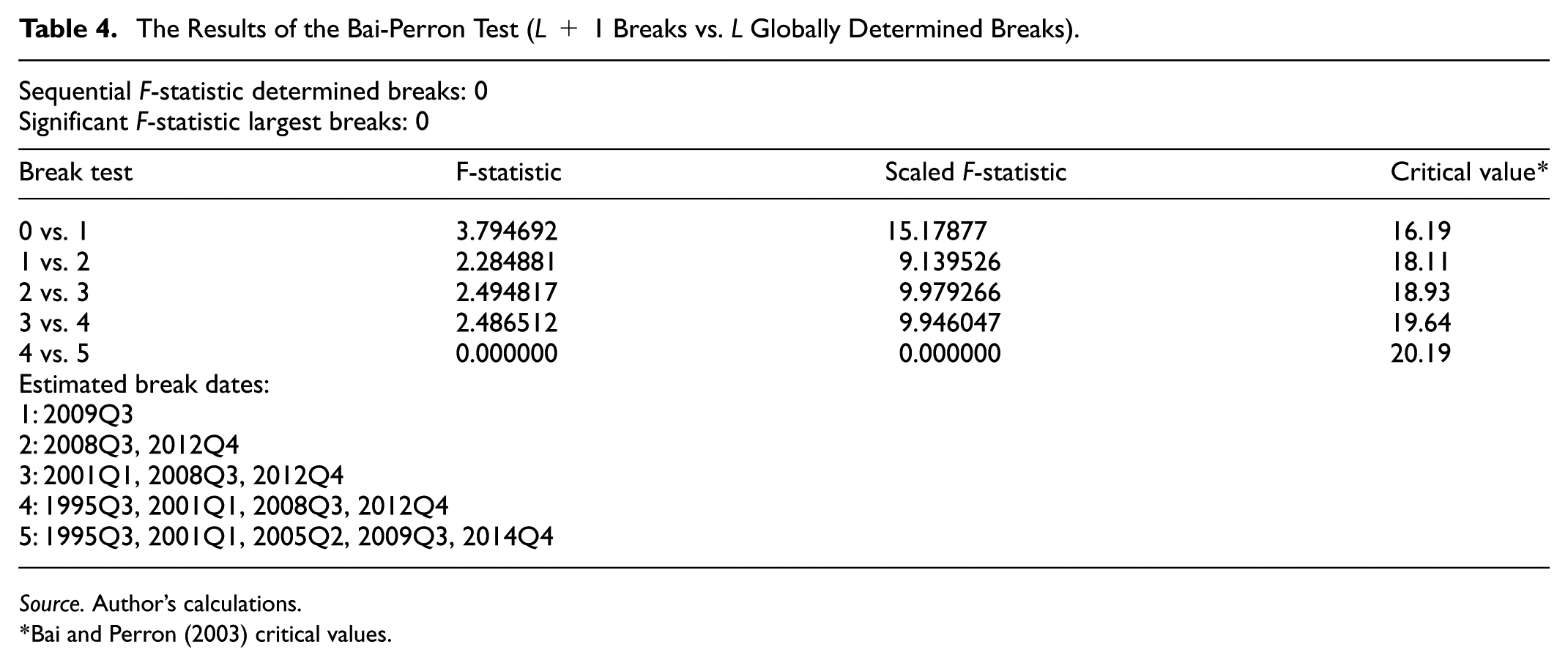
The lag length of both unemployment rates was estimated using the Akaike Information Criterion (AIC) and the Schwarz Information Criterion (SIC) to guarantee free serial correlation residuals. The residual and stability tests confirm that the model satisfies the classical linear regression assumptions. It includes the normality test, serial correlation LM test, and heteroskedasticity test, while the stability diagnostics include the Ramsey RESET test and recursive estimates. Then, this research conducts several multiple breakpoint tests. All these tests reject the existence of structural breaks in the U.S. unemployment rate. Tables 3 and 4 introduce sample results of the Bai and Perron (2003) test.
The Results of the Bai-Perron Test (L + 1 Breaks vs. L Globally Determined Breaks).

Source. Author’s calculations.
Bai and Perron (2003) critical values.
The Results of the Bai-Perron Test (L + 1 Breaks vs. L Globally Determined Breaks).
Source. Author’s calculations.
Bai and Perron (2003) critical values.
Further, this study employs the Augmented Dickey-Fuller (ADF) test, as suggested by Dickey and Fuller (1981), and the Phillips-Perron (PP) test, as introduced by Phillips and Perron (1988). Both tests are conducted in their conventional configurations, with additional examination for potential structural breaks. The null hypothesis for these tests proposes the presence of a unit root within the series. The results of the four tests are presented in Table 5, showing that our sample data demonstrates stationarity either at the level or at the first difference. Thus, the ARDL approach is deemed appropriate for analyzing the current data and estimating its models’ parameters.
Unit Root Tests.

Source. Author’s calculations.
p < .01 and **p < .05.
The PSS-Bounds Test (Cointegration Test)
Following the completion of the unit root tests, this research utilizes the PSS-bounds test to investigate the presence of a long-run relationship among the models’ parameters. The ARDL and DARDL models are estimated to have a maximum of eight lags, and the econometric software automatically selects the models’ lags, which minimizes the AIC. Table 6 displays the results of the PSS-bounds test, indicating significant F and t-statistics at the 1% level for the two models of the current research. For Equation 6, F and t-statistics are 14.341 and 5.080, respectively. While for Equation 7, F and t-statistics are 31.548 and 5.094, respectively. These results validate the existence of a long-term cointegration relationship between the unemployment rates and the model’s independent variables.
The Results of PSS-Bounds Test.

Source. Author’s calculations.
Note.I(0) and I(1) are the lower and upper band critical values at a significance level of 1%, 5%, and 10% for the PSS bound test.
Indicates significance levels at 1%.
Diagnostic and Stability Tests
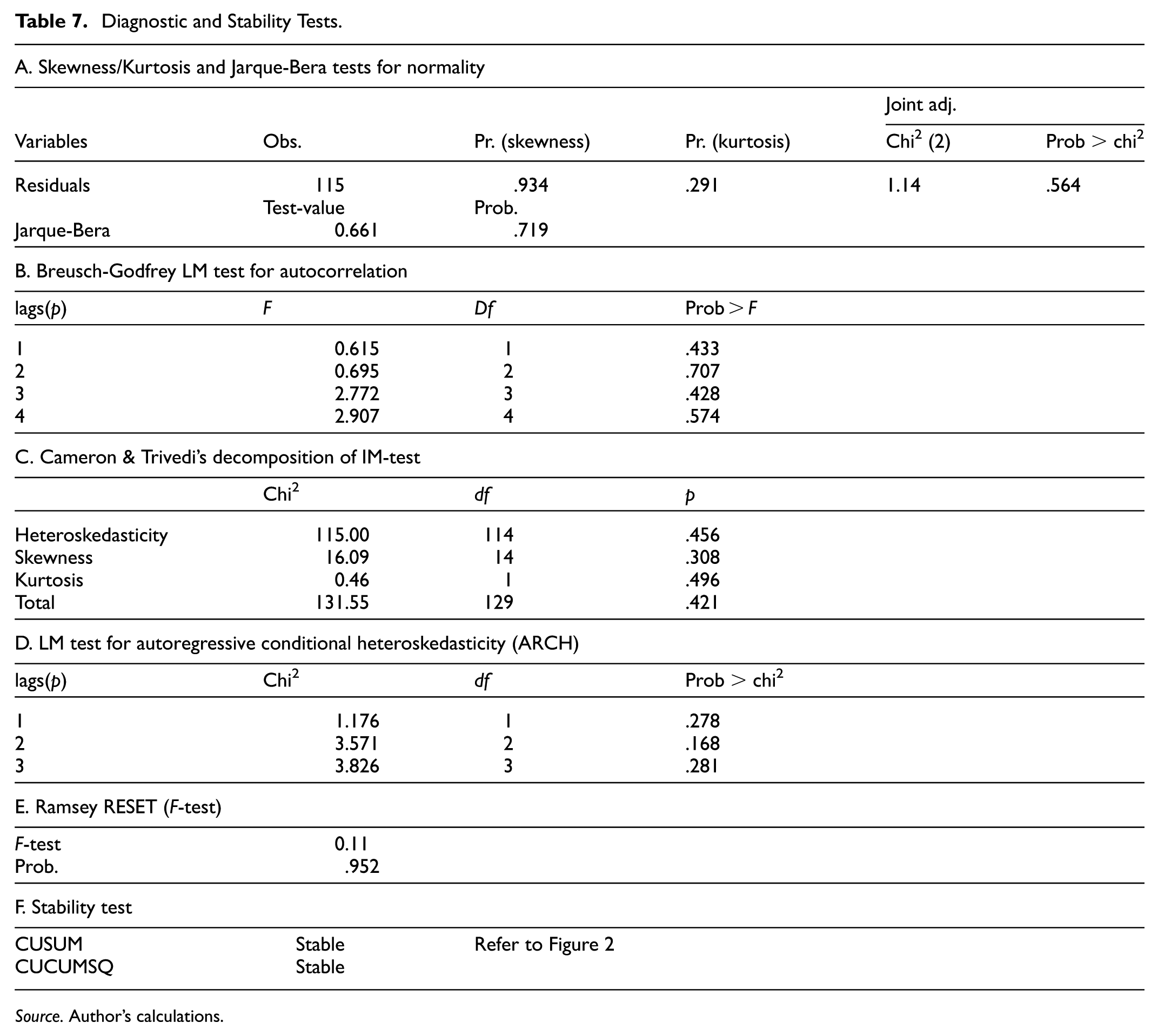
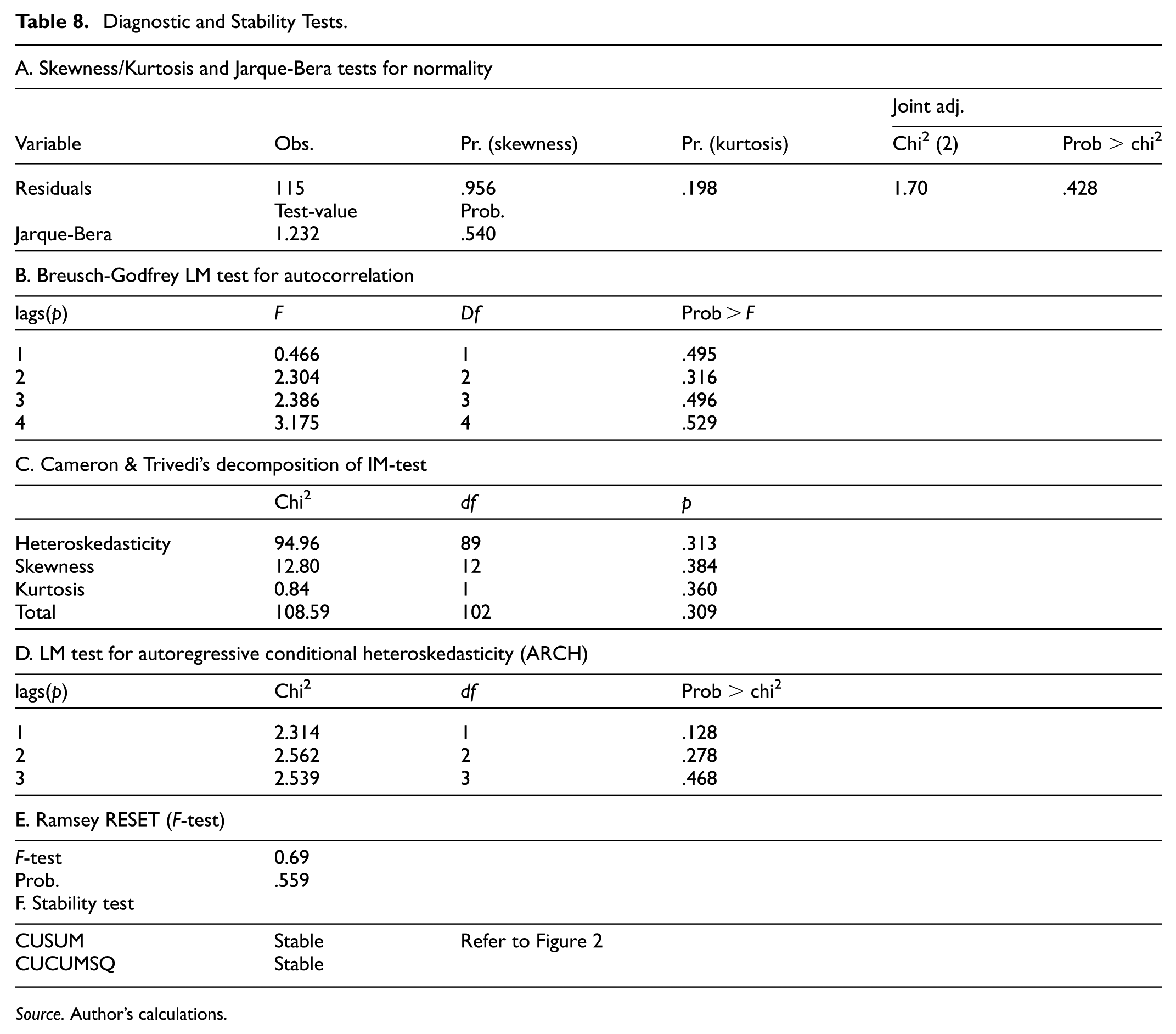
Tables 7 and 8 display the outcomes of diagnostic and stability assessments of the current study computed econometric models. This step is crucial and one of the actions in the current study to guarantee robust results. The Jarque-Bera test evaluates the normality of model residuals, revealing no evidence to reject the null hypothesis of normal distribution. Moreover, the Breusch-Godfrey LM (BG) test finds no autocorrelation within the econometric models’ residuals. The Breusch-Pagan-Godfrey (BPG) and White’s heteroscedasticity (ARCH) assessments authenticate the homoscedasticity of the models’ residuals. The research also implements the Ramsey RESET test to ratify the models’ form. Besides, the Cumulative Sum of Recursive Residuals (CUSUM) and the Cumulative Sum of Squared Recursive Residuals (CUSUMSQ) confirm the stability of the model’s parameters (refer to Figures 2 and 3). These diagnostic and stability tests provide compelling evidence of the robustness of our results, demonstrating that our models adhere to the assumptions of the classical linear regression model. Hence, the application of DARDL is warranted in this study.
Diagnostic and Stability Tests.
Source. Author’s calculations.
Diagnostic and Stability Tests.
Source. Author’s calculations.

The CUSUM and CUSUMSQ of the ARDL model.

A sample of the CUSUM and CUSUMSQ of the sub-sample ARDL model.
Analyzing the Results
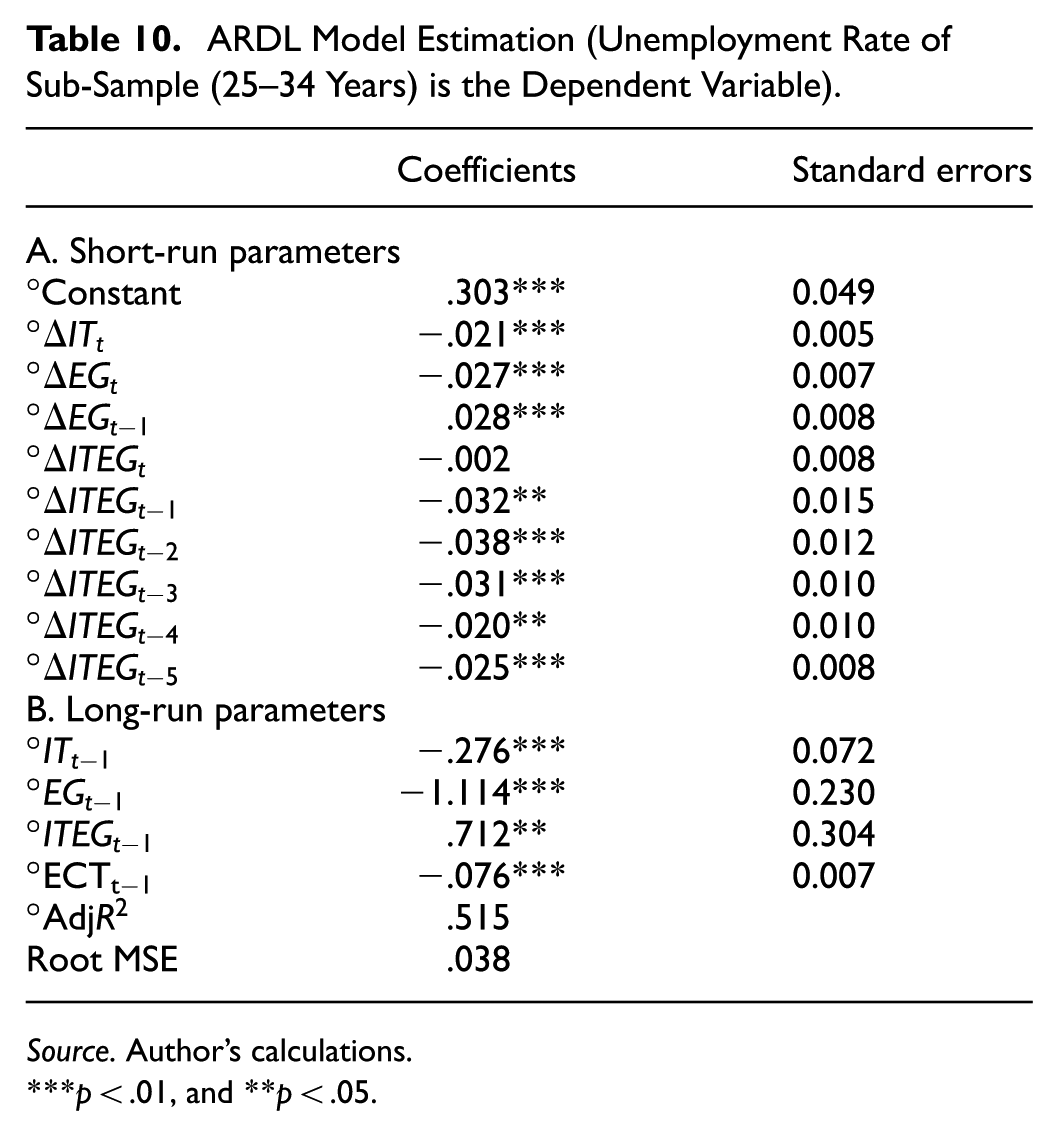
The analysis in this section relies on the findings derived from the ARDL and DARDL models. Tables 9 to 11, and 12 report the estimated parameters of the current study’s models. Besides, Figures 4 and 5 present the effect of a counterfactual shock of each regressor on the two unemployment rates (
ARDL Model Estimation (Unemployment Rate of Full Sample is the Dependent Variable).

Note.***p < .01, **p < .05, and *p < .10.
Source. Author’s calculations.
ARDL Model Estimation (Unemployment Rate of Sub-Sample (25–34 Years) is the Dependent Variable).
Source. Author’s calculations.
p < .01, and **p < .05.
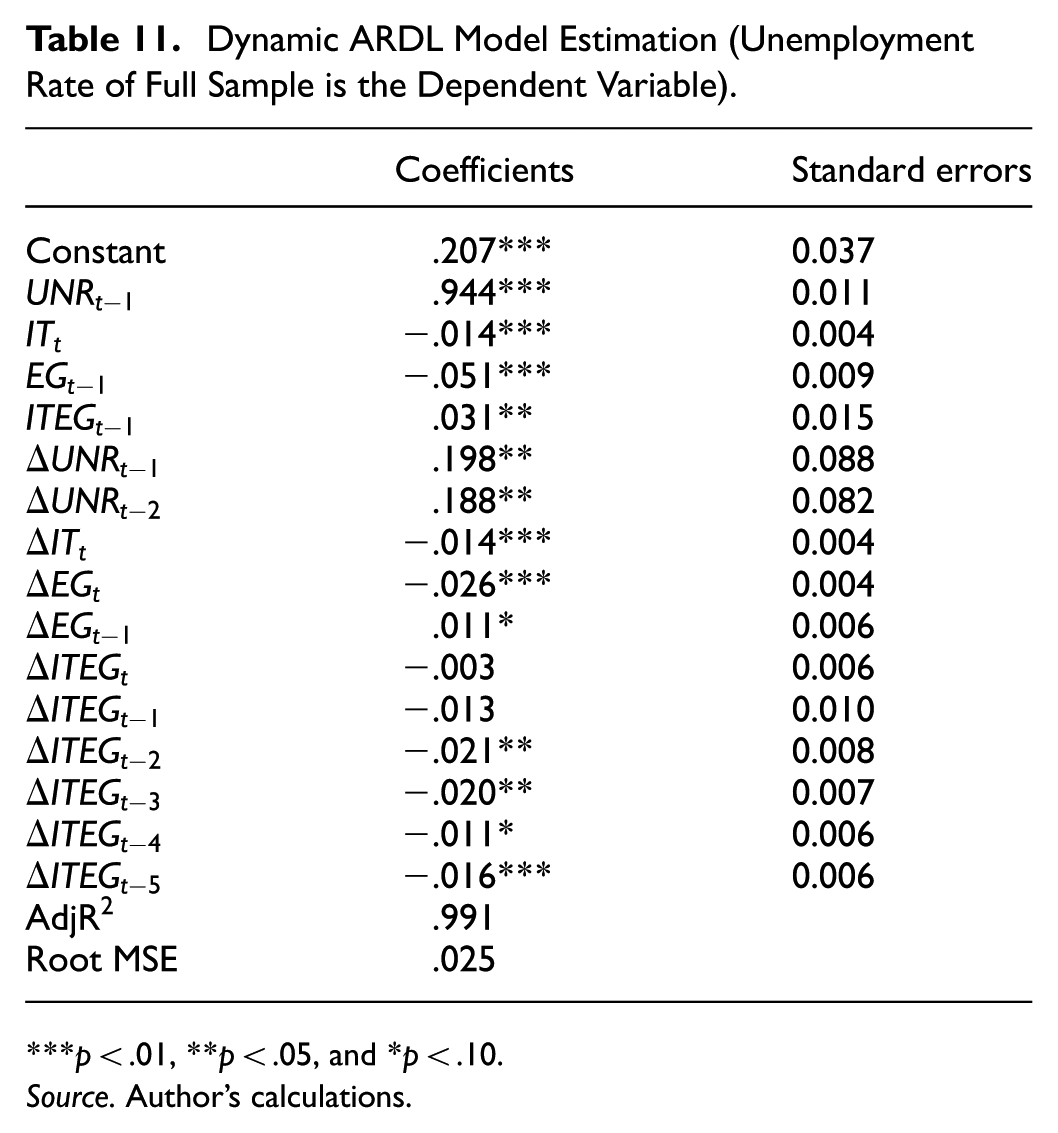
Dynamic ARDL Model Estimation (Unemployment Rate of Full Sample is the Dependent Variable).
p < .01, **p < .05, and *p < .10.
Source. Author’s calculations.
Dynamic ARDL Model Estimation (Unemployment Rate of Sub-Sample (25–34 Years) is the Dependent Variable).

Source. Author’s calculations.
p < .01, and **p < .05.

Counterfactual shocks in

Counterfactual shocks in
Tables 9 and 10 reveal that information technology’s short and long-run effects on the U.S. unemployment rates either for the full sample (
The relationship between information technology and unemployment rate becomes more complex when combined with economic growth. The interaction between information technology and economic growth appears to generate a correcting or hidden force, which reduces or even reverses the direct job-creating impact of information technology under certain conditions. The short-run moderation-term impact on the U.S. unemployment rate is negative and statistically significant. However, this influence turns out to be positive and has the same significance in the long run. Hence, the long-run net negative effect of information technology on the U.S. full sample of unemployment rate becomes smaller and relies on economic growth
The DARDL simulation results in Figures 4a and 5a reveal that a positive one standard-deviation shock to the information technology in the fifth year gradually decreases both unemployment rates from the short to the long run. However, the DARDL simulation outcomes in Figures 4b and 5b demonstrate that a positive one standard-deviation shock to the moderation effect in the fifth year boost gradually both types of unemployment rates from the short to the long run.
Furthermore, the results in Tables 9 and 10 show that economic growth has an instantaneous negative and statistically significant influence on both U.S. unemployment rates in the short run. However, the one lagged effect turns to be positive and statistically significant. This short-run behavior can be explained by many reasons, such as many firms may change their hiring decision based on uncertain macroeconomic signals, and output can rise due to productivity gains, which may cause a temporary rise in unemployment or no change at all. Besides, The ARDL short-run coefficients reflect temporary deviations from equilibrium, while the ECT ensures that the model adjusts back to the long-run relationship. For this reason, economists rely mainly on the ARDL long-run parameters to justify the actual relation among the variables under investigation.
In the long run, this impact turns out to be negative and statistically significant. The consequence of economic growth on the U.S. unemployment rates is expected and consistent with the economic theory because expanding the production level increases the demand for the labor force, and thus, the unemployment rate declines. This finding is consistent with the conclusion of Asravor and Sackey (2023), Mariko and Niare (2024). Similarly, the DARDL simulation conclusions in Figures 4c and 5c demonstrate that a positive one standard-deviation shock to the information technology in the fifth year gradually decreases both unemployment rates from the short to the long run.
The estimated coefficients of the adjustment speed are very slow and roughly between 0.056 and 0.076 in both models. When there is a deviation from equilibrium, around 5% or 7% is corrected in one quarter as the variables move toward restoring the equilibrium of the unemployment rate. In this case, the existence of a long-run equilibrium for the unemployment rate implies reasonable pressures to preserve its long-run equilibrium whenever there is a shock. The slow adjustment speed shows that re-establishing the long-run equilibrium is not easy in the current research model and takes some time. The error correction terms sign, and significance level approve the presence of a long-run Granger causality from information technology and economic growth to the U.S. unemployment rate.
As an additional measure of robustness for our findings, this study employs the FDC test to examine the Granger-causal relationship between our explanatory variables and the dependent variables (
Frequency domain causality results.

Source. Author’s calculations.
Note. The Table reports Wald test statistic and the p-values. The number of used lags is 4.
,b, and c correspond to 1%, 5%, and 10% significance levels, respectively.
In terms of limitations and future research directions, this work has several limitations that offer rooms for future research. First, while the research addresses the shortcomings of earlier studies by using macroeconomic data rather than survey data, it still relies on aggregate indicators that may mask important variations at the firm or industry level. The lack of disaggregated data limits the ability to capture sector-specific or occupation-specific effects of information technology on unemployment. Second, the current analysis is limited to the U.S. economy, which may restrict the relevance of the findings to other countries with different labor market dynamics, technological infrastructures, or economic conditions. Future research could extend this framework to cross-country analyses or compare developed and developing economies to assess the global applicability of the findings. Third, although the study explores the interaction between information technology and economic growth, it does not investigate the role of labor market institutions and automation types. Future studies could incorporate more detailed data on job characteristics, education levels, and automation intensity to improve the understanding of how technology affects unemployment across demographic groups. Additionally, further investigation is also needed into policy dimensions, particularly regarding how nations can effectively build an “invisible hand” in the innovation sector, and whether small or large economies are better positioned to adapt to technological disruptions. Understanding these dynamics could significantly enhance the design of future labor market policies and reskilling strategies.
Conclusions and Policy Implications
Economic theory appraises technological progress in enhancing productivity and growth. However, the recent developments in information technology raise warnings about job displacement and structural shifts. While many empirical studies explored its influence on the employment, findings are mixed; some show job creation, others job loss. A major limitation is data availability, as most studies rely on firm or industry-level data and are based on surveys, which may not capture broader macroeconomic effects or long-term trends accurately.
This study addresses gaps in prior research by examining the relationship between information technology and U.S. unemployment rate using macroeconomic data. It develops a model with three key variables: The S&P U.S. Information Technology Index, economic growth, and their interaction term. To ensure robustness, the model is re-estimated using unemployment data for ages 25 to 34. The analysis applies three methods: the conventional ARDL model, the Dynamic ARDL model, and the frequency domain causality test, offering a comprehensive approach to understanding these relationships.
The current study concludes that U.S. information technology and economic growth reduces directly the U.S. unemployment rate. These results support the idea that information technology’s dominant impact is increasing labor demand. Concurrently, some sectors may have a substitution effect among workers with heterogeneous skills. The positive sign of the interaction term adds a new magnitude to the analysis. It demonstrates that combining information technology and economic growth generates a hidden force to mitigate the direct negative influence of information technology on the U.S. unemployment rates. It implies that the widespread adoption of new information technology with economic growth displaces routine-intensive jobs, leading to a surge in unemployment rates. This means that we cannot ignore the potential rise in the unemployment rate for specific jobs because of information technology. The current results are reliable compared to the previous research findings conducted using surveys.
From a policy implication perspective, exploring this crucial topic from the U.S. macroeconomics perspective generates three dimensions to the policy implications. First, policymakers should continue their efforts to accelerate digital adoption among small and medium enterprises, and enhance technology education pipeline. It can be achieved by various economic policies, such as use grants, low-interest loans, and expand federal support for information technology colleges and majors. Second, the main factor is the flexibility and capability of the economy to adapt to innovations and exploit their benefits. Easy adaptation depends on two factors. (i) the availability of advanced technological infrastructure. (ii) the nation’s ability to develop and apply educational programs on using new technologies. Those two crucial elements should help policymakers manage the transition to the more advanced innovation eras. This discussion opens an important question: Which economies perform better in adapting innovation, large or small? Can nations develop an invisible hand in the innovation sector? Third, we cannot ignore a potential rise in the unemployment rate for specific jobs because of the interaction between information technology and how high economic growth. This requires monitoring the structural unemployment rates to retrain and re-engage the unemployed in the labor market. This step requires to identify carefully the harmed group of workers. Policymakers can address the negative influence of information technology by concentrating on national workforce reskilling strategy, and strengthen unemployment insurance through increased generosity.
Footnotes
Acknowledgements
The author would like to thank the editor and three anonymous referees of

Consent to Participate
This article does not contain any studies with human or animal participants.
Funding
The author received no financial support for the research authorship. The United Arab Emirates University (UAEU) paid the Article Processing Charges (APC) of this study.
Declaration of Conflicting Interests
The author declared no potential conflicts of interest with respect to the research, authorship, and/or publication of this article.
Data Availability Statement
The data used in this research is available upon request.