



Abstract
While entrepreneurship has been extensively studied worldwide, scant empirical research evidence has been found in Vietnam. Building upon the institutional economics perspective, this study empirically investigates the tripartite relationship between formal institutions, entrepreneurial activity, and socio-economic outcomes. A fixed effects model is employed to test the proposed hypotheses using a 5-year strong balanced panel data. The findings indicate that provinces are heterogeneous along multiple dimensions of institutional quality, leading to different entrepreneurial rates. Concurrently, it highlights the vital role of entrepreneurial activity in explaining the differences in economic performance, unemployment rate, and living standards across Vietnam’s regions. The results also confirm that the entrepreneurial rate exerts a mediating effect on the relationship between institutional quality and socio-economic outcomes. This study contributes to the entrepreneurial literature in Vietnam and provides practical implications for Vietnamese policymakers.
Plain Language Summary
This study dives into how government regulations and rules (formal institutions) influence the rise of new businesses (entrepreneurship) in Vietnam. Unlike previous research that examined these factors in isolation, we analyze them collectively for a more comprehensive understanding. Vietnam, being an emerging economy with a vibrant market, has seen a boost in small and medium-sized businesses. However, not much research has delved into the reasons behind why some areas in Vietnam have more new businesses than others. We also want to understand how business formation impacts the local economy, jobs, and people’s living standards in different parts of the country. The empirical analysis is based on five-year panel data (2014–2018) encompassing 63 provinces in Vietnam. Fixed effects regression was employed to test the proposed hypotheses. This study significantly advances our understanding of regional entrepreneurship in Vietnam by providing valuable insights into the impact of formal institutional quality on firm formation. It offers empirical evidence highlighting positive associations between entrepreneurial activity and key socio-economic indicators, including economic performance, unemployment rates, and living standards. Furthermore, the research emphasizes the mediating role of entrepreneurship in connecting formal institutions to socio-economic outcomes, stressing the crucial need to consider institutional conditions in frameworks analyzing the influence of entrepreneurship on economic performance. In essence, this study represents a noteworthy progression in the field of regional entrepreneurship, particularly in emerging economies and developing nations. It also suggests that policies supporting entrepreneurship play a crucial role in many countries and regions by creating a good environment for new businesses, especially in Vietnam.
Introduction
While institutional conditions indirectly link to economic growth, entrepreneurial activity serves as a conduit to connect institutions and economic growth (Aparicio et al., 2016; Urbano et al., 2019). However, little is known about their relationship in a simultaneous framework (Urbano et al., 2019). Additionally, formal institutions have been studied by entrepreneurial scholars in different cultures and diverse aspects at country-level analysis, but there is significant regional heterogeneity in the institution associated with entrepreneurial activity within a country (Bennett, 2021a, 2021b; Tran & Santarelli, 2017). This heterogeneity can create institutional impediments that prevent the market selection mechanism from functioning evenly and adequately across spaces (Tran, 2019). Therefore, it is crucial to understand the local institutional environment and how it affects entrepreneurial activity to promote sustainable economic development.
Entrepreneurship has been widely recognized as a significant factor in promoting sustainable socio-economic development in developed countries and regions (Urbano et al., 2019). Yet, the potential of entrepreneurship to contribute to the sustainable development of socio-economic outcomes in developing or less-developed countries has not been thoroughly investigated (Dhahri & Omri, 2018). Although a few studies have examined this topic, the mixed evidence regarding the contribution of entrepreneurship to economic development (see Prieger et al., 2016; Van Stel et al., 2005) creates major gaps in our understanding of how entrepreneurial activity impacts socio-economic outcomes in developing countries (Hall et al., 2010).
Vietnam is an emerging economy with a dynamic market and plays a critical role in the global supply chain. Since adopting economic reforms in 1986, the government has encouraged and supported small- and medium-sized enterprises (SMEs) in the private sector, significantly increasing entrepreneurial activities. Still, there is relatively moderate empirical research on entrepreneurship in Vietnam despite its growing importance to the community, policymakers, and scholars. Only sparse investigations have been done on factors affecting entrepreneurial intention (Khuong & An, 2016; C. Nguyen, 2018; A. T. Nguyen et al., 2019). In addition, very few empirical studies are interested in how institutional quality affects business performance (Malesky & Taussig, 2009; Tran, 2019; Tran & Santarelli, 2017).
It is important to note that, for the most part, academic studies related to entrepreneurship tend to be dominated by Northern American and Western European countries, even in sub-national regions research. However, it is plausible to argue that the regional entrepreneurship patterns observed in these areas may not be representative of the rest of the world. As a result, there is a research gap in the field of regional entrepreneurship when it comes to emerging economies and developing countries, which requires more attention and research to understand the unique challenges and opportunities that entrepreneurs face in these regions (Sternberg, 2022). Given the significant gaps in the literature regarding the relationship between formal institutional quality, entrepreneurial activity, and socio-economic outcomes, especially at the meso-level analysis, this study aims to provide a more comprehensive and insightful analysis to address these critical issues in Vietnam. The research is thus designed to answer the following questions: Could the divergent entrepreneurial rate across Vietnam be explained by the heterogeneous local institutional quality? Which underlying indicators of the formal institutions are more conducive to entrepreneurial activity that enhances economic performance in Vietnam? Does the entrepreneurial rate exert an effect on regional economic performance, unemployment rate, and living standards of 63 provinces-municipalities (PMs) in Vietnam? How do formal institutions influence socio-economic outcomes through the mediating effect of entrepreneurial rate?
This study makes substantial contributions to our comprehension of regional entrepreneurship within Vietnam. Firstly, it offers valuable insights into the impact of formal institutional quality on firm formation. Additionally, the study presents empirical evidence demonstrating positive associations between entrepreneurial activity and key socio-economic indicators. Moreover, it underscores the mediating role of entrepreneurship in the connection between formal institutions and socio-economic outcomes, emphasizing the critical need to incorporate institutional conditions in frameworks analyzing the influence of entrepreneurship on economic performance. In essence, this research represents a significant advancement in the field of regional entrepreneurship, particularly within the context of emerging economies and developing nations. It demonstrates that entrepreneurial policies have played an essential role in many countries and sub-national regions by shaping a favorable institutional quality that helps promote new business entry rates and firm development (Shukaili et al., 2018).
The rest of this paper is organized as follows. The next section lays the foundation for the development of hypotheses by providing an overview of the literature regarding the relationship between formal institutions, entrepreneurship, and socioeconomic outcomes. Section 3 describes the data sources and research samples, explains how we measure the variables studied and specifies the empirical method used to test our hypotheses. Section 4 presents the findings of our empirical analysis, while Section 5 discusses the results. In section 6, we conclude this research by addressing the limitations and presenting directions for future research.
Literature Review and Hypothesis Development
Institutional Quality and Entrepreneurship
Institutions refer to a set of rules and regulations derived from culture, tradition, or legal systems that either constrain or enable human behaviors and interactions in different spheres of society (Eijdenberg et al., 2019). According to North (1990), the institutional framework for new business creation includes formal institutions (i.e., regulatory procedures and supporting programs) and informal institutions (i.e., social norms and cognitive aspects) (Urbano et al., 2019). Formal institutions have a higher impact on entrepreneurial activity than informal ones due to their shorter change period (Guerrero & Marozau, 2023; Williamson, 2000). They influence entrepreneurial actions and the extent of potential profits entrepreneurs can capture (Boudreaux et al., 2019). Therefore, analyzing formal institutional quality at the local level can provide a more accurate and detailed understanding of how institutions affect economic agents’ outcomes and help policymakers design more effective and targeted approaches to promote economic performance.
Formal institution matters for an individual’s decisions and entry choices. It could simultaneously act as a catalyst to promote more start-up activities and play the gatekeeper role that prevents new entrants. The work of Carlos Díaz Casero et al. (2013) indicates that entrepreneurial activity is beneficial within a more developed institutional quality. Conversely, a weak institution leads entrepreneurs to do fewer projects or forces them to focus more on inefficient operations. Notably, the study of Eijdenberg et al. (2019) points out that both developed and weak formal institutions could constrain and hinder entrepreneurial activity. The developed institutions with constrained regulations force potential entrepreneurs to follow many rules and cumbersome regulations that may prevent their intention to start a new business. In comparison, the inadequate institution can lead to a weak institutional quality, which is accompanied by an ineffective legal system, poorly specified property rights, underdeveloped capital markets, low-skilled labor market, excessive regulatory requirements, and requests for bribery (Li & Atuahene-Gima, 2001; Luo & Junkunc, 2008; Tybout, 2000). However, despite a weak or strong institutional quality within a country, there will be large variations in the quality of institutional governance (i.e., institutional quality) across provinces or states (Bennett, 2021b; Tran, 2019). The heterogeneity in the governance quality of lower-level administrative units, such as provinces or municipal cities, will lead to a difference in the institutional environment among those administrative units within a country (Efendic et al., 2015). Similarly, Webb et al. (2020) advocate that while it is conventional among scholars to study formal institutions at the national level, the robustness of these institutions can vary within a country due to limited means of implementing rules and significant differences in infrastructure across localities. As a result, the discrepancy in institutional quality turns out to be institutional impediments that prevent the market selection mechanism from functioning evenly and adequately across spaces.
While research has extensively examined the connection between institutional quality and cross-countries entrepreneurial activity (Guerrero & Marozau, 2023), there has been a relative lack of investigation at the local level. Studies argue that subnational differences in formal institutions bring on a variety of economic agents (García-Posada & Mora-Sanguinetti, 2015; Stansel & Tuszynski, 2018), especially entrepreneurial activity (Bennett, 2021a, 2021b; Sobel, 2008). For instance, Sobel’s (2008) study found a positive association between institutional quality and entrepreneurship across 48 states in the U.S., demonstrating that states with better institutional quality had higher rates of new business formation, more self-employment, and more venture capital investment. Moreover, Sobel’s study highlighted that the positive relationship between institutional quality and entrepreneurship was stronger in states with higher levels of economic freedom. These findings imply that strong institutions are vital drivers of entrepreneurship and innovation. Bennett (2021a) also found a positive correlation between formal institutions, measured by the economic freedom index, and the rate of new firm entry across U.S. cities from 1972 to 2012. Furthering this research, Bennett (2021b) used nine underlying institutional variables of the economic freedom index to explore how the variation in local institutional quality across the United States influences firm entry and exit rates. The study revealed that higher institutional quality is associated with higher firm entry rates and lower firm exit rates, suggesting that formal institutions play a crucial role in promoting entrepreneurial activity and business sustainability. Nevertheless, these studies have mainly focused on developed countries with strong and established institutional quality, such as the United States. However, the regional entrepreneurship patterns observed in these areas may not be representative of the rest of the world. A significant research gap in regional entrepreneurship for emerging economies and developing countries requires more attention (Sternberg, 2022).
Research has shown that in weak institutional countries, such as Vietnam, there is a positive association between institutional governance quality and the form or performance of new businesses. Malesky and Taussig (2009) found that improvements in provincial institutions make Vietnamese entrepreneurs more likely to choose to operate as a formal company at the start of their business ventures. This is because better institutions provide greater protection for property rights, lower transaction costs, and a more stable business environment. Similarly, Tran (2019) demonstrated that improving institutional quality paves the way for new entrants as measured by firm age and improves the performance of new entrants compared to incumbents. While Tran and Santarelli’s (2017) study emphasized the importance of geographic conditions and industry structural variables in promoting entrepreneurial activity in Vietnam, their article did not focus on the influence of spatial institutions in fostering new businesses. There is ample room to explore the sub-national variation in institutional quality and entrepreneurial activity development within Vietnam. This study aims to fill that gap by providing better insights into the relationship between formal institutional quality and new firm formation at the subnational level. By doing so, this study will contribute to the growing literature on the significance of institutions in promoting entrepreneurial activity in weak institutional countries like Vietnam. Therefore, we hypothesize that:
H1: The better the local institutional quality is, the higher the entrepreneurship rate in that region will be.
Entrepreneurship and Socio-Economic Outcomes
Entrepreneurship has been widely recognized as a significant contributor to economic growth, particularly in developed countries like Germany, Belgium, Spain, Sweden, Canada, the United States, and European countries (Audretsch & Keilbach, 2008; González-Pernía & Peña-Legazkue, 2015; Noseleit, 2013). Policymakers in developing countries recognize the importance of entrepreneurship for economic development, given the empirical evidence supporting its role in Western countries (Dhaliwal, 2016). However, the relationship between entrepreneurship and economic performance in developing countries remains a topic of debate. While some studies, such as Prieger et al. (2016), suggest a positive impact of entrepreneurship on economic growth in low- and middle-income countries, others, including Van Stel et al. (2005), report a negative relationship in relatively poor countries. The mixed results suggest the need for further investigation in the context of developing countries (Urbano et al., 2019). Therefore, it is crucial to gain a better understanding of the relationship between entrepreneurship and economic performance in the context of developing countries, which is the focus of this study.
Recent research has highlighted the complex relationship between entrepreneurship and economic development, which varies depending on the specific context and characteristics of the economy (Dhaliwal, 2016; Naudé, 2010, 2011). In particular, Dhaliwal (2016) emphasizes the importance of material resources, business climate, and institutional quality for the impact of entrepreneurship on economic development. Naudé’s studies (2010, 2011) suggest that start-up activity can contribute to economic growth in developing countries, especially when there is a high demand for entrepreneurship to address market gaps or social issues. Given Vietnam’s unique market characteristics, business culture, and institutional quality, it is crucial to investigate the relationship between entrepreneurship and economic development in this specific context. Thus, this paper aims to contribute to understanding this relationship in Vietnam and provide insights for policymakers to foster economic development through entrepreneurship. We hypothesize that:
H2: The higher the entrepreneurship rate, the better economic performance in that region.
The rising unemployment rate, particularly among the educated workforce, is a persistent problem in underdeveloped countries. It is believed that entrepreneurial activity not only contributes to economic development but also has a significant impact on social issues, particularly in reducing the unemployment rate (Ughulu, 2022). However, not all scholars agree on the extent to which entrepreneurship can effectively address unemployment in developing countries. Some argue that the effects of entrepreneurship on employment are often overstated and can sometimes exacerbate existing inequalities. For instance, Sengupta et al. (2016) argue that entrepreneurship may not be an effective solution to the issue of unemployment in developing countries, as it tends to create low-quality jobs with low pay and poor working conditions. Furthermore, entrepreneurship may also contribute to the “brain drain” phenomenon, in which highly skilled workers leave their homes to seek opportunities elsewhere. While entrepreneurship can create jobs, it may not necessarily retain highly qualified individuals, leading to a loss of human capital for developing countries (Mazzarol & Reboud, 2018). Kum and Karacaoğlu (2012) conducted a study on the relationship between entrepreneurship and unemployment in Turkey and found that the two were not interrelated. They suggested that this may be because of the difficulties faced by new entrepreneurs in starting a business, including lack of expertise, market research, technological support, qualified human resources, and marketing and advertising.
On the other hand, McKeever et al. (2015) argue that business founders create value through their businesses and participate in various activities that address social and economic issues such as unemployment, training workers, and emigration. Furthermore, Abdesselam et al. (2018) demonstrate that high-quality start-ups can have a broader impact in mitigating the unemployment rate. These findings are consistent with Acs’s (2006) argument that self-employment can replace unemployment, leading to a relatively low unemployment rate in developed countries with a high share of self-employment. Similarly, Wennekers (2006) has found evidence of a negative relationship between the unemployment rate and entrepreneurial activity in the European context. Moreover, start-ups and their fast-growing demand have opened job opportunities for many unemployed workers (Van Stel & Storey, 2004). Entrepreneurs contribute to solving the unemployment situation by providing job opportunities directly and indirectly. They directly employ themselves as entrepreneurs and indirectly create large-scale employment opportunities by starting many projects or industrial units (Dhaliwal, 2016). Given the conflicting arguments on the relationship between entrepreneurship and unemployment, this study aims to test the hypothesis that there is a negative relationship between the entrepreneurship rate and the level of unemployment in a given region.
H3: The higher the entrepreneurship rate is, the lower the degree of unemployment in that region.
Entrepreneurship has been widely recognized as a crucial driver of economic performance. By identifying and exploiting market opportunities, entrepreneurs create wealth and increase the income of the people (Dhaliwal, 2016). Moreover, start-up ventures often leverage the latest technologies to produce a wide range of goods and services on a large scale at a lower cost than incumbents. This, in turn, makes it possible for people to consume better quality goods and services at lower prices, improving their living standards (Ughulu, 2022).
However, the findings of empirical studies on the relationship between entrepreneurship and living standards remain ambiguous. Some scholars argue that entrepreneurship can help reduce income inequality by creating job opportunities and increasing income (Foss & Klein, 2012). Others argue that entrepreneurship can exacerbate income inequality by favoring certain individuals with greater access to resources and networks (Le et al., 2018). Bosma et al. (2018) note that prior studies have found strong positive effects in the relationship between entrepreneurship and income, with a moderate impact on the quality of the institutional setting. Also, Cebula et al. (2016) have found that entrepreneurial activity leads to higher growth rates in the standard of living measured by per capita income. Still, El Harbi and Grolleau (2012) have reported a negative effect of self-employment on per capita income. These findings have cast doubts on entrepreneurship’s role in increasing income per capita. Therefore, there is still a gap in the literature, and further empirical studies are needed to fully understand the complex relationship between entrepreneurship and living standards. Accordingly, we hypothesize that:
H4: The higher the rate of entrepreneurial activity, the better the degree of living standards in that region will be.
The Mediating Effect of Entrepreneurship on Formal Institutions and Socio-Economic Outcomes
While past research has examined the institutional factors behind entrepreneurship and their impact on economic performance, little is known about the indirect impact of institutions on economic development through entrepreneurship (Urbano et al., 2019). By adopting a simultaneity approach that considers entrepreneurship as a conduit between institutions and socio-economic outcomes within the same framework, we can better understand the complex system involved in the interplay between these three variables. This approach not only corrects statistical bias but also assesses the effectiveness of policies on economic development by generating more entrepreneurial activity (Urbano et al., 2019).
Scholars suggested that institutions could affect economic performance in an indirect way rather than through a direct effect (Acemoglu et al., 2014; Baumol, 1990; Rodrik, 2003). Notably, Rodrik’s (2003) findings suggest that while institutions may not directly impact aggregate output or growth rates of per-capita income, they play a crucial role in shaping the underlying endogenous factors that drive economic development, such as resource endowment and productivity. This implies that strong institutions are critical for achieving sustainable economic performance in the long run, as they provide the necessary conditions for fostering productivity gains, efficient resource allocation, and innovation. Baumol and Strom’s (2007) argument highlights institutions’ crucial role in shaping the entrepreneurial environment and, ultimately, economic performance. This is because effective institutions can provide the necessary support for entrepreneurial activity by reducing entry barriers, providing access to finance and resources, protecting property rights, and promoting innovation. They suggest that a conducive institutional framework can foster a higher level and quality of entrepreneurship, which is essential for sustainable economic performance.
From another perspective, scholars such as Audretsch and Keilbach (2008) and Urbano and Aparicio (2016) found that the rate of entrepreneurship capital positively affects economic performance. At the same time, they claim that more studies are needed to understand better how entrepreneurship capital serves as a conduit into society for the institutional context that impacts productive behavior such as entrepreneurship activity. The key findings emerged from previous studies that institutional quality, in addition to influencing the traditional inputs such as human capital, physical capital, and knowledge, also shapes human behaviors such as entrepreneurship that generate economic dynamics. Bjørnskov and Foss (2016) and Terjesen et al. (2016) have made a compelling argument regarding the critical role of institutions in shaping the entrepreneurial environment and its impact on economic growth. Their work denotes that understanding how institutions affect entrepreneurial activity is essential in identifying the interplay between entrepreneurship and economic performance in different institutional contexts. This highlights the importance of developing effective institutional frameworks that can facilitate entrepreneurial activity, as it has the potential to generate positive spillovers for the broader economy. The work of Aparicio et al. (2016) provides compelling empirical evidence supporting the critical role of institutions in shaping the entrepreneurial environment and its impact on economic growth. Specifically, their study highlights the complex interplay between institutional context, entrepreneurship, and economic performance, indicating that a conducive institutional framework can promote entrepreneurial activity, which drives economic performance. This finding underscores the importance of effective institutions in creating an environment that fosters entrepreneurship and promotes long-term economic success. However, extant research on the relationships among institutions/economic policy, entrepreneurship, and macroeconomic performance has focused on macro variables only, typically cross-country or cross-state variation within the United States (Bjørnskov & Foss, 2016). Although Amorós et al. (2012) and Terjesen and Amorós (2010) linked institutions to the stage of economic development in order to explain entrepreneurial activity in emerging economies, they still leave space to keep exploring the differentiated impact of institutions on entrepreneurship and this factor on economic development. Thus, we hypothesize as follows.
H5: Entrepreneurial rate mediates the positive relationship between the formal institutions and socio-economic outcomes regarding (a) regional economic performance and (b) living standards while mediating the negative effect of formal institutions on (c) the unemployment rate.
Figure 1 illustrates the relationships between the proposed hypotheses in this Study. Notably, the entrepreneurial rate is affected by the institutional environment managed by provincial governments and is mediating in connecting the institutional environment to socio-economic outcomes.
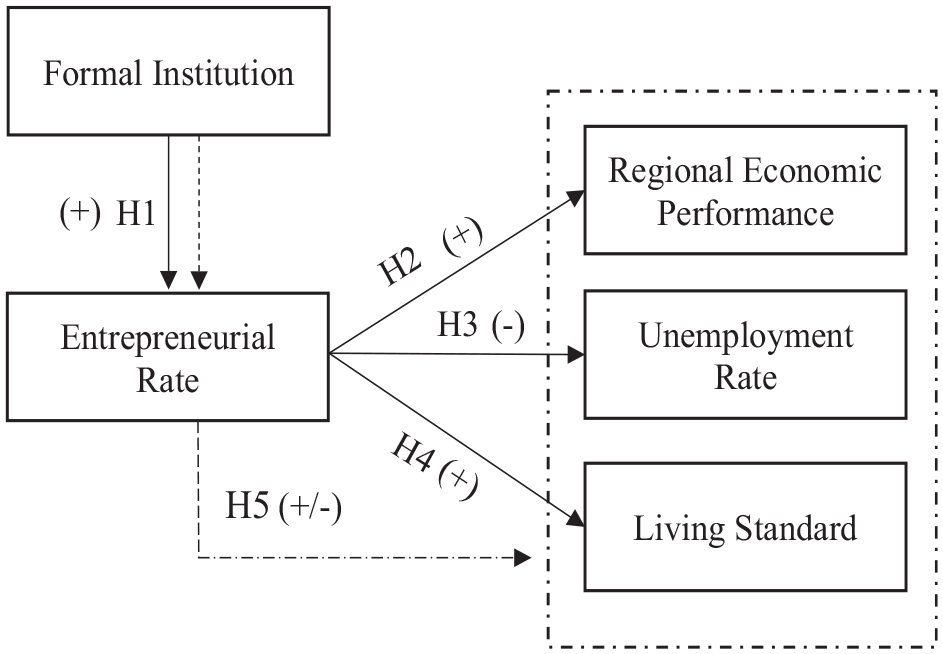
Hypothetical model of formal institution, entrepreneurship, and socio-economic outcomes in this study.
Methodology
Data Sources
The empirical analysis relies on 5-year panel data (2014–2018) sourced from the White Book on Vietnamese Enterprises 2019, the Statistical Yearbook of Vietnam, the Statistical Yearbook of Vietnam’s Provinces, and the Provincial Competitiveness Index (PCI). These datasets offer a comprehensive understanding of studied variables across 63 provinces in Vietnam. The White Book on Vietnamese Enterprises 2019, published annually by the Ministry of Planning and Investment of Vietnam, provides data on new business registrations. The Statistical Yearbook of Vietnam and the Statistical Yearbook of Vietnam’s Provinces, both annual publications by the General Statistics Office of Vietnam, offer a wide range of statistical information on various aspects of the country. They encompass data on population density, working age population, trained labor, provincial status, gross regional domestic product per capita, employment rate, and living standards. Lastly, the PCI index, a collaboration work between the Vietnam Chamber of Commerce and Industry and the United States Agency for International Development (USAID), assesses provincial institutional quality, focusing on business formation regulations, the ease of doing business, and the quality of economic governance across Vietnam’s provinces and municipalities. Many studies have adopted it to measure Vietnam’s institutional quality, such as Malesky and Taussig (2009), Tran (2019), and B. Nguyen (2020). The analysis covers the period from 2014 to 2018, aligning with the available data from the Statistical Yearbook of Vietnam’s Provinces.
Measures
Entrepreneurial rate (ER) is quantified as a percentage, determined by the density of new entries, representing the number of newly registered formal businesses per 1,000 residents aged 15 to 64 in each unit annually (Autio & Fu, 2015; Carbonara et al., 2016).
The PCI index is utilized to gage the quality of formal institutions, with studies emphasizing the significance of provincial-level institutional conditions for business in Vietnam (Malesky & Taussig, 2009; Meyer & Nguyen, 2005). A higher PCI score corresponds to a more favorable institutional environment within a province.
This study investigates the impact of entrepreneurship on key socio-economic indicators, including economic performance, unemployment rate, and living standards (Castaño et al., 2016b; Cebula et al., 2016; Dhahri & Omri, 2018; Roskruge et al., 2016). Economic performance is evaluated using per capita gross regional domestic product at constant 2010 prices (Million VND). The unemployment rate (UR), expressed as a percentage, is calculated by dividing the total number of unemployed individuals by the working-age population. Living standards are assessed through per capita monthly average income (Million VND), derived by dividing the total household income in a given year by the average headcount over 12 months.
The analysis incorporates additional control variables related to socioeconomic conditions influencing firm formation, including employees trained (TL), population density (PD), and provincial city status. Research has shown that higher population density encourages entrepreneurial activity (Di Addario & Vuri, 2010; Sato et al., 2012), and having a trained local workforce is a significant factor in investment decision-making for new ventures (Costa & Mata, 2021; Doms et al., 2010). Employees trained (TL) is quantified as the percentage of individuals aged 15 and above who have received training. Population density (PD) denotes the number of people in an area relative to its size (persons/km2). Finally, a dummy variable is included to account for provincial city status, with five major cities coded as one (Ha Noi, Ho Chi Minh, Da Nang, Can Tho, and Hai Phong) and the remaining provinces coded as zero. Detailed descriptions of the measured variables are available in Table 1.
Variable Measurement.

Model Specification
The hypothetical framework is analyzed based on the estimation of the following equations corresponding to the institutional quality antecedent and outcomes of entrepreneurial activity.




In equation (1), the dependent variable−ER i,t stands for the entrepreneurial rate indicated by province or municipality i in year t. The explanatory variable of institutional conditions of province i in year t−1 is denoted by FIi,t−1. Control variables of trained employed labor and population density of province i in year t−1 are denoted by TLi,t−1 and PDi,t−1, respectively. Regarding outcome variables, EP i,t in the second equation stands for per capita gross regional domestic product, which is a measure of the economic performance of province i in year I. UR i,t in the third equation stands for the unemployment rate of province i in year t, while LS i,t in the fourth equation stands for per capita provincial monthly average income measured living standards of province i in year t. u i , v i , z i , and n i is the random error term. Parameters γ, λ, α, and ε denote the vector of the coefficient to be estimated. Lagging explanatory variables by one period is a common econometric technique used to address potential endogeneity issues in regression analysis (Bellemare et al., 2017). By introducing a lag, we aim to capture the past values of the explanatory variables, which may have a causal influence on the current values of both the dependent and independent variables. In our study, variables such as trained employed labor, population density, institutional conditions, and entrepreneurial rate may be influenced by past economic conditions or policy changes. The inclusion of lagged variables allows us to more effectively isolate the genuine causal relationships among the variables of interest, thereby improving the validity and reliability of our econometric model. This method strengthens the analysis of the factors influencing entrepreneurial activity and its subsequent impact on diverse socio-economic outcomes. Additionally, it safeguards against potential issues of reverse causality or feedback effects, which could otherwise introduce biases into our estimates.
The final dataset is a strongly balanced panel where all the cross-sectional units have data for all time periods (Hill et al., 2007). As in our case, 63 provinces and municipalities spread over the 5-year data set. This completeness is important for econometric techniques. It ensures that the data is not missing for any unit or time period, which can be crucial for drawing valid conclusions and making reliable inferences in panel data analysis. We conducted the Hausman (1978) test to determine whether fixed effects or random effects estimator is more appropriate for our estimated equation. The null hypothesis of the Hausman test is that the random effects model is consistent and efficient, while the fixed effects model is inconsistent. The result shows that the Prob>chi2 is significant (at a 0.1% significance level). This means that there is strong evidence to reject the null hypothesis. It indicates that employing fixed effects is a more suitable approach than random effects for the panel analysis in this study.
Fixed effects in panel data analysis serve to account for unobserved time-invariant heterogeneity at the individual or entity level. Their inclusion enables the isolation of the impact of time-varying independent variables on the dependent variable within each entity, allowing for the identification of causal relationships in the presence of potential bias from unobserved, time-invariant factors. Fixed effects are particularly valuable in mitigating omitted variable bias arising from unobservable individual-level characteristics, and they effectively address selection bias by focusing on within-entity variations over time. Therefore, the four equations in the analysis will utilize fixed effects regression. Each equation examines specific aspects of the underlying relationships between the variables, and together, they provide a comprehensive understanding of the first four hypotheses under investigation. For the last hypothesis (H5), we applied Baron and Kenny’s (1986) method for mediation because it is a well-established and widely recognized approach for exploring mediating effects in statistical analysis. This approach ensures a thorough and systematic examination of the mediating effect, ultimately bolstering the validity and robustness of our findings.
Finally, because our dummy control variable (i.e., Provincial Status) is constant over time, it is not added to the fixed effects model but will be captured by γ0, λ0, α0, and ε0 in estimated equations (Allison, 2009). In practical terms, absorption of the dummy variable into the intercepts ensures that the model accounts for and controls for individual-specific attributes that remain constant over time, thereby isolating the effects of the variables of interest that do change over time. This is especially important in panel data analysis when there may be unobserved factors unique to each individual or entity that could otherwise bias the estimates.
Results
The summary statistics for studied variables in Table 2 illustrate a steady increase in ER over the years in Vietnam, averaging 12.5 new enterprises per 1,000 working-age individuals from 2014 to 2018. Regional disparities in entrepreneurial rate are apparent, highlighting a notable contrast between provinces and municipalities. The data also underscores room for improvement in FI, with scores averaging around 70 out of 100, indicating persistent challenges in the institutional environment. Furthermore, variables like local EP and PD exhibit substantial variations, signaling uneven economic distribution and population density across regions. The increasing percentage of TL reflects ongoing efforts to cultivate a skilled workforce, while the average UR hovers around 2%, albeit some provinces experience higher rates. Despite yearly increases, the LS remains relatively modest, showcasing significant disparities between the maximum and minimum values. The data of PS indicates that provinces constitute the majority of the observed sample, as Vietnam has only five centrally-run cities, including Ha Noi, HCM City, Hai Phong, Da Nang, and Can Tho, out of a total of 63 administrative regions.
Descriptive Statistics of Variables.

Table 3 shows the pairwise correlations where most variables positively correlated with the ER at a 5% significance level. However, these correlations are only at the level of moderate and weak, as their relative coefficients are below the value of 0.6. We also computed the variance inflation factor (VIF) scores for all study variables to ensure the multicollinearity issues. The result points out that none of the VIF scores exceeds the value of 10 VIF. The maximum inflation factor score is 3.48 for corruption, which provides evidence of no multicollinearity between variables included in the study (Bowerman & O’Connell, 1990).
Pairwise Correlation Matrix.

Note.*Correlation is significant at the .05 level.
The estimation results for the hypothetical model are presented in Table 4. All equation models exhibit high statistical significance, with p-values of the F-test associated with the R-squared well below 0.01. It indicates a strong overall good fit to the data, making it highly improbable that the model results from chance. Consequently, we confidently reject the null hypothesis, which sugegests no predictive relationship between independent and dependent variables. Furthermore, the relatively high R-squared values in Models 1 and 4 affirm that the independent variables in the model can account for a large proportion of the variation in the dependent variable. In contrast, Models 2 and 3, with lower R-squared values, suggest a smaller effect of all independent variables on dependent ones.
Formal Institutions, Entrepreneurial Rate, and Socio-economic Outcomes in Vietnam’s Provinces and Municipalities.
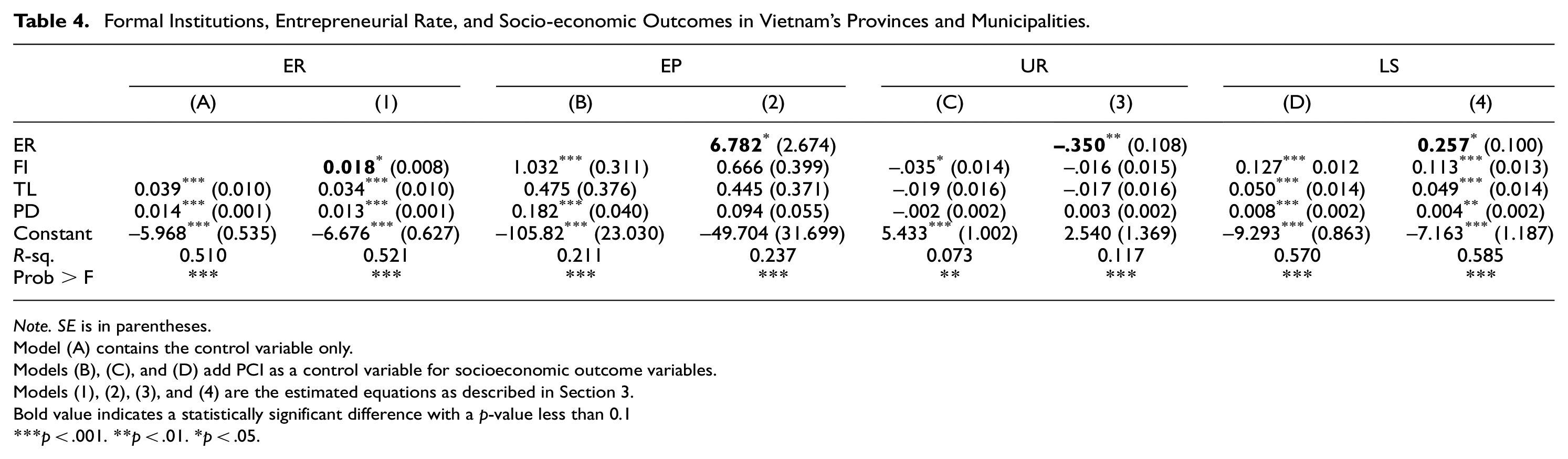
Note. SE is in parentheses.
Model (A) contains the control variable only.
Models (B), (C), and (D) add PCI as a control variable for socioeconomic outcome variables.
Models (1), (2), (3), and (4) are the estimated equations as described in Section 3.
Bold value indicates a statistically significant difference with a p-value less than 0.1
p < .001. **p < .01. *p < .05.
Based on Table 4, we observe a statistically significant positive relationship between FI and ER in Model 1 (p < .05). The coefficient indicates that, on average, an increase of one unit in FI corresponds to a 0.018 units (1.8%) increase in ER, holding other factors constant. In practical terms, a 10-point increase in FI score is associated with approximately two new start-ups per 1,000 working-age population in a province or municipality. This finding supports hypothesis H1 and aligns with previous research demonstrating that improved formal institutional quality fosters increased startup activity (Aparicio et al., 2016; Bennett, 2021a; Estrin et al., 2013).
Concerning the regional economic performance, Model 2 in Table 4 shows a positive and statistically significant relationship between ER and EP at the 5% level. The coefficient (
We also confirm a negative effect of ER on UR, supporting hypothesis H3. In contrast to El Harbi and Grolleau’s (2012) findings, our study reveals a negative and statistically significant association between ER and UR (α = −.350; p < .01). Specifically, a 1% increase in entrepreneurial rate per 1,000 working-age population is linked to a 35% reduction in the unemployment rate within a province or municipality. This finding aligns with our initial expectations and broader research (Abdesselam et al., 2018; Acs, 2006; McKeever et al., 2015; Wennekers, 2006).
Our empirical test further confirms the relationship between ER and LS at a 5% significance level. Holding all other variables in model 4 constant, a 1-unit increase in ER corresponds to a 0.257 points increase in MAIp (
In investigating the mediating effect of entrepreneurial activity, we applied Baron and Kenny’s Method for Mediation. As outlined by Baron and Kenny (1986), mediation is established when three simultaneous conditions are met: (1) the independent variable significantly influences the dependent variable, (2) the independent variable significantly affects the mediator, and (3) the mediator significantly influences the dependent variable (with both the independent variable and mediator as predictors). Complete mediation occurs when the independent variable no longer affects the dependent variable after controlling for the mediator, and all three conditions are met. In contrast, partial mediation occurs when the independent variable’s influence on the dependent variable is reduced after accounting for the mediator. Following Baron and Kenny’s (1986) method, we found evidence supporting the mediating effect of entrepreneurial rate on the relationship between formal institutions and socio-economic variables.
Specifically, in Table 4, we observe significant impact of FI on EP (
Discussion
Theoretical Implications
This study contributes to the existing literature by providing empirical evidence to fill three significant gaps. Firstly, it demonstrates that regional heterogeneity in formal institutional conditions influences entrepreneurship rates within a developing country, an aspect often overlooked in institutional theory-led entrepreneurial research. The findings support the positive role of local institutional quality in entrepreneurship, which has been predominantly explored in developed countries (Bennett, 2021a, 2021b; García-Posada & Mora-Sanguinetti, 2015; Sobel, 2008; Stansel & Tuszynski, 2018). Our findings support the argument made by Efendic et al. (2015) that differences in the quality of governance at the lower-level administrative units result in variations in institutional environments among those units within a country. Similar to Bennett’s (2021a), our study identified a positive relationship between local institutional quality and the rate of new firm entry throughout Vietnam.
Secondly, the study affirms the vital role of entrepreneurship in enhancing regional economic performance, improving living standards, and reducing unemployment rates in Vietnam. This finding contrasts with some prior research in developing countries, providing evidence of the positive effect of entrepreneurship on regional economic development in a specific context (Prieger et al., 2016; Van Stel et al., 2005). Moreover, the study highlights the positive impact of entrepreneurship on social aspects like the unemployment rate and living standards, supporting valuable insights from previous research (Abdesselam et al., 2018; Acs, 2006; Bosma et al., 2018; Cebula et al., 2016). Overall, a higher rate of start-ups in Vietnam can lead to a more dynamic and diversified economy. By introducing new products, services, and business models, entrepreneurship can help create new markets and increase competitiveness, contributing to the country’s overall economic development. Also, entrepreneurship can create new job opportunities, which can help reduce the country’s unemployment rate. With more people employed, they can contribute to the economy and support themselves and their families, leading to a higher standard of living.
Lastly, this present study reveals the role of entrepreneurship as a conduit of formal institutional quality to socio-economic outcomes, a relationship rarely explored within a single research framework (Urbano et al., 2019). The presence of entrepreneurship as a mediating variable suggests that it mitigates or entirely alters the impact of institutional quality on socio-economic variables. This underscores the significance of government governance quality with a regional focus on fostering new firms, creating employment opportunities, and generating revenue for specific regions (Sternberg, 2022). Overall, the findings complement entrepreneurial and economic literature in developing countries that entrepreneurship significantly contributes to the socio-economic development of various administrative units within a nation thanks to favorable institutional conditions.
Practical Implications
This research furnishes practical recommendations for policymakers, emphasizing entrepreneurship’s pivotal role as a conduit for formal institutional quality driving socio-economic development. Policymakers should holistically address all three aspects to craft more comprehensive and efficacious regional development policies. In Vietnam, the disparities in development among provinces have been exacerbated by the COVID-19 pandemic, leading to challenges such as job loss, income decline, and health crises, especially in densely populated economic hubs. These policies can help tackle the complex issue of urban-to-rural migration triggered by the pandemic and its aftermath.
Fostering entrepreneurship is crucial at both the provincial and municipal levels, as it significantly contributes to socio-economic development. Entrepreneurs identify market opportunities and cater to consumer needs, creating value and generating local prosperity which in turn, spurs economic performance. Moreover, entrepreneurship plays a pivotal role in addressing unemployment concerns, providing income for entrepreneurs and employment opportunities for others. Additionally, a thriving entrepreneurial ecosystem boosts the demand for labor, resulting in competitive salary adjustments, especially for highly qualified and skilled workers. This increase in income subsequently enhances overall living standards. Encouraging entrepreneurship aligns with market dynamics, offering an effective means to improve living standards while mitigating potential negative effects associated with direct government-led minimum wage adjustments.
This study advances our comprehension of how local institutions impact entrepreneurial rates. It offers valuable insights into the distinct challenges and opportunities encountered by entrepreneurs in various regions, aiding in the identification of potential strategies to bolster entrepreneurship in these areas. Local institutional quality refers to the effectiveness of the legal and administrative systems at the lower administrative level. In those provinces and municipalities that have formal institutional quality is high, it is easier for entrepreneurs to start and operate their businesses, as the rules and regulations are clear, predictable, and enforceable. In contrast, when formal institutional quality is low, entrepreneurs may face higher transaction costs, corruption, and uncertainty, making navigating the business environment more challenging. This can lead to a lower rate of entrepreneurship in the region.
Policymakers can use the FI index as a tool to adjust and improve the efficiency of economic governance that would encourage local start-up activity, which in turn contributes to the development of socio-economics. A strong formal institutional environment, encompassing factors like reduced entry costs, secure land access, transparent business information, streamlined regulatory compliance, minimal informal charges, unbiased treatment of state-owned and private sectors, proactive provincial leadership, comprehensive business development services, efficient labor training and matching, and a high level of trust in legal institutions, significantly augments the likelihood of individuals channeling their resources into entrepreneurial pursuits within a given province or municipality. This favorable environment fosters an atmosphere conducive to entrepreneurial activity and investment.
Conclusion
This paper aims to provide important insights into how formal institutional quality influences the ratio of firm formation, which in turn could lead to the enhancement of socio-economic conditions at the subnational level analysis. We conduct empirical research to test five main hypotheses: (1) the divergence exists between entrepreneurial activity across geographic areas in Vietnam, which suggests the impact of the institutional quality. This divergence explains the disparity in (2) economic performance, (3) unemployment rate, (4) living standards of those regions, and (5) the mediating role of entrepreneurship in the relationship between formal institutions and socio-economic outcomes.
The study makes some notable contributions. Firstly, it offers valuable insights into how formal institutional quality impacts the ratio of firm formation and the potential for entrepreneurship to enhance socio-economic conditions at the subnational level in Vietnam. Secondly, the study provides empirical evidence that supports the link between regional institutional quality and entrepreneurial activity. It demonstrates the positive relationship between entrepreneurship and socio-economic indicators, including regional economic performance, unemployment, and living standards. Additionally, the study highlights the mediating role of entrepreneurship in the relationship between formal institutions and socio-economic outcomes, underscoring the need to include institutional conditions in frameworks that seek to understand entrepreneurship’s role in economic performance. Overall, the study contributes significantly to the literature on regional entrepreneurship, particularly in the context of emerging economies and developing countries.
Several limitations should be addressed in further studies. The first issue is about the available data. While we had access to several data sources, we acknowledge that there were limitations in terms of the breadth and depth of the data available. These limitations may have influenced the research framework and results to some extent. For instance, certain variables of interest (e.g., informal entrepreneurship activity, educational attainment, poverty levels, income inequality, etc.) may not have been included in the data set, which could have impacted our ability to explore specific research frameworks. We believe that further research in this area could help to consider a broad range of data that contain more related variables. This could provide a more comprehensive view of the factors that influence sub-national level entrepreneurship and help to identify additional areas for intervention or policy development. Another limitation relates to our measures of institutional quality. Since data on FI are partly collected by enterprise surveys, perception biases are likely to exist in our database. Further studies can leverage other data sources measuring Vietnam’s institutional environment, such as the Doing Business Index from the World Bank, Economic Freedom from The Heritage Foundation, or the World Economic Forum’s Global Competitiveness Index of Vietnam. Finally, our work focuses only on the direct and indirect impact of institutional quality on entrepreneurial activity and entrepreneurial activity on socio-economic conditions; the later relationship might be moderated by the effect of institutional quality. Further investigation is called to explore the moderated role of institutional regimes on the relationship between entrepreneurial activity and socio-economic conditions. Also, while our study did not specifically explore potential inverse relationships between the variables of interest, we acknowledge that such relationships may exist and may be relevant to understanding the broader dynamics of entrepreneurship in the region. Further research is needed to confirm these findings and to fully understand the implications of such relationships for our understanding of the research topic.
Footnotes
Declaration of Conflicting Interests
The author(s) declared no potential conflicts of interest with respect to the research, authorship, and/or publication of this article.
Funding
The author(s) disclosed receipt of the following financial support for the research, authorship, and/or publication of this article: This research is funded by University of Economics and Law, Vietnam National University Ho Chi Minh City / VNU-HCMC.

Data Availability Statement
The data that support the findings of this study are available from the corresponding author upon reasonable request.