




Abstract
Sustainable economic growth and reducing unemployment stood at the heart of each monetary policy. Despite controversial discussions among scholars, Okun’s Law remains a valuable tool for measuring the relationship between economic growth and the unemployment rate. The study covers the six Western Balkan (WB) countries using quarterly unemployment and economic growth data from 2005 to 2019. The results were obtained from the Vector Autoregressive Model, Granger Causality Test, and Impulse Response Function. The findings show that the GDP growth rate has no influence on the unemployment rate in the case of six Western Balkan countries. From the policy perspective, the outcomes of this study provide valuable indications for the policymakers in WB countries on the importance of economic growth in reducing the unemployment rate.
Introduction
Scholars, politicians, and the media discuss economic growth and unemployment rates. Even though economic growth is not considered an inclusive indicator of well-being and development, it remains widely debated. In their report, Stiglitz et al. (2009) document that the GDP growth rate is not an excellent indicator to address the issues of inequality and human development. In this context, Piketty (2013) argues that western countries have been facing permanent economic growth since World War II while stagnation in real wages and a rise in wealth concentration. Unemployment and ongoing migration remain difficult for Western Balkan (WB) countries. Economic growth is still the solution to many national problems by reducing social tensions, improving the standard of living, and increasing employment opportunities. Arthur Okun, an American economist, studied the relationship between unemployment and GDP growth rate extensively while concluding that this ratio was 2:1 (Okun, 1962). The ratio is known as Okun’s Law, where economic growth of 2% lowers the unemployment rate by 1%. The model does not consider the number of working hours, productivity rate, the size of the labor market, and social market policies Gil-Alana et al. (2020) investigated Okun’s coefficient across 24 countries using fractionally integrated techniques. Results of their work indicate long memory between unemployment and GDP growth while Okun’s coefficient changes considerably among nations. An earlier study by Adams and Coe (1990) confirmed that economic structure plays a central role in GDP’s growth rate and impacts the unemployment rate, which the Okun Law neglects. Arthur Okun was aware of the limitation that the methodology contains where the country context is essential for the validity of this relationship. Other than those commonly recognized by previous scholars (Sögner & Stiassny, 2002), factors influence Okun’s Law’s instability and coefficient variability. The countries of the Western Balkans face high informality in the labor market, and this fact has made economic growth not to be reflected in the unemployment rate. These remain to be seen from our work, which tends to analyze whether economic growth impacts reducing the unemployment rate or the other way around.
The impact of the GDP growth rate on the unemployment rate also depends on the business cycles, that is, whether the economy is expanding or falling into recession (Caporale & Gil-Alana, 2007). In addition to common geographical position, WB countries were part of a centralized market economy where the state-controlled economic activities and social life in general. The economic and financial system transformation did not necessarily generate the excepted results for the Western Balkan countries (Aliu & Aliu, 2017). The lack of efficient capital markets in WB countries was an additional obstacle to capital flows and exacerbated the transformation of ownership control. In this context, Aliu and Nadirov (2016) show that very high-interest rates in the case of Kosovo appeared in the absence of the bond and stock markets. Figure 1 indicates the tradeoff between GDP growth and the unemployment rate for the six Western Balkan countries. As can be seen from the graph, there is no inverse relationship between unemployment and economic development in this region.
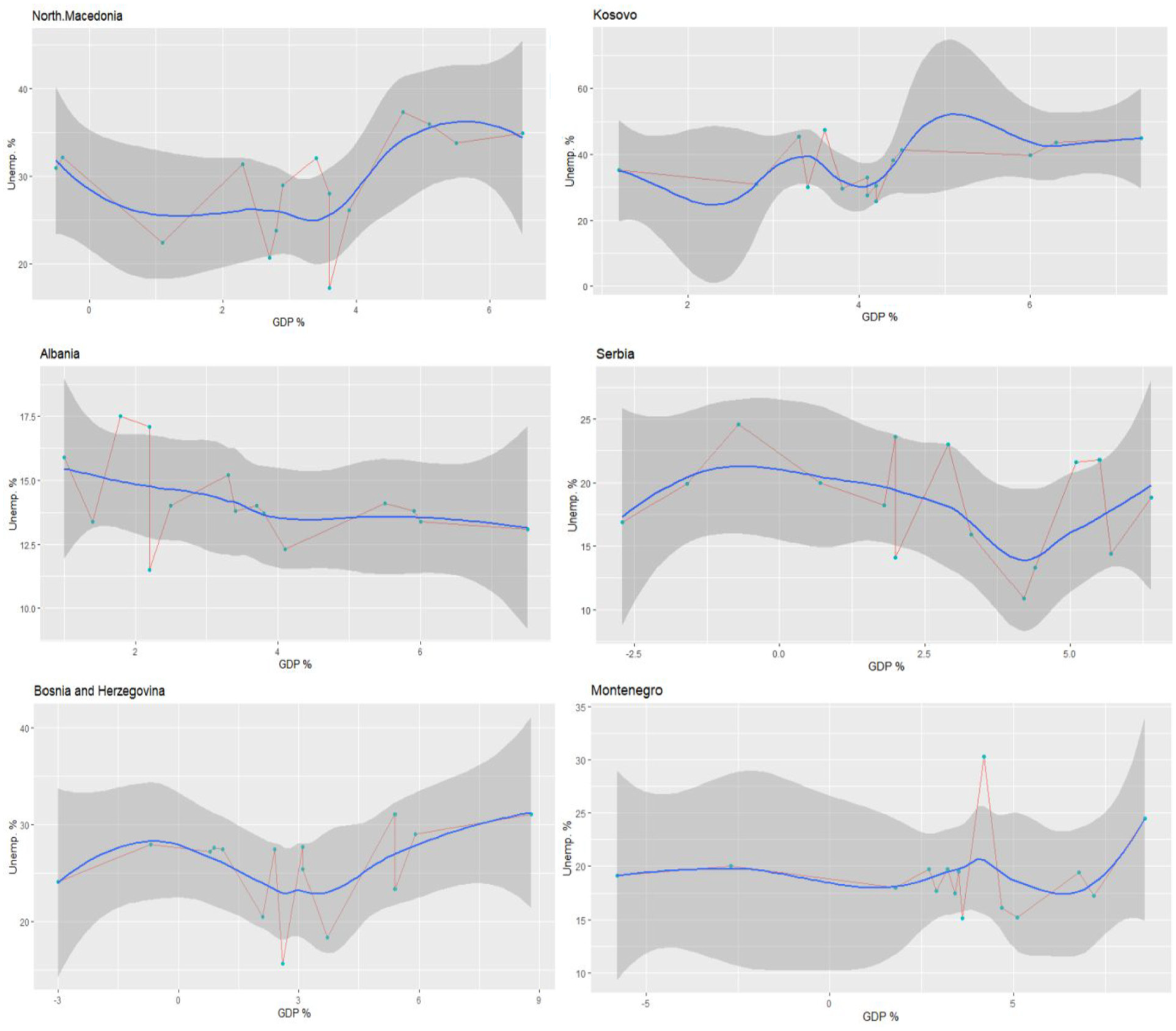
Relationship between GDP growth rate and unemployment rate from 2005 to 2019 for the six Western Balkan countries.
The other issue regarding the validity of Okun’s Law depends on the methods used to achieve different conclusions from diverse approaches. A further problem arises from the nonlinearity of the data series that can make the model of a co-integrated nature (Attfield & Silverstone, 1997). The coefficient that follows Okun’s Law constantly changes with findings that are not uniform in different countries. Several studies argue that the coefficient derived from Okun’s Law was continually rising, implying that the GDP growth rate has strengthened the influence on the unemployment rate (Ball et al., 2013; International Monetary Fund (IMF), 2010). Besides the fact that Okun’s coefficient changes over time, it also varies across methods. Criticize the HP filter generally applied in testing Okun’s relationship between GDP growth and unemployment rate. Given each Country’s demographic changes, the economy’s structure, and institutional elements, expect that Okun’s coefficient can generate diverse outcomes. Perman et al. (2015) investigated the changes in the 269 estimates of Okun’s coefficients in the context of various geographical locations. Their results show that Okun’s coefficient was relatively low, displaying a weak relationship between GDP growth and changes in the unemployment rate. The US financial meltdown of 2008 and the Greek debt crisis of 2010 proved that the problems in the financial system might quickly reflect the unemployment problems. In the case of Romania, Caravan (2010) identified that Okun’s coefficient is higher during the crisis periods due to the sensitivity of the Romanian economy toward economic downturns. However, Christopoulos (2004), in the case of Greece, did not find sufficient evidence that the unemployment rate is susceptible to economic shocks. The Western Balkan countries operate under different tax regimes, diverse national currencies, and economic development, which should be carefully analyzed while interpreting results.
The six WB countries in our study (except Albania) were part of Yugoslavia, where the dual market system prevailed. Yugoslavia, which was neither part of the communist bloc nor the western one, selectively promoted private initiative with the supervision of the state authorities. Meanwhile, until the 90s, Albania operated on the principle of the total command economy, where the private industry was inexistent. Structural economic changes required liberalizing financial processes, and openness to foreign investments was an integral part of the reforms in WB countries (Aliu, 2014). In this context, the geographical location naturally led these countries toward the EU membership process, where improving the standard of living and reducing the unemployment rate are inevitable criteria. The importance of this study increases when these countries face massive migration toward EU member states. Therefore, findings shed light on a complex issue, such as the relationship between economic growth and unemployment. To the best of our knowledge, this is the first study to analyze economic growth’s impact on WB countries’ unemployment rates. Based on identified problems and the importance of issues, it would be helpful to ask the following question:
The rest of the paper is structured as follows. Section 2 briefly describes the economic context in Western Balkan countries. In section 3, there are the methods used and data collection. The results are placed in Section 4, while the concluding remarks are in Section 5.
Economic Context of Western Balkan Countries
Significant events characterize the political atmosphere of the Western Balkans (WB). The most important one can be considered the plan for the Mini-Schengen (Regional Schengen) area proposed by the prime minister of Albania, aiming to create a unique market, facilitating movements of goods, services, and people in the WB countries (SELDI.net, 2020). In the upcoming years, this form of regional cooperation might change the perception of EU member states toward the integration of WB countries. So far, the worldwide perception of the WB countries prevails only in conflicts most of the time (Arifi, 2017, pp. 7, 8). Western Balkans’ economies now suffer from a high-level unemployment rate and unsolved informality issues (SELDI.net, 2020). In March 2020, European Union (EU) declared immediate financial support for the WB region to improve the recession caused by the outbreak of the COVID-19 pandemic. It expects budget transfers and liquidity for the financial system to support the immediate needs regarding health capacities (European Commission Press Release, 2020). To improve the economic situation in the WB countries, the Council of the European Union held an informal ministerial meeting on 8 July 2021 in Brdo—Slovenia (Council of European Union, 2021).
The focus of the meeting was to create promotion and opportunities for youth employment which stands as the main obstacle in these countries. The EU has always viewed the WB region as a single entity, as the states have generally presented identical problems and have pursued almost the same policies for solving them. According to informality issues, these countries demonstrated for years that they were incompetent in solving the problem of informality in the economy. The informality issue in the WB appears in two forms and founds itself with the non-declaration of business activities and the labor market informality. According to the World Bank estimates informal labor market counts for almost 30% of the total labor force in the WB countries (World Bank Group, 2021, pp.37). Standing on the very word, informality in Serbia recently has declined by 5%, while in Albania, 34% of employees earn more than they declare. In Kosovo, 35% of employees stand in the informal zone.
Standing on the forecasts of domestic and international financial institutions, the economic activity in the Western Balkans tends to improve in 2021, where the growth tends to catch up with the pre-pandemic period. Referring to the latest reports of the World Bank, the government’s effort in this region to revive national economies seems to have limited effects. Although the consequences of the crisis are still unfolding, some promising signs of relief can show the expected growth rate and improvements in the labor market. Consequently, the growth rate in 2021 has increased budget revenues and, as a result, has smoothened the effect of public debt on macroeconomic stability (European Commission, 2021). The Western Balkan countries have moved from a semi-centralized economy to a free market economy. This process has required structural reforms in the economy, including privatizations and changing the taxation system, but also measuring economic growth and unemployment. During this time, WB countries have faced high corruption levels, informality in the labor market, fiscal invasion, and a criminal economy. Recognizing these facts, we analyze whether economic growth in these countries has impacted reducing unemployment. These countries were chosen because five of them (North Macedonia, Bosnia, Kosovo, Serbia, and Montenegro) were part of Yugoslavia. To this end, they have functioned as part of economic, political, and common development philosophy. On the other hand, these countries and Albania now aspire toward the European Union, so they are part of the control mechanisms of the European Commission.
Methodology
This study identifies the impact of economic growth on the unemployment rate for the six Western Balkan countries. The countries selected for the analysis are North Macedonia, Bosnia and Herzegovina, Albania, Kosovo, Montenegro, and Serbia. Economic growth (real GDP growth rate) and unemployment rate are collected quarterly from the World Bank database (The World Bank Data – WB, 2021) from 2005 to 2019. The data for the entire period from 2005 to 2019 in the case of Kosovo have been collected by the Trading Economics Database (Trading Economics Database TE, 2021). Three static tests were performed to test the time series for the unit root. The data were not tested at the level but their first differentiation. The first differentiation has been used since the series did not pass the unit root tests such Augmented Dickey-Fuller Test (ADF), Phillip-Peron Test (PP), and Kwiatkowski–Phillips–Schmidt–Shin (KPSS) Test. In R studio, these tests are performed using the functions adf.test(), pp.test(), and kpss.test(). After the first differentiation, our data have a p-value lower than 5% in the case of ADF and PP while higher than 5% in the case of the KPSS test. This shows that our data pass the static test and can be used for the VAR model. The percentage changes contain two inputs used in our model to test Okun’s Law in the WB countries. The vector autoregression model (VAR) has been used to investigate the relationship between the GDP growth rate and the unemployment rate for each Country separately. The variables used in the VAR model are in the vector

Since the model comprises two variables (GDP growth rate and Unemployment rate), each variable (lagged values) possesses its equation.


VAR models are generally established through their orders linked with previous periods that the model used. Lags are a variable that characterizes earlier series, where p-the orders are named VAR (p) and often den as VAR with p-lags. The formula for the VAR (p) stands as:

The VAR model may contain different such as structural shocks and named SVAR with p lags, such as:


These two models measure the impact of the GDP growth rate on the unemployment rate and the other way around. At the same time, VAR measures GDP’s growth rate influence on itself and the unemployment rate. Several tests have performed the model’s validity, such as the Normality test, Granger Causality test, and impulse response function. Since VAR is widely known and recognized for forecasting, the authors have conducted forecasting of the GDP growth rate and unemployment rate by recognizing the model’s limitations. It uses a normality test to determine the typical distribution of the data series. The impulse response function can identify the reaction (shocks) of one variable (GDP growth rate and Unemployment rate) over time. It extensively uses the method in the macroeconomic field, which identifies the response of specific economic agents toward public policies. Since VAR is an unrestricted model where all variables are endogenous, SVAR enables the establishment of the structure in the matrix. In this case, SVAR can limit the influence of one on the other, for example, only GDP on unemployment and vice versa. The Granger causality test determines whether the one-time series variable helps forecast another one built by Granger (1969). The Granger test establishes the accordance of the two following assumptions, the tradeoff occurs in advance of its effect, and the cause holds exclusive evidence concerning future values. Regarding two premises, the Granger test identifies the cause-effect of X on the Y variable (All the tests basis on the R-studio program, and part of the coding is available on request).
Results
VAR Estimation Results
To determine the persistence of the model, we have used the autocorrelation function (ACF—R studio) and partial autocorrelation functions (PACF). ACF and PCF operations have been conducted independently for the GDP growth and unemployment rates. Autocorrelation measures the association between current and past values of the specific variables.
Figure 1 indicates ACF and PACF for GDP growth rate and Unemployment rate in the case of Albania. The blue dashed lines in the charts represent the significant thresholds of the ACF and PACF. It is clear that the first few lags of GDP and unemployment are substantial and cross the points but stabilize later. In the appendix, the ACF and PACF for the other five Western Balkan countries are represented in Figures A1 to A5. An identical situation follows the other countries where only a few lags of GDP growth rate and unemployment rate cross the threshold (blue line), and the data follow a random walk. Past GDP growth and unemployment rate values in WB countries hold little influence on the current values.
The second step in building the VAR model was identifying optimal lags. Each Country has implemented an identical procedure. The R program, through the varselect function and the “vars” package, automatically generates the optimal number of lags to be used. For this purpose has been used four lag selection criteria SIC (n), HQ (n), and SC (n). Autoregressive order is based on the dominance of the number of lags identified by Akaike (AIC), Hannah-Quinn (HQ), and Schwarz (SC). All roots were standing within the unit circle (<1), while the characteristic polynomial in the case of Albania was 0.9549, 0.9549, 0.7433, and 0.4382.
Albania, Serbia, Bosnia, and Kosovo appear to be the countries where the past unemployment covering 2005 to 2019 has influenced unemployment. In the case of Albania, the significance level is stronger on the unemployment affecting the unemployment rate compared to other WB countries. None of the Country’s GDP holds significance to the effect (positive or negative) on the unemployment rate. To this end, we can conclude that economic growth in the Western Balkan countries does not reduce the unemployment rate. The GDP stands as an independent variable, and we measure the influence of the unemployment rate on GDP growth; it builds two models. The other model, where unemployment is the dependent variable, analyses the impact of GDP growth on the unemployment rate (see Tables 1 and 2).
Estimating the VAR Equation for GDP and Unemployment for the Six Western Balkan Countries.
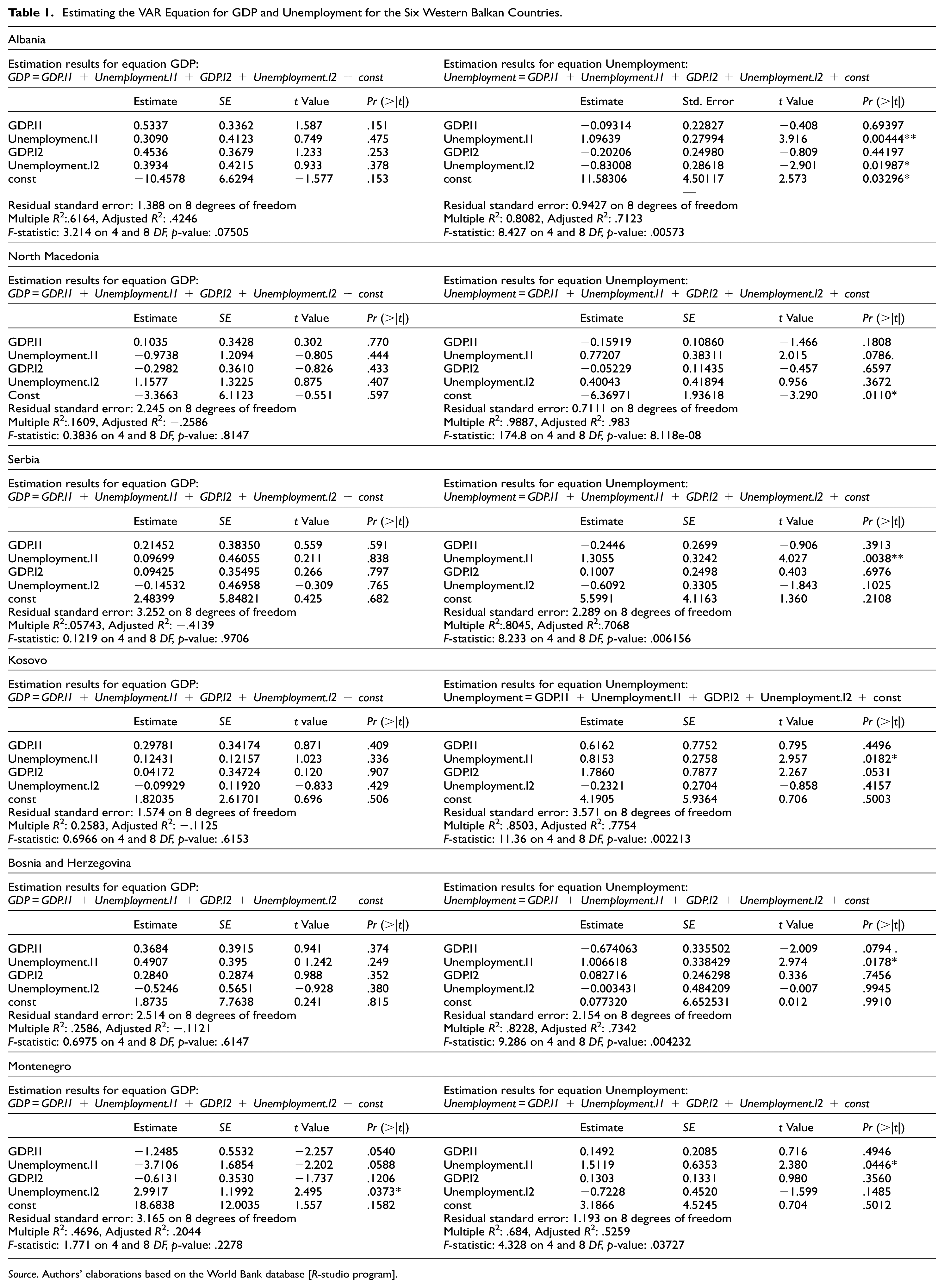
Source. Authors’ elaborations based on the World Bank database [R-studio program].
Granger-Causality Test for GDP and Unemployment in the Case of Albania.

Source. Authors’ elaborations based on the World Bank database [R-studio program].
Albania, Serbia, Kosovo, Montenegro, and Bosnia are where a certain level of unemployment is detected. The normality test shows that where JB-Test (multivariate) indicates a p-value <.05 and passes the Skewness and Kurtosis test, it usually distributes residuals for Albania. The structural breaks have tested residuals and have conducted the stability of the system’s stability causality test to identify if GDP granger causes unemployment and the other way around. The first H0 indicated GDP does not Granger cause unemployment, while the second H0 shows that unemployment does not Granger cause GDP. We fail to reject both cases’ null hypothesis (H0) since the p-value is >.05.
VAR is also widely used for impulse response functions, showing how the variable would behave under external shock at a specific time interval. Moreover, the impulse response function examines how variables react to themselves and from the wonders of other variables. Figure 2 shows that the unemployment rate increase also GDP in the short run. In the long run, the constant rise in unemployment and decrease in GDP stands in line with theoretical expectations. Identical patterns follow when GDP shocks unemployment both in the short and long run (see Figures 3 and 4).

Autocorrelation (ACF) and partial autocorrelation (PACF) of GDP and unemployment rate for Albania.

Impulse response function for GDP and unemployment in the case of Albania.
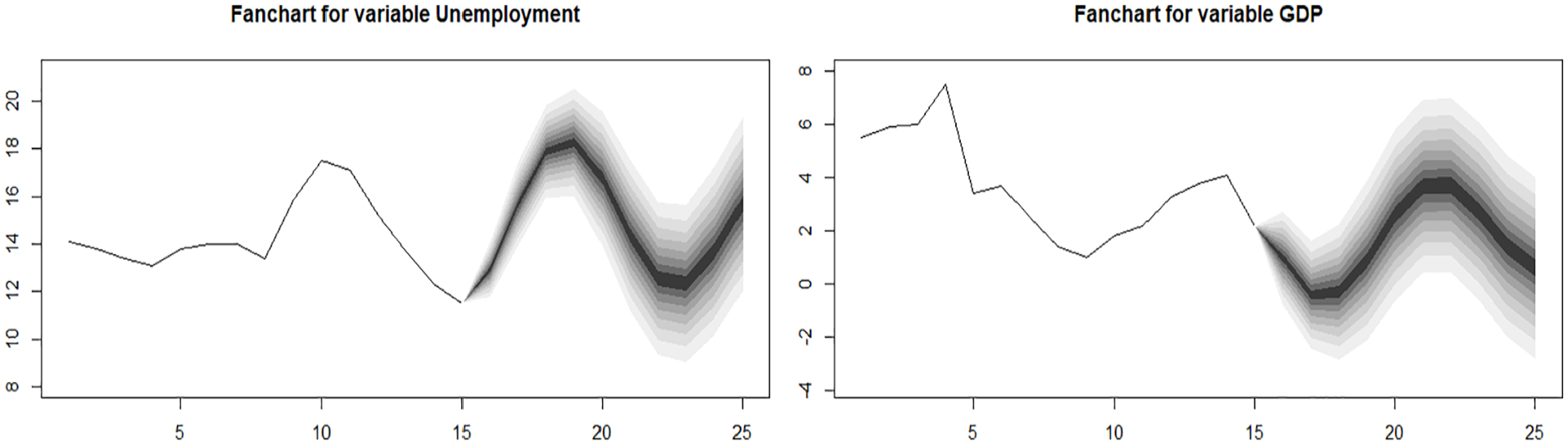
Forecasting GDP and unemployment 4 years ahead, in the case of Albania.
VAR forecasting was an additional technique used for predicting GDP growth and the Unemployment rate for Albania, based on the annual data from 2005 to 2019. We have forecasted both variables 4syears ahead with a 95% confidence interval. The forecasting builds the Fan chart, indicating that both variables have low error terms, although we are moving from the first to the fourth year. It is clear from these estimates, which recognize their limitations, GDP in the following years will slightly decrease and then increase. The unemployment rate will increase in years ahead and then fall, following other patterns than GDP.
Since only in the case of Albania did the results indicate that economic growth affects the unemployment level, then only for this Country, we have presented a granger causality test. In the case of other countries, the p-value is always more significant than the 5% significance, which shows that the GDP growth rate does not grangers cause unemployment level.
Conclusion
Social dissatisfaction always follows economic and financial crises that worsen the standard of living and raise the unemployment rate. The Greek debt crisis of 2010, the recession in Venezuela, the global financial meltdown of 2008/2009, and the pandemic outbreak of 2020 allowed us to understand that economy is of great importance to people’s lives. History has documented that economic crises, at best, cause unemployment to increase while, at worst, bringing totalitarian power regimes. Therefore the importance of the relationship between unemployment and GDP growth rate transcends the economic nature of this issue. This study addresses the tradeoff between GDP and unemployment for the six Western Balkan countries with annual data from 2005 to 2019. Based on VAR and Granger causality test, we can conclude that economic growth does not reduce the unemployment rate in Western Balkan countries. Okun’s Law does not consider productivity rate, labor market size, economic informality, and growth structure, while the findings should be analyzed considering these constraints. According to the VAR model in the case of Albania, Serbia, Kosovo, Montenegro, and Bosnia, past unemployment significantly affect present unemployment.
Arthur Okun knew that the interpretation of the results should replace the methodology’s limitations. The Western Balkan countries suffer from high informality in the labor market and the economy in general, which may be factored into these outcomes. An additional element may be that entries of a new workforce in the labor market are higher than employment opportunities generated by the GDP growth rate. Moreover, recognizing the fragility of the institutions in this region and the level of corruption, it is very likely that the reports on the unemployment rate may be inaccurate. One of the limitations of the work is the results from the Johansen test and the Vector Error Correction Model. Future studies can see if GDP and unemployment in these countries have long-term integration. If yes, in that case, it is possible to continue generating results from VECM.
Economic growth and unemployment are not necessarily influenced by each other but also by other factors. Future studies can also deal with other factors that influence these two series, which may not necessarily be economical. The results provide essential signals for WB governments that economic growth does not contribute to reducing the unemployment rate in these countries. From a practical perspective, the findings are also of interest to stakeholders such as the International Monetary Fund and the World Bank. The standard economic textbooks indicate that economic growth in countries with low corruption and viable institutions reduces unemployment. However, in the case of Western Balkan countries with high corruption levels and fragile institutions, this ratio does not hold. The increased fiscal evasion and informality in the labor market are clear signals that economic growth is hardly reflected in reducing the unemployment rate.
Footnotes
Appendix
Declaration of Conflicting Interests
The author(s) declared no potential conflicts of interest with respect to the research, authorship, and/or publication of this article.
Funding
The author(s) received no financial support for the research, authorship, and/or publication of this article.
