




Abstract
This study examines the short- and long-run relationship between remittance and Benin household expenditure. We analysed 45 years of time series data, from 1974 to 2019, from the World Bank Open data repository using the autoregressive distributed lag (ARDL) to cointegration model. The findings suggest no significant long-run relationship between remittance receipts and household expenditure. However, the short-run relationship is positive and significant indicating that household remittance increases their expenditure solely in the short run. Development aid and trade openness used as control variables are negatively associated with household expenditure. These do not significantly increase household expenditure in the short and long-run. We recommend that policymakers in developing countries like Benin adopt instruments that encourage remittance inflows and promote household efficient use to meet short- and long-run expenditure needs.
Plain language summary
Previous studies did not provide conclusive information on the long-run importance of remittance for households in the context of developing countries. We contribute to the literature by evaluating the short and long-run relationship between remittances and household expenditure taking evidence from Benin. We retrieved data on remittance, household expenditure, development aid, trade openness, and inflation from the World Bank open data repository and analysed them using an econometric model. The long-run results show no significant association between household remittance and their expenditure. In the short-run, household remittances increase their expenditure. We recommend that policymakers in developing countries like Benin adopt instruments that encourage remittance inflows and promote household efficient use to meet short- and long-run expenditure needs.
Introduction
The increasing volume of global remittance shows its importance as one of the largest sources of foreign capital inflows into developing countries. According to the World Bank (2021a), remittances represent about 739 billion US dollars in 2021 and account for about 0.8% of the global GDP. About 77% of global remittances are received by the low-and-middle-income countries (World Bank, 2021b). The remittances are nearly three times the net official development aid received by these countries. In Benin, a lower-middle-income country, remittance remains one of the most important foreign capital inflows. Between 2011 and 2021, remittances increased by 20% (equivalent to 59 million US dollars), accounting for 1.3% of the Benin GDP in 2021, and standing as the second-largest foreign capital inflow after development aid (World Bank, 2021c). It is sent by 14% of the Benin population representing migrants (INStaD, 2024) and accounts for 2% of household income (Kinkpe, 2024).
Remittance refers to the money and goods transmitted to households by migrant workers working outside their origin communities (Adams, 2011). According to the World Bank (2021b), remittances are part of the compensation paid to migrant employees and are sent home as personal transfers. These consist of all transfers in cash or kind received by households from non-resident households (World Bank, 2021b). Remittances result from migrants’ decision to send money to their home of origin which is explained by the theories of pure altruism, self-interest, and tempered altruism or enlightened self-interest (Lucas & Stark, 1985). The theory of pure altruism posits that migrants remit to support their families due to emotional ties, mostly observed among migrants from developing countries (Azizi, 2019). The self-interest theory suggests that migrants remit money to embark on investment projects or repay a loan (Lucas & Stark, 1985). According to tempered altruism or enlightened self-interest, remittances are part of an intertemporal, mutually beneficial contractual arrangement (investment or risk sharing) between migrants and their homes (Lucas & Stark, 1985). Against the motivation to remit, remittances can take various natures in household income affecting how households spend it. Existing literature suggests three potential expenditure channels through which households allocate remittances. First, households disburse the remittance receipts as compensatory income for the consumption of food and durable goods (Ajefu & Ogebe, 2021; Akobeng, 2022; Mishra et al., 2022; Mondal & Khanam, 2018; Nguyen et al., 2017; Thapa & Acharya, 2017). Second, households spend the remittance receipts as transitory income to invest in productive activities, health, and education (Askarov & Doucouliagos, 2020; Dash, 2023; Mohammed & Karagöl, 2023; Nanziri & Mwale, 2023). Thus, remittances generate long-run income streams for households through financial and human development. Third, remittances are like any other income source and do not necessarily affect household expenditure (Makina, 2024). Based on existing migration data, Benin households employ mostly the first two expenditure channels through which they allocate 46% of remittance receipts to food, followed by health (21%), education (12%), ceremonies (7%), and other various expenditures accounting for 14% (INStaD, 2024).
Despite the growing remittances in Benin and its importance in receiving households, no empirical evidence exists supporting its positive effect on household consumption expenditure in Benin. We study Benin analyzing remittance data from 1974 to 2019 to address this gap. The long-run implications of remittances on household consumption expenditure are also very limited in the literature, specifically in the sub-Saharan African context. The few existing long-run studies including Musakwa and Odhiambo (2019) in Botswana, Aslam and Sivarjasingham (2020) in India, Lamsal (2024) in Nepal, and Makina (2024) in Lesotho also led to inconsistent and contradictory findings that can hardly be extended to other developing countries like Benin. While the studies of Aslam and Sivarjasingham (2020), Lamsal (2024), and Makina (2024) found a positive long-run relationship, Musakwa and Odhiambo (2019) found no long-run relationship between remittances and household consumption expenditure. By employing the autoregressive distributed lag model (ARDL), which simultaneously estimates short- and long-run effects, we provide new evidence contributing to the literature on the long-run relationship between remittances and household expenditure.
Following this introduction, a summary of past empirical studies on the relationship between remittances and household expenditures in low- and middle-income countries is provided. Data, variables, and the econometric model are presented. After discussing the results, some concluding remarks and potential policy implications are provided.
Literature Review
Existing empirical studies on the relationship between remittances and household expenditure can be categorised into three groups. The first body of literature addresses the question of the actual effect of remittances on total household expenditure. Using various methods and with different country focus, these studies suggest that, on average, household remittances increase their total spending. Démurger and Wang (2016), Randazzo and Piracha (2019), and Nanziri and Mwale (2023) analysed household survey data using the propensity score matching (PSM) technique in China, Senegal, and Zambia respectively, and found that remittance receipts have a positive impact on household expenditure. Besides, Yamada et al. (2022) and Akobeng (2022) adopted an instrumental variable (IV) estimation approach which also led to the outcome that remittances have an increased household expenditure effect in Tajikistan and Ghana respectively. In Tajikistan, Yamada et al. (2022) pinpoint the heterogenous effect of remittances among household heads given their sex, age, and education level. According to the authors, the remittance effect on household expenditure is more pronounced among male, older, and less-educated head-leading households. Having assessed the remittances and household consumption expenditure nexus among farming households in Ghana, Akobeng (2022) found that remittance plays an income-compensating role as households use it to compensate for agricultural income loss. We have the studies of Adeseye (2021) and Chintamani and Kulkarni (2023) which relied on primary data at a county level in Nigeria and India respectively. Employing the ordinary least square (OLS) and logit/probit methods, the studies found a significant positive association between remittances and household consumption expenditure. Beyond increasing household expenditure, remittance is found to have a multiplier effect of reducing poverty (Awan et al., 2017; Muhammad Abubakar et al., 2016; Nanziri & Mwale, 2023; Wagle & Devkota, 2018; Yoshino et al., 2017) and inequality (Basanta & Malvika, 2016; Ellyne & Noxolo, 2017). Moreover, remittance can significantly reduce household consumption volatility in the short and long-run (Mondal & Khanam, 2018).
The second body of literature delved into each household consumption expenditure component. These studies demonstrate that remittances affect each component differently. Using the propensity score matching (PSM) method, studies such as Mahapatro et al. (2017) in India, Awan et al. (2017) in Pakistan, Thapa and Acharya (2017) in Nepal, and Dey and Ahmed (2024) in Bangladesh, conclude that remittance-receiving households increase their expenditure on food consumption, and invest in health, education, and housing. Using primary data and regression models, Dhakal and Oli (2020) also show that remittance positively affects household food consumption and education expenditure. Ajefu and Ogebe (2021) and Mishra et al. (2022) employed an instrumental variable (IV) technique and found a result consistent with the latter. Besides, they provide additional consideration to the effect of remittances on household expenditure. Mishra et al. (2022) show that remittance is negatively associated with household expenditure on alcohol and tobacco in Vietnam. Considering five sub-Sahara African countries such as Burkina Faso, Kenya, Nigeria, Senegal, and Uganda, Ajefu and Ogebe (2021) found the remittance effect on food, health, and education expenditure consistent across different household expenditure quantiles. Kakhkharov and Ahunov (2022) assess the remittance effect on household wedding expenditures in Uzbekistan and unveil that remittance-receiving households are less likely to consume conspicuously. While most studies show a positive remittance effect on household expenditure, a few other studies found mixed results. Adams and Cuecuecha (2010) and Maara et al. (2019) found that remittance-receiving households spend less on food and more on education and durable goods in Guatemala and Kenya respectively. Nguyen et al. (2017) and Raihan et al. (2022) found a significant relationship between remittances and household spending on durable goods but not education in Vietnam and Bangladesh respectively. Furthermore, Wang et al. (2021) suggest that remittance only has a small increasing effect on food and health expenditures and no effect on other household consumption expenditures in Kyrgyzstan.
The third body of literature investigated the short and long-run effects of remittances on household expenditure. We identified four long-run studies conducted in Botswana (Musakwa and Odhiambo, 2019), India (Aslam and Sivarjasingham, 2020) Nepal (Lamsal, 2024), and Lesotho (Makina, 2024). Musakwa and Odhiambo (2019) examined the impact of remittances on poverty reduction. The study employed time-series data from 1980 to 2017 and considered two poverty proxies including household consumption expenditure. Using the ARDL model, the results show that remittances have no association with household expenditure in the short and long-run. Aslam and Sivarjasingham (2020) employed the ARDL model on time-series data from 1975 to 2018, and found that remittances have a positive short and long-run relationship with household consumption expenditure. Lamsal (2024) also employs the ARDL model and draws a similar conclusion. Even with the Johansen cointegration technique and the Engle-Granger residual approach, Makina (2024) found a positive long-run relationship between remittances and household consumption expenditure. Contrary to the latter, Makina (2024) found a negative short-run relationship between remittances and household consumption expenditure.
In light of all the above, we observe that the long-run assessments of the relationship between remittances and household expenditure report inconsistent and sometimes contradictory results. For instance, while some studies find a positive long-run association between remittances and household expenditure, others report no significant relationship. This suggests that the effects of remittances on household expenditure may be context-specific and potentially influenced by methodological differences. This inconsistency underscores a critical research gap, particularly for developing countries striving to achieve the Sustainable Development Goals (SDGs), where remittances could play an important role in enhancing household consumption, contributing to economic growth, and alleviating poverty. Therefore, further long-run assessments are essential to generate valuable insights to support development policymaking in Benin and other similar countries.
Methodology
Data and Variables
We analysed 45 years of time-series data (1974–2019) from the World Bank Indicator repository. We considered variables such as household final consumption expenditure, personal remittances, net official development aid, inflation, and trade openness.
Household final consumption expenditure, expressed in US dollars, constitutes the market value of all goods and services, including durable products such as cars, washing machines, and home computers purchased by households. It includes payments and fees to governments to obtain permits and licenses. It can be used as an official poverty measure. Besides, it explains economic differentials in education, unemployment, and healthcare (Srivastava & Mohanty, 2010). It is a better measure of achieved living standards (Stoyanova & Tonkin, 2018). Final consumption expenditure is preferred as a measure of economic well-being in low-income countries, as it reflects the long-run economic status of households (Friedman, 1957). It is measured more accurately than household income (Brewer et al., 2017). Its data collection process involves adjustments for household size, composition, and price level (Srivastava & Mohanty, 2010).
Personal remittances are expressed as a percentage of GDP and used in the model to capture international remittances flows. The importance of choosing remittances as a percentage of GDP is to account for the country’s sizes (Musakwa & Odhiambo, 2019).
Official development aid is also expressed as a percentage of GDP. It consists of disbursements of loans made on concessional terms (net of repayments of principal) and grants by official agencies. It is included in the model because of its economic welfare promotion and poverty reduction implications (OECD, 2018). Following Ellyne and Noxolo (2017), the study determines whether all foreign capital inflows generally increase household expenditure.
Inflation shows the rate of price change in the economy and is measured by the annual growth rate of the GDP implicit deflator. According to Rashid Talukdar (2012), high inflation lowers the value of cash holdings, real income, and purchasing power. Inflation is included in the model as a control variable because it can determine household expenditure.
Trade openness is the sum of exports and imports of goods and services measured as a share of gross domestic product. Trade openness benefits local producers as they can easily access foreign inputs for use in their production processes (Pradhan & Mahesh, 2014). It also benefits consumers because of the availability of increased variety and cheaper products, which raises national income and triggers poverty reduction (Pradhan & Mahesh, 2014). Trade openness is included in the model to explore its association with household expenditure, similar to Berg and Krueger (2003) regarding its correlation with economic growth.
Econometric Model
The study employed the autoregressive distributed lag (ARDL) to cointegration model developed by Pesaran and Shin (1999). In the model, household final consumption expenditure represents the dependent variable while personal remittances constitute the main explanatory variable. The other variables are used as control variables.
The choice of the model lies in its advantages. The model is free from residual correlation as all variables of the model are assumed to be endogenous (Nkoro & Kelvin, 2016). The ARDL approach is reliable for small samples and simultaneously estimates short and long-run effects (Pesaran et al., 2001). The model provides unbiased estimates irrespective of the endogeneity of some regressors (Pesaran & Shin, 2012). Given this characteristic, addressing endogeneity is usually not a concern within the ARDL framework.
According to Pesaran and Shin (1999), the general ARDL model is expressed as:


where:
-
-
-and
We logarithmically transformed all the variables to address potential heteroscedasticity. Thus, the model is expressed as:
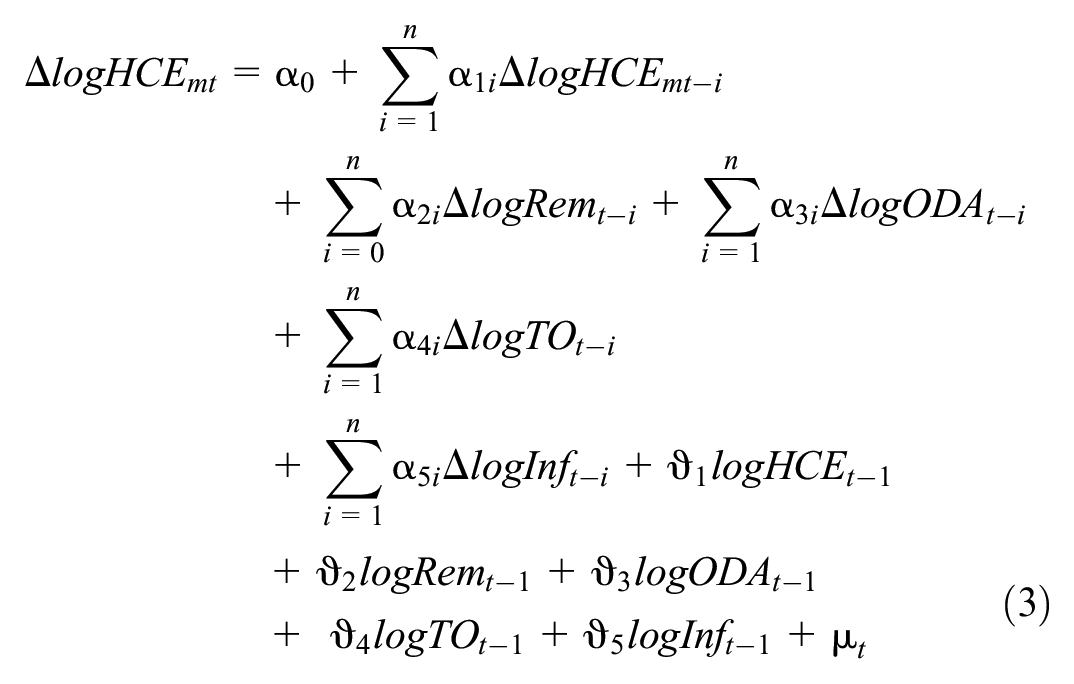
where:
-
-
-
-
-
-
According to Nkoro and Kelvin (2016), if there exists a long-run relationship between variables, both the short and long-run information can be captured by parametrizing the ARDL model into the Error Correction Model (ECM). This is expressed as:

where:
-
-
-
-The definition of other variables remains the same as in Equation 3.
We replaced household final consumption expenditure with GDP data for a robustness check. GDP is the first indicator considered when evaluating a country’s economic growth and the well-being of its inhabitants.
Results and Discussion
Unit Root Test
The ARDL model to cointegration is the preferable technique when dealing with variables that are integrated of a different order, I (0), I (1), or a combination of both. It crashes when variables are integrated of order I (2) or higher (Nkoro & Kelvin, 2016). For this reason, the existence of unit root was checked at a 5% level of significance, using two different testing strategies which include the Augmented Dickey-Fuller (ADF) test (Dickey & Fuller, 1981) and Phillips and Perron (PP) test (Phillips & Perron, 1988). Under the ADF and PP tests, variables are said to be stationary, that is, have no unit root (integrated), when the absolute value of the t-statistic is greater than the absolute critical value, and vice-versa. An application of this shows that only the variable inflation is stationary at a level that is, integrated in the order I (0) (see Table 1).
Unit Root Test with Intercept and Linear Trend.
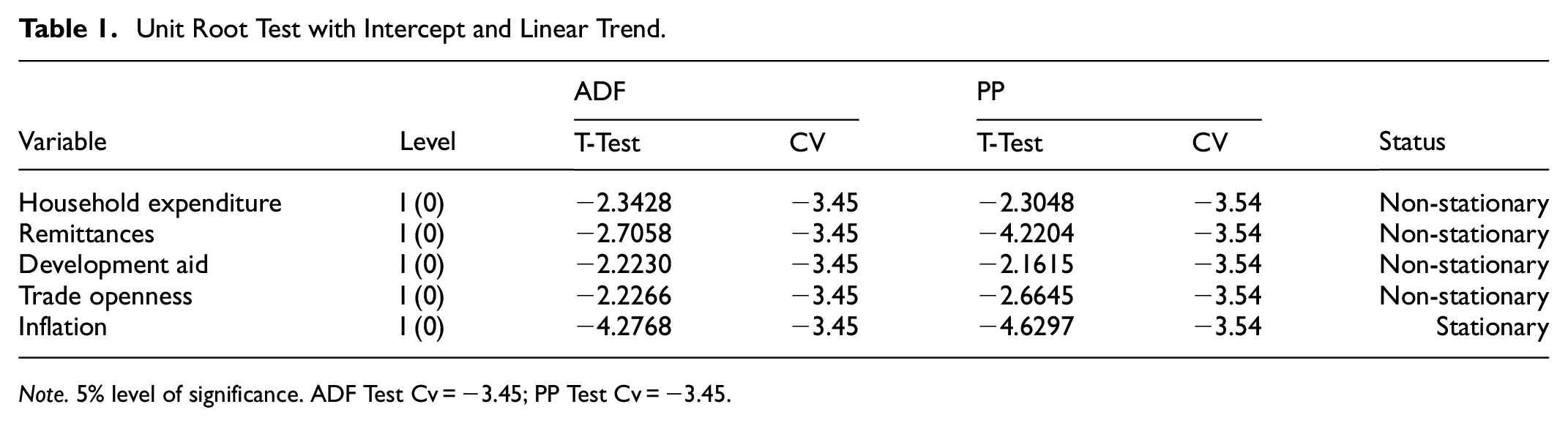
Note. 5% level of significance. ADF Test Cv = −3.45; PP Test Cv = −3.45.
The variables such as household expenditure, remittances, development aid, and trade openness are found to be stationary at the first difference I (1), but not at level, that is, not integrated of order I (0) (see Table 2). The mixed stationary state of the variables confirms the appropriateness of employing the ARDL model for cointegration.
Unit Root Test with Intercept and No Trend.
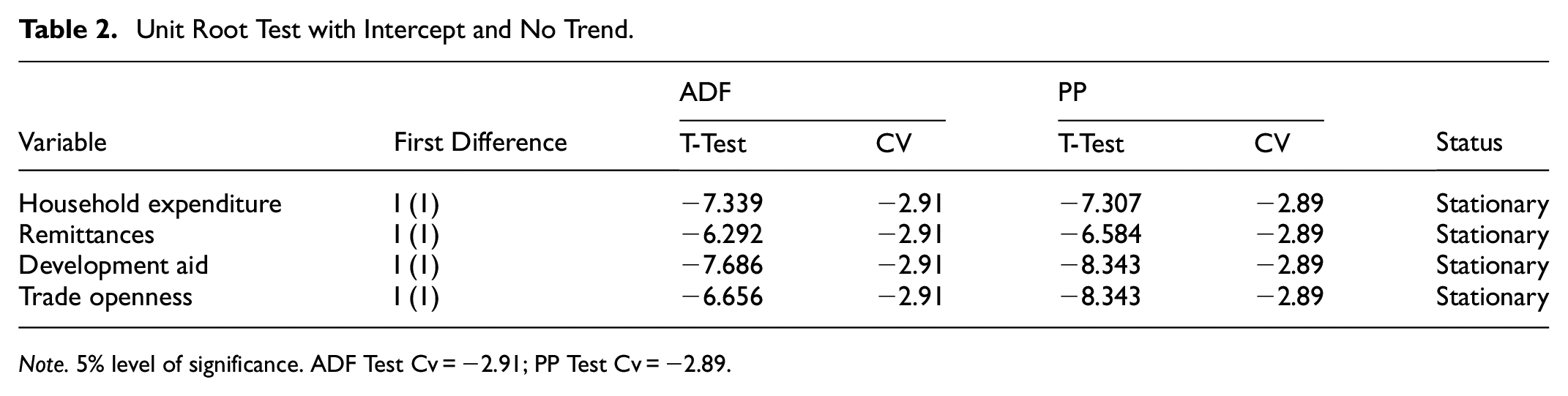
Note. 5% level of significance. ADF Test Cv = −2.91; PP Test Cv = −2.89.
Cointegration Test
One of the most important steps in the ARDL to cointegration analysis involves testing the existence of a meaningful long-run relationship between the dependent variable and the set of regressors. This is done using a cointegration test (see Table 3). Cointegration is an econometric concept that mimics the existence of a long-run equilibrium among underlying economic time series that converges over time (Nkoro & Kelvin, 2016). In practice, when the bound F-statistic (or W-statistic) value is lower than the lower critical bound, there exists no long-run relationship among variables, that is, variables are not cointegrated. When the value is greater than the upper critical bound, there exists a long-run relationship among variables, that is, variables are cointegrated. In case the value falls between the lower and the upper critical bounds, the result is inconclusive.
Cointegration Test.

Note. Function: F (Household expenditure | Remittances, Development aid, Trade openness, Inflation). I (0) = Lower critical bound; I (1) = Upper critical bound.
In this study, the results show that both at 10% and 5% levels of significance, the F-statistic (and/or W-statistic) value is less than the lower critical bound. This implies that variables are not cointegrated. Furthermore, it implies that there is no significant long-run relationship between the dependent variable (household consumption expenditure) and the regressors (remittances, development aid, trade openness, and inflation). Thus, the results suggest no long-run relationship between remittances and household expenditure in Benin, consistent with the findings of Musakwa and Odhiambo (2019) in Botswana.
Relationship Between Remittances and Household Expenditure
We only discussed the short-run model results (see Table 4) as suggested by the cointegration test. The analysis was conducted using the Schwarz Bayesian Criterion (SBC) for the optimal lag length of the model. This SBC was chosen because it is a consistent model selection criterion and performs better in most of the experiments. From the results, we observed that all the regressors are significantly associated with household expenditure except inflation.
ARDL Model Results.

Note.** and *** denote statistical significance at 5% and 1% levels respectively.
The first lag coefficient of remittances is positive and significant at 5%. This means that a unit change in remittances is associated with a 0.16 change in household expenditure on average, ceteris paribus, at a 5% statistical significance level. It can be inferred that remittances received by households are positively associated with their expenditure. Remittances come as a compensatory income spent by households to purchase more goods and services. Chintamani and Kulkarni (2023) made a similar inference about remittance-receiving households in India. The authors analysed primary data collected from remittance-receiving and non-receiving households using the probit model and found that remittances increase household income. The result is also consistent with the findings of Yamada et al. (2022) who employed an instrumental variable approach on nationwide household data in Tajikistan and confirmed a positive association between remittances and household total expenditure. Contrary to Aslam and Sivarjasingham (2020), Lamsal (2024), and Makina (2024), our result is only significant in the short-run. The difference between our result and the latter could be explained by household behaviour variation across countries. Most likely, households in Benin use remittances to meet short-term expenditure needs and do not invest in any productive activities that could generate additional income in the long-run.
The coefficient of development aid is found to be negative and significant at 1%. This implies that a unit change in development aid is associated with a −0.26 change in household expenditure. This means when household expenditure increases, development aid will tend to decrease and vice-versa. Countries demand development aid to promote economic growth and reduce poverty (OECD, 2018). Achieving this aim implies that household welfare has improved, and likely translated into an increased consumption expenditure. In such an economic situation, countries will be less demanding of development aid as shown by the result. In other words, development aid will no longer be necessary when increased consumption expenditure is observed among households. The result is supported by Asongu (2014) suggesting that high-growth African countries would require less development aid given its fewer positive effects in these countries.
The coefficient of trade openness is also negatively related to household expenditure at a 1% statistical significance level. This implies that a unit change in trade openness is associated with a −0.45 change in household expenditure on average, ceteris paribus, and vice-versa. Contrary to what could have been predicted, if increased, trade openness would not be beneficial to households. This result is supported by Dowrick and Golley (2004) testing whether trade benefits vary over time and across countries. Findings from the study showed that export specialization in primary commodities harms growth. Benin intervenes in the international market, mostly through the export of agricultural commodities and the import of manufactured commodities (International Trade Centre, 2019). Therefore, we argue that the country could experience a negative effect of trade on growth suggesting a negative spillover effect on household final consumption.
Diagnostic Tests
The diagnostic tests performed on the ARDL model include serial correlation, functional form, normality, and heteroscedasticity test, at a 5% level of significance (see Table 5). The results show that the null hypothesis of no serial correlation in the time series cannot be rejected. Furthermore, the functional form of the model fits the data at a 5% significance level. Similarly, the null hypothesis of normality and heteroscedasticity assumptions cannot be rejected at a 5% level of significance.
Diagnostic Tests.

Note. (a) Lagrange multiplier test of residual serial correlation (b) Ramsey’s RESET test using the square of the fitted values. (c) Test of skewness and kurtosis of residuals (d) The regression of squared residuals on squared fitted values.
We plotted the cumulative sum of recursive residuals (see Figure 1) and the cumulative sum of squares of recursive residuals (see Figure 2) to check for the model stability. The results show that the model lies within the critical bounds at a 5% significance level. This implies that the model is stable, and the results from the model are robust.

Plot of the cumulative sum of recursive residuals (CUSUM).

Plot of the cumulative sum of squares of recursive residuals (CUSUMSQ).
The results remain consistent after we replaced household final consumption expenditure with GDP (see Annex).
Conclusion
Remittance is one of the largest sources of foreign capital inflows in developing countries. In Benin, remittance has increased in the past few years and accounted for a non-negligible percentage of the GDP as the second-largest foreign capital inflow. Despite the growing inflow of remittance in Benin, no empirical evidence is available to support its positive effect on household consumption expenditure in Benin. Moreover, the long-run implication of remittances on household consumption expenditure is not sufficiently explored in the literature. The few existing long-run studies suggest findings that are misleading and inconclusive. We contributed to the existing literature by examining the short-and-long-run relationship between remittances and household consumption expenditure employing the autoregressive distributed lag (ARDL) model. The findings suggest no significant long-run relationship between remittances and household expenditure in Benin. In the short-run, remittances received by households are positively associated with their expenditure. This implies that households increase their overall expenditure with an additional remittance received. We conclude from the results that Benin households use remittances mainly to meet short-term expenditure needs.
We used other control variables such as inflation, development aid, and trade openness that could also affect household expenditure. We found that inflation does not play any significant role in influencing household expenditure. Development aid and trade openness are negatively associated with household expenditure. Households seem to not benefit when the country continues relying heavily on development aid and trade involving the exchange of raw agricultural commodities for manufactured commodities.
Based on the findings, we recommend policymakers in developing countries like Benin design and implement policies that encourage and promote efficient use of remittance by receiving households. Setting up a favourable business environment and encouraging remittance use in productive activities could lead to long-run benefits among households. Future studies could delve into the short and long-run effects of remittances when used by households to consume and invest in productive activities.
Footnotes
Appendix
ARDL Model Results with GDP as a Dependent Variable.

| ARDL (1,1,0,0,0) selected based on Schwarz Bayesian Criterion | ||||||
|---|---|---|---|---|---|---|
| Variable | Coefficient | Std-Error | T-Ratio | Prob. | ||
| GDP (−1) | 0.59 | 0.1075 | 5.46 | 0.000 | ||
| Remittances | −0.12 | 0.0815 | −1.49 | 0.146 | ||
| Remittances (−1) | 0.17 | 0.0682 | 2.60 | 0.013 | ||
| Development aid | −0.20 | 0.0743 | −2.77 | 0.009 | ||
| Trade Openness | −0.36 | 0.1497 | −2.45 | 0.019 | ||
| Inflation | 0.006 | 0.0181 | 0.37 | 0.713 | ||
| Constant | 4.01 | 0.9789 | 4.09 | 0.000 | ||
| Trend | 0.01 | 0.0036 | 3.47 | 0.001 | ||
| R-Squared | 0.99 | |||||
| R-Bar-Squared | 0.99 | |||||
| S.E. of Regression | 0.051 | |||||
| F-Statistic | 440.45 | |||||
| Prob. | 0.000 | |||||
| Residual sum of squares | 0.095473 | |||||
| Equation Log-likelihood | 74.65 | |||||
| DW-statistic | 1.81 | |||||
| Schwarz Bayesian Criterion | 59.42 | |||||
| Akaike Info. Criterion | 66.65 | |||||
| Test | Value | 5% – I (0) | 5% – I (1) | 10% – I (0) | 10% – I (1) | Status |
| F-statistic | 2.6417 | 3.8775 | 5.1303 | 3.2637 | 4.3894 | Not Cointegrated |
| W-statistic | 13.2083 | 19.3875 | 25.6517 | 16.3184 | 21.9468 | Not Cointegrated |
| Note. Function: F (GDP| Remittances, Development aid, Trade openness, Inflation) | ||||||
| Test Statistics | LM version | F version | ||||
| (a) Serial Correlation | 0.34 (0.558) | 0.28 (0.602) | ||||
| (b) Functional Form | 2.09 (0.148) | 1.75 (0.194) | ||||
| (c) Normality | 1.30 (0.522) | Not applicable | ||||
| (d) Heteroscedasticity | 0.80 (0.371) | 0.77 (0.382) | ||||
Note. (a) Lagrange multiplier test of residual serial correlation (b) Ramsey’s RESET test using the square of the fitted values. (c) Test of skewness and kurtosis of residuals (d) The regression of squared residuals on squared fitted values.
Acknowledgements
We are deeply grateful to Prof. Hans De Steur for his contribution at the early stage of this work. We want to acknowledge especially that “the article processing charge was funded by the Open Access Publication Fund of Humboldt-Universität zu Berlin.

Funding
The author(s) received no financial support for the research, authorship, and/or publication of this article.
Declaration of Conflicting Interests
The author(s) declared no potential conflicts of interest with respect to the research, authorship, and/or publication of this article.