




Abstract
Sustainable agricultural development is a global issue. Improper disposal of pesticide packaging waste will pose a challenge to sustainable development. An endogenous switching probit (ESP) model is used to analyze the effect of smartphone use on pesticide packaging waste recycling behavior based on data from the China Land Economic Survey (CLES) in 2020 and 2021. The result shows the following: (1) Smartphone use significantly enhances farmers’ engagement in pesticide packaging waste recycling. For farmers who use smartphones, smartphone use increases their pesticide packaging waste recycling behavior by 6.1% (significant at the 1% level) compared to those without using smartphones. (2) Smartphone use better promotes the adoption of pesticide packaging waste recycling behavior by small-scale farmers, farmers living closer to towns, and high-income farmers. The results of this study will help promote the recycling behavior of pesticide packaging waste and help the development of “Internet plus” agriculture.
Plain language summary
(1) Smartphone use significantly enhances farmers’ engagement in pesticide packaging waste recycling. For farmers who use smartphones, smartphone use increases their pesticide packaging waste recycling behavior by 6.1% (significant at the 1% level) compared to those without using smartphones. (2) Smartphone use better promotes the adoption of pesticide packaging waste recycling behavior by small-scale farmers, farmers living closer to towns, and high-income farmers. The results of this study will help promote the recycling behavior of pesticide packaging waste and help the development of “Internet plus” agriculture.
Introduction
Sustainable agricultural development is a global issue (Rockström et al., 2017; Shen et al., 2022). In response to the growing pressure on food security, pesticides are widely used in agricultural production. However, improper disposal of pesticide packaging waste poses challenges to the Sustainable Development Goals (Hofmann et al., 2023). First, the residual pesticide chemical and harmful substances on the pesticide packaging waste will infiltrate the soil and pollute the runoff through rainfall (Q. Zhou et al., 2020). Secondly, most of the pesticide packaging waste is composed of substances that are not easily degradable, which can cause serious land pollution (Huang & Elahi, 2022). In addition, farmers’ unreasonable pesticide packaging waste disposal behavior, such as burning, burial, used for other purposes, etc., will also threaten the ecological environment and human health (Mehmood et al., 2021).
In response to the hazards of pesticide packaging waste, existing research has begun to focus on how to deal with pesticide packaging waste. In Greece, Garbounis et al. (2022) conclude that pesticide plastic containers after three washings are almost harmless waste based on the Life Cycle Assessment methodology. In Indonesia, Handayani et al. (2024) recognize the positive role of the closed-loop supply chain for the disposal of empty pesticide containers. In Argentina, Sorichetti et al. (2024) explore the feasibility of Reverse logistics for collecting empty pesticide containers from a cost perspective. In China, Chen et al. (2024) find that neighborhood effects and policy interventions have significant positive effects on farmers’ pesticide waste packaging recycling behavior, respectively. Although the influencing factors of pesticide packaging waste disposal have been studied around the world, few studies have explored the impact of the Internet on pesticide waste packaging waste.
In recent years, more and more scholars have begun to pay attention to the impact of Internet use on agricultural production. Research on the role of the Internet focuses on the following three areas. First, research on the relationship between Internet use and farmers’ income (Khan et al., 2022; Leng et al., 2020; Ma & Wang, 2020). Second, research on the role of the Internet on agricultural technology promotion (Mohammed & Abdulai, 2022; Zheng et al., 2022). Finally, research on the impact of the Internet on farmers’ mental health (Nie et al., 2021; H. Zhou et al., 2023). Mohammed and Abdulai (2022) find that the diffusion of ICT helps to increase the adoption of new agricultural technologies among soybean farmers. H. Zhou et al. (2023) identify the frequency of online learning, online socialization, and online entertainment as important channels that influence farmers’ subjective well-being. Overall, studies have focused on the relationship between the Internet and farmers’ income, agricultural technology diffusion, and mental health. Smartphone technology is a major innovation in the current ICT technology development (Michels et al., 2020), which combines Internet access, visiting geographical information, microphone, camera, and other functions. It is unclear how using smartphone connected the Internet affects farmers’ pesticide packaging waste recycling behavior.
China became the world’s largest user of pesticides, with pesticide consumption exceeding 1.2 million tons in 2021 (National Bureau of Statistics of China, 2022). With the widespread use of pesticides, China has produced a large amount of pesticide packaging waste. According to statistics, China only recycled 28,700 tons of pesticide packaging waste and processed 22,700 tons in 2020, yet Chinese industry produces about 100,000 to 110,000 tons of pesticide packaging waste each year (Ren et al., 2021), which indicates that there is still a large amount of pesticide packaging waste that has not been properly recycled. Statistically, 99.8% of Chinese Internet users access the Internet through the way of smartphones (CNNIC, 2023).
In this context, this study empirically examines the effect of smartphone use on pesticide packaging waste recycling behavior by constructing an endogenous switching probit (ESP) model based on survey data from the China Land Economic Survey (CLES) in 2020 and 2021. The marginal contributions of this study are: (1) China is the largest developing country in the world. China’s experience in dealing with pesticide packaging waste will provide insights for other countries. (2) Previous studies have focused on the impact of the Internet on farmers, and few studies have focused on the impact of smartphones on farmers. (3) This paper explores the heterogeneity and examines the results of adoption of pesticide packaging waste recycling behavior by different groups of farmers after using smartphones.
Conceptual Background
Potential Impact of Smartphone Use on Pesticide Packaging Waste Recycling Behavior
Innovation diffusion theory proposes that farmers experience five sequential stages during the adoption of agricultural technologies. These stages are cognition, persuasion, evaluation, trial, and confirmation. Within this framework, the behavioral adoption of pesticide packaging waste recycling by farmers is fundamentally determined by their perception of this practice. Prior studies have emphasized that a sufficient level of technological awareness is a crucial prerequisite for widespread adoption (Jack, 2013). Notably, when farmers have limited access to operational details, such as recycling procedures and benefits, their likelihood of participating in these environmental initiatives is significantly reduced.
Given the importance of information dissemination in the adoption of agricultural technologies, the rise of digital technologies has brought new opportunities. The proliferation of digital technologies in the 21st century has established the Internet as the dominant information dissemination channel (Gajewski & Li, 2015). Aligned with its “Internet Plus Agriculture” strategy, a strategy that aims to integrate Internet technology with agricultural development, China has prioritized digital infrastructure development to bridge information gaps in rural communities (Deng et al., 2022). This technological integration demonstrates three key advantages for promoting sustainable practices.
First, digital platforms act as dynamic hubs, facilitating the delivery of information in multiple modes, including visual, auditory, and textual formats. By transforming technical guidelines and policy documents into accessible multimedia content, these tools enhance comprehension among farmers with varying literacy levels (Maredia et al., 2018). Such optimized information transmission directly supports farmers’ understanding of recycling protocols.
Second, Internet-based systems overcome spatiotemporal constraints (constraints related to space and time) inherent to traditional media (Deichmann et al., 2016). With nationwide broadband coverage in rural China (CNNIC, 2023), smartphones allow farmers to access recycling-related information on demand, regardless of their geographical location or the time of day.
Third, mobile Internet use facilitates the expansion of social networks and peer-to-peer knowledge exchange (Zhu et al., 2020). Farmers can actively engage in online discussions with practitioners from other regions, thereby refining their perceptions of recycling efficacy through experiential learning (Zhang et al., 2018). This digital interaction model creates pathways for behavioral adoption by connecting theoretical knowledge with practical implementation cases.
Considering these significant advantages of digital technologies in promoting sustainable agricultural practices, we formulate the following hypothesis:

Study framework.
Heterogeneous Effects of Smartphones on Pesticide Packaging Waste Recycling Behavior
Both large-scale and small-scale farmers utilize similar information sources, such as government agencies, agronomic stations, agricultural stores, farmers’ cooperatives, agricultural associations, and local networks (FAO, 2012). Nevertheless, large-scale farmers tend to access a greater number of information sources compared to their counterparts (Houser et al., 2019). Large-scale farmers benefit more from these sources, obtaining more valuable information due to factors such as frequent contact, higher crop yields, and the potential for exemplary outcomes (Ju et al., 2016), thereby leading to information disparities between small-scale and large-scale farmers. Internet use enables small-scale farmers to access a wealth of agricultural information, including tutorials on pesticide packaging waste recycling, recycling policies, incentives, and environmental benefits, effectively reducing the information disparity with large-scale farmers. Furthermore, this empowers certain small-scale farmers to modify their agricultural practices based on the acquired information. Simultaneously, the traditional information access channels have evolved alongside the growth of the Internet (FAO, 2012), maintaining a high level of information quality that adequately caters to the requirements of large-scale farmers. Therefore, smartphone use is more likely to expand the agricultural information sources of small-scale farmers and influence the pesticide packaging waste recycling behavior of small-scale farmers.
Based on this, the study proposes the following hypothesis:
The concept of Perception of Environmental Threat (PET) pertains to an individual’s evaluation of the risk posed by environmental degradation (Arthur & Quester, 2004). Prior studies have indicated that Internet usage heightens individuals’ perceptions of environmental threats (F. Li et al., 2022; Zhang, Cheng, Mei, & Wang, 2020). Augmented perceptions of environmental threats can foster individuals’ willingness to address environmental issues (Schmitt et al., 2018), subsequently increasing the likelihood of engaging in pro-environmental behaviors. These findings can be attributed to the enhanced information access and the broader scope of information comparisons facilitated by Internet use (Zhang, Cheng, & Yu, 2020). More specifically, when farmers receive information about the ecological environment through smartphones, they may compare their local environmental conditions with those of other areas. According to the environmental Kuznets curve theory, a substantial positive relationship exists between population urbanization and environmental pollution until reaching a turning point in economic development (Liang & Yang, 2019), implying that peri-urban populations experience greater exposure to environmental pollution compared to distant populations. Consequently, when information regarding favorable ecological conditions in other regions is accessible online, suburban farmers are more inclined to compare this information with their heavily polluted local environment, unlike distant suburban farmers. Observing the disparity between their living environment and that of other regions heightens their perception of environmental threats. this heightened awareness fosters a strong inclination among peri-urban farmers to engage in environmental conservation practices, thereby enhancing their likelihood of adopting pesticide waste packaging recycling behavior. As a result, the disparity in environmental threat perceptions between peri-urban and distant farmers drives smartphone use, effectively enhancing peri-urban farmers’ adoption of pesticide waste packaging recycling behavior.
Based on this, the study proposes the following hypothesis:
Among farmers with varying incomes, the impact of using smartphones to access the Internet on their pesticide packaging waste recycling behavior varies due to two primary reasons. On the one hand, while China has achieved internet coverage in every village, the cost associated with internet use remains a significant concern. Lower-income farmers may encounter challenges in affording the substantial costs associated with internet fees and smartphone acquisitions (Krell et al., 2021). Consequently, they may utilize smartphones less frequently to access the internet, resulting in limited information access. As a result, the promotion of pro-environmental behaviors facilitated by internet information is diminished. Conversely, affluent farmers, who have unrestricted access to the internet through smartphones, are more inclined to acquire comprehensive information regarding pesticide packaging waste recycling from the vast resources available online. This expanded knowledge further facilitates their understanding of pesticide packaging waste recycling practices and motivates their adoption of such behaviors. On the other hand, individuals with higher household incomes exhibit an increased demand for a high quality of life, particularly within esthetically pleasing ecological surroundings (Sun et al., 2020). This demand, to some extent, diminishes the opportunity cost associated with engaging in pesticide packaging waste recycling and motivates individuals to embrace pro-environmental behaviors. In such scenarios, smartphone use offers affluent farmers convenient access to information, enriches their comprehension of pesticide packaging waste recycling behavior, and effectively communicates the environmental benefits associated with this behavior. At this point, smartphone use becomes a “catalyst” for high-income farmers to adopt pesticide packaging waste recycling behavior. Conversely, low-income farmers exhibit a reduced external facilitation effect of smartphone usage on pro-environmental behavior, as they possess a lower motivation to embrace such behaviors due to their comparatively lesser ecological demands when contrasted with affluent farmers.
Based on this, the study proposes the following hypothesis:
Data, variables and Method
Data
The data used in this study are from the China Land Economy Survey (CLES) in 2020 and 2021. The survey is conducted by Nanjing Agricultural University, China, and the data can be found at: http://jscv.njau.edu.cn/. This questionnaire covers agricultural production, factor markets, green development, finance and insurance, rural governance, and rural construction. The survey employs the probability proportional to size (PPS) sampling method, and 52 administrative villages and 2,600 farming households are selected from 13 prefecture-level cities in Jiangsu Province. All variables selected in this paper are obtained from household questionnaires, focusing on those related to pesticide packaging waste recycling and using smartphones to access the Internet. After cleaning the data, data from 5,044 valid household questionnaires are used for analysis.
Variables
Dependent Variable
Previous studies have primarily assessed farmers’ pesticide packaging waste recycling behavior based on the location where the waste is placed (Hu et al., 2022; B. Li et al., 2022; Xu et al., 2021). Referring to the studies conducted by Hu et al. (2022), the dependent variable is defined as placing pesticide packaging in a dedicated recycling facility or site that is scientific and the rest of the behavior is non-scientific. The dependent variable in the study conducted by Xu et al. (2021) is defined as whether pesticide packaging waste is disposed of locally or relocated for disposal. B. Li et al. (2022) describe their dependent variable as whether farmers take the pesticide packaging waste to a designated recycling point. Based on these existing studies, this study adopts the dependent variable of “whether farmers engage in pesticide packaging recycling behavior,” assigning a value of 1 if farmers exhibit this behavior and 0 if they do not.
Focus Variable
This study focuses on Internet use by farmers. Previous studies have predominantly employed the binary measure of “whether or not to use the Internet” to gauge Internet usage (Ankrah Twumasi et al., 2021; Zhang, Cheng, & Yu, 2020). However, it is important to acknowledge that the different modes of accessing the Internet can have an impact on the user experience (Min et al., 2022). Given the widespread adoption of smartphones, Internet access has become more accessible for farmers. Smartphones offer farmers quick and convenient access to a vast amount of information. Thus, in this study, Internet use is defined as whether or not the Internet is accessed through a smartphone. A value of 1 is assigned if the farmer uses a smartphone to access the Internet, while a value of 0 is assigned if they do not.
Control Variables
With reference to Deng et al. (2022), Zheng et al. (2022), this study will also control householder, household-level, and village characteristics. Among them, the household variables contain head age, head gender, head education, head health, head job, and agricultural training. The household-level variables include family income, family burden, family education, family cadre, family asset, and land size. The village variables include plain and distance. The variables and related statistical information of the model are shown in Table 1.
Variable Settings and Assignment Descriptions.

Methods
This study aims to investigate the impact of smartphone use on pesticide packaging waste recycling behavior. However, several challenges need to be addressed in order to enhance the scientific rigor of the outcomes. Firstly, endogeneity poses a concern. The decision of whether a farmer uses a smartphone to access the Internet is influenced by self-selection, and farmers who already engage in pesticide packaging waste recycling may also actively seek additional knowledge through the Internet. Secondly, the use of smartphones by farmers is influenced by a multitude of factors, some of which are unobservable, such as farmers’ level of Internet literacy and the costs associated with Internet usage. Lastly, the data obtained from natural observations do not encompass the pesticide packaging waste recycling behavior of the same farmers in both the context of using smartphones to access the Internet and not using smartphones to access the Internet, making it challenging to establish causality in the study (Miguel & Kremer, 2017). Drawing from previous research (Hu et al., 2022; Osabohien et al., 2020), propensity score matching has emerged as a widely used method to address causality issues. However, this method only considers the impact of observable variables on farmers’ engagement in pesticide packaging waste recycling, neglecting the influence of unobservable variables (Abdulai & Huffman, 2014; Lokshin & Sajaia, 2004). Thus, referring to the studies conducted by Lokshin and Glinskaya (2009), Lokshin and Sajaia (2011) and Jiang et al. (2024). This study adopts the ESP model to address this limitation. The ESP model allows for a comprehensive examination of the selection bias arising from both observable and unobservable factors. The estimation of the ESP model involves two stages.
First, a probit model is employed to formulate a selection equation that examines farmers’ adoption of smartphones for Internet access in Equation 1:

where the subscript of
Second, the outcome equation of farmers’ pesticide packaging waste recycling behavior is constructed in Equations 2 and 3:


where the subscript of
The parameters of both the selection equation and the outcome equation can be estimated simultaneously using the full information maximum likelihood (FIML) method.
To address the potential endogeneity of smartphone use, there is a distinction between
After estimating the parameters, the study can calculate three average treatment effects of smartphone use on pesticide packaging waste recycling behavior using counterfactual analysis: the average treatment effect for the treated (ATT), average treatment effect for the untreated (ATU), and average treatment effect (ATE). However, the estimates of ATU and ATE are not significant because they include samples that do not use smartphones. In this study, the focus is on the average treatment effect for the treated group (ATT), which is the most important estimated parameter (Heckman et al., 1998). Thus, Equation 4 is used to estimate ATT as a measure of the effect of smartphone use on pesticide packaging waste recycling behavior.

Results
Descriptive Statistics
Sample Description Analysis
Smartphone use has the potential to enhance farmers’ pesticide packaging waste recycling behavior. Figure 2a presents the smartphone use among the surveyed farmers, indicating that 45% of them use smartphones while 55% do not. Meanwhile, Figure 2b reveals that 12.15% of farmers who do not use smartphones engage in pesticide packaging waste recycling behavior. In contrast, Figure 2c demonstrates that 16.12% of farmers who use smartphones participate in pesticide packaging waste recycling. These figures illustrate a higher proportion of pesticide packaging waste recycling behavior among farmers who use smartphones compared to those who do not.
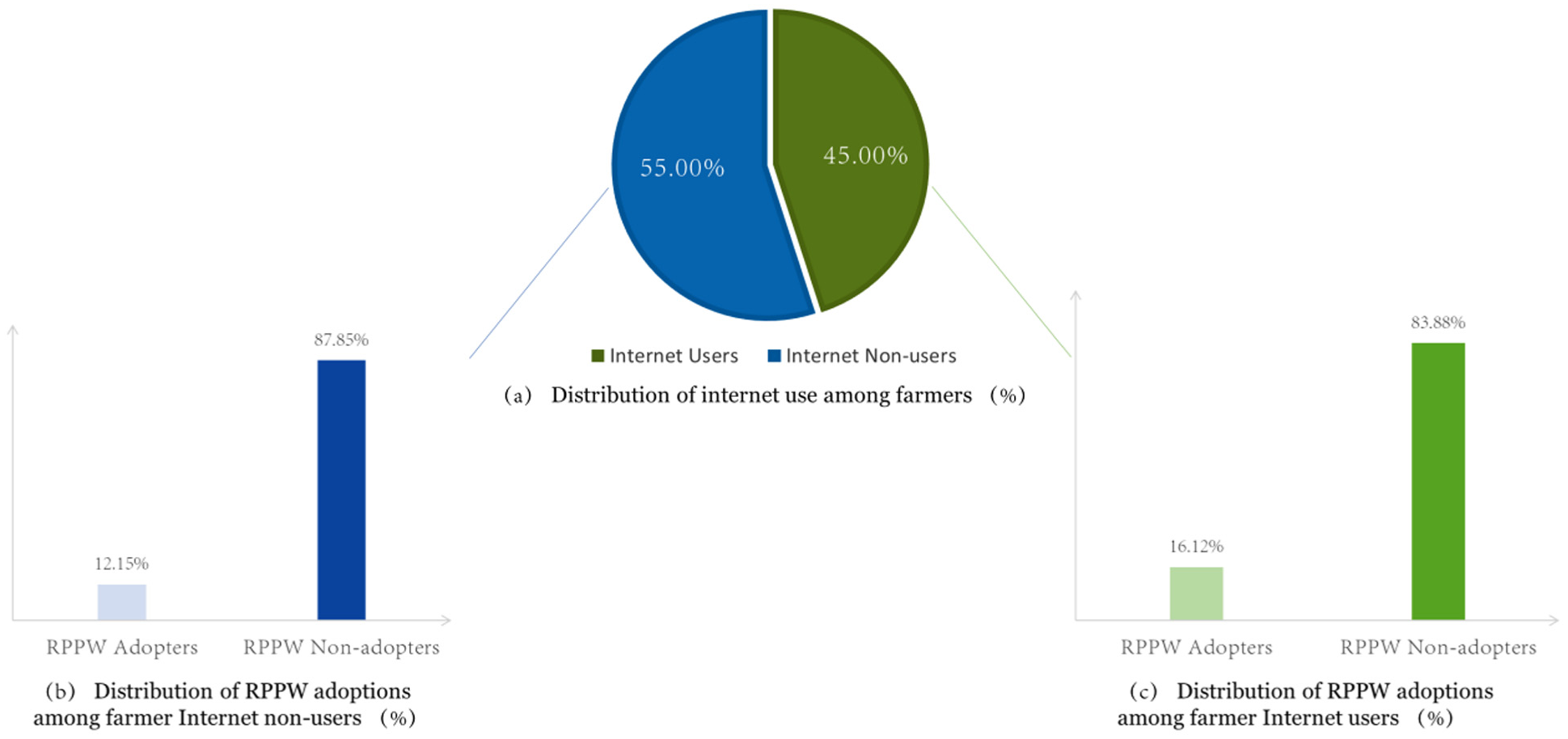
Sample description statistics: (a) distribution of internet use among farmers (%), (b) distribution of RPPW adoptions among farmer Internet non-users (%), and (c) distribution of RPPW adoptions among farmer Internet users (%).
Mean Differences in Characteristics Between Use and Not Use Smartphones
This study examines the data structure and presents mean differences to provide insights. Table 2 presents the disparities between farmers who use smartphones and those who do not. Firstly, the findings align with previous research by Deng et al. (2019), Ma et al. (2020), Twumasi Ankrah et al. (2023), indicating that farmers who use smartphones tend to be younger, have higher levels of education, and possess higher household incomes compared to non-users. Secondly, notable distinctions were observed in pesticide packaging waste recycling behavior between smartphone users and non-users. Specifically, farmers who use smartphones demonstrate a higher likelihood of engaging in pesticide packaging waste recycling. These findings suggest a significant association between smartphone use and pesticide packaging waste recycling behavior.
Mean Differences in Characteristics Between Use and Not Use Smartphones.
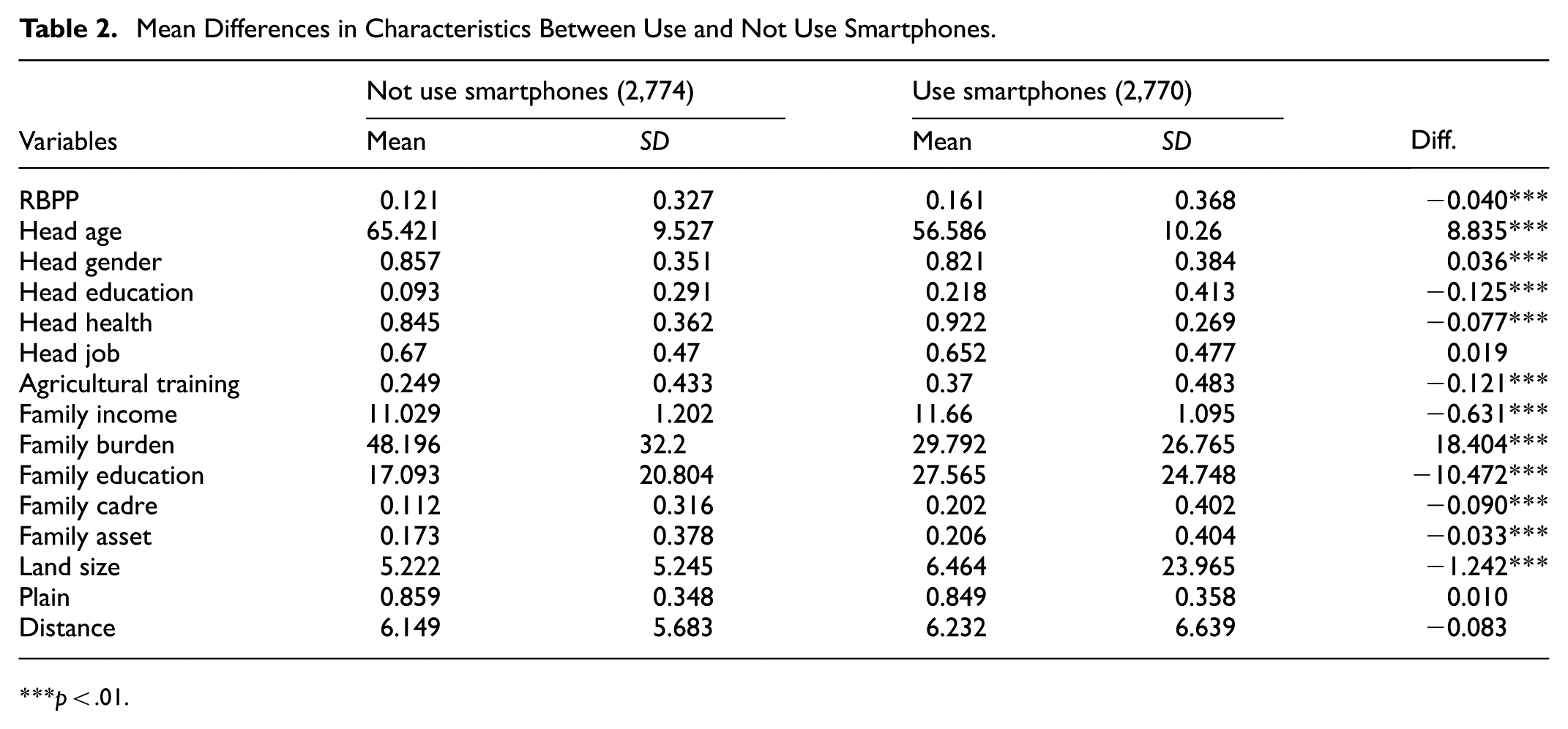
p < .01.
Adoption of Pesticide Packaging Recycling Behavior by Different Farmers
Table 3 presents the adoption of pesticide packaging waste recycling behavior among different groups of farmers. The results indicate variations based on land size, distance from the household to the town, and household income. Specifically, the adoption rate of small-scale farmers is lower compared to that of large-scale farmers in terms of land size. Conversely, distant farmers exhibit a higher adoption rate compared to peri-urban farmers in terms of the distance from the household to the town. Furthermore, the adoption rate of low-income farmers surpasses that of high-income farmers in terms of household income.
Adoption of Pesticide Packaging Recycling Behavior by Different Farmers.

Empirical Analysis
Determinants of Smartphone Use and Recycling Behavior of Pesticide Packaging Waste
Table 4 presents the results of the analysis. The coefficient ρ1 is found to be negative and statistically significant at the 1% level, leading to the rejection of the original hypothesis at the 10% level based on the Wald test. This indicates the presence of selection bias in the sample. Thus, the ESP approach is appropriate.
Determinants of Smartphone Use and Determinants of Recycling Behavior of Pesticide Packaging Waste.

Note. Standard deviations are in parentheses.
p < .1. **p < .05. ***p < .01.
In Column 2 of Table 4, the determinants of smartphone use are examined. The variables head age, head education, agricultural training, family income, family burden, family education, family cadre, land size, and peer effect demonstrate significant effects on smartphone use. Specifically, head age and family burden exhibit negative effects, while the remaining variables have positive effects. These findings align with previous studies conducted by Deng et al. (2019). However, in contrast to the findings of the previous study (Ma et al., 2020), this study does not find significant effects of head job and head gender on smartphone use.
Column 3 and Column 4 of Table 4 present the factors influencing pesticide packaging waste recycling behavior, highlighting the differences in these factors between smartphone users and non-users. For smartphone users (Column 3), the variables head gender, head job, family education, family cadre, and distance are found to have significant effects on pesticide packaging waste recycling behavior. On the other hand, for smartphone non-users (Column 4), the variables head age, head job, agricultural training, family education, family cadre, plain, and distance exhibit significant effects on pesticide packaging waste recycling behavior.
Notably, variables such as head job, family cadre, and distance have a significant and positive impact on farmers’ pesticide packaging waste recycling behavior regardless of whether the household uses smartphones or not. However, in contrast to previous studies (Bondori et al., 2018), the variable household education shows a negative effect on pesticide packaging waste recycling behavior.
Estimating the ATT
To explore the specific impact of smartphone use on pesticide packaging waste recycling behavior, we conduct a counterfactual analysis based on the estimated results of the ESP model (Table 4) with Equation 4, as shown in Table 5. From row 2, in general, smartphone use improves farmers’ pesticide packaging waste recycling behavior. Specifically, for farmers who use smartphones, smartphone use increases their pesticide packaging waste recycling behavior by 6.1% (significant at the 1% level) compared to those without using smartphones.
Impacts of Smartphone Use on Recycling Behavior of Pesticide Packaging Waste by Land Size/ Distance/ Income.

p < .05. ***p < .01.
In this study, the sample is divided based on land size, household distance to town, and income to examine the heterogeneous effects of smartphone use on different populations. First, smartphone use was more likely to improve pesticide waste recycling behavior among small-scale farmers. According to the land size grouping, Top 10% are large-scale farmers (>10 mu); Low 10% are small-scale farmers (<1.5 mu). The ATT of Land size (<1.5 mu) is larger than the ATT of Land size (>10 mu). According to row 3 of Table 5, the ATT value of small-scale farmers is 0.062 (statistically significant at the 1% level), which means that smartphone use can significantly increase the pesticide packaging waste recycling behavior of small-scale farmers by 6.2%.; according to row 4 of Table 5, the ATT value for large-scale farmers is 0.057 (statistically significant at 1% level), that is, smartphone use can significantly increase pesticide packaging waste recycling behavior of large-scale farmers by 5.7%. For small-scale farmers, there are information barriers in the market and small-scale farmers have less access to information than large-scale farmers. For example, many of the current policies are geared toward the moderate-scale operation group, and policies are only available when the scale of operation reaches a certain level (Song et al., 2024). This limits small-scale farmers’ access to pesticide packaging waste recycling. Smartphones expand small-scale farmers’ access to information on recycling services. Therefore, smartphone use improves the pesticide packaging waste recycling behavior of small-scale farmers more than large-scale farmers.
Second, smartphone use improved pesticide packaging waste recycling behavior among farmers closer to town. According to the grouping of households according to their distance to towns, Top 10% are farmers who are farther away from towns (>10.2 km); Low 10% are farmers who are closer to towns (<1.2 km). According to row 5 of Table 5, the ATT value for farmers farther away from towns is 0.017 (statistically significant at 1% level), which means that smartphone use can significantly increase pesticide packaging waste recycling behavior by 1.7% for farmers far away from towns. According to row 6 of Table 5, the ATT value for farmers closer to towns is 0.075 (statistically significant at 1% level), which means that smartphone use can significantly increase pesticide packaging waste recycling behavior of farmers closer to towns by 7.5%. The population closer to towns and cities is exposed to stronger environmental pollution than the population farther away from towns and cities. Therefore, when the information about the good ecological environment in other areas is also available on the Internet, farmers closer to towns are more inclined to compare this information with the reality of their own heavily polluted ecological environment. This makes them see the gap between their living environment and that of other regions, which will enhance the farmers’ perception of environmental threats. This awareness will give rise to a strong willingness of peri-urban farmers to participate in environmental protection behaviors, which is more conducive to the pro-environmental behavior of pesticide packaging waste recycling by peri-urban farmers. Therefore, smartphone use is more likely to improve the pesticide packaging waste recycling behavior of peri-urban farmers than that of remote farmers.
Finally, smartphone use was more likely to improve pesticide packaging waste recycling behavior among farmers with higher household incomes. According to annual household income, Top 10% are high-income farmers (>12.79); Low 10% are low-income farmers (<9.42). According to row 7 of Table 5, the ATT value for low-income farmers is 0.05 (statistically significant at 1% level), which means that smartphone use can significantly increase pesticide packaging waste recycling behavior of low-income farmers by 5%. ; According to row 8 of Table 5, the ATT value for high-income farmers is 0.09 (statistically significant at 1% level), which means that smartphone use can significantly increase pesticide packaging waste recycling behavior by 9% for high-income farmers. For low-income farmers, the use of smartphones requires a certain cost. Usually, smartphones are more expensive than regular cell phones. However, ordinary cell phones do not have the same ability to access information as smartphones. Therefore, smartphone use is more likely to improve pesticide packaging waste recycling behavior of high-income farmers compared to low-income farmers.
Robustness Test
In order to enhance the reliability of the research findings, two approaches are employed to test them: Changing the econometric model to an instrumental variable probit model (IV-probit). (2) Changing the econometric model to an endogenous switching regression model (ESR).
While smartphone use is an endogenous variable, the introduction of instrumental variables enables testing for its endogeneity. As indicated in Column 2 of Table 6, the marginal coefficient effect is 0.305, which is significant at the 1% level, after employing the IV-probit model. This finding suggests that smartphone use has a significant positive impact on pesticide packaging waste recycling behavior.
Results of Robustness Test.

Note. Standard deviations are in parentheses.
p < .01.
Referring to Lokshin and Sajaia (2004), the ESR model is selected in this study to examine the effect of smartphone use on pesticide packaging waste recycling behavior. As displayed in Column 3 of Table 6, the ATT is 0.026, significant at the 1% level. This implies that, among the group using smartphones, utilizing these devices can enhance their pesticide packaging waste recycling behavior by 2.6% compared to those without smartphones. In summary, the robustness test results support the main findings of this study (Table 4).
Conclusions and Discussions
This study examines the impact of smartphone use on pesticide packaging waste recycling behavior using data from the China Land Economic Survey (CLES) conducted in 2020 and 2021. The analysis employs the endogenous switching probit (ESP) model. The study draws the following main conclusions: (1) Smartphone use significantly enhances farmers’ engagement in pesticide packaging waste recycling. Specifically, for farmers who use smartphones, smartphone use increases their pesticide packaging waste recycling behavior by 6.1% (significant at the 1% level) compared to those without using smartphones. This result is similar to the study of Zhang and Gong (2023) and Mulungu et al. (2025). (2) Small-scale farmers exhibit lower levels of pesticide packaging waste recycling behavior compared to their large-scale counterparts; however, smartphone use has a more pronounced positive effect on pesticide packaging waste recycling behavior among small-scale farmers. (3) Farmers residing closer to town centers demonstrate a lower adoption rate of pesticide packaging waste recycling behavior compared to those located farther away, yet smartphone use serves as a significant catalyst for farmers in proximity to town centers. (4) Regarding income, low-income farmers have a lower adoption rate and limited reliance on smartphones, while high-income farmers exhibit a higher adoption rate and greater dependence on smartphones. Based on those conclusions, this study closes the research gap on the impact of smartphone use on pesticide waste packaging recycling.
Notably, this study quantitatively analyzes how smartphone use affects pesticide packaging recycling behavior without empirical analysis of the specific channels. Furthermore, it should be acknowledged that owning a smartphone does not necessarily imply accessing agricultural-related information, as smartphones may primarily be used for entertainment purposes (Sen et al., 2021). This observation prompts us to consider investigating the intended use of smartphones for Internet access in future studies, such as querying whether individuals employ the Internet to acquire agricultural information. Moreover, the econometric model significantly reduces self-selection bias, but cannot exclude all biases as well as external effects. Finally, the results of this research can only be used as a reference and cannot be directly replicated in other developing countries.
Policy and Implications
Based on the preceding analysis, this study presents the following policy recommendations. Firstly, concerted efforts should be directed toward promoting Internet connectivity in rural area. Heterogeneity analysis highlights the need to prioritize Internet use promotion activities for small-scale farmers. These farmers should be educated about the benefits of Internet access for acquiring agricultural information. Additionally, enhancing Internet promotion initiatives in towns and their surrounding areas is crucial to increase Internet use among residents in proximity to urban centers. This can bolster their awareness of environmental challenges, subsequently fostering their engagement in pesticide packaging waste recycling behavior. Furthermore, improving the income of low-income farmers is essential. To facilitate their Internet use, the government can offer subsidies and loans, among other measures, to reduce the financial burden associated with Internet access. Enabling low-income farmers to use smartphones and access the Internet would expand their information sources, ultimately facilitating the adoption of environmentally friendly agricultural practices.
Secondly, it is crucial to enhance the recycling services for pesticide packaging waste. The current mechanism for pesticide packaging waste recycling is characterized by government leadership and the integration of market forces. Despite the substantial amount of pesticide packaging waste generated, the actual volume of recycling remains low. This requires the government to build pesticide packaging waste recycling outlets (Sorichetti et al., 2024; Y. Zhou & Rao, 2025). At the same time, the publicity of the recycling policy should be increased (Abadi, 2023). Reasonable incentive policies can also be formulated, which in turn will increase farmers’ willingness to recycle pesticide packaging. One potential measure is to increase subsidies for pesticide packaging waste recycling, which requires the government has a strong financial base.
Finally, “Internet plus” agriculture should be developed. The utilization of digital technology can streamline the recycling process, allowing farmers to track their pesticide packaging waste recycling activities through their smartphones. This can provide them with information regarding the weight of recyclable materials, the value of rewards, and the progress of waste disposal, thereby fostering engagement and participation among farmers. This measure requires the development of Internet in the village region.
Footnotes
Acknowledgements
We gratefully acknowledge financial support from National Statistical Science Research Project, China (Grant No. 2023LY014), Research Base for Megacity’s Delicacy Management, Chengdu, China (Grant No. TD2024Z01), and Key Project of Consulting and Political Service Capacity Building of Chengdu Philosophy and Social Sciences Research Center in 2024 (Grant No. YJZX-2024-ZZZD-17). The authors also extend great gratitude to the anonymous reviewers and editors for their helpful review and critical comments.

Ethical Considerations
There are no human participants in this article.
Author Contributions
Xin Deng: Writing—review & editing, Validation, Resources, Funding acquisition, Project administration, Investigation, Conceptualization. Yating Zhan: Writing—review & editing, Writing—original draft, Conceptualization. Qian Qiao: Writing—original draft, Software, Methodology, Investigation, Data curation.
Funding
The authors disclosed receipt of the following financial support for the research, authorship, and/or publication of this article: This research was funded by National Statistical Science Research Project, China (Grant No. 2023LY014), Research Base for Megacity’s Delicacy Management, Chengdu, China (Grant No. TD2024Z01), and Key Project of Consulting and Political Service Capacity Building of Chengdu Philosophy and Social Sciences Research Center in 2024 (Grant No. YJZX-2024-ZZZD-17).
Declaration of Conflicting Interests
The authors declared no potential conflicts of interest with respect to the research, authorship, and/or publication of this article.
Data Availability Statement
The dataset supporting the conclusions of this article is included within the article.