



Abstract
This paper utilizes a comparative case study approach to explore the teacher job satisfaction (TJS) status of rural and urban teachers and the underlying factors that influence their TJS in central China by utilizing semi-structured interviews. Our participants include 30 rural and 14 urban public primary school teachers. We found that both rural and urban teachers had low levels of TJS. The main factors related to teachers’ job satisfaction were low salaries, heavy workload, low social respect, and frustration with the professional ranking system. Specific to rural teachers, the overburden of non-teaching-related duties, lack of parental support, and the low suzhi (quality) of students and parents had a significant impact on rural teachers’ job satisfaction. Moreover, rural and urban teachers also had misconceptions about each other’s positions, both believing that the “other side” had a better job. Implications for relevant education policy in China and beyond will be discussed.
Plain language summary
This paper utilizes a comparative case study approach to explore the teacher job satisfaction (TJS) status of rural and urban teachers and the underlying factors that influence their TJS in central China. We conducted semi-structured interviews with 30 rural and 14 urban public primary school teachers. Our analysis showed that contradicting with existing literature, both rural and urban teachers had low levels of TJS, with the leading contributing factors being: low salaries, heavy workload, low social respect, and frustration with the professional ranking system. Moreover, the overburden of non-teaching-related duties, lack of parental support, and the low suzhi (quality) of students and parents had a significant impact on rural teachers’ job satisfaction. Rural and urban teachers had misconceptions about each other’s positions, both believing that the “other side” had a better job. The findings of the study have significant implications for education policy inside and outside of China. Education policymakers and administrators should take into consideration of teachers’ actual workload, responsibilities in the teacher salary and compensation mechanism, for both rural and urban teachers. We call for a more transparent and fair professional rank promotion and evaluation system for K-12 teachers. The comparison between rural and urban teachers’ job satisfaction and their mis/perceptions about each other’s jobs could provide important insights for the recruitment and retention of quality teachers in other contexts where significant disparity in teacher quality exists.
Introduction
Teachers’ job satisfaction (TJS) is closely associated with students’ academic achievement (Banerjee et al., 2017; Hoppock, 1935; S. Liu et al., 2018). TJS not only affects the educational outcomes of students but also can play a mediating role in the equal distribution of quality teachers (Darling-Hammond, 1997; Sargent & Hannum, 2005). Studies show that teachers’ satisfaction levels with their job are important influencing factors for the recruitment and retention of quality teachers (Darling-Hammond, 2003; Jeon & Wells, 2018; S. Liu & Onwuegbuzie, 2014; Peng et al., 2014; Sargent & Hannum, 2005; Woods et al., 2023). Teachers are more likely to stay in their positions and be more motivated to pursue instructional excellence when they are satisfied with their jobs and working conditions (Mullis et al., 2017). Consequently, less developed and poorer school districts, which usually have lower TJS among their teachers, tend to have higher turnover rates and poorer quality of teachers (X. S. Liu & Ramsey, 2008).
The literature on rural schools in China also demonstrated that, when teachers are less satisfied with their job, it often results in poorer quality of its teaching force (X. S. Liu & Ramsey, 2008). Studies illustrate that more qualified rural teachers tend to move to urban schools if given the opportunity (S. Liu, 2012; S. Liu & Onwuegbuzie, 2012). This is due, in part, to the significant disparities in teacher quality between rural and urban schools (An, 2018; Chu et al., 2015; Peng et al., 2014; Sargent & Hannum, 2005). Moreover, such disparities in teacher quality between rural and urban education have a significant impact on the student achievement gap between these two groups of students (Chu et al., 2015; J. Wang & Li, 2009).
Despite the importance of TJS and its impact on teacher quality and student achievement, there has been limited rigorous research on TJS in China, especially in rural schools with more marginalized and disadvantaged student bodies. Studies on TJS among public school teachers in China have focused mainly on urban teachers, and most of the research used quantitative methodologies (Ouyang & Paprock, 2006; Sargent & Hannum, 2005; Xiao & Li, 2003). In regards to rural teachers, Dan Wang’s ethnographic work discussed that the lack of autonomy and trust from school administration is the primary reason for “teacher demoralization.” (Wang, 2013). However, there are very limited studies that have looked closely at the underlying reasons for the high turnover rate and low job satisfaction among rural public school teachers (S. Liu, 2012; S. Liu & Onwuegbuzie, 2012; Wei & Zhou, 2019). On the other hand, to understand more holistically the complex factors that affect rural teachers’ job satisfaction, it is important to understand if the factors that affect rural and urban teachers’ TJS are different or similar, which is lacking in the existing TJS literature in China.
The purpose of this study is to address the research gap and uses a qualitative approach to explore in-depth the factors related to job satisfaction or dissatisfaction among rural public primary school teachers in central China. To understand better what part of TJS is due to being a teacher, in general, and what part is due to factors related to teaching in a rural school, in particular, this study also includes urban public primary school teachers in the sample to provide a comparative perspective. In this study, we refer to rural schools as village and township schools and urban schools as county-city schools. To the best of our knowledge, there have been no previous qualitative studies that have compared the underlying factors related to the job satisfaction status of rural and urban teachers.
We chose primary school teachers as our study sample, as primary school is an important part of compulsory education (Grades 1–9) in China. The literature shows that rural-urban inequality in compulsory education constitutes the major form of educational inequality in China (H. Cheng, 2009; C. Li, 2015; Qian & Smyth, 2008; J. Wang & Li, 2009; W. Wang & Zhao, 2014; Yang et al., 2014). Studies also have shown that the rural-urban disparity in compulsory education leads to a further divide in the rural-urban educational attainment level as well as future employment in the labor market (Chung & Mason, 2012; Lei & Shen, 2015; Y. Shi et al., 2015). Moreover, as we noted, TJS is an important factor in the recruitment and retention of quality teachers (Peng et al., 2014; Sargent & Hannum, 2005). Therefore, understanding the underlying factors that influence rural and urban primary school teachers’ job satisfaction is critical to identify areas of improvement for education policymakers. Are these factors common to both rural and urban teachers or specific to teaching in rural schools and/or urban schools? To investigate these issues, we utilize the following research questions:
What are the underlying factors that influence rural and urban teachers’ job satisfaction?
How does being a rural or urban teacher shape teachers’ satisfaction status with their job?
This study utilizes a comparative The primary data collection method is in-depth semi-structured interviews. We conducted semi-structured interviews with 30 rural teachers and 14 urban public primary school rural and urban teachers. Interview topics included job satisfaction status, work environment, and factors related to their job satisfaction. To further understand if any of the factors are specific to teaching at a rural or urban school, we also asked teachers their perceptions of each other’s positions.
Conceptualizing Teacher Job Satisfaction
Job satisfaction as a concept has a strong theoretical base in social sciences research (Banerjee et al., 2017; Ouyang & Paprock, 2006). The literature in the conceptualizations of job satisfaction mostly focuses on either “affective reactions (emotional),”“attitude (cognitive or evaluative),”“beliefs (one’s perceptions about their job),” or a combination of two or all of these dimensions (Banerjee et al., 2017, p. 205; Lee et al., 1991; S. Liu et al., 2023; Skaalvik & Skaalvik, 2011; Weiss, 2002). In line with this theoretical framework, we take a broad approach to conceptualizing teacher job satisfaction and define the term “teacher job satisfaction” as teachers’“affective reactions,” attitudes, evaluative judgments (positive or negative), and beliefs and perceptions about their job (Skaalvik & Skaalvik, 2011, p. 1030; Weiss, 2002). As a qualitative study, it is important to stay true to the authenticity of research participants’ voices. The concept of “teacher job dissatisfaction” came up during the interviews, therefore the topic of “teacher job dissatisfaction” is discussed in the findings section. In this case, teacher job dissatisfaction refers to teachers’ negative judgment/attitude toward their job.
Teacher Job Satisfaction in China
The literature on TJS in China shows that urban teachers are generally more satisfied with their job than rural teachers (S. Liu, 2012; S. Liu et al., 2023; S. Liu & Onwuegbuzie, 2012; Qin & Zeng, 2018; Y. Wang et al., 2014). Research that focuses on understanding urban public school teacher satisfaction documents mainly the factors that could improve TJS. For example, Feng (2007) found that, among public middle school teachers in Beijing, higher levels of salaries of teachers, lower workload, and activities/programs that reduce the stress from exams were significant factors that raised job satisfaction levels. Moreover, when their schools had better organizational climates, higher levels of administrative support, and more collegial collaboration among teachers, urban teachers had higher levels of TJS (Jiang, 2005; Kwong et al., 2010). Finally, teacher autonomy and control over decision-making related to curriculum and pedagogy were shown to greatly improve urban teacher satisfaction (Jiang, 2005; Jiang et al., 2019; S. Liu et al., 2023).
In a more limited set of studies on Chinese rural TJS, researchers have shown that some of the factors related to urban TJS were associated with the job satisfaction of rural teachers as well. An (2018) and Chen (2010) found that rural teachers’ dissatisfaction with their salaries significantly affects their job satisfaction. In both studies, dissatisfaction was often expressed in terms of the gap in salary and benefits between rural and urban teachers. S. Liu (2012) showed that the overall poor organizational environment within rural schools, especially when they compare their schools to those in urban areas, also is a source of dissatisfaction and has led many rural teachers to begin to consider leaving their positions. Another set of studies found that the dissatisfaction among rural teachers was due to their heavy workload and the absence of any actions to reduce the high levels of stress in schools (S. Liu, 2012; S. Liu & Onwuegbuzie, 2012; L. Liu & Tu, 2005). As part of the workload and stress, serving as a homeroom teacher was shown to add extra responsibilities and workload to teachers (see Notes A1 in Appendix A). Little is known, however, whether being a homeroom teacher is related to TJS.
Although many factors related to TJS are similar between urban and rural schools, some studies have identified factors related to TJS that are unique to rural teachers. For example, Chen (2010) and S. Liu (2012) showed that rural teachers were dissatisfied with their work due to the poor living conditions in rural communities. Another study showed that rural teachers were frustrated with the lack of parental support and poor student behavior among students (Zhou et al., 2019). The analysis in several studies demonstrated that the complexity of and biases within China’s teacher professional rank (zhicheng) evaluation system lead to perceived difficulties of rural teachers’ being able to gain promotion within the system, and this, in turn, greatly affected their TJS (see Notes A2 in Appendix A; Qin, 2017; Qin & Zeng, 2018; Sargent & Hannum, 2005).
Although these earlier studies on rural and urban teacher dissatisfaction are useful in improving our understanding of TJS among rural and urban teachers, as a group, they have several methodological limitations. First, the majority of the studies were quantitative and presented only statistical indicators of TJS. Because many of the issues that lead to poor TJS for rural teachers are often complicated, the focus on quantitative studies does not give teachers the space to tell their stories and share their experiences and perspectives on their jobs, working conditions, and so forth. Second, although the literature has shown that rural teachers are generally less satisfied than urban teachers, researchers have not always been able to fully delineate the factors that make rural teachers less satisfied than their urban counterparts. Therefore, a comparative study that looks closer at the how and why factors of TJS and gives voices to the teachers is greatly needed.
Methods, Data Collection, and Analysis
This study utilized a comparative case study approach. The two cases are a set of rural public primary school teachers and a group of urban public primary school teachers in Henan Province, China. The following section discusses the participants, the background of the research sites, and the data collection method more in-detail.
Participants
The research took place in three counties in two prefectures in Henan Province, China, which had a population of nearly 100 million people in 2020 (People’s Government of Henan, 2021). The three sample counties are similar in terms of population demographic and economic development and, on average, had a population of 0.85 million in 2018. The average share of the populations that were rural in the three counties was 82%, which is close to the average share of the rural population in Henan Province (80%) and slightly higher than the national average of 70%; (Minquan County People’s Government, 2019; National Bureau of Statistics of China, 2011). The average annual disposable income per person for rural residents in the sample counties in 2018 was 11,748 RMB (1,646 USD; (Minquan County People’s Government, 2019). The average disposable income per person of rural residents in Henan Province was 13,830 RMB (2,151 USD), and the national average disposable income per person for rural residents was 10, 998 RMB (1,695 USD); (Minquan County People’s Government, 2019; National Bureau of Statistics of China, 2019; People’s Government of Henan, 2019). In terms of education level, the seventh Population Census in 2020 showed that the average educational attainment of the population over 15 years old in the three sample counties was 9.1 years, the average educational attainment was 9.8 years in Henan Province, and the national average across the country was 9.9 years (National Bureau of Statistics of China, 2021; Pan, 2018). Finally, the ethnicity of the sample counties is nearly all Han (over 90%), which is similar to the national share of Han ethnicity in the population (National Bureau of Statistics of China, 2021; Pan, 2018). Although the purpose of the qualitative study is not to generalize its findings but to provide insight, the demographic makeup and levels of economic development of the three counties are representative of Henan’s and China’s rural landscape.
Data Collection
Participants were identified using snowball and purposive sampling. The participants were initially referred to the research team through the personal connections of the first author. The criteria used for referrals were that the teacher needed to be a public primary school teacher in a village, township, or urban school. When asking for and selecting those referred contacts, the research team attempted to ensure a variation in age, gender, and position of the teacher, that is, a homeroom teacher or principal.
Each participant was asked to participate in an hour-long semi-structured interview to explore each teacher’s TJS status and identify factors that were related to their job satisfaction, upon receiving their consent to participate in the study. The first author, a native Mandarin Chinese speaker, conducted the interviews in Mandarin Chinese along with two field note-takers, who were also native Mandarin speakers. Some interview participants were more comfortable with speaking the local dialect, in which case the interviewer asked the questions in the local dialect.
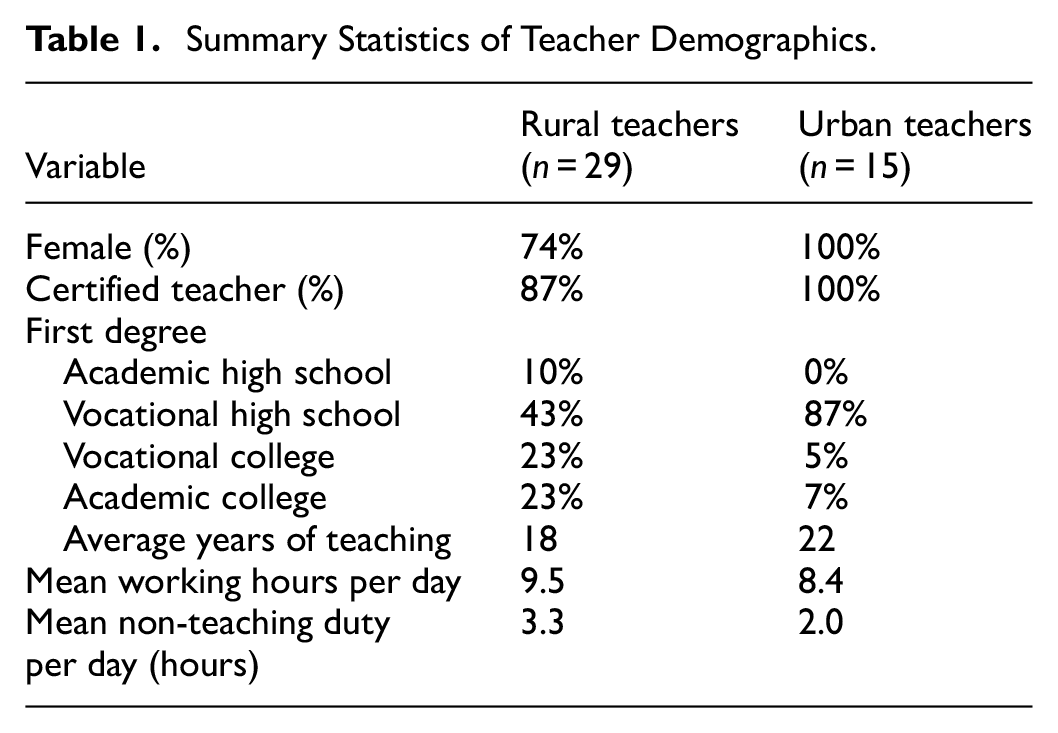
In total, we interviewed 30 rural teachers and 14 urban teachers from 22 public elementary schools. Table 1 presents the demographic information of the sample. Among the rural teacher participants, 75% were female, and their ages ranged from 26 to 60 years old. The urban teacher participants were all female, and their ages ranged from 36 to 47 years old. The average years of teaching experience of the rural teacher participants was 18 years; the urban teachers in the sample were more experienced, at 22 years. Among the rural teachers, about 10% had achieved, as their highest degree, an academic high school degree; 42% had a vocational high school degree (mainly teacher training vocational schools); 23% had attended a vocational (3-year) college; and 23% had obtained a 4-year college degree. Among the urban teacher participants, 87% held a vocational high school degree; 5% had attended a 3-year college; and 7% had obtained a 4-year college degree.
Summary Statistics of Teacher Demographics.
Interview topics covered teacher characteristics, such as educational background, rank status and rank promotion process, teaching experience, working conditions, professional development opportunities, relationships with colleagues, and other topics that emerged during the interviews. The interviews were conducted during the summer holiday and the majority of our interviews were conducted at the homes of the teachers, with a few interviews being conducted at the schools of the teachers at their request.
Data Analysis
The interview recordings were transcribed by the first author and three research assistants, who were all native Mandarin speakers. The transcription team cross-checked each other’s work after each recording was transcribed to ensure the accuracy of the transcription. The transcripts were then uploaded to the qualitative data analysis software NVivo to analyze the data. The transcripts were kept in the original interview language, Mandarin, to prevent cultural loss during translation and to respect the original voices of the participants (Adom & Asare-Yeboa, 2016; Brazill, 2016; Koro-Ljungberg, 2010; L. Shi, 2019). This also allowed the researcher to understand and analyze the data fully and accurately. Selected quotes presented in the findings were translated into English.
The first author first read through all of the transcripts and developed a preliminary codebook (main themes) based on the literature and then revised and expanded the codebook during the first cycle of coding. Subcategories and second-level codes were added as new themes arose during the second and third cycles of the coding process. Memo writing and jotting were used throughout the coding analysis to record reflections and analytical notes to enhance the validity and trustworthiness of the data analysis (Allen et al., 2019, p. 90; Miles et al., 2014). Member checking was utilized at multiple points of the data analysis and write-up stage to check the accuracy of the data interpretations (Johnson & Christensen, 2014).
Findings
The section is organized by the order of the research questions. We discuss the findings of the first research question by presenting the major themes related to the TJS of both rural and urban teachers, which are salary, workload, social respect/status, and the professional ranking system. We answer the second research question by discussing the factors that influence the TJS of rural teachers more than that of urban teachers, such as non-teaching-related duties and the low suzhi/quality of rural parents and students. Our findings do not show any factors that influence the level of TJS of urban teachers more than that of rural teachers. We also explore teachers’ perceptions of the difference between teaching at a rural or urban school.
Factors That Influence TJS
When asked “Are you satisfied with being a teacher?,” both rural and urban teachers shared a similar and consistent sense of dissatisfaction with their job, such as “Satisfied? No! . . . But there is nothing else I can do!,” or “I really cannot think of anything to be satisfied with [being a teacher].” We now turn to the discussion of the major factors that influence teachers’ job satisfaction status. We categorized these factors by whether they were common to almost all rural and urban teachers, whether they were common to some but not all rural and urban teachers, or whether they were common to most/all rural teachers but not to any urban teachers.
Table 2 presents the main factors mentioned by rural and/or urban teachers that influence their job satisfaction status. Based on our interviews, the issue of low salaries is cited by almost all rural and urban teachers. In the case of low respect from the community and the use of the professional ranking system in determining promotions, some but not all rural and some but not all urban teachers cite these two factors as sources of their dissatisfaction. All rural teachers, but no urban teachers, are unhappy with the proliferation of non-teaching duties and cite the quality interactions with parents of rural students as a source of dissatisfaction. We now discuss in detail how each of these factors affects rural and/or urban teachers’ job satisfaction/dissatisfaction.
Summary of TJS Factors and Percentage of Responses.

Common Factors Related to Rural and Urban TJS
Low Salary
The imbalance between a heavy workload and low pay and poor benefits is the most frequently mentioned theme by both rural and urban teachers in terms of their job satisfaction. It is reported that rural teachers work an average of 9.5 hr per day. Urban teachers work, on average, 8.4 hr per day. This time includes their lunch period (often about 1–1/2 to 2 hr long), which almost always coincides with the time that students are eating lunch and have self-study. It is during this lunch period that there are fundamental differences between rural and urban schools. In many cases, rural teachers are often required to staff the lunchroom and/or manage the lunchtime self-study period. In urban schools, students usually go home for lunch and return to the campus for afternoon sessions.
Regarding the relationship between salary and job satisfaction, a teacher who had taught in an urban school for 19 years explained to us: Of course, it (salary) does (affect job satisfaction)! Being a teacher is a work of good consciousness (liang xin). But I do not feel good about my job. [My] efforts are not correlated with [my] pay. But I have to keep working, just suppress my feelings, and live one day at a time. . . . [One day] I will eventually become a faded old woman [huang lian po]. (Urban teacher SQMQC10)
When talking about the relationship between workload and salary, a teacher who has taught in a village school for about 19 years expressed: I do not believe my salary matches my workload at all. . . . Even people who run breakfast food trucks or clean the streets make more than 100 RMB per day. . . . My [pay rate] is just too low. (Rural teacher SQMQV7)
The responses of the village school and urban school teachers reflect their frustration with how their salaries do not match their workload. However, when asked whether they thought about changing their profession, most teachers expressed that being a teacher provides a sense of job security and the benefit of allowing them to be close to their family, despite the low pay. For example, one township teacher said, “A factory worker makes more than I do, but my job is more secure” (Rural teacher SQMQV7). Such a sentiment goes a long way to explain why, even at the high rates of dissatisfaction, teachers are willing to stay in their jobs.
Social Respect
Another source of dissatisfaction was that teachers do not believe that teachers are respected in the community as a profession. For many rural and urban teachers, this absence of respect was tied mainly to their low salaries. An urban school teacher with nearly 20 years of teaching experience talked about an incident that had occurred when she went shopping with her colleagues. As they started to bargain with the shop owner, the shop owner asked them if they were teachers: He [the shop owner] said [bluntly] . . . teachers are the ones that always bargain. . . . We were so upset [to hear that]. Like other people don’t bargain? But when he said, “Teachers always bargain,” it felt like he was looking down on us, like teachers are stingy. But other people bargain, too! It’s all because [we teachers] have a low salary! (Urban teacher SQMQC9)
This urban teacher became emotional as she talked about this incident and the humiliation she felt from the shop owner due to the economic constraints she has as a teacher. Another example that also illustrates how salary affects the sense of society’s respect for teachers is reflected in a female township teacher’s response: On the surface, [parents] are polite when their children are in your class. But after a while, [when you run into each other, a parent] will greet you if he wants to or ignore you if he doesn’t want to. . . . [It is like] when they ask you, “What’s your salary, teacher?” Even a new college graduate [working somewhere in the county seat] makes more than we do. Nowadays in the village, only rich people can earn the respect of others. (Rural teacher SQMQT2)
Both rural and urban teachers believe that they are not respected by either the parents of students or those in the community due to their low salaries. One teacher stated this bluntly: “People are all chasing money, and money decides your social status” (Rural teacher SQMQT5).
The teachers commonly stated that they felt “left out,”“unimportant,” and/or “disrespected.” This sense of feeling undervalued, unappreciated, and not being rewarded fairly for their work appears to have negatively affected their work enthusiasm and motivation.
Teacher’s Rank Promotion System
Many rural and urban teachers have shared another layer that contributes to their dissatisfaction wiht their job: their discontent and frustration with the teacher professional ranking system. In China, the salaries of certified teachers are directly associated with their professional rank status and the requirements for professional rank promotion are complicated and formalistic and lack transparency (Qin, 2017; Qin & Zeng, 2018). In addition, there is a limited quota for rank promotion each year. Therefore, this system is seen as one of the main barriers to rank promotion (and higher salaries) for teachers. Moreover, most teachers indicate that a teacher’s professional rank does not necessarily reflect one’s teaching quality.
An urban teacher with 19 years of experience expressed her disappointment with the lack of transparency: “I was promoted to Level 2 in 2005. I should have been promoted to Level 1 in 2009. Unfortunately, there was no quota. The [rank promotion] process is not fair” (Urban teacher SQMQC11). The same teacher continued, citing her own story that was still unfolding 11 years after she was denied professional rank promotion: To give you an example, we had one quota [at my school] this year. It was my turn to be promoted to Level 1. But I eventually lost to another teacher by one point because her documents show she has more teaching years. But it was a fake document. Everybody knew her documents were fake. But what could I do? All they do is look at the papers. Everybody knows that I’ve been working hard all these years and it was [finally supposed to be] my turn this year. But she had fake documents. What can I do? (Urban teacher SQMQC11)
The frustration with the professional ranking system also affects the sense of pride that many teachers have in their job: “Am I proud of the work I do? There is nothing to be proud of. Nowadays teachers are so stressed. . . . And [above all], it is extremely difficult to move up to a higher rank” (Urban teacher SQMQC1).
In addition to the difficulty with moving up in professional rank, the quota for professional rank promotion and its direct association with the salary scale of teachers also creates competition among teachers and, according to some of our interviews, negatively affects their collegial relationships. A female township teacher with 18 years of teaching experience said: The rank promotion criteria, I think, is not a good thing. Because you know, sometimes, people [the teachers] get into conflicts, like, really serious conflicts. The competition [for the quota] is not good for collegial relationships. Just for this little benefit, they are fighting with each other [over the quota] all the time. (Rural teacher SQMQT1)
Studies have shown that the frustration with rank promotion applies only to rural teachers (Qin, 2017; Qin & Zeng, 2018; Sargent & Hannum, 2005). In our study, however, both rural and urban teachers expressed frustration and disappointment with the seemingly unclear, unstandardized, and often non-transparent rank promotion criteria and process.
The above factors are the most common sources of rural and urban teachers’ dissatisfaction with their jobs. There are some factors that, for complex reasons, are particular to the job satisfaction of rural teachers. The following subsection concerns these factors.
Factors Unique to Rural Teacher TJS
Non-teaching Related Duty
When teachers talked about the imbalance between salary and workload, one theme that emerged among rural teachers was the significant proportion of non-teaching-related duties that they are required to undertake during the regular course of their workday. Non-teaching-related duties referred to activities and events that are not directly related to in-the-classroom teaching. During our interviews, the burden of non-teaching-related duties was the most frequently mentioned issue that rural teachers claimed led to their dissatisfaction with teaching. They reported that they are often caught up with administrative paperwork that is not related to teaching. A male township school teacher described some of these non-teaching-related responsibilities: Sometimes I have to do these meaningless things, like making up fake documents [e.g., documents that show there are no dropouts from their school, when there often are]; . . . party development files, etc. . . . They make the teachers do all that work. . . . It is really annoying. Of course, it does [affect job satisfaction]. You can talk about it with the principal, but nothing will change. (Rural teacher NYFCT1)
A female teacher who has taught for 20 years in two different village schools talked about the different types of non-teaching-related tasks that she and her colleagues had been assigned over the years: You know, a few years ago, the township government asked us [teachers] to clean the streets! We had to cancel classes to clean the streets and plant trees. We do not do those things now. But there are still too many responsibilities like this outside of the classroom. For example, during the weekends, they [village leaders] asked the teachers to do “Poverty Alleviation” work, such as visiting the poor households and asking them if they have enough food to eat. You know things like that. . . . We [teachers] all complain in the office when the principal is not there. You know we complain like little kids. . . . Those things are just beyond my responsibility as a teacher. (Rural teacher SQMQV13)
The responses of these two teachers indicate how rural teachers are caught up with many mandated, non-teaching-related duties. They state unambiguously that these activities take their time away from lesson planning and instruction and add to their already heavy workload. Moreover, they rarely have a choice to not participate in the assigned extra duties, which leads to frustration and an absence of satisfaction with their job.
Homeroom Teacher Duty
In addition to the extra non-teaching-related duties of all teachers, many homeroom teachers whom we interviewed reported that they had an even greater burden. They had extra tasks for which they are not compensated very much, if at all, which frustrated them and added to their dissatisfaction with their job. One typical response that reflects this frustration is: Talking about homeroom teachers, nobody wants to do the job. We only get 80 RMB per month for being a homeroom teacher. There is so much extra responsibility. Regular subject teachers only need to worry about teaching, no parents will bother them. . . . I do not believe that the principal will agree if I tell him that I want to quit being the homeroom teacher because no other teachers want to do it. It (being a homeroom teacher) is very exhausting. (Rural teacher SQMQT1)
In contrast to rural teachers, urban teachers did not seem to experience stress regarding the intensity of non-teaching-related duties or the burden of being homeroom teachers, possibly because urban schools tend to be relatively more sufficiently staffed and efficiently managed. Many administrative responsibilities were not given to urban teachers. In addition, compared to rural schools, urban schools have shorter school hours and do not require students to be on campus for pre-morning class self-study or lunch duty, as urban students return home for lunch. In contrast, rural teachers have to staff early morning self-study periods, lunch duty, and mid-day self-study periods. On average, rural teachers spend 3.5 hr per day and urban teachers spend about 2.1 hr per day on non-teaching-related duties.
On the other hand, urban teachers in our sample did not seem to be bothered by the burden of being a homeroom teacher. In urban schools, homeroom teachers get compensated monetarily more than rural teachers (which appears to make a difference in the attitude of rural and urban teachers toward taking on the extra duties).
Low-Suzhi of Rural Students and Parents
Part of the responsibilities of homerooms teachers is dealing with parents and students, and both our rural and urban teacher participants feel that rural parents and students are of lower suzhi (education and quality) and are often more “difficult” to deal with as compared to urban parents and students. In particular, our rural teacher participants stressed their frustration with dealing with, in their words, the “lower suzhi” rural parents and students, one important factor that influences the level of rural TJS.
Rural teachers often felt that rural parents and grandparents, at most, provided minimal support for the education of their children, as a village school principal explained: The difference between rural and urban teachers is that they [the urban parents] know how to respect teachers, but rural [parents] don’t. Rural parents have low suzhi, [so] they don’t care about teachers at all. For example, there was a student; his teacher snapped at him one time. Then the grandpa came to the school and yelled at the teacher, saying, “If you don’t let my child back into the classroom, I will stab you to death.” (Rural teacher SQMQV15)
This type of threat and the overall absence of understanding and support from rural parents and grandparents make many rural teachers feel disheartened. Fear of potential reprisals also makes the teachers feel constrained in utilizing strategies to discipline the students. As one teacher noted, “They say whatever is on their mind. They curse at the teachers whenever they want to” (Rural teacher SQMQV15).
Not only are rural teachers frustrated with the low suzhi of rural parents and grandparents, but they also think the students are of lower suzhi compared to urban students. Both rural and urban teachers feel that rural students are behind their grade level in almost every subject, including mathematics, Chinese language, and English. A female urban school teacher who used to teach at a village school shared her observations on the differences between rural and urban students: Rural students are behind urban students on test scores. Their home environment is different. For example, urban students have their parents supervise their homework, but rural students play as much as they can. [One of the reasons this is so, in a large part, is] . . . because their parents are not with them. They do not get enough rest. There is no supervision. Consequently, every aspect [of their life] is not good. They do not have good habits in any aspect. (Urban teacher SQMQC5)
This teacher indicated that it was essentially the differences in family backgrounds and home environments among rural and urban students that were the source of the achievement gap between these students. Another teacher expressed a similar view when talking about the challenges of teaching rural students: The [left-behind children’s] grandparents/guardians do not ask about their schooling. So the burden of the teachers is heavier [than that of urban teachers]. Urban families emphasize children’s learning; they send their kids to tutoring and extracurricular/interest classes during weekends. Their kids are so good. Rural kids only learn in school. They have to finish their homework at school because their parents do not ask about it at home. For urban schools, the homework is not given to the students but to the parents. . . . But this is impossible in rural schools. If you ask someone at home to sign their homework for supervision purposes, the students will tell you that their grandparents cannot write. (Rural teacher SQMQT3)
The Grass Is Always Greener on the Other Side
To better understand the nature of teachers’ dissatisfaction with their job, whether it is related to teaching at a rural or urban school, we turn to the discussion on how rural and urban teachers think about each other’s jobs.
Rural Teachers
When asked about the difference between being a rural and an urban teacher, many rural teachers repeatedly mentioned that urban teachers received more compensation and benefits, had a lighter workload, and enjoyed a better working environment that provided opportunities for extra income. A township teacher discussed the difference in workload between rural and urban teachers: Urban teachers don’t have as much of a heavy workload as rural teachers. Rural teachers have more students in each class, so we have more assignments and papers to grade. It is exhausting. There are more students in urban schools, but [they have] smaller class sizes, so they have fewer papers to grade and less of a workload. (Rural teacher SQMQT6)
Rural teachers also believe that there is a fundamental structural difference between being a rural and urban teacher, as one rural teacher explained: Of course, there is a huge difference [in being a rural or urban teacher]. Like with the professional rank, even at the same rank level in name, rural teachers’ rank is considered one level lower than urban teachers [reflected in the pay scale and professional rank structure]. (Rural Teacher SQMQT3)
Another township teacher provided an example of the difference in compensation between rural and urban teachers: Urban teachers get paid more allowances and compensations. I have a friend who teaches at an urban school; they get paid 10 RMB for an hour-long self-study period supervision duty. We get paid 2 RMB for a 90-minute long self-study period supervision duty. (Rural Teacher SQMQT1)
Moreover, rural teachers frequently mentioned the unique advantages that urban teachers have in making extra income, using their position of teaching at urban schools: Regarding our rural teachers’ stipend, what we get is nothing compared to what the urban teachers can make through side tutoring. For example, I know this teacher at a county-seat school. [She charges] a couple of thousand RMBs per student, and every student in her class [regular school class] is in her tutoring school. They [urban teachers] make over 10,000 RMB every year [through after-school tutoring]. (Rural teacher SQMQV15)
In short, for rural teachers, there was nothing that made their job satisfying, and they were envious of urban teachers in several areas: their higher salaries, lower workload, better working environment, and channels of extra income. As discussed earlier, rural teachers also envied the fact that urban teachers worked with higher-quality students and that the parents of urban students also were of higher quality.
Urban Teachers
We asked the same questions to urban teachers about the differences between being a rural and an urban teacher, the responses were quite contradictory to rural teachers’. Many urban teachers expressed their envy of the government’s policy preference for subsidizing rural teachers with a higher basic salary when the difference in location of rural and urban schools was only “a few kilometers away.” One urban teacher responded passionately about this frustration: I believe rural teachers actually get paid more than we do; they have that extra stipend for being a rural teacher. But we [urban teachers] get nothing, and everything costs money living in the city. . . . Many rural teachers also farm, so they spend less money on groceries . . . so they don’t actually need to spend any money. (Urban teacher SQMQC11)
Moreover, urban teachers believed that rural teachers had a more satisfying job because they felt that rural teachers had a lighter workload. As one urban teacher stated: Not only do the rural teachers get paid the extra stipend, but also their jobs are much more relaxing [than ours]. They only have a dozen or two students to teach in each class at the village schools, while our class sizes are much larger, and it is so much more work. (Urban teacher SQMQC2)
Another example of urban teachers’ perception of teaching in rural schools is seen in the following: “It is so much easier to teach in rural schools. The students are simple, and you do not have to think of anything but to teach; it is less stressful” (Urban teacher SQMQC5). Such perspectives, that rural teachers have an easier and more financially rewarding job, were very common in our interviews with urban teachers.
Taken together, both rural and urban teachers in our sample generally have a low satisfaction level with their jobs. Moreover, both sides believed that the other side’s job was better than theirs, in other words, they believed that “the grass is greener on the other side.” During the interviews, although there were clear misperceptions held by rural and urban teachers about the nature of teaching and its challenges in rural and urban schools, almost every interviewee had complaints about various aspects of their jobs that undermined their TJS. In fact, the actual story is that “the grass is grey on
Discussion and Conclusion
This study explores the TJS status of rural and urban public primary school teachers in Henan Province, China. Our findings show that both rural and urban teachers were very dissatisfied with their jobs. The main factors that influenced rural and urban TJS were: low salaries and heavy workload, low sense of respect in the community, and frustration with the complex professional ranking system. The burden of non-teaching related duties, lack of parental support, and the lower suzhi of students have a significant impact on rural TJS.
Not only were rural and urban teachers very unhappy with their job, but they also seemed to have misconceptions about each other’s positions. They believed that the other party had a better job than they did, from the perspective of salaries, benefits, or workload. A possible explanation for the perceptions of these rural and urban teachers might be that, in their increasingly urbanized society, it is a common assumption that jobs in urban areas are better, with better pay, working environments, benefits, and social status. Rural teachers believe that they could be upwardly mobile if they could teach in urban schools. For urban teachers, who are surrounded by a community of various professionals, such as government officials, business owners, and corporate employees, their salaries make them feel like they are on the bottom rung of the social and economic ladder compared to other professionals in the city. Moreover, the government’s recent policy preference for rural teachers’ quality improvement made them feel left out.
It is worth noting that the most frequent theme related to rural TJS, which was brought up by both rural and urban teachers, is the perceived lower quality (suzhi) of rural students and parents. Suzhi, a contextualized form of what Bourdieu (1997) would call “cultural capital,” refers to the “cultural goods” or symbolic representations (culture, managers, and values), or in the form of institutionalized state “education qualifications and credentials” (p. 283). In comteporary China, the ones who are in possession of higher suzhi/cultural capital are urban residents as they are the dominant group whose knowledge, lifestyle, and values are perceived as superior, mainstream and of value (L. Wang, 2016; Cheng & Kaplowitz, 2016; Wu, 2018).
Rural and urban teachers feel that rural students, especially left-behind children, are disadvantaged due to the lower educational background and economic resources of their parents and grandparents. Many rural students are left-behind children, which refers to those whose parents are migrant workers in remote cities. Rural teachers mentioned that they had to work longer hours to help some left-behind children finish their homework during the school day. Moreover, rural teachers have to deal with negative responses and reactions from grandparents when teachers need to discipline students. Although rural students or parents may not possess what the teachers perceive as “high suzhi,” they might have other valuable assets in other aspects such as independence (especially for left-behind children), farming/crafting skills, and/or resilience developed from living in hardship. However, these skills are not recognized as “high quality/suzhi” as they are not the mainstream capital, which is the dominant urbanized social norms and values (L. Wang, 2016).
Significance and Contributions
The findings of this study make a significant contribution to the literature on TJS. Our study uses a qualitative approach, where we listen to the voices of rural and urban teachers and understand their lived experiences as a teacher in a rural or an urban school. Compared to most of the quantitative studies that use only survey methods to examine TJS, our study provides a more in-depth and complex picture of TJS. Moreover, our study includes both rural and urban teachers in the sample and the in-depth comparison of factors related to rural and urban TJS makes our study unique. Our results show that both rural and urban teachers are dissatisfied with their job, which is a new finding in the literature on TJS in China. The comparison between rural and urban TJS factors and perceptions of each other’s jobs certainly is a new contribution to the existing literature on TJS, not only within China but also in the international context.
The findings of the study also have important policy implications. Despite the government’s recent efforts and investment in recruiting teachers into rural schools, the teacher turnover rate in rural schools remains high, and the teacher shortage remains a serious concern (An, 2018; Du, 2019; Yan, 2018). Our study provides valuable insight for policy change and recommendations. The common factors that influence rural and urban teachers’ job satisfaction, sense of respect in the community, and value to society are the low salary and poor benefits. Increasing teachers’ salaries and benefits is crucial to improving TJS and helping teachers to feel valued and respected by the community. It is also important to compensate for rural teachers’ non-teaching-related responsibilities, such as the homeroom monitoring of self-study hours and other duties. Reducing the non-teaching-related responsibilities of rural teachers will help them to focus on preparing for lessons and improving their teaching in the classroom. Finally, a more transparent and fair professional rank promotion and evaluation system and the loosening of the strict quota are much needed to provide a fair and encouraging environment for teachers to work toward promotion to a higher professional rank.
The findings of the study have significant education policy implications for education policy outside of China as well. The rural-urban divide in education exists in many contexts in the world. In some areas where rural and urban inequality is not as explicit as China, there exist other dimensions of inequality such as urban/suburban/rural, socioeconomic status, race, geographic area, etc. The comparison between rural and urban teachers’ job satisfaction and their mis/perceptions about each other’s jobs could provide important insights for the recruitment and retention of quality teachers in other contexts where significant disparity in teacher quality exists.
Footnotes
Appendix A

Funding
The author(s) received no financial support for the research, authorship, and/or publication of this article.
Declaration of Conflicting Interests
The author(s) declared no potential conflicts of interest with respect to the research, authorship, and/or publication of this article.
Data Availability Statement
The data of this study is available upon request.