




Abstract
The rapid rise of the fast fashion industry not only accelerated the growth of the textile industry, but also caused environmental pollution problems of a large number of waste clothing. As a populous country in the world and has a huge textile industry, China’s urban residents’ willingness to recycle waste clothing plays a vital role in global environmental protection. The purpose of this study is to adopt the value belief norm (VBN) theoretical framework and introduce two additional constructs of attitude and recycling trust to explore their role in promoting residents’ waste clothing recycling behavior. A valid sample of 1,529 was collected by questionnaire survey and analyzed by structural equation model (SEM). The validity of VBN theory and its extended construct attitude and recycling trust in predicting clothing recycling behavior was verified. The results show that the personal norms (PN) significantly indirectly affect the behavior of recycling behavior by affecting its attitude and trust in the recycling system, and the mediating effect of recycling trust is more significant than that of attitude. This shows that strengthening public confidence in the reliability of recycling systems is an important way to promote recycling behavior. This study not only provides a solid theoretical basis for formulating more effective recycling strategies in the future, but also clarifies the specific practical direction, which is of great significance for promoting a wider range of waste clothing recycling actions.
Plain language summary
The fast fashion industry’s rapid growth has led to significant environmental issues due to the large amount of waste clothing generated. In China, a country with a vast population and a substantial textile industry, it’s crucial for urban residents to recycle their old clothes to help protect the environment globally. This study uses the Value-Belief-Norm (VBN) theory and adds two new aspects: attitude and recycling trust. We wanted to find out how these factors influence people’s willingness to recycle their old clothes. We surveyed 1529 people and used a statistical method called Structural Equation Modeling (SEM) to analyze the data. Our findings showed that personal norms (what society expects us to do) indirectly affect people’s intentions to recycle clothes by influencing their attitude towards recycling and their trust in the recycling system. Importantly, trust in the recycling system had a stronger influence than attitude alone. This means that making sure people believe in the effectiveness of recycling programs can encourage them to recycle more. Our study helps create better recycling strategies and points out clear ways to increase recycling of old clothes, which is beneficial for the environment.
Introduction
With the rise of fast fashion culture, consumers’ demand for clothing has increased dramatically. Although this has promoted the economic growth of the textile sector, it has also led to the accumulation of a large amount of discarded clothing (Xie et al., 2021). The environment effect of the textile business is apparent in the pollution of groundwater, air and soil. For example, chemicals used in the spinning and dyeing processes can seep into water sources and pollute groundwater; the wastewater from dyeing and finishing processes is discharged into natural water bodies without proper treatment, which further aggravates water pollution (Berradi et al., 2019). In addition, these chemicals may contain harmful substances, for example azo dyes and heavy metals, which not only cause persistent damage to the environment, but also harmful to human health (Islam et al., 2022). Globally, more than 30 million tons of clothing are discarded every year, and less than 5% of them are recycled, which results in a huge waste of resources, as well as the potential risk of urban pollution (Rausch & Kopplin, 2021). It is thought that by 2030, it will have caused about 2.79 billion tons of carbon dioxide emissions, 118 billion cubic meters of washing water use, and 148 million tons of textile trash (Rausch & Kopplin, 2021).
Clothing recycling plays an important role in this circular transition. According to the study, recycling 100 items of second-hand clothes reduces the need to acquire 60 to 85 pieces of new apparel, and the environmental impact of the collecting and processing chain is minor when compared to new product manufacturing (Farrant et al., 2010). Recycling used clothing not only reduces our reliance on raw materials, but it also reduces the quantity of waste that ends up in landfills, so minimizing the environmental impact (Leal Filho et al., 2019). As the world’s largest textile producer, China generates around 100 million tons of textile and garment waste each year (Li et al., 2021). At the same time, about 26 million tons of waste clothing need to be processed every year. It is expected that this number will climb to about 50 million tons by 2030. Therefore, it is particularly urgent to enhance people’s attention and participation in recycling.
Many developed countries have established advanced recycling systems, increasing participation rates through policy incentives and consumer awareness campaigns. For example, European countries have implemented Extended Producer Responsibility (EPR) programs to ensure sustainable textile management (Jansone-Vevere et al., 2024), the United States has seen a growth in the second-hand clothing market supported by digital resale platforms (Padmavathy et al., 2019) . But the present recovery rate of waste textiles is quite poor (China Association of Circular Economy, 2021). China does not have sufficient recycling infrastructure, clear policy benefits, or public trust in the recycling system, like Western countries. Therefore, consumers do not recycle as much (Xiao et al., 2018). According to research, Chinese consumers are less likely to participate in recycling programs because they trust them less (Ramzan et al., 2019). In addition, financial incentives to recycle are still weak, but Western countries offer tax incentives and deposit refund programs to promote participation. Considering that China’s urban population will reach 932.67 million in 2024 (Handheld College Entrance Examination, 2024), in this context, enhancing public trust and participation in waste classification policies will become an important breakthrough in promoting the construction of an ecological civilization.
In recent years, the academic community has attached great importance to the study of environmental protection, in which there has been some progress in the field of clothing recycling. For example, some scholars have reviewed the recycling and reuse methods of refuse clothes, analyzed the benefits and disadvantages of current recycling technologies, and discussed the reasons for the inefficiency of the recycling system (Xie et al., 2021). Other studies have explored consumers’ purchase behavior of environmentally friendly fashion clothing, emphasizing the importance of enhancing people’s positive attitude toward the use of recycled material clothing to reduce clothing waste (Hatef & Shaharuddin, 2019). In addition, researchers have explored a variety of theoretical models to analyze people’s green behavior, such as the Theory of Planned Behavior (TPB; Kumar & Nayak, 2023), Value-Belief-Norm Theory (VBN; Steg et al., 2005), and Norm Activation Model (NAM; Setiawan et al., 2021).
While a variety of psychological and behavioral models have been used to understand consumer participation in recycling, their applicability to Chinese socio-cultural and economic conditions remains uncertain. In the specific context of textile recycling, the applicability of the traditional TPB and the NAM has been challenged. It has been shown that these models have limitations in explaining behaviors that are strongly influenced by external factors, especially when the behavior is not fully autonomous in decision making, and their predictive power may be inadequate (Rossi & Armstrong, 1999). People often use VBN theory to guess how they will act in ways that are good for the environment. However, most of the research that has been done on the VBN model has been on direct and indirect effects, not on how the individual paradigm affects behavior. On the other hand, most analyses only focus on external factors such as psychological factors or policies, ignoring a mixed factor between external and internal factors, such as recycling trust. Although clothing recycling has become a global issue, related research is not balanced in geographical distribution, and may focus more on the situation of certain regions or countries. However, there are relatively few discussions on the specific participation of Chinese urban residents in this regard and the reasons behind it. This lack makes it difficult for us to fully understand how and why urban residents participate in recycling activities in different cultural backgrounds.
To compensate for the shortcomings of existing studies, this study extends the VBN theoretical framework by introducing attitude and recycling trust as parallel mediating variables between personal norms and clothing recycling behavior. Specifically, this study focuses on the influence of psychological factors on apparel recycling behavior, explores how attitudes and recycling trust drive individual recycling behavior under the influence of personal norms, and proposes feasible strategies to enhance public trust in the recycling system and increase actual participation. This study fills a gap in the existing research on psychological mechanisms in apparel recycling behavior and provides practical guidance for policy makers. By deepening the understanding of individual psychological drivers, this study provides theoretical support for optimizing the promotion of apparel recycling and feasible suggestions for increasing the public’s willingness to recycle and participation. In addition, in light of the waste management challenges posed by the fast-fashion industry, the study’s findings can assist can help promote more targeted consumer education and behavioral guidance, and provide a scientific basis for increasing the apparel recycling rate.
Literature Review
The Value-Belief-Norm Theory
The VBN theory is a theoretical framework created by American sociologist Paul C. Stern and others to explain environmental-related behaviors. The theory is based on three main psychological levels to explain the individual’s environmental behavior, which are values, beliefs, and norms (Stern, 2000). Researchers are using VBN theory to forecast eco-friendly behavior in various contexts, including recycling (Onel & Mukherjee, 2017), consumers’ intention to choose green hotels (C.-P.Wang et al., 2023), tourists’ environmental behavior (Sharma & Gupta, 2020), energy conservation (Wolske et al., 2017), and public support for green policies (Whitley et al., 2018).
Although the VBN theory is effective, it has obvious limitations, such as ignoring the role of attitudes in behavioral decisions (Bamberg et al., 2007). In reality, even if people have strong personal norms, they may still not take actual action if they have negative attitudes toward recycling behaviors (Tamar et al., 2020). VBN fails to consider the impact of trust in pro-environmental behavior (Nguyen et al., 2019). Nguyen et al. (2019) discovered that trust influences customers’ desire to participate in recycling programs. Trust plays a significant part in the shift from intention to action in environmental protection behavior (Ellen et al., 1991). In China, consumer trust in the recycling system is low, which may be an important factor influencing recycling behavior.
In addition, VBN theory focuses on the psychological determinants of behavior while ignoring external environmental factors such as government policies, economic incentives, and schooling (Oyelade, 2019; Sun et al., 2024). In some countries, deposit return programs, tax breaks, and ease of access to recycling stations have been shown to promote recycling participation (Oyelade, 2019). While external factors certainly play a role in affecting recycling behavior, the focus of this research remains on the psychological mechanisms that influence consumer decision-making. This approach is effective for two main reasons: 1. psychological variables are intrinsically motivating, while external factors often act as indirect influences by altering these internal processes (Nguyen et al., 2019). 2. Longitudinal data are needed to accurately measure the effect of policies and infrastructure, whereas this study uses cross-sectional data, making it more suitable for studying individual psychological characteristics related to recycling behavior. By addressing these theoretical gaps, this study extends the VBN framework to include attitudes and recycling confidence as mediators, giving a more complete view of the psychological mechanisms of consumer participation in clothing recycling.
Comparing VBN With TPB and NAM
Although the VBN theory is widely used to foresee environmentally friendly activities, models like the theory of TPB and NAM give further insights into recycling behavior. Each model has its own strengths but also has specific limitations when applied to clothing recycling behavior, especially in the Chinese socio-cultural context. The TPB model’s subjective norms and perceived behavioral control have a major effect on recycling behavior, but it fail to account for the effects of moral obligation and environmental beliefs on recycling behavior, whereas the VBN theory explains these factors better (Onel & Mukherjee, 2017; L. Zhang et al., 2020). Schwartz developed the NAM model, which emphasizes how personal values can influence positive behaviors for society and the environment. The NAM model relies too heavily on moral responsibilities. Moral norms are crucial, but they do not entirely explain how attitudes, emotions, and faith in external systems influence behavior (Schwartz, 1994). NAM doesn’t talk about controlling behavior like TPB does, which might make someone less likely to recycle. Similar to TPB, NAM does not address the effects of recycling infrastructure, policy incentives, or customer trust (Ding et al., 2023). VBN encompasses personal values, beliefs about environmental issues, and ethics to explain pro-environmental behaviors, and VBN provides a more holistic approach by combining values-based motivation and personal responsibility.
The original VBN model had a good basis for understanding why people act in ways that are good for the environment, but it didn’t include how people felt about or trusted the recycling system, which are two things that have been shown to have a big effect on recycling behavior. While the standard VBN model implies that values and ethics control behavior, the expanded model acknowledges that attitudes mediate the process of making choices. This inclusion is consistent with the TPB framework, which has shown attitudes as an effective indicator of behavioral (Ru et al., 2019). One of the VBN and NAM’s weaknesses is that they believe that ethical duty alone is enough to motivate behavior. However, research has shown that individuals are more inclined to recycle when they trust the recycling system and believe their efforts will have a significant influence. By incorporating recycling trust into the extended VBN model, we close the gap and provide a more detailed understanding of recycling decisions.
Trust and Recycling Behavior in China
Although scholars have conducted plenty of study on environmental-friendly actions, the applicability of these studies in China is limited due to differences in cultural, institutional, and other factors. In Western countries, recycling behavior is usually driven by rules, strong institutional trust, and financial rewards (Guerin et al., 2001; Rompf et al., 2017). In comparison, China lacks comprehensive recycling infrastructure, effective policy enforcement, and strong public trust in recycling programs, that greatly affects consumer participation (B. Wang et al., 2019).
In China, trust is an important factor influencing residents’ participation in recycling behaviors, as many citizens perceive recycling programs as ineffective (Liao & Xing, 2023). In China, social trust has a significant effect on residents’ recycling behavior (Hua et al., 2021). Furthermore, social variables like community-led initiatives and peer influence can have an impact on public trust in recycling programs. However, existing theoretical models have not yet explicitly included trust as a mediating factor, which somewhat limits their explanatory power for recycling behavior in the Chinese context.
Research Hypothesis
Antecedents of New Ecological Paradigm (NEP)
According to Stern, there are three forms of value orientations: egoism, social altruism, and biosphereism (Stern et al., 1993). Biosphere values (BV) are a key factor in shaping an individual ’s worldview, especially in terms of interests related to nature and the environment. People with biospheric values (BV) are usually more concerned about environmental protection, highlighting the importance of ecological considerations in their decision-making process (De Groot & Steg, 2008). It has been shown that BV has a strong connection with an individual’s sense of responsibility for the environment and positively influences the NEP (W. Zhang et al., 2022).
People with altruistic values (AV) prioritize the well-being and needs of others, they often act in ways that serve others and are prepared to give up their own interests for the benefit of others (Hong et al., 2024). Furthermore, it has been demonstrated that AV has a good influence on establishing a new ecological worldview, as such beliefs increase concern for environmental concerns (W. Zhang et al., 2022). Persons with egoistic values (EV) believe that environmental problems damage them, thus they emphasize their own personal interests and focus more about their resource demands. In the field of sustainable consumption, it has been noted that EV individuals may support environmental policies or take action after realizing that environmental issues threaten their interests (Onel & Mukherjee, 2017). Some studies have shown that AVs and EVs have a positive effect on NEP (Arya & Kumar, 2023; Onel & Mukherjee, 2017). In addition, Ünal et al. (2019) showed that both EV and AV are positively associated with increased awareness of environmental protection. Therefore, the following hypothesis are proposed:
Awareness of Consequences (AC), Ascription of Responsibility (AR), and Personal Norms (PN)
Beliefs consist of a NEP, AC, and AR, which together affect behavioral (Schwartz, 1994). The. AC is a person’s impression of the probable bad environmental impacts of the items they value (Ibtissem, 2010). Research has shown that there is a causal relationship between NEP and AC, that is, people with stronger NEP are more cognizant of environmental problems (Masnita & Sudirwan, 2022) . Therefore, the following hypothesis is proposed:
According to Hong et al. (2024), AR is the process of assigning responsibility for a specific conduct or outcome to an individual or group. Research has shown that people are more likely to take responsibility for their actions when they know that those actions hurt the environment (i.e., AC; Liobikienė & Juknys, 2016). Choi et al.’s (2015) study further confirmed a significant positive relationship between environmental consciousness (AC) and attribution of responsibility (AR) when engaging in green behaviors.
In addition, AR affects PN, that is, when individuals realize that their actions may affect the environment, they are more likely to develop a strong sense of moral responsibility and adopt environmentally friendly behaviors (Fauzi et al., 2024). Winingsih et al. (2022) also found a significant positive relationship between attributions of responsibility (AR) and personal norms (PN). Therefore, the following hypotheses are proposed:
PN is defined as the degree to which an individual feels morally obligated to perform a particular behavior (Schwartz, 1970). PN is also regarded as a fundamental motivator of norm-driven pro-environmental conduct, and a higher sense of personal ethics can lead to increased participation in environmentally beneficial activities (Sia & Jose, 2019). According to the VBN theory, environmental behavior (in this case, the recycling behavior of clothing) is influenced by personal norms (Stern, 2000). Related studies have also shown that when people feel a high feeling of obligation, their propensity to engage in eco-friendly acts increases (Ünal et al., 2019). This argument means PN can result in planned, environmentally sensitive conduct. Therefore, the following hypothesis is proposed:
Extended VBN Theory
Attitude
The paradigm of the individual, that is, a series of beliefs and values formed in its specific social and cultural background, has a considerable impact on the individual’s attitude and behavior, and this effect is also reflected in the consistency of behavior (Kaiser et al., 2010). The study found that people who had better PN were more likely to support policies and actions that were good for the environment (Steg et al., 2005). Individual internalized social norms not only affect their views on a certain issue, but also promote or inhibit their behavioral tendencies in the face of specific decision-making situations. In addition, attitudes as one of the main elements determining behavioral intentions (Sánchez-García et al., 2021). PN influences individuals’ attitudes toward environmental behavior, which further influences individuals’ recycling behavior. Therefore, the following hypotheses are proposed:
Trust in Recycling
As some authors have shown, trust is not only a belief, it also has a substantial impact on individuals’ attitudes and practices toward green behavior (Amin & Tarun, 2021). Personal norms (PN) are important drivers of environmental behavior (Stern, 2000). It has been found that individuals with strong PN are more likely to believe in the reliability of green policies and recycling systems because they are more inclined to perceive these systems as consistent with their own moral values (De Groot & Steg, 2009).
Trust plays a role in reducing uncertainty in the decision-making process of environmental behavior. Research has shown that individuals’ trust in the environmental system reduces their doubts about the outcome of recycling and thus promotes environmental behavior (Sparks & Browning, 2011). Taufique et al. (2017) showed that consumer trust in sustainable goods promotes pro-environmental consumer behavior. In the context of clothing recycling, individuals are more willing to participate in recycling when they believe that the recycling system is transparent and effective. Therefore, the following hypotheses are proposed:
Based on the previous discussion, the relationships of all hypotheses are displayed in Figure 1 below.

Conceptual framework.
Research Design and Methodology
After putting forward the hypothesis and building the theoretical framework, this study collects the data for the experiment through the form of the questionnaire survey and analyzes the data systematically to test the validity of the model and the initial hypothesis.
Questionnaire Design
The data for this study were collected using a two-part questionnaire. The first portion collected basic demographic data from the participants, such as gender, age, education level, and clothing consumption. The second component used a 7-point Likert scale to assess the elements impacting urban residents’ participation in garment recycling activities, with 1 indicating “strongly disagree” and 7 indicating “strongly agree.” To ensure the questionnaire’s validity and reliability, the scale items were selected from recognized scales in the accessible literature (Appendix 1).
The pre-test stage was used to improve the questionnaire’s quality and identify potential design flaws before the formal questionnaire was sent. First, three professors were invited to assess the content of the questionnaire to ensure that it effectively measured the behavioral of urban residents to participate in garment recycling. Subsequently, 10 urban residents were randomly selected as initial test subjects and were requested to complete the questionnaire and provide comments on any challenges they faced in completing it, especially those areas that could be deceptive or not easily understood. Then, based on the feedback of experts and participants, the wording and expression of the questionnaire were further improved. This process ensured the face validity and applicability of the scale in investigating clothing recycling behavior in urban China.
Data Collection
Given the wide distribution of participants in this study, data were collected through an online survey conducted by Questionnaire Star, a Chinese market research platform. The design of the questionnaire avoids problems involving sensitivity, privacy, and causing discomfort to the participants to limit the risk of injury to the study participants. Participation in research can enable them to contribute their own strength to the development of social sciences. This sense of participation and the sense of socially valuable identity itself also have a certain positive psychological impact on them. Respondents gave written consent before starting the questionnaire.
This study specifically targeted urban residents who had participated in clothing recycling. Therefore, the option of whether to participate in clothing recycling is set at the beginning of the questionnaire. Since complete random sampling is difficult to implement due to cost and time constraints, this study used an optimized convenience sampling method, which is widely used in consumer behavior research and improves the feasibility and validity of data collection in specific groups.
To minimize the bias associated with convenience sampling, the study took several measures. First, the survey was distributed through multiple online platforms, WeChat, Weibo, Xiaohongshu, Tencent email and other social platform platforms to expand the diversity of respondents. to cover a wide range of participants and ensure diversity in age, gender, and education level. Second, demographic balance checks were conducted to compare sample characteristics with the overall urban population distribution in China to ensure that the sample was reasonably representative. Third, procedures were taken to ensure that high-quality data was being obtained. For example, attention-checking questions were used to get rid of answers that were given without paying attention.
Although convenience sampling may introduce some bias, especially among underrepresented individuals without Internet access, previous research has shown that online surveys provide reliable data for environmental behavior and consumer research (Munshi et al., 2020). Future research could use stratified or quota sampling to further enhance the representativeness of the sample.
Pre-Testing and Reliability Assessment
Prior to the formal survey, a pre-test was conducted to assess the reliability and validity of the questionnaire by randomly selecting 158 urban residents through the Questionnaire Star platform. Cronbach’s α calculation revealed that all scales had internal consistency coefficients greater than 0.7, indicating good internal consistency. The Kaiser-Meyer-Olkin (KMO) value was 0.89, and the Bartlett’s spherical test was significant (p < .001), suggesting that the data may be analyzed as factors. These findings relate to the questionnaire’s reliability and preliminary validity, confirming its usefulness for data gathering in formal surveys.
Common Methodological Biases and Statistical Considerations
All data for this inquiry were obtained using self-reported questionnaires, so procedural and statistical checks were utilized to address common method bias (CMB). Procedurally, the questionnaire was designed to separate the independent and dependent variables, include reverse-coded items to ensure anonymity and confidentiality, and randomize the order of questions to reduce response bias (Podsakoff et al., 2003). We used Harman’s one-way test, which revealed that no single factor explained more than 50% of the whole variation, implying that CMB was not a substantial issue.
To ensure acceptable statistical accuracy, Jackson (2003) recommends that the minimum sample size for SEM analysis be at least 10 times the number of observed variables. This study has 10 latent variables, each with four measurement items, hence a minimum of 400 questionnaires are required. However, because this study focuses on China’s urban population with a huge base size, as many data samples as possible were obtained within a constrained time frame to improve data robustness. The original collection yielded 2,387 replies. Prior to data analysis, thorough data cleaning was performed to exclude outliers, and surveys with completion times of less than 2 min were deleted to exclude respondents who answered randomly or mechanically. Finally, 1,529 valid replies were obtained, providing a valid response rate of 64.1%, meeting the statistical conditions for SEM analysis.
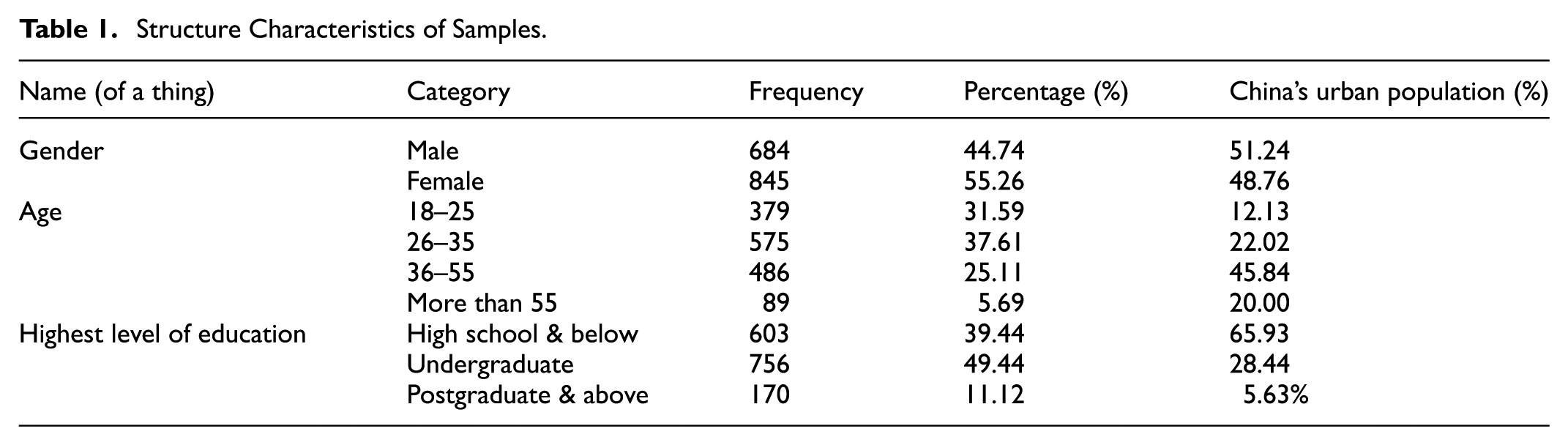
The demographic characteristics of the samples, presented in Table 1, reveal a suitable distribution in terms of gender, age, and education level, supporting the study’s findings for urban inhabitants in China. The rightmost column of Table 1 shows data on the distribution of China’s urban population in terms of gender, age, and educational attainment in 2024 (China Statistical Database, 2025; National Urban Population, 2024) . Since the detailed age structure of the urban population is not independently reported in official statistics, this study estimates the age distribution of the urban population based on the seventh national census of China. It is assumed that the age proportions of urban residents are broadly consistent with national trends. It is worth noting that the relatively high proportion of the 18 to 35 age group could be attributed to the fact that younger people are more prone to take online surveys.
Structure Characteristics of Samples.
Results
Measurement Model Analysis
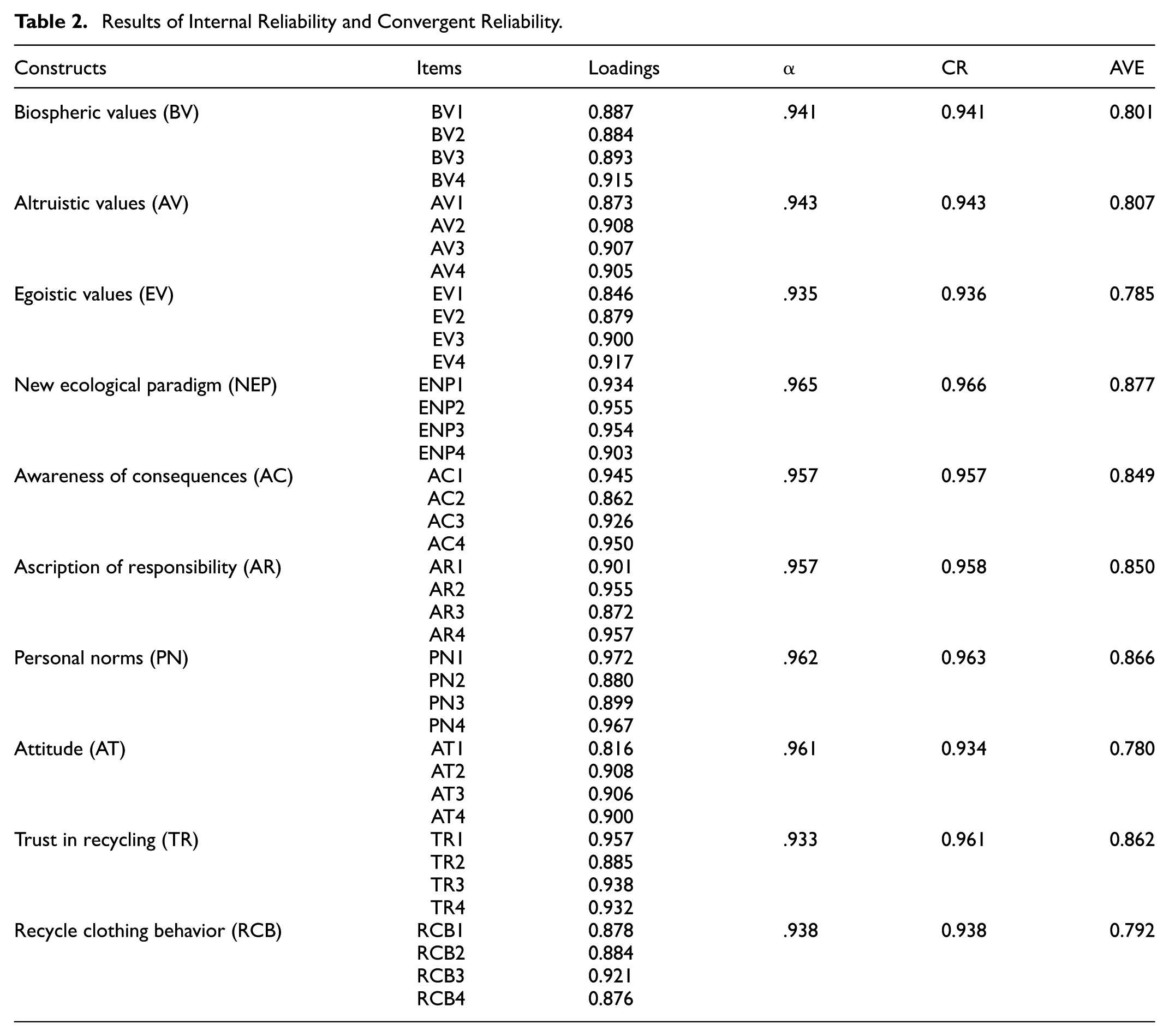
To assess the scale’s reliability and validity, this study used AMOS 26.0 software for confirmatory factor analysis (CFA) and SPSS software for detailed reliability analysis. To ensure the internal consistency of the study, the Cronbach’s α coefficient and composite reliability (CR) of each construct needed to be at or above the standard of 0.70 (Talukder et al., 2019). The Cronbach’s α coefficient of this study ranged from 0.921 to 0.979, exceeding the 0.7 threshold, indicating that the observed variables were reliable and consistent in each dimension. In addition, the CR values ranged from 0.934 to 0.966, all of which also exceeded the 0.7 threshold, confirming the high internal consistency and reliability. The KMO coefficient was also used to assess the overall validity of the scale. The achieved value was 0.908, which was much higher than the required threshold of 0.5, demonstrating that the scale is generally valid (Hair et al., 2012).
In this study, confirmatory factor analysis (CFA) was used to further verify the convergent validity and discriminant validity of the construct. As shown in Table 2, the factor loading values are between 0.816 and 0.972, which are higher than the recommended 0.7 recommended threshold, indicating that the measurement term has good reliability. The AVE values ranged from 0.780 to 0.866, which exceeded the recommended standard, indicating that the measurement tool had high internal reliability and convergent validity (Bagozzi & Yi, 1988).
Results of Internal Reliability and Convergent Reliability.
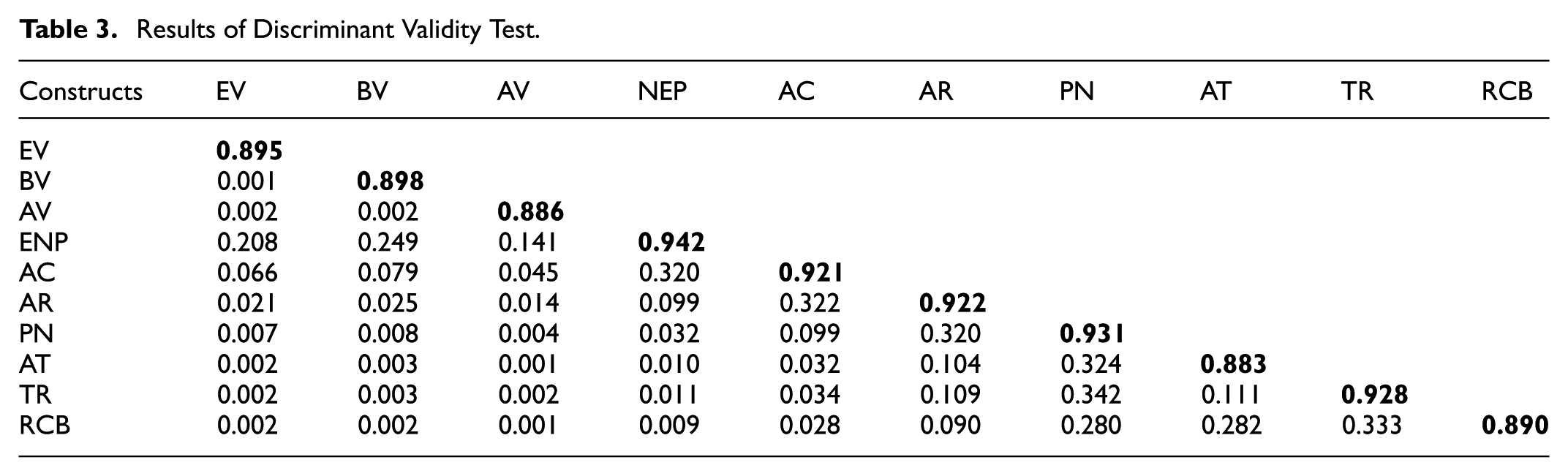
According to Fornell and Larcker (1981), a concept has high discriminant validity if the square root of its average variance extracted (AVE) value exceeds the correlation coefficients with the other constructs. Table 3 shows that the values highlighted in bold on the diagonal line represent the square root of the constructs’ AVE values, which are greater than their correlation coefficients with other constructs, demonstrating that the constructs have sufficient discriminative power among themselves. Furthermore, to ensure that multicollinearity does not pose a problem in this research, we examined the relationships among latent constructs. The low correlation coefficients between constructs in Table 3 suggest that no significant collinearity exists between the independent variables.
Results of Discriminant Validity Test.
Structural Model Analysis
Figure 2 shows the route coefficient between SEM-calculated parameters and variables. According to the model fitting indicators in Table 4, these findings are not only statistically significant, but also strongly congruent with the research aims in practical applications. In order to verify the effectiveness of SEM, it’s fitting degree must be carefully evaluated (Segars, 1997). Hu and Bentler (1999), a good model should have a χ2/df should be less than 3, the value of goodness of fit index (GFI), comparative fit index (CFI), Tucker-Lewis index (TLI) should be greater than 0.9, root mean square approximation error (RMSEA) and root mean square residual (RMR) value should be less than 0.08 standard. The fitting indexes of this study include χ2/df = 2.136 < 3, RMSEA = 0.046 < 0.10, and CFI = 0.987 > 0.9, which all exceed the recommended threshold, indicating that the model fits well (Browne & Cudeck, 1992).

Path analysis.
Model Fit Indices.

According to the results of Figure 2, it can be seen that the path coefficients from different value perspectives (BV, AV, EV) to NEP are 0.249***, 0.141***, 0.208***, respectively, and explain the significant impact of BV, AV, and EV on the NEP; the path coefficient from NEP to AC is 0.342***, indicating a significant correlation between NEP and AC. The path from AC to AR (0.311***) demonstrates the tremendous influence of AC on AR. AR and PN have a considerable association, as indicated by the path coefficient of 0.320***. The above path coefficients reach the statistical significance level, which supports the hypothesis path H1 to H7.
To adjust for potential bias and increase estimation accuracy, this study used the Percentile Bootstrap Method for data processing. To test our hypothesis, we resampled 5,000 times and derived a 95% confidence interval (CI) for the parallel mediating effect. Based on the data in Table 5 and the model in Figure 2, we can analyze in detail the impact of PN on recycle clothing behavior in detail. According to Table 5 and Figure 2, the model shows that the direct effect of PN on RCB is 0.11 (p < .001, 95%, CI [0.076, 0.163]). The path coefficient from PN to TR is 0.342 (p < .001, 95% CI [0.301, 0.381]); and the coefficient from PN to AT is 0.324 (p < .001, 95% CI [0.284, 0.363]). The path coefficient from ATT to RCB is 0.214 (p < .001, 95% CI [0.171, 0.256]), and from TR to RCB is 0.268 (p < .001, 95% CI [0.226, 0.313]). Regarding mediation effects, the indirect effect of PN on RCB through AT is 0.064 (p < .001, 95% CI [0.049, 0.081]). Similarly, the indirect effect of PN on RCB through TR is 0.085 (p < .001, 95% CI [0.068, 0.103]), which represents 32.7% of the overall effect. The total effect of PN on RCB is 0.259 (p < .001, 95% CI [0.222, 0.298]), suggesting that AT and TR have a partial mediation function in the effect of PN on RCB. AT accounts for 24.7% of the total effect, while TR is responsible for 32.7%. These data lend support to hypothesis 7 to 11, which propose that PN influence CRB both directly and indirectly via AT and RT.
Mediation Effect Path and Effect Analysis.

Note.***p < 0.001.
Discussion
With rising public awareness of environmental protection and the significant environmental impacts caused by the apparel industry, understanding the apparel recycling willingness of Chinese urban residents has become a key issue in promoting sustainable consumption and the development of a circular economy. Focusing on the VBN theory, this research developed a theoretical model for influencing garment recycling behavior that included AT and TR as mediating variables, and empirically tested it through SEM. The findings not only validate the applicability of VBN theory in China’s clothing recycling behavior, but also further reveal that PN have a greater influence on recycling behavior through TR than through AT, and suggest corresponding policy implications to promote clothing recycling behavior among urban residents in China.
The current study validates the usefulness of VBN theory for understanding urban Chinese residents’ participation in garment recycling. The result that biospheric, altruistic, and self-interested values among the VBN variables had a substantial impact on the NEP is consistent with earlier studies, underlining the relevance of values in determining environmental attitudes and actions (H1-3). The study indicated that BV had the highest impact on NEP (β = .249, p < .001), indicating that persons with high BV are more likely to support environmental protection and participate in garment recycling in China. The effect of EV on NEP was also more significant (β = .208, p < .001). Although EV prioritize personal gain, individuals may still hold environmental views due to the potential economic benefits of garment recycling. The coefficient of AV on NEP is 0.141, which is lower than the previous two values but still statistically significant. This suggests that although altruists tend to be concerned about social and environmental well-being, the extent to which their environmental awareness is translated into practical action in the field of garment recycling may be influenced by other factors such as convenience, institutional support, and so on. Thus, this study further validates the applicability of VBN theory in explaining how different values shape environmental attitudes and highlights the central role of BV in promoting clothing recycling behaviors among urban residents in China.
The NEP significantly improved AC (β = .320, p < .001). This finding is consistent with the findings of Landon et al. (2018) about the impact of environmental value in predicting sustainable behavior. This correlation reveals the effect relationship between the depth of environmental awareness and the degree of behavior change. It is recommended that community management agencies work with environmental organizations to add a thematic module on textile waste to the education on garbage sorting, and to demonstrate the ecological costs of landfilling old clothes through visual data, so as to strengthen residents’ sense of environmental responsibility and promote the transformation of recycling behaviors from random participation to habitual behaviors.
The path coefficient of AR on PN is 0.32 (H6). This suggests that when individuals have a clearer understanding of the potential environmental impacts of their actions, they are more willing to take responsibility and internalize it as a conscious environmental norm. In some community-led recycling programs, residents formed environmental habits as a result of their long-term participation in clothing recycling and gradually influenced the people around them, a phenomenon that further validates the role of personal responsibility in the process of behavioral normalization.
The research also discovered that the path coefficient of AC on AR was 0.311 (H5), and the path coefficient of AR on PN was 0.32 (H6), which is consistent with previous studies’ findings (Ghazali et al., 2019; Ünal et al., 2019). This shows that when people understand the potential environmental consequences of their behavior, they are more likely to accept responsibility and internalize it as a conscious environmental standard. In some community-led recycling programs, residents develop environmental habits as a result of their long-term participation in clothing recycling, gradually influencing those around them, a phenomenon that reinforces the importance of personal responsibility in the process of behavioral normalization.
Mediated Effects Analysis
In the mediated effects analysis, PN had a significant indirect effect on RCB through AT and TR (H7-H11). The mediating effect of TR was 32.7% higher than that of AT, 24.7%), while the direct effect of PN was 42.6%. This implies that residents’ trust in the recycling system has a stronger effect on actual recycling behavior than recycling attitude alone. When individuals have confidence in the reliability and effectiveness of the recycling system, they are more inclined to actually participate in recycling rather than just holding positive environmental value. This conclusion is similar with research by Choi et al. (2015) and Xu et al. (2022), suggesting the central role of trust in promoting recycling behavior.
Furthermore, external influences influence trust and attitudes toward recycling. Empirical studies have shown that economic incentives, such as the deposit return system used in Nordic countries (Johansson, 2025), and environmental regulatory policies, such as China’s mandatory separation of household waste regulations, which are scheduled to be implemented in 2019, can increase the incidence of recycling behavior among residents. Improved infrastructure, such as enhanced accessibility to recycling bins, minimizes the perceived inconvenience of recycling and so boosts favorable attitudes about participation. Without these enabling measures, even people with strong personal norms may struggle to put their intentions into action due to a lack of faith in the system or logistical difficulties.
Theoretical Implications
This study extends the value-belief-norm theory (VBN) to the field of clothing recycling, and constructs a theoretical analysis framework with local adaptability. Through empirical research on the recycling behaviors of Chinese urban residents, the study focuses on analyzing the differential effects of institutional environment and cultural context on the behavioral decision-making mechanism. Compared with the traditional VBN theory’s emphasis on the linear relationship between values and behaviors, this study innovatively introduces attitude (AT) and institutional trust (TR) as parallel mediating variables, systematically revealing the multidimensional paths of individual psychological mechanisms and behavioral outcomes in China’s recycling system.
It was found that recycling trust has significant predictive validity for actual recycling behavior. Unlike previous studies in environmental psychology, this study demonstrated that the perceived operational efficacy of the recycling system has more explanatory power compared to individual attitudes. This finding confirms the centrality of recycling trust and perceived system effectiveness in environmental behavioral decision-making, and provides a theoretical basis for improving the environmental governance system.
The study also reveals the special mechanism of environmental value in the Chinese context. Compared with Western market-driven recycling models (e.g., economic incentives, second-hand trading platforms), the recycling behavior of Chinese residents is more influenced by collective environmental awareness and community mobilization mechanisms. This suggests that the existing behavioral models need to incorporate cultural dimensions and establish a theoretical explanatory framework with geographical adaptability.
The theoretical contributions are mainly reflected in three aspects: first, through the introduction of institutional trust variables, the theory of the mediating mechanism between environmental beliefs and behavioral practices is improved; second, the explanatory boundaries of the VBN model in transitional societies are verified, revealing the moderating role of the institutional environment on behavioral decision-making; and third, an analytical framework incorporating cultural characteristics is constructed, which provides new methodological perspectives for the study of environmental protection behaviors in developing countries. These findings are important references for optimizing the design of community recycling systems and formulating culturally appropriate environmental policies.
Practical Implications
The results of the study provide feasible insights for increasing participation in garment recycling among urban residents in China. Given that trust in the recycling system (TR) has a greater impact on recycling behavior than attitudes (AT), interventions to increase participation should not only raise public awareness, but also enhance trust by increasing system openness, improving infrastructure, and incentives.
First, different public participation strategies should be adopted according to people’s values. Governments and environmental organizations should develop educational campaigns, customized social media content, and community outreach to promote the long-term environmental benefits of apparel recycling. Examples include incorporating recycling education into school curricula, launching “eco-ambassadors” programs in communities, and using digital storytelling to highlight the environmental impacts of discarded textiles. Meanwhile, financial incentives for EV drivers, such as deposit refund programs, recycling credits, and discounts on sustainable fashion products, may help broaden participation. The government may be able to increase the economic benefits of recycling by working with fashion retailers to create “trade-in” programs.
Second, greater community involvement and social responsibility may strengthen recycling practices. Successful programs in cities such as Beijing and Guangzhou have shown that organizing community-based recycling days, establishing local collection points, and publicly recognizing active participants can promote collective responsibility and social norms in recycling. Schools and organizations can also contribute by incorporating recycling initiatives into corporate social responsibility (CSR) and employee engagement activities. Digital platforms, such as mobile apps that allow householders to track their recycling, can also be used to engage the public and instill a sense of personal responsibility for environmental sustainability.
This study found that trust (TR) in the recycling system has a substantial impact on actual recycling activities. This suggests that creating positive attitudes is not enough; government and private sector participants must also inspire confidence in the efficiency, reliability, and fairness of the recycling system. One successful way to increase the transparency of the system is to deploy a smart recycling tracking system that allows households to monitor the entire recycling process of discarded textiles. This will alleviate concerns about whether collected items are being reused or misused. In addition, a “green certification” scheme could be developed to certify recycling companies and ensure their legitimacy, thereby increasing public trust.
In addition, improving recycling infrastructure and accessibility is critical to building long-term partnerships. Studies have shown that the availability and accessibility of recycling facilities have a significant impact on participation rates. To achieve this, local governments should emphasize increasing the number of recycling bins in residential areas, integrating recycling stations into existing waste management facilities, and expanding door-to-door recycling services for used textiles. Policymakers could also consider smart waste management options, such as automated textile pickup kiosks with artificial intelligence sorting capabilities, which have been successfully tested in cities such as Shanghai and Shenzhen.
Limitation
While this study has achieved some results, there is still room for several improvements. Specifically, the following four limitations deserve attention.
First, there are limitations in data timeliness. The current study uses cross-sectional data from the same time node, which only reflects residents’ clothing recycling in a specific time period. This static analysis method makes it difficult to capture the dynamic association between residents’ environmental awareness and recycling behavior. A tracking survey that lasts for many years would help to reveal the patterns between urban residents’ environmental awareness and recycling practices.
Second, the study sample has some limitations in terms of its representativeness. This study used an optimal convenience sample strategy, which increased data collecting feasibility but may still have some sampling bias. Additionally, because data collection was conducted using an online questionnaire platform, persons without Internet access may have been excluded. In addition, the screening criteria of this study were limited to urban residents who had participated in clothing recycling, so the findings failed to reflect the attitudinal and behavioral characteristics of the non-participating group. Future studies may consider adopting stratified sampling or quota sampling methods that combine online and offline data collection channels to further improve the representativeness of the sample.
Third, there are geographical limitations in the research sample. This study only covers urban residents, but rural residents, who account for nearly 40% of the population, also deserve attention. Influenced by factors such as infrastructure improvement, policy implementation and traditional living habits, textile recycling patterns in rural areas are significantly different from those in cities. In particular, the coverage rate of rural recycling stations is only 58% of that of urban areas, and this objective difference will inevitably lead to differences in recycling behavior, and subsequent research needs to build a comparative analysis framework between urban and rural areas.
Fourth, there are limitations in analyzing the dimensions of the influencing factors. The existing model focuses on the measurement of individual psychological variables (e.g., environmental attitude, institutional trust, etc.), but lacks the consideration of external variables such as the density of recycling bins, the standard of subsidies for recycling used clothes, and the binding force of policies and regulations.
In view of the above findings, it is suggested that the follow-up study should be deepened in three aspects: constructing a tracking database, establishing a comparative research paradigm between urban and rural areas, and developing a multilevel interaction model between psychological factors and policy environment. This will not only help to improve the theoretical research system, but also provide empirical evidence for government departments to formulate differentiated regional recycling policies, which is of practical significance for the construction of urban-rural synergistic sustainable textile management system, especially in the context of rural revitalization strategy.
Conclusions
By combining attitude (AT) and trust in recycling (TR) into the VBN theoretical framework, this study uncovers the critical roles of these psychological elements in molding urban Chinese people’ real garment recycling habits. The findings indicate that personal norms (PN) not only influence people’s views toward recycling, but also their trust in the recycling system, which has a stronger impact on actual behavioral engagement. This emphasizes the importance of trust in encouraging active engagement in recycling. To enhance garment recycling rates in China, education and promotional initiatives should be used to raise recycling awareness and favorable attitudes. Second, public faith in the recycling system should be strengthened by increasing openness, efficiency, and accessibility. Recycling legislation should promote community-based recycling initiatives, smart tracking systems, and financial incentives to encourage public engagement in sustainable textile processing.
This study stresses the mediating function of trust and presents some practical ideas for policy makers and environmental organizations. However, this study has significant shortcomings that need be further addressed in future research. First, as this study relied on cross-sectional data, future research may adopt a longitudinal study design to track changes in residential recycling activity over time and better explain behavioral alterations over time. Second, given that this study focused only on urban residents, future research should be expanded to include rural populations, where infrastructure, policies, and social norms may differ significantly, to provide a more comprehensive understanding of apparel recycling behaviors among different demographic groups. Third, external factors, such as the density of recycling facilities, government incentives for used clothing recycling, and the effectiveness of policy implementation, were included in the research framework to analyze the role of external elements versus psychological considerations. Fourth, future studies could also use stratified or quota sampling to improve the representativeness of the sample. By addressing these concerns, future study could lead to the creation of more effective and inclusive recycling programs as a method to foster a sustainable circular economy.
Footnotes
Appendix

| Construct | Items | Reference(s) |
|---|---|---|
| Biospheric Values (BV) |
BV1: I should protect nature and the environment. BV2: I am an integral part of nature. BV3: I appreciate the earth. BV4: I should share my efforts to build a better world. |
Lee and Jan (2018), Sánchez-García et al. (2021) |
| Altruistic Values (AV) |
AV1: All men are created equal. AV2: The world should be peaceful. AV3: Society should be ruled by justice. AV4: I should be an altruist. |
Denley et al. (2020), Kim et al. (2022) |
| Egoistic Values (EV) |
EV1: I think recycling old clothes is very important to my personal economic interests. EV2: I am more concerned about the direct benefits of recycled clothing to me personally, rather than the long-term impact on the environment. EV3: I will choose to recycle my old clothes because of the convenience of the recycling site. EV4: I tend to support clothing recycling programs that offer personal rewards or discounts. |
Bouman et al. (2018) |
| New ecological paradigm (NEP) |
ENP1: I believe that clothing recycling is very important for environmental protection. ENP2: I think everyone should be responsible for reducing clothing waste and promoting recycling. ENP3: I think supporting clothing recycling is part of achieving sustainable development. ENP4: I believe that clothing recycling is essential to reducing pollution and protecting natural resources. |
Davis and Stroink (2016) |
| Awareness of consequences (AC) |
AC1: I think it will do harm to the environment if we don’t recycle old clothes. AC2: Participation in recycling behavior helps to reduce environmental problems. AC3: I believe that by recycling clothing, we can reduce the exploitation of new resources. AC4: Participation in recycling behavior helps to improve the safety and health of individuals. |
Abrahamse and Steg (2011), Stern et al. (1999) |
| Ascription of Responsibility (AR) |
AR1: I accept personal responsibility for the problems caused by my non-ecologically sensitive post-use behavior. AR2: My non-ecologically sensitive post-use behavior can lead to environmental problems. AR3: I share responsibility for environmental issues. AR4: I believe that by participating in the recycling of clothing, I can help reduce the environmental burden. |
Abrahamse et al. (2009), Steg et al. (2011) |
| Personal Norms (PN) |
PN: Whatever other people do, I have a moral obligation to recycle my old clothes. PN2: I feel guilty when I don’t recycle my old clothes. PN3: I would consider myself a better person if I recycled clothing. PN4: I think by recycling old clothes, I’m fulfilling my responsibility to the environment. |
Abrahamse and Steg (2011) |
| Attitude (ATT) | ATT1: It is beneficial to participate in the recycling of clothing. ATT2: It is wise to participate in the recycling of clothing. ATT3: It is useful to participate in the recycling of clothing. ATT4: Participation in clothing recycling is beneficial. |
Conradie et al. (2023), Khan et al. (2020) |
| Trust in Recycling (TR) | TR1: I think the environmental commitments of clothing recycling are generally reliable. TR2: I think the environmental performance of clothing recycling is generally reliable. TR3: I think that the environmental protection of clothing recycling is generally reliable. TR4: I think the environmental concerns of clothing recycling are in line with my expectations. |
Choi et al. (2015) |
| Recycle Clothing Behavior (RCB) | BRC1: If I have the opportunity, I will actively participate in clothing recycling. BRC2: I intend to increase my involvement in clothing recycling efforts in the future. BRC3: I would encourage my family and friends to take part in clothing recycling activities. BRC4: I will regularly recycle my old clothes as long as accessible recycling options are available. |
Xu et al. (2022) |
Acknowledgements
We gratefully acknowledge the support and contributions of all those who assisted in this research.

Ethical Considerations
The Ethics Review Committee at Jiangxi Institute of Fashion Technology Research approved our questionnaire (approval JIFT-FD-2024-058) on 22/04/2024.
Consent to Participate
Participants were shown an electronic informed consent form at the start of the online survey. Only those who clicked “Agree” could proceed. No written signature was required.
Author Contributions
Conceptualization, M.Y., M.L. and J.J; methodology, M.Y. and M.L.; software, M.Y. and J.J.; validation, M.Y., M.L and J.J.; formal analysis, M.Y. and J.J.; investigation, M.Y. and M.L.; resources, M.L.; Data curation, M.Y. and M.L.; writing—original draft preparation, M.Y.; writing—review and editing, M.Y., M.L. and J.J.; supervision, J.J.; project administration, J.J.; funding acquisition, M.L. All authors have read and agreed to the published version of the manuscript.
Funding
The authors disclosed receipt of the following financial support for the research, authorship, and/or publication of this article: This study was supported by the Jiangxi Provincial Department of Education Science and Technology Research Fund (Mi Luo, Grant Numbers GJJ191075 and GJJ202402).
Declaration of Conflicting Interests
The authors declared no potential conflicts of interest with respect to the research, authorship, and/or publication of this article.
Data Availability Statement
The data that support the findings of this study are available from the corresponding author upon reasonable request.