



Abstract
This study examines the impact of Sci-tech Finance on rural industrial integration in China. Findings indicate that Sci-tech Finance has a significant positive effect on rural industrial integration. Additionally, impulse response analysis reveals that Sci-tech Finance has a more significant long-term positive impact on rural industrial integration. Further variance decomposition demonstrates that, although the variance contribution rate of Sci-tech Finance to rural industrial integration increases during the prediction period, it remains relatively low. This result suggests that while Sci-tech Finance supports rural industrial integration, there is still ample opportunity to improve this influence. The key to improvement lies in enhancing the supply of science and technology finance from the supply side, improving acceptance of rural industrial integration on the demand side, strengthening platform and carrier construction and improving policy guarantee mechanisms.
Introduction
Sci-tech Finance is regarded as a holistic concept in the Chinese academic community. Although the defining concepts have differences, they all emphasise the precise alignment between corporate innovation needs and funding. Sci-tech Finance highlights providing sufficient financial support for the development of science and technology innovation activities and promoting the realisation of primary competitiveness by deeply integrating the technology innovation chain and financial investment chain (Yueqian et al., 2021). The level of Sci-tech Finance in China has achieved leapfrog development over the past decade, exhibiting a strong regional convergence, with the gap in the development levels of Sci-tech Finance between different regions significantly narrowing overall (Junlin & Zhiqiang, 2024) and the issue of regional development imbalance has been improved (Yao et al., 2024). Sci-tech Finance has become an important measure for China to achieve its goal of becoming a financial superpower (Haiyun & Mingbo, 2024). It is not only a key driving force for promoting high-quality economic development (Jiachao et al., 2024), but also a core element for developing new types of productive forces (Xiaodong & Zhuo, 2024). At the same time, it is an important tool for promoting the innovation-driven development strategy (Tingqiu & Wenhao, 2024) and an essential path for China to enhance its position as an innovative nation (Li et al., 2024).
In 2015, the Central Document No. 1 of China emphasised the importance of addressing the problems of agriculture, rural areas and farmers. This objective can be achieved by extending the agricultural industry chain, increasing agricultural added value, and achieving the integrated development of rural primary, secondary and tertiary industries. Since then, the integration of rural industries has been one of the focal points in agriculture, rural areas and farmers in China, and it is regarded as a key driving force for promoting rural revitalisation.
The development of Sci-tech Finance should support emerging industries and empower traditional industries. Based on financial development theory, finance plays a crucial role in industrial development, including providing funding support, optimising resource allocation, and reducing financing costs. The more mature the financial industry, the stronger its role in promoting industrial development. Based on innovation theory, technological innovation is the key endogenous driving force for industrial development. By providing technological support for industrial development, it not only improves total factor productivity but also fosters new industries, new business models, and new modes, thereby driving industrial upgrading. As a product of the deep integration of technology and finance, Sci-tech Finance through functions such as providing financing support, optimising resource allocation, processing information, managing risks, and governance (Mingxi, 2024), guides industries onto a fast-track development path. Sci-tech Finance has a theoretical connection with the integrated development of rural industries. However, whether this connection is also the case in reality needs to be verified, which is the focus of this study. The structural arrangement of this article is as follows: The second part is theoretical analysis, which constructs an analytical framework from two aspects, namely, agricultural technology innovation and rural financial construction, and elaborates on the theoretical mechanism of the impact of Sci-tech Finance on rural industrial integration. The third part is a literature review, summarising the relevant literature involved in this study. The fourth part concerns variable selection, model setting and data sources, clarifying the dependent variables, core independent variables, control variables and analytical econometric models used in this article and explaining the data sources. The fifth part is empirical analysis, which displays the estimated results of the econometric model and analyses the results. The sixth part is the conclusion and policy implications.
Literature Review
Many studies believe that the current integration of rural industries in China is still at an early stage, with a low overall level and significant regional differences (Chibo et al., 2021; Lingling et al., 2018; Xinwu & Shubin, 2021). Many studies have analysed the influencing factors of rural industrial integration, such as farmers’ cooperatives (Changzheng et al., 2022), rural digitisation (Dingxiang et al., 2022) and urbanisation (Xiaolong, 2021).
When examining the factors influencing rural industrial integration, technology and finance have been identified as two key areas of interest among scholars. With respect to the impact of technology on rural industrial integration, Rosenberg (1963) defines industrial integration from the perspective of technological integration. He argues that innovation activities, which stem from the application and spillover of technology, can be considered a form of industrial integration.
Alfonso and Salvatore (1998) regards technology integration as one of the stages of the industrial integration process. Borés et al. (2003), Curran and Leker (2011) and Geum et al. (2016) believe that technological innovation is a key factor driving industrial convergence. Yiqing et al. (2016) point out that a common technological foundation is a prerequisite for internalising the inter industrial division of labour in rural areas while technology integration and product integration are manifestations of different degrees of the inter industrial division of labour in rural areas. Aihua and Han (2019) believe that new technologies, formats and business models result from technological innovation, promoting the integration and development of rural industries. They are the symbol of the ultimate formation of rural industrial integration.
Relevant studies on the effect of finance on rural industrial integration have found many differences. Some studies believe that financial development has constraints or reverse effects on rural industrial integration (Bakucs et al., 2009; Minglou et al., 2022; Saravanan, 2016). However, other studies claim that financial development positively impacts rural industrial integration (Qingxia and Yueze, 2022; Xiaolong, 2019; Xiaowei and Junhong, 2022).
Many scholars have researched the influencing factors of rural industrial integration from the perspectives of technology and finance. However, few studies have explored the impact of Sci-tech Finance on rural industrial integration as a whole concept. Sheng (2024) analysed the matching level and influencing factors between Sci-tech Finance and rural industrial integration in China. The study found that the overall matching degree between Sci-tech Finance and rural industries is on the rise, with rural revitalisation policies, the implementation of science and technology finance pilot policies, urban-rural integration levels, and the lagged one-period matching degree all playing a positive role in improving the matching level. However, this study only explored the overall collaborative level between the two systems of Sci-tech Finance and rural industrial integration, without examining the interrelationship between them. Furthermore, no additional research on rural industrial integration was identified. Some studies, however, have analysed the impact of Sci-tech Finance on industrial development, which provides some reference for this paper. As Yongqi and Jingjing (2021), Jianguo and Mingxian (2018) and other researchers believe that China’s Sci-tech Finance has a significant positive impact on upgrading industrial structures. Xinming et al. (2022) find that China’s Sci-tech Finance and industrial structure upgrading are increasingly connected; however, significant regional differences exist, with the average coupling gradually decreasing from east to west. Xiaohong and Jun (2021) find that China’s scientific and technological innovation, technology industry and Sci-tech Finance as a whole are at a moderately coupled and coordinated level, characterised by periodic fluctuations in time and a trend of ‘high in the east and low in the west’ in space. Jing (2018) studies the science and technology industry chain and believes that it strongly depends on science and Sci-tech Finance; thus, it cannot be separated from the support of science and Sci-tech Finance throughout all stages of enterprise development. Jiya (2021) believes that supporting the high-end development of strategic industries through science and Sci-tech Finance should focus on improving key and weak links in the financing model, invigorating science and technology financial resources, enhancing science and technology financial performance and improving the science and technology financial environment.
Although there is a certain amount of relevant research that can provide reference for this study, two main issues remain. First, while some studies have explored the impact of science and technology finance on industrial development, research specifically focussing on rural industries is scarce. Second, existing research tends to discuss the relationship between science and technology finance and industrial development from a static perspective, with insufficient understanding of their dynamic relationship.
Compared to existing research, this paper may offer marginal contributions in two areas. First, it focuses on the subfield of rural industrial integration and explores the impact of science and technology finance on this aspect, which has not been addressed in previous studies. This not only provides a new supplement to existing research but also opens up a new area of study. Second, this paper not only analyses the impact of science and technology finance on rural industrial integration from a static perspective but also further uses a panel vector autoregressive model to analyse the dynamic relationship between the two, providing new empirical evidence for existing research.
Theoretical Analysis
The development of Sci-tech Finance lies in the flourishing state of technology and finance. It involves the deep integration of technology and financial innovation (Sudi & Fuxin, 2012). This study constructs an analytical framework from two aspects, namely, agricultural technology innovation and rural financial construction, and elaborates on the theoretical mechanism of the impact of Sci-tech Finance on the integration of rural industries.
In the context of agricultural technological innovation, a successful technological innovation requires sufficient capital investment and a deep integration of technology and finance (Yinxing, 2011). Firstly, the high investment and risk associated with agricultural technology lead to innovation entities having multi-layered and multi-dimensional financial needs, presenting a more complex three-dimensional characteristic and financial requirement. In this scenario, Sci-tech Finance promotes the entry of financial capital into agricultural technology innovation by facilitating the interaction between the technology system and the financial system. Increasing the accessibility of agricultural technology innovation finance weakens corresponding risks and improves the driving force of agricultural technology innovation. The iterative updating of agricultural technology innovation also brings endogenous power to the development of rural industries, building connections between rural industries on the path of technology support to meet the technological needs of rural industrial development, eliminate technological barriers between industries, provide technological support for the intersection of different industries, promote the integration and restructuring of industries, accelerate industrial agglomeration and achieve rural industrial integration. Secondly, from the perspective of industrial correlation, high-tech industries are an important carrier of innovation-driven development (Gu Youjin et al., 2022). The investment changes of science and Sci-tech Finance in high-tech industries are linked by intermediate input and output and transmitted to rural industries through industrial correlation. With technological factors, products and equipment as the main media, the emergence and development of rural industrial integration are stimulated, and the development of rural industries are further accelerated. Especially with the deepening of the digitalisation and informatisation characteristics of rural industries, the industrial correlation effect between the two has been strengthened, and the driving role of high-tech industries in integrating rural industries has gradually increased.
From the perspective of rural financial construction, the development of Sci-tech Finance correspondingly drives the development of the financial system. The optimisation of the financial system increases financial supply, promote the further rational allocation of financial resources, improves the efficiency of the financial system and thus affects the integration of rural industries on both vertical and horizontal lines. Vertically, increasing rural financial resources and improving efficiency help to enhance the connection and interaction between upstream and downstream industries in the industrial chain and close the connection between pre-production, production and post-production departments. Thus, the extension of the industrial chain is promoted, and the industrial structure is optimised and upgraded. Horizontally, the increase of rural financial resources and the improvement of efficiency can help eliminate horizontal distance, facilitate the interaction of boundaries between different types of rural industries, promote the emergence of new business models, expand the multifunctionality of agriculture and achieve the integration of rural industries.
In summary, this paper proposes the hypothesis that Sci-tech Finance can effectively promote the integration and development of rural industries.
Variable Selection, Model Setting and Data Sources
Variable Selection
The dependent variable of this study is rural industrial integration, measured by the constructed rural industrial integration index. The core independent variable is Sci-tech Finance, measured by the constructed Sci-tech Finance index.
The following control variables were also considered in this study: (1) The education level of a region affects the integration and development of rural industries by improving human capital. Per capita education years is used as its proxy variable. (2) The level of rural informatisation affects the integrated development of rural industries by applying agricultural information technology. The ratio of rural broadband access households to broadband access households is used as its proxy variable. (3) The level of rural income is related to the level of market demand, which affects the integration and development of rural industries. The ratio of the per capita disposable income of rural residents to the per capita disposable income of urban residents is used as its proxy variable. (4) The level of rural consumption affects the scale and structure of consumption, affecting the integrated development of rural industries. The ratio of the per capita consumption expenditure of rural residents to the per capita consumption expenditure of urban residents is used as its proxy variable. (5) The integration of rural industries has certain requirements for the scale of operation. Thus, the level of agricultural scale operation is included in the control variables. Considering the strong correlation between the level of agricultural scale operation and the degree of agricultural mechanisation, the improvement of agricultural scale operation depends on the degree of agricultural mechanisation. Therefore, the ratio of the total power of agricultural machinery to cultivated land area is used as its proxy variable. (6) The level of fiscal support for agriculture is related to the investment of fiscal funds and is one of the factors affecting the integration and development of rural industries. The total amount of fiscal expenditure on agriculture is used as its proxy variable. The meanings of each variable are shown in Table 1.
Influential Factor Equation Variables.

Source. Self-made by the author.
Regarding dependent and core independent variables, whether rural industrial integration variables or Sci-tech Finance variables, their variables cover a wide range of content. Therefore, using a single indicator as a proxy variable will have significant shortcomings. Therefore, this study constructs an indicator system for the above two variables. This study increases the explanatory power of proxy variables by using more indicators.
The indicator design of the Sci-tech Finance index refers to the research results of Zhiruo (2019) and Hao et al. (2011). The present study examines and designs an indicator system composed of four secondary indicators with 15 tertiary indicators, namely, basic resources of science and Sci-tech Finance, investment in science and Sci-tech Finance funds, financing scale of science and Sci-tech Finance and output level of science and Sci-tech Finance. The indicator design of the rural industry integration index refers to the relevant research results of Xiaolong and Guanghe (2019) and Liying et al. (2021) The present study designs an indicator system composed of four secondary indicators and five tertiary indicators for rural service industry development, rural industrial chain extension, cultivation of new agricultural formats and agricultural multi-functional expansion. This study conducts dimensionless standardisation on the secondary and tertiary indicators in the constructed rural industry integration and Sci-tech Finance indexes. This study uses the entropy method to determine the weight of indicators at all levels based on standardised processing. The dependent variable and core independent variable indicators are shown in Table 2.
Dependent Variable and Core Independent Variable Indicators.
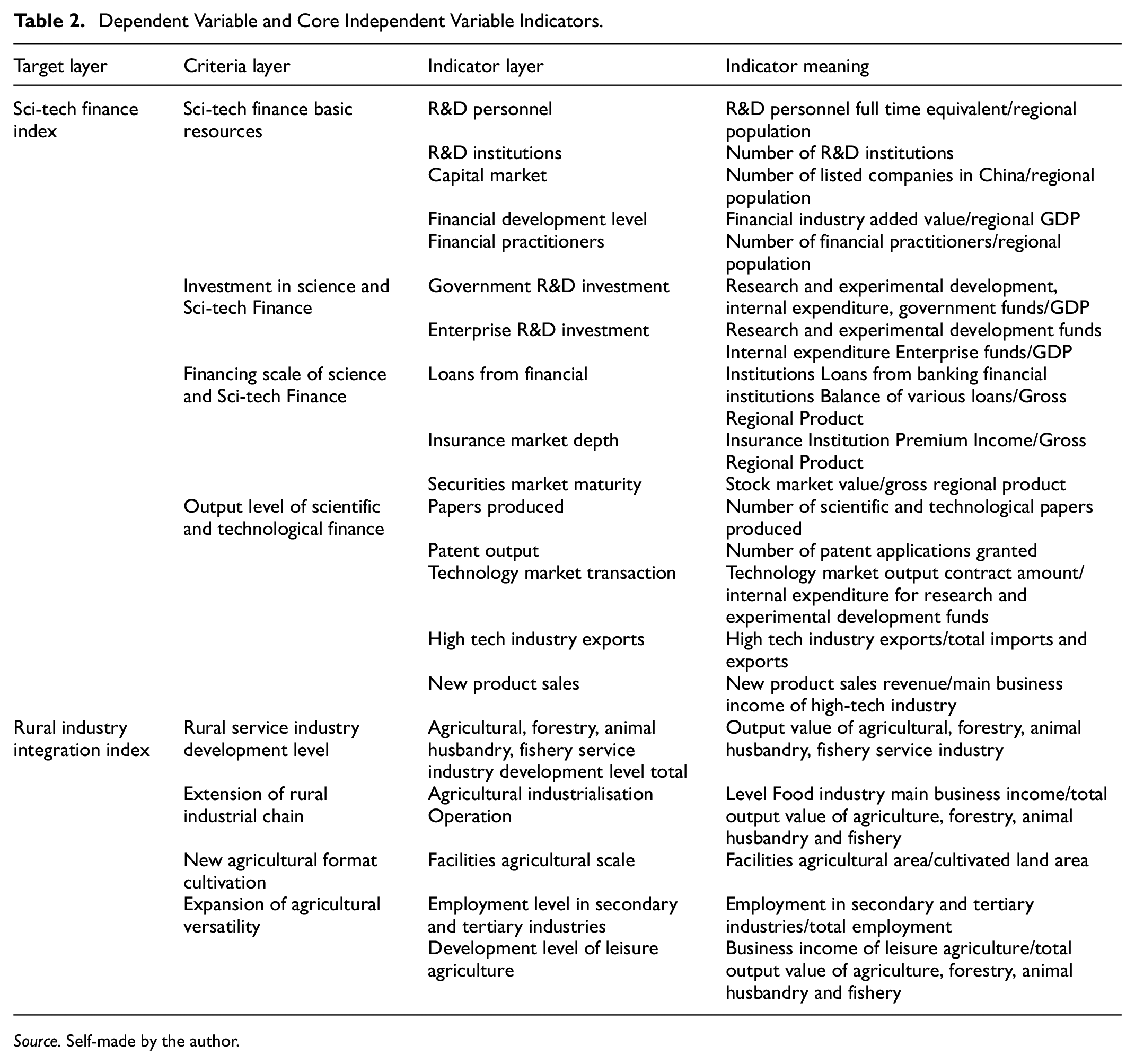
Source. Self-made by the author.
The descriptive statistical analysis results of each variable are shown in Table 3. Variance inflation factor (VIF) was used for testing to address the potential multicollinearity issue among variables. The VIF values of each variable were all less than 2, with an average VIF value of 1.39, indicating no multicollinearity issue among the variables used in this study.
Descriptive Statistics of Variables.

Source. Calculated by the author.
Model Building
Entropy Method
Dimensionless processing of indicators:

where x represents the original value of each indicator. When the indicator is considered positive, a higher value indicates a preferable outcome. Conversely, when the indicator is deemed negative, a lower value indicates a preferable outcome. Xi represents the standardised value of each indicator, xmax represents the maximum original value of each indicator, and xmin represents the minimum original value of each indicator. The standardised indicator data is translated to avoid the meaningless use of logarithmic values for standardised indicators:

where m = 1, 2, …, b; n = 1, 2, ……, a.
The proportion of the m-th evaluation object under the n-th index to the index Pmn:

where m = 1,2,…, b; n = 1,2,……, a.
Information entropy of the nth indicator:


where m = 1,2,…, b; N = 1,2,…, a, k are constants, and the value interval of En is [0,1].
Difference coefficient of the nth indicator:

Weight of the nth indicator:

Reference Equation
This study uses a static panel to estimate the benchmark equation. The equation constructed is as follows:

In the above formula, yi represents rural industrial integration, X1 represents Sci-tech Finance, and X2i represents control variables such as regional education and rural income levels.
Endogenous Analysis
This study constructs a dynamic panel and uses generalised moment estimation (GMM) for endogenous analysis. The equations constructed are as follows:

In the above formula, yi represents rural industrial integration, X1 represents Sci-tech Finance, X2i represents control variables such as regional education level and rural income level, and Yi (−1) indicates a lag in the first phase of rural industrial integration.
Panel Vector Autoregressive Model (PVAR)
PVAR combines the advantages of panel data analysis and the VAR model, relaxing the constraints on the relationship between various variables while increasing the freedom of observation values, controlling individual heterogeneity and explaining complex relationships between multiple variables.
The PVAR model constructed in this study is as follows:

In the above formula, yit is a column vector including dependent variables and independent variables, I represents the sample area, T represents time, α0 represents the intercept term vector, αj represents a parameter matrix with a lagging j order, K is the lagging order, γi represents the individual effect vector, δt represents the time effect vector, and μit represents a random interference term that follows a normal distribution.
Data Source
Given the availability of partial variable data, this study selected panel data from 30 provinces and municipalities in China, excluding Hong Kong, Macao, Taiwan and Tibet, for analysis from 2006 to 2020. The sample data used are from the ‘China Rural Statistical Yearbook’‘China Science and Technology Statistical Yearbook’, ‘China Statistical Yearbook’, ‘China Financial Yearbook’, ‘China Leisure Agriculture Yearbook’ and the National Greenhouse Data System. The study used linear interpolation to complete individual missing data.
Empirical Analysis
Benchmark Equation
This study uses OLS (Equation 1), generalised least squares (Equation 2), individual fixed effect (Equation 3) and individual and time double fixed effect models (Equation 4), as well as a fixed effects model incorporating robust standard error clustering (Equation 5) to estimate the benchmark equation. According to the estimation results (Table 4), the core independent variable Sci-tech Finance has positive estimation coefficients in the four benchmark equations. Through a significance test of at least 5%, the improvement of Sci-tech Finance positively impacts the realisation of rural industrial integration, the research hypothesis is validated.
Baseline Equation Estimation Results.
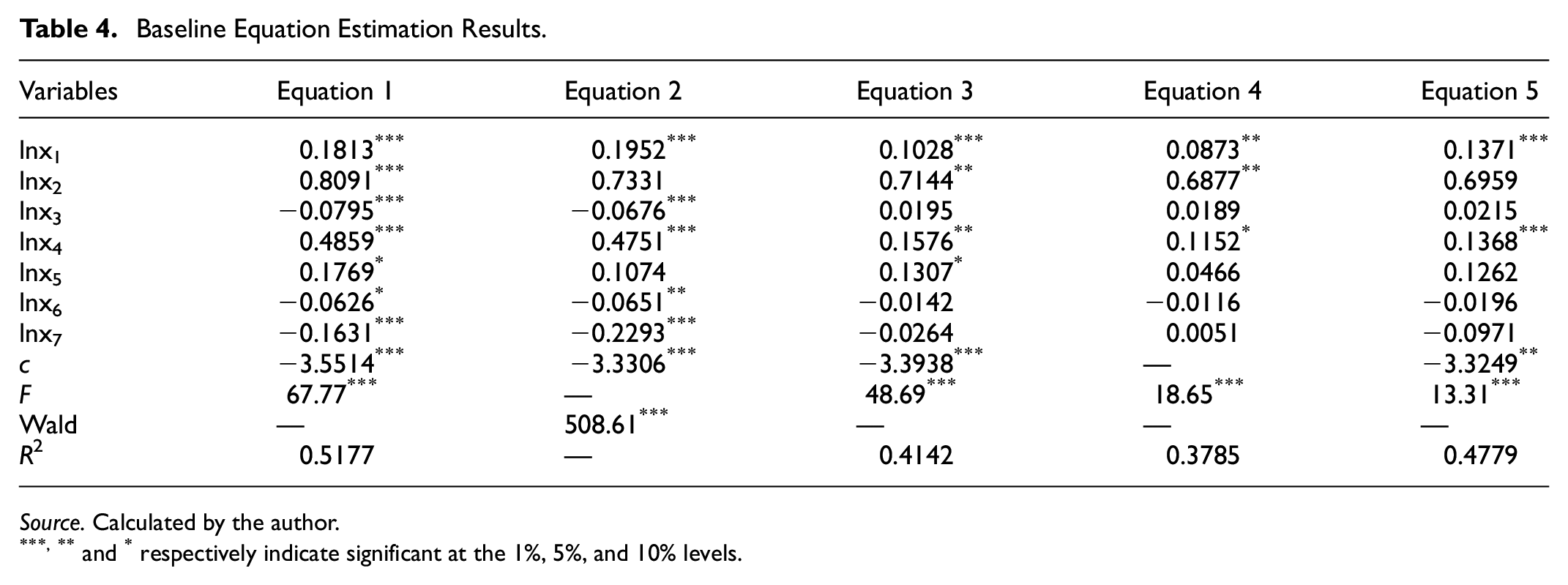
Source. Calculated by the author.
, ** and * respectively indicate significant at the 1%, 5%, and 10% levels.
Endogenous Analysis
Considering that the endogenous problem in the benchmark equation may lead to inconsistent and biased estimation results, this problem must be solved to obtain uniformly asymptotically effective estimation results. This study constructs a dynamic panel by introducing a lag-dependent variable into the benchmark equation and estimates it again using GMM.
According to the GMM estimation results (Table 5), neither the differential GMM nor the system GMM models have second-order autocorrelation or excessive identification problems. Due to the smaller deviation and higher efficiency of the system generalised moment estimation compared to the differential generalised moment estimation, the system GMM (SYS-GMM) estimation results are used for interpretation in this study. Guidance through policy measures and leveraging the beneficial impact on rural industrial integration are necessary.
GMM Estimation Results.

Source. Calculated by the author.
Note. In () are the p values of AR (1), AR (2) and Sargan tests.
, ** and * indicate significant at levels of 1%, 5%, and 10%, respectively.
In terms of control variables, the estimated coefficients of regional education level, rural income level, rural consumption level and agricultural scale operation level are positive, and through a significance test of at least 5%, an increase in the level of the above variables will contribute to the realisation of rural industrial integration. The improvement of regional education level will correspondingly lead to the improvement of human capital, contributing to the integrated development of rural industries. The improvement of income level promotes the expansion of market demand, promoting the integrated development of rural industries. The improvement of consumption level affects the integrated development of rural industries through the upgrading of consumption scale and consumption structure. The improvement of rural scale management level will bring about economies of scale and also contribute to the integrated development of rural industries. The estimated coefficient of rural informatisation level is positive but did not pass the significance test, possibly due to the relatively low application level of rural informatisation technology in the integration and development of rural industries.
The estimated coefficient of fiscal support for agriculture is negative, and through the 1% significance test, the increase in fiscal expenditure on agriculture has a negative impact on rural industrial integration. The reason may be due to the unreasonable structure of fiscal expenditure on agriculture and the low efficiency of using financial funds. The estimated coefficient of the dependent variable for the first lag period is positive and passes the 1% significance test, indicating that the development of rural industrial integration is affected by the previous development level and there is a significant lag effect.
In 2011, the Ministry of Science and Technology of China, the People’s Bank of China, the China Banking Regulatory Commission, the China Securities Regulatory Commission and the China Insurance Regulatory Commission issued the ‘Notice on Determining the First Batch of Pilot Areas to Promote the Integration of Science and Technology with Finance’. Sixteen regions became the first batch of pilot areas. In 2016, nine cities were selected as the second batch of pilot areas to promote the integration of science and technology and finance. This policy has an important impact on the development of science and Sci-tech Finance in China. Based on this policy, this study divides the sample period into two periods and estimates them separately to examine further the impact of science and Sci-tech Finance on rural industrial integration in different sample periods. Given the determination time of the first batch of pilot areas at the end of October 2011 and the consideration of the policy action time, this study sets the starting time of policy implementation as 2012, resulting in two sample periods: 2006 to 2011 and 2012 to 2020.
Systematic GMM estimation was conducted for the two sample periods. According to the estimation results (Table 6), the core independent variable Sci-tech Finance had a positive estimation coefficient in the 2006 to 2011 sample period but failed the significance test. However, its estimation coefficient in the 2012 to 2020 sample period was positive and passed the 1% significance test. Therefore, implementing the pilot policy effectively enhances the support effect of China’s science and Sci-tech Finance on rural industrial integration. After implementing the pilot policy, science and Sci-tech Finance can effectively assist in realising rural industrial integration.
GMM Estimation Results.
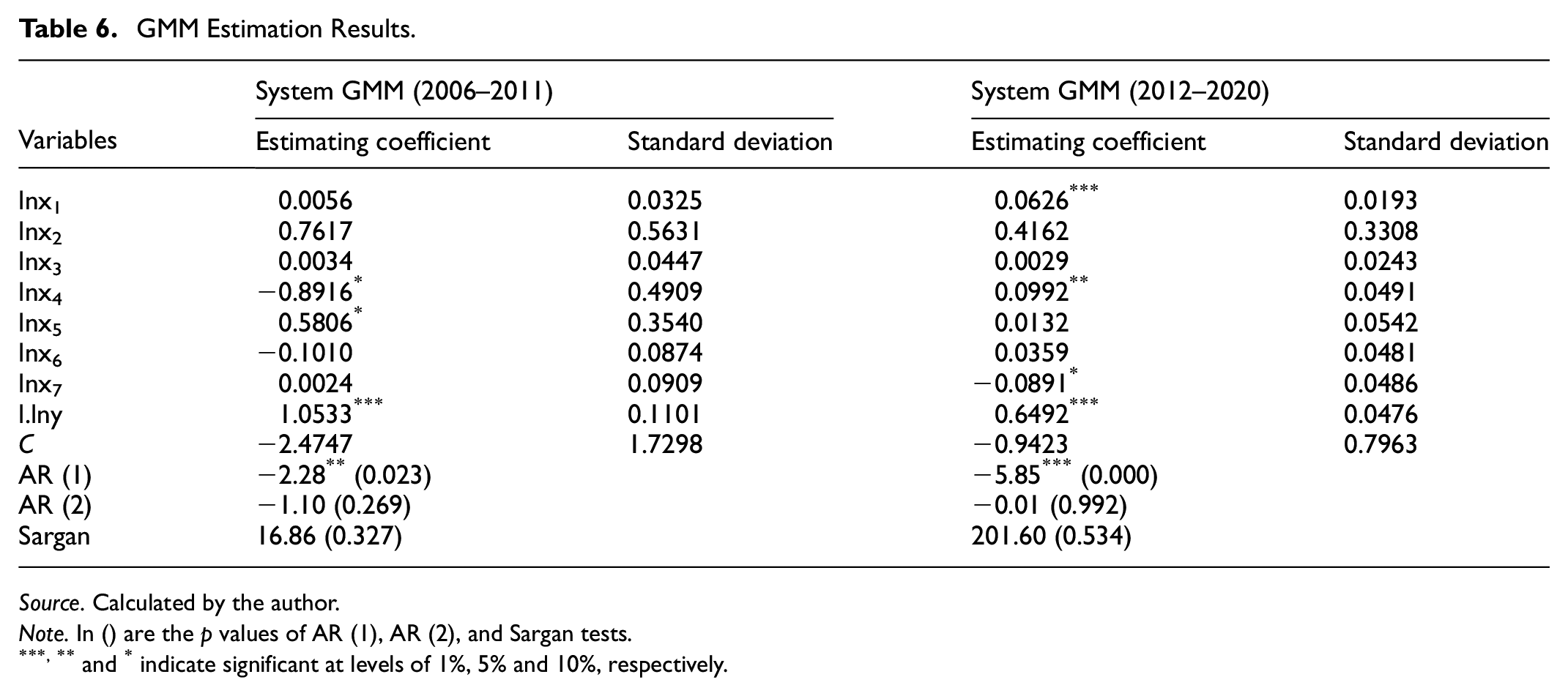
Source. Calculated by the author.
Note. In () are the p values of AR (1), AR (2), and Sargan tests.
, ** and * indicate significant at levels of 1%, 5% and 10%, respectively.
Dynamic Analysis of Panel Vector Autoregressive Model PVAR
Pulse Response Analysis
Impulse response analysis can comprehensively understand the model’s dynamic relationship between various variables. It focuses on the impact of shocks from one variable on other variables while controlling other variables to remain unchanged. This study performed Monte Carlo simulations 200 times to obtain an orthogonal impulse response function diagram (Figures 1–8).
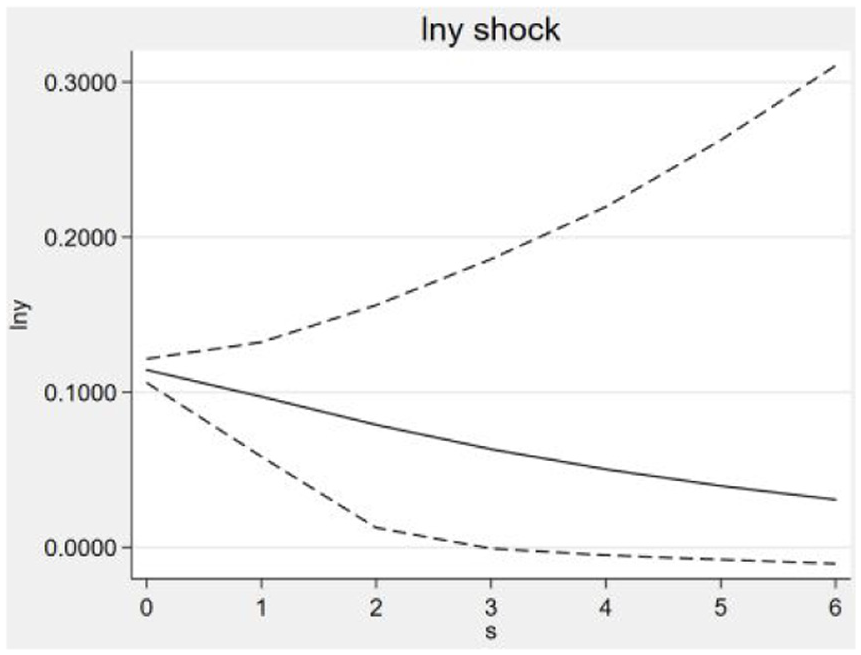
Pulse response function diagram of rural industrial convergence to itself.

Pulse response function diagram of rural industrial convergence to science and sci-tech finance.

Pulse response function diagram of rural industrial convergence to education level.

Pulse response function diagram of rural industrial convergence to rural informatisation.

Pulse response function diagram of rural industrial convergence to income level.

Pulse response function diagram of rural industrial convergence to consumption.

Pulse response function diagram of rural industrial convergence to machinery.

Pulse response function of rural industrial convergence to finance.
Rural industrial integration impacted by a standard deviation from itself (Figure 1) shows a continuous positive response. However, the pulse response shows a slow downward trend from the beginning, indicating that the impact of rural industrial integration itself continues to decrease over time. This indicates that the current stage of integrated development of rural industries has a certain degree of inertia. Rural industrial integration impacted by a standard deviation from Sci-tech Finance (Figure 2) shows a slight decrease in response in the first two periods. However, it begins to show a sustained positive response, indicating that the positive impact of Sci-tech Finance on rural industrial integration is relatively more evident in the long term. The possible reason is that the development of technology finance rather emphasises long-term accumulation, making its long-term effects more prominent.
The response of the rural industrial integration development index to a standard deviation impact from the education level of the region is not significant (Figure 3). Only a slight positive response is observed at the initial stage, but the duration is very short and soon tends to flatten out in the second stage. Improving regional education level is a relatively long-term and slow process. Thus, it cannot have a more significant impact on the integration of rural industries in the short term. The rural industrial integration development index exhibits a weak and sustained negative response to a standard deviation impact from the level of rural informatisation (Figure 4) and tends to stabilise after the fourth period. The possible reason may still be due to the low application of rural information technology in industrial integration.
The rural industrial integration development index impacted by a standard deviation from the income level of rural areas (Figure 5) shows a continuous positive response, reaching a peak response in the second period and continuing to the third period. Subsequently, it starts to have a slight downward trend but still maintains a positive response. The response of the rural industrial integration development index to a standard deviation shock from rural consumption level is not significant (Figure 6) but only shows a weak negative response at the initial stage and soon begins to stabilise after the first period. The weak impact of rural income and consumption levels on the rural industrial integration development index may be due to the limited improvement in current rural income and consumption levels, which has not had a stronger impact on the rural industrial integration development.
The rural industrial integration development index impacted by a standard deviation from the level of agricultural scale operation (Figure 7) shows a continuous negative response, but the response degree is relatively gentle. It starts to stabilise after the third period mainly because the formation of economies of scale and their effects require a more extended period. The rural industrial integration development index impacted by a standard deviation from the level of financial support for agriculture (Figure 8) shows a positive response at the initial stage and a rapid upward trend, with a slight decline after reaching its peak in the third period. This trend implies that the current fiscal support for agriculture has a more prominent effect in the short term.
Variance Decomposition
The variance decomposition method is used to reveal the contribution of each endogenous variable to the prediction variance (Table 7). According to the variance decomposition results, although the variance contribution rate of rural industrial integration to itself will continue to decline in the successive 1 to 10 periods, it still reaches 81.17% in the 10th period, surpassing the variance contribution rate of other variables. Therefore, rural industrial integration has a strong development inertia and a good self-reinforcing effect.
Variance Decomposition.

Source. Calculated by the author.
The variance contribution rate of science and Sci-tech Finance to rural industrial integration gradually increased during the prediction period, reaching 1.35% in the 10th period. Despite their supportive role in the integration of rural industries, the overall contribution rate remains relatively low. These findings suggest ample opportunity to improve the level of support provided.
The variance contribution rate of the remaining variables to the integration and development of rural industries has improved to varying degrees during the prediction period. By the 10th period, the variance contribution rate of fiscal support for agriculture has reached 8.36%, the highest among all variables, followed by 4.04% of agricultural scale operation level, 2.12% of rural consumption level, 1.20% of rural informatisation level and 1.07% of regional education level. The variance contribution of rural income level is relatively small, only 0.7%.
Conclusions and Policy Implications
Conclusion
This study focuses on the impact of Sci-tech Finance on rural industrial integration in China and finds that Sci-tech Finance has a significant positive impact on rural industrial integration. In the segmented estimation based on the pilot policy of integrating technology and finance, the implementation of the pilot policy is found to effectively enhance the support effect of China’s technology and finance on rural industrial integration. Based on impulse response analysis, rural industrial integration exhibits a slight decrease in response to a standard deviation impact from Sci-tech Finance in the first two periods but then begins to exhibit a sustained positive response. Therefore, Sci-tech Finance has a relatively more significant positive impact on rural industrial integration in the long term. Further variance decomposition reveals that the variance contribution rate of Sci-tech Finance to rural industrial integration is gradually increasing during the prediction period but its overall contribution rate remains relatively low. Therefore, despite the support effect of Sci-tech Finance on rural industrial integration, ample opportunity is available to improve the level of support given.
Two areas of further research can be conducted in the future. The first is using the DID method to verify the effectiveness of the policy on the impact of technology and finance on rural industrial integration based on the time of the issuance of the ‘Notice on Determining the First Batch of Pilot Areas for Promoting the Integration of Technology and Finance’. The second is to empirically analyse further the mediating effect of technology finance on rural industrial integration from the perspectives of technology and finance. Moreover, when researching the above two paths, further improvements can be made to the indicator system of rural industrial integration to obtain more accurate estimation results.
Policy Implications
Improve the Supply Level of Sci-Tech Finance
The supply of science and Sci-tech Finance to rural industrial integration should be increased by promoting the deep integration of science and Sci-tech Finance, formulating relevant policies and focussing on increasing the amount of science and technology credit are necessary. The supply quality of science and Sci-tech Finance for the integration of rural industries can also be enhanced by improving the construction of science and Sci-tech Finance service system, actively exploring innovation in science and Sci-tech Finance services, improving the level of accurate docking services and establishing a risk prevention mechanism are also needed.
Improve the Acceptance Level of Rural Industrial Integration
On the one hand, in the two dimensions of vertical industrial chain and horizontal industrial multi-function, the level of rural industrial integration can be further solidified by increasing the absorption capacity of rural industrial integration for agricultural scientific and technological innovation, improving the utilisation capacity of rural industrial integration for financial investment and enhancing the industrial correlation between rural industrial integration and high-tech industries. On the other hand, diversified rural industrial integration entities should be actively cultivated, playing their leading role, improving the acceptance ability of rural industrial integration for science and Sci-tech Finance and ensuring that the support effect of science and Sci-tech Finance can be fully played.
Strengthen Platform and Carrier Construction
The full play of the effect of technology and finance in supporting rural industrial integration needs to be supported by perfect platforms and carriers. The professional service platform must be improved further, and various services such as coordination, docking and training for technology and finance should be provided to support rural industrial integration. The construction of carriers such as characteristic towns and industrial parks must be increased to provide venues for technology and finance to support rural industrial integration.
Establish and Improve the Policy Guarantee Mechanism
Focussing on the respective development and interconnection of the two systems of science and Sci-tech Finance and rural industry integration, relevant policies, regulations, regulations and methods should be formulated in a more targeted manner from the perspective of enhancing factor flow, removing management barriers, increasing effective investment and innovating in various forms to establish a sound policy guarantee mechanism for the realisation of the support effect of science and Sci-tech Finance.
Footnotes
Acknowledgements
We thank the authors of the literature cited in this article.

Funding
The author(s) disclosed receipt of the following financial support for the research, authorship, and/or publication of this article: This work was supported by the soft science project of Zhejiang science and technology department (fund number: 2022C25024) and the pre-research project of the Institute of ‘Two Mountains’ theory (fund number: LSY2201).
Declaration of Conflicting Interests
The author(s) declared no potential conflicts of interest with respect to the research, authorship, and/or publication of this article.
Data Availability Statement
Data will be made available on request.