




Abstract
Despite a steady increase in while-in-bed smartphone use among adolescents worldwide, there has been a lack of research on while-in-bed smartphone use. The present study focused on measuring while-in-bed smartphone-induced sleep procrastination and aimed to evaluate the psychometric properties of the Turkish while-in-bed smartphone-induced sleep procrastination scale for adolescents. The research was designed as a mixed-method study. A total of 857 Turkish adolescents were included in different phases of the study. The results showed that the 3-dimensional structure and the 22-item instrument were validated for Turkish adolescents. The instrument provided high-reliability scores. The results suggest that this instrument is useful for assessing while-in-bed smartphone-use-induced sleep procrastination in adolescents.
Introduction
A few decades ago, smartphones did not exist. In contrast to the many benefits of smartphones, researchers have mostly focused on the problems they cause. Smartphone ownership and use are proliferating, especially among young people. In Türkiye, adolescents aged 11 to 15 use smartphones for 4 hr and 55 min on weekdays and 3 hr and 47 min on weekends. Furthermore, Turkish adolescents use their smartphones mainly for messaging (TÜİK, 2021). At this point, it has become undeniable that adolescents face many problems due to the intensive use of their smartphones for messaging, playing games, and accessing social media. Recent research has highlighted the specific problems caused by smartphone use in bed as an emerging issue (Chen et al., 2022; Tu, He, Li, et al., 2023).
Sleep rituals are defined as preparations that are performed regularly every day just before going to sleep. The main purpose of sleep rituals is to reduce stress and relax the body (Aslan, 2019). However, smartphones are one factor that does not reduce the body’s stress and stimulate the autonomic nervous system. Continuous exposure to electricity and LED light affects the duration and quality of sleep (Walker, 2018). Smartphones significantly impact adolescents’ sleep duration (Schweizer et al., 2017), and therefore, excessive screen exposure pushes sleep onset to later hours (Duffy & Czeisler, 2009). There is strong evidence that electronic media indirectly affects sleep, with the negative association between increased sleep duration and technology use among adolescents notable (Cain & Gradisar, 2010). Smartphone use at night has been reported to cause insomnia or some sleep-related complaints in adolescents (Kortesoja et al., 2023). The fact that smartphones are lighter and more convenient than other media tools is one of the factors that increase their use among adolescents, and they are also much easier to use in bed (Lemola et al., 2015). Moreover, using smartphones before going to bed seems quite familiar, with a rate of 96.5% (Elsheikh et al., 2024). Therefore, adolescents can easily focus on their smartphones instead of performing sleep rituals in bed at night. These results suggest that while-in-bed smartphone-use potentially causes sleep procrastination and other related insomnia issues.
In recent years, excessive use of electronic media at night, especially during adolescence, is a severe risk factor for sleep disorders (Lemola et al., 2015). Although an average of 8 to 10 hr of sleep per night is recommended for healthy sleep in adolescents (Hirshkowitz et al., 2015), recent studies have shown that individuals have decreased sleep duration (Tu, He, Wang, et al., 2023). The current studies show decreased sleep duration is often due to increased screen use (Kortesoja et al., 2023; Lemola et al., 2015). Furthermore, smartphone addiction both increases the severity of insomnia (Al Battashi et al., 2021) and leads to decreased nighttime sleep duration compared to the non-clinical population (Kawabe et al., 2019). In summary, adolescents sacrifice their sleep due to smartphone use, that is, they have to procrastinate. In parallel with the decreasing sleep duration in adolescents, it is necessary to investigate further the problematic smartphone use accompanying the increasing sleep procrastination problems. This is because secondary school students who start using the internet earlier tend to use the internet more problematically and spend more time on the internet (Nakayama et al., 2020). The current state of affairs shows the increased risk of sleep procrastination and related problems of adolescents’ smartphone use. Moreover, smartphone use does not only lead to problems related to sleep procrastination. There are significant associations between smartphone addiction and depression (Alhassan et al., 2018; Elhai et al., 2017; Li, Li, Liu, et al., 2020), anxiety (Demirci et al., 2015; Elhai et al., 2017), and impulsivity (Li, Li, Liu, et al., 2020). In addition, excessive smartphone use hurts academic performance (Daraj et al., 2023). In summary, the literature suggests that adolescents’ intensive and problematic use of smartphones in bed at night leads to a decrease in sleep duration and a delay in sleep onset.
Several studies have focused on smartphone use after lights out at night, that is, during nighttime hours before sleep, with most research focusing on children or adolescents (Thomée, 2018). Specifically, it has been suggested that adolescents and young people who spend more time on their smartphones in bed at night (gaming and socializing) may somehow have their sleep time disrupted (Al Battashi et al., 2021; Munezawa et al., 2011). Increased smartphone use at bedtime also makes it more difficult for people to fall asleep when they want to (Jahrami, 2023). Smartphone use before bedtime is associated with shorter sleep duration and poorer sleep quality (Thomée, 2018). Recent studies in the literature have shown that smartphone use in bed increases smartphone addiction (Liu et al., 2022), and smartphone use in bed is also associated with high levels of depressive symptoms (Lemola et al., 2015). Previous research suggests that adolescents use their smartphones in bed to engage with enjoyable content, deliberately sacrificing their sleep. As a result, they experience the negative consequences of sleep procrastination (e.g., insomnia, poor sleep quality, depression) along with the purposeful use of smartphones in bed. Therefore, sleep procrastination is becoming an essential issue for adolescents’ health and quality of life.
Recent studies in the literature have focused on a form of sleep procrastination (Rapoport et al., 2025). In one of the earliest studies, bedtime procrastination was considered to be the deliberate procrastination of the planned bedtime without any external factors, and bedtime procrastination was characterized by inadequate sleep. In particular, it has been argued that bedtime procrastination is related to an unwillingness to let go of a desired behavior. Therefore, individuals may show interest in desired activities during bedtime procrastination (Kroese et al., 2014). However, in this study, smartphone use was not explicitly identified as one of the specific desired behaviors contributing to sleep procrastination. Adolescents’ motivations for procrastinating at bedtime are different, and there was no specific formulation for sleep procrastination caused by smartphone use while in bed. Furthermore, there was no evidence on how much time adolescents spend doing what before bedtime (Magalhães et al., 2020). While adolescents may basically focus on out-of-bed activities with bedtime procrastination behavior (Kroese et al., 2014), the time in bed with sleep procrastination is considered as a criterion. However, a recent study provided a valuable construct to conceptualize while-in-bed smartphone-use-induced sleep procrastination (WSSP) and showed it to be a phenomenon due to a lack of self-regulation (Tu, He, Wang, et al., 2023). Conceptually, we focus on sleep procrastination caused by smartphone use at bedtime when the lights are switched off. However, bedtime procrastination involves pre-sleep activities other than smartphone use before the lights are switched off (Tu, He, Li, et al., 2023). Chen et al. (2022) showed that smartphone users in bed tend to delay sleep and experience poor sleep quality. The results of previous studies indicate that WSSP has the potential to emerge as a considerable issue. This shows that more research on WSSP is needed, particularly to design studies aimed at identifying, measuring, and reducing the WSSP.
There is a relatively emerging literature on smartphone use in bed (Kroese et al., 2014, 2016). More specifically, there is an apparent need for more measurement instruments that can measure WSSP. In the previous literature, there are a minimal number of measurement instruments, including the Bedtime Procrastination Scale for adults (Kroese et al., 2014) and the while-in-bed smartphone-use-induced sleep procrastination scale for undergraduate students (Tu, He, Wang, et al., 2023). The bedtime procrastination scale was developed for adults and does not focus directly on smartphone-induced sleep procrastination. Instead, the bedtime procrastination scale includes factors that cause non-specific procrastination behavior (Kroese et al., 2014). The while-in-bed smartphone-use-induced sleep procrastination scale for undergraduates was appropriate for Chinese undergraduates and was not informed by the direct experiences of undergraduates (Tu, He, Wang, et al., 2023). In this point of view, the development of a culture-specific measurement instrument (TWSSPS) in Turkish adolescents may provide a unique contribution.
The development of culturally relevant measurement instruments offers potentially important benefits. Such instruments can provide more accurate assessments by reflecting the social and behavioral norms of specific populations. They also increase the validity of psychological constructs across cultural settings (van de Vijver & Leung, 1997). Measurement instruments tailored to a specific culture may better capture the culture-specific structure and routines (Heine, 2016). A culturally tailored WSSP measurement instrument for Turkish adolescents would increase sensitivity and relevance across settings. Moreover, the latest advances in scale development and validation provide more robust and diverse information about the structural aspects of measurement instruments. Network analyses have been presented in scale development studies for the last few years. In particular, network analyses facilitate understanding by visualizing complex relationships between items (Borsboom & Cramer, 2013). Moreover, as network analysis provides the position of the items in the network plane, it shows various centrality measures such as the centrality of the items (Epskamp et al., 2018). The present study will utilize network analysis for construct validity along with exploratory factor analysis and confirmatory factor analysis (CFA).
In conclusion, the present literature shows the necessity of a culturally sensitive and adolescent experience-based measurement instrument when considering the risks posed by WSSP for adolescents. Thus, measuring WSSP as a new adolescent issue can make a remarkable contribution to the literature. To summarize, despite the increasing sleep procrastination in adolescents, no research has yet been performed to measure WSSP in adolescents. The present study aimed to measure WSSP in adolescents. Thus, the present study will allow the structure of WSSP to be revealed for the first time in the literature and to be measured with a measurement instrument.
The Present Study
Based on the current literature, this study aims to address key gaps related to WSSP among adolescents. Previous studies have primarily focused on general bedtime procrastination (Kroese et al., 2014), excessive smartphone use (Alhassan et al., 2018; Elhai et al., 2017), and their effects on sleep duration and quality (Chen et al., 2022; Lemola et al., 2015). Tu, He, Wang, et al. (2023) provided an insightful conceptualization of while-in-bed smartphone use, problematic smartphone use, bedtime procrastination and sleep onset latency. Critically, while-in-bed smartphone use was defined as a construct that occurs after lights out and before eyes are closed. In addition, inability to fall asleep, sleep duration and sleep quality are constructs that occur after WSSP. In this respect, the WSSP is distinctive and represents a critical research topic. However, research examining WSSP as a culturally sensitive construct and its relationship with other psychosocial variables remains limited. Existing instruments (e.g., Tu, He, Wang, et al., 2023) have provided preliminary frameworks for WSSP, but measurement instruments were developed for specific populations (e.g., Chinese undergraduates) without considering adolescents’ lived experiences or cultural nuances. Adolescents’ smartphone usage behaviors in Türkiye highlight the need for a culturally sensitive, reliable, and valid measurement instrument. Culturally tailored instruments not only enhance construct validity but also enable accurate assessments across diverse populations (Heine, 2016; van de Vijver & Leung, 1997). Furthermore, the relationship between WSSP and critical psychosocial variables—such as smartphone addiction (Alhassan et al., 2018), depression (Elhai et al., 2017), and sleep deprivation (Tu, He, Wang, et al., 2023)—requires further exploration to validate the external criteria of the scale.
Noteworthy studies indicate that adolescents engage in deliberate and hedonistic smartphone use in bed before sleep (Al Battashi et al., 2021; Munezawa et al., 2011). Prolonged screen engagement may delay sleep onset and could contribute to sleep procrastination (Jahrami, 2023; Kroese et al., 2014). This behavior reflects problematic smartphone use, which exacerbates emotional distress, including depression—a relationship well-documented in previous literature (Alhassan et al., 2018; Elhai et al., 2017; Li, Li, Liu, et al., 2020). Additionally, sleep procrastination and sleep deprivation may share structural similarities, with the former potentially serving as a precursor to the latter. These findings emphasize the necessity of further investigating the cultural and psychosocial dimensions of WSSP and its associations with emotional distress and sleep-related issues. Synthesizing these insights, this study aims to explore whether WSSP aligns with culturally specific constructs and provides a theoretical framework through the development of a measurement instrument. Moreover, the study seeks to investigate the associations of WSSP with depression and sleep deprivation through the following research questions.
Research Questions and Hypotheses
The research questions and hypotheses to be tested in this study are presented below.
Research Questions
Does the factor structure of WSSP correspond to categories generated from the literature-supported qualitative research?
Do WSSP scores reflect a culturally sensitive, reliable, and valid measurement instrument?
How do scores on the WSSP relate to measures of smartphone addiction, depression, and sleep deprivation?
Hypotheses
H1. The factor structure of the WSSP will be consistent with the categories identified through literature-based qualitative research, confirming its theoretical validity and contributing to its overall reliability and validity.
H2. Scores on the WSSP will indicate significant positive correlations with measures of smartphone addiction, depression and sleep deprivation.
Methodology
Research Design
The present study used mixed methods research, combining qualitative and quantitative approaches (Creswell & Plano-Clark, 2011). In the first phase, focus group interviews were conducted using an exploratory sequential design to explore smartphone-induced sleep procrastination among Turkish adolescents. In the second phase, a quantitative design was implemented with the development of the measurement instrument. This approach was chosen to gain a deeper understanding of the phenomenon through qualitative insights before creating a robust and contextually relevant quantitative measurement instrument.
Participants
Participants in the present study were included in one of five distinct phases. Each participant was included in only one phase, ensuring that participants in each phase did not participate in any of the other phases.
Phase I: Participants of Exploring Dimensions
The focus group interview in the qualitative exploratory phase included 12 adolescents. Of the 12 adolescents in the study, 9 were girls, and three were boys. These adolescents ranged in age from 14 to 16 years (Mage = 15.17, SD = 0.80). Adolescents use their smartphones primarily for entertainment and communication. The average duration of smartphone use was 5 hr (SD = 2.08). At night, adolescents spend an average of 1.67 hr (SD = 0.94) in bed before falling asleep. Eight of the adolescents reported that they frequently experienced sleep deprivation during the day. All but one of the adolescents positioned their beds about the sockets in their rooms and fell asleep with a smartphone.
Phase II: Participants of Pilot Study
There were 54 adolescents in the pilot study. The mean age of the adolescents was 16.91 (SD = 0.45), and the age range was 16 to 18. Forty-two (77.8%) of the adolescents were female and 12 (22.2%) were male. Adolescents spend an average of 4.47 (SD = 1.91) hours per day with smartphones. Adolescents use smartphones primarily for entertainment, communication, and access to social media. Approximately 66% of adolescents (N = 35) position their beds according to the socket. Adolescents spend 1.77 (SD = 1.02) hours in their beds before falling asleep. Participants reported that 31.5% (N = 17) occasionally, 20.4% (N = 11) frequently, and 5.6% (N = 3) always experienced daytime sleep deprivation.
Phase III: Participants of Exploratory Factor Analysis (EFA)
There were 425 adolescents in the EFA phase. The mean age of the adolescents was 15.09 (SD = 1.12), and the age range was 16 to 18. One hundred and sixty-three (38.5%) of the adolescents were female and 260 (61.5%) were male. Adolescents spend an average of 3.59 (SD = 1.60) hours on smartphones on weekdays and 6.04 (SD = 3.17) on weekends. Adolescents mostly use smartphones for entertainment (24.8%), communication (19.1%), gaming (14.8%), and access to social media (24.7%). About 43% of adolescents (N = 174) position their beds according to the socket. Adolescents spend 1.69 (SD = 0.46) hours in bed before falling asleep. Participants reported that 38.4% (N = 163) occasionally, 17.4% (N = 74) frequently, and 8.7% (N = 37) always experienced daytime sleep deprivation.
Phase IV: Participants of Confirmatory Factor Analysis (CFA)
There were 334 adolescents in the CFA phase. The mean age of the adolescents was 15.57 (SD = 0.94), and the age range was 13 to 18. Two hundred and seventy-two (81.4%) of the adolescents were female and 62 (18.6%) were male. Adolescents spend an average of 4.78 (SD = 2.99) hours per day with smartphones. Adolescents spend 1.64 (SD = 1.30) hours in bed before falling asleep. Adolescents mostly use smartphones for entertainment (29.2%), communication (19.7%), and access to social media (30.7%).
Phase V: Participants of Test-Rest Study
There were 32 adolescents in the test-retest study. The mean age of the adolescents was 16.59 (SD = 0.88), and the age range was 15 to 18. All adolescents were male.
Instruments
A number of measures were utilized in each of the phases of the study. In Phase I, the focus group interview form was used. In Phase II, the 40-item TWSSPS was implemented, which was refined to a 37-item version during the Phase III. In Phase IV, the final 22-item version of the TWSSPS was used together with the Smartphone Addiction Scale-Short Version (Şata & Karip, 2018), the Kutcher Adolescent Depression Scale (Tatar & Bekiroğlu, 2019)and the Sleep Deprivation Scale for Children and Adolescents (Kandemir et al., 2021). The while-in-bed smartphone-use-induced sleep procrastination, as measured by TWSSPS, was assessed together with the Smartphone Addiction Scale-Short Version because of its potential association with problematic smartphone use, the Kutcher Adolescent Depression Scale because of its potential negative impact on mental health, and Sleep Deprivation Scale for Children and Adolescents because of its direct association with sleep deprivation. Finally, the final 22-item version of the TWSSPS was used in Phase V.
Focus Group Interview Form
This form, designed in a semi-structured format, is built around four key questions to guide the research. These core questions not only provide a balance between structured guidance and open-ended flexibility, but also encourage participants to provide both concise and elaborate responses. The primary focus of these questions is to explore the underlying motivations for WSSP. By delving into the reasons and driving factors behind WSSP actions or behaviors, the form seeks to highlight the deeper motivations that influence decision-making processes and outcomes.
Smartphone Addiction Scale-Short Version
The measurement instrument aims to assess smartphone addiction in adolescents. The instrument consists of 10 items and one dimension (Kwon et al., 2013). CFA results (CFI = 0.99, GFI = 0.93, AGFI = 0.88, TLI = 0.98, RMSEA = 0.064 [90% CI: 0.041–0.086], SRMR = 0.046) indicated that the model fit of the instrument was acceptable. Reliability analyses showed Cronbach’s (α) = .90 and McDonald’s (ω) = 0.94. An example item of the instrument is as follows: “I cannot do without a smartphone (Akıllı telefon olmadan yapamam).” (Şata & Karip, 2018). The Cronbach’s (α) calculated in this study was .81.
Kutcher Adolescent Depression Scale (KADS-6-Tr)
The measurement instrument aims to assess depression in adolescents. The instrument consists of six items and one dimension (LeBlanc et al., 2002). CFA results (CFI = 0.99, GFI = 0.99, AGFI = 0.98, NFI = 0.99, SRMR = 0.02, RMSEA = 0.05, χ2/df = 5.52) indicated that the single-factor structure of the instrument demonstrated good model fit. Reliability analyses showed Cronbach’s (α) = .82, and Spearman-Brown and Guttman coefficients both calculated as .83. An example item of the instrument is as follows: “Feeling anxious, nervous, restless, tense, or worried (Endişeli, sinirli, telaşlı, gergin, kaygılı hissetme).” (Tatar & Bekiroğlu, 2019). The Cronbach’s (α) calculated in this study was .82.
Sleep Deprivation Scale for Children and Adolescents
The measurement instrument aims to assess sleep deprivation in children and adolescents. The measurement instrument was developed in the Turkish language and psychometric validation was provided. The measurement instrument has 15 items and one dimension. CFA results (CFI = 0.94, GFI = 0.91, AGFI = 0.91, NFI = 0.94, IFI = 0.96, TLI = 0.97, RMR = 0.027, RMSEA = 0.07, χ2/df = 3.92 [χ2(65) = 254.94]) indicated that the model demonstrated an acceptable fit. Reliability analysis showed Cronbach’s (α) = .94, indicating good scale score reliability. An example item of the instrument is as follows: “I have difficulty waking up in the morning (Sabahları uyanırken güçlük çekerim).” (Kandemir et al., 2021). The Cronbach’s (α) calculated in this study was .91.
Procedure
Firstly, permission was obtained from the authors of the measurement instruments used in the study. Ethical approval was then granted by the Research Ethics Committee of Recep Tayyip Erdoğan University. Following this, research permission was secured from the Rize Provincial Directorate of National Education to include adolescents in the study. During this process, written informed consent was obtained from the adolescents’ parents and legal guardians for participation in the focus group interviews. In addition, assents were obtained from the adolescent participants themselves. For the subsequent survey phase of the study, informed consent was obtained from all participants, along with written permission from their legal guardians. The study design ensured minimal risk to participants by maintaining confidentiality in data handling. However, during focus group sessions, participants were informed that confidentiality could not be fully guaranteed and there was a shared responsibility among group members. The potential benefits of the study, such as contributing to the understanding of adolescent well-being and informing school-based interventions, outweighed the minimal risks involved. All survey data collection procedures were conducted face-to-face in classroom settings using the paper-and-pencil method.
In Phase I, a phenomenological approach was adopted to design a semi-structured interview focused on adolescents’ smartphone use in bed at night. The interview form was reviewed by experts before being utilized in the study. Examples of the interview questions include: “How would you describe your experience of using a smartphone in bed at night? How would you explain the benefits of your nighttime smartphone use? How would you explain the drawbacks of your nighttime smartphone use?” An announcement was made in schools in Rize province to identify participants with insomnia and smartphone addiction, with the help of school counselors. The inclusion criteria required participants to have owned a smartphone for at least 1 year, have experienced insomnia for a minimum of 6 months, and spend time using their smartphone in bed during the evenings. After securing consent from the families and the adolescents, participants were briefed on the procedures and ethical considerations. The interviews began with general questions and proceeded with in-depth inquiries during the focus group discussions. Participants were assured of the confidentiality of their information. Based on the data from these interviews and expert feedback, an item pool was created, and draft items were developed. These items were then reviewed by independent experts, including two experienced PhD academics specializing in research on the cognitive model of sleep and insomnia and one experienced PhD academic in Turkish education, and consensus was reached on the final item list (40 items). In Phase II, the reliability and validity of the instrument were assessed in a pilot study. During this process, 3 items (A7, B6, and D4) were removed due to their poor performance in the reliability analyses, resulting in a refined 37-item version of the instrument. Specifically, these items had the lowest item-rest correlation values and negatively affected the overall reliability of the instrument. As a result, these items were excluded from the item pool. Following these modifications, the draft instrument was refined to consist of 37 items. In Phase III, following the pilot study, EFA was conducted to refine the draft instrument, resulting in a 22-item scale. In Phase IV, CFA was then carried out to validate the structure of the measurement instrument, and the 22-item version was confirmed. In Phase V, the instrument underwent test-retest reliability assessment to ensure its consistency over time.
Data Analysis and Criteria
The qualitative data analyses in the study’s first phase were performed with the Maxqda package program. The quantitative data in the following stages were analyzed using SPSS (SPSS PASW, 2009) and JASP (Goss–Sampson, 2022). In the EFA stage, an exploratory factor analysis using principal axis factoring was performed to reveal the factors, and oblimin rotation was used. The criterion for the present study was an excellent minimum factor loading (0.55; Comrey & Lee, 1992). In the EFA stage, the KMO measure (0.8 and above) and the significance level of Bartlett’s test of sphericity were used as indicators to assess the suitability of the data for factor analysis (Bartlett, 1951). In addition, the parallel analysis method was preferred for the number of dimensions in the instrument. In the CFA phase, TLI ≥ 0.90, CFI ≥ 0.90, RMSEA ≤ 0.08, and SRMR < 0.05 were considered to indicate an acceptable model fit (Hu & Bentler, 1998). Cronbach’s (α) and McDonald’s (ω) were reported for internal consistency. To assess the constructs’ convergent validity, average variance extracted (AVE) values were calculated with a minimum recommended threshold of 0.50, and composite reliability (CR) values were assessed to ensure that they exceeded the minimum acceptable criterion of 0.70. For test-retest, a high level of correlation was indicative of the criterion. Network analysis is a relatively new approach, and the present study focuses on the position of items in the network plane and provides information about their position. In network analysis, each item defines a node, and the relationships between nodes are termed edges (Love et al., 2019). Betweenness, closeness, and strength are measures of centrality that are frequently reported in network analysis. Closeness is the inverse sum of the shortest paths from a node to all other nodes. Strength is the total strength of all the links of a node in the network, indicating both its importance and how centralized it is in the network. Betweenness shows how many of the shortest paths between nodes pass through a particular node (Wagenmakers & Kucharský, 2020).
Findings
The findings of the present study were implemented in five phases (see Figure 1).

Phases of the research.
Phase I: Exploring Dimensions
In the first phase of the study, three themes emerged during the exploration of the dimensions. The themes are intentional problematic smartphone use, hedonistic preoccupation and emotional discomfort (See Figure 2). These themes were refined and validated through feedback from two PhD-level experts with experience in research on the cognitive model of sleep and insomnia, ensuring conceptual clarity and relevance.

Exploring dimensions of TWSSPS.
In the first dimension, hedonistic preoccupation, adolescents use their smartphones at night for a hedonistic purpose before going to sleep. In other words, the adolescents were satisfied with using their smartphones in bed. One participant said he looked forward to going to bed in the evening and using his smartphone. The other participant enjoyed being in bed with his smartphone as a friend. This was a regular, almost daily activity. The second dimension, emotional discomfort, is a significant finding of our research. It shows that adolescents experience negative emotions when they are unable to use their smartphones just before sleep. For instance, one participant reported feelings of anger when they were unable to use their phone at night in bed, while another reported feeling of anxiety due to the inability to use their phone. This finding underscores the emotional toll of smartphone deprivation at night. In the third dimension, intentional problematic smartphone use, young people continue to use their smartphones in bed at night, even though they know the negative consequences. In fact, what begins as a pleasant process turns into an action with poor consequences. One participant said that when he woke up in the morning, his eyes hurt, and he was tired, but he continued to use his phone. Another participant said he was sleepy in class and had a hard day, but this problem was caused by using his smartphone at night just before going to sleep. Finally, the integration of the indicators from the exploring dimensions phase resulted in a draft item pool of 40 items.
Phase II: Pilot Study
Adolescents completed the 40-item draft instrument in the pilot study. Three items that did not perform well enough in the pilot study were removed from the draft instrument. Three items removed from the draft instrument had a negative impact on the reliability of the instrument and had low item-rest correlation coefficients (see Table 1). The correlation matrix of the remaining 37 items was auspicious (See Supplemental Appendix). The 37-item instrument was used in the subsequent EFA study.
Item Analysis.

Phase III: Exploratory Factor Analysis and Network Analysis
The results of the current study present KMO score = 0.95 and Bartlett’s results χ2 = 6983.420, df = 231, p < .001. These results indicate that the data were suitable for factor analysis. The parallel analysis results showed a three-factor structure (see Figure 3). After the third dimension, the refraction shifts to a horizontal alignment, indicating a lack of structural support for the emergence of a fourth dimension. Moreover, the 37-item draft instrument of the TWSSPS was refined through EFA, resulting in a final 22-item version. The EFA indicated that the first factor had an eigenvalue of 11.07, the second factor had an eigenvalue of 1.63 and the third factor had an eigenvalue of 1.23. The amount of variance explained by the first factor was 48.70%, by the second factor was 7.40% and by the third factor was 5.60%. Together, these three factors accounted for a cumulative total of 61.70% of the explained variance. These results indicate that the scale has a robust factor structure that explains a significant amount of variance. Only items with strong loadings (≥0.55) on a single factor and no notable cross-loadings were retained. Item factor loadings were satisfactory for EFA (see Table 2). The final version included three factors: Hedonistic Preoccupation (5 items), Emotional Discomfort (7 items), and Intentional Problematic Smartphone Use (10 items).

Parallel analysis of TWSSPS.
Factor Loadings of TWSSPS.

Note. Factor 1 = intentional problematic smartphone use; Factor 2 = emotional discomfort; Factor 3 = hedonistic preoccupation.
Cronbach’s (α) and McDonald’s (ω) were reported for internal consistency. In EFA, the Cronbach’s (α) of the TWSSPS was .95 (95% CI [0.94 and 0.96]) and the McDonald’s (ω) was .95 (95% CI [0.94 and 0.96]). In addition, internal consistency were calculated for each of the three subscales: for the Hedonistic Preoccupation, Cronbach’s (α) = .82 and McDonald’s (ω) = .82; for the Emotional Discomfort, Cronbach’s (α) = .91 and McDonald’s (ω) = .91; and for the Intentional Problematic Smartphone Use, Cronbach’s (α) = .95 and McDonald’s (ω) = .96. The EBICglasso estimation method in the network plane for TWSSPS was performed using 5000 Bootstrapping. Network analysis showed that for EFA, the items were in the network plane in a rational framework (Figure 4).
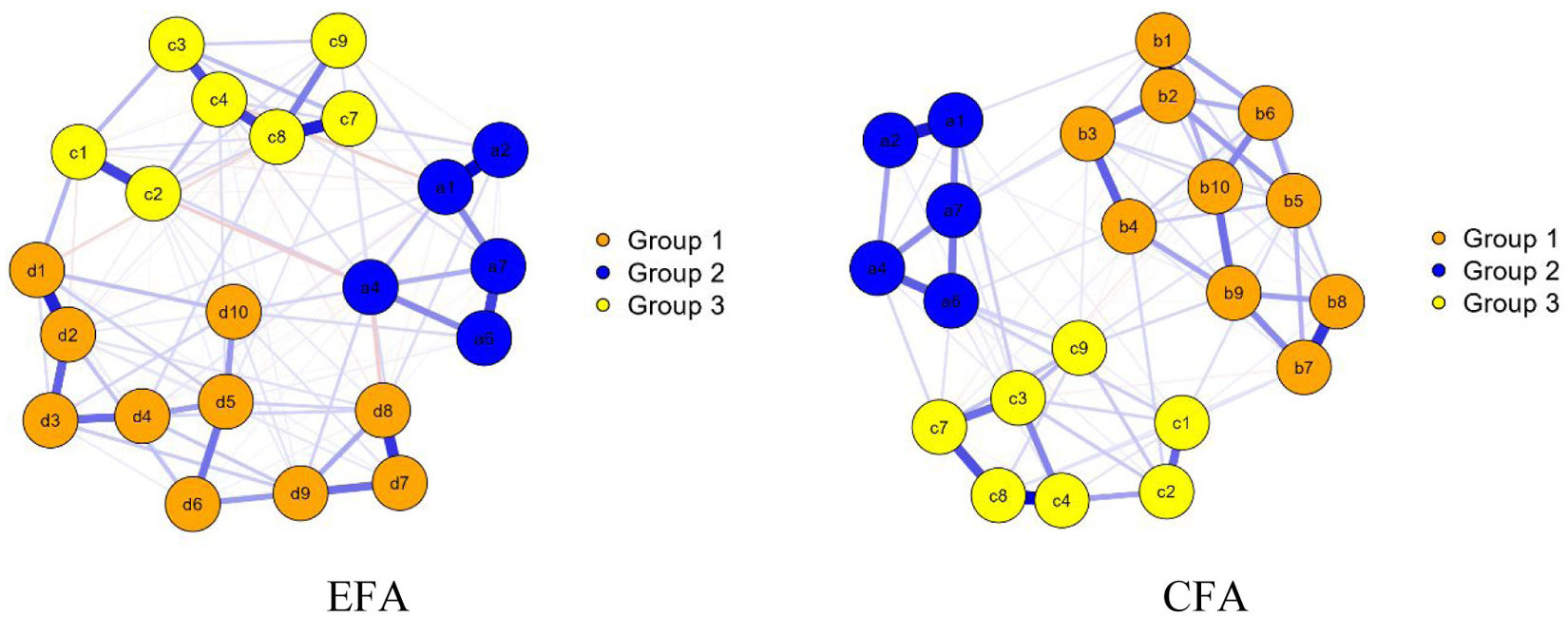
Network analysis of TWSSPS.
The network analysis results provided supporting evidence on the network plane for the factor structure provided in EFA and confirmed by CFA. The nodes related to the dimensions especially show close edges to each other and group together.
Phase IV: Confirmatory Factor Analysis, Network Analysis, and Correlational Analysis
CFA was performed using maximum likelihood estimation using JASP at phase IV. A three-factor and 22-item version were tested. The results of the present study showed that the fit-index criteria were at an acceptable (TLI ≥ 0.914, CFI ≥ 0.925, RMSEA ≤ 0.073 and SRMR < 0.057). Item factor loadings were satisfactory for CFA (see Table 2).
In CFA, the Cronbach’s (α) of the TWSSPS was .93 (95% CI [0.92 and 0.94]) and the McDonald’s (ω) was .93 (95% CI [0.92 and 0.94]). In addition to Cronbach’s (α) and McDonald’s (ω), CR values of 0.940, 0.866, and 0.834 were calculated for the three factors, demonstrating strong internal consistency. The AVE values for the factors were 0.613, 0.483, and 0.508, respectively, with the first and third factors meeting the recommended threshold for adequate construct validity (AVE > 0.50). In contrast, the AVE value of the second factor (0.483) was slightly below the threshold but still acceptable as it was very close to the criterion value, indicating that the TWSSPS had good convergent validity in the sample of this study. Pearson correlations between smartphone usage duration, bedtime usage duration, smartphone addiction, depression, sleep deprivation were calculated with the TWSSPS (see Table 3). Network analysis showed that for CFA, the items were in the network plane in a rational framework (Figure 4).
Pearson Correlations.

p < .05; **p < .001.
Phase V: Test–Retest Reliability (Pearson and Intraclass Correlation Coefficients)
The TWSSPS was performed at 4-week intervals to assess test-retest reliability. In the initial analysis, Pearson correlation results confirmed a high positive correlation between the two time points (r = .73, p < .01). Additionally, an intraclass correlation analysis was performed in JASP using a two-way mixed effects model with absolute agreement. Results indicated good test–retest reliability: ICC(3,1) = 0.73, 95% CI [0.51, 0.86], p < .001. The average measures intraclass correlation coefficient was .84, demonstrating strong consistency across administrations.
Discussion
The present study aimed to investigate the factor structure of the TWSSPS in Turkish adolescents. The results supported a three-dimensional and 22-item structure for the TWSSPS. In addition, test-retest scores provided results in the expected direction. TWSSPS had satisfactory internal consistency scores. Network analysis provided additional support for the factor structure that emerged in both the EFA and CFA, further validating the relationships between variables and enhancing the overall robustness of the model. Furthermore, the calculated AVE and CR values demonstrated satisfactory internal consistency and provided evidence of adequate construct validity, indicating the scale’s reliability and validity in measuring TWSSP. So far, the results of the present study have shown that TWSSPS is a valid and reliable measure of smartphone-induced sleep procrastination in Turkish adolescents. The present study is the first to measure TWSSPS developed based on adolescent experience.
In the present study, item factor loadings on the EFA ranged from 0.55 to 0.92. In the CFA, item factor loadings ranged from 0.53 to 0.87. In the study, item factor loadings above 0.55 indicate a good level of item factor loading (Comrey & Lee, 1992). The present study showed that the item factor loadings for the TWSSPS were satisfactory (except for item 21 in the CFA). Furthermore, the network analysis results showed that the items belonging to the dimensions of the three-dimensional 22-item TWSSPS were included in both the EFA and CFA and at the network level, and the results of the parallel analyses showed the stability of the existing three-dimensional structure. Although the positive correlations in the items between the dimensions were notable, it was expected that the items within the dimensions would have stronger correlations.
The study’s internal consistency and test-retest results provided strong evidence for the reliability of the TWSSPS. In the literature, Cronbach’s (α) and McDonald’s (ω) values above .70 are typically accepted, and the CR values calculated for the three factors (0.940, 0.866, and 0.834) further indicated strong internal consistency of the scale. In addition, the AVE values for the factors (0.613, 0.483 and 0.508) indicated adequate construct validity for the first and third factors (AVE > 0.50), while the slightly lower AVE value for the second factor (0.483) was still considered acceptable due to its proximity to the recommended threshold. Overall, these results suggest that the TWSSPS has good convergent validity, supporting its potential as a reliable and valid measure for use in this study’s sample.
As expected, TWSSPS showed a positive mid-level relationship between smartphone addiction and smartphone use duration in the present study. At the same time, TWSSPS showed a positive mid-level relationship with sleep deprivation. Our findings are consistent with previous studies (Demirci et al., 2015; Liu et al., 2022; Tu, He, Wang, et al., 2023). This means that adolescents, in a sense, increased smartphone use in bed means more sleep procrastination. We emphasize that increased bedtime (Li, Qin, Sun, et al., 2020) and increased depressive tendencies (Wang et al., 2021), which increased during the pandemic, persisted after the pandemic. This shows the potential for sleep procrastination because while-in-bed smartphone use is a critical issue.
Previous studies in the literature need more structure for measuring smartphone-induced sleep procrastination. However, the latest study provides a promising resource for measuring smartphone-induced sleep procrastination. This study focused on the development and psychometric properties assessment of a six-item instrument measuring smartphone use-induced sleep procrastination in undergraduate students (Tu, He, Wang, et al., 2023). Our present study differs from the previous study in several aspects: Adolescents are at risk of increased smartphone usage time, and the present instrument is directly addressed to them. Our present study is mixed-design research, and the instrument items are directly derived from the experiences of adolescents. The instrument presents a three-dimensional structure, namely hedonistic preoccupation, emotional discomfort, and intentional problematic smartphone use, and each dimension has the potential to provide direction for future studies.
Limitations and Recommendations
The present study’s first and most major limitation was excluding electronic devices other than smartphones used in bed. Future studies could include other electronic devices, such as tablets and laptops, to explore their potential contribution to smartphone-induced sleep deprivation. Second, the instrument was developed on Turkish adolescents in a province in the eastern Black Sea region of Türkiye. Future studies could validate and adapt the TWSSPS in culturally and geographically diverse populations, both within and outside Türkiye, to increase the generalizability of the evidence. Third, all participants were included in the study without distinguishing between clinical and non-clinical populations. Researchers could perform comparative studies between these two groups to investigate possible differences in the relationship between smartphone use and sleep deprivation. Fourth, no gender-based measurement invariance was included in the present study. Future studies should focus on testing gender invariance to ensure that the TWSSPS provides equivalent measures across genders, enhancing its applicability. Fifth, the focus of the present study was limited to WSSP. Previous research suggests that while-in-bed smartphone use may also lead to other adverse outcomes, such as poor sleep quality (Thomée, 2018). Therefore, the present study does not address other potential negative consequences of while-in-bed smartphone use beyond sleep procrastination. Sixth, a single-factor model was not tested during the CFA process. Since the factor structure was developed based on themes emerging from focus group interviews, the current study focused solely on validating this multidimensional structure. Finally, discriminant validity was not assessed and should be addressed in future research using unrelated constructs.
Conclusion
TWSSPS, a valid and reliable measurement instrument, plays a crucial role in helping adolescents measure while-in-bed smartphone-induced sleep procrastination. By providing a critical construct for the assessment of while-in-bed smartphone-induced sleep procrastination, it directly contributes to improving adolescents’ quality of life. This underscores the importance of our present study and the potential of TWSSPS for the development and adaptation of other culture-specific measurement instruments.
Turkish researchers and mental health practitioners may utilize the TWSSPS to conduct research, adolescent psychotherapy, counseling, and case studies. Researchers and practitioners can perform randomized controlled trial experiments for adolescents who have high while-in-bed smartphone-induced sleep procrastination. Future studies may focus on measuring invariance and adapting the instrument in clinical cases and culturally diverse adolescents.
Supplemental Material
sj-docx-2-sgo-10.1177_21582440251369968 – Supplemental material for Turkish While-in-Bed Smartphone-Use-Induced Sleep Procrastination Scale (TWSSPS): Scale Development and Validation in Adolescents
Supplemental material, sj-docx-2-sgo-10.1177_21582440251369968 for Turkish While-in-Bed Smartphone-Use-Induced Sleep Procrastination Scale (TWSSPS): Scale Development and Validation in Adolescents by Fedai Kabadayi in SAGE Open
Supplemental Material
sj-xlsx-1-sgo-10.1177_21582440251369968 – Supplemental material for Turkish While-in-Bed Smartphone-Use-Induced Sleep Procrastination Scale (TWSSPS): Scale Development and Validation in Adolescents
Supplemental material, sj-xlsx-1-sgo-10.1177_21582440251369968 for Turkish While-in-Bed Smartphone-Use-Induced Sleep Procrastination Scale (TWSSPS): Scale Development and Validation in Adolescents by Fedai Kabadayi in SAGE Open
Footnotes
Author Note
This study was presented as a conference paper at the 2nd EPAC - International Congress on Pedagogical Research in Education, held in Antalya/Belek, Türkiye, between May 20 and 22, 2025, and published as an abstract in the conference proceedings.

Ethical Considerations
This study was approved by the Research Ethics Committee of Recep Tayyip Erdoğan University (2023/262) on September 27, 2023. Respondents’ parents gave written consent before starting interviews.
Consent to Participate
All participants provided written informed consent prior to participating.
Funding
The author disclosed receipt of the following financial support for the research, authorship, and/or publication of this article: This study has been supported by the Recep Tayyip Erdoğan University Development Foundation (Grant number: 02024010016128).
Declaration of Conflicting Interests
The author declared no potential conflicts of interest with respect to the research, authorship, and/or publication of this article.
Data Availability Statement
The datasets generated during and/or analyzed during the current study are available from the corresponding author on reasonable request.
Supplemental Material
Supplemental material for this article is available online.
References
Supplementary Material
Please find the following supplemental material available below.
For Open Access articles published under a Creative Commons License, all supplemental material carries the same license as the article it is associated with.
For non-Open Access articles published, all supplemental material carries a non-exclusive license, and permission requests for re-use of supplemental material or any part of supplemental material shall be sent directly to the copyright owner as specified in the copyright notice associated with the article.
