




Abstract
Grounded in the principles of ecological efficiency, this study prioritizes the minimization of natural resource inputs alongside the maximization of derived value, and constructs a multi-dimensional carbon emission performance index across economic, social, and environmental factors. Utilizing panel data from 300 Chinese cities over the period 2012 to 2022, this research dissects the impact and underlying mechanisms of industrial intelligence on urban carbon emission performance. The findings show: (1) Industrial intelligence substantially enhances urban carbon emission performance, with findings remaining robust across various tests. (2) Moderation analysis indicates that green technological innovations and advancements in human-machine collaboration mechanisms for improving carbon emission performance. (3) Subgroup regressions suggest that the positive impact of industrial intelligence on carbon emission performance is more marked in cities with higher overall emissions and where there is a strategic emphasis on scientific talent by local governments. (4) The beneficial effects of industrial intelligence are more accentuated in non-traditional industrial cities than in established industrial bases, with significantly stronger impacts observed in peripheral cities compared to central urban areas. The study extends the discourse on sustainable development by providing actionable insights into the strategic deployment of industrial intelligence to foster environmental sustainability and improve urban carbon management practices.
Keywords
Introduction
Since the official adoption of the Kyoto Protocol in 2005, a significant shift toward a “low-carbon” economy has begun to take shape globally, positioning carbon reduction as a key issue for the international community. In China, data from the World Bank shows that although carbon emission intensity significantly decreased by 77% from 1990 to 2020, demonstrating its significant efforts in environmental protection (as shown in Figure 1), the total carbon emissions still reached 10.945 billion tons by 2020, which is still high compared to other major global economies. Moreover, China is undergoing a crucial transition from an industrial power to an industrial powerhouse, during which the issues of high energy consumption and high emissions have become increasingly prominent. To address these challenges and promote green and low-carbon development, China has proposed the “dual carbon” goal and has repeatedly emphasized its importance in important meetings. The “14th Five-Year Plan” for developing intelligent manufacturing in China points out that intelligent manufacturing is a key direction for promoting industrial technological transformation and optimization upgrading. Through “innovation,” it drives “innovation,” emphasizes improving production quality and efficiency, reducing resource and energy consumption, aiming to enhance carbon emission performance through intelligent manufacturing, and achieve coordinated development of economic growth and environmental quality. Cities are the central hubs of modern economic growth, gathering important production factors including resources, labor, capital, and technology. With the rapid development of urban industrialization and other industries, it has become particularly urgent to transform the momentum of economic development while alleviating environmental pollution. Therefore, given the above background and current situation, considering that the development of industrial intelligence has a significant impact on improving urban carbon emission performance, in-depth research on its impact mechanism and practical effects on urban carbon emission performance has theoretical value and significant practical significance.
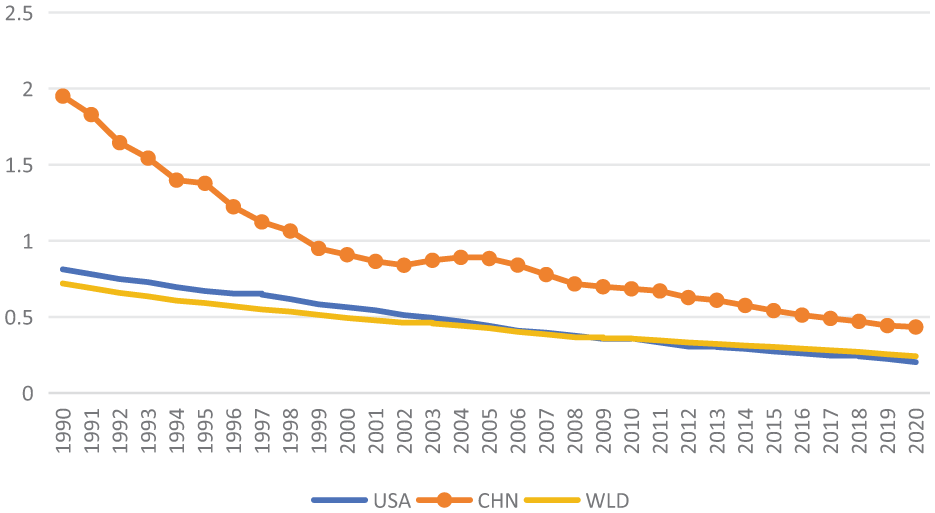
Carbon emission intensity of major countries and regions (1990–2020).
Driven by the Fourth Industrial Revolution, transformative advancements in information and communication technology, biotechnology, new materials, and renewable energy have accelerated the fusion of these fields with advanced manufacturing, thus propelling industrial intelligence. This convergence provides robust support for precision decision-making in urban pollution control and the attainment of “dual carbon” targets. Research on the impacts of industrial intelligence has predominantly explored its implications for economic growth (Gasteiger & Prettner, 2017), industrial upgrading (Acemoglu & Restrepo, 2020), technological innovation (C. Li et al., 2023; Y. Liu et al., 2023), labor markets (Graetz & Michaels, 2018), income distribution (Acemoglu & Restrepo, 2020; Damioli et al., 2023), and energy efficiency and emissions reduction (He et al., 2022; Azam et al., 2021). For example, J. Huang and Koroteev (2021) examined the application of intelligent technologies in energy and waste management planning, while Yin and Zeng (2023) investigated the effects of industrial intelligence on China’s energy intensity, emphasizing the role of technological absorption capacity. Meng et al. (2022) further proposed that industrial intelligence extends beyond technological deployment. It represents a paradigm shift, enhancing output and reinforcing the integration of intelligent technologies into the real economy.
With the accelerated development and application of artificial intelligence in industry, academic focus has increasingly shifted to the link between industrial intelligence and environmental pollution. Yu et al. (2022) examined how industrial robots affect urban air pollution and the mechanisms underlying this impact, using data from Chinese cities between 2013 and 2018. Luan et al. (2022), analyzing panel data from 78 countries, further substantiated the potential effects of robotic adoption on air quality. Although early discussions on the environmental impact of industrial intelligence originated in studies on ICT’s influence on carbon emissions, findings remain inconclusive (Plepys, 2002; Wei & Liu, 2017; Zhang & Liu, 2015). Recent studies have deepened this inquiry. X. Li et al. (2022) assessed the effect of robotics on carbon emissions across 35 countries, while Jiang et al. (2022), using provincial data from China, explored AI’s role in reducing carbon intensity in manufacturing, emphasizing varying impacts across industries and development stages (J. Liu et al., 2022). While these studies provide valuable insights, most remain focused on national and provincial levels, leaving a notable gap in urban-level analysis. This limitation points to the need for precise city-level data on carbon performance, which would advance scholarly understanding of how industrial intelligence shapes carbon emission performance at the city level, offering more targeted and actionable policy recommendations.
However, existing research presents several notable limitations that this study aims to address. First, while prior studies have examined the environmental impact of industrial intelligence at national and provincial levels (X. Li et al., 2022; Jiang et al., 2022), there remains a significant gap in city-level analysis, limiting the precision of policy recommendations for urban sustainability. Second, existing carbon emission performance measurements predominantly adopt a neoclassical economic approach, failing to capture non-market social welfare outputs that are crucial for comprehensive urban sustainability assessment. Third, the mechanisms through which industrial intelligence influences carbon performance remain insufficiently explored, particularly the synergistic effects of green innovation and human-machine collaboration. Finally, most studies treat cities as homogeneous units, overlooking the heterogeneous impacts across different urban contexts such as emission intensity, government priorities, and development stages.
Therefore, this study uses panel data from 300 Chinese cities between 2012 and 2022, measuring industrial intelligence through the density of industrial robot installations. Based on ecological economics theory, the study constructs a comprehensive carbon emission performance index encompassing economic, social, and environmental dimensions to represent urban low-carbon development levels. This approach addresses the gap in evaluating urban low-carbon development from the perspective of social welfare and expands the scope of carbon emission performance. To further investigate the specific impact and mechanisms of industrial intelligence on urban carbon emission performance, the study employs a dual fixed effects model, a moderation effect model, and instrumental variable techniques. These methods effectively control for unobservable city-specific characteristics and time effects, thereby enhancing the accuracy of the estimates. Finally, this study conducts a stratified analysis of the 300 cities, exploring the heterogeneous effects of industrial intelligence on carbon emission performance based on carbon emission intensity, local government emphasis on technological talent, status as an old industrial base, and geographic positioning (central vs. peripheral cities). This stratified approach reveals varied impacts of industrial intelligence across urban contexts and offers insights for targeted sustainability policies.
This study makes four distinctive contributions to the literature. First, it examines industrial intelligence’s impact on carbon performance at the city level, providing granular insights that bridge macro-level findings with urban policy needs. Second, we introduce a novel multidimensional carbon emission performance index grounded in ecological economics principles, incorporating both economic output (GDP) and social welfare (HDI) relative to carbon inputs, advancing beyond traditional single-factor indicators and total-factor approaches that ignore non-market welfare outputs. Third, we unveil the dual-pathway mechanisms through which industrial intelligence enhances carbon performance via green technological innovation and human-machine collaboration enhancement, thereby providing critical knowledge and theoretical foundations for optimizing deployment strategies. Finally, through systematic heterogeneity analysis across 300 Chinese cities, we reveal that industrial intelligence’s carbon benefits vary significantly based on emission intensity, government scientific talent emphasis, industrial base status, and urban positioning, challenging the “one-size-fits-all” assumption prevalent in existing literature and providing nuanced insights for differentiated urban sustainability policies.
Hypothesis Development
Industrial Intelligence and Carbon Emission Performance
While existing theoretical frameworks have primarily focused on the direct economic impacts of industrial intelligence (Acemoglu & Restrepo, 2020) or examined environmental effects through traditional pollution measures (Yu et al., 2022), this study develops a novel theoretical framework that integrates ecological economics principles with urban sustainability theory. Our approach uniquely combines the technology-environment nexus with urban welfare maximization, providing a more holistic understanding of how industrial intelligence can catalyze sustainable urban development.
Industrial intelligence, defined as the integration of artificial intelligence (AI) with advanced manufacturing, uses intelligent systems to replace traditional manual and cognitive labor, driving the digital transformation of industries and society. This model significantly impacts economic growth, employment structure, and environmental sustainability. In terms of economic growth, AI optimizes capital allocation, achieving the dual goals of boosting consumption and driving economic expansion (Lin et al., 2020). However, as AI permeates industrial production, some traditional jobs are displaced, potentially reducing income levels, weakening consumption, and dampening investment—a risk that may lead to economic stagnation (Gasteiger & Prettner, 2017). The disruption to labor markets reshapes employment structures and social frameworks, with further implications for resource allocation and energy demand, potentially affecting overall energy consumption and emissions. Like other emerging technologies, AI exhibits a dual impact: while it displaces some traditional roles through task automation, it simultaneously generates new employment opportunities, especially in green and high-tech sectors (L. Wang et al., 2022). These shifts in economic and employment structures influence social production relations and production modes, subsequently shaping energy consumption and carbon emission patterns. This potential impact warrants further study to clarify its role in advancing a low-carbon economy and sustainable development.
Industrial intelligence, by integrating next-generation information technologies such as the Internet of Things (IoT), artificial intelligence (AI), big data, and cloud computing, demonstrates a substantial “technology dividend” effect, significantly improving carbon emission performance both locally and in spatially related regions (Shao et al., 2022). These technologies enable real-time monitoring and analysis of energy consumption throughout production processes, optimizing workflows to reduce energy waste. On one hand, intelligent manufacturing systems can automatically adjust the operational states of production equipment to ensure maximum energy efficiency, thereby effectively minimizing unnecessary energy consumption. Supporting this view, Yu et al. (2023) found that the deployment of industrial robots not only enhances energy efficiency but also, through the optimization of green technology, substantially reduces urban carbon emissions. Moreover, industrial intelligence transforms corporate production models and drives the structural upgrading of urban industries. The widespread application of robotics and other intelligent equipment facilitates industrial transformation and optimizes production modes, thereby reducing urban carbon emissions (J. Wang et al., 2023). Additionally, industrial intelligence equips enterprises with precise insights into each phase of the production process, enabling real-time monitoring of emissions and improving pollution control and treatment capacities (Qi & Zhang, 2022), further contributing to reductions in urban carbon emissions. Based on this analysis, the following hypothesis is proposed:
Green Technological Innovation Effect
Green technological innovation, as a vital approach to addressing environmental challenges, not only achieves the dual objectives of economic growth and environmental protection but also amplifies the carbon reduction effects of industrial intelligence (Lee & Min, 2015). By integrating green technologies, firms can optimize resource allocation, reducing their reliance on traditional fossil fuels during production, which in turn lowers carbon emissions and enhances environmental performance (J.-W. Huang & Li, 2017). However, green innovation often involves high technological investment, significant market risks, and long payback periods, which can deter resource-constrained firms from pursuing green technology-based innovation pathways. In this context, industrial intelligence becomes a critical tool for transforming production models, enabling firms to effectively incorporate green technologies through the use of AI, IoT, and big data analytics (S. Yang & Liu, 2024). This integration optimizes resource utilization and enhances firms’ adaptability to environmental regulations, thereby promoting carbon emissions reduction and supporting sustainable development, offering a viable pathway for firms to balance economic and environmental goals.
Industrial intelligence enhances firms’ responsiveness and dynamic optimization capabilities through automated collection and analysis of market demand data, improving alignment between products and market needs. It also enables firms to integrate business modules and conduct real-time monitoring of the entire R&D process, effectively mitigating resource misallocation and significantly boosting the efficiency of green technology development (S. Yang & Liu, 2024). In heavily polluting industries, the widespread application of industrial robots and other intelligent devices drives firms toward cleaner production and low-carbon transitions, directly reducing energy consumption and pollutant emissions during production processes (Xu et al., 2023), thereby substantially curbing industrial carbon emissions at the urban level.
Furthermore, green technological innovation provides essential support for carbon capture, storage, and utilization technologies, thereby reducing decarbonization costs and enabling the industrial sector to capitalize on the technological dividends (Shao et al., 2022). In cities with advanced green technological innovation capabilities, which not only reflects strong technological absorption capacity, substantial R&D funding, and a robust reserve of high-tech talent but also demonstrates their ability to drive the development of industrial intelligence. Such capacity facilitates knowledge sharing and technology exchange within firms, across industries, and between regions, integrating green technologies into every aspect of intelligent production. This further strengthens the positive impact of industrial intelligence on urban carbon emission performance. Based on this analysis, the following hypothesis is proposed:
Human-Machine Collaboration Effect
Under the framework of Industry 4.0, artificial intelligence (AI) technologies, exemplified by industrial robots, have exerted a profound impact on labor markets. On one hand, AI and next-generation digital technologies free traditional labor from repetitive tasks, allowing firms to focus more intensively on strategic innovation activities, thereby advancing their digital capabilities (G. Yang & Hou, 2020). On the other hand, the development of industrial intelligence has spurred the emergence of new business models, industries, and jobs supported by digital technologies. Although, in the short term, the job displacement effects of AI may outweigh job creation, potentially exacerbating income inequality, in the long term, job creation is expected to predominate, leading to inclusive green growth (Acemoglu & Restrepo, 2018).
Research indicates that industrial intelligence tends to replace middle-skilled labor more significantly than low-skilled labor, as middle-skilled workers typically possess stronger learning capabilities, allowing them to adapt to technological advancements and improve their skill levels, ultimately leading to higher incomes (Michaels et al., 2014). In practical terms, the application of industrial intelligence imposes higher demands on human capital, requiring specialized knowledge in areas such as programing, mechanical design, and electrical control. Moreover, as industrial intelligence spans various fields and industries, operators must possess the skills to proficiently handle robotics and rapidly acquire new technical expertise. Only through continual skill and knowledge enhancement can workers meet the evolving demands of rapidly advancing robotics technology.
As industrial intelligence becomes more deeply integrated into socio-economic domains, “human-machine collaboration” is expected to become a dominant production model. In collaborative contexts, workers no longer simply operate machines in a repetitive manner but instead engage as contributors to critical thinking, innovation, and decision-making. Simultaneously, intelligent machines, equipped with advanced autonomous learning and task-handling capabilities, assist workers in executing complex and high-risk tasks. This close partnership maximizes the advantages of both parties, creating a complementary synergy that significantly enhances efficiency and quality. Although robots can efficiently perform routine tasks, human involvement remains indispensable for complex work. Only when workers possess the capability to collaborate with robots can the economic and social benefits of robotics be fully realized (Acemoglu & Restrepo, 2020). In cities where human-machine matching is optimized, workers are proficient in using industrial robots across production, energy management, and sales, thereby improving corporate productivity while reducing energy consumption. Consequently, the effective application of industrial intelligence in human-machine collaboration is closely linked to urban carbon emission performance. Based on this analysis, the following hypothesis is proposed:
Although existing studies have explored the economic upgrading (Acemoglu & Restrepo, 2020), labor substitution (Graetz & Michaels, 2018), and environmental impacts (X. Li et al., 2022; Yu et al., 2022) of industrial intelligence, several critical research gaps remain. First, most prior works have been conducted at the national or provincial level (Jiang et al., 2022; J. Liu et al., 2022), overlooking the city-level heterogeneity that is essential for effective local policy design. Second, dominant carbon emission metrics adopt a narrow total-factor or single-factor productivity framework, often neglecting non-market welfare elements crucial to urban sustainability (Zhou et al., 2019). Third, the mechanisms through which industrial intelligence improves carbon outcomes—particularly through green innovation and human-machine collaboration—are seldom empirically tested (Shao et al., 2022; Yang & Liu, 2024). Finally, existing literature tends to assume uniform effects across space, without considering the differential impacts shaped by emission intensity, government science and talent orientation, or industrial legacy (Shi & Li, 2020). By constructing a city-level ecological performance index and testing heterogeneous moderating pathways across 300 cities, this study advances the theoretical understanding of how industrial intelligence fosters sustainable urban development in a more differentiated and policy-relevant manner. Figure 2 illustrates the research framework.
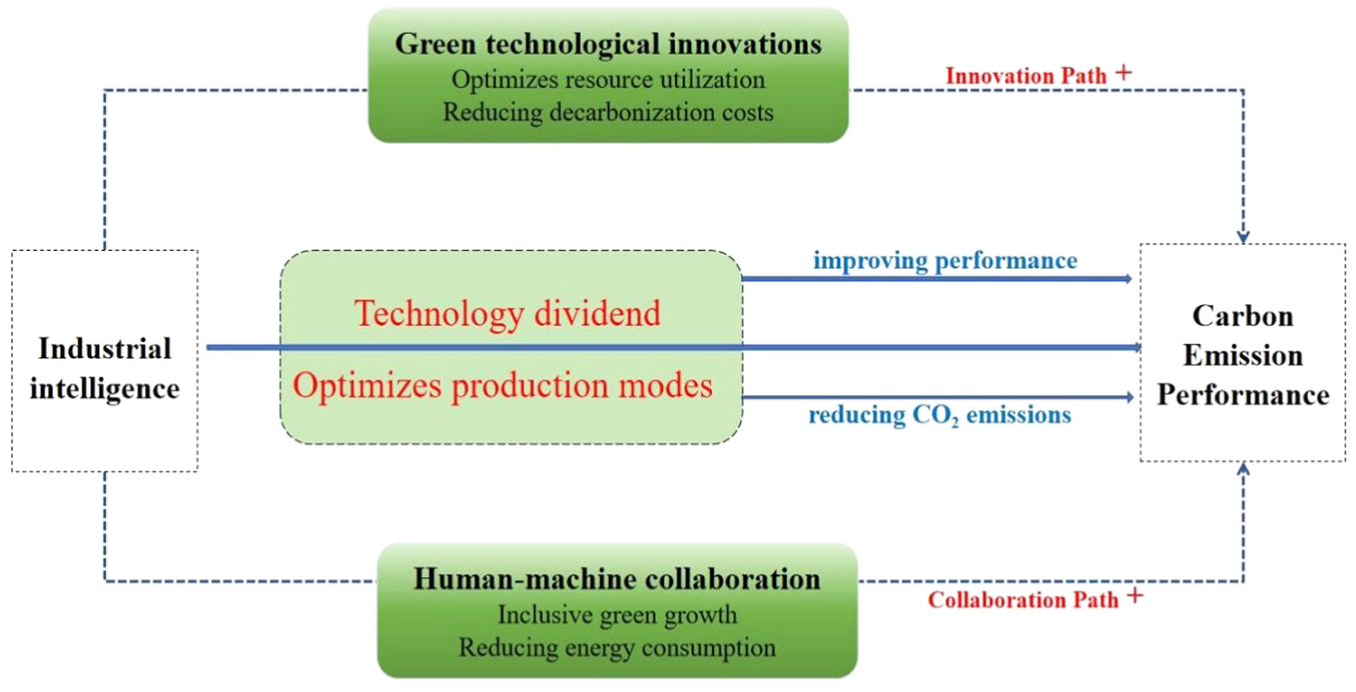
Theoretical framework.
Research Design
Data
The empirical sample for this study spans 2012 to 2022, utilizing a panel dataset of 300 Chinese cities. The time window for the study begins in 2012 because the significant growth in industrial intelligence, becomes evident after this point, marking the start of a transformative phase in industrial automation and its potential impact on economic and environmental performance (as shown in Figure 2). Data sources and processing steps are as follows: (1) Industrial Robot Data: Information on industrial robot installations and stock across 14 manufacturing sub-sectors is obtained from the International Federation of Robotics (IFR) database. (2) Manufacturing Employment Data by Sub-sector: Employment data for manufacturing sub-sectors are sourced from the China Labor Statistical Yearbook. Given classification differences between IFR’s 14 sub-sectors and Chinese industry categories, we follow the reclassification method of Yan et al. (2020) to align Chinese sub-sectors with the IFR framework, ensuring consistent employment data by sub-sector. (3) City-Level Manufacturing Employment Data: City-industry employment shares are derived from the 2008 Second National Economic Census, which provides firm-level employment and industry data, allowing for the calculation of city-industry employment shares. (4) Carbon Emissions Data: Carbon emissions are estimated using IPCC guidelines and specific greenhouse gas inventory coefficients, with energy data sourced from the China Carbon Emissions Database. (5) Additional Variables: Further data are drawn from annual editions of the China Energy Statistical Yearbook, China Statistical Yearbook, China City Statistical Yearbook, as well as provincial and city-level statistical yearbooks and bulletins. Descriptive statistics for key variables are presented in Table 1.
Summary Statistics.

Variables
Core Explanatory Variable: Urban Industrial Intelligence Level
This study measures the explanatory variable by adopting established approaches in current literature (Acemoglu & Restrepo, 2020; Yuan et al., 2022). Specifically, the measurement process begins by aligning the industry classifications provided by the International Federation of Robotics (IFR) with the “Industrial Classification for National Economic Activities” (GB/T4754-2002) in China to obtain the number of industrial robots installed across industries in China. The year 2004 is chosen as the baseline year, and following the rationale of the Bartik instrumental variable method, the industrial robot penetration rate for each city is calculated by multiplying each industry’s employment share by its robot penetration rate in the baseline year. This resulting measure serves as a proxy for the urban industrial intelligence level, calculated as follows:

where: i, j,
Figure 3 shows the rapid growth of cumulative industrial robot installations from 2008 to 2021, reflecting significant progress in China’s industrial intelligence. This progression not only drives high-quality manufacturing development but also plays a critical role in optimizing resource allocation and enhancing energy efficiency, contributing to the green and low-carbon transition.

Cities’ industrial intelligence level by year.
Dependent Variable: Urban Carbon Emission Performance (CEP)
Carbon emission performance (CEP) is a pivotal link between achieving the “dual carbon” targets and advancing high-quality economic development, incorporating both single-factor and total-factor indicators. Single-factor indicators typically assess low-carbon development through metrics such as per capita carbon emissions, carbon productivity, and carbon intensity. Since CEP reflects the efficiency of factor inputs relative to desired outputs across urban activities—stemming from the combined influence of capital, labor, and other economic inputs—the measurement must emphasize a “total-factor” perspective. With the development of Data Envelopment Analysis (DEA), scholars have increasingly considered energy consumption, capital investment, and labor inputs to calculate GDP as the desirable output and CO2 emissions as the undesirable output, thereby evaluating total-factor carbon emission performance.
However, both single- and total-factor indicators primarily adopt a neoclassical economic approach, which often fails to capture non-market social welfare outputs. This study, therefore, redefines CEP from an ecological economics perspective, rooted in the concept of urban green development, to highlight the minimization of energy input (carbon emissions) and the maximization of economic and social welfare output. The CEP index includes two sub-indicators: carbon economic performance and carbon welfare performance, measured by the ratios of GDP and the Human Development Index (HDI) to total CO2 emissions, respectively. The calculation formula is as follows:

In Equation 2, CEP represents the comprehensive index of carbon emission performance, CEE denotes carbon emission economic performance, and CSE indicates carbon emission social welfare performance.


In Equations 3 and 4, CE represents carbon emissions, serving as a measure of energy input; GDP denotes gross domestic product, reflecting economic output; and HDI stands for the Human Development Index, capturing social welfare output.

The Human Development Index (HDI) is a composite measure based on three primary indicators: life expectancy, education level, and income level (S. Wang et al., 2019). Since life expectancy data is typically only available at the provincial level and is difficult to obtain for individual cities, this study uses the number of hospital beds per 10,000 residents (H1) as a proxy for the life expectancy indicator, following previous research that demonstrates a significant correlation between healthcare quality and life expectancy. The education indicator (H2) is measured by the number of enrolled students per 10,000 residents, while the income indicator (H3) is represented by per capita income. These three social welfare indicators are considered equally important, assigned equal weights, and calculated using Equation 5.
Figure 4 depicts the upward trend in urban carbon emission performance (CEP) from 2012 to 2022, indicating gradual improvements in carbon efficiency. Combined with the rapid increase in industrial robot installations, this highlights the potential relationship between industrial intelligence and CEP. Investigating this relationship is crucial for understanding how industrial intelligence can drive both economic growth and environmental sustainability, providing insights into achieving low-carbon development through technological advancements.
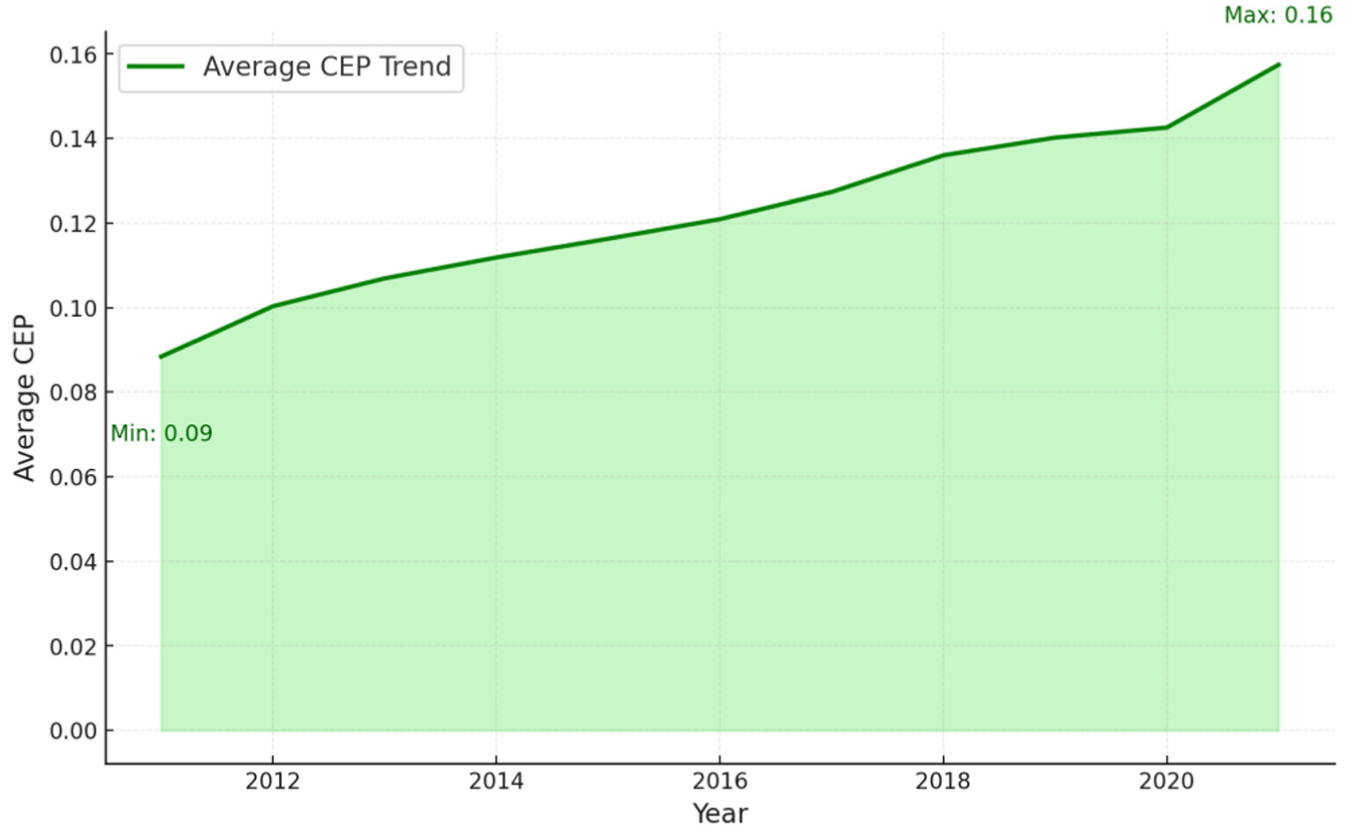
Annual average CO2 emission performance.
Mechanism Variables
(1) Green innovation: This study measures the level of green technological innovation using the logarithm of the number of authorized green invention patents. Green patent data is obtained from the green inventory of the International Patent Classification issued by WIPO and retrieved through the State Intellectual Property Office. Only invention patents are selected due to their higher standards, which more accurately reflect “genuine innovation” and the acquisition of new technologies. The total logarithm of authorized green invention patents effectively captures the quality of firms’ green innovation, reflecting the successful development and commercialization of green technologies, as well as the overall level and impact of their innovative activities.
(2) Human-machine collaboration: This study employs the number of enrolled undergraduate and junior college students as an indicator of human capital levels to reflect the role of the “human-machine collaboration” mechanism. This variable effectively captures the reserve of highly educated labor within a city or region, providing essential support for human-machine collaboration in technological innovation and the advancement of intelligent processes.
Control Variables
To minimize estimation bias from omitted variables, the model includes the following control variables: (1) lnperGDP, representing the regional economic development level, measured as the natural logarithm of per capita GDP; (2) popdensity, representing population density, calculated as the ratio of year-end population to regional area; (3) education, representing the educational level, defined as the proportion of education expenditure within total fiscal spending; (4) consumption, representing social consumption, measured by the ratio of total retail sales of consumer goods to GDP; (5) industructure, representing industrial structure, measured by the share of the tertiary sector in GDP; (6) gov, representing government support, measured by the ratio of local government fiscal expenditure to GDP; (7) finance, representing financial development, measured by the ratio of loan and deposit balances to GDP; (8) FDI, representing the degree of openness, measured by the ratio of foreign investment to GDP; and (9) industrialization, representing the level of industrialization, measured by the ratio of industrial added value to GDP.
Models
A two-way fixed effects model is constructed to identify the impact of industrial intelligence on urban carbon emission performance. To address endogeneity issues stemming from bidirectional causality and omitted variables, instrumental variable methods and additional techniques are employed in the subsequent analysis. The baseline model is specified as follows:

In Equation 6, i denotes the city, and
To investigate whether green innovation and human capital enhancement act as influence mechanisms through which industrial intelligence influences the improvement of urban carbon emission performance, this study constructs moderation effect models (7) and (8).


In this context,
Results and Analysis
Baseline Results
This study employs a two-way fixed effects panel model to examine the impact of industrial intelligence development on urban carbon emission performance. Table 2 presents the baseline regression estimates, with Columns (1) and (2) displaying the results without and with control variables, respectively. The coefficients for industrial intelligence are positive and statistically significant at the 1% or 5% level, indicating that industrial intelligence can serve as a driver for improving urban carbon emission performance, thereby supporting Hypothesis 1.
Baseline Results.
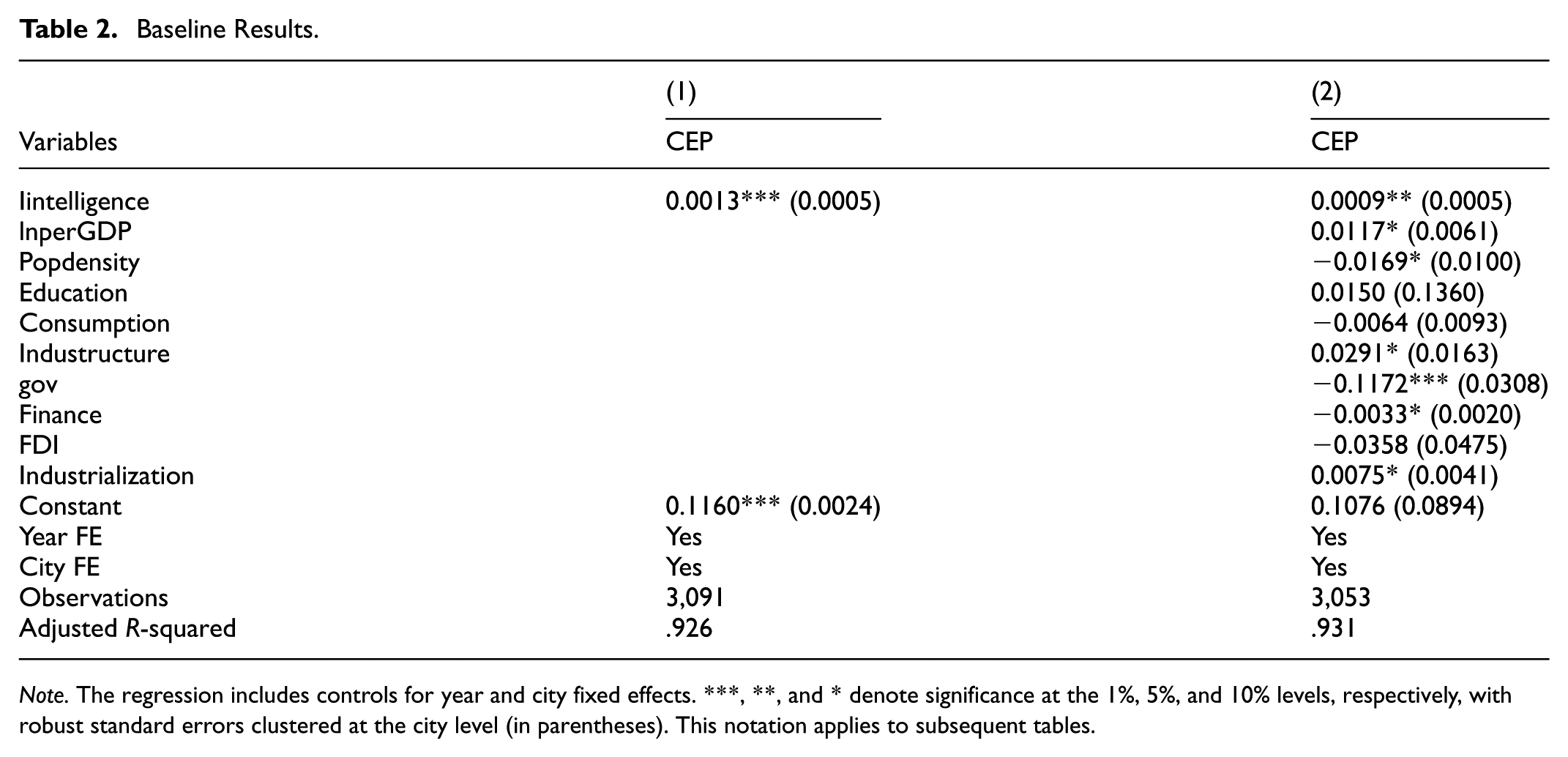
Note. The regression includes controls for year and city fixed effects. ***, **, and * denote significance at the 1%, 5%, and 10% levels, respectively, with robust standard errors clustered at the city level (in parentheses). This notation applies to subsequent tables.
These results are consistent with previous studies that emphasize the positive impact of industrial technologies on environmental outcomes. For instance, Yu et al. (2022) found that industrial robots significantly reduce urban air pollution by enhancing energy efficiency, which aligns with our finding that industrial intelligence improves carbon performance. Similarly, X. Li et al. (2022) demonstrated a reduction in carbon emissions across countries with increased adoption of robotics, further supporting our hypothesis that industrial intelligence can lead to substantial environmental benefits at the urban level.
Robustness Tests
To further validate the results of the baseline model, this study performs a series of robustness checks. The estimated coefficients for industrial intelligence remain significantly positive across all tests, confirming the robustness of the baseline findings.
Replacing the Dependent Variable
To further test robustness, an economic performance indicator is used as an alternative measure of urban carbon emission performance, capturing potential economic contributions to emission efficiency. Column (1) of Table 3 shows that industrial intelligence development remains positively significant at the 1% level, confirming its positive effect on urban carbon emission performance.
Robustness Checks.

p < 0.05, **p < 0.01, ***p < 0.001.
Replacing the Independent Variable
The baseline regression primarily relies on the measurement formula in Equation 1, using city-level industrial robot installation data across sectors. The logic is that if the aggregated application of sectoral industrial robots positively impacts urban carbon emission performance, then the stock of industrial robots should similarly have a positive effect. Given that the International Federation of Robotics (IFR) provides both stock and incremental data for industrial robot use in China, this study uses the stock data as an alternative measure of sectoral industrial robot penetration and re-estimates the model. The results are shown in Column (2) of Table 3.
Excluding Pandemic Year
Given the unique economic disruptions caused by the pandemic, this study performs a robustness check by excluding data from 2020 and re-estimating the model. The pandemic period introduced significant economic variability and policy responses that could distort typical industrial intelligence and carbon emission dynamics. The results from this adjusted sample are shown in Column (3) of Table 3.
Changing the Clustering Dimension of Robust Standard Errors
To control for spatial correlation and policy consistency at the regional level, this study adjusts the clustering dimension of robust standard errors from the city to the provincial level, reducing bias from shared provincial characteristics and enhancing estimation robustness. The results are shown in Column (4) of Table 3.
Lagged Effect Test
The effect of technology application unfolds over time, with a lag between the development of intelligent technologies, subsequent investment in machinery and industrial adoption, and the eventual impact on carbon emission performance. To account for this delay, a lagged variable test is performed, with the estimation results shown in Column (5) of Table 3.
Adding Provincial Fixed Effects
To control for regional heterogeneity due to differences in provincial policies, economic conditions, and resource distribution, provincial fixed effects are added alongside the existing time and city fixed effects. This adjustment reduces potential bias from provincial characteristics, enhancing the robustness and accuracy of the model estimates. The results are shown in Column (6) of Table 3.
Endogeneity Issues
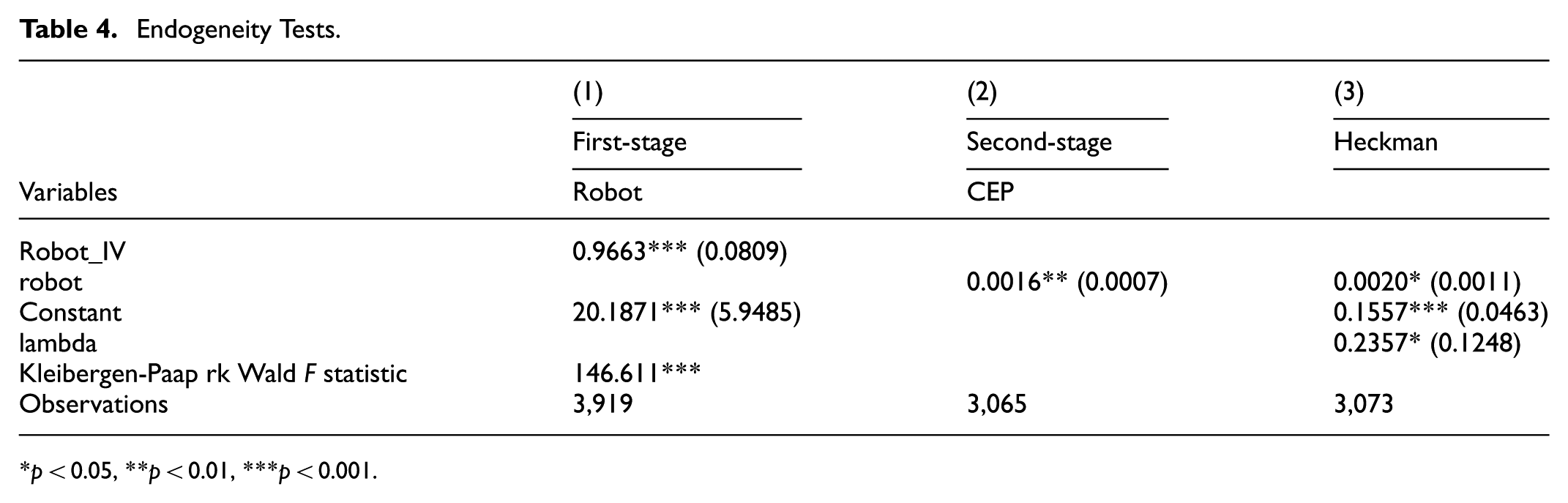
This study considers potential endogeneity issues in the effect of industrial intelligence on urban carbon emission performance, primarily due to reverse causality. Specifically, improvements in carbon emission performance may encourage local governments and firms to increase investments in industrial intelligence. To address this, we employ an instrumental variable (IV) approach, using the average industrial intelligence level of the same industry in other cities during the same year as the IV. This choice is valid as, on one hand, industrial intelligence levels across cities in the same industry are influenced by similar macroeconomic conditions and technological advancements, ensuring relevance. On the other hand, the industrial intelligence level in other cities does not directly impact the carbon emission performance of a specific city, thereby satisfying the exogeneity condition. The IV regression results, presented in Columns (1) and (2) of Table 4, show a first-stage F-statistic well above 10, addressing concerns of “weak instruments.” The second-stage results indicate a significantly positive coefficient for industrial intelligence on urban carbon emission performance at the 5% level, consistent with the baseline results.
Endogeneity Tests.
p < 0.05, **p < 0.01, ***p < 0.001.
To further address potential sample selection bias, this study employs the Heckman two-step method. Such bias may arise from a higher likelihood of industrial intelligence adoption in economically developed or policy-supported regions, resulting in a non-random sample. The Heckman method first corrects for selection bias, followed by the main regression analysis, thereby enhancing estimate precision. The results, shown in Column (3) of Table 4, indicate that the coefficient for industrial intelligence on urban carbon emission performance remains significantly positive at the 10% level, consistent with the baseline findings. This suggests that even after controlling for sample selection bias, industrial intelligence continues to significantly improve carbon emission performance.
Mechanism Analysis
The empirical results in Table 5 provide support for the hypothesis that green technological innovation is a key mechanism through which industrial intelligence enhances urban carbon emission performance. Specifically, the coefficient of the interaction term is positive and statistically significant at the 1% level across various model specifications. This significant interaction effect demonstrates that the adoption of industrial intelligence fosters green technological advancements, which in turn contribute to improved urban carbon performance. These findings validate Hypothesis 2, underscoring the crucial role of green innovation as a channel for realizing the environmental benefits of industrial intelligence.
Results of Green Innovation Effect Tests.

p < 0.05, **p < 0.01, ***p < 0.001.
This result aligns with Lee and Min (2015), who highlighted the role of green technological innovation in reducing carbon emissions, emphasizing its synergy with technological advancements. Furthermore, Yang and Liu (2024) demonstrated that integrating industrial intelligence with green innovation enhances production efficiency and supports sustainable development, reinforcing the argument that technological transformation plays a critical role in driving environmental performance. These studies provide theoretical grounding for our findings, supporting the idea that industrial intelligence not only drives economic growth but also contributes to environmental sustainability through innovation.
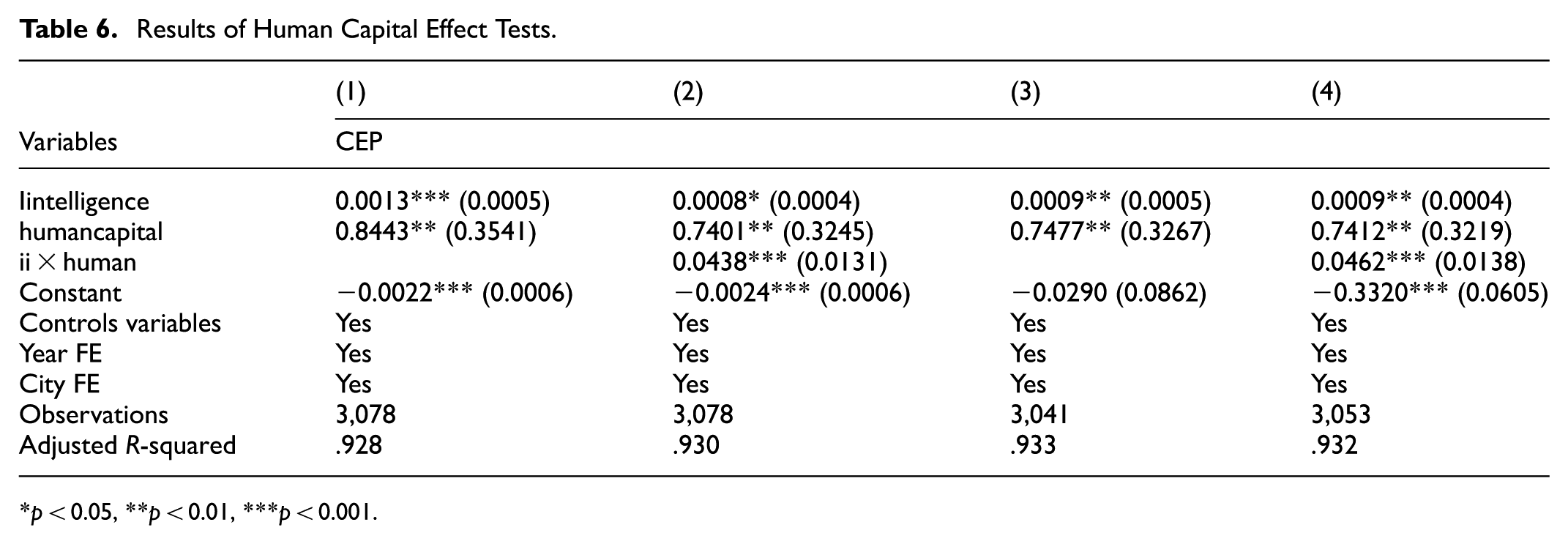
The interaction term ii × human in Table 6 has an estimated coefficient of 0.0462, which is significant at the 1% level, supporting the hypothesis that human capital enhances the impact of industrial intelligence on urban carbon emission performance through the human-machine synergy effect. Specifically, higher levels of human capital not only facilitate the adoption of intelligent equipment, enhancing production efficiency, but also foster the continuous development and implementation of new technologies. Consequently, regions with more developed human capital are better equipped to maximize the environmental benefits of industrial intelligence, amplifying its positive impact on carbon emission performance. These findings underscore the essential role of human capital as a catalyst in realizing the full environmental potential of industrial intelligence. Our results support those of Michaels et al. (2014), who found that middle-skilled workers possess stronger learning capabilities, allowing them to adapt to technological advancements and improve their skill levels. The significant interaction effect validates Acemoglu and Restrepo (2020), who argued that the economic and social benefits of robotics can only be fully realized when workers possess the capability to collaborate with intelligent systems, extending this principle to environmental benefits in our context.
Results of Human Capital Effect Tests.
p < 0.05, **p < 0.01, ***p < 0.001.
Heterogeneity Analysis
Heterogeneity in Carbon Emission Intensity
This study categorizes cities into three groups based on carbon emission intensity—low (CO2_30), medium (CO2_30–70), and high (CO2_70)—and conducts separate regressions for each. As shown in Table 7, Column (3), cities with high carbon emission intensity have the largest coefficient (0.0022), significant at the 1% level, indicating that industrial intelligence has a more pronounced effect on carbon emission performance in these cities. This may be due to the higher concentration of traditional industries in high-emission cities, which often rely on high-carbon energy sources and operate inefficiently, offering substantial potential for improvement through intelligent transformation. Additionally, these cities face greater regulatory pressure to reduce emissions, with stricter policies and incentives that further amplify the positive impact of industrial intelligence. These findings underscore the need for targeted policies to maximize the environmental benefits of industrial intelligence in cities with varying emission profiles.
Group Test Results of Total Carbon Emissions.

p < 0.05, **p < 0.01, ***p < 0.001.
Heterogeneity in Government Attention to Scientific Talent
This study assesses the emphasis placed on scientific innovation and talent development by cities through an analysis of keyword frequencies in local government reports. Specifically, the analysis focuses on two dimensions: “Basic Research” keywords, including terms such as scientific research, applied foundational research, core technology, frontier technology, original innovation, and public welfare technology; and “Science and Technology Talent” keywords, which encompass talent resources, high-level overseas talent, talent team building, technology system reform, innovation-driven strategy, intellectual property, and dual innovation initiatives. The combined frequency of these keywords, calculated as a proportion of the total word count in government reports, provides an index of each city’s focus on innovation and talent development, offering valuable insights for policymakers to guide targeted urban development strategies.
Based on the level of government attention to scientific talent, all cities are classified into three categories: low, medium, and high attention, with regression results shown in Table 8, Columns (1) to (3). The findings indicate that higher government attention to scientific talent strengthens the positive impact of industrial intelligence on carbon emission performance. In high-attention cities, greater availability of scientific talent and supportive policies enhance the effectiveness of industrial intelligence in reducing carbon emissions. This suggests that, in advancing industrial intelligence and low-carbon development, strong government support for scientific talent serves as a crucial enabling factor, significantly amplifying the potential for carbon emission improvements.
Group Test Results of Government Attention to Scientific Talent.

p < 0.05, **p < 0.01, ***p < 0.001.
Heterogeneity in Old Industrial Base Status
To accelerate the development of the industrial system, the Chinese government established several industrial bases in specific regions, centered around heavy industry enterprises. However, as economic conditions evolved, the extensive growth model of these bases has led to substantial energy consumption issues. Consequently, the impact of industrial intelligence on carbon emission performance may vary between old industrial base cities and non-industrial base cities. This study conducts a subsample regression analysis based on the classification of old industrial bases. The results in Table 9, Columns (1) and (2), show that while industrial intelligence positively affects carbon emission performance in both types of cities, the effect is significantly stronger in non-industrial base cities. This disparity likely stems from path dependency issues in old industrial bases, which limits short-term reductions in energy intensity (Shi & Li, 2020). In contrast, non-industrial base cities, driven by a stronger demand for environmental quality, are better positioned to improve carbon emission performance through industrial intelligence.
Group Test Results of Classification of Cities.

p < 0.05, **p < 0.01, ***p < 0.001.
Heterogeneity in Urban Location
In this study, cities are classified as central or peripheral based on economic criteria. Central cities include those with a per capita GDP above the World Bank’s high-income threshold, while peripheral cities fall below this standard. The regression results in Table 9, Columns (3) and (4), show that industrial intelligence significantly enhances carbon emission performance in peripheral cities (coefficient = 0.0010, significant at the 5% level) but has no significant effect in central cities. This suggests that peripheral cities, with their weaker industrial foundations and lower low-carbon pressure, can benefit more from industrial intelligence improvements. Additionally, peripheral cities rely more on industrial intelligence to enhance competitiveness, whereas central cities, already equipped with strong economies and environmental policies, experience limited marginal gains. These findings highlight the need for differentiated low-carbon strategies that prioritize industrial intelligence in peripheral cities, where the potential for carbon efficiency improvement is greater.
Conclusions and Suggestions
Amid rapid technological and industrial transformation, intelligent industries like industrial robotics are meaningful to achieving China’s carbon peak and neutrality goals. This study, grounded in eco-efficiency, constructs a multidimensional carbon performance index prioritizing minimal resource input and maximal value. Using panel data from 300 Chinese cities (2010–2021) and employing two-way fixed effects, moderation, and instrumental variable models, we analyze the impact of industrial intelligence on urban carbon performance. Results show that industrial intelligence significantly enhances carbon efficiency, consistent across robustness and endogeneity tests. Mechanism analysis reveals that this improvement occurs through green innovation and human capital. The positive impact is strongest in cities with higher carbon emissions, greater government focus on scientific talent, non-old industrial bases, and peripheral locations, offering important policy insights for targeted low-carbon strategies.
First, leverage favorable opportunities to promote urban industrial intelligence. Industrial intelligence can optimize industrial structures, operational models, and spatial layouts within cities, providing crucial support for the digital, intelligent, and green transformation of the economy, thereby enhancing urban carbon emission performance. Governments should increase investments in new infrastructure for networks, data processing, and emerging technologies, using industrial, fiscal, and tax incentives to encourage firms to adopt intelligent technologies. Additionally, by strengthening intellectual property protections, governments can create favorable conditions for R&D, motivating enterprises and research institutions to innovate in AI technologies, thus advancing industrial intelligence.
Second, innovate talent development models to cultivate specialized skills for industrial intelligence. Findings from this study indicate that cities with higher levels of human capital experience a stronger positive impact of industrial intelligence on carbon performance. The complex demands of AI-driven environments require advanced talent capable of complementing intelligent technologies, facilitating human-machine collaboration, and enhancing productivity. Educational institutions, local governments, companies, and HR departments should align training programs—including continuing education, pre-employment, and on-the-job training—with the evolving needs of industrial intelligence, dynamically refining talent development strategies and expanding AI-related academic disciplines.
Third, enhance green technology innovation to amplify its moderating effect on carbon performance. Due to the positive externalities of green technology, encouraging market players to invest in green innovation requires a comprehensive, market-oriented policy framework. Effective measures should provide incentives for green R&D, supported by a holistic policy mix that includes green industry planning, environmental standards, and the internalization of the social costs of energy and emissions. This multifaceted approach is essential to motivate sustained green technology innovation across the market.
Fourth, pursue region-specific industrial intelligence strategies tailored to local contexts. While industrial intelligence holds significant potential to improve carbon performance in China, cities must implement strategies adapted to their unique contexts. Central cities should strengthen the “trickle-down” effect of carbon efficiency improvements on surrounding regions. Given that industrial intelligence is in an early exploratory stage, its spatial spillover and diffusion effects are not yet fully realized. Promoting coordinated regional development can enhance economic and productive linkages between cities, maximizing the spatial spillover effects of industrial intelligence on carbon performance improvements.
Discussion
Our findings demonstrate that industrial intelligence significantly enhances urban carbon emission performance through two key mechanisms: green technological innovation and human-machine collaboration. This extends existing literature by establishing a direct link between intelligent manufacturing and comprehensive environmental performance at the urban scale. The multidimensional carbon performance index we developed addresses critical gaps in environmental measurement by incorporating social welfare alongside economic outputs, providing a more holistic framework for evaluating urban sustainability.
The heterogeneous effects across different urban contexts offer important policy insights. Industrial intelligence shows more substantial environmental benefits in high-emission cities, cities with greater government focus on scientific talent, non-industrial base cities, and peripheral locations. These patterns suggest that targeted deployment strategies prioritizing specific city types could maximize environmental returns on industrial intelligence investments. The more potent effects in peripheral cities challenge conventional assumptions about technology diffusion and indicate untapped opportunities for simultaneous economic development and environmental improvement.
Several study limitations provide directions for future research. The relatively short time span limits the analysis of long-term dynamic effects and potential non-linear relationships. Our carbon performance index, while innovative, could be expanded to include additional sustainability dimensions such as biodiversity and resource consumption. Enterprise-level studies should complement the city-level analysis to identify organizational mechanisms that maximize environmental benefits from industrial intelligence adoption. Cross-national comparative studies would enhance understanding of how institutional contexts moderate these relationships and improve generalizability beyond the Chinese context.
Footnotes
Acknowledgements
We gratefully acknowledge the support of Professor Zhicui Li, School of Business, Xinjiang Normal University, and the funding from the Science and Technology Program of Xinjiang Uygur Autonomous Region (“Research on the Cross-Border Integration and Development of the Textile and Garment Industry between Xinjiang, China and Kyrgyzstan,” Grant No. 2025E01015).

Author Contributions
Lang Wu: Conceptualization, methodology design, data analysis, manuscript drafting, revision, and overall supervision of the study. Xuemei Ma: Data collection, initial manuscript preparation, project administration, funding acquisition, and coordination of research progress.
Funding
The authors disclosed receipt of the following financial support for the research, authorship, and/or publication of this article: The Social Science Fund Project of Xinjiang Uygur Autonomous Region, China: “Research on Labor Employment and the Matching of Labor-Intensive Industries in the Four Prefectures of Southern Xinjiang” (Project No. 22BJY022). The Bid Project of the Research Center for High-Quality Industrial Development in the Core Area of the Silk Road Economic Belt at Xinjiang Normal University: “Evaluation of the Multi-Party Cooperative Network Structure, Influencing Factors, and Effects of Xinjiang's Cotton and Textile Industry Clusters” (Project No. ZK202324C). The Science and Technology Program of Xinjiang Uygur Autonomous Region, China: “Research on Cross-Border Integration and Development of Textile and Clothing Industry between Xinjiang, China and Kyrgyzstan” (Project No. 2025E01015).
Declaration of Conflicting Interests
The authors declared no potential conflicts of interest with respect to the research, authorship, and/or publication of this article.
Data Availability Statement
Data sharing not applicable to this article as no datasets were generated or analyzed during the current study.