




Abstract
A rational layout of circulation node cities and the construction of an efficient and coordinated urban circulation network are crucial for promoting green urban development. Investigating the effect of urban circulation network development on urban carbon emission performance and its underlying mechanisms can offer a theoretical foundation and empirical evidence for the evaluation and refinement of policies in circulation node cities. Based on the quasi-natural experiment of circulation node cities, this study utilizes a difference-in-difference (DID) model to evaluate the influence of urban circulation network construction on urban carbon emission performance and examine its operative mechanisms. The findings reveal that the development of urban circulation networks markedly improves urban carbon emission performance, a result demonstrated to be robust. The enhancement effect of such development is more substantial in central and western regions, non-resource-based cities, as well as small and medium-sized cities. Analyses of underlying mechanisms indicate that the construction of urban circulation networks primarily operates through green technology innovation to indirectly elevate urban carbon emission efficiency. Extended analysis confirms the objective existence of regional convergence in carbon emission performance. Although the development of urban circulation networks facilitates the advancement of carbon emission performance, its influence on accelerating regional convergence remains limited. The research conclusion helps to expand the understanding of the modern circulation system construction from a green and low-carbon perspective and provides policy reference value for achieving high-quality development.
Plain Language Summary
A rational layout of circulation node cities and the construction of an efficient and coordinated urban circulation network are crucial for promoting green urban development. Investigating the effect of urban circulation network development on urban carbon emission performance and its underlying mechanisms can offer a theoretical foundation and empirical evidence for the evaluation and refinement of policies in circulation node cities.
Keywords
Introduction
In the context of accelerated global economic expansion, escalating carbon emissions have contributed to pressing ecological challenges, presenting a formidable threat to human sustenance and worldwide development (Abbasi et al., 2022; Miao et al., 2024; Park et al., 2024; Zhang & Choi, 2025; Zhao, Long, et al., 2023). As the preeminent developing nation, China has undergone an extraordinary economic ascent in recent decades. Although predominantly fueled by industrial and demographic dividends, this growth has concurrently imposed substantial environmental strains (Li, Zhang, et al., 2022). According to the International Energy Agency (IEA), China’s carbon dioxide emissions amounted to 12.6 billion tonnes in 2023, accounting for approximately 34% of the global total (see Figure 1). This considerable proportion highlights the formidable responsibility on China to curtail its carbon output (S. Cheng et al., 2020).

CO2 emission.
As China continues to advance in industrialization and urbanization, sacrificing economic growth for carbon emission reduction is no longer feasible (Zhang & Liu, 2022). The core challenge now lies in pursuing sustainable economic development while curbing carbon dioxide emissions. Boosting carbon emission efficiency, which means maximizing economic output with minimal carbon footprints, aligns perfectly with the dual goals of cutting emissions and sustaining growth (Wu et al., 2023; Xie et al., 2021). This makes it a practical and effective pathway not just for China, but for other developing nations as well (Liu & Zhang, 2021). Thus, the Chinese government has rolled out a series of policies to promote green, low-carbon economic development and enhance emission efficiency (Cai & Ye, 2022; Y. Liu et al., 2023; X. Liu et al., 2024; Wang, Yu, & Sun, 2024). Furthermore, China’s success in achieving a low-carbon transition is crucial for global sustainable development. Therefore, deepening our understanding of optimal routes for China’s low-carbon shift can provide valuable insights-helping China and other developing countries achieve economic growth while reducing emissions more effectively (Fan et al., 2022).
Distribution acts as a bridge between supply and demand and a link that connects the flow of goods and factors between regions, and it is indispensable for a well-established distribution system in promoting coordinated regional development. As an important part of the modern distribution system, China’s distribution network construction is continuously advancing, with distribution infrastructure, transportation, and logistics systems becoming increasingly sophisticated (Wu et al., 2024). The construction of distribution networks not only strengthens regional infrastructure interconnectivity, urban division of labor, and industrial collaboration, enhancing the efficiency of supply and demand matching, but it also has significant practical importance for unblocking bottlenecks in the national economic cycle and promoting regional green and sustainable development. Therefore, the Chinese government pays close attention to the construction of distribution networks and provides strong support. For instance, in August 2012, the State Council issued the “Opinions on Deepening the Reform of the Distribution System and Accelerating the Development of the Distribution Industry,” supporting the formulation and improvement of distribution network planning and the scientific layout of national distribution node cities.
The so-called circulation node cities refer to cities with a large economic scale and commodity circulation volume, where commercial flows, logistics, capital flows, and information flows are highly concentrated, possessing strong agglomeration and radiation functions, and occupying a pivotal position in the circulation network (Yang & Zhao, 2016). In May 2015, the Ministry of Commerce and nine other departments jointly promulgated the “National Circulation Node City Layout Plan (2015–2020),” initiating the layout work of national circulation node cities. Following the principle of appropriate scale and quantity, and matching functional structures, 37 national-level and 66 regional-level circulation node cities have been selected.
The national circulation node city layout plan represents a significant strategic endeavor to advance the construction of urban logistics networks, with one of its core components being the proactive promotion of environmentally sustainable and low-carbon distribution systems. This objective is pursued primarily through advocating for civilized, economical, green, and low-carbon modes of production, distribution, and consumption, as well as facilitating energy conservation and emissions reduction within the circulation sectors of node cities. Specific measures include accelerating the enhancement and enforcement of energy efficiency and environmental protection standards within the distribution industry, actively implementing energy-saving, eco-friendly, and low-carbon certification programs. Furthermore, it entails advancing energy conservation and emission reductions in commercial infrastructure and facilities, alongside curbing the excessive packaging of merchandise. Thus, a critical inquiry arises: can this initiative effectively enhance urban carbon emission efficiency in practice? If so, what is the underlying mechanism? Moreover, how does this planning instrument influence urban carbon emission efficiency across cities with divergent developmental characteristics? Theoretical elaboration and empirical validation of these questions will contribute valuable experience and decision-making insights to support cities in their transition toward low-carbon development pathways.
This study delivers three pivotal scholarly contributions to the field. First, it pioneers a unified analytical framework that concurrently examines China’s national circulation node city policy and urban carbon efficiency metrics, thereby generating novel empirical evidence which significantly advances contemporary understanding of logistics network development. Second, capitalizing on the quasi-exogenous implementation of this policy through a rigorously designed DID methodology, we effectively mitigate endogeneity concerns and measurement biases prevalent in extant literature, establishing a methodological benchmark for robust policy evaluation. Third, the research identifies two distinct causal mechanisms through which the policy enhances carbon efficiency: accelerated green technology innovation and optimized resource allocation patterns. These pathways collectively constitute an integrated theoretical model that explicates the relationship between logistical infrastructure development and emission mitigation outcomes.
Literature Review and Hypotheses Development
Literature Review
In recent years, due to the critical role that research on carbon emission efficiency plays in determining the overall level of carbon emissions, scholars have shown a great interest in carbon emission efficiency (Gao et al., 2021). Research on carbon emission efficiency predominantly concentrates on two dimensions: the methodologies of measurement and the factors that influence these measurements (Pan et al., 2020). This efficiency is a metric within the productivity analysis that elucidates the performance of carbon emissions, quantifying the ratio of actual to potential CO2 emissions per unit output (Miao et al., 2024). Various studies have employed carbon emissions per unit of GDP, known as carbon intensity, as a measure of this efficiency (Cheng et al., 2016; Jaraite & Di Maria, 2012; Wei et al., 2012). However, these studies may encounter inaccuracies in their calculations as they overlook the substitution effects of other production factors. Consequently, later research has endeavored to assess carbon emission efficiency more holistically by developing a comprehensive input-output evaluation system that encompasses both parametric and non-parametric methodologies (Dissanayake et al., 2020; Li & Yue, 2024; Sun et al., 2020; Wang & Shao, 2022).
Stochastic Frontier Analysis (SFA) constitutes a principal parametric methodology extensively employed in efficiency measurement studies (Lin & Du, 2015; Moutinho et al., 2020; Yu et al., 2021). However, conventional SFA specifications fail to incorporate unforeseen production externalities (Lampe & Hilgers, 2015). Tone’s (2001) seminal slack-based measure (SBM) model addresses this limitation by integrating inefficiency slacks into the objective function, including provisions for undesirable outputs. This foundation enabled the development of the Super-SBM framework, which explicitly accounts for environmentally detrimental byproducts and has emerged as the prevailing analytical tool for carbon efficiency quantification (Wen et al., 2022). Empirical applications by Liu (2022) utilizing this methodology reveal sustained improvement in China’s carbon efficiency performance, exhibiting statistically significant patterns of both absolute and conditional β-convergence.
Extant literature establishes multiple significant determinants of carbon emission efficiency. Empirical evidence confirms the substantive impacts of economic scale expansion (Acheampong et al., 2020), industrial structural transformation (Brini, 2021; Lu et al., 2022), international trade integration (Xie et al., 2021), technological advancement (Miao et al., 2024), and urbanization patterns (Chhabra et al., 2023; Katircioglu et al., 2018) on emission performance. Particularly noteworthy are knowledge spillover effects, which demonstrate considerable mitigation potential through inter-industry diffusion mechanisms (Chhabra et al., 2023). Katircioglu and Katircioglu (2018) concluded that the increase in carbon dioxide emissions is mainly attributed to the use of fuel oil and the traditional energy consumption patterns associated with urban development. Concurrently, emerging scholarship examines digital economy influences, with Han and Jiang (2022) quantifying substantial efficiency enhancements attributable to digitalization processes. Policy-oriented research predominantly focuses on regulatory instruments, including emissions trading schemes (Hong et al., 2022) and low-carbon city pilot programs (Shi & Xu, 2022; Zhou et al., 2019). Methodologically sophisticated approaches such as quantile regression further reveal how macroeconomic policy uncertainty modulates carbon efficiency outcomes (Yu et al., 2024).
Current literature on urban circulation network construction primarily focuses on the study of circulation network construction, the operational efficiency of node cities, and their impact effects. For instance, it concentrates on aspects such as logistics hubs, logistics network organizations, and logistics and trade connections, which are based on seaport gateways, port-city relationships, and port-hinterland relationships (Hayut, 1981; Zhang, 2019). As a key policy in urban circulation network construction, the layout of circulation node cities has attracted significant scholarly attention. Dong et al. (2020) empirically found that the circulation node city policy has promoted logistics production efficiency through the construction of a DID model. However, to date, few studies have examined the impact of the spatial layout of urban circulation networks on carbon emission efficiency, and both theoretical and empirical research in this area are in urgent need of refinement and supplementation. Therefore, this article utilizes the national layout of circulation node cities as a quasi-natural experimental condition and employs a DID model to study the policy effects of this layout on emission reduction and carbon reduction, as well as its transmission mechanisms. Furthermore, we take Chinese cities as the research subjects and discuss the logical relationship between the national layout of circulation node cities and green transformation development at a more detailed spatial scale.
Hypotheses Development
The direct impact of urban circulation network construction on urban carbon emission performance can be divided into two main aspects: economic growth effect and demonstration effect. Firstly, urban circulation network construction can enhance the economic efficiency of cities. Urban circulation network construction possesses attributes of high standards, high efficiency, and high synergy in public value creation (Wu et al., 2024), which can adjust and optimize the spatial layout of circulation infrastructure. It promotes the co-construction and sharing of transportation, warehousing logistics, financial telecommunications, public information service platforms, and related supporting facilities among cities, enhancing the service capacity of public facilities, and thus has a significant role in improving economic development efficiency (Dong et al., 2020; Yang & Zhao, 2016). Consequently, with a certain amount of input, an increase in output is facilitated, which is therefore conducive to the enhancement of carbon emission performance.
Secondly, urban circulation network construction plays the role of an engine and hub for network nodes, enhancing the role of institutional innovation and demonstration leadership in circulation node cities. Specifically, urban circulation network construction has high diffusibility, which can break through specific industries and regions to form industrial and talent agglomeration. It highly concentrates commercial flows, logistics, capital flows, and information flows (Fan, 2015), and has strong agglomeration and radiation functions, leading to consumption upgrading, innovation and entrepreneurship, industrial structure transformation, and optimization of resource allocation. It effectively plays the “point” agglomeration diffusion and radiation effects, thereby driving the overall improvement of urban carbon emission performance. Based on this, this article proposes the following hypothesis:
Urban circulation network construction enhances urban carbon emission performance by upgrading the functionality of circulation node cities, accelerating the construction of the national backbone circulation network, and promoting capital flow, transportation connectivity, and technical cooperation between cities, especially the transfer of patent technology. This strengthens the interaction and cooperation between cities, forming a competition among global technological innovation centers based on cities as the fundamental spatial units, and enhancing urban innovation capabilities. At the same time, urban circulation network construction leads to economic agglomeration, promoting the upgrade of industrial structures and further driving the enhancement of urban innovation capabilities (Cao & Han, 2022).
Based on Porter’s classical theory of innovation, technological innovation plays a vital role in enhancing production efficiency. In particular, green technological innovation not only reduces energy consumption and environmental pollution in production processes but also promotes energy conservation and emission reduction on the consumer end through the provision of energy-saving products and services. By taking a holistic approach, green technological innovation seeks to maximize benefits while minimizing ecological harm, thereby exhibiting greater innovation and sustainability compared to conventional technologies (Yang et al., 2019). As a distinctive innovation paradigm, it effectively balances economic growth with environmental preservation (Zhou & Qi, 2022). Empirical studies have consistently highlighted the significant contribution of green technological innovation to improving carbon emission efficiency (Kwon et al., 2017; Xu et al., 2021; Zhao et al., 2023b). Specifically, Chen et al. (2021) emphasized that green technological innovation serves as the primary driver for reducing carbon emissions in China. In view of this evidence, this article proposes Hypothesis H2.
Urban circulation network construction enhances the circulation capacity and efficiency of cities, promoting the free flow of talent, capital, and technology, which aids in optimizing the allocation of resources among different economic entities and improving the efficiency of resource allocation. Moreover, urban circulation network construction contributes to promoting integrated regional development and optimizing resource allocation between regions, thereby reducing the likelihood of resource misallocation (Li & Liu, 2020; Wu et al., 2024). Resource allocation effectiveness specifically pertains to a mode of factor allocation capable of maximizing the overall social output, which means attaining Pareto optimality. The optimization of resource allocation constitutes an inherent necessity for enhancing factor production efficiency and plays a vital part in boosting energy utilization efficiency and reducing carbon emission efficiency (Cai, 2023; Hu & Deng, 2023). In accordance with the aforesaid theoretical analysis, Hypothesis H3 is proposed in this article.

Mechanism of the article’s thought progressing.
Research Design
Methods of Measuring Carbon Emission Efficiency
Chambers et al. (1996) seminal introduction of directional distance functions established a foundational framework for efficiency analysis. Subsequent critique by Fukuyama and Weber (2009) identified limitations in traditional radial implementations, noting potential efficiency overestimation due to unaddressed slack variables. Non-radial methodologies, conversely, accommodate differential adjustment rates across inputs and outputs through explicit slack incorporation, demonstrating superior applicability in energy-environmental efficiency contexts (Zhou et al., 2012). This study consequently adopts the Meta-frontier Non-radial Directional Distance Function (MFNDDF) approach, extending methodological frameworks developed by Hu et al. (2020) and Shao and Wang (2023) to operationalize total-factor carbon efficiency as our primary performance metric. Given cities’ irreducible status as fundamental spatial entities exhibiting distinct operational mechanisms irreducible to provincial aggregates (Scott, 2001), we designate municipal units as decision-making entities. Each unit’s production technology is characterized by labor (L), capital (K), and energy (E) inputs generating both desirable economic output (Y) and undesirable carbon emissions (CO2).
Model Settings
The DID methodology constitutes a robust causal inference framework employed to appraise policy interventions. By framing policy enactment as an exogenous shock within a quasi-natural experimental context, this strategy effectively addresses endogeneity concerns pervasive in policy assessment research (Li et al., 2018; Qiu et al., 2021; Wang & Shao, 2024a). In accordance with DID identification assumptions, we define two essential dummy variables: (1) A policy binary variable to delineate the treatment and control groups. Municipalities designated as national circulation nodes are categorized into the treatment group and assigned a value of 1, while non-pilot cities comprise the control group and receive a value of 0. (2) A temporal dummy variable demarcating the commencement of policy implementation. To examine the ramifications of urban circulation network development on urban carbon emission performance, this study conceptualizes the development initiative as a quasi-natural experiment. Correspondingly, building upon the analytical framework proposed by Zhang et al. (2023), we specify the following econometric model:

In this specification, i and t denote the city and year, respectively; TCPI signifies urban carbon emission performance. The term DID it is constructed as the interaction Treat t × Time t . Here, Treat t is a binary indicator that equals 1 if city i is designated as a national circulation node city, and 0 otherwise. Timet represents a temporal dummy variable, taking the value of 1 for all years following the policy implementation and 0 otherwise. The coefficient β1 constitutes the central parameter of interest in this analysis; its magnitude and sign reflect the direction and extent of the influence exerted by the urban circulation network construction on carbon emission performance. The vector X encompasses a set of control variables, while γ t and μ t capture city-specific and time-fixed effects, respectively. The term ε it represents the random error term.
On the basis of theoretical analysis, this article further verifies the mechanism by which urban circulation network construction affects urban carbon emission performance. By referring to existing research (Li & Du, 2021), we have established the following model:

In which,
Variable Definition
Input and output variables: Drawing upon established scholarly work, carbon emission performance is predominantly assessed utilizing capital, labor, and energy as inputs, with outputs categorized as desirable and undesirable (Haider & Mishra, 2021; Wang & Shao, 2022). In the present study, capital input is quantified through capital stock. Given the absence of official municipal-level capital stock statistics in China, the perpetual inventory method is employed to estimate urban capital stock (Li & Ma, 2021; Lin & Tan, 2016). Labor input is proxied by year-end urban employment statistics (Guo et al., 2018). Owing to the unavailability of granular energy consumption data at the city level, this investigation adopts the approach of Fu et al. (2021), utilizing urban electricity consumption as a proxy for energy input. Desirable output is represented by urban gross domestic product, serving as an indicator of economic expansion, whereas undesirable output is gauged by municipal carbon dioxide emissions.
Empirical variables: The dependent variable in this article is total carbon performance index denoted as TCPI. The article uses national circulation node cities as a quasi-natural experiment, with the dummy variable Treat i indicating whether it is an experimental group city, and the dummy variable Time t indicating whether the experimental group city became a national circulation node city in that year. Therefore, the interaction term Treat i × Time t is the core explanatory variable of this article.
To mitigate potential omitted variable bias, this investigation integrates a series of control variables widely utilized in existing scholarship, encompassing economic development level (PGDP), financial development (FI), urbanization (UR), external openness (OP), industrial structure advancement (IS), and human capital (HC; Hu et al., 2020; Wang & Shao, 2022; Zhu et al., 2022). Economic development is operationalized as the natural logarithm of per capita GDP (Murshed et al., 2022). Financial development is proxied by the ratio of total loans and deposits to GDP (Rasoulinezhad & Taghizadeh-Hesary, 2022). Urbanization is quantified by the proportion of urban population relative to the total population (Chai et al., 2023; Wang, Long, et al., 2024). Openness is captured through the ratio of actually utilized foreign direct investment to GDP (Liu et al., 2024; Song et al., 2021). Regarding industrial structure advancement, this analysis adheres to the methodology established by Liu and Zhang (2008), defining it as the product of intersectoral proportional relations and labor productivity, computed as follows:

In this context, ES denotes the advancement of industrial structure, while LP stands for labor productivity. LP is calculated by dividing the regional industrial value added by the number of employed persons at the end of the period. A higher ES value indicates a more advanced industrial structure. The level of human capital is measured by the number of university students per 10,000 people (Xue et al., 2021).
Mechanism variables: (1) Green technology innovation (GTI). This research methodically compiles and filters patents from the National Intellectual Property Administration and the Google Patents database to establish green patent datasets at the prefecture-level city scale. In accordance with established scholarly practices, this study employs the count of green invention patent applications per 10,000 individuals within a region as an indicator to assess levels of green technological innovation (Gao et al., 2022; Yang et al., 2021). (2) Resource allocation efficiency. Hsieh and Klenow (2009) highlighted in their research that distortions in production factor allocation create disparities in the marginal costs of capital and labor across regions. This prevents resources from flowing freely, ultimately leading to resource misallocation. To tackle this issue, this article employs the approach proposed by Chen and Hu (2011) to compute the capital misallocation index (

In Equation 4,

In Equation 5,
From Equations 4 and 5, the capital misallocation index

Taking the logarithm of both sides of Equation 6 and rearranging, we get:

By estimating Equation 7, the output elasticities of capital and labor for the regions, denoted as
Results
Correlation Analysis
Before model regression, this study conducted a correlation analysis on all variables. The correlation coefficient between the dependent variable and independent variables shows an initial positive correlation between TCPI and DID. Moreover, all correlation coefficients among other variable pairs are below .8, indicating no severe multicollinearity in the model (Table 1).
Correlation Coefficient Test.

Benchmark Model Regression
The primary empirical findings of this analysis are presented in Table 2. As documented in columns (1) to (2), absent control variables, the estimated coefficients associated with the establishment of urban circulation networks on carbon emission performance are statistically significant at the 5% level. This implies that, on average, municipalities implementing such networks demonstrate enhanced carbon emission performance. As evidenced in column (5), even after the incorporation of control variables alongside individual and temporal fixed effects, the coefficient on the core explanatory variable retains its positive sign and statistical significance. On one hand, urban circulation network construction optimizes the layout of infrastructure and enhances the capacity of public services, improving economic efficiency, thereby helping to enhance carbon emission performance. On the other hand, urban circulation network construction plays the role of an engine and hub of network nodes, promoting industrial agglomeration, talent agglomeration, consumption upgrading, innovation and entrepreneurship, industrial structure transformation, and optimization of resource allocation through its gathering and radiation functions. It plays a demonstrative and leading role, thereby enhancing the overall carbon emission performance of the city, thus validating H1.
Baseline Regression Results.

p < .1. **p < .05. ***p < .01.
Parallel Trend Test
The credibility of the DID approach is contingent upon the parallel trends assumption, which mandates that treatment and control groups demonstrate comparable trajectories in the absence of the policy enactment. Selective designation of pilot regions may compromise the robustness of the policy assessment outcomes. Building upon the methodology established by Beck et al. (2010), this study constructs the following econometric specification to examine the parallel trends assumption:

In Equation 8, the value of

Parallel trend test.
Placebo Test
To eliminate the interference of unobservable random factors on regression results, this article performs a placebo test following the methodologies of Zhou et al. (2023) and Wang and Ma (2024). The procedure involves 1,000 resamplings within the research dataset. For each resample, a randomly assigned treatment group is selected, and a modified policy variable is integrated into the original model’s regression analysis. The policy effect is validated by comparing regression outcomes across these simulations. Figure 4 illustrates the distribution of absolute t-statistics for the estimated coefficients of spurious interaction terms. As shown, most resampled coefficients have absolute t-values below 2, with p-values exceeding .1. These results suggest that the impact of urban circulation network construction on carbon emission performance is minimally influenced by omitted variables or random fluctuations, confirming the robustness of our research conclusions.
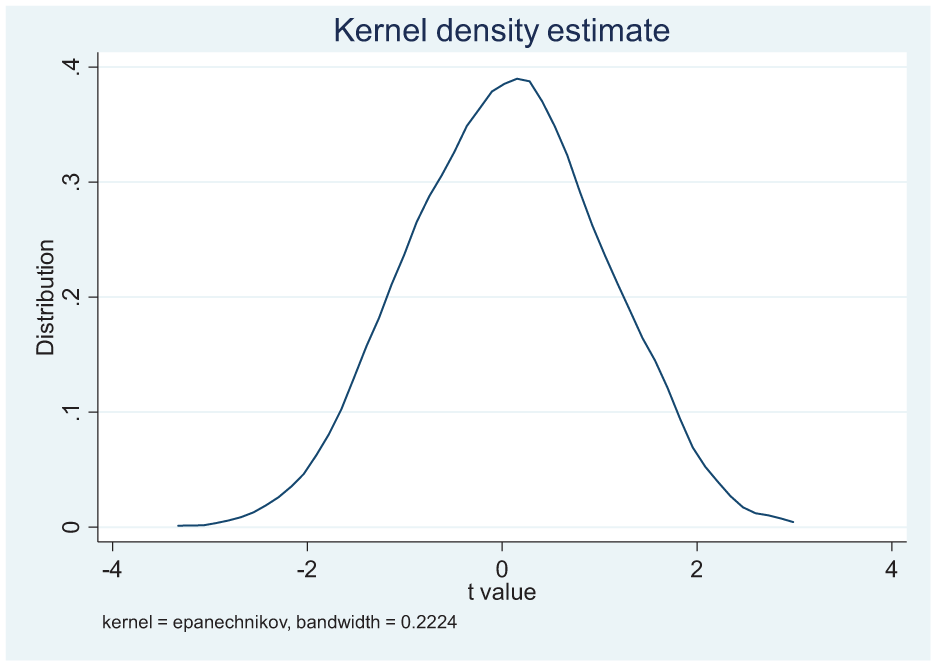
Kernel density distribution.
Discussion on the Non-Randomness of Policy Selection
In reality, the selection criteria for circulation node cities may be related to factors such as city level, market size, and government fiscal capacity. To avoid biases in the results caused by the non-randomness of policy selection, this article, following the approach of P. Li et al. (2016), introduces interaction terms between the selection criteria variables for circulation node cities and time trends into the baseline regression model, constructing the following model:

In which,
Results of the Test for Non-Random Selection of Policy.

p < .1. **p < .05. ***p < .01.
Endogeneity Test
Although the construction of urban circulation networks has a strong exogeneity, the potential issue of omitted variable bias in the model cannot be ignored, and the instrumental variable method is used to mitigate endogeneity issues. Following the instrumental variable construction approach of Wu et al. (2024), this article manually reviews relevant historical literature and selects whether the city “had a railway opened in the 22nd year of the Republic of China (1933)” (opened = 1, not opened = 0) as the instrumental variable for urban circulation network construction. In terms of relevance, railways are carriers of goods and factors and important logistics channels; historical transportation infrastructure is likely to have an impact on the construction of urban circulation networks and to constrain current logistics costs and efficiency. On the exogeneity front, the decision to build railways in various cities during the Republic of China period was mainly determined by the social context and historical environment of the time, and due to the long time span, it has a minimal association with current urban carbon emission performance. Therefore, the instrumental variables selected in this article meet the requirements of correlation and exogeneity at the theoretical level. Furthermore, since the chosen instrumental variable is cross-sectional data, to address the issue of cross-sectional data in panel data model estimation, this article follows the approach of Goldsmith-Pinkham et al. (2020), by interacting “whether the railway was opened in the 22nd year of the Republic of China” with the national railway mileage of the previous year, thereby endowing it with time-varying characteristics.
Table 4 presents the two-stage least squares (2SLS) regression results for the instrumental variable analysis. In the first-stage regression shown in column (1), the instrumental variable (IV) coefficient is significantly positive, demonstrating a strong positive link between the opening of a railway in the 22nd year of the Republic of China and urban circulation network construction. The Kleibergen–Paap rk LM statistic is significant at the 1% level, which rejects the null hypothesis of weak instrument identification. Additionally, the Cragg–Donald Wald F statistic exceeds the 10% significance level critical value for the Stock–Yogo weak instrument test, further confirming the instrument’s validity. The second-stage results show that the regression coefficient for urban circulation network construction remains significantly positive at the 1% level. This indicates that even after accounting for endogeneity, the model’s regression findings remain robust. The consistent positive coefficient suggests a reliable causal relationship between circulation network development and improved carbon emission performance.
Instrumental Regression Estimate Results.

p < .1. **p < .05. ***p < .01.
Other Robustness Tests
To bolster the validity of the empirical findings, this study undertakes robustness assessments across multiple dimensions. First, owing to the distinct administrative status of the four direct-controlled municipalities (Beijing, Tianjin, Shanghai, and Chongqing), these cities are omitted from the overall sample. The model is subsequently re-estimated using the remaining observations (Li, Pan, & Yuan, 2022), with outcomes displayed in Column (1) of Table 5. Second, to account for the exogenous disturbance stemming from the 2015 stock market turbulence, the estimation is repeated after excluding data from the year 2015 (Fang & Liu, 2024; Lyu et al., 2024). The results derived from this procedure are provided in Column (2) of Table 5. Third, recognizing that the influence of urban circulation network development on carbon emission performance may demonstrate a temporal lag, the one-period lagged value of urban carbon emission performance is employed as the dependent variable within the baseline specification for re-estimation. These results are documented in Column (3) of Table 5. Fourth, to mitigate potential confounding effects from concurrent urban policy initiatives, this investigation identifies two overlapping programs: Smart City Construction (SMC) and the Low-Carbon City Pilot (LCCP). In line with conventional methodologies (Wang & Wang, 2023), dichotomous variables representing these initiatives are introduced as additional controls, and the re-estimated results are presented in Columns (4) and (5) of Table 5. Fifth, double machine learning (DML), grounded in the concept of orthogonalization, effectively addresses the influence of multidimensional confounding variables in quasi-natural experiments. This approach has gained widespread adoption in causal inference research (Chernozhukov et al., 2018; Knittel & Stolper, 2021). Therefore, this paper further employs the DML method to estimate the model. Column 6 reports the regression results based on DML. This article constructs a partially linear DML model as follows:


In which,


Among them,
Results of Additional Robustness Checks.

p < .1. **p < .05. ***p < .01.
Heterogeneity Analysis
The preceding empirical findings demonstrate that the development of urban circulation networks exerts a substantial facilitative influence on urban carbon emission performance in the aggregate. Owing to China’s extensive geographical expanse and intricate socioeconomic landscape, cities display pronounced variations in natural geographic conditions, economic advancement, and resource endowment (Ma & Lin, 2023). Accordingly, this research examines the heterogeneous effects of urban circulation network construction on carbon emission performance across three distinct dimensions: regional positioning, municipal characteristics, and city scale.
As shown in columns (1) and (2) of Table 6, the core coefficients for the central and western regions are notably positive. By contrast, the eastern region’s core coefficient is significantly negative. This suggests that urban circulation network construction effectively boosts local carbon emission performance in central and western areas, but slightly inhibits performance improvement in the eastern region. A plausible reason is that central and western regions, while overall less developed, have established scaled traditional industries. Here, early-stage network construction delivers more pronounced marginal benefits: enhancing resource allocation efficiency, improving transportation accessibility, boosting population agglomeration, and optimizing industrial layout. These effects are more significant than in the eastern region, which already operates at a higher development baseline. Additionally, since urban circulation network construction is still in its initial phase, the “polarization effect” currently prevails. The eastern region draws high-quality resources from surrounding developed cities, which may increase local carbon emissions and hinder performance improvements.
Heterogeneity Analysis Results.

p < .1. **p < .05. ***p < .01.
As shown in columns (3) to (4) of Table 6, urban circulation network construction significantly promotes carbon emission performance in non-resource-based cities. Conversely, it has a negative impact on resource-based cities. This discrepancy arises because resource-based cities in China rely heavily on natural resources, leading to a mono-industrial economy and resource depletion. These factors hinder regional industrial innovation, transformation, and coordinated sustainable development, thus weakening the effectiveness of circulation network policies (Wu et al., 2024). Columns (5) to (6) of the table reveal that circulation networks notably enhance carbon performance in small and medium-sized cities, while their impact on large cities is negligible. The main explanation is that although large cities benefit from agglomeration effects that reduce public investment costs, they also face “big city challenges” like high energy consumption and resource scarcity. Specifically, oversize cities often experience congestion effects, which exacerbate urban environmental pollution.
Mechanism Analysis
Thus far, compelling evidence indicates that the development of urban circulation networks can markedly enhance urban carbon emission efficiency. In the theoretical discussion of this study, it was highlighted that urban circulation networks can influence carbon emission performance through technological impacts and the allocation of resources. Consequently, after conducting baseline and robustness model assessments, this part of the study delves deeper into the empirical investigation of the mechanisms through which the establishment of urban circulation networks influences urban carbon emission performance.
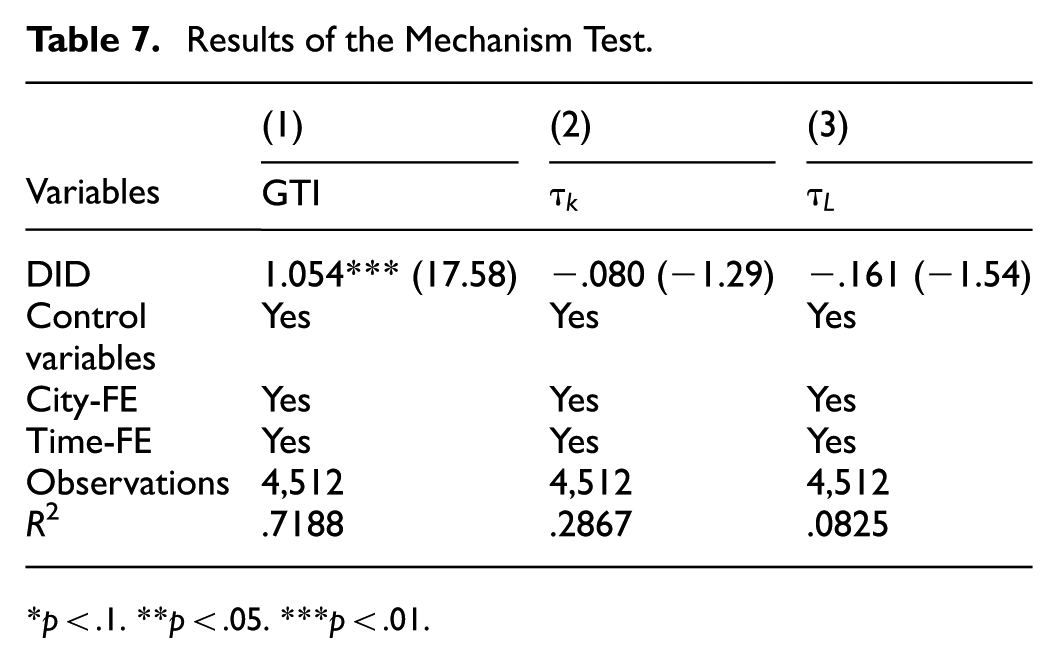
The results of the mechanism test are shown in Table 7. The regression coefficient in column (1) is 1.054 and is significantly positive at the 1% level, indicating that the construction of urban circulation networks significantly enhances green technology innovation. The construction of urban circulation networks accelerates the development of the national backbone circulation network, thereby promoting the flow and cooperation of capital, transportation, and technology (especially patent technology) between cities. This enhanced interaction and cooperation between cities forms a competition based on global scientific and technological innovation centers, thereby increasing the cities’ innovation capabilities, thus validating H2. However, the regression results in columns (2) and (3) show that although the core explanatory variable’s regression coefficients are negative, they are not significant, meaning that, for now, the role of urban circulation network construction in improving resource allocation efficiency is not significant. The main reason might be that improving resource allocation efficiency requires coordination from multiple aspects and cannot be achieved in a short period. For example, factors such as constraints on the employment system, the household registration system, and the delayed reform of the social security system still hinder the transfer of labor, making the barriers to labor mobility between regions not effectively resolved in a short time (Wang & Shao, 2024b).
Results of the Mechanism Test.
p < .1. **p < .05. ***p < .01.
Further Analysis
Currently, unbalanced and insufficient economic development remains China’s principal contradiction. The construction of urban circulation networks offers a key opportunity to rationalize the allocation of China’s spatial resources and advance coordinated regional economic development. From the preceding analysis, first, the role of urban circulation network construction in boosting urban carbon emission performance has started to show. Next, does convergence exist in urban carbon emission performance? Further, can such construction serve as an “accelerator” for convergence in regional carbon emission performance? Answering these questions helps clarify the critical role of urban circulation network construction in coordinated regional development and offers a feasible path reference for its continued advancement. Thus, this article employs the convergence model to examine these questions.

Among these, β denotes the convergence coefficient. A negative value of β in Equation 14 suggests the presence of conditional β convergence. Building upon this premise, a conditional β convergence testing model is formulated to investigate the influence of urban circulation network development on urban carbon emission performance:

If β < 0, it suggests the presence of conditional β convergence, implying that urban carbon emission performance manifests a tendency to evolve toward its steady state. Furthermore, if after incorporating the DID term, β remains negative and its absolute magnitude exceeds that in Equation 14, this demonstrates that the establishment of urban circulation networks contributes to promoting a more rapid regional convergence of urban carbon emission performance.
Table 8 reports the results of the conditional β convergence regression. When DID is not included in column (1), the convergence coefficient of urban carbon emission performance is −.592, and it is significant at the 1% level, indicating that there are significant conditional β convergence characteristics in urban carbon emission performance. According to the estimation results in column (2), the conditional β coefficient is −.593 and is significant at the 1% level, indicating that after the inclusion of DID, there are still significant conditional β convergence characteristics in urban carbon emission performance, but the absolute value of the coefficient does not change significantly. This also shows that although the construction of the urban circulation network is conducive to promoting the improvement of urban carbon emission performance, its effect on the convergence of urban carbon emission performance is not obvious.
β Convergence Test Results.

p < .1. **p < .05. ***p < .01.
Conclusions and Policy Recommendations
Conclusions
Reasonably determining and accelerating the cultivation of circulation node cities is of great significance for building a national backbone circulation network, improving the modern market system, and promoting the efficiency and quality of the national economy. This article uses the national circulation node city layout plan as a quasi-natural experiment and employs the DID method to identify the policy effect of urban circulation network construction on urban carbon emission performance. The conclusions are as follows: (1) The construction of urban circulation networks significantly enhances urban carbon emission performance, a conclusion that still holds under robustness tests such as parallel trend tests, placebo tests, instrumental variable methods, and excluding interference from other policies of the same period. (2) The promotional effect of urban circulation network construction on urban carbon emission performance varies significantly across different geographical locations, resource endowments, and city sizes. (3) The mechanism test confirms that urban circulation network construction mainly indirectly promotes the improvement of urban carbon emission performance through green technology innovation. (4) Further analysis shows that the regional convergence of urban carbon emission performance objectively exists, but the role of urban circulation network construction in its regional convergence is not obvious.
Policy Implications
In view of the aforementioned conclusions, the following policy implications are proposed:
(1) The development of urban circulation networks should be further promoted to amplify the demonstrative and spillover effects of nodal cities. On the one hand, it is essential to advocate for the adoption of civilized, conservation-oriented, green, and low-carbon modes of production, distribution, and consumption; to facilitate energy conservation and emissions reduction within the circulation sectors of nodal cities; and to steer the transformation and upgrading of industrial structures. Efforts should also be made to enhance the planning and integration of logistics parks and other related infrastructure, conscientiously conduct environmental impact assessments for urban plans, and encourage rational spatial allocation. On the other hand, it is imperative to expedite the refinement and enforcement of energy-saving and environmental protection standards within the circulation sector, and to actively promote certifications related to energy efficiency, environmental protection, and low-carbon operations. Energy conservation and emission reduction in commercial buildings and facilities should be advanced, and excessive product packaging must be curtailed. The widespread adoption of electricity-saving, water-saving, and environmentally friendly technologies and equipment should be vigorously encouraged to reduce energy consumption and emissions in logistics and transportation. Green consumption and procurement ought to be incentivized, green and low-carbon supply chains established, and a cohort of model enterprises cultivated.
(2) Maximize the efficacy of green technology innovation and resource allocation mechanisms. First, enhance support for research and development in green science and energy-conservation technologies, and prioritize interregional collaboration in green innovation. Concurrently, throughout the process of green technology advancement, utilize the development of urban circulation networks to strengthen information acquisition capabilities, thereby increasing the conversion efficiency of novel green innovation outcomes. Second, advance the deeper integration of urban circulation network development with capital markets to enhance its capacity to optimize and integrate capital factor allocation. Regarding labor allocation, it is essential to continuously refine policy services supporting flexible employment within the labor market, employ urban circulation network construction to diversify labor employment options, and guide the optimal distribution of labor resources.
(3) The construction of circulation networks should be advanced in a “context-specific” manner, relying on regional resource endowments, industrial foundations, location advantages, and other conditions to enhance complementarity with surrounding cities and achieve low-carbon and green development goals to a greater extent. Meanwhile, implement the “carbon cost sharing-benefit sharing” model, where the core city pays a “low-carbon technology spillover fee” to the cooperation area to support emission reduction in peripheral cities. Peripheral cities undertake the low-carbon industrial segments of the core city through the circulation network, achieve benefit feedback, balance costs and benefits, and ultimately realize regional collaborative green development.
Limitations and Future Research
Although this study addresses many issues, some limitations can be explored in future research. Firstly, the generalizability of our findings beyond the Chinese context may be constrained due to China’s unique institutional and socio-economic characteristics. Secondly, although we employed the DID method, the effectiveness of this method depends on strict assumptions. Thus, future research could advance this field by developing an institutional-technological-spatial tripartite framework to systematically quantify urban circulation network construction effects across varying governance regimes. Additionally, the synthetic control method could be further adopted to reconstruct counterfactual cities, alleviating the limitations of the parallel trend assumption in the DID model.
Footnotes

Ethical Considerations
This article does not contain any studies with human or animal participants.
Author Contributions
Lianghu Wang and Jun Shao: Conceived and designed the research question. Lianghu Wang: Constructed the models and analyzed the optimal solutions. Lianghu Wang: wrote the article.
Funding
The authors disclosed receipt of the following financial support for the research, authorship, and/or publication of this article: This work was supported by the National Social Science Foundation of China (Nos. 23CJY028; 22&ZD095); Doctoral Faculty Scientific Research Support Project of Jiangsu Normal University (No. 24XFRS042). Ministry of Education Humanities and Social Sciences Research Project: Study on the Formation Mechanism and Implementation Path of Digital Technology Empowering the Development of Enterprises' New-Quality Productive Forces. Jiangsu Provincial Social Science Fund Project: Study on the Mechanism, Effect and Promotion Path of Digital Technology Innovation Empowering the High-Quality Development of Jiangsu's Low-Altitude Economy.
Declaration of Conflicting Interests
The authors declared no potential conflicts of interest with respect to the research, authorship, and/or publication of this article.
Data Availability Statement
Data sharing not applicable to this article as no datasets were generated or analyzed during the current study.