




Abstract
As digital transformation increasingly drives reforms in vocational education, this study aims to assess the current status and effectiveness of digitalization policies across five provinces in China. By applying the Policy Modeling Consistency (PMC) index model, the study quantitatively analyzes 21 policy documents from 2012 to 2024 based on nine indicators. The findings indicate that while provinces demonstrate consistency and comprehensiveness in their policy formulation aligned with national strategies for the digitalization of vocational education, they also share common weaknesses in balancing policy content, diversifying policy tools, and ensuring functional integrity. Furthermore, significant disparities exist between provinces regarding policy timeliness and incentive measures. This study provides targeted recommendations to optimize policy effectiveness and facilitate equitable digital transformation across regions. Its key contributions include: (1) analyzing vocational education digital transformation policies across five provinces with diverse economic, geographical, and educational profiles; (2) employing the quantitative approach and PMC index model for accurate and multi-dimensional policy valuation; and (3) offering reference cases and theoretical support for global experience exchange and cooperation in vocational education digital transformation. The results provide valuable insights for understanding digitalization policies in Chinese vocational education, guiding policymakers in the digital transformation process, and serving as references for practitioners and researchers.
Plain language summary
As digital transformation increasingly drives reforms in vocational education, this study aims to assess the current status and effectiveness of digitalization policies across five provinces in China. By applying the PMC index model, the study quantitatively analyzes 21 policy documents from 2012 to 2024 based on nine indicators. The findings indicate that while provinces demonstrate consistency and comprehensiveness in their policy formulation aligned with national strategies for the digitalization of vocational education, they also share common weaknesses in balancing policy content, diversifying policy tools, and ensuring functional integrity. Furthermore, significant disparities exist between provinces regarding policy timeliness and incentive measures. This study offers targeted recommendations to enhance the overall effectiveness of these policies and facilitate a more equitable digital transformation across regions. The results provide valuable insights for understanding digitalization policies in Chinese vocational education, guiding policymakers in the digital transformation process, and serving as references for practitioners and researchers.
Introduction
Digital transformation is not only a critical driver behind the supply-side structural reform in vocational education but also a necessary imperative in response to the global digital revolution (Dong et al., 2024). Recognizing this, China has in recent years implemented several key policy documents that, through top-level design, actively promote the deep integration of vocational education with digital technology, aiming to comprehensively enhance its digital capacity.
However, given China’s vast territory and significant disparities among provinces in economic foundation, infrastructure, and employment orientation, the implementation of vocational education digital transformation policies has exhibited unevenness. To comprehensively evaluate provincial-level policies related to the digitalization of vocational education is necessary. This involves conducting an in-depth analysis of the characteristics, problems, and challenges faced by each province in the process of digital development. Such an evaluation is crucial for guiding future policy optimization and fostering the sustainable and coordinated development of vocational education digitization.
The digital transformation of vocational education has been extensively explored in academia. Existing research covers diverse perspectives; for example, some scholars have analyzed the challenges and strategies for vocational education development in the digital age from the perspective of macro level (e.g., J. Q. Zhang et al., 2024), while other scholars conducted research from a micro-level perspective, discussing specific issues such as the reform of assessment systems (e.g., Xiong & Zhu, 2024). These studies provide valuable insights into understanding the digital transformation of vocational education.
However, despite progressing research on digitalization in vocational education, studies specifically conducting systematic, particularly quantitative, evaluations of policies related to vocational education digital transformation remain limited. Most existing research employs qualitative methods, which, while valuable, often struggle to provide the objectivity and applicability provided by quantitative analyses of policy. In light of this, this study aims to address this gap by conducting an in-depth evaluation of vocational education digital transformation policies issued between 2012 and 2024 in five representative provinces across China.
To achieve this goal and enhance the objectivity and scientific rigor of the study, this research employs the quantitative Policy Modeling Consistency (PMC) index model to conduct a multi-dimensional and systematic analysis of the 21 collected policy documents. Utilizing the PMC model allows for the quantitative evaluation of policy structure, content, and potential effects, thereby enabling a more accurate identification of policy strengths and weaknesses. Specifically, this study analyzes the characteristics of these policies, evaluates their current status and effectiveness, and based on the evaluation results, puts forth targeted recommendations for policy optimization and implementation.
The contributions of this study are multifaceted, primarily highlighted in three key areas:
(1) This research shifts the focus to the provincial level, selecting five provinces with diverse economic, geographical, and educational development profiles as study samples. This systematic examination of cross-regional vocational education digital transformation policies provides a deeper understanding of their implementation and the challenges faced at the local level, distinguishing it from prior research that primarily centered on national policies.
(2) The study employs a quantitative and comprehensive PMC index model for multi-dimensional policy analysis. This approach yields evaluation results with greater objectivity and comparability compared to traditional qualitative methods, thereby enhancing the rigor and reliability of the policy assessment.
(3) Within the context of global vocational education digital transformation, this study’s in-depth analysis of China’s cross-regional policies offers reference cases and theoretical support for other countries and regions grappling with how to balance global trends with local needs when formulating and implementing digital transformation policies, thus fostering international experience exchange and collaboration.
Literature Review
Policy evaluation plays a critical role in the formulation, management, and analysis of public policies (D. S. Cai et al., 2021). It not only reviews past policy performance but also anticipates future impacts by employing a variety of analytical tools, thereby providing essential feedback to support revised and sustained policy initiatives (Adelle & Weiland, 2012; Rashidian, 2017). In the sphere of vocational education, digital transformation is critical for equipping the workforce with future-oriented digital skills. In response, governments and international organizations have increasingly crafted supportive policies to guide this transformation. Evaluating these policies is especially important when considering global strategic frameworks, as it facilitates the identification of diverse approaches, the sharing of best practices, and the recognition of common challenges.
Digital transformation in vocational education extends far beyond the adoption of new technologies. It requires a comprehensive rethinking of how education is delivered and how skills are developed (Anisimova & Efremova, 2022). Accordingly, evaluations typically consider multiple dimensions—such as policy themes, instruments, stakeholder involvement, and outcomes (e.g., Xiu, 2024). Common themes include infrastructure development, digital resource allocation, improving digital competencies among both teachers and learners, and the implementation of supportive measures (e.g., H. Wang, 2023). Simultaneously, policy outcomes are often assessed in terms of effectiveness, implementation efficiency, and equity, etc. (e.g., Gorard, 2018).
Existing literature contributes valuable insights into the content, challenges, and improvement opportunities for policies in this area. For example, J. R. Zhou (2023) used text analysis, revealing specific preferences in the selection of policy instruments within national digital transformation initiatives in vocational education. Similarly, M. J. Cai and Zhou (2024) employed the PMC index to examine policies related to digital campus construction, emphasizing the importance of balancing multiple policy dimensions. In another study, R. F. Guo et al. (2023) applied grounded theory to identify deficiencies in informatization policies, while L. Z. N. Wang (2024) utilized SWOT analysis to evaluate digital transformation initiatives in Hubei Province.
Research has examined vocational education digitalization policies at various levels. Some studies have focused on policy trends among international organizations, with Niemann et al. (2024) analyzing different strategies adopted by global entities and D. Zhang and Che (2022) evaluating Europe’s digital education transformation policies. At the national level, scholars have compared policies across both developed (e.g., Germany, Switzerland) and developing countries (e.g., Malaysia) (e.g., Y. Liu, 2024; Wu & Zhang, 2024; M. Zhou & Ma, 2023), and some studies have undertaken cross-national comparisons (Han et al., 2025). Regionally, analyses include cross-provincial assessments—such as Lin’s (2024) investigation into China’s Higher Vocational Education based on policies of 31 Chinese provinces—and in-depth case studies examining specific contexts, such as DangNguyen et al.’s (2024) work on Ho Chi Minh City in Vietnam.
Methodologically, policy analysis and evaluation typically rely on qualitative or quantitative approaches, or a combination of both. Traditionally, qualitative methods dominated the field, employing established frameworks like policy tool theory, which have proven valuable in disciplines such as economics (M. P. Zhang, 2021), education (Q. T. Hu et al., 2024), and agriculture (M. Zhang & Zhang, 2024). Tools such as SWOT analysis (Ding & Wang, 2011) and thematic analysis (Herzog et al., 2017) have been widely adopted. However, advances in information technology and positivist approaches have increasingly encouraged the integration of qualitative and quantitative methods. For instance, Li and Su (2024) used NVivo to code policy documents for a quantitative assessment of local governments’ use of policy instruments, while Ma and Liu (2024) combined NVivo with policy tool classification theory in a quantitative evaluation of martial arts policies. Mixed-method techniques have also emerged, with researchers blending qualitative frameworks (such as multi-stream theory or SWOT analysis) and quantitative text-mining approaches (using tools like NVivo for word-frequency and content analysis) to capture policy intentions and priorities.
Among these approaches, the PMC index model has become particularly promising for the analysis of digital transformation policies in vocational education. Originally developed by Ruiz Estrada et al. (2007), the PMC index quantitatively assesses policy modeling consistency by constructing an evaluation system with multiple variables extracted from policy documents. The approach involves several steps: classifying variables, identifying parameters, developing multi-input-output tables, and constructing PMC surface diagrams. Compared with traditional qualitative approaches, the PMC index minimizes subjective judgment and enhances both the comprehensiveness and comparability of policy evaluations. Its utility is supported by applications in diverse fields, including Y. A. Zhang and Qie’s (2018) analysis of “Mass Entrepreneurship and Innovation Initiatives” and H. Guo’s (2024) study of skill talent policies in the Guangdong-Hong Kong-Macau Greater Bay Area. Additional studies by Qian et al. (2024) on digital education policies in Southeast China, Ma and Liu (2024) on vocational education policies in Sichuan Province, and Y. Liu and Zhao (2022) on textile industry policies further emphasize the effectiveness of the PMC model.
While digital transformation in vocational education is widely acknowledged as crucial, several challenges persist in effectively evaluating the related policies. Many studies have relied on simplistic quantitative methods—such as basic word-frequency analyses—that fail to reveal the underlying complexities of digital transformation. In addition, these studies often suffer from sample biases owing to the use of limited or non-representative policy documents, raising concerns about the generalizability and reliability of their results. Furthermore, an overemphasis on analyzing policy instruments can sometimes obscure a broader, holistic assessment of overall policy impact.
Another notable gap in existing research is the tendency to focus on national or single-province analyses, often neglecting the regional differences that are critical to policy success. Given the central role of provincial governments in both policy formulation and implementation, a detailed examination of provincial policies is essential for uncovering key features and challenges in vocational education digitalization. In response to these limitations, this study adopts the PMC model as a robust quantitative tool for evaluating digitalization policies in vocational education, enabling the construction of a standardized framework that simultaneously addresses policy design, implementation, and outcomes—facilitating systematic cross-regional comparisons. This integrated approach is expected to yield actionable and comparable insights, which will help policymakers refine and optimize their initiatives.
In light of these considerations, the research is guided by the following central questions:
(1) What are the key characteristics and effectiveness of digitalization policies in vocational education across the five selected provinces in China?
(2) What are the strengths and weaknesses of the current digitalization policies in vocational education?
(3) What targeted policy optimizations can be recommended to enhance the effectiveness of digitalization in vocational education across different regions?
Methodology
This study systematically examines provincial policies on the digital transformation of vocational education in China. The methodology involves three major stages. First, relevant policy texts are collected and preprocessed using text mining techniques, with high-frequency terms extracted to help structure a comprehensive evaluation framework. Second, a comprehensive PMC index model is constructed based on the framework, and PMC surface graphs are generated for each province to reveal distinctive policy characteristics. Finally, a comparative evaluation of policies across five provinces is conducted, providing a solid foundation to inform future policy formulation and improvement.
Selection of Provinces and Policy Samples
Since 2012, China has significantly intensified its efforts in informatization and digitalization, especially within the vocational education sector. At the national level, a series of policy documents have been issued to guide this transformation, while provincial governments have introduced complementary measures. This progression offers a foundational case study to trace the evolution of digital strategies in vocational education at the sub-national level.
The selection of policy documents is based on three key criteria: (1) Authority: Priority is given to documents officially issued by credible entities such as provincial governments and education departments; (2) Relevance: Selected policies must directly relate to the digital transformation of vocational education, ensuring that the study is focused and pertinent; (3) Representativeness: The policies should capture the distinctive features and priorities characterizing each province’s strategy.
To capture a broad spectrum of geographic, economic, and educational diversity, the study focuses on five provinces in China—Jiangsu, Shandong, Shaanxi, Yunnan, and Xinjiang, spanning from eastern coastal areas to central and western regions, as illustrated in Figure 1. Their geographic profiles vary notably in location, landform, and transportation connectivity. Economically, the development level of eastern coastal areas is higher, while the western resource-based areas face additional challenges due to lower economic levels (Sun et al., 2024). Culturally and educationally, Jiangsu leads in accessibility and university resources; Shaanxi and Shandong benefit from strong cultural traditions, whereas Yunnan and Xinjiang show comparatively lower educational levels. These distinctions are detailed in Table 1.

Map of China highlighting the study areas.
Provincial Characteristics: Geography, Economy, Education.

Given this diversity, the analysis of relevant policies across these five provinces offers insights into the implementation effects and challenges of vocational education digitalization policies under varying regional conditions.
This study thus conducts a thorough analysis of provincial-level authoritative policies concerning the digital transformation of vocational education across five Chinese provinces, spanning the period from 2012 to 2024. Detailed information about selected policies can be found in Table 2.
Selected Policies of Five Provinces.

Social Network Analysis
Social network analysis, a widely adopted method in sociological research, focuses on understanding phenomena through the study of relationships and their interactions (Qian et al., 2024). In this study, policy text keywords are conceptualized as nodes, with their co-occurrence establishing the links between the nodes. By analyzing connections and evaluating co-occurrence frequencies, this approach can clarify the relative significance and influence of each keyword within the overall network (Wei, 2009).
Policy Modeling Consistency Index
The PMC index model, grounded in the Omnia Mobilis hypothesis introduced by Ruiz Estrada et al. (2007), posits that inherent interconnections and dynamic characteristics exist among all elements, which should be extensively considered in policy model analysis. In light of this hypothesis, the number of secondary variables should not be constrained, and the weight assigned to each variable should remain uniform. Moreover, the model utilizes a binary framework to balance all variables effectively. The PMC index serves as a tool to evaluate the consistency of a specific policy model, offering clear insights into the strengths and weaknesses of the policy in question. It further provides a detailed exposition of the specific meanings and importance of each variable, thereby playing a pivotal role in addressing the query: “How effective is the policy implementation?”
Establishing Policy Indicator Evaluation Framework
Prior to defining the parameter framework, this study identifies the specific indicator related to policy tools (X6). By integrating multiple classification systems, it comprehensively delineates the dimensions of digital vocational education policy tools into five categories: authoritative, incentive, capacity-building, symbolic and exhortatory, and systemic transformating tools. Table 3 specifies each tool type’s definition and its manifestation within policy texts.
Policy Tools and Their Manifestations.

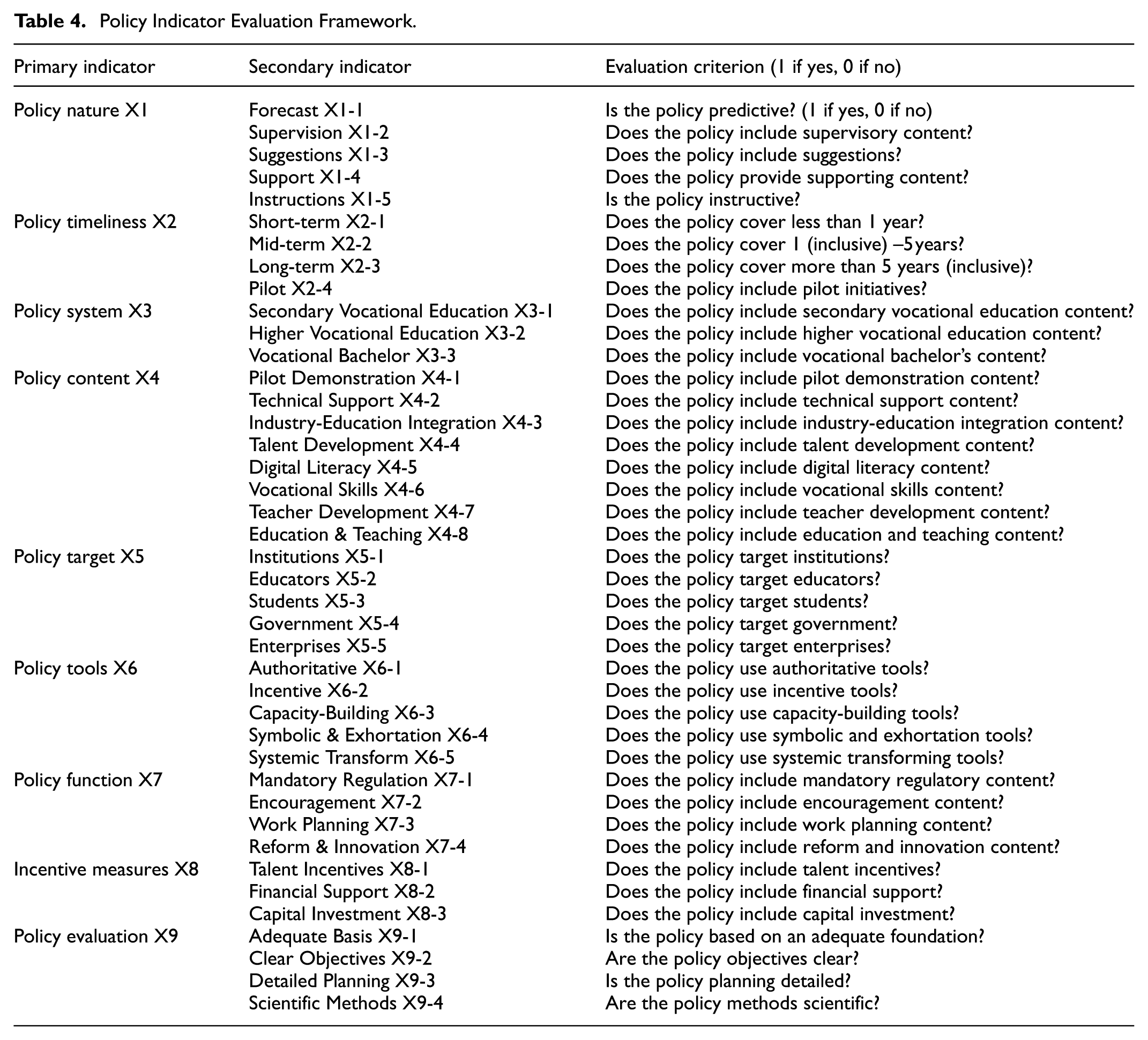
The PMC index model is designed to evaluate policies quantitatively by comprehensively considering all relevant variables, ensuring a holistic analysis without omission. Drawing on its foundational principles and prior research, this study integrates findings from social network analysis of vocational education digitalization policies to develop an evaluation framework across five provinces. This framework identifies 9 primary and 41 secondary variables, with each scored as 1 if present and 0 if absent, as detailed in Table 4.
Policy Indicator Evaluation Framework.
To ensure the objectivity and precision, two researchers independently scored the secondary indicators. When ambiguities arose, consensus was achieved through discussion and negotiation, with a third expert consulted to reach a resolution.
Measuring the PMC Index
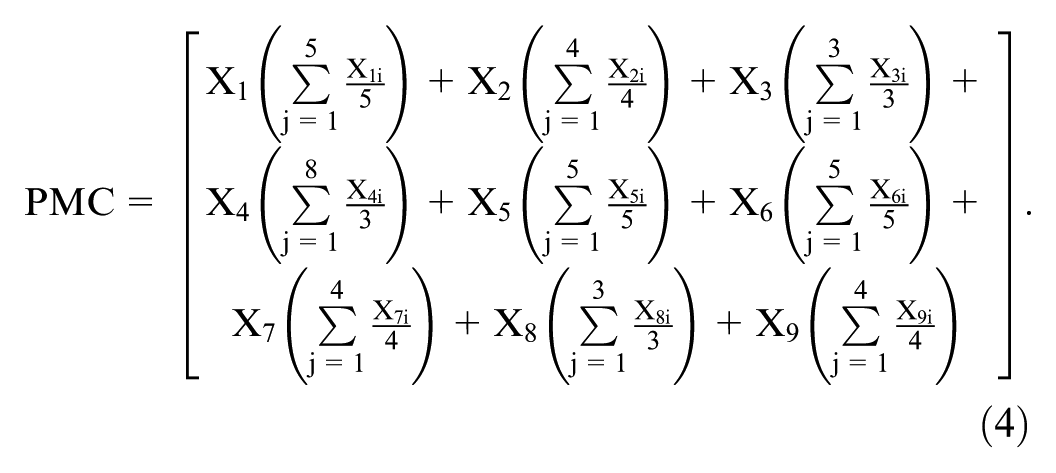
The PMC index calculation follows a structured four-step process (Ruiz Estrada, 2011). First, incorporate the 9 primary variables and 41 secondary variables from the provincial vocational education digitalization policies into the multi-input-output table (see Table 5). The table serves as a powerful analytical framework, providing researchers with a multidimensional perspective to thoroughly understand and interpret specific variables. Within this framework, the primary indicators function independently, and each secondary indicator holds equal importance and weight. All indicators are defined using binary parameters: 1 if the policy meets a specific criterion, 0 otherwise. Next, values of the secondary indicators are calculated using Equations 1 and 2. Third, values of the primary indicators are computed according to Equation 3. Finally, the comprehensive value of the PMC index is determined using Equation 4.


Multi-Input-Output Table.

To enhance the clarity of the underlying objectives and scope inherent in the formulation of the policies, the study adopts and refines the rating framework advanced by J. D. Liu et al. (2022). The framework identifies four distinct evaluation levels: “Reasonable and Complete Policy,”“Policy Meeting Expectations,”“Policy with Emphasis” and “Weak Policy Applicability.” These categories facilitate a detailed and quantitative analysis of the digitalization policy texts pertinent to vocational education. The specific criteria for each rating level are provided in Table 6.
Policy Rating Standards.

Creating a PMC Surface Plot
The study utilizes the PMC scores obtained from selected policies of each province to construct a PMC matrix for the nine primary indicators by employing Equation 5. This matrix is then visualized as a PMC surface plot through MATLAB software. The extent of indentations on this surface assesses the performance of the primary variables: deeper indentations indicate lower scores, thereby highlighting deficiencies in policy content, whereas shallower indentations suggest a more comprehensive coverage of policy aspects. Furthermore, the smoothness of the PMC surface provides insight into the coherence among policy elements; a smoother surface denotes stronger integration of these components within the framework of digitalization policies for vocational education.

Results and Analysis
Overview of All Policies
Policy Document Review and Social Network Analysis
This study applies the text mining software ROSTCM 6 to perform a social network analysis of 21 policy documents following a comprehensive review. High-frequency keywords are extracted to construct a semantic network and a corresponding matrix, illustrating provincial-level policies in vocational education digitalization (see Figure 2).
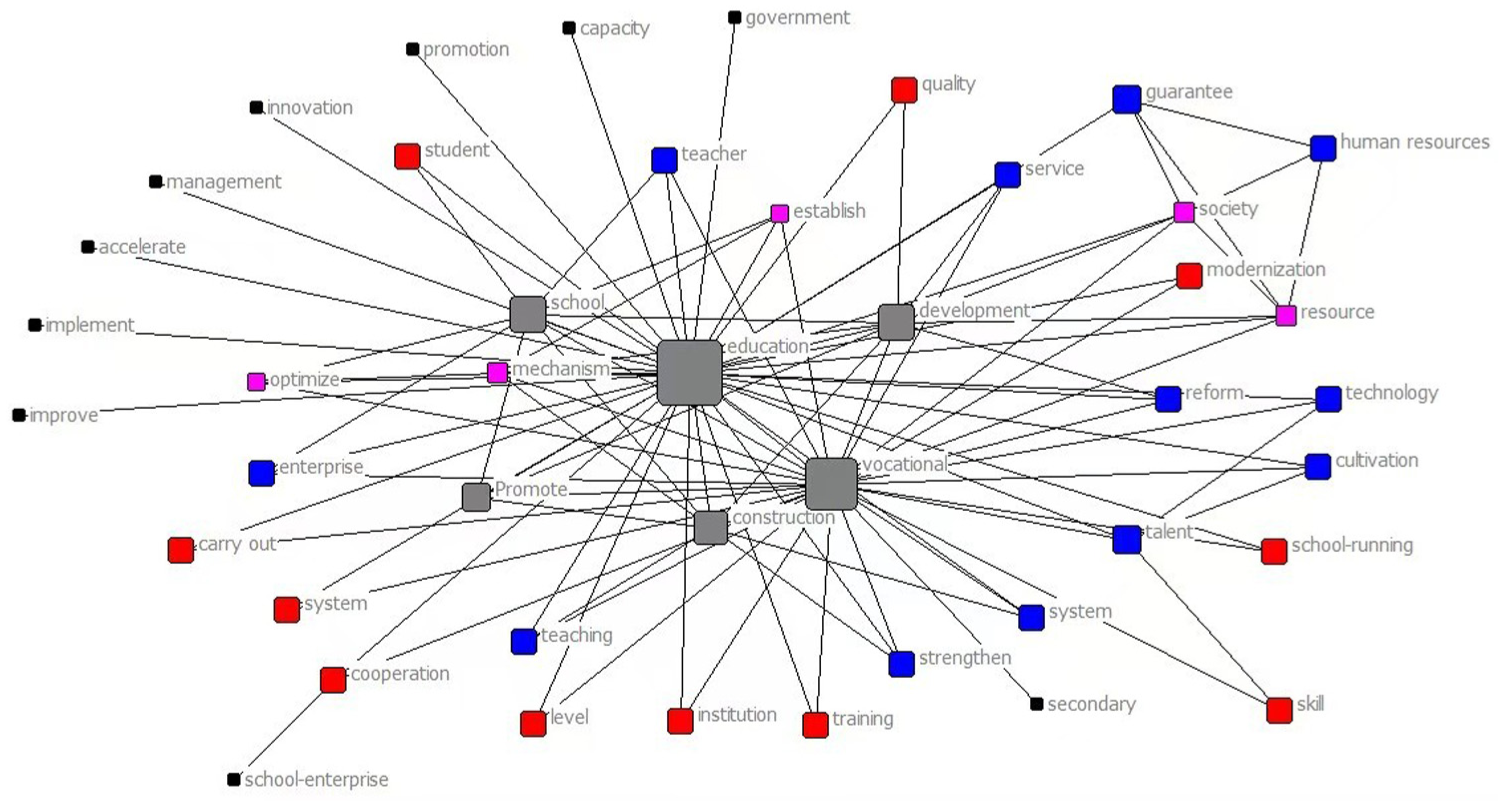
Social network diagram of keywords from policies of five provinces.
The diagram highlights the 10 core keywords with the highest node density and degree centrality: education, vocational, school, development, construction, teacher, institution, training, teaching, and enterprise. These keywords encapsulate the central themes and focal points of vocational education’s digital transformation at the provincial levels. The secondary keywords—such as talent, resource, training, management, and technology—depict the specific implementation pathways, while keywords like reform, quality, innovation, and assurance represent the overarching objectives of digital transformation in provincial vocational education.
To ensure statistical accuracy, this study carried out a manual screening of high-frequency keywords, excluding action verbs such as “develop”“construct” and “implement” that are not directly related to the substantive policy content. The refined list was ranked to identify the top 20 keywords by frequency (see Table 7).
High-Frequency Keywords in Policies of Five Provinces.

PMC Indices Calculation and Comparative Analysis
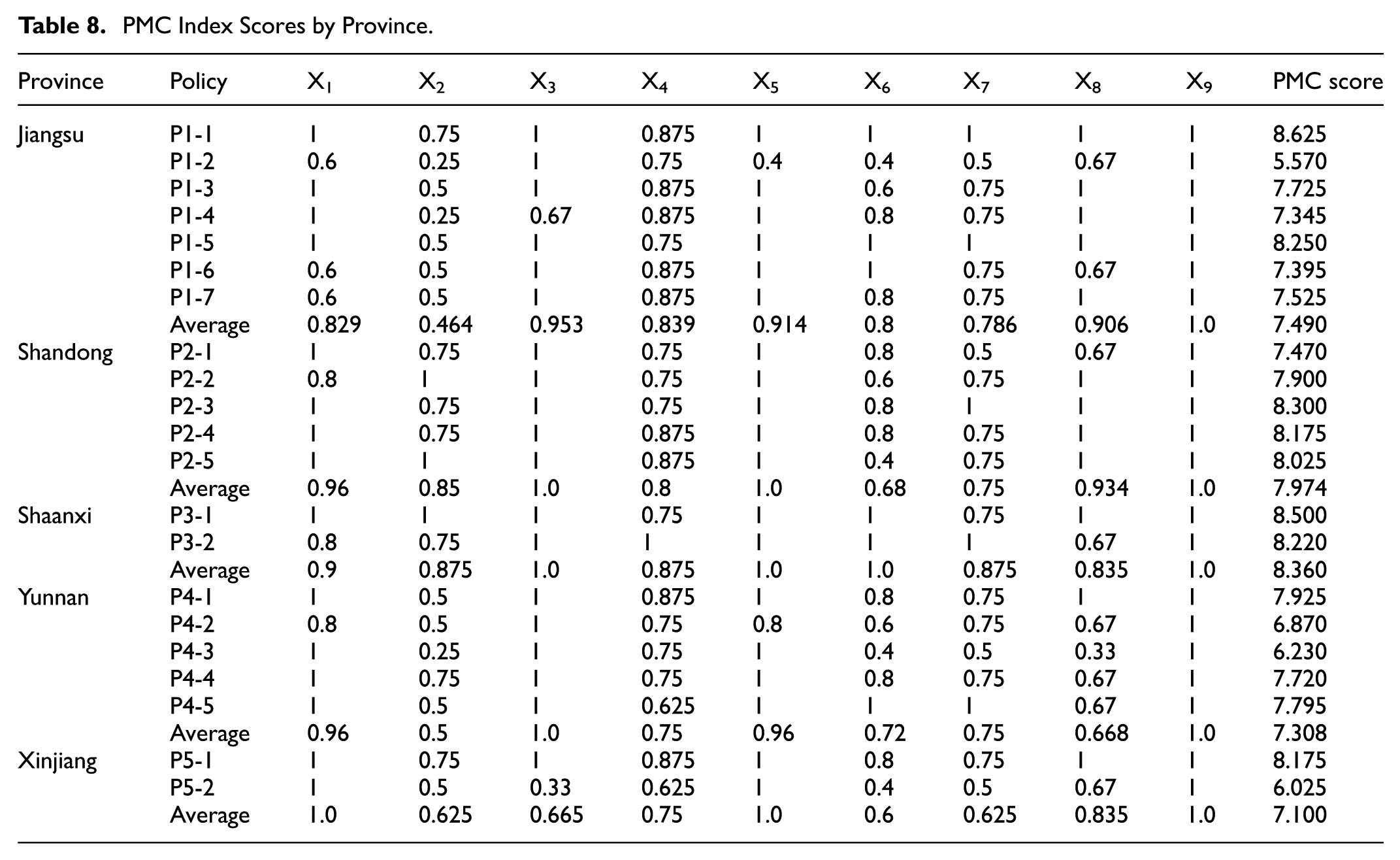
PMC indices were calculated for sampled policies, and a PMC matrix was established, featuring nine primary indicators (X1 to X9), as is shown in Table 8. The analysis, covering 21 policy documents, ranks Shaanxi highest with a score of 8.36, achieving “Policy Meeting Expectations” rating, reflecting strong alignment with strategic goals. Shandong follows closely with a score of 7.974, alongside Jiangsu (7.49), Yunnan (7.308), and Xinjiang (7.1), all classified under “Policy with Emphasis.” These scores underscore the provinces’ strategic focus on digitalization in vocational education, highlighting regional adaptations and targeted priorities.
PMC Index Scores by Province.
PMC Surface Plots and Performance Analysis
The performance of the 21 policies was visualized through a PMC surface, with the Z-axis indicating the value of each primary indicator (X1 to X9), as shown in Figure 3. These indicators represent the core dimensions of the policies. Smoother surface profiles indicate higher overall scores, while uneven surfaces with sharp declines indicate potential weaknesses in specific policy dimensions.
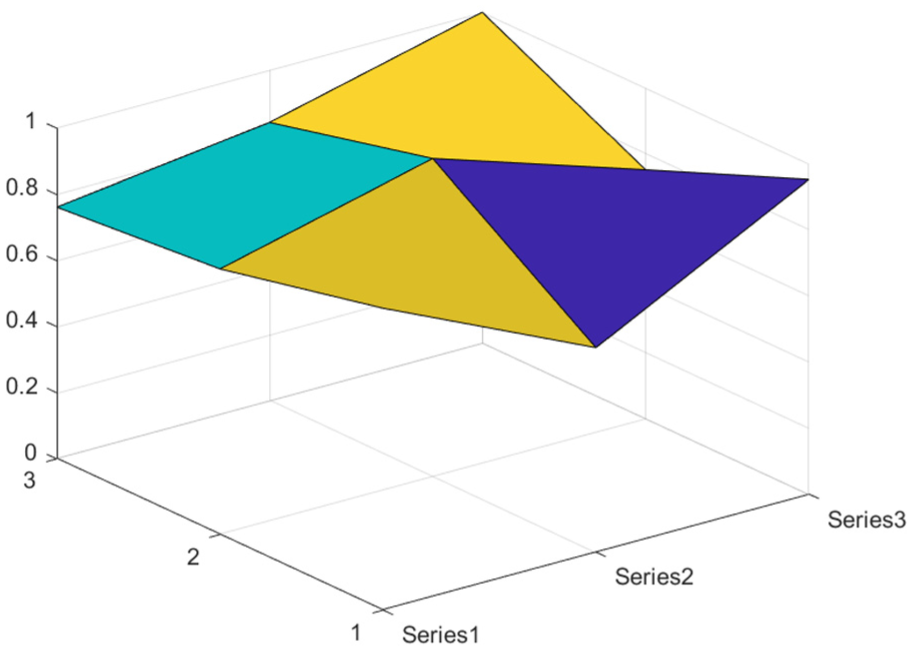
PMC surface for all 21 policies.
Figure 3 shows the average performance of all 21 policies. Notably, the high scores in Policy Nature (X1) and Target Audience (X5) (all approaching 0.9 or above) indicate that the existing policies are well-designed with strong predictability, broad applicability and effective evaluation mechanisms, effectively address diverse stakeholder needs. Conversely, the low score for Timeliness (X2) (0.619), visible as a pronounced dip in the surface plots, signaling considerable room for enhancement.
Moderate scores in Policy Content (X4), Policy Tools (X6), Policy Function (X7) and Incentive Measures (X8), as suggested by the slightly lower peaks in these dimensions, indicate the need for more detailed implementation strategies, enhanced policy functions, and a wider range of tools and incentives.
Overall, the average PMC score of 7.608 reflects that the policies are reasonable and feasible. However, the surface plots underscore the need for continued improvements, particularly in aspects like timeliness to ensure that vocational education policies better adapt to rapidly evolving educational demands and maximize their implementation impact.
Policy Evaluation via PMC Score Analyses
Evaluation of Jiangsu’s Policies
The PMC score analysis for Jiangsu Province’s vocational education digitalization policies reveals a performance range from 5.57 to 8.625. Policies P1-1 and P1-5 stand out with scores above 8, indicating their comprehensive design, as evidenced by the smooth and elevated sections of their surface plots (see Figure 4). Policies P1-3, P1-4, P1-6, and P1-7, scoring between 7 and 8, also perform well in most aspects.

PMC surfaces for policies in Jiangsu province.
In contrast, P1-2 scores a low 5.57, marked by a noticeable depression in its surface plot, indicating significant weaknesses. It underperforms in Timeliness (X2), Target Audience (X5), Policy Tools (X6), and Functions (X7). The inadequate focus on short-term implementation and the absence of targeted measures for stakeholders—such as schools, educators, and businesses—further reduce its relevance and adaptability in a rapidly changing educational landscape. Its insufficient use of policy tools, such as authoritative, incentive-based, or capacity-building approaches, hinders engagement and implementation, underscoring the need for substantial revisions to improve its effectiveness and meet the diverse needs of the vocational education sector.
Overall, the average score for Jiangsu’s policies is 7.49, reflecting that most policies are reasonable and practical. High scores in Policy System (X3) and Policy Evaluation (X9) suggest effective coverage and clarity in the frameworks and objectives for vocational education. However, despite significant progress in advancing vocational education digitalization, the province lags in Timeliness (X2), averaging below 0.5. This weakness, visible as a sloped surface in the relevant plot, highlights limited responsiveness to immediate needs and rapid changes, pointing to a critical area for improvement.
Evaluation of Shandong’s Policies
Five vocational education digitalization policies in Shandong Province were analyzed using PMC indices, with performance illustrated through PMC surface plots (see Figure 5).

PMC surfaces for policies in Shandong province.
Scores range from 7.47 to 8.3, with P2-3 leading at 8.3, demonstrating strong support and guidance, as well as a comprehensive approach to digital transformation, clearly represented by an elevated PMC surface plot. Conversely, P2-1, with the lowest score at 7.47, with dips in Policy Function (X7) and Incentive Measures (X8) indicating a lack of crucial incentives and support mechanisms.
Shandong’s policies average 7.974, indicating that most are well-designed and feasible. High scores in Policy Nature (X1), Policy System (X3), Target Audience (X5), and Policy Evaluation (X9) reflect effective coverage across multiple educational levels. The smoothness of the PMC surfaces suggests that these policies are well-rounded and coherent, which facilitates the digital transformation process and offers clear guidance to educational institutions and stakeholders. However, lower scores in Policy Tools (X6), manifested in less smooth surfaces, indicate potential hurdles in effective execution and stakeholder engagement. Enhancing policy effectiveness could involve diversifying the range of policy tools to improve implementation efficiency and target accuracy.
Evaluation of Shaanxi’s Policies
Shaanxi has implemented only two policies, fewer than other provinces, indicating an early stage of digital transformation and a need for more targeted policies for educational reform. Illustrated with PMC surface plots (see Figure 6), both policies meet expectations, scoring 8.22 to 8.5, respectively. P3-1 excels in several key dimensions but scores lower in Policy Content (X4) and Policy Function (X7), indicating gaps in incentive and regulatory content. P3-2 also performs well but scores 0.67 in Incentive Measures (X8) and 0.75 in Policy Timeliness (X2), pointing out weak incentive structures and timing misalignments with rapid educational developments.

PMC surfaces for policies in Shaanxi province.
Overall, Shaanxi’s policies are well-designed and feasible, yet require stronger incentives and improved timeliness to further boost their implementation effectiveness and practical application.
Evaluation of Yunnan’s Policies
Yunnan’s five vocational education digitalization policies, illustrated in Figure 7, average 7.308.

PMC surfaces for policies in Yunnan province.
P4-1 leads with 7.925 while P4-2 and P4-3 score lowest at 6.87 and 6.23, respectively. Notably, the average score for Timeliness (X2) across Yunnan’s policies is a low 0.5, with P4-3’s Timeliness (X2) score of 0.25, the lowest among all policies. This shows Yunnan’s tendency toward mid-term planning. Some policies incorporate long-term and pilot demonstration elements, but lack short-term content, which affects the coherence of policy execution. Low scores in Policy Tools (X6) and Policy Functions (X7) indicate limited implementation strategies, constraining their impact and scalability. Conversely, high scores were recorded in many other aspects, with some scoring a perfect 1.0, reflecting a solid foundational framework that supports clear objectives and alignment with the needs of vocational education.
To improve, Yunnan should address underperforming policies, enhance timeliness and diversify policy tools and functions to meet the demands of the rapidly evolving educational landscape.
Evaluation of Xinjiang’s Policies
Two policies in Xinjiang were assessed, with PMC surfaces shown in Figure 8.

PMC surfaces for policies in Xinjiang Uyghur autonomous region.
The average score is 7.1. Policy P5-1 exceeds 8, meeting expectations with strong performance across dimensions, evident in its elevated and smooth surfaces. In contrast, P5-2 scores only 6.025, indicating weak adaptability, with a Policy System (X3) score of 0.33 and Policy Tools (X6) at 0.4. Additionally, P5-2’s low Policy Timeliness (X2) and Function (X7) scores of 0.5, further highlight planning and incentive deficiencies. It’s worth mentioning that P5-2, titled “Xinjiang Uyghur Autonomous Region Vocational Skills Enhancement Action Plan (2019-2021),” specifically targets vocational skills improvement, which may explain its limited scope despite a targeted approach.
Overall, Xinjiang’s vocational education digitalization policies are relatively well-rounded but limited in number. Future efforts should strengthen the comprehensiveness and systematization of its policies to bolster digital development of vocational education.
Discussion
Existing literature on vocational education digitalization reveals a focus on national or single-province studies, often neglecting regional variations. This study addresses this gap by employing the PMC index model to quantitatively analyze policies across five provinces in China. Through cross-regional comparison, it identifies shared strengths and unique characteristics, offering empirical evidence for tailored policy development.
Common Strengths and Characteristics
Amid the global shift toward digital transformation in vocational education, Chinese provinces are actively formulating policies to modernize their systems. Analysis of policies from five provinces reveals several shared strengths.
Clear Strategic Goals: The policies across the five provinces consistently reflect predictive, guiding, supervisory, advisory, and supportive functions aligned closely with national strategies. This alignment underscores China’s centralized administrative model, as noted by S. Liu and Hardy (2021), who highlight the government-led nature of vocational education reforms. Similarly, Cao et al. (2024) emphasize the forceful promotion of digital transformation policies. While this top-down approach ensures strategic adherence to national strategic directives, it may also constrain local innovation and experimentation.
Comprehensive Policy Framework: The establishment of a multi-tiered vocational education system is a widely adopted practice in international vocational education, as observed in countries like France, Switzerland, and Spain (Lamamra et al., 2021), promotes educational equity and efficiency by accommodating diverse student needs (Gao et al., 2020). Chinese provinces’ efforts to establish similar structures align with this global trend toward systematic and coordinated vocational education frameworks.
Wide Range of Stakeholders: The policies encompass a broad array of stakeholders, reflecting a trend in modern educational governance that emphasizes collaboration. This approach aligns with the global movement toward fostering “educational communities,” which advocates for collective efforts in driving educational innovation and reform (Fullan, 2016). China’s vocational education reforms involve complex policy networks, including cross-industry alliances and government agencies and affiliations, which are more varied than typical public-private partnerships in Western contexts (Hardy & Liu, 2022). This stakeholder diversity, as supported by Han et al. (2025), enhances policy responsiveness and innovation.
Strong Policy Evaluation Mechanisms: Provinces have established clear assessment and feedback mechanisms, aligning with the emphasis on multi-layered feedback systems in educational policy (Sewerin et al., 2020). Effective policy evaluation is crucial for ensuring alignment with objectives and driving improvements (OECD, 2020). However, ensuring the independence and objectivity of evaluations in practice remains an area requiring further investigation and refinement (Crato & Paruolo, 2019). To this end, the OECD (2020) stresses that institutional support—regulation, funding, and expertise—is critical for credible evaluations. Transparency in outcomes is equally vital, with recommendations for third-party involvement, multidimensional metrics, and accountability frameworks to enhance objectivity and fairness.
Common Weaknesses
Despite the common strengths observed in the digital transformation policies of vocational education, significant shortcomings also exist. These issues primarily relate to the imbalances in policy content, the limitations of policy tools, and gaps in policy functions. The following analysis details each issue and its implications.
Imbalance in Policy Content: Current vocational education policies exhibit an uneven focus on their content. For instance, more developed regions such as Jiangsu and Shandong emphasize school-enterprise cooperation, while less-developed provinces like Shaanxi, Yunnan, and Xinjiang prioritize infrastructure development. This divergence, reflecting varying economic development priorities, aligns with findings by J. R. Zhou (2023), who identifies a similar content imbalance in vocational education digitalization policies, which may lead to uneven resource allocation. Comparable patterns emerge internationally; the OECD and African Union (AU) differ in their approaches to educational digitalization, with the former promoting uniform solutions across diverse members and the latter tailoring strategies to regional needs (OECD, 2020). Such disparities risk neglecting critical areas. Overemphasis on infrastructure can undermine investments in talent development and innovative educational practices. Such imbalanced development not only hampers local economic diversification but also limits the overall contributions of the vocational education system.
Limitations of Policy Tools: Developed regions employ a diverse set of policy tools, including incentives and capacity-building initiatives, enabling flexible advancement of the digital transformation of vocational education. In contrast, resource-constrained areas often rely on authoritative and traditional regulatory measures, with mandatory tools dominating over other types. This pattern aligns with Cao et al. (2024) and Che and Sun (2016), who note a persistent dependence on conventional tools with minimal evolution over the past decade, likely due to China’s early-stage digital transformation. Such limitations reduce adaptability to policy changes, potentially undermining these regions’ capacity to lead transformations within the rapidly evolving technological and educational landscape. In urgent situations, over-reliance on rigid and singular policy tools may hamper swift responses, undermining the development of a modernized and competitive educational system and diminishing their standing in a globalized economy.
Incompleteness of Policy Functions: Selected provinces typically focus on regulatory compliance and operational planning, yet they lack incentives and innovative reform mechanisms, similar to previous findings by R. F. Guo et al. (2023). This deficiency is particularly pronounced in economically disadvantaged regions. The lack of robust incentive systems stifles creativity, limiting both educators and students in their willingness to experiment with new teaching methods and technologies. Furthermore, the absence of reform-oriented functions reduces policy adaptation to the rapid changes of the digital economy, delaying advancements in educational reform and responsiveness to demands for new skills and knowledge in the labor market. On a broader scale, the divergence of these policies reflect global variations in digital education priorities. For instance, poorer nations often focus on addressing structural challenges such as poverty, whereas developed countries prioritize catering to individual student differences (Ferrante et al., 2024). In China, this global pattern manifests internally: resource-scarce regions grapple with structural inequities in digital education, exacerbated by the lack of effective incentives and innovative mechanisms. Consequently, these areas find it difficult to tackle systemic issues effectively. In contrast, wealthier regions can shift their focus toward individual student needs, highlighting a disparity that widens the educational development gap across the country.
Interprovincial Differences
Regional variations in the digital transformation of vocational education across China have been well-documented in prior research (Peng & Lin, 2024) This study highlights that these interprovincial differences are most pronounced in two critical areas: policy timeliness and incentive measures.
Variability in Policy Timeliness: Policy timeliness exhibits significant variation across provinces. Short-term policies typically target immediate implementation outcomes, while medium-term strategies focus on sustaining policy execution over time. Long-term policies, in turn, target enduring impacts on both the education system and society. Together, they form a comprehensive framework for evaluating education policy effectiveness. However, a persistent timeliness crisis undermines this framework, driven by limitations in institutional flexibility, technical capacity, and organizational culture. This study identifies substantial room for improvement.
The interplay among these time scales is further strained by practical challenges faced by local governments. In dynamic policy environments, local governments often face constraints in information access within dynamic policy contexts, leading them to rely on established models and neglect immediate short-term adjustments. This rigidity hampers the ability to address immediate needs, which in turn delays medium-term sustainability efforts. Compounding this, rapid technological advancements amplify the difficulty of forecasting trends in vocational education, labor markets, and societal demands—key for robust long-term strategies. Williams and Nusberg (1973) noted that accelerating socio-economic changes could increase policy discontinuities, a concern magnified today as policymakers.
Regional disparities further exacerbate these timeliness issues. Uneven regional development limits the capacity of certain areas to create effective long-term policies. Less developed provinces may lack the resources and technical support necessary for flexible short-term planning in response to rapidly changing socio-economic conditions. Flexible policies, vital for meeting diverse regional needs and enhancing quality and equity (Butler et al., 2024), become elusive. Yet, overemphasizing medium- and long-term objectives at the expense of short-term planning can reduce the efficiency of policy execution, causing implementing entities to lose direction and missing opportunities in emerging markets and technologies. The failure to make timely short-term adjustments can further impede resource allocation and diminish the sustainability of vocational digital transformation.
Disparities in Incentive Measures: Incentive measures reveal another layer of interprovincial divergence. Economically and educationally advanced provinces like Jiangsu and Shandong utilize their abundant resources and strong administrative systems to implement diverse incentive measures, which attracts high-quality talents and enhance educational resource allocation. In contrast, resource-constrained regions like Yunnan and Xinjiang struggle to implement effective funding and talent incentives. This disparity is deemed to be closely linked to economic development levels. For example, Macao, bolstered by its economic strength, prioritizes substantial education investment and strategic policy adjustments, maintaining stability and fostering continuous progress even amid challenges (R. Cai et al., 2024) Conversely, provinces with weaker economic and cultural bases hinder their capacity to provide competitive salaries or research conditions and impede capital investment and innovative potential. These limitations create a cascading effect, the education system’s adaptation to digital transformation slows, skill development lags, ultimately impairing regional competitiveness in emerging industries. This economic divide thus perpetuates an uneven landscape in vocational education digitalization across the nation.
Conclusions
Digital transformation is a key driver of structural reforms in vocational education, necessitated by the digital revolution. In China, provincial policies to enhance digital capacity in vocational education show varying effectiveness due to regional differences, highlighting the need for comprehensive policy evaluation to achieve a holistic transformation. As digitalization poses a global challenge, the efforts of Chinese provinces offer valuable insights for both domestic reform and international reference. Provinces should build on strengths—such as aligned objectives and established frameworks—while addressing disparities and shortcomings to ensure effective policy implementation and balanced development.
Summary of Major Findings
This study conducts a quantitative analysis of 21 policy documents across China’s five provinces from 2012 onward. Using social network analysis to extract high-frequency terms, a comprehensive PMC index model was constructed to assess provincial policies. Subsequently, PMC surface maps were generated for each province to analyze their unique policy characteristics and evaluate the rationality and feasibility of these policies.
This study reveals that digitalization policies in vocational education across five Chinese provinces align well with national strategies, boasting clear goals, comprehensive frameworks, and robust evaluation mechanisms, with most PMC scores exceeding 7.0, indicating feasibility. However, content imbalances, limited tools, and functional gaps—particularly in less developed regions—hinder their full effectiveness; The PMC index highlights strengths in nature, target audience, and evaluation, but exposes weaknesses in timeliness, tools, functions and incentives, underscoring the need for more responsive and adaptable designs to bolster implementation; To enhance effectiveness and equity, the study advocates improving policy timeliness, diversifying tools, strengthening incentives—especially in underdeveloped regions—and tailoring strategies to local contexts, paving the way for a balanced digital transformation in vocational education nationwide.
Suggestions for Policy Formulation and Optimization
To optimize policies, policy makers at provincial level should first strengthen collaboration between national and local policies, regularly evaluating and adjusting strategic objectives to adapt to the rapidly evolving digital landscape, consistent with international policy-making principles, which advocate for a balance between global standards and local contexts (Niemann et al., 2024), and local-national alignment (Xu, 2024). Furthermore, a multi-tiered policy framework provides a solid foundation for vocational education reform, enhanced by refining policies at all levels and bolstering inter-regional cooperation by sharing best practices and strategies. The inclusion of diverse stakeholders, like, social organizations and community groups help cultivate a more inclusive and resilient educational community. Clear evaluation and feedback mechanisms have been crucial in ensuring effective policy execution as well. Incorporating data-driven technologies can enhance accuracy, objectivity and timeliness, enabling swift policy adjustments. By leveraging these strengths, provinces can sustain effective policy support and provide a reliable basis for future reforms.
To address the shortcomings identified in this study, policymakers should adopt a streamlined approach that enhances policy balance, diversifies tools, and strengthens incentives. A unified framework should integrate comprehensive elements of vocational education with local characteristics, adhering to national guidelines in areas such as school-enterprise collaboration, infrastructure, and teacher training to improve overall educational quality. To mitigate regional disparities, provinces should explore a wider policy toolkit, with resource-constrained regions introducing incentives and capacity-building measures such as securing external investments, diversifying government funding, and building a public resource-sharing platforms. To enhance policy timeliness and incentive measures, provinces like Jiangsu, Yunnan, and Xinjiang should develop short-term implementation plans with explicit tasks and deadlines, prioritizing urgent needs—such as teacher training and infrastructure improvements—will quickly build foundational capabilities. In economically disadvantaged regions with weak educational foundations, incentives should be reinforced through special allowances and professional development for educators, business partnerships via mutual exchange programs and internship opportunities, and local special funds for digital infrastructure, supplemented by scholarships, low-interest loans and public-private partnerships (PPPs) to boost enrollment. Regular evaluations, supported by a dynamic, multi-tiered evaluation system and digital resource-sharing platform, will reward excellence, promote collaboration, and promote effective policy implementation and equitable development in vocational education.
Significance and Limitations of This Study
This study offers useful references for policymakers worldwide. By analyzing China’s vocational education digitalization policies in provinces with different features, it reveals key elements and factors in policy formulation and implementation, aiding policymakers in planning scientifically and enhancing policy effectiveness and adaptability. It also identifies shared or distinctive strengths and weaknesses, offering insights into policy refinement in other regions.
Meanwhile, the study acknowledges its limitations, notably the confined sample size to five provinces and the focused time frame from 2012 to 2024, which may restrict a comprehensive understanding of national policy implementation. Future studies could broaden the sample size and conduct longitudinal analyses, thereby providing deeper insights.
Footnotes
Acknowledgements
We are grateful for the support from Hainan Provincial Philosophy and Social Science Planning Base. Thanks also go to colleagues and experts for their valuable advice. We appreciate the data and resources provided by various institutions.

Author Contributions
Conceptualization, Xu Ding and Junfeng Diao; methodology, Xu Ding and Junfeng Diao; formal analysis, Xu Ding; resources, Junfeng Diao; writing—original draft preparation, Siman Zhang; writing—review and editing, Junfeng Diao; supervision Junfeng Diao; funding acquisition, Xu Ding and Junfeng Diao. All authors have read and agreed to the published version of the manuscript.
Funding
The authors disclosed receipt of the following financial support for the research, authorship, and/or publication of this article: This study is supported by the Hainan Provincial Philosophy and Social Science Planning Base Project (Number: HNSK(JD)24-14, Title: Research on the Impact of ChatGPT on the Talent Cultivation Model of the Free Trade Port and Countermeasures) and Hainan Higher Education Teaching Reform Research Project (Number: Hnjg2025-42, Title: Digital Innovation and Practical Exploration of Teaching Paradigms in the Context of Free Trade Port Construction). This study is also supported by Hainan Provincial Philosophy and Social Science Planning Base Project (Number: HNSK(JD)22-35, Title: The Digital Transformation of Basic Education in ASEAN and Its Enlightenment to the Educational Development of Hainan Free Trade Port).
Declaration of Conflicting Interests
The authors declared no potential conflicts of interest with respect to the research, authorship, and/or publication of this article.
Data Availability Statement
The datasets used or analyzed during the current study are available from the corresponding author on reasonable request.