




Abstract
This study decodes the “policy DNA” of China’s study-tour sector by analysing nine central-level policy documents (2013–present) using text mining, policy-instrument coding, and the PMC index. The findings indicate a transition from fragmented pilot programs to a more mature, student-centred, curriculum-integrated governance system. Capacity-building and advisory tools are predominant, mandates serve as safeguards, and an average PMC score of 6.55 signifies robust yet improvable coherence. Several key deficiencies remain: an unclear evaluation system, insufficient incentives, weak timeliness, and limited inclusivity. Recommended reforms include integrating experiential learning and evaluation, implementing tiered performance-linked incentives, promoting unified cross-sector coordination, and adopting phased roll-outs with stakeholder engagement. Methodologically, the study advances policy research by combining quantitative and qualitative approaches, enabling systematic deconstruction and empirical comparison of policy evolution, surpassing previous single-case or purely qualitative studies. Although grounded in China’s context, the framework and recommendations offer transferable insights for countries aiming to align educational and tourism objectives, balance heritage preservation with innovation, and foster equitable access.
Plain Language Summary
This study constructs a three-dimensional analytical framework of policy themes, policy tools, and policy assessment, and conducts a quantitative text analysis of nine national-level China’s study tour policy documents from 2013 to 2025.
Introduction
Amid the global push for educational innovation, experiential learning has become central to cultivating 21st-century competencies. Study-travel models vary across countries: Japan’s long-standing Shugaku Ryoko is embedded in the national curriculum, emphasising collective living, cultural heritage, and international exchange (Zhao, 2020); in the United Kingdom, the aristocratic “Grand Tour” has evolved into outdoor education centred on learning through travel, enhancing historical literacy and cross-cultural understanding (X. Wang et al., 2021). The U.S. favours camp-based education with thematic activities that build leadership, practical skills, and exploration spirit (F. Yang et al., 2019). Singapore’s immersion programmes combine national identity education with outdoor experiential learning, while Russia and Finland promote welfare-oriented camps and multidisciplinary real-world learning respectively (X. Wang et al., 2021).
China’s study-tour policy originated in the 2013 National Tourism and Leisure Outline, which first proposed “gradually implementing study tours for primary and secondary school students,” marking the beginning of nationwide promotion at the state level. Since then, a cascade of state-issued documents has sought to position study tours as a critical vehicle for quality-oriented education, integrating moral cultivation, innovation, and social responsibility by connecting classroom learning with on-site patriotic education and deeper understandings of the nation (Hunan Provincial Department of Culture and Tourism, 2021). This policy trajectory has fuelled rapid market expansion: the sector’s revenue grew from RMB 146.9 billion in 2023 to RMB 179.1 billion in 2024 and is projected to surpass RMB 300 billion by 2028 (iiMedia Research, 2024).
Despite sustained national policy promotion, persistent operational challenges remain at local and programmatic levels. Many initiatives have shifted toward high-priced, low-quality sightseeing, characterised by inflated credentials, homogenised syllabi, and a shortage of qualified mentors (Tian, 2025). Current scholarship offers limited insight into these interconnected challenges; systematic analyses of policy texts are still scarce, constraining the capacity to generate robust evidence for improvement. Existing studies often treat safety protocols, curriculum design, and resource integration as isolated issues, neglecting their systemic interconnections across policy themes, implementation instruments, and evaluation practices. Consequently, alignment between policy goals, instruments, and outcomes remains partial and disjointed. Furthermore, the predominance of qualitative case studies has restricted generalisability and hindered integrated analyses of macro-level policy patterns and micro-level mechanisms. Most evaluative studies are confined to single-province or single-case analyses and often lean toward speculative or overly theoretical discussions, lacking a multidimensional, longitudinal, evidence-based framework with rigorous empirical grounding.
Addressing these gaps requires a comprehensive approach that can capture the thematic priorities of national study-tour policies, assess policy instruments in terms of configuration and coherence, measure policy performance across multiple dimensions, and derive actionable strategies for policy optimisation.
To meet these needs, this study proposes a triaxial analytical framework—encompassing policy themes, policy instruments, and policy PMC evaluation. Drawing on the concept of “policy DNA,” it conceptualises policy elements as dynamic and adaptive units that evolve in response to changing societal demands. Guided by this framework, the study proceeds as follows: themes are identified through text-mining and semantic-network clustering; policy instruments are double-blind coded into a five-category taxonomy; and evaluations apply the PMC Index to quantify policy performance across time and dimensions. This sequential approach links thematic analysis, instrument mapping, and quantitative evaluation to generate integrated insights for policy optimisation.
Based on this framework, the research addresses four interrelated questions:
(1) Policy themes: What core objectives and key domains shape the developmental logic of study-tour policies in China?
(2) Policy instruments: What instruments are employed, and to what extent are they optimally configured?
(3) Policy PMC evaluation: How do these policies perform across nine dimensions?
(4) Policy improvement: How can these policies be refined to strengthen coherence between goals, instruments, and outcomes?
Literature Review
Study tours, as a significant form of experiential learning, have gradually developed across many countries and secured a place within their respective education systems. The concept of “study tour” can be understood in both a broad and narrow sense. Broadly, it often overlaps with the term “study travel,” referring to short-term travel and visits undertaken away from one’s usual environment for the purposes of cultural learning, practical experience, and research-based exploration. Such practices are known internationally by various terms, including “Grand Tour,”“Shugaku Ryoko” (school excursions), “educational travel,”“experiential education,”“outdoor education,” and “field trip learning.” Narrowly, the term denotes school-organised off-campus educational activities that deliberately integrate research-based learning and travel experiences through collective journeys and centralised accommodations (Hunan Provincial Department of Culture and Tourism, 2021; Y. Zhou, 2024).
This section provides an overview of representative study-tour policy frameworks in several countries, highlighting distinctive developmental trajectories, organisational mechanisms, and practical implications.
Overview of International Study-Tour Policies
Japan: Japan’s Shugaku Ryoko (school excursions) originated in 1886 when Tokyo Normal School started long-distance educational trips. In 1888, Japan’s Ministry of Education incorporated them into the Facilities Standards for Ordinary Normal Schools, formalising their integration into the educational system. Since 1958, guided by the Basic Act on Education and national Curriculum Guidelines, study travel has been a core activity for broadening students’ horizons, engaging with nature and culture, and cultivating skills and ethics. Local education boards adapt the guidelines with itineraries, budgets, and safety protocols, creating a layered governance structure that balances standardisation and flexibility. Over a century, the drivers of study travel have shifted from political loyalty and patriotism to economic development and global talent cultivation (C. Wu, 2021; Zhao, 2020) Today, Japan’s study travel has an integrated network led by the Ministry of Education, coordinated by the National Study Travel Research Association, implemented by schools, and supported by industry stakeholders. This mature public-private-academic collaboration model offers valuable lessons for China in policy security, curriculum design, safety management, and cultural integration.
United States: In the United States, “camp-based education” or “outdoor education,” has over 150 years of history and a mature institutional system. It started in 1861 when a Connecticut teacher led a 2-week outdoor expedition, founding “Gunnery Camp.” In 1910, the American Camp Association (ACA) was created, and by 1948, it developed legally-recognised accredited standards. In 1990, the federal commitment was established through the National and Community Service Act, authorising grants and creating programs like Learn and Serve America (LSA) and the National Service-Learning Clearinghouse (NSLC). Later initiatives such as the Iowa Service-Learning Partnership (ISLP) and Learning in Deed (LID) diversified available experiences (Luo, 2024; X. Wang et al., 2021). Governance has a multi-tiered structure of federal legislation, state-level adaptation, and non-governmental partnerships, ensuring alignment with curriculum goals and local flexibility. The U.S. system features clearly defined objectives (emphasising hands-on learning and practical competence), strong safety regulations, diverse curricula, professionally trained and certified personnel, and high social recognition, making it an influential global model.
Singapore: Singapore’s experiential learning system combines adventure education with national civic goals. It started in 1967 when Outward Bound Singapore (OBS) was established under the Ministry of Defence and Ministry of Home Affairs. In 1998, the MOE’s Learning Journeys policy set standards, objectives, and funding for experiential travel, and was later reinforced by initiatives like SkillsFuture and the National Outdoor Adventure Education curriculum. Since 2004, more adventure centres have been established, and from 2020, 15-year-old students must participate in OBS programmes, consolidating Singapore’s “design–curriculum–practice–standardisation” pathway, supported by safety, funding, resource, and societal endorsement frameworks (Teng & Chan, 2018; Weng, 2023). Now, its school-based “learning journeys” operate under the Ministry of Education’s National Education (NE) framework to foster civic consciousness, cultural identity, and global awareness. The policy is delivered top-down: the MOE provides guidance and budget, schools adapt activities, state-market partnerships ensure efficiency, and legal provisions ensure operational safety.
China: China’s study-travel tradition dates back centuries but entered its modern policy-driven phase in the past two decades. Historically, its early evolution can be traced through three periods. (1) Ancient educational travel (Spring and Autumn period–1840): Exemplified by Confucius’ travels with his disciples, embedding the ideals of “reading ten thousand books and travelling ten thousand miles” and “unity of knowledge and action” as cultural foundations. These were mostly individual scholarly pursuits for learning, official service preparation, or cultural exchange. (Yin & Tang, 2019) (2) Modern excursions (1840–1949): Marked by politically motivated overseas study and inspections, with objectives centred on learning advanced Western science and technology for national salvation (Wei, 2024). (3) Early PRC exploration (1949–1990s): The government promoted integration of education with productive labour, resulting in school activities akin to study travel—such as “study work” and “study farming”—though without a formalised concept or policy framework (Yin & Tang, 2019).
The modern development stage of study travel in China is characterised by policy-driven standardisation and curricular integration. It began in 2012, when the Ministry of Education (MOE) launched pilot programmes in eight provinces. In 2013, the National Tourism and Leisure Outline (2013–2020) first proposed the gradual implementation of study travel nationwide, followed in 2014 by the MOE’s formal definition and the State Council’s inclusion of the practice in school education. A pivotal milestone came in 2016 with the Opinions on Promoting Study Travel for Primary and Secondary Students, jointly issued by the MOE and 10 other ministries, integrating study travel into formal curricula—widely regarded as its “first year.” In 2017, it was incorporated into the MOE’s Guidelines for Comprehensive Practical Activity Courses, and the China National Tourism Administration issued the Standards for Study-Travel Services, marking full institutionalisation, clear curriculum status, and uniform safety protocols (H. Wang, 2023; X. Wang, 2025). From 2020, the COVID-19 pandemic suspended most activities. Then, the 2021 “Double Reduction” policy spurred recovery, focusing on curriculum quality, subject integration, and local resource development. After the pandemic, restructuring has prioritised substantive content, deepening the “study-travel” link and driving the sector towards high-quality growth (X. Wang, 2025).
Overall, the trajectory of China’s study-travel development reflects a path emerging from a deep historical tradition yet propelled over the past two decades by sustained national policy support. This has facilitated the transformation from local experimentation to national standardisation, from extracurricular activity to curricular requirement, and from travel-focused experiences to an integrated balance of “study” and “tour.” The underlying goal remains consistent: to serve quality-oriented education by fostering students’ sense of social responsibility, spirit of innovation, and practical competencies.
Comparative Analysis of Study-Tour Policy Frameworks
A cross-national comparison of study-travel policies in China, Japan, the United States, and Singapore reveals distinct cultural orientations and institutional logics shaping policy goals and implementation mechanisms.
At the level of policy goals, Japan’s Shugaku Ryoko prioritises collectivism and holistic development across moral, intellectual, physical, and aesthetic domains, reflecting the Eastern educational tradition of character formation. The United States’ experiential and service-learning models focus on cultivating individual practical skills and social responsibility, embodying a “learning by doing” philosophy. Singapore’s outdoor adventure education aligns closely with national citizenship education and human capital development strategies, exemplifying a state-driven governance model. China’s study-travel approach, deeply rooted in the Confucian ethos of “unity of knowledge and action,” integrates classroom instruction with experiential activities to promote all-round student development. These varied objectives are grounded in each country’s socio-cultural context like Japan’s group-oriented societal fabric, America’s individualism, Singapore’s state-directed governance ethos, and China’s emphasis on harmonising knowledge and practice.
In terms of implementation mechanisms, the four countries demonstrate different governance architectures. Japan’s layered structure, comprising national legislation, ministerial guidelines, and local regulations, ensures standardised execution while allowing context-specific adaptation. In the United States, federal frameworks combined with strong local autonomy encourage diversity and innovation but also present challenges in maintaining consistent quality. Singapore employs a “state-led, market-assisted” model, balancing efficiency and safety through comprehensive legal frameworks and competitive procurement of services. China adopts a top-down governance approach, which enables rapid scaling but can constrain local adaptability.
Insights from these international models suggest that the effectiveness of study-travel policies hinges upon the alignment of policy goals with cultural values and the compatibility of governance mechanisms with national administrative systems. Moreover, sustained involvement of non-governmental stakeholders, such as community organisations and private-sector partners, emerges as a critical factor in ensuring the quality, safety, and relevance of study-travel programmes.
Review of Current Research on Study-Tour Policies
Study tour, also referred to as “learning travel” or “educational tourism,” etc. in different contexts, has evolved from scattered educational activities into a strategically significant experiential learning industry, in which policy plays a central role in its emergence, formalisation, and governance. As an interdisciplinary field spanning education policy, tourism management, and public administration, current scholarship on study-travel policies remains fragmented, lacking a systematic mapping of its knowledge structure and future directions. This review synthesises research between 2015 to 2025 with three aims: (1) to examine methodological approaches and their limitations; (2) to identify and summarise core thematic areas; and (3) to highlight research gaps and propose forward-looking agendas.
Research Methodologies in Policy Studies
The empirical work in policy studies is predominantly qualitative, grounded in policy analysis, case studies, content analysis, and in-depth interviews (Ieong, 2024; T. Li, 2023; Luo & Liu, 2024; Montero, 2016; Phuong et al., 2023). These studies illuminate macro-level policy trajectories and local implementation contexts. Descriptive analyses often address operational challenges, including “tour-heavy, learning-light” tendencies, weak stakeholder coordination, inadequate base construction, and the persistence of exam-oriented mindsets (Chen, 2019; Yao et al., 2024), providing valuable contextual insight but limited explanatory depth.
Quantitative research, though less common, typically measures project-level impacts on tourist outcomes via surveys and statistical methods such as ANOVA, correlation, and regression analysis (Zainordin et al., 2021). Zhong and Liu (2018) analysed policy documents from 14 Chinese provinces/municipalities and survey data using Echarts/Python to identify priority factors and gender-specific correlations for study travel demonstration base development, providing recommendations for governmental guidance and base enhancement. R. Xia (2023) developed a four-level evaluation system for study travel courses based on national policy content, and identified key deficiencies (e.g. inadequate course design, poor base management).
These studies emphasise micro-level effects, such as intercultural competence and personal growth (Black & Duhon, 2006; Harrison, 2006; Iqbal, 2019), while comprehensive macro-policy impact evaluations remain scarce. Mixed-method designs, integrating quantitative scales and qualitative narratives (Glaser et al., 2021; G. Li et al., 2024), offer more nuanced assessments.
More recently, systematic reviews and bibliometric analyses have been used to map research status. Pang et al (2017) conducted a systematic review of active school travel (AST) interventions to evaluate their effectiveness. Assess research trends on tourism policy implementation to establish the existing trends and identify gaps for future studies. Kifworo and Dube (2024) adopted the bibliometric review approach to assess research trends and identified geographical, theoretical and practical gaps. These studies provide effective methodological instruments and reference for systematic understanding of this field.
Major Research Themes in Study-tour Policy Studies
Policy Evolution, Content, and Implementation
Research on study-travel policy most commonly focuses on tracing the historical progression from conceptual origins to institutionalisation, examining objectives, emphases, and instruments across historical phases in light of socio-economic contexts and educational reform agendas (Jin, 2017; T. Li, 2023).
A central theme in the international literature is how study-travel becomes a policy priority. For example, Ieong (2024) shows that in Macau, the “Ten Thousand Persons Plan” reframed study tours from purely nationalist education toward a hybrid model combining “national education + tourism,” aiming to enrich cultural experience and foster exchanges among youth across Mainland China, Hong Kong, Macau, and Taiwan. At a global scale, policy analysts note that study travel is often embedded within internationalisation or development strategies. UNESCO and OECD discussions frame it as a means for cultivating global competence and advancing sustainable development (Tomasi et al., 2020).
Policy-content analyses interpret core documents in terms of definitions, objectives, curriculum construction, base development, safety assurance, and evaluation standards (Chen, 2019; Zhu et al., 2021). These often assess consistency between national and subnational guidance, identify explicit and implicit goals, and reveal regulatory and administrative architectures shaping delivery.
Despite growth in documentation, much existing work remains at a descriptive level, focusing on phenomena and constraints without deep empirical analysis of underlying mechanisms.
Policy Impact Assessment
Research on the impact of policies primarily investigates how government measures stimulate and regulate the study-travel market. Key areas of analysis encompass market size, industry-chain composition, product typologies, curriculum design, and camp/base construction (Liu, 2023; Yao et al., 2024). Spatial studies have identified the institutional environment, economic foundation, and several other factors as the principal determinants of the geographic distribution of study-travel bases in China (R. Wu et al., 2021). Wan et al. (2022) conducted a systematic evaluation of study-travel policies by constructing a 4-dimensional, 36-indicator framework, revealing a significant regional imbalance, with economic capacity and human capital being the primary constraints.
Beyond structural and market outcomes, researchers also assess study-tour outcomes at a micro-level, with non-academic impacts being the most extensively studied. Evidence suggests that well-designed programs—especially cross-border initiatives—substantially enhance soft skills such as intercultural communication, global outlook, critical thinking, teamwork, problem-solving, and independence (Black & Duhon, 2006; Clarke et al., 2009; Orahood et al., 2004). R. Xia (2023) applied the Kirkpatrick model to assess primary school study-tour curricula, offering a pathway towards more rigorous quality evaluation in early-stage programs.
Academic impacts are less frequently examined and present mixed results. Tucker and Weaver (2013) found that participants in an international business study-tour reported varied short-term outcomes but consistently positive long-term reflections, indicating that the timing of evaluation critically shapes perceived benefits. Similarly, Paige et al. (2009), using a retrospective tracer study with mixed methods, identified sustained gains in disciplinary knowledge, intercultural competence, academic skills, and career development among study-abroad alumni.
Despite these advances, reliable measurement remains a core challenge. Ongoing debates address what should be evaluated, by whom, and how, noting that many policy objectives are inherently difficult to quantify and that evaluators often lack clear methodological guidance (Carley & Tudor, 2010; Z. Wu et al., 2019).
Governance Models and Stakeholder Roles
Existing scholarship explores governance structures and the roles of various actors within study-travel policy ecosystems. Stakeholder networks generally include schools, universities, local governments, travel agencies, NGOs, base operators, educators, students, and parents.
In China’s cross-departmental governance model, Chai et al. (2024) identified three primary types of partnerships: horizontal cross-sectoral cooperation, vertical public-sector cooperation, and public–private partnerships. The study further revealed key factors shaping these partnerships and the underlying causes of power imbalances.
The Macau model represents a highly centralised, government-led, project-based platform that integrates education and tourism to facilitate equal and collaborative cultural exchanges among Greater Bay Area and cross-strait youth (Ieong, 2024). In contrast, other contexts emphasise bottom-up initiatives, funded by international organisations and coordinated by local NGOs, forming what Montero (2016) describes as a “non-governmental organisation-led, cross-country funded, media-participatory” structure for educational tours.
R. Hu and Mo (2021) analyse relevant literature and examine the roles, demands, interactions of diverse stakeholders (education departments, tourism authorities, schools, teachers, students, parents, travel agencies, base operators) and their influence on policy outcomes. They noted stakeholders vary in concerns and interest intensity. Pursuing maximum self-interest may harm others’ benefits, adversely affecting urban campus study travel overall. As argued by Ning (2021), it is essential to clarify each actor’s role and foster mutual coordination to jointly advance and sustain the healthy development of study-travel programs.
Comparative and Cross-National Learning
Finally, comparative studies contrast China’s policies with mature models from Japan, the United States, the United Kingdom, Australia and other regions, extracting lessons on institutional frameworks, curriculum design, safety assurance, and teacher certification (Ma, 2018; X. Wang et al., 2021; Luo, 2024). While such literature offers valuable international benchmarks, some works appear to be “simple transplantation” of foreign experience without sufficient adaptation to China’s educational context—highlighting the need for deeper integration with domestic systems.
Identified Research Gaps
Although research on study-travel policy has made certain progress, the field remains emerging, with multiple areas still requiring in-depth exploration. Several methodological limitations are evident: (1) Emerging frameworks with limited theoretical depth—Foundational research frameworks have begun to take shape; however, most studies are still application-oriented and solution-driven, with an emphasis on empirical summaries rather than theoretical development. Limited attention has been given to building a theoretical system for study tour itself—such as its philosophical underpinnings, learning theories, and curriculum theories. (2) Lack of quantitative and mixed-methods research—The predominance of case studies and qualitative analyses constrains result generalizability, limiting the ability to simultaneously capture macro-level policy patterns and micro-level mechanisms. (3) Scarcity of longitudinal studies—Policy assessments overwhelmingly adopt cross-sectional designs, thus focusing on short-term effects. As Tomasi et al. (2020) note, there is still a lack of empirically grounded models to guide educational tourism interventions at the regional level.
Looking ahead, the expansion of research themes and theoretical depth could include the following directions: (1) Shifting from project evaluation to policy analysis—Current work largely evaluates the performance of individual study-tour projects, with limited investigation into the policy-making process, implementation, and evaluation. Future research should examine the sustainability of study-travel policies, including stable fiscal support, professional teacher training systems, and dynamic mechanisms for policy assessment and adjustment. Strengthening policy evaluation through rigorous outcome measurement and cost–benefit analysis will be essential. (2) Deepening theoretical construction and fostering interdisciplinary dialogue—Theoretical applications remain underdeveloped and primarily descriptive. Drawing on perspectives from education, public policy, and tourism studies could enrich the analysis of organisational mechanisms, policy learning, and innovation. Such approaches would contribute to the formation of theoretical frameworks suited to a broader context.
Methodology
Systematic analysis of public policy texts involves examining instruments benefit distribution, and other dimensions. Ball (1997) advocates tracking policy trajectories across levels, considering “context of influence,”“policy text production,”“practice and outcomes,” to capture their temporal and spatial evolution as well as inconsistencies. Foss et al. (2019) operationalised “policy implications” as codable textual objects, employing structured reading guides to mark explicit and implicit references. Through descriptive statistics and qualitative interpretation, they analysed policy texts as comparable research subjects. Advances in computational social science have further positioned text mining and quantitative methods—such as frequency counts and systematic coding—as key tools for dissecting policy goals, implementation mechanisms, and impacts (Krippendorff, 2004; Laver et al., 2003). Nonetheless, current research often lacks a comprehensive framework that integrates these dimensions, calling for a novel approach tailored to the complexity of study-travel policies.
Analytical Framework
This study adopts a three-dimensional “policy theme–instrument–evaluation” framework—labelled Policy DNA—to dissect the textual anatomy of China’s study-tour policies and trace their developmental logic and performance. Conceptualised as a meso-level analytical instrument, Policy DNA connects macro-level institutional and network-governance perspectives with an operational structure: (1) Themes reveal policy goals and value orientations; (2) Instruments unpack intervention mechanisms; (3) PMC Index evaluation identifies implementation gaps and feeds recommendations back into policy design.
The Policy DNA framework extends existing traditions of policy analysis rather than constituting an entirely new construct. It draws on institutional theory, emphasising institutional logic and path dependence (Trouvé et al., 2010), and policy-network analysis, which views policy formation as the negotiated product of multiple actors (Klijn, 1996). Recent comparative education studies have demonstrated the analytical utility of multidimensional designs—for example, Z. Q. Wang and Mirhari (2024) applied an actors–instruments–themes triad to G7 digital-education policies, while Diao et al. (2025) used a similar template for vocational-education policies across five countries. Policy DNA synthesises these antecedents into a cohesive lens for policy-text analysis.
Operationally, the “policy theme-instrument-evaluation” triad functions as three strands in a conceptual helix. Themes encode the value orientation of goals; instruments specify the operational means; evaluation records observed effects and signals directions for refinement. This decoding process reveals both the internal architecture and the evolutionary trajectory of China’s study-tour policy suite, providing a meso-framework that bridges macro-theoretical continuity with methodological innovation.
To address the shortage of systematic, multidimensional analytical instruments in the literature, this study undertakes three interlinked tasks:
(1) Mapping thematic evolution: identify policy priorities;
(2) Interrogating instruments: assessing the rationality, diversity, and interaction of instruments to advance policy aims;
(3) Building a multidimensional PMC Index evaluation framework: gauging policy quality and feasibility while identifying optimisation routes.
Methodologically, text mining, quantitative analysis, policy-instrument taxonomy and coding, and the PMC Index Model are integrated to unpack the nexus between themes, instruments, and evaluation. Specifically, themes are extracted via text mining and semantic-network clustering to capture policymakers’ priorities, policy instruments are double-blind-coded into a five-category taxonomy—mandate-based, incentive-based, capacity-building, system-changing, advisory instruments—mapping how interventions are deployed, and evaluation converts high-frequency indicators (e.g. fiscal input, curriculum coverage, assessment mechanisms) into PMC Index scores, benchmarking policies across time and jurisdictions to guide optimisation.
Selection of Policy Samples
This study analyses Chinese policy texts on study tours using a structured and systematic sampling approach. Core search terms included: “study tour,”“study travel,”“educational journey,”“travel program,”“school excursion,” and “outdoor education.” To expand coverage, 16 supplementary keywords were incorporated, such as “quality education,”“comprehensive practical activities,”“labour education,”“red education,”“tourist bases,”“tourist curriculum,”“museum education,”“study-abroad camp” and “field trip.”
Policy documents were sourced from the national-level, with particular emphasis on regulations and official directives issued by China’s State Council, the Ministry of Education (MOE), and the Ministry of Culture and Tourism (MCT), etc. The collection period spanned 2013, marked by the MOE’s landmark Opinions on Promoting Study Tours, to 2025, reflecting a high-intensity phase of policy issuance.
To ensure comparability and analytical precision, only structured policy texts (e.g. opinions, notices, outlines, norms, guidelines) were retained. The initial set of 24 documents underwent a three-stage text cleaning process: duplicate removal; exclusion of non-official materials (such as news articles, academic papers, and corporate guidelines), content narrowing to core texts directly related to study tours, education, and practical activities. The final sample comprised nine authoritative documents issued by central agencies, covering five formal document types: opinions, notices, outlines, norms, and guidelines (see Table 1).
Selected Policy Documents.

Semantic Network Analysis
This research applies a mixed-methods approach integrating text mining, policy instrument classification, and comprehensive evaluation. Semantic network analysis is used to reveal the structural relationships and thematic patterns within the study-tour policy corpus. High-frequency terms and co-occurring clusters are extracted to produce both a term–frequency matrix and a semantic association network. The matrix offers baseline quantitative evidence, while the network visualises thematic linkages among policy concepts.
Policy Instrument Classification and Coding
Building on McDonnell and Elmore’s (1987) fourfold typology of policy instruments (mandates, inducements, capacity-building, and system-changing) and incorporating Schneider and Ingram’s (1990) classification (authority, incentives, capacity-building, symbolic/hortatory, and learning) from the perspective of regulating target actors’ behaviour, and to ensure the categories are readily understood by their names, terms were chosen to directly convey the functional essence of each instrument type, this study developed a five-category framework comprising “mandate-based,”“incentive-based,”“capacity-building,”“system-changing,” and “advisory instruments.” Each policy clause was double-blind coded into one dominant category accordingly. For example, directives involving the allocation of “special funds support” were coded as “incentive instruments,” as they employ financial measures to encourage compliance. This classification enables the identification of prevailing governmental preferences in instrument application and highlights potential areas for optimisation.
Construction of PMC Index
The policy modelling consistency index (PMC Index) draws upon Lasswell’s policy sciences, which advocate a problem-oriented approach to analysing complex public-affairs issues (Mintrom et al., 2024). Ruiz Estrada’s (2010) hypothesis, “Omnia Mobilis,” further supports the model by conceptualising policy variables as interdependent and dynamically co-evolving, a perspective that justifies multidimensional quantification. Building upon previous literature (Dong et al., 2020; Fu et al., 2022; Ruiz Estrada, 2010; T. Yang et al., 2020; Zhang & Geng, 2015; Zhang et al., 2017), this paper integrates the scope and objectives with the outcomes of policy text mining. Consequently, it constructs a PMC index model evaluation indicator system, which comprises nine first-order variables and 38 second-order indicators (see Tables 2 and 3).
PMC Indicator Variables and Evaluation Criteria.

Mult-Input–Output Table.

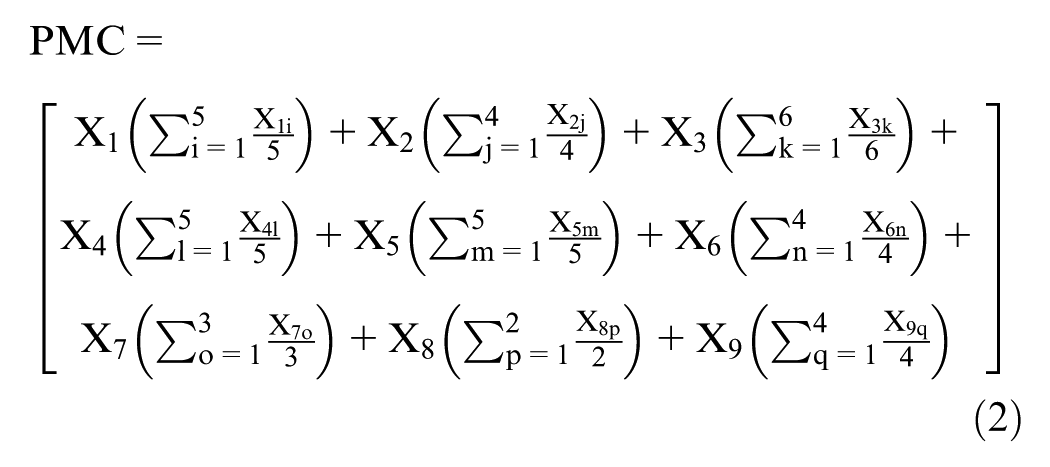
Input–output tables were constructed from these variables, and first-level indices were calculated using Equation 1, followed by PMC values from Equation 2 and a three-dimensional surface plot from Equation 3 to visually locate policy strengths and weaknesses. Drawing on prior applications of the PMC model in diverse policy domains (Dong et al., 2020; Fu et al., 2022; T. Yang et al., 2020; Zhang et al., 2017), the resulting scores were interpreted against four ordered performance categories: “Reasonable and Complete Policy,”“Policy Meeting Expectations,”“Policy with Emphasis,” and “Policy with Weak Applicability,” with detailed criteria provided in Table 4.
PMC Index Standards.

Longitudinal comparison of PMC scores since 2013 allows for tracking the evolution of policy quality, where an upward trajectory signals effective optimisation and a downward trend indicates the need for remedial action.

i = main variable; j = sub-variable; t = total variables in analysis

Results and Analysis
High-frequency terms were extracted from the selected policy documents using ROSTCM 6.0 to define variables for the Policy Modelling Consistency (PMC) Index.
Policy Themes
After initial word segmentation and frequency ranking, a manual screening process removed irrelevant or redundant entries. Three categories of exclusions were applied: (1) Functional or grammatical words and degree adverbs lacking semantic value (e.g. “for,”“and,”“further,”“somewhat,”“continuously”); (2) Overly generic procedural or directional words with no specific policy target or instrument (e.g. “due,”“various,”“relevant”); and (3) non-semantic elements such as dates of issuance, page numbers, punctuations, and URLs.
To minimise subjectivity, two researchers independently reviewed the top 500 high-frequency terms. Consensus was reached through discussion, resulting in a final selection of the top 60 valid terms ranked by frequency (Table 5). The semantic network diagram derived from these terms is shown in Figure 2.
Top 60 Highest-frequency Valid Terms in China’s Study-Tour Policy Texts.

Core Themes
The frequency data (Table 1) and semantic network (Figure 1) reveal a coherent policy discourse over the past decade, integrating tourism and education into a unified framework for governance and development. The highest-frequency terms—Tourism (408), Study (266), Student (234), Education (171), and Service (151)—position study-tour activities as a blend of experiential learning and tourism consumption. The emphasis is notably student-centred and curriculum-oriented, rather than focusing on isolated leisure programmes.
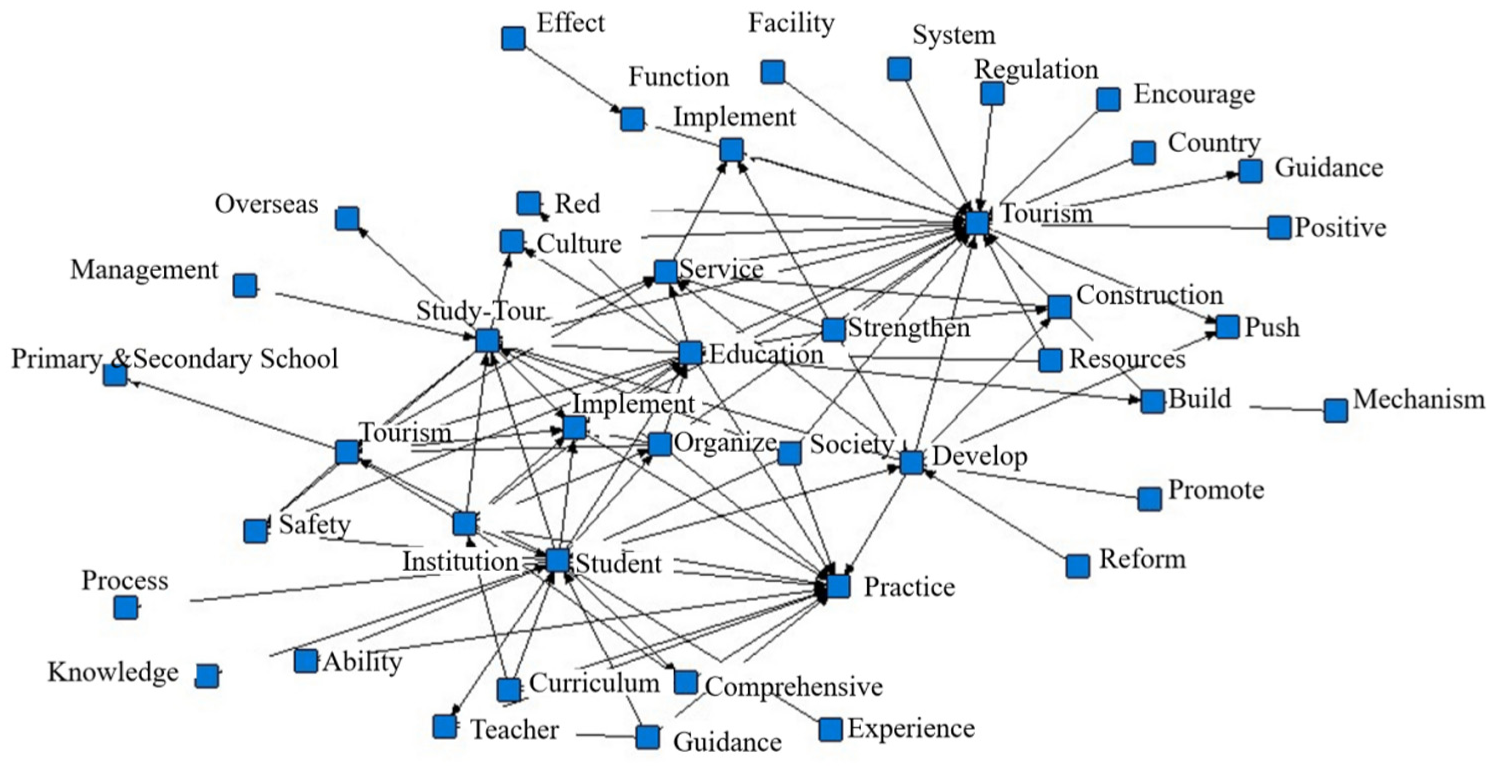
Semantic network diagram of China’s study-tour policy texts.
Educational Linkages
“Study” and “Education” show strong co-occurrence with Curricular, School, Teacher, Guidance, Learning, Ability, and Knowledge. This highlights deliberate alignment between field experiences and formal learning objectives, combined with pedagogical clarity. The role of teachers is central in designing and delivering activities, ensuring instructional integration.
Programmatic Process
Clusters containing Practice, Project, Planning, Implementation, and Evaluation reflect a project-based, evidence-oriented approach to programme development. These terms imply expectations for measurable outcomes and feedback mechanisms to support continuous improvement.
Social and Infrastructural Dimensions
Terms such as Facility, Resource, Safety, Regulation, Management, Standards and System, pointing to multi-stakeholder coordination.
Regional and Thematic Features
“Overseas” and “National” indicate both international opportunities and standardised national frameworks. The presence of “Red,”“Region,” and “Scenic Areas” signals incorporation of red tourism (national memory and patriotic education) alongside local development strategies and utilisation of cultural sites.
Network Structure and Gaps
The semantic network exhibits a core–periphery structure, with tourism and study at the centre, surrounded by modules focused on safety, regulation, infrastructure, management, guidance, and regionalisation, etc. This demonstrates integrated attention to content (objectives, pedagogy), process (planning, governance), and context (sites, socio-economic development). However, gaps remain: (1) evaluation standards are limited in detail, relying largely on the general term “Effect” and “Evaluation”; (2) Policies focus disproportionately on “Primary & Secondary School” without specifying grade levels or school types, indicating a need for more tailored assessment mechanisms and stage-specific guidance.
Policy Instrument Analysis
Based on the coding framework, policy instruments in the nine major study-tour documents were classified into five categories: mandate-based, incentive-based, capacity-building, system-changing, and advisory instruments (see Table 6).
Distribution of Policy Instruments in Nine Study-Tour Policy Documents.

Note. Numbers indicate frequency; percentages in parentheses indicate the share within each document.
Overall Distribution
Analysis of the nine documents on study-tour policy reveals that capacity-building instruments (mean share: 28.56%), which aim to enhance capabilities and resources, and advisory instruments (28.11%), which provide non-binding recommendations or guidance, are the most frequently adopted. This indicates a policy framework that predominantly relies on soft support measures such as guidelines, resource development, and training, rather than solely on strict enforcement. Mandate-based instruments (26.22%), containing command or mandatory provisions, also account for a substantial share, reflecting the necessity of regulatory measures, especially for safeguarding program quality, safety standards, and curriculum compliance. In contrast, incentive-based instruments (11%), which use fiscal or material incentives to induce behaviour, and system-changing instruments (6.11%), aimed at reforming structures or systems, are relatively rare—suggesting that financial inducements and structural reforms remain underutilised.
Evolution Across Phases
Three distinct developmental phases can be identified: (1) Early phase (2013–2014): Policies displayed a balanced mix of advisory instruments and capacity-building instruments, complemented by moderate mandate-based components. These initiatives focused on setting strategic direction and improving foundational resources and conditions, with an exploratory and pilot-oriented character rather than full institutionalisation; (2) Middle phase (2016–2017): Diversification and departmental specialisation emerged. Multi-agency directives (e.g. P4) showed a balanced profile, collectively addressing safety, curriculum, funding, and logistics. The Ministry of Education’s Department of Basic Education (P4, P5, P7) combined capacity-building with mandate-based provisions, supported by moderate advisory guidance and elements of system-changing reforms—reflecting targeted adjustments in teaching arrangements and curriculum integration. In contrast, tourism sector policies (e.g. P6) relied heavily on advisory and mandate-based instruments, while underusing capacity-building, incentive-based, and system-changing measures; (3) Recent phase (2023–2024): A clear shift towards capacity-building appeared, coupled with moderate mandate-based regulatory guidance. Emphasis was placed on infrastructural and resource support closely linked to ideological and moral education objectives. Both policies in this phase showed low or zero system-changing measures and moderate incentive-based use, indicating a stable institutional framework with incremental capacity enhancement rather than full structural overhaul.
This longitudinal evolution—from balanced and exploratory combinations in the early phase, through diversification and department-specific specialisation in the middle phase, to capacity-building emphasis with moderate regulation in recent years—demonstrates a maturation pathway. It suggests that policymakers are moving from setting broad objectives and piloting initiatives toward consolidating infrastructure and refining guidance, while persistent gaps in incentive-based and system-changing instruments may limit adaptability to emerging challenges.
Agency-Level Differences
Patterns vary by issuing authority. State Council documents tend to integrate extensive capacity-building and advisory measures within a national strategic framework, supplemented by certain incentive-based instruments. Education authorities more often employ mandate-based and capacity-building instruments, showing restraint in incentive-based use, aligned with their primary responsibility to ensure educational quality and equity rather than stimulate market competition. Tourism regulators typically combine substantial mandate-based and advisory components, emphasising service norms, operational standards, and compliance assurance, while underusing the other categories. Joint multi-agency policies usually achieve a more balanced instrument mix, demonstrating coordinated alignment between regulatory domains and operational sectors.
Policy PMC Index Evaluation
The Policy Modelling Consistency (PMC) index evaluation quantitatively examines nine major study-tour policies issued between 2013 and 2024. PMC scores range from 4.67 (P2) to 7.96 (P4), with a mean of 6.55, indicating generally good policy consistency (Table 7). Specifically, five policies (P1, P3, P4, P7, P9) meet expectations, two (P5, P8) are categorised as “with emphasis,” and two (P2, P6) exhibit weak applicability (Table 8). Figure 2 presents the average PMC indicator scores, revealing strong performance in policy assessment (X9), content richness (X4), and perspective (X8), contrasted by relatively weak results in timeliness (X2), incentive measures (X7), and policy target diversity (X3).
PMC Index of Nine Study-Tour Policies.

Ratings by Overall PMC Index.
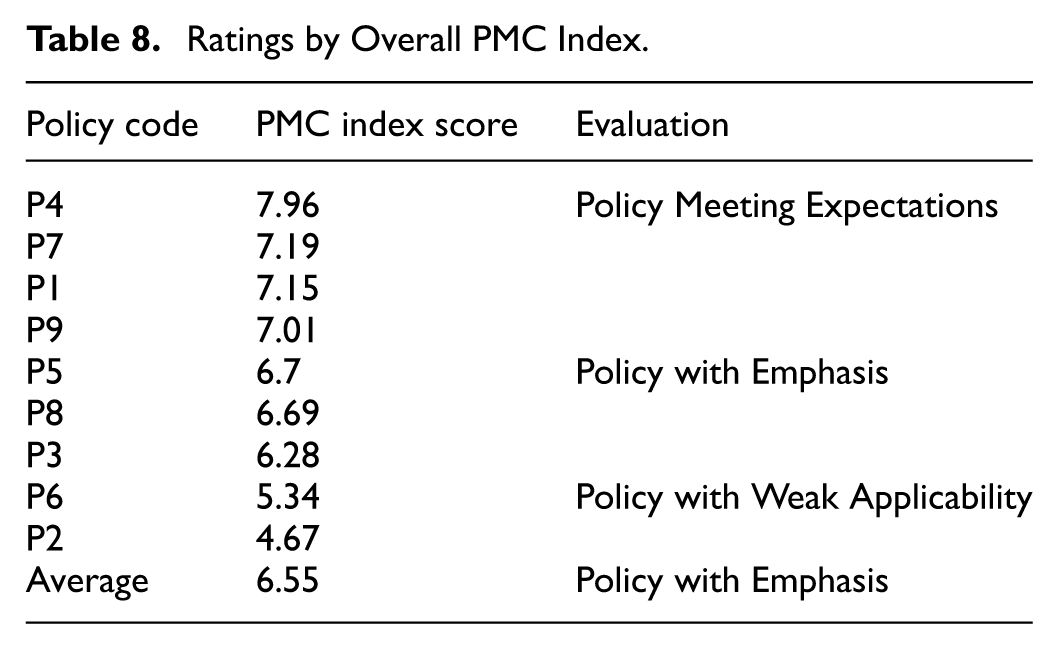

Radar chart of mean scores across nine PMC dimensions.
Strengths
Among the nine dimensions, Policy Assessment (X9) holds the highest mean score (0.97), with eight policies achieving the maximum of 1.0 across its four sub-indicators. On a procedural level, this suggests that most policies explicitly present justifying evidence, state objectives, outline plans, and reference methodological rigour. Besides, Policy Content (X4) averages 0.89, demonstrating extensive coverage of educational planning, management arrangements, facility assurance, cultural-technological integration, and practical activities. This breadth highlights the consistent integration of pedagogical practice with operational safeguards. Policy Perspective (X8) also scores high, with an average of 0.83, indicating that most policies balance macro-level strategic vision with micro-level operational considerations.
High-scoring policies such as P4, P7, and P1 share notable strengths: multi-target orientation (schools, government, enterprises, educators, students, parents), comprehensive content coverage, diversified instrument portfolios, and clear macro/micro integration. P4, a multi-agency directive, scored highest, fully addressing all nine PMC dimensions and serving as a model of cross-sector collaboration.
Weaknesses
Figure 3 highlights three low-performing dimensions: timeliness (X2), incentive measures (X7), and policy targeting (X3).

Surface plots for PMC Indxt scores by dimension.
Timeliness (X2) ranks last (mean = 0.31). Most policies adopt medium-term planning horizons (1–5 years), and some omit explicit timelines for pilot measures. This reflects a pronounced concentration in medium-term arrangements and experimental measures. In contrast, short-term policies to drive immediate uptake, and long-term commitments to ensure sustainability, are comparatively rare.
Incentive Measures (X7) average 0.56, underscoring insufficient incentives in all areas, including talent incentive, fiscal support, and capital investment. References are largely generic, lacking concrete operational mechanisms. For example, P8 mentions red-resource utilisation and training but omits specific funding measures or outcome-linked rewards, which may dampen stakeholder enthusiasm.
Policy Targets (X3) average 0.68, with limited emphasis on certain pivotal actors. Parents, key contributors to funding, safety assurance, and feedback, are rarely included, and few policies define their rights, roles, or participation mechanisms. Enterprise involvement scores slightly higher yet remains underdeveloped, often limited to broad cooperation statements without clear responsibilities, standards, or incentives. While students are commonly referenced, they are generally treated as a homogeneous group, with insufficient targeted provisions for disadvantaged participants (e.g. those from low-income families or with developmental differences), reducing equity and social benefit.
Comparative Analysis
Figure 3 visualises score distributions across PMC dimensions for each policy. Top-ranked P4 exhibits consistently high values, reflecting its integrated, multi-agency design. By contrast, low-ranked P2 and P6 display sharp declines in timeliness (X2) and incentive measures (X7), which notably reduce their overall PMC scores.
Cross-reference with the earlier policy instrument analysis reveals consistent structural relationships: high-PMC policies tend to employ diverse instrument mixes, balance mandate-based and advisory approaches, and emphasise capacity-building, while lower-PMC cases align with narrower departmental mandates that emphasise compliance but underinvest in operational capacity and time-bound implementation mechanisms. Persistent weaknesses in timeliness and incentives highlight the need for measurable implementation horizons, robust incentive packages, and sustained multi-agency coordination.
On average, China’s study-tour policies score 6.55 in PMC, suggesting a solid but improvable baseline. Scores have progressed from exploratory early designs toward more assured, resource-backed frameworks. Going forward, enhancing timeliness (X2), strengthening incentive measures (X7), and institutionalising multi-sector coordination will be critical to improving consistency and promoting high-quality, equitable development.
Discussion
Thematic Cohesion and Structural Dynamics in Policy Themes
Results indicate a stable semantic architecture in China’s study-tour policies over the past decade, marked by a core–periphery configuration with “Tourism” and “Study” as the central nexus. From an educational standpoint, this curricular orientation, featuring terms such as “Curricular,”“School,”“Teacher,”“Guidance,”“Learning,”“Ability,” and “Knowledge,” aligns closely with Kolb’s experiential learning cycle, framing study tours as iterative processes of concrete experience, reflective observation, abstract conceptualisation, and active experimentation (Morris, 2019) to foster adaptive skills and knowledge construction.
This thematic orientation mirrors China’s policy evolution under the 2019 Double Reduction reforms, which emphasise “healthy development” by reducing primary and secondary school students’ in-campus academic workload and off-campus tutoring to expand substantive extracurricular activity. It also supports tourism sector upgrading through cultural–tourism integration. Furthermore, China’s study-tour policy trajectory accords with Sustainable Development Goal 4 (SDG 4), promoting inclusive, equitable quality education and lifelong learning by diminishing disparities and embedding experiential learning that preserves cultural heritage while raising sustainability awareness (UNESCO, 2015). Collectively, these shifts signal maturation from foundational “framework building” to efficacy-driven “effectiveness enhancement,” situating study tours within broader agendas of holistic youth development and regional revitalisation.
Implementation Gaps and Discursive Peripheries
Despite thematic strengths, the centripetal structure shows implementation flaws. As Rein and Schön (1996) note, concentrated themes clarify goals yet risk translational discontinuities when peripheral motifs remain under-developed. This is apparent in the low infrequent and poorly connected “Effect” network. The current fragmented effect evaluation structure produces incomplete intelligence: data are collected sporadically, indicators remain inconsistent, and cross-sector comparisons are rarely performed. This limitation mirrors what Weiss (1998, p. 281) describes as “black box evaluations,” with which “they have collected data only on outcomes and do not know what went on inside the program box, treating it as though it were totally opaque,” and “the focus was on outcomes, with little attention to the operation of the program.” In practice, this means that while certain results may be measured, such as participant numbers or satisfaction rates, the underlying processes of curriculum integration, pedagogical delivery, and resource allocation remain unexamined. Empirically, the absence of robust, process-oriented assessment is reflected in study-tour programs that are criticised as being “fast-paced, checklist-style” or “high-cost, low-quality” with limited learning or research components (China Tourism News, 2024).
Similarly, references to “Safety” and “Regulation” lack clearly codified risk-mitigation protocols, while the broad “Primary & Secondary Schools” category fails to differentiate by age groups or specialised demographics, thereby creating barriers to participation. Students from low-income families, or those with intellectual, physical, or developmental needs, often encounter challenges such as insufficient funding, inadequate adaptation measures, and limited support services when taking part in educational travel programmes. The absence of targeted safeguards within current policies further widens this coverage gap, which not only lowers participation rates among vulnerable groups but also compromises the fairness and social value of these initiatives.
Strategic Orientation and Gaps in Policy Instruments
Complementing thematic insights, the deployment of policy instruments within China’s study-tour frameworks shows a clear preference for capacity-building and advisory “soft” measures, supplemented by moderate regulatory controls. This configuration aligns with common policy instrument classifications, where indirect instruments influence behaviour through non-coercive measures, and opportunity instruments foster desired actions by building institutional capacity or establishing supportive rules. Such strategies have facilitated incremental institutional consolidation, particularly through cross-sectoral synergies whereby education and tourism authorities integrate infrastructure enhancement with service benchmarks, fostering more coordinated and sustainable policy ecosystems.
Yet motivational (incentive-based) and systemic-change tools remain rare, limiting behavioural shifts and structural renewal. Fiscal incentives connect objectives with stakeholder actions through economic interests, lowering costs, raising returns, stimulating engagement, leveraging social capital, and achieving strategic goals (Howlett & Ramesh, 2006; W. Xia & Wan, 2024; Xie & Tian, 2015). System-changing instruments alter institutional arrangements by redistributing authority (McDonnell & Elmore, 1987). They can directly reshape existing incentive structures, proving particularly valuable in situations where current incentives fail to meet policy objectives, thereby enabling fundamental and sustainable change. For example, the merger of China’s Ministry of Culture and Ministry of Tourism represents a notable step towards such systemic transformation, as it consolidates governance responsibilities, reduces bureaucratic fragmentation, and enhances cross-sector coordination (XinhuaNet, 2018).
Nevertheless, the full potential of this reform has yet to be realised. To translate structural change into tangible policy outcomes, it will be necessary to deepen integration in organisational workflows, unify data and performance evaluation systems, and develop joint strategic frameworks that align cultural and tourism development priorities. Their absence leads to a “plateau effect,” where standards slowly improve but innovation, inclusivity, and resilience fall behind.
Sectoral differences compound this issue: education-focused policies lean towards pedagogical regulation and investment, tourism policies towards compliance, while joint initiatives produce balanced portfolios—showing inter-agency collaboration’s effectiveness in reducing bias through aligned resources and harmonised standards. Given the maturation cues in recent years, opportune avenues exist to infuse adaptive, innovative elements for heightened responsiveness.
Insights From PMC Evaluation: Coherence, Gaps, and Structural Interlinkages
The PMC evaluation underscores the overall coherence of China’s study-tour policies. Nevertheless, persistent weaknesses in timeliness, incentive complexity, and stakeholder inclusivity remain. These deficiencies are interconnected with previous thematic and instrumental analyses, confirming their structural rather than temporary nature: temporal gaps restrict monitoring and scaling, unclear incentives reduce mobilisation, and target biases, neglecting parents, enterprises, and differentiated student profiles, impede collaborative inclusiveness.
Incentive design patterns further reveal a preference for measures that balance a manageable planning horizon with scope for testing innovative approaches. Medium-term incentives often align with typical budgetary and administrative cycles, offering predictability for implementation, while experimental incentives signal policymakers’ willingness to explore new models—particularly in cross-sector collaboration between education and tourism. However, these remain limited in scale and rarely benefit from robust evaluation frameworks. The scarcity of short-term measures further reduces the capacity to rapidly mobilise stakeholders in response to emergent opportunities or local needs, whereas the absence of long-term incentives (such as multi-year funding guarantees, sustained infrastructure investment, or continuous capacity-building programmes) undermines the ability to achieve lasting transformation. As a result, much of the current incentive landscape is concentrated in the “testing and consolidation” phases, with insufficient anchoring in either “initial activation” or “permanent embedding.”
Theoretically, this reflects scholarship on the policy cycle, where temporal deficits hinder long-term agility and incentive gaps lead to failures in cross-sectoral activation. Collaborative governance paradigms similarly suggest that the exclusion of critical stakeholders undermines legitimacy, resource diversity, and durability (Ansell & Gash, 2007). Therefore, rectification requires a shift towards integrated, flexible architectures capable of accommodating both rapid mobilisation and sustained transformation.
Policy Implications
To address the identified gaps in thematic cohesion, policy instrument deployment, and the structural interlinkages revealed by the PMC evaluation, this study proposes a set of multifaceted, theoretically grounded recommendations. These integrate principles of experiential learning, incentive design, systemic reform, and collaborative governance to enhance both the quality and the equity of China’s study-tour policies.
Integrate Experiential Learning Cycles With Multi-Dimensional Evaluation Frameworks
Embedding Kolb and Kolb’s (2005) four-stage experiential learning cycle (concrete experience, reflective observation, abstract conceptualisation, and active experimentation) into study-tour programme design can transform tours from passive excursions into iterative, skills-oriented learning processes. This entails: implementing structured post-tour reflections (e.g. guided debrief sessions) to consolidate participant learning; introducing active experimentation elements such as follow-up school or community projects to encourage application of newly acquired knowledge; and embedding tours within formal curricula to maintain continuity and alignment with broader educational goals.
To sustain policy agility and responsiveness, study-tour initiatives should adopt a phased implementation model comprising short-term pilots, medium-term expansions with interim reviews, and long-term consolidation phases. Pairing this structure with Kirkpatrick’s (1959) four-level evaluation model enables comprehensive impact assessment across: (1) reaction (participant satisfaction and perceived relevance); (2) learning (knowledge acquisition, skills development, and attitudinal change); (3) behaviour (transfer and application of learning); and (4) results (systemic gains such as deeper education–tourism integration and regional revitalisation). Independent third-party audits should be mandated, and verified outcomes linked to formal credentialing or accreditation, thereby enhancing accountability and reducing variability in service quality.
Strengthen Standards, Diversify Themes, and Advance Inclusivity Via Targeted Incentives
Quality improvement should be anchored in nationally unified standards covering pedagogical depth, thematic relevance, safety, and culture–tourism integration. Enforcement mechanisms, such as systematic inspections, transparent public reporting, and corrective actions for non-compliance, can foster greater consistency.
Study-tour program content should move beyond generic cultural sightseeing to integrate diverse, locally relevant themes, including ecology, science and technology, and industry, to enrich educational value and highlight regional distinctiveness. Participant categorisation should be refined from general “Primary & Secondary School” labels to stage-specific and group-specific profiles, with particular attention to underserved populations: children with disabilities, left-behind children, economically disadvantaged students, and ethnic minority youth. For these groups, participation barriers, such as cost, accessibility, and cultural distance, should be mitigated through targeted subsidies, tailored curricula, and immersive technologies (e.g. VR/AR) that enable remote engagement. Evaluation tools should also be adapted; for example, incorporating sensory-perception metrics for children with disabilities. Targeted fiscal instruments such as subsidies, matching grants, and performance-based rewards for inclusive programme design can complement standards enforcement and incentivise equitable service provision.
Advance Systemic Reform and Deepen Cross-Sectoral Coordination
Building on existing collaboration among education, culture, tourism, and other authorities, deeper structural integration is required to overcome governance fragmentation. Priority measures include merging or functionally aligning institutional responsibilities to streamline decision-making. In addition, unified, interoperable data platforms should be developed to harmonise indicators on participation rates, learning outcomes, and safety standards. Shared strategic frameworks can then be formulated to collaboratively define thematic priorities, allocate resources, and coordinate evaluation schedules.
Such systemic reforms can mitigate the “plateau effect” of gradual yet stagnant improvement by fostering innovation, inclusivity, and resilience. Enhanced coordination can also balance the regulatory emphases of education policy with the compliance focus of tourism policy, resulting in more synergistic and adaptive policy portfolios.
Phase Implementation and Institutionalise Stakeholder Engagement
A phased roll-out that covers pilot, expansion, and consolidation stages should be paired with data-informed interim reviews. This offers the flexibility to make timely adjustments while maintaining a clear strategic direction. Each stage needs to be supported by clear milestones, accountability mechanisms, and opportunities for policy refinement.
Inclusive and collaborative governance should also be formalised by engaging a broad range of stakeholders in policy design, delivery, and evaluation. These stakeholders include educators and school leaders, tourism operators, cultural organisations, parents, community representatives, and student voices. Together, these engagement strengthens policy legitimacy, diversifies resource inputs, and builds shared ownership of objectives.
Conclusions, Contributions, and Limitations
This study decodes the “policy DNA” of China’s study-tour sector by analysing central policy documents since 2013 through text mining, policy-instrument coding, and the PMC index. Findings reveal a shift from fragmented pilots to a mature, student-centred, curriculum-integrated governance system, with “tourism” and “study” forming a stable semantic core surrounded by safety, infrastructure, and red-culture education. Capacity-building and advisory tools dominate, mandates serve as safeguards, and the average PMC score of 6.55 indicates solid but improvable coherence.
Three intertwined deficits remain. First, timeliness is weak, with policies confined to medium-term horizons lacking both immediate activation and long-term commitments. Second, incentives are insufficient, with vague fiscal measures and scarce performance-linked rewards dampening stakeholder motivation. Third, inclusivity is underdeveloped, as key actors like parents, enterprises, and disadvantaged learners are often excluded, limiting equity and collaborative governance.
To break this cycle, systemic reforms are needed. First, integrate experiential learning cycles and rigorous evaluation into programs; Second, establish tiered incentives, from micro-grants to long-term endowments, conditioned on learning outcomes and equity; Third, enhance cross-sector coordination via a unified national data platform. Finally, apply phased rollout with monitoring and stakeholder engagement.
This study innovatively integrates policy themes, instruments, and the PMC index within a “policy DNA” framework to systematically deconstruct and quantitatively compare China’s national-level study-tour policies. It advances beyond prior single-case or qualitative studies by offering a structured, traceable paradigm for policy evolution and effectiveness. Introducing the PMC index for assessing content and coherence further enriches policy research methodology with empirical and dynamic monitoring tools.
By analysing China’s study-tour policies from a comparative perspective, this study offers a scalable model for bridging education and tourism objectives. Although the analysis is situated within China’s policy context, its conceptual framework and multi-level recommendations resonate with broader international debates on integrated policy design, particularly in the fields of experiential education, heritage promotion, and sustainable regional development. Countries facing similar challenges, such as reconciling cultural preservation with educational innovation or ensuring equitable access across diverse student populations, may draw on these findings to craft policies that are both contextually responsive and globally informed.
This study has several limitations. First, the sample size is small, comprising only nine policies; while precedent exists for such scope, it may still constrain the depth and breadth of analysis. Second, the focus on central-level policy documents limits visibility into local-level implementation and the diverse practical challenges faced on the ground. Third, the text-analysis approach effectively identifies structural features but provides limited capacity for causal inference or impact evaluation, indicating the need for future mixed-methods validation. Finally, the use of official and general policy language introduces potential subjectivity in coding, which was mitigated—though not entirely eliminated—through double-blind procedures.
Footnotes

Author Contributions
Conceptualisation, Xu Ding and Junfeng Diao; methodology, Xu Ding and Junfeng Diao; formal analysis, Xu Ding; resources, Rong Huang and Junfeng Diao; writing—original draft preparation, Xinyan Ma; writing—review and editing, Junfeng Diao; supervision Junfeng Diao; funding acquisition, Junfeng Diao. All authors have read and agreed to the published version of the manuscript.
Funding
The authors disclosed receipt of the following financial support for the research, authorship, and/or publication of this article: Supported by the Hainan Provincial Higher Education Teaching Reform Research Project (Project Number: Hnjg2025-42, Project Title: Digital Innovation and Practice Exploration of Teaching Paradigms under the Background of Free Trade Port Construction); Hainan Provincial Educational Science Planning Project for 2024 (Project Number: QJY202412207, Project Title: Construction of Moral Education Knowledge System and Innovation in Educational Practice Empowered by Artificial Intelligence: Exploring the Integration of Traditional and Modern Education); Hainan Provincial Graduate Innovation Research Project in Ordinary Higher Education Institutions in 2024 (Project Title: Current Status, Problems, and Countermeasures of the Application of the National Primary and Secondary School Smart Education Platform in Free Trade Port Teaching, Project Number: Qhys2024-355).
Declaration of Conflicting Interests
The authors declared no potential conflicts of interest with respect to the research, authorship, and/or publication of this article.
Data Availability Statement
The datasets used or analysed during the current study are available from the corresponding author on reasonable request.