



Abstract
The study emphasises how important it is for Green Capital tree plantations to sequester CO2, support biodiversity, and strengthen ecosystem resilience to mitigate climate change. In addition to addressing the shortcomings of conventional carbon reduction strategies, this natural and sustainable approach can support current mitigation efforts and promote green capital and environmental sustainability. It analyses data along four dimensions (awareness of the severity of climate change, perception of the value of trees, perceived necessity of taking action to plant trees, and intention to plant trees) using Structural Equation Modelling to provide guidance to use the Green Capital concept to mitigate CO2 emissions efficiently. The findings (1) The Awareness of serious climate change had a strong effect on the Intention of tree plantations; (2) The respondents are cognisant of the benefits and necessity of forest growth but lacked financial support; (3) The findings delve into factors driving environmental stewardship, offering insights for promoting sustainability. It uncovers a gap between acknowledging the importance of tree planting as a Green Capital and actual engagement. The study seeks to stop deforestation and encourage planting trees for both commercial and environmental benefits. We encourage planting trees, balancing emissions, and investing in environmentally friendly solutions. Tree planting and other green capital initiatives provide an alternative, but financial support is essential, especially in developing countries. This study highlights the critical role of Green Capital tree plantations in sequestering CO2, enhancing biodiversity, and strengthening ecosystem resilience to mitigate climate change. By introducing a Green Capital model, this study presents a novel approach that integrates environmental sustainability with economic incentives to address the limitations of conventional carbon-reduction strategies. This natural and sustainable method not only supports existing mitigation efforts, but also fosters investment in green initiatives. In this research study, data across four key dimensions: awareness of the severity of climate change, perception of the value of trees, perceived necessity of tree planting, and intention to plant trees, were analysed using Structural Equation Modelling (SEM). The findings reveal that (1) awareness of severe climate change significantly influences the intention to engage in tree plantations; (2) while respondents recognise the benefits and necessity of forest expansion, financial constraints hinder participation; and (3) there is a gap between acknowledging tree planting as a Green Capital investment and actual involvement. By emphasising tree plantations as both environmental and commercial assets, this study proposes a strategic framework for balancing emissions and promoting sustainability. This underscores the need for financial support to facilitate the transition to Green Capital investment, particularly in developing countries. This study contributes to the existing literature by introducing the concept of Green Capital as an integrated and scalable solution for climate action and sustainable development.
Plain language summary
This study explores how planting trees, seen as “Green Capital,” can help fight climate change and create economic value. Trees absorb carbon dioxide, protect wildlife, and support ecosystems, yet traditional climate solutions often overlook their financial potential. The Green Capital model bridges this gap by treating tree plantations as both environmental assets and profitable investments. This encourages businesses and communities to take part in tree-planting efforts. Through surveys, the study found that people who understand the urgency of climate change are more likely to support tree planting. However, high costs remain a major barrier, especially in developing countries. Even when people see tree planting as a smart investment, few participate revealing a gap between awareness and action. By framing forests as Green Capital, this model can attract funding for climate initiatives by linking environmental benefits with financial gains. For this to work, governments and organisations must provide financial support, lower costs, and promote tree planting as a profitable and practical solution. This approach offers a scalable way to cut emissions, restore nature, and strengthen economies, especially in regions most affected by climate change. Ultimately, by making trees a win-win for both people and the planet, the Green Capital model could reshape how the world addresses the climate crisis.
Introduction
Global warming and climate change are serious problems that need to be addressed immediately. As part of the Paris Climate Agreement (PA) and United Nations Framework Convention on Climate Change (UNFCCC), the European Union (EU) plans to considerably reduce carbon dioxide (CO2) and other greenhouse gas (GHG) emissions to reduce global climate change (M. Wang & Kuusi, 2024). The rise in Earth’s temperature has caused a lot of global warming, a phenomenon now referred to as “global boiling” (Sembiring et al., 2024). This environmental problem affects everyone, because rising CO2 levels are closely linked to climate change and rising temperatures worldwide (Chen et al., 2021; Pachauri et al., 2014). Several countries use market-based, mandatory, and voluntary rules to lower greenhouse gas (GHG) emissions (Chen et al., 2021; Martin et al., 2016). To achieve a net-zero economy, governments are implementing new laws and policies, such as carbon taxes and emission quotas. Climate policy uncertainty affects how much carbon companies emit, how much they invest, and their financial decisions (Gavriilidis, 2021).
Industrialisation is often linked to economic growth; however, if it not handled in a way that is beneficial to the environment, it can have negative effects. Environmental problems worsen when industries grow quickly, because they use more natural resources (Dubey & Narayanan, 2010; Mahmood et al., 2020). A recent study showed that rapid economic growth is detrimental to the environment, particularly because it leads to more CO2 emissions. Kashem and Rahman (2019) and Ghasemi et al. (2023) showed the importance of dealing with the link between environmental risks and economic growth. To protect the environment and achieve sustainable growth, sustainability should be integrated in numerous sectors such as transportation and supply chains (Lotfi et al., 2025; Rajabi et al., 2022; Yazdi & Mastorakis, 2014). Maritime transportation requires the least amount of energy to move goods by ocean, which is important to global trade. Notably, it accounted for 2.89% of all CO2 released by humans in 2018, which is a significant issue (Deng & Mi, 2023). Obtaining technical and operational steps such as fuel-efficient propulsion systems and alternative fuels to reduce emissions has been difficult (Boretti & Castelletto, 2024; Cames et al., 2015; Jiang et al., 2014; Lv et al., 2024; Tan et al., 2023; Wan et al., 2018; Woo & Moon, 2014). Emissions Trading Systems (ETS) and other market-based measures have also been unable to meet the net-zero goal for emissions reductions (Bleuel & Müller, 2024; Graham et al., 2018). Given these challenges, alternative methods of balancing CO2 emissions should be explored urgently. Tree plantations may emerge as a promising solution, offering a natural and sustainable approach for sequestering carbon from the atmosphere. This is because trees absorb CO2 via photosynthesis, reduce atmospheric CO2 levels, and provide additional benefits. Thus, tree plantations are considered Green Capital in the present and future.
The concept of Green Capital, represented by tree plantations, offers an innovative solution for meeting green quotas. To bridge the gap in energy quotas, we propose that tree plantations, owing to their physical presence and natural functions, be allocated emissions quotas in the form of tree plantations. Ajzen (1985) developed the Theory of Reasoned Action (TRA) and Davis (1985) proposed the Technology Acceptance Model (TAM). These frameworks explain and predict organisational behaviour in specific contexts, particularly when assessing user reactions to information systems. Therefore, the TAM explores the acceptance of green capital initiatives, shedding light on the factors that influence the adoption of environmentally sustainable technologies and practices. Given that trees naturally absorb CO2 through photosynthesis and contribute to biodiversity, thus promoting a sustainable environment, it is essential to ask why this natural solution is not utilised on a larger scale to combat severe climate change. At the same time, developing countries are striving to improve their economic conditions. If developing countries follow the paths taken by developed nations, when can zero or balanced emissions targets be reached? Are there niche strategies for developing countries such as Pakistan that can be adopted to foster economic growth while simultaneously addressing climate change? To explore these questions, the current study employed the TAM to achieve the following objectives:
Q1: What factors hinder people from planting and reforesting more trees?
Q2: How can we encourage people to plant trees and reforest?
The remainder of this study is divided into sections that discuss the theoretical background, including the research model and hypotheses, methodology, findings, and conclusions.
Literature Review
Climate Change
In an attempt by nations worldwide to lower GHG emissions for a more sustainable future, policies targeted at combating climate change have been of paramount importance for decades. However, there may be considerable uncertainty regarding the implementation of these policies (Gavriilidis, 2021). The goal of the investigation is to learn more about the importance of green finance and technology in achieving the objectives of the PA. The PA, which includes targets, mitigation, adaptation, loss, damage, finance, technology, capacity building, and transparency, provides a cohesive framework for international climate change actions beyond 2020 (Salman et al., 2022). With efforts to keep the rise in global mean temperature below 2°C above pre-industrial levels (Iacobuţă et al., 2022; Kuriakose et al., 2022; Mulder et al., 2021), the aim is to achieve net-zero GHG emissions by the second half of the 21st century (Kuriakose et al., 2022).
In recent years, experts have attempted to incorporate sustainability into a range of fields and enterprises, such as transportation (Rajabi et al., 2022), supply chains (Lotfi et al., 2025), development (Rajabi et al., 2022). Energy consumption is an important factor influencing economic growth. Without considering sustainable economies, this has resulted in numerous issues and environmental risks (Yazdi & Mastorakis, 2014). Additionally, there is growing interest in renewable energy as a means of achieving international environmental protocols, such as the Kyoto Protocol, and less polluting economic development. Moreover, energy security issues and growing costs of fossil fuels can be resolved using renewable energy. Ghasemi & Rajabi (2022) pointed out that employing updated data analytics can be beneficial for sustainable development, and that increasing productivity and renewable energy sources is recognised as a way of reducing GHG emissions. In addition to natural causes, human activities have increased GHG emissions over the past 200 years, particularly CO2 emissions, which are considered the primary drivers of global warming. The primary causes of CO2 emissions are industrial production and burning of fossil fuels (Ghasemi et al., 2023).
The oil and gas industry contributes significantly to GHG emissions, primarily through fossil fuel combustion and methane leaks during extraction and transportation (Calderon et al., 2022). To address this issue, companies are investing in innovative technologies to minimise emissions throughout production (Cheng et al., 2023; Martin-Roberts et al., 2021; Oshilalu et al., 2021). These efforts reflect the industry’s commitment to environmental stewardship and investments in solutions to mitigate climate change (Emeka-Okoli et al., 2024). Initiatives for ecosystem restoration are crucial components of environmental stewardship in the oil and gas industry (Haden Chomphosy et al., 2021). Deforestation, habitat destruction, and biodiversity loss are frequent outcomes of oil and gas operations, particularly in delicate ecosystems such as wetlands, forests, and coastal areas. To reduce these effects, companies have launched numerous projects to repair and rehabilitate impacted ecosystems to lessen these effects (Emeka-Okoli et al., 2024). This study examines how environmental and social performances affect the risk of corporate financial distress. Often overlooked, these factors can lead to high costs, poor investments, reputational damage, and potential company closure (Sembiring et al., 2024).
However, as “economic men,” businesses must consider how their efforts to reduce carbon emissions will inevitably affect their bottom line. This is because reducing carbon emissions is expensive and dangerous (Z. Wang et al., 2023). Insufficient motivation to reduce carbon emissions is caused by the lack of positive incentives (Y. Wang, 2023). Consequently, society and the government now consider it crucial to encourage corporate motivation towards low-carbon and green development (Li & Xu, 2024). Research on emissions and energy consumption has focussed on the potential applications of green technology beyond the objectives of PA. According to Behera et al. (2023), reducing carbon emissions in the long run depends on green technology, renewable energy, urbanisation, and corruption control. Green technology can effectively moderate the relationship between renewable energy and carbon emissions over time. According to Cheng et al. (2023), green technology initially increases carbon emissions when development levels are low but then decreases when development levels rise above a particular threshold. According to Majekodunmi et al. (2023), environmental degradation is negatively impacted by both green technology and population growth, but worsened by exports and economic growth. Green technologies can reduce these negative effects. Green energy, environmental taxes, and green technology are negatively correlated with carbon emissions over the long and short term (Sharif et al., 2023).
The ETS has gained popularity and momentum in different countries (Huang et al., 2024). As a market-based carbon reduction mechanism, the traditional neoclassical economic perspective contends that joining an ETS may result in increased compliance and mitigation costs(Chapple et al., 2013; Choi & Luo, 2021; Clarkson et al., 2015). The shipping industry is now part of the ETS, meaning that shipping companies must buy emission quotas to comply with ETS regulations. Several laws and regulations, including those on speed limits, low-carbon fuel requirements, and more stringent energy-efficiency targets, are necessary to ensure compliance (Halim et al., 2018). The shipping industry accounts for 2.89% of global anthropogenic CO2 emissions (Dewan & Godina, 2023; Fan et al., 2023). GHG emissions management in international shipping faces challenges, with disputes arising from principles such as “common but differentiated responsibilities” and “no more favourable treatment” (Shi & Gullett, 2018). Methane slip significantly increases the greenhouse gas emissions from LNG-powered ships throughout their fuel lifecycle (Hellström et al., 2024; Lindstad & Rialland, 2020). Although hydrogen is a promising clean fuel alternative, challenges related to its supply chain, storage, safety, and energy penalties have hindered its widespread adoption (Calabrese et al., 2024). Ammonia has also been explored as a potential fuel; however, its harmful byproducts and high energy costs associated with fuel cell technology raise environmental concerns (Solangi et al., 2024). Methanol offers another alternative; however, its future viability depends on scaling production and addressing storage challenges (Patil et al., 2024). Furthermore, the high energy requirements for fuel production can generate significant CO2 emissions even before the fuel is utilised, exacerbating the carbon footprint (Wu et al., 2022). Considering these challenges, tree plantations are proposed as a sustainable and tangible solution for shipping companies. By investing in tree plantations, companies can secure physical green quotas to offset their emissions, thereby contributing to their compliance with Emission Trading Systems (ETS). This approach not only addresses the immediate need for emission reduction but also promotes long-term environmental sustainability.
Recent research (Lee & Liang, 2024) highlights that the ETS not only regulates emissions but also encourages firms to innovate by adopting advanced environmental strategies. In this context, tree plantations offer nature-based innovation to firms seeking cost-effective ways of meeting their ETS obligations. Rather than being an alternative to the ETS, Green Capital tree plantations complement ETS mechanisms by serving as a carbon offset strategy. By investing in reforestation and afforestation, firms can generate carbon credits to comply with ETS caps or trade in carbon markets. Furthermore, environmental regulations, such as Minimum Energy Efficiency Standards and emission reduction frameworks, encourage industries to integrate sustainable initiatives, such as tree plantations, in alignment with corporate social responsibility (CSR) goals. This finding supports the argument that ETS drives firms to explore innovative sustainability measures rather than imposing financial burdens. The combination of ETS policies and tree-planting programmes allows companies to comply with regulations while enhancing their long-term environmental and financial performance (Akhtyrska & Fuerst, 2024). Green capital refers to investment in trees for economic growth, increased performance or productivity, and competitive advantages (Guo et al., 2018). Several real-world initiatives have demonstrated the effectiveness of tree plantations and ecosystem restoration in combating environmental challenges. Examples include China’s Green Great Wall (Ji et al., 2024) and Costa Rica’s Reforestation and Payment for Environmental Services (PES) Programme (Umaña Quesada, 2024). Both programmes have been effective at improving environmental quality, advancing sustainable land management, and addressing climate change, providing significant insights into large-scale environmental restoration. The lessons learned from these case studies emphasise the importance of government-backed initiatives, long-term investments, and community engagement in driving successful reforestation and restoration efforts.
Despite the growing body of research on ecosystem restoration, carbon trading mechanisms, and sustainable development, a comprehensive conceptual framework that positions trees as green capital in the context of carbon offsetting in high-emission sectors, such as shipping, is lacking. Numerous studies have perceived tree plantations solely as ecological or corporate social responsibility initiatives, overlooking their role as measurable, marketable economic assets that directly improve market-based systems, such as the ETS. This study fills this void by presenting a Green Capital Model that redefines tree plantations as capital investments that provide carbon balance, economic returns, and compliance value in regulated emission markets, rather than merely as environmental measures.
The lifeblood of our planet goes beyond conventional measures of economic prosperity. In addition to contributing to the visual appeal of landscapes, silent sentinels are essential in promoting biodiversity, reducing the effects of climate change, and conserving ecosystems.
Theoretical Support
The new concept of a green energy quota is only effective when it is accepted. Davis (1985) developed a technology acceptance model based on the theory of reasoned action (Vallerand et al., 1992) to explain and predict the behaviour of organisational members in specific situations, especially to test users’ reactions to information systems. It has also been widely applied in various empirical studies to examine the user acceptance of new information technology systems (Bueno & Salmeron, 2008; Davis et al., 1989; Hu et al., 1999; Mathieson, 1991; Straub et al., 1995; Tsai, 2017; Yoon, 2009). These studies implied that they perceived that the products could serve as solutions (perceived usefulness and perceived need), and then intended to use them. Before they recognised the products, they were awarded requirements and results. The aim of the current study is to employ trees as a solution to combat climate change; therefore, we propose four dimensions: awareness of climate change, useful trees, the need to increase forests, and intention of action. Green Capital, however, pays sustainable projects directly, supports green quotas, and creates long-term economic and environmental benefits. By combining environmental and financial goals, this method not only solves environmental problems but also supports long-term growth. However, carbon credits can only be used to offset greenhouse gas emissions. Because the TAM has also been applied in other empirical studies (Bueno & Salmeron, 2008; Davis et al., 1989; Hu et al., 1999; Mathieson, 1991; Straub et al., 1995; Tsai, 2017; Yoon, 2009), and is considered the most parsimonious, predictive, and robust (Venkatesh & Davis, 2000). Therefore, the primary theoretical contribution of this study lies in the adaptation of the TAM to develop the Green Capital Model. While TAM has been extensively used in technology adoption research, its application to green capital and environmental behaviour is unprecedented. This novel approach introduced new constructs, such as awareness of serious climate change, usefulness of trees, action of tree plantations, and intention of tree plantations, to examine the respondents’ perspective regarding the adoption of green capital. These four dimensions are directly influenced by the fundamental principles of the TAM. In the conventional TAM, user behaviour is influenced by perceived usefulness and perceived ease of use, which collectively determine behavioural intention. In this modified approach, “awareness of climate change” operates similarly to the promotion of a new technology, establishing the cognitive foundation. “Usefulness of trees” denotes perceived utility, analogous to how the TAM highlights functional advantages. The “Need action of tree plantation” corresponds with the acknowledgement of necessity or problem identification, hence enhancing its significance. Ultimately, “intention of tree plantation” corresponds directly to behavioural intention, the primary outcome variable in the TAM. Consequently, each component is conceptually rooted in the TAM framework, and together, they inform the operationalisation of green capital acceptance within the research. Thus, our study extends the theoretical boundaries of TAM and provides a new framework for understanding the adoption of green capital practices.
Research Approach and Hypothesis
Awareness of Climate Change
Climate change is defined as a major and long-term shift in climate measures, referring to long-term changes in temperature, precipitation, and wind patterns (Agboola & Emmanuel, 2016). It presents a worldwide environmental, social, and economic problem (Mendelsohn et al., 2006). Knutson (2015) describes climate change research as a massive undertaking because it involves the entire world and everything that influences its existence. Human activities are responsible for almost all the increase in greenhouse gases in the atmosphere over the last 150 years (Agboola & Emmanuel, 2016). The largest source of gas emissions is the burning of fossil fuels for electricity, heat, and transportation (Agboola & Emmanuel, 2016). The United States Global Change Research Programme suggests that we must understand the influence of climate on society (Agboola & Emmanuel, 2016).
Climate change has a cumulative effect on natural resources and natural balance. (Marty & Yokochi, 2006) indicated that when the climate changes, everything changes from the natural habitat of wildlife to the culture and sustainability of a region. Some effects of climate change include sea-level rise, changes in rainfall patterns, water scarcity, and adverse health effects from warmer temperatures. It is one of the biggest threats to the world today and is progressively emerging as one of the most serious problems affecting many segments of economic growth worldwide (Kangalawe & Lyimo, 2013). Its effects have been experienced in many countries in the form of widespread flooding, incessant drought, disruption of weather patterns, increased global temperatures, devastating windstorms, and forest fires (Okorie et al., 2017). This significantly affects rural communities, particularly in Africa, which rely mainly on farming activities and natural resources for their livelihoods (Samuel et al., 2018). The African continent is expected to be most affected and susceptible to climate change (Hummel, 2016). Natural causes include volcanic eruptions and ocean effects, whereas anthropogenic causes include the use of fossil fuels, deforestation, overgrazing, agricultural activities, and discharge of aerosols (Gobir et al., 2021).
According to the literature review, climate change refers to notable and enduring changes in climate metrics such as temperature, precipitation, and wind characteristics. There are numerous environmental, social, and economic implications of this global challenge. Greenhouse gas emissions, which cause climate change, are mostly attributed to human activity, most notably to the burning of fossil fuels. Ecosystem disruptions, changes in rainfall patterns, and unfavourable health effects are characteristics of this phenomenon. Therefore, people are more aware of serious climate change and the usefulness of trees, and they are more willing to consider it and have more intention to act on tree plantations. The following hypotheses were postulated:
Usefulness of Trees
Trees play a crucial role in mitigating climate change by absorbing carbon dioxide (CO2; Parmesan & Hanley, 2015). Through photosynthesis, trees remove approximately 130 billion tons of carbon (Gt-C) annually globally. This natural process considerably surpasses approximately 10 Gt-C emitted annually from human activities, including fossil fuel burning and deforestation. The magnitude of plant-driven carbon removal was remarkable. Recognising the significance of trees for carbon sequestration underscores their critical role in addressing climate change (Bala, 2014). The effects of climate change include drought, flooding, biodiversity loss, and poor agricultural productivity among others (Gobir et al., 2021; Okorie et al., 2017).
The study (Okorie et al. (2017) reported that the extensive planting of trees with large canopies captures carbon dioxide from the atmosphere, thereby mitigating rising atmospheric carbon dioxide levels. Forests play a prominent role in the global carbon cycle (Dixon et al., 1994; Smith et al., 1993). One possible strategy for reducing GHG emissions is to use forests to sequester CO2. Forests are relevant to climate change because they function as carbon reservoirs. Tree plantations play vital roles in reducing global soil erosion and preventing desertification, both of which pose significant environmental challenges. By stabilising soil with their roots, reducing water runoff, and providing shade to retain soil moisture, trees can help combat these processes. In addition, trees sequester carbon from the atmosphere through photosynthesis and store it in their biomass and soil. Tree planting also mitigates atmospheric carbon emissions (Okorie et al., 2017). Excessive carbon dioxide in the atmosphere raises the Earth’s temperature. Therefore, excessive global warming can be prevented by planting trees and removing significant amounts of carbon from the atmosphere. This underscores the significant contribution of tree plantations to carbon sequestration and climate change mitigation efforts while promoting biodiversity, supporting ecosystem health, and sustaining livelihoods for local communities (Cole et al., 1993). Research (Ramachandran Nair et al., 2009) indicated that trees can contribute substantially to soil carbon sequestration (Ramachandran Nair et al., 2009). The value of forests for sequestering carbon and reducing carbon dioxide emission to the atmosphere is increasingly recognised worldwide. Forest plantations and agroforestry systems are thus recognised as having the potential to regain some of the carbon lost to the atmosphere during forest clearing. Although neither regrowth nor plantations can come close to replacing the full amount of carbon present in primary forests, plantations and agroforestry systems have the added benefit of providing valuable products and food to local people. The rotation age of plantations and trees in agroforestry systems plays a significant role in the amount of carbon they can sequester (Alemu & Kidane, 2014).
Forest plantations and agroforestry are acknowledged as methods for storing carbon dioxide while preserving biodiversity and sustaining local economies. Trees are essential in mitigating climate change and promoting environmental sustainability. They are more perceptive of the usefulness of trees and need actions and intentions towards tree plantations. Given the significant roles that trees play, they contribute to combating climate change. Individuals may be more inclined to plant trees when they understand the benefits. We assert that, as awareness of the benefits of tree farms increases, individuals will be more inclined to engage in tree planting, thereby enhancing the significance of this environmental strategy. Therefore, the following hypotheses were postulated:
Need Action of Tree Plantation
The studies (Griscom et al., 2017) highlighted the effectiveness of trees as cost-effective carbon sinks as acknowledged by economists, with business and political leaders viewing tree planting as a unifying solution for carbon emissions. Although reforestation, the carbon cycle, and biodiversity in forests are essential considerations, some scientists have expressed concerns about relying solely on trees for their carbon benefits. Nature-based solutions, including the use of trees, have the potential to reduce excess carbon by up to 30%.
Tree plantations hold great potential to sequester atmospheric carbon and mitigate global climate change. The integration of trees and plantations in various settings such as agricultural systems, homes, institutions, markets, parks, and urban areas is urgently required. Furthermore, planting trees can accelerate the sequestration of carbon stocks in forests by living trees (Domke et al., 2020). However, with the increasing loss of forests owing to human activities, such as logging, fires, and fragmentation, the certainty of trees combating climate change diminishes. Trees are valued for their ability to absorb substantial amounts of human-produced carbon dioxide, benefitting society, health, and biodiversity. To understand the scale of carbon capture and tree cover increases, research has focussed on local and municipal solutions that are sustainable and beneficial to local communities, natural systems, and economies (Parmesan & Hanley, 2015). They were more perceptive of the need action of tree plantation would be more perceptive of the intention of the action of tree plantation.
Recognising the significance of tree-planting can motivate individuals, communities, and municipalities to initiate tree-planting efforts to combat climate change and enhance the health of their local ecosystems. Therefore, the following hypothesis was postulated:
The outcomes of different studies (Agboola & Emmanuel, 2016; Parmesan, 2007; Parmesan & Yohe, 2003; Poloczanska et al., 2013; Root et al., 2003; Schleuning et al., 2016; Wu et al., 2022) indicate that climate change has a positive, direct impact or association with the need for action of tree plantation, intention of tree plantation, and usefulness of tree plantation because whenever the climate changes, the need and intention towards tree plantation may increase/decrease. Therefore, the conceptual research model is postulated as follows (see Figure 1):

Conceptual research model.
Methodology
Questionnaire Design
We utilised the Theory of Reasoned Action (TRA) and Technology Acceptance Model (TAM) as frameworks for constructing the questionnaire. The enquiries were designed to evaluate the participants’ perspectives on tree planting, subjective norms (i.e., the impact of social influences on their conduct), and perceived behavioural control (e.g., their beliefs about the ease or difficulty of engaging in tree planting). The questionnaire exclusively addressed professional and environmental opinions, omitting any requests for sensitive personal or financial data. Participation was completely voluntary, and respondents might quit at any moment without repercussions. Data were gathered anonymously to safeguard privacy. This method elucidates the determinants of participants’ readiness to embrace sustainable practices to seek guidance for questionnaire adoption and research design by interviewing experts who majored in different domains, including shipping management, maritime transportation, and marine environment engineering. The expert interviews were informal and allowed for flexible, in-depth discussions. While this approach provides rich insights, we acknowledge that specifying the format enhances methodological rigour. Drawing on their extensive experience and valuable suggestions, the concept of tree plantations as green capital is new and has not been addressed previously in the existing body of literature. We adopted a unique questionnaire (Olson, 2010; Rattray & Jones, 2007) and designed it to collect data on the respondents’ perceptions based on the recommendations of (Churchill & Iacobucci, 2006). This unique aspect provides a fresh perspective to our study, distinguishing it from previous studies. Therefore, all questions in this study were developed following the approaches regarding the theory of reasoned action (Al-Suqri & Al-Kharusi, 2015) and the technology acceptance model (Davis et al., 1989).
Sampling
This study examined the different domains of people in Pakistan, focussing on the collection of information. We used a carefully made survey with a five-point Likert Scale to gather these data because it is the most frequently used psychometric scale for collecting and analysing research questions based on latent traits. The Likert scale is an easy-to-understand scale. Our survey was sent to important areas such as agriculture, industry, and shipping in Pakistan. Participants were informed of the study’s goal, that their participation was optional, and that their replies would be kept anonymous. They gave informed consent by stating they understood before commencing the questionnaire. The research enhances understanding of sustainable practices and environmental policies, benefitting both industry stakeholders and society as a whole. The poll afforded participants the chance to express their professional perspectives on environmental matters and contribute to research pertinent to policy.
We employed a purposive sampling approach to target individuals working in industries such as agriculture and shipping that are directly impacted by environmental regulations in Pakistan. These participants were selected because of their specific expertise and first-hand experience, which are highly relevant to the focus of our study. Agriculture, shipping, and industries are some of the largest sources of greenhouse gas emissions in Pakistan and worldwide. Because of the significant carbon output from their operations, they are important targets for emission reduction plans. Consequently, they provide the clearest framework for assessing how trees might serve as green capital, that is, as a living economic resource that can produce carbon credits, offset emissions, and satisfy environmental compliance requirements. The theoretical and practical relevance of our sampling strategy was strengthened by the correlation between high-emission sectors and the functions of tree plantations. However, concentrating only on these industries may restrict the applicability of the findings to other businesses with distinct environmental profiles and lower levels of regulatory exposure. This targeted approach ensured that the collected data reflected the perspectives of individuals with in-depth knowledge, enabling us to gain meaningful insights into the environmental, social, and economic impacts of tree plantation programmes.
To determine the sample size, we balanced the need for a realistic and manageable data collection process to obtain a representative overview of the industries involved. Although a larger sample size could have provided broader perspectives, our sample size ensured data quality while capturing diverse and relevant viewpoints from key stakeholders. Pakistan is a developing country with numerous environmental problems, such as tree cutting and the effects of climate change (Abbas et al., 2023; Adnan et al., 2024). This makes it a good place to study what causes people to grow trees and protect forests. These problems are especially important in poor areas, where limited resources and money complicate environment friendly practices. Pakistan also plays an important role in global efforts to protect the environment, particularly those related to the Sustainable Development Goals (SDGs) of the United Nations and systems such as the Emissions Trading System (ETS) (Malik et al., 2024). Therefore, the current study focussed on respondents in Pakistan.
Data Analysis Techniques
Explanatory Factor Analysis
Explanatory Factor Analysis (EFA) is a multivariate statistical method that simplifies data interpretation by grouping the observed variables into concise clusters defined by fewer latent variables. This enables researchers to focus on key items, enhancing their understanding of study structures by effectively categorising relevant elements (Bartholomew et al., 2011; Lu & Tsai, 2010; Rummel, 1988; Yong & Pearce, 2013). This is a useful tool for identifying latent patterns in data and evaluating how well they capture the original information. Additionally, it builds models using underlying unobservable variables and investigates the relationships between the observed data points. This facilitates the identification of important patterns in the initial variables. In this case, Bartlett’s test of sphericity must be significant, and the Kaier-Meyer-Olkin value guarantees suitability for factor analysis (Hair et al., 2006). Moreover, factor analysis requires a sample size of 100 or a minimum of five participants per variable (Coakes, 2007). The criteria for factor analysis involved eigenvalues greater than 1 and a minimum of 5% variance per factor. The scree plot, commonly used in factor extraction, helps determine factors, with those having loadings of 0.40 or more being retained (Lauder et al., 2000; Nunnally, 1978). The ratio of true score variance to observed score variance is known as reliability, and can be measured using internal consistency, alternate-form, and test-retest techniques (Fink & Litwin, 1995). Internal consistency reliability is frequently assessed using Cronbach’s alpha, with levels of .7 or higher regarded as reliable in fundamental research (Churchill & Peter, 1984; Nunnally, 1978; Tsai et al., 2019).
Structural Equation Modelling
Structural equation modelling (SEM) is a potent, multivariate technique increasingly used in scientific enquiries to assess and scrutinise multivariate causal relationships. SEMs set themselves apart from other modelling approaches by scrutinising both the direct and indirect effects on pre-assumed causal relationships. Subsequently, SEM transformed the social sciences by incorporating factor analysis. The results of the EFA are a subset of the SEM, and are generally used to evaluate the hypothesised factor structure of a measure.
Over the past few decades, ecologists have relied increasingly on SEM to examine diverse hypotheses involving multiple variables. This method has proven instrumental in dissecting intricate networks of causal relationships within ecosystems (Chang, 1981; Eisenhauer et al., 2015; Grace, 2006; Maddox & Antonovics, 1983; Shipley, 2016). Therefore, SEM was used to examine the relationships between the dimensions in the current study.
Data Analysis
Respondents’ Profile
The aim of this study was to elucidate how respondents’ perceptions might vary based on their gender, age, education level, work status, and specialised skills (work experience). Surveys were conducted between January and February, 2024 to collect data. In total, 300 questionnaires were distributed to individuals employed in various industries. Ultimately, 193 respondents completed the survey. To obtain relatively optimised results, we excluded 32 respondents and conducted a final analysis. Among the respondents, 151 were male and 10 were female (Table 1). The results indicated fewer female participants, primarily because Pakistan has fewer women employed in all departments than men, and the questionnaire likely did not reach many female respondents, particularly those in education. Regarding age, 27 respondents were aged below 40 years, 87 between 41 and 50 years old, and 47 between 51 and 60 years. Regarding the education level, 27 respondents indicated that they had a bachelor’s degree or below, 98 had completed a master’s degree, and 36 had completed a PhD. Regarding departmental status, 37 respondents stated that they were working in agriculture, 36 in industry, 50 in shipping, and 38 in other departments. Notably, disparities existed at the responders’ age, education, and departmental level. The sample predominantly comprises highly educated senior-level personnel, reflecting the perspectives of individuals with extensive field experience. Most respondents were over 40 years of age, which aligned with the target demographics of professionals in agriculture, industry, and shipping. We recognise that these disparities may influence the findings; however, we contend that the composition of the sample provides valuable insights for seasoned practitioners in tree planting and environmental sustainability. The diversity of departments adds complexity to this study by encompassing various relevant industries. To enhance and apply these findings, future studies should strive for a more balanced demographic representation. A questionnaire was administered to the respondents to assess their agreement with the 28 Green Capital attributes using a five-point rating scale. Respondents were asked to indicate their level of agreement on a scale ranging from “strongly disagree” to “strongly agree.” This approach allowed for a nuanced understanding of respondents’ perspectives on various aspects of Green Capital, enabling researchers to capture the breadth of their opinions and attitudes towards the subject matter.
Respondents’ Profile.

Results of EFA Analysis
Exploratory factor analysis with VARIMAX rotation was conducted to reduce the 28 measures to a smaller and manageable set of underlying dimensions. The Kaiser–Meyer-Olkin value of 0.607 indicated that the data were suitable for conducting factor analysis, and the Bartlett Test of Sphericity [X2 = 275.791, p < .01] suggested that correlations existed among some of the response categories (Fidell, 2001; Guttman, 1954; Kaiser, 1970; Shrestha, 2021). An eigenvalue greater than one is the criterion for yielding four factors. The findings suggest that Four underlying dimensions were identified in the responses of people regarding tree plantations. These dimensions accounted for approximately 71.28% of total variation (Table 2). Podsakoff et al. (2003) highlighted that common method bias (CMB) can significantly distort the empirical results and conclusions of a study when both independent and dependent variables are measured in the same survey (Kock et al., 2021; Podsakoff et al., 2024). To address this concern, we employed Harman’s single-factor test and conducted an exploratory factor analysis (EFA) by loading all items of the substantive variables. The results revealed that the first unrotated factor accounted for 31.64% of the variance, which is below the 50% threshold. Therefore, common method bias does not pose a significant issue in our study.
Exploratory Factor Analysis of Green Capital (Tree Plantation).

Additionally, when looking at factor loadings, all items were found to have loadings of 0.5 or higher on each of the factors.
ANOVA Test of Different Perspective of Respondents
The ANOVA results revealed significant differences between the four dimensions of Green Capital (tree plantations) and the three performance measurements. Particularly noteworthy is the finding that the intention of the tree-plantation dimension exhibited a significant difference at the .01 level. Furthermore, the intention of the tree-plantation dimension displayed notably higher means with respondents’ work experience compared to the other dimensions. Notably, respondents with more than 10 years of experience recorded the highest mean score on the intention of the tree plantation dimension (mean = 4.14, S.D. = 0.89), followed by those with 6 to 10 years of experience (see Table 3) and 1 to 5 years of experience. What caught our attention was how closely we tied this dimension to something personal: work experience. As we looked into the numbers, we noticed that the people with the most experience stood out in intentionality. They showed a strong understanding of the importance of sustainable practices by being the most dedicated to Green Capital, as indicated by their high mean scores.
Comparisons of Differences in Respondents’ Perception of Tree Plantation as Green Capital Based on Their Work Experience.

Note. BTN = between; MTN = more than.
p < .01.
Table 4 presents the results obtained by comparing respondents’ perceptions of the four Green Capital (tree plantations) dimensions based on their industry domains. The data indicate significant differences in respondents’ perceptions of awareness of serious climate change dimensions according to industry domain. Respondents from Industries had the highest mean score on the awareness of serious climate change dimension (mean = 4.46, S.D. = 0.53), followed by agriculture (mean = 4.31, S.D. = 0.45), and shipping (mean = 4.15, S.D. = 0.54).
Comparisons of Differences in Respondents’ Perception of Tree Plantation as Green Capital Based on Their Industry Domains.
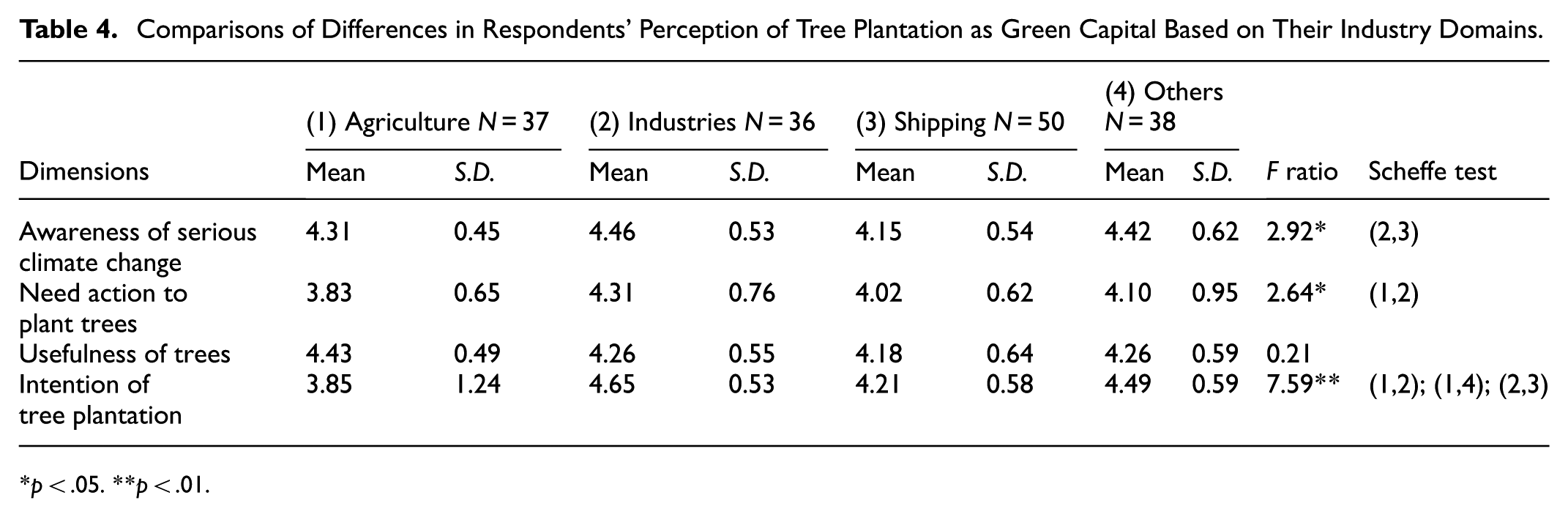
p < .05. **p < .01.
Similarly, for the need Action to plant tree dimensions, significant differences were observed according to the industry domain. Respondents from Industries had the highest mean score on the need to plant trees (mean = 4.31, S.D. = 0.76), followed by shipping (mean = 4.02, S.D. = 0.62) and agriculture (mean = 3.83, S.D. = 0.65). Moreover, the Intention of the tree-plantation dimension showed significant differences based on the industry domain. Respondents from Industries had the highest mean score on the tree-plantation intention dimension (mean = 4.65, S.D. = 0.53), followed by shipping (mean = 4.21, S.D. = 0.58), and agriculture had lowest mean score (mean = 3.85, S.D. = 1.24). Overall, the notable contrast in regulatory frameworks between the industries, shipping, and agriculture reflects the distinct challenges and priorities faced by each sector. Industries and shipping, with their complex operations and potential environmental impacts, are subject to rigorous environmental oversight.
Test the Relationships of Influences Among the Dimensions
Because we determined the underlying dimensions of the adoption of tree plantations, this study examined the hypothesised relationships among these dimensions using structural equation modelling (SEM). SEM was used to test the relationships among the dimensions and the hypotheses.
The overall model fit was assessed by X2(183) = 30.875, p < .01. As mentioned previously, the chi-square value tends is affected by a large sample size; therefore, examining other fit indices is advisable. In the final model, the CFI = 0.964, TLI = 0.941, and RMSEA = 0.050. All of these fit measures indicate that the hypothesised model fits the data well (Byrne, 2001). Estimations of the proposed structural model results are based on standardised coefficients and are shown in Figure 2.

Proposed structural model result.
The results of structural equation modelling (Figure 2) served as the basis for evaluating the hypotheses in this study.
The results also indicated that
To provide more evidence to support the proposed structural model of Green Capital (Tree Plantation), both the direct and indirect effects of Green Capital (Tree Plantation) dimensions on carbon emissions balance were examined. Table 5 showed that the relationship between usefulness of tree plantation and needs action of tree plantation had the strongest total effect (β = .50, p < .01). Followed by the relationship between awareness of serious climate change and intention of tree plantation (β = .45, p < .01), and the relationship between awareness of serious climate change on usefulness of tree plantation (β = .31, p < .01). While the relationship between need action of tree plantation and intention of tree plantation had the weakest total effect (β = −.21, p > .1), whereas this relationship was not supported by current data. Table 5 also showed that the total effect of the relationship between awareness of serious climate change and need action of tree plantation (β = −.12, p > .1) and the relationship between usefulness of tree plantation and intention of tree plantation (β = −.15, p > .1) were not significantly affected. Consequently, this study demonstrates that awareness of serious climate change has a positive effect on the usefulness and intention of tree plantation, and the usefulness of tree plantation has a positive effect on the need for tree plantation. Both direct and indirect effects on the carbon emission balance. However, the other hypotheses (H2, H5, and H6) did not show significant effects.
Effect of Green Capital dimensions on Carbon Emission Balance.
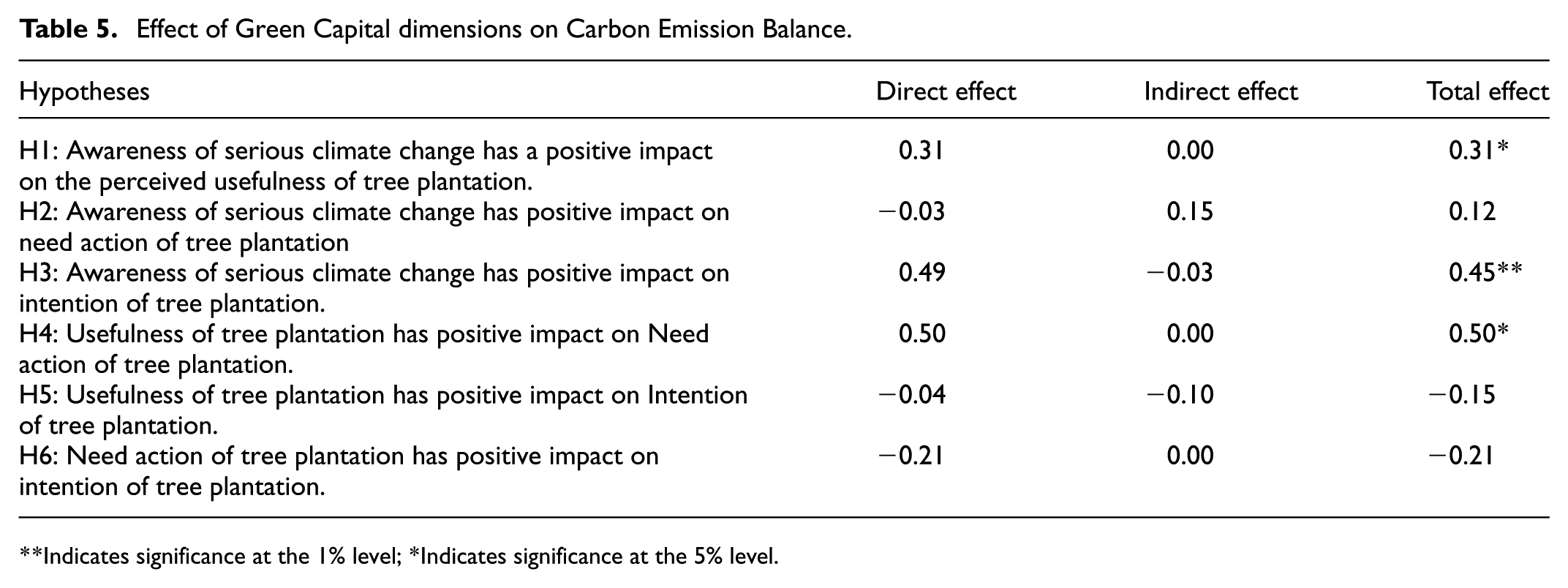
Indicates significance at the 1% level; *Indicates significance at the 5% level.
Discussion
Inadequate support for H2 arose from the fact that despite citizens acknowledging the severity of climate change, this awareness does not inherently translate into a willingness to engage in tree-planting activities. Conflicting objectives such as budgetary constraints or immediate survival needs may eclipse environmental concerns. Several individuals recognise climate change as a critical issue; nonetheless, they may not regard tree-planting as an immediate or practical solution, particularly when their primary focus is economic stability or meeting basic needs. The negative association observed in H5 suggests that despite individuals recognising the benefits of tree planting, various hurdles hinder their active participation. The absence of explicit incentives or immediate benefits diminishes motivation, as individuals may prioritise job stability and daily survival over long-term environmental activities. The perceived labour and time required for tree maintenance may dissuade individuals, particularly those who feel unqualified or lack the necessary resources. The long-term benefits of tree-planting may make it less appealing than the more pressing economic concerns. These factors collectively elucidate why the perceived benefits of tree-planting do not necessarily correlate with an increased likelihood of engaging in such activities.
Despite the consensus that trees need to be planted, H6 was not supported because external obstacles complicated action. Therefore, economic viability is an important issue. Many individuals or groups lack the funds to plant trees when they must address their fundamental survival needs, particularly in underdeveloped areas. People are considerably less likely to become engaged if significant official support such as subsidies or incentives, is lacking, because they may not immediately recognise the benefits of planting trees. Certain individuals may be unable to cultivate trees because of practical issues, such as a lack of water or space, or a lack of tree-care expertise. Renewable energy sources such as wind and solar power immediately reduce emissions by replacing fossil fuels, making them a more direct solution for carbon reduction (Ghasemi & Rajabi, 2022; W.-Y. Liu et al., 2022). Similarly, carbon capture technologies can remove CO2 from industrial emissions, although they are often expensive and require significant infrastructure investments (Wilberforce et al., 2021). A combination of strategies, including renewable energy expansion and carbon capture, may be necessary to achieve long-term emission reduction goals. In addition, to achieve a net-zero economy, governments are implementing new laws and policies such as carbon taxes and emission quotas. This makes it more difficult for businesses to earn money (Gavriilidis, 2021; Rodriguez Lopez et al., 2017). Climate policy uncertainty affects how much carbon companies emit, how much they invest, and their financial decisions (Gavriilidis, 2021). Although tree planting alone may not provide immediate emission reductions such as renewable energy or carbon capture technologies, its role as a Green Capital investment can enhance long-term sustainability. When supported by financial incentives and policy measures, tree plantations can complement other carbon-reduction strategies, making sustainability viable and impactful.
In light of the analysis results, people’s perception of the usefulness of planting trees is important, which is why the environmental and social benefits of this practice should be emphasised (Cole et al., 1993). Knowing the importance of tree plantation does not always motivate tree planting. Decisions are also affected by factors such as financial problems, living choices, and lack of resources. Targeted interventions and educational campaigns are even more important in tree-planting because of the complicated relationship between awareness, perceived need, perceived usefulness, and purpose. In developing countries such as Pakistan, encouraging tree-planting programmes means solving many issues that affect community involvement (Agboola & Emmanuel, 2016). Making more people aware of the environmental benefits of trees and how they directly affect their lives can improve the value of tree-planting projects, leading to more people joining (Alemu & Kidane, 2014).
Moreover, understanding the pressing usefulness and need for action in tree plantations is imperative. In underdeveloped countries, where environmental challenges are often exacerbated by factors such as deforestation and climate change, communities recognise the urgency of implementing solutions. Tree-planting has emerged as a tangible and practical strategy to address these challenges, prompting individuals to actively engage in tree-plantation efforts. Fostering the intention to plant trees is essential for sustaining momentum in tree-plantation initiatives. When individuals are committed to improving their environment through tree-planting, they are more likely to translate their intentions to action. This commitment drives community participation, leading to increased involvement in tree-plantation activities and positive outcomes for environmental conservation and sustainable development (Alemu & Kidane, 2014).
This discussion illustrates how awareness, perceived usefulness, understanding of the need to act, and purpose affect each other when planting trees in developing countries. Although some people are aware of climate problems, they prioritise daily survival over taking action to help the earth. Smart financial incentives are required to address this problem. Communities can plant trees and protect green areas with the help of the government or corporate investments. This method provides an economic basis for planting trees that meet both social and economic needs as well as climate risks. Communities can benefit from both the environment and economy by balancing environmental preservation with the ability to make a living. The study shows that regional ETS is not sufficient to meet global goals for reducing emissions, stressing the need for everyone to work together (Garcia et al., 2021; Wu et al., 2022). Various factors, such as raising awareness, acknowledging the benefits of tree planting, grasping the need for action, and fostering intentions to plant trees, synergistically support tree plantation initiatives and propel communities towards these efforts (Gobir et al., 2021; Marty & Yokochi, 2006; Samuel et al., 2018). By comprehensively addressing these factors, stakeholders can foster community engagement and contribute to environmental conservation and sustainable development.
Implications and Recommendations
The empirical findings reveal the essential paths and obstacles affecting the adoption of tree plantations as a type of Green Capital, offering several actionable lessons for policymakers, industry players, and environmental advocates. The significant favourable impact of understanding severe climate change on both the perceived usefulness of tree plantations and the intention to engage in tree plantation activities indicates that educational and awareness initiatives are essential. Policy initiatives must emphasise focussed communication tactics that highlight environmental urgency, while explicitly presenting tree planting as an effective, pragmatic solution for carbon mitigation. Enhancing awareness must transcend theoretical climate discussions and should be directly linked to the concrete advantages of tree plantations in regulated emissions markets.
The significant impact of tree plantations on the need for action highlights the need to showcase their functional and economic benefits. Industry leaders and environmental managers must establish and communicate explicit measurements and case studies demonstrating how tree plantations may produce carbon credit, generate green capital assets, and facilitate adherence to ETS. This evidence-based framing can transform attitudes towards tree-planting from a charitable or optional endeavour to a strategic investment with quantifiable returns. Nonetheless, the non-significant correlations, particularly between the need for action and intention, underscore the considerable motivational and structural impediments. The findings indicate that although individuals and organisations acknowledge the importance of tree planting, they may deprioritise it because of conflicting economic pressures, the absence of immediate rewards, and perceived resource requirements. This signifies an urgent need for policy frameworks that convert environmental goals into practical incentives. Governments and regulatory bodies should consider the formulation of subsidy schemes, tax incentives, and performance-based rewards to alleviate the economic and operational burdens of tree-plantation initiatives, particularly focussing on industries and communities where survival or economic stability is paramount.
Moreover, the tenuous connection between perceived utility and purpose indicates the need to enhance the accessibility and support mechanisms for tree-planting initiatives. Training, resource allocation, and community involvement programmes can diminish perceived labour or knowledge obstacles, rendering participation more attainable and appealing, particularly for lower-income or resource-limited stakeholders.
Conclusions
This study reveals what motivates people to want and do things that are beneficial for the world. Economic support for tree-planting programmes can make a big difference in improving the environment and economy in areas that are not well developed. The current study aims to protect forests and grow more trees worldwide, in line with the EU ETS and the UN’s Sustainable Development Goals (SDGs). Reducing deforestation and protecting trees are part of this project, which will help developing countries improve their economies. Projects deal with poverty and climate change by investing in Green Capital (tree planting) which creates jobs and slows climate change by absorbing carbon and restoring ecosystems (Nations, 2015; Okorie et al., 2017; Paustian et al., 2000; Smith et al., 1993). Large-scale afforestation, advocated by the United Nations, offers a planetary solution to combat climate change by cooling the environment and absorbing carbon dioxide (Parmesan & Hanley, 2015).
This study offers a global plan to encourage people to plant trees that combines ETS with Green Capital. Respondents from Pakistan, a developing country, supported the idea that this method could encourage people to join tree-planting efforts. The long-term goals of this project are to balance CO2 emissions and help struggling areas grow their economies. This plan uses Green Capital and ETS incentives to help the economy grow and protect the environment. When the EFA identified the four underlying dimensions, we applied SEM to examine the relationships between these dimensions. Notably, the relationships between dimensions highlighted positive impacts on awareness leading to action, while the relationships with negative impacts between the “Need action to plant trees” and “Intention of tree plantation,” and the “Usefulness of trees” and “Intention of tree plantation” indeed appears counterintuitive. These results partially comply with the TAM which has been applied in other empirical studies (Bueno & Salmeron, 2008; Davis et al., 1989; Hu et al., 1999; Mathieson, 1991; Straub et al., 1995; Tsai, 2017; Yoon, 2009), and is considered the most parsimonious, predictive, and robust (Venkatesh & Davis, 2000). Despite sampling limitations, adapting the TAM to formulate the Green Capital Model signifies a notable theoretical advancement. In contrast, earlier research predominantly utilised the TAM in technological adoption scenarios. Our framework broadens its application to encompass environmental behaviour, particularly green capital and tree-planting activities. This represents a novel contribution, as no previous research has applied the TAM in this situation. Our model integrates dimensions, such as environmental awareness and perceived ecological advantages, connects technology acceptance theories with pro-environmental behaviour, and provides a novel framework for understanding green capital adoption. In previous studies, including those by Gobir et al. (2021), Kangalawe and Lyimo (2013), Alemu and Kidane (2014), Griscom et al. (2017), and Domke et al. (2020), hypotheses 2, 5, and 6 were supported. However, in our study, the answers to questions such as “I would plant more trees if tree plantations had monetary returns,”“I would contribute to forest growth if forestry created jobs,” and “I would increase forest growth if forestry were an investment in the economy” showed strong agreement. The data revealed that economic barriers were a critical factor preventing intentions from translating into actionable outcomes. This finding highlights the pivotal role of economic incentives in driving forest growth initiatives. Future research should focus on identifying effective economic support systems such as subsidies, grants, or market-based incentives that can bridge the gap between intention and action. The unsupported hypotheses underscore a significant challenge for environmental policies: public willingness alone is insufficient to achieve large-scale forest growth without addressing the underlying economic constraints. These findings have important implications for both policymakers and stakeholders. To address this, governments and organisations must prioritise financial incentives such as payments for ecosystem services, job creation programmes in forestry, and investments in sustainable forest management. Collaborative efforts between governments, businesses, and communities are essential for providing the necessary resources and making forest growth economically viable. Additionally, while the respondents recognised the benefits of forest growth, there is need for targeted educational campaigns to inform stakeholders about the economic potential of forests. By addressing these gaps, this study contributes to a more nuanced understanding of the interplay between economic barriers and environmental action, offering actionable insights for future research and policy development.
Forest conservation could lead to business options, such as ecotourism or sustainable forestry, which could bring economic support to local communities and help with conservation efforts. Economic interests can be aligned with ecological goals by linking financial rewards to environmental goals. This will lead to more people investing in and participating in forest growth projects. Individuals in developing nations, such as Pakistan, often have to put immediate wants ahead of long-term environmental concerns, such as planting trees. Despite knowing how important it is to plant trees, financial survival comes first, creating a gap between purpose and action. Interventions that reduce poverty, offer financial rewards for environmentally friendly actions, and spread information about the advantages of tree-planting are required to solve this problem. In underdeveloped countries, the gap between intentions and actions in tree-planting attempts can be reduced by addressing the causes of financial insecurity. This includes thinking about how useful and easy something is to use, cultural and societal norms, economic factors, organisational support, legal compliance, environmental factors, psychological views, education levels, peer pressure, and media action (Bueno & Salmeron, 2008; Davis et al., 1989; I.-F. Liu et al., 2010; Sternad et al., 2011; Sternad & Bobek, 2013).
As companies increasingly emphasise ESG initiatives, they pursue sustainable solutions to reduce their environmental footprints, improve social responsibility, and bolster governance. Robust ESG performance attracts environmentally concerned investors, enhances financial results, and guarantees regulatory adherence (Lee et al., 2024). In this context, tree plantations represent a feasible Green Capital solution that provides a natural and efficient method to mitigate carbon emissions while enhancing biodiversity and ecosystem restoration. By incorporating tree-planting into their ESG initiatives, organisations achieve regulatory obligations and sustainability goals while simultaneously enhancing brand recognition and stakeholder confidence. The increasing focus on ESG has generated heightened demand for Green Capital, establishing tree plantations as a crucial instrument for enterprises seeking long-term sustainability and financial stability.
Making Green Capital a worldwide sign of dedication to a sustainable earth encourages a mindset of caring for the planet. Although the study was mostly conducted in Pakistan, it can help poor countries with similar environmental and social problems.
Footnotes
Appendix
Questionnaire
Part I: Green Capital Attributes.

| Level of agreement | ||||||
|---|---|---|---|---|---|---|
| Strongly disagree |

|
Strongly agree | ||||
| Please indicate, from your point of view, your agreement with each item in the current condition regarding the environment and CO2 reduction (1 = strongly disagree, 2 = disagree, 3 = neutral, 4 = agree, 5 = strongly agree) | 1 | 2 | 3 | 4 | 5 | |
| 1. | The environment is worsened by greenhouse gases… | □ | □ | □ | □ | □ |
| 2. | Greenhouse gases have serious impact climate change… | □ | □ | □ | □ | □ |
| 3. | Carbon content is historically high on earth now… | □ | □ | □ | □ | □ |
| 4. | Greenhouse gases worsen the environment … | □ | □ | □ | □ | □ |
| 5. | Greenhouse gases emission needs to be reduced immediately… | □ | □ | □ | □ | □ |
| 6. | Planting trees and maintaining forests can help neutralize carbon emission… | □ | □ | □ | □ | □ |
| 7. | I think planting trees and forests can absorb carbon from the atmosphere … | □ | □ | □ | □ | □ |
| 8. | I think tree plantation is essential for the environment… | □ | □ | □ | □ | □ |
| 9. | I think planting more trees can reduce the carbon problem… | □ | □ | □ | □ | □ |
| 10. | I think investing in forest protection can protect the earth … | □ | □ | □ | □ | □ |
| 11. | I think forests play a vital role against climate change… | □ | □ | □ | □ | □ |
| 12. | I think the plantation of trees reduces the impact of greenhouse gases on the environment… | □ | □ | □ | □ | □ |
| 13 | I think trees can neutralize carbon emission … | □ | □ | □ | □ | □ |
| 14 | I think we must act for air pollution… | □ | □ | □ | □ | □ |
| 15 | I think we need to start campaigns for climate change … | □ | □ | □ | □ | □ |
| 16 | I think spreading greenery is my responsibility… | □ | □ | □ | □ | □ |
| 17 | I think climate change is a priority for the current generation. | □ | □ | □ | □ | □ |
| 18 | I think we need to plant more trees to protect the environment… | □ | □ | □ | □ | □ |
| 19 | I think we need to plant more trees to reduce air pollution… | □ | □ | □ | □ | □ |
| 20 | I think organizations must adopt good practices for climate change… | □ | □ | □ | □ | □ |
| 21 | I think organizations should invest in growing forests to reduce Carbon emission… | □ | □ | □ | □ | □ |
| 22 | I have more intention toward environment friendly practices… | □ | □ | □ | □ | □ |
| 23 | I will do my best to reduce carbon content through tree plantation … | □ | □ | □ | □ | □ |
| 24 | I like to contribute to tree protection in my daily life….. | □ | □ | □ | □ | □ |
| 25 | I will encourage organizations to invest in forests… | □ | □ | □ | □ | □ |
| 26 | I would plant more trees if tree plantations had monetary returns… | □ | □ | □ | □ | □ |
| 27 | I would increase forest growth if forestry was employment… | □ | □ | □ | □ | □ |
| 28 | I would increase forest growth if forestry was an economic investment… | □ | □ | □ | □ | □ |

Ethical Considerations
Not applicable.
Consent to Participate
The study was voluntary, and all participants were aware of its purpose and the ability to withdraw at any time. Informed consent was obtained before participation.
Consent for Publication
Not applicable.
Author Contributions
Chaur-Luh Tsai: Research concept development, Investigation, Writing - original draft, review & editing. Majid Ali: Investigation, Writing - original draft, & editing. Chitsan Lin: Editing, Content proofreading. Aimal: Investigating, Analysis. Nimra: Investigating, Analysis.
Funding
The authors received no financial support for the research, authorship, and/or publication of this article.
Declaration of Conflicting Interests
The authors declared no potential conflicts of interest with respect to the research, authorship, and/or publication of this article.
Data Availability Statement
Data sharing not applicable to this article as no datasets were generated or analysed during the current study.