



Abstract
Against the backdrop of rapid advancements in information technology, Information and Communication Technology (ICT) has been widely applied in art education. Whether teachers accept and use these tools largely depends on their digital literacy. This study explores how teachers’ digital literacy influences their ICT integration intention based on the Extended Technology Acceptance Model (TAM2). This study surveyed 580 art education teachers using validated scales to measure variables, including the Digital Literacy Scale, Image Scale, among others. Structural equation modeling analyzed the relationships among these variables. The study found that the proposed model explains 65% of the variance in ICT integration intention. Digital literacy significantly influences perceived usefulness and perceived ease of use. Subjective norms directly and positively affect ICT integration intention and indirectly influence it through image and perceived usefulness, but the indirect effect accounts for less than 20% of the total effect. ICT output quality significantly impacts perceived usefulness, while job relevance and result demonstrability do not. This study demonstrates that enhancing teachers’ digital literacy, improving subjective norms, image, and ICT output quality can strengthen ICT integration intention. These findings support ICT promotion in education and offer practical recommendations for policymakers and administrators.
Introduction
The continuous surge in technological progress has led to a widespread digital shift, especially within the education sector, where ICT are redefining how teaching occurs and how learners engage with content, effectively moving away from long-standing pedagogical routines. In the context of art education, while artistic creation and expression take diverse forms, the widespread adoption of digital technologies has led many art educators to integrate ICT into their daily teaching practices, aiming to provide richer and more varied learning experiences (Hui et al., 2022). Given their central role in the educational system in the educational process, teachers’ acceptance of ICT directly affects the practical application of these tools and the improvement of educational quality. Therefore, understanding and promoting art education teachers’ acceptance and use of ICT has become a critical topic in contemporary art education research.
ICT refers to a broad range of technologies and tools used for collecting, transmitting, processing, and presenting information. It encompasses computer hardware and software, network infrastructure, mobile devices, multimedia applications, and internet services (Denić & Petković, 2023; Momčilović & Ninković, 2024). Currently, ICT has been applied across various fields, including education, environmental protection, healthcare, employment, and business development (Appiah-Otoo et al., 2023; Kumar & Kumar, 2022; Mijailovic et al., 2022; Mlambo et al., 2022). Within art education, the integration of ICT has greatly improved both instructional methods and learning outcomes. It not only broadens the modes of expression and communication between teachers and students but also strengthens students’ engagement and creativity (Stojanovic, 2023). ICT provides new platforms for traditional art forms and fosters interdisciplinary learning experiences (Villares & Sánchez, 2022). Through multimedia teaching materials, online resources, and remote collaboration tools, teaching has become more dynamic and intuitive, sparking students’ interest (Escala et al., 2024). New technologies, such as digital creation software, 3D printing, and electronic drawing tablets, break the limitations of traditional media and greatly expand the possibilities for artistic creation (Bernaschina, 2020; Nocheseda et al., 2023; Qiu & Zhang, 2023). However, despite the numerous advantages of ICT, its practical application still faces several challenges. Art education teachers, as key figures in cultivating students’ creativity, esthetic awareness, and cultural understanding, play a critical role in determining the successful adoption and integration of ICT tools. Therefore, studying art education teachers’ ICT integration intention holds significant practical value.
In the context of the digital age, digital literacy (DL), defined as an individual’s ability to effectively access, understand, evaluate, and create information in digital environments, has gradually emerged as a core competency for educators. Lately, studies concerning DL have concentrated chiefly on examining its influence on behavioral intentions across various populations (Aldekhyyel et al., 2024; Ramli & Mohamad Arsad, 2023; Sadik Tatli et al., 2023). However, within the field of art education, particularly concerning art teachers’ ICT integration intention, relevant studies remain limited. Existing literature predominantly emphasizes students’ technological acceptance, while the intentions and behaviors of art teachers in this regard have received comparatively little attention, especially in terms of how ICT are integrated into art education practices. TAM2, which extends the original TAM by incorporating additional socio-psychological variables such as subjective norms (SN) and image (IMG), enhances the explanatory power for technology adoption behaviors (Venkatesh & Davis, 2000). Numerous studies have applied TAM2 to explore technology acceptance across diverse domains (Altawalbeh, 2023; Belda-Medina & Calvo-Ferrer, 2022; DiMartini et al., 2023; A. Wang et al., 2024). While some studies have integrated DL into TAM as a predictor, confirming its indirect effect on ICT integration intentions through perceived usefulness (PU) and perceived ease of use (PEOU), few have explored the integration of DL within the TAM2 framework.
Consequently, this research seeks to fill two key gaps identified in the current use of ICT within the educational context. By incorporating DL as a key variable into the TAM2 model, the current research investigates its influence on art teachers’ ICT integration intention from two perspectives: the characteristics of the technology itself and the professional attributes of teachers. This model not only builds upon the strengths of the traditional technology acceptance framework but also introduces DL as a novel construct, offering a more comprehensive perspective for understanding art teachers’ ICT integration intention into their instructional practices. Accordingly, this study seeks to fill these research gaps through an empirical investigation of the following questions:
1. How does DL influence art education teachers’ ICT integration intention?
2. Which specific characteristics of ICT affect art education teachers’ ICT integration intention?
3. To what extent can the proposed model explain the variance in art education teachers’ ICT integration intention?
The structure of the article is as follows: The second section is the theoretical framework and research hypotheses; the third section provides a detailed explanation of the research methods; the fourth section presents the research results; the fifth section is the discussion, including research findings, theoretical implications, practical implications, research limitations, and suggestions for future research; the final section is the conclusion of this study.
Literature Review and Research Hypotheses
Literature Review
TAM2
TAM was proposed by Davis (1989) to explain that individuals’ motivation to use new technologies is influenced by their PU and PEOU, which positively predict users’ intention and behavior toward adopting the technology. Building on TAM, Venkatesh and Davis (2000) developed TAM2, recognizing that, beyond PU and PEOU, factors such as SN, IMG, job relevance (JR), output quality (OQ), and result demonstrability (RD) also play significant roles in shaping users’ attitudes and intentions to adopt new technologies. PU describes how strongly an individual believes that adopting a particular technology will improve their job effectiveness or productivity. PEOU indicates how much effort a user believes is necessary to operate a given technology. SN refer to the social pressure individuals feel, particularly the perceived opinions of significant people or groups regarding performing a specific behavior. IMG refers to the extent to which using the technology enhances an individual’s IMG or social status. JR is the degree to which individuals perceive the new technology as relevant to their current job tasks. OQ refers to the perceived quality of results produced by using the new technology for the task at hand. RD refers to the tangibility or observability of the outcomes achieved through the use of the technology.
TAM2 has been extensively adopted in numerous disciplines to examine and forecast how individuals accept and intend to utilize emerging technologies. These fields include educational technology (Altawalbeh, 2023; Doo, 2023), healthcare (DiMartini et al., 2023; Thakkar & Bharathi, 2023), artificial intelligence (Belda-Medina & Calvo-Ferrer, 2022; A. Wang et al., 2024), and financial services (Kasemharuethaisuk & Samanchuen, 2023; Kim & Kim, 2022), among others. For instance, in the financial services sector, Kasemharuethaisuk and Samanchuen (2023) employed the TAM2 framework to examine the determinants affecting Thai retail investors’ acceptance of digital investment platforms provided by brokerage companies, with the model accounting for 60% of their intention to use such services. Similarly, Alwreikat et al. (2023) employed TAM2 to analyze Arab scholars’ intentions to use informal academic communication tools, finding that the model accounted for 83.9% of usage intention. Izuagbe et al. (2022) examined faculty members’ intentions to use electronic databases, revealing that the JR, OQ, and RD of electronic databases significantly and positively influenced their usage intentions. However, studies exploring the connection between DL and ICT integration intention within the realm of art education are still relatively scarce. In particular, existing studies have not sufficiently considered DL as a critical variable influencing art teachers’ ICT integration intention.
Additionally, researchers have expanded the original TAM2 by introducing new constructs such as perceived risk, trust, security, and perceived fear to further explore how the model influences users’ behavioral intentions (Jörling et al., 2023; Kim & Kim, 2022; Obidat et al., 2022). For example, Jörling et al. (2023) investigated the factors influencing individuals’ willingness to voluntarily report infections through COVID-19 tracking applications by incorporating trust and perceived fear into TAM2, with the model explaining 49% of the reporting intention. Similarly, Kim and Kim (2022) extended the TAM2 model by including perceived risk to examine how various factors affect users’ intention to adopt mobile payment systems. Their findings showed that the model accounted for 48% of the variance in usage intention. While prior research has examined the linkage between DL and TAM (AbdulKareem & Oladimeji, 2024; Nazzal et al., 2021; Nikou et al., 2022; Ullah et al., 2022), research in the context of art education remains limited. For example, Nazzal et al. (2021) incorporated DL into the TAM framework to examine its influence on internet users’ online purchase intentions. Their findings revealed that DL significantly affects PU, PEOU, and online purchase intention. Similarly, Yao and Wang (2024) found that among pre-service special education teachers, DL not only enhanced their PEOU of AI-based educational tools but also increased their PU of such tools. However, current research has paid limited attention to DL in the context of art education, with most studies focusing on university students’ acceptance and continued use of new technologies, rather than on the unique experiences of art teachers. Therefore, integrating DL into the TAM2 is particularly important for enriching the theoretical framework of technology acceptance. In art education, teachers’ DL not only shapes their perceptions of technological tools but also potentially influences their ICT integration intention. Further exploration of this mechanism will deepen our understanding of technology acceptance and provide empirical support for teacher training and the effective implementation of educational technologies.
Digital Literacy
Digital literacy refers to an individual’s ability to effectively, critically, and creatively access, comprehend, evaluate, utilize, and create digital information within digital environments (Law et al., 2018). Across academic contexts, this concept has been expanded to encompass a range of competencies that teachers must possess, including but not limited to innovative thinking, exploratory skills, teamwork, and critical thinking, especially when utilizing digital technologies for teaching (Lim, 2023). Marsh (2018) categorized DL into three stages: digital use, digital competence, and digital transformation. With advancements in information technology and its widespread application in education, art education teachers are now facing higher demands, not only mastering basic Information Technology skills but also successfully incorporating digital technologies into art instruction and creative practice (Amon, 2023). Furthermore, research indicates that a high level of DL serves a crucial function in enhancing teaching quality and helping students adapt to a rapidly changing societal landscape (Damanik & Widodo, 2024).
Prior studies have investigated the effects of DL on users’ intention to integrate new technologies based on TAM (Nazzal et al., 2021; Nikou et al., 2022; Ullah et al., 2022; Yao & Wang, 2024). For instance, Ullah et al. (2022) assessed the contribution of DL to individual banking users’ intention to adopt mobile payment technologies, finding that individuals possessing stronger DL were more inclined to embrace and utilize mobile payment technologies. Nikou et al. (2022) further examined the impact of information and DL on employees’ digital technologies integration intention, revealing that DL primarily influences usage intention indirectly by enhancing PEOU. Yao and Wang (2024) examined the determinants influencing the behavioral intentions of pre-service special education teachers regarding the use of AI-based educational technologies. Their findings demonstrated that DL indirectly influences behavioral intention through both PU and PEOU. This implies that, for special education teachers, DL not only increases their recognition of the value of technological tools but also reduces the perceived difficulty of using these tools, thus increasing their intention to embrace emerging technologies. In art education, the enhancement of DL goes beyond mere technical proficiency; it also encompasses the ability to effectively integrate technology into the teaching of artistic creation. Art teachers’ ICT integration intention is influenced by both their level of DL and the inherent characteristics of the technology itself. To effectively incorporate information and communication technologies into creative instruction and improve teaching outcomes, teachers must possess a high level of DL. Therefore, investigating the role of DL in art teachers’ technology integration holds significant practical and theoretical value. The present study is situated within the field of art education, aiming to provide a more comprehensive analysis of how DL impacts art education teachers’ ICT integration intention and to explore the various factors influencing this intention.
Research Hypotheses
Digital Literacy, Perceived Usefulness, Perceived Ease of Use, and ICT Integration Intention
A substantial body of research has confirmed that DL significantly and positively influences PU and PEOU (Nazzal et al., 2021; Nikou et al., 2022; Ullah et al., 2022; Yao & Wang, 2024). For example, Nikou et al. (2022) investigated how information and DL facilitate employees’ acceptance of digital technologies, finding that higher levels of DL significantly enhanced employees’ PEOU of these technologies. Similarly, Yao and Wang (2024) found that among pre-service special education teachers, DL not only improved their PEOU of AI educational tools but also increased their PU of these tools.
Based on the original TAM, numerous studies have confirmed the relationships among PU, PEOU, and ICT integration intention (Arthur, 2022; Jamali et al., 2024; Saleh et al., 2022; Sulistiyo et al., 2022). For instance, Sulistiyo et al. (2022) analyzed students’ ICT integration intention in the context of English language learning, finding that both PU and PEOU significantly promoted ICT integration intention. Moreover, PEOU indirectly enhanced usage intention by increasing PU. Similarly, Saleh et al. (2022) investigated the continued intention of sustainable e-learning and highlighted that both PU and PEOU are key factors for improving the continued intention of both students and teachers, with PEOU further enhancing PU. Additionally, Arthur (2022) evaluated the integration intention and acceptance of ICT among secondary school mathematics teachers, revealing that PU and PEOU jointly influence teachers’ ICT integration intention, underscoring the importance of these factors in promoting technology integration in classroom teaching. Building on these findings, this study hypothesizes that during ICT use, art education teachers with higher DL are more likely to exhibit stronger PU and PEOU, which in turn strengthens their ICT integration intention. Therefore, the following hypotheses are proposed:
Subjective Norms, Image, Perceived Usefulness, and ICT Integration Intention
Many studies have confirmed the close relationships among SN, IMG, PU, and ICT integration intention (Altawalbeh, 2023; Baah-Peprah, 2023; Doo, 2023; Salah & Alyouzbaky, 2023). For example, Doo (2023) explored how peer and societal pressures shape learners’ decisions regarding the adoption of flipped classrooms. The study demonstrated that SN played a notably positive role in driving students’ intent to engage with this instructional format. Similarly, Altawalbeh (2023) examined Jordanian academic staff’s learning management systems integration intention after returning to work post-pandemic, finding that SN not only enhanced lecturers’ IMG but also strengthened their continued intention to use these technological tools. Moreover, the lecturers’ personal IMG positively influenced their PU of the system. Baah-Peprah (2023), from the perspective of crowdfunding supporters, demonstrated that SN promote contribution intention by enhancing supporters’ IMG and highlighted that their IMG also strengthens their PU of the platform. Based on these studies, it can be inferred that when art education teachers use ICT, stronger SN leads to a more positive perception of their self-IMG, which in turn promotes their PU of ICT and ultimately enhances their intention to integrate ICT into teaching practices. Furthermore, the improvement in teachers’ IMG also contributes to an increased perception of ICT usefulness. Therefore, this study aims to test the following hypotheses:
Job Relevance, Output Quality, Result Demonstrability, and Perceived Usefulness
Numerous studies have confirmed the relationships between JR, OQ, RD, and PU (Altawalbeh, 2023; Baah-Peprah, 2023; Salah & Alyouzbaky, 2023; Steinert et al., 2025). For instance, Salah and Alyouzbaky (2023) focused on doctors’ Internet of Things technology integration intention in the medical field, finding that JR and RD are critical factors determining PU of Internet of Things technology among doctors. Similarly, Altawalbeh (2023) examined Jordanian academic staff’s learning management systems integration intention after returning to work post-pandemic, revealing that JR, OQ, and RD all positively influence PU. Additionally, Baah-Peprah (2023) explored fundraisers’ intentions to use crowdfunding platforms, demonstrating that JR, OQ, and RD significantly and positively affect PU. Based on these findings, this study posits that when art education teachers use ICT, stronger JR, higher OQ, and better RD will enhance their PU of the technology, thereby encouraging its integration into art teaching activities. Therefore, the following hypotheses are proposed:
Accordingly, the proposed research model derived from the aforementioned hypotheses is presented in Figure 1. This figure depicts how DL impacts the ICT integration intention, both directly and through mediating variables, with the goal of offering a holistic view of the determinants and underlying mechanisms influencing teachers’ ICT integration intention in their professional practice.

Research hypothesis model.
Methods
Sample and Data Collection
Between March and December 2024, this study employed an online survey platform (https://www.wjx.cn/) to collect data for testing the proposed theoretical framework. To ensure the diversity and representativeness of the sample, participants were randomly selected from five universities in Liaoning Province. In collaboration with school administrations, the email addresses and contact information of all employed art education teachers were obtained. A simple random sampling method was applied using computer-generated random number lists to select participants from each school’s roster. Selected teachers received standardized invitation emails outlining the study’s purpose, procedures, and significance, along with a link to the questionnaire. The email emphasized voluntary participation and assured the confidentiality of personal information. Prior to filling out the questionnaire, participants were asked to sign an online informed consent form, ensuring they understood the research process and agreed to participate willingly. This approach adhered to ethical guidelines while enhancing the fairness and reliability of the data collection process. Out of 627 questionnaires distributed, 580 were successfully returned and collected for analysis. A total of 47 cases were excluded from the analysis based on the following two criteria: (1) if more than 20% of a questionnaire’s items were unanswered, it was deemed invalid. (2) if participants consistently chose extreme options, such as “completely agree” or “completely disagree,” for over 80% of the items, their responses were excluded. These types of response tendencies may introduce substantial bias, commonly referred to as floor or ceiling effects, thereby reducing the precision and reliability of the data analysis (D. Wang et al., 2012). Consequently, this study analyzed data from 580 valid responses (Gao, 2025). In the present research, up to six paths were directed toward each endogenous latent variable. According to F. Hair et al. (2014), to achieve an R2 value of .10 with a significance level of 1%, a minimum sample size of 91 is required. By fulfilling the sample size threshold, this study reinforces the credibility and stability of its analytical outcomes.
Significant differences were found in ICT integration intention across gender (p < .05), age (p < .001), teaching experience (p < .001), and educational background (p < .001). This representative sample provides a solid foundation for analyzing the impact of DL on art education teachers’ ICT integration intention. The diversity and size of the sample contribute to ensuring the generalizability of the study’s findings to a broader population of teachers within this research context (Table 1).
Demographic Characteristics of the Sample.

Measurement Tools
The questionnaire collected participants’ demographic information and self-reported data using validated scales to assess the variables. Some scale items were modified to better align with the research context and target population. For instance, in the perceived ease of use scale, the original item “My interaction with the system is clear and understandable” was adjusted to “I find the use of ICT clear and easy to understand,” to more accurately reflect participants’ experiences within the specific research context. Similarly, in the digital literacy scale, the original item “I know about the ICT resources that enhance the mastery in my subject” was revised to “I am familiar with ICT resources that support learning in art education.” These adjustments ensured the items were more relevant and relatable to the participants, thereby enhancing the validity and reliability of the data collected in this study.
In addition to basic demographic information, the questionnaire included key constructs such as digital literacy, perceived usefulness, perceived ease of use, subjective norms, image, job relevance, output quality, result demonstrability, and ICT integration intention. Each construct was measured using a 7-point Likert scale, ranging from (1) “Strongly Disagree” to (7) “Strongly Agree.”
The digital literacy scale was adapted from the study by Yao and Wang (2024). This scale evaluates individuals’ proficiency and ability to perform tasks on various digital platforms and comprises three dimensions: digital knowledge, digital application, and digital attitude, with a total of 12 items (e.g., “I am familiar with ICT resources that support learning in art education”). In this study, the Cronbach’s alpha for the digital literacy scale was .91, indicating high reliability.
The subjective norms scale was adapted from the study by Lu et al. (2024). This scale assesses the extent to which users feel influenced by societal perceptions of ICT usage, comprising three items (e.g., “Teachers at my school approve of my use of ICT in art teaching”). In this study, the Cronbach’s alpha for the subjective norms scale was .69, demonstrating acceptable reliability.
The ICT integration intention scale was adapted from the study by Rahmata and Au (2012). This scale evaluates users’ willingness to integrate ICT into their work in the future, consisting of six items (e.g., “I intend to use ICT more frequently in my art classes”). In this study, the Cronbach’s alpha for the ICT integration intention scale was .85, indicating good reliability.
The perceived usefulness scale was adapted from A. Wang et al. (2024) and measured the extent to which users perceive ICT as beneficial for teaching and learning. It included four items (e.g., “Using ICT can improve my performance in art teaching”). In this study, the scale’s Cronbach’s alpha was .81, demonstrating good reliability.
The perceived ease of use scale, also adapted from A. Wang et al. (2024), measured users’ perceptions of the ease of learning and operating ICT. It consisted of four items (e.g., “I find the use of ICT clear and easy to understand”). The Cronbach’s alpha for this scale was .83, indicating good reliability.
The image scale, based on A. Wang et al. (2024), assessed the extent to which using ICT enhances an individual’s image or social status. It included three items (e.g., “In my school, teachers who use ICT have more prestige than those who do not”). The Cronbach’s alpha for this scale was .80, showing good reliability.
The job relevance scale, adapted from A. Wang et al. (2024), measured the extent to which individuals perceive the relevance of ICT to their current tasks. It consisted of two items (e.g., “Using ICT in my art class is very important”). The scale’s Cronbach’s alpha was .72, indicating acceptable reliability.
The output quality scale, also adapted from A. Wang et al. (2024), assessed the perceived quality of results produced using ICT for current tasks. It included two items (e.g., “The teaching outcomes I achieve using ICT are of high quality”). The Cronbach’s alpha for this scale was .75, demonstrating good reliability.
The result demonstrability scale, adapted from A. Wang et al. (2024), measured the tangibility or observability of outcomes achieved through the use of ICT. It consisted of four items (e.g., “I can easily explain to others the outcomes resulting from the use of ICT”). The scale’s Cronbach’s alpha was .76, demonstrating good reliability.
This study conducted the Kaiser-Meyer-Olkin (KMO) test and Bartlett’s test of sphericity on all 40 measurement items. The results showed a KMO value of 0.984 and a statistically significant Bartlett’s test (p < .001), indicating that the data were suitable for structural modeling analysis.
To ensure the quality of the questionnaire, two experts with different areas of expertise were invited to assist with translation. One was a professional proficient in ICT and bilingual in English and Chinese, while the other was an expert in Chinese linguistics. They translated the original English questionnaire into Chinese, compared the two versions, and resolved any significant discrepancies to produce a unified version. The finalized version was then pretested with 20 art education teachers. Any inconsistencies with the original English content or unclear expressions identified during the pretest were corrected, resulting in the finalized Chinese questionnaire.
Data Analysis
In this study, data analysis was conducted in two main stages. First, IBM SPSS 26 software was used to examine the reliability, validity, and multicollinearity of the scales to ensure their applicability and the reliability of the data quality within the research sample. Second, the Partial Least Squares Structural Equation Modeling (PLS-SEM) approach was employed to test the significance of the model relationships, the explanatory power of the model (R2), and its predictive relevance (Q2). This method was chosen due to its suitability for exploring complex relationships among constructs and its ability to handle small to medium sample sizes.
Results
Multicollinearity Test
To ensure the stability of the model and the validity of its interpretations, a detailed diagnosis of multicollinearity among independent variables was conducted. Using SPSS software, the Tolerance and Variance Inflation Factor (VIF) values of each independent variable were calculated to assess potential multicollinearity issues. The data in Table 2 indicate that all variables have Tolerance values greater than 0.1, and VIF values range from 2.60 to 4.26. A Tolerance value greater than 0.1 suggests the absence of severe multicollinearity, while a VIF value below 3.3 is considered ideal, and a value below five is deemed acceptable (J. F. Hair et al., 2019) . These results imply that multicollinearity has an acceptable influence on this study.
Multicollinearity Test of the Structural Model.

R2 and Q2
R2 is an indicator that measures the degree to which independent variables explain the variance of dependent variables within a model. It reflects the overall effect of exogenous variables on endogenous variables. According to Chin (1998), R 2 values can be interpreted as follows: .67 indicates strong explanatory power, .33 suggests moderate explanatory power, and .19 represents weak explanatory power. In this study, the R2 value for the dependent variable, ICT integration intention, reached .65, meaning approximately 65% of the variance in the dependent variable can be explained by the independent variables. This demonstrates that the research model exhibits strong explanatory capability.
However, J. Hair et al. (2023) caution that R2 alone is insufficient to fully reflect the overall quality of the model. To provide a more comprehensive assessment of the model’s predictive capability, this study employed the Stone-Geisser Q2 test (Geisser, 1974; Stone, 1974). This method, implemented through the blindfolding procedure, evaluates the predictive relevance of the structural model for external data. A Q2 value greater than zero indicates that the latent exogenous variables in the model possess predictive accuracy for the endogenous variables (Chin, 1998). In this study, the Q2 value for ICT integration intention was .71, indicating that the model has predictive relevance and can effectively predict changes in the endogenous variable based on the exogenous variables.
Path Hypothesis Analysis
In analyzing the structural model, significance tests were conducted to determine whether the effects of exogenous variables on endogenous variables were significant. The results in Table 3 and Figure 2 show the following: For factors influencing PU, DL had the largest effect (β = .26, t = 5.04, p < .001), followed by PEOU (β = .24, t = 5.07, p < .001), IMG (β = .15, t = 2.87, p < .01), and OQ (β = .13, t = 2.65, p < .01). Thus, H1, H5, H8, and H10 are supported. However, JR and RD had no significant effects on PU, so H9 and H11 are not supported. For factors influencing ICT integration intention, PU had the largest effect (β = .35, t = 7.96, p < .001), followed by PEOU (β = .22, t = 4.53, p < .001) and SN (β = .34, t = 7.28, p < .001). Thus, H3, H4, and H7 are supported. In addition, DL significantly and positively influenced PEOU (β = .76, t = 44.64, p < .001), supporting H2. SN significantly and positively influenced IMG (β = .66, t = 27.32, p < .001), supporting H6.
Path Hypothesis Testing Results.


Path coefficients after bootstrapping.
Mediation Effect Analysis
Prior to conducting mediation analysis, the mediation model was evaluated, yielding acceptable fit indices (SRMR = 0.10, NFI = 0.79). Mediation effects were analyzed using the bootstrapping method in PLS-SEM. Table 4 presents the mediation effects among different variables. The results indicate that: DL has a significant indirect effect on PU through PEOU (β = .18, t = 5.03, p < .001), and its direct effect is also significant, suggesting that PEOU serves as a partial mediator in this relationship. PEOU has a significant indirect effect on ICT integration intention through PU (β = .08, t = 4.54, p < .001), with a significant direct effect as well, indicating that PU plays a partial mediating role in this relationship. SN have a significant indirect effect on ICT integration intention through IMG and PU (β = .03, t = 2.58, p < .05), and the direct effect is also significant. However, the indirect effect accounts for less than 20% of the total effect, indicating a weak partial mediation.
Mediation Effect Analysis.
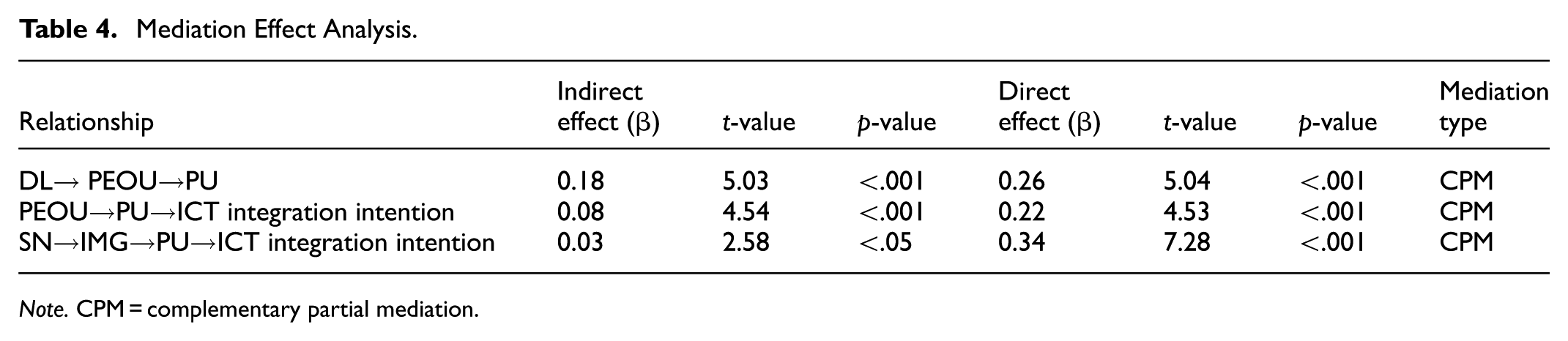
Note. CPM = complementary partial mediation.
Discussion
This study, based on TAM2, delves into the factors influencing art education teachers’ ICT integration intention, placing specific emphasis on the mediating effects of DL on ICT integration intention. Drawing on prior research, the study posits that art educators’ digital capabilities shape their willingness to adopt ICT not directly, but through the influencing roles of PU and PEOU. Additionally, SN and IMG were identified as critical predictors of teachers’ intention to integrate ICT into teaching. Furthermore, ICT OQ was also highlighted as an important predictor of ICT integration intention. The study employed PLS-SEM to test the model, and the results indicated that PU is the most significant predictor of ICT integration intention among art education teachers, followed by SN and PEOU. The outcomes of this study correspond with previous findings reported by Altawalbeh (2023) and Arthur (2022). DL was found to significantly and positively influence both PU and PEOU, while PEOU also significantly positively influenced PU. This conclusion has been consistently supported by prior research (Nazzal et al., 2021; Nikou et al., 2022; Ullah et al., 2022; Yao & Wang, 2024). The study revealed that the proposed model explains 65% of the variance in ICT integration intention, with a Q2 value of .71, indicating that the predictors exhibit strong predictive relevance. The subsequent sections offer an in-depth analysis of the study’s results.
Art teachers’ DL has a significant positive impact on their PU of information and communication technologies, thereby supporting Hypothesis H1. The finding corresponds with previous evidence presented by Yao and Wang (2024), who also confirmed the positive effect of DL on PU in their study on teachers’ willingness to adopt artificial intelligence technologies. Educators with stronger DL are more inclined to adopt and explore innovative teaching strategies and digital technologies, including online education platforms, VR, and AR applications (Lozano & Blanco Fontao, 2023). This capacity for innovation enables them to better integrate art and technology, thereby creating more diverse and enriched learning environments, which in turn enhances their PU of ICT (Stojanovic, 2023). Moreover, art teachers with strong DL skills are typically able to efficiently search, filter, and integrate online resources to find materials that align with their course content, improving lesson preparation efficiency. At the same time, they can provide students with up-to-date industry trends and developments, further reinforcing the perceived convenience and effectiveness of ICT in educational settings (Kolyvas et al., 2024).
Art teachers’ DL has a significant positive effect on their PEOU of information and communication technologies, thereby supporting Hypothesis H2. This finding aligns with the results of Yao and Wang (2024), who demonstrated that DL not only enhances teachers’ PU of technology but also contributes to their PEOU. Specifically, art teachers with higher levels of DL often maintain a positive learning attitude and exhibit a strong willingness to explore and adopt new ICT tools and technologies. This open mindset helps reduce the psychological barriers associated with unfamiliar technologies, making ICT appear more approachable and manageable (Yao & Wang, 2024). In addition, these teachers tend to be more inclined to develop proficiency in a variety of ICT tools, such as graphic design software and multimedia creation platforms, and to use them effectively in lesson planning and classroom activity design. As a result, they are more likely to recognize the practical value of ICT in teaching, which in turn may increase their ICT integration intention (Ajayi & Luckay, 2023).
Art teachers’ PU of information and communication technologies has a significant positive impact on their ICT integration intention, thereby supporting Hypothesis H3. This finding is consistent with the results of Sulistiyo et al. (2022), who analyzed students’ willingness to use ICT in the context of English language learning and found that PU significantly promoted their intention to adopt ICT. Similarly, within the context of art education, when teachers believe that ICT can enhance teaching efficiency, enrich instructional content, or improve student learning outcomes, they are more inclined to form favorable intentions toward incorporating these technologies into their practice. More specifically, PU strengthens teachers’ recognition of the educational value of ICT tools, increasing their willingness to actively learn and adopt digital tools relevant to art instruction. In practice, these tools can enhance the visual appeal and interactivity of the classroom, support personalized learning, and facilitate interdisciplinary integration, thereby further improving teaching quality and student engagement (Arthur, 2022).
Art teachers’ PEOU of information and communication technologies significantly and positively influences their ICT integration intention, thereby supporting Hypothesis H4. Similar outcomes were identified in the research conducted by Saleh et al. (2022), who highlighted PEOU as a critical element in promoting users’ sustained intention to utilize technology. In educational settings, when teachers perceive a technological tool as easy to operate, user-friendly, and simple to master, they are more inclined to integrate it into their routine teaching practices (Arthur, 2022). For art teachers, ICT tools that facilitate efficient demonstrations of artistic creation, management of student work, or the design of interactive learning activities can reduce the psychological burden and learning costs associated with technology use, thereby increasing their willingness to integrate these tools. PEOU not only affects the initial intention to try a new technology but also plays a critical role in its continued use and dissemination (Saleh et al., 2022). Perceiving digital technologies as easy to navigate increases teachers’ self-assurance in their ability to learn and apply these tools in practice. This sense of self-efficacy further encourages the active use of technology in the classroom, promoting innovation in teaching practices (Jamali et al., 2024).
Art teachers’ PEOU of information and communication technologies significantly and positively influences their PU, thereby supporting Hypothesis H5. The same findings was observed in previous research carried out by Saleh et al. (2022), whose research on sustained e-learning adoption demonstrated that PEOU can further enhance users’ PU. Within the framework of TAM, PEOU is considered a key antecedent of PU, that is, if individuals perceive a technology as easy and convenient to use, they are more likely to believe that it will improve their work efficiency and instructional outcomes (Ibrahim & Shiring, 2022; Saleh et al., 2022). For art teachers, when ICT tools feature intuitive interfaces and user-friendly operations that can be easily integrated into daily teaching routines, they are more likely to recognize the potential effectiveness of these tools in areas such as curriculum design, student feedback, and instructional assessment. This recognition, in turn, enhances their PU of ICT (Ibrahim & Shiring, 2022).
Art teachers’ SN have a significant positive influence on their IMG, thereby supporting Hypothesis H6. This finding is consistent with the results of Altawalbeh (2023), which demonstrated that SN can enhance instructors’ professional IMG. When teachers perceive strong support and expectations from colleagues and administrators, they are more likely to adopt information and communication technologies to align with these social pressures. Such behavioral alignment facilitates external recognition and support, contributing to the development of a more professional and modernized IMG (Rejón-Guardia et al., 2020). This enhanced IMG not only helps teachers gain greater recognition and access to resources in their professional development but may also inspire their peers to emulate their behavior. As a result, a positive and sustainable culture of ICT integration can be fostered at the institutional level (Adelana et al., 2024).
Art teachers’ SN significantly and positively influence their ICT integration intention, thereby supporting Hypothesis H7. This finding is consistent with the results of Altawalbeh (2023), which demonstrated that SN directly promote academic staff’s sustained intention to use learning management systems. The work environment of teachers is highly dependent on teamwork and collective decision-making, and the selection of instructional strategies and technological tools is often shaped by organizational orientation and peer behavior (Adelana et al., 2024). Within this context, when art teachers perceive that school administrators strongly advocate for ICT integration, colleagues widely adopt digital tools to enhance teaching quality, or students express a clear preference for modern instructional platforms, they are more likely to actively adapt to these environmental expectations, thereby demonstrating a stronger intention to integrate ICT (Adelana et al., 2024; Jiao & Cao, 2024). For art teachers, the use of ICT represents not merely a change in teaching tools but a transformation in pedagogical philosophy and classroom structure. In this process, administrative policy guidance, peer modeling effects, and student preferences for modern teaching approaches jointly influence teachers’ decisions, increasing the likelihood that they will proactively integrate ICT into their teaching.
Art teachers’ IMG has a significant positive effect on their PU of information and communication technologies, thereby supporting Hypothesis H8. This finding is consistent with the results of Altawalbeh (2023), which demonstrated that instructors’ professional IMG positively influences their PU of learning management systems, thereby further strengthening their continued usage intentions. In the context of rapidly evolving educational technologies, a teacher’s IMG represents not only their outward professionalism but also their overall capacity to manage instructional innovation, technological application, and learning outcomes (Hui et al., 2022). As art teachers’ professional IMG is increasingly recognized, they are often perceived by students, colleagues, and administrators as educators with strong technical competence and a spirit of innovation. This positive social perception, in turn, reinforces the teachers’ own confidence in and appreciation of ICT, thereby enhancing their PU of such technologies (Adelana et al., 2024). A high level of professional IMG often drives educators to engage in hands-on exploration and adoption of multiple tech-based resources in their teaching routines. These proactive behaviors further validate the practical value and efficiency of ICT in educational settings (Altawalbeh, 2023).
The JR of information and communication technologies did not have a significant direct effect on art teachers’ PU, thereby leading to the rejection of Hypothesis H9. This result contradicts the findings of Altawalbeh (2023), who examined Jordanian academic staff’s continued use of learning management systems upon returning to campus after the pandemic and found that JR positively influenced their PU. This discrepancy may be attributed to the characteristics of ICT itself and the unique nature of the educational process. First, the field of information technology evolves rapidly, with new tools and features constantly emerging. For educators, this fast-paced development requires continuous learning and adaptation, which imposes additional demands on their time and cognitive resources (Othman et al., 2024). As a result, even if a technology is highly relevant to their teaching tasks, the burden of frequent updates may lead teachers to adopt a more cautious or reserved view regarding its PU. Second, teacher–student interaction is a core component of the educational experience. Art teachers, in particular, may place high value on direct, in-person interaction with students. If students become overly immersed in the content provided by ICT tools, it may hinder communication and reduce the sense of connection in the classroom. This perceived disruption in interpersonal dynamics may further diminish teachers’ PU of ICT (Algerafi et al., 2023).
The OQ of information and communication technologies has a significant positive effect on PU among art teachers, thereby supporting Hypothesis H10. This finding is consistent with the results of Altawalbeh (2023), who found that the OQ of learning management systems promoted academic staff’s PU and their continued use of such systems upon returning to campus after the pandemic. High-quality ICT can provide diverse instructional resources—such as virtual museum tours and interactive art history lectures—that vividly present artworks, enhance student engagement, and improve artistic competencies, thereby increasing teachers’ PU (Stojanovic, 2023). Moreover, ICT enables teachers to easily access global art education resources, quickly search for and integrate relevant materials, and even auto-generate high-quality, structured lesson plans (Ashykhmina, 2021). These high-quality outputs greatly improve teaching efficiency and reinforce teachers’ perception of the usefulness of these technologies (Izuagbe et al., 2022). ICT technologies frequently feature personalized learning platforms and intelligent assessment functions designed to adjust instructional content in response to learners’ unique interests, current progress, and cognitive understanding (Lozano & Blanco Fontao, 2023). These features further enhance the practical value of ICT in teaching, contributing to teachers’ PU (Lozano & Blanco Fontao, 2023).
The RD of information and communication technologies did not have a significant direct effect on art teachers’ PU, thereby leading to the rejection of Hypothesis H11. This finding contrasts with the results of Altawalbeh (2023), who found that the RD of learning management systems positively influenced academic staff’s PU in the context of post-pandemic campus re-entry. However, in the context of art education, teaching outcomes are often difficult to quantify and typically emerge over extended periods of time (Matsunobu, 2021). For instance, the development of students’ creativity and the formation of individual artistic styles are complex, non-linear processes that evolve gradually and are not easily observed or assessed in the short term. Moreover, ICT tools that provide course analytics primarily rely on objective data and immediate feedback to evaluate instructional effectiveness. Yet, such tools may fall short in capturing the more nuanced and long-term learning outcomes that are characteristic of art education (Othman et al., 2024). As a result, art teachers may perceive the RD offered by ICT as insufficiently clear or directly relevant. This limitation not only weakens their PU of such technologies but may also influence how they evaluate and apply ICT in their instructional practices.
Implications
Theoretical Implications
First, this study integrates DL into TAM2, offering a new perspective for applying this theoretical framework in the educational domain. As information technology evolves and becomes increasingly integrated into education, DL has become an essential professional competency for teachers. By validating the influence of DL on PU and PEOU, as well as how these factors jointly affect ICT integration intention, this study enriches the theoretical foundation of TAM2 in terms of teachers’ professional characteristics. It further offers an innovative conceptual model that can inform technology acceptance studies across diverse disciplines.
Second, this research targets art education teachers as a distinct population, providing fresh perspectives on how educational technologies are utilized within the context of art instruction. Technological integration within the realm of art education has frequently been overlooked in academic research. However, as digital technologies become prevalent across various disciplines, understanding how to encourage teachers to adopt and use these technologies is increasingly critical. This study reveals that art education teachers’ acceptance of ICT is not only influenced by their professional characteristics (e.g., DL, SN, IMG) but is also closely tied to the characteristics of ICT itself (e.g., OQ). These results offer a conceptual foundation for subsequent studies on technology acceptance in comparable educational settings.
Practical Implications
First, the findings of this study indicate that enhancing teachers’ DL can improve their PU and PEOU of ICT, thereby increasing their ICT integration intention. Therefore, school administrators and educational institutions should prioritize and invest in systematic and professional training programs. This includes developing specialized ICT courses tailored to teachers and leveraging online learning platforms to provide flexible and diverse learning opportunities, ensuring that teachers can access the latest knowledge and technological advancements anytime, anywhere. Additionally, to bridge the gap between theory and practice, schools can organize various hands-on activities, such as workshops, skill competitions, and other practical sessions. Inviting domain experts for face-to-face instruction and guidance can ensure that every teacher gains hands-on experience and masters practical application techniques. These strategies not only greatly boost instructional efficiency but also deepen and enhance students’ learning experiences, thereby supporting a broader enhancement of educational quality.
Second, SN and IMG have been proven to be significant external factors influencing teachers’ ICT integration intention. Based on this, educational administrators should strive to create a culture that supports technological innovation, encouraging and recognizing teachers’ exploration and contributions in this area. Specifically, schools can establish policies to commend teachers who actively experiment with new technologies, providing them with material or psychological rewards to strengthen their enthusiasm and sense of recognition for technology adoption. At the same time, organizing experience-sharing activities, both within and outside the school, can encourage teachers to share successful cases and insights on technological applications. This mutual support and recognition among teachers can establish positive role models, fostering the dissemination of new technologies. Moreover, parents and the broader community should also actively participate in creating a supportive environment for educational digitalization, contributing to the advancement of ICT integration in education.
Finally, the OQ of ICT can significantly enhance teachers’ PU of the technology. This suggests that ICT developers should focus on aligning their products with existing educational systems and providing customized lesson plans to meet the specific needs of different subjects, grade levels, and teaching environments. Developers should also create diverse teaching models, such as flipped classrooms and blended learning, to offer tailored teaching plans and methods that address the unique characteristics of individual students, thereby facilitating personalized education. Additionally, developers must prioritize user experience, ensuring that ICT applications feature intuitive and user-friendly interfaces. This enables teachers to quickly learn and effectively utilize these tools in their teaching activities, maximizing their potential impact.
Limitations and Future Research Directions
While this study provides important perspectives on teachers’ ICT integration intention, it is important to recognize certain limitations that future research should aim to address. First, the sample exhibited a gender imbalance, with female teachers accounting for 67.59% of participants. While this reflects the higher proportion of women in the field of art education, such gender imbalance may introduce bias, particularly in variables such as DL, SN, and IMG perception, thus limiting the applicability of these results to different educational contexts. Future studies should aim to increase the representation of male teachers in the sample or control for gender effects through stratified analyses or group comparisons to mitigate potential biases. Second, by relying on a cross-sectional methodology, the study was limited to uncovering statistical associations, without the ability to trace the temporal or cause-effect dynamics between DL and teachers’ ICT integration intentions. To capture shifts in teachers’ willingness to adopt ICT, subsequent research could implement long-term study designs that monitor changes across different time points. Collecting data at multiple time points would allow for a more nuanced understanding of how ICT integration intentions evolve in relation to changes in DL and external support systems, thereby providing stronger empirical evidence for causality and temporal dynamics. Lastly, data were collected through self-administered questionnaires, which, despite being efficient for gathering large-scale subjective data, may be subject to response biases and influenced by social desirability. To overcome this limitation, future studies could adopt a mixed-methods approach. While maintaining quantitative measures through surveys, researchers could incorporate qualitative methods such as in-depth interviews and classroom observations to gain deeper insights into teachers’ personal experiences, perceptions, and challenges in the process of ICT integration. This would yield richer and more comprehensive data for understanding the complexities of ICT adoption in educational settings.
Conclusion
Amid the rapid development of digital technologies, the application of ICT in education is gradually transforming traditional teaching methods, profoundly influencing teachers’ choice of teaching approaches and tools. Based on this, the study integrates TAM2 with theories related to DL to systematically explore the factors influencing art education teachers’ ICT integration intention. The findings revealed that art education teachers’ DL indirectly affects their ICT integration intention through PU and PEOU. Additionally, SN not only have a significant positive direct effect on ICT integration intention but also influence it indirectly through IMG and PU. Furthermore, the OQ of ICT determines teachers’ ICT integration intention. These results provide theoretical support for the promotion and application of ICT in the education sector and offer valuable practical recommendations for educational policymakers and administrators.
Footnotes
Acknowledgements
We would like to thank the action teams, staff, and students involved in the university survey for their assistance in gathering information.
List of Abbreviations
CPM = Complementary Partial Mediation; DL = Digital literacy; ICT = Information and Communication Technology; IMG = Image; JR = Job Relevance; KMO = Kaiser-Meyer-Olkin; OQ = Output Quality; PU = Perceived Usefulness; PEOU = Perceived Ease of Use; PLS-SEM = Partial Least Squares Structural Equation Modeling; RD = Result Demonstrability; SN = Subjective Norms; TAM = Technology Acceptance Model; TAM2 = Technology Acceptance Model 2; VIF = Variance Inflation Factor.
Ethical Considerations
The researchers confirm that all research was performed in accordance with relevant guidelines/regulations applicable when human participants are involved (e.g., Declaration of Helsinki or similar). This study was approved by the Ethics Committee of Liaoning Petrochemical University (Ethics approval number: 2024-0012).
Consent to Participate
The participants received oral and written information and provided written informed consent before participating in the study.
Author Contributions
Conceptualization: Yi Chen; Methodology: Yi Chen; Formal analysis and investigation: Yi Chen; Writing - original draft preparation: Yi Chen; Writing - review and editing: Yi Chen; Supervision: Honghe Gao. All the authors have read and agreed to the published version of the manuscript.
Funding
The authors received no financial support for the research, authorship, and/or publication of this article.
Declaration of Conflicting Interests
The authors declared no potential conflicts of interest with respect to the research, authorship, and/or publication of this article.
Data Availability Statement
The dataset supporting the conclusions of this study is publicly available on Zenodo: Gao (2025). Raw Data _ Factors influencing art education teachers’ ICT Integration Intention [Data set]. Zenodo.  .
.