




Abstract
Based on the technology acceptance model (TAM), this paper discusses how the functional attributes and design characteristics of sports wearable devices affect users’ attitude and behavior. In order to estimate the relationship between variables, structural equation model (SEM) was used to analyze the data from questionnaire. By analyzing the relationship among data analysis, real-time monitoring, appearance design, simple operation, perceived usefulness, perceived ease of use, use attitude, and use behavior, it is found that data analysis and real-time monitoring has a significant impact on the perceived usefulness of sports wearable devices. The simple operation and appearance design have a significant impact on the perceived ease of use of sports wearable devices. The perceived usefulness and perceived ease of use of sports wearable devices further affect users’ attitude and behavior. The result means all study hypotheses were accepted. Therefore, providing perfect data analysis function, developing accurate real-time monitoring function, introducing friendly appearance design, and simplifying product operation mode can improve the use value and operation convenience of sports wearable devices and enhance the acceptance of users.
Introduction
Wearable device is one of the most popular technologies in recent years (T. Kim & Chiu, 2019). The global wearable device market is forecast to reach $109 billion in 2024 (V.-H. Lee et al., 2020), with the shipment of wearable devices keeping a 15.1% compound annual growth rate from 2021 through 2024 (V.-H. Lee et al., 2020). Asia Pacific will account for the largest share in the market in 2026 (Ometov et al., 2021). Sport wearable account for about 50 percent of the unit sales in the global wearable technology market. It made monitoring fitness and health easy for consumers–anytime, anywhere, on any device by tracking information from consumer (Lunney et al., 2016).
Wearable device are defined as “wearable computers with a mobile internet connection that are worn like dresses and personal adornments to display information for users intelligently and efficiently, such as wearable glasses and wearable watches” (D. Liu & Guo, 2017). There are three categories of wearable devices, including “notifiers,”“glasses,” and “trackers” (Lunney et al., 2016). Sport wearable falls into the third category (Lunney et al., 2016). According to ABI, 61% of the wearable technology market is attributed to sports or activity trackers. About 31% of consumers identified themselves as “self-trackers,” whom monitor health via apps, smart watches, wearable fitness trackers, or website (Lunney et al., 2016). China has grown into the largest market of smart wearable device, in which the market size of sport wearable in China is estimated to reach 4.7 billion US dollars in 2023 (Dutot et al., 2019).
The function of sport wearable is the core of the product (Peake et al., 2018). Sport wearable can propose improvement strategy for users’ sport performance and prevent participants from getting injuries by observing their physical conditions (Sugar et al., 2018), such as Fitbit (Ferrara et al., 2017). However, sport wearable is still in the early stage of market development (T. Kim & Chiu, 2019). Only 19% of the population adopts sport wearable with over 30% of them abandon the product after the device lose their sense of novelty (V.-H. Lee et al., 2020).with the low popularity of sport wearables, enterprises cannot get enough market experience to improve their products in the short term (T. Kim & Chiu, 2019).
Increasing attention is paid to the research of user’s wearable devices adoption in current literature (Canhoto & Arp, 2017; Chuah et al., 2016). Most of them focus on the adoption of smart watch (Chuah et al., 2016; Hsiao, 2017), but the section of sport wearable, which has the most growth potential, is ignored in the extant literature (K. J. Kim & Shin, 2015). Very few studies research the use of sports-and fitness-related wearable by the general public, who care about the maintenance of health more (T. Kim & Chiu, 2019). Most of the studies on the adoption of wearable devices is based on the theory of TAM (Chuah et al., 2016; K. J. Kim & Shin, 2015), which relies on perceived usefulness and perceived ease of use to predict the acceptance of smart wearable to users. However, what can impact on perceived usefulness and perceived ease of use is not fully discussed by current research.
In the research on smart wearable, many of them use TAM as the theoretical basis to describe the users’ adoption of the technology (Chuah et al., 2016; K. J. Kim & Shin, 2015), but it is not sufficiently (C. H. Lin et al., 2007). Therefore, technology readiness and acceptance model (TRAM) is proposed (Cruz-Cardenas et al., 2021; C. H. Lin et al., 2007), in which optimism, innovativeness, discomfort, and insecurity are confirmed as external variables to impact consumers’ acceptance of sports wearable (T. Kim & Chiu, 2019). Function is one of the important factor that influence the purchase decision making of consumers (Mostaghel & Chirumalla, 2021; Sylcott et al., 2013).
The main objective of the study is to explore the influencing mechanism of consumers’ acceptance of sports wearable. This study focuses on role of functional factors of sports wearable, which is important for sport wearable but scarce in extant literature (T. Kim & Chiu, 2019; Peake et al., 2018). Theoretically, this study can extend TAM theory in the context of sports wearable by discussing how functional factors impact on consumers’ acceptance of a new technology. Practically, this study can give guidance for sports wearable companies on how to improve the function of product to advance consumers’ acceptance of sport wearable.
Literature Review
Technology Acceptance Model
According to innovation diffusion theory, the innovation development process includes six stages, in which adoption and diffusion is the fifth stage (Rogers et al., 2014). TAM is a theoretical framework proposed to explain the process of use and adoption of a new technology (Davis, 1989). TAM is the most accepted theory to examine one’s acceptance of new technology because it has been proved effective in forecast consumers’ acceptance of a new technology in many studies (Wallace & Sheetz, 2014). From the perspective of TAM, consumers’ perceived usefulness (PU) and perceived ease of use (PEOU) toward a new technology can influence their attitude toward the technology, which can influence their adoption intention of the technology further and finally their actual behavior (Figure 1). In TAM model two important concept, perceived usefulness and perceived ease of use, are used to predict users’ intention to adopt a new technology (T. Kim & Chiu, 2019). Perceived usefulness means the extent that someone adopt a new technology to improve the capability to achieve his objective (Venkatesh & Davis, 2000). While perceived ease of use means the perception of the extent that someone use a particular new technology without extra effort (Venkatesh & Davis, 2000). Therefore, the usefulness and ease of use of a new technology are the determinants of whether a new technology can be accepted by users smoothly from the perspective of TAM.
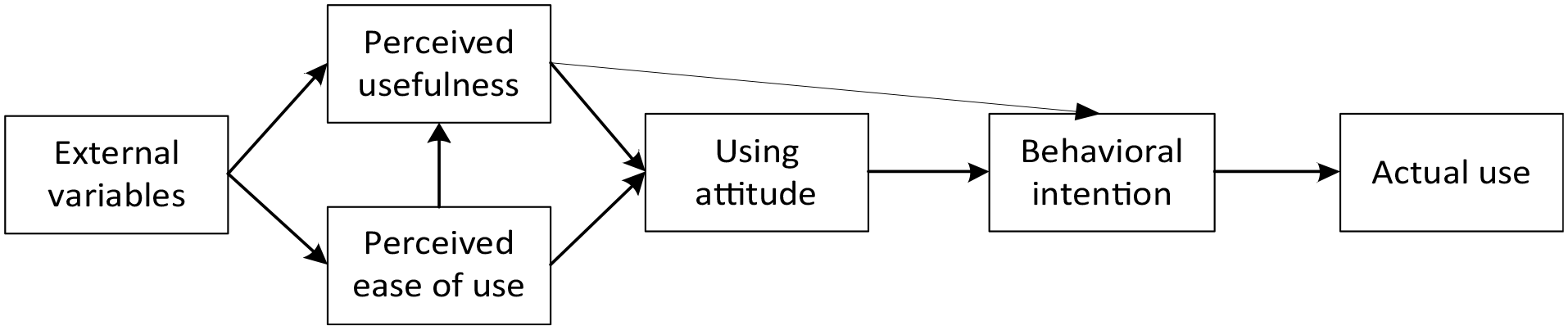
Technology acceptance model (TAM).
The reasons why TAM was popularly used to explain consumers’ adoption of a new technology lays on three aspects. First, the framework of the theory can effectively predict and explain consumers’ adoption of various technologies in many organizations and cultural contexts (Jamshidi & Hussin, 2016). Second, based on strong theory (Reasoned Action model and Planned Behavior model), the measurement scales of variables in TAM were tested in various industries extensively, which make it operationally appealing (Jamshidi & Hussin, 2016). Third, the effectiveness of TAM was empirical tested to reveal its strong explanatory power in a large number of studies (Jamshidi & Hussin, 2016). Therefore, the framework of TAM is very suitable to be used to explore user’s adoption behavior of new technology, including sports wearables.
Since the proposal of TAM, it has been extended by literature in many ways (He et al., 2018). First, many important variables were integrated into the model to enhance its power of explanation. These important variables include subjective norm, social influence, perceived behavioral control, and so on (Brown et al., 2010; Holden & Rada, 2011). Second, the antecedents of the two key factors of TAM, namely perceived ease of use and perceived usefulness, were explored by relevant literature (Ha & Stoel, 2009). Third, the boundary of TAM theory is explored by identifying the moderator in the influence of perceived ease of use and perceived usefulness (X. F. Zhang et al., 2017).
TAM is developed from the basis of reasoned behavior theory and planned behavior theory, which are used to explain users’ intention to purchase a certain product (Davis et al., 1989). TAM framework was widely used in many fields continuously because it is a cost-saving model and highly effective in most technology acceptance studies (P. Wang et al., 2022). Therefore, TAM has been used to explain users’ acceptance of new technologies in many products areas, such as blockchain (N. Liu & Ye, 2021), AI product (C. Y. Lin & Xu, 2022), mobile wallets (Sarmah et al., 2021), Dockless Bikes Sharing System (Lyu & Zhang, 2021), MOOC learning (Y. R. Wang et al., 2020), telemedicine services (Kamal et al., 2020), and e-Tax Service (Rifat et al., 2019). Furthermore, the TAM is employed to explain the consumers’ adoption of fitness wearable, which extend TAM by adding subjective norm into the framework (Lunney et al., 2016). From above studies, it is found that the TAM is extensively used in current studies to describe how users accept and use a new technological product or applications. It is also be used to explain how fitness wearable users accept and use the products. Therefore, the behavior of sports wearable users can also be illustrated under the framework of TAM.
TAM and Sports Wearable Acceptance
TAM was usually used as the most extensively used basic theoretical framework in previous studies to discuss the users’ acceptance for wearable devices, especially for sport wearable products (Kalantari, 2017). The products area explained by the theoretical framework of TAM to predict their users’ adoption behavior include sport wearable (T. Kim & Chiu, 2019), wearable fitness technology (Lunney et al., 2016), wearable device (Chang et al., 2016), wearable self-tracking technology (Pfeiffer et al., 2016), wearable symbiotic devices (Chuang & Chen, 2022; Spagnolli et al., 2014), smart watch (Choi & Kim, 2016; Chuah et al., 2016), wearable healthcare technology (Cheung et al., 2019, 2021), wearable trackers (Koo, 2017), and so on. In addition to perceived usefulness and perceived ease of use, which are the important variables to influence users’ intention to use a new technology in TAM, many other variables were introduced in TAM to explain users’ acceptance of wearable technologies in existing studies. These variables included technology readiness (T. Kim & Chiu, 2019), subjective norm (Lunney et al., 2016), task-technology fit (X. Q. Wang et al., 2021), social influence (Pfeiffer et al., 2016), perceived comfort (Spagnolli et al., 2014), visibility (Chuah et al., 2016), perceived credibility (Cheung et al., 2021), reference group influence (Cheung et al., 2019), consumer innovativeness (Cheung et al., 2019), and so on. Besides, these variables are also be influenced by many external factors that can impact on users’ acceptance of wearable technology eventually. These external factors include connectivity, communication, healthcare, infotainment, vanity, need for uniqueness, health belief, health information accuracy, privacy protection, innovativeness, and electronic word of mouth referral (Chang et al., 2016; Cheung et al., 2019, 2021; Choi & Kim, 2016).
External Factor to Impact Wearable Device Adoption
In the framework of TAM model, external factors are summarized as factors that can influence perceived usefulness and perceived ease of use of consumers toward a new technology. Cruz-Cardenas et al. (2021) and Kalantari (2017) categorized these external factors into five categories, including perceived benefits, social influences, technology characteristics, individual characteristics, and perceived risks. Perceived benefits category includes factors such as price value and hedonic motivation (Cruz-Cardenas et al., 2021; Gao et al., 2015; Yang et al., 2016). Social influence category includes factors such as social norm, image of self-express, and so on (Gimhae, 2013; Horton et al., 2012). Technology characteristics category includes factors such as perceived quality (Ernst & Ernst, 2016), perceived aesthetics (Coorevits & Coenen, 2016), perceived comfort (Hwang et al., 2016), perceived compatibility (L. H. Wu et al., 2016), and visibility (Krey et al., 2016). These external factors can influence consumers’ perceived usefulness perceived ease of use and then their adoption of wearable technology in different products context respectively.
TAM is the theory to explain users’ acceptance to a new technology. TAM was wildly used as the theoretical framework in the literature to explain consumers’ acceptance to wearable devices, including sport wearables. External factors, which could influence perceived usefulness and perceived ease of use, were discussed in many wearable product categories. However, for the sport wearables, what kind of external factors can influence users’ acceptance of the product is not discussed in the theoretical framework of TAM. Therefore, it is necessary to explore the external factors influencing sport wearables in the framework of TAM to deepen our understanding on the influencing mechanism of users’ acceptance of sport wearables.
Model
Existing studies on sports wearable devices are mainly conducted from several perspectives, such as extended expectation theory (Gupta et al., 2021), technology preparation theory (T. Kim & Chiu, 2019), and UTAUT theory (Chun & Lim, 2017), but the studies on user behavior of sports wearable devices seldom developed from the perspective of TAM model theory. Based on TAM model theory, this study explores how four external variables, namely data analysis, real-time monitoring, simplicity of operation and appearance design, affect users’ perceived usefulness, perceived ease of use, attitude, and behavior of use. Referring to the outcomes of existing research on exercise APP (Yi, 2017), medicine health wear equipment (Tian et al., 2020), military clothing equipment (Hailong, 2018), and based on the characteristics on function and design of sports wearables, previous research summarizes four external variables affecting users’ behavior of sport wearables, including data analysis, real-time monitoring, appearance design, and simple operation. Based on the theory of the TAM model, our research discusses the influencing relationship among data analysis, real-time monitoring, simple operation, appearance design, perceived usefulness, perceived ease of use, use attitude, and use behavior. The relationship among these variables is shown in Figure 2.

Research model.
In the proposed model, data analysis function refers to the function of recording real-time motion data, storing cloud data to the background and generating data reports. Real-time monitoring refers to the function that quantifies the motion, specifically referring to helping the user to feedback and process the real-time information in the dynamic process. Simplicity of operation means that users can correctly operate the product without professional learning. Appearance design refers to the shape and the color of the product as well as the visual presentation and user interface (UI) of its operation system.
Hypothesis
Data Analysis and Perceived Usefulness
Wearable devices are not isolated products, but technological products arising from the background of big data (H. Li et al., 2020). Its data analysis function is to record real-time motion data, store cloud data to the background and generate data reports. T. Kim and Chiu (2019) believe that sports wearable devices are intelligent products with functions such as providing training plans, assisting in the tracking of fitness activities, collecting and processing health-related data, and providing user performance feedback, which are carried out based on the data analysis function. The visual data analysis function can provide users with services such as body feature measurement, prediction of sports performance, and formation of sports suggestions and feedback. Users can timely improve their sports performance according to the data analysis results to achieve the purpose of improving the sports effect. For example, in college physical education teaching, wearable devices process and integrate various index data in the process of physical education through Bluetooth, wireless network, and other technologies, the result of which can be used in college physical education teaching practice (W. G. Chen & Wang, 2021; Xie et al., 2018). In competitive sports, athletes, and coaches can view corresponding data through wearable devices, and the quantification and analysis of data can provide scientific and effective guidance to improve the effect of sports (H. Li et al., 2020). It can be seen that data analysis function is an important factor influencing users’ perception of the usefulness of sports wearables. Therefore, this paper puts forward the following hypotheses:
H1: The data analysis function of sports wearables has a significant positive effect on perceived usefulness
Real-Time Monitoring and Perceived Usefulness
Real-time monitoring is a kind of sensing technology that quantifies the motion, specifically referring to helping the user to feedback and process the real-time information in the dynamic process. For the commonly used sports wearables, real-time monitoring includes monitoring physical data (such as exercise time, distance, frequency, calorie consumption, track, and step trend), as well as sleep monitoring, calculating food intake, and heart rate monitoring, which is the most useful functional of sports wearables. Cardinale and Varley (2017) emphasized the role of wearable devices in real-time monitoring of exercise load. At present, countries around the world attach great importance to heart rate monitoring in the process of sports training. Coaches not only monitor the whole training process in real time through heart rate monitoring, but also use heart rate monitoring to comprehensively monitor physical fitness and injury recovery (Schneider et al., 2020). Therefore, the real-time monitoring technology of sports wearable devices plays an important role in the field of sports. Therefore, this paper puts forward the following hypotheses:
H2: The real-time monitoring function of sports wearables has a significant positive effect on perceived usefulness
Simple Operation and Perceived Ease of Use
Simple operation means that users can correctly operate the product without professional learning (Yi, 2017), which is related to users’ perception of the simplicity of the operation mode of the product, whether the use method is easy to understand and the speed of network (Zhao et al., 2014). From the perspective of Technical Structuralization Theory, J.-H. Lee et al. (2010) proposed that when a new technology came into being, the main factor affecting users’ acceptance was technical convenience. With the development of science and technology, the types of smart wearable devices are increasing and the iteration speed of the products is accelerating. Convenience and efficiency of product operation are the basic conditions for users to have a positive perception of products. Therefore, the ease of operation has a great impact on the user’s perceived ease of use toward the products, and thus affects the user’s willingness to use it. Therefore, this paper puts forward the following hypotheses:
H3: Simple operation of sports wearable devices have a significant positive impact on perceived ease of use
Appearance Design and Perceived Ease of Use
Appearance design is a direct factor affecting users’ perceived easy of use for sports wearable devices. Appearance design includes screen fitness, UI system interface comfort design, aesthetic feeling, tactile feeling, and whether it is small and convenient to carry. Good visual design promotes friendly interaction between the user and the system. A well-organized and carefully designed navigation interface can help users identify relevant information more easily (Thong et al., 2002). Research shows that product appearance design has a significant promoting effect on consumers’ purchase intention (Cheng et al., 2022). Therefore, good appearance design not only brings pleasant sensory experience to users, but also makes users feel that the product is easy to use, thus generating their willingness to use. Thus, this paper puts forward the following hypotheses:
H4: Appearance design of sports wearable devices has a significant positive impact on perceived ease of use
Relationship Between Perceived Usefulness, Perceived Ease of Use, Attitude of Use, and Behavior of Use
Technology acceptance model is widely used in the research of technology acceptance in the information field (Y. Wu et al., 2014). Perceived usefulness and perceived ease of use are key components of the technology acceptance model. Davis (1989) defines perceived ease of use as users’ perception toward the ease of using a particular system, perceived usefulness as users’ perceived benefits to his work of using the system. Using attitude is the users’ positive or negative toward the products in their use. Use behavior is users’ corresponding behavior influenced by their attitude. In this study, perceived usefulness refers to the users perception toward whether wearable devices can improve users’ sports performance, sports achievement, and physical quality. Perceived ease of use refers to the users’ perception toward the extent of ease of use of sports wearable devices. Use attitude refers to the user’s positive or negative feeling to use sports wearable devices. Use behavior refers to the frequency of users to use sports wearable devices. A large number of previous studies based on technology acceptance models have confirmed that perceived ease of use has a positive impact on perceived usefulness and attitude toward use; perceived usefulness has a positive impact on attitude toward use; and attitude toward use has a positive impact on willingness to use (Buabeng-Andoh, 2021; Moon & Kim, 2001; Pavlou, 2003). Therefore, this paper puts forward the following hypotheses:
H5: Perceived ease of use has a significant positive impact on perceived usefulness
H6: Perceived usefulness has a significant positive effect on usage attitude
H7: Perceived ease of use has a significant positive impact on attitude toward use
H8: Use attitude has a significant positive influence on use behavior
Method
Sample Selection
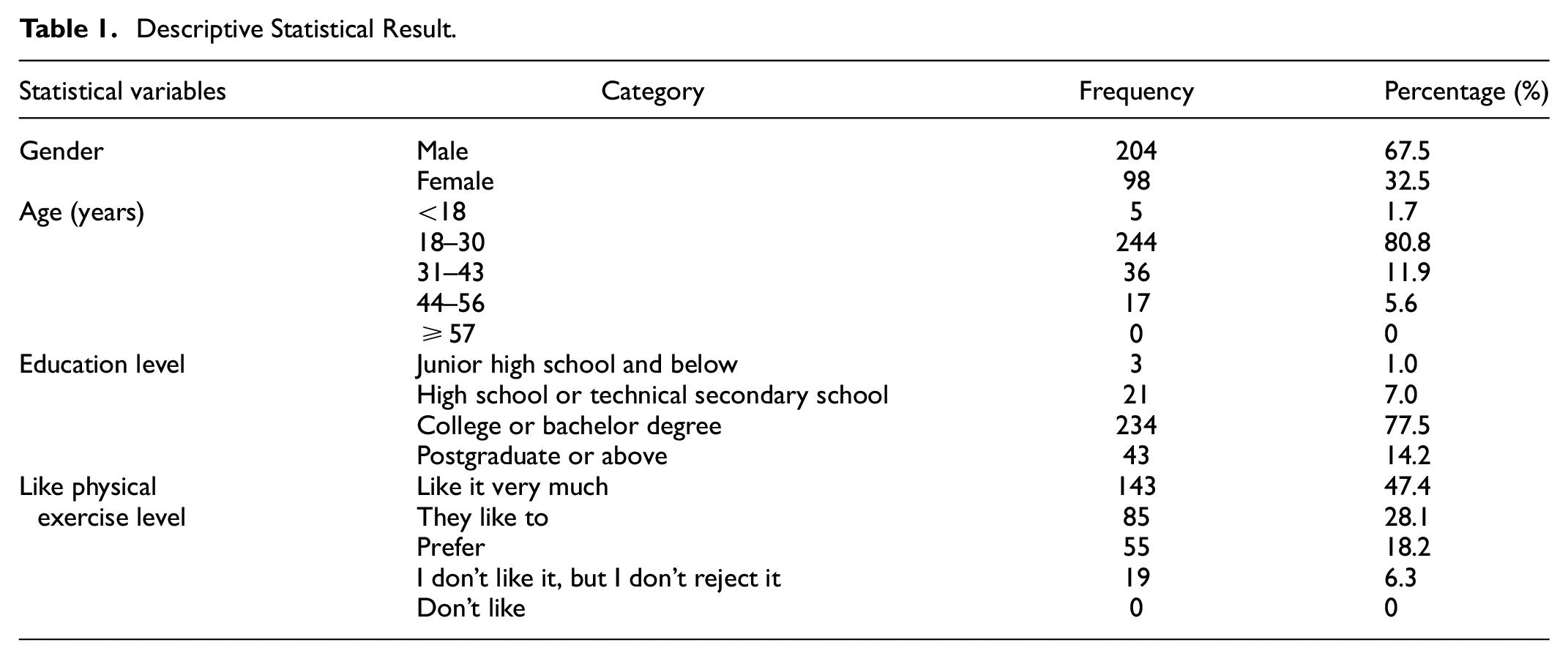
The questionnaire was randomly distributed to participants who have used or are using sports wearable devices. The study used both online (60%) and offline (40%) questionnaires. Descriptive statistical analysis was conducted on the survey data through SPSS17.0. The result of descriptive statistical analysis toward sample was shown in Table 1. A total of 200 electronic questionnaires and 120 paper questionnaires were sent out, and 320 questionnaires were collected with a recovery rate of 100%. Among them, 302 were valid, with an effective rate of 94.03%.
Descriptive Statistical Result.
Measurement
In the existing studies, the measurement of relevant variables has been used extensively. The measurement of variables in this study is mainly based on the scales in existing studies and have been adjusted appropriately according to the particularity of sports industry. The development process of the scale is as follows: relevant scales in existing studies were collected. Then the scales we revised according to the research context of this study through expert consultation and full discussion within the research group. Finally the scale is confirmed.
There are eight variables involved in this study, namely data analysis, real-time monitoring, appearance design, simple operation, perceived usefulness, perceived ease of use, attitude to use, and use behavior. Questionnaire adopted Likert’s 7-level scale to measure each variable. Users choose the degree of satisfaction or importance of each question in the questionnaire according to their feelings and cognition. About 1 means “strongly disagree” and 7 means “strongly agree.”
The measure of all variables in this study were based on the existing scale. Data analysis referred to scale developed by Yousef et al. (2014). Real-time monitoring referred to measurement used by Macfarlane (2017). Simple operation referred to measurement used by Yu and Peng (2017). Appearance design referred to measurement use by M. Chen et al. (2015). Perceived usefulness referred to measurement used by Deng et al. (2009) and Venkatesh and Davis (1996). Perceived ease of use referred to the scale used by Deng et al. (2009) and Davis (1989). Attitude referred to the scale used by Yunjian and Weng (2016) and Venkatesh and Davis (1996). Use behavior referred to the scale used by Yunjian and Weng (2016) and Venkatesh and Davis (1996). The items of each scale are shown in Table 2.
Measurement Items.

Pilot Research
Before the beginning of formal investigation, to ensure the accurate expression of the questionnaire, pilot research was conducted with initial questionnaires sending to 30 sports wearable device users. The questionnaire was modified according to feedback and suggestions from these 30 participants. Then the final questionnaire was decided.
Results
Test of Measurement Model
In this study, confirmatory factor analysis was used to test the reliability and validity of the data. The results showed that the fit of the measurement model was good: χ2 = 276.861, χ2/df = 1.258, RMR = 0.059, GFI = 0.934, AGFI = 0.902, PGFI = 0.632, TLI = 0.983, CFI = 0.988, and RMSEA = 0.029. As shown in Tables 2 and 3, the composite reliability of all structural variables was above the recommended level of .60, and the mean AVE was above or close to the recommended level of .50. This indicates that this study has a good reliability for the measurement of related structural variables. The standardized factor load of all structural variables was higher than 0.6, and was significant at the level of α = .01, indicating that the scale had high aggregation validity. In addition, the square roots of all AVE are greater than the correlation coefficients of their rows and columns, which indicates that the scale has high discriminative validity.
Correlation Numbers of Latent Variables.

Note. The diagonal data is SQ-RT (AVE).
Test of Structural Model
This paper uses AMOS17.0 to perform structural equation fitting analysis on the hypothesis model to verify the relevant assumptions in the model. The goods-fit statistics of the structural model were χ2 = 639.078, χ2/df = 2.76, RMR = 0.036, GFI = 0.896, AGFI = 0.893, TLI = 0.885, CFI = 0.912, and RMSEA = 0.077. These statistics show that the measurement model has a good fitting degree. Figure 3 shows the path analysis test results of the structural equation model.
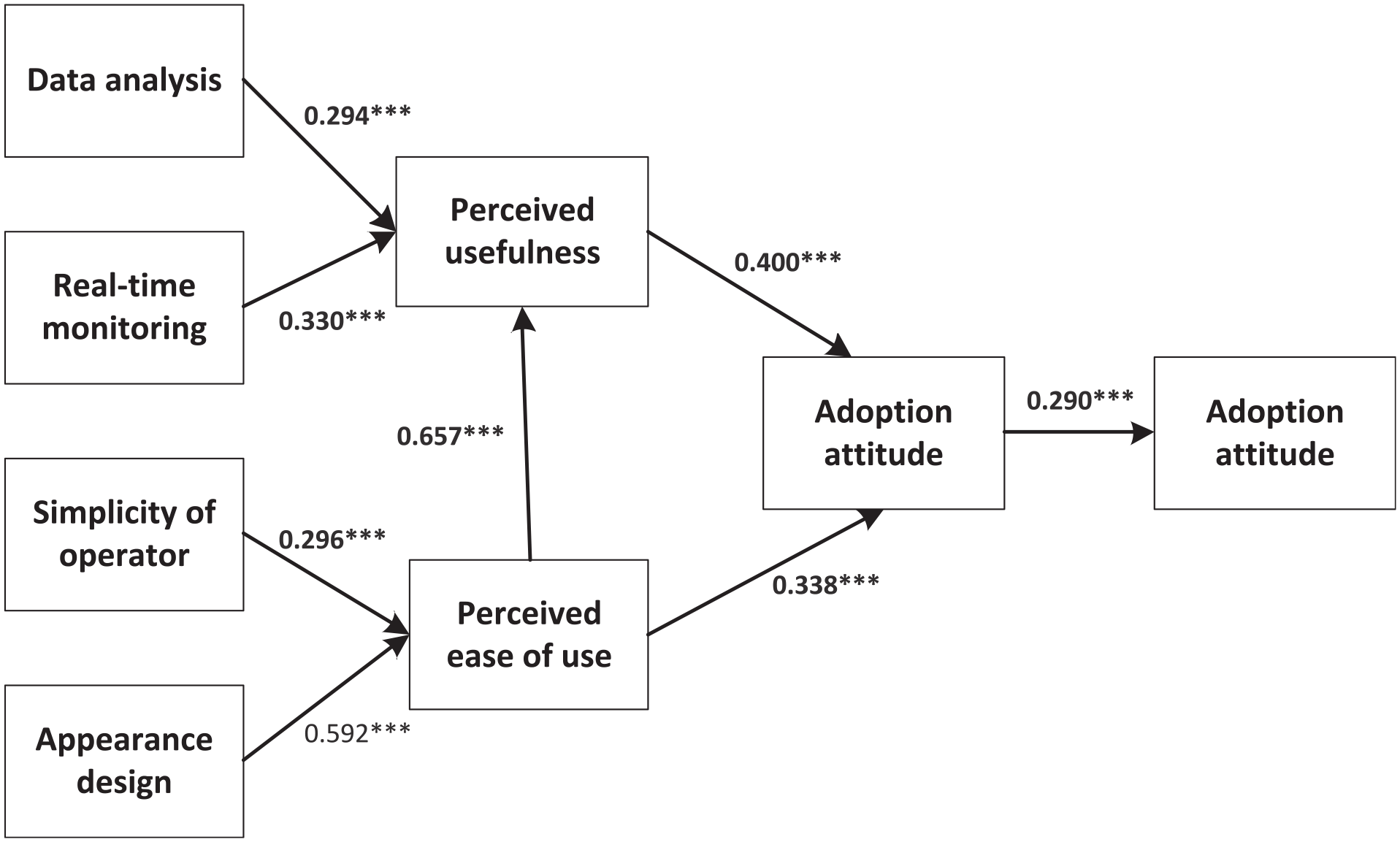
Path analysis results.
Analysis of Research Results
The results of data analysis show that the influencing relationship among the variables constructed by this model is significant. The data analysis function of sports wearable devices significantly positive influences perceived usefulness (γ = .294, p < .001), and data real-time monitoring also have a significantly positive impact on perceived usefulness (γ = .330, p < .001). The simple operation have a significantly positive impact on perceived ease of use (γ = .296, p < .001), and the appearance design also have a significantly positive impact on perceived ease of use (γ = .592, p < .001). Perceived ease of use had a significantly positive effect on perceived usefulness (γ = .657, p < .001), perceived usefulness had a significantly positive effect on use attitude (γ = .400, p < .001), perceived ease of use had a significantly positive effect on use attitude (γ = .338, p < .001), and use attitude had a significantly positive effect on use behavior (γ = .290, p < .001). The hypothesis of H1, H2, H3, H4, H5, H6, H7, and H8 are all verified. Therefore, data analysis, real-time monitoring, appearance design, and simple operation are all important external factors affecting the user behavior of sports wearable devices (Table 4).
Hypothesis Verification Results.

Discussion and Conclusion
Discussion
Based on the research practices of information system function design such as APP (X. Li & Ziyun, 2014), library system (Xiaoting, 2014), and website, this study summarized data analysis and real-time monitoring functions as product function attributes and appearance design and simple operation as product design attributes according to the product characteristics of sports wearable devices.
(1) Functional Attributes and Perceived Usefulness
In the technology acceptance model, the user’s perceived usefulness of the product is affected by some external factors. For different technical products and situations, the external factors that influence the perceived usefulness of a product are different. Studies on information systems showed that external factors affecting the perceived usefulness of information systems included system characteristics, product development, system implementation, training, and policies (J. B. Zhang & Zhao, 2014). Through the research on the user acceptance behavior of sports wearable devices, this study further verifies the relevant research findings on the technology acceptance model, finding that the product functional attributes are an important external influencing factor affecting the user’s perceived usefulness of the product. Different from information system products, this study find that for sports wearable devices, product functional attributes includes data analysis, and real-time monitoring functions, which are important external factors affecting the user’s perceived usefulness of such products. This is because users need to understand their own sports state with the help of sports wearable devices, and adjust their sports behavior based on the understanding. Therefore, it is very important for users to monitor their own motion status and analyze relevant data.
(2) Design Attributes and Perceived Ease of use
THE technology acceptance model holds that the perceived ease of use of a user’s product is also influenced by external factors. Existing studies believe that the factors affecting the perceived ease of use for a user’s product include product entertainment (Ling et al., 2013), service quality (L. Zhang & ZG, 2016), product innovation (Sheng et al., 2019), and other factors. Through the study on the users’ acceptance behavior of sports wearables, this study further verifies the relevant research findings of the technology acceptance model, fining that product design attributes are an important external influencing factor affecting the user’s perceived usefulness of the product. Different from existing studies, this study finds that for sports wearable devices, product design attributes includes simple operation, and appearance design, which are important external influencing factors affecting users’ perceived ease of use of such products. This is because users do not have extra time and attention to carry out frequent and complex operation on the device when they are doing exercises, they need the product to be simple, direct, and fast in operation. Moreover, the interface identification of the product and system should be simple and clear. Therefore, simple operation and appearance design of such products are very important to the user’s perception of whether the product is easy to use.
Conclusion
(1) Data analysis function is an important factor affecting users’ perceived usefulness of sports wearable devices. Visualized data formed in consumers’ use of sports wearable devices, provide accurate records of users’ sports status, and performance. These data can guide technical actions based on data analysis and effectively predict future sports performance. Namely, users can prepare for the exercises through previous data analysis and records before the start of the exercises. During the course of exercise, the device will record relevant data such as heart rate and pace, exercise intensity, and calorie consumption, which can help users adjust their exercise behavior in time and improve their exercise efficiency. At the same time, the data recording can effectively predict the user’s next stage of exercise status or performance. All these improvement in exercise relies on the data analysis function of sports wearables. In the future, digitalization and intelligence will become the inevitable trend of the development of sports industry. Therefore, data analysis is the key innovation and improvement of product’s technological function that sports wearable device enterprises need to notice in the future.
(2) Real-time monitoring function is an important factor affecting users’ perceived usefulness of sports wearable devices. When users use sports wearable devices, real-time monitoring function is the base of data analysis. When doing exercises, real-time monitoring function enable users grasp their own sports status in real time, which can help achieve processing and feedback on sports performance in time, effectively improving sports efficiency. At the same time, it can guarantee the sports safety of users. Therefore, real-time monitoring is an essential characteristic function to help organize planned sports activities and carry out intelligent physical education courses.
(3) Appearance design is an important factor affecting users’ perceived ease of use of sports wearable devices. Good appearance design (such as beautiful appearance of product, simple operation page, good screen compatibility, and personalized UI design) can bring users visual impact and spiritual pleasure. For different sports activity environments or different groups, the appearance design requirements on sports wearables are different. For example, smart bracelet used in water should be designed with strong waterproof and anti-water pressure functions, and the operation page of smart wearables for special groups such as children and the elderly should be simplified. Both the external and internal functions of the product need to be presented through good appearance design, so as to promote the user’s perceived ease of use and improve the user experience. Therefore, appearance design is important for the product itself, the user’s perceived ease of use and the enterprise.
(4) Simple operation is an important factor affecting users’ perceived ease of use of sports wearable devices. Simple operation includes easy to see, easy to learn, and easy to understand. In other words, if the complex page index in the sports wearable device is easy to understand, the commonly used function button display are prominent, and the operation process is intuitive and easy to understand, users can operate it easily without professional learning, and the experience will be improved accordingly. Therefore, the ease of operation is an important factor affecting users’ experience of sports wearables.
(5) The perceived usefulness and perceived ease of use of sports wearables can significantly influence users’ attitudes and behaviors. Users’ attitudes and behaviors toward the use of sports wearables are influenced by perceived usefulness and perceived ease of use. If users think that sports wearable devices are helpful for their exercise and easy to operate and use, they will have a good impression on the products and tend to use such devices in sports. At the same time, if users find sports wearables easy to use, it could also make them feel that such products are helpful for their physical activities.
Theoretical Contributions
In this study, the technology acceptance model was introduced into the study of user attitude and behavior toward sports wearable devices to explore the relationship between data analysis, real-time monitoring, simple operation, appearance design and perceived usefulness, perceived ease of use, and as well as user attitude and behavior. Contributions of this study are as follows:
First, the theory of technology acceptance model is further developed and improved. According to the technology acceptance model theory, the perceived usefulness and perceived ease of use of new technologies have a significant impact on users’ attitudes and behaviors. External variables will affect the factors of perceived usefulness and perceived ease of use of users (Davis et al., 1989). In different product domains, there are different external factors affecting users’ perceived usefulness and perceived ease of use (D. Liu & Shanji, 2016; Yi, 2017). This study takes sports wearables as the research target and confirms that data analysis, real-time monitoring, simple operation, and appearance design are external variables that affect the perceived usefulness and perceived ease of use of sports wearables. This finding further develops and improve the understanding of external variables in the technology acceptance model theory, leading to the discovery of new external variables that affect the perceived usefulness and perceived ease of use of products.
Second, it introduces a new theoretical perspective for the research on sports wearable devices, enriching the theoretical basis for research in this field. Existing researches on sports wearables are mostly based on theories such as expectation theory, UTAUT model, and TRAM model to study users’ attitude and behavior toward sports wearables (Chun & Lim, 2017; Gupta et al., 2021; T. Kim & Chiu, 2019). By introducing the theory of technology acceptance model into the research of sports wearables, this study regards sports wearables as a new technology that users need to master, discussing users’ attitude and behavior toward sports wearables from the new theoretical perspective of users’ technology acceptance. The introduction of technology acceptance model into the research of sports wearable devices brings a new theoretical perspective and enriches the theoretical basis of the research of sports wearable devices.
Thirdly, the introduction of technology acceptance model into a new research field expands the application scope of technology acceptance model. At present, the technology acceptance model is widely used in the study of users’ acceptance of new technologies, especially for information system products such as medical information system (Jeyaraj, 2022; Wan & Yingkang, 2012), tourism APP (Yan & Jian, 2019), third-party payment system (D. Liu & Shanji, 2016), shared logistics platform (W. Wu et al., 2019), fitness APP (Yi, 2017), and so on. As a new technology product, the research of sports wearable devices have not been explained by the technology acceptance model. Wearable sports devices, as equipment products, are obviously different from information system products in terms of product characteristics, thus external factors that affect users’ acceptance of this products are also different from information system products. In this study, the research target of technology acceptance model was extended from information system to sports wearable device, discussing external factors influencing users’ acceptance of sports wearable device, which further expanded the theoretical application field of technology acceptance model.
Management Implications
(1) Provide Perfect Data Analysis Function
Enterprises of sports wearables should improve and innovate product functions so that they can measure more indicators, improve the accuracy of data measurement and provide multi-dimensional scientific data analysis reports and personalized sports and health suggestions. This is an effective way to improve users’ knowledge of the usefulness and effectiveness of wearable devices. For example, in the most usually used sports bracelets, heart rate monitoring is the basis of data analysis for all sports, which can analyzed the body status of people in sports. Therefore, based on heart rate monitoring function, the enterprise can develop data analysis on PAI, pressure value, emotional cycle, body water loss situation, and so on. Enterprises can improve automatic identification technology on users’ motion state to provide data analysis reports in terms of different sport groups and sports projects, forming personalized and scientific exercise prescription. Sports wearables should provide technical convenience for users to achieve “multiple body data analysis function with a single sports wearable device” and “sports wearable technology data processing for any sports project,” deeply expanding the value behind the data and strengthening user’s behavior. At the same time, in terms of data security, manufacturers should pay attention to the encryption measures of independent data while considering the user’s data sharing, transmission, and storage to protect the user’s personal privacy.
(2) Develop Accurate Real-Time Monitoring Function
In different sports projects, the emphasis of monitoring is different. According to different sports projects, enterprises should improve technology, set different monitoring systems, pay attention to the multi-dimensional development of monitoring targets and meet the needs of different sports groups, so as to improve the user’s perceived usefulness. For example, for the wearable devices of golf and shooting sports, there are higher requirements for the accuracy of real-time monitoring on precise GPS tracking technology, slight tremor of the body, the angle of the bending of the joints during movement, and so on. Realizing zero error is one of the objectives in the development of wearable device technology. Therefore, only by improving the calibration technology of sports wearables and improving the sensitivity of vibration, pressure, and temperature sensing technology, can we better serve users.
(3) Improve and Innovate Product Appearance Design
The appearance design of sports wearable devices is not only to meet the actual needs and aesthetic needs of users, but also to take into account the prevention of sports injuries of users in sports. For example, in boxing sports, head-mounted intelligent equipment can automatically adjust the soft and hard degree of head-mounted intelligent equipment scientifically through intelligent sensing data such as punch strength and punch speed, so as to prevent athletes from head injury. At the same time, manufacturers should combine high technology such as nanotechnology in product design materials, accelerate the integration of wearable devices with related industries such as sports technology companies and biological application technology, and follow environmental protection principles to achieve product innovation. On the other hand, the design of display interface of sports wearable products is also the most intuitive perception factor for users. The screen fit on the interface, the UI design, the vibration, or sound of the touch should be kept simple and reasonable, reducing user interaction, and following the principle of minimalism. A single and centralized design can improve users’ efficiency. For example, in swimming, wearable devices have achieved the “micro-sticker” technology. Therefore, the development of sports wearables that are “easy to wear, easy to operate, small and easy to carry” and the entertainment of wearables can be properly considered to enhance the stickiness of users to wearables.
(4) Simplify the Product Operation Process
Enterprises of sports wearables should strengthen the research and development of technology combined with virtual reality (VR) and augmented reality (AR), make the operation process intuitive, the technical terms easy to simplify, the page layout rationalization, so that users can easily find the functions they need to use. At the same time, enterprises should consider the applicability of the product, such as introducing personalized setting system for different groups (educational level, age, and professional level). On the other hand, reduce the battery power loss of sports wearable products, extend the battery service life, improve the charging technology, and further improve the user efficiency. Finally, enterprises should follow the trend of 5G technology, launch new friendly devices with low delay and low power consumption, and make sports smart wearable life to be the future development direction of sports wearable products.
Research Deficiencies and Future Directions
Based on the technology acceptance model, this study discusses the users’ attitude and behavior of sports wearable devices. This study has the following limitations, which also indicates the direction for future research. First, the target of this study are users who have experience in using sports wearable devices. For those who have no experience in using such products, what factors hinder them to try the product? This needs to be further explored in future studies. Secondly, based on products attributes, this study confirms that data analysis, real-time monitoring, simple operation, and appearance design are important external factors affecting users’ perceived usefulness and perceived ease of use. However, besides products attributes, other factors, such as social influence, can also affect users’ perceived usefulness and perceived ease of use, which need to be studied further in the future.
Footnotes
Declaration of Conflicting Interests
The author(s) declared no potential conflicts of interest with respect to the research, authorship, and/or publication of this article.
Funding
The author(s) disclosed receipt of the following financial support for the research, authorship, and/or publication of this article: Young and middle aged scientific research team of Wuhan Sports University in 2021 (21KT18); Philosophy and social science research project of Hubei Education Department (19Y099); Scientific research project of Hubei Education Department (B2021186); and Youth Scientific Research Fund of Wuhan Sports University (2022S05).
