



Abstract
The rise of smart cities as systemic eco-innovations has leveraged advanced digital technologies to support green development and reduce carbon emission intensity in manufacturing. Using data on green technology innovations of A-share listed firms in Shanghai and Shenzhen from 2007 to 2022, this study applies a multi-period difference-in-differences design combined with a double machine learning method to assess how smart city pilot programmes influence enterprises’ low-carbon transitions. We find that (1) Smart city pilot programmes significantly increase the quantity, quality, and independence of green patenting, and these effects remain robust under alternative specifications; (2) mediation analysis shows that the pilots improve enterprise’ access to financial resources and strengthen external digital monitoring, which, in turn, enhances environmental disclosure and stimulates substantive green innovation; and (3) heterogeneity tests reveal that policy effects are strongest in regions with weaker environmental regulation, among firms with lower research and development (R&D) intensity, and in pollution-intensive industries, highlighting the contexts in which smart city initiatives are most effective. These findings provide empirically grounded insights into the contextual effectiveness of the smart city pilot and offer concrete evidence to inform its broader adoption and replication.
Keywords
Introduction
As urban-related carbon emissions are increasing, the per capita energy consumption in cities and per unit of building area is several times higher than in rural areas because of the high-density characteristics of urban environments (Aftab et al., 2022). The construction of a smart city is an innovation-driven strategy and believed to be a crucial approach for developing countries to pursue sustainable development. By leveraging urban digital transformation and artificial intelligence, a novel smart energy system can be established and deployed as an integral part of an innovation ecosystem, which will help advance green technologies and significantly enhance overall urban energy efficiency.
The concept of a smart city stems from IBM’s 2008 Smarter Planet vision within the realm of information technology. It amalgamates the principles of digital twin cities and the Internet of Things (IoT) to foster systematic innovation within a societal and institutional framework. In recent years, leading global economies have promoted smart city development to facilitate green, low-carbon transitions. Developed countries are already at the forefront of creating urban smart infrastructure, including advanced pipe networks, water supply systems, and waste treatment technologies (Albino et al., 2015). As the world’s largest emitter of carbon dioxide among the developing nations, China has committed to peaking its emissions by 2030 and achieving carbon neutrality by 2060, milestones that are vital for global climate stabilisation. To support these goals, China is accelerating the development of digital city clusters alongside a green, low-carbon, circular economy. In December 2012, the Ministry of Housing and Urban-Rural Development launched the first batch of Smart City Pilot (SCP) projects, aiming to establish intelligent, collaborative, efficient, and secure urban management systems that leverage green technologies to address low-carbon transition challenges (Nicolas et al., 2021). In this context, it is essential to examine how smart city development influences enterprise-level green innovation, especially in developing-country settings.
Enterprises play a crucial role in fulfilling social responsibility, and green technology innovation represents a micro-level commitment to sustainability. According to the resource-based theory, such innovations constitute strategic assets that enhance firms’ competitive advantage while delivering environmental benefits by advancing production technologies and processes and reducing pollutant emissions, thereby improving resource use efficiency and generating the dual externalities of environmental protection and technological spillovers (Chu et al., 2021). From the perspective of institutional theory, the SCP provides manufacturing firms with the necessary institutional support and an innovative ecosystem. Demonstration projects and application scenarios reduce adoption complexity and foster the integration of diverse green technologies (Yao et al., 2020). Drawing on Rogers’s diffusion of innovations framework, the construction of information sharing platforms, intelligent infrastructure, and collaborative networks strengthens connections among firms. Meanwhile, the successful outcomes and market performance of early adopters serve as demonstrations that accelerate the industry-wide spread of green technologies (L. Zhao & Ye, 2025). Although many studies treat smart cities as part of a broader innovation landscape, few have examined how they specifically motivate firm-level green innovation through the lens of Ecological Modernisation Theory (EMT), transforming urban data and resources into environmental and economic gains (Zaidi et al., 2019). Moreover, case studies in developing countries remain scarce, highlighting a valuable opportunity for future research.
Therefore, to address these gaps, this study applies a multi-period difference-in-differences model integrated with a double machine-learning framework to assess the impact of SCP initiatives on manufacturing firms’ green-technology innovation. It makes three key contributions. First, it verifies the causal effect of SCP at the micro-level and uncovers the dominant transmission mechanisms, thereby enriching our understanding of macro-level drivers of green innovation in manufacturing. Specifically, we clarify two pathways: optimising the allocation of financial resources and strengthening external technological oversight. Second, it extends the use of quasi-natural experiments to evaluate the SCP by accounting for overlapping policy adjustments and isolating the marginal impact of a single pilot policy on firms’ green and low-carbon transformation. We capture firms’ innovation efforts and outcomes using precise indicators, including green patent application counts, the proportion of invention patents, and the share of independent innovation modes. Third, it explains heterogeneity through a granular analysis across multiple dimensions, regional environmental regulation, industry pollution intensity, and firm-level R&D strength. These empirically grounded insights reveal how pilot policies perform under different conditions and provide evidence to guide scalable, context-sensitive policy replication.
Literature Review and Hypotheses Development
Literature Review
Economic and Environmental Effects of the SCP
A growing body of literature has examined the economic and environmental impacts of the Smart City Pilot (SCP). Economically, endogenous growth theory (Romer, 1990) argues that long-term expansion depends on knowledge accumulation and spillovers. By investing in digital networks, human capital and infrastructure, the SCP reduces transaction costs and accelerates the diffusion of ideas across firms and institutions, thereby enhancing innovation capacity and driving industrial restructuring. Empirical studies support these theoretical insights, showing that smart city development improves urban innovation capacity, fosters sustainable development and enhances risk resilience (Caragliu & Del Bo, 2019; Desouza et al., 2020; Yigitcanlar et al., 2018; Zaidi et al., 2019). From a socio-technical transitions perspective, smart-city initiatives serve as protected niches where novel green practices, such as real-time emissions monitoring and IoT-driven energy management, can emerge, stabilise and ultimately displace incumbent, polluting technologies. Moreover, higher levels of smart-city policy implementation correlate with greater innovation capacity in European cities (Caragliu & Del Bo, 2019). However, scholars warn that without robust data governance mechanisms, smart cities may suffer from data asset mismanagement, privacy violations and cybersecurity threats, which undermine public and enterprise trust and lead to redundant infrastructure or resource inefficiencies (Meijer & Bolívar, 2016; L. Wang et al., 2023). In other words, the effectiveness of policy implementation plays a decisive role in transforming natural and data resources from a curse into a blessing.
Environmentally, smart cities are associated with significant improvements in air quality and reductions in pollution. Input–output models at the macro level show that SCP help optimise production input structures, accelerate industrial upgrading, decentralise urban layouts, and reduce carbon emissions at the source (Asghar et al., 2024). Other scholars have focussed on household-level carbon emissions and found that smart city development promotes green consumption behaviour and improves energy efficiency through demand-side transformation (Wu, 2022). At the micro level, the environmental benefits of smart cities differ across industries. In manufacturing, pilot policies foster cleaner production, energy efficiency, and process-level green transformation. In services, industries such as logistics, transport, and tourism benefit from improved environmental performance (Desouza et al., 2020). The information technology sector plays a dual role as a driver and beneficiary of smart city development (Orejon-Sanchez et al., 2022), integrating green practices internally and enabling digital green solutions externally (Nie et al., 2023). However, some challenges remain unresolved. Some firms engage in greenwashing by superficially complying with green standards, without substantial innovation (Alam et al., 2022). Others may be reluctant to participate in smart city initiatives because of concerns about data disclosure and privacy (Nicolas et al., 2021).
Drivers of Enterprises’ Green Technology Innovation
Green innovation refers to the development of technologies that incorporate environmental protection goals, which helps improve enterprise performance and promote broader sustainability objectives. The existing literature identifies both external and internal drivers. External influencing factors include industrial policy guidance (Perruchas et al., 2020; X. Wang et al., 2022), regional strategic layout (Qi et al., 2018), and financing environment (Xiang et al., 2022). The theory of resource dependence emphasises that technological innovation is highly dependent on an organisation’s external resources. Industrial policy provides new resources and opportunities for enterprises, encouraging them to guide the forward-looking development of green technologies to obtain government support and market resources (Rauf et al., 2020). Green innovation requires multi-channel financial support. In particular, market or institutional investor demand for green products and services not only directly impacts enterprises’ innovation efforts but also promotes knowledge sharing among enterprises, indirectly encouraging green innovation (Ali et al., 2019).
Internally, green technology innovation is primarily influenced by corporate governance structures, equity-based incentive schemes, R&D intensity, and degree of digital transformation. First, the governance structure directly affects the formulation of innovation strategies and the efficiency of resource allocation (Guizani et al., 2024). For example, boards that include members with environmental expertise are more likely to engage in green innovation initiatives. Second, executive incentive mechanisms play a significant role in driving green technological advances (G. Li et al., 2022); equity incentives and green performance evaluations can effectively increase senior managers’ commitment to environmental investment. Third, firms promote the development and application of green technologies by increasing environmental protection expenditures, whereas low R&D intensity, often resulting from talent turnover, can undermine innovation efficiency (Zhang et al., 2023). Finally, information technology capability and digital maturity are critical enablers of green innovation. In the context of smart city development, firms leverage digital technologies to reconfigure traditional production factors, thereby reducing innovation costs and catalysing intelligent upgrades of green production processes (Weng et al., 2015).
Research Gaps
Although existing studies have improved the understanding of SCP effects and green innovation drivers, three key gaps remain. First, most SCP research focuses on macro level outcomes such as urban growth, industrial restructuring and broad environmental improvements. Micro level causal evidence on how pilot designation influences firms’ green innovation behaviour is scarce. In particular, the mechanisms linking policy activation to firm level patent quality and innovation mode have not been rigorously tested using quasi experimental methods. Second, the literature on green technology innovation drivers identifies both external factors such as industrial policy and financing environment, and some internal factors, but rarely examines how SCP initiatives interact with these drivers. We lack precise evidence on whether SCP policies complement or substitute for other policy or market incentives and on which channels, such as financial reallocation or regulatory pressure, play the dominant role in driving substantive innovation. Third, variation in SCP effects across firms and regions remains underexplored. Prior work suggests that innovation responses vary by firm characteristics, yet few studies systematically analyse these differences within an SCP framework or consider potential spillover effects into surrounding districts or smaller municipalities. Addressing these gaps will improve policy design by clarifying where and how smart city interventions can most effectively catalyse green technological progress.
Hypotheses Development
The SCP and Enterprises’ Green Innovation
Smart city construction embodies the principles of sustainable development and is an effective strategy for enhancing urban competitiveness and resolving complex urban challenges. Drawing on innovation diffusion theory, smart cities create a supportive environment and infrastructure that accelerate both the generation and inter-firm diffusion of green technologies (Costales, 2022; T. Zhao et al., 2021). When the benefits derived from these innovations balance or exceed the costs imposed by environmental regulations, firms experience an innovation compensation effect that yields a mutually beneficial outcome of more sustainable operations alongside improved environmental performance. For instance, by embedding smart city platforms within distributed energy grids, enterprises can integrate, aggregate, and optimise renewable energy sources, thereby expanding utilisation rates, boosting overall energy efficiency, and reducing emissions (Zhang et al., 2023).
The direct influence of the SCP on corporate green innovation can be understood through three interrelated mechanisms: green signalling, digital transformation, and technological supervision effects. First, green signalling effects arise as smart city policies communicate clear commitments to low carbon development, which encourages firms to enhance their environmental disclosures, such as carbon emission reporting and ESG information, which, in turn, attracts capital towards greener enterprises (Lin et al., 2023). Second, from the perspective of transforming production modes, smart city construction accelerates the digital penetration of enterprise production, promoting the establishment of intelligent management systems (Caragliu & Del Bo, 2019). Using a large data control platform, smart cities enable efficient production data collection and apply machine learning and artificial intelligence technologies to adjust production parameters, increase investment in high-efficiency departments, and eliminate or outsource inefficient production units (Nabeeh et al., 2021). This encourages enterprises to adopt low pollution and high utilisation as principles to improve production processes. Third, technological supervision effects reflect how enhanced regulatory oversight facilitated by digital monitoring can raise enterprises’ compliance costs, thereby providing an incentive to innovate. When innovation gains offset of these costs, firms realise both economic and environmental benefits. Therefore, we propose the following hypothesis:
The SCP’s Innovation Impact via Financial Resource Allocation
The construction of smart cities can leverage the financial agglomeration effect better. On the one hand, pilot cities should fully absorb various production factors, such as data, talent, and capital, accelerating the formation of industrial clusters with innovation-leading capabilities and driving the development of environmentally friendly industries through economies of scale. Dynamic coordination, allocation, and a combination of financial resources and regional endowments can effectively improve the efficiency of using existing funds, expand the scale of incremental capital, enhance the market financing environment, and provide more financial support for enterprises to expand production scales and technology research and development (Jung et al., 2018). Simultaneously, the popularisation of urban intelligent technology promotes the spatial agglomeration of new quality production factors, facilitating the transformation of regional industrial structures from resource-to technology-intensive (Yan et al., 2023). Furthermore, it fully leverages the accumulation of innovative technologies to promote environmentally friendly industries, encourages the agglomeration of green economic activities in pilot areas, and accelerates the transformation and development of production modes towards green and digital intelligence.
On the other hand, guidance based on the healthy development of smart cities has led to the construction in the pilot area of an environmentally intelligent monitoring system with water, atmosphere, and soil as its primary detection indexes, covering pollution emissions, energy consumption, and dynamic monitoring systems. This means that the pilot policy imposes stricter requirements on regional environmental quality (F. Wang, 2023). Typically, when enterprises face strong environmental regulations, they tend to increase pollution prevention and control expenditures, enhance environmental protection expenditures to purchase environmental protection equipment, or conduct green technology R&D (Luo et al., 2023). This behaviour can lead to a crowding-out effect on other project investments, affecting total factor production efficiency and hindering green technology innovation. With the transformation and upgrading of traditional manufacturing enterprises, the process of replacing traditional high-energy consumption models with energy conservation and emission reduction technologies usually faces high uncertainty and strong financing constraints. The construction of smart cities is conducive to the deep integration of digital and real economies (Desouza et al., 2020). City digitalisation enables enterprises to deploy IoT-enabled supply chains that lower operational, maintenance, search, and monitoring costs, while fostering closer collaboration with financial institutions. By providing real-time data on firm performance and environmental metrics, this digital infrastructure enhances lenders’ abilities to evaluate creditworthiness, reduces information asymmetry, and expands access to external funding. Improved financing conditions spur the development of low-carbon technology, creating a virtuous cycle of financial support, independent innovation, and sustainable transformation. Therefore, we propose the following hypothesis:
The SCP’s Innovation Impact via External Digital Monitoring
From the perspective of enterprises’ external science and technology supervision path, the smart city produces the effect of new infrastructure construction, which is conducive to balancing governmental environmental governance behaviour with the effective allocation of market supply and demand (Du et al., 2021). New infrastructure has spawned multi-innovative applications and industrial forms, driving the sustained economic development of modern service industries, producer services, and other related industries. First, the construction of a smart city promotes the integration of intelligent equipment into infrastructure (Guo et al., 2022). For instance, by relying on big data supervision, the government can monitor enterprises’ energy conservation and emission reduction efforts in real time, strengthen the terminal treatment of environmental pollution, and force enterprises to innovate green technologies for profit maximisation (Meng et al., 2024). Second, smart business systems can enhance the upgrading of the consumer Internet. Enterprises, with digital technology, improve their ability to allocate innovation resources, efficiently match consumer demand with green product development activities through e-commerce platforms, integrate green environmental protection knowledge, guide the production department towards green product R&D, produce differentiated products to obtain a green competitive advantage, ensure that green products achieve economic benefits in the market, and stimulate enterprises to engage in green innovation activities.
The SCP also drives substantive green technology innovation through enhanced external digital monitoring, which lowers internal governance costs and optimises organisational structures within firms (F. Wang, 2023). First, green technology innovation is characterised by greater professionalism and higher information opacity. Transformation into a smarter city reduces the cost of supervision from shareholders to the management. By enhancing the big data platform of enterprises, the construction of a smart city can accurately detect the pollution emission situation on the supply side, provide timely transmission of corporate financial data to shareholders, promote transparency and visualisation of the management process, limit the independent discretion of management, and reduce the agency problem. Second, a smart city is established through an open-city information service platform (Kashef et al., 2021), facilitating internal and external information exchange, prompting the enterprise’s organisational structure to shift from vertical to flat, enabling horizontal information sharing, assisting management in making efficient whole-green innovation decisions, and reducing the uncertainty and ambiguity of green technology R&D (Nilssen, 2019). Together, these digital governance enhancements accelerate enterprises’ internal digitisation, improve environmental disclosure quality, and foster substantive green technology innovation. Based on this mechanism, we propose the following hypothesis:
Data and Methods
Data Source
The smart city policy, serving as a quasi-natural experiment in new urban infrastructure development, provides an institutional framework and an innovative ecosystem for enterprises to explore green technology. To promote the integration of new urbanisation and informatisation, China’s Ministry of Housing and Urban-Rural Development issued a notice in December 2012 announcing the first batch of “National Smart City” pilot projects. The programme covered 90 cities and regions, including Beijing, Tianjin, Shijiazhuang, Shanghai, Wuhan, and Zhengzhou. Additional batches released in 2013 and 2014 expanded the pilot cities and regions, advancing their digital and intelligent transformation and continuously improving urban management. Therefore, given the critical role of green transformation and upgrading in the manufacturing sector, this study builds an unbalanced panel of A-share listed manufacturing firms on the Shanghai and Shenzhen main boards for the period 2007 to 2022. Financial data were drawn from the Wind and China Stock Market & Accounting Research (CSMAR) databases, green patent counts were obtained from the China National Intellectual Property Administration, and city–level control variables were sourced from the China Urban Construction Statistical Yearbook. We excluded firms with missing financial records and those designated ST or *ST. Continuous variables were winsorized at the 1st and 99th percentiles to mitigate the influence of outliers, resulting in a final sample of 12,585 observations.
Research Model
Multi-Period Difference-in-Differences Model
This study examines the driving factors and heterogeneous mechanisms of the impact of smart city policies on green technology innovation in Chinese enterprises. We construct a multi-period DID model to verify the impact of smart city construction on the quality and efficiency of green technology innovation in listed companies. Following the approach of Meng et al. (2024), this study determines the policy shock time and sample selection for treatment and control groups. Accounting for implementation lags, we identify 2013, 2014, and 2015, corresponding to the three batches of SCP projects, as the time nodes within a quasi-natural experiment framework:

The multi-period DID model solves the problem of dealing with different time points. The dependent variables in Equation 1 show the number of green patent technology applications (InnoNum), measured by invention patents (InnoQua) and independent patent applications (IndInno). Time is a dummy variable equal to 1 if the city where the enterprise is located has been selected as a SCP in any of the three batches during the current year or thereafter, and 0 otherwise.
Mediating Effect Model
To analyse the impact mechanisms through which smart city construction affects corporate green technology innovation, this study employs a two-step mediation effect model, following Jiang (2022). The model examines two transmission pathways: (1) optimisation of financial resource allocation and (2) strengthening of external technology supervision. The formal specification is given by:

The mediation analysis framework is implemented using Equation 2, which serves as the second-stage test by introducing regional green credit scale (LocalGC) and environmental disclosure quality (ESG_Score) as mediating variables. Theoretically, we expect to find a significantly positive coefficient.
Variable Design
Explanatory Variables
In December 2012, China’s Ministry of Housing and Urban-Rural Development issued the Interim Management Measures for National Smart City Pilot Project, officially launching the national SCP initiative. The first batch included 90 pilot projects, of which 37 were at the prefecture level. In May 2013, the second batch was announced, leading to the establishment of 103 cities (districts, counties, and towns) as national SCP projects for 2013, including 83 cities and districts, 20 counties and towns, and 9 areas that expanded on the 2012 pilot projects. The third batch, announced in April 2015, designated 84 new pilot areas for 2014, such as Mentougou District in Beijing. More than 290 pilot smart cities were established during the three phases. To improve the evaluation accuracy, this study excludes certain prefecture-level cities and enterprises, focussing instead on pilot areas at the district and county levels, while accounting for administrative division changes and missing data.
Explained Variables
To more convincingly capture firms’ substantive environmental actions, we measure green technology innovation along three complementary dimensions: quantity, quality, and innovation mode. This approach avoids the limitations of previous studies that relied on enterprise innovation investment costs as proxy indicators, which reflect only the R&D input process and fail to capture actual innovation outcomes. The specific measurement methods are as follows:
The quantity and quality dimensions of green technology innovation are constructed based on enterprise-level green patent data obtained from the China National Intellectual Property Administration. The data screening and classification process consists of three steps. First, based on the International Patent Classification (IPC) system, patent information is initially categorised into A–H8 groups to facilitate separate storage and extraction. Second, using the IPC Green Inventory published by the World Intellectual Property Organization, patents are identified according to seven major green technology categories: alternative energy production, transportation, energy conservation, waste management, agriculture and forestry, management regulation and design, and nuclear power. The IPC identification numbers are refined to the most specific subclass levels to ensure precise classification. Third, the effective green patent information is organised and summarised following the method proposed by Du et al. (2021). In this framework, the quantity of green innovation is measured using the number of green invention patent applications (InnoNum), which reflects the overall scale of innovation activities. The quality of green innovation is captured by the share of inventive green technology patents (InnoQua) because invention patents are subject to rigorous examinations for novelty, inventiveness, and practical applicability, making them a more credible proxy for substantive innovation performance.
Green technology innovation forms reflect how innovation activities are organised, with independent and cooperative innovation being the two primary modes. Generally, enterprises prefer independent innovation to enhance R&D efficiency and maintain control over innovation costs and strategic direction (J. Li et al., 2023). In the context of the SCP, local digital transformation initiatives stimulate innovation momentum among enterprises and support the broader goal of low-carbon urban development. Accordingly, this study distinguishes innovation methods based on whether patents are filed by individual applicants or jointly by two or more applicants and constructs an independent innovation (IndInno) indicator to capture heterogeneity in innovation organisation.
Control Variables
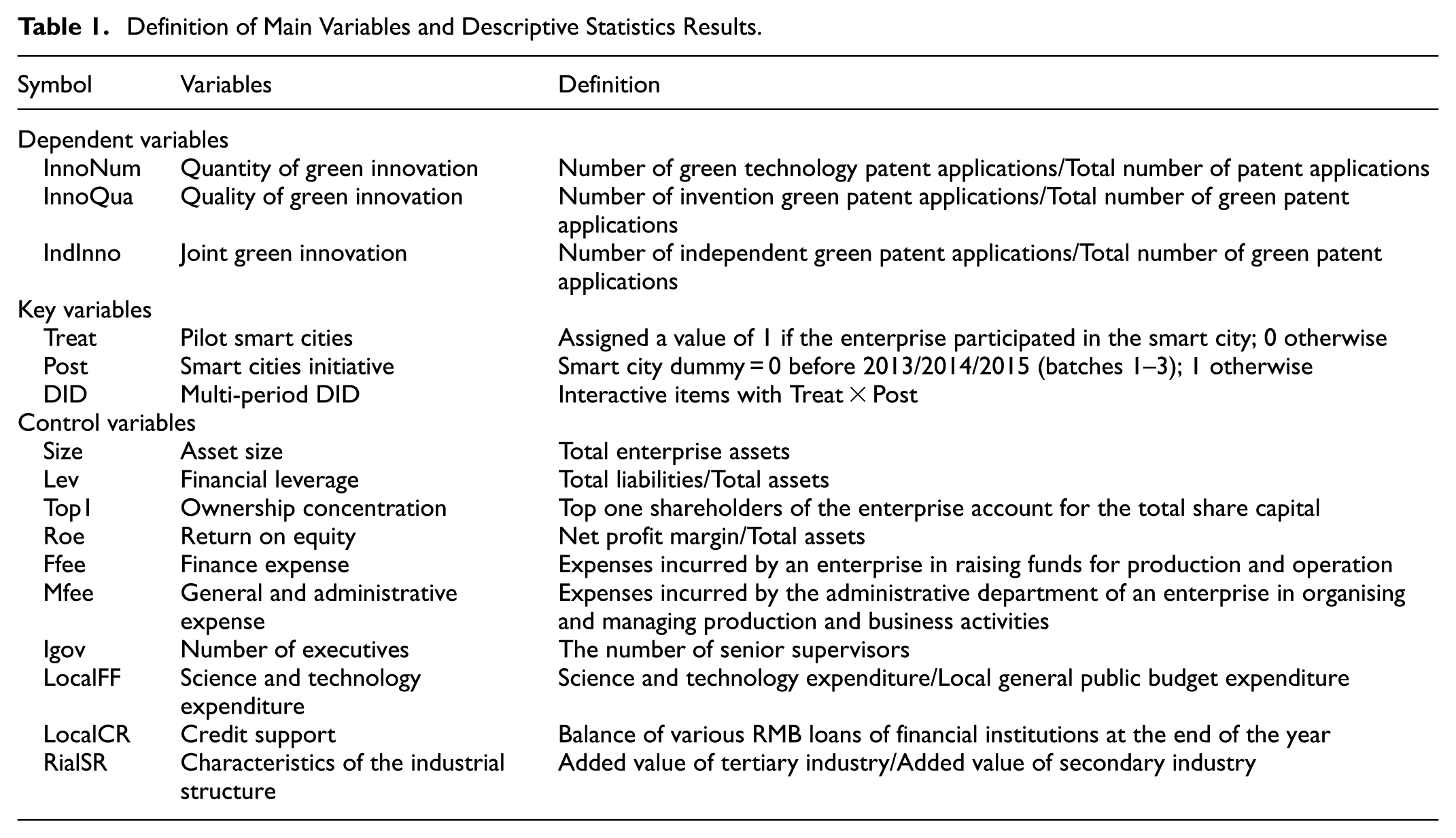
Following previous studies, we include some related control variables that may affect a firm’s green practices (Guizani et al., 2024; B. Li et al., 2024). This study specifically includes firm-level control variables such as the firm’s total assets (Size), leverage ratio (Lev), and return on equity (Roe) as well as city-level control variables such as the level of digital development (LocalFF) and the scale of credit support (LocalCR) to control for factors at the city level that could affect the dependent variable over time. Additional details are provided in Table 1. Industry (Ind) and year (Year) virtual variables are introduced to effectively control for the influence of industry differences and time trends on the empirical results.
Definition of Main Variables and Descriptive Statistics Results.
Descriptive Statistics
Table 2 reports descriptive statistics for the key variables. Over the sample period, green technology patent applications accounted for 49.7% of all patent filings, outstripping the share of invention patents. The large gap between the maximum and minimum counts of invention patents underscores substantial heterogeneity in green-innovation levels across publicly traded firms. Meanwhile, the average annual count of independent green patents is just 0.21, suggesting ample room for firms to strengthen autonomous innovation. The median value of the DID interaction term is 1, indicating that most cities participated in the smart city pilot initiative and thereby created environmentally and economically meaningful variation in manufacturing firms’ innovation responses. Moreover, correlation analysis and variance inflation factors (all VIFs < 3.17) confirm that multicollinearity is not a concern.
Descriptive Statistics of Variables.

Empirical Results and Analysis
Baseline Regression Results
The estimates of the benchmark regression analysis Model (1) are presented in Table 3, along with the control variable, individual fixed effects, and time-fixed effects. The analysis shows coefficients of 0.338, 0.316, and 0.147 for the effects of SCP projects (DID) on the volume, calibre, and autonomy of green technology innovation in firms, respectively, each statistically significant at the 1% level. Columns (4) to (6) encompass industry and annual fixed effects, with the findings retaining their statistical significance. Thus, Hypothesis 1 is validated, echoing the findings of previous studies (Yan et al., 2023). These findings validate H1 and demonstrate that pilot policies markedly enhance green technology innovation within corporations, with notably greater impacts on invention-based and autonomous innovation technologies.
Benchmark Regression Results.

Note. All models include the year (FE) and industry (FE), with robust standard errors corrected. T-statistics are shown in parentheses. ***, **, and * denote 1%, 5%, and 10% significance levels, respectively.
Concerning the control variables, both Size and Lev coefficients display a significantly positive correlation, suggesting that larger and highly leveraged firms possess greater cash flows and robust R&D commitment and are proactive in digital transformation to sustain their dominance in green technology. The Top1 and Ffee coefficients reveal a significantly negative relationship, signifying that an increased concentration of equity within firms correlates with a heightened risk of agency conflict. Additionally, a higher financial expense ratio is associated with conflicts of interest between controlling and minority shareholders, prompting a conservative management approach and curtailing high-risk green technology activities. The ratio of scientific and technological expenditures in enterprises’ operational cities is elevated, and the loan balance coefficient from financial institutions manifests a significant positive effect at the 1% level, illustrating that smart city initiatives intensify societal demands for green environmental practices. Financial support for scientific research plays a pivotal role in motivating firms to pursue innovation in green technologies.
Parallel Trend Test
Testing for parallel trends is a prerequisite for conducting a DID analysis. This analysis assumes that in the absence of the SCP, there would be no systematic variations in enterprises’ levels of green technology innovation regarding temporal trends. This study adopts an event study methodology to assess the validity of this assumption. It examines the pre-treatment trends in the sample means of innovation quantity (Figure 1a), quality (Figure 1b), and autonomous innovation (Figure 1c) across firms. The results presented in Figure 1 provide evidence supporting the assumption of parallel trends.

Parallel trend test. (a) The dependent variable is InnoNum. (b) The dependent variable is InnoQua. (c) The dependent variable is IndInno.
The findings reveal that the sample divisions across the three metrics of green technology innovation comply with the parallel trends prerequisite prior to the SCP policy enactment, with pre-pilot coefficients being uniformly lower than post-policy shock coefficients. Post-2013 policy initiation, the regression coefficient linking the volume of green technology innovation to the quality of inventive innovation notably increased within the 95% confidence interval, experiencing a minor decrease after the fourth interval. The initial phase of the pilot programme exhibited no significant variance in the autonomous innovation model, whereas the subsequent phase marked a significant enhancement in firms’ capacity for independent innovation. This may be attributed to the inherent characteristics of the patent application review process, including long cycles, intricate identification procedures, and delayed verification timelines. In the long term, smart city initiatives positively influence corporate green technology innovation behaviour. This approach satisfies the parallel trend analysis criteria, making the application of a multi-period DID model a rational choice.
Placebo Test
To more rigorously assess if SCPs have substantially enhanced green technology innovation, beyond the effects of potential random factors or overlooked variables, this study implements a placebo test involving randomly chosen treatment groups and policy implementation periods to confirm the reliability of our baseline regression findings. A placebo test was conducted on a dummy treatment group of enterprise samples using an enterprise placebo. Some samples were randomly selected as the treatment group, whereas the remainder were considered the control group. Initially, 500 random selections were made from the sample cities, with 110 cities randomly chosen in each instance to simulate pilot projects for the development of hypothetical smart cities. Subsequently, policy implementation points were randomly identified within the pilot cities to create fictive smart city projects, and 500 fabricated policy interaction scenarios were generated. In the absence of extraneous random factors or unaccounted variables, the estimated coefficient for the fabricated policy interaction term is expected to show no significant deviation from zero. Regression coefficients for the interaction terms are illustrated in Figure 2, where it is evident that coefficients for the artificially constructed policy interaction terms cluster around zero, with most of their p-values exceeding 10%. Nevertheless, the influence of actual SCP policies on innovation performance diverges distinctly from placebo test estimates and is classified as an outlier. Consequently, we can infer that the assessed influence of SCP policies on green technology innovation is not influenced by random factors or overlooked variables.

Placebo test.
Endogeneity Analysis
Double Machine Learning
The motivation behind a corporate low-carbon transition is a complex system with many influencing factors that may be simultaneously affected by multiple external policy shocks. To address the issue of variable confounding in traditional causal inference, this study employs the double machine learning (DML) method for robustness testing. The DML model effectively handles nonlinear relationships between variables through machine learning algorithms. While traditional causal inference models have limitations in processing multidimensional data, the DML model avoids the curse of dimensionality by leveraging machine learning algorithms. Following Chernozhukov et al. (2018), we construct the following partially linear DML model:


In Equations 3 and 4, the dependent variables represent enterprises’ green innovation level. The key independent variable SCP is a policy dummy variable that indicates smart city implementation. The coefficient
We employ the random forest algorithm within the DML framework, implementing a 1:4 training-to-testing data split. Table 4 presents the benchmark regression results, where columns (1) to (3) demonstrate that the SCP significantly enhances both the quality and quantity of green innovation at the 1% level. Robustness checks further confirm that the SCP transforms traditional production factor allocation and improves resource utilisation efficiency.
Robustness Test Results: Double Machine Learning.

Note: All models include the year (FE) and industry (FE), with robust standard errors corrected. Z-statistics are shown in parentheses. ***, **, and * denote 1%, 5%, and 10% significance levels, respectively.
Partial Linear Instrumental Variable Model
The implementation of the SCP may exhibit non-random patterns correlated with urban digital transformation processes, potentially introducing an endogenous selection bias. To address this challenge, we construct a partial linear instrumental variable double machine learning model following Chernozhukov et al. (2018). To verify robustness, we adopt the instrumental variable strategy proposed by Xu et al. (2024), utilising regional mobile cellular subscriptions per 100 inhabitants and the Internet user penetration rate of the resident population.

IV serves as a valid instrumental variable for the SCP, satisfying the exclusion restriction condition. Using the cross-sectional variation in these instruments, Table 4 presents instrumental variable regression results. Columns (4) and (5) show that the SCP primarily influences green innovation through direct policy channels, confirming the robustness of our benchmark estimates against endogeneity concerns.
Robustness Tests
Propensity Score Matching Difference-in-Differences Method
To address polit factor concerns more effectively, enterprises choose to locate in regions that consider a comprehensive range of factors, including urban economic growth and the accessibility of public services. The development of smart cities fosters the optimisation of the business environment and improves the quality of digital services, creating a reciprocal causal relationship along with a self-selection effect. Therefore, we employ the propensity score matching difference-in-differences approach to align the conditions of firms in non-pilot regions with relevant control variables, allowing us to estimate the net impact of green innovation within SCP initiatives. The key covariates selected include the city’s level of digital development, number of years since the firm’s establishment, and fundamental factors. Applying kernel matching and one-to-three nearest neighbour matching, Table 5 confirms that all three green innovation metrics remain statistically significant. After correcting for potential self–selection bias, the consistently positive DID coefficient confirms that the SCP policy effectively drives green innovation.
Robustness Test Results: PSM-DID Method.

Note. All models include the year (FE) and industry (FE), with robust standard errors corrected. T-statistics are shown in parentheses. *** denote 1% significance levels, respectively.
Replacing the Explained Variables
To further assess the robustness of the baseline regression results, we adopt alternative measures for green innovation. First, we use the natural logarithm of the total number of authorised patents as a new proxy for the quantity of innovation (InnoANum), which provides a broader representation of enterprises’ overall environmental innovation output. Second, we measure innovation quality (InnoRQua) by the number of forward citations received by the granted green invention patents, capturing the technological influence and substantive value of innovation. Third, we use the natural logarithm of the total number of independently granted patents to represent firm-level independent innovation (IndAInno). As shown in Columns (1) to (3) of Table 6, the SCP remains significantly and positively associated with green innovation across all three dimensions at the 1% significance level. The consistency between these results and the baseline regression findings further supports the robustness and credibility of the main conclusions.
Robustness Test Results.

Note. All models include the year (FE) and industry (FE), with robust standard errors corrected. T-statistics are shown in parentheses. *** denote 1% significance levels, respectively.
Eliminating the Interference of Other Policies
In 2013, the State Council of China issued the Broadband China Strategy Implementation Plan. Between 2014 and 2016, three batches of a total of 120 demonstration cities were approved under this initiative. The policy gradually expanded network infrastructure coverage and promoted the construction of Internet data centres, along with upgrades through cloud computing and green energy-saving technologies, aiming to enhance urban operational efficiency and resource intensiveness. However, such policies may have influenced the marginal effects of the SCP. To isolate the impact of the SCP, sample data from 2014 to 2016 were excluded from the analysis. Meanwhile, 2013 was treated as a single-policy-shock period to examine the initial effect of the SCP on enterprises’ low-carbon transformation. The regression estimates in Columns (4) to (6) of Table 6 show that even after accounting for the influence of other policies, the SCP remains statistically significant in promoting green innovation at the 1% significance level. The consistency between these results and the baseline regression findings further reinforces the robustness of our main conclusions.
Mechanism Analysis
The Mechanism of Financial Resource Allocation (LocalGC)
One possible path of smart city construction is to influence corporate environmental protection behaviour through credit constraints, and financing constraints are bound to affect the implementation of green technical performance (Albino et al., 2015). Firms frequently encounter considerable financing limitations and liquidity shortages when pursuing green technology innovations (Alam et al., 2022). Smart city development accelerates the digital transformation of businesses and significantly enhances their access to finance. Digital infrastructure adeptly connects businesses with financial institutions, improving their capability to acquire and assess loan information, bypassing the high costs of traditional signal theory and elevating the likelihood of securing external investments for firms (Fan et al., 2024). Concurrently, digital transformation signals a corporate commitment to green development in society, promptly communicates the success of environmental governance to governmental bodies, aligns with national green growth policies, and seeks additional policy incentives, motivating firms to engage in green technology innovation to broaden financial avenues. This study employs the Local Green Credit Scale (LocalGC) as an indicator of the ongoing enhancement of green initiatives in smart cities.
Column (1) of Table 7 reports the impact of green credit supply in SCP areas, representing the second-stage outcome of the mediating effect arising from financial support for green and sustainable corporate development. The LocalGC coefficient is significantly positive at the 5% level, suggesting that pilot cities prioritise green and sustainable urban construction. This fosters low-carbon technological innovation in businesses through the diversification of green financial instruments and the enhancement of capital availability. To further validate the mediation mechanism, we employ a structural equation modelling (SEM) approach. Columns (2) to (4) present the SEM estimation results for three dimensions of green technology innovation. The results show that the quality, quantity, and mode of innovation are all significantly affected at the 1% level, indicating that the expansion of green credit partially mediates the positive impact of the SCP on firms’ carbon performance. This occurs through enhanced access to external investment and targeted support from structural monetary policy tools provided by financial institutions.
Mechanism Test Results: Financial Resource Allocation.

Note. All models include the year (FE) and industry (FE), with robust standard errors corrected. T-statistics are in Column (1) parentheses, and Z-statistics are in Column (2) to (4) parentheses. *** denote 1% significance levels, respectively.
Additionally, the SEM goodness-of-fit indices, CFI and GFI, exceed 0.9, indicating a strong model fit between the observed data and hypothesised measurement structure. The mediation analysis reveals that approximately 62%, 61%, and 65% of the DID effect on green innovation (in terms of quality, quantity, and mode, respectively) is mediated by green credit, confirming the presence of a substantial mediation effect. Furthermore, Sobel test p-values are all significant at the 1% level, supporting the statistical significance of the mediating role of the green credit indicator in the relationship between policy intervention and corporate green innovation. These findings provide empirical support for Hypothesis 2a and confirm the pathway mechanisms underlying SCP. Specifically, the mechanism follows the sequence of enhancing resource allocation efficiency, expanding green financial credit, and promoting green technology innovation.
The Mechanism of Information Technology Supervision (ESG_Score)
In the context of the SCP, digital governance and data infrastructure enhance the transparency and traceability of corporate environmental behaviour, thereby exerting external pressure on firms to improve the quality and timeliness of ESG disclosures. Environmental information disclosure serves as a dynamic evaluation tool, narrowing the information gap between investors and corporations (J. Li et al., 2023). It enables investors to assess whether firms are genuinely committed to green and low-carbon transitions, thus ensuring consistency between public declarations and actual practice. Moreover, it fulfils the growing demand for green transparency and helps channel societal capital towards sustainable initiatives. Based on previous research, this study employs the ESG disclosure score (ESG_Score) from the Bloomberg database, an international third-party rating agency, as an indicator of environmental information disclosure quality (F. Wang, 2023). The Bloomberg database features a transparent and comprehensive scoring system that standardises data through its proprietary model, addressing scale deviations and enhancing disclosure adequacy. Owing to data availability, encompassing a total of 9,229 samples. Typically, firms with elevated ESG scores demonstrate a heightened willingness to proactively disclose environmental information, aiding external investors in making accurate informational assessments and mitigating information asymmetry within the realm of environmental investments. Concurrently, the volume of green patent applications constitutes a critical evaluative criterion for ESG scores, reflecting, to a degree, the genuine environmental stewardship efforts of corporations.
Column (1) in Table 8 presents the impact of the SCP on the quality of corporate environmental disclosure, representing the second-stage effect driven by external technological oversight. The ESG_score coefficient is significantly positive at the 5% confidence level, indicating that digital transformation in pilot cities significantly enhances corporate disclosure transparency. This positive correlation underlines a supervisory function of government authorities. We employ SEM to further examine the mediation mechanism. Columns (2) to (4) report the SEM estimation results, showing that all three dimensions of green innovation were affected at the 1% level.
Mechanism Test Results: Information Technology Supervision.
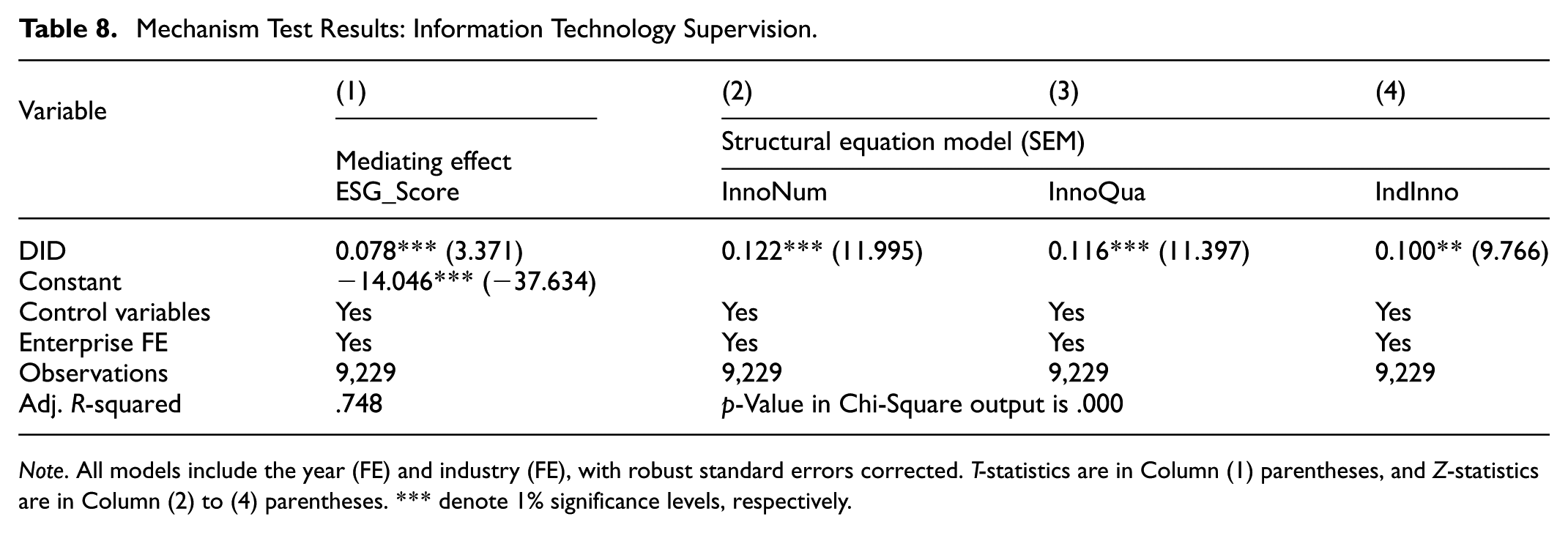
Note. All models include the year (FE) and industry (FE), with robust standard errors corrected. T-statistics are in Column (1) parentheses, and Z-statistics are in Column (2) to (4) parentheses. *** denote 1% significance levels, respectively.
Moreover, the SEM goodness-of-fit indices, CFI and GFI, exceed 0.95, indicating a good fit between the observed data and the hypothesised model. The mediation analysis further reveals that approximately 55%, 53%, and 51% of the impact of the SCP on green innovation is mediated through ESG_Score, confirming the presence of a substantial mediation effect. Additionally, Sobel test p-values are all significant at the 1% level, providing further statistical support for the mediating role of environmental disclosure in the relationship between policy intervention and green innovation. These findings provide empirical support for Hypothesis 2b and validate the pathway mechanism embedded in the SCP, specifically: enhanced technological oversight → improved environmental information disclosure quality → accelerated green technology innovation.
Heterogeneity Analysis
Heterogeneity Analysis by Regional Environmental Regulation
Different regions exhibit varying levels of concern about environmental issues and have accordingly adopted diverse environmental protection measures. These differences directly affect business development and the effectiveness of financial institutions offering green credit. This study employs text analysis as its research method to extract environmental vocabulary from annual government work reports of prefecture-level cities. The extracted terms include environmental protection, low-carbon development, sulphur dioxide (SO2), carbon dioxide (CO2), haze, PM2.5, clean energy, environmental pollution, energy conservation, emission reduction, water conservation, air quality, green spaces, greening, pollutant discharge (e.g., sewage), global warming, ecology, and acid rain, among others. The proportion of these environmental protection words to the total frequency of words in government work reports is calculated and used as a proxy variable for environmental regulation (Erhence).
Table 9 presents the heterogeneity of outcomes under varying levels of environmental regulatory intensity. The results indicate that all three measures of green technology innovation are significantly influenced by stringent regional environmental regulations. In the SCP regions with relatively lax environmental oversight, both the number of green patent filings and the diversity of invention types have increased markedly. The DID coefficient is significantly positive at the 1% level, implying that firms in regions with weaker environmental governance may have insufficient intrinsic motivation for green transformation. Nevertheless, inclusion in the SCP significantly boosts companies’ social responsibility and environmental awareness. A plausible explanation for this is that the pilot policy fosters both internal and external collaboration among cities, enterprises, and other stakeholders by promoting advanced information technologies, thereby lowering R&D costs and accelerating green technology innovation.
Regional Environmental Regulation Heterogeneity Results.
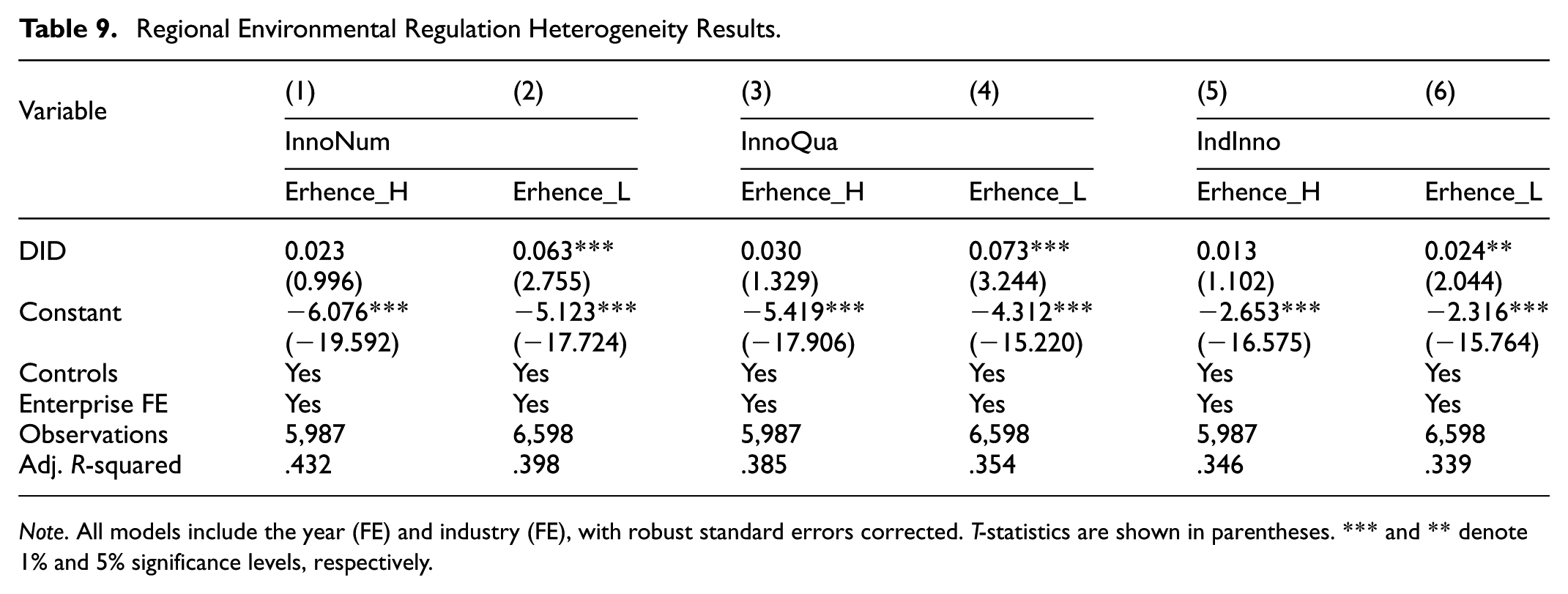
Note. All models include the year (FE) and industry (FE), with robust standard errors corrected. T-statistics are shown in parentheses. *** and ** denote 1% and 5% significance levels, respectively.
Heterogeneity Analysis by Heavily Polluting Industries
Against the background of the SCP, environmental regulations have shifted from traditional ex-post inspections to full-process digital monitoring. Given the substantial compliance pressure they already face, heavily polluting industries are compelled to adapt more quickly to digital regulatory systems, meet increasingly stringent environmental requirements, and respond to regulatory mandates, while cultivating a reputation for green governance. According to the Guidelines for the Legal Disclosure Format of Corporate Environmental Information issued by China’s Ministry of Ecology and Environment, eight high-emission industries, including electric power, basic chemicals, petroleum and petrochemicals, steel, building materials, non-ferrous metals, coal, and aviation and airports, have been designated as key sectors for green transformation. In this study, these industries are classified as heavily polluting (IndPoll).
Table 10 presents an analysis of the differential impacts of SCP projects on firms categorised within polluting industries. Firms in heavily polluting sectors have seen enhanced marginal benefits in green technology innovation following participation in SCP initiatives, in contrast to their counterparts in other sectors. The DID coefficient demonstrates a significantly positive impact at the 1% significance level across all three innovation metrics. A likely explanation for these findings is that the SCP facilitates the shift of heavily polluting firms from intensive and unsustainable practices to more resource-efficient and eco-friendly development models. Companies highly sensitive to environmental issues or those with strong ties to environmental governance show a marked correlation. Driven by the need to comply with local regulatory standards, these companies are motivated to enhance their self-driven innovation capacities and bolster their environmental reputations.
Heavy Polluted Industries Heterogeneity Results.

Note. All models include the year (FE) and industry (FE), with robust standard errors corrected. T-statistics are shown in parentheses. *** denote 1% significance levels, respectively.
Heterogeneity Analysis by Enterprise R&D Intensity
Differences in enterprises’ R&D investments are associated with varying attitudes towards environmental protection (Zhang et al., 2023), leading to the heterogeneous effectiveness of green credit among enterprises. This study employs the current year’s ratio of R&D expenditure to operating income (RdStr) as a measure of R&D intensity. Firms with higher R&D intensity typically possess stronger cash flows and technological capabilities, which not only support green innovation but also encourage the proactive disclosure of environmental performance, thereby contributing to a positive reputation for green governance. When firms face considerable financial constraints and their R&D investments are restricted, their drive to pursue green development strategies tends to be lacking.
Table 11 reports the results of heterogeneity under different levels of R&D intensity in enterprises. Among groups with lower R&D expenditure, the coefficients for three types of green technology innovations are significantly positive at the 5% level. This indicates that in situations where corporate R&D investment is insufficient, SCPs can facilitate resource aggregation, direct social capital towards green environmental protection projects and technological advancements, and enhance financial support. Generally, small and medium-sized enterprises may be unable to fully participate in and benefit from the advantages of smart cities due to limited resources (Nilssen, 2019). This issue of unequal access to technology, which intensifies due to limited innovation capacity and funding constraints, can be addressed by smart city initiatives, thereby significantly improving the quality and efficiency of green innovations.
Enterprise R&D Intensity Heterogeneity Results.

Note. All models include the year (FE) and industry (FE), with robust standard errors corrected. T-statistics are shown in parentheses. *** and ** denote 1% and 5% significance levels, respectively.
Conclusions and Policy Recommendations
Conclusions
Smart cities that integrate information technology with urban development are increasingly vital for driving economic transformation and environmental sustainability. Based on data from Shanghai and Shenzhen A-share listed manufacturing companies between 2007 and 2022, we use SCP initiatives as a quasi-natural experiment and employ the multi-period DID model to verify the direct impact and mechanism of smart cities on green innovation.
First, the pilot designation substantially enhances manufacturing firms’ green innovation output across multiple dimensions. It boosts both the quantity and quality of green technology innovations, significantly raising the average number of green patent applications and the share of invention patents, signalling intensified R&D efforts in eco-friendly technologies. Firms in pilot areas also show a stronger propensity to file patents independently, indicating that smart city incentives strengthen in-house innovation capabilities rather than merely fostering external collaborations. These results remain robust across alternative model specifications and robustness checks.
Second, two principal channels drive greener innovation gains. The pilot status provides preferential access to green financing through municipal bond guarantees and subsidised credit, easing liquidity constraints and steering firms’ resources towards low-carbon projects. Stronger regulatory oversight, such as mandatory environmental reporting and real-time emissions monitoring, forces firms to enhance their disclosures and align corporate strategies with sustainable development objectives.
Third, the effectiveness of SCP initiatives varies by firm and regional characteristics. Firms with low historical R&D intensity experience the greatest relative gains, while regions with less stringent environmental regulations see larger marginal improvements, underscoring the complementarity between pilot oversight and existing policy frameworks. Moreover, pollution-intensive industries such as steel and chemical manufacturing demonstrate strong innovation responses, reflecting both higher abatement needs and the added value of smart-city infrastructure in supporting targeted green technology development.
Theoretical Contributions
By integrating micro-level causal inference, novel mediation mechanisms, and heterogeneity analysis, this study advances theoretical understanding of how smart city initiatives drive corporate green innovation and provides a methodological guide for future research on digital-urban policy interventions. From a macro perspective, our findings enrich Ecological Modernisation Theory (EMT), which posits that economic development and environmental protection can be mutually reinforcing (Ahmad et al., 2024; Guizani et al., 2024). EMT emphasises the role of technological innovation, manufacturing process optimisation, and environmental management system improvements in reducing ecological burdens while sustaining growth. Exploiting the staggered rollout of SCP batches in a multi-period DID framework, we demonstrate that the policy incentivises firms to innovate green patents and adopt eco-friendly solutions. This leads to more efficient resource use and pollution minimisation, further deepening theoretical insights into digital-urban governance and corporate innovation.
From a micro perspective, this study strengthens empirical support for stakeholder theory, which posits that firms must actively engage with diverse stakeholders, including shareholders, employees, customers, government entities and broader society (Ali et al., 2019; Weng et al., 2015). Smart city initiatives serve as dynamic platforms for such engagement, facilitating real-time collaboration and responsiveness to stakeholder concerns, thereby accelerating the adoption of green practices. We also identify two novel mediation mechanisms: preferential reallocation of green funding and enhanced regulatory transparency. These channels show how SCP synergises with traditional market and regulatory incentives to drive substantive green innovation. Additionally, our analysis uncovers systematic heterogeneity in SCP effects across firms and regions, refining the boundary conditions of stakeholder and urban-governance theories and providing a more nuanced framework for understanding how digital-urban governance facilitates green-technology diffusion.
Policy Recommendations
Based on our findings, we propose three policy recommendations. First, policymakers should integrate digital-infrastructure development with ecological upgrading by deploying high-speed networks and AI-enabled sensors to create urban nerve centres that channel real-time environmental and production data into unified big data platforms. Breaking down interdepartmental data silos will enable cross-regional coordination of resource allocation, pollution monitoring, and innovation incentives, ensuring these functions operate in concert rather than in isolation.
Second, governments should identify and publicise firms that have fully digitised and greened their operations, turning them into innovation beacons for their sectors. These demonstration enterprises should receive fast-track access to land, infrastructure, and public procurement contracts in order to scale up their green-technology solutions. Industry clustering can be promoted by establishing green-technology parks with shared R&D labs, testing facilities, and supply-chain networks. Open-access data repositories from these clusters will help traditional companies leapfrog into low-carbon production.
Third, authorities should foster structured partnerships among industry, academia and research institutions by establishing jointly funded consortia that leverage urban data infrastructure to translate academic breakthroughs into practical applications. Financial institutions, venture capitalists and service providers should pool resources into dedicated green innovation funds to support high-risk, high-reward projects. At the same time, public campaigns such as green label certifications and consumer education initiatives will broaden demand for sustainable products and cultivate an ecological culture.
Limitations and Future Research
On the one hand, although the difference-in-differences model is applied to estimate the causal impact of smart city initiatives, limitations in certain city-level datasets may result in some time-varying shocks remaining uncontrolled. Moreover, reliance solely on the number of green technology patents as a proxy indicator may fail to accurately represent firms’ actual emissions reductions or pollution-control efforts. Future research could therefore incorporate a wider range of environment-related metrics, including carbon emissions, energy usage, and pollutant discharge records, to enable a more precise measurement of outcomes.
On the other hand, this study is focussed exclusively on Chinese manufacturing enterprises and excludes non-listed firms as well as small- and medium-sized enterprises, which may possess considerable innovation potential. As a result, the findings may not fully reflect the relationship between smart-city digital development and green transformation in regions beyond China. Future research should consider expanding the sample to a wider range of developing countries so that the conclusions may be more broadly generalisable.
Footnotes
Acknowledgements

Consent to Participate
This article does not contain any studies with human participants performed on by any of the authors.
Author Contributions
Conceptualisation, Z.Z. and H.L.; methodology, Z.Z. and B.L.; software, B.L.; validation, B.L. and H.L.; formal analysis, Z.Z. and H.L.; investigation, Z.Z. and B.L.; resources, B.L.; data curation, Z.Z. and B.L.; writing-original draft preparation, Z.Z. and B.L.; writing-review and editing, H.L. and B.L.; visualisation, B.L.; supervision, B.L. and Z.Z.; project administration, Z.Z. and B.L.; funding acquisition, Z.Z. and B.L.. All authors have read and agreed with the published version of the manuscript.
Funding
The authors disclosed receipt of the following financial support for the research, authorship, and/or publication of this article: This research was funded by the 75th batch of China Postdoctoral Science Foundation Project, No. 2024M750332; Liaoning Province Social Science Planning Fund Project, No. L24CGL039; Scientific Research Fund of Zhejiang Provincial Education Department, No. Y202455099.
Declaration of Conflicting Interests
The authors declared no potential conflicts of interest with respect to the research, authorship, and/or publication of this article.
Data Availability Statement
The data supporting the findings of this study are available from the corresponding author upon reasonable request.