




Abstract
We explore the complex interplay between the stringency of environmental policy with Foreign Direct Investment (FDI) in reference to two theoretical frameworks: Pollution Haven Hypothesis (PHH) and Porter’s Hypothesis. Focusing on how three subcategories of environmental policies – market-based, non-market-based, and technology support policies – influence FDI decisions, our research contributes to examine the understanding of the dynamics at play for the academics and policymakers. The study provides empirical evidence for the arguments using a panel data of 40 countries over a decade (2010–2020). Our findings reveal that the stringency of aggregate environmental policy, along with non-market-based and technology support policies, exhibit an affirmative and significant correlation with FDI. Interestingly, there is no clear relationship between policies that are market-based and those of FDI positions, this suggests that strict market-based policies do not deter FDI into host countries. The findings contribute to the ongoing discourse on environmental regulation and international investment, suggesting that stringent environmental policies – depending on their type – can be compatible with or even facilitate FDI attraction.
Introduction
Emerging as an important component, foreign direct investment has been signaled as a pivotal concern for the interplay of global economic growth and environmental sustainability. As the national policy makers struggle to achieve two national objectives of fostering economic development while also preserving environmental integrity, the impact of environmental protection policies on the FDI levels of a country becomes a critical issue. While the traditional literature predicts the presence of FDI to inhibit or redirect investment decisions (Chichilnisky, 1994; Copeland & Taylor, 1994; Pigou, 1920; Shahbaz et al., 2015; Singhania & Saini, 2021), we seek to examine if there are contexts where this signals an attractive inducement for multinationals? Similarly, may strict policies create a more attractive FDI location through signaling a better regulatory and institutional setting for the firms?
Waste is a normal part of any industrialization process from R&D, through manufacture, and consumption, with the end-of-life also resulting in waste or pollution. To help influence this, there are three types of environmental policies that governments can utilize to attract FDI while contending with the associated environmental impacts. Some researchers have suggested that certain multinationals are attracted to weak institutional environments for a variety of reasons including the absence or lax policy considerations for pollutants (Zarsky, 1999). Meanwhile others have suggested multinationals may be attracted to strict institutional environments including how this can facilitate cutting-edge innovations to improve processes and mitigate pollutants by leveraging the three types of policies (M. E. Porter & van der Linde, 1995).
Building upon this foundational division, our research takes a step further to dissect the dynamics among the types of environmental policies and those of foreign direct investment. This inquiry is particularly timely and relevant, given the evolving nature of global investment strategies and the increasing emphasis on sustainable environmental and business practices as promoted by several supranational organizations (Kyoto Protocol, 1997; Millenium Development Goals, United Nations, 2000; Paris Agreement, 2015; Sustainable Development Goals, United Nations, 2015). As such, this paper aims to contribute to the theoretical discussions on the effects of different types of policy bundles on inward foreign investment positions of a country and aims to provide empirical evidence to the policy makers, a subject that has mixed results and remains underexplored in contemporary discourse. By doing this, we aim to engage in the academic conversation that examines the interplay among increasing FDI and the impact of that economic activity on the environment (e.g., Adeel-Farooq et al., 2021; Grossman & Krueger, 1995; Mangun & Mangun, 1993; Zhang et al., 2024).
To investigate this research question, we build an unbalanced panel containing 40 countries – tracked by the OECD – spanning 2010 to 2020 in order to examine the ways in which the degree of policy stringency for country-level environmental protection tools may impact inward foreign direct investment. These 40 countries represent all the countries in the environmental policy database which is composed of developed and developing countries (such as Indonesia and the BRICS) as these nations are key players in global FDI flows. An important contribution of this study to this field lies in the nuances of the relationship between policy stringency and FDI. Briefly put, the effect does not have the same impact when examining the different policy types – the cases of nonmarket-based and those of environmental and technology support policies differ from those of market-based policies.
The following Introduction section examines the key literature as we build upon theory and structure the logic building of our arguments. Following this, we present an empirical model to test the relevance of different policy types on FDI. We then present the discussion and policy implications, and conclude with avenues for future research.
Relevant Literature
Competing Theoretical Backgrounds: Pollution Havens and Pollution Halos
This leads us to a pivotal aspect of our study: the examination of the relevance of Pollution Haven Hypothesis (PHH) and Porter’s hypothesis in the context of environmental protection policies for countries.
Pollution Havens
In an “ideal” market system, pollution as an economic externality, is part of the market imperfections and any regulation to internalize it will impose new costs that in turns reduce productivity (Vatn & Bromley, 1997). Termed the Pollution Haven Hypothesis (PHH), this historically postulated that countries with more stringent environmental regulations will have lower levels of FDI, as foreign businesses may perceive these stipulations as a supplemental-yet-mandatory financial burden (Chichilnisky, 1994; Copeland & Taylor, 1994); whereas, a country with lenient environmental regulations might be viewed as having a comparative advantage in attracting pollution-intensive industries. Simply, PHH posits that environmental regulations can impact the location decisions of firms, especially those in pollution-intensive industries such that stricter environmental policy regulations in some nations may encourage a relocation of high polluting industries to developing nations with lax environmental standards. Thus, the historical belief in academic literature effectively affirms the mere existence of environmental policy regulations may disincentivize international investments.
While investigating the relevance of this Pollution Haven Hypothesis (PHH), Essandoh et al. (2020) argued that, specifically in low-income countries, there is a positive long-term correlation between environmental degradation and inward FDI. Likewise, using Chinese provincial data, several studies confirmed the relationship that FDI had varying effects on different environmental pollutants (Q. Liu et al., 2018; Wang et al., 2021). A firm that seeks to minimize costs, might view these countries as attractive investment locations compared to strictly regulated countries for their more environmentally damaging operations, in the process these firms dump unrestrainedly into the environment and pollute without repercussion. The advantage to the firm is the false illusion of a growth rate that is increasing (Field & Field, 2013). In most cases, those are in emerging markets with weaker institutions and laxer regulations compared to the developed countries (Satoglu, 2020).
Some of the empirical evidence for the pollution haven effect on foreign investment is mixed. Xu et al. (2021) found mixed results on the validity of PHH for Chinese provinces. Similarly, Dean et al. (2004) did not find clear evidence to justify that foreign investors are more attracted to the regions with weaker environmental regulations. Instead, they found factors other than environmental regulation stringency are more significant in influencing the distribution of foreign investment within China.
Porter’s Hypothesis
Conversely, it may also be possible that a nation with more strict environmental regulations may be associated with an increase in international business activities if those decision makers see the environmental regulations as a clear signal of the given country’s commitment to sustainability. Challenging the conventional economic thinking about the effects of environmental regulations on firm competitiveness, Michael Porter (1996) proposed that strict environmental regulations can stimulate innovation and competitiveness within firms. According to Porter, a well-designed and strictly implemented government policy on the environment can spur innovation and economic growth, creating a win-win scenario for society, the environment, and the actors of the economy. He postulated innovation on waste reductions and production efficiency through environmentally friendly technologies could offset the costs that stem from the strict regulations. Thus, strict environmental regulations in a country can push firms to innovate and increase their global competitiveness. Consequently, multinationals may not be deterred from investing in countries with stricter environmental standards.
When specifically looking at India, some have empirically illustrated that stringency in environmental policy is an inducement to international business activities in the form of FDI (Pargal et al., 1997). As suggested by Porter’s hypothesis, they found a heightened degree of stringency in environmental protection laws serves to induce to FDI at the level of both the manufacturing plant and the firm which suggested that strict rules about the environment stimulate innovation and increase productivity of a country. Dean et al. (2004) found similar results for equity joint ventures (EJV) going into China. At first they found Chinese-based FDI investments supported behavior with the PHH as domestic EJVs selected provinces within China that had lax enforcement of weak laws; this was especially pronounced when the industry was also categorized as high polluting. They also found when the EJV location selection was determined by internationally-based FDI sources into China, the outcome signaled direct opposition to the norms outlined by the PHH as the selected provinces – regardless of industry – had high stringency in laws regarding environmental protections.
In other contexts, Christmann and Taylor (2001) find firms that had previously not regulated their pollution output began to enact self-informed regulations for their respective degree of pollution, after watching global industry leaders do so across contexts and particularly notably when those leader firms were investing in developing nations where the environmental laws are weak. This signals alignment among the more recent literature that reveals how global multinationals transfer their pollution-mitigation informed best practices, the advanced knowledge from other contexts, and practices that support the environmental while mitigating impact, which taken together and over time can improve the environmental performance of domestic firms and industries (Benzerrouk et al., 2021; Zarsky, 1999).
These trends suggest a complex interplay between corporate practices, global standards, and local policy environments, further complicating the assessment of how environmental policies impact FDI. The implications of these findings are significant when considering policy applications, particularly in the context of Porter’s Hypothesis. This perspective introduces an important dimension to our analysis: the differentiation of policy types and their respective impacts on economic and environmental outcomes. As we navigate these various theoretical frameworks, our study seeks to identify the complex nature of different environmental policies, shaped by global trends and local nuances, and their specific influence on FDI decisions.
Types of Environmental Policies
Policy makers are faced with the difficult responsibility of establishing institutional norms (i.e., setting the rules of the game) that attract FDI, while mitigating unwanted degradation. There are clear historical precedents for this, among these is the philosophy encouraging an alignment of the private costs of the multinational, to the equivalent social costs encountered by the local host population for harm done to the atmosphere and environment (Pigou, 1920). One of the difficulties herein is identifying and assigning a monetary value to environmental degradation. While there are many environmental valuation techniques, most are types associated with either market-based and/or non-market based techniques. For instance, water demand modeling now takes into account the values from the market and those of the non-market environment in building support for policy decisions (Booker et al., 2012), later these two valuation techniques are impacted by the technology available in industry. Because of this, we examine the three ways environmental policies are typically framed – market-based policies, non-market based policies, and environmentally-oriented technology support policies. We examine these at the country-level to determine if the type of policy stringency matters for FDI decisions as strict institutional tools and structures have also precipitated and led to sustainable development norms (Gradus & Smulders, 1993).
Market-Based Environmental Protection Policies
Environmental taxes and marketable permits are what commonly comes to mind when thinking about market-based instruments. These are alternatively called Pigouvian taxes, pollution taxes, and/or green taxes, which these serve to outline, specify, and collect a set amount in relation to a standardized and specific unit of pollution in the given nation (Pearce & Turner, 1990). These taxes follow the belief that if a firm’s pollution causes societal costs, a tax equivalent to the cost of the harm should be imposed, thus aligning private costs with social costs, leading to a more socially optimal level of production and pollution (Pigou, 1920). The impact of such taxes and regulations that enforce firms to be directly financially responsible for damaging the environment may have other outcomes in terms of global investment distribution. Rooted on Ricardian Comparative Advantage Theory, the Pollution Haven Hypothesis suggests that while these taxes internalize the external costs of pollution, leading to better environmental outcomes domestically, they could instead inadvertently encourage pollution-intensive industries to relocate to countries with looser environmental regulations (Dean et al., 2004).
Additional market-based control instruments for pollution are those of marketable permits, marketable certificates, and tax subsidies. With regards to the former, there is an ongoing ethical debate about purchasing the “right to pollute” via permits and certificates (Tietenberg & Lewis, 2018). This can become a sensitive and contentious government issue when the zone-of-impact extends many kilometers, does not adhere to agreed upon international borders, and thus often impacts the jurisdictions of multiple nations or regional agreements. With regards to the latter, reimbursement funds as subsidies are provided after (1) transitioning equipment and machinery to new equipment with greater efficiency and (2) after the recipient has shown a measurable decrease in pollution from the improvements (Baumol & Oates, 1988).
From the firm’s perspective, in addition to the formalized costs associated with taxes and the price of permits/certificates, each technique entails other costs – such as the cost of collecting and handling said information and those then associated with the administrative costs – where there are multiple levels of financial overhead (Kolstad, 2009). Thus, the policy represents an additional financial burden for firms seeking to engage in international business activities in a given target country. Therefore the baseline cost to engage in FDI behaviors must increase to attend to these strict environmental policies, as such the increasing costs may deter investment when such green taxes and associated costs of compliance represent an addition to the minimum threshold for business activities in the focal country.
Therefore when considering the role of financial burden on the firms, in light of the tenets of the Pollution Haven Hypothesis, in this study we argue that the more stringent the market-based tools used for environmental protection policy, will lead to lower levels of foreign direct investment into a country.
Non-market-Based Policies for Environmental Protection
Given how market-based initiatives represents an immediate market where participants can buy and sell, non-market policies exist outside that to reach environmental goals (Botta & Koźluk, 2014). Instead, the non-market policies set emission limits and mandate certain standards be met for business activities to continue occurring (Kruse, 2022). As such other actors can exert influence from governments, supranational organizations, NGOs, and citizen-led social movements. For example, continuous monitoring of protected areas for improved conservation is a recommendation that could be paid for via non-market strategies as has been done for UNESCO World Heritage Sites (Otto & Chobotova, 2013). In doing so the governments have since been able to signal legitimacy for such environmental initiatives and is another example of a non-market based protection approach (Kölbel & Busch, 2021).
Tax schemes require much oversight and administration which may present a hurdle to the host government in addition to the investing firm, thus such alternative policy options via non-market regulations (outlined above) could be an alternative tool with less administrative oversight for both parties while still anticipating adequate protection effectiveness (Hoffmann et al., 2005). Indeed, the focal country also incurs a cost when developing, implementing, and monitoring the environmental protection regulations it issues. Using a non-market approach and regulations to limit potential damage beforehand may be a less expensive way to achieve comparable outcomes for environmental protection in FDI contexts. In parallel to this, there is a growing interest by some firms voluntarily undertaking environment-oriented corporate social responsibility initiatives. As more responsible actors are involved in the environmental sustainability process over time, in return this progression supports the rise of non-market policy schemes to internalize the externalities of pollution.
As such we argue that the more the stringency of the enacted non-market-based policy tools designed to protect and preserve the environment, the more the foreign direct investment stock into a country.
Government Policies for Environmentally-Oriented Technology Support
Technology support subcategory of environment policy entails policies that support innovation in clean technologies and their adoption (Kruse, 2022). Such policies outline government-backed support for research and development, sourcing, and integration of clean technologies into firm processes and procedures via funding, tax credits, and myriad of other financial types of support. Indeed, early research suggest that contexts with strict policies to protect environmental interests serve to promote the innovation then onboarding of cleaner industry technologies, in doing so, this has been shown to additionally promote production efficiency (M. E. Porter & Linde, 1995). There is additional evidence of these policies having the intended impact, for example Tsoy and Heshmati (2024) recently found these renewable energy projects improved the consumption of clean energy, leading to a reduction of adverse climate change impacts.
From the firm’s perspective, these policies of financial support might incentivize foreign direct investment decisions. In doing so, these policies may serve as a motivation and inducement which may expedite environmental improvements. Indeed, these policies may align with the PHH expectations (Zarsky, 1999), wherein such global firms with knowledge from the cutting edge, machinery, and procedures can spread their best industry practices to local incumbents upon entry (Benzerrouk et al., 2021). With greenfield FDI entry, international businesses may be using Green Infrastructure approaches and tools to build “with” the environment and simultaneously address climate challenges while local business communities may be influenced by knowledge spillover effects (S. J. Liu & Xu, 2021; Meierdiercks & McCloskey, 2022).
Taken together, we specifically argue that the more stringent the environmentally-oriented technology support policies, the more the FDI into a country.
Data and Variables
In this empirical analysis, we briefly test our arguments on FDI and environment policy relationship empirically. Our database is an unbalanced panel of 40 countries from the years 2010 to 2020 (see Appendix Table A1 for the list of countries). The sample countries are limited to the 40 due to data availability for the variable of main interest Environmental Policy Stringency. The composite Index of Environmental Policy Stringency – which can be subdivided into the three categories – are our main variables of interest in four separate models and were collected from the Environment Statistics Database hosted by the OECD; which primarily tracks OECD countries plus a few non-OECD countries like Indonesia, Brazil, Russia, India, China, and South Africa (i.e., the BRICS) that are significant players in global FDI positions. Thus, our sample includes all countries for which the environmental policy index is available, ensuring comprehensive coverage of the relevant data.
Our analysis begins with the inward FDI positions as the dependent variable, the data is thus extracted from the database of OECD Globalization Statistics. We collected the variable data in USD dollars, it provides total inward foreign direct investment positions of the OECD and non-OECD countries.
Explanatory Variables
Below we develop four separate models in order to examine the four hypotheses above, thus the four different explanatory variables which are directly related to environment policy are examined in their influence on FDI.
Environmental policy stringency (EPS)
The Index for Environmental Stringency is used to measure strictness specific to the target host country of the regulations on environment issues and maintained by the Organization for Economic Co-operation and Development (OECD) to differentiate, measure, and provide a way to compare the stringency of policies across the nations they track. It is a composite index which recombines many indicators of environmental policy stringency – often including those of regulatory standards, various measures of enforcement, and economic instruments (e.g., taxes, subsidies, and the like); the index was updated in 2022 to include broader instruments of environment policy (Botta & Koźluk, 2014; Kruse, 2022). The updated index which we will use in this study includes several instruments on climate change and air pollution and otherwise covers a wide range of environmental policy areas. The index facilitates a comprehensive overview to examine the landscapes of environmental policy across different countries, thus it and allows for the direct comparison of the stringency by country and over time for such environmental policies. Specifically, data in the EPS and its sub-categories use a standardized scale ranging from 0 to 6, where higher values indicate greater stringency in the policy environment. The exact meaning of the index values can vary depending on the specific policy area or indicator being considered. However, in general, a higher EPS value indicates that country has policies of higher environmental protection stringency in place, and may take additional or more assertive policy steps to address the environmental challenges within their respective sphere of influence. Thus, the EPS index is a useful tool for researchers, policy makers, and other stakeholders who seek to understand and compare the policy effectiveness across countries for environmental interests. As such, we have incorporated EPS index in our FDI-environment policy analysis.
Figure 1 below plots the relationship between Inward Foreign Direct Investment (FDI) positions of the countries and their Environmental Policy Stringency from 1990 to 2020. The graph suggests that as environmental policies become more stringent, FDI levels vary, with some countries demonstrating higher investment despite stricter regulations. Remarkably, the “fitted” line appears to show a positive correlation between the two variables.

The environment policy stringency and inward FDI.
As our study highlighted, governments have various instruments to address environmental degradation which can be aggregated into three main sub-categories. The composite Environmental Stringency Index can be disaggregated into three subcategories of: market-based policies, non-market-based policies, and technology support policies (Botta & Koźluk, 2014; Kruse, 2022). The study’s methodological approach uses all four policy tools as separate independent variables in our goal of examining and assessing the different impacts of the various policies on FDI levels. Table 1 summarizes the policy instruments measured in each sub-category.
Classification of Policy Instruments in EPS Index.

The Environmental Stringency Index defines market-based policies as those which are market-based mechanisms (e.g., prices, green taxes, tradable permits, etc), to promote the mitigation of adverse environmental impacts. Carbon dioxide (CO2) trading schemes, renewable energy trading schemes, carbon taxes, and/or fuel taxes are typical modern examples of market-based policies (Botta & Koźluk, 2014). Briefly, renewable energy trading scheme is a market system trading green energy certificates for the firms that are obliged to generate a regulated amount of electricity from renewable sources. So, a higher percentage of the mandated amount will show the stringency of the policy. Similarly, the CO2 trading scheme sets a cap for the total CO2 emission amount. Permits are bought and sold by the regulated units. Higher annual average price of a permit is an indicator of a stricter policy. CO2, nitrogen oxides, sulfur oxides, and fuel taxes are all the policies of imposing new taxes for polluting gasses. So, the stringency of the policy can be measured by the tax rate for the emissions of each gas. In most cases, however, diesel tax is imposed on the liter of the gas.
Those government polices that are non-market-based are defined by the EPS as the types which do not utilize markets to reach or maintain environmental targets (Botta & Koźluk, 2014). Such policy types leverage regulations to mitigate pollution byproducts which each firm emits in the course of doing business activities, as well as performance standards of specific products and technologies utilized. Emission limits for nitrogen oxides (NOx), sulfur oxide (SOx) and particulate matter (PM) values are the indicators that show the upper-limit of the permitted level of concentration of the gasses and the PM in the coal-fired power plants. Likewise, sulfur content limit for diesel is a fuel standard for the maximum level of concentration of sulfur permitted in the diesel gas used for transportation. These limits would represent the standards of the energy sector as the lower the limits the more stringent the policy.
Lastly, the EPS defines technology support policies by the initiatives that outline government support during the stages of clean technology development, deployment, and adoption. These policies are mainly classified as upstream (public R&D support and finance of clean technologies) and downstream policies (incentives for the adoption of specific technologies). Upstream value chain policies for research and development (R&D) funding, tax credits when purchasing and using clean technologies, as well as a myriad of other alternative forms of direct and indirect financial support (Botta & Koźluk, 2014). In more detail, public R&D expenditures are the share of GDP spent by the government for the research and development of low-carbon technologies such as searching for renewable energy sources and energy efficiency (Kruse, 2022). Other cross-cutting technologies such as carbon capture and storage, nuclear energy, hydrogen energy, and fuel cell technology are also funded by the public research support programs. Downstream technology support policies are the feed-in tariffs (FIT) and renewable energy auctions to support adoption of solar and wind energy generation. The average awarded price from the auctions shows the level of support and signals the stringency of the policy measured by the indicator (Kruse, 2022).
Figure 2 displays the changing pattern of environmental policy stringency of the 40 observed countries over three decades in three policy categories: market-based, non-market, and technology support measures. From 1990 to around 2005, we see a gradual increase in non-market measures, indicating a rising preference for regulatory and voluntary actions for environmental protection. The market-based measures, represented by the red dots, show a more modest rise, suggesting a steady but weak adoption of economic incentives and actions. Meanwhile, technology support, the blue dots, sees a significant surge post-2000, peaking around 2010 before plateauing. This suggests an initial rush to invest in technological solutions for environmental issues, which stabilizes as the technologies mature.

Environmental stringency policy over time.
Controls
When it comes to investing, the location decision of a multinational firm is a complex decision that factors like labor market, market size and institutional strength also play significant roles (Chakrabarti, 2001). We followed the literature and added several country level control variables into our models.
Population, one of the most significant determinants of the FDI, might reflect the country’s size in terms of abundance of labor and the market’s demand structure. Several studies in the past have shown population to be positively correlated with foreign direct investment in larger labor markets to attract more FDI for the host country (Chakrabarti, 2001). Thus, our data used the total population of the observed countries which we collected via the World Development Indicators (WDI) Database as hosted and supported by the World Bank.
Gross Domestic Product (GDP), which we also collected from the WDI is in constant terms, measures the size of s given national economy. Market size has also been long known to impact multinational firm investment decisions, this is often considered because they may anticipate more opportunities in the market and profit potential in nations with larger GDP levels (Schneider & Frey, 1985).
Trade Openness
Trade barriers, such as tariffs and transportation costs, drive firms to invest directly in foreign markets to bypass these restrictions. Similarly, cost differences between countries encourage firms to allocate their production across different locations which in turn boost FDI (Aizenman & Noy, 2006). Therefore, trade openness of a country is a significant determinant in FDI analysis. In our database, this variable was calculated by the WDI as the percent share of international trade in gross domestic product (GDP).
FDI Restrictiveness Index
This index measures all types of macroeconomic and institutional policies of a given country that has restrictions on international investment via FDI. This index ranges from 0 to 1, and is calculated by the OECD for several countries. For this index, a higher value signals a comparatively more restrictive regime for FDI and higher extent of regulatory barriers for investment which would lead to less FDI into that country, as the firms prefer more favorable institutional and policy areas to invest. Thus, we expect a negative impact in our results when controlling for the of this foreign direct investment restrictiveness index on FDI activities in a given country.
Table 2 summarizes the source and the descriptive statistics of the model variables which we discussed so far.
Descriptive Statistics.

Model
Our model uses a fixed effect panel regression to empirically assess our arguments on FDI investments and the utilized environmental policies of a given country in our study. A fixed-effects model controls for all time-invariant differences between the individuals, so the estimated coefficients are not biased because of omitted characteristics of countries (Kohler & Kreuter, 2005). In other words, the fixed effect model ensures control for country-specific factors that are unobserved but constant over time. The model is appropriate for cross-country studies because it controls for characteristics that may differ across countries but remain constant over time, and provides safety for heterogeneity. This allows us to isolate the impact of environmental policy stringency on foreign direct investment (FDI) levels, while controlling for any unobserved factors specific to each country (Baltagi, 2005).
To confirm the appropriateness of using a fixed effects model, we conducted a Hausman Test, which compares the fixed effects model with the random effects model. In all four models Hausman tests provided p values less than 0.05, as such we rejected the null which resulted in confirming that fixed effect models are consistent for our analysis (Baltagi, 2005; Wooldridge, 2010) (See Hausman Test results in Appendix Table A2.).
Taken together, this equation illustrates the econometric model utilized here:

Here, Yit represents our dependent variable, inward FDI positions (stocks); and Xit represents all the explanatory variables of the four different models; (1) environmental stringency index (eps), (2) market related environment policies index (market-related), (3) non-market related environment policies index (non-market related), and the (4) technology support environment policies index. We use several controls in the model with the inclusion of several country level variables. These are represented by CVit and includes: population, gross domestic product (GDP), Trade Openness, and the FDI Restrictiveness Index. In all our models, continuous variables are used in logarithmic forms (see Table 2).
The correlation matrix and their significance levels for the variables of our analyses are shown in Table 3. The refined matrix highlights critical relationships among key economic indicators. We also test the models multicollinearity as revealed by variance inflation factor (VIF) calculations of all four regression models. Mean VIF for the respective models are 3.76, 3.38, 3.5, and 3.59. The VIF values for the variables of the models were also consistently below 6.0. These values are far below threshold point of 10 that signals multicollinearity problems (Chatterjee & Price, 1991), as such the VIF results prove that our models are clear from multicollinearity concerns. Finally, across the regressions, we use robust standard errors in order to affirm model reliability should there be potential heteroskedasticity in the data. Wald Test for groupwise heteroskedasticity which is tested after the fixed effect regressions also confirmed heteroskedasticity-robust standard errors in the analysis.
Pairwise Correlation Matrix.

p < .05.
Empirical Output
We next present results for the fixed effect panel regression models for different variables of interest as seen in Table 4 (below): overall environmental policy stringency (EPS), market-based policies, non-market policies, and the technology support policies.
Regression Results.

Note. Standard errors in parentheses.
p < .01. **p < .05. *p < .1.
Our results indicate that the relationship between FDI and overall environment policy stringency is direct, significant, and positive. Secondly, of the three subtypes of environmental policies, those that are non-market-based reveal the strongest positive impact on FDI. Likewise, policies that provide technology support reveal a significant and positive impact in attracting foreign direct investment into host countries. In addition, these results are significant within the 95% confidence intervals. On the other hand, there is no evidence for the relevance of Porter’s hypothesis for the market-based policies. The small positive impact of market related environment policies on inward FDI positions, as seen in Table 4, is not statistically significant. Hence, we cannot claim a significant relationship between those two variables. But still, the findings on market-based policies do not indicate support for the pollution haven hypothesis since the findings are not negative and significant.
In this paper, we conducted two robustness checks to ensure the reliability and consistency of our results. First, the two-stage least squares (2SLS) technique can be useful to demonstrat how endogeneity concerns are not an issue in our models. This approach revealed in Table 5 confirms that the relationship between our two key variables of environmental policy stringency and that of foreign direct investment is not due to reverse causality or omitted variable bias (Wooldridge, 2010).
Results with 2SLS Instrumental Variables 2SLS Regression.
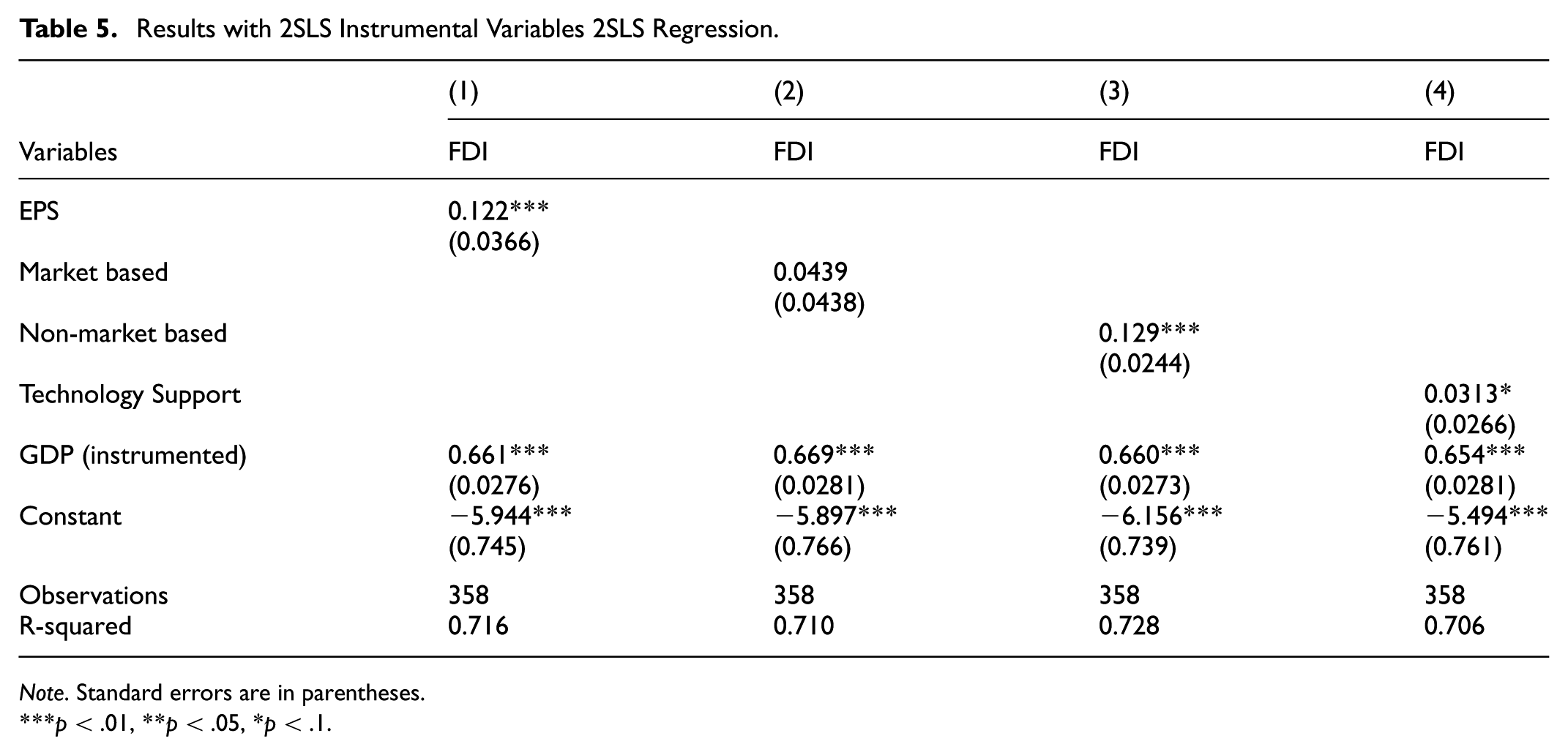
Note. Standard errors are in parentheses.
p < .01, **p < .05, *p < .1.
Secondly, we tested the robustness of the results by dividing the sample into OECD and non-OECD countries as observed on Table 6. By doing this, we aimed to provide an account for different levels of economic development. The majority of OECD members are industrialized, high-income economies (OECD, 2022) and the non-OECD countries in our sample are the BRICS and Indonesia which are the so-called fast-growing emerging markets. The results confirmed the consistency of our findings across different development stages.
OECD/non-OECD Countries Fixed Effect Results.

Note. All Standard errors in parentheses: ***p < 0.01, **p < 0.05, *p < 0.1.
Results of non-OECD countries are reported with limited observations.
We further discuss the mechanisms behind the findings in the Discussion section.
Discussion
In alignment with the Porter’s Hypothesis on the relationship of environment and global investment location decisions, our findings show that the existence of more stringent environmental policies in a host country is associated with statistically higher levels of foreign direct investment positions into that country. A deeper examination of this relationship is necessary however as the association is not consistent when the three subtypes of environmental policy are independently examined. Notably, there is no significant impact of market-based environment policy stringency on foreign direct investment patterns in our findings, while inward FDI is significant and positive when affected by the two policy types of non-market-based and separately those of technology support.
Our findings herein clearly justifies that policies for environmental protection with more stringency do not automatically deter FDI. The outcome of this is valid even for the market-based policies which is a contradiction to the claims of pollution haven hypothesis in which market-based policies of greater strictness – for example, taxes and/or alternative pricing methods – which is expected to decrease the attractiveness of that potential investment in countries with these types of policies (Adeel-Farooq et al., 2021). Our findings align with the arguments that indicate international corporations derive benefits from clear and concrete regulatory guidelines on FDI policies (Ufimtseva, 2020). This suggests that companies may perceive the advantages of setting operations within a host country that offers a routine and predictable regulatory context, as is often considered a critical foundation for a sustainable business model. This suggests that having strict and robust environmental policies in place implies a relatively consistent government agenda which is a sign of overall stability and a long-term focus on the future. For firm decision makers, this can help facilitate practical decisions due to increased predictability. We anticipate sectoral level research could deepen this finding by examining the potential factors that are likely to influence the interplay between environmental policies and foreign direct investment in the future.
The findings in our empirical models cannot be overstated in light of their relevance and potential importance to multinationals and policy makers, given how they signal a dynamic link between the strictness of certain types of environmental policies and FDI levels. Notably, the findings emphasize the critical and complementary role these policies can be leveraged as to attract FDI (e.g., Clarkson et al., 2011). As such we anticipate this signals actionable implications for those designing policy and other such stakeholders who are looking to promote national economic growth and associated development initiatives, given how this study highlights several advantages in designing and supporting comprehensive, multifaceted, and consistent policies for environmental protection.
There are also several limitations to this study that should be assessed as relevant to the context of the audience segments. A primary limitation in our study is its coverage in terms of environment policies. Sole reliance in measuring the stringency of various types of environmental policies though composite indices may not adequately reflect the full and dynamic range of environmental policy contexts among the assessed nations. A broader environmental policy measurement tool that includes all the polluting industries with additional instruments of regulation would give a better understanding of the efficiency of the policies in terms of sustainable development goals, and would provide policymakers with more detailed guidance. Additionally, our analysis focused mostly on emission of greenhouse gasses and air pollution, but left the industry-specific regulations of the economy out. A larger panel data with the sectoral level controls may help us to better comprehend the scope of the relationship. However in spite of the limitations summarized here, we are confident this research still provides several important contributions to crafting and assessing environmental policy and that of foreign direct investment literature; as such we believe this study provides actionable and impactful insights for stakeholders ranging from policy makers to researchers, as well as others who are concerned with such important issues in the present and for the future. In this regard, the following section provides associated policy implications of our findings.
Policy Implications
The results of this research can be used to make the following policy implications with regards to regulatory restrictiveness. In the first, regulatory restrictions on FDI are gradually moving from national security concerns to the global threats of climate change. Thus, the policy makers need to look for more global collaborators to achieve sustainable growth over the national interest-based protectionist policies. In the second, regulatory tightening on environmental policy makes a country more attractive to FDI. This suggests, policymakers do not need to be worried about losing potential foreign investors while trying to make progress on the United Nations Sustainable Development Goals.
The results of this research can also be used to suggest policy implications for each of the three examined policy sub-types. With regard to the first policy instrument type, market-based environmental policies such as emission taxes and tradable permits are relatively underutilized policies across countries. One implication from this study therefore is that stricter environmental policies that are market-based do not inhibit foreign direct investment into a country. Thus, policymakers may adopt more strict market-based policies without hesitation of potentially inhibiting economic development.
For the second policy instrument type, we have seen the rise of the implementation of strict non-market based environmental policies – such as emission limits and performance standards – over time across the nations. It tells a story of changing priorities and strategies in environmental policy, reflecting a world that’s increasingly recognizing the importance of innovation and regulation in addressing environmental challenges compared to the economic tools. Given the result where a more strict policy environment of non-market initiatives, resulted in more foreign direct investment into that country, our analysis provides evidence that such policies are welcomed by foreign investors. Thus, in order to achieve the dual goals of climate protection with economic development, policymakers can tighten environmental policy regulations via non-market instruments.
For the third policy instrument type examined herein, we showed that despite the results showing statistical support, technology support policies have slowed down since the 2010s (see Figure 2) which may indicate that the government support for innovation in clean energies are not at the expected level (in comparison to the prevalence of non-market based policies, which also showed statistical support). One reason might be that innovation is a process and takes time. Hence, firms probably have yet to see the outcomes of the technology support policies. Additionally, this could also reflect the changing nature of the available technology for the environmentally friendly initiatives – the options are spreading the breadth of the industry and are now more readily available to individual citizens. To exemplify, some individual-level technology support policies (e.g., US-based tax incentives up to $7,500 for purchasing electric vehicles) that are being widely used are not captured in country-level data for firm activity.
Additionally, we suggest international agreements such as The Paris Agreement from COP21 promoted the sharing of environmentally-friendly technologies but were not clearly aligned with financial support incentives, so it may be that these knowledge sharing initiatives are not being fully captured by technology support policies.
Finally while we examined the policies individually, it is important to note that the optimal configuration of environmental protection policies requires a portfolio of options rather than a single choice (Fischer & Newell, 2008). As such, policy makers should be certain to use a complement of each policy type, as adapted for the unique goals and contexts of the country or region.
Conclusion
Our study examined if and what the effects of a strict environmental policy in a target host county has with regards to its inward FDI positions. The literature expects the more the regulations, stringency, taxes, and other hurdles for environmental protection there are, can make the target host country unappealing for foreign direct investment. Our study alternatively hypothesized that some types of environmental policies designed to protect the environment during international business activities may actually function to attract inward foreign direct investment. Using a fixed effects regression on panel data, our overall results show how a restrictive EPS policy is associated with more FDI entering the target host country.
This is the opposite finding of the Pollution Haven Hypothesis underpinning some of the historical literature on the topic, instead aligning more with Porter’s hypothesis implying strict policies have a more attractive impact for FDI from the countries in this study. While market-based policy techniques were not statistically significant, this still provides valuable insight. It implies the presence of taxes – while not an attractive policy feature – also does not actively deter inward FDI. Meanwhile the two policy types of non-market based and technology support both attract FDI. A key implication here is that there are several techniques that can be used, as such a portfolio of policies can be used in combination to produce comparable inward FDI results, as such multilateral policy coordination may be even more important in locations where the zone of adverse impact can cross over into neighboring regions or countries (Blomström et al., 2003; Li et al., 2022; Tang, 2015).
To summarize, the results of our assessment between the dynamic of environmental policy stringency and that of FDI positions presents intriguing outcomes. Our analysis signals affirmative support for the counterintuitive finding whereby environmental policies that are more stringent can be associated with increased stocks of foreign direct investment. More narrowly, our analysis reveals how policies that are non-market-based and that are framed for technology support by the government can result in a statistically significant positive effect on foreign direct investment, whereas policies that are market-based do not have a significant, nor negative effect which refutes the relevance of pollution haven arguments. The findings herein add to the research stream and literature on policy design for sustainable development through illustrating the role distinct types of environmental protection policies can play in attracting foreign direct investment. Future studies may also consider grouping countries by their per capita levels, as the policies may be sensitive to such criteria as was not revealed here. Likewise, we believe leading investment destinations such as Singapore and China have a role in shaping the future patterns of the FDI positions. Therefore, their regulatory approaches to environment policy are areas worth exploring in future research.
Footnotes
Appendix
Hausman Test Results.

| Model | Chi-squared (5) | p-Value | Decision |
|---|---|---|---|
| (1) EPS | 70.29 | Prob > chi2 = .0000 | Fixed effect model |
| (2) Market-based EPS | 74.13 | Prob > chi2 = .0000 | Fixed effect model |
| (3) Non-market based EPS | 53.36 | Prob > chi2 = .0000 | Fixed effect model |
| (4) Technology support | 92.61 | Prob > chi2 = .0000 | Fixed effect model |
Author Note
This article does not contain any studies with human or animal participants.

Funding
The authors received no financial support for the research, authorship, and/or publication of this article.
Declaration of Conflicting Interests
The authors declared no potential conflicts of interest with respect to the research, authorship, and/or publication of this article.
Data Availability Statement
This article exclusively uses secondary data sources.