




Abstract
To assess the applicability of the “Porter hypothesis” (PH) within the context of China’s energy policies, enhance theoretical understanding of environmental regulation, and explore the green economy effect of the new energy demonstration city policy (NEDC), this study employs a difference-in-differences (DID) model. Based on panel data from 284 prefecture-level cities in China from 2007 to 2022, it empirically examines the impact and underlying mechanisms of the NEDC on urban green total factor productivity (GTFP). The main findings are as follows: (1) The NEDC significantly increased urban GTFP by 2.3%. This conclusion remains robust even after a series of robustness and endogeneity tests, including alternative explained variable, winsorization analysis, placebo tests, propensity score matching-DID, and instrumental variable, among other approaches. These findings provide strong empirical support for the PH in the context of China’s environmental and energy policy landscape. (2) Mechanism analysis reveals that the policy promotes urban GTFP growth primarily through four channels: increasing government attention to environmental governance, advancing industrial structure upgrading, improving energy efficiency, and stimulating technological innovation capacity. These findings provide concrete pathways for achieving green economic development. (3) Heterogeneity analysis shows that the green economic effects of the NEDC are more pronounced in cities characterized by higher levels of industrial agglomeration, those located in the eastern region, and resource-based cities. This highlights the importance of place-based and targeted policy implementation, offering empirical evidence for differentiated policy design, and precise governance. Therefore, by showcasing the successful experience of NEDC, this study provides valuable insights and policy implications for other countries pursuing energy transitions and sustainable development.
Keywords
Introduction
In the face of increasingly severe environmental pollution and the complex challenges posed by climate change, effectively curbing the continuous growth of fossil fuel consumption, adjusting energy strategies, and developing alternative clean energy sources have become critical policy challenges shared by countries worldwide (Filho et al., 2023; He et al., 2014; Khan et al., 2016; Papadopoulos & Balta, 2022; Wang et al., 2024). For decades, China’s rapid economic growth has been closely tied to high energy consumption levels, particularly in energy-intensive industries. As the world’s largest energy consumer and carbon emitter, China’s energy consumption structure, dominated by heavy industry and fossil fuels, has significantly intensified the pressure to reduce carbon emissions. Meanwhile, the development and utilization of clean energy have yet to form a mature and integrated system (X. Wang et al., 2023). This dynamic not only exacerbates environmental degradation and increases governance expenditure but also impedes the development of an urban green economy (Yu et al., 2018). According to the BP Statistical Review of World Energy (73rd edition, 2024), China accounts for 26% of global energy consumption, 55% of global coal consumption, and 32% of global carbon emissions. In response to the pressing carbon emission situation, China is vigorously promoting the construction of a low-carbon energy system to mitigate the greenhouse effect. The country has set clear emission reduction targets, pledging to peak carbon dioxide emissions before 2030 and to achieve carbon neutrality by 2060 (Liu & Zhang, 2021; Zeng et al., 2023).
Since implementing the “Dual Carbon” strategy, the Chinese government has adopted a series of innovative policy initiatives to foster the development of new energy resources (He, 2025). Among these, introducing the new energy demonstration city policy (NEDC) in 2014, which designated 81 pilot cities as demonstration sites (see Figure 1), represented a significant shift in China’s energy governance model, initiating a novel exploration of decentralized governance management (Wu et al., 2018). This innovative policy initiative highlights the government’s dedication to achieving a comprehensive energy transition and provides valuable insights for global renewable energy development through regionally differentiated pilot initiatives. It decentralizes decision-making authority on energy development to the prefecture-level governments, thereby granting local authorities greater autonomy and space for innovation. Supporters of decentralized governance argue that this institutional design fully demonstrates advantages, particularly in enhancing government responsiveness to complex local social issues (Faguet, 2012) and achieving more targeted policy provision (De Vries, 2000). However, scholarly research also indicates that institutional advantages can mainly depend on the quality of local government policy implementation (Clausen, 2020; Zuidema & de Roo, 2015). Driven by a series of innovative policies by the Chinese government, the new energy industry has undergone substantial advancement, enabling China to emerge successfully as the world’s largest producer of renewable energy (Li et al., 2023). Consequently, an in-depth examination of China’s energy transition policies and their effectiveness offers valuable policy insights and holds considerable international significance for refining the effectiveness of decentralized governance models.

Map of new energy demonstration cities.
Current academic discourse regarding the effectiveness of environmental policies reveals a pronounced theoretical divergence. Central debates focus on the dynamic relationship between environmental protection and economic development. Traditional economic theorists adhering to the “cost-compliance hypothesis” argue that environmental regulations inhibit productivity growth by increasing corporate compliance costs and reducing competitive advantages (Barbera & McConnell, 1990; Gray, 1987; Malik, 2007). In stark contrast, the groundbreaking “Porter hypothesis” (PH) has challenged this conventional perspective by proposing a triadic transmission mechanism—regulation, innovation, and competitiveness According to this hypothesis, appropriately designed environmental policies can trigger innovation offsets, meaning that induced technological innovations and organizational optimizations effectively counterbalance—or even surpass—the costs associated with regulation. Consequently, this process simultaneously improves environmental performance and productivity growth (Porter & Van der Linde, 1995). Although this revolutionary theory has sparked ongoing theoretical debate, it provides an entirely new analytical lens for understanding the economic implications of environmental regulations. Within this theoretical discourse, China’s NEDC offers unique theoretical significance. Existing research indicates that the institutional design of this policy aligns closely with the core elements of the PH. Specifically, the NEDC essentially serves as a conventional administrative instrument for environmental governance—a form of environmental regulation (Wang & Yi, 2021)—embodying well-designed regulatory interventions consistent with the fundamental assumptions of the PH. Building upon this policy practice, the current study addresses a question of critical theoretical importance and relevance: Can the NEDC empirically validate the predictions of the PH and concurrently foster the “green economy” arising from simultaneous environmental improvement and economic growth? Investigating this question not only contributes to testing the applicability of the PH within the Chinese context but also provides empirical evidence to refine and enrich theories of environmental regulation.
Although scholars have begun exploring the effectiveness of specific energy pilot policies, the current literature concentrates mainly on a few prominent initiatives. Most of these emerging studies have focused on the low-carbon city pilot policy (Li & Tang et al., 2023; Li et al., 2025; Song et al., 2020; Yuan et al., 2025), smart city pilot policy (J. Chen, 2023; Zhang & Fan, 2023), new energy and electric vehicle policies (Huang et al., 2022; Tan et al., 2018), and the dual credit policy (Wu et al., 2022), which all fall within the broader realms of energy, environmental governance, and sustainability policy. By contrast, the NEDC—regarded as a critical instrument in shaping the trajectory of new energy development due to its more comprehensive and targeted policy design (Feng & Nie, 2022)—has received comparatively limited scholarly attention. The few existing studies primarily assess the NEDC’s effects on individual aspects such as energy efficiency (Cheng et al., 2023), energy consumption intensity (Liu et al., 2023; Q. N. Zhang et al., 2022), carbon emissions (Ding et al., 2024), green technological innovation (Li, Cheng, & Ni, 2023; C. M. Liu et al., 2024), environmental pollution (Yang et al., 2021), and industrial structural transformation (Liu, Zhang, Ma, et al., 2024). Guided by the dual objectives of fostering high-quality economic development and advancing ecological civilization, NEDC seeks to chart synergistic pathways integrating economic growth, resource conservation, and environmental protection. Despite its strategic importance, limited research has systematically evaluated the policy’s combined effects on economic performance and environmental outcomes. In particular, there is a notable gap in empirical studies that assess the policy from the perspective of green economic growth, sustaining economic expansion while simultaneously achieving efficient resource utilization and meaningful reductions in environmental pollution.
A critical question arises: How can the level of green economic development—reflecting both economic performance and environmental outcomes—be effectively measured? In response to this challenge, the concept of green total factor productivity (GTFP) has emerged (Lin & Chen, 2018). As a key indicator of sustainable development and green transformation, GTFP extends beyond the limitations of traditional productivity metrics by explicitly incorporating environmental constraints into the production analysis framework. It thereby offers a comprehensive evaluation of the quality and sustainability of economic growth (Cui & Li, 2025; Lee & Lee, 2022). Accordingly, this study employs urban GTFP as an integrated metric to assess the overall effectiveness of the NEDC in promoting green economic development. By systematically examining the policy’s impact and underlying transmission mechanisms, the research aims to provide empirical evidence on its effectiveness, thereby contributing theoretically and practically to the literature on environmental regulation and green economy growth. Specifically, this study seeks to address the following research questions: (1) Does the NEDC empirically facilitate or constrain improvements in urban GTFP in China? (2) What is the magnitude of its impact? (3) Through which mechanisms are these effects realized? (4) To what extent do regional heterogeneities—such as industrial agglomeration, geographic location, and resource endowments—shape or moderate the policy’s effectiveness? The findings are expected to offer robust theoretical support and practical guidance for scaling up new energy demonstration initiatives in China and globally.
This study constructs a panel dataset comprising 284 prefecture-level cities in China from 2007 to 2022 to address the research questions. Two primary considerations guide the sample selection: first, since 2006, the Chinese government has introduced a series of energy conservation policies and binding energy consumption targets, rendering the post-2006 data more consistent and comparable in terms of policy context; second, data before 2006 suffer from a high incidence of missing values and inconsistencies in statistical definitions, limiting their reliability for empirical analysis. Regarding research design, the study treats the 2014 implementation of the NEDC as a quasi-natural experiment. It employs a novel difference-in-differences (DID) approach by integrating the NEDC with urban GTFP within a unified analytical framework. This allows for systematically evaluating the policy’s environmental and economic effects and underlying mechanisms. The findings offer a scientific basis for refining China’s new energy policies and provide valuable empirical insights contributing to the global green and low-carbon development discourse. More specifically, the study makes the following marginal contributions:
(1) In existing research, traditional total factor productivity (TFP) is commonly used to evaluate economic development quality; however, it fails to account for resource consumption and environmental externalities, limiting its applicability in the context of sustainable development (Y. Jiang et al., 2024). Given rising concerns over pollution and climate change, GTFP—which incorporates resource inputs and undesirable outputs—offers a more appropriate metric. This study adopts GTFP to reflect better the dual goals of economic efficiency and environmental sustainability (Xia & Xu, 2020). Compared to earlier GTFP studies, this article introduces a more comprehensive evaluation by integrating input saving, green output expansion, and pollution reduction. It employs the Slack-Based Measure–Global Malmquist–Luenberger (SBM-GML) index, which incorporates the non-radial, non-oriented SBM model with the GML index to account for undesirable outputs and enable intertemporal comparability, thereby addressing key limitations of conventional Data Envelopment Analysis (DEA) approaches.
(2) Previous studies have seldom systematically evaluated the win–win effects of NEDC on economic development and environmental protection, notably lacking empirical analyses from the perspective of “green economic growth.” To fill this research gap, we introduce the indicator of urban GTFP to explore the mechanisms and relationships through which NEDC influences GTFP. Specifically, this study systematically investigates the key pathways by which NEDC affects urban GTFP across four dimensions: government attention to environmental protection, industrial upgrading, improvements in energy efficiency, and green technological innovation. Furthermore, we uncover the heterogeneous effects of the policy by examining three contextual factors: industrial agglomeration characteristics, regional location, and resource endowments. The findings of this study offer valuable insights not only for China in achieving its dual carbon goals but also contribute to global efforts in addressing climate change and promoting green and low-carbon development by sharing the Chinese experience.
(3) This study further tests and extends the applicability of the PH within the context of environmental and energy regulation, offering new empirical evidence from China. Through rigorous econometric analysis, we find that the NEDC, as a form of environmental regulation, fails to hinder economic development and significantly enhances urban GTFP by triggering an “innovation compensation effect.” These findings enrich the body of evidence supporting the PH in developing countries and provide theoretical backing for emerging economies striving to balance environmental protection with economic growth. Moreover, moving beyond conventional energy governance approaches, this study evaluates the effectiveness of decentralized energy governance through a pilot policy lens. The results demonstrate that delegating specific approval authority from the central government to local governments strengthens accountability and broadens participation in environmental governance. Finally, we contribute to developing Simon’s attention theory, new structural economics (NSE), and the energy trilemma framework by applying and refining them to analyze real-world policy impacts.
The study is structured as follows (see Figure 2).

An illustration of the theoretical framework.
Literature Review
Literature on Urban GTFP
Traditional TFP primarily emphasizes the efficiency dimension of economic development; however, its measurement framework typically accounts only for conventional inputs (e.g., capital and labor) and desirable outputs (e.g., total output), while neglecting undesirable outputs such as environmental pollution (Mao & Koo, 1997; Miller & Upadhyay, 2000; J. Q. Su et al., 2023). This omission limits the ability of TFP to comprehensively reflect the level of green economic development (Y. F. Zhang et al., 2023). In advancing ecological civilization and high-quality economic growth, there is a growing academic consensus on integrating environmental factors into traditional productivity evaluation frameworks. This has led to the development of GTFP, an innovative metric incorporating desirable and undesirable outputs (B. Guo et al., 2024; Li & Wu, 2017; Xia et al., 2024; Yang et al., 2025; Zhou et al., 2008). As an integrated indicator that simultaneously captures economic growth, energy consumption, and environmental degradation, urban GTFP is particularly well-suited for assessing the quality and sustainability of regional green economic development.
In the existing literature on urban GTFP, most studies have focused on identifying its key driving factors. A substantial body of research has highlighted the roles of industrial agglomeration (Y. Wang et al., 2023), land resource allocation (D. Guo et al., 2024; Sun et al., 2025; Xie et al., 2022), technological innovation (Jiang et al., 2023; X. Zhao et al., 2022), green finance (Lee & Lee, 2022), urban competitiveness (Xia et al., 2024), foreign investment (M. L. Zhao et al., 2022), and digital infrastructure (Zhao & Duan, 2025) in enhancing urban GTFP. With the increasing implementation of environmental policies, many scholars have shifted their attention to the influence of policy instruments on urban GTFP. These include pollution emission right trading policy (Liu, Ling, Ou, et al., 2024), low-carbon pilot cities program (Cheng et al., 2019; Yuan et al., 2025), initiatives for building civilized cities (Zhao & Ye, 2025), e-commerce city pilot (Cao et al., 2021), and circular economy pilot policy (Xie et al., 2024). Despite the growing interest in green economy development, the impact of the NEDC on urban GTFP remains underexplored. This represents a notable gap, considering the NEDC’s pivotal role in advancing clean energy transitions and mitigating energy–environment pressures (X. Y. Zhang et al., 2022). Moreover, the mechanisms through which the NEDC influences urban GTFP have yet to be systematically investigated. To address this, the present study focuses on the NEDC, assessing its effect on urban green economic performance. In doing so, it provides fresh empirical insights into how environmental regulatory policies shape GTFP, thereby enriching the evaluation of green development strategies.
In terms of methodological approaches to examining the determinants of urban GTFP, scholars have predominantly employed classical models such as the Spatial Durbin Model (Guo et al., 2024; Yu et al., 2021), fixed effects models (Guo & Li et al., 2024; Shang & Feng, 2024; Wei & Hou, 2022), and threshold regression models (Wang & Sun, 2020; W. Zhao, 2022). These approaches have been instrumental in identifying various factors that influence urban GTFP. However, they may suffer from endogeneity issues. For instance, in the case of energy transition and its relationship with urban GTFP (which is also studied in this article)—there exists potential bidirectional causality: while energy transition promotes GTFP by fostering technological innovation and optimizing resource allocation, improvements in GTFP can, in turn, drive preferences for green investment, thereby accelerating the energy transition. The present study constructs a causal inference framework to address this endogeneity concern by exploiting the NEDC as a quasi-natural experiment. Specifically, a DID approach is employed to identify the net impact of the NEDC on urban GTFP by comparing changes in GTFP between treated and control cities before and after the policy implementation. This method mitigates endogeneity bias inherent in conventional regression models and ensures the exogeneity of the policy shock through event study analysis and parallel trend testing (Wu et al., 2023). Building on this framework, the study further conducts mechanism and heterogeneity analyses to comprehensively explore the pathways and boundary conditions through which the NEDC affects urban GTFP.
Literature on Institutional Design for Energy Transition
Current research on institutional designs for energy transition generally follows three paradigms. The first is a centralized, top-down model that emphasizes local governments’ passive implementation of higher-level directives (Lindberg et al., 2019). This approach relies primarily on coercive regulatory instruments but often fails to address the complex governance challenges inherent in energy transitions. The second paradigm introduces the concept of policy network governance, highlighting the pivotal role of intermediary actors in shaping the policy agenda. These actors include non-governmental organizations and network-based platforms. This model is exemplified in countries such as Australia (Nordt et al., 2023), the United Kingdom (Kivimaa & Martiskainen, 2018), Switzerland (Markard et al., 2016), and Finland (Vihemäki et al., 2020). The third paradigm embodies a more decentralized approach to energy governance, marked by the active participation of local actors in the development and implementation of renewable energy initiatives. This mode of governance is frequently operationalized through pilot and demonstration programs that serve as experimental arenas for innovation and policy learning. Prominent examples include Germany’s Energiewende Pilot Regions (Schnuelle et al., 2019), Sweden’s Fossil-Free Zones (Green, 2022), the United States’ Clean Energy Communities Program (Berry, 2020), and the Green New Deal pilot initiatives undertaken in Barcelona and Warsaw (Szpak & Ostrowski, 2025).
While the aforementioned paradigms offer distinct governance logics, China's practice presents a unique case. It is worth noting that China has developed a distinctive ‘local pilot’ model within its centrally-steered governance framework. This model, a form of controlled decentralisation, encourages local governments to actively engage in renewable energy development through demonstration projects and policy experimentation (Hughes et al., 2020; Peng & Gao, 2025). This decentralized governance strategy offers several notable advantages. On the one hand, the pilot mechanism facilitates risk management and targeted policy innovation by combining hierarchical delegation with context-specific governance. Local authorities, leveraging their deep understanding of regional resource endowments, industrial structures, and transition bottlenecks, are thus able to deliver more tailored policy interventions (Che et al., 2023). On the other hand, the central government’s certification and incentive mechanisms—such as policy support and the promotion of local officials—effectively mobilized local governments (Zou et al., 2024), providing sustained momentum toward achieving new energy development goals. However, empirical assessments of the effectiveness of China’s energy pilot policies remain limited, particularly in the context of the green economy. There is a pressing need for more rigorous, methodologically sound studies to evaluate their outcomes. As such, in-depth research into China’s NEDC and its performance is significant for enhancing decentralized governance models, offering policy insights and international lessons.
Literature on the NEDC Effects
Early research on China’s NEDC primarily adopted qualitative approaches, focusing on conceptual analyses, urban planning strategies, and implementation challenges (Li & Wu, 2015; Lou, 2014). With the gradual advancement of policy implementation, a growing body of literature has begun to employ econometric methods to assess the policy’s effectiveness. Nevertheless, the development of quantitative studies in this domain remains nascent. A systematic review of existing research indicates that scholars have explored the policy’s influence on various dimensions, including energy efficiency (Cheng et al., 2023), energy consumption intensity (Liu et al., 2023), carbon emissions (Ding et al., 2024; Gao et al., 2024), green technological innovation (M. Chen et al., 2023; C. Liu et al., 2024), industrial structural transformation (Liu, Zhang, Ma, et al., 2024), and land-use efficiency (M. Wang et al., 2022). Despite these advancements, current studies exhibit notable limitations. Most analyses concentrate on isolated indicators and fail to capture the comprehensive dynamics of the economic development–environmental sustainability nexus. Consequently, a unified and systematic framework for evaluating the policy’s overarching objective—namely, the promotion of green economic benefits—has yet to be established.
The relationship between the promotion of renewable energy and green economic development remains a subject of ongoing debate within the academic community. Proponents argue that the development of renewable energy can foster green economic growth by optimizing the energy structure and cultivating strategic emerging industries (Aydin et al., 2025; J. M. Li et al., 2022; Wang & Yi, 2021; Zeb et al., 2014). In contrast, critical perspectives contend that due to constraints such as technological bottlenecks and underdeveloped market mechanisms, the large-scale deployment of renewable energy may fall short of delivering the anticipated green economic benefits (Gao et al., 2025). This divergence highlights the complexity of evaluating the actual impacts of renewable energy promotion and underscores the urgent need for a more systematic and scientifically grounded assessment framework. Against this backdrop, the present study adopts a policy evaluation perspective and introduces urban GTFP as a comprehensive metric to assess progress toward a green, low-carbon economy. By investigating the impact and underlying mechanisms of NEDC construction on urban GTFP, this study broadens the scope of NEDC evaluation. It addresses a critical gap in understanding its dual objective of economic growth and environmental sustainability—namely, green economic development. Furthermore, the findings contribute valuable empirical evidence to the discourse on the applicability of the PH in the context of energy and environmental regulation in China.
Research Hypotheses
Direct Impact of the NEDC on Urban GTFP
The PH posits that well-designed environmental regulations do not necessarily hinder economic growth; on the contrary, they can stimulate corporate innovation, thereby enhancing productivity and competitiveness while achieving a dual goal of environmental protection and economic development (Porter & Van der Linde, 1995). Specifically, environmental regulation can positively influence urban GTFP through three key mechanisms: the first-mover advantage effect, the innovation compensation effect, and the learning effect (D’Agostino, 2015; Rassier & Earnhart, 2015; Zhao & Sun, 2016).
Firstly, the first-mover advantage effect highlights that regions or enterprises taking the lead in implementing environmental regulations can leverage policy support and institutional advantages to achieve an early strategic position in green technologies. This enables them to gain a competitive edge in both technological accumulation and market expansion, a view also supported by Chavez and Chen (2022), Zhao et al. (2012), and Halberstadt et al. (2022). In the context of China’s new energy demonstration cities, policy incentives from the central government have encouraged local governments and enterprises to prioritize investments in clean energy and low-carbon technologies (Lin & Xu, 2024). These initiatives have effectively accelerated breakthroughs in green technologies and their commercialization. By capitalizing on this early-mover advantage, such cities are better positioned to capture emerging opportunities in the green transition, thereby enhancing their overall level of productivity.
Secondly, the innovation compensation effect suggests that although environmental regulations may increase corporate costs in the short term, they can stimulate technological innovation that compensates for or even exceeds these initial costs in the long run, ultimately generating net benefits (Lanoie et al., 2008; Li & Li, 2024). Policies designating cities as pilots for new energy development are often accompanied by fiscal incentives and tax breaks to support green technological innovation. These measures encourage firms to invest in research and development (R&D) and achieve technological breakthroughs within the new energy sector (Li, Cheng, & Ni, 2023). Rapid advancements in areas such as electric vehicles, photovoltaic power generation, and wind energy reduce environmental pollution and promote structural optimization and efficiency gains across related industrial chains. Collectively, these developments serve to enhance urban GTFP.
Ultimately, the learning effect suggests that firms, through continuous engagement with environmental regulations, can accumulate experience, optimize production processes, improve management practices, and achieve cost reductions in technological applications (Xu et al., 2022). This dynamic learning mechanism gradually enhances firms’ capacity to absorb and innovate upon green technologies, thereby facilitating the synergistic advancement of efficiency improvement and green transformation. Accordingly, this study proposes the following research hypothesis:
Indirect Impact Pathways
Government Environmental Attention
Simon (1976) regarded attention as a scarce resource and viewed it as a management process where decision-makers focus on specific information while neglecting others. The theory of government attention suggests that changes in the distribution of government attention lead to dynamic shifts in executive pressure, causing fluctuations in the speed of policy implementation and resulting in variations in the quality, direction, and outcomes of policy execution (Chu et al., 2024). Specifically, government attention reflects the extent to which the government prioritizes public issues, with relevant departments needing to respond to tasks the government emphasizes. These responses serve as the transmission mechanism of attention on governance outcomes (Hooper et al., 2018). Demonstration cities, influenced by the NEDC, will likely invest more attention in environmental protection. The transmission mechanism of government environmental attention is a process that involves government investment and regulation.
On one hand, the allocation of attention reflects the government’s preferences and governance priorities, directly impacting the distribution of public finances (Bao & Liu, 2022). Driven by this allocation, demonstration cities have increased fiscal investments in environmental protection and encouraged corporate environmental initiatives. This approach facilitates the transformation of production methods, reduces environmental pollution emissions, and enhances the environmental carrying capacity. On the other hand, the allocation of attention to environmental protection can, to a certain extent, indicate variations in the intensity of environmental regulation. By enhancing the allocation of attention to environmental protection, pilot cities effectively reflect an intensification of environmental oversight. Stringent environmental regulation not only maximizes the “environmental dividends” derived from environmental policies but also more effectively curbs pollution emissions, thereby yielding “economic dividends” through productivity growth (Salvia et al., 2021; Xu et al., 2023). Therefore, we propose the following hypothesis:
Industry Structure Upgrading
NSE posits that economic development is a dynamic resource allocation process aligned with industrial comparative advantages, involving the transition from existing technologies and industrial configurations toward more efficient technologies and higher value-added industrial structures (Lin, Cai, & Xia., 2023). If a country’s industrial structure evolves by its inherent comparative advantages, it can produce goods and services at the lowest factor costs (Lin, 2017; Zhou & Wang, 2022). As capital accumulates rapidly, the economy’s endowment and industrial structure will accelerate, thereby driving economic growth. The NEDC exemplifies the practical application of this theory. With the support of the NEDC, these cities leverage their local resource endowments and competitive advantages to implement differentiated and refined industrial development strategies, ensuring that their industries evolve in line with their comparative strengths.
Through rational planning and policy guidance, NEDC facilitates the green upgrading of new energy industries, optimizes resource allocation, improves energy efficiency, and reduces the proportion of high-pollution sectors, thereby achieving a green transformation of their industrial structures. For instance, cities abundant in solar or wind resources can develop renewable energy industries, lowering production costs, and enhancing energy efficiency, further strengthening local industrial competitiveness. Such structural optimization improves comprehensive resource utilization and environmental benefits, ultimately boosting urban GTFP. By fostering industrial upgrading, NEDC attracts innovative technologies and high-efficiency production factors, further elevating productivity and economic performance while steering the economy toward a greener, low-carbon, and more efficient trajectory. Thus, the NEDC accelerates the green transition of industrial structures and provides critical support for GTFP growth, contributing to sustainable economic development. We propose the following hypothesis:
Energy Utilization Efficiency
The energy trilemma theory posits that it is inherently difficult to simultaneously achieve an optimal balance between energy security, economic viability, and environmental sustainability (Alola et al., 2023; Khan et al., 2022; C. Su et al., 2023). However, we argue that the NEDC partially mitigates this dilemma by improving energy utilization efficiency, thereby indirectly promoting urban GTFP. Specifically, the NEDC addresses the challenges embedded in the energy trilemma in the following ways.
First, by promoting the substitution of clean energy and optimizing the energy structure, the policy significantly reduces reliance on traditional fossil fuels, leading to lower emissions of pollutants and greenhouse gases. This enhances environmental quality and reduces energy intensity, thereby improving economic performance and achieving a synergistic optimization of environmental and economic objectives (C. M. Liu et al., 2024). Second, the policy facilitates industrial energy-saving retrofits, smart grid upgrades, and market-oriented energy management mechanisms, all of which contribute to lowering energy costs per unit output. This efficiency-driven approach strengthens industrial competitiveness and enables economic growth to decouple from the traditional high-consumption, high-emission trajectory, steering it toward a more sustainable, green development path (He, 2025). In sum, the NEDC takes energy utilization efficiency as a central lever for reform, advancing comprehensive optimization across the entire energy production, transmission, and consumption chain. Minimizing energy waste and pollutant emissions at the source reduces the need for costly end-of-pipe governance and offers long-term support for high-quality economic development. This systemic transformation enables a higher-level dynamic balance among energy security, economic efficiency, and environmental sustainability.
Technological Innovation Capacity
Porter and Van der Linde (1995) argue that well-designed environmental regulations can generate an innovation compensation effect by stimulating firms to engage in independent research and development, enhancing their technological innovation capabilities. This process boosts labor productivity and facilitates economic growth, environmental protection, and synergistic development. The PH theoretically supports the notion that the NEDC promoting demonstration cities can foster technological innovation, offset the costs associated with environmental compliance, and ultimately enhance urban GTFP.
In practice, local governments in pilot cities have actively promoted the development and application of green technologies by introducing a series of environmental policies, regulations, and standards. These policy measures have effectively lowered the cost barriers to green innovation, encouraging enterprises and research institutions to engage in deeper R&D in green technology. In addition, by offering tax incentives, subsidies, and financial support, governments have reduced the economic burden of green technology investments, further facilitating the widespread adoption of green innovation (Lee & Ogata, 2025). This policy-driven approach has accelerated the diffusion of green technologies across various industrial sectors, particularly in high-emission industries such as energy, transportation, and manufacturing. Moreover, governments have imposed constraints on energy-intensive and high-pollution industrial enterprises within pilot cities by establishing specific performance indicators, such as new energy development and utilization targets. These restrictions have compelled high-emission industries to undertake fundamental transformations in production methods, technological approaches, and resource efficiency (Zheng et al., 2025). Finally, the rapid rise of the new energy industry has also triggered competitive pressures, pushing enterprises to accelerate their pace of innovation and improve both the speed and quality of green innovation outcomes.
Based on the preceding analysis, we developed the theoretical framework illustrated in Figure 3.

The diagram of mechanism analysis. Icons made by Freepik (https://www.flaticon.com/authors/freepik) from www.flaticon.com.
Methodology and Data
Benchmark Model
To assess the PH’s applicability in energy and environmental regulation and evaluate its practical outcomes in China, this study employs the DID method to systematically examine the impact mechanism of the NEDC on green economic development. Specifically, it focuses on the policy’s effect in promoting urban GTFP. The DID approach is chosen for its threefold advantages in policy evaluation. First, by constructing a counterfactual framework, the method compares the differential development trends between the treatment group (demonstration cities) and the control group (non-demonstration cities) before and after policy implementation, thereby identifying the net treatment effect with greater precision (Wu et al., 2023). Second, by controlling for both time and regional fixed effects, the model accounts for unobserved, time-invariant city characteristics and temporal trends associated with the policy rollout. Third, in the absence of randomized controlled trials, DID provides a quasi-natural experimental design approximating causal inference as closely as possible (Wu et al., 2024). To enhance the robustness of the empirical findings, a set of multidimensional control variables is incorporated into the baseline regression model to mitigate potential endogeneity concerns. The specification of the baseline model is as follows:

where
Variables
Explained Variable
Urban GTFP is widely recognized as a key indicator of green economic development (Guo & Yu et al., 2024; Sun et al., 2025), and is selected as the explained variable in this study. Drawing on the theoretical framework of green and low-carbon development, as well as relevant scholarly contributions (Feng et al., 2023; Jiang et al., 2023; Lin & Zhong, 2024; Liu, Ling, Ou, et al., 2024; Sun et al., 2022), this research constructs a comprehensive urban GTFP evaluation index system (see Figure 4). The construction process is grounded in data availability, accuracy, completeness, and continuity principles, and is informed by systematic review and rigorous theoretical reasoning. Given that this study focuses on the dynamic changes in productivity under environmental constraints, we draw on the methodological frameworks of Zhao et al. (2024) and J. Jiang et al. (2024), and adopt an extended DEA model—the SBM-GML model—to measure urban GTFP. For further details on measurement methods and indicators, please refer to Supplemental Appendix 1.
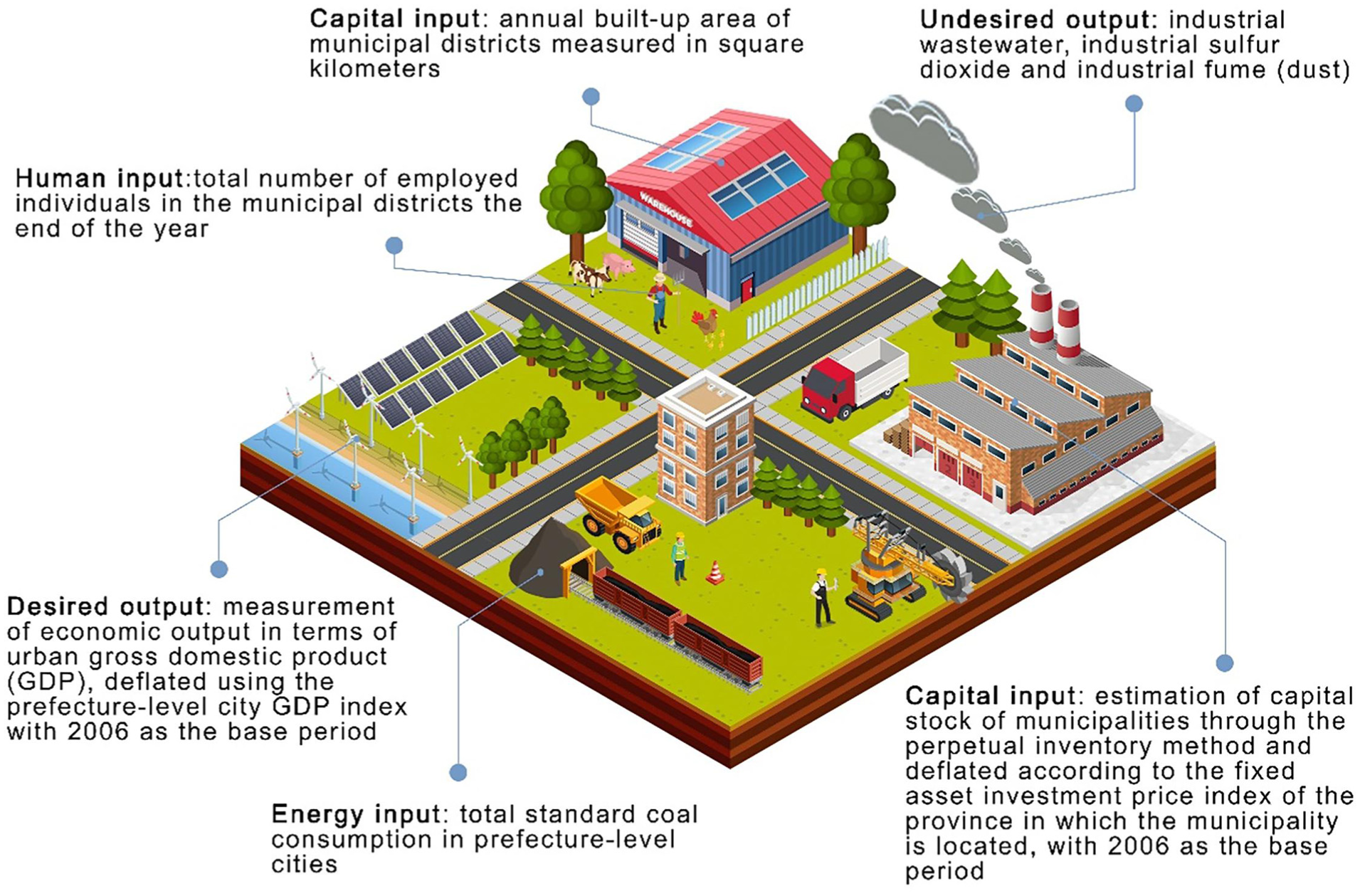
Input and output indicators measured by urban GTFP.
Core Explanatory Variable
The interaction term between the new energy demonstration city dummy variable and the policy implementation time dummy variable is selected as the core explanatory variable, that is,
Control Variables
To mitigate the effect of potential confounding variables on the regression analysis, this study follows previous literature (He, 2025; Shen et al., 2023; Wang & Li, 2025; Zhou et al., 2023) and incorporates the following control variables: foreign direct investment (FDI), human capital level (HCL), population density (ln.POD), regional economic development (RED), financial development level (FIN), science and technology expenditure (STL). Please refer to Supplemental Appendix 1 for details regarding the control variables.
Mechanism Variables
We adopt the following four types of mechanism variables to test our proposed hypotheses: (1) Government environmental attention (GEA), drawing from the studies of Chen and Chen (2018), in which Python is employed to examine work reports from prefecture-level city governments, focusing on terms of environmental preservation, pollution control, energy use, joint development, and ecological management, in addition to associated terms specified in Supplemental Appendix 1. The occurrences of these defined terms are counted, and the cumulative frequency of these occurrences is determined. This ratio, derived from the cumulative frequency of occurrences about the overall number of words in the reports, is a measure of the GEA. (2) Industry structure upgrading (ISU), the measurement of ISU is derived from the research of Gan et al. (2011), which involves calculating the proportion of the added value of the primary industry to GDP * 1 + the proportion of the secondary industry’s added value to GDP * 2 + the proportion of the added value of the tertiary industry to GDP * 3. (3) Energy utilization efficiency (EUE) refers to the research of Shi and Li (2020), who selected labor, capital, and energy as inputs, regional GDP as the desired output, and industrial sulfur dioxide, industrial smoke dust, and industrial wastewater emissions as the undesirable outputs, using the super efficiency SBM index model to measure the EUE of each prefecture-level city. The specific indicators measured by EUE are shown in the Supplemental Appendix 1. (4) Technological innovation capacity (TIC), we operationalized TIC using the established measurement framework developed by Kou and Liu (2017). This methodology, comprehensively documented in the Report on the Innovativeness of Chinese Cities and Industries 2017, offers systematic indicators for evaluating urban innovation capabilities across multiple dimensions.
Data Processing and Descriptive Statistics
The empirical analysis employs panel data spanning 284 Chinese cities from 2007 to 2020. For the selection criteria of the experimental group, this study refers to the list introduced by China’s Ministry of Energy in 2014. To ensure the robustness of the conclusions, cities with a significant number of missing data points are excluded. Consequently, the experimental group comprises 66 cities, while the control group comprises 218. Regarding the data sources, the original GEA measurements are derived from prefecture-level government reports; the total nighttime lighting data are obtained from the National Oceanic and Atmospheric Administration; and the remaining data are sourced from the China Urban Statistical Yearbook, China Regional Statistical Yearbook, China Energy Statistical Yearbook, China Environmental Statistical Yearbook, and the official website of Harvard University. Please refer to Supplemental Appendix 1 for details regarding the descriptive statistics of the variables.
Empirical Results
Parallel Trend Test
A basic premise for isolating the net impact of a policy using the DID method is the evaluation of the parallel trend assumption (Stucki et al., 2018). In this study, the event-study method is chosen to construct the following regression equation described by Jacobson et al. (1992) to test the dynamic effects of the parallel trend before and after the policy implementation. The estimated equations are as follows:

where

Parallel trend test.
Benchmark Regression Analysis
In this section, we investigate the effects of the NEDC on urban GTFP by employing DID models. The results of the benchmark regression analysis are recorded in Table 1. The findings in Column (1) reveal the impact of the interaction term
Benchmark Regression Analysis.

Note. City FE and year FE refer to city fixed effects and year fixed effects, respectively; Control variables, namely, FDI, HCL, ln.POD, RED, FIN, and STL, correspond with the regression analysis in the subsequent tables.
*, **, *** denote 10%, 5%, and 1% significance levels, respectively. The brackets are t-values.
This study provides preliminary empirical support for the applicability of PH within the context of China’s energy policy, thereby extending its theoretical relevance. Furthermore, the findings affirm the effectiveness of a decentralized governance model in environmental management, particularly highlighting the practical outcomes of pilot policy initiatives. The flexibility and innovation demonstrated by local governments in formulating and implementing energy policies have played a significant role in advancing green economic development. Decentralization has enhanced local authorities’ sense of responsibility and autonomy, enabled region-specific policy optimization, and fostered a more effective green transition. Finally, from a policy evaluation perspective, this research offers novel theoretical and empirical insights into the relationship between renewable energy promotion and green economic growth, addressing a critical gap in understanding the dual benefits—economic advancement and environmental protection—of the NEDC.
Robustness Tests
To lessen the impact of omitted variables, our research controls for city FE, year FE, and various variables in the benchmark regression analysis. Nevertheless, certain unobservable and uncontrollable factors may still affect the estimation results. To further ensure the robustness and reliability of the findings, this study conducts a series of robustness tests: (1) Changing the explained variable estimation. (2) Winsorization analysis. (3) Increasing fixed effects. (4) Excluding municipality samples. (5) Adding more control variables. (6) Excluding the impact of the COVID-19 pandemic. (7) Considering policy interference. (8) Extending the time span. (9) Placebo tests. The particular operations and outcomes are illustrated in Appendix 2 of the supplemental material. The results demonstrate that the NEDC remains significantly associated with improvements in urban GTFP, substantiating hypothesis 1.
Endogeneity Tests
While the parallel trend assumption test provides support for the DID framework’s validity, the non-random selection process of new energy demonstration cities may introduce estimation bias (Lu, 2022), creating potential selection bias concerns. Furthermore, bidirectional causality between key variables could generate substantial endogeneity problems (Kitagawa, 2014). To comprehensively address these identification challenges, we implement a dual-method strategy: (1) propensity score matching difference-in-differences (PSM-DID) to correct for observable selection bias, and (2) carefully constructed instrumental variables to account for unobserved confounding factors. For detailed information regarding the implementation and outcomes of our endogeneity treatment, please refer to Appendix 3 of the Supplemental material.
Expanded Research
Mechanism Analysis
Building upon the preceding discourse, the NEDC has significantly promoted the urban GTFP. Therefore, what mechanisms does the NEDC use to realize a green economy development? To answer this question, this study empirically analyzes the four types of hypothetical mechanisms in the previous section based on the following formula:

where
Results of the Mechanism Analysis.

*, **, and *** denote 10%, 5%, and 1% significance levels, respectively. The brackets are t-values.
Government Environmental Attention Mechanism
According to Column (1) in Table 2, the regression coefficient for GEA is 1.325 and is significantly positive at the 1% level. This indicates that GEA notably enhanced urban GTFP during the sample period, supporting hypothesis 2. Drawing from Simon’s attention theory, increased governmental attention directly shapes policy-making and its implementation priorities. When the government focuses intensively on environmental protection, administrative resources, financial incentives, and regulatory oversight are increasingly directed towards green industries. Such attention facilitates financial resource flows into environmentally sustainable sectors, effectively advancing the economy’s transition towards low-carbon development and improving urban GTFP.
Empirical evidence shows that, on one hand, driven by heightened attention towards environmental protection, the Chinese government has established institutional guarantees and provided financial backing to new energy demonstration cities, facilitating the efficient allocation of subsidies into renewable energy sectors. This alleviates financial constraints faced by new energy enterprises and accelerates the green transformation of the energy industry, ultimately promoting urban green low-carbon development and enhancing urban GTFP. On the other hand, appropriate environmental regulations supervise and incentivize enterprises to undergo low-carbon transformations, compelling industries dependent on high-energy-consuming and polluting resources to innovate technologically in a greener direction. Green technological advancements shift the production frontier toward resource conservation and pollution mitigation, simultaneously stimulating green economic growth, characterized by reduced environmental management costs and enhanced circular economy benefits (Shang et al., 2022). Consequently, reallocating resources driven by enhanced governmental attention optimizes the institutional environment, establishing a positive feedback mechanism that further solidifies the NEDC’s ability to achieve sustainable economic growth alongside environmental goals.
Industry Structure Upgrading Mechanism
Table 2, Column (2), reveals the impact of
The findings support NSE propositions: aligning industrial strategies with local resource endowments drives structural transformation and upgrading. Selecting industries compatible with regional resources and development stages enhances efficiency, competitiveness, and sustainability. Under the NEDC framework, leveraging regional advantages in wind/solar/hydro resources and industrial foundations facilitates transitioning polluting industries into tech-driven, eco-friendly sectors. This optimizes industrial structures, stimulates endogenous growth, and balances economic-ecological development, validating NSE's core premise—harnessing endowments to upgrade industries for high-quality growth.
Energy Utilization Efficiency Mechanism
According to the empirical results in Column (3) of Table 2, EUE significantly promotes the improvement of urban GTFP at the 1% significance level, with a contribution rate of approximately 6.4%. The finding confirms that hypothesis 4 is valid. The NEDC focuses on developing and applying renewable energy to reduce reliance on high-carbon conventional energy sources (Yuan et al., 2022). By promoting low-carbon and even zero-carbon energy forms, NEDC effectively curbs total carbon emissions. These pilot cities actively advance the deployment of renewable energy technologies across various industries while continuously exploring optimal configurations of diverse renewable sources. At the same time, they emphasize the coordinated integration of renewable and traditional energy systems to enhance overall energy system efficiency. As a result, the share of renewable energy consumption and the efficiency of resource allocation have steadily increased, leading to improvements in EUE and further promoting urban GTFP. In summary, the NEDC has not only achieved carbon reduction and environmental improvement but has also enhanced the reliability of the energy system and the efficiency of resource utilization. By lowering energy consumption costs, these cities have formed a green, efficient, and secure energy utilization model, thereby mitigating the structural contradictions associated with the energy trilemma to a certain extent.
Technological Innovation Capacity Mechanism
The regression results in Column (4) of Table 2 show that the interaction term
Specifically, the NEDC, aimed at fostering a green and low-carbon industrial structure, has prompted local governments to accelerate the integration of scientific and technological resources and the construction of R&D platforms. At the same time, it has encouraged enterprises to increase innovation investment in areas such as green technologies, energy conservation, emission reduction, and renewable energy development. Through targeted policy incentives and resource prioritization, NEDC has not only activated the enthusiasm of innovative actors but also improved the efficiency of innovation resource allocation. As a result, cities have witnessed significant improvements in green innovation capacity and technological efficiency.
This empirical finding is consistent with the PH’s theoretical predictions, which posit that well-designed environmental regulations can induce an “innovation offset” effect, thereby achieving simultaneous improvements in environmental performance and economic efficiency.
Heterogeneity Analysis
The degree of industrial agglomeration (IA), resource endowment (RE), and stage of economic development in Chinese cities exhibit distinct regional characteristics. To enhance the credibility of the research findings, this study conducts a heterogeneity analysis by classifying the sample in three dimensions: cities are divided into IA or non-IA based on the extent of industry clustering; into eastern, central, and western regions based on geographic location; and into resource-based and non-resource-based cities according to their natural endowment profiles. Among them, the degree of IA and the area in eastern, central, or western regions are analyzed through sub-sample regressions, while the resource-based cities are explored using the following model:

The heterogeneity variable is set as
Heterogeneity of Industrial Agglomeration
NSE argues that the formation of IA depends heavily on the structure of factor endowments of an economy (Ju et al., 2015). Interactions between nearby industries may increase production efficiency due to upstream and downstream linkage effects in IA (Jofre-Monseny et al., 2011). Considering that there are specific differences in IA and resource endowment in geographic regions of China, the cities in the sample are categorized into two distinct groups: IA cities and non-IA cities. Z. Li et al. (2022) measured the industrial agglomeration value (IND) of each city. The equation is outlined below:

Columns (1) and (2) in Table 3 demonstrate that the NEDC has facilitated the advancement of green and low-carbon development in both IA and non-IA cities. A comparison of the regression coefficients reveals a more pronounced impact effect in IA cities. There are several possible causes. The NEDC stimulated the growth of new energy industry clusters in IA cities by leveraging natural resource advantages, industrial strengths, and policy preferences. This has resulted in the optimal allocation of energy resources and industries, attracting human capital and production factors from surrounding areas (Y. Wang et al., 2023). IA helps to enhance the professional division of labor and collaboration, resulting in reduced transaction costs, increased production efficiency, and advancement of the green economy’s high-quality development. Nevertheless, new energy projects in non-IA cities may be hindered by a range of intrinsic challenges, such as geographical location, resource constraints, and a disadvantage in talent acquisition.
Heterogeneity Analysis Results.

*, **, and *** denote 10%, 5%, and 1% significance levels, respectively. The brackets are t-values.
Heterogeneity of Geographical Location
Considering the regional disparities in economic and social development and varying levels of new energy utilization, this study employs a regional classification in line with the China Bureau of Statistics. Cities are grouped into eastern, central, and western regions, with separate regression analyses conducted for each. The findings in Columns (3) to (5) in Table 3 indicate a notable enhancement in urban GTFP across these regions due to the NEDC. According to the comparison of regression coefficients, the analysis further reveals a varying degree of policy efficacy across the regions, with the eastern cities experiencing the most substantial impact, followed by the central, and then the western cities.
Possible reasons for this include that the eastern region surpasses the central and western areas regarding energy utilization and consumption. This higher level of energy consumption is pivotal for maximizing energy resource use and fostering a transition to greener, low-carbon development practices (Estevão & Lopes, 2024). Economically, the eastern region typically outperforms other regions. This advanced economic status aids in efficiently attracting and deploying investments and technologies pertinent to the new energy sector. Moreover, it is noteworthy that the central and western regions have already established a foundational presence in the new energy domain. Consequently, the incremental influence of the NEDC on enhancing urban GTFP in the central and western regions might be relatively modest, given the preexisting level of development in these areas.
Heterogeneity of Resource Endowment
Considering the differences in RE across cities, we follow the classification method outlined by the State Council of China and construct a binary variable to distinguish between resource-based and non-resource-based cities. Based on Equation 4, we introduce the interaction term
The analysis reveals that the NEDC significantly enhances the urban GTFP of RE cities in China. Several factors may explain this outcome: First, resource-based cities have long relied on natural resources such as coal, petroleum, and non-ferrous metals as their primary economic pillars. This dependency has led to challenges such as resource depletion, severe environmental pollution, and economic structural rigidity—commonly referred to as the “growing pains” of such cities. As a result, these cities face a more urgent need for economic transformation and the exploration of new development paths. The NEDC provides a timely breakthrough and strategic direction, making local governments more willing and proactive in implementing it. Second, resource-based cities typically exhibit lower baseline levels of green production efficiency and weaker environmental governance capacities due to their reliance on traditional energy industries. Introducing the NEDC and green technologies can generate leapfrogging effects in technological progress, with greater potential for improvement in urban GTFP. Third, resource-based cities often possess ample land, lower land costs, and relatively abundant industrial space—conditions well-suited for deploying large-scale new energy projects such as wind power, photovoltaic energy, and biomass power generation (Wu et al., 2021). In contrast, non-resource-based cities, especially those in densely populated and economically developed eastern regions, are constrained by limited land availability and high land-use costs, resulting in more significant physical and economic barriers to new energy infrastructure development. Fourth, many resource-based cities have relatively complete energy industry chains, including electricity, coal, and metallurgy sectors. These established industrial foundations can rapidly integrate with new energy technologies, thereby facilitating the development of the green economy (Y. Wang et al., 2022).
In sum, the more pronounced effect of the policy in resource-based cities reflects both endogenous demand pressures (e.g., for industrial transformation) and the synergistic interaction between external policy incentives and local resource endowments.
Conclusions and Discussions
Conclusions
To examine the applicability of the PH within the context of China’s energy policies, improve the theoretical framework surrounding environmental regulation, and further explore the green economic effects of the NEDC, this research empirically investigates the impact of the NEDC on the urban GTFP of 284 prefectural-level cities in China from 2007 to 2022 using the DID model, and the significant findings are as follows: (1) The NEDC significantly enhances urban GTFP. This result remains robust after robustness and endogeneity tests, including PSM-DID estimation, changes in the explained variable, winsorization analysis, placebo tests, and instrumental variable approaches, among others. These findings confirm Hypothesis 1 and further support and extend the applicability of the PH within the context of China’s environmental and energy policy framework. (2) Mechanism analysis reveals that the NEDC promotes urban GTFP primarily through four channels: increasing government attention to environmental governance, advancing industrial structure upgrading, improving energy efficiency, and stimulating technological innovation capacity. These pathways verify Hypotheses 2 through 5 and clarify the core transmission mechanisms through which the policy affects urban GTFP, thereby providing concrete strategies for achieving green economic development. (3) Heterogeneity analysis indicates that the NEDC’s green economic effects exhibit significant regional variation. Specifically, the policy has a more pronounced impact in cities with higher industrial agglomeration, eastern regions, and resource-based cities. These findings underscore the importance of localized and tailored policy implementation, offering empirical evidence for differentiated policy design and precision governance.
Theoretical Implications
This study makes notable theoretical contributions, outlined as follows.
First, it adopts GTFP as the central indicator for evaluating the quality of green economic development, thereby addressing the inherent limitations of conventional TFP metrics that tend to overlook resource depletion and environmental degradation (Y. Jiang et al., 2024). To operationalize this, the study develops a refined analytical framework that integrates a non-radial, non-angle SBM model with the GML index. This enhanced DEA approach facilitates a rigorous and multidimensional evaluation of GTFP by capturing efficiency gains in three critical dimensions: input conservation, green output enhancement, and pollution abatement. The proposed framework reflects the core principles of sustainable development. It contributes to more precise and comprehensive assessments of urban green productivity within the broader context of high-quality economic growth.
Second, existing studies have rarely provided a systematic evaluation of the win–win effects of the NEDC on both economic development and environmental protection, notably lacking empirical evidence from the perspective of green economic growth. To fill this research gap, this study introduces urban GTFP as a key metric and systematically investigates the impact mechanisms and transmission pathways of the NEDC on urban GTFP. The findings indicate that the policy significantly promotes urban green economic growth through multiple channels, including strengthening governmental attention to environmental governance, facilitating industrial structure upgrading, improving energy efficiency, and stimulating technological innovation capacity. This elucidates the core mechanisms through which the policy influences urban GTFP and offers practical pathways for achieving green development goals. Moreover, the study reveals notable heterogeneity in policy effectiveness across cities with different levels of industrial agglomeration, regional locations, and resource endowments, thereby highlighting the necessity of precise policy implementation and differentiated regulatory approaches.
Third, this study rigorously evaluates and further extends the applicability of the PH within the specific context of China’s environmental and energy policy landscape. The empirical results reveal that the NEDC, as an instrument of environmental regulation, did not impede economic development; on the contrary, it significantly improved urban GTFP through innovation compensation. These findings underscore that, when supported by well-designed and effectively implemented policy frameworks, environmental protection and economic growth are not inherently in conflict, but can yield synergistic and mutually reinforcing outcomes. Moreover, the study provides valuable theoretical underpinnings and policy implications for other nations pursuing green transitions. In addition, the analysis empirically affirms the efficacy of a decentralized governance approach by examining a pilot policy framework. The evidence suggests that, under conditions of appropriately delegated authority, local governments demonstrate greater flexibility and responsiveness in areas such as attention allocation, policy implementation, and regulatory feedback. This enhanced local autonomy contributes to more efficient environmental governance and precise policy execution.
Finally, in terms of theoretical development, this study addresses core issues in green economic development by constructing a systematic set of theoretical hypotheses based on the mechanisms through which policy interventions influence urban GTFP. Building upon this theoretical foundation, the article incorporates Simon’s theory of attention to highlight the critical role of environmental attention in governmental resource allocation and its influence on the enforcement intensity of environmental policies. From the perspective of NSE, the study further examines the strategic significance of industrial upgrading in facilitating green transformation. Additionally, drawing on the “energy trilemma” framework, the paper analyzes the inherent trade-offs in improving energy efficiency while balancing energy security, environmental protection, and economic growth goals. In line with the PH, it emphasizes technological innovation’s “innovation compensation effect” in advancing green economic development. Through the organic integration and application of these theoretical perspectives, the study enriches the analytical framework for research on green development and policy evaluation.
Policy Recommendations
This study’s findings are significant for advocating for the NEDC and promoting urban green economic growth. The policy recommendations are as follows:
(1) Encouraging the diffusion of successful experiences related to the NEDC. The results of our study show that the NEDC enhances the urban GTFP and is highly important for transforming the urban energy structure. Therefore, local governments should vigorously publicize the experience of the NEDC and develop a multi-energy complementary system tailored to regional characteristics. They should also encourage enterprises to prioritize renewable energy and expand the market for new energy applications. In addition, local governments should establish cooperation and exchange platforms between pilot and non-pilot areas to share pilot technologies’ existing experiences and application results. This will facilitate the publicity of expertise in demonstration cities (Song et al., 2024).
(2) Integrating environmental protection into overarching economic governance to strengthen its role in high-quality development. Mechanism testing shows that greater governmental attention to ecology significantly enhances urban GTFP. National and local authorities are advised to issue targeted notices or guidelines to define the core role of green development, clarify policy pathways for environmental governance, and reinforce responsibilities at all government levels. These documents should specify targets for ecological spending, regulatory scope and frequency, and performance metrics focused on green outcomes. Institutionalizing these measures will help shift government priorities toward green transformation. In addition, fiscal policy should increase support for the environmental sector, and regulatory capacity and enforcement must be strengthened to modernize the environmental governance system.
(3) Promoting industrial structure upgrading. Mechanism testing reveals a significant synergistic effect between the NEDC and industrial structure upgrading, jointly contributing to the enhancement of urban GTFP. Advancing the overall optimization and upgrading of the industrial structure is a critical pathway for moving beyond traditional, extensive growth models and achieving high-quality development (Yu & Wang, 2021). Regions should leverage their unique resource endowments and industrial foundations to promote the development of deep-processing industries tailored to local conditions, accelerate the transformation of conventional energy sectors toward new energy industries, and steer the industrial system toward greener and lower-carbon trajectories. In parallel, it is essential to strengthen the synergy between industrial restructuring and energy efficiency improvement, establish a modern energy supply system centered on clean and low-carbon energy sources, optimize the energy consumption structure, and comprehensively enhance the green development level of the energy system.
(4) Sustaining progress in energy efficiency enhancement. Mechanism testing indicates a significant synergistic effect between the NEDC and energy utilization efficiency, jointly contributing to the enhancement of urban GTFP. The sustained improvement of energy efficiency is crucial for easing resource and environmental constraints but also plays an essential role in optimizing the energy supply-demand structure and improving the quality of economic operations. To this end, regional governments should accelerate energy-saving retrofits and efficiency upgrades in key sectors such as industry, construction, and transportation. Efforts should focus on phasing out outdated energy-intensive processes and promoting the transition toward cleaner and more efficient energy use. Simultaneously, it is necessary to enhance the monitoring and evaluation systems for energy efficiency, refine incentive and constraint mechanisms for energy conservation, and strengthen the integration of energy management with technological innovation.
(5) Strengthening technological innovation capacity. Mechanism testing reveals that the NEDC plays a significant role in enhancing technological innovation, and its synergy effectively promotes improvements in urban GTFP. Accordingly, regions should intensify investment in research and development, improve the green innovation system, and strengthen collaboration across industry, academia, research institutions, and application sectors (Lin & Xie, 2023). Emphasis should be placed on achieving breakthroughs and accelerating the commercialization of core green technologies, particularly in energy efficiency, carbon reduction, clean energy, and new materials. Cultivating innovative enterprises and technologies with independent intellectual property rights is also essential. Furthermore, optimizing the allocation of scientific and technological resources, refining incentive mechanisms, and fostering an institutional and market environment conducive to green innovation will be key to sustaining the role of technology as a cornerstone of green development.
(6) Designing a differentiated mix of policy instruments based on local conditions. This finding underscores the necessity for regionally differentiated policy approaches rather than uniform implementation. Policy support should prioritize less-developed areas with limited industrial concentration to enhance their green development capacity, while eastern regions should capitalize on their fiscal and technological advantages to advance renewable energy self-sufficiency and cultivate new energy industrial clusters (Su & Tan, 2023). Concurrently, central and western regions require focused efforts on raising environmental awareness, attracting green technology talent, and transitioning from conventional growth paradigms to sustainable development models. Such tailored, coordinated policy interventions will facilitate the establishment of an integrated yet diversified low-carbon development framework across regions.
Limitations and Future Research Directions
This study has several limitations that should be acknowledged. These constraints highlight the need for continued investigation in future research to further validate and expand upon the current findings: (1) Geographic scope limited to China, restricting international applicability. Although this study covers 284 prefecture-level cities in China, the country’s unique political institutions, stage of economic development, and resource endowment conditions differ significantly from those of other countries. As a result, the findings may not directly apply to regions with different socio-economic contexts. Future research should consider extending the analytical framework to other countries and areas, thereby enhancing the generalizability and comparative value of research on energy policy. (2) While the study’s dataset of 284 Chinese cities offers some representativeness, it fails to fully capture urban heterogeneity. County-level or emerging cities may exhibit distinct green transition patterns. Future research should expand the sample scope to better reflect China’s diverse urban green development. (3) Potential selection bias in the city sample. Despite employing the PSM-DID approach to mitigate selection bias, endogenous factors may still influence which cities are selected for the NEDC, affecting identification accuracy. Future studies could consider more rigorous natural experimental designs to strengthen causal inference. (4) The study’s heavy reliance on quantitative methods, while useful for causal analysis, overlooks qualitative aspects like institutional context and local governance. Future work should incorporate case studies or interviews for more holistic policy evaluation.
Supplemental Material
sj-docx-1-sgo-10.1177_21582440251382641 – Supplemental material for Harvesting Green Economy: Exploring the Impact of New Energy Demonstration City Policy on China’s Urban Green Total Factor Productivity
Supplemental material, sj-docx-1-sgo-10.1177_21582440251382641 for Harvesting Green Economy: Exploring the Impact of New Energy Demonstration City Policy on China’s Urban Green Total Factor Productivity by Fanjun Zeng, Yingying Zhou, Bin Wei and Yongzhou Chen in SAGE Open
Footnotes
Ethical Considerations
This article does not contain any studies with human or animal participants.
Consent to Participate
Not applicable.
Consent for Publication
Not applicable.
Author Contributions
FZ: Conceptualization, Data curation, Formal analysis, Funding acquisition, Methodology, Project administration, Software, Writing—original draft. YZ: Conceptualization, Investigation, Resources, Supervision, Validation, Visualization, Writing—original draft. BW: Investigation, Resources, Supervision, Writing—review and editing; Funding acquisition. YC: Conceptualization, Supervision. All authors read and approved the final manuscript.
Funding
The authors disclosed receipt of the following financial support for the research, authorship, and/or publication of this article: This study was supported by the National Social Science Foundation of China, Research on Emergency Collaborative Blocking and Holistic Resilience Governance of Cross-regional Major Public Health Emergencies (22BGL245), the Key Research Base of Humanities and Social Sciences of Universities in Guangxi Zhuang Autonomous Region: Regional Social Governance Innovation Research Center, the Key Research Base of Humanities and Social Sciences of Universities in Guangxi Zhuang Autonomous Region: China-ASEAN Collaborative Innovation Center for Regional Development and the Innovation Project of Guangxi Graduate Education (Nos. YCSW2025079, 2024YCBZ00X).
Declaration of Conflicting Interests
The authors declared no potential conflicts of interest with respect to the research, authorship, and/or publication of this article.
Data Availability Statement
Publicly available datasets were analyzed in this study. This data can be found here: raw data were obtained from the China Urban Statistical Yearbook, China Regional Statistical Yearbook, China Energy Statistical Yearbook, China Environmental Statistical Yearbook, the official website of Harvard University, Report on the Work of Prefectural Municipal Governments in China and the National Oceanic and Atmospheric Administration. Data available:  . Further inquiries should be directed to corresponding author BW.
Supplemental Material
Supplemental material for this article is available online.
References
Supplementary Material
Please find the following supplemental material available below.
For Open Access articles published under a Creative Commons License, all supplemental material carries the same license as the article it is associated with.
For non-Open Access articles published, all supplemental material carries a non-exclusive license, and permission requests for re-use of supplemental material or any part of supplemental material shall be sent directly to the copyright owner as specified in the copyright notice associated with the article.
