




Abstract
This article examines the relevant relationship between transport infrastructure and foreign direct investment (FDI) in explaining economic growth from the road and air transport perspectives in Ethiopia over the period 1981 to 2017. To determine the economic effect of transport infrastructure, first, we assess the co-integration between transport infrastructure and economic growth using the autoregressive distributed lag bound test model. Once co-integration is established, the elasticity of economic growth is estimated using Ordinary Least Square estimation techniques. Second, we perform the hierarchical multiple regression to estimate the mediation impact of FDI in the association between transport infrastructure and economic growth. Initially, we have standardized all variables. Then, we estimate the mediating effect of FDI. To validate the consistency of our method, we check the robustness of our model. The obtained result shows that transport infrastructure has a significant long-term economic effect, and the short-run dynamics show the speed of adjustment is corrected by 81% each year toward the long-run path, and thereby transport infrastructure attracts FDI in Ethiopia. Moreover, FDI plays a significant mediating role, thereby increasing the economic growth performance of the country in Ethiopia. The study extends previous research and increases the validity of the findings by investigating the economic impact of transport infrastructure in the Ethiopian context. Moreover, this study is the first research study that explores the mediating role of FDI in the relationship between transport infrastructure and economic growth in Ethiopia.
Introduction
Transport infrastructure is one of the predominantly strategic economic areas among the various types of provision in developing countries (Pojani & Stead, 2015); the fundamental basis for attaining inclusive growth, supports all economical sectors and is widely recognized as the engine of efficient growth in the developing nations (Thacker et al., 2019). The development of the transport network eliminates constraints on production and improves growth in the economy (Mehmood Alam, 2017). Hence, spending on new construction and improvement of the existing transport infrastructure network can create employment (Thacker et al., 2019), reduce transport and input costs (A. Ford et al., 2015), attracts FDI and minimize the cost of imports and utilities while doing business (Wekesa et al., 2016). Similarly, the expansion of the transport network stimulates the economy by minimizing the cost of manufacturing (Deng, 2013; Magalhães et al., 2015), increases global trade, industrial development, and competitiveness by tumbling inequalities within and among countries (Damania et al., 2018; Pojani & Stead, 2015).
Several attempts have been made to transport-led economic growth, and a number of studies underscore transport infrastructure prominence on growth in different countries’ economies (Banerjee et al., 2012; Banister & Berechman, 2001; Deng, 2013; Khadaroo, 2015; Meersman & Nazemzadeh, 2017; Pradhan & Bagchi, 2013). A study by Meersman and Nazemzadeh (2017) Examined the influence of transport network expansion in boosting economic activities in industrialized nations. The result reveals that the development of the transport network and investment in the transport sector can generate considerable employment and add value to economic growth. Another study by Deng (2013) focused on assessing the effects on competitiveness and economic activities of transport infrastructure. The study found that the expansion transportation network positively contributes to the country competitiveness and growth. Similarly, the study by Khadaroo (2015) evaluates the role of transport infrastructure availability in 33 African economies. The study confirms that transport infrastructure network expansion determines Foreign Direct Investment (FDI) attraction inflows from countries.
Also, more studies (Shrestha, 2017; Smith et al., 2017) recognized that an inadequate transport infrastructure poses a substantial restraint to economic performance in developing economies. According to Gebre and Nigussa (2019), Ethiopia is a developing country having weak and low-level standard transport infrastructures. As a result, this will lessen affordability among individuals, limit industrial growth, limit job creation, diminish export size, and in general, hinders the speed of economic performance in the nation. In the meantime, many existing studies concerning transport infrastructure have focused on the direct impact of the countries transport infrastructure network (Bae & Joo, 2016; Guillen et al., 2013; Zhang & Zhang, 2016), no attention paid to the current economic research in the context of Ethiopia. Besides, in previous transport-led economic studies, the mediator effect of FDI on the association between transport infrastructure and economic growth has been overlooked in the context of Ethiopia. Such studies have made an essential contribution to understanding investment decisions in transport infrastructure as an engine for economic activity in the country. However, no one of the previous studies have considered the expansion of transport infrastructure and the mediating role of FDI in the Ethiopian context.
Hence, in this study, we attempt to mitigate these gaps by exploring the mediating roles of FDI toward the transport infrastructure impact on Ethiopia’s economic growth. Transport infrastructure expansion can accelerate both FDI and high economic growth by attracting more investors who have access to the much-needed capital to supplement the low domestic savings (Rungqu, 2014). We used the principal component analysis (PCA) to define the value of the transport infrastructure index (i.e., from the total road density per 100 people and air transport freight in million-ton kilometers) from 1981 to 2017. To attain given purposes, the present study proxying the transport infrastructure index, investment in the road and air transport infrastructure, and foreign direct investment (i.e., net capital inflows). Moreover, to confirm the outcome results and their consistency, robustness checks are executed through testing the residual diagnostic and stability tests of the model. We examined the model through diagnostic tests by adding, eliminating, or varying the variables of the study (Lu & White, 2014). To explore the serial correlation, heteroscedasticity, and model stability, we first conducted a residual diagnostic using the Lagrange multiplier to test the model structural stability; then, we conducted the cumulative sum and the cumulative sum square for the study. Hence, from a residual diagnostic test, the result shows that autocorrelation and heteroscedasticity were not found. In addition, the graphic representation of the cumulative and cumulative square lies inside the 5% critical bound; thus, the results are robust and reliable in the models, and the structural integrity of the model does not suffer from any shakiness over study time. In this context, the paper contributes to transport-led economic growth literature from the situation of Ethiopia. The outcomes of this study can be helpfully in supporting future decisions in terms of transport infrastructure investments in Ethiopia.
In general, the contribution of our work can be summarized as follows:
(1) The first contribution of our work is from the literature point of view. That means, in this work, we build theoretical knowledge on the mediation role of FDI on the economic impact of transport infrastructure and use it as input for further studies.
(2) Secondly, the main contribution of this paper is the development of an econometric model that estimates the mediation effect of FDI and the impact of the transportation network on the entire economy.
(3) Finally, the third contribution of this paper is the construction of the transport infrastructure development index. This is another novelty aspect of this paper, which takes the status of transport infrastructure variables into consideration.
Accordingly, to address the significance of transport infrastructure, FDI, and economic growth in the context of Ethiopia, the current studies assess the following research questions (RQ1): Does the transport infrastructure of a country has any significant impact on Ethiopia’s economy? (RQ2): Does FDI play a mediating role in the association between transport infrastructure and economic growth in Ethiopia? To answer RQ1, We used the ARDL bound test approach to observe the co-integration between the index of transport infrastructure and economic growth (GDP). Seeing the entire variables are co-integrated, we used the ordinary least square (OLS) method to evaluate the economic effects of transport infrastructure development in Ethiopia using the ARDL error correction model (ECM). To answer the research question (RQ2), we used the hierarchal multiple regression model to evaluate the mediating effect of FDI. We have used the annual aggregated time series data from 1981 to 2017. The empirical evidence shows that the transport infrastructure network contributes to economic growth and FDI; thereby, FDI plays a mediating function in transport—leading to economic growth in Ethiopia.
The other section of this article is organized as follows: Section 2 presents a comprehensive review of theories and the research hypothesis of this study, and materials and methodological issues are offered in Section 3. In Section 4, we present results and discussions, and Section 5 concludes the article.
Transport Infrastructure, FDI, and Economic Growth: Theories and Hypotheses
The ultimate goal of this section is to briefly review numerous previously diverse aspects of the empirical and theoretical works on the economic consequences of transport infrastructure. In the 1970s, the theoretical study included the effect of the transport infrastructure network on growth theories (Arrow & Kurz, 1970). Krugman (1991) argues that access to transport influences global paths of development and can improve the economy but also reduce the gap toward economic growth (Krugman, 1991). In more recent studies, the role of the transport network and its connection with economic activity have received considerable attention in economic literature and were widely recognized as supporting the advancement of nations (Meersman & Nazemzadeh, 2017; Palei, 2015; Skorobogatova & Kuzmina-Merlino, 2017).
Moreover, several studies have argued the importance of the transportation network in boosting growth in the economy (Damania et al., 2018; Tripathi & Gautam, 2010). Research conducted by Tripathi and Gautam (2010) estimates the influence of transport systems in terms of economic growth using panel data in Pakistan. The study establishes that, apart from enhancing availability, infrastructure development brings investment opportunities and trade to formerly disconnected areas. It also offers access to resources, facilities, and job opportunities in these areas through the multiplier effect. According to Damania et al. (2018), improving the road infrastructure brings significant economic benefits by improving market access and reducing transportation costs in different countries. Likewise, more studies (Aschauer, 1989; Donaldson, 2018; Sahoo, 2010) confirm that increased investment in transport infrastructure would reduce the cost of economic activities, reduce systemic problems in the movement of raw materials or goods throughout the country, and increase economic growth (GDP). In a study by (Tripathi & Gautam, 2010), using a panel data analysis, the unit root, and co-integration model, the transport system has a positive influence on Pakistan’s GDP. The study discovered that, in addition to improving accessibility, the development of infrastructure provides opportunities for investment and trade in formerly isolated areas. It also delivers access to resources, facilities, and opportunities for advancement in such countries via multiplier impact.
On the other hand, several studies are simultaneously questionable in terms of timeframes, differences in country-specific analysis, and causality and methodological strands. The number of studies confirms that among the central contributors to economic growth, the expansion of the transport system has a substantial outstanding impact on GDP driven by investment in the transport sector (Achour & Belloumi, 2016). Another study by Achour and Belloumi (2016), using as a road density transport infrastructure parameter based on the panel evidence from 48 US states over the span of 1960 to 1985 and OLS, TSLS, WLS, WTSLS methods shows that the quantity and quality of the highway has a substantial and constructive economic impact and production elasticity of 0.2 to 0.30. During the same time, when Moomaw and Williams (1991) used the size of the national highway network as transport infrastructure variables, the OLS noticed that highway assets had a positive influence on industrial expansion, having a production elasticity of 0.25 across 48 US states.
Nevertheless, the transport-led literature on economic growth receives little interest in the context of Ethiopia (Birhanu, 2017; Dercon & Hill, 2009; Shiferaw et al., 2015). The study conducted by Dercon and Hill (2009), found that improving road quality improved access to farming, and expansion services, resulting in a 16% rise in consumption and a 6.7% decrease in poverty. Similarly, Birhanu (2017) discovered that the expansion of the public infrastructure network had a positive influence on economic activity either by lowering the price of intermediate products or by having an external effect. On the other side, research by Shiferaw et al. (2015) showed that strengthening the infrastructure correlated with favorable outcomes and positive trends and increased the firm scale in the Ethiopian manufacturing sector.
Hence, taking these concepts into account and considering the country of Ethiopia, the first hypothesis follows:
The developed transport system is crucial for attracting private capital and promoting economic growth. Better transport infrastructure provision reduces transaction costs in the manufacturing or service sector by enabling entrepreneurs to communicate easily with their manufacturers and clients. Through increasing access to markets and hence growing the actual size of the available marketplace, decent infrastructure is especially valuable to foreign companies that are typically attracted to broader markets (DK, 2011). Similarly, numerous studies have shown that transport infrastructure facilitates economic growth by drawing lower international inflows by eliminating different bottlenecks to discourage higher FDI inflows throughout developing countries (Donaubauer et al., 2016). Better quality and significant improvements to the transport system can save a lot of time and expenses for foreign investors. Decreased travel time and expenses could be particularly substantial for international companies in deciding the viability of FDI capital flows (Astatike & Assefa, 2006; Khadaroo, 2015; Khadaroo & Seetanah, 2009, 2010). Thus, we hypothesized that:
The attraction of FDI has now become an indispensable part of the expansion of infrastructure strategies among unindustrialized countries, and several authors have tried to explore the influence of FDI on the receiving country’s monetary system (Farole, 2011; Kotlewski & Dudzińska-Jarmolińska, 2017). Kotlewski and Dudzińska-Jarmolińska (2017), evaluate the role of capital inward in the countries’ development. The study result shows that FDI could play an essential role in raising the supply of domestic investment resources to the receiving country. This could be done via the production chain when overseas investors purchase locally produced products or secondary consumer components from local businesses. Moreover, according to the study by Farole (2011), inward FDI can boost the export capability of the host nation, contributing to the third-world country boosting its foreign currency earnings. FDI can also support the creation of new employment, support to improve technology, transfer, and enhance the productivity growth of respective countries. FDI also creates effects on the economy by technology transfer to the host nation.
Likewise, multiple reports analyze the effects, functions, and interactions between FDI and growth in the economy (Abbes et al., 2015; Kahouli & Maktouf, 2015), specifying that the improvement of FDI has a remarkable effect on economic activity. According to Abbes et al. (2015), FDI is viewed as a catalyst for economic activities and development in developing countries, narrowing the imbalance between capital requirements and domestic savings, raising levels of expertise in the recipient area, boosting access to the market, and leading to technology development. Similarly, Kahouli and Maktouf (2015), identified the FDI as affecting economic growth through rising national income, labor productivity, and jobs, transfer of technologies, progressive strategic planning, and modern manufacturing techniques. Overall, the FDI is an essential element that has a beneficial influence on growth in the economy, allowing FDI as a cornerstone underlying efficiency growth so that the attraction of FDI is the prime driver of countries’ economic growth (Adeleke Kunle et al., 2014; Pegkas, 2015). Thus, we hypothesized that:
Interaction among transport network expansion and other significant parameters, including FDI, and economic expansion, has drawn a considerable number of scholars across the world and has contributed to an extensive and growing literature. Çelebi et al. (2015), examine the mediator impact of FDI on the association between logistics efficiency and growth in the economy using the hierarchical regression method. The study discovered that the mediator impact of FDI on the relationship between logistics efficiency and GDP is conclusive.
In line with this, Erdoğan and Ataklı (2012), stressed the importance of investments in the countries’ economic growth. FDI is an investment tool that is described as moving capital and individuals to another state. States are trying to attract foreign capital through exceptions and opportunities for international companies and business preferences, public programs, and even monopoly privileges. Another study by Donaubauer et al. (2016) establishes that transport infrastructure attracts foreign direct investment inflows by eliminating common bottlenecks that inhibit higher levels of FDI in third-world countries, which indicates that the transport system has an indirect economic effect in the countries. In the same vein, according to Dethier et al. (2014), infrastructure improvements are crucial to rising capital flows—thus increasing healthy economic development in developing countries.
Materials and Method
Materials
In this study, we intended to estimate the significance of transport infrastructure, FDI, and economic growth in the context of Ethiopia from 1981 to 2017. We used the ARDL model to evaluate the economic effect of transport infrastructure (i.e., from road and air transport). On the other side, we used the hierarchical regression method (Baron & Kenny, 1986), to investigate the mediator effect of the FDI on the association between transport infrastructure (TRA) and economic growth (GDP) in Ethiopia over the study period. We used aggregated time-series annual secondary materials to evaluate the relevance of the transport infrastructure index (i.e., from the road and air transport components), FDI inflows, and Ethiopian economic growth. The entire materials used in the evaluation congregated from available sources: The World Bank database, the Ethiopian Road Authority, and the Ethiopian Investment Commission.
Transport infrastructure articulated as the principal component analysis (i.e., from the road density per 1,000 people, and air-transport freight defined in (the million ton-km) within the study period in Ethiopia). We measured FDI using capital stock and Economic growth (GDP) (Tripathy et al., 2016). To attain the heterogeneity of transport infrastructure components, we constructed the transport infrastructure index using the PCA from the road density per 100 people and the air transport in millions of ton kilometers throughout the study time in Ethiopia.
In this paper, we used the Akaike Information Criterion (AIC) to decide the optimum lag length. Besides, we used the augmented Dickey-Fuller (ADF) to test the stationarity of variables. The outcome result shows that the transport infrastructure index (TRA) is stationary at the level, whereas the entire variables (i.e., transport infrastructure index (TRA), economic growth (GDP), and FDI stock are static at the first difference.
We performed the analysis of data using the ARDL bound test method to assess the co-integration between the transport infrastructure index and economic growth (GDP) in Ethiopia. Moreover, we employed the Ordinary Least Square (OLS) to evaluate the extent of GDP using the ARDL-ECM model. Furthermore, we add the FDI to the model to assess the mediating impact of FDI on the association between transport infrastructure and economic growth in Ethiopia. We performed the hierarchical regression method to examine the mediator effect of FDI on the association between the index of the transport infrastructure (TRA) and economic growth (GDP) in Ethiopia over the study period. Accordingly, the transport infrastructure index (TRA) and FDI have a direct impact on economic growth (GDP). Besides, transport infrastructure (TRA) has a direct effect on the mediator variable (FDI).
Empirical Modeling
Using an earlier mentioned framework that FDI is used as a mediator variable to specify the condition under which a given predictor (i.e., transport infrastructure) is associated with an outcome (i.e., economic growth). The mediating effect of FDI could be complete mediation or partial mediation. We analyzed the relationships among TRA, GDP, and FDI on the bases of economic transport infrastructure relevance.
Given the nature of the study, we used autoregressive distributed bound testing and ARDL-ECM to assess the economic impact of transport infrastructure. Besides, we performed the hierarchical multiple regression to evaluate the mediation impact of FDI in the association between transport infrastructure networks and economic growth, as noted by Baron and Kenny (1986), over the study period in Ethiopia. We used the ARDL-ECM and hierarchical regression approach because of the following: Firstly, the ARDL-ECM estimates the relationships irrespective of integration order over other methods (Bank, 1992; Pesaran et al., 2001). Secondly, this model can be appropriate for the limited data and provide robust results over the other methods (Abbasi & Riaz, 2016; He et al., 2019; Pesaran et al., 2000). Thirdly, ARDL captures a large number of lags than other time series models (Laurenceson & Chai, 2003). Finally, the re-parameterized ARDL-ECM allows for assessing short and long-run impacts of parameters in the study (He et al., 2019). At the same time, multiple regression allows the evaluation of the mediating effect of foreign direct investment.
We adopt six steps to explore the relevant relationship among transport infrastructure, FDI, and economic growth; this study followed the empirical framework in Figure 1 for the direct relationship, using STATA 12.
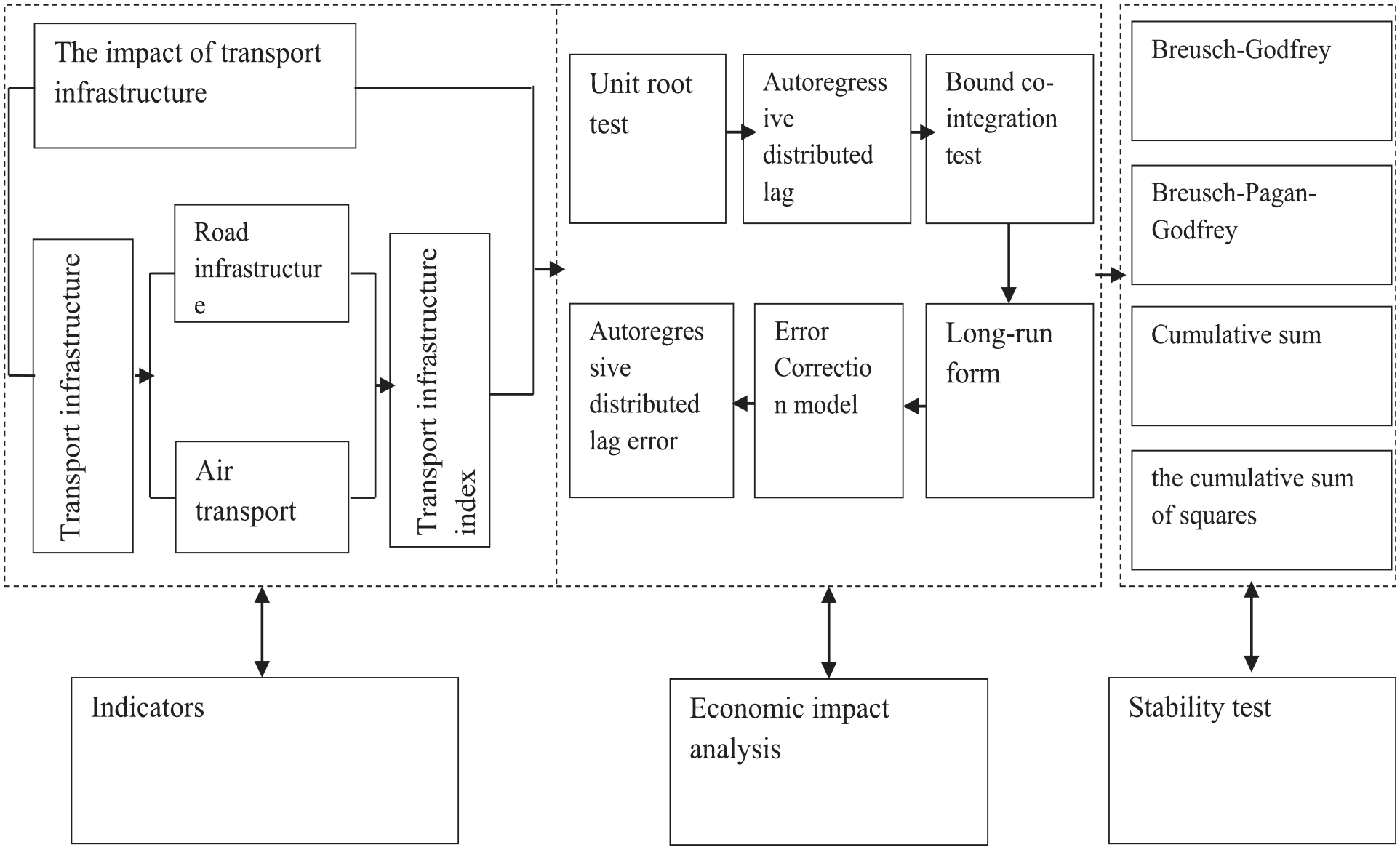
Framework for the economic impact of transport infrastructure analysis (direct relationship).
In the first step, we measure the co-integrating relationship via ARDL bounds-testing (Pesaran et al., 2001). We employed the next ARDL [m, p, q] model to decide the appearance of long-term associations between the study variables on the bases of the above discussions;

where Δ represent change;
To examine the presence of the long-term relationship, we perform an F- static using the estimation of Equation 1 (Iheanacho, 2018).
Secondly, once co-integration is recognized, the following ARDL (m, n, and p) long-run model for
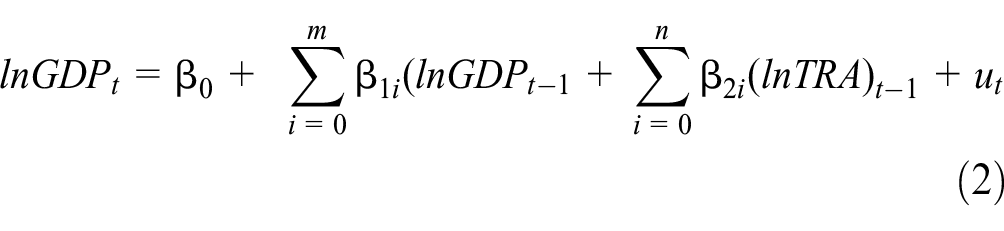
where
Thirdly, we estimate the short-term effect of the ECM form of adjusted ARDL through the Ordinary Least Square (OLS) method. We implemented ECM estimating by the following equations:

where Δ is the operator of the difference;
Fourthly, we performed diagnostic and structural stability tests to verify the model’s validity and robustness: we estimated the serial correlation and heteroscedasticity via the Lagrange multiplier test (Lu & White, 2014). Likewise, we carried out the cumulative sum and the cumulative sum square to examine the model’s structural stability.
Finally, a hierarchical Multiple Regressions Analysis (HMR) was identified to examine the effect of FDI capital flows on Ethiopian economic growth. We performed HMR by entering FDI inflows in the regression equation. It enables us to examine the contribution of mediating FDI. Thus, it might find any weakening or strengthening impacts behind the basic analysis of the multivariate relationship by examining the changing methods and contrasting various outcomes. This step followed the empirical framework in Figure 2, using STATA 12. The regression equation is written as follows:

The analytical framework for a mediating effect of FDI.
Economic growth (GDP) is regressed on both the transport infrastructure and FDI as follows:

where β0, β
X
, β
M
,
Results and Discussion
In this part of the study, we describe the empirical results and discussions concerning the research questions stated in Section 1 of this paper. An ARDL model and the bound test were used to assess the co-integration between economic growth and the transport infrastructure network in Ethiopia. To estimate the extent of GDP growth, an ordinary least square (OLS) was used using the error correction (ECM) model. Moreover, we used hierarchical multiple regression to estimate the relationship among the mediating effect of FDI, transport infrastructure (TRA), and economic growth (GDP) in the country.
We checked the stationarity test of the selected variable using ADF to define the order of the variable’s integration. The result reflects that all parameters are constant at the first difference’s five-per-cent significance level. Hence, the entire variables are integrated in order I (0) or I (1). The implication is that; we would accept the null hypothesis of no unit root at 5% significance (see Table 1).
The ADF Test Result.

Source. Authors output from input data.
Note. *** denote 1% level of significance.
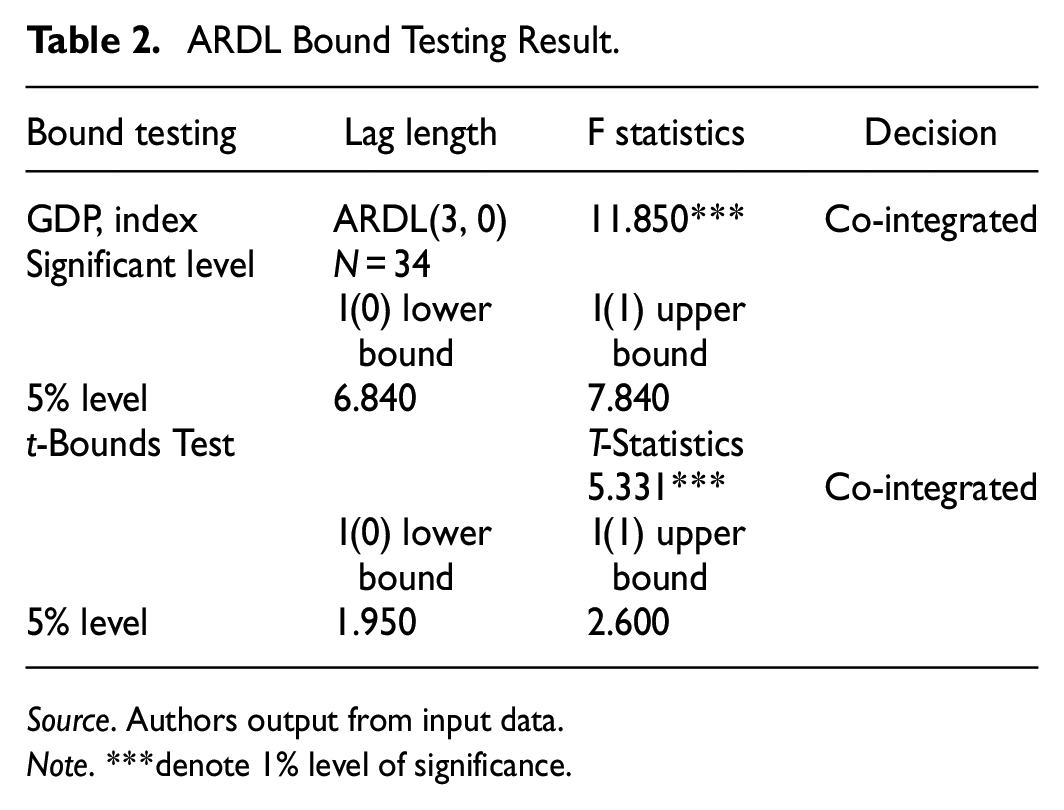
Based on the integrated series, we established the co-integration test by using the ARDL bound test Equation 1 above. The F-value (11.850) and T-value (5.330) of the co-integration test results are higher than the upper bound of the critical value [6.840, 7.840] and [1.950, 2.600], respectively, indicating that transport infrastructure and economic growth are cointegrated, and hence, the parameters run together in the long term (see Table 2).
ARDL Bound Testing Result.
Source. Authors output from input data.
Note. ***denote 1% level of significance.
We present the empirical outcomes of the ARDL-ECM model in Equations 2 and 3 of our study in Table 3. The table result shows the economic impact of transport infrastructure estimated by the OLS estimator. As one can observe from the table, the evaluated coefficient of transport infrastructure has a favorable and statistically substantial long-term economic impact (β = .460, p < .05), suggesting that a 1% growth in transport infrastructure in the previous 1-year leads to an increased GDP by 0.460%. The result suggests that when a country has an excellent transport infrastructure reduces the cost of goods and services, generates job opportunities, and provides the possibility for the underprivileged while supporting economies in becoming more competitive and efficient. Every day, transportation infrastructure connects individuals to jobs, healthcare, and educational opportunities. It makes it easier to provide goods and services to customers wide and boost the countries revenue, and as a result, attracts international investment.
The Long-Run Elasticity Results (ARDL-ECM) Model.

Source. Authors output from input data.
Note. *** and ** sequentially represent a significance level at 1% and 5%.
Moreover, the short-run dynamic outcome reports that the immediate impact of transport infrastructure is insignificant, even though it does significantly in the long term. However, the co-integration results come up with the expected sign and level of significance. In a practical sense, it implies that 81% of the disturbance in the short run is corrected each year and adjusted to the long-term equilibrium at the speed of 81% per annum. Therefore, hypothesis 1 is supported.
Furthermore, we investigate the mediating effect of the FDI in the relationship between transport infrastructure and the economic growth of the country using a hierarchical multiple regression model. Initially, we have standardized all variables. Accordingly, the model is free from heteroscedasticity. Besides, as we have mentioned earlier, all the variables are stationary, and the variance in nation factors for the variables in all models was less than four, which indicates the absence of collinearity.
Table 4 presents the empirical results of Equation 4 in our study. This table introduces FDI as a mediator in the association between transport infrastructure and economic growth. Model 2 to 3 estimates the significant coefficients of predictors after adding the mediator variable (i.e., FDI) in the model. As presented in Table 4, we evaluated model 1, before adding the mediator variable (i.e., the direct effect of transport infrastructure; β = .460, p = .01). After adding FDI as a mediator, we evaluated model 2 and model 3 to test hypotheses 2, 3, and 4, respectively. Firstly, we evaluated the transport infrastructure as a predictor of foreign direct investment (model 2). The result shows a significant favorable influence of the transport infrastructure on FDI (β = 1.400, p = .000) over the study period in Ethiopia. Next, both transport infrastructure and FDI were evaluated as predictor and mediator variables, respectively (model 3). The result shows a significant favorable impact of transport networks on both FDI on economic growth (β = .240, p = .010) and (β = .770, p = .000), respectively.
The Result of the Mediating Effect of FDI on the Economic Impact of Transport Infrastructure.

Source. Authors output from input data.
Note. Model I; before adding FDI; Model II: after adding FDI, TRA regressed over FDI; Model III: after adding FDI, both FDI and TRA regressed over GDP. The numbers in parentheses show t-values, and *** denotes a significance at 1% level.
More specifically, as one can observe from model 1, the direct effect of transport infrastructure is significant (β = .460, p = .01). Besides, the R-squared change (with and without interaction) was statistically significant. We claim that the better transport infrastructure the country has, the country attracts more FDI, which adds to the economic growth of the country. When the mediator variable and the independent variable (FDI and TRA, respectively) are both included in the same model, the effect of TRA (IV) on GDP (DV) decreases while remaining significant (Model 3). A significant p-value is also obtained from a hierarchical multiple regression test in Table 4. The findings indicate that increased transportation infrastructure spending benefits the Ethiopian economy by expanding the country’s capacity to produce goods and services (potential GDP), thereby generating economic growth above and beyond what would have occurred in the absence of additional infrastructure spending. Increased spending on transportation infrastructure also results in increased productivity and production indices compared to what would have happened without extra spending. This positively affects both business earnings and government revenue, enhancing both. Individual households benefit from increases in earnings, disposable income, and employment opportunities, the latter of which is likely the most significant growth.
Additionally, this paper employs FDI as a moderating variable; as a result of our findings, we argue that expanding transportation infrastructure attracts FDI by removing common bottlenecks that prevent larger levels of FDI in Ethiopia, hence enhancing economic growth. Thus, to expand its growth potential, Ethiopia should attract more FDI, which can help sustain economic growth in the long run. As a result, all sub-hypotheses are accepted, and the partialmediator variable role of FDI in the relationship between TRA and GDP is found to be statistically significant. That is, FDI positively mediates the relationship between expansion in the Ethiopian transport infrastructure and economic growth. Therefore, hypotheses 2, 3, and 4 are supported.
Finally, to confirm the results and evaluate the reliability of the study, we performed the robustness checks using residual diagnostic and stability tests of the ARDL-ECM model. The diagnostic tests examined how the model estimate behaves after the modified variables. From a residual diagnostic test shown in Table 5, the result indicates that autocorrelation and heteroscedasticity were not found; hence, the results are robust and reliable in the models.
Diagnostic Tests Outcomes of the Models.

Source. Authors output from input data.
Similarly, we conducted the cumulative sum and the cumulative sum square to examine the model structural stability, the graphic representation of the cumulative and cumulative square lies inside the 5% critical bound; thus, the structural stability of the model does not suffer from any shakiness over study time (see Figure 3).
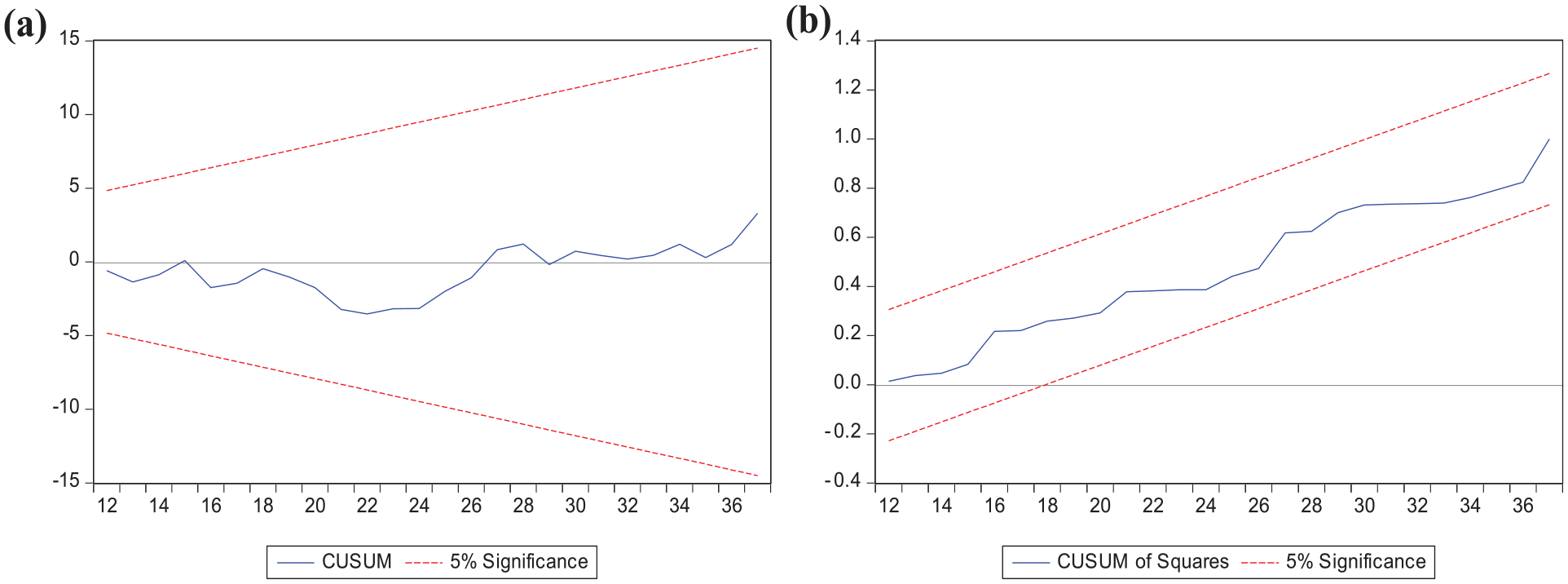
The structural stability results: (a) the cumulative sum and (b) the cumulative sum squares.
Conclusions
In the current study, we have assessed the economic effect of transport infrastructure development in the context of Ethiopia over the study period. The ARDL Bound test of co-integration is applied in order to explore the co-integration test between the entire variables selected in the study. Seeing the entire variables of this study are co-integrated, the OLS method is used to evaluate the autoregressive distributive lag and ECM to evaluate the long and short-run economic impacts of transport infrastructure development using aggregated annual time series data over the study period in Ethiopia. The empirical findings reveal that transport infrastructure (i.e., index from the components of the road and air transport) and GDP are co-integrated, indicating that the entire variables move together in the long run. Besides, the expansion of transport infrastructure has a significant long-term economic effect in Ethiopia. Moreover, FDI adds value and plays a significant mediating role, thereby increasing the economic growth performance of the country. Furthermore, from the outcome result, we conclude that transport infrastructure expansion attracts FDI by eliminating common bottlenecks that inhibit higher levels of FDI in Ethiopia and thereby increase economic growth; therefore, in order to create more opportunities for growth, Ethiopia ought to attract more FDI.
The theoretical findings reveal that investments in transportation infrastructure positively impact total factor productivity by increasing micro-production efficiency and resource allocation efficiency, which promotes increases in labor productivity through extensive and intensive marginal effects in economic growth. It improves the economic growth environment, processes, and outcomes by boosting technological innovation, industrial structure, and productivity. Moreover, investment in transportation infrastructure boosts technical innovation capacity by extending R&D size, enhancing R&D efficiency, and facilitating the transition of scientific and technology innovation achievements through foreign direct investment.
Hence, transport infrastructure development in Ethiopia can be deemed to be the paramount policy variable for forecasting economic growth in Ethiopia. Policy restructuring in transport infrastructure advances the investment in the private sector, linking resources and marketplaces and attracting FDI that can sustain Ethiopian economic growth for the long run. This paper makes some theoretical contributions to existing research. The first theoretical contribution is to transport-led economic growth literature. Previous transport-led growth studies lose to consider the mediating effect of the FDI. Thus, this paper used the FDI as a mediator variable that stimulates transport-led economic growth. The second theoretical contribution is to consider the findings of previous studies to establish an econometric model to assess the FDI and the economic effect of transport infrastructure.
Moreover, another relevance to this paper of this paper is the creation of a transport index, taking into account the variables regarding the state of transport infrastructure. The paper thus contributes to transport-led economic growth literature that provides a general view of the economic effect of transport infrastructure development from an FDI point of view. These results also have important policy implications for supporting not only future decisions on transport infrastructure investment but also illustrate the need to develop a sustainable strategy that makes poor public policy results more viable. Besides, as transportation infrastructure investments impact the quality of economic growth, technological innovation and comprehensive digitization of the supply chain can increase economic growth through technical innovation, industrial structure, and productivity, especially during the Covid-19. This includes cloud and internet of things (IoT) technology, advanced analytics tools to optimize freight scheduling and routing, and biofuel adoption. Because of this, future studies may combine the repulsiveness of this aspect.
On the other hand, just like other studies, the study has some limitations—in the case of control variables and the outcomes described in this study delimited to Ethiopia. However, countries have diverse political, economic, social, and technological backgrounds that could affect the transport infrastructure and in turn, affect economic growth. Hence, replication is welcome based on the backgrounds of the countries and using control variables. Such knowledge could be merged into future studies.
Footnotes
Declaration of Conflicting Interests
The author(s) declared no potential conflicts of interest with respect to the research, authorship, and/or publication of this article.
Funding
The author(s) received no financial support for the research, authorship, and/or publication of this article.
