




Abstract
Rural English teachers play a significant role in rural education, implementing relevant educational policies, such as “poverty alleviation through education.” Exploring the factors influencing rural English teachers’ occupational well-being and their mechanisms is of great importance for enhancing the stability of the rural teacher workforce and promoting the healthy development of rural education. Based on the Job Demands-Resources model, a survey was conducted among 350 rural English teachers in Guangxi’s rural schools, and a structural equation model was established to explore the impact mechanism of organizational support on the occupational well-being of rural English teachers. The study found that organizational support has a significantly positive effect on the occupational well-being and psychological resilience of rural English teachers. Psychological resilience has a significantly positive effect on the occupational well-being of rural English teachers and mediates the relationship between organizational support and rural teachers’ occupational well-being. The research results may be used to enhance the occupational well-being of rural English teachers.
Keywords
Introduction
The performance of teachers, especially those in the early stages of their careers, is fundamental in assessing the quality and effectiveness of learning environments in the rapidly evolving educational landscape. Globally, education systems recognize the multifaceted factors that influence teacher performance, extending beyond conventional pedagogical skills to encompass a broader range of professional and personal dynamics (Xiaoyu, 2024). Retaining quality teachers in rural areas is a significant and increasing issue worldwide. Teacher well-being is crucial for maintaining teacher quality, as effective educators must operate at their best to deliver high-quality instruction. Teachers in rural China face disadvantages compared to their urban counterparts in terms of working conditions, remuneration, and access to professional development opportunities. (Cui, 2020). Rural education represents the most vulnerable segment. Rural teachers exhibit low job stability, a diminished willingness to remain in their positions, and a pronounced inclination to depart. The turnover rate of rural teachers in China from 2010 to 2020 was 55.2%(H. Li et al., 2024). Education in rural areas is a “shortcoming” in realizing socialist modernization in rural China (Liu, 2024). In 2018, China’s Five-Year Plan established the objective of “building a high-quality education system in China” to improve teacher well-being in Rural China (China_Government, (Wei & Baocun (2018)). Under the rural revitalization strategy, the status and well-being of rural teachers have become a significant concern among education policymakers, practitioners, and researchers. Accordingly, the “Opinions of the Ministry of Education and five other departments on strengthening the construction of rural teachers in the new era” in 2020 proposed to “improve their status and treatment, so that rural teachers can enjoy the social respect (Ma et al., 2022).
The well-being of teachers has become a critical factor in maintaining the quality and effectiveness of educational systems in the rapidly evolving landscape of global education. This research investigates the relationship between organizational support and occupational well-being, while also examining the mediating effect of psychological resilience on Chinese English educators in rural middle schools. Teaching is a demanding profession frequently linked to elevated stress levels, job dissatisfaction, and psychological disorders (Fernández-Berrocal et al., 2017). The challenges teachers face can significantly impact their overall well-being and, consequently, the quality of education they deliver to students. Teachers’ emotional intelligence and organizational commitment significantly influence their well-being and job satisfaction (M. Li et al., 2024).
Berger et al. (2022) argue that teachers have higher levels of stress and depression relative to other professions. Current literature emphasizes the importance of organizational support in enhancing teacher well-being. Employers who supply sufficient resources, cultivate a supportive work environment, and acknowledge the contributions of their employees can enhance psychological and emotional outcomes (Fernández-Berrocal et al., 2017). The mechanisms by which organizational support affects well-being are not fully understood. The significance of psychological resilience in enhancing teacher well-being, alongside organizational support, has been acknowledged. Resilient teachers effectively manage the emotional challenges of their profession, sustain a positive perspective, and engage in self-care practices that enhance their overall well-being (Luthar & Mendes, 2020). Beltman (2021) research highlights the essential role of resilience in enabling teachers to navigate the complexities of their roles and maintain their commitment to students and the teaching profession. The current literature has not thoroughly examined the potential mediating role of psychological resilience in the relationship between organizational support and teacher well-being. The identified gap in the research provides a basis for examining the mechanisms by which organizational support influences the overall well-being of teachers. This paper investigates the mediating role of psychological resilience in the relationship between organizational support and occupational well-being among English teachers. Therefore, this study selects samples from rural English teachers in Guangxi and employs structural equation modeling to delve into the mediating effect of teacher psychological resilience in the relationship between organizational support and teachers’ occupational well-being, aiming to provide insights for enhancing rural English teachers’ occupational well-being and subsequently improving educational quality.
Teachers experience significantly higher stress and depression than employees. Recent research has also underlined the role of organizational support in promoting teacher well-being. Employers who provide adequate resources, create a supportive work environment, and appreciate the input of teachers can enhance both their psychological and emotional outcomes (Fernández-Berrocal et al., 2017). However, the mechanisms by which organizational support influences well-being remain underexplored. It has been agreed upon that psychological resilience is important in alleviating teacher well-being, together with organizational support. When teachers receive additional support, they are more likely to sustain a supportive mindset and turn to self-care strategies that lead to sustained resilience (Luthar & Mendes, 2020). In Gitter’s review, Beltman (2021) identified the crucial role resilience plays in helping teachers navigate the demands of their work and sustain commitment to students and their profession. However, the previous literature has not adequately tested whether psychological resilience mediates the relationship between organizational support and teacher well-being. This research gap serves as a foundation for exploring how organizational support affects the well-being status of teachers who witness it. The current study explores the mediating effect of Psychological Resilience on Organizational Support and Occupational Well-being among English Teachers. Accordingly, this study employs a sample survey of rural English teachers in Guangxi and utilizes structural equation modeling to investigate the mediating role of teacher psychological resilience between organizational support and teacher occupational well-being. This approach aims to enhance the theoretical understanding of rural English teachers’ occupational well-being, thereby optimizing our research to improve educational quality.
Literature Review
Middle school teachers in China face unique challenges that can impact their occupational wellbeing (Yang et al., 2020). These teachers are responsible for educating students during a crucial developmental stage while navigating a complex education system with high demands and limited resources. The level of organizational support provided to these teachers may be crucial for their ability to manage stress and maintain job satisfaction. Research studies have consistently emphasized the importance of organizational support in enhancing teachers’ quality of life. Improved job satisfaction, lower burnout, and overall psychological and emotional well-being have been linked to access to professional growth opportunities, cooperative work cultures, and recognition of their efforts. The occupational well-being of teachers refers to their sense of meaning and gratification derived from their work (Viac & Fraser, 2020). Teachers’ occupational well-being not only relates to the individual teachers themselves but also influences their job performance, job satisfaction, and retention rate. It becomes a vital factor that cannot be overlooked in teacher team building and a necessary prerequisite for improving educational quality. The concept of occupational well-being for teachers has a significant impact on their job satisfaction, performance, and output quality. It encompasses multiple dimensions, including psychological and Emotional Factors, social and economic factors, and organizational factors (Kume, 2024; Ozyildirim, 2024). Comprehending these dimensions is crucial for developing effective strategies to enhance teachers’ well-being, ultimately leading to improved educational outcomes.
The JD–R model classifies working environments and situations into job demands and resources(Awwad-Tabry et al., 2023). These two components may have both positive and negative consequences for employees’ well-being (J. Wang et al., 2020; Z. Wang et al., 2020). High job demands may lead to energy depletion, which can potentially result in health issues. On the other hand, sufficient job resources, serving as both external support and internal motivation, can drive enhanced job performance. A person’s well-being at work is often the result of a balance between these two constructs.
The JD–R model has been demonstrated to be relevant in the educational context. In the literature concerning teacher research, job demands encompass the mental and physical exertion required of educators, including time constraints, disciplinary issues, low student engagement, and role ambiguity. Conversely, job resources encompass opportunities for professional development, peer evaluations, access to teaching and learning resources, support for teacher autonomy, and collegial relationships. Rural English teachers need to continuously enhance their emotional caring for students, lesson planning, and grading to adapt to new teaching methods and technologies; however, if this demand is substantial and lacks adequate support, it may lead to stress and fatigue. On the other hand, organizational support from schools and educational institutions, including effective management, opportunities for professional development, peer feedback, the availability of resources that support teaching and learning, and teacher autonomy, directly impacts teachers’ job satisfaction and occupational well-being. By diligently balancing these aspects, rural English teachers can better manage work pressure, increase job satisfaction, and improve their occupational well-being. Based on this premise, this study focuses on rural English teachers and aims to investigate the impact of organizational support on their occupational well-being, while also examining whether teachers’ psychological resilience serves as a mediator in this relationship.
The JD-R model provides a comprehensive framework for understanding how work environments influence employee well-being, particularly through the interaction between job demands and resources. In educational contexts, this model has been widely applied to examine how teachers manage occupational stress and maintain psychological well-being. Hakanen et al. (2006) found that Finnish teachers with access to job resources such as supervisory support and an innovative school climate reported higher work engagement and lower burnout. Similarly, Skaalvik and Skaalvik (2018) observed that Norwegian teachers who perceived strong organizational support and autonomy experienced greater motivation and reduced emotional exhaustion. These studies highlight organizational support as a critical job resource that buffers the adverse effects of job demands, especially in high-pressure teaching environments. Furthermore, Hascher et al. (2021) emphasized the role of psychological resilience as a personal resource that mediates the relationship between organizational support and well-being, allowing teachers to better adapt to stress and maintain occupational functioning. Within the JDR framework, psychological resilience can be understood as a mechanism through which external job resources, such as organizational support, contribute to teachers’ well-being (Bauer et al., 2014). Therefore, applying the JDR model in this study provides a solid theoretical basis for exploring how organizational support and psychological resilience shape occupational well-being among Chinese English teachers in rural middle schools.
Teachers’ professional lives are significantly influenced by organizational support, which affects job satisfaction (Chinomona & Sandada, 2014), performance (Farooqi et al., 2019), and organizational commitment (Gündüz, 2014). Empirical studies have already underlined the need to attend to teachers’ occupational welfare. Often linked with great degrees of stress, teaching is a very emotional profession that can cause job discontent, psychological problems, and lower general wellness. Furthermore, China’s rapid pace of educational reforms is affecting its occupational health, which has added to teachers’ demands and workload (Nwoko et al., 2023). Organizational support is positively associated with teachers’ well-being and mediates the relationship between school head’s caring leadership and teachers’ well-being. This suggests that supportive organizational structures enhance leadership effectiveness and improve teacher well-being (Disilio & Callo, 2024). Supportive behaviors of school administrators were found to significantly impact teachers’ job satisfaction and subjective well-being. Teachers’ job satisfaction affected their subjective well-being levels (Ertürk, 2021). These studies suggest that a teacher’s dedication can be enhanced by augmenting organizational support, ameliorating a disadvantaged working environment, and fostering job satisfaction (Bibi et al., 2019). Organizational support refers to the employee’s perception and conviction that the organization genuinely cares for their well-being (Eisenberger et al., 1986). Forms of organizational support include providing training, professional development opportunities, and job flexibility, etc. Teachers’ occupational well-being refers to the sense of meaning and fulfillment that teachers derive from their work. This sense of well-being encompasses multiple aspects, including enjoyment of teaching, interaction with students, identification with the educational mission, satisfaction with the work environment, and pleasure in professional development etc. When teachers experience support from school leaders (such as principals, directors, etc.) and a positive support atmosphere is established among colleagues, they are more likely to demonstrate a sense of ownership, increase job satisfaction, and thus gain more occupational well-being (Disilio & Callo, 2024).
Teachers’ occupational well-being refers to the sense of meaning and fulfillment that teachers derive from their work (Viac & Fraser, 2020). Teachers’ occupational well-being is related to their individual well-being and influences their job performance, job satisfaction, and retention rates. It is a crucial factor that cannot be ignored in teacher team construction and is an important prerequisite and guarantee for improving educational quality (Shi et al., 2023; Tao & Yan, 2021; J. Wang et al., 2020; Z. Wang et al., 2020). It has been demonstrated that organizational support has a positive correlation with teachers’ occupational well-being. At the same time, psychological resilience, as a positive internal resource of individuals, serves as an energy booster and a protective factor for their occupational well-being, thus contributing to its enhancement. However, previous studies have rarely explored how organizational support influences teachers’ occupational well-being through the mediator of teacher psychological resilience, nor have they fully elucidated the operating mechanism of this influence pathway in the context of rural education environments and cultural backgrounds. In rural schools, students’ weak English foundations and teachers’ lack of support from an English-speaking environment, as well as targeted training, can potentially affect English teachers’ occupational well-being (Dhote, 2021; Shan & Aziz, 2022). Against this backdrop, investigating the impact of organizational support on the occupational well-being of rural English teachers and further elucidating the mediating role of teacher psychological resilience becomes a pressing research question.
Teacher psychological resilience is the dynamic process of positive adaptation that instructors demonstrate in response to the pressures, challenges, or adversities of their teaching profession. Teacher psychological resilience refers explicitly to the flexibility, tenacity, good attitude toward stress management, and speedy recovery from challenges that teachers show when under educational teaching demands. Teachers will have more chances to develop inner psychological strength, increasing their psychological resilience and efficacy, when they feel great organizational support. Teachers are more likely to exhibit positive psychological states and be ready to commit themselves to their work, the more organizational support they find (J. Wang et al., 2020; Z. Wang et al., 2020).
The psychological resilience of teachers is a significant determinant of their occupational well-being, facilitating effective stress management, preventing burnout, and maintaining a positive work-life balance. Multiple factors, including individual characteristics, professional support structures, and organizational practices, shape the relationship between resilience and well-being. Existing research suggests that resilience is a protective factor against burnout, a prevalent concern among educators due to the demanding nature of their profession. Educators who cultivate resilience are more adept at managing stress and sustaining their professional and personal well-being(Karimi & Adam, 2023; Skovholt & Trotter-Mathison, 2014). Supportive work environments, characterized by positive relationships among colleagues and effective leadership, are essential for fostering resilience. These factors contribute to teachers’ sense of value and support, which is crucial for their well-being (Griffiths, 2014; Shields, 2019).
Psychological Resilience positively impacts teachers’ mental and emotional health, enabling them to experience professional well-being. It creates a favorable teaching environment that benefits teachers and students (Da Conceição Lettnin et al., 2014). During challenging times, such as the COVID-19 pandemic, resilience enables teachers to navigate stress and maintain their well-being. Both individual and environmental factors contribute to a sense of well-being, highlighting the importance of a supportive school environment (Fox & Walter, 2022). Psychological resilience is critical in maintaining effective educational environments and ensuring teacher retention. Organizational support plays a crucial role in fostering resilience, enabling teachers to manage stress and adversity effectively. The interplay between resilience and organizational support involves individual, relational, and systemic factors. Social support, including relationships with colleagues, family, and community, is vital for teacher resilience. Teachers who engage in supportive networks are better equipped to handle stress and adversity(Asghar et al., 2021; Lee et al., 2012). Most significantly, teachers become psychologically intense when they receive strong organizational support, including encouragement, positive social interaction, opportunities for professional learning, and help with managing emotions (Hooper & Johnson, 2025).
The Job Demands-Resources (JD-R) model suggests that job satisfaction mediates the relationship between job demands and performance. Here, the model suggests that organizational support in the form of job resources facilitates the acquisition of personal resources, leading to positive outcomes such as increased engagement and improved well-being (Bakker & Demerouti, 2007). Therefore, when an organization supports its workers, it enhances their wellness and equips them with the skills to cope more effectively with difficulties. Gu and Day (2007) found that having a stronger professional identity and emotional well-being benefited teachers by increasing their commitment and effectiveness. Tait (2008) stated that resilience helps prevent teacher burnout and is significantly increased when the job environment is supportive. When challenges like the COVID-19 pandemic arise, resilience has helped teachers cope with high stress levels and uncertainty (Fox & Walter, 2022). Teachers who received great social and organizational support during the pandemic were stronger and happier than those who did not (Asghar et al., 2021). Resilience is also influenced by the location of education and the environment in which students learn, as well as their relationships and the leadership at school (Luthar et al., 2000). If teachers have positive relationships with others, they are more likely to be resilient and commit to their profession.
Based on the literature, this study proposed the following hypothesis,
Based on these hypotheses, the conceptual model is depicted in Figure 1.

Conceptual model diagram.
Materials and Methods
Participants
The research received ethical clearance from the Institutional Review Board (IRB) of the University. Research assistants administered the questionnaires, elucidating the survey’s objectives and completion criteria to the participants. Following the acquisition of informed consent, the assistants disseminated and retrieved the questionnaires. The research underscored the veracity, autonomy, and confidentiality of the responses given by the participants. Educators were informed of the voluntary nature of their participation and their right to withdraw at any time. Participants received a token of appreciation as an incentive. This study employed random sampling to select 350 middle school English teachers from 10 rural schools in Guangxi for the survey. The selection process for the 10 schools and 350 teachers was conducted through a stratified random sampling method. First, the schools were stratified based on geographical location (urban/rural) and educational level (middle/high school), and then randomly selected within each stratum to ensure representativeness. Within the selected schools, teachers were randomly chosen from staff lists provided by school administrators using a random number generator. Sample selection considered teachers’ gender, teaching segment, years of teaching experience, and professional title. After excluding invalid questionnaires, 326 valid questionnaires were obtained, resulting in an effective rate of 93%. Regarding the distribution of teachers’ characteristics: there were 128 male teachers (39.3%) and 198 female teachers (60.7%) in terms of gender; in terms of teaching segment distribution, there were 149 elementary school teachers (45.7%) and 177 junior high school teachers (54.3%); regarding years of teaching experience, 98 teachers (30.1%) had 5 years or less of experience, 31 teachers (9.5%) had 6 to 10 years, 42 teachers (12.8%) had 11 to 20 years, 124 teachers (38.1%) had 21 to 30 years, and 31 teachers (9.5%) had over 30 years of teaching experience. In terms of professional titles, there were 42 teachers (12.9%) with a third-level or lower title, 62 teachers (19%) with a second-level title, 129 teachers (39.7%) with a first-level title, and 93 teachers (28.4%) with a senior title.
Measures
The organizational support is measured by a modified version of the Organizational Support Scale adapted from Eisenberger et al. (1986), comprising nine items. Responses were recorded on a 5-point Likert scale ranging from “1 = Strongly Disagree” to “5 = Strongly Agree.” Higher scores indicate higher levels of organizational support. The rural teachers’ occupational well-being is measured with a questionnaire developed by Zhao et al. (2012), comprising six factors: sense of occupational nobility, satisfaction with income, emotional well-being, physical and mental pleasure, sense of job efficacy, and sense of social support, totaling 22 items. Responses were recorded on a 5-point Likert scale ranging from “1 = Completely Inconsistent” to “5 = Completely Consistent.” Higher scores indicate higher levels of occupational well-being for rural education teachers. Due to the high homogeneity between the “sense of social support” and the “organizational support scale” in this study, this factor and its items were removed.
The “Teacher Psychological Resilience” measurement is adapted from the Resilience Scale by Yu and Zhang (2007), who revised the CD-RISC by Connor and Davidson. The scale consists of 25 questions in three constructs: Self-Improvement, Optimism, and Tenacity. Responses were recorded on a 5-point Likert scale ranging from “1 = Not at all” to “A lot.” Higher scores indicate stronger psychological resilience for rural English teachers. The internal consistency Cronbach’s alpha coefficients for the three scales were .868, .856, and .871, respectively, all exceeding the standard value of .7, indicating good internal consistency of the measurement items within each dimension(Dong et al., 2020).
Statistical Methods
Data analysis and processing were conducted using SPSS 26.0 and AMOS 26.0, involving two stages. In the first stage, SPSS 24.0 was used for data management and basic statistical analysis. In the second stage, AMOS 26.0 was utilized to perform structural equation modeling (SEM) on the entire sample dataset to validate the relationships among organizational support, teacher psychological resilience, and teacher occupational well-being. The mediating effect of teacher psychological resilience was also examined using the Bootstrap resampling method.
Results
Descriptive Statistics and Correlations Between Variables
The descriptive statistics and correlation results among rural teachers’ occupational well-being, organizational support, and psychological resilience are presented in Table 1. On average (on a five-point scale, M = 3), rural teachers perceive relatively strong organizational support (M = 3.07, SD = 0.92), while their levels of occupational well-being (M = 2.71, SD = 0.86) and psychological resilience (M = 2.53, SD = 0.95) require improvement. Regarding the correlation relationships, significant positive correlations (p < .01) were found among teachers’ occupational well-being, organizational support, and psychological resilience. Specifically, the correlation between occupational well-being and organizational support is relatively high (with a correlation coefficient greater than 0.6), while the correlation between organizational support and psychological resilience is relatively lower (with a correlation coefficient close to but greater than 0.4). To further investigate the specific relationships among the three variables, structural equation modeling will be conducted in the next step, along with examining the mediating role of teachers’ psychological resilience.
Descriptive Statistics and Correlations Between Variables.

p < .01.
Reliability and Validity Testing of Measurement Model
SPSS 24.0 was employed to evaluate the reliability and validity of the measurement scales. The factor loadings varied from 0.6 to 0.9, exceeding the threshold of 0.6, indicating that the three dimensions can be accurately represented by the corresponding measurement indicators. The composite reliability (CR) and average variance extracted (AVE) exceeded the threshold values of 0.7 and 0.5, respectively, signifying robust convergent validity of the model (Table 2). According to the suggestion of Fornell and Larcker (1981), discriminant validity is confirmed when the square root of a construct’s AVE exceeds its correlation with other constructs. This investigation demonstrated that the square roots of the Average Variance Extracted (AVE) for each construct exceeded the correlations with other constructs, signifying robust discriminant validity among the constructs (Table 2).
Reliability and Validity Testing.

Note. The bold values on the diagonal are the square roots of AVE; the lower triangle represents the Pearson correlations between dimensions. CR = composite reliability; AVE = average variance extracted.
Goodness-of-Fit Test
Utilizing the AMOS 24.0 software, the goodness-of-fit of the model was examined. Following the suggestion by Wen et al. (2004), a χ2/df ratio between 0 and 3 indicates a good model fit. Similarity indices (GFI, AGFI, TLI, CFI) greater than 0.900, and closer to 1, indicate a better fit between the data and the model. Discrepancy indices (RMSEA, SRMR) less than 0.080 suggest good model fit. Upon examination, the results were as follows: χ2/df = 2.591, GFI = 0.921, AGFI = 0.901, TLI = 0.933, CFI = 0.942, RMSEA = 0.068, SRMR = 0.046. Therefore, the sample model demonstrates a good fit.
Hypothesis Testing
Direct Effects Testing
In this study, organizational support is the independent variable, psychological resilience is the mediating variable, and occupational well-being is the dependent variable for path analysis. The results of the path relationships are presented in Table 3. Hypotheses H1, H2, and H3 all passed the significance test, indicating empirical support for the proposed paths. At the significance level of p < .001, organizational support has a significantly positive effect on the occupational well-being of rural teachers (β = .462, p < .001), confirming hypothesis H1; organizational support has a significantly positive effect on the psychological resilience of rural teachers (β = .265, p < .001), confirming hypothesis H2; and psychological resilience has a significantly positive effect on the occupational well-being of rural teachers (β = .304, p < .001), confirming hypothesis H3.
Path Analysis Results.
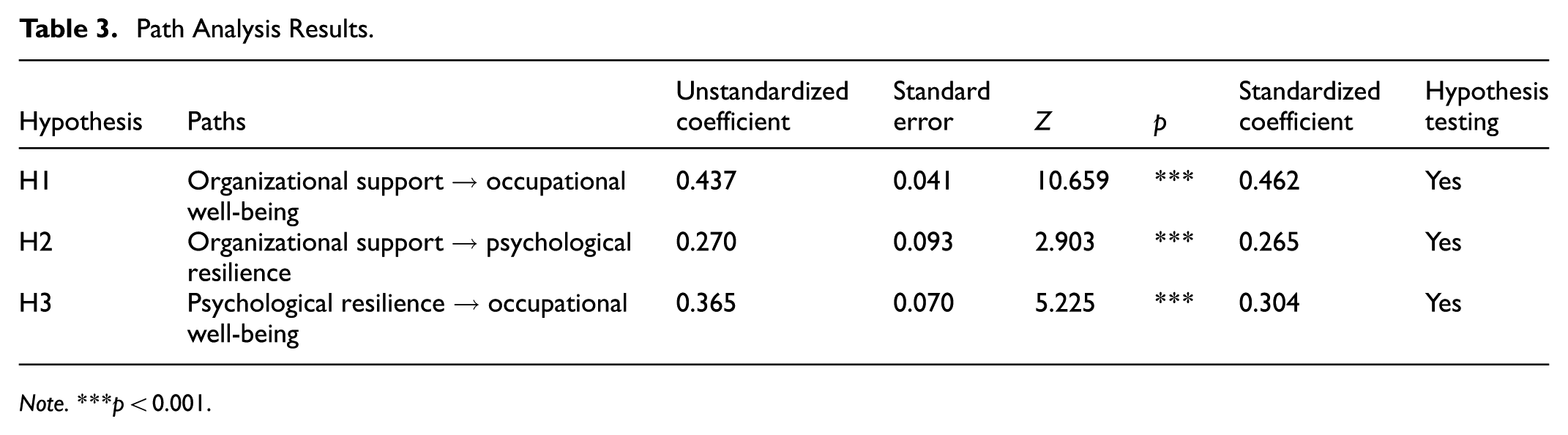
Note.***p < 0.001.
Mediation Effect Test
Bootstrapping was employed to draw 1,000 samples from the dataset. A 95% confidence interval was used to test the significance of the mediating effect between organizational support and occupational well-being. Following the recommendation by MacKinnon et al. (2007), the bias-corrected method was utilized for the bootstrapping analysis. According to the mediation effect test results (see Table 4), the total effect between organizational support and occupational well-being (sum of direct and indirect effect point estimates) is 0.612. The mediating effect of psychological resilience is significant (confidence interval does not include 0, p < .05). Specifically, the mediating effect through psychological resilience is 0.15, accounting for 24.5% of the total mediation effect. The hypothesis that psychological resilience mediates the relationship between organizational support and the occupational well-being of rural English teachers was supported (
Bootstrap Mediation Effects.

Conclusion and Discussion
This study examined the mediating role of psychological resilience in the relationship between organizational support and occupational well-being among rural English teachers in Guangxi. The findings reveal that organizational support significantly enhances teachers’ occupational well-being (β = .462, p < .001) and psychological resilience (β = .265, p < .001), while psychological resilience itself has a positive contribution to occupational well-being (β = .304, p < .001). Critically, psychological resilience mediates 24.5% of the total effect of organizational support on occupational well-being, underscoring its role as a partial but meaningful mechanism. The direct effect of organizational support on occupational well-being (β = .462) aligns with studies in urban Chinese and Western contexts, albeit with notable distinctions. For instance, J. Wang et al. (2020) and Z. Wang et al. (2020) reported a more substantial direct effect (β = .58) among urban teachers, likely due to greater resource availability and institutional stability in urban schools compared to rural settings. Similarly, Disilio and Callo (2024) found a comparable organizational support → well-being path (β = .41) in Western contexts but emphasized job autonomy as a more potent mediator than resilience. This divergence suggests that rural teachers in Guangxi, who often face systemic challenges (e.g., limited resources, isolation), may rely more heavily on organizational support to compensate for structural inequities.
The mediation effect of psychological resilience (24.5%) is modest compared to mediators like social support (35–40% in Karimi & Adam, 2023) or self-efficacy (30% in Nwoko et al. (2023). However, its significance lies in its focus on internal coping mechanisms rather than external buffers. For rural teachers operating in high-stress, resource-constrained environments, psychological resilience may be a critical safeguard against burnout, complementing organizational support. This aligns with Skovholt and Trotter-Mathison (2014) assertion that resilience is particularly vital in contexts lacking systemic safeguards.
The partial mediation (24.5%) suggests that organizational support has both direct and indirect effects on occupational well-being through resilience. These results suggest interventions should combine institutional support (e.g., professional development, recognition programs) with resilience-building initiatives (e.g., mindfulness training, peer mentoring). The modest mediation also signals the presence of other unexplored mechanisms, such as work-life balance or community engagement, that may further explain the link between organizational support and well-being. Future studies should test multi-mediator models to disentangle these pathways. The weaker direct effect of organizational support in this study compared to urban Chinese contexts (J. Wang et al., 2020; Z. Wang et al., 2020) may reflect systemic disparities in rural Guangxi, where schools often struggle with funding and teacher retention. In such settings, even robust organizational support may be insufficient to fully offset structural deficits, amplifying the importance of psychological resilience as a compensatory factor. Conversely, in Western studies (Disilio & Callo, 2024), organizational support often interacts with stronger labor protections and unions, potentially diminishing the relative role of resilience. These cross-contextual differences highlight the need for culturally and structurally tailored well-being interventions. This study advances the literature by quantifying how psychological resilience is a mediator in under-resourced rural educational contexts. While the mediation effect is modest, its practical significance lies in its actionable focus: schools can amplify occupational well-being by fostering supportive environments and resilience-building programs. These findings challenge the assumption that organizational support alone is sufficient in high-stress settings and call for integrative strategies that address both systemic and individual-level factors.
For a long time, rural teachers have played a crucial role in promoting equity and progress in rural education, as well as improving educational quality. The “Rural Teacher Support Plan (2015), Rural Teacher Support Plan (2016), Rural Teacher Support Plan (2017), Rural Teacher Support Plan (2018), Rural Teacher Support Plan (2019), Rural Teacher Support Plan (2020)” (Jian, 2020) explicitly emphasizes the importance of “focusing on building a rural teacher workforce” and striving to enhance the occupational well-being of rural teachers (J. Li et al., 2020). Significant progress in rural education has been made with the increasing attention from the party and government to rural education, as well as rapid economic growth. However, rural English teachers currently face various pressures and challenges, including addressing students’ weak English foundations, low English learning motivation, diverse student ability levels, and collaborating with parents to reduce the dropout rate. Meanwhile, rural teachers including rural English teachers, have to be involved in poverty alleviation work in rural areas. Furthermore, they must also adapt to the technological demands of the era, using digital tools to enhance learning. These pressures and challenges may negatively affect the occupational well-being of rural English teachers. Based on the current pressures and challenges faced by rural English teachers and the empirical findings of this study, the enhancement of occupational well-being for rural English teachers can be attempted through the following approaches: At the organizational (school) level, a series of localized measures should be implemented, including targeted teacher training, optimization of educational resource allocation, and strengthening of parent-teacher communication mechanisms. Firstly, schools should provide targeted professional training for rural English teachers to enhance their teaching skills for students with weak foundations, while also stimulating their interest and motivation to learn. Secondly, schools should streamline the allocation of educational resources to ensure that every student has access to English learning materials and tools suitable for their proficiency levels. Schools also need to strengthen communication with parents to develop strategies to prevent student dropout and encourage parents to participate in their children’s English learning process. Through these localized measures, the teaching quality of rural English teachers can be effectively improved, students’ learning outcomes can be enhanced, and the dropout rate can be reduced.
Encouraging community members and volunteers to assist with the “Poverty Alleviation” of the school. Encouraging the participation of community members and volunteers in the management of schools, especially in non-teaching administrative tasks such as “poverty alleviation,” can significantly reduce the burden on rural schools and their English teachers. In rural schools, there is a shortage of English teachers, and non-teaching administrative tasks like “poverty alleviation” significantly reduce the teaching time of English teachers, while also draining their energy and diminishing their enthusiasm for teaching. By encouraging community members and volunteers to get involved in the school’s “poverty alleviation” efforts, teachers can focus more time and energy on teaching and student development, improving teaching outcomes, and promoting the comprehensive development of students.
Building a Harmonious and Trustworthy Interpersonal Network to Enhance Rural English Teachers’ Psychological Resilience. From an ecological perspective, individuals within the school ecosystem, including teachers, students, parents, and administrators, exhibit both independence and interdependence, influencing each other in various ways. A harmonious and trusting interpersonal network within the school is a vital resource for helping teachers establish a sense of belonging in the school community. It can be said that teachers’ psychological resilience is shaped by their interactions within the complex network of interpersonal relationships. The quality of interpersonal relationships in teachers’ work has a direct impact on their level of psychological resilience. To enhance the psychological resilience of rural English teachers, it is essential to emphasize trust among teachers, foster a positive and supportive teacher community, and prioritize building trust between English teachers and students to improve their job satisfaction and cultivate students’ self-confidence. Furthermore, effective communication and cooperation mechanisms between English teachers and parents should be established to enhance cohesion and stability within the school. Finally, school leadership should play a crucial role by guiding, supporting, and creating a conducive work environment to facilitate positive interactions among teachers primarily English teachers.
Limitations
The present study contributes to understanding the mediating role of psychological resilience in the relationship between organizational support and occupational well-being among English teachers in rural middle schools in China. Several limitations exist. The present study employed a self-report questionnaire for data collection, which may introduce concerns regarding social desirability bias. Future research should implement supplementary strategies to mitigate this bias, including incorporating fictitious items or adding a straightforward self-reporting item. This study employed a cross-sectional design, which makes it challenging to establish causal relationships among the variables. Future research may examine these findings through longitudinal studies to establish the causal relationships between organizational support, psychological resilience, and occupational well-being. Third, the participants in this study were primarily drawn from 10 rural schools in Guangxi Province, China; consequently, the findings may not be applicable to education teachers nationwide. Future studies should increase the sample size to assess the generalizability of our findings. Future studies could adopt longitudinal designs to track changes in well-being and resilience over time, enabling causal analysis and exploration of critical periods in teachers’ careers. By integrating qualitative interviews or focus groups with quantitative surveys, mixed-method approaches could mitigate self-report bias by triangulating subjective accounts with observational or contextual data. Finally, expanding the scope to include systemic variables (e.g., institutional policies, community support) would yield a more holistic understanding of teacher well-being, strengthening theoretical models and informing multifaceted interventions.
Footnotes

Ethical Considerations
The research received ethical clearance from the Institutional Review Board (IRB) of the Guilin University of Aerospace Technology, Guilin. Research assistants administered the questionnaires, elucidating the survey’s objectives and completion criteria to the participants.
Consent to Participate
Informed consents from all those who participated in the study with human subjects were duly taken. The study was conducted following ethical standards and maintaining confidentiality. Also, their privacy was protected.
Author Contributions
SJ: Investigation, Data collection, Data curation, Data analysis, Formal analysis, Conceptualization, Software, Resources, Validation, Visualization, Writing–original draft, Writing – review & editing. GY: Funding acquisition, Project administration, Investigation, Methodology, Data analysis, Formal analysis, Writing – review & editing.
Funding
The authors disclosed receipt of the following financial support for the research, authorship, and/or publication of this article: This work was supported by the Research Project of Guangxi Philosophy and Social Science Planning in 2022 under Grant No. 22FYY017 and GUAT Social Research Project on the Strategic Development of Distinctive Interdisciplinary Fields under Grant No. TS2024531 as well as Guangxi Key Project of Higher Education Reform in 2023 under Grant No. 2023JGZ166.
Declaration of Conflicting Interests
The authors declared no potential conflicts of interest with respect to the research, authorship, and/or publication of this article.
Data Availability Statement
The raw data supporting the conclusions of this article will be available from the corresponding author on reasonable requests.