




Abstract
As an extremely disadvantaged group, orphans have received extensive attention from researchers. However, previous research focused on their survival status and psychological distress. The present study aims to explore the mechanism of orphans’ life satisfaction from the perspective of positive psychology. We conducted a survey among Tibetan orphans (n = 131) and compared the results with Tibetan non-orphans (n = 134). A mediation model was used to assess associations between resilience and life satisfaction, and the intermediary role of dimensions of hope (agency thinking and pathways thinking). Results indicated that, among orphans, agency thinking acted as a mediator in the mediation model, while pathways thinking did not. Moreover, hope dimensions did not play mediating roles between resilience and life satisfaction among non-orphans. The results highlighted that resilience is of vital importance for orphans’ life satisfaction. It was expected to inspire psychologists to develop specific interventions on resilience for orphans to enhance their internal resources (such as agency thinking of hope) and life satisfaction.
Introduction
The term “Orphans” refers to those who have lost or cannot find their birthparents. They often grow up in an incomplete family environment, are burdened with the pain of losing parents, and are unable to improve their living conditions on their own (Yendork & Somhlaba, 2016). Under these circumstances, they may confront multiple challenges including insufficient food, shelter, schooling, and medical care (Hailegiorgis et al., 2018; Nichols et al., 2014), as well as deficient attachment and psychological assistance (J. Y. Wang et al., 2020). As a result, their difficult life situation makes them prone to dissatisfaction with life (He & Ji, 2009). The International Conference on Poverty Reduction and Child Development held by the United Nations proposed paying additional attention to extremely poor children, including street children, minority children, orphans, etc., by developing policy focused on preventing risk and reducing vulnerability (UNICEF, 2012). China has also issued a series of policies to care for orphans: the Opinions of the General Office of the State Council on Strengthening the Work of Providing Guarantees for Orphans (General Office of the State Council, 2010) highlighted the importance of establishing an orphan security system commensurate with the level of economic and social development in China in order to bring orphans greater dignity and quality of life. Despite these strides, the importance of improving and maintaining mental health is seldom considered when making policies. Therefore, the present study intends to explore how to improve the life satisfaction of orphans on the psychological level.
Life Satisfaction of Orphans
Life satisfaction refers to a cognitive judgmental process (Diener, 1984; for a late review, see Kansky & Diener, 2021) that generally evaluates the quality of life according to individuals’ own criteria (Shin & Johnson, 1978). The theory of Pleasure and Pain (Diener, 1984) holds the view that lack or deprivation is a necessary premise of happiness; individuals have goals or needs to the extent that something is missing in their life, and the greater the deprivation, the greater the happiness upon achieving the goal. Orphans’ living environment is highly deprived, resulting in difficulty satisfying their living or psychological needs, in turn potentially diminishing their life satisfaction. Compared with non-orphans, orphans’ life satisfaction may be relatively low. However, this means that successfully reaching their life goals can enable them to experience much more happiness than non-orphans due to greater relative deprivation.
The limited studies that have focused on the psychological well-being of orphans suggest that their life quality and satisfaction are overall worse than that of non-orphans (Hailegiorgis et al., 2018). However, these studies have generally paid more attention to the presence or absence of specific life circumstances, such as HIV infection, physical or sexual abuse (Nichols et al., 2014; Operario et al., 2011), and psychological distress (Cluver et al., 2012; Hermenau et al., 2015). Studies in China on orphan groups are fewer in number, and focus on problematic behaviors or psychological adjustment (Guan & Wang, 2011; Ling et al., 2020). In addition, empirical (J. Y. Wang et al., 2020; Y. Wang, Zhang, et al., 2009) and intervention studies (J. Y. Wang et al., 2019) from the perspective of positive psychology in China have been conducted to improve their mental health. However, the life satisfaction of orphans from ethnic minorities still merits further exploration. This study aims to understand Tibetan orphans’ actual feelings about life and determine how to improve their life satisfaction, which may fill the literature gap and be beneficial to future clinical intervention.
Relationship Between Resilience and Life Satisfaction
Previous studies have found that there are many protective factors that can improve life satisfaction. Not only social factors like social capital, social support, and close social relationships, but also personal characteristics such as self-esteem, self-efficacy and resilience all show a significant association with life satisfaction (Gadermann et al., 2016; Mo et al., 2014). Among these, resilience has been found to play an important role specifically in improving life satisfaction following adversity (Haider et al., 2022; Supervía et al., 2022; Xu & Ou, 2014).
Resilience is defined as the process of effectively adapting to, or managing sources of stress or trauma (Windle, 2011). Studies have found that resilience, as a protective factor for quality of life, can help people improve life satisfaction (Abolghasemi & Varaniyab, 2010; Liu et al., 2012). Wu et al. (2021) conducted a study on socioeconomically disadvantaged college students and showed that a higher level of resilience helps individuals cope effectively under economically disadvantageous conditions, which in turn promotes the positive evaluation of their current life status. Ledesma (2014) detailed the protective model of resilience by suggesting that resilience can reduce the probability of experiencing negative outcomes through balancing threats and intra- and interpersonal skills. In other words, resilient people are better able to defend themselves from negative experiences by mobilizing resources to successfully deal with stress and buffer negative outcomes, thus enhancing their positive evaluation of life.
Mediating Roles of Hope
Orphans may find significant difficulty improving their lives in the short term. As such, resilience is a crucial buffer against low life satisfaction. Research on resilience has also attempted to identify individual traits that buffer against adversity and help to explain positive outcomes (Xu & Ou, 2014). Studies have proved that resilience can significantly predict hope (Karaman et al., 2020; Mak et al., 2011). By facilitating the development of hopeful thinking, resilience can increase the positive cognition of life, thus mitigating the negative influence from adverse life experience on well-being. In other words, resilient individuals can use hope to bounce back and keep moving.
From a historical perspective, Tibetan people have formed their unique ethnic beliefs over a long history, and there are many pious behaviors, such as pilgrimages and prayer. Many regard faith as the supreme pursuit, and put emphasis on the cultural atmosphere of spiritual experience (Gong, 2018). The results of the qualitative research we carried out also found that, to some extent, traditional cultural activities have given Tibetan orphans a spiritual habitat (i.e., environment, atmosphere, community) and these traditions have transformed into their inner spiritual power to promote their development (Yan et al., in preparation). Therefore, we posit that a sense of faith or hope is the spiritual core of Tibetan people. We further hypothesize that hope, as a representation of the positive belief motivated by resilience, plays an important role in achieving life satisfaction.
According to Snyder (2002), hope is a goal-directed cognitive set which consists of two components: agency thinking and pathways thinking. Specifically, “agency thinking” represents belief in the capacity to initiate and sustain actions to achieve a goal, while “pathways thinking” represent belief in the capacity to generate routes toward that goal. Hope theory (Snyder, 2002; for late reviews, see Edwards & McConnell, 2023; Ong et al., 2022; Rose, 2022) emphasizes that hope consists of a specific goal and sustained activity toward that goal. As mentioned previously, the theory of Pleasure and Pain (Diener, 1984) states that greater happiness stems from gaining goals or needs. Thus, belief in one’s own ability to achieve future goals could encourage people to achieve their goals and reap life satisfaction.
Recent studies have revealed that hope is a significant predictor of life satisfaction among the general population (Demirli Yıldız et al., 2015; Karataş et al., 2021). Meanwhile, studies on disadvantaged populations come to a similar conclusion (e.g., Guliyeva et al., 2022; Ng et al., 2014). Ng et al. (2014) conducted a study among underprivileged children and found that hope is positively correlated with life satisfaction and can positively predict life satisfaction. Recently, Guliyeva et al. (2022) reviewed 9 studies from 477 articles found that hope was moderate correlated with life satisfaction among cancer populations. Nevertheless, studies have not paid enough attention to exploring the relationship between resilience, life satisfaction and hope among disadvantaged populations. In the general population, previous research has yielded some intriguing conclusions. For example, Satici (2016) found that hope mediated the relationship between resilience/psychological vulnerability and subjective well-being in a Turkish college sample. A study of Chinese young adults (Mak et al., 2011) revealed that individuals who had higher levels of resilience held significantly more hope and reported significantly higher levels of life satisfaction. Although the researchers above have examined the role of hope in the relationship of resilience and well-being, no other study has investigated the possible mediator role of two dimensions of hope, especially among orphans.
The Present Study
The purpose of this study is to investigate the mediating effect of agency/pathways on the relationship between resilience and life satisfaction among Tibetan orphans. Such analyses may help to understand the psychological condition of orphans. Furthermore, exploring the mechanism of internal resource pathways such as the association between resilience and life satisfaction could facilitate further psychological services for disadvantaged children.
Our hypotheses are as follows: (a) The life satisfaction of orphans is lower than that of non-orphans. (b) The total effect from resilience to life satisfaction is significant. (c) The effect of resilience to life satisfaction is mediated by the two dimensions of hope, namely agency and pathways.
Method
Participants and Procedure
We have a long-term cooperation with a public welfare foundation in China, through which we provide psychological assistance to orphans in Tibet every year. The present study was conducted in August 2020. Orphans were recruited from one of the partner orphanages in Naqu city, Tibet, while non-orphans were recruited from a college in Gannan Tibetan Autonomous Prefecture. We created survey links and sent them to the WeChat Group of Orphans (vs. non-orphans), inviting them to fill them our voluntarily. Permissions were obtained from the orphanage and school administration, ethics committee and participants.
Prior to distributing the questionnaire link, we explained the purpose of our study to the participants and had them read and sign a consent form. Then, they were asked to complete questionnaires online, and the time spent on the questionnaires was approximately 20 min.
Ultimately, 265 valid questionnaires were collected. Participants’ ages ranged from 15 to 26 (M = 19.20; SD = 2.10). Among them, 49.43% (131) were orphans and 50.57% (134) were not orphans. Among orphans, 47.3% (62) were men, and 52.7% (69) were women. Among non-orphans, 41.0% (55) were men, and 59.0% (79) were women.
Measurement
Satisfaction with Life
Life satisfaction was measured using the Satisfaction with Life Scale (SWLS, Diener et al., 1985; revised by K. T. Wang, Yuen, & Slaney, 2009). The scale consists of 5 items, asking participants to estimate their perceived level of life satisfaction (e. g. “My living conditions are very good”). Each item was rated on a 7-point Likert scale (1 = strongly disagree, 7 = strongly agree). A higher score reflects a higher level of satisfaction with life. The scale showed good internal consistency in previous studies, ranging from 0.84 to 0.87 (Chai et al., 2018; Karaman et al., 2018; J. Y. Wang et al., 2020). In the current study, Cronbach’s alpha was .74.
Resilience
Resilience was measured using the Connor-Davidson Resilience Scale (CD-RISC, Connor & Davidson, 2003; revised by Yu & Zhang, 2007), which was designed to assess the ability to bounce back or recover after experiencing stress. The scale contains a total list of 25 items with 3 dimensions: tenacity (e. g. “When things look hopeless, I don’t give up”), strength (e. g. “I have the ability to adapt to change”), and optimism (e. g. “I can see the humorous side of things”). Each item was rated on a 5-point Likert scale (1 = strongly disagree, 5 = strongly agree). Higher scores indicate greater resilience. This scale has shown a good internal consistency with reliability coefficients ranging from 0.94 to 0.95 (Goldstein et al., 2013; J. Y. Wang et al., 2020). Cronbach’s alpha in the current study was .95.
Hope
Hope was measured using the Adult Dispositional Hope Scale (ADHS, Snyder et al., 1996; revised by Chen et al., 2009). It was adopted to assess general or characteristic levels of hope of an individual. The ADHS is a 12-item questionnaire with two subscales: agency thinking (e.g., my past experiences have prepared me for my future) and pathways thinking (e.g., I can think of many ways to get the things in life that are important to me). Meanwhile, it includes four distractor items which used to divert attention of the participant and do not contribute to the final score. Each item was rated on a 4-point Likert scale (1 = not at all, 4 = absolutely). Higher scores indicate greater hope levels. The scale showed good internal consistency ranging from 0.77 to 0.84 in previous studies (Chen et al., 2009). In the current study, the Cronbach’s alpha of total scale, agency thinking sub-scale, pathways thinking sub-scale are .80, .66, .71, respectively.
Data Analysis
First, common method bias, descriptive statistics, Pearson correlations of all measures, and independent t-test between groups were computed by bruceR package (Bao, 2022). Then, we built the mediation model using PROCESS 4.2 (Hayes, 2022) to test the hypothesized model and mediation effects. Finally, indirect effects were examined using the Bootstrap method; we set 5000 bootstrap samples and 95% confidence intervals.
Results
Test of Common Method Bias and Control Variables
According to Podsakoff et al. (2003), common method bias may exist when data are collected using self-reported questionnaires. Therefore, the Harman single factor test was conducted to test whether common method bias exists. Exploratory factor analysis was performed on all research-related items, and the un-rotated factor solution was examined to determine the factor number that accounts for the overall variance. This procedure suggested seven factors, while the first factor accounted for 34.23% covariance, not over 40% among the variables. In addition, a one-factor model was tested and showed a poor model fit, χ2/df = 2.72, RMSEA = 0.08, CFI = 0.75, TLI = 0.74, NFI = 0.66, IFI = 0.75, GFI = 0.69, AGFI = 0.65, SRMR = 0.08. Taken together, no significant common method bias was present in the study.
We conducted an independent t-test separately among two participant groups to examine whether there were gender differences in life satisfaction, resilience, agency, and pathways. The results showed that, among orphans, gender differences were not significant in all main variables (ps > .06), while among non-orphans, resilience and agency showed significant gender differences. Specifically, for non-orphans, men exhibited greater resilience (M = 3.50, SD = 0.51) than women (M = 3.30, SD = 0.41), t (132) = 2.51, p = .01, Cohen’s d = 0.44. Also, men (M = 2.80, SD = 0.40) were more likely to report possessing agency thinking than women (M = 2.64, SD = 0.39), t (132) = 2.34, p = .02, Cohen’s d = 0.41. Therefore, gender was included in the following mediation model.
Moreover, we found that age was not significantly associated with main variables (i.e., resilience, agency thinking, pathways thinking, life satisfaction), whether in the orphan sample (ps > .26), the non-orphan sample (ps > .34), or even the total sample (ps > .08). Yet independent t-test indicated that non-orphans (M = 19.66, SD = 2.02) are significantly older than orphans (M = 18.73, SD = 2.08), t (263) = 3.70, p < .001, Cohen’s d = 0.45. Thus, just to be on the safe side, we included age as a covariate in the mediation model.
Descriptive Statistics and Correlation Analysis
Descriptive statistics and correlations between the variables among total sample, Tibetan orphans and non-orphans are respectively provided in Tables 1 to 3. A series of independent sample t-test were also conducted to test for any difference in the main variables between the two groups. The results revealed that the two groups differed significantly in life satisfaction and resilience (ps < .01), but not in agency thinking and pathways thinking (ps > .09). To be more specific, the life satisfaction of orphans (M = 4.39, SD = 1.19) was significantly higher than non-orphans (M = 4.03, SD = 0.98), t (251.93) = 2.66, p = .008, Cohen’s d = 0.33, while the resilience of orphans (M = 3.00, SD = 0.86) was significantly lower compared with non-orphans (M = 3.38, SD = 0.46), t (198.32) = –4.44, p < .001, Cohen’s d = –0.55. For correlations, all variables were mutually significantly correlated regardless of group (Total sample: rs = 0.25–0.63; orphans: rs = 0.31–0.68; non-orphans: rs = 0.31–0.53; ps < .001).
Means, Standard Deviations, and Correlations of the Main Variables Among Total Sample (n = 265).

Note. ***p < .001.
Means, Standard Deviations, and Correlations of the Main Variables Among Orphans (n = 131).

Note. ***p < .001.
Means, Standard Deviations, and Correlations of the Main Variables Among Non-Orphans (n = 134)

Note. ***p < .001.
Analysis of the Mediating Effects of Hope
Considering the comparison between orphans and non-orphans, we specified subgroups in PROCESS 4.2 to report mediating effects separately. We conducted bias-corrected bootstrap tests with a 95% confidence interval to evaluate the significance levels of the path coefficient in mediation model. Five thousand bootstrap samples were created from the original data.
The results revealed that, among Tibetan orphans, mediating effect of agency thinking (effect size = 0.14, 95% CI = [0.0175, 0.2378] did not include zero) was significant while pathways thinking (effect size = 0.06, 95% CI = [–0.0599, 0.1986] included zero) was not significant (see Table 4), showing that agency thinking function as a mediator. In addition, among Tibetan non-orphans, the mediating effects of agency (effect size = 0.09, 95%CI [–0.0052, 0.1899] included zero) and pathways (95%CI [-0.0058, 0.1980] included zero) were not significant (see Table 4), showing that hope does not function as the mediator. The results of path analysis are shown in Figures 1 and 2.
Standardized Total, Direct, Indirect Effects of Resilience on Life Satisfaction.
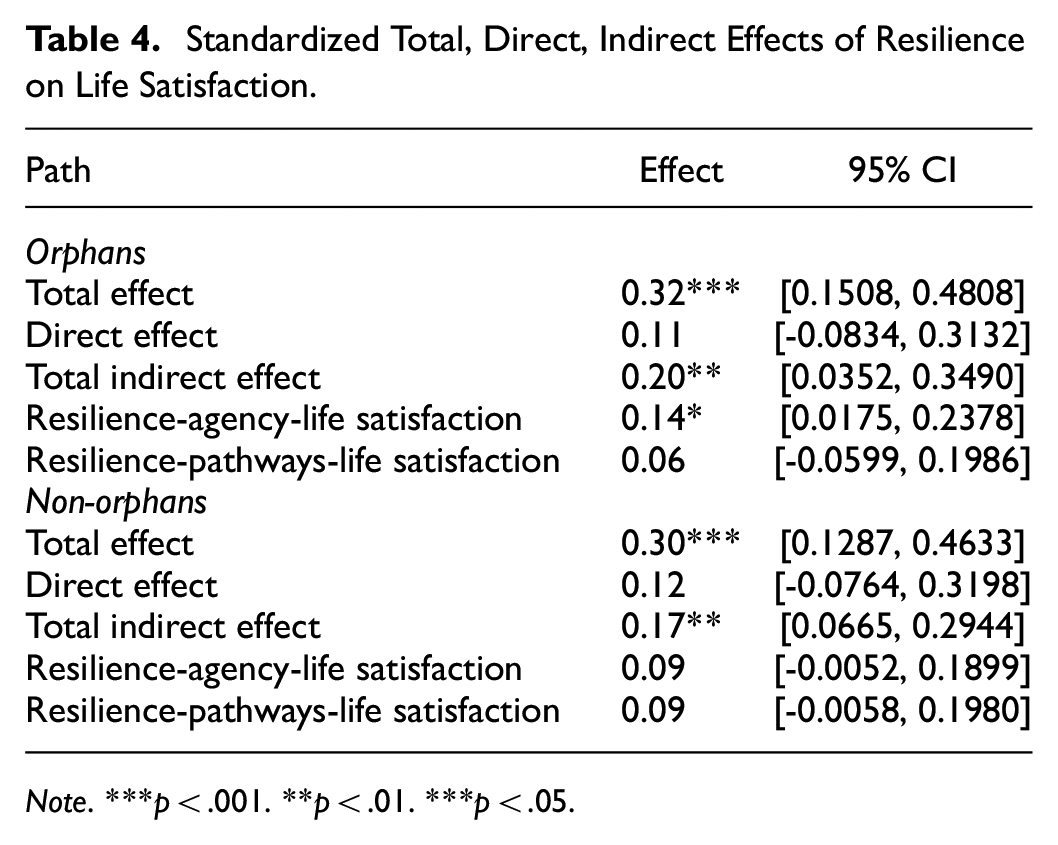
Note. ***p < .001. **p < .01. ***p < .05.
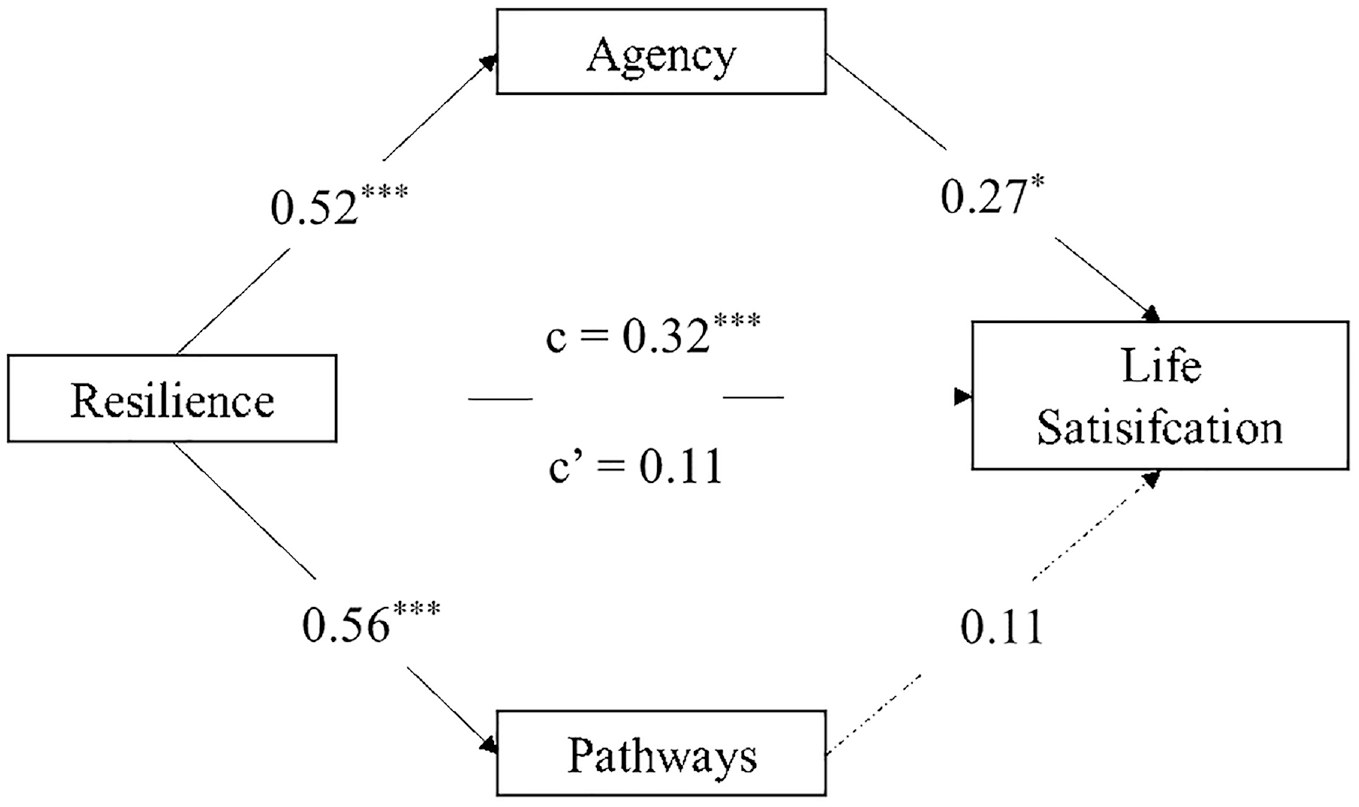
The mediation model of the orphans.

The mediation model of the non-orphans.
Discussion
This study examines the mediating role of hope in the relationship between resilience and life satisfaction. This is one of the few studies that attempts to examine the function of resilience in improving life satisfaction among orphans.
First, the results of descriptive statistics are worth mentioning. We found it surprising that life satisfaction of orphans was higher than non-orphans, which was inconsistent with previous studies (Hailegiorgis et al., 2018; Rouholamini et al., 2017). One possible reason is that orphans’ satisfaction with life may hinge on survival-related issues (Sympson, 2000), which are relatively easy to achieve. Using the theory of Pleasure and Pain (Diener, 1984), orphans are deprived of family and family-related environmental and emotional experiences, and achieve higher satisfaction upon reaching their goals. This may explain their higher life satisfaction than non-orphans.
As expected, the complete mediating role of hope was identified in the relationship between resilience and life satisfaction among Tibetan orphans. This finding is in line with the conditioning model of resilience, which holds that some individual traits can reduce or adjust the negative impact of risk factors (Garmezy et al., 1984). Factors such as self-reliance, positive belief, and other personal traits can make individuals more actively seek solutions and solve problems, maximizing adaptation and development. Nevertheless, the result of mediation is not completely consistent with previous studies (Mak et al., 2011; Satici, 2016) because it only found that agency thinking functioned as a mediator between resilience and life satisfaction.
Although, to date, researchers have examined the role of hope in the relationship of resilience and well-being among college students (Karaman et al., 2020; Mak et al., 2011; Satici, 2016), no other study has investigated the possible mediator role of two dimensions of hope, let alone among orphans. Specifically, in our study, orphans with higher resilience tended to adopt agency, and probably obtained higher life satisfaction. Adopting agency indicates the individual holds the belief in the capacity to initiate and sustain actions to achieve goals. Orphans may develop adaptive abilities in a chronically unstable life, and have their own philosophy of happiness. Furthermore, having confidence in capacity makes them feel that life is under control, thereby establishing their life orders and achieving life satisfaction.
Through pathways thinking, individuals will consider what they should do and how to realize it in response to the goal based on their own abilities and possessions. Sympson (2000) argued that individuals who experienced extreme trauma would restrict their goals to those involving survival, both psychological and physical. However, confidence in pathways thinking seems easily affected by the uncertainty of living conditions and resources of an orphan; hence, it has no actual promoting effect on achieving goal-oriented life satisfaction.
Among non-orphans in Tibet, resilient individuals were prone to be satisfied with their life, which is consistent with previous studies (Abolghasemi & Varaniyab, 2010; Karaman et al., 2020; Liu et al., 2012). In addition, individuals with higher resilience also adopted agency and pathways thinking. Unexpectedly, results showed that these two dimensions of hope cannot predict their life satisfaction. The reason could be that for non-orphans, their living environment is relatively good, and their external resources are sufficient to support them directly in achieving their goals. In contrast, due to a lack of external resources, orphans must develop sufficiently strong internal resources to compensate, allowing them to achieve a balance between risk and mental health.
Limitations
Several limitations of the present study should be acknowledged. Firstly, the data of the study was collected via self-reporting measures, which may have impacted internal validity. Future studies should collect data combining different perspectives from peers and caregivers to reduce the influence of subjectivity (Satici, 2016; Shek & Liang, 2018). Secondly, the sample size was relatively small for building the mediation model. Many ethnic minorities in China live in border areas such as mountains, forests, plateaus, and grasslands that are difficult to access and establish cooperation. Furthermore, the distribution of these ethnic groups is scattered, which leads to difficulties in collecting questionnaires. In addition, while the model fit was poor, it should be further examined in a large sample of minority orphans. Thirdly, demographic variables such as the time point and cause of parental death, time length of residence at the orphanage, and religious beliefs were not adequately investigated. Finally, the cross-sectional design of the current study fails to make cause and effect interpretations. Therefore, some sort of reciprocal relationship might be found between resilience and hope. In order to overcome this limitation, future research should use longitudinal designs to obtain more convincing conclusions about the causal direction of variables (Maxwell & Cole, 2007).
Implications
Despite the aforementioned limitations, the present study has the potential to contribute to the literature and future intervention of positive psychology (e.g., resilience intervention, hope intervention) through identifying mechanisms of obtaining life satisfaction among minority orphans. The results of this study indicate that interventions centered on resilience may yield significant improvement of life satisfaction among orphans. Therefore, when seeking to enhance the strain of mental health symptoms on orphans, we may begin with two aspects which are beneficial for fostering resilience. According to the detailed protective model of resilience suggested by Ledesma (2014), we can help orphans to clarify accessible social and internal resources, which will enable them to discover ways to cope with life events. Social resources may include support from orphanages, other relatives, and public welfare, and internal resources may include their personal traits and capabilities. Moreover, it is crucial to carry out anti-stress education for orphans to correctly understand and assess dilemmas and risks (Helmreich et al., 2017). When combined with psychological intervention, this can enable orphans to mobilize resources to deal with adversity.
Conclusion
The present study explored the mechanism between resilience and life satisfaction among the orphan from a positive psychology perspective. The results suggested that resilience is essential for life satisfaction, especially for orphans rather than non-orphans. By facilitating a kind of hopeful thinking, resilience help mitigate the negative influence from adverse life experience on well-being. In the two dimensions of hope, the agency thinking seems to be the more important factor for orphans to achieve life satisfaction. Therefore, except providing psychological assistance such as resilience improvement, solid support from all sides of society is also essentially important for improving the living condition of orphans.
Footnotes
Declaration of Conflicting Interests
The author(s) declared no potential conflicts of interest with respect to the research, authorship, and/or publication of this article.
Funding
The author(s) disclosed receipt of the following financial support for the research, authorship, and/or publication of this article: This research was funded by Tsinghua University Cultural Research Grant.
Ethical Approval
The study was approved by the Ethics Committee of Beijing Well-Being Foundation and in accordance with the ethical standards as laid down in the 1964 Declaration of Helsinki and its later amendments or comparable ethical standards.
Consent to Participate
Informed consent was obtained from all individual participants included in the study.

Data Availability Statement
Data sharing not applicable to this article as no datasets were generated or analyzed during the current study.