




Abstract
This study examines employee engagement within tourism organizations to address the critical challenge of establishing and maintaining a stable workforce in Vietnam’s tourism industry. The ongoing talent shortage, exacerbated by the COVID-19 pandemic, has intensified the difficulty of achieving long-term employee retention. To explore this issue, this study investigates the influence of perceived organizational support, job satisfaction, psychological empowerment, organizational trust, and supervisor accessibility on organizational commitment, with the goal of enhancing workplace sustainability. Using data collected from 418 participants, the study employs structural equation modeling to analyze the relationships between these variables. The findings reveal a positive correlation between perceived organizational support and organizational commitment. Furthermore, supervisor accessibility is identified as a significant moderating factor, positively affecting perceived organizational support, psychological empowerment, job satisfaction, and organizational trust. These results contribute to the understanding of factors that promote sustainable workforce development in the tourism sector.
Keywords
Introduction
Human talent is one of the most valuable resources for the success of an organization. Given the increased rivalry in many marketplaces, firms must prioritize their employees to ensure their dedication to the workplace. It is not surprising that organizational commitment is regarded as one of the most critical goals of any organization to ensure its continued stability and survival (Hanaysha, 2016). According to the Vietnam National Administration of Tourism, Vietnam’s tourism industry has been facing a labor shortage. Thus, attracting and maintaining adequate workers, whether of good quality or not, has become a growing industry concern that will continue in the aftermath of the current pandemic aberration. In particular, “The fourth wave of COVID-19 infections has had a significant effect on the labor market, with a high unemployment rate,” Pham Minh Chinh told lawmakers at the United Nations Climate Change Conference (COP26, 2021). Therefore, efforts to make employees feel supported by the organization have a positive effect on their perception (Thoresen et al., 2003).
The tourism industry currently faces a high level of turnover uncertainty. This raises questions about which factors are relevant to job satisfaction and how these factors affect employee commitment. Moreover, when employees perceive that their organization supports them, they tend to increase their trust in the firm and their affective commitment, thereby encouraging lasting trust (Eisenberger et al., 1990). Predominantly, empowerment is widely regarded as a motivational tool that enables employees to enjoy their work and affects their job duties and circumstances (Spreitzer, 1995; Thomas & Velthouse, 1990). Individuals who are empowered receive greater authority, control, and power in their roles, increasing their commitment to the firm (Zaraket et al., 2018).
This study examines the relationship between organizational commitment and psychological empowerment, job satisfaction, and trust within travel agencies in Ho Chi Minh City. Few researchers have analyzed the moderating role of supervisor accessibility (Mathieu et al., 2016). Therefore, this study investigates how job satisfaction, organizational trust, and psychological empowerment affect organizational loyalty and commitment in the context of the new ideology that emerged in the post-COVID period, characterized by global austerity, uncritical managerialism, and an unrestricted market economy. Examining these factors may lead to improved practices within tourism organizations and increase employee trust, satisfaction, and organizational commitment.
This study also explores research gaps and introduces new directions for researchers who analyze human resources in the tourism industry. The first novelty of this study is its detailed investigation into the role of supervisor accessibility, especially pertinent as the tourism industry seeks recovery from the COVID-19 pandemic. While previous studies have often focused on supervisor accessibility for employees, our research examines this aspect with close attention. The second innovation of this study is the examination of psychological empowerment in the literature on human resources within the tourism industry, a factor seldom explored in studies on human resources in Vietnam. However, this study aims to confirm that, in the current era, empowerment plays a significant role in encouraging employee loyalty to the organization.
This study investigates how psychological empowerment, job satisfaction, and organizational trust affect organizational commitment in travel agencies in Ho Chi Minh City. The focus on Vietnam’s tourism industry is important, because it is a key sector poised to drive national goals in the coming years. Additionally, Vietnam’s tourism sector has been experiencing a labor shortage, especially since the onset of COVID-19, which brought significant challenges to the industry. By adopting a multi-dimensional approach, this study also analyzes the influence of psychological empowerment, organizational trust, and job satisfaction on an employee’s commitment within the lodging sector of Vietnam.
Literature Review and Hypotheses Development
The discussion on organizational commitment theory seeks to enhance our understanding of its key components. To achieve thoroughness and precision in reviewing theories and associated research, this study carried out a bibliographic analysis of documents related to organizational commitment from the past two decades, from which we derived hypotheses for testing. By using bibliometric analysis, supported by VOSviewer (van Eck & Waltman, 2010), we collected research literature on organizational commitment from the Web of Science (WoS) database.
In assessing research trends on commitment to organizations, we used keywords such as “organizational commitment,”“employee organizational commitment,”“employee organizational,”“employee engagement,”“organizational engagement,” and “organizational loyalty.” We collected literary resources from the ISI database in February 2024, covering studies published from 1989 to 2023. This search revealed a substantial increase in scholarly interest and output, addressing previous concerns about the lack of literature on organizational commitment. Publications showed a chronological increase, particularly noteworthy in 2019, 2020, 2021, and 2022. Research fields included business consulting (Donthu et al., 2021), corporate finance (Durisin & Puzone, 2009; Linnenluecke, 2017), human resource management (Andersen, 2019), and general management (Ellegaard & Wallin, 2015; Zupic & Čater, 2015). We applied two main bibliometric methods: performance analysis and science mapping, which revealed relationships in prior research. Additionally, we constructed a network of countries engaged in organizational commitment research, where the top 15 countries contributed 21,614 out of 24,002 articles, accounting for 90% of total publications. The top five countries were the United States (7,378), China (2,354), England (1592), Canada (1,455), and Australia (1,326).
By aggregating various types of literature, such as journal articles and conference proceedings, and analyzing their relevance with VOSviewer, we visually represent a comprehensive overview of reference documents related to the perception of organizational support, commitment to organizations, and factors that influence organizational commitment.
Theoretical Review
In this research, we applied three main theories to understand and analyze the organizational dynamics that offer insights into the contextual factors that enhance employee commitment to their organization. These factors include external income, workplace environment, and coworker and personal influences. Specifically, we investigate social exchange theory (SET), psychological empowerment theory, and organizational support theory to explore the reasons why employees may maintain long-term relationships with an organization.
SET by Homans (1958) suggests that positive treatment from organizations leads to positive employee attitudes. The benefits of SET in research include the allocation of future responsibilities, which is an implicit long-term social pattern that causes subordinates to commit to their work. Therefore, SET is considered an important concept in understanding workplace behavior (Kim & Qu, 2020). The theory connects to employee empowerment, emphasizing that psychological empowerment, an important factor, leads to increased effort, job satisfaction, and reduced intentions to seek alternative employment (Muhammad & Abdullah, 2016). This theory shows that assistive relationships between organizations and workers lead to trust and commitment, as demonstrated in several previous studies (Kariuki & Kiambati, 2017; Widayanti & Sariyathi, 2016; Zaraket et al., 2018). When an organization psychologically empowers a worker, they tend to work harder and contribute more to the company, often indicating their intention not to seek a new job elsewhere, which is positive for the company. Company approval, even without financial incentives, can nevertheless increase job satisfaction (Lyu et al., 2019; Sandhya & Sulphey, 2019).
Psychological empowerment theory, a theoretically rigorous complement to SET (Spreitzer, 1995), emphasizes the importance of measuring empowerment factors to enhance operational effectiveness and job satisfaction. According to the model of human agency (Bandura, 1989), individuals who feel more positive and aware of their environment also perceive its effects more clearly (Spreitzer, 1996). This theory highlights the roles of autonomy and self-confidence in employees’ work, which lead to increased motivation, higher satisfaction, and greater commitment. It also explains that empowered employees are more likely to take initiative in decision-making and improve work performance, thereby creating a stronger connection with the organization.
Third, the theory of perceived organizational support (POS; Eisenberger et al., 1986) enhances employees’ trust in their organization and increases their willingness to remain employed there. Scholars who advocate for this theory also note that POS significantly boosts responsiveness to organizational goals and strengthens long-term commitment (Gouldner, 1960). Higher levels of POS are associated with supervisor accessibility, where employees view supervisors as direct representatives of the organization (Levinson, 1965). POS theory is important in analyzing research hypotheses by examining how various factors can affect employees’ commitment to their organization. Both the SET and POS theories serve as precursors to explaining beneficial outcomes for individuals and organizations. For analytical convenience, we categorize these theories into three areas: (1) employee wellbeing, (2) orientation to the job route, and (3) positive behaviors (Eisenberger & Stinglhamber, 2011; Kurtessis et al., 2017; Rhoades & Eisenberger, 2002).
POS and Its Relations to Organizational Trust, Psychological Empowerment, and Job Satisfaction
POS theorists examine individuals’ general perceptions of how much their organization values employee welfare and appreciates their efforts (Eisenberger et al., 1986). POS plays a crucial role in the employee-employer relationship, with effects on enhancing employee wellbeing and alignment with organizational goals (Kurtessis et al., 2017). Furthermore, Sabir et al. (2022), Sheikh (2023), and Setyoko and Kurniasih (2022) find that employees perceive POS as recognition of the organization’s care and contributions to their wellbeing, especially when they face challenges in life and work. POS helps them calmly develop effective solutions to these issues.
Trust, psychological empowerment, and job satisfaction are interconnected in the workplace (Gounaris, 2005). Trust is essential for both internal and inter-organizational relationships. According to POS theory, employees perceive the extent to which the organization values their contributions and cares about their wellbeing (Eisenberger et al., 1986). In exchange for financial benefits and to fulfill socio-emotional needs, such as approval and esteem, workers dedicate effort and commitment to the organization. Trust among the parties involved usually leads to lasting mutual commitments. Research shows a strong positive relationship between organizational support and empowerment (Chow et al., 2006). Employees’ trust in the organization includes confidence in the integrity, fairness, and reliability of individuals and acceptance of the actions and intentions of the other party, which leads to high levels of cooperation efficacy, especially in large organizations. Thus, POS is a critical factor that directly predicts employees’ trust in the organization (Karimi et al., 2023; Khairunnisa, 2023).
Few studies have investigated the relationship between POS and psychological empowerment. From the perspective of SET, research shows that psychological empowerment affects employee behavior by helping them maintain high-quality relationships. POS acts as an intrinsic motivator that drives employee empowerment, offering a fresh perspective, positively affecting wellbeing, and increasing employee satisfaction (Audenaert et al., 2017). Employees who view their work environment as supportive are more likely to experience psychological empowerment (Ertürk, 2010). Psychological empowerment refers to the conditions that allow individuals or groups to feel a sense of control over their tasks (Hechanova et al., 2006). It is argued that when individuals feel empowered, they recognize the importance of their roles and their ability to make independent decisions (Maan et al., 2020). An experiment shows a close relationship between POS and psychological empowerment, suggesting that when individuals perceive empowerment in their work environment and feel they can make decisions within their scope, it enhances job performance and increases job satisfaction, positively affecting the organization (Chiang & Hsieh, 2012). Another study indicates that providing psychological empowerment to employees is essential for an organization’s competitiveness in the market (Olçer & Florescu, 2015), promoting employee motivation and dedication to their work.
POS and job satisfaction are essential for improving employee performance and organizational commitment. Job satisfaction arises from the belief that a job meets both material and psychological needs. Optimal job satisfaction involves various factors that contribute to employee contentment (Aban et al., 2019). Perceiving organizational support addresses employees’ emotional needs and fosters a sense of responsibility within them (Sun, 2019). Moreover, when employees feel that the organization values their contributions and prioritizes their wellbeing, it increases job satisfaction. Previous studies have found that POS is a predictive factor for enhancing job satisfaction (Choi, 2019; Maan et al., 2020; Mascarenhas et al., 2022). A longitudinal study by Armstrong-Stassen (1998) showed that employees with higher levels of POS report greater job satisfaction compared to those with lower POS. POS acts as a social exchange process, nurturing employees’ sense of responsibility toward achieving organizational goals. This positive connection strengthens the relationships between employees and the organization, as outlined in Social Exchange Theory (Biswas & Bhatnagar, 2013), leading employees to reciprocate support in various ways and enhancing their job satisfaction.
Perceiving organizational support leads to psychological empowerment, encouraging trust and job satisfaction. Recognizing these connections is vital for a positive and productive work environment. Thus, the hypotheses to be tested focus on these relationships:
Psychological Empowerment and Its Relations to Organizational Trust and Job Satisfaction
Thomas and Velthouse (1990) define the concept of psychological empowerment, breaking it down into four effective perceptions: meaning (the importance of the work), competence (self-efficacy), autonomy in initiating and organizing procedures, and the ability to influence regulatory outcomes. Spreitzer (1995) further explains that psychological empowerment relates to how employees perceive their role and their capacity to shape their work environment.
This research highlights empowerment as a crucial element in maintaining organizational trust and employee satisfaction within tourism companies. Previous studies, such as those by Nyhan (2000) and Hassan et al. (2012), have examined the relationship between psychological empowerment and organizational trust. H. K. Laschinger et al. (2000) conducted a study that shows employees with high levels of trust experience increased empowerment. Emphasizing the role of trust in an organization is important for any company or organization aiming to enhance, maintain, or stabilize human resources (Cook & Wall, 1980). In general, organizations can gain employees’ trust when the company creates a work environment that recognizes and rewards workers through an open organizational empowerment process (Andrews, 1994).
Job satisfaction is an expression of employee psychology and affects work performance (Li et al., 2019; Shafique et al., 2018). When employees are empowered, especially in significant tasks, it directly influences their job satisfaction, leading to increased motivation and responsibility (Hackman & Oldham, 1980). This empowerment makes employees more inclined to commit to the organization and strive to demonstrate their performance and contributions in their work to achieve recognition (Tarigan, 2015). Sadati (2012) found that empowering employees psychologically has a significant effect on their job satisfaction. Based on this evidence, the study hypothesizes a positive correlation between empowerment, trust, and satisfaction:
Organizational Trust and Its Relations to Organizational Commitment
Based on the bibliometric analysis shown in Figure 1, organizational commitment (OC) is identified as an important variable in the field. Researchers have examined OC at various levels, including as moderator, predictor, and mediating variables. Additionally, OC has been explored both as a multidimensional concept and in terms of overall OC, demonstrating the variable’s flexibility. Consistent with previous assumptions, the analysis of research topics on OC during this phase reveals notable clusters of 321 studies related to organizational culture, health, work styles, creative work environments, and employee organization fit. In this study, the authors identify specific factors that affect OC, namely organizational trust, psychological empowerment, and job satisfaction, in the context of tourism companies in Vietnam.

OC research map.
In McAllister’s (1995) definition, organizational trust is described as the confidence a person has in, and their willingness to act based on, the manners, words, attitude, decisions, and actions of others. Guinot et al. (2013) further define it as the trust between supervisors and subordinates, as well as trust in the organization as a whole. This type of trust is crucial, as companies lacking it often struggle to achieve their objectives. Moreover, previous research shows that organizational trust reflects a mental state that reveals how employees perceive challenges when the organization faces risks.
According to Mowday et al. (1979), commitment is defined as a bond or allegiance, characterized by the psychological strength of an individual who fully dedicates themselves to an organization. This commitment includes three components: dedication to the organization’s principles and aims, affiliation with and to the organization, and a drive to work for the organization’s benefit. Based on social exchange theory, which has been used to explain the positive correlation between organizational trust and OC, a high level of organizational trust leads to a high level of employee OC (Colquitt et al., 2014).
Social exchange theory suggests that relationships enhance people’s trust and commitment levels. It indicates that individuals at managerial levels with high degrees of trust in their employees are more likely to invest in them, thereby increasing their sense of obligation and trust (Hayunintyas et al., 2018). Researchers have highlighted organizational trust as a critical factor in maintaining and increasing commitment to an organization (Liu et al., 2013; Yilmaz, 2008). Previous synthesized literature demonstrates a positive relationship between organizational trust and commitment to the organization. However, this study investigates all three aspects of OC: normative, affective, and continuance commitment. Further, we analyze these factors as objectively as possible, because our view is that previous research has not yet thoroughly examined the different facets of commitment to an organization. Moreover, trust evolves from a mutual understanding based on shared values and is essential for employee loyalty and commitment. Overall, the literature shows a positive relationship between the two variables. Therefore, we propose the following hypotheses:
Psychological Empowerment and Its Relations to OC
The concept of empowerment originated in organizational behavioral studies, as introduced by Douglas McGregor in 1960. McGregor proposed “Theory Y,” which suggests that employee behaviors such as productivity, motivation, and active participation yield greater benefits when characterized by flexibility and autonomy (Zaraket et al., 2018). Numerous studies have examined the correlation between psychological empowerment and OC. Empowered employees perceive themselves as having a greater ability to influence their work and their organization’s outcomes. Those who experience a heightened sense of empowerment are more inclined to exhibit dedication to their organizations by focusing more on their tasks (Eisenberger et al., 1990). H. K. S. Laschinger et al. (2002) showed that creating an environment that promotes the practice of empowerment within the workplace can positively affect employees’ commitment levels. Additionally, Rawat’s (2011) study on the effect of psychological empowerment on employee commitment in the industrial services sector in Singapore also confirmed that empowering employees in the workplace can affect three levels of employee commitment within the organization. However, there is still a scarcity of experimental studies that investigate the relationship between empowerment and various aspects of OC. Based on a literature review and the operational mechanism of SET, we discuss the following hypotheses:
Job Satisfaction and Its Relation to OC
Job satisfaction is a multidimensional concept that various academics have defined differently. Some describe it as “a pleasurable or positive emotional state resulting from the appraisal of one’s job or job experiences.”Aziri (2011) states that job satisfaction is a feeling that arises from the recognition that a job meets both material and psychological needs. Additionally, Anggreyani and Satrya (2020) explain that job satisfaction includes both the happiness and the sensation associated with a job.
For some, the relationship between job satisfaction and OC shows how job satisfaction positively affects OC (McIntyre et al., 2002). Employees who are satisfied with their work tend to have favorable perceptions of their organization, exhibit strong emotional connections and loyalty to the company, and demonstrate improved performance (Scanlan & Hazelton, 2019; Scanlan & Still, 2019). A previous study established a positive connection between job satisfaction and OC based on the outcomes of various linear regression analyses. Additionally, job satisfaction plays a role in influencing employee attachment within the organization. Arguments suggest that when employees are satisfied with their current jobs, they are more likely to demonstrate higher loyalty to their organization (Putra & Herawati, 2017). Therefore, when organizations focus on creating a positive work environment, prioritize employee welfare schemes, career advancement paths, and acknowledge their positive contributions, they are more likely to increase commitment to the organization’s success (Rosalia et al., 2020; Saputra & Mahaputra, 2022).
In the overview of the hypotheses (and, specifically, hypothesis 8), we use a bibliometric approach to examine the global interest in the relationship between OC and employee compliance. The data presented in Figure 2 indicate that the United States shows the most significant interest in OC, with 7,378 instances, followed by China with 2,354, the United Kingdom with 1592, Canada with 1,455, and Australia with 1,326. These results provide the author with a more objective perspective on the relationships considered in the research model and highlight aspects of OC that remain unexplored in Vietnam. The literature consistently shows a positive relationship between these two variables. Therefore, we propose the following hypotheses.

OC studies by country.
The Moderating Role of Supervisor Accessibility
Supervisor accessibility acts as a moderator in the relationships between key organizational factors (POS, psychological empowerment, job satisfaction, and organizational trust) and OC. Baron and Kenny (1986) define a moderator variable as one that affects the strength or direction of the relationship between independent and dependent variables. In this study, supervisor accessibility moderates these relationships by either enhancing or reducing the effects of the predictors on OC.
Supervisor accessibility refers to the potential for communication, rather than actual communication events. This concept is significant, even when interactions between a supervisor and a subordinate are rare (Follert, 1984). When leaders adhere to an organizational culture that values supervisor accessibility, they become more approachable (Dallinger, 1987). This perceived accessibility, even in an environment that promotes open communication, facilitates the implementation of Authentic Leadership in individual relationships. Being an accessible supervisor positively affects followers’ job satisfaction and engagement, while also reducing their intention to leave, thus making it an important element in the perception of authentic leadership (Gallant, 2019).
This study examines the broader perspectives of employee trust, psychological empowerment, and job satisfaction throughout the organization. Both employees and supervisors significantly share and have a stake in the outcomes of the organization. This shared reference to the organization is particularly significant for employees. As a result, when supervisors’ attitudes toward the company improve, these positive changes are likely attributed to an increase in the supervisors’ trust and confidence in the organization (T. W. Ng & Feldman, 2013). Supervisor accessibility is crucial in enhancing employees’ trust in their organization as a social structure. Therefore, the fundamental assumption is that when employees experience accessibility from their supervisors, they will feel more confident in the company and continue to align themselves with the organization (Cropanzano & Mitchell, 2005). Supervisors play an important role in communicating and guiding the company’s directions to employees. Kyei-Frimpong et al. (2022) show that leadership behavior is demonstrated through the accessibility of supervisors, which enhances the trust of both parties. Jose and Mampilly (2015) confirm that supervisor accessibility play a moderating role in the research literature. According to SET (Blau, 1964), supervisor accessibility is linked to trustworthiness, leading employees to respond with optimism. Therefore, timely, honest, and transparent accessibility are key factors that strengthen the relationship between supervisors and their employees (Enwereuzor et al., 2020). Trust in supervisors leads employees to build trust in the organization, and in response to this social exchange, they exhibit positive behaviors, which manifest as commitment (Bedi et al., 2016).
Supervisor input is identified as a source of psychological empowerment (Thomas & Velthouse, 1990), and Spreitzer et al. (2010) emphasize the importance of a supportive and trusting relationship with leaders in enhancing psychological empowerment. This empowerment, in turn, correlates with increased dedication to tasks and the organization (Bordin et al., 2006). Galletta et al. (2011) confirm that the evaluation of supervisor accessibility significantly affects job satisfaction. Supervisor accessibility is one of the factors that support employee empowerment. Kyei-Frimpong et al. (2022) assert that leadership behavior, reflected through supervisor accessibility, helps employees gain confidence in their work, thereby enhancing their commitment to the organization. This finding aligns with the study by Mihardjo et al. (2020), which investigated this effect in Malaysian hotels, showing employees’ positive attitudes when they receive support from their supervisors.
Supervisor accessibility directly correlates with satisfaction regarding one’s immediate supervisor, because supervisors who are more accessible tend to elicit greater employee satisfaction (Follert, 1984). Psychological empowerment relates to individuals’ perceived competence and capability within an empowered work environment. Individuals who have a stronger belief in their ability to perform their work proficiently are more likely to experience satisfaction in their tasks, show greater emotional commitment to the organization, have fewer intentions to leave, and exhibit improved job performance compared with those with lower levels of psychological empowerment (Meyerson & Kline, 2008).
Accessibility, considered a key element in the organizational atmosphere, also plays a crucial role in influencing communication satisfaction. Empirical studies show that the assessment of supervisor accessibility significantly affects job satisfaction (Galletta et al., 2011; Griffin et al., 2001; T. W. H. Ng & Sorensen, 2008). Examining the benefits of open communication between leaders and their staff, supervisor accessibility has been positively associated with employee engagement. By promoting transparency and self-awareness, supervisor accessibility decreases employees’ intention to leave by creating a culture of active work engagement (Azanza et al., 2015).
The research model explicitly addresses the moderating role of supervisor accessibility on the variables discussed. This role is examined not only in traditional in-person work environments, but also in the increasingly common remote and hybrid work settings that have emerged following the COVID-19 pandemic (Gan et al., 2023). Supervisor accessibility is important for maintaining effective communication, building trust, and reducing challenges, such as feelings of isolation and susceptibility to stress in the post-pandemic workplace (Nappo, 2020). By showing a willingness to listen and providing timely support, supervisors can enhance employees’ adaptability and overall wellbeing. Consequently, we examine the following hypotheses:
The detailed constructs of the study are presented in Figure 3 below.

Research framework.
Methodology
Procedure
The data were collected from February 22 to April 12, 2023, when the World Health Organization had COVID-19 under control. Initially, we gathered relevant literature on tourism prediction using Internet-generated data. This literature was selected from major databases, including Science Direct and Google Scholar, based on a review of tourism research. The purpose was to provide an overview of the research issue and the current context of global and Vietnam’s tourism.
The study used a quantitative research methodology, conducting a survey with a questionnaire divided into two stages. In the first stage, the author created the questionnaire based on previous reputable references, ensuring the questions were understandable and tested them before full distribution. Consequently, the research team pre-tested the questionnaire with 50 participants from tourism companies. The purpose of this pre-test was to validate the Vietnamese translation, assess the time required, and verify the accuracy and validity of the questions. The pre-test results showed that all Cronbach’s alpha values exceeded .8, confirming sufficient reliability. After the pre-test, the next step involved confirming the appropriate sample size.
In the second stage, the survey was officially distributed through two channels. First, we distributed the online questionnaire via social media platforms, such as Facebook and LinkedIn, and collected data, receiving 29 valid responses. Simultaneously, we conducted a direct survey through personal relationships, distributing a total of 600 questionnaires and receiving 448 responses. The analysis showed that the sample size (n = 418) was appropriate, because it exceeded the criteria set by Cochran. The data, meeting the conditions, were then analyzed using SPSS and Smart-PLS.
Measurement Instrument
We established a seven-point Likert scale in the data collection questionnaire, based on preliminary studies, with 1 and 7 representing “strongly disagree” and “strongly agree,” respectively. The measurement of POS includes six items based on the studies by Shanock and Eisenberger (2006) and Chen and Eyoun (2021). Organizational trust was measured by five items using a scale from Lee et al. (2013) and Kang et al. (2021). The factor of psychological empowerment, composed of five items, was derived from Men (2010) and AlKahtani et al. (2021). A four-item job satisfaction scale, measuring how satisfied employees are with their work, is based on Lee et al. (2013) and Kang et al. (2021). OC uses a nine-item scale to measure whether employees intend to leave and their commitment to the organization. The scale is derived from Lee et al. (2013) and Murray and Holmes (2021). Supervisor accessibility was measured with four items modified from Atuahene-Gima and Li (2002) and Mihalache and Mihalache (2022).
Data Analysis and Results
Descriptive Statistics
SPSS version 28 was used to check the data quality and perform descriptive statistics. SmartPLS 4 was used to perform a confirmatory factor analysis and to test the hypotheses. Table 1 shows the demographic characteristics of the respondents. The results indicate that out of 418 responses, 202 were from males and 216 were from females, representing 48.3% and 51.7%, respectively. Among the respondents, the group aged under 25 was the largest, with 193 individuals, accounting for 46.2%. Regarding the highest educational level, the survey results show that university attendees were the most numerous, with 299 people making up 71.5%. Additionally, most respondents were single, comprising 67.9% or 284 individuals. The income group earning under VND 10 million (approximately USD 400) was the largest, with 49.5% or 207 responses, while the group earning over VND 40 million was the smallest, with 1.7% or 7 responses. Sales professionals constituted the largest career group, with 54.3% or 227 responses. The group with less than 1 year of career experience was the largest when asked about their career period in this study, with 40.0% or 167 responses.
Profile of Respondents.

Measurement Model
Table 2 shows the coefficient of determination (R2) for six variables: .756 for organizational trust, .796 for psychological empowerment, .857 for job satisfaction, .790 for affective commitment, .879 for normative commitment, and .811 for continuance commitment. Schroer and Hertel (2009) consider these R2 coefficients to be moderate. The average variance extracted (AVE), which ranged from 0.636 to 0.879, proved convergent validity. Additionally, the robustness of the variance shared by the corresponding indicators was demonstrated by the construct reliability (CR) coefficients, which ranged from 0.912 to 0.960.
Construct Reliability and Validity.

The Test of Common Method Variance
According to Henseler et al. (2009), the degree to which one concept of a certain latent variable is distinguishable from the concepts of other latent variables is measured by its discriminant value. This value is confirmed when the square root of a concept’s AVE exceeds the correlation coefficients squared with other concepts, adhering to the criterion set by Fornell and Larcker (1981). In the model, each factor’s discriminant value is evident as the square root of its AVE is greater than the correlation coefficients with other factors in the same column and row, as shown in Table 3. Consequently, each factor demonstrates discriminant value.
Evaluation of the Measurement Model.

Note. CR = composite reliability; AVE = average variance extracted; N/A = not available.
The comparison of all correlation coefficients with AVE square roots in Table 4 provides conclusive evidence of discriminant validity. To verify this validity, Henseler et al. (2015) introduced a new method called the heterotrait-monotrait (HTMT) ratio. The HTMT technique has shown that it can calculate the parameters of the structural model accurately and reliably, while overcoming bias. According to the Table 5, an HTMT value of less than 0.90 confirms the discriminant validity between two reflective variables (Henseler et al., 2015).
Distinguishing Fornell–Larcker Factors.

Note. Square roots of AVE (bold diagonal). AC: Affective Commitment; CC: Continuance Commitment; JS: Job Satisfaction; NC: Normative Commitment; OT: Organizational Trust; PE: Psychological Empowerment; POS: Perceived Organizational Support; SA: Supervisor Accessibility.
Distinguishing Heterotrait-Monotrait Factors.

AC: Affective Commitment; CC: Continuance Commitment; JS: Job Satisfaction; NC: Normative Commitment; OT: Organizational Trust; PE: Psychological Empowerment; POS: Perceived Organizational Support; SA: Supervisor Accessibility.
Common Method Bias
Following Podsakoff et al. (2003), we employed both procedural and statistical remedies to minimize common method bias (CMB). For procedural remedies, we ensured that respondents fully understood the questionnaire by pretesting all items with five tourism researchers and five travel agency employees, which allowed us to identify any wording issues that might have affected the respondents. We then conducted a pilot test. For statistical remedies, we used Kock’s (2015) technique, and the results showed that all direct relationships had variance inflation factor (VIF) values less than 3.33, indicating that CMB was not a major concern.
Hypotheses Tests Using SEM Model
Based on the results obtained from the PLS-SEM analysis, the relationships among constructs in the research model are summarized in Table 6. POS positively and significantly affects organizational trust (β = .059, t-value = 0.059, p = .000). The data indicate that staff members feel supported and cared for by their organization, which, in turn, gives them long-term trust in their company.
Results of Evaluation of the Measurement Model.
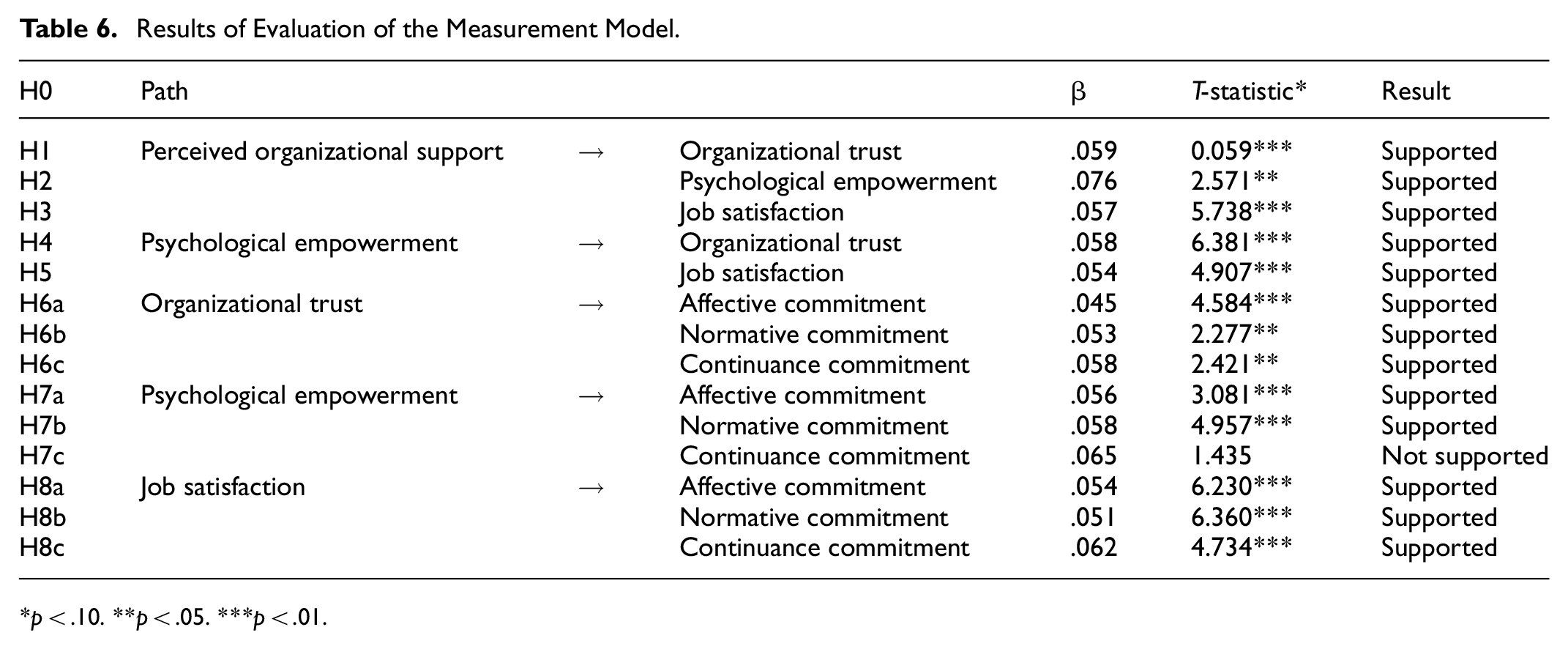
p < .10. **p < .05. ***p < .01.
Employees’ feelings of self-efficacy, effect, and self-determination increase with POS. Staff members who perceive organizational support are more confident that they possess the necessary tools, expertise, authority, and resources to perform their jobs effectively. Afzali et al. (2014) also found this outcome. Their study shows that psychological empowerment is positively and significantly affected by perceived organizational support (β = .057, t-value = 2.571, p = .010).
Furthermore, when employees recognize that their organization evaluates their involvement in achieving organizational goals and is aware of their wellbeing, they tend to feel more satisfied with their job. In travel agencies, POS is regarded as a significant factor in enhancing job satisfaction among employees.
Another finding shows that psychological empowerment positively and significantly affects organizational trust (β = .058, t-value = 6.381, p = .000). Other research supports these relationships, indicating that empowered employees affect trust within the organization (Joseph & Winston, 2005; H. K. Laschinger et al., 2000). Empowered employees feel that the business trusts them.
When examining the dimensions of psychological empowerment and job satisfaction, the results, as anticipated, showed that psychological empowerment positively relates to job satisfaction (β = .059, t-value = 5.738, p = .000).
To examine the relationship between organizational trust and the three levels of OC, we analyzed the path coefficients. The first path coefficient (β = .045, t-value = 4.584, p = .000) was statistically significant, supporting hypothesis H6a, which proposes that organizational trust is positively related to affective commitment. The second path coefficient was also significant (β = .053, t-value = 2.277, p = .023), thus supporting hypothesis H6b, which suggests a positive relationship between organizational trust and normative commitment. Finally, the third path coefficient (β = .058, t-value = 2.421, p = .016) was significant, confirming hypothesis H6c, which proposes a positive relationship between organizational trust and continuance commitment.
In this research, we investigate the relationship between organizational trust and three levels of commitment. Specifically, the path coefficients were affective commitment (β = .397, t-value = 9.408, p < .001), normative commitment (β = .383, t-value = 0.253, p < .001), and continuance commitment (β = .322, t-value = 5.784, p < .001).
This study examines the dimensions of psychological empowerment and three levels of OC. However, contrary to expectations, the findings show that psychological empowerment is positively related only to affective and normative commitment (β = .054, t-value = 3.081, p = .002; β = .058, t-value = 4.957, p = .000) for normative commitment. These results suggest that employees remain with their travel agencies primarily owing to their emotional attachment or adherence to company rules.
Contrary to our theoretical predictions, the path coefficient from psychological empowerment to continuance commitment (β = .14, t-value = 1.86, p > .1) was not statistically significant, indicating that H7c is not supported. Therefore, the results are consistent with previous results.
When testing job satisfaction and three levels of OC, as expected, the results show that job satisfaction positively relates to affective commitment, normative commitment, and continuance commitment. The path coefficients are as follows: (β = .054, t-value = 0.230, p = .000), (β = .051, t-value = 6.360, p = .000), and (β = .062, t-value = 4.734, p = .000), respectively.
The study hypothesized that supervisor accessibility moderates the relationship between POS and organizational trust. However, the results are not statistically significant (β = .069, t-value = 0.606, p = .545). Therefore, the data do not support the proposed relationship in Hypothesis 9, and it is rejected. The findings show that the supervisor’s support does not depend on the employees’ trust in travel agencies, even though the employees perceive the company’s support.
In evaluating the structural model presented in Table 7, the study hypothesized that supervisor accessibility positively moderates the association between POS and psychological empowerment. The results indicate that the interaction between supervisor accessibility and psychological empowerment is positive and statistically significant (β = .037, t-value = 4.322, p = .000). Our findings suggest that psychological empowerment within organizations relies on social support, regardless of whether it is provided by supervisors. According to social exchange theory, all workplace relationships, including those with managers, have the potential to be important (Spreitzer, 1996).
Moderation Tests Using PLS.

The positive correlation between psychological empowerment and POS is moderated by supervisor accessibility. We investigated the moderating effect of supervisor accessibility on the relationship between POS and job satisfaction. The results indicate that supervisor accessibility moderately affects the relationship between POS and job satisfaction, with a beta coefficient of 0.047, a t-value of 2.806, and a significance level of .005. These findings align with previous research, which suggests that social support can effectively help workers manage stress in the workplace (Halbesleben & Buckley, 2004; Sochos et al., 2012). Consequently, the outcomes are consistent with the hypotheses proposed in H11.
Discussion and Implications
This study examines various factors that have affected OC following the COVID-19 pandemic. POS positively affects organizational trust, psychological empowerment, and job satisfaction, which, in turn, positively affect OC. Additionally, the data show the moderating role of supervisor accessibility in the relationship between POS and OC. To address this, it is suggested that organizations adopt human resource practices and policies that focus on rewards and recognition, and create an environment that supports career advancement.
The findings of this study have various practical implications. Considering POS, the study suggests that organizations should ensure the availability and frequent use of resources and policies that promote personal care to support their employees. It highlights three boxes of solutions: reward solutions that prioritize benefits, such as salary, allowances, and bonuses; compensation; and working environment. These factors are crucial to ensuring employees’ quality of life. The study also examines the effects of the COVID-19-induced lockdown on employees’ intentions to leave the tourism industry, finding that the employees felt their workload was high and their pay was low. To create a positive environment and increase employee motivation, organizations should develop flexible working hours, a trend that has emerged post-COVID-19. From an employee’s perspective, providing development policies and resources can help sharpen their career skills. The human resources department is responsible for creating these policies as they work cross-functionally and enact policies for all employees while addressing related issues. Along with the human resources team’s responsibilities, they work on-site with management and all departments within the company, giving them a deep understanding of employees’ needs. HR must build a conducive working environment that includes smart work, flexible hours, and inspiring conditions. In addition to compensation factors, HR must ensure employees receive a fair salary, variable bonuses, and allowances. Employee benefits should be considered an indispensable policy. This study specifically suggests conducting Goal and Performance Dialogue (GPD) and Career Development Discussion (CDD). Moreover, when employees feel the need to enhance their team’s performance, leadership feedback and talent programs should be implemented. For GPD and CDD, the main roles belong to the Human Resource Business Partner (HRBP) and management, including the leader of each department or function. The HRBP is responsible for building the program and guiding leaders on effective performance.
Building an inclusive culture is an effective method to increase employees’ trust in their organization, because it demonstrates the value placed on the competencies and potential of each employee. By focusing on initiatives that promote equal pay, accessibility, and flexibility, a business can show that it is a safe and welcoming place for all employees.
Many leaders today empower their workforce by delegating authority and decision-making, sharing information, and soliciting feedback. This study proposes that eight “empowerment practices” affect employees: strategic clarity, a clear mission, the transfer of some resources, inspirational leaders, personal ownership, decision processes, creativity and entrepreneurship, and soliciting employee input. When employees feel empowered and believe that their supervisors transfer resources to them, they tend to be more motivated, adopt a positive attitude toward work, and commit to their organizations. An open discussion, such as soliciting employee input, helps employees feel valued. Actively seeking and responding to employee input can boost morale and improve quality, productivity, customer service, and safety. Leaders should seize every opportunity to encourage employee input.
This study highlights that work-life balance plays an important role in enhancing employee satisfaction. By supporting employees with encouragement and satisfaction, organizations can positively affect their work-life balance. Although compensation is significant in contributing to employee happiness, many individuals prioritize work-life balance even more. If a company frequently requires overtime or enforces strict policies against remote work, employee happiness and retention are likely to suffer. Thus, it is essential that work-life issues are aligned with job requirements.
Theoretically, this research shows that coaching involves unlocking individuals’ potential to maximize their performance, which, in turn, contributes to the OC. To enhance the OC, management should invest in coaching and training for their executives. Gardner & Ibarra (2017) suggests that managers use the 2 × 2 matrix to consider the nature of coaching and how to improve it within a learning business context. This includes directive coaching, where a manager with years of experience voluntarily shares knowledge with a rookie team member, who listens attentively to learn as much as possible. Employees then take time to observe what the manager has shared, a method known as laissez-faire coaching. Instead of merely instructing, managers should elicit knowledge, insight, and creativity from the individuals they coach, teaching them to solve problems and handle challenging situations independently, a style referred to as nondirective coaching. Ultimately, situational coaching requires a fine balance between directive and nondirective approaches, depending on the specific needs at the time.
This study shows various factors that have affected OC following the COVID-19 pandemic. POS positively affects organizational trust, psychological empowerment, and job satisfaction. These mediating variables, in turn, have a positive effect on OC. It is important for travel agencies and tourism department owners and managers to recognize and improve these aspects to retain employees.
Limitation and Future Research
This research has three limitations. First, although we obtained 418 valid samples, we collected only 60 samples from tour guides, a position greatly affected by the COVID-19 pandemic. Second, the study focuses solely on personnel working in travel agencies and does not compare these findings with other sectors in the tourism industry, such as restaurants and hotels. Third, this study relies exclusively on quantitative research to examine the relationship between POS and OC, meaning the solutions we offer to travel agencies are based on evidence from quantitative data.
We suggest that to accurately determine the causes of employees’ strong or weak commitment to their companies, future studies should include qualitative methods, such as in-depth interviews. Additionally, further research could explore the commitment of workers in sectors such as hospitality. Such studies could provide a comprehensive perspective and solutions for those in the tourism industry. This research is not only relevant in the context of COVID-19, but also addresses the ongoing and significant issue of employee commitment, which companies must manage to retain talent in today’s environment. Moreover, the findings from this research could be applicable in various other sectors, including human resources management, leadership models, and general business management. Future researchers might also apply this study across many organizational and cultural contexts.
Footnotes

Funding
The author(s) received no financial support for the research, authorship, and/or publication of this article.
Declaration of Conflicting Interests
The author(s) declared no potential conflicts of interest with respect to the research, authorship, and/or publication of this article.
Data Availability Statement
Data sharing not applicable to this article as no datasets were generated or analyzed during the current study.