




Abstract
The main aim of the study was to empirically investigate the mediating role of organizational commitment (OC) and person–organization fit (POF) between the causal relationship of supportive work environment (SWE) and employee retention (ER). One thousand questionnaires were sent to the targeted population included employees of all chains of multinational fast-food brands (restaurants) in Lahore, Pakistan. The restaurants were selected from clusters by using a cluster sampling technique. Questionnaires were comprised of multiple items adopted from former studies to obtain responses using quantitative methodology. For statistical analysis and to test the proposed hypothesis, the partial least squares (PLS) structural equation modeling (SEM) technique was employed through Smart PLS 2.0 M3 software. The study’s findings elucidated that SWE has a positive and significant association with ER. In addition, OC and POF acted as mediators between the relationship of a SWE and ER. This study presented implications for human resource (HR) practitioners that they should endure developing mechanisms for imparting a SWE to foster healthy exchange relationships with people, which in turn will result in ER. This article significantly contributed to the extant literature on the relationship of the SWE and ER while highlighting the critical factors to be noticed for retaining key employees. This study also explicated the limitations and scope for further research.
Keywords
Introduction
In today’s knowledge-intensive and highly competitive era, retention of organizational people is becoming the major global challenge confronted by the organizations (Aguenza & Som, 2018). Human resource management (HRM) has been evolved as an integral factor that is crucial for obtaining a competitive edge (Kaushik et al., 2013). Employees’ turnover harms organization performance due to the exemption of a talented workforce from the employing organization (Guchait & Cho, 2010). With the emergence of strategic HRM, retention of the best people is considered as a critical role of HRM (Bhatnagar, 2007). Past research delineates various retention practices such as job empowerment, job enrichment, monetary and non-monetary rewards, training and development prospects, job climate, and work–life balance (Aguenza & Som, 2018; Ghosh et al., 2013).
The hospitality sector is progressing massively during recent years. According to the “Fast Food Industry Analysis—Cost & Trends” (2018), over the globe, this sector gives around US$570 billion in revenue. The fast-food sector is the second largest sector in Pakistan, accounting for 27% for its worthy production. Pakistan occupies the world’s eighth largest market concerning fast food and food-related business. The hospitality sector generates 16% of the total employment in the manufacturing sector, with a forecasted 180-million consumers (Noor, 2016). The estimated employment figure indicates the number of employees required to retain in the growing industry. Given the assertion on the importance of retaining talent in the Pakistan food sector, this article attempts to find strategies for employee retention (ER).
According to Guchait and Cho (2010), more than 80% of employees would like to work in a healthy and supportive environment. Thereby, it is becoming important to provide a supportive work environment (SWE) to retain talented personnel (Ghosh & Sahney, 2011). A SWE is a significant antecedent of ER (Richman et al., 2008). Many scholars have cited the necessity to sustain the learning culture and a better working climate for promoting the best professionals (Boswell et al., 2017). The existence of SWE is mandatory for employers to maintain desirable development and profits (Luthans et al., 2008).
In the context of employee turnover, what are the predecessor of organizational commitment (OC) and perceived organizational support (POS) has been a fundamental query in the domain of behavioral science. Scholars are intriguing to examine the interplay of OC invariant change contingencies (Y. Chang et al., 2015; Herscovitch & Meyer, 2002). OC is a job attitude that is closely related to employee participation, retention, and employee performance (Metin & Asli, 2018; Sharma & Dhar, 2016). Person–organization fit (POF) is another foremost component that leads toward decreasing intention to turnover. Individuals perceiving high POF are more likely to satisfied with the job and, consequently, do not intend to leave and reverse the relationships which are held valid (Kristof-Brown et al., 2005; Verquer et al., 2003). Organizational behavior (OB) scholars agreed that the extent of fit between two parties is favorable and vital for both in terms of performance and employer turnover (Mathieu et al., 2016). A complete diagnostic analysis is obligatory to match a fit between organization culture and individual personality and values to avoid employee turnover (Rostiana, 2017).
The research aims to cover the gap in the previous literature stream by empirically testing the impact of a SWE on OC and POF among employees, simultaneously predicting the effects of OC and POF on ER. This study is underpinned with two approaches, such as social exchange theory (SET; Blau, 1964) and theory of organizational equilibrium (TOE; March & Simon, 1958), asserting the belief that employee will be committed with an organization and stay to reciprocate the supporting treatment by the organization. This study responds to the call of the previous research (Kundu & Lata, 2017) by fortifying the broader view of a SWE where OC and POF play the role of mediators to resolve the issue of ER in the challenging service sector of Pakistan. Many studies focus on testing direct relationships; however, this study bridge gap by empirically testing sequential relationships of SWE, POF, and OC toward ER. Thus, contributing significantly to deliberation on ER theory and strategies. It further validates and provides practical shreds of evidence to models of SET and TOE in case of employees working at the food sector in Pakistan.
Literature Review
Today, organizations are primarily focusing on how to attract and retain key workforce (Aguenza & Som, 2018). Due to increased gaps in the employees’ demand and supply, employers are striving hard to retain valued people (Guchait & Cho, 2010). According to the TOE (March & Simon, 1958), employees are rewarded with an expectation that they will be likely to stay with the organization to contribute equally in exchange relationships. Support obtained from colleagues, supervisors, and workplace reinforces positive work behaviors and attitudes such as OC and satisfaction with the job (Luthans et al., 2008). Research proclaimed that employees relation with peers and supervisor has strong predictive ability to account changes in the SWE (Ma Prieto & Pilar Pérez-Santana, 2014). Based on the literature (Kundu & Lata, 2017), SWE is measured with respect to the perceived climate (PC; Kennedy & Daim, 2010), supervisory relationship (SR; Rhoades et al., 2001; Umamaheswari & Krishnan, 2016), peer-group interaction (PG; Ghosh & Sahney, 2011), and POS (Ghosh & Sahney, 2011; Rhoades et al., 2001).
According to Boswell et al. (2017), a SWE refers to the climatic component that includes supervisory/peer support, obstacle, and prospect to apply learned behavior in the workplace. ER shows employers’ intentions to maintain organizational stability by keeping older employees in their organizations. Person–organization fit (POF) denotes the integration between an individual and the organization and specifies the extent to which an individual and the corporate occupy similar factors to satisfy each other’s requirements (Boon, 2017). OC reflects that employees feel emotionally bonded and psychologically associated with an organization (Meyer & Allen, 1997).
SWE and ER
A deliberate review of the literature indicates that supportive organizational practices have considerable consequences on employee turnover (AbuAlRub et al., 2016). The debate on how SWE influences employee intentions and behaviors is still subject to query. According to Ma Prieto and Pilar Pérez-Santana (2014), organizational people have positive feelings of support and stimulation in a SWE. SWE enhances the employees’ interest in their jobs, thereby increasing their performance (Ma Prieto & Pilar Pérez-Santana, 2014).
Different scholars ascribe variant factors that may influence one’s intention to stay with the organization. According to Hytter (2007), workplace practices, for instance, compensation, supervisory styles, career development activities, employee training and growth, physical working environment, and work–life balance, are positively related to ER. As these practices give employees the signals that they are being valued, therefore, Ramlall (2003) has purported that such kind of perceived SWE encourages the employee intentions to retain. Others view that managers are retained in organizations due to interpersonal relationships (Bamel et al., 2013) and a well-developed environment (Ghosh & Sahney, 2011). Few others claim that supportive workplace factors such as encouragement, motivation, and job pressures are positively related to ER (Kyndt et al., 2009). Another study propagates that organizations utilize an effective leadership style to establish a supportive environment (Lancaster & Di Milia, 2015).
A great number of studies have cited the supervisor’s support and peers’ support as predominating predictors of ER. For instance, one study suggests that supervisory support at the workplace may diminish stress and persuade an increased level of job satisfaction (van Dierendonck et al., 2002) and employee intentions to retain (Eisenberger et al., 2002). The supervisor’s behavior significantly influences subordinate absenteeism (van Dierendonck et al., 2002). Another research view that positive supervisor rapport with their subordinates is formed through sharing feedback and information, performance appraisal, appreciation, mutual exchange, reliability, and assistance, which indicate support to the greater degree of retention (Ghosh & Sahney, 2011). Peers’ support is also proved to be a strong predictor of retention (Ng & Sorensen, 2008). Participation and acknowledgment from higher management give employees the perception that the organization is supportive (Kirkland et al., 2017; Kurtessis et al., 2017). Such POS influences employees’ emotions, attach them psychologically with the organization, and reinforce them to stay longer. Hereby, POS (a component of SWE) is empirically considered as an antecedent of people’s behavioral intentions (Saks, 2006).
It is assumed that the lack of agreement on which common factors can be attributed to ER is due to the unique context of a particular industry and country. To bridge the gap and conclude, therefore, this study aims to contribute to the deliberation on which factors influence ER in the fast-food industry of Pakistan. Majority researchers have discussed role of PC, SR, PG, and POS individually, but this study provides contextualized perspective of SWE in bundle form of four dimensions (PC, SR, PG, and POS) as suggested in earlier study (Kundu & Lata, 2017). To our limited knowledge, no study is found which measures impact factors of SWE (PC, SR, PG, and POS) on ER in challenging fast-food restaurants of Pakistan though a few studies are found in the western context.
Undergrounding with SET and TOE, people who perceive greater support from their employer organizations are more likely to sense obligation to their organizations and reciprocate their exchange relations by staying for a longer period. (Eisenberger et al., 2002; Presbitero et al., 2016). These theories proliferate how an organization emotionally attaches people by influencing their commitment level (Rhoades et al., 2001) which ultimately creates the desire to perform productively and stay with the organization. Therefore, based on the above previous research, the following hypothesis can be anticipated:
SWE and OC
A variety of studies have cited diverging views on the association between work environment and OC. According to Luthans et al. (2008), desirable employee outcomes, for instance, OC, and job satisfaction can be attained through a supportive environment which employees may obtain while interacting with colleagues, direct supervisors, and other counterpart departments. Others suggest that employees feel advantageous and committed in a work environment that promises ownership to them (Miller et al., 2001). Similarly, Kline (2008) has stated that employee ownership (in any form) is positively linked to commitment. As per the research carried out by Wells and Thelen (2002), the provision of substantial personnel policies and delegation of power on the workplace stimulate employees’ energy to commit with employers for a longer period. Some other insist performance monitoring, feedback from management, and the supervisor–subordinate relationship do not only reduce stress levels rather also give rise to job satisfaction and OC (Firth et al., 2004). In addition, OC is predicted by various work-related environmental variables, namely, supervisor support, promotional chances, colleagues relationship, prevalent working conditions (Richards et al., 1994), social support (Haggins, 2011), POS (Casper et al., 2002), and opportunity to participate in decision-making (Subramaniam & Mia, 2001).
Employees’ trust in their supervisors fosters OC (Gilbreath & Benson, 2004; Perry, 2004), which cannot be earned without a positive supervisory role. The supervisory role is considered most important for organizational performance and a large number of studies empirically evident that healthy superior–subordinates relationship enhances employee’s job-satisfaction (Newsome & Pillari, 1992), thereby leading to increased OC (Landsman, 2008). Supportive and innovative culture (Lok et al., 2005) are positively linked to commitment. Henceforward, an organization should attempt to find ways to foster a healthier working environment to sustain improved relationships with workers (Levi, 2002).
On the contrary, Maqsood (2011), in his study on the work environment, ascertains that supervisor support is not related to continuance commitment, which is one form of OC. The debate continued on which factors may embark influence in determining one’s commitment toward the organization. To date, scholars have introduced different factors influencing OC. The debate instigates authors to try to close the gap by analyzing the interplay of variables of SWE (PC, SR, PG, and POS) in the combined form on OC in the food sector of Pakistan.
Based on the assertion of SET, people who receive higher support from their employer organization are more likely to reciprocate the organization while expressing a sense of affiliation, loyalty, and OC (Eisenberger, 2015; Kurtessis et al., 2017). According to TOE, the employee is provided a good working environment in an expectation that feelings of support and care will give rise to employee’s commitment toward the organization to equalize employer and employee relationship (Valentine et al., 2002; Vanaki & Vagharseyyedin, 2009). Hence, based on the discussion mentioned above, the following hypothesis can be postulated:
OC and ER
Organizations are striving hard and intriguing to hire and retain human capital as staffing and retention are key issues in a competitive era (Kundu & Lata, 2017). The tight labor market enforces organizations to retain valuable trained human resources (Guchait & Cho, 2010). ER plays a significant role in evaluating the strength of the culture of any organization (Kennedy & Daim, 2010). Individuals are more inclined to retain in those organizations where they are highly involved as engaged employees have more learning attitudes (Bhatnagar, 2007). Employee engagement is derived from one of the forms of OC referred to affective commitment (Richman et al., 2008).
OC is a signal of an employee’s desire to stay with the organization (Bulut & Culha, 2010). People with high commitment demonstrate loyalty, emotional connection with job and recognize themselves with organizational objectives (Bulut & Culha, 2010). OC is gaining scholars’ attraction due to its strength to yield functional outcomes for both the employees and organization (Mowday et al., 1982) and has been studied as both an imperative organization related predecessor and outcome (Meyer & Allen, 1997; Meyer et al., 2002). OC is the prominent predictor of intentions to turnover (Saraih et al., 2017; Umamaheswari & Krishnan, 2016), and it is negatively associated with turnover (Cooper-Hakim & Viswesvaran, 2005).
As an outcome, OC emerges from desirable work experiences, satisfaction from job, trust in supervisors, and attractive compensation (Meyer et al., 2002). Previous work has also demarcated that there is a connection between high-commitment human resource practices and advantageous organizational outcomes, for example, improved organization production, excellence, profits (Zhong et al., 2016), employee performance and positive job attitudes (Li et al., 2019; Salah Ud Din Khan et al., 2017). A great amount of research has been performed on intent to leave or turnover (Harden et al., 2018). Scholarly work inveterate that OC is positively associated with ER (Carmeli & Weisberg, 2006; Firth et al., 2004; Neininger et al., 2010; Rostiana, 2017; Saraih et al., 2017) invariant contexts. Authors aim to seek whether staff working at food restaurants like to stay due to their commitment or other factors may significantly affect their intentions to stay. As a result of this, the following hypothesis can be postulated:
Mediating Role of OC Between SWE and ER Relationship
Previous studies have empirically demarcated that a SWE is a predictor of OC (Rhoades et al., 2001) and ER (Eisenberger et al., 2002). Employees are more intended to stay if they perceive working environment is favorable and are less likely to stay if they perceive working environment is unfavorable to them (Ghosh et al., 2013). Moreover, individuals are less likely to find other jobs if a philosophy of commitment is prevalent, which is a positive outcome of SWE, and lack of commitment level brings a desire to leave the organization (Firth et al., 2004). Consequently, this infers that OC may mediate the relationship between a SWE and ER. The simultaneous impact of numerous exogenous variables, including SWE and OC, on retention of employees, has been tested significantly by recent studies (Eisenberger, 2015; Kurtessis et al., 2017; Luthans et al., 2008).
Conferring to SET and TOE, support gained from supervisors leads toward perceived organization support, which enables employees to commit with their employing organization and, thereby limiting the desire to quit since people tend to reciprocate positively to management support (Eisenberger et al., 1990). Majority studies concentrate their attention on examining the direct effect of work environment on ER. Only a few studies contemplate that OC mediates the relationship between work environment and ER (Juhdi et al., 2013; Paré & Tremblay, 2007; Samgnanakkan, 2010) in non-Asian context. Therefore, to bridge the gap, the study aims to check the mediating role of OC in the link between SWE and ER in the Asian context. Henceforth, the above literature leads us to postulate the following hypothesis:
SWE and POF
In context of SET, a rapport between POS and POF lies in the fact that an employee whose socio-emotional needs are appreciated and compensated feels indebted to recompense the organization by performing beyond job descriptions, and meeting all explicit and implicit organizational demands thus, in turn, exchanging ideology and maintaining POF (Kristof-Brown et al., 2005). The positive supervisory role is an indispensable part of a psychologically and emotionally fit work climate (Gilbreath & Benson, 2004). As the supervisor can guide and train their staff on how to achieve organizational goals and values. Interactionist intellectuals view that few climatic elements, for instance, supervisory provision for creativity and delegation of power at work climate, should enable an employee to show creativity at work (B. Zhang & Morris, 2014; X. Zhang & Bartol, 2010). Some of the investigators explain POF as a goal analogy with top management or coworker (Boon, 2017; Vancouver & Schmitt, 2006).
POS (a factor of SWE) is an individuals’ inmost perception that the organization cares about their wellbeing, respects their opinions, realizes their work outcome, and in exchange, provides appreciation, facilitates, and meets their socio-emotional needs (Eisenberger, 2015; Eisenberger et al., 2002). In fact, on the basis of law of reciprocity (SET and TOE), employee with POS obtains socio-emotional resources from employer organization, which in turn lead employee to trust and become adaptive toward organizational goals, values, and culture and so give rise to compatibility between the these two constructs, that is, POS and POF (Karatepe, 2012; Kristof-Brown et al., 2005). Employees’ POS promote an intangible factor of exchange between two parties, that is, support from both peers and management give birth to innovative work behavior at the workplace, which is the desirable work-related outcome (Ma Prieto & Pilar Pérez-Santana, 2014). When work outcomes are met, employees’ efforts are appreciated which stimulates employees to stay congruent with set organizational values and goals. Thereby, based on the discussion mentioned above, the following proposition can be demarcated:
POF and ER
Research delineates POF as the similarity index between the organization culture and the value system of employees (Boon, 2017). POF measures to what extent an employee tries to be congruent with the organization’s values, goals, objectives, and mission (Lauver & Kristof-Brown, 2001). Lack of value–goal congruence between two parties, that is, employee and employer, decreases one’s satisfaction, mostly by violating his expectations, thereby provoking his intentions to leave the organization (Kristof-Brown et al., 2005).
POF is gaining the attention of many practitioners as it is a vital facet of employment and therefore connected to organizational retention, selection criteria, and job attitudes and outcomes (Resick et al., 2007). This concept is reliant on the belief that organizational performance and person productivity will progress as a result of values similarity between the two sides employee and the employer (Das & Baruah, 2013). Putting adequately fit people and strategically integrating them in the corporate culture improves the competitive edge of organizations and decreases employee turnover (Dawson & Abbott, 2011).
An effective POF infers that the person’s needs are primarily met, and the organizational demands are fulfilled (Boon, 2017; Lauver & Kristof-Brown, 2001). Underpinning with TOE, employees will find less inducement to leave the employer as they feel indebted to show higher commitment to the organization and to get equilibrium in the equation (Y. Chang et al., 2015). These decisions can also be associated with the norm of reciprocity or SET (Blau, 1964; Harden et al., 2018). For illustration, as long as people and the organizations are satisfied with the preferences, requirements, hopes, and aspirations, employees will continue to be committed and stay with the extant organization and vice versa. Recent research has rendered assurances in support of the belief that POF is positively related to OC and is negatively connected to employee turnover intentions (Kirkland et al., 2017; Rostiana, 2017). Henceforth, based on the above literature, the following proposition can be formulated:
The Mediating Role of POF Between SWE and ER Relationship
Previous researchers’ views, one of the prominent works in psychology is to observe the person’s perceptions of the external environment and whether it is aligned to their expectations (Kirkland et al., 2017). It is the significantly evident fact that factors of the work environment influence people’s behavior (Das & Baruah, 2013; Kyriakidou & Ozbilgin, 2004). A SWE creates a desire for discretionary behaviors and actions such as employees exhibit organizational citizenship behavior (Gilbreath, 2004) and tend to behave as desired (Ma Prieto & Pilar Pérez-Santana, 2014). If employees are positioned in a working environment that is “fit” to them, they tend to feel leisure and amusement in performing their duties at work. The opposite holds for those employees who are positioned in working environments that are not “fit” to them. The occurrence of mismatch between two parties, that is, employer organization and employee, leads to subpar employee performance (Westerman & Yamamura, 2007; Zhong et al., 2016) and such average below performance will not be appreciated and rewarded. When employees’ needs are not met, they will intend to leave the organization.
Underscoring the SET, social climates express an amalgamation of job attitudes, emotions, and behaviors which regulate quality of life in an organization, and the way one perceives the work environment determine to a large extent the way one will act in that work setting (Lancaster & Di Milia, 2015), as perception is a predictor of behavior. POF is an important antecedent of career/job choice as employees choose those organization whose values are congruent to their values (Kim et al., 2016; Kurtessis et al., 2017) and are more inclined to retain in such organizations (Aguenza & Som, 2018) and less likely to stay with not best suited. Although this seemingly linear relationship would appear to support the traditional models of turnover, POF scholars test the SWE–POF, and POF–ER relationships independently instead of concurrently. Therefore, to support sequential path flow to turnover intentions, researchers need to simultaneously examine the combined effects of SWE and POF on ER. It is contemplated that the deficiency of theoretical foundation has prevented empirical investigations of these sequential relationships. This study attempts to investigate that liking to work for certain organizations depends on the similarity between people’s insights of themselves and an organizational image. The symmetry of values satisfies employees’ spiritual needs and encourages them to stay. Thereby, based on the above literature, the following supposition can be delineated:
Theoretical Consideration
The study contributes to the extant literature by presenting a contextualized perspective of the SWE and the critical problem of retention of the employee in Pakistan. In particular, first, the research started with the theoretical recognition of studied variables, later tested empirically through developing a structural model (Figure 1), and assessed how factors of SWE are affecting the ER.

Research model
This proposed model is underpinned with two theories, such as SET (Blau, 1964) and the TOE (March & Simon, 1958). SET postulates that OC is driven by employees’ perception of the employer’s commitment and support from them (Cropanzano & Mitchell, 2005; Eisenberger, 2015). Therefore, the stream of these perspectives endorses to visualize commitment behavior as an element of equitable exchange between an organization and its employees. This idea is rooted in the philosophy of motivation, which entails that both parties are bounded in an exchange relationship (Lin, 2017). Employees’ perception of SWE motivates individuals to be committed with the organization and stay to reciprocate the fair treatment by not quitting. When employees feel they are treated with care and given SWE, then they reciprocate the support through commitment and stay for a longer period.
The TOE advocates that an employee’s intention to stay in the organization is balanced with the rewards provided by the company and anticipated input from an employee (March & Simon, 1958). Based on SET and TOE, SWE signals an organization’s interest in maintaining a long-term relationship with its employees, and also takes care of the socio-emotional needs by providing benefits and rewards and push them in the aspects of the exchange. Following the norm of reciprocity (SET), an individual working in the SWE obtains socio-emotional resources that force him or her to believe and become conducive to values of the organization in turn moving to better value congruence between the employer and employee (Karatepe, 2012). When both parties’ needs are met, the employer will try to retain them and employees will not intend to leave the workplace.
Methodology
Population and sample
The targeted population included employees of all chains of multinational fast-food brands (restaurants) in Lahore, Pakistan. This study used sampling in two steps. First, the restaurants were selected from clusters by using a cluster sampling technique. District Lahore was divided into five clusters (five tehsils of district Lahore), and then two clusters were selected randomly refer to Appendix (A and B). After selecting clusters, employees were selected by applying a simple random sampling technique in the second step from selected clusters. Table 1 summarized that the total population of the selected restaurants in selected clusters was 3,085. Krejcie and Morgan (1970) described that if the population is more than 3,000, a minimum sample size of 341 is enough. Meanwhile, as a rule of thumb, the sample size of a minimum 300 usually provided reliable results. For the purpose of ensuring the minimum 341 respondents, a total of 1,000 and questionnaires were distributed in the selected restaurants. Moreover, the required sample was proportionate to the total number of elements in each cluster. As shown in Table 1, they were calculated by dividing the sample required by the total population size in each cluster and then multiplying it with the total sample size.
Sample size calculation.

Data Collection Procedure
Restaurants (multinational fast food chains) were selected to examine the relationship between SWE and ER. The survey questionnaire method was used to collect the data from employees. Prior to collect data from the participants, many procedures had to be fulfilled. First, a letter of recommendation for the data collection and request letter to obtain the list of employees were sent to selected restaurants. After that, selected restaurants were requested to participate, but only 45 restaurants agreed to participate in the study. An introductory and approval letter was sent to the concerned authorities of the selected restaurants to explain the objective of the study, and after their formal acceptance, data were collected by using the personally administrated survey methods. After having an appointment with the “Human Resource Departments,” the selected restaurants were visited to collect their responses. Data were collected in two phases. In the first phase, only 168 participants responded. Questionnaires were distributed again in selected restaurants to meet the required sample size. Therefore, in Phase 2, 71 participants participated and responded to survey questionnaire. The distribution and collection of the questionnaires took almost 4 months to be completed.
Sample Demographics
This section deals with the demographic characteristics of respondents. Results showed that out of 239 employees, 82.2% (198) were male and 17.2% (41) were female. The findings reported that the majority of employees were aged 25 to 35 years. The survey accounted for 50.6% (121) of employees were being in that age group. Although 35.1% (84) of employees were of ages less than 25 years old, 8.4% (20) of participants were the age group of 35 to 45, and remaining 5.9% (14) belonged to the age group of 45+ years. Meanwhile, 71.5% (171) of respondents had permanent job positions, while 15.5% (37) were on the contractual nature of employment, and the remaining 13% (31) of participants were Internees in their respective restaurants. The results relating to employees’ length of service found that 22.6% (54) of participants had up to 1-year job experience, 32.2% (77) of participants had 2 to 5 years of experience, while 15.5% (37) had 6 to 10 years of experience, and the remaining 29.7% (71) had 10+ years of job experience.
Measures
SWE had been scaled on four multiple items such as PC (Kennedy & Daim, 2010), SR, PG (Ghosh & Sahney, 2011), and POS (Rhoades et al., 2001). PC was measured on three items. One item of the scale on PC includes “employees are treated with respect.” The SR was measured on seven items. One of the items for a SR constitutes “supervisor is reliable and trustworthy.” PG was measured on eight items. For measuring PG, one example of an item includes “people socialize with the co-workers even outside the Job.” POS was measured on eight items. An example item on POS consists “my organization cares about my well-being.” OC was measured on nine items scale adopted from the 15 items Organizational Commitment Questionnaire (OCQ) Scale (Mowday et al., 1979). One item as an example was “for me; this is the best of all possible organizations for which to work.” The POF had been measured on four items scale developed by Netemeyer et al. (1997). One example of an item was “I feel that my personal values are a good fit with this organizational culture.” ER had been measured on four items scale adopted from the Michigan Organizational Assessment Questionnaire (Cammann et al., 1983). An example item was “I would hate to quit this job.” All these latent variables were measured on a 5-point Likert-type scale ranging from 1 “strongly disagree” to 5 “strongly agree.” All the constructs used in the study show a satisfactory level of reliability and validity. A pilot study has not been performed because the study’s instrument is well established and adopted. Furthermore, items of constructs such as SWE and ER have been used in the service context as well (Kundu & Lata, 2017).
Results
Statistical Analysis and Hypotheses Testing
After completing the data collection step, both inferential and descriptive statistics were applied for analysis. For data coding, preliminary data screening and descriptive profile, SPSS version 24 was used. Structural equation modeling (SEM) technique was used to test the hypotheses. According to Hair et al. (2014), there are two further domains and variations in SEM that are covariance-based structural equation modeling (CB-SEM) and partial least squares structural equation modeling (PLS-SEM). Previously, studies widely used CB-SEM, although both approaches (PLS-SEM and CB-SEM) have similar roots (Hair et al., 2012). In recent years, PLS-SEM is adopted as a vigorous statistical tool due to its distinct methodological and statistical features that make it a potential alternative to CB-SEM (Hair et al., 2011, 2012; Henseler et al., 2014). This study attempted to predict and explain the study constructs with the help of underpinning theories. PLS-SEM is a useful tool when the major objective of applying structural modeling is the explanation and the prediction of constructs (Hair et al., 2016). It is deemed as a flexible approach for model building (Ringle et al., 2005). It also makes fever demands regarding sample size as compared with other techniques and it does not require normally distributed data (Hair et al., 2016), and this study used this technique to avoid data normality issues. Previous studies also purported that statistical properties of PLS-SEM also offers greatly robust estimations with normal data as well as non-normal distributional data (Hair et al., 2016, 2017, 2018, 2014). Meanwhile, PLS-SEM was used because the purpose of this study was more toward prediction rather than theory testing. A study by Hair et al. (2011) also revealed that PLS-SEM could be a “silver bullet” to estimate the theoretical models. Hence, based on the above characteristics and arguments, this study focused on PLS-SEM for the assessment of measurement and structural model and used Smart PLS 3 software.
Common Method Bias (CMB)
Common method variance (CMV) denotes the variance which can be attributed to measurement method instead of attributing it with the construct to which measures are supposed to represent (Podsakoff et al., 2003). While conducting a research, variations are likely to be problematic because independent and dependent variables are assessed by the self-reported data of the same person (Podsakoff et al., 2003; Richardson et al., 2009). Common method variance is quite possible because data are collected from only a single respondent. To reduce CMV pre and post remedies were administered by researchers (S. J. Chang et al., 2010; Podsakoff et al., 2003). As a pre-remedial step, all the labels in the questionnaire were removed and various types of the scale were also employed.
A study by Kock (2015) discussed the CMB in the domain of SEM by using PLS approach (PLS-SEM). This study recommend that common method variance could be assessed with the full collinearity test in the context of SEM. Based on a study by Kock (2015), this study used this practical approach to identify CMB with the help of variance inflation factors (VIFs) engendered by a full collinearity test. The values of VIFs higher than 3.3 indicate that the model may be filthy by CMB. Hence, if values of VIFs with full collinearity test are lower than 3.3, model could be deemed as free of CMB. As shown in Table 2, the findings of this study revealed that all the values of VIFs for all constructs are lower than 3.3 that indicated that there is no contamination of CMB in this study. Therefore, it is summed up that CMV was not a problem in the study.
Full collinearity VIFs.

Note. VIFs = variance inflation factors; CMB = common method bias.
Non-Response Bias
Non-response bias refers to the error that a scholar is subjected to exhibit when assessing a sample because some types of survey respondents are not fully represented due to non-response problem (Berg, 2002). Therefore, there is a need to conduct the non-response bias analysis for this study. As shown in Table 3, participants were separated into two independent samples based on their response to survey questionnaires about four main survey variables (ER, OC, POF, and SWE). One of the standard methods to check the non-response bias which is adapted for this study is to make the comparison of responses who responded to the questionnaires early in first phase of data collection, and those who responded to the questionnaires late in second phase. Hence, those who responded to questionnaires in first phase are, in fact, a sample of non-respondents to the first distributed questionnaires and are presumed that they are representative of the non-respondent group. The confirmation of the explanation above could be deduced from Table 3.
Results of independent samples t-test for non-response bias.

Descriptive and Correlation Analysis
This study used descriptive statistics to describe the characteristics of the data. Table 4 presents the descriptive statistics of the study variables. It shows the mean values, standard deviations, and correlation coefficients of all understudy variables. The mean values of all constructs are ranged between 3.44 and 3.627. Table 4 also signifies the correlation between understudy variables. This correlation matrix identifies that a SWE has a highly significant positive correlation with OC (r = .650, p < .05). Moreover, all constructs are positively and significantly correlated with each other.
Descriptive statistics and correlation analysis.

Note. SWE = supportive work environment; ER = employee retention; OC = organizational commitment; POF = Person–organization fit.
p < .05.
Validity and Reliability
Construct validity affirms to what extent the measure is fit to tap the actual concept as theorized (Hair et al., 2010). According to Ramayah et al. (2011), any item having a loading of higher than .5 on two or more components considered to be having significant cross-loadings. Following this, the items for OC (OC 2, 3, 6), ER (ER 2), supervisory relation (SR 2), and peer-group interaction (PG 1, 2, 3, 8) were omitted. The PLS algorithm analysis was performed again to get the new loadings and cross-loadings as represented in Table 5 and Figure 2. It was witnessed that all the items of a particular construct loaded highly only on its particular construct; however, they loaded lower on the other construct, thereby validating construct validity.
Confirmatory factor analysis.

Note. SWE = supportive work environment; ER = employee retention; CR = composite reliability; AVE = average variance extracted; POS = perceived organizational support; PC = perceived climate; SR = supervisory relationship; POF = person–organization fit; OC = organizational commitment; PG = peer-group interaction.

Measurement model assessment.
Convergent validity attempted to measure whether the items that were related to a particular variable converge or establish a great quantity of variance in common and can be measured through average variance extracted (AVE) and composite reliability (CR; Hair et al., 2010). Findings delineated that the AVE lies in the range between .515 and .675. CR demarcated the extent to which the latent construct could be measured through the observed construct (Tseng & Tsai, 2011). In this study, CR value lies between the range of .801 and .868, which was higher than the minimum value of .6 (Bagozzi & Yi, 1988). Thereby, this study confirmed the convergent validity of hypothesized constructs, as shown in Table 5, which presented the findings of the measurement model.
Discriminant validity assessed the extent to which one latent variable was accurately dissimilar to other latent variables (Hair et al., 2010). Henceforward, the current research espoused the “multitrait-multimethod matrix” to check discriminant validity (Henseler et al., 2015). As reflected in Table 6, the HTMT ratios (heterotrait-monotrait ratio) were estimated to appraise the discriminant validity. The study followed on the cut off the value that the “Heterotrait-Monotrait ratio” should be “less than .85” to propagate discriminant validity (Kline, 2008). It might be believed that no issue of discriminant validity emerged as all the values of the measured variables were less than .85.
Discriminant validity heterotrait-monotrait ratio.

Note. ER = employee retention; POS = perceived organizational support; PC = perceived climate; POF = Person–organization fit; OC = organizational commitment; PG = peer-group interaction; SR = supervisory relationship.
As a previous practice, Cronbach’s alpha had been significantly considered as a technique to measure reliability; however, it was prone to criticism due to its lower bound value, which undervalued the actual reliability (Peterson and Kim, 2013). Therefore, CR could be used as an alternative, as its value was slightly greater than Cronbach’s alpha value. The study mainly used a criterion of CR to check inter-item consistency. However, in this case, Cronbach’s alpha values lied between the range of .641 and .885. The lowest values of alpha in the following cases .686 for PG, .671 for POF, and .641 for ER still met the cutoff value of .5 to .7, reflecting moderate reliability (Perry et al., 2004). A study by Perry et al. (2004) identified that reliability is considered moderate, if it lies in the range of .50 to .70. There are other studies that also reported low alpha value (α < .70) and justified that lowest factor loading is not a major issue until unless it is above .50 (Hair et al., 2016; Tavakol & Dennick, 2011). Moreover, another study by Nunally (1978) also highlighted that satisfactory level of reliability is depends upon on how a measure is being measured. He also proposed that reliability values that were greater than .60 are considered sufficient to accept.
CR did not take effect from extant items number in each scale and rather deployed item loadings extracted from the tested casual model (Barroso et al., 2010). As shown in Table 5, CR values of all the factors range from .801 to .882 exceeding the threshold value of .6 (Bagozzi & Yi, 1988). Based on the criterion of CR, it could be said that the measurement scale was reliable.
Assessment of Structural Model
The structural model signifies the understudied hypothesis in the proposed research model, reflecting the relationship between multiple latent variables. The variance can explain the goodness of the theoretical model explained (R2) of the dependent variables and the significance of all path estimates (Chin, 2010). The variance explained (R2) for each dependent variable is demonstrated in Table 7. As populated in table 7, there are three dependents variables in total. R2 denoted that SWE explained 37.5% variations in ER, 48.5% variations in OC, 42.7% variations in POF. The path coefficient range is more than .1, which is assumed acceptable (Lohmöller, 1989); therefore, this study satisfies the cut off value.
Path coefficients.
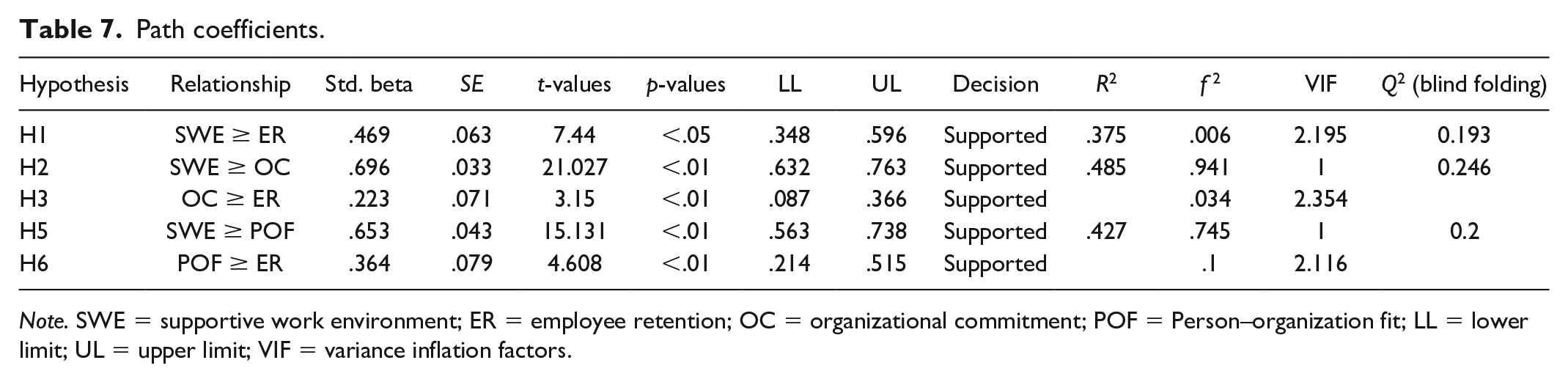
Note. SWE = supportive work environment; ER = employee retention; OC = organizational commitment; POF = Person–organization fit; LL = lower limit; UL = upper limit; VIF = variance inflation factors.
After computing the path estimates in the structural model, a bootstrap analysis was calculated to evaluate the statistical significance of the path coefficients. PLS–SEM structural model was deployed to statistically examine the interaction between exogenous and endogenous constructs (Lowry & Gaskin, 2014). SWE is significantly and positively associated with ER (β = .469; t = 7.44; lower limit [LL] = .348, upper limit [UL] = .596), OC (β = .696; t = 21.027; LL = .632, UL = .763), and POF (β = .653; t = 15.131; LL = .563, UL = .738). The findings delineated that H1, H2, and H5 are supported. H3 purported that there is a significant positive effect of OC on ER. Results (Table 7) identified a positive association of OC on ER (β = .223; t = 3.15; LL = .087, UL = .366). H6 shows a positive association of POF on ER (β = .364; t = 4.608; LL = .214, UL = .515). Thereby, the findings of the study supported all five proposed hypotheses. As can be seen in Figure 3, t-values are reflecting hypothesized relationships.

Structural model assesment.
Effect size (f2) identified that OC and POF exerted a small effect on ER. SWE also has a small effect on ER and OC. However, SWE influenced highly on POF. A cross-validated measure Q2 was used to assess the predictive accuracy of the tested model. It used to measure to what extent the tested model predicted the data of deleted cases. As per threshold, Q2 > 0 confirmed that there was no issue of blindfolding and was used for calculating predictive relevance (Geisser, 1974; Stone, 1974). Findings suggested that all Q2 values were greater than zero ranging from .193 to .361. The criterion of VIF inferred that its values should be less than 5, which was satisfied with the results of this study as its values were ranging from 1 to 2.354. Since predictors were not highly correlated with each other, there was no issue of multicollinearity.
Mediation Results
This study applied the PLS technique (Wold, 1985) due to its ability to assess complex multivariate direct and indirect effects models (Hair et al., 2013), such as in this study. During PLS analysis, the step of bootstrap is performed to examine the indirect effects (Chin, 2010) statistically.
Role of OC as the mediator in the relationship between SWE and ER
Results disclosed in Table 8 shows that OC mediates the relationship between SWE and ER (β = .155; t = 3.025; LL = .061, UL = .264) thus providing evidence to support H4. As indicated by Preacher and Hayes (2008), the indirect effects, as shown in Table 8 (LL = .061, UL = .264), had not included a zero in between denoting the existence of mediation between relations of two latent variables. The result supports the mediating effect of OC (H4) between SWE and ER, which infers that there is an indirect effect of SWE on ER via OC. The method proposed by the past scholar (Baron, 1986) was implied to estimate further whether constructs relationship is fully or partially mediated. The findings expressed that the actual direct effect of SWE to ER was significant (β = .469; t = 7.44, p < .05). However, the study found that when the mediating effect of OC is included the significance becomes smaller (β = .155, t = 3.025, p < .01). As such, the direct relationship between SWE and ER was a significant and indirect relationship between SWE and ER after adding the mediating variable of OC is also significant. Thus, it confirmed that OC partially mediates the association between SWE and ER.
Indirect effect.

Note. WE = supportive work environment; ER = employee retention; OC = organizational commitment; POF = Person–organization fit; LL = lower limit; UL = upper limit.
Role of POF as the mediator in the relationship between SWE and ER
POF mediates the relationship between SWE and ER (β = .238; t = 4.692; LL = .14, UL = .345) thus providing evidence to support H7. As indicated by Preacher and Hayes (2008), the indirect effects, as shown in Table 8 (LL = .14, UL = .345), had not included a zero in between denoting the existence of mediation between relations of two latent variables. The result supports the mediating effect of POF (H7) between SWE and ER, which infers that there is an indirect effect of SWE on ER via POF. The method proposed by (Baron, 1986) was implied to estimate further if there is a full or partial mediation. The findings expressed that the original direct effect of SWE to ER was significant (β = .469; t = 7.44, p < .01). However, the study found that when the mediating effect of POF is included, the significance becomes smaller (β = .238, t = 4.692, p < .01). As such, the direct relationship between SWE and ER was significant and indirect relationship between SWE and ER after adding mediating variable of POF is also significant. Thus, it confirmed that POF partially mediates the association between SWE and ER.
Discussion
In a service industry, ER presents a critical challenge and contributes pragmatically in organizational success. This study seeks to identify the positive role of SWE in determining ER in employees of fast-food restaurants. Less emphasis has been given on finding the mediating interplay of variables in the relationship between SWE and ER. This study attempts to fill the gap by empirically intriguing such a relationship through the mediating role of OC and POF. This study measures SWE with the help of variables, namely, PC, SR, PG, POS. The path analysis shows strong evidence that a SWE has a significant positive influence on ER. SWE has been conceptualized and framed as a strong predictor of ER, thereby supporting H1. This finding is in communion with earlier studies on ER (Lingard & Francis, 2006). This positive association between SWE and ER infers that a SWE keeps employees safe from stress and burnout and brings positive attitude and behavior due to felt obligation of work support from supervisor and coworkers. Based on the assertion of the theory of equilibrium and SET, POS reinforces people to stay for a longer tenure to meet balance and social exchange relationships. A happy workplace attracts people to retain with employing organization (Ramlall, 2003) and reduces attrition rates. Supportive work climate (Ramlall, 2003) and open channel for communication with managers (AbuAlRub et al., 2016) promote the positive job attitudes of people toward their organization (Gilbreath & Benson, 2004), and decrease intentions to turnover (Guchait & Cho, 2010). SWE is not only fostered by one’s supervisor but also with positive interactions with colleagues both inside (office, cafeteria) and outside (parks, restaurants) the organization. This leads us to believe that a flexible, friendly, and SWE should be promoted to attract, retain, and encourage competent employees (AbuAlRub et al., 2016), in particular, fast-food restaurants of Pakistan where job switching for pay raises is common practice.
Findings demonstrate that SWE is positively associated with OC thus supporting H2. This view is congruent with previous work on SWE (Y. Chang et al., 2015). Supportive HR practices, for instance, involvement in decision-making, career development prospects, and equality of rewards act as driving forces for OC. Employees feel committed to their job if they are communicated and listened by supervisors and peers (Reed et al., 2016). The findings are consistent with the theory of equilibrium and SET perspective holding people stay committed and attach affective emotions with their organizations to pay off and reciprocate the rewards and support received from the environment. Supervisory and peers support may increase employee’s emotional satisfaction arousal and intrinsic motivation. The positive feelings that employees’ emotional needs are met and their wellbeing is taken care of are perceived as gratitude and obligation. Employees reciprocate in the form of OC to balance the exchange favors obtained from the working environment.
The study has found support for H3, indicating that OC is positively related to ER. This result is in line with other scholars (Harden et al., 2018; Saraih et al., 2017) who have found an inverse relationship between commitment–turnover intention. OC plays the role of mediator in the relationship between SWE and ER, thus supporting H4. This is similar to previous scholar’s findings (Juhdi et al., 2013; Samgnanakkan, 2010). Indeed, the supervisor’s feedback, fair appraisal, information sharing, participation in problem-solving, forgiving, and a favorable attitude caring and friendly environment make employees feel indebted and committed. The feelings of indebtedness and belongingness force them to remain with the organization to reciprocate a supportive environment.
The findings of this study entail support for a positive relationship between a SWE and POF as established in H5. Favorable work climate and caring culture foster expectations from employees to indulge themselves in such activities that are well fit with those of organizational values. Therefore, employees having a higher level of POF are more inclined to involve in activities that are preferred by their peers, superiors, and organizations and, in turn, receive higher desirable reinforcements from them in the form of acknowledgment, recognition, support, and rewards. Thus, subsequently, the positive appraisal will also intensify the employees’ emotions of engagement and confidence at work and motivate them intrinsically (X. Zhang & Bartol, 2010) and meet organizational expectations from them. This explanation advocates that SWE and POF mutually reinforce each other in a two-way sequential form.
The findings of this study support a positive relationship between POF and ER as tested in H6. This result is coinciding with the earlier research that POF stimulates people to stay for a longer duration (Lauver & Kristof-Brown, 2001). This view is generally acceptable because people join those organization that represents the best fit to their personalities and provides ample chances to adhere to their own values system, and as a result of internal satisfaction gained from environment, they are more inclined to retain in such organizations (Kundu & Gahlawat, 2016; Kundu & Lata, 2017) and are less likely to stay with not best matched.
Furthermore, the construct of POF acts as a mediator in the relationship between SWE and ER, hence supporting H7. The positive effect of a SWE on ER is likely to reduce for employees who perceive their skills, capabilities, personal values, and characteristics are not fit with organizational philosophy and requirements. An employee with a lower level of perceived POF finds it difficult to socialize himself with peers and is less expected to respond with positive emotions because of mismatch of personal values with organizational values. Such employees do not feel a strong sense of belonging, disagree with this organization’s policies, and unable to find meaningfulness of staying with the organization. On the contrary, individuals with a high level of POF are likely to enjoy time with colleagues, appreciate working environment, and exhibit intrinsic motivation to stay connected. Therefore, it is assumed that POF provides a suitable mechanism via which the positive effect of SWE passes on ER.
Implications of the Study
This study has made many practical implications for human resource practitioners in the fast-food sector in Pakistan. First, HR professionals should seek to understand the changing facets of SWE and strategically develop and employ SWE practices in a bundle/set for retaining talented employees. Because the conclusions of the study elucidated that when organizational people are supported by supervisors, peers, climate, and organization, they become more committed, feel obligated and thereby, reciprocate the social exchange relationships, do not intend to leave the organization and stay longer voluntarily. Second, in the same way, sharing and promoting a strong organizational culture with their workers may encourage the emotional and psychological attachment to the organization, and the best human talent could be retained for a longer time (Mathieu et al., 2016). Third, this study tries to amalgamate a fit between people’s and organizations’ values through POF to reduce turnover intentions. Since a good fit is advantageous for both the employer and employee, thereby recruiters should use those selection tools/measures that may assess candidates’ characteristics and hire only those applicants who proved themselves the best match and show value congruence. Fourth, keeping in view the likely positive effect of SWE on employee attitude such as OC and ER, employers should provide conducive environment by adopting strategic HRM practices, for instance, involvement in decision-making, healthy relationships with employees, compensation, training, career-oriented opportunities, and work–life balance to increase ER (Presbitero et al., 2016). Organizations should not adopt traditional HR practices rather they should apply customized HR practices that can meet both employer and employee needs. According to the results of study’s implications, following motivational HR retention strategies can be used to implement SWE and promote commitment, that is (a) performance feedback, trust, acknowledgment, information sharing, and fair appraisal by supervisor; (b) idea sharing on job-related issues, problem-solving, teamwork, informal gathering, and leisure time outside the organization with peers; and (c) caring and helpful behavior, and favorable and tolerable attitude by organization.
This article also contributes theoretically by providing a contextualized perspective of SWE in bundle form of four dimensions (PC, SR, PG, and POS). It tries to examine the combined effects of the variables of SWE on ER through POF and OC. It additionally confirms and delivers practical evidence to models of SET and TOE in case of employees working at the food sector in Pakistan. It adds to the current body of literature on ER and SWE. The results imply that SWE can be used as a successful retention strategy if employees and organizations have a compatible goal. Results further advocate that people will retain in an organization if they feel committed due to prevalent SWE.
Limitations and Future Research
Similar to other studies, this article is also not free from limitations. Such limitations provide avenues for future research. One of the main limitations is data are received from respondents assuming that respondents give accurate responses, and they are well familiar with their employing organization. Employees’ biased responses toward their organization can undermine the truthiness of facts. Another limitation is perceptions and demands of people may vary according to their norms, economic conditions, and country. Therefore, there could be a generalizability issue if demands in one country are not necessary for another country. This research has been conducted only in the hospitality industry of Lahore. There is a need to ensure validity across varied work contexts by conducting the same research in multiple industries, cities, and countries. The next limitation is the use of a cross-sectional design, which is likely to include common method variance. However, it has been tried to reduce by using remedies as cited in MacKinnon (2011). To get better results, a longitudinal design can be adopted out to ensure the causality of the relationship between latent variables. Inclusion of other variables, for example, positive job attitudes and behaviors (job satisfaction. employee engagement, employee performance, knowledge sharing behavior, organizational citizenship behavior) as outcomes of SWE, would be a good idea.
Conclusion
In the knowledge-intensive era, retention of higher performers is becoming a challenging task for organizations to succeed (Aguenza & Som, 2018). This study demarcates that there is a significant positive relationship between the exogenous variable of SWE and the endogenous variable of ER. In addition, it also reveals that OC and POF act as mediators in the relation between the SWE and ER. Many scholars have widely studied the construct of retention of employees, yet it is necessary to have a deeper insight to explore predictors and interplay of mediating factors to cover the literature gap. Thus, the study investigates phenomena while providing evidence to theories of SET and TOE via empirically testing the proposed model to add in the current body of knowledge. The results indicate that OC and POF with their organization proliferate their probability of staying with them. The proliferation of the organizational social (PG, SR) and technical subsystem (POS) carry organizational success and ER (Ghosh et al., 2013).
Footnotes
Appendix
Lists of Multinational Fast Food Chains in Lahore Cantt (Cluster 2).

| No. | List of selected fast food chains | No. of branches |
|---|---|---|
| 1 | McDonalds | 5 |
| 2 | KFC | 3 |
| 3 | Subway | 2 |
| 4 | Hardee’s | 3 |
| 5 | Burger King | 2 |
| 6 | Pizza Hut | 5 |
| Total selected chains | 20 |
Acknowledgements
This research is part of self-organized cluster entrepreneurship behavior reform, evolution, and promotion strategies study (No. 16BGL028), China National Social Science Foundation; study on Bottleneck and Innovation of Postindustrial Intellectual capital development in Jiangsu Province (No. 14JD009), Jiangsu Province Social Science Foundation Project; and Interactive effect between Self-Organized Innovation and Industrial cluster, Jiangsu Province Graduate Scientific Research Innovation Project (KYCX17-1746).
Author Contributions
S.N. and C.L. contributed to the definition of research objectives, models, and hypotheses. N.A. contributed to the provision of materials (i.e., questionnaires). S.N. and M.A.S.K. contributed to data collection. S.N. and Q.A.N. contributed to data analysis planning and data analysis. S.N. contributed to principal article writing. F.A. and S.N. contributed to article revision and proofreading. Final approval was done by S.N., C.L., Q.A.N., N.A., M.A.S.K., and F.A.
Declaration of Conflicting Interests
The author(s) declared the following potential conflicts of interest with respect to the research, authorship, and/or publication of this article: The authors declare that the research was conducted in the absence of any commercial or financial relationships that could be construed as a potential conflict of interest.
Ethical Approval
This study was carried out under the recommendations of the Ethical Principles of Psychologists and Code of Conduct by the American Psychological Association (APA). All participants gave consent following the Declaration of Helsinki. The review board of the Jiangsu University exempted the research for ethical approval, as it was a survey-based study. Although the authors are affiliated to Chinese institution, they are Pakistani by the origin and are conducting the study under the supervision of a Chinese professor. Human resources and branch managers of restaurants gave consent on the telephone for conducting a questionnaire survey. Participants were intimated through their supervisors and they filled questionnaires willingly.
Funding
The author(s) received no financial support for the research, authorship, and/or publication of this article.
