




Abstract
Existing literature has focused on the impact of occupational stigma in traditional industries; however, limited research investigates how occupational stigma and identity affect employee performance within the gig economy. Thus, this study examines the causes of stigma and the barriers faced by workers in the gig economy. Using a survey of 400 food delivery workers in China, this study investigates how occupational stigma affects employee performance and turnover intentions. It also examines the roles that workplace well-being and professional identity play in this process. Using structural equation modeling, the findings indicate that participants’ higher perceived stigma is associated with reduced workplace well-being, which in turn leads to decreased performance and increased turnover intentions. The results also show that the effect of occupational identity is contingent on its level, with a more pronounced impact observed at lower levels under certain boundary conditions. Furthermore, the relationship between stigma and turnover intentions is weaker for those with stronger occupational identity. This study presents a novel theoretical framework from an Eastern perspective to enhance the understanding of occupational stigma. Its findings can contribute to the development of strategies for mitigating it.
Introduction
The gig economy has experienced significant growth in the last decade, representing a labor-sharing market system that provides opportunities for workers to engage in short-term projects or freelance work (Allon et al., 2023). Its expansion has been dramatic, with an average growth rate of 10% per year pre-pandemic and approximately 40% since the pandemic’s onset in March 2020 (Herrmann et al., 2023). The primary distinction between the gig economy and traditional work arrangements is that “gig work” refers to a temporary engagement in which the worker is only paid for a specific job (Harris, 2017), which may provide greater economic benefits to firms (Mulcahy, 2017). However, the characteristics of the gig economy have resulted in issues such as instability, invasion of privacy, job insecurity, and labor substitutability (M. A. Fox et al., 2018; Frey & Stutzer, 2002; Hyperwallet, 2016; Lobel, 2017; Lucas, 2007). As a result, employees in the gig economy may face more occupational stigma, both externally and internally. This stigma can also pose challenges to firms’ human resource departments, such as organizational management difficulties, job uncertainty, low employee loyalty, and workforce instability (Lowe, 2017).
The Report on the Development of China’s Sharing Economy 2021, published by the Sharing Economy Research Center of the State Information Center of China, states that by the end of 2020, 84 million service providers were working in the sharing economy, with approximately 6.31 million engaged by platform companies in China (Herrmann et al., 2023). China has become one of the world’s largest gig economy markets in terms of the number of workers and technology platform companies running on mobile apps. These platforms include e-retail, telecommunications, door-to-door food delivery, streaming services, and personalized restaurant experiences (Mukhopadhyay & Chatwin, 2021). In addition, China’s gig economy faces greater challenges due to occupational stigmatization resulting from low employment thresholds, inadequate legal safeguards, and the influence of traditional employment concepts (Chen et al., 2020).
Understanding the effects and limitations of occupational stigma in the gig economy is crucial for its development, as it can benefit both enterprises and employees. This research is particularly important as it investigates this stigma by focusing on a sample of food delivery workers in the Chinese context.
The few existing studies on occupational stigmatization in the gig economy mainly examine traditional occupations in a predominantly Western social context (Ashforth & Kreiner, 1999; Clough et al., 2019; Kreiner et al., 2006; Shantz & Booth, 2014; Stanley, 2012; Wildes, 2005). Existing research has suggested that the distinct characteristics and professional environments of occupational stigma shape and outcomes. These studies have generally concluded that occupational stigma adversely affects practitioners by increasing emotional exhaustion, counterproductive work behaviors, turnover, and stress (Clough et al., 2019; Lai et al., 2012; Schaubroeck et al., 2018; Shantz & Booth, 2014). Researchers have also found that occupational stigma is linked to job meaning and occupational identity (Leurent & Ducasse, 2023). However, other studies have not found a significant correlation between occupational stigma and job meaning, occupational identity, or counterproductive behaviors (Shantz & Booth, 2014). Therefore, further research is needed to investigate the effects of stigma in various occupations. Research on this topic has predominantly been rooted in theoretical models, such as the Expectancy Theory and the Resource Conservation Theory.
Recent occupational stigma studies predominantly centered on traditional professions in a Western socio-cultural context have provided inconsistent results. Furthermore, research into emerging gig economy occupations is relatively scarce, especially within the context of China. Thus, this study aims to address this gap by exploring and supplementing existing knowledge, focusing on the impact of the mechanisms and outcomes of occupational stigma in the emerging occupation of food delivery work within China’s gig economy. The examination is conducted at individual and organizational levels, grounded in the theoretical framework of Consistency Theory (Festinger, 1957).
Consistency Theory elucidates the relationships among occupational stigma, workplace well-being, occupational identity, job performance, and turnover intentions (Festinger, 1957). This study presents the following objectives. First, this study systematically investigates the mechanisms and boundary conditions through which occupational stigma affects employee performance and turnover intentions within the gig economy by collecting data through questionnaires and examining the results using structural equation modeling. Second, it examines the mediating role of workplace well-being in the relationship between occupational stigma and employee performance and turnover intentions. Third, it examines the moderating mechanisms of different occupational identity levels to reveal the role of occupational identity in occupational stigma.
This research targets food distribution workers. The sample provides a unique context as it is a representative occupation of China’s gig economy, which is characterized by a large volume of workers and low barriers to entry.
This study can contribute theoretically, methodologically, and practically by offering new insights into the role of professional identity in mitigating stigma by applying a novel theoretical framework from an Eastern perspective. Figure 1 presents the conceptual research model.
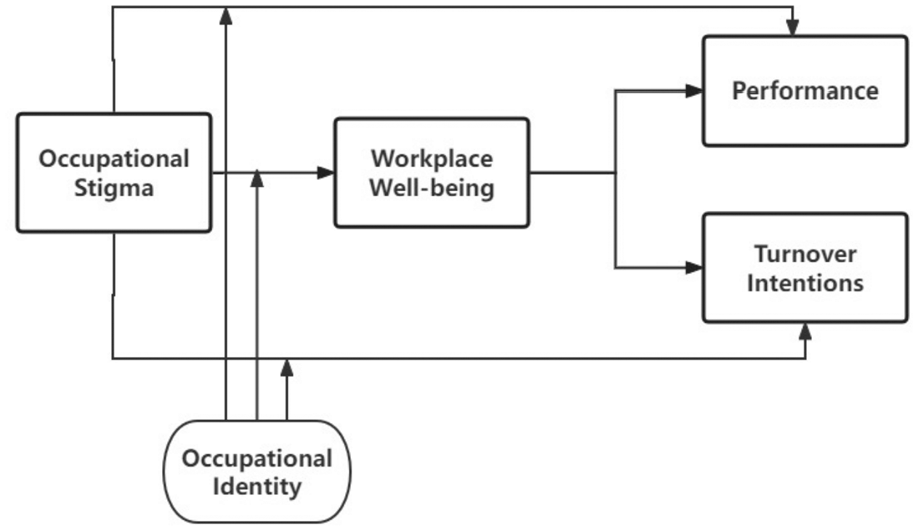
Conceptual model.
Theoretical Background and Hypotheses Development
Stigma Research and Consistency Theory
Occupational stigma originates from the negative societal stereotypes of certain occupations, encompassing their characteristics, social relationships, and ethics (Stenger & Roulet, 2018). Particularly, it arises from subjective cognitive biases based on the inherent characteristics of occupations, and the negative stereotypes society imposes on specific jobs, which adversely affect public perception (Pinel & Paulin, 2005). Thus, practitioners engaging in stigmatized work may be mistreated by society due to stereotyping.
Occupational stigma stems from two primary sources (Bosmans et al., 2016; Pinel & Paulin, 2005; Shantz & Booth, 2014). First, a profession’s negative social image may be attributed to its stigmatizing nature, which is perceived as causing physical and social defilement. Second, certain jobs may be viewed as involving unskilled or low-skilled labor, leading to the belief that jobs outside the boundaries of traditional employment are easy (Goods et al., 2019). Thus, the occupational prestige of these jobs is perceived as low as they may be considered to offer less status, power, income, and work quality and require less education, contributing to the stigma (Bosmans et al., 2016).
Research on occupational stigma has primarily been grounded in content models, such as the Expectancy Theory and Resource Conservation Theory (Krug et al., 2019; Link & Phelan, 2014). These models explore the adverse effects of stigma and the associated coping strategies, particularly in traditional employment settings. Related research that focuses specifically on the gig economy has mainly examined topics like stigma transfer, occupational stratification, and the interplay between stigma and personal perceptions (Petriglieri et al., 2019; Phung et al., 2021). However, there is a notable lack of research on stigma in relation to employee performance and retention, particularly concerning new occupations within the gig economy.
Consistency Theory examines how individuals maintain internal consistency by adjusting their attitudes in response to new information (Osgood & Tannenbaum, 1955). It serves as a foundational concept for several other theories (van Kampen, 2019), such as Cognitive Dissonance Theory (Festinger, 1957), Heider’s Equilibrium Theory (Heider, 1958), Newcomb’s Equilibrium Theory (Newcomb, 1968), and Kelley’s Attribution Theory (Kelley, 1967). Consistency Theory suggests that arousal increases when logically inconsistent cognitive structures are simultaneously activated, leading to attempts to increase consistency and reduce arousal. A consistent state is believed to help individuals avoid conflicts, enhancing their behavioral efficiency (van Kampen, 2019).
Consistency Theory can be applied to various research fields. Studies exploring this theory in the context of stigma have been conducted in areas such as gender and mental health stigma (Jackman et al., 2018; Wu et al., 2022), industry stigma (Kim & Choi, 2022), racial stigma (Byrd & Chavous, 2011), and weight reduction stigma (Meaney & Rieger, 2021). Several studies have also employed this theory to investigate the relationships between cognition and job satisfaction, performance (Visser & Coetzee, 2005), stigmatized careers, and management (Ashforth et al., 2017). However, limited research has applied this theory to occupational stigma, employee well-being, and organizational management, especially in the context of emerging occupations. Therefore, further investigation is necessary to gain deeper insights into the mechanisms and implications of Consistency Theory, allowing a better understanding of how to address occupational stigmatization in contemporary work settings.
Consistency Theory proposes that individuals may exhibit more positive attitudes or behaviors toward an object when they perceive it aligns with their existing beliefs or values (Lee & Jeong, 2014; Osgood & Tannenbaum, 1955). That is, behavior often correlates with perceptions (Aaker, 1995). However, when faced with cognitive dissonance, they may hesitate to alter their attitudes or beliefs, causing them to engage in behavioral feedback or present defense mechanisms (Festinger, 1964). Therefore, this study aims to utilize Consistency Theory to elucidate the mechanisms and effects of the perceived outcomes stemming from individuals’ views of their occupations being incongruent with those of society. By examining this inconsistency, this study aims to elucidate how occupational stigma affects attitudes, behaviors, and well-being in the context of emerging occupations within the gig economy.
Occupational Stigma, Performance, and Turnover Intentions
Practitioners are often aware that their professions face stigmatization, as they are conscious of the negative attitudes toward them and their work, which may differ from their perceptions (Shantz & Booth, 2014). According to Consistency Theory, aversion occurs when inconsistencies exist between one’s environment and perceptions (Festinger, 1957; Heider, 1958; Proulx et al., 2012). This aversion is resolved by avoiding or distancing oneself from the environmental behaviors that cause these perceptual inconsistencies (Archer, 1976; Berlyne, 1960; Hebb, 1946).
Numerous studies have demonstrated that occupational stigma can have detrimental effects, including burnout, which adversely affects performance and increases turnover intentions (Clough et al., 2019; A. B. Fox & Quinn, 2015; Schaubroeck et al., 2018). When practitioners perceive their occupation as stigmatized, they may develop an aversion to it, which can reduce their work commitment and performance. As the inconsistency between their perceptions and the reality intensifies, they may begin to avoid work and consider quitting. Thus, when gig workers perceive occupational stigma, they are less likely to commit to their jobs, worsening their performance and potentially increasing turnover. Based on these observations, the following hypotheses are presented:
Hypothesis 1: A negative relationship exists between participants’ perceived occupational stigma and performance.
Hypothesis 2: A positive relationship exists between participants’ perceived occupational stigma and turnover intentions.
Occupational Stigma and Workplace Well-Being
The core of occupational stigma lies in practitioners perceiving a cognitive threat from negative social stereotypes, which can result in cognitive dilemmas, such as doubting one’s identity, self-concept ambiguity, and resource limitations (Zhang et al., 2021). To effectively address these dilemmas, individuals can engage in state. However, they may struggle to resolve this disharmony, leading to a persistently negative emotional state that intensifies the impact of stigma perceptions (Peters et al., 2004). For instance, food delivery workers may face physical stigmatization due to being perceived as performing “dirty” work. They may also experience mental stigmatization by being considered as having poor customer interactions, causing feelings of shame, helplessness, and disrespect. Furthermore, workers experiencing emotional states that are inconsistent with their goals and expectations can contribute to negative emotions and thoughts, thereby decreasing well-being. Building on this analysis and referencing the research hypothesis of Liu et al. (2022), this study presents the following hypothesis:
Hypothesis 3: A negative relationship exists between participants’ perceived occupational stigma and workplace well-being.
Workplace Well-Being, Performance, and Turnover Intentions
Well-being is a positive subjective emotion. Specifically, in the professional context, it refers to the positive emotions individuals experience at work after evaluating their self-status (Crisci et al., 2019). Based on Consistency Theory, information that is inconsistent with an individual’s cognitive beliefs can hinder the realization of expected cognitive outcomes and increase discomfort, thus reducing well-being (Kruglanski et al., 2018). Emotional factors and job satisfaction are vital in influencing performance (Blumberg & Pringle, 1982). Thus, employees’ subjective well-being directly impacts their performance and job engagement, significantly affecting turnover rates (Adnan Bataineh, 2019; Brunetto et al., 2012; Wright & Cropanzano, 2000). Based on analyzing the relationship between well-being, work performance, and turnover intentions, the following hypotheses are proposed:
Hypothesis 4: A positive relationship exists between workplace well-being and work performance.
Hypothesis 5: A negative relationship exists between workplace well-being and turnover intentions.
According to the above analysis and considering the logical relationships between Hypotheses 3 and 5, this study proposes that gig workers’ occupational stigma negatively impacts their workplace well-being, adversely affecting their performance and increasing their turnover intentions. Thus, the following hypotheses are proposed:
Hypothesis 6: Workplace well-being mediates the relationship between occupational stigma and performance.
Hypothesis 7: Workplace well-being mediates the relationship between occupational stigma and turnover intentions.
Occupational Identity’s Moderating Effect
Existing research has confirmed that stigmatized practitioners experience cognitive dissonance (Ashforth & Kreiner, 2014a), as the self-perceived value of their work does not align with consistent social evaluative feedback. Consistency Theory research has identified methods for eliminating this inconsistency, such as ego-defense mechanisms for maintaining self-image and emotional equilibrium (Freud, 1936; Vaillant, 1998). Examples of these mechanisms include rationalization, denial, distortion, and repression (Chaxel et al., 2016; Straube, 2012). For instance, denial can entail psychologically rejecting an unpleasant situation and adjusting one’s thinking to reinterpret the situation from a more favorable perspective.
This present study draws on Consistency Theory to introduce the concept of occupational identity as a “code of change” for counteracting the cognitive incongruity of stigma. Derived from social identity theory, occupational identity refers to the relatively stable attitude individuals develop toward their occupation, encompassing their perceptions of their roles, responsibilities, attitudes, beliefs, and standards (Skorikov & Vondracek, 1998). Existing research has demonstrated that occupational identity can be strengthened through reconstructing occupational ideology strategies. These strategies can include reinterpreting and understanding the significance of one’s career (Ashforth & Kreiner, 1999; Mikolon et al., 2021), constructing a shared occupational ideology, and making favorable social comparisons (Ashforth & Kreiner, 2014b), and enhancing career adaptability and job alignment (Peng et al., 2024). Occupational identity can mitigate the effects of stigma on withdrawal behaviors, such as reduced performance and increased turnover (Ashforth & Kreiner, 1999; Barbier et al., 2013). It is also a significant influencer of well-being (Fisherman, 2015; Karas et al., 2013). Furthermore, Major and Schmader (2018) argue that it can moderate the impact of stigma on well-being.
Individuals with a strong occupational identity recognize the significance of engaging in their role and often exhibit greater enthusiasm, interest, and positive emotional experiences (Wildes, 2005). They also tend to experience pride and self-actualization, achieving growth through their occupations, which positively affects their well-being (Jue & Ha, 2018) and enables them to face the adverse effects of stigmatization.
In summary, employees experiencing external stigmatization may experience external criticism and a lack of understanding from outsiders. However, if their occupational identification is strong, the adverse effects of stigma on their work performance and retention can be attenuated, diminishing its negative impact on well-being. Based on the above analysis, this study introduces occupational identity as a moderating variable and proposes the following hypotheses:
Hypothesis 8: Occupational identity moderates the relationship between occupational stigma and performance, weakening occupational stigma’s adverse effect on performance.
Hypothesis 9: Occupational identity moderates the relationship between occupational stigma and turnover intentions, weakening occupational stigma’s positive effect on turnover intentions.
Hypothesis10: Occupational identity moderates the relationship between occupational stigma and workplace well-being, weakening occupational stigma’s negative effect on workplace well-being.
This study further constructs a mediated moderating effect model by combining Hypotheses 6 and 7 (workplace well-being mediates the relationship between perceived occupational stigma and performance as well as turnover intentions) with Hypothesis 10 and proposes:
Hypothesis 11: The interaction between perceived occupational stigma and occupational identity affects performance through the mediating mechanism of workplace well-being.
Hypothesis 12: The interaction between perceived occupational stigma and occupational identity affects turnover intentions through the mediating mechanism of workplace well-being.
Research Method
Sample
The sample for this study comprises food delivery workers employed on online platforms in China. Food delivery work represents a typical occupation facing stigmatization in the gig economy. For instance, workers often operate under hazardous conditions (Ashforth & Kreiner, 1999), including exposure to extreme weather, traffic, and unsanitary working environments (Benoit et al., 2015). Furthermore, the job is often highly demanding and time-constrained, prompting workers to engage in risky behaviors to meet deadlines, such as driving while fatigued, speeding, or violating traffic regulations (Dong et al., 2021), which can jeopardize their safety. Additionally, workers frequently find themselves in a “subordinate relationship” with others (Ashforth & Kreiner, 1999), threatening their status and identity.
In 2021, China’s online food delivery revenue accounted for approximately 21.4% of its catering revenue, and per capita expenditure on online food delivery accounted for 21.4% of catering consumption expenditures (Chinas State Information Center [CSIC], 2022). In sum, food delivery workers often face stigmatization in the gig economy. Thus, researching the occupational stigma of food delivery workers on online platforms provides an important case study for a better understanding of occupational stigma in China’s gig economy.
For this study, 490 electronic questionnaires were distributed to food delivery workers through the Credamo platform, an online sampling database. After removing invalid questionnaires, 400 responses remained, resulting in a validity rate of 81.17%. Survey respondents comprise 54.75% men and 45.25% women, indicating a relatively balanced gender distribution. Respondents are primarily between 21 and 30 years old (34%) and 31 and 40 years old (52%), and 63.25% hold a bachelor’s degree. Most have worked for less than 2 years (49.25%) or between 3 and 4 years (41.25%). Respondents identified Meituan as the most popular gig work platform, selected by 55.17%, followed by EleMe at 31.23%, while the remaining platforms accounted for 13.6%.
Measures, Reliability, and Validity
A five-point Likert scale was employed to measure the variables in this study, using well-established scales from existing research (excluding control variables). Questionnaires were developed in English and then translated into Chinese in accordance with the situation in China. Following this, we asked external experts to back-translate the Chinese version into English to confirm there were no translation errors. The Cronbach’s alpha coefficients for each variable in the questionnaire exceeded .7, indicating the scales had good reliability.
Occupational Stigma: The Initial Stigma Perception Scale was developed by Pinel (1999) and subsequently revised by Pinel and Paulin (2005) to assess stigma perceptions among employees. Shantz and Booth (2014) used it to study occupational stigma among call center employees. This scale was adapted to the specific context of this study. Thus, perceived occupational stigma was assessed using a six-item scale, exemplified by statements such as “Most people who are not food delivery workers perceive these workers more negatively than they express.” The Cronbach’s α value for this scale is .890.
Performance: Performance was measured using a scale developed by Eisenberger et al. (2001), consisting of four measurement items, exemplified by statements such as “I performed the duties specified in the job description.” The Cronbach’s α value for this scale is .848.
Turnover intentions: A scale from Chan Yin-Fah et al. (2010) was adapted to assess turnover intentions. Three measurement items were used, exemplified by statements such as “I often consider quitting my job.” The Cronbach’s α value for this scale is .886.
Workplace well-being: Well-being was measured using a six-item scale developed by Zheng et al. (2015). Representative items include “Overall, I am satisfied with my work” and “My work is meaningful.” The Cronbach’s α value for this scale is .884.
Occupational identity: Mael and Ashforth’s (1992) Organizational Identity Scale was adapted to assess occupational identity using six items measured on a five-point Likert scale, exemplified by statements such as “When someone criticizes my profession, it feels like a personal insult.” The Cronbach’s α value for this scale is .913.
Control variables: Gender, age, education, years of experience, and work platform were included based on the suggestions of previous research.
Data Analysis
AMOS 32.0 was used to analyze the data, as it can output both indirect and total effects, demonstrating the usefulness of the relationships between variables. First, a validated factor analysis was conducted with descriptive statistics. A correlation analysis was also applied for all variables to investigate the association between each variable, followed by testing the main and mediation effects. Next, the mediated moderation model was examined using PROCESS macro (Model 7; Hayes, 2018). Given effect complexity, SPSS 26.0 facilitated regression analyses of the moderating variables.
Kaiser-Meyer-Olkin (KMO) Test, Bartlett’s Test, and Confirmatory Factor Analysis
The Kaiser-Meyer-Olkin (KMO) test and Bartlett’s Test of Sphericity were conducted to assess the data’s suitability for exploratory factor analysis. The KMO value is 0.935, which exceeds 0.7. This result indicates that this study is suitable. Subsequently, the maximum variance method of matrix rotation was used to extract five factors, and the factor loadings for each were higher than those of the others. Thus, the variables were effectively distinguished, indicating that the scale used in this study has high validity.
Next, a confirmatory factor analysis was performed to assess the fit of five-, four-, three-, two-, and one-factor models (Table 1). The fit indices of the five-factor model are χ2/df = 1.602, CFI = 0.973, IFI = 0.974, TLI = 0.97, GFI = 0.92, and RMSEA = 0.039, indicating a good model fit. Comparing these five models reveals that the fit of the five-factor model is superior to that of the others, suggesting that the present study has significantly reduced the potential impact of common method bias.
Confirmatory Factor Analysis.

Note. Five-factor model: OS, WWB, OI, PF, TT; Four-factor model: OS, WWB, OI, PF+TT; Three-factor model: OS, WWB, OI+PF+TT; Two-factor model: OS, WWB+OI+PF+TT; One-factor model: OS+WWB+OI+PF+TT.
Thus, the values of the above fit indices suggest that this study’s measurement model aligns well with the research data, indicating a good model adaptation.
Descriptive Statistics and Correlation Coefficients Between Variables
This study examined the relationships between the variables using Pearson’s correlation analysis. The results presented in Table 2 reveal the two-by-two correlations among occupational stigma, workplace well-being, occupational identity, turnover intentions, and performance. These correlations serve as a foundation for hypothesis testing.
Means, SDs, and Correlations of Variables (N = 400).

p < .01.
Results
Main Effect Test
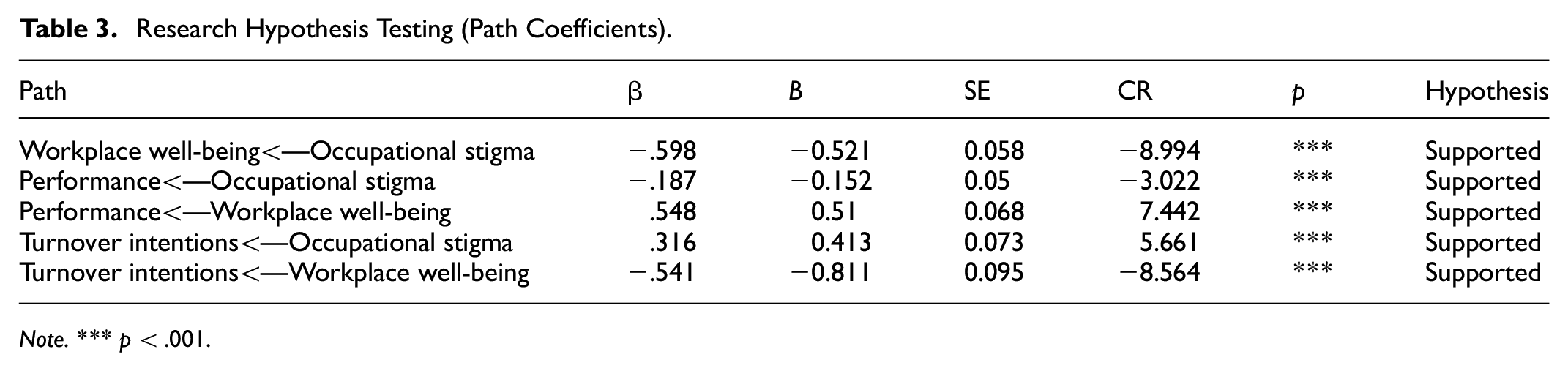
This study constructed a structural equation model (Figure 2) to examine the relationships among occupational stigma, workplace well-being, performance, and turnover intentions. Table 3 presents the results of the path coefficient test.

Structural equation modeling diagram.
Research Hypothesis Testing (Path Coefficients).
Note. *** p < .001.
The results of the path coefficient test presented in Figure 2 and Table 3 indicate that all five paths between the four latent variables are statistically significant (p < .05). Specifically, occupational stigma has a significant adverse effect on performance (β = −.187, p < .05) and a significant positive effect on turnover intentions (β = .316, p < .05). Thus, Hypotheses 1a and 1b are supported.
Additionally, occupational stigma has a meaningful negative impact on workplace well-being (β = −.598, p < .05), supporting Hypothesis 2. Workplace well-being positively impacts performance (β = .548, p < .05) and has a significant negative impact on turnover intentions (β = −.541, p < .05). Thus, Hypotheses 3a and 3b are supported.
Mediation Effect Path Test Results
The path test results for the mediation effects were obtained by running the study 5,000 times using the Bootstrap method in AMOS 23.0.
As shown in Table 4, the indirect effect value of “occupational stigma → workplace well-being → performance” is −0.328. The confidence intervals for these indirect effects do not include 0, indicating the existence of mediation. These results suggest that the path from occupational stigma to workplace well-being to performance is significant, indicating that workplace well-being mediates the relationship between occupational stigma and performance, supporting Hypothesis 4a. Furthermore, the indirect effect value of “occupational stigma → workplace well-being → turnover intentions” is 0.324. The confidence intervals for the indirect effects do not include 0, suggesting mediation. Thus, workplace well-being significantly mediates the relationship between occupational stigma and turnover intentions, supporting Hypothesis 4b.
Mediated Effects Test.

Moderation Effect Test Results
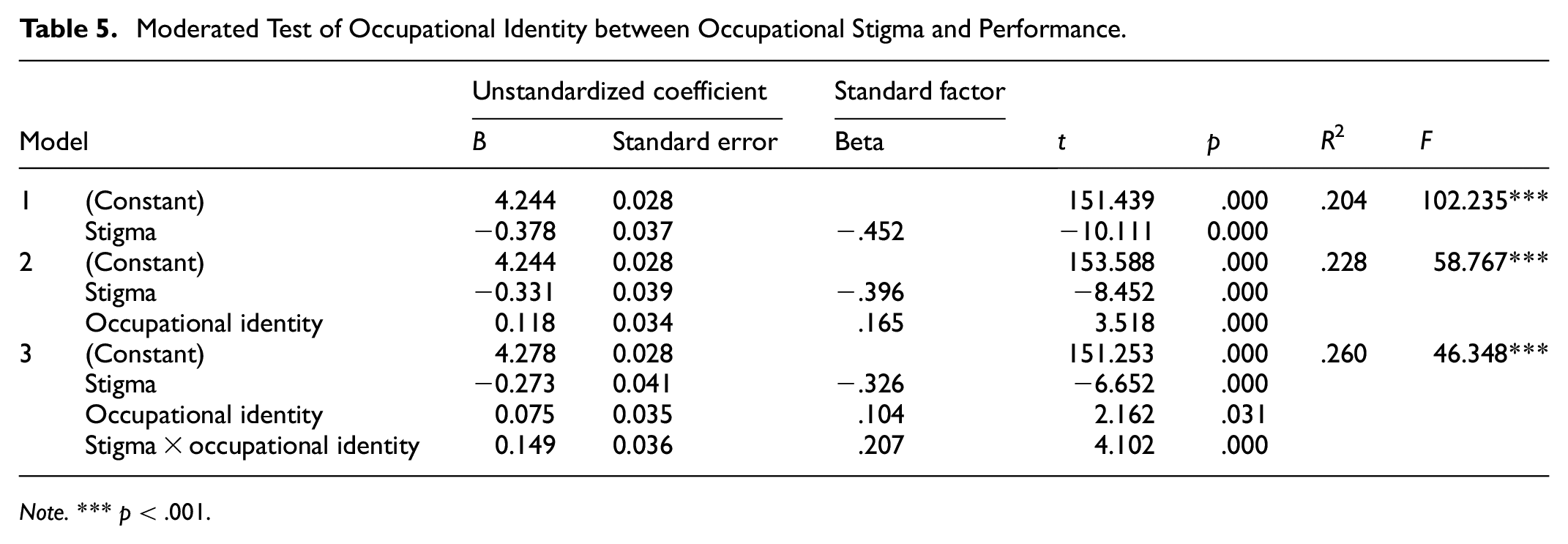
Model 3 of Table 5 shows that the interaction between occupational stigma and occupational identity is positive (β = .207, p < .001), confirming identity’s moderating role in the relationship between stigma and performance, thereby supporting Hypothesis 5b. As depicted in Figure 3, identity mitigates the adverse impact of stigma on performance. Notably, the effect of stigma on job performance is stronger at lower levels of identity. That is, occupational identity attenuates the negative influence of occupational stigma on job performance.
Moderated Test of Occupational Identity between Occupational Stigma and Performance.
Note. *** p < .001.

The moderating role of occupational identity in the relationship between occupational stigma and performance.
As evidenced in Model 3 of Table 6, the interaction between occupational stigma and occupational identity is negative (β = −.14, p < .001), signifying the moderating effect of identity on the relationship between stigma and turnover intentions, supporting Hypothesis 5b. According to the findings presented in Figure 4, stigma’s impact on turnover intentions is more pronounced when identity is low. That is, occupational identity weakens the positive effect of occupational stigma on turnover intentions.
Testing Occupational Identity’s Moderating Role on the Relationship Between Occupational Stigma and Turnover Intentions.

Note. *** p < .001.

The role of occupational identity as a moderator of the relationship between occupational stigma and turnover intentions.
Model 3 of Table 7 shows that the interaction between occupational stigma and occupational identity is positive (β = .213, p < .05), indicating that identity moderates the relationship between stigma and workplace well-being, supporting Hypothesis 5c. As indicated in Figure 5, the influence of stigma on workplace well-being is more pronounced with a weak identity. That is, a strong occupational identity mitigates the negative impact of occupational stigma on workplace well-being.
Occupational Identity’s Moderating Role in the Relationship Between Occupational Stigma and Workplace Well-Being.

Note. *** p < .001.

The role of occupational identity as a moderator of the relationship between occupational stigma and workplace well-being.
Mediated Moderation Test Results
This study performed a mediated moderation test using Model 7 of PROCESS 3.4 with 5,000 Bootstrap iterations. As depicted in Table 8, when performance is the dependent variable, the mediating effect of low occupational identity is −0.213, and the confidence interval does not contain 0, indicating a significant mediating effect. However, the mediating effect of high occupational identity is −0.083, with a confidence interval that does contain 0, suggesting a non-significant mediating effect. The test value for the mediated moderation is 0.074, with a confidence interval that does not include 0, indicating the presence of a mediated moderation effect. Thus, Hypothesis 6a is supported.
Mediated Moderation Test Results.

When the propensity to leave is the dependent variable, the mediating effect of low occupational identity is 0.303, and the confidence interval does not contain 0, implying this effect is significant. Conversely, the mediating effect of high occupational identity is 0.118, with a confidence interval containing 0, suggesting a non-significant mediating effect. The corresponding test value for moderation by the mediator is −0.105, and the corresponding confidence interval does not contain 0, indicating the presence of a mediated moderation effect. Thus, Hypothesis 6b is supported.
The mediating effect of high occupational identity was found to be non-significant, which is potentially explained by the educational background of the food delivery workers in this sample. Highly knowledgeable professionals who are well-regarded in their professional community may be more affected by stigma, as suggested in previous studies, such as Shantz and Booth (2014). As 63.25% of food delivery workers hold a bachelor’s degree or higher, they may have a heightened occupational identity, potentially leading to a stronger emotional response when facing stigma. In other words, food delivery workers with strong occupational identities may already possess a solid sense of commitment and self-worth in their profession, making them less susceptible to the mediating effect of workplace well-being when facing stigma.
Discussion
This study examines the stigma experienced in emerging gig economy occupations in China, with food delivery workers as a representative example. It also investigates the mechanisms behind this stigma and its effects on employees. Additionally, it analyzes the moderating role of organizational identity in the relationship between occupational stigma and workplace well-being, as well as its direct effects on employee performance and turnover intentions.
The results of this study suggest that occupational stigma negatively impacts job performance and increases turnover intentions, supporting the conclusions of Manchha et al. (2023). When employees experience stigma and find that others’ perceptions are inconsistent with their own, their defensive behaviors (e.g., diminished job performance and an increased desire to leave) become more pronounced as their perceived stigma intensifies. At the same time, negative emotions resulting from cognitive inconsistencies can lead to job dissatisfaction, which in turn fosters anti-work behaviors, reduces performance, and increases turnover. That is, occupational stigma affects job performance and turnover intentions through the mediating role of workplace well-being.
In addition, occupational identity moderates the correlations between occupational stigma and job performance, turnover intentions, and workplace well-being, which is consistent with Johnson’s (2018) findings. When occupational cognitive congruence is strengthened, whether externally or internally, employees’ identification with their occupation increases. This enhancement reduces cognitive incongruence and negative emotions, thereby mitigating the negative impacts of occupational stigma. The empirical analysis results are similar to Shantz and Booth’s (2014) findings on perceived congruence; that is, the alignment between employees’ perceptions of society and their jobs, along with how they believe others evaluate them, significantly influences their feelings of occupational stigma and their work outcomes. This study differs from Ashforth and Kreiner’s (1999) research on occupational identity among employees engaged in “dirty work,” which found that a stronger occupational identity better mitigated the negative impact of stigma. In contrast, this present study suggests that a weak occupational identity has a more pronounced role in reducing the impact of stigma within the gig economy. This discrepancy could be attributed to variations in workers’ self-esteem and cognition, possibly influenced by the dynamic and structural changes to the labor force in the gig economy context.
Theoretical Implications
This study contributes to the existing literature by integrating theories, offering new research perspectives, and elucidating micro-level mechanisms.
In terms of theoretical integration, it furthers the examination of occupational stigma within emerging occupations in the gig economy by refining and clarifying the mechanisms underlying the perception and resolution of this stigma. Unlike previous studies that primarily focus on content models such as Expectancy Theory and Resource Conservation Theory (Krug et al., 2019; Link & Phelan, 2014), this research integrates elements of Social Cognitive Theory, Cognitive Dissonance Theory, and Cognitive Consistency Theory. Particularly, Consistency Theory is adopted as a foundational framework, unifying the application of related theories within this theoretical domain to stigma research, allowing the theory’s framework to be applied to the dynamic context of occupational stigma.
Unlike the predominantly Western-focused mainstream research, this study adopts a Chinese perspective to theoretically contribute to the examination of occupational stigma in emerging occupations within the gig economy. It offers fresh insights and guidance for theoretical researchers, organizational managers, and practitioners seeking to mitigate stigma. It also integrates representational, intrinsic perceptual, and destigmatizing strategies with emotion allocation to expand the research on occupational stigma beyond a static context.
A sample of Chinese gig economy workers was used to confirm that workplace well-being and occupational identity are vital in mitigating occupational stigma, underscoring the significance of emotional allocation in the mechanism of this stigma.
At the micro-level of the mechanisms, the findings elucidate the connection between occupational stigma and employee organizational outcomes by intervening in the impact of stigma from an affective congruence perspective.
These results confirm and extend those of previous research on occupational stigma, showing that it significantly relates to both employee performance and turnover intentions. Furthermore, the boundary conditions for the role of occupational identity in alleviating stigma among gig economy employees are confirmed.
This study also demonstrates that stigma significantly affects performance and turnover intentions through its impact on workplace well-being, aligning with the findings of earlier studies.
This study also examines and verifies the boundary conditions of this effect. Caricati et al. (2022) suggest that a stronger occupational identity might lead to increased employee distress when professionals, who are often highly knowledgeable and respected in their work groups, encounter adverse outcomes.
In line with the recommendations of Caricati et al. (2022), this research focuses on food delivery workers, who are often perceived by their community as being in highly stigmatized occupations. The methodology reflects a situation where a strong occupational identity interacted with stigma perceptions, demonstrating that workplace well-being did not significantly mediate the effect of the interaction. This finding further supports the results of Caricati et al. (2022); however, it contradicts the findings of Ashforth and Kreiner (1999). This contradiction is attributed to the changing role of occupational identity in moderating occupational stigma, which is related to labor force characteristics. With the transformation and development of China’s economy, the casual labor market is also in transition, similar to the developing service economy (Overholt, 2016). This labor force is characterized by low to mid-levels of higher education with a cross-cutting knowledge structure; thus, its influencing factors are more complex. For example, in this study, food delivery workers holding bachelor’s degrees or higher accounted for 63.25% of the sample, which can be the focus of future research into the different levels of occupational stigma.
This study offers insights into categorizing occupational stigma and raises questions about segmenting it solely based on skill levels, working conditions (such as poor or superior; Kreiner et al., 2006), and other factors.
Practical Implications
The findings provide valuable guidance for employees and managers in the gig economy. Notably, they reveal that occupational identity is critical in moderating the impact of occupational stigma on performance and turnover intentions, thereby reducing its negative effects. Additionally, identity moderates the impact of perceived occupational stigma on workplace well-being, influencing performance and turnover. Furthermore, workplace well-being serves as a significant mediator between stigma and performance, particularly in relation to turnover intentions.
To ensure well-being, employees can actively engage in occupational awareness and skills training to enhance job fit, thereby addressing challenges and increasing loyalty and identity within the gig economy. This proactive approach can help mitigate the impact of stigma.
Managers can utilize these insights to improve organizational performance and foster retention. Effective strategies include incorporating occupational identity into recruitment evaluations by prioritizing related education, such as providing training on competence, commitment, compensation, and job satisfaction (Vaillant & Milofsky, 1980). Moreover, managers can enhance employee well-being through welfare measures, well-being initiatives, and support for physical and mental health, mitigating the adverse effects of occupational stigma on performance.
Furthermore, industry managers can help change societal perceptions of gig economy occupations by implementing positive publicity initiatives. Strengthening preferential policies and labor protections for gig workers, as well as eliminating societal stigma, are critical steps toward promoting their acceptance and support at the societal level.
Limitations and Future Directions
This study has several limitations. First, the performance measurement questionnaire relied on workers’ self-assessments, which may cause biased results. Thus, future studies can improve response accuracy by collaborating with platform companies to access their personnel and financial data for more effective assessments.
Second, future studies should consider incorporating platform algorithms into the stigma research model. Platform algorithms have a significantly greater impact on workers in China’s food delivery platform industry than in other countries (Griesbach et al., 2019). Therefore, including these algorithms could provide a more comprehensive understanding of their effects on workers.
Third, this research only explored the moderating role of occupational identity regarding the relationship between occupational stigma and the well-being of food delivery workers. Hence, future studies should incorporate other relevant variables to examine their interactions, considering the numerous factors influencing well-being.
Fourth, in terms of data collection, this study collected cross-sectional data, which only reflects a situation at a specific point in time and does not allow for observing variables’ changes and developmental tendencies. Thus, future research should collect tracking data to more comprehensively consider the factors influencing occupational stigmatization.
Finally, it is important to consider “specific environmental variables or levers that influence behavior or attitudes” (Griesbach et al., 2019). Therefore, researchers should conduct categorization studies in different contexts to identify the potential differential impacts of occupational stigma in various geographic, environmental, and occupational settings, including emerging occupations in different countries. While this study examines the impact of stigma within this context, it is recommended that future studies validate this study’s proposed model in comparable occupational settings to further assess its applicability.
Conclusion
The results of this study show that occupational stigma has a significant adverse impact on performance and turnover intentions. They also highlight the unique role of occupational identity and job well-being in mitigating the negative effects of stigma. These results offer theoretical insights for future studies to integrate relevant influencing factors to support in-depth research on stigma.
Notably, the findings provide valuable insights into the complexities of occupational stigma and its implications for workers in different environments. They emphasize the significance of perceived consistency in shaping employees’ experiences with stigma and its consequences on work outcomes. Moreover, this research sheds light on the unique challenges faced by gig economy workers, emphasizing the need for tailored strategies to support their well-being and productivity.
Footnotes

Ethical Considerations
This research did not require ethical approval, as it involved an anonymous survey of adult participants and did not collect personally identifiable information. The study posed minimal risk and complied with the ethical standards of the authors’ institutional research policy.
Consent to Participate
Participants were informed about the study’s purpose, and their participation was entirely voluntary and anonymous. Informed consent was implied through the completion of the questionnaire.
Funding
The author(s) received no financial support for the research, authorship, and/or publication of this article.
Declaration of Conflicting Interests
The author(s) declared no potential conflicts of interest with respect to the research, authorship, and/or publication of this article.
Data Availability Statement
The data that support the findings of this research are available from the corresponding author upon reasonable request. The data are not publicly available due to privacy and ethical restrictions.