



Abstract
The strategic choice of how to gain a new competitive advantage internationally again under the pattern of domestic and international mutual promotion and development is particularly important. Based on the empirical research method, this paper uses both panel data model and BVAR model to analyze the tripartite interaction between digital economy, innovation quality and trade development. A study with innovation quality, digital economy and trade development real data, collected from the China Statistical Yearbook, National Bureau of Statistics, is conducted to illustrate the proposed interaction mechanism. The results show that a good market environment has a certain promotion effect on improvement of digital economy and innovation quality, and there is a certain positive interaction between digital economy and innovation quality.
Keywords
Introduction
At the domestic level in China, the globalization of the digital economy represented by cross-border e-commerce has played a considerable role in optimizing China’s domestic supply-side reform, while optimizing the structure proportion of domestic traditional industries. At the International level, the globalization of digital trade has had a significant ameliorating effect on the cross-border e-commerce economies of various countries and the uneven development between cities. The digital economy and digital trade, as new trade forms, have enhanced the performance of traditional trade, and also made its peer competition environment more intense. Therefore, there is a need to enhance the innovation effect in promoting the digital economy, and to encourage the leadership and support innovation in providing new audience groups, developing new product ideas, and opening new sales channels. Although China is already the second-largest economic entity in the world, at present, in terms of economic volume, there is still a large gap between the high-end equipment manufacturing industry and the world’s top powers. Especially in the context of the current global epidemic trends, China’s economy is under great downward pressure. And there is an urgent need to find new models and new driving forces to help emerging industries produce results, improve the quantity and innovation quality, and thus promote industrial upgrading thereby forming new economic growth points to enhance China’s international competitiveness.
At present, China’s innovation development has entered a new period from quantitative innovation growth to qualitative innovation development. Promoting the high-quality development of innovation, comprehensively enhance the effectiveness of the composite system of innovation quantity and quality on the overall economic dynamics and social development of the country (Zhang et al., 2020). At the same time, with the turbulence in the industry chain caused by the trade friction between China and the United States, it also leads to more uncertainty for future economic growth (Jin et al., 2019). Therefore, China must enter the stage of independent innovation.
The theory of endogenous economic growth reveals the interaction between sustained national economic development and R&D innovation (Romer & Romer, 1989). Technological innovation in the Internet era has given rise to the flourishing concept of digital trade and expanded the scope of new trade theories. With the emergence of new industries and new business models, there is bound to be an impact on the industrial structure and investment direction of the national economy (Brynjolfsson & Hitt, 2000). With the emergence of digital technologies, digital platforms and digital infrastructures, innovation and entrepreneurship approaches are gradually changing (Nambisan et al., 2019). For consumers, they gain new ways to participate and express their ideas (Mäkinen, 2006). For businesses, digital technologies reduce the cost of storing, computing and transmitting data on the one hand (Goldfarb & Tucker, 2019); on the other hand, they provide room for employees to grow (Barner, 1994). Thus, the digital economy offers great opportunities for SMEs in manufacturing and services (Şerbu, 2014). In addition, the COVID-19 has accelerated the digital development and provided an opportunity for companies to transform (Grover & Sabherwal, 2020).
A comparison of countries with open economies in the contemporary world economic system shows that innovation quality becomes the core of national competitiveness and that innovation plays an important role in economic and trade development. Innovation policies can increase the productivity of firms and facilitate their access to export markets (Cassiman et al., 2010). Likewise, firms that innovate to upgrade their technology and reduce the cost of their products gain an advantage in export competition (Karasek, 2012). Moreover, firms that engage in innovation tend to earn more from export transactions than other firms because they are able to sell goods and target markets that reward innovation (Blyde et al., 2018).
With the rapid rise of the digital economy, global value chains are undergoing transformation. As the basis for economic growth and social development, innovation triggers regional development imbalances (Steinmetz, 2015). As an example, innovation has a positive impact on the performance of transformed firms (Ramadani et al., 2019). “Innovation compensation” can offset the “compliance costs” of firms, thus increasing their productivity and product competitiveness (Brunnermeier & Cohen, 2003). It can be a source of competitive advantage for a company by improving its products or refining its services (Taques et al., 2021). As service and manufacturing activities become increasingly inseparable, it is also imperative to develop a new measure of innovation (Bellstam et al., 2020). Digital innovation is different from the traditional innovation process and therefore requires new approaches and new theories to manage innovation (Brock et al., 2020). Relevant organizations should actively participate and enhance their innovation outcomes (Nambisan et al., 2017). The WTO, as a multilateral forum, is also continuously focusing and promoting the future development of digital trade (Koopman et al., 2020). To sum up, the spirit of innovation will be the driving force behind the prosperity of nations. Accordingly, it is significant to have a deeper investigation on the nexus of innovation quality, digital economy and trade development.
Mechanisms of Interaction Between Innovation Quality, Digital Economy and Trade Development
Mechanisms of Influence
With the gradual growth in the number of digital economy participants in various industries, a new trade market represented by cross-border e-commerce has been gradually established. And only when the scale of the digital economy reaches a certain level, the relevant products can form a unique digital trade market advantage in the transaction process of e-commerce.
The non-linear relationship between the digital economy and the international circulation of traditional trade: when the scale of the digital economy is low, the international circulation of the market of traditional trade is still dominant at this time, and once the digital economy products are innovative, it will guide the development of the international circulation channels of traditional trade to new business models such as cross-border e-commerce, so the digital economy presents a negative correlation to traditional trade. Consequently, the first hypothesis is:
New industries such as the digital economy can effectively enhance China’s position in the global value chain. The innovation quality has a positive feedback effect, which can lead to encourage more enterprises to invest more in R&D and further improve their advantages in the trade market. Thus, the second hypothesis is:
Interaction Between Trade Development and Digital Economy, Innovation Quality
With the innovative use of blockchain, quantum computing and a series of other emerging technologies, a large number of digital economy platforms have emerged and made the economy and trade prosperous. Technological innovation and mechanism innovation have positive feedback effects on the innovation quality and digital economy. The prosperity of the digital economy will inevitably lead to better returns for enterprises. If the products provided by enterprises can be competitive under the role of innovation quality, it will prompt enterprises to pay more attention to investment in innovation quantity or quality, so as to achieve the improvement of trade development level.
In recent years Chinese companies have faced a serious situation. Various types of enterprises and industrial entities need various ways to get innovation support. At the macro level the country has proposed an innovation-driven development strategy, and at the micro level all types of enterprises fully utilize the dividends of the digital economy, all these initiatives are conducive to improving the international and domestic cycle of economic and trade development.
In summary, the interaction mechanism of innovation quality, digital economy and trade development is shown as in Figure 1.

Interactive mechanisms for innovation quality, digital economy, and trade development.
Research Model and Data
Research Model
This paper firstly establishes a model of influencing factors of trade development.


In Equation 1, tra denotes trade development; pur denotes digital economy; ent denotes digital economy development potential; tans denotes market environment; rdt denotes corporate R&D investment; nps denotes innovation quality; and rdp denotes innovation environment. Further, the two-dimensional term of digital economy is introduced.
The above model is more mature (Mundlak, 1961) and is estimated using the systematic generalized method of moments (Blundell & Bond, 1998), introducing the first-order lag term of each variable as an instrumental variable.
Research Data
The indicators of various variables in the equation of factors influencing trade development use yearbook statistics. Trade development (tra) is expressed in terms of international trade imports and exports, digital economy (pur) is expressed in terms of e-commerce purchases, digital economy development potential (ent) is expressed in terms of the number of enterprises with e-commerce trading activities, market environment (tans) is expressed in terms of e-commerce transactions, enterprise R&D investment (rdt) is expressed in terms of R&D investment time, innovation quality (nps) is expressed in terms of new product sales revenue, innovation environment (rdp) is expressed by the number of market projects.
The data in this paper are obtained from the China Statistical Yearbook, National Bureau of Statistics. Since the concept of digital economy has only been proposed to emerge in recent years, the data range in this paper is from 2016 to 2020. The descriptive statistics of the variables are shown as in Table 1.
Descriptive Statistics.

Empirical Analysis
Smoothness Test of Variables
The results of the stationarity test of the data are shown in Table 2, and after first-order differencing, all variables are stationary panel data.
Stability Test of Variables.

The test passed at the 10%, 5%, and 1% levels, respectively.
Estimation of the Role of Innovation Quality, Digital Economy on Trade Development
The estimation results of the panel data are shown as in Table 3. Firstly, the averagelasticity coefficient of innovation quality and digital economy is estimated based on Equation 1, and the Hauseman test value is 85.560 with a companion probability of .000. The original hypothesis of random effect is rejected, and the fixed effect model is used for estimation, and the goodness of fit of the estimated results is 0.888, which is within the acceptable range.
Estimation Results of the Panel Data.

The test passed at the 5%, and 1% levels, respectively.
While the digital economy, digital economy development potential does not pass the statistical test, it indicates that there is almost no contribution to trade development in a certain extent. The coefficient of market environment is .289, which indicates a positive role of market environment on trade development by statistical test; the coefficient of R&D investment is −.556, which indicates a negative role of R&D investment on trade development by statistical test; the coefficient of innovation quality is .431, which indicates a positive role of innovation quality on trade development by statistical test; the coefficient of innovation atmosphere is .738, which indicates a positive role of innovation atmosphere on trade development by the coefficient of innovation atmosphere is .738, which indicates a positive correlation between innovation atmosphere and trade development.
This study inferred that the digital economy, digital economy development potential needs to work together with other factors. That is, in the initial stage of the development of the digital economy, the initial investment is not significant effect. Only when the digital economy has reached a certain stage of development, the high-quality efficiency aggregation brought by the digital economy can have a driving effect on trade development.
Based on Equation 2 to estimate the law of action of digital economy, the Hauseman test value is 88.901, with a companion probability of .000, the original hypothesis of random effect is rejected, and the fixed effect model continues to be used for estimation, and the goodness of fit of the model is .897 acceptable. The 2-term terms of R&D investment, digital economy, innovation quality, innovation environment, and digital economy passed the statistical test.
The regression coefficient of the two-dimensional term of digital economy is 0.058, indicating that the contribution of digital economy to trade development shows a U-shaped curve, which can verify hypothesis one. The market environment and the development potential of digital economy did not pass the statistical test. The coefficient of innovation quality is .424, which indicates through statistical test that the innovation quality is positively correlated to trade development; the coefficient of innovation atmosphere is .776, which indicates through statistical test that the innovation atmosphere is positively correlated to trade development; the coefficient of R&D investment is −.443, which indicates through statistical test that the R&D investment is negatively correlated to trade development; the coefficient of digital economy is −.553. The coefficient of digital economy is −.553, which indicates a negative correlation between digital economy and trade development.
This study combined with other factors to infer that the market environment, digital economy development potential needs to work together with other factors, that is, inefficient inputs are meaningless, and must improve the market environment, digital economy development potential connotation and efficiency to be able to significantly promote the role of trade development.
Both Equations 1 and 2, digital economic development potential did not pass the statistical test, H2 verification. However, the second term of pur passed the statistical test, which synthetically indicates that the digital economy in the process of China’s domestic and foreign double-loop development can only produce a qualitative effect if it reaches a certain threshold.
Interaction Between Innovation Quality, Digital Economy and Economic Trade
In order to analyze the interaction between innovation quality, digital economy and trade development, a panel Bayesian vector autoregressive model is further employed for estimation, considering that market environment and R&D investment in each region will play an important role in it, so they are introduced together, and a total of five variables are used to build the Bayesian vector autoregressive model. Since the time span of the panel data is small, the lag term is chosen to be 2, which also facilitates the saving of degrees of freedom.
Figure 2 shows that the model is smooth, that is, the AR root tests are all within the unit circle, and impulse response and variance decomposition analysis can be done. The following impulse response function and variance decomposition are used to analyze the interaction between innovation quality, digital economy and trade development.

AR root test.
Impulse Response Function Analysis
First, the impulse response function of the digital economy is shown as in Figure 3. A positive shock of one standard deviation from the market environment has the largest impact, which is zero in the current period and reaches a great value in period 2, then decays slowly in period 3, but starts to rise steadily from period 4 with a high overall level. The next is the impact of trade development, which is 0 in the current period and rises steadily from period 2, maintaining an upward stable state, indicating that the improvement of trade development can effectively promote the digital economy. The shock effect of innovation quality is negative in the first seven periods and turns positive from the eighth period and starts to rise steadily. The underlying reason is that China’s current innovation quality is low and it takes some time to effectively promote the digital economy. R&D investment fluctuates and is mostly negative in the first few periods, but starts to rise steadily from the eighth period, indicating that both of them will induce the improvement of digital economy when they reach a certain scale, forming a benign relationship.
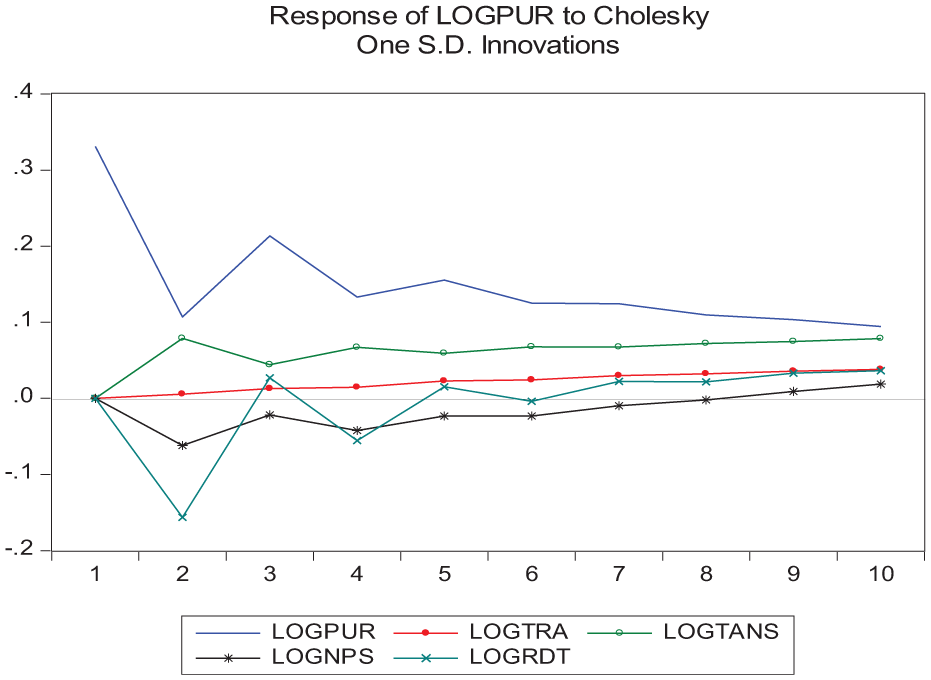
Impulse response functions for the digital economy.
Second, the impulse response function of trade development is shown as in Figure 4. The positive shock from the market environment with one standard deviation is zero in the current period, reaches a great value in the second period, and then decays slowly in the third period, but starts to rise steadily from the fourth period and the overall level is high. The second is the shock of digital economy, which is negative in the current period and steadily increases from period 2, maintaining an upward stable state, indicating that the digital economy enhancement can effectively promote trade development. The impact effect of innovation quality is zero in the current period, negative in the second period, and rapidly and steadily increasing from the third period. R&D investment fluctuates and is mostly negative in the first few periods, and is in a stable state of improvement from the fifth period. It shows that the innovation quality and R&D investment reach a certain scale before they form a positive relationship with trade development.

Impulse response function of trade development.
Third, the impulse response function of the market environment is shown as in Figure 5. The positive shock from a standard deviation of the digital economy has the greatest impact, reaching a great value in period 1 and then decaying slowly, but with a high overall level. This is followed by a trade development shock, which reaches a maximum value in period 3 and then remains relatively stable at a high level. The innovation quality is zero in the current period, and increases slightly in the second and third periods, and has been in a steady state of improvement after fluctuating in the fourth period. The effect of R&D investment shock is negative and fluctuating in the first seven periods, and then turns positive in the eighth period and starts to rise steadily. The underlying reason is that China’s current R&D investment is low and needs to develop for a period of time to effectively promote the market environment.
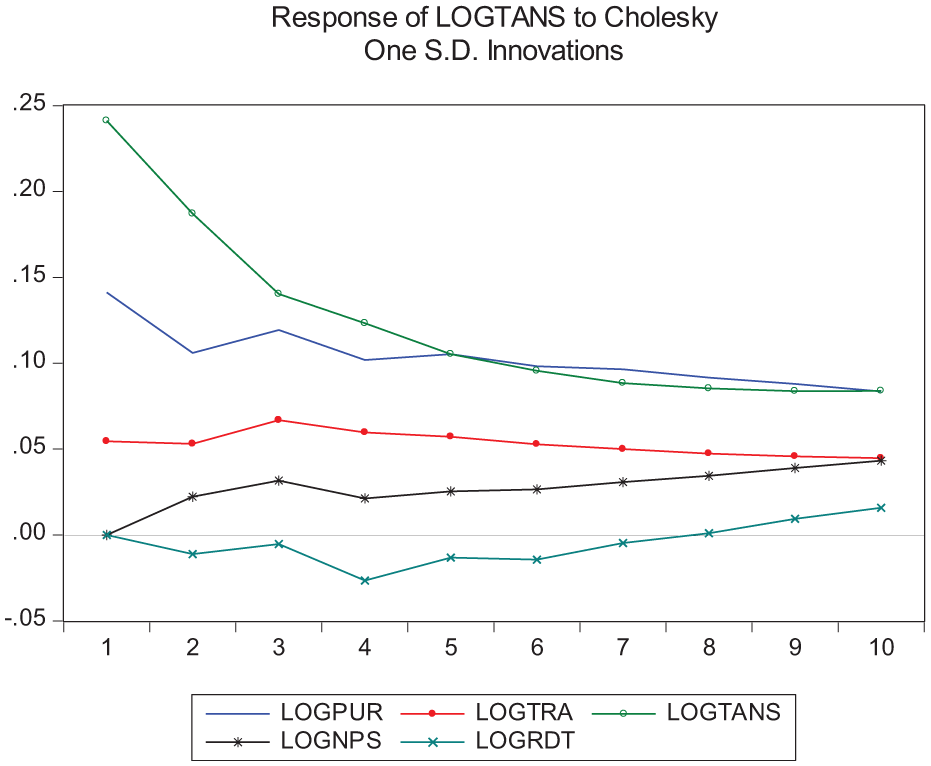
Impulse response function of the market environment.
Fourth, the impulse response function for the innovation quality is shown as in Figure 6. the impact of a positive shock of one standard deviation from the digital economy reaches a great value in period 1 and then decays slowly. The trade development shock, which is followed by a small fluctuation in period 2 to 3, then maintains a relatively stable level of increase. The effect of market environment shocks has been in a state of rapid elevation, and remains stable from period 7. It indicates that the market environment enhancement can effectively promote the innovation quality. The two form a benign relationship, and will remain stable when reaching a certain scale. The effect of the impact of R&D investment has been in a state of rapid increase, and starts to decay slowly after period 6. It indicates that from the short-term perspective, the increase of R&D investment can effectively promote innovation quality. From the long-term perspective, R&D input enhancement cannot effectively promote innovation quality.

Impulse response function for innovation quality.
Fifth, the impulse response function of R&D investment is shown as in Figure 7. The impact of a positive shock from one standard deviation of the digital economy reaches a great value in period 1 and then decays slowly. The shock from trade development reaches a very small value in period 2 and then rises steadily, remaining horizontal. The effect of shocks from the market environment is in a rapid increase, and the innovation quality is in a rapid increase from period 2 and remains high. It indicates that the investment in market environment and innovation quality can significantly improve the R&D investment and maintain a high level.
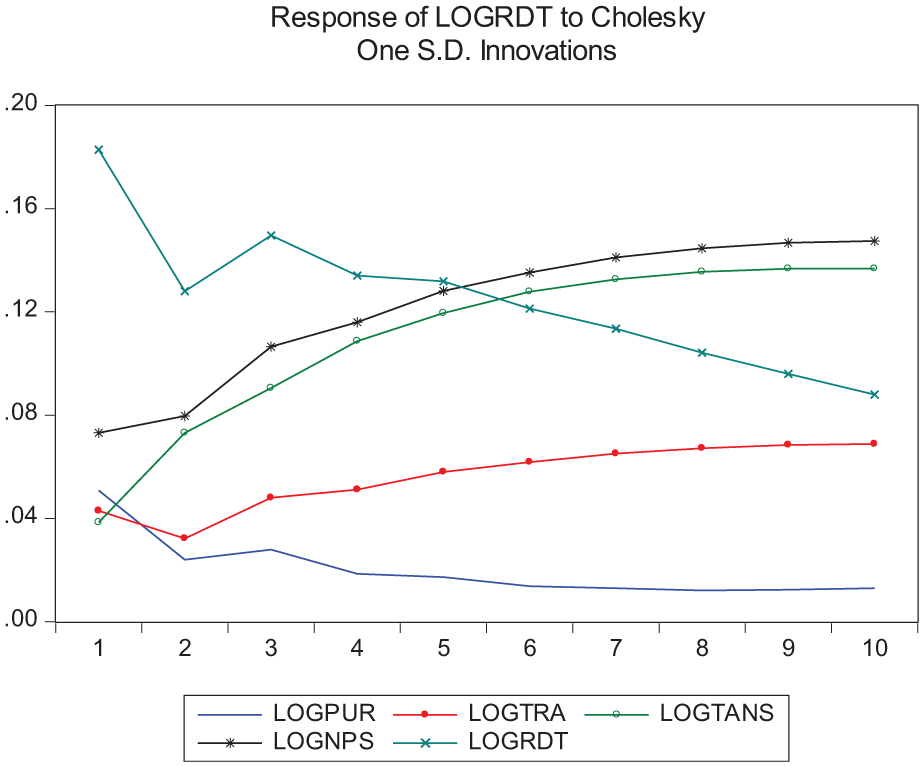
Impulse response function of R&D investment.
Variance Decomposition
The variance decomposition of each variable for the 10th period is shown as in Table 4 and is analyzed below one by one.
The 10th Period Variance Decomposition of Each Variable.

In the variance decomposition of digital economy, its own share is 74.177%, and the contribution of market environment is 17.766%, which indicates that market environment has a role in the share of contribution of digital economy. The contribution of trade development is only 1.828%, the contribution of R&D investment is only 4.218%, and the contribution of innovation quality is only 2.008%, which means that the contribution of trade development, R&D investment, and innovation quality to the digital economy is not high in general.
In the variance decomposition of trade development, it accounts for 66.257%, and the market environment plays a larger role, contributing 12.057%, while the remaining variables contribute very little, indicating that the improvement of trade development mainly relies on the market environment as the basis.
In the variance decomposition of market environment, its own share is 58.193%, the contribution of digital economy is 29.295%, and the contribution of the remaining variables is very small, which indicates that digital economy can effectively contribute to the improvement of market environment.
In the variance decomposition of R&D input, itself accounts for 60.923%, and the other factors that play a greater role are market environment accounting for 21.474% and innovation quality accounting for 13.356%, indicating that the market environment and innovation quality have a better effect on R&D investment.
In the variance decomposition of innovation quality, 42.990% of the variance is for itself, 21.520% is for market environment, and 30.538% is for R&D investment, which means that market environment and R&D investment have better effect on innovation quality.
Conclusions
Positive Interaction Between Digital Economy and Trade Development
The mechanisms of the digital economy on trade development include blue ocean market, industry restructuring, and benign feedback, and the mechanisms of the trade development on the digital economy include improvement of industry standards, marketing feedback effect, and government policy effect. The results of the panel data show that the elasticity coefficient of the digital economy on trade development is negative, and the elasticity coefficient of the quadratic term of the digital economy on trade development is positive and passes the test, indicating that the contribution of the digital economy to trade development shows a U-shaped curve. The results of the impulse response function show that there is a positive interaction between the digital economy and trade development. The results of variance decomposition show that the feedback effect of digital economy on trade development is greater than the contribution of trade development to digital economy. In general, the Chinese government and enterprises attach more importance to the development of digital economy. The digital economy in general has a certain scale and the number of relevant inputs around the country is large, which effectively promotes the development of trade development as can be seen through the model constructed in this paper. The positive feedback effect of the international cycle of trade development also further motivates the government and enterprises to increase their investment, forming a domestic cycle of gains in the digital economy.
Low Interplay Between Innovation Quality and Trade Development
The expected mechanisms of the role of innovation quality on trade development include formation of improved product efficiency, fostering innovative talents, and cultivating an innovative atmosphere. However, the results of the empirical study of panel data indicate that the contribution of innovation quality to trade development is insignificant. The share of innovation quality contribution in the variance decomposition of trade development is generally low. The share of trade development contribution in the variance decomposition of innovation quality is also small. This indicates that the interaction between innovation quality and trade development is low. The reason for the above problems is that China has a low overall level of innovation quality, few original achievements, and a small contribution of innovation quality to trade development. China plays the role of the world factory provider in the current world trade system, the technical content of trade products and brand services need to be improved, and Chinese enterprises are still in the primary stage in the international trade supply chain. For this reason, it is necessary to continuously improve the innovation quality and enhance the connotation of innovation with domestic and international double cycle in order to gradually solve the problem fundamentally.
A Good Market Environment Can Promote the Digital Economy
The digital economy is an emerging concept that has been flourishing everywhere in recent years. The results of the impulse response function indicate that the market environment has a better effect on the development of the digital economy. The digital economy development comes from the application of various emerging technologies and advanced management in the Internet market. Generally speaking, the more regions tend to cultivate, adopt, and deploy emerging technologies and advanced management systems, that is, regions with better cultivated market environments, the better the digital economy development is. Therefore, society should be encouraged to pay more attention to the cultivation of the market environment based on the expansion of the hardware inputs number. Using various effective measures, such as sharpening the focus on new economic rules by improving the level of digital infrastructure, to comprehensively enhance the development of the digital economy.
Positive Interaction Between Digital Economy and Innovation Quality
The innovation quality drives the development of new technologies. The combination of new technologies and new models drives the progress of the digital economy. However, from a short-term perspective, the role of innovation quality on the digital economy is not significant. The underlying reason is that the innovation quality in China is currently low and needs to be developed for some time to make new technologies and new models more mature and industrialized. Only on this basis can the innovation quality effectively contribute to the digital economy. The impulse response function shows that in the long run, as the digital economy becomes fully developed, its feedback effect promotes the innovation quality. This is because the value of the digital economy can attract more investment into this industry, causing continuous technological and managerial progress thus increasing the level of innovation quality.
A Good Market Environment Can Promote the Innovation Quality
The impulse response function shows that the market environment enhancement can effectively promote the innovation quality. The improvement of innovation quality can also keep the market environment in a steady improvement state. The two form a virtuous relationship, which will remain stable when a certain scale is reached.
Generally speaking, regions with a better cultivated market environment are more inclusive of all kinds of emerging technologies and advanced systems. The better the level of innovation quality development is the better innovation atmosphere becomes. Therefore, through the management system, policies and regulations of the cultivation of the soft environment, the full use of all kinds of effective resources, measures, can be a comprehensive and effective way to enhance the innovation quality.
Footnotes
Acknowledgements
The authors appreciate the supports from Zhejiang Creative Science Research Association and Zhijiang Technology Think Tank. Ke XU and Wenjing LI from The Voice of the West Lake.

Author Contributions
Guanglan ZHOU: Supervision, Funding acquisition, Data curation, Writing – review & editing, Conceptualization. Kemin TANG: Visualization, Writing – review & editing, Software, Methodology.
Funding
The authors disclosed receipt of the following financial support for the research, authorship, and/or publication of this article: This work was supported by the National Social Science Fund of China (22BTQ063).
Declaration of Conflicting Interests
The authors declared no potential conflicts of interest with respect to the research, authorship, and/or publication of this article.
Data Availability Statement
The data that support the findings of this study are available from the corresponding author upon reasonable request.