



Abstract
This study provides the first systematic evaluation of China’s Specialized, Refined, Differential, and Innovative (SRDI) “Little Giant” certification policy’s impact on corporate innovation, employing a multi-period difference-in-differences (DID) design using A-share listed firm data from 2016 to 2022. Three key findings are identified: First, SRDI policy significantly enhanced corporate innovation, with results that were robust to multiple specification tests. Second, mechanism analysis revealed this effect operated through dual channels - explicit channels including financial support and implicit channels including digital transformation. Third, the policy demonstrated stronger effects for NSOEs, technologically advanced firms, and those in highly marketized regions. Beyond providing systematic evidence of SRDI’s innovation effects, this study contributed an original explicit-implicit dual-channel framework for policy evaluation.
Introduction
With the intensification of anti-globalization and international trade disputes, the key technologies of Chinese enterprises have been placed in a “stranglehold,” and the construction of the industrial chain suffered tremendous damage (Ding & Wu, 2023). To mitigate the impact of uncertainties in the external environment, address the problems of chain blockage and breakage, and improve the independent and controllable ability of the industrial chain, the Chinese government continuously improved the cultivation policy for specialized, refined, differentiated, and innovative (SRDI) enterprises (Xiao & Li, 2022). Additionally, it has supported SMEs in terms of finance, credit, talent, and digital transformation, etc., and has vigorously promoted the development of SMEs toward “SRDI.” The Chinese government implemented the first series of SRDI “little giants” enterprise cultivation plan in 2018 (Kong et al., 2023), and as of 2022, the Ministry of Industry and Information Technology certified four series of SRDI “little giants” enterprises for 9,279 enterprises. To strengthen and complement the industrial chain and eliminate the “stranglehold” of key technologies, the SRDI policy has received great attention in practice and theory.
The SRDI policy represents a refined “picking winners” mechanism. Through multi-dimensional screening criteria including specialization, refinement, distinctive characteristics, and innovation capabilities, the government identifies high-quality enterprises with exceptional innovation potential (Cantner & Kösters, 2012). The policy addresses innovation market failures through three mechanisms: signal transmission, policy mix tools, and targeted cultivation (OECD, 2015; Spence, 1973). However, the empirical evaluations of the policy’s effectiveness remain contentious. While some studies have demonstrated reduced financing costs and enhanced R&D intensity (Carboni, 2011; Ma et al., 2022; Olivero, 2011; Shi et al., 2023), others have suggested potential distortions in R&D decisions and crowding-out effects (Howell, 2017; Lach, 2002; Leahy & Neary, 1997). These contradictions primarily reflect insufficient examination of the policy’s transmission mechanisms, particularly at the micro level. Current research exhibits two critical limitations: an excessive focus on macro-level effects while overlooking micro-level transmission through explicit and implicit channels, and an inadequate consideration of firm heterogeneity in policy responses. These gaps underscore key research questions: Through what specific channels does the SRDI policy influence innovation? How do policy effects vary across different types of firms? Addressing these questions would provide more precise policy evaluation while advancing innovation governance theory from macro design to micro-level mechanisms.
We employed the difference-in-differences (DID) method to examine the impact of the SRDI policy on corporate innovation and its underlying mechanisms, using data on A-share listed firms from 2016 to 2022. Results demonstrated that the SRDI policy significantly promotes corporate innovation. Mechanism analyses revealed that this effect operates primarily through both explicit channels including financial support and credit support and implicit channels including digital transformation support. Heterogeneity tests further indicated that the innovation-enhancing effect of the SRDI policy is more pronounced for NSOEs enterprises, firms with stronger technological foundations, and those located in regions with higher marketization levels.
This study makes three main contributions. First, at the theoretical mechanism level, we innovatively constructed an “explicit-implicit” dual-channel analytical framework that systematically reveals how the SRDI policy promotes corporate innovation through explicit channels including financial support and credit support and implicit channels including digital transformation support. This findings not only enrich the theoretical connotation of the government’s “picking winners” strategy (Cantner & Kösters, 2012), but also provide a new analytical perspective for resolving disputes in innovation policy evaluation (Lach, 2002; Shi et al., 2023). Second, methodologically, this study breaks through the current limitation of qualitative analysis dominating SRDI research (Dun & Mao, 2023). Through collecting panel data of multi-batch certified enterprises from 2016 to 2022 and innovatively adopting the multi-period DID approach, we effectively overcame the deficiencies in sample selection (Zhang et al., 2023) and policy cycle definition (Ding & Wu, 2023) found in existing studies, thereby providing a more rigorous econometric analysis paradigm for policy evaluation. Finally, regarding policy implications, based on heterogeneity analysis results, we systematically identified characteristic patterns showing more significant policy effects for NSOEs, firms with stronger technological foundations, and those located in regions with higher marketization levels. These results not only verify the “institutional complementarity” of innovation policies (Acemoglu et al., 2006)—where policy effectiveness depends on the alignment between market environment and firm capabilities—but also provides empirical evidence for targeted government interventions (Dong & Li, 2021).
This paper is structured as follows. Section 2 introduces the policy background, literature review, and research hypotheses. Section 3 describes the research design. Section 4 presents the empirical results. Section 5 conducts the analysis of heterogeneity and mechanism. Section 6 provides a conclusion and recommendations for policy formulation.
Policy Background, Literature Review, and Research Hypotheses
Policy Background
The SRDI policy was first introduced by the Chinese government as an official initiative in July 2011. The SRDI policy is a key innovation policy proposed by the Chinese government to improve scientific and technological innovation, to strengthen industry and supply chain resilience, and to address the “stranglehold” problem. The role of SRDI SMEs in complementing and strengthening the industrial chain has helped maintain national security (Dong & Li, 2021). The SRDI policy implemented by the Chinese government went through strategic layout, detailed implementation, and accelerated promotion phases. In the strategic layout phase (2011–2016), the government mainly primarily proposed the concept of SRDI medium-sized enterprises and clarified future directions of SRDI. At that time, SRDI was only a concept, and no specific evaluation standard were established; instead, the direction of SME transformation and upgrading was outlined, along with general development guidelines. The second phase was the refinement and implementation phase (2016–2019), during which the government refined the cultivation path of SRDI enterprises and clarified the specific cultivation conditions of SRDI “little giants” enterprises. This phase refined the first phase, but no list of SRDI enterprises had been formulated. The third phase was the acceleration phase (2019–2022), in which the government further emphasized the importance of the SRDI policy and accelerated the steps for the cultivation of enterprises. In 2019, SRDI “little giants” enterprises were first announced by China’s Ministry of Industry and Information Technology (MIIT). In 2021, the government proposed 31 specific support measures for SRDI “little giants” enterprises, including increasing financial support and improving credit support. By 2022, MIIT had certified four batches of SRDI “little giants” enterprises, with a total of 9,279 enterprises (Cao et al., 2022; Xing & Yang, 2022). This phase ushered in the official implementation phase of the policy of “little giants” enterprises with SRDI. The data collected in this study on certified “little giants” SRDI enterprises comes from this phase.
Literature Review
The SRDI policy implemented by the Chinese government, as a typical “picking winners” strategy (Cantner & Kösters, 2012), has emerged as an important policy tool for promoting industrial chain modernization (Dun & Mao, 2023). Research on its policy effects reveals distinct theoretical divisions. At the macro level, studies supporting the “promotion effect” have demonstrated that this policy significantly reduces corporate financing costs through government endorsement signals (Spence, 1973; Shi et al., 2023), and directly enhances R&D intensity through supply-side policies such as tax incentives (Ma et al., 2022;Guo et al., 2016). Conversely, research on the crowding-out effect argues that the policy may distort market selection mechanisms, causing firms to develop path dependence on government subsidies for R&D investment (Lach, 2002; Leahy & Neary,1997).This theoretical divergence highlights the necessity for in-depth analysis of the policy’s transmission mechanisms.
Existing research demonstrates three key limitations regarding policy transmission mechanisms: First, while recognizing the promotional effects of supply-side and environmental policies (Guo et al., 2016), most studies lack in-depth analysis and testing of dual-channel mechanisms combining explicit resource support (such as government subsidies) and implicit qualification certification (such as government endorsement). Second, although studies acknowledge that SRDI enterprise development requires systematic support (Dong & Li, 2021), including critical variables like business environment optimization (Douglas et al., 2020; Greenwood et al., 2011; Lim et al., 2016) and digital transformation (J. Li, 2021; Xing & Yang, 2022), how these variables operate in policy transmission remain insufficiently explained. Third, while research finds more significant policy effects in discrete manufacturing sectors (Zhang et al., 2023) and patent-intensive enterprises (Ding & Wu, 2023), limitations persist as Ding and Wu (2023) only examined incubation cycles and Zhang et al. (2023) omitted 2020 enterprise data, leading to inadequate examination of how heterogeneous factors like ownership type, technological foundation, and regional marketization levels moderate policy effectiveness.
Given these research limitations, this study contends that China’s four consecutive rounds of SRDI “Little Giants” certification since 2019 provides an ideal scenario for applying the continuous multi-period DID method. This approach offers dual advantages: first, by constructing a dynamic evaluation framework, it systematically examines the differential transmission pathways of explicit and implicit policy tools on corporate innovation, addressing the insufficient analysis in existing studies of policy mechanisms; second, by incorporating multidimensional heterogeneous characteristics including ownership type, technological foundation, and regional marketization levels, it can deeply reveal differentiated policy response mechanisms across various enterprise types (Dong & Li, 2021). This research design not only resolves the sample selection and methodological limitations in studies by Ding and Wu (2023) and Zhang et al. (2023), but also provides new theoretical perspectives for understanding the micro-level mechanisms of SRDI policy, ultimately advancing innovation policy theory from macro-level design to in-depth exploration of micro-level transmission mechanisms.
Research Hypotheses
Unlike those in the government’s previous innovation support policies such as the high-tech enterprise certification, the SRDI policy for SMEs is distinguished by establishing a synergistic policy framework that combines both explicit and implicit support channels. This design is aligned with the OECD’s concept of “innovation policy mix,” which advocates coordinated policy instruments to facilitate the holistic allocation of innovation resources including capital, talent, and technology. On the explicit support level, the policy employs direct interventions such as fiscal subsidies, tax incentives, and targeted credit provisions to alleviate financial constraints on corporate innovation—consistent with the OECD’s principle of “addressing market failures.” On the implicit support level, it provides indirect empowerment through talent recruitment support, digital transformation services, and industrial chain collaboration platforms, thereby mitigating information asymmetry and capability gaps in the innovation process. This embodies the OECD framework’s core proposition of “enhancing innovation system connectivity.” The integration of explicit and implicit channels not only expands the policy’s coverage across multiple innovation dimensions but also enhances the overall efficiency of the innovation ecosystem through synergistic effects among these elements.
“Explicit,” Channels
Financial and credit support is the most used instrument of government innovation policy, with a direct impact on the objectives of government policy support and enterprise innovation.
First, enterprises certified as SRDI “little giants” can receive financial support such as government recognition incentives and capital subsidies. In general, enterprises that are certificated as SRDI “little giants” can receive government subsidies ranging from ¥300,000 to ¥1,000,000 from the local government. Previous studies have shown that enterprises invest more in R&D and file more patents with the help of government subsidies (Czarnitzki & Delanote, 2015; Piao et al., 2023). Innovation activities are stimulated by financial subsidies. First, because financial subsidies directly increase the funds invested by enterprises in R&D; Second, it is also a manifestation of the government’s encouragement of enterprise innovation, which can increase the motivation for enterprise R&D investment.
Second, companies certified as SRDI “little giants” can receive credit support from the government, and thus alleviate financing constraints. SRDI “little giants” are more active in innovation activities, implying that they require large amounts of capital investment. These companies often face difficulties in obtaining financing (Wang et al., 2017). Therefore, the government has opened a financing “green channel” for these enterprises, and enterprises certified as SRDI “little giants” are prioritized for obtaining credit support from banks as well as in obtaining the qualifications for listing on the stock market, which helps these enterprises solve the financial problems and enhance their innovative capacity.
“Implicit,” Channels
While talent and digital transformation support directly affect the recipients of policy support, they can indirectly help enterprises to improve their innovative capacity and promote their innovation through the “signaling” effect and “platform support.”
First, enterprises certified as SRDI “little giants” can receive government-led talent support obtained from two sources: First, the government sets up special job fairs for SRDI enterprises and provides subsidies for high-level technical talent to help enterprises attract such talent, thereby encouraging enterprises to carry out research and development activities. Second, the certification creates a signaling effect (Lei & Guo, 2018; Lerner, 2000), which makes skilled workers more optimistic about the development of enterprises certificated by the “little giants” certification program and devote themselves to the R&D work of the enterprises.
Second, enterprises certified as SRDI “little giants” can obtain government-led support for digital transformation. Industry big data and Internet platforms supported by the government can help enterprises improve their digital solutions (Bagale et al., 2021; Chanias et al., 2019; Li et al., 2018; Vial, 2019), accelerate the speed of new product development, continuously improve their products and business models, address SME challenges, and promote enterprise innovation (F. Li, Xu, & Yan, 2023; L. Li, Huang, & Cheng, 2023). The government encourages leading enterprises in the industry to share their experience and resources in digital transformation, guides leading enterprises in the industry to incorporate SRDI “little giants” enterprises into the supply chain system, and promotes the digital transformation of SRDI “little giants” enterprises in the supply chain.
Based on the above analysis, we propose the following Hypothesis 1:
Research Design
Model Construction
To assess the effect of policy implementation, the DID method is widely used. As a quasi-natural experiment, the SRDI “little giant” certification policy serves, with the listed companies certified as “little giants” as “treatment group” and the other listed companies without “little giants” certification being the “control group.” The net effect of the SRDI policy is effectively assessed by separating the “treatment effect” and the “time effect” through the DID method. On this basis, we employ PSM-DID to conduct the study. The basic logic of this method is to identify control group enterprises matched to the “treatment group” enterprises through PSM method, and then use DID method to evaluate the policy effects under balanced conditions, to effectively avoid the endogenous interference and isolate the pure policy effects as much as possible. Therefore, this study constructs the following multi-period DID model:

To elaborate,
Variable Definitions
(1) Explained variable: We measure Innovation using the natural logarithm of (1 + patent applications), applying a one-period lag to account for both the SRDI policy’s delayed effects and potential heteroskedasticity from skewed patent distributions.
(2) Explanatory variable: we use DID to determine whether an enterprise has been certified as SRDI “little giants.”DID represents the difference-in-differences term, so if the listed company obtains the SRDI “little giants” certification, the value in that year and thereafter will be “1,” and otherwise, it will be “0.”
(3) Control variables: following Yin and Li (2022), this study introduces some variables that affect innovation as control variables, including Age, the number of years the firm has been in business; Size, the natural logarithm of total assets; ROE, the net profit divided by the average net assets, which represents the overall business condition of the firm; Hold1, the first-largest shareholder share percentage compared to total shares, which indicates firm governance; and FixR, the ratio of the fixed assets to the total assets, which represents the business characteristics of the firm; LEV, the ratio of liabilities to total assets, which represents the solvency of the enterprise; Growth, the growth rate of the enterprise’s revenue, expresses the growth ability of the enterprise; IndboardR, the ratio of the number of independent directors to the number of directors, represents the governance level of the enterprise.
Data Source
This study constructed its research sample based on data from Chinese A-share listed firms from 2016 to 2022, using these screening criteria: (1) excluding financial and insurance sector firms (CSRC industry codes J and I) due to their significantly different capital structures and accounting systems; (2) excluding ST and *ST companies under special treatment because their abnormal financial conditions (delisting risks for ST or other risk warnings for *ST) may distort research results; (3) removing observations with missing key data (total assets, asset-liability ratio, ROE, patent applications, etc.); (4) We winsorized all continuous variables at the top and bottom 1% to control for outliers. While the SRDI policy was implemented starting in 2019, we extended the sample period to 2016 to ensure sufficient pre-policy data for parallel trend testing in the difference-in-differences (DID) analysis. The final sample included 9,004 firm-year observations, including 1,226 SRDI-certified “Little Giants” enterprises (treatment group) identified by MIIT and 7,778 control firms, representing 90 sub-sectors with 100% industry representation. Data were obtained from the following sources: (1) the official SRDI enterprise certification list disclosed by MIIT and the WIND Financial Database; (2) corporate financial data from the CSMAR Database, along with corporate digital transformation and patent data provided by the Chinese Research Data Service Platform (CNRDS).
Empirical Results
Propensity Score Matching
As the SRDI policy reflects the government’s “picking winners” approach (Cantner & Kösters, 2012), systematic differences in baseline characteristics (e.g., firm size, profitability) may exist between certified and non-certified enterprises. To address potential estimation bias, we implement propensity score matching (PSM) to control for these observable confounders. Specifically, we employ Logit regression to estimate the propensity scores using variables in both treatment and control groups. Based on the propensity score, we apply caliper nearest neighbor matching to match the samples. Given significant differences in the characteristics of enterprises between industries and cities, we control the factors of industries and cities for matching.
Propensity Scores Matching Kernel Density Function Plot
The kernel density function plot can be used to check the quality of PSM. Greater overlap between the kernel density plots of the treatment group and the control group, the better the matching effect. Figure 1 and 2 show that before PSM, the skewness and kurtosis of the kernel density function plot of the control group deviated greatly from those of the treatment group, and after PSM, the kernel density function degree distributions of the “control group” and the “treatment” group nearly overlapped, which indicated that the matching quality was better.

Kernel density function plot before match.
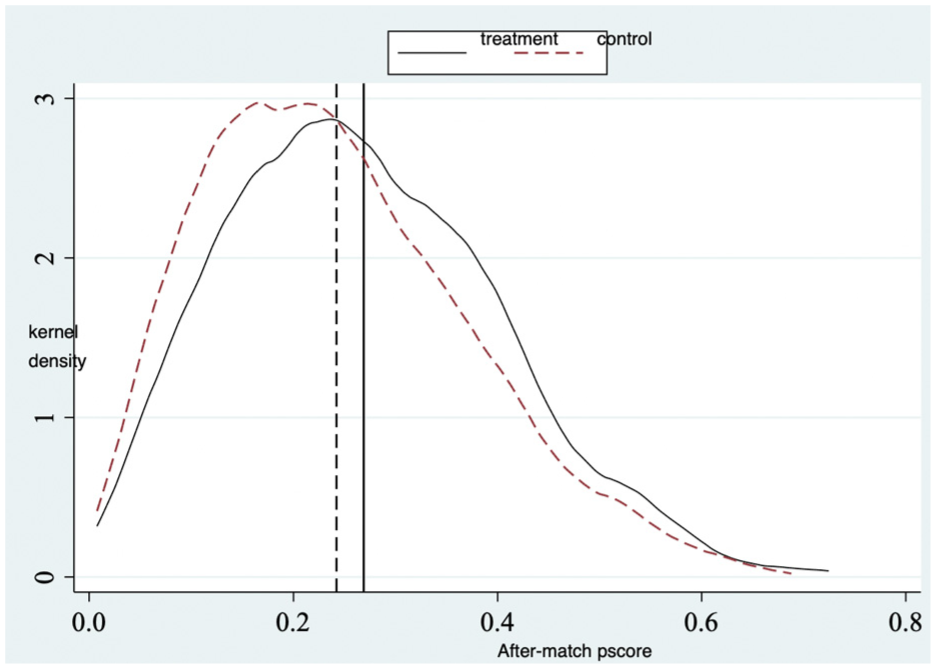
Kernel density function plot after match.
Propensity Scores Matching Balance Test
To ensure the PSM results more reliable, the results must satisfy the “conditional independence assumption,” that is, significant difference between the treatment group and the control group in terms of the matched variables. The standard approach for evaluating the validity of PSM is to verify whether the absolute value of the standard deviation of the matched variable is less than 20, and the smaller the absolute value of the standard deviation is, the better the matching effect is. As Table 1 shows, the absolute values of the standard deviations of the matched variables after PSM are all below 5%. At the same time, after checking the t-test value of the probability of matching, it is found that the t-test value is no longer significant, which indicates that the original hypothesis that the mean values of the matched variables are equal after PSM is accepted, confirming PSM effectiveness.
The Balance Test of Propensity Score Matching.

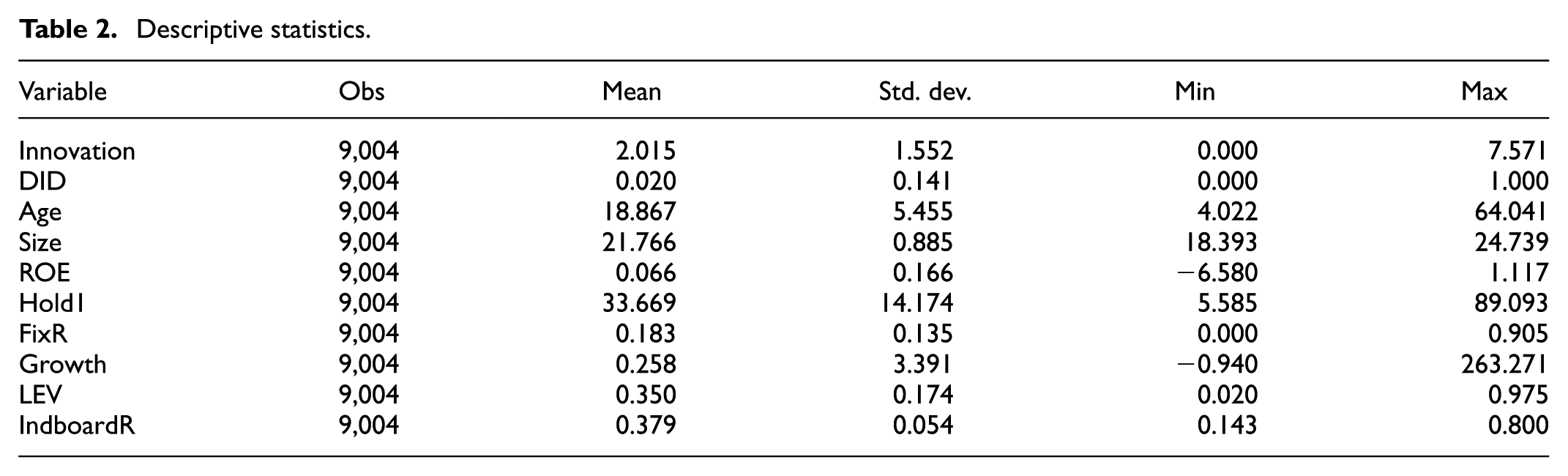
Descriptive Statistics
Table 2 presents the descriptive statistics of all variables. The statistics for Innovation (Mean = 2.015, Max = 7.571, SD = 1.552) reveal significant variation across enterprises, which is crucial for subsequent empirical analysis.
Descriptive statistics.
Baseline Results
This study tests its hypothesis as reported in Table 3. Results are reported without and with control variables respectively. The results of model 2 show that the SRDI policy promotes enterprise innovation significantly (β = .392, p < .01), thereby supporting the hypothesis 1.
The Impact of SRDI Policy.

Note. Standard errors in parentheses are clustered at the firm level.
p < .01, respectively.
Endogeneity Treatment and Robustness Tests
To address omitted variable bias, we incorporate both firm and year fixed effects in the model, which substantially ensures the validity of the regression results. However, potential endogeneity issues including measurement error, residual omitted variable bias, and reverse causality may remain in the baseline estimates. To strengthen the robustness, we perform additional endogeneity treatments and robustness tests on the relationship between the SRDI policy and corporate innovation.
Parallel Trend Test
The DID approach is only valid when they satisfy the parallel trend assumption before the policy occurs, and the treatment and control group’s outcome variables must exhibit parallel trends pre-treatment to permit in the DID method. Pre-treatment, the treatment and control groups should have the same tendency to move. To test the parallel trends assumption, following Luo et al. (2015), we use an event-study framework to examine changes in both groups following certification as SRDI “little giants.” Methodologically, we construct the following model:

To elaborate,

Statistics for parallel trend test (N = 9,004).
Placebo Test
As an additional measure of validity, we conduct a placebo test by randomly sampling the entire sample using bootstrap sampling, to control for the influence of other unobserved variables. For 500 randomly generated treatment groups, Figure 4 shows the kernel density of the estimated coefficients and the distribution of their p-values. The regression coefficients have means of near 0, with most p-values exceeding .1, and that the actual estimated coefficients are substantially smaller than the estimated coefficients for the placebo test. These results confirm the estimates pass the placebo test and are not seriously biased due to omitted variables.

Placebo test (clusters: N = 9,004).
Instrumental Variables
The SRDI policy and corporate innovation may mutually influence or be simultaneously affected by certain common factors, creating endogeneity issues. To address this problem, we employ the two-stage least squares (IV-2SLS) method to mitigate endogeneity problems. Specifically, we use the policy implementation intensity at the provincial level where the sample firms are located as an instrumental variable (IV) for the SRDI policy. The policy implementation intensity at the provincial level affects corporate innovation, satisfying the relevance condition of the instrumental variable. However, it does not directly affect corporate innovation, meeting the exogeneity condition of the instrumental variable. Columns 1 and 2 of Table 4 present the estimation results of the two-stage least squares (IV-2SLS) method based on the instrumental variable. The first-stage regression shows that the IV is significantly positively correlated with Innovation (β = 5.238, p < .01), indicating that the instrumental is strongly correlated with corporate innovation and satisfies the relevance condition. In addition, the Kleibergen-Paap rk LM statistic is 13.175, rejecting the null hypothesis of under identification at the 1% level; the Cragg-Donald Wald F statistic is 10.034 > 10, rejecting the null hypothesis of a weak instrumental variable. These results basically confirm the rationality of the instrumental variable selected in this paper. The second-stage regression results are consistent with the baseline regression (β = 9.708, p < .05). Thus, Hypothesis 1 is supported by the instrumental variable test, and the SRDI policy promotes corporate innovation.
IV Test and Reverse Causality Test.

Note. Standard errors in parentheses are clustered at the firm level.
p < .01, **p < .05, respectively.
Reverse Causality
To test whether reverse causality exists between the SRDI policy and corporate innovation, specifically assessing whether firms with stronger innovation capabilities are more likely to be certified as SRDI “Little Giants,” we use corporate innovation as the explanatory variable, one-period-lagged DID as the explained variable, and controls for the same variables as in our baseline model for regression. The regression results, shown in Column 3 of Table 4, indicate that the coefficient between corporate innovation and the lagged one-period DID is statistically insignificant, implying no reverse causality between the SRDI policy and corporate innovation.
Negative Binomial Regression
In the baseline regression model, since patent data typically contain numerous zero values and exhibit extreme right-skewed characteristics, logarithmic transformation effectively mitigates the influence of outliers. Therefore, we use the logarithmically transformed patent application data as the explained variable. To further test the robustness of the baseline regression results, we employ the untransformed count of patent applications as the explained variable and conduct negative binomial regression. The Vuong test (Z = 11.95, p < .001) significantly supports the zero-inflated negative binomial (ZINB) regression over the standard negative binomial model, indicating pronounced zero-inflation in the data. The dispersion parameter test (α = 1.734,
Negative Binomial Regression.

Note. Standard errors in parentheses are clustered at the firm level.
p < .01, **p < .05, respectively.
Other Robustness Tests
To further verify the robustness of the results, this study employs six additional methods to test the baseline regression findings: (1) changing the matching method by replacing the original caliper nearest neighbor matching with kernel matching and re-running the regression; (2) adding region-year fixed effects (i.year#city) to the existing firm and year fixed effects in the regression; (3) extending the measurement of corporate innovation by one additional year (Innovation1) to examine the dynamic impact of the SRDI policy on corporate innovation; (4) using the proportion of invention patents granted relative to total patents the high-quality patent ratio, HPR) as the explained variable in the regression; (5) using the logged count of granted invention patent applications (lnGpatent) as the explained variable in the regression; and (6) reducing the sample period by randomly excluding one year and re-running the regression. As shown in Columns 1-6 of Table 6, the direction and statistical significance of the DID regression coefficients remain consistent with the baseline regression across all six methods, and Hypothesis 1 once again passes the robustness tests.
Other Robustness Tests.

Note. Standard errors in parentheses are clustered at the firm level.
p < .01, **p < .05, respectively.
Mechanism Test and Heterogeneity Analysis
Mechanism Test
“Explicit,” Channel
Financial Support
Financial support is usually given to enterprises that have been certified as SRDI “little giants” and can receive government recognition incentives, capital subsidies, and other funds from the government to support innovation. Government subsidies will promote innovation from both R&D and behavioral additionality (Lei & Guo, 2018). R&D additionality means that government subsidies can directly increase the funds invested in R&D by firms, fill the gap in their innovation funds, and promote their technological innovation (Romano, 1989). Due to government subsidies, firms can not only increase their innovation confidence and be more inclined to innovate, but they can also send out positive signals that will attract additional external investors to invest in their R&D projects and encourage firms to pursue innovation (Meuleman & Maeseneire, 2012).
Therefore, this study adopts the method of Lei & Guo (2018) to extract government subsidy data from annual reports of listed companies, using the logarithmic value (lnsubsidy) as a measure of financial support intensity to verify the mediating role of financial support. We strictly follow the three-step testing procedure proposed by Wen and Ye (2014) for mediation effect analysis. First, the baseline regression confirms that the SRDI policy significantly promotes corporate innovation. Second, the SRDI policy significantly increases government subsidies (
Mechanism Test.

Note. Standard errors in parentheses are clustered at the firm level.
p < .01, **p < .05, *p < .1, respectively.
Credit Support
Credit support mainly refers to the fact that enterprises that have been certified as SRDI “little giants” enterprises can obtain some supportive bank loans from the government to alleviate financing constraints. At present, the financing of specialized and new SMEs still largely relies on the banking support (F. Li, Xu, & Yan, 2023; L. Li, Huang, & Cheng, 2023). Enterprises’ innovation activities are restricted by unstable sources of financing, and the financial constraints significantly restrict their R&D investment (Ju et al., 2013). For enterprises that receive government subsidies, establishing a relationship with the government can help them obtain bank loans as a source of R&D investment (Zhang et al., 2012), and this credit support from the government will help them promote innovation.
Therefore, we use the financing constraints of listed firms (SA) to measure the extent to which SRDI “little giant” enterprises receive credit support. The stronger the credit support an enterprise receives, the smaller its financing constraint. We strictly follow the three-step testing procedure proposed by Wen and Ye (2014) for mediation effect analysis. First, the baseline regression confirms that the SRDI policy significantly promotes corporate innovation. Second, the SRDI policy significantly alleviates corporate financing constraints (
“Implici,” Channel
Talent Support
Talent support mainly refers to the fact that enterprises that have been certified as SRDI “little giants” enterprises can attract high-level technical talent from government-run high-level talent fairs to participate in R&D work in their enterprises. The reason for attracting high-level technical talent may be that when an enterprise obtains the government policy affirmation, it is equivalent to the government’s official affirmation of the enterprise’s technological level, innovation capability, and development prospects, which will send positive “signals” to the outside world and attract high-level technical talent to devote themselves to the enterprise’s innovation activities (Lei & Guo, 2018).
Therefore, by collecting the number of R&D personnel and total employees disclosed in the annual reports of listed companies, we constructed the R&D personnel ratio (Rdstaff) =number of R&D personnel/total employees*100% to measure the strength of talent support received by the identified firms. We strictly follow the three-step testing procedure proposed by Wen and Ye (2014) for mediation effect analysis. First, the baseline regression confirms that the SRDI policy significantly promotes corporate innovation. Second, the SRDI policy does not significantly affect talent support (
Digital Transformation Support
Support for digital transformation mainly refers to the fact that enterprises that have been certified as SRDI “little giants” enterprises can receive appropriate support from the government-led digital platform to improve digital solutions. A new concept of digital empowerment has emerged as a key tool to promote high-quality enterprise development in an era of Internet integration, big data, and AI. However, digital transformation requires high capital investment, and the financing constraints of SMEs limit the “first step” of digital transformation. Therefore, the government should guide digital transformation service providers and big data platforms to focus on exploring the path of data-driven industrial upgrading, reduce the “trial and error cost” of enterprise digital transformation, and bridge the “digital divide” (Dong & Li, 2021). Thus, it can open up the product and innovation chains of enterprises, accelerate the development of new products and quickly get market feedback, thereby encouraging enterprises to innovate.
Thus, the Python method is used to calculate how much digital transformation support (lndigitaltrans) is received by the SRDI “little giants” enterprises. We strictly follow the three-step testing procedure proposed by Wen and Ye (2014) for mediation effect analysis. First, the baseline regression confirms that the SRDI policy significantly promotes corporate innovation. Second, the SRDI policy significantly enhances corporate digital transformation (
Heterogeneity Analysis
Following the full sample analysis, as different types of firms may have different sensitivities to the policy, this study analyzes heterogeneity according to firms’ ownership rights, the degree of technological foundation, and the degree of regional marketization.
Nature of Enterprise Ownership
Building on the resource-based view (Barney, 1991) and the compensatory advantage principle from institutional theory (Oliver, 1997), we construct a dual theoretical framework to explain heterogeneous innovation responses across firms. Compared to state-owned enterprises (SOEs), non-state-owned enterprises (NSOEs) typically face institutional discrimination in resource allocation. These institutional constraints make the resource infusion and legitimacy signals from the SRDI policy more marginally valuable for NSOEs, resulting in greater policy impact on their innovation. Accordingly, we categorize firms into SOEs and NSOEs based on ownership type and conduct subgroup regressions. The results in Columns 1 and 2 of Table 8 validate this theoretical expectation: the policy’s innovation-promoting effect is significantly stronger for NSOEs (β = .475, p < .01) than for SOEs. This demonstrates that SRDI policy exerts a greater innovation impact on NSOEs compared to SOEs. The findings confirm the critical role of resource endowment and reveal the policy value of institutional compensatory mechanisms, providing important insights for optimizing the targeting of innovation policies.
Heterogeneity Analysis.

Note. Standard errors in parentheses are clustered at the firm level.
p < .01, **p < .05, respectively.
Degree of Technical Foundation of the Enterprise
The technological foundation of an enterprise determines its innovation efficiency. Compared with enterprises with a weak technological foundation, enterprises with a strong technological foundation supported by the SRDI policy are more likely to stimulate the previous technology of the enterprise to play a role in increasing its competitive advantage over other enterprises(Huang et al., 2024), showing a “positive-selection effect”. Therefore, in enterprises with a strong technological foundation, the SRDI policy will have a greater impact on innovation. Based on firms’ patent applications in the previous year, we categorize them into two groups of enterprises with strong and weak technological foundations according to the median and conduct regressions separately. The results in Columns 3 and 4 of Table 8 show that the positive impact of the SRDI policy on innovation is significant among firms with a strong technological foundation (β = .522, p < .01). Thus, the impact of the SRDI policy on innovation is more pronounced in firms with a strong technological foundation than in firms with a weak technological foundation.
Degree of Regional Marketization
SMEs in high-marketized regions are easier to get the support they need from the market to innovate. The market’s powerful function in allocating resources in high-marketized regions may make government policies more effective at promoting firm innovation than in low-marketized regions (Lu & Zhu, 2018). Therefore, the SRDI policy will have a greater impact on innovation within high-marketized regions. Next, we classify firms into those in high-marketized regions and those in low-marketized regions according to their median and conduct group regressions, based on the marketization index published by the National Economic Research Institute in Beijing. The results in Columns 5 and 6 of Table 8 indicate that the positive impact of the SRDI policy on innovation is more significant for enterprises in high-marketized regions (β = .455,
Conclusion and Policy Implications
Conclusion
This study aims to examine how the SRDI policy impacts enterprise innovation among Chinese A-share listed firms from 2016 to 2022 using a DID method. The results demonstrate the following. (1) Corporate innovation is facilitated by the SRDI policy, and this conclusion remains valid after robustness tests. (2) The SRDI policy mainly promotes the innovation of SRDI “little giants” enterprises through “explicit” channels (financial support and credit support)and “implicit” channels(digital transformation support). (3) The heterogeneity analysis shows that the SRDI policy has a stronger innovation-promoting effect on NSOEs, technologically strong enterprises, and highly marketized enterprises.
Policy Implications
The policy recommendations derived from the findings discussed above are as follows:
First, we recommend optimizing the SRDI policy standards by drawing on the successful tiered certification model of Germany’s “hidden champions.” A three-tier cultivation system should be established, comprising basic-level, growth-stage, and leadership-level categories. Specifically, for low-tech enterprises, an innovation potential assessment dimension should be introduced, focusing on dynamic indicators such as R&D investment growth rates, while developing a digital certification platform should be developed for real-time monitoring. This tiered and categorized approach enables more precise identification of innovation needs at different development stages, fully leveraging the market-signaling role of certification mechanisms.
Second, resource support should be more targeted and diversified. A “technology credit whitelist” system should be implemented to grant differentiated credit policies for certified firms. Special subsidies for digital transformation should be established, prioritizing key technology applications such as cloud services and industrial internet. Additionally, an industrial chain collaborative innovation fund should be created to foster innovation partnerships between certified firms and their upstream/downstream counterparts. These measures will effectively amplify the dual-channel (explicit and implicit) promotional effects of the policy, ensuring precise alignment between policy resources and corporate innovation needs.
Finally, differentiated cultivation strategies should be adopted. For non-state-owned enterprises (NSOEs) with strong innovation responses, priority should be given to forming SOE-NSOE innovation alliances to facilitate resource complementarity. For low-tech firms, customized service packages—including technical diagnostics and process upgrades—should be provided. In regions with lower marketization levels, pilot programs combining “tax incentives + innovation vouchers” should be tested. This tailored approach aligns with the logic of the resource-based view while maximizing the marginal benefits of policy interventions.
Limitation and Prospects
This study has two key limitations. First, regarding policy transmission mechanisms, the research primarily focuses on firm-level mediation effects while inadequately accounting for the moderating effects of regional innovation ecosystems (e.g., industrial cluster maturity, university-industry collaboration intensity). These cross-level interaction effects may significantly influence policy implementation effectiveness. Second, from an international comparative perspective, the study lacks systematic comparison between China’s SRDI policy and similar international programs such as Germany’s “hidden champions” or Japan’s “Nakaken enterprises,” which could provide crucial references points for policy optimization. Future research should develop an integrated firm-region multilevel policy evaluation framework while establishing a transnational comparative research system with policy element transferability assessment matrices.
Footnotes
Acknowledgements

Author Contributions
Qiaoli Li: Conceptualization, Funding acquisition, Investigation, Project administration, Supervision, Formal analysis, Methodology, Visualization, Writing-Original draft preparation, Writing-Reviewing. Ruyan Hong: Data curation and Editing.
Funding
The authors received no financial support for the research, authorship, and/or publication of this article.
Declaration of Conflicting Interests
The authors declared no potential conflicts of interest with respect to the research, authorship, and/or publication of this article.
Data Availability Statement
The datasets used and/or analyzed during the current study are available from the corresponding author on reasonable request.