




Abstract
With the rise of online education, students’ online learning engagement (OLE) has become a key factor influencing academic performance. Understanding the factors affecting OLE can improve learning environments and student experiences. This study examines the impact of external factors—teacher feedback (TF), perceived teacher support (PTS), and peer relationships (PR)—alongside internal factors—self-efficacy (SE) and learning motivation (LM)—on university students’ OLE. It also explores the mediating roles of SE and LM. The study employed a standardized self-report survey with a sample of 910 Chinese university students. Descriptive statistics and correlation analysis were used to examine sample characteristics and preliminary associations among variables. Mediation analysis was conducted using Model 4 of the PROCESS macro, with 5,000 bootstrap samples applied to test the significance and robustness of indirect effects. (1) Teacher positive feedback (TPF), PTS, and PR significantly enhanced OLE; (2) Teacher negative feedback (TNF) had no significant effect on OLE; (3) SE and LM mediated the relationships between TF, PTS, PR, and OLE. The study highlights the importance of TF, PTS, and PR in shaping students’ OLE, with SE and LM playing key mediating roles. Findings offer theoretical and practical insights for improving OLE, providing valuable references for educational policymakers and higher education professionals.
Keywords
Introduction
With the rapid progression of information technology, online learning has evolved into an integral part of modern education, especially in higher education, where its extensive use and crucial importance are becoming more evident (Al-Adwan et al., 2022; Rawashdeh et al., 2021). The core advantage of online learning lies in its flexibility and accessibility, allowing students to access educational resources globally, overcoming the barriers of time and location (Abdelrady & Akram, 2022; Dinu et al., 2022; Garlinska et al., 2023; Xie, 2021). While the nature of online learning offers students greater autonomy and flexibility in their educational journey, it also brings challenges, including diminished focus, lower LM, and reduced engagement in the learning process (Abuhassna et al., 2020; Curelaru et al., 2022; Shim & Lee, 2020). Therefore, effectively enhancing university students’ OLE has become an urgent issue in the field of education. Learning engagement (LE) denotes the amount of time, effort, and emotional investment students dedicate to their educational activities. It is not only closely related to learning outcomes but also strongly associated with students’ learning attitudes, emotion experiences, and behavioral performance (D. An et al., 2024; Capone & Lepore, 2021; Chan et al., 2021). LE mainly consists of three types: behavioral, cognitive, and emotional engagement (Bond et al., 2020; Sharif-Nia et al., 2023; Vezne et al., 2023). Capone and Lepore (2022) point out that LE is the foundation for attracting students to participate in online courses. Therefore, exploring the factors that influence OLE is essential for enhancing the effectiveness of online education and helping students achieve academic success.
However, existing studies have predominantly examined either external supportive environments or individual psychological resources in isolation when exploring their effects on OLE (Hu et al., 2023; Kedia & Mishra, 2023; X. Ma et al., 2023; Martin et al., 2021), lacking a systematic analysis of their combined mechanisms. On the one hand, some research has examined how external elements—including TF, PTS, and PR—on learning behavior (D. An et al., 2024; Miao et al., 2022; Sengsouliya et al., 2020). On the other hand, other studies have highlighted the critical role of individual characteristics such as LM and SE (Anthonysamy et al., 2020; H. Liu et al., 2020). Nevertheless, studies that integrate both external environmental factors and internal psychological variables into a unified model under a coherent theoretical perspective remain limited. This gap hinders a thorough understanding of how external assistance in online learning environments facilitates student engagement by activating internal psychological mechanisms.
Therefore, drawing on Self-Determination Theory (SDT) and Self-Efficacy Theory (SET), this study systematically integrates external support factors and internal psychological mechanisms to construct a comprehensive model of college students’ OLE. SDT posits that LM is influenced not only by internal drives but also by the extent to which the social environment satisfies individuals’ core personal needs for relatedness, autonomy, and competence (Deci & Ryan, 1985). TF, PTS, and PR are essential external resources that help meet students’ needs for relatedness and autonomy, which in turn promote their LM and subsequently enhance OLE. Meanwhile, SET emphasizes that SE, or individuals’ belief in their ability to complete learning tasks successfully, plays a central role in sustaining persistence and engagement in learning activities (Bandura, 1977). Both TF and social relationships can shape students’ perceptions of task value and influence their judgments about personal competence, thereby affecting their level of LE. Based on these theoretical foundations, this study proposes a model that includes four external variables (TPF, TNF, PTS, and PR), two mediating variables (LM and SE), and one outcome variable (OLE). By integrating SDT emphasis on motivation driven by social support with SET focus on SE as a determinant of learning behavior, the model addresses the fragmented treatment of variables in previous research and provides a coherent framework for understanding the psychological processes underlying OLE among college students.
Teacher Feedback and Online Learning Engagement
TF refers to the information provided by educators regarding students’ learning progress, task completion, and behavioral performance throughout the teaching process (Eriksson et al., 2022; Guo et al., 2019; Guo & Zhou, 2021). TF primarily includes five aspects: validation feedback (VF), directive feedback (DF), scaffolding feedback (SF), teacher praise (TP), and teacher criticism (TC). Among these, VF, SF, and TP are considered TPF, while DF and TC are considered TNF (Guo, 2020; Guo & Zhou, 2021). The distinction between TPF and TNF has been widely adopted in existing research. However, it is essential to recognize that students’ interpretations of TF are not always uniform. Their perceptions can be influenced by contextual factors such as tone, delivery method, timing, and the quality of the teacher–student interactions. TPF is typically linked to encouragement and affirmation, which may help boost students’ confidence (Câmpean et al., 2024). In contrast, TNF may be perceived as either a challenge or a threat, depending on the context, and can affect students’ emotional responses as well as subsequent learning behaviors (Brandmo & Gamlem, 2025). The core purpose of TF is to help students understand what they are doing well and what areas need improvement in their learning process, thereby providing specific suggestions and guidance for further enhancing their learning performance (Guo, 2020; Pan & Shao, 2020; Zheng et al., 2023).
With the development of online education, TF has grown in importance, playing a vital role in assisting students in accessing learning resources and refine their learning approaches (Zheng et al., 2023). In the online learning environment, the timeliness and effectiveness of TF are particularly crucial because of the absence of in-person interaction and immediate communication (Guo, 2020; Selvaraj et al., 2021). Studies have shown that TF significantly impacts students’ LE (Dong et al., 2021; Guo & Zhou, 2021). In their research on the effects of TF on student LM, Guo and Zhou (2021) noted that TPF from teachers can enhance students’ self-confidence and inspire them to actively participate in learning activities, while TNF may decreased LE. SDT claims that when students see TF as guiding, affirming, and supporting, it can boost their sense of competence and autonomy throughout the learning process, which in turn increases their engagement with learning tasks (Deci & Ryan, 1985). However, in online learning environments, the specific mechanisms through which different types of TF influence student engagement remain insufficiently explored.
Perceived Teacher Support and Online Learning Engagement
PTS encompasses the support, attention, and help students perceive from their instructors throughout the learning process, which manifests itself through both emotional and academic forms of assistance (Liang & Long, 2024; H. Liu & Li, 2023). Although TF and PTS appear to be conceptually related, they refer to different constructs. TF specifically denotes task-oriented feedback provided by teachers on students’ academic performance during the instructional process. This includes concrete behaviors such as affirmation, guidance, praise, and criticism, and serves as an immediate mechanism for regulating instructional practices (Eriksson et al., 2022; Guo et al., 2019; Guo & Zhou, 2021). In contrast, PTS denotes students’ personal interpretations of the overall support they receive from teachers throughout the learning process. It includes relational aspects including support for autonomy, competence, and emotion (Hejazi et al., 2023; L. Ma et al., 2021; Y. Zhao & Yang, 2022). In other words, TF focuses on the transmission of specific information related to academic tasks, while PTS reflects students’ general impressions of teacher attitudes and the dynamics of the teacher–student relationship.
A considerable amount of research highlights a strong connection between PTS and LE (F. An et al., 2022; Yang & Du, 2025; Zhou et al., 2025). Studies have indicated that constructive teacher interactions, timely responses, and emotional support can effectively compensate for the absence of interaction in online learning, enhancing students’ motivation and engagement (Chiu, 2023; Fan, 2024; He et al., 2024; Luo et al., 2022). He et al. (2024) discovered that students who feel support from their teachers tend to demonstrate greater learning initiative and enthusiasm. They are also more resilient when encountering learning challenges, which ultimately enhances their LE. Fan (2024) noted that the guidance, assistance, and feedback provided by teachers during the learning process can boost students’ self-confidence, enabling them to face academic challenges with greater assurance. In other words, teachers’ academic support helps students better master course content, while emotional support helps them cope with the emotional challenges of learning (Sadoughi & Hejazi, 2021; Tao et al., 2022). According to SDT, PTS functions as a relational resource that helps satisfy students’ basic psychological needs. This support fosters a feeling of connectedness and psychological safety in online learning environments, thereby promoting sustained OLE (Deci & Ryan, 1985). However, existing research has not sufficiently examined the relevance of PTS in varied learning settings, and the underlying mechanisms of its influence remain inadequately explored.
Peer Relationships and Online Learning Engagement
PR denotes the connections formed between students throughout the learning process, encompassing interpersonal connections, social-emotional ties, and communicative interactions (Shao et al., 2024; Tu & Chu, 2020). Wissing et al. (2022) emphasize that PR are vital to the learning process, as students’ learning activities frequently depend on interactions and collaboration with their peers. Although online learning provides more autonomy, it can also result in feelings of isolation and detachment among students, as they miss the traditional group interactions typical of in-person classrooms (Ferri et al., 2020; X. Liu et al., 2022). Therefore, strong PR not only enhance students’ social support but also improve learning efficiency, and foster academic achievement, thereby increasing students’ LE (Valiente et al., 2020; Wang et al., 2022; D. Wu & Dong, 2024).
Wang et al. (2022) highlight that in online learning environments, interaction among peers becomes an important way to enhance LE. By engaging in online discussions, collaborative learning, and mutual support, students can receive both emotional and cognitive assistance. This enhances their enthusiasm for learning, while also boosting their confidence and sense of control over their academic abilities (Wissing et al., 2022; J. Zhao & Liu, 2022). Particularly without traditional classroom interaction, students frequently encounter difficulties in the absence of prompt feedback and engagement, making PR especially important for enhancing OLE (Wissing et al., 2022). Existing studies suggest that PR exerts a significant positive impact on university students’ LE (Ertesvåg et al., 2024; Shao & Kang, 2022). In online learning, peer communication, discussions, and feedback enable students to acquire a more thorough understanding of the learning content, foster greater interest and enthusiasm, and enhance their engagement (Hollister et al., 2022). Within the framework of SDT, PR contribute to the formation of a learning community through equal interaction and mutual recognition. This process enhances students’ academic trust and stimulates their autonomous OLE (Deci & Ryan, 1985). However, current research lacks a systematic theoretical analysis of the pathways through which PR interacts with individual psychological mechanisms.
The Mediating Role of Learning Motivation
LM refers to the motivating factor that drives students to participate in learning activities, influencing both their level of engagement and the results they achieve throughout the learning process (Fu et al., 2024; Hsieh & Maritz, 2023; Pan, 2023). Based on Deci and Ryan (1985) SDT, LM is generally categorized into intrinsic and extrinsic motivation. Intrinsic motivation involves the desire to learn driven by personal interest, curiosity, or internal needs, while extrinsic motivation pertains to the pursuit of learning to attain external rewards, such as grades, scholarships, or social recognition (I. F. Liu, 2020; Sato et al., 2024). Research findings have indicated that LM serves as a crucial impetus for students’ OLE (Akram & Li, 2024; Ferrer et al., 2022; Fu et al., 2024; Vezne et al., 2023). Elevated LM levels are typically linked to increased LE, encouraging students to engage more fully in learning activities, thereby enhancing their academic performance and results (Capone & Lepore, 2022; Pan & Shao, 2020; H. Wu et al., 2020).
Owing to the absence of in-person teacher guidance and peer interactions, students’ LM is frequently more prone to difficulties. Therefore, stimulating students’ LM has become one of the key factors for enhancing OLE. Research by Leung et al. (2022) found that when students perceive TF as constructive and supportive, their LM significantly increases, thereby promoting their LE. F. An et al. (2022) indicated that when students sense teacher support, it boosts their LM, which in turn fosters greater engagement and concentration during classroom activities. Shao et al. (2024) highlighted that positive PR, through emotional support, encouragement, and fostering a feeling of connectedness, is essential for strengthening students’ LM, boosting their confidence, and igniting their enthusiasm for academic involvement and LE. According to SDT, TP, PTS, and PR respectively fulfill students’ needs for competence, relatedness, and autonomy. By activating individuals’ LM, these sources of support can further enhance their OLE (Deci & Ryan, 1985). However, existing studies have not systematically examined the mediating role of LM in the relationship between multiple forms of instructional support and OLE. As a result, the integrative function of LM within multi-source support pathways remains underexplored.
The Mediating Role of Self-Efficacy
According to Bandura (1977) SET, SE not only reflects an individual’s assessment of their abilities but also significantly influences their willingness to engage in an activity, the effort they invest, and their persistence in overcoming challenges. The significance of SE is especially evident in online learning, particularly in situations where there is minimal in-person instruction from teachers and limited interaction with peers. Whether students believe they can complete learning tasks and overcome challenges has a direct impact on how engaged they are in online learning (Cao & Han, 2024; Derakhshan & Fathi, 2024; Getenet et al., 2024). Cao and Han (2024) found that students with high SE tend to engage more actively in online learning, dedicate more time and effort, and are better at managing their emotions to overcome challenges encountered during the learning process (Akram & Abdelrady, 2025). In online learning environments, students are required to exercise greater self-management, with their progress and the quality of their learning often relying on their ability to work independently.
In this context, enhancing students’ SE is crucial to effectively mobilize their LE. Guo (2020) noted that TF, by providing both cognitive help and emotional support, can enhance students’ SE, thereby motivating them to participate more actively in learning tasks and devote more effort in their studies. Pan (2022) pointed out that students who perceive teacher support often feel more secure and a sense of belonging, which enhances their SE, boosting their confidence in their learning abilities and outcomes, and promoting more active learning participation and OLE. Shao and Kang (2022) found that in the online learning environment, PR not only alleviate loneliness and learning anxiety but also strengthen students’ learning confidence by enhancing SE, thus promoting greater LE and helping them confidently overcome challenges through collaboration. According to SET, SE serves as a key psychological mechanism linking external support to students’ learning behaviors. When students receive positive cognitive and emotional experiences from TP, PTS, or PR, they are more likely to form favorable judgments about their capacity to carry out academic tasks. This enhanced SE consequently drives them to invest greater time and effort in online learning (Bandura, 1977). However, most existing studies have concentrated on the positive impact of SE on LE, with limited attention to its mediating role in the joint influence of various sources of support including TF, PTS, and PR. Moreover, in the context of online learning, systematic investigations into the mechanisms through which SE operates remain scarce, and relevant theoretical pathways require further development.
Current Study
This study will focus on how TF (TPF and TNF), PTS, and PR influence college students’ OLE via the mediating effects of LM and SE. Based on this goal, the study will address the following key questions and propose the research model shown in Figure 1 to test the following hypotheses:

Research model diagram.
Research Questions:
Research Hypotheses:
Methods
Study Design
This study adopted a quantitative research design based on standardized self-report questionnaires, aiming to investigate the psychological and contextual factors influencing university students’ OLE. This design is well-suited for testing theoretical models and examining the relationships among latent psychological variables in a large sample. Guided by SET and SDT, the study focused on exploring the roles of TF, PTS, and PR, as well as the mediating effects of LM and SE on OLE. Data were analyzed using SPSS Statistics 26 and the PROCESS macro (Model 4), which enabled rigorous testing of mediation effects among multiple psychological variables.
Data Collection
This research utilized a simple random sampling approach for distributing the questionnaires and gathering data, with the study taking place from September 2024 to December 2024. The selection process for research participants is outlined as follows: First, the university was identified as the source of the research sample. Then, participants were chosen through a simple random sampling technique from the full student body at the university. Specifically, participants were randomly selected from the student roster using a generated numbering system, guaranteeing equal participation opportunities for all students in the questionnaire. The questionnaire was administered online via the Wenjuanxing platform (https://www.wjx.cn/), with the link sent to the target audience through social media, emails, and the internal platform of the educational institution. All participants gave their consent by signing an informed consent form before completing the questionnaire.
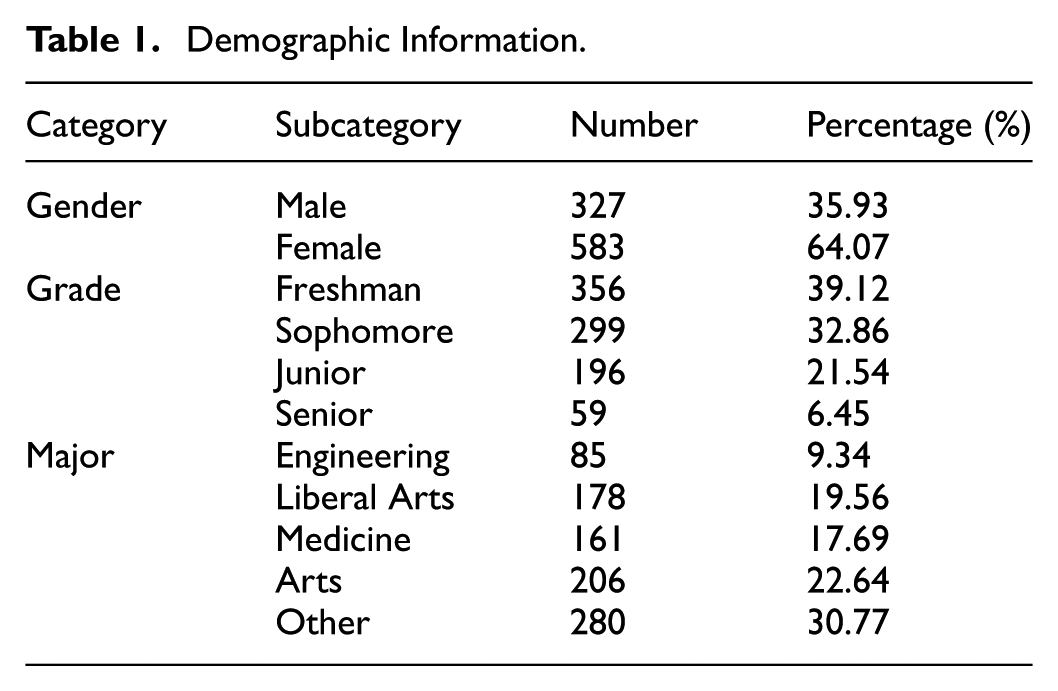
In total, 943 questionnaires were collected, and after screening for missing information and inattentive responses, 910 valid questionnaires were retained, resulting in a response rate of 96.50%. Of the valid responses, 327 were from male participants (35.93%) and 583 from female participants (64.07%). In terms of grade level, the sample included 356 freshmen (39.12%), 299 sophomores (32.86%), 196 juniors (21.54%), and 59 seniors (6.45%). Regarding academic discipline, 85 participants (9.34%) were from engineering, 178 (19.56%) from liberal arts, 161 (17.69%) from medicine, 206 (22.64%) from arts, and 280 (30.77%) from other fields. Although the sample covered a wide range of academic disciplines, the data were categorized into five major academic groups during the collection and organization process to ensure appropriate representation of disciplinary diversity: engineering, humanities, medical sciences, arts, and a general “other” category. The “other” group includes disciplines not listed separately, such as social sciences, business, and natural sciences. This classification approach helps maintain the diversity of the sample while ensuring the feasibility and rationality of subsequent analyses. Demographic information is presented in Table 1.
Demographic Information.
Measurement Tools
All constructs in this study were measured using established scales, and all items were rated on a 5-point Likert scale. No changes were made to the items’ content or structure in order to preserve integrity with the original scale.
Online Learning Engagement
The present research made use of the OSES formulated by R. Wu (2023). The scale includes 16 items, which are categorized into four subscales: behavioral engagement, cognitive engagement, emotional engagement, and social engagement. In this study, the overall score of OLE was calculated as the average of the four subscale scores, with higher scores indicating a higher level of OLE among college students. The Cronbach’s α coefficient for OSES was .911, indicating good internal consistency and supporting its suitability for educational research.
Teacher Feedback
The present research made use of the TFS formulated by Guo (2020). The scale includes 24 items, which are divided into two subscales: positive feedback (VF, SF, and TP) and negative feedback (DF and TC). The average score for each subscale is calculated separately, with higher scores indicating that teachers provide more frequent feedback of that particular type. The Cronbach’s α values for the two subscales were .865 (TPF) and .813 (TNF), indicating good internal consistency and supporting the scale’s appropriateness for educational research.
Perceived Teacher Support
The present research made use of the PTSS formulated by Xu et al. (2023). The scale includes 13 items, divided into three dimensions: autonomy support (5 items), competence support (4 items), and emotional support (4 items). Higher scores indicate a higher level of PTS. The Cronbach’s α coefficient for PTSS was .853, indicating good internal consistency and supporting its suitability for educational research.
Peer Relationships
The present research made use of the PRS formulated by Shao and Kang (2022), which consists of 4 items. Higher scores indicate a higher level of PR among university students. The Cronbach’s α coefficient for PRS was .877, indicating good internal consistency and supporting its suitability for educational research.
Self-Efficacy
The present research made use of the SES formulated by Shao and Kang (2022), which consists of 5 items. Higher scores indicate higher levels of SE among university students. The Cronbach’s α coefficient for SES was .734, indicating good internal consistency and supporting its suitability for educational research.
Learning Motivation
The present research made use of the LMS formulated by Y. Liu et al. (2024), which was adjusted to suit the online education environment and better measure university students’ LM. The scale includes 10 items, divided into two dimensions: intrinsic motivation and extrinsic motivation. Higher scores indicate higher levels of LM among university students. The Cronbach’s α coefficient for LMS was .791, indicating good internal consistency and supporting its suitability for educational research.
Data Analysis
There were four primary processes in the data analysis process for this study. First, descriptive statistics and Pearson correlation analyses were conducted to examine the basic characteristics of the sample and the preliminary associations among the key variables. Second, reliability and validity tests were performed on the measurement scales, including the calculation of Cronbach’s α coefficients to assess internal consistency. Third, the appropriateness of the measurement model was assessed using model fit indices and confirmatory factor analysis (CFA) with AMOS 24.0. Finally, mediation analyses were performed using Model 4 of the PROCESS macro to construct a regression-based path model and test the indirect effects of TPF, TNF, PTS, and PR on OLE through LM and SE. The significance and robustness of the mediation effects were assessed using 5,000 bootstrap samples.
Results
Descriptive and Correlation Analysis
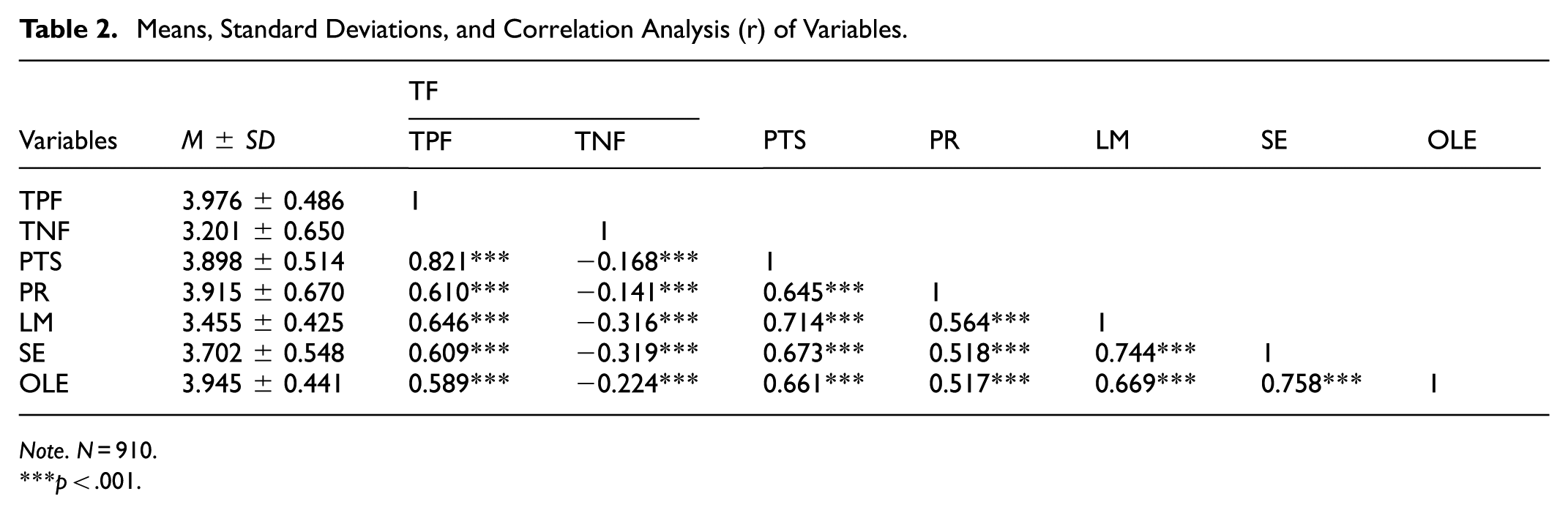
Descriptive statistics and correlation analysis were performed on the data from 910 valid samples to explore the relationships between TF, PTS, PR, LM, SE, and college students’ OLE. As presented in Table 2, all variables were statistically significant (p < .001, N = 910). TPF was positively correlated with LM (r = .646, p < .001), SE (r = .609, p < .001), and OLE (r = .589, p < .001). In contrast, TNF was negatively correlated with LM (r = −.316, p < .001), SE (r = −.319, p < .001), and OLE (r = −.224, p < .001). PTS showed positive correlations with LM (r = .714, p < .001), SE (r = .673, p < .001), and OLE (r = .661, p < .001). PR were also positively correlated with LM (r = .564, p < .001), SE (r = .518, p < .001), and OLE (r = .517, p < .001). Additionally, both LM (r = .669, p < .001) and SE (r = .758, p < .001) were positively correlated with OLE.
Means, Standard Deviations, and Correlation Analysis (r) of Variables.
Note. N = 910.
p < .001.
Reliability and Validity Testing
The scales used in this study demonstrated good content validity and construct validity (Table 3). The Kaiser-Meyer-Olkin (KMO) values for the TPF Scale, TNF Scale, PTSS, PRS, SES, LMS, and OLE Scale is 0.917, 0.868, 0.912, 0.819, 0.790, 0.865, and 0.954. The results of the Bartlett’s Test of Sphericity were all significant (p < .001), indicating that the data were appropriate for conducting factor analysis.
KMO Values and Bartlett’s Test of Sphericity for Each Variable.

Confirmatory Factor Analysis
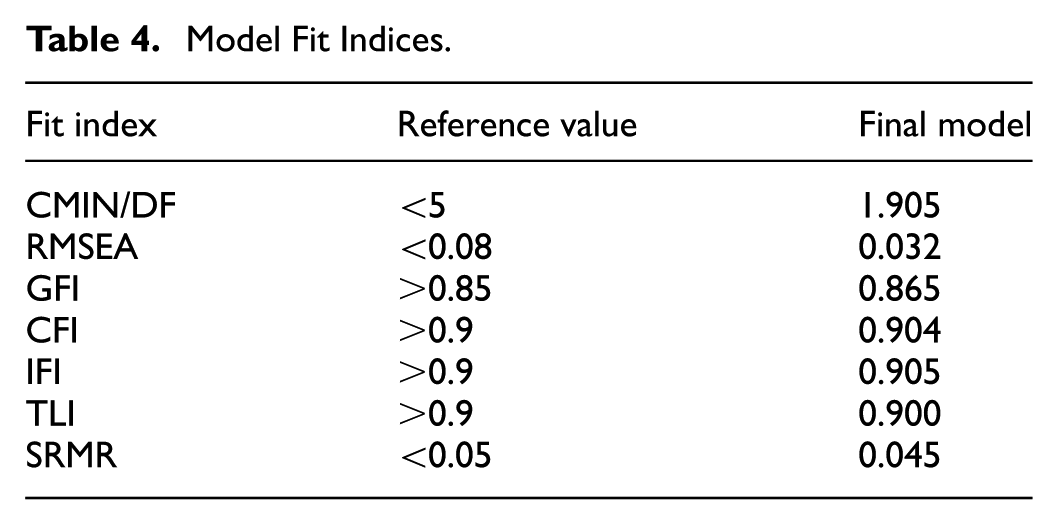
To evaluate the model’s validity even more, we conducted a CFA to examine whether the factor structure of the scales was consistent with theoretical expectations. The CFA findings showed a good model fit, as Table 4 illustrates (Ji et al., 2024).
Model Fit Indices.
Mediation Effect Analysis
Table 5 and Figures 2 to 9 display the regression analysis’s findings. First, TPF was found to significantly and positively predict SE (β = .687, p < .001), LM (β = .565, p < .001), and OLE (β = .262, p < .05). TNF significantly and negatively predicted SE (β = −.269, p < .001) and LM (β = −.206, p < .001), but its effect on OLE was not significant (β = −.008, p = .664). PTS was found to significantly and positively predict SE (β = .718, p < .001), LM (β = .590, p < .001), and OLE (β = .330, p < .05). PR were also found to significantly and positively predict SE (β = .424, p < .001), LM (β = .357, p < .001), and OLE (β = .153, p < .001). Overall, TPF, PTS, and PR had significant effects on SE, LM, and OLE, whereas TNF had a more limited impact on LM and OLE. Furthermore, the R2 value of the theoretical model developed in this study was 0.618, indicating that the selected independent variables explained 61.80% of the variance in the dependent variable. This result demonstrates that the model is highly effective in explaining and predicting students’ OLE and clearly reveals how TF, PTS, and PR influence LE through their effects on students’ motivation and SE.
Regression Analysis of Variable Relationships in the Mediation Model.

p < .001.

The mediating role of SE between TPF and OLE.

The mediating role of LM between TPF and OLE.
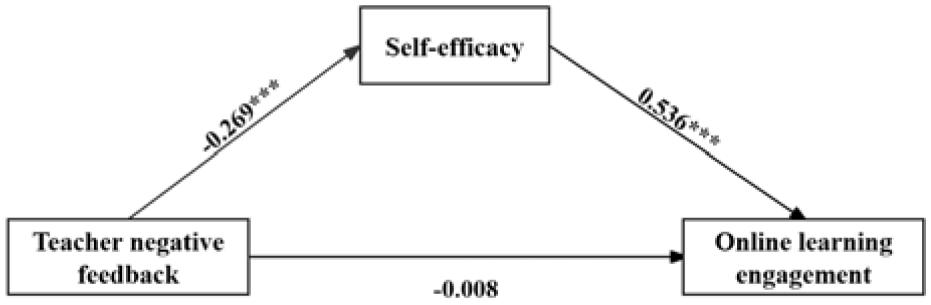
The mediating role of SE between TNF and OLE.

The mediating role of LM between TNF and OLE.

The mediating role of SE between PTS and OLE.

The mediating role of LM between PTS and OLE.

The mediating role of SE between PR and OLE.

The mediating role of LM between PR and OLE.
This study investigates the effects of TPF, TNF, PTS, and PR on OLE, analyzing total, direct, and indirect effects. First, the total effect of TPF on OLE is 0.535, with the direct effect accounting for 48.97% and the indirect effect accounting for 51.03%. TPF also has an indirect effect on OLE through LM, which accounts for 71.03% of the total effect. Second, the total effect of TNF on OLE is −0.152, with the direct effect accounting for 5.26% and the indirect effect accounting for 94.74%. The indirect effect through LM makes up 92.76% of the total effect. Additionally, the total effect of PTS on OLE is 0.567, with the direct effect accounting for 58.20%, the indirect effect through SE accounting for 41.80%, and the indirect effect through LM accounting for 62.96%. Finally, the total effect of PR on OLE is 0.341, with the direct effect accounting for 45.16%, the indirect effect through SE accounting for 54.84%, and the indirect effect through LM accounting for 74.49%. Overall, TPF, PTS, and PR all have significant effects on OLE, particularly through the indirect effect of LM. The effect of TNF is weaker, mainly exerting its influence through SE (see Table 6).
Mediation Effect Analysis of Variable Relationships in the Mediation Model.

Discussion
This study aimed to explore the direct and indirect effects of TF, PTS, and PR on college students’ OLE, with a particular emphasis on the mediating roles of LM and SE. The study provides an in-depth analysis of the impacts of TF, PTS, PR, LM, and SE on students’ OLE. The results show that TF, PTS, and PR have direct significant effects on OLE while also exert indirect effects through LM and SE. This study unveils the potential mechanisms through which TF, PTS, PR, LM, and SE influence students’ OLE. The following sections will provide a detailed discussion of the results.
TPF significantly and positively influences college students’ OLE, suggesting that providing positive feedback can effectively enhance students’ motivation to engage in online learning, thus supporting H1a. This finding is aligns with the results of Guo and Zhou (2021), which indicated that TPF offers affirmation and support, boosting students’ confidence and motivation. It helps students recognize the progress they have made in their learning, and this positive feedback promotes their engagement in online learning. TPF also contributes to creating a positive learning atmosphere. By offering encouraging feedback, teachers can make students feel cared for and valued, which in turn increases their LM and LE (Dong et al., 2021). In the Chinese context, TPF often generates a motivational effect among peers, which can foster a positive and achievement-oriented learning atmosphere within the group. This cultural factor may amplify the positive impact of TPF on OLE, making its effect particularly salient among Chinese students. In conclusion, to foster students’ LM and engagement, teachers should focus on providing timely, specific, and constructive feedback, especially in online learning environments, as it is crucial for students’ learning experiences and outcomes.
Contrary to expectations, this study revealed that TNF did not have a significant direct effect on college students’ OLE, and thus Hypothesis H1b was not supported. This result contrasts with the findings of Guo and Zhou (2021), who reported a direct negative effect of TNF on LE. However, based on the mediation path analysis conducted in this study, TNF indirectly affected OLE by undermining students’ SE and reducing their LM (Akram & Li, 2024; Ernst et al., 2025), indicating that TNF exerts negative influence at a more implicit psychological level. Therefore, although TNF did not directly reduce students’ OLE, its indirect effects through SE and LM still warrant attention from educational practitioners. This study does not deny the necessity of TNF in corrective instruction, but recommends that teachers complement TNF with emotional support and constructive suggestions to avoid the potential psychological harm of purely negative evaluations. Such an approach can help preserve students’ SE and promote sustained LM, which is particularly important in online education.
PTS significantly positively influenced college students’ OLE, with both academic and emotional support playing crucial roles in students’ engagement. This finding supports H2. This aligns with the research of Romano et al. (2021), which suggested that when students perceive teacher support and assistance, they become more capable of handling stress and uncertainty of learning, maintain a positive learning attitude, and consequently increase their OLE. Regarding emotional support, teachers’ encouragement and care help alleviate students’ anxiety, thereby enhancing their motivation to learn (Sadoughi & Hejazi, 2021). In terms of academic support, teachers’ efforts through online lectures, Q&A sessions, and personalized tutoring can help students address learning difficulties, thereby boosting their SE and further enhancing OLE (Tao et al., 2022). Chinese college students tend to hold high expectations for the teacher’s role, viewing teachers as transmitters of knowledge and as moral authorities and emotional role models. Within this cultural context, emotional support from teachers is often regarded as a key source of learning-related psychological safety, which becomes particularly important in highly structured but low-interaction online learning environments. These findings indicate that, in an online learning environment, teachers should not only focus on providing academic support but also be attentive to addressing the emotional needs of students. By offering multi-faceted support, teachers can foster students’ LM and OLE.
PR significantly positively influenced college students’ OLE, highlighting the importance of strong peer connections during the learning process, which supports H3. This finding is consistent with the research of Dias et al. (2024), which demonstrated that positive PR, through emotional and cognitive support, promote LM, improve learning efficiency, and increase students’ engagement, thereby enhancing academic performance. In online learning environments, students may face challenges such as a lack of social interaction and emotional support, which can reduce their motivation and participation. In contrast, strong PR offer cognitive, emotional, and social support, helping students build confidence in their learning (Wissing et al., 2022). Specifically, in collaborative learning and online discussions, students can share knowledge, encourage each other, and solve problems together, which enhances their engagement with learning tasks (Shao et al., 2024). Chinese college students generally place a high value on group belonging and interpersonal support. The collectivist culture reinforces peer collaboration and group identity in the learning process. Within this cultural context, positive PR serve not only as a form of social support but also as a crucial psychological foundation for sustaining OLE. This suggests that in online education settings, promoting collaborative learning and fostering constructive peer interactions are essential for enhancing students’ learning experiences and maintaining their ongoing engagement.
Mediating Effect of Learning Motivation
This study found that LM played a mediating role in the relationship between TPF, TNF, PTS, PR, and OLE. First, TPF not only directly motivated students to enhance their LE, but also indirectly promoted engagement by stimulating students’ LM, thereby supporting H4. This is consistent with the findings of Leung et al. (2022), which demonstrated that TPF boosts students’ self-confidence and interest in learning, thereby stimulating their LM and, consequently, increasing their OLE. LM serves as a critical psychological mechanism that influences engagement, helping students maintain a positive attitude in the face of challenges. By enhancing LM, TPF effectively boosts students’ OLE (Martinez et al., 2024).
Secondly, the potential adverse effects of TNF in online learning environments, particularly in terms of stimulating students’ LM, verifying H5. This aligns with Guo and Zhou (2021), whose research indicated that while negative feedback aims to correct errors and promote improvement, it often triggers feelings of frustration, failure, and decreased self-confidence, thereby weakening motivation. In the online learning environment, where face-to-face interactions are limited, these negative emotional responses are amplified. Without emotional support and understanding from teachers, students’ intrinsic motivation may further decline (Dong et al., 2021).
Additionally, the key role of PTS in students’ OLE was confirmed, supporting H6. This finding aligns with F. An et al. (2022), who suggested that when students perceive support from teachers, their LM is stimulated, which in turn promotes higher levels of engagement. Specifically, teacher support, through both academic guidance and emotional care, can stimulate students’ intrinsic LM, prompting them to dedicate more time and effort to their studies (Fan, 2024; He et al., 2024).
Finally, PR played a key role in students’ LE in online learning environments, confirming H7. This supports the findings of Shao et al. (2024), which demonstrated that positive interaction and good relationships with peers can stimulate students’ LM and, consequently, their OLE. In online learning, students often face feelings of isolation and lack of support, but PR provide emotional support and academic collaboration, alleviating negative emotions and enhancing LM (Wang et al., 2022; Wissing et al., 2022). Encouragement and cooperation among peers can make students feel a sense of belonging and support, which positively influences their learning attitudes and motivation (Hollister et al., 2022).
Mediating Effect of Self-Efficacy
This study found that SE played a mediating role in the relationship between TPF, TNF, PTS, PR, and OLE. First, TPF directly enhanced students’ OLE, and indirectly promoted engagement by boosting their SE, thus supporting H8. This finding aligns with Guo (2020), where according to SET, suggested that individuals who receive TPF tend to feel their efforts are acknowledged, which boosts their confidence in their abilities and strengthens their belief in successfully completing tasks. This confidence promotes greater LE (Sökmen, 2021). In the online learning environment, TPF is particularly crucial as it helps reduce feelings of isolation and uncertainty that students may encounter in the absence of face-to-face interaction, boosting their confidence and motivating them to become more deeply engaged in the learning process (Guo & Zhou, 2021; Selvaraj et al., 2021).
Secondly, TNF indirectly reduced students’ OLE by affecting their SE, thus validating H9. This is consistent with Cionea et al. (2023), which found that after receiving negative feedback, students may doubt their abilities and feel that their efforts are unrecognized. This negative psychological reaction can lead to avoidance of learning, decreasing their engagement. In online learning environments, where face-to-face interactions are limited, students may struggle to receive timely emotional support and understanding, making these negative emotional responses even more pronounced and further undermining their SE (Guo & Zhou, 2021; Zheng et al., 2023).
Furthermore, perceived teachers support enhanced students’ SE, which in turn promoted their OLE, supporting H10. This finding is consistent with Pan (2022), who found that when students perceive both academic and emotional support from teachers, their confidence in their own learning abilities is strengthened. This enhanced confidence boosts their SE, increasing their LE tasks. Unlike traditional classrooms, where teacher-student interaction is direct, online learning environments often lack immediate feedback or face-to-face encouragement. Therefore, when teachers offer effective support in such environments—particularly through personalized academic assistance and emotional care—students’ SE is greatly strengthened, resulting in increased engagement and better learning outcomes (Fan, 2024; He et al., 2024).
Finally, positive PR enhanced students’ SE, which indirectly promoted their OLE, supporting H11. This is in line with Shao et al. (2024), where students in positive PR receive support and encouragement, which not only improves their emotional state but also boosts their learning confidence, thus enhancing their SE and increasing LE tasks. Due to the lack of face-to-face interaction in online learning, positive PR provide emotional support and learning resources, enhancing students’ SE and increasing their LE (Hollister et al., 2022; Wissing et al., 2022).
Previous studies have indicated that TF and PR are widely acknowledged as important social factors influencing LE across diverse cultural contexts (Dias et al., 2024; Romano et al., 2021). However, the psychological mechanisms underlying these factors may differ across cultures. In Western education systems that emphasize individual autonomy, TF is often regarded as a key strategy for promoting students’ self-regulation and sense of agency (Câmpean et al., 2024; Szumowska et al., 2023). In contrast, students raised in the Chinese cultural context tend to perceive TF as a form of emotional support and a reflection of social expectations, making them more sensitive to its affective value (Guo, 2020; Guo & Zhou, 2021). Similarly, in collectivist cultures, the quality of PR not only provides academic assistance but also plays an important role in emotional regulation and fostering a sense of group belonging, which contributes to enhanced LM and SE (Shao et al., 2024; Shao & Kang, 2022). To further examine the cross-cultural applicability of the proposed model, future studies should expand the sample to include college students from a wider range of countries and regions and conduct comparative research across cultural contexts.
Impact
Theoretical Impact
First, this study is based on SET and SDT, examining the external and internal factors that influence students’ OLE from both perspectives. It proposes a comprehensive research model that explores how teacher positive and negative feedback, PTS, and PR affect students’ OLE. The focus is on how these factors impact students’ LE through LM and SE. Secondly, this study further demonstrates that LM and SE mediate the effects of TF, PTS, and PR on OLE, offering valuable insights into the role these psychological mechanisms play in the engagement process. This deepens our understanding of how LE is shaped by these factors. Finally, the theoretical model presented in this study has an R2 value of 0.618, indicating that the independent variables account for 61.80% of the variation in the dependent variable. This indicates that the model has good explanatory power and predictive capability, effectively revealing the mechanisms through which TF, PTS, and PR influence students’ OLE.
Practical Impact
Based on the empirical findings, this study offers practical recommendations for teachers, students, and educational administrators to enhance college students’ OLE. First, teachers are encouraged to provide specific and targeted positive feedback and support during instruction, rather than relying on vague praise (e.g., “Good job” or “Well done”) or emotionally charged negative comments. For example, when grading assignments or giving instructions, teachers should clearly point out both strengths and areas for improvement, such as: “Your structure is clear, adding more examples could make your argument more persuasive.” Additionally, teachers should pay attention to students’ emotional states, express empathy and support, and foster a safe and trusting learning environment. Second, students should actively develop positive relationships with teachers by asking questions after class and communicating their concerns through email or online platforms to increase the frequency and quality of interaction. They are also encouraged to engage in PR, such as joining online study groups, participating in collaborative tasks, and conducting regular peer assessments. These behaviors can help enhance their LM and SE. Finally, educational administrators should provide training for teachers on effective feedback strategies and supportive instructional practices, promoting a shift from one-way transmission to two-way interaction in teaching. Institutions should also establish dedicated academic support mechanisms, including tutoring services, psychological counseling, and teacher–student communication platforms. Furthermore, schools are advised to institutionalize peer support initiatives such as online study groups and collaborative projects, in order to strengthen students’ connections and sense of belonging.
Limitations and Future Research Directions
Although this study has made certain contributions in both theory and practice, several limitations remain. First, the sample in this study had a higher proportion of female participants, which could lead to a gender bias in the research findings. Therefore, future research could delve deeper into the influence of gender differences on OLE and ensure a more balanced gender distribution in the sample to improve the generalizability of the findings. Secondly, this study used a cross-sectional data design. While it uncovered the relationships between different variables, the absence of longitudinal data restricts the ability to examine how these relationships evolve over time. Future research could adopt a longitudinal design to investigate the long-term effects of TF, PTS, and PR on students’ OLE, as well as the dynamic pathways between these factors. Additionally, this study relied on self-reported questionnaires to collect data, which may introduce social desirability bias or subjective emotional influences that could affect the accuracy of the findings. Therefore, future research could further incorporate objective data, such as behavioral observations or physiological indicators, and employ triangulation to enhance the accuracy and robustness of the research findings. Finally, the data in this study were collected from a sample of college students in mainland China, whose educational backgrounds and cultural context present certain specificities. In particular, cultural tendencies such as strong recognition of teacher authority and a high emphasis on group relationships may influence the findings. Future research should validate the proposed theoretical model in different countries and cultural contexts to enhance its cross-cultural explanatory power and theoretical generalizability.
Conclusion
Based on SET and SDT, this study explored the impact of external support factors (TF, PTS, and PR) and internal psychological factors (LM and SE) on university students’ OLE. A model of the mechanisms influencing OLE was constructed, with LM and SE as mediating variables. The study found that positive TF significantly increased students’ OLE, while negative feedback did not have a substantial impact on engagement. Similarly, PTS and positive PR also had a positive effect on OLE, enhancing students’ confidence and motivation through emotional and academic support. Furthermore, the study indicated that LM and SE, as internal factors, played a crucial mediating role between external factors and OLE. Enhancing students’ intrinsic motivation and self-confidence is an important way to improve OLE. Based on these findings, practical recommendations are provided to optimize online educational strategies, including improving the timeliness and effectiveness of TF, offering more PTS, promoting the development of PR, and enhancing students’ LM and SE to boost their OLE. This study is constrained by the gender imbalance in the sample, the cross-sectional design, and potential biases inherent in self-reported data. Future research should increase the sample size, adopt a longitudinal design, and include objective data to further validate the findings.
Footnotes

Ethical Considerations
The researchers confirms that all research was performed in accordance with relevant guidelines/regulations applicable when human participants are involved (e.g., Declaration of Helsinki or similar). This study was approved by the Ethics Committee of Xuchang University (Approval Number:2024-0040).
Consent to Participate
The participants received oral and written information and provided written informed consent before participating in the study.
Author Contributions
Conceptualization: Xiaoying He; Methodology: Xiaoying He; Formal analysis and investigation: Xiaoying He; Junchao Wen; Writing—original draft preparation: Xiaoying He; Writing—review and editing: Xiaoying He; Supervision: Xiaoying He. All the authors have read and agreed to the published version of the manuscript.
Funding
The authors disclosed receipt of the following financial support for the research, authorship, and/or publication of this article: This work was supported by Higher Education Research Project of Henan Higher Education Association (No. 2021SXHLX087).
Declaration of Conflicting Interests
The authors declared no potential conflicts of interest with respect to the research, authorship, and/or publication of this article.