




Abstract
Guided by ecological systems theory, this study investigated the relationship between the perceived teacher support, perceived self-efficacy, and student engagement of Chinese local college undergraduates. Data collection was carried out by questionnaire survey, and a convenience sample of 556 Chinese local college students (Male = 260, Female = 296) participated in the study. After reliability and validity analysis and SEM analysis, results show that perceived teacher support has a positive predictive effect on student engagement through the mediating effect of self-efficacy, whereas perceived teacher autonomy support has the greatest effect on student engagement, followed by teacher emotional support and teacher academic support. After discussing these results, practical significance to improve local college students’ engagement and suggestions for future research are put forward.
Plain Language Summary
This study investigated 556 Chinese local college students using online questionnaire to explore the relationship between the perceived teacher support, perceived self-efficacy, and student engagement in class. Results show that Chinese local college students have relatively low engagement scores, and on the other hand, their perceived teacher support positively predicted their engagement through the mediation of self-efficacy, whereas perceived teacher autonomy support has the greatest effect on student engagement, followed by teacher emotional support and teacher academic support. Thus teachers should increase the concrete autonomy-supportive strategies to promote student engagement, enhance students’ sense of being supported and involved in learning and help them to construct higher self-efficacy. For further research, we recommend to conduct longitudinal studies to examine the dynamics of the relationship among perceived teacher support, self-efficacy and engagement and take some other variables like students’ future time perspectives and students’ academic emotions as mediators to generate more insight.
Introduction
Student engagement, active participation of students in various learning activities and tasks (Fredricks et al., 2004), is an important manifestation of students’ efforts in the learning process, and has become a core indicator to evaluate the education process and the effect of teaching reform (Lawson & Lawson, 2013). Not only for institutional-level educational evaluation, student engagement, from the individual aspect, is closely related to students’ academic achievement, and can be nursed and utilized to promote student future accomplishment (Bru et al., 2021; Kahu, 2013). Besides, student engagement is not a static concept but a dynamic one that can be developed, responsive to contextual features, and adaptive to environmental changes (Lawson & Lawson, 2013). Because of the facets student engagement exhibited, it has become a popular and valuable research topic and variable in the educational field.
Student engagement in higher education has invoked more attention with the opinion that the degree of student engagement at a given college or university is considered as an effective indicator of educational quality and institutional excellence (Axelson & Flick, 2010; Kuh, 2001b). Axelson and Flick (2010) emphasized that when talking college student engagement, or as some earlier researchers put it, student involvement, learning takes the lead in the concept. Kuh (2001b) defined the term as the time and effort students devoted to when participating in educationally-relative practices, which actually enlarged the boundary of the concept from studying to other activities that would benefit college students’ learning. Schaufeli, Martinez, et al. (2002) assumed that academic careers are the daily activities performed by the students that constitute their very role, which is similar to the work employees, thus the definition of college student engagement advocated by them was borrowed from work engagement. They then deepened student engagement as a multifaceted construct that includes three sub-concepts in learning, vigor, dedication, and absorption (Schaufeli, Martinez, et al., 2002). Based on this, subsequent studies divide the dimensions of the construct in different ways, for example, two-dimensional structure that includes behavioral and emotional engagement (Skinner et al., 2009), three-dimensional construct that includes cognitive, emotional and behavioral engagement (Fredricks et al., 2004; Kahu, 2013) and multidimensional construct that contains behavioral, cognitive, emotional, and agentic engagement (Chiu, 2022), or skills, emotional, performance, interaction, and attitude engagement (Lin & Huang, 2018). Despite the ways of classification being different, they made an implied consensus that student engagement is the embodiment of the students’ vitality activation in the learning process. Kuh (2009) also emphasized the important links between the desired outcomes of college and student engagement, implying that undergraduates’ efforts of engagement should be measured according to the extent students achieve the educational outcomes framed by institutional policies or societal expectations (Hagel et al., 2012). Kahu (2013) constructed student engagement in tertiary education from a holistic perspective, which brings together many influences on student engagement and makes it a quite complex structure that needs to be explored continually and carefully. To summarize, in this study, college student engagement is identified as the vigor, dedication, and absorption undergraduates devoted to their learning process in the way of achieving certain educational outcomes.
A large volume of empirical findings has documented various factors that may influence student engagement in higher education. Some researchers identified that context-related factors can predict student engagement, for example, the allocation of institutional resources and the arrangement of its curricula, other learning opportunities, and support services are positively associated with student engagement (Kuh, 2001a). Ahlfeldt et al. (2005) also suggested that students in smaller-sized, upper-level classes can achieve higher levels of engagement. A recent systematic review with a majority of researches undertaken in language learning revealed that educational technology can enhance student engagement (Bedenlier et al., 2020). Many other studies have confirmed that some teacher-related factors, such as teacher support (Federici & Skaalvik, 2014; Tao et al., 2022), teachers’ self-efficacy beliefs (Sarfo et al., 2015; van Uden et al., 2013) and teachers’ teaching style (Ahlfeldt et al., 2005; Jiang & Zhang, 2021) have a close relation to college student engagement. However, the majority of these studies tried to clarify the teachers’ factors from teachers’ perspective without considering how students perceive the influence that teachers posed on them.
On the other hand, a few studies have examined university students’ demographic variables concerning student engagement. For example, Martin (2009) found that university students’ level of engagement was at the middle level compared with that of students at different educational stages. Shi et al. (2011) found that Chinese female students were more likely to engaged in learning than their counterparts. The discipline differences were also explored as Ahlfeldt et al. (2005) addressed that achieving higher levels of engagement in math and science programs is more challenging than in arts and humanities classes. Additionally, students’ internal factors, such as motivation (Yin, 2015), basic psychological needs satisfaction (Zhen et al., 2017), and student expectations (Bowden et al., 2021) play an important predictive role in tertiary student engagement.
Though many studies have investigated some antecedents and consequences of tertiary student engagement, few set foot in the local undergraduate universities/colleges in China, which account for more than 50% of China’s whole 1,270 universities and colleges according to the statistic officially announced by the Ministry of Education of China. Unlike the top students in China’s elite universities, many students in local colleges are more likely to face learning difficulties because of inferior learning abilities and disadvantageous learning environments. Besides, the learning objectives in local colleges are quite different from that of elite universities, generally speaking, the former features in teaching orientation instead of research orientation, and focuses more on students’ employment-related and problem-solving skills. Though China is trying hard to improve the training quality of undergraduates, various stakeholders have expressed concerns and worries about the quality of China’s higher education in recent years (Lin & Huang, 2018; Yin & Wang, 2015), especially that of the local colleges. From a sociocultural perspective on student engagement, the social and cultural contexts is critical in student’s learning experience (Kahu, 2013), which means the level of student engagement may vary under certain circumstances. Thus, this study focuses its attention on Chinese local college student engagement and tries to figure out some external and internal factors that influence their engagement.
Theoretical Framework and Research Hypothesis
Ecological systems theory (Bronfenbrenner, 1992) describes in detailed how the nested environmental structures influence personal accomplishment at different levels. This theory emphasizes that environmental factors not only influence students’ behavioral outcomes directly, but also interact with individuals’ characteristics, cognitional and emotional processes to influence students’ behavior indirectly. As is commonly accepted, engagement is conceptualized as a dynamic system and collaborative process of social and psychological constructs (Lawson & Lawson, 2013). In other words, student engagement is connected to their learning environment that includes classmates, teachers, and the institutions (Axelson & Flick, 2010), as well as to their own psychological energy (Lin & Huang, 2018), which provides the applicability to ecological systems theory. A teacher-supported classroom is a critical and direct micro-system affecting students’ learning practices and performances (Tao et al., 2022). However, the influence of college students’ perception of support from teachers on their engagement might be conditional, as ecological systems theory implies, be influenced by students’ individual factors, such as their efficacy beliefs. In this study, the mediators between perceived environmental factors and student engagement are explored in order to understand how perceived teacher support influence student engagement, further enrich the follow-up research on the relationship between them, and also have important reference value for targeted educational practices. Therefore, based on the perspective of individual students, the current research examines the impact of Chinese local college/university undergraduates’ perception of teachers’ support (subjective environment) on their engagement (behavioral results), and reveals the intermediary role of self-efficacy (psychological process), see Figure 1.
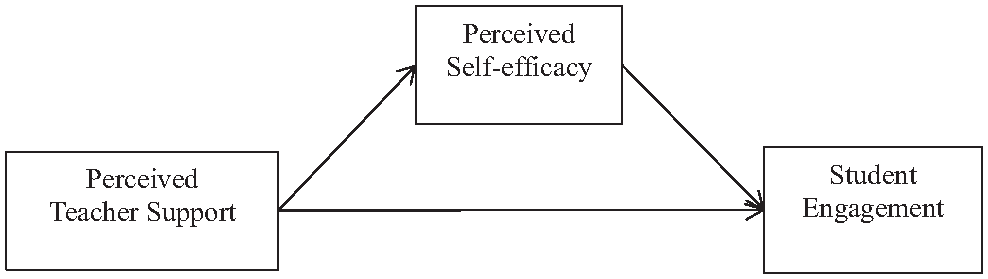
Research structure.
Teachers in colleges and universities undoubtedly play an important role in cultivating student engagement (Axelson & Flick, 2010). Previous studies have shown a positive correlation between students’ perception of being supported by their teachers and learning engagement (Bru et al., 2021; Federici & Skaalvik, 2014). However, the measurement of teacher support is inconsistent across studies (Tao et al., 2022), which may hinder relevant theory construction and empirical research. For instance, Federici and Skaalvik (2014) explored students’ perceptions of teachers’ support from two dimensions, emotional and instrumental, and verified that both types of support have a close relation to students’ motivational constructs. Metheny et al. (2008) revealed three factors of perceived teacher support, they are instrumental, emotional, and informational. Mercer et al. (2011) added appraisal support into the teacher support construct. To fill the gap of perceived teacher support in the literature, it is imperative to clarify the dimension of this construct first.
According to Self-Determination Theory (SDT), tertiary students, as well-developed grownups, naturally need to take control of their learning, make their own decisions, maintain harmonious relationships with teachers, and acquire needed competencies. Thus, when students realize that the learning environments around them meet their basic psychological needs for autonomy, competence, and relatedness, they become active and engaged learners and are more likely to cultivate internal motivation to learning (Deci & Ryan, 2000; Tao et al., 2022). To manifest and satisfy students’ needs for autonomy, competence, and relatedness, the dimensions of teacher support should be in accordance with the constructs of SDT (Tao et al., 2022), which should include autonomy, academic, and emotional support (Bru et al., 2010; Tao et al., 2022). Distinctive dimensions of teacher support relate deferentially to student engagement (Bru et al., 2021). Autonomy support is the interpersonal behavior provided by teachers to identify and build students’ awareness of autonomy and intrinsic motivational resources in classroom teaching (Deci & Ryan, 2000). Studies have shown that perceived autonomy support had a positive and significant relationship with college student’s academic performance with the mediating effect of grit (Huéscar-Hernández et al., 2020). Academic support, also identified as instrumental support, refers to what extent teachers care about students’ learning, provide them with instructional guidance and help, and encourage them to try their best to achieve academic success (Tao et al., 2022). Seldom empirical studies have been processed to measure perceived instrumental support solely, but there was evidence showing that instrumental support has a direct positive correlation with students’ intrinsic motivation, effort, and help-seeking behavior (Federici & Skaalvik, 2014). Emotional support, which refers to a sense of recognition, care, and concern that teachers convey to their students (Bru et al., 2021), occupied a prominent position in the empirical studies examining teacher support. Previous studies explored the correlation of teachers’ emotional support with student engagement, but achieved few consensuses. Some researchers believed that emotional support becomes less important for students as they get older (Bru et al., 2010; Lynch & Cicchetti, 1997), on the contrary, other researchers supported the idea that teachers’ emotional support had the closest relationship with engagement at different education stages (Fredricks et al., 2004; Havik & Westergård, 2019). Several empirical studies proved that emotional support is equally important to undergraduate students, for example, Goldman and Goodboy (2014) revealed that when instructors care about students and invest time and energy into their learning practices, undergraduates tend not to exert their unnecessary emotional energy so that they can be more focused on course learning. Thus, the first hypothesis was proposed as follows:
H1: The perceived support from teachers (autonomy, academic, and emotional support) has a significant positive effect on college student engagement.
In effect, even the same type of teacher support may be perceived differently by students, which means that the internal mechanism between perceived teacher support and student engagement is complex. But the internal mechanism is seldom explored in the field of higher education. According to ecological systems theory, undergraduates’ internal psychological processes interact with external context. No doubt, institutions and students themselves both have responsibilities for the engagement of learning. When institutions provide the appropriate environments, for example, teacher support, to facilitate student learning, students need to put forth the necessary effort to develop their own knowledge and skills (Axelson & Flick, 2010), which implies the teacher support influence students learning behavior through mediating effect of personal traits. One of self-evaluation traits students can develop and resort to is self-efficacy. Perceived self-efficacy, first advocated by Bandura, refers to the beliefs about individuals’ capabilities to exercise control over their own level of functioning and over events that affect their lives (Bandura, 1993), it is also viewed as an indicator of one’s essential ability to cope, perform, and succeed (Judge & Bono, 2001). The process of self-efficacy formation is influenced by the environment such as perceived social support, teacher-student interaction, and peer cooperation. Self-efficacy in turn affect the selection and construction of environments (Bandura, 1993). Teachers may provide the most proximal impact in shaping students’ efficacy beliefs by adjusting their instructional or interpersonal strategies (Schunk & Mullen, 2012), while students’ perception of teacher support interacted with students’ own efficacy beliefs, and provided the motivational setting through which engagement can lead to the expected outcomes (Lam et al., 2012). When students perceive the teacher’s positive emotional support, it can promote students’ learning self-efficacy and in turn, academic engagement (R. D. Liu et al., 2018). In fact, for those students who have low academic self-efficacy, perceived teacher support may be more prevalent and important (Mercer et al., 2011) to stimulate students’ learning motivation and actions in classrooms. Kim et al. (2018) noted the more students perceive teacher support, the higher their academic self-efficacy. In addition, increasing empirical studies have showed that perceived teacher support has a significant positive predictive effect on academic self-efficacy (R. D. Liu et al., 2018; X. X. Liu et al., 2020; Yu & Singh, 2018). A large number of research also proved that efficacy beliefs have significant impact on the level of motivation and performance (Bandura & Locke, 2003). Students’ beliefs in their efficacy can regulate their own learning goals and academic activities, and influence the determination of their aspirations, motivation level, and academic accomplishments (Bandura, 1993). Thus, a commonly accepted expectation is that students with higher self-efficacy are more willing to invest time and energy in learning. Students who feel efficacious and vigorous are more inclined to perform well and persist long compared to those who are low in self-efficacy (Schaufeli, Martinez, et al., 2002; Schwarzer et al., 1997). Several recent experimental studies demonstrated that that self-efficacy is a convincing predictor of student engagement in learning (Chong et al., 2018; Wu et al., 2020), the higher the academic self-efficacy, the higher the level of student engagement. Furthermore, a previous experimental study also verified that the influence of instructional contexts, including teacher support, on student engagement was mediated partially by self-efficacy (Lam et al., 2012). Thus, this study proposed the second hypothesis as follows:
H2: Perceived teacher support can indirectly affect college student engagement through perceived self-efficacy, which means self-percepts of efficacy is the possible mediating variable between perceived teacher support and student engagement.
Research Methodology
Participants and Procedures
A total of 631 undergraduate students from a local college in central China took the web-based survey with the method of non-probabilistic convenience sampling. Among them, 75 invalid questionnaires were excluded, with the valid response rate being 88.11%. Since convenience samples may not be generalized beyond the sample unless the individuals in the sample possess similar characteristics to the population (Estepp & Roberts, 2015), a comparison was made between the sample and the population on several variables. For example, the number of female participants was 296, whose ratio is quite approximate to the gender ratio of the whole population in China’s higher education. Furthermore, the number of students majoring in science and technology and those in humanities is 342 and 214 respectively, which is also quite consistent with the proportion of students from different types of majors since the sample local college is more advantageous in science and technology subjects.
As college students are familiar with digital technology, and online surveys provide easy access to specific populations, meanwhile save time and cost (Wright, 2005), participants in the current research were invited to access the online survey on a personal electronic device, such as smartphone or laptop. They were also informed in advance that the collected data will only be used for the current study and participants’ privacy will be guaranteed. Three undergraduate students assisted with the survey distribution and data collection. Data were collected from October 23rd, 2022 to November 10th, 2022.
Instruments
All the instruments in the current study were administered in Chinese. Some instruments were previously translated and validated in Chinese such as the perceived self-efficacy scale used in this study. The perceived teacher support scale was translated to Chinese by three English major students based on the protocol outlined by the authors (Bru et al., 2010; Havik & Westergård, 2019). All the responses were given on a 5-point Likert scale(1 = “strongly disagree” and 5 = “strongly agree”).
Perceived Teacher Support Scale
According to the sub-dimension of teacher support mentioned above in line with students’ learning needs, the perceived teacher support scale was operationalized into three factors, namely, teacher autonomy support, teacher academic support, and teacher emotional support (Tao et al., 2022). Teacher autonomy support was measured using the scale created by Bru et al. (2010), which includes three items. Examples of items are as follows: “I participate in decisions regarding the choice of my learning tasks,”“I feel I can influence my working situation at school.” Teacher academic support was assessed using the scale developed by Havik and Westergård (2019), which includes five items. Examples of items are as follows: “The teachers describe clear learning targets for the activities and the lessons,”“The teachers carefully help us to understand concepts and facts and the relationship between them.” Teacher emotional support was assessed using the scale created by Bru et al. (2010), which includes 5 items. Examples of items are as follows: “I feel the teachers care about me,”“The teachers often praise me,”“The teachers will help me if I have problems.” The value of Cronbach’s alpha is .854, .820 and .929 respectively. CFA confirmatory factor analysis results showed that the fit index NFI = 0.914, IFI = 0.907, CFI = 0.926, PGFI = 0.727, the factor load of each item was 0.679 to 0.911, the CR value was 0.857, 0.824, 0.931, and the AVE value was 0.546, 0.610, 0.729, respectively, which was higher than the evaluation standard (Fornell & Larcker, 1981).
Student Engagement Scale
Utrecht Work Engagement Scale-Student (UWES-S), developed by Schaufeli, Salanova, et al. (2002) and translated and revised by Chinese scholar Fang et al. (2008), was adopted in this research. The scale includes 17 items in three dimensions, including vigor, dedication and absorption. Vigor (sample item “When I’m doing my work as a student, I feel bursting with energy”) refers to the energy and enthusiasm devoted to learning, the higher the score, the more energy you have in the learning process. Dedication (sample item “I find my studies full of meaning and purpose”) refers to the affirmative emotional experience of learning, the higher the score, the more positive you feel about learning. Absorption (sample item “When I am studying, I forget everything else around me” refers to the degree of concentration during learning, the higher the score, the more concentrated you are engaged in learning. The value of Cronbach’s alpha is .891, .883 and .894 respectively. CFA confirmatory factor analysis results showed that the fit index NFI = 0.921, IFI = 0.937, CFI = 0.937, PGFI = 0.675, the factor load of each item was 0.689 to 0.873, the CR value was 0.891, 0.884, 0.897, and the AVE value was 0.579, 0.605, 0.593, respectively, which was higher than the evaluation standard (Fornell & Larcker, 1981).
Perceived Self-Efficacy Scale
Perceived self-efficacy was measured using the General Self-efficacy Scale. The original German instrument has been proved reliable and valid in various researches and the items were reduced from 20 to 10 at last, and the Chinese version was proven to be psychometrically the best one (Schwarzer et al., 1997). Examples of items are as follows, “I can always manage to solve difficult problems if I try hard enough,”“It is easy for me to stick to my aims and accomplish my goals.” Cronbach’s alpha is .921. The CFA confirmatory factor analysis results showed that the fit index NFI = 0.893, IFI = 0.902, CFI = 0.901, PGFI = 0.556, the factor load of each item was between 0.602 to 0.822, CR value was 0.923, AVE value was 0.548, which was higher than the evaluation standard (Fornell & Larcker, 1981).
Results
Common Method Bias Test
Harman’s single-factor test was used to solve the problem of common method variance (Podsakoff et al., 2003). Exploratory factor analysis was conducted on all items of each variable. The results showed that KMO = 0.957, Bartlett’s spherical test p < .001, and seven common factors (including three dimensions of teacher support scale, three dimensions of student engagement scale, and self-efficacy scale) with feature roots greater than 1 were selected. The variance interpretation rate of the first common factor was 39.832%, which was less than the critical standard of 40% (Harris & Mossholder, 1996). Therefore, it is believed that the data in this study are not affected by the common method bias, and the relationship between the variables derived from the data is reliable.
Descriptive Statistics and Correlation Analysis
The average score of perceived teacher support is 3.18, the average score of self-efficacy is 3.06, and the average score of student engagement is 3.00. The average score of each dimension is shown in Table 1.
Descriptive Statistics and Correlation Analysis Results of Each Variable.

Note. PTS = perceived teacher support; TES = teacher emotional support; TAS = teacher autonomy support; TCS = teacher academic support; PS = perceived self-efficacy; SE = student engagement; V = vigor; D = dedication; A = absorption.
p < .001.
The results of correlation analysis showed that, firstly, perceived teacher support was positively correlated with student engagement (r = .59, p < .001), three dimensions of perceived teacher support, teacher emotional support (.54), teacher autonomy support (.55) and teacher academic support (.42) are significantly positively correlated with student engagement. Secondly, there is a positive correlation between perceived teacher support and perceived self-efficacy (r = .53, p < .001). Thirdly, perceived self-efficacy and student engagement also have a significant positive relationship (r = .64, p < .001). Self-efficacy was positively correlated with the three dimensions of student engagement, that is, vigor (.58), dedication (.60), and absorption (.58). Based on the above analysis results, there is a significant positive correlation between all variables.
Mediating Effect Analyses
Structural Model Analyses
After confirming the correlation between the variables, this study uses AMOS software to establish a structural equation model to further explore the interaction path among the three variables. With perceived teacher support as the independent variable, student engagement as the dependent variable, and perceived self-efficacy as the intermediary variable, the overall model test results are obtained (Table 2).
Model Fit Test.

According to the suggestion of Hair et al. (2019), the measures of absolute fit, incremental fit measures and parsimonious fit measures is good to assess structural models. Thus in the current study, measures of absolute fit: χ2 value is 2,425.123, χ2/df = 3.318, which is close to χ2/df = 2 (Ullman, 2001), RMSEA = 0.065, although the strict standard is greater than 0.05, it can still be accepted if below 0.8 (McDonald & Ho, 2002), GFI is 0.796, which does not reach the standard of 0.900, but Bollen (1990) proposed that GFI and AGFI will be underestimated when the sample size is small. SRMR = 0.057, which is close to 0.05 standard (Hu & Bentler, 1999); Incremental fit measures: CFI, IFI and NNFI are 0.893, 0.893 and 0.854 respectively, which are close to the standard of 0.900; Parsimonious fit measures: PNFI and PGFI are 0.800 and 0.837, both of which are greater than the standard of 0.50 (Breivik & Olsson, 2001). Although some indicators are not fully matched, they are still within the acceptable range, so the adaptability of the theoretical model and the data is acceptable.
Path Test of Direct Effect
There are three direct effect paths between the three latent variables in this study, namely, perceived teacher support → perceived self-efficacy, perceived teacher support → student engagement, perceived self-efficacy → student engagement. The analysis results show that the standardization coefficients of each path are .658, .526, and .332 respectively, and the three paths are significant at the level of p < .001. Therefore, the hypothesis of H1 is tenable (see Table 3).
Bootstrap SEM Analysis of Total, Direct, and Indirect Effects.

Note. PTS = perceived teacher support; PS = perceived self-efficacy; SE = student engagement.
Intermediary Effect Test of Perceived Self-Efficacy
This study uses the bootstrapping method proposed by Shrout and Bolger (2002) to improve the accuracy of the estimated value of the intermediary effect test. This is a method to obtain the average number of intermediary effects and the 95% confidence interval by the procedure of repeated sampling. If the 95% confidence interval of the intermediary effect obtained by repeated sampling does not contain 0, it means that the intermediary effect reaches a significant level of p < .05.
The indirect effect of perceived self-efficacy between teacher support and student engagement is .219 (.658 × .332), and the confidence interval [0.120, 0.319], indicating that self-efficacy has a mediating effect. The direct effect is .526, the confidence interval [0.386, 0.675], and the total effect is .745 (.526 + .219), the confidence interval [0.663, 0.809], none of them includes 0, indicates that the intermediary effect of perceived self-efficacy is significant. According to the results, self-efficacy has a partial intermediary effect between teacher support and student engagement (see Table 3 and Figure 2). The assumption of H2 is true.

SEM path coefficient diagram.
In addition, by comparing the standardized regression coefficients of various dimensions in AMOS, it is found that among perceived teacher support, teacher autonomy support (0.84, p < .001) has the greatest effect on student engagement, followed by emotional support (0.80, p < .001) and teaching support (0.69, p < .001).
Discussion
The Level of College Student Engagement
The results show that the average score of local college students’ engagement is 3, which is lower than that of Maroco et al.’s (2016) research conducted in Portuguese universities and Zhang et al.’s (2007) research conducted in a comprehensive university in mainland China. It implies that Chinese local college students’ engagement in learning still have room for improvement. As for the three sub-dimensions of student engagement, vigor accounts for the lowest mean score of 2.78, while dedication has the highest mean score of 3.23. The differences between the three sub-dimensions are similar to previous studies (Gan et al., 2007; Zhang et al., 2007). The result might be related to the academic environment of the local university, where students have the passion and aspiration to learn but was negatively affected by and conformed to the disadvantageous contexts so that they devote less energy to learning in practice and can’t stick to learning longer if confronted with academic difficulties. Thus we inferred that both students and institutions are responsible for the deficiency of student engagement. Students need to stick to goals and make efforts to acquire necessary knowledge and skills, and build a good learning atmosphere and healthy competitive relationships with college peers, on the other hand, universities and colleges need to provide the appropriate environments to facilitate and support student learning (Axelson & Flick, 2010) by optimizing teaching facilities and enhancing teachers’ developmental teaching abilities.
The Relationship Between Perceived Teacher Support and Student Engagement
The hypothesis about perceived teacher support and engagement was fully confirmed. It is also consistent with ecological systems theory that perceived external environments influence individuals’ behaviors. However, different teacher support has a different predictive effect on student engagement. Specifically, perceived teacher autonomy support has the greatest effect on student engagement, followed by teacher emotional support and teacher academic support. This is consistent with Reeve et al.’s (2004) research verifying the more autonomy support teachers used in their teaching, the more engaged were their students. Nevertheless teacher autonomy support was underestimated in previous studies. Though teacher academic support and emotional support is important to motivate students in certain contexts, autonomy support for college students is an inevitable way to promote students engagement during instruction because college students have more need to be autonomous in learning and become independent learners. When autonomy is satisfied in action, students feel a sense of psychokinesis and internal trajectory, and experience that their inner thoughts and values support their own behaviors (Deci & Ryan, 2013; Reeve & Jang, 2006). Thus nurturing students’ inner resources in learning can improve their engagement. In addition, we can’t ignore the role of other two types of teacher support in influencing college student engagement. How to organically combine the three different types of teacher support to promote their positive influence on student engagement is also an issue that needs to be considered. Just as research shows, in emotionally supported classrooms, students experienced more developmentally-appropriate chances to exercise autonomy in their daily learning activities (Ruzek et al., 2016).
Though predictive role of teacher support on student engagement has been verified, the data of different types of teacher support also tells its own story. The average score of perceived teacher academic support is 3.48, which is the highest, while the average score of perceived teacher emotional support is 2.83, which is the lowest. The data is consistent with previous research conducted in other cultures, for example, Norway high school context (Bru et al., 2021). It is also in line with the situation in most Chinese local universities where instrumental teaching outweighs autonomy-supportive teaching, and teachers’ emotional devotion is rather limited. Therefore, to improve the engagement of local college students, teachers should increase the concrete autonomy-supportive strategies before, during and after instruction, devote more emotion to teaching, build a harmonious relationship with students and cultivate students’ personal responsibility for their learning.
The Mediating Role of Perceived Self-Efficacy
This study revealed that self-efficacy played a partial mediating role between perceived teacher support and engagement undergraduate students. The result also supports the ecological systems theory that perceived teacher support constitutes the micro-environment that affects engagement and perceived self-efficacy is recognized as the individual cognitive factor that promotes engagement through the interaction with the external environment. The result showing self-efficacy has a positive predictive effect on all aspects of student engagement, which is consistent with previous research findings (Chang & cheng Chien, 2015; Sökmen, 2019), and the result also verifies that higher levels of teacher support were associated with greater student engagement, and this trend was most pronounced among students with high perceived self-efficacy, which is in line with existing research findings (Mercer et al., 2011). The results of this study suggest that to improve the engagement of local college students, we should pay attention to the active construction of self-efficacy and the supporting factors that help their self-efficacy formation. By cementing teacher-student interaction, deepening professional understanding of the concept of teacher support, strengthening different types of teacher support, upgrading teaching methods to satisfy students’ autonomy, competence and emotional needs, enhancing students’ sense of being supported and involved in learning, teachers can help to stimulate students’ lasting and stable internal learning efficacy and positive engagement behaviors.
Conclusion
In summary, the findings of the study have both empirical and theoretical enlightenment. From an empirical perspective, the current study depicted a rough picture of the engagement of local college students in China, and provided references for Chinese local colleges to promote student engagement and improve the quality of teaching. It also showed that the teaching of local college teachers is mainly didactic, lack of guidance for students’ autonomous learning, and lack of emotional interaction, both of which should be enhanced, so did the students’ self-efficacy. Teacher support is a valuable construct and critical factor on the development of students’ self-efficacy, thus to improve students’ self-efficacy and further enhance their engagement in learning, teachers should provide more instrumental help and autonomous learning strategies, and give positive feedback to students as much as possible. Furthermore, the current study made a innovative contribution to understanding the relationship between teacher support and student engagement by categorizing different types of teacher support, which uncovered what supportive resource university teachers should provide more in their teaching. Theoretically, this study adds new knowledge to the student-engagement research field by revealing how perceived teacher autonomy support, academic support and emotional support may play different roles with the mediation of self-efficacy. Students’ perceived teacher autonomy support plays significant role in stimulating and maintaining their commitment to learning, which was not highlighted in previous studies compared to emotional support and academic support. Moreover, the findings also provide empirical evidence to the merit of ecological systems theory in revealing the correlation between perceived teacher support and student engagement.
However, we also need to address some possible limitations. First, we conducted a cross-sectional investigation of the focal issue, but students’ perception of teacher support and self-efficacy is dynamic, and their experience of learning engagement may be subject to change over time. Therefore, longitudinal studies are warranted in the future to examine the dynamic relationship among perceived teacher support, self-efficacy and engagement. In addition, we only located self-efficacy as the mediator. But according to ecological systems theory, variables related to individuals’ characteristics, and cognitional and emotional process also need to be examined in the student engagement literature. Future studies should take some other variables like students’ future time perspectives and students’ academic emotions as mediators, which may help to generate more insights. Last but not least, this research was conducted in a local university in central China, it might not be easy to reflect the connection between the variables among undergraduate students across China since China has various educational resources and levels. Future studies should expand the tertiary educational contexts, for example, research-oriented universities and vocational colleges, and diversify participants, for example, post graduates and graduates in different majors or gender, to enhance the research results or discover new interesting findings.
Footnotes
Acknowledgements
We are grateful to the students who helped with circulating the questionnaire and the students who carefully completed the questionnaire in this study.
Authors Contributions
W.G.: Conceptualization, Investigation, Writing-Original Draft, Writing - Review & Editing, Supervision, Project administration. C.X.: Methodology, Software, Validation, Formal analysis, Data Curation, Visualization, Writing - Review & Editing.
Declaration of Conflicting Interests
The author(s) declared no potential conflicts of interest with respect to the research, authorship, and/or publication of this article.
Funding
The author(s) disclosed receipt of the following financial support for the research, authorship, and/or publication of this article: This work was supported by Scientific Research Foundation of Hunan Provincial Education Department [grant number: 18C0901].
Ethical Approval
The study received the approval of the Hunan Normal University’s Ethics Committee.

Data Availability Statement
Our data is public in figshare.com, DOI 10.6084/m9.figshare.24038337