




Abstract
Since the outbreak of the COVID-19 pandemic, social media are used frequently in the process of teaching and learning interaction, which not only endows learning with sociality, but also poses challenges to students’ autonomous learning behavior. To identify the influencing factors of motivation regulation in blended learning environments, we need to pay more attention needs to the mechanisms and strategies that support students’ long-term interests. The results revealed that social interaction and perceived playfulness are important factors affecting students’ motivation regulation, and teachers’ support of autonomy, emotion, and ability play a regulatory role. The results present internal and external driving forces of students’ motivation regulation, which are useful for educators to understand the plasticity of motivation and the inequality of learning achievements of specific student groups. Therefore, teachers are required to play a more supportive role in the social learning environment based on game thinking and interactive design to enhance students’ learning motivation.
Introduction
Since the outbreak of the COVID-19 pandemic, colleges and universities in China have entered the process of blended teaching reform at a deep level. Blended learning uses various combinations of learning approaches, ranging from face-to-face learning and social media platforms to online learning (Vallée et al., 2020). It provides many benefits and meets the demands of today’s digital generation, such as boosting their motivation and engagement level with the help of social media, mobile applications, gamification; enhancing their interaction; and increasing their enthusiasm (Ramalingam et al., 2022). The full use of social networks provides a way of knowledge sharing and transfering between teachers and students, and online pedagogical interactions happened at different times and in different contexts (Sebbowa, 2022) which endows learning with the attribute of socialization. The application of intelligent mobile terminal data breaks the traditional teaching mode and is a necessary practice for the innovation and development of the teaching environment (D. F. Zheng & Shi, 2020). Blended learning plays an important role in the construction of a sustainable learning environment with greater inclusivity (learner control, Van Laer & Elen, 2017) and fairness (student subjectivity, Bruggeman et al., 2021). It has been recognized as fostering independent learning among undergraduate students (Onah et al., 2020). However, we should not only see the benefits but also the challenges brought about by the application of information technology to teaching. Studies have shown that technology can also pose risks to blended learning environments. For example, feeling of isolation or alienation as loss of social ties due to lack of contact with peers and lack of sufficient lecturer-student interaction, feeling of fatigue and frustration due to excessive use of information and communication tools which create obstacles in learning and cognition, and greater susceptibility to various forms of distraction (Gikas & Grant, 2013; Goundar, 2014; Macintyre et al., 2020; Ober & Kochmańska, 2022).
Due to the complex factors affecting the relationship between learning and interaction, a lack of ability to learn and control autonomously may lead to the loss of motivation on the part of the learner. This may happen at the start of a student’s study or because of instability, motivation varies from person-to-person depending on the time and situation (Sansone & Thoman, 2006), and could eventually lead to withdrawal from learning. That is, trying to understand group-based educational inequalities requires looking beyond student performance and further focusing on whether and how students maintain the motivation for their educational and career paths over time (Thoman et al., 2019). The Self-Regulation of Motivation (SRM) model describes how students’“choice persistence” is driven by the dynamic interplay between goal-defined motivation and experientially-defined motivation (or interest). These two predictors will also become the basis for students’ choice persistence (Thoman et al., 2019). It is a dynamic state that arises through continuous transactions between context, goals and actions (Sansone & Smith, 2000). In summary, greater efforts are needed to address students’ and emotional needs, all the while making up for learning loss and preparing for the unpredictable combinations of distance learning, blended learning, and in-classroom learning (Darling-Hammond & Hyler, 2020). However, the existing research is based mainly on the technology acceptance model (TAM) to explore students’ perceptions of education and teaching, and the research results focus mainly on the effect of blended learning. There is almost no special evaluation of the key dimensions affecting students’ motivation regulation in the social environment of blended learning from the perspective of students’ perceptions. Building on that, this study aims to explore the influence mechanism of motivation regulation in blended learning from the perspective of learning socialization, to provide theoretical supplement for SRM to better understand if and how students stay motivated for the long-term. And further discusses the possibility of transforming the traditional role of the instructor (teacher) as the main source of information and power, toward being a facilitator of the learning process (Barak, 2006). Additionally, this study provides more avenues for investigating the core values of blended learning and helps reduce or eliminate unsustainable practices in blended teaching reform.
Materials and Methods
Motivation is a complex part of human psychology and behavior that influences how individuals choose to invest their time, how much energy they exert in any given task, how they think and feel with the task, and how long they persist with the task (Urdan & Schoenfelder, 2006). Motivation regulation refers to the activities through which individuals act to initiate, maintain, or supplement their willingness to start, provide work toward, or complete a particular activity or goal (i.e., their level of motivation) (Wolters, 2003). Motivation regulation is a facet of self-regulated learning that describes students’ efforts to control their own motivation or motivational processing (2011). Self-efficacy for motivation regulation refers to students’ beliefs about effectively using strategies to regulate their motivation (Trautner & Schwinger, 2020). In other words, as an important individual factor of motivation regulation, self-regulated efficacy can stimulate students’ belief in the flexible use of strategies to regulate motivation and be used as a moderating variable in the process of self-regulated learning (Sitzmann, 2012). Supporting students’ self-efficacy beliefs for motivation regulation can enhance self-regulatory success (Trautner & Schwinger, 2020). A previous study found that and greater social support can help individuals experience a higher sense of self-efficacy (Hahn, 2010), and teachers play a more critical role in students’ learning in comparison to peers and parents (De Garmo & Martinez, 2006). Thus, teachers support can help students reflect on the strategies they can successfully apply and improve their self-efficacy in motivation regulation (Krans et al., 2018; Trautner & Schwinger, 2020). In addition, interaction is one of the key attributes that supports learners’ self-regulation ability (Van Laer & Elen, 2017), and the concept of interaction is a key factor in the design of a blended instructional course (Gao et al., 2020). When an individual perceives that their attention is focused on their interaction with the Internet, is curious during the interaction, and finds the interaction intrinsically enjoyable or interesting, it constitutes the dimensions of perceived playfulness, and becomes an important factor affecting learners’ internal motivation (Moon & Kim, 2001; Padilla-Meléndez et al., 2013). In other words, experiential motivation (related to perceived playfulness) based on emotions, feelings, and relational knowledge in social interaction can drive learners’ choice of and persistence in learning activities (Singleton, 2015), indicating a stronger role within the motivational-affective components of self-regulated learning in enhancing self-regulatory success. To sum up, although the current study about the malleability of various personal attributes have been linked to successful self-regulation in several domains (e.g., abilities and emotions), and extended to achievement motivation in the context of self-regulated learning (Trautner & Schwinger, 2022), few empirical studies have focused on the impact of the above-mentioned crucial attributes individual perceived on the motivation regulation process in blended learning environments in higher education.
To further clarify the influential mechanism of learners’ motivation regulation in the social environment of blended learning, it is necessary to investigate the direct predictive effect of social interaction and perceived playfulness on motivation regulation, and the regulation mechanism of teacher support. It will help reveal how different teacher support strategies create differences in the impact of social interaction and perceived interest on motivation regulation and be beneficial to encourage students to take more initiative in social learning settings to better manage their motivation. Specifically, the study examined the following themes:
What is the relationship between social interaction, perceived playfulness, and motivation regulation?
How does teacher support affect the relationship between social interaction and motivation regulation?
How does teacher support affect the relationship between perceived playfulness and motivation regulation?
Conceptual Background
The Relationship Between Social Interaction and Motivation Regulation
Social learning is not only about how we learn from others but also about how we help others learn, the two processes work together toward a common, shared epistemic goal (Bratman, 2013; Tomasello, 2019), giving rise to a form of learning and communication that is powerful, smart, and distinctively human (Gweon, 2021). Social learning also involves external interactive processes and internal psychological processes (Illeris, 2003). External interactive processes such as participation, observation, cooperation, communication to facilitate the integration of the social environment with the individual. Internal psychological processes include cognitive functions (to process learning information) and emotional functions (representing psychological responses) (Illeris, 2003; Li & Hua, 2021). From the above standpoint, social learning in the classroom scenario includes the basic elements of “negotiated goals,”“responsible dialog,”“continuous process,” and “emergent generation”. “Social interaction,” referred to the interactive behavior of users in blended learning and social scenes, happens all the time in the process of the above learning modules.
Learners can experience a sense of communication and establish a continuous and close relationship with others in the process of social interaction (Song et al., 2020). An individual’s desire to be associated with others or have a sense of belonging may be satisfied, which may affect their level of motivation (E. L. Deci & Ryan, 1980, 2000) and help learners maintain goal-oriented activities. Learner interaction is a significant factor in learner satisfaction and knowledge construction. The interactive and collaborative learning activities in the classroom should be able to attract students to create deeper thinking and discussions on topics (Khlaisang et al., 2021). A lack of timely feedback for learners can lead to dissatisfaction with the online courses (Kintu et al., 2017), which is considered to be an internal factor leading to learners’ failure. In other words, this is also a reason for the lack of learning motivation. The impact of the perceived relationship with teachers on the students’ intrinsic motivation has been empirically demonstrated in the Massive Open Online Courses (MOOC) learning environments (Yang, 2016). In a basic blended course setting, students can receive their lectures at home in the format of videos, tasks, quizzes, and written materials in online spaces. Then, more student-centered activities can be performed in- class time, along with addressing detailed questions and realizing more efficient opportunities for learning (Namaziandost & Çakmak, 2020). This is also the main direction of blended teaching reform since the COVID-19 pandemic.
However, instructors and students still faced struggles and difficulties in the use of platforms for online and virtual classes. Research has shown that emotional resistance has a significant negative impact on the effect of teacher-student interaction in the flipped classroom (Y. Liu & Qi, 2021). Special attention should be paid to students’ emotions, which requires educators to be more interactive in virtual and online environments (Jeong & González-Gómez, 2021). While how does the dimension and degree of interaction affect students’ sense of learning experience and their self-regulation of motivation? Relevant research results suggest that students’ satisfaction and sub-dimensions “communication and usability,” as well as “interaction and evaluation” are significant predictors of students’ engagement and motivation in the mobile-based flipped classroom (Karaoğlan Yılmaz, 2022). As thus, the first hypothesis is as follows:
H1. Social interaction can positively affect learners’ motivation regulation.
The Relationship Between Perceived Playfulness and Motivation Regulation
“Playfulness” was first proposed by Lieberman (1976, 1977) and is seen as a behavior that includes a sense of humor, obvious happiness, and spontaneity. Lieberman believes that playfulness is the most important factor in human-computer interaction. Playfulness is a complex variable that includes an individual’s pleasure, psychological stimulation, and interest (Gao et al., 2020). Perceived playfulness is an intrinsic perceptual variable, an individual’s inner pleasure in the process of participating in a learning activity (Van Laer & Elen, 2017). As such, it can be understood as being one of the greatest concerns among today’s college students when learning online. Studies show that perceived playfulness is an important factor that directly affects external motivation (Tselios et al., 2011), which can promote the tendency of individuals to interact with computers spontaneously, creatively, and imaginatively (Webster & Martocchio, 1992). Therefore, perceived playfulness is also related to highly interactive activities (Van Vleet & Feeney, 2015).
During the process of implementing interactive teaching, it is essential to find positive and interesting factors that stimulate and drive students’ learning and practice. This refers to applying gamification to teaching. When gamification is applied to education, it refers to making learning experiences more engaging and game-like by using game design elements and mechanics (Leitao et al., 2019). This is also the case in the flipped classroom, which uses a mix of e-learning and face-to-face teaching, as well as gamification, which bases its didactic principles on the recreational components of games. The findings showed that the application of these methods promoted an increase in students’ motivation, as well as in their autonomy and self-regulation when approaching the subject (Gómez-García et al., 2020). In addition, gamification can significantly increase the intrinsic motivation and introjected regulation of college students (Jo et al., 2023; T. Liu & Lipowski, 2021).
Perceived playfulness is also thought to establish a safe and secure relationship among students and teachers. It has been linked with relationship quality and positive emotions, which may enhance students’ level of exploration (Van Vleet & Feeney, 2015), or in other words, their emotional involvement. Moreover, the emotional component of motivation in self-regulated learning plays a stronger role in the effective use of strategies to regulate motivation, and is closely related to self-efficacy in motivation regulation (Trautner & Schwinger, 2020). Therefore, playfulness is important as it helps individuals be more inclined to choose to participate in activities, increase their efforts, commit to completing difficult tasks, and reach higher levels of achievement (Schunk & DiBenedetto, 2020). Attitude and motivation theorists also believe that perceived playfulness is a decisive factor in behavior (Igbaria et al., 1994). In conclusion, perceived playfulness is a dynamic emotional attribute. When an individual’s playfulness needs are met, it will help maintain or enhance their motivation regulation. Based on the above reasons, the second hypothesis is proposed as follows:
H2. Perceived playfulness can positively affect learners’ motivation regulation.
The Moderating Effect of Teacher Support
Teacher support refers to teachers’ attention, friendliness, emotional care, and willingness to help students with the problems they encounter (Henderson et al., 2000). Based on the three basic psychological needs of self-determination theory: autonomy, relationship, and competency needs (E. Deci et al., 1991; Tan et al., 2019), teacher support can be further divided into three dimensions: autonomy support, emotional support, and ability support. Teachers’ autonomy support is defined as students’ perceptions of the extent to which their teacher makes them feel confident in their abilities, understood, listened to, and accepted (Simon & Salanga, 2021; Williams & Deci, 1996). Teachers’ emotional support means that teachers communicate with students positively, showing sincerity, care, understanding students’ emotions, and respecting students’ views (Patrick et al., 2002). Due to the novelty of online learning at the beginning of the learning process, students may develop positive emotions such as enjoyment and curiosity. However, as learning progresses, the frequency and intensity of these positive emotions will gradually decrease. Therefore, teachers should pay special attention to assisting and guiding students to execute emotional self-regulation in order to effectively improve students’ learning achievement and satisfaction (Wu et al., 2021). In addition, students with a high self-regulation learning profile have the highest achievement motivation (Vanslambrouck et al., 2019). Teachers’ ability support refers to the extent to which teachers help students improve their learning and the degree of recognition that teachers provide students for good performances (John et al., 2003). Research on the synthesis framework of constructivist via gamification-based learning environments model showed that “Helping Room,”“Coaching,” and “Hints” options can enhance self-regulation for undergraduate students (Daungtod & Chaijareon, 2019).
Students who learn through blended learning are in greater need of higher- level social interaction, participation, and affective learning, which has a strong effect on their cognitive learning. In students who learn face- to- face, teachers’ affective factors such as immediacy, supportiveness, inclusiveness, being warm and caring, and their friendships with the students play a greater role in developing students’ course knowledge and skills (W. Zheng et al., 2022). It has been identified that aspects of the classroom environment, such as support offered by the teacher, have a strong relationship with the self-regulatory motivational strategies used by students (Rojas-Ospina & Valencia-Serrano, 2021). Consequently, the support of teachers is an essential factor in the interaction between students and teachers. In case of a lack of social support for learners in the technological environment of blended learning, they will feel a lack of social connection, isolation, and a sense of loneliness (Peplau & Perlman, 1982), which further expands the lack of quality, accuracy, and depth of learning. However, when teachers’ support is warm and helpful, it makes learners feel confident and plays a positive role in consolidating learning achievements (Simon & Salanga, 2021). Research shows that teachers’ autonomy support has a positive impact on learners’ learning interests (Tsai et al., 2008), and learners who are motivated to attain goals engage in effective self-regulatory activities such as implementing strategies, monitoring performances, adapting their approach as needed, reflecting on their progress, and sustaining motivation for task completion (i.e., self-regulation of motivation) (Cleary & Kitsantas, 2017; Usher & Schunk, 2018). This has been proven by an empirical study showing that teacher support can positively predict students’ learning motivation (Jang et al., 2012). Moreover, motivation is also associated with an individual’s experience (i.e., motivation that results from whether the experience is interesting; Sansone & Thoman, 2006), which may be caused by the moderating effect of teachers’ support. The study shows that need-supportive instruction is beneficial to improving participants’ intrinsic motivation, skill performance, and enjoyment (Manninen et al., 2022).
In conclusion, teacher support may regulate the relationship between teacher-student interaction and motivation regulation. Teacher support also has a significant impact on learners’ curiosity (Zhao et al., 2011), which is an important dimension for measuring students’ perceived playfulness. Thus, this study also believes that teacher support may regulate the relationship between perceived playfulness and motivation regulation. Thus, the third and fourth hypotheses are as follows:
H3. The higher the degree of teacher support, the stronger the positive relationship between social interaction and learners’ motivation regulation.
H4. The higher the degree of teacher support, the stronger the positive relationship between perceived playfulness and learners’ motivation regulation.
This study extracts social interaction and perceived playfulness as independent variables, teacher support as the moderating variable, motivation regulation as the dependent variable, and control variables (learners’ personality, age, grade, major, etc.) as antecedent variables to construct a theoretical analysis framework (Figure 1).

Research model.
Sample and Data Collection
As the core area supporting the construction of the 21st century Maritime Silk Road, Fujian Province is facing a once-in-a-lifetime development opportunity. The accompanying pressure of talent training will inevitably become the driving force to promote the reform of education and blended learning in colleges and universities. As a new social school driving force, private colleges and universities are more flexible in teaching management and talent training, and have made historic contributions to the prosperity of social and cultural undertakings. Fujian private colleges and universities are mainly concentrated in coastal cities. Their development level in terms of the number of schools and students is at the forefront to implement blended learning. Based on that, students from private undergraduate universities in Fujian, China were sampled. Relevant information was collected through colleagues, friends, and online communities, and a questionnaire survey was carried out via network and offline distribution in the second half of 2020.
Before distributing the questionnaires in this study, we invited several teachers and students to conduct focus group interviews to confirm that they have engaged in and participated in blended learning, as well as social interaction, perceived playfulness, and motivation regulation. Afterward, the first draft of the questionnaire was produced by combining the results of the focus group interviews and the literature.
Content validity is the degree to which a measurement tool (questionnaire) accurately covers the research topics and variables. After the first draft of the questionnaire was designed, we hired three scholars and experts (specialized in educational psychology, social psychology, and organizational behavior) to measure the content validity. According to the experts’ suggestions, the content and semantics of the questionnaire items were revised. After corrections are made, experts are invited to confirm and finalize the questionnaires.
The sampling process can be divided into five stages. (1) Confirm whether the target sample (student) participates in blended learning in the classroom, and whether the teacher implements blended learning. (2) To obtain representative samples, detailed instructions were given before the questionnaire was distributed, and the relevant concepts of the study were explained mainly through e-mail, voice group chat, and offline modes. (3) Respondents were invited to respond to the questionnaire, acknowledging their right to privacy and the use of item answers for academic research purposes only. (4) First ask students to fill items in two independent variables (social interaction and perceived playfulness) and one moderator (teacher support). (5) After 1 month, ask the students to complete the answer on the dependent variable (motivation regulation). A total of 1,000 questionnaires were distributed, and 607 valid questionnaires were returned, giving a response rate of 60.7%.
Participating students completed social interaction, perceived playfulness, motivation regulation, and teacher support items. The respondents’ attributes were as follows: 25.5% were male and 74.5% were female. In terms of grade, 64.3% of participants were first-year students, 11.7% were second-year students, 22.4% were third-year students, and 1.6% were fourth-year students. Most of the participants were majoring in literature and history (48.9%), 35.9% were majoring in art, and 15.2% were majoring in engineering. In terms of personality, most of the participants in the sample were intellectual type (52.1%), 41% were emotional type, and 6.9% were willpower type.
This study mainly carried out data analysis using Amos 24.0, SPSS 22.0, and Mplus. We adopted Amos to test the confirmatory factor analysis and estimate the baseline of the structural equation model. We also adopted SPSS to conduct hierarchical regression to estimate the direct and moderating effects of the hypotheses. Finally, we adopted Mplus to test the alternative model.
Measurement Instruments
Social Interaction (SI)
The dimension and degree of social interaction was measured with the teacher-student interaction scale by Xu (2016), with a total of 21 items. Using a five-point Likert scale (“strongly disagree” to “strongly agree”), the six social interaction dimensions “interaction quantity” (e.g., “I can always answer the teacher’s questions in blended learning in time.”), “interaction form” (e.g., “I often ask teachers questions in blended learning.”), “interaction distance” (e.g., “In blended learning, every communication with teachers makes me feel very happy”), “interaction content” (e.g., “In blended learning, I often communicate with teachers about the problems encountered in life.”), “interaction time” (e.g., “In blended learning, I can communicate with teachers for a long time every time.”), and “interaction motivation” (e.g., “In blended learning, I communicate with teachers to solve the problems I encounter in learning.”) with three to six items each were assessed. As shown above, to ensure the reliability of the collected data, the term “E-Learning” in the original scale was replaced by “blended learning.”
Perceived Playfulness (PP)
Perceived playfulness was assessed with the items adapted from the perceived fun scale by Igbaria et al. (1994). In the original scale, six pairs of different semantic difference items: rewarding/unrewarding, pleasant/unpleasant, fun/frustrating, enjoyable/unenjoyable, positive/negative, and interesting/uninteresting are adopted to evaluate the perceived playfulness. In order to avoid conceptual confusion in Chinese Semantics, it is simplified into three items in this study, and using a five-point Likert scale (“strongly agree” to “strongly disagree”) for scoring.
Teacher Support (TS)
Teacher support was mainly measured from three aspects: autonomy support, emotional support, and ability support. The autonomy support was assessed with the Learning Climate Questionnaire (LCQ) (Simon & Salanga, 2021), which was originally developed by Williams and Deci (1996) on the basis of the Health-Care Climate Questionnaire (Núñez et al., 2012), and was divided into the 15-item and 6-item versions. In this study, the six-item version was selected for measurement; The emotional support was assessed with the teacher’s involvement scale from the social classroom structure measurement project of Stornes et al. (2008), with a total of four items; The ability support was assessed with the teacher support scale form Lee, Lee, and Wong’s Hong Kong Classroom Environment Scale (HKCES) (John et al., 2003), with a total of seven items. The above scales are scored by using a five-point Likert scale (“strongly agree” to “strongly disagree”).
Motivation Regulation (MR)
Motivation regulation was measured with the Motivation Adjustment Scale by Wolters and Benzon (2013), with a total of 30 items. Using a five-point Likert scale (“strongly disagree” to “strongly agree”), the six motivation adjustment dimensions “value regulation” (e.g., “I try to make the material seem more useful by relating it to what I want to do in my life.”), “performance goal regulation” (e.g., “I think about how my grade will be affected if I don’t do my reading or studying.”), “self-reinforcement” (Gon et al., 2017) (e.g., “I promise myself some kind of a reward if I get my readings or studying done.”), “learning environment construction” (e.g., “I make sure I have as few distractions as possible.”), “situational interest regulation” (e.g., “I make studying more enjoyable by turning it into a game.”), “mastery goal regulation” (e.g., “I convince myself to work hard just for the sake of learning.”), with four to six items each were assessed.
Results and Discussion
Confirmatory Factor Analysis (CFA) and Discriminant Validity
Before testing the hypothesis, AMOS and the method of Maximum Estimation were used for confirmatory factor analysis (CFA) to confirm the independence of each variable and to verify the discriminant validity. Discriminant validity specifically measures whether constructs that should not be related theoretically. Table 1 shows the goodness-of-fit indices of the baseline model (Four Factor Model): χ2/df = 4.97, RMSEA = 0.080, CFI = 0.958, RMR = 0.02, GFI = 0.907, AGFI = 0.886. The cut-off values of Model goodness-of-fit indices are as follow: χ2/df values of 5 or less being a common benchmark; RMSEA should be <0.08 or <0.05; CFI should be >0.90; RMR should be <0.08; The GFI and the AGFI should be >0.90 (Kline, 2015; Schumacker & Lomax, 2004). It can be seen that the baseline model is the best fitting model compared with others. This result also represents that the discriminant validity of the scale has reached.
Comparison of Measurement Models.

Note. Baseline model (four factor model): SI, PP, TS, and MR are separate. Three factor model: TS and MR combine into one factor, and the other two factors are SI and PP. Two factor model: SI and PP combine into one factor, and TS and MR combine into another factor. One factor model: all variables combine into one factor.
In addition, four variable-independent CFA testing results are shown in Table 2. The factor loadings of SI are ranging from 0.709 to 0.912. The factor loadings of PP are ranging from 0.813 to 0.933. The factor loadings of TS are ranging from 0.880 to 0.903. The factor loadings of MR are ranging from 0.794 to 0.903.
CFA Results of Each Variable.
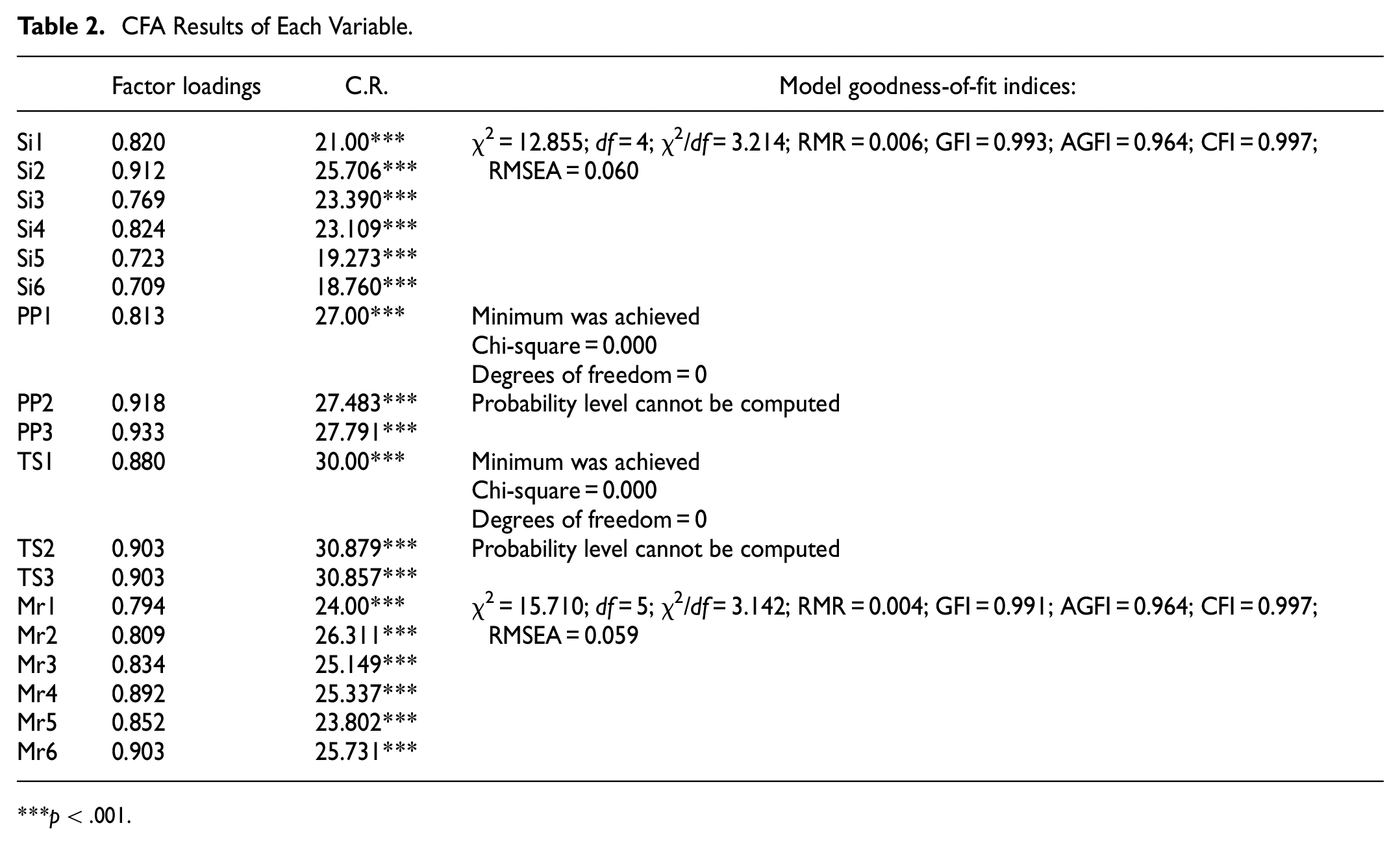
p < .001.
Correlation Matrix
Table 3 shows the mean, standard deviation, correlation coefficient, and reliability (internal consistence) of each variable. The study found that, SI was positively correlated with MR (r = .671, p < .001), and PP was also positively correlated with MR (r = .637, p < .001). In the blended learning environment, therefore, social interaction and perceived playfulness are more likely to become important factors affecting motivation regulation. It also verifies the theoretical rationality of this research framework. In addition, reliability (Cronbach’s α) of SI is .965. Reliability (Cronbach’s α) of PP is .917. Reliability (Cronbach’s α) of TS is .966. Reliability (Cronbach’s α) of MR is .977. All variables show good internal consistency reliability, indicating the reliability of the measured data, which can be further analyzed.
Mean, Standard Deviation, Correlation Coefficient, and Reliability of Each Variable.

Note. The values in parentheses represent reliability.
p < .001.
Hypothesis Verification
Hierarchical multiple regression was employed to assess the direct effect of SI on MR and PP on MR, and the moderating effect of TS on MR (Table 3). In mode 1, the control variables were used as independent variables for regression. The results show that the relationship between SI and MR is significant (β = .665, p < .01), and thus the hypothesis 1 was supported. The relationship between PP and MR was also significant (β = .639, p < .01), and thus the hypothesis 2 was supported, too.
We further use Mplus to test structural equation modeling of the base model, and clarify the relationship between the latent variables, and test the factor loading of each observed variable. Table 4 illustrates the results of structural equation modeling of the base model and factor loadings, and shows the model-fit indices of base model.
Regression Weights of Base Model and Factor Loadings.

Note. Model goodness-of-fit indices: χ2 = 290.425; df = 76; χ2/df = 3.821; RMR = 0.016; GFI = 0.941; AGFI = 0.906; CFI = 0.975; RMSEA = 0.068.
p < .01. ***p < .001.
This study speculates, therefore, if teachers are good at enhancing teacher-student interaction and interesting experiences through appropriate social means, it will have a significant positively impact on learners’ motivation regulation. Based on the analysis presented above, we verifies the views of Van Laer & Elen (2017) that teacher-student interaction is a key attribute supporting self-regulation in a blended learning environment. It is also a supplement to the research of Moon and Kim (2001) on network interaction learning environment, that is, in the blended learning environment, playful perception can also effectively stimulate and drive students’ motivation adjustment.
Next, the regulation effect of TS was detected by hierarchical regression analysis. In Table 5 model 2, there is a significant positive correlation between the interaction term of TS and SI on MR (β = .847, p < .01), and thus the hypothesis 3 was supported. It is found in the cross diagram of adjustment effect further drawn (Figure 2 below) that the relationship between SI and MR of students with strong TS is significantly higher than that of students with weak TS. This study responds to the views of Ryan and Deci (2000), that is, if teachers lack integration in the social environment of blended learning and can’t properly support or reasonably guide learners, the negative emotions resulting from loneliness and frustration will have an adverse impact on learners’ internal motivation, which will have a negative impact on individual motivation regulation. In addition, there is also a significant positive correlation between the interaction terms of TS and PP on MR (β = .437, p < .01), and thus the hypothesis 4 was supported. It is found in the cross diagram of adjustment effect further drawn (Figure 3 below) that the relationship between PP and MR of students with strong TS is significantly higher than that of students with weak TS. According to previous research results, playfulness can trigger learners’ positive emotion and improve students’ emotional involvement (Rodríguez-Ardura & Meseguer-Artola, 2018; Van Vleet & Feeney, 2015), and that emotions will change strongly with the surface, deep and social-emotion interactions, thus stimulate individual curiosity and promote the problem-solving process (C. Huang et al., 2021). In another study, it also found that teacher support can effectively improve the quality of social interaction on the basis of making individuals feel confident, warm and helpful, so that individuals can engage in deeper interaction with the development of blended learning activities, and in which sentiments change from confusion/negative to insightful/positive sentiments (C. Q. Huang et al., 2019). Besides, the classroom factors (e.g., teacher support) and the individual factors (e.g., perceived playfulness) have been proved to positively affect learners’ learning participation (Igbaria, 1994). Based on the above analysis, this study believes that teacher support plays a regulatory role in the influence of social interaction on motivation regulation and the influence of perceived playfulness on motivation regulation.
The Result of Hierarchical Regression.

p < .001.

Moderating effect of TS on SI and MR.

Moderating effect of TS on PP and MR.
To sum up, the conclusions of this study are shown in Figure 4.

The effective path of SI, PP, MR by moderating TS.
Alternative Models
This study further tests the alternative model and use Mplus for this analysis. This alternative model assumed that the two regression coefficients of SI → MR and PP → MR are the same. After data analysis, we compared the fitness metrics of the two models and found that the numerical values of the alternative model were significantly worse than the original model. The model-fit indices of original model are as follow: χ2/df = 3.821, RMSEA = 0.068, CFI = 0.975, RMR = 0.016, GFI = 0.941, AGFI = 0.906. The model-fit indices of alternative model are as follow: χ2/df = 6.46, RMSEA = 0.117, CFI = 0.623, RMR = 0.071, GFI = 0.764, AGFI = 0.725. Therefore, we argue that the original model is the better model.
Conclusions
Theoretical Implication
This study is helpful in understanding the blended teaching reform of private colleges and universities in China in the context of the pandemic. The results show that the proposed model has a good fit, that is, it reveals the possibility of combining internal factors (game perception) and external factors (social interaction and teacher support) in the blended learning social environment to reshape learning motivation. It enriches the theory of self-regulated learning, adds to the body of knowledge in the field of blended learning and provides theoretical support for teachers in colleges and universities who want to implement this teaching method. It can also allow decision-makers and educators of government departments and universities to understand the views of college students on technological integration and innovative applications in higher education. The facts show that it is not the tool itself, which is the most important aspect, but rather, a thoughtful choice, and constructive coordination between learning outcomes, teaching choices, and the creative use of technology. In brief, there is a need to reflect on students’ perception and the promotion of quality and innovative educational practice.
Practical Implication
To build a sustainable blended learning ecosystem, more attention needs to be paid to the mechanisms and strategies that support students experiencing blended learning. The social learning environment emphasizes an equal relationship between students and teachers. Teachers are required to play a more supportive, guiding role throughout learning, which also puts greater requirements on teachers’ social teaching ability. Teachers not only need to design, promote, and guide learners’ learning objectives and cognitive processes, but also need to show sincere care and love for students, respect and understand students’ emotions and views, and have an equal dialog with students in a positive way. In short, teachers should consider their interactions and support from both social and teaching perspectives. The frequency, duration, and content of teacher-student interaction, as well as the psychological distance and playful experience produced by the individuals during this process, are key factors that affect the regulation of learning motivation, which stimulates learners to actively adjust their cognition of learning value through will, thus realizing self-motivation and maintaining goal-oriented activities.
Furthermore, the informatization and visualization of interactive data on learning platforms show the diverse and open feedback of blended learning evaluation systems and provide suggestions for improvements to enhance teachers’ digital management capability. Teachers can learn from the management strategies of the virtual community and increase interest in teaching procedures such as management, interaction, evaluation, and feedback through game thinking and interaction design. This stimulates students’ social and emotional needs and provides the ability and emotional support, thus boosting students’ internal learning motivation. Social behaviors such as star ratings, praise, bonus points, and timely replies, can be integrated to enrich the dimensions of learning evaluation and promote students’ interactive behaviors (autonomy, sharing, and cooperation). It is also necessary to evaluate and reflect on the quality of curriculum teaching based on students’ overall learning behavior data. For example, teachers can regularly test students’ interest in relevant activities and topics, then select appropriate teaching strategies to guide students to self-regulate motivation, ensuring the sustainability of students’ participation in learning. In short, a more flexible and inclusive blended learning environment requires teachers to actively build a dynamic teaching management model to create a better learning atmosphere and enhance sustainability.
Finally, as a learning support or guide, teachers’ active intervention in a social learning environment is not only to pay attention to knowledge and cognition, but also to cultivate students’ ability to identify and solve problems and learn autonomously during the process of socialization. Within student groups, teachers can promote mutual assistance through cooperation between students who excel and students who may be underperforming, to reduce the inequality between students’ grades and create a culture of teamwork. At the same time, attention should also be paid to the feelings and experiential emotions related to knowledge generated by interaction and cooperation between individuals to cultivate students’ social attitudes and values, and even develop ethical literacy such as empathy, care, and respect. This will help promote students’ all-round development and improve their comprehensive literacy.
Limitations and Further Recommendations
This study has some limitations. First, although this study presented a theoretical framework, more research is needed to explore the possibility of other effective interventions. In other words, there are other independent variables that may also have an impact on the dependent variables of this study. Therefore, it is suggested that future research can adopt different perspective, such as social exchange theory, and consider other different variables.
Second, as this is a cross-sectional research, it’s may cannot accurately demonstrate causal relationship or fully reflect the blended learning within a university. The interactions among teachers and students in a university take place continuously every day, and previous interactions may affect subsequent interactions. Thus, in future studies, a longitudinal and qualitative research design can be used to collect data at multiple time points to explain causal relationships more accurately.
In addition, the target sample of this study was the students of private colleges and universities in Fujian Province who have had blended learning experiences since the outbreak of the COVID-19 pandemic. In the future, we will conduct research on colleges and universities in different regions and at different levels, strive to implement the research results, and further explore the construction and application of social value in the blended learning environment.
Finally, future research can consider incorporating the concepts of socialization and social emotional learning, and further explore how newcomers can achieve smooth socialization process through blended learning and achieve the goal of social emotional learning.
Footnotes
Declaration of Conflicting Interests
The author(s) declared no potential conflicts of interest with respect to the research, authorship, and/or publication of this article.
Funding
The author(s) disclosed receipt of the following financial support for the research, authorship, and/or publication of this article: This research was supported by the 2022 Fujian Province Undergraduate Education and Teaching Research Project (FBJG20220184): “Exploration and Empirical Research on the “Boundary Crossing Concept” Education of Image Art Courses in the Context of New Liberal Arts.”
