




Abstract
This study investigates the effects of narrow reading as writing sources on Chinese English as a foreign language (EFL) learners’ writing quality in classroom settings. It also explores the potential correlations between writing self-efficacy and the narrow-reading supported writing instruction. To this end, a classroom-based study was conducted with 91 senior high school students from two parallel classes in China to assess their English writing quality based on a pretest-posttest design. One class, serving as the experimental group, received narrow reading as writing resources in their writing instruction. In contrast, the other class, serving as the control group, maintained their previous traditional writing practices, which did not emphasize the connection between reading and writing. A questionnaire and an interview were employed to assess students’ writing self-efficacy after the instructional intervention. The results showed that (1) narrow reading could be used as an effective writing resource to improve students’ writing quality, particularly in terms of content richness, structure clarity, and language diversity; and (2) the narrow-reading supported writing instruction enhanced students’ writing self-efficacy in the dimensions of ideation, organization, grammar/spelling, tasks, and self-regulation. Students reported increased confidence in generating writing ideas, organizing content, and using appropriate language. The pedagogical recommendations for classroom-based writing instruction are provided.
Plain Language Summary
This study looked at how narrow reading as writing sources influenced Chinese English learners’ writing quality and writing self-efficacy in classroom settings. 91 senior high students from two parallel classes in China took part in the study. One class received narrow reading as writing resources in their writing instruction, while the other class maintained their previous traditional writing-only practices. The results showed that (1) narrow reading could be used as an effective writing resource to improve students’ writing quality, particularly to enrich writing content, clarify text structure, and diversify language use; and (2) it also enhanced students’ writing self-efficacy. Students reported increased confidence in generating writing ideas, organizing content, and using appropriate language.
Keywords
Introduction
Reading and writing are fundamental mechanisms for language input and output, respectively. It is believed that reading can be utilized as a source for writing through which learners improve their writing in alignment with what they read (Cumming et al., 2005; Plakans, 2008; Wang & Wang, 2014). The reading-writing integration has garnered increasing attention in language acquisition research due to its synergistic potential for promoting language learning (H. Cho & Brutt-Griffler, 2015; Esmaeili, 2002).
China’s General Senior High School English Curriculum Standards delineate rigorous requirements for high school English writing, including the construction of a logical discourse structure, the deliberate selection and application of language, and specialized training with content comprehension. More and more English educators and researchers endorse the role of reading in writing, particularly the use of reading as a resource for writing (e.g., Bui & Luo, 2021; Cai & Huang, 2023; Cui et al., 2022; Meng & Yin, 2023; Peng et al., 2020; Wang & Wang, 2014; Zhang, 2025). Despite this theoretical support, the current state of writing instruction in senior high schools in China appeared to be problematic. Firstly, students often lacked sufficient background knowledge to fully understand the reading texts. Additionally, the writing tasks failed to support students’ upcoming production with an excessive emphasis on grammatical structures and vocabulary use, but overlooking writing content and discourse structure. These challenges presented in writing practices hinder the effectiveness of writing courses, leading to students’ unsatisfactory writing quality (National Commission on Writing, 2004) and, meanwhile, affecting the development of their writing self-efficacy, that is, learners’ beliefs in their ability to complete a writing task (Bruning & Kauffman, 2016).
While extensive studies have explored reading-writing integration, a notable gap exists in understanding how specific reading approaches can systematically enhance both writing quality and self-efficacy among Chinese EFL learners. Narrow reading, which requires students to engage with reading materials under the same theme over an extended period of time, represents a promising yet underexplored pedagogical approach in this context. Therefore, this study aims to investigate the effects of integrating narrow reading into writing instruction on senior high school students’ writing quality and self-efficacy. Specifically, the research objectives are to: (1) examine how narrow reading integration affects students’ writing performance in terms of content, structure, and language use; and (2) assess the impact of this approach on students’ writing self-efficacy. This study intends to provide empirical evidence for narrow reading integration in EFL writing instruction and offer practical insights for curriculum design in Chinese secondary education. It will follow a systematic flow beginning with a literature review of narrow reading in L2 writing, followed by a mixed-method design with pre- and post-intervention assessments, data collection through writing tasks, questionnaires, and interviews, statistical and thematic analysis of results, and concluding with pedagogical implications for Chinese EFL curriculum design.
Literature Review
Narrow Reading
Narrow reading, introduced by Krashen (1981), involves reading within one genre, theme, or author’s works. Its effectiveness stems from shared contexts enhancing incidental learning (Gardner, 2008) and recurring vocabulary and structures increasing linguistic exposure (Min, 2008). China’s Senior High School English Curriculum Standards emphasizes thematic teaching and extensive reading under consistent themes.
Numerous studies have demonstrated the facilitative role of narrow reading in L2 learning, particularly in the domains of reading and vocabulary acquisition (Ballance, 2021; Chang & Renandya, 2021; K. S. Cho & Krashen, 1994; Kang, 2015; Rodgers & Webb, 2011; Yuan & Tang, 2023). With regard to reading, an early study conducted by K. S. Cho and Krashen (1994) engaged four female immigrants in the United States in reading the Sweet Valley Kids book series. They exhibited increased interest in reading and demonstrated progression to a higher reading level, indicating the supportive role of narrow reading in the enhancement of reading proficiency. When it comes to vocabulary learning, Rodgers and Webb (2011) found that related television programs presented word families more frequently than unrelated programs, suggesting that television series may serve as an effective medium for vocabulary learning. Kang’s (2015) study indicated that narrow reading significantly facilitated Korean English learners’ comprehension of word meanings and their ability to use target words appropriately. Chang and Renandya (2021) revealed that Taiwanese EFL learners acquired more vocabulary after exposure to narrow reading, suggesting that learning rates increased as they read more. Ballance (2021) identified the potential of concordance-based narrow reading to reduce vocabulary load and develop collocation knowledge. Yuan and Tang (2023) integrated narrow reading and morphological intervention, revealing its combined effects on Chinese EFL learners’ vocabulary acquisition.
Integration of Narrow Reading Into L2 Writing
The advantages of reading-writing integration have been demonstrated in various studies (e.g., Bui & Luo, 2021; Cui et al., 2022; Wang & Wang, 2014; Zhang, 2025). However, there is a dearth of research exploring the potential differential effects when learners utilize multiple thematically-related texts as sources for writing, and even fewer studies have considered L2 writing with multiple input texts as writing sources.
Renandya et al. (2018) underscored the importance of narrow reading in achieving advanced L2 proficiency, encompassing the learning of vocabulary, grammatical structures, and writing styles, but they did not undertake any empirical research to validate its impact on writing quality, especially on the dimensions of ideation and organization. Plakans and Gebril’s (2012) examined the functions of writers’ use of reading sources in their writing, including idea generation about the topic and language repository provision. Their follow-up study (Plakans & Gebril, 2013) further indicated that writers were able to comprehend the source material, select pertinent information from several thematically related source texts, and ultimately synthesize them into their writing. Plakans (2008) discovered that in the reading-to-writing task, L2 learners engaged with and drew ideas from source texts. Similar findings were echoed in Kyle (2020), exploring the relationship between writing quality and source text use. Gill and Janjua (2020) employed a reading-for-writing approach for the genre analysis of argumentative texts. The results indicated that the process of reading and analyzing diverse texts within the argumentative genre equipped students with a comprehensive understanding of the genre.
Reading as Source Texts in L2 Writing Self-Efficacy
Self-efficacy refers to individuals’ beliefs in their ability to accomplish specific tasks (Bandura, 1997). Within the writing context, writing self-efficacy reflects learners’ perceived competence in completing a writing task (Bruning et al., 2013; Graham, 2020). This concept is considered to be intrinsically linked to language writing in that learners’ metacognitive ability and self-perceptions significantly influence the quality and performance of their writing (Bruning et al., 2013; Sun & Wang, 2020). Bruning et al. (2013) introduced a three-factor instrument to measure writing efficacy in an L1 context. This instrument includes writing ideation, writing conventions, and writing self-regulation. Sun and Wang (2020) further developed Bruning et al.’s (2013) construct by measuring L2 writing self-efficacy across five subscales: ideation, organization, grammar, and spelling, use of English writing, and self-efficacy for self-regulation.
To date, only a handful of studies have explored the contribution of self-efficacy to L2 writing (Han & Hiver, 2018; Sun & Wang, 2020; Woodrow, 2011), with even fewer addressing the influence of reading as source texts on L2 learner’s writing efficacy (Golparvar & Khafi, 2021; Wilby, 2022; Zhou et al., 2022). Wilby’s (2022) study indicated that while students’ writing motivation and self-regulatory strategy use remained stable, their writing self-efficacy significantly increased over time. Golparvar and Khafi’s (2021) findings revealed a significant correlation between EFL learners’ writing self-efficacy and summary writing performance. In another study, Zhou et al. (2022) employed a quasi-experimental pretest-posttest framework to scrutinize the self-efficacy for writing of Chinese EFL learners when they were instructed in a 10-week writing course. The results showed that learners’ writing self-efficacy remained stable throughout the course.
Since there is relatively sparse evidence regarding the benefits of narrow reading for L2 writing as source texts and its influence on L2 learners’ writing self-efficacy remains largely unexplored, this study sought to investigate the effects of narrow reading on Chinese EFL learners’ writing quality and self-efficacy over a semester-long writing course, guided by the following two research questions:
RQ1: How does the use of narrow reading as source texts influence Chinese EFL learners’ writing quality in the context of writing instruction?
RQ2: How does the use of narrow reading as source texts influence Chinese EFL learners’ writing self-efficacy in the context of writing instruction?
Research Methods
Participants
The study involved 91 senior one students (51 males and 40 females), aged 15 to 16, from two intact classes at an East Chinese high school. The sample size of 91 was determined through a priori power analysis. A minimum required sample size for a 2 × 2 repeated-measures ANOVA was 82 participants. Our actual sample of 91 exceeds this threshold, providing adequate statistical power (β = .8). Additionally, recent studies on writing interventions with Chinese EFL learners have employed similar sample sizes (e.g., Bui and Luo (2021) with 91 middle school students; Cui et al. (2022 with 60 low-intermediate Chinese EFL learners). These students had 10 years of English learning experience with intermediate proficiency. They were randomly assigned to experimental and control groups, with comparable writing proficiency confirmed through statistical testing (t(89) = −0.222, p = .825).
Reading Materials
The texts selected for the study were derived from China’s senior high school English textbooks (Oxford Yilin edition), Books 3 and 4, along with newspaper publications such as 21st CENTURY, Current New Articles for Extensive Reading, and Student Times. The selection of reading materials was guided by the following principles:
The reading materials were closely connected to one theme (six themes in total) and focused on topics of student interests;
The readability of the reading materials estimated by the New Dale and Chall (1995) Readability Formula was moderate, ensuring that neither low difficulty hindered students’ learning extension, nor high difficulty posed barriers to their comprehension. The length of the news articles was comparable in reading level to the textbook.
The repetition of the language features was prioritized as much as possible. Recurrent vocabulary and sentence patterns could help establish discourse coherence and enhance students’ cognitive understanding of the discourse.
Research Instruments
Writing Tests
The writing tests were administered both prior to and after the instructional intervention to assess the effects of narrow reading as source texts on students’ writing quality, particularly in terms of content, organization, and language. The pre-test writing task, derived from a Senior One Placement Test, required students to write a green travel initiative for the entire school in the name of the Students’ Union. The post-test writing task, sourced from another Senior One Placement Test, required students to share their favorite song with others as a member of the Music Society club. Both the pre- and post-writing tests took the form of a letter and shared similar 80-word limits. Students were given a 15-min timeframe to complete their writing.
Questionnaire
A questionnaire was utilized to gage the impact of narrow reading on students’ writing self-efficacy before and after the writing instruction. Sun and Wang’s (2020) English writing self-efficacy questionnaire was adapted and modified for the study. It comprised five subscales with 27 items, covering ideation (three items), organization (five items), grammar and spelling (four items), tasks (eight items), and self-efficacy for self-regulation (seven items). A five-point Likert scale was employed for students to rate, with one point representing “totally disagree” and five points representing “totally agree.” Both the reliability and validity of the questionnaire were assessed beforehand.
Interview
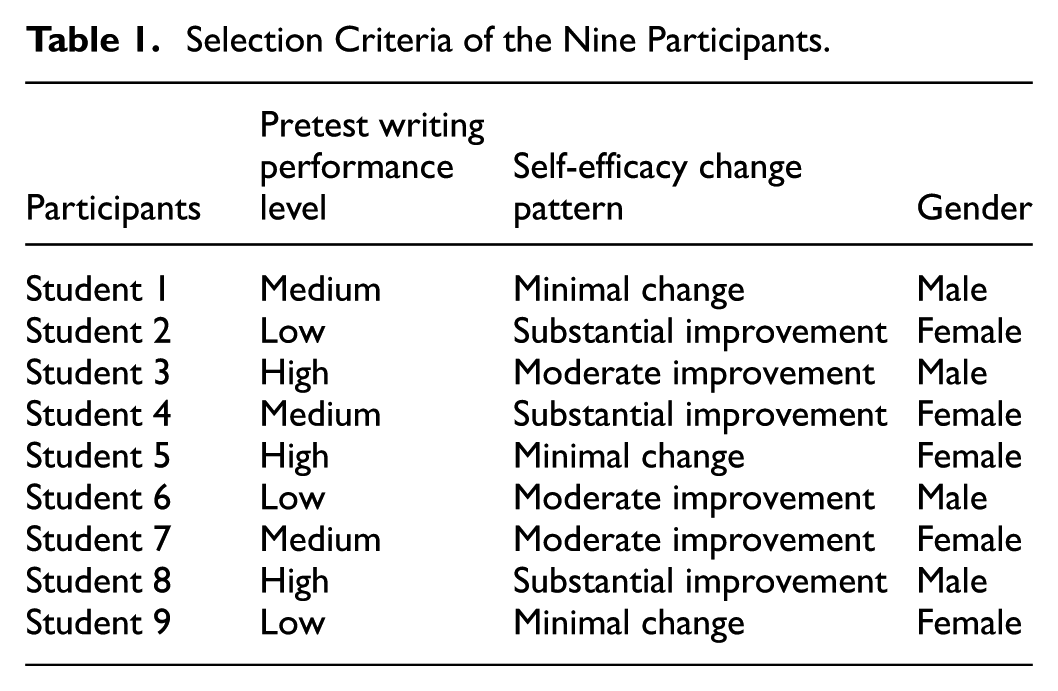
To complement quantitative findings, nine students from the experimental group were interviewed about their perceptions of narrow reading’s impact on writing quality and self-efficacy. These students were selected through purposive sampling to ensure diverse representation across writing performance levels and self-efficacy improvement patterns. The selection criteria (See Table 1) included: (1) varied pretest writing scores, (2) different patterns of self-efficacy change, and (3) gender balance. This stratified approach was ensured to provide comprehensive insights into how narrow reading instruction affects students across the performance spectrum. The semi-structured interview, based on Rahimi and Fathi’s (2022 study, addressed three questions: (1) Did you enjoy the writing course with thematically-related reading materials as sources? If so, how? (2) Do you feel your English writing quality has improved due to this approach? (3) Did the course help reduce negative feelings (anxiety, lack of confidence, fear of evaluation) during writing? Interviews were conducted in Chinese to avoid language interference and were recorded and transcribed verbatim.
Selection Criteria of the Nine Participants.
Treatment
Narrow-Reading Supported Writing Instruction for the Experimental Group
The experimental group followed the instructions, divided into three major phases, namely, lead-in, narrow reading, and writing. In the lead-in phase, six themes were introduced before reading and writing tasks. Theme-related pictures or videos were used to motivate students’ exploration through sharing life experiences or suspense prediction. In the narrow reading phase, students were first guided to read the article from the textbook with the theme as the central axis. Next, they were guided to sort out the text structure, analyze the writing purpose, viewpoints, attitudes, and language features. For newspaper reading, the instructor guided students to read two theme-related newspaper texts to apply what they had learned and demonstrated the benefits of narrow reading. In the writing phase, students applied their theme knowledge to a new context. They completed individual writing tasks, expressing opinions through discussions, creating outlines, and drafting within the allotted time. Assessment and feedback followed, including self-evaluation, peer review, and instructor comments, prompting further revisions.
Writing-Only Instruction for the Control Group
The control group received writing-only instruction with the same amount of instruction time. This began with a brief introduction of the writing assignment, followed by an idea exchange and sharing to activate prior knowledge. Students then classified ideas, summarized main content, and focused on structural organization, coherence, cohesion, and language accuracy. Finally, students completed their writing, followed by peer and teacher evaluations for refinement.
Procedure
The study was conducted over nearly one semester, from early March 2023 to the end of June 2023. Initially, both the experimental and control groups were given a brief introduction to the experiment and signed the consent forms to guarantee their rights. Then, a pre-test for writing was administered to assess their initial writing quality. Also, a questionnaire was allocated to the experimental group to test students’ writing self-efficacy. From Week 2 to Week 17, instructed interventions were conducted in both groups. The experimental group used narrow reading as source texts for the writing tasks, while the control group engaged in writing-only tasks without the connection between reading and writing. Till the final week, a post-test of writing for both groups, a questionnaire, and an interview for the experimental group were conducted to assess students’ writing quality and self-efficacy after the instruction.
Data Collection and Analysis
Two writing tests and two questionnaires were employed to collect quantitative data from the experiment. The writing scoring standard for the college entrance examination was utilized to assess students’ holistic writing quality. Jacobs et al.’s (1981) rubric was adopted to evaluate students’ analytic writing quality in pre- and post-tests for both groups. The former included four aspects: content, organization, vocabulary, and grammar, with five levels from zero to 15 points. The latter, modified to fit the Chinese senior high education system, covered content (seven points), organization (four points), and language use (four points). Two instructors were trained to rate students’ writing, with rescoring conducted if differences exceeded five points. The data from the writing tests and questionnaires were analyzed using IBM SPSS Statistics 26. Repeated measures ANOVA was used to investigate changes in writing quality within and between groups prior to and after instruction. Before conducting the ANOVA, all underlying statistical assumptions were systematically verified. A paired sample t-test was employed to examine students’ variation in writing self-efficacy after the instruction. The significance level was set at .05. Effect sizes were reported in eta squared (η2) values of small = 0.01, medium = 0.06, and large = 0.138 for writing tests following Pallant (2013) and Cohen’s d values of small = 0.40, medium = 0.70, and large = 1.00 for questionnaires following Plonsky and Oswald (2014).
Qualitative data from interviews underwent thematic analysis (Miles et al., 2014). Researchers coded transcripts, focusing on participants’ feelings and beliefs about narrow reading in writing instruction. Key themes were identified and summarized to present students’ perspectives in their own words.
Results
Table 2 delineates the descriptive statistics of writing test scores, both in their entirety and across each dimension. Before conducting a 2 × 2 repeated-measures ANOVA with Phase (pretest/posttest) and Group (experimental/control) as factors, all statistical assumptions were systematically verified. The sphericity assumption was inherently satisfied given the two-level Phase factor (Field, 2018). Homogeneity of variances for pretest-posttest difference scores was confirmed through Levene’s test across all measures: total score, F(1, 89) = 0.380, p = .541; content, F(1, 89) = 0.270, p = .602; organization, F(1, 89) = 1.190, p = .278; and language use, F(1, 89) = 0.010, p = .936. These results indicated comparable variability between groups. Normality was assessed quantitatively through Shapiro-Wilk tests conducted on model residuals, with all values exceeding acceptable thresholds (W > 0.980, p > .07), confirming no significant deviations from normal distribution. All assumptions were satisfied, supporting the validity of parametric analysis. The results of the repeated measures ANOVA showed significant interaction effects between Phase and Group on the quality of students’ writing. The overall writing quality demonstrated a significant interaction effect (F(1, 89) = 46.874, p < .001, η2 = 0.345), as did the dimensions of writing content (F(1, 89) = 8.295, p = .005, η2 = 0.085), writing organization (F(1, 89) = 10.949, p = .001, η2 = 0.110), and language use (F(1, 89) = 12.966, p = .001, η2 = 0.127). Significant main effects of Phase and Group were also observed: overall writing quality (Fphase(1, 89) = 157.658, p < .001, η2 = 0.639; Fgroup(1, 89) = 12.519, p = .001, η2 = 0.123), writing content (Fphase(1, 89) = 66.549, p < .001, η2 = 0.428; Fgroup(1, 89) = 7.092, p = .009, η2 = 0.074), writing organization (Fphase(1, 89) = 51.571, p < .001, η2 = 0.367), and language use (Fphase(1, 89) = 47.684, p < .001, η2 = 0.349; Fgroup(1, 89) = 9.889, p = .002, η2 = 0.100). However, no significant main effect of Group was observed in the dimension of writing organization (Fgroup(1, 89) = 1.519, p = .221). This suggests that students enhanced their overall writing quality as well as the content, organization, and language use of their writing after the writing instruction with narrow reading as source texts.
Descriptive Statistics of Writing Test Scores on the Whole and Each Dimension.
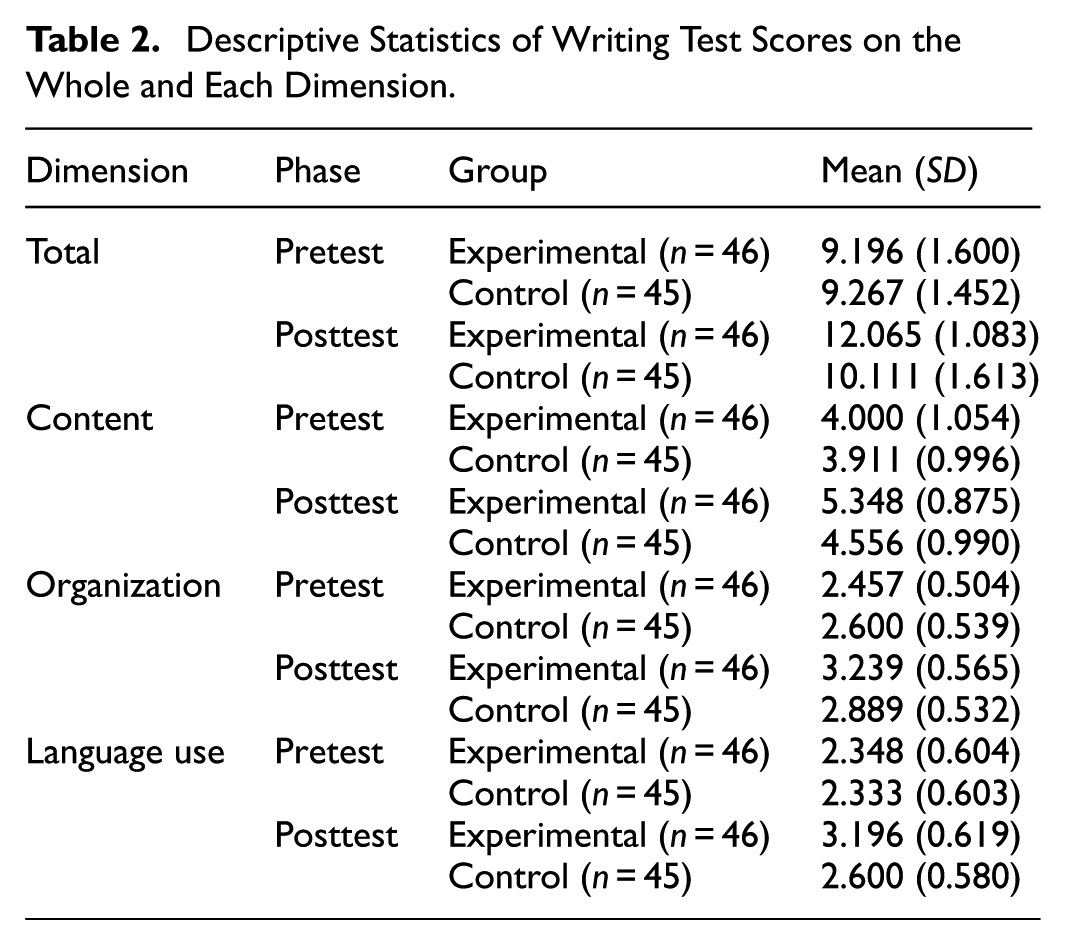
Table 3 presents the descriptive statistics of the questionnaire scores for the experimental group. A noteworthy observation was the statistically significant enhancement in students’ overall self-efficacy for writing (t(45) = −4.320, p < .001, Cohen’s d = 0.528). This improvement was also reflected across various dimensions of writing, specifically in ideation (t(45) = −4.435, p < .001, Cohen’s d = 0.809), organization (t(45) = −4.368, p < .001, Cohen’s d = 0.914), grammar/spelling (t(45) = −3.271, p = .002, Cohen’s d = 0.709), tasks (t(45) = −5.461, p < .001, Cohen’s d = 1.128) and self-regulation (t(45) = −6.483, p < .001, Cohen’s d = 1.318). All these suggest a significant improvement in students’ self-efficacy for writing following the implementation of the writing instruction with narrow reading as source texts. This underscores the potential efficacy of this pedagogical approach in enhancing students’ writing self-efficacy.
Descriptive Statistics of Questionnaire Scores for the Experimental Group.

Qualitative data were obtained from interviews conducted with nine students from the experimental group, supplementing the questionnaire data. The students reported that narrow reading contributed to their writing output and influenced their self-efficacy for writing. The interview responses were categorized into positive and negative descriptions, with key themes elicited from each category. In terms of positive description, three major themes emerged: strong interest, overall improvement in writing quality, and enhancement of self-efficacy for writing. For negative descriptions, some students presented their low self-efficacy in writing tasks.
Some students expressed increased interest in the narrow-reading supported writing instruction. For instance, some students noted that the current writing course was more engaging than previous ones, and the activities set by the teacher held their attention more effectively. Others further reported that the writing course with narrow reading provided a unique experience, teaching them how to organize structure and enhance writing expressions.
Student 9: I’m enjoying the current writing course. Our previous one was too boring, and I often found myself lost during the lessons. Now, however, the classroom activities easily capture my interest, and I find myself much more engaged during class. Student 5: The course changed my attitudes towards writing. The teacher guides us to analyze the text structures, vocabulary, and sentence patterns through reading several texts with the same theme. This has taught me how to diversify my writing expressions and organize my compositions more effectively. It gives me a much deeper understanding of the writing process.
To the enhancement of writing quality, some students stated that they were able to pay more attention to the finer details of their writing. They also benefited from idea creation and content organization. Furthermore, some also reported increased writing quality in vocabulary and grammar.
Student 8: The support from the reading materials made me focus more on my writing content, organization, and genre of the writing tasks, leading to better writing scores from both homework and tests. Student 4: We could integrate various ideas within a topic and establish a comprehensive framework for our writing with the help of reading materials. I really make progress in my English writing with the help of this teaching approach. Student 6: I used to conceptualize a composition in Chinese before translating it into English, which often resulted in unidiomatic expressions and grammatical errors. Now, I summarize thematic vocabulary and sentence patterns before writing. This helped me improve my vocabulary use and reduce grammatical errors.
Regarding the overall improvement in writing self-efficacy, some students reported that the novel writing course created a conducive atmosphere for writing, boosting their self-confidence. Some other students also mentioned a reduction in writing anxiety due to the narrow-reading-supported writing instruction.
Student 3: It is like a puzzle that we are supposed to complete step by step. This approach helps me build my confidence in English writing compared to our previous one. Student 1: Writing used to be of great anxiety for me. However, this writing course has alleviated much of my anxiety with strong support from reading similar topics in texts.
However, some students expressed diminished confidence in writing practices. Additionally, students also underscored their deficiency in self-efficacy concerning the application of self-regulation strategies, such as planning and revising.
Student 2: The task of writing is daunting and intimidating for me. I used to refuse all kinds of English writing tasks because my writing was not good. This hasn’t changed yet, but I’m hopeful that after a long-term exposure to these novel writing practices, I will gain more confidence in tackling various writing tasks. Student 7: It is more common for me to start writing directly without planning first. During writing, I write down anything that comes to my mind due to time constraints. I often don’t even have time to revise my draft.
Discussion
This study investigated the impact of narrow reading on Chinese EFL students’ writing quality and self-efficacy. The results showed that using narrow reading as source texts in the writing instruction facilitated students in both their writing quality and self-efficacy.
Narrow Reading as Source Texts in Chinese EFL Learners’ Writing Quality
In terms of writing quality, students demonstrated improvement in overall writing quality and the specific dimensions of content, organization, and language use as shown in both quantitative study results and students’ sample writings. These findings align with previous studies (Gill & Janjua, 2020; Kyle, 2020; Plakans, 2008), suggesting that using narrow reading as source texts in writing tasks could facilitate a more robust process of discourse synthesis and improve EFL writing quality. It is expected that the use of narrow reading confines information input to a relatively narrow scope, thereby enhancing the comprehensibility of the input and ensuring that students acquire adequate background knowledge. The writing instruction with narrow reading as source texts also echoed with Pickering and Garrod’s (2004) interactive alignment model, which emphasized the importance of engaging and absorbing relevant input materials, ultimately leading to mutual alignment. Students could enhance their writing quality through observing and imitating the relevant input information from reading, and apply what they have learned through reading directly into their writing.
In terms of writing content quality, the study results demonstrated a positive enhancement under the new writing instruction, echoing results from Kyle (2020). Kyle (2020) posited that students who engaged with thematically related source texts demonstrated improved ability to synthesize key ideas and incorporate sophisticated phrasing into their writing, thereby establishing a correlation between narrow reading and improved writing content. The present study’s classroom-based narrow reading activities operated through similar mechanisms, whereby students’ exposure to texts sharing thematic coherence with their writing tasks facilitated the construction of robust content schemas and enriched the substantive quality of their compositions. The thematic consistency between reading materials and writing tasks creates meaningful connections that support knowledge transfer from comprehension to production. Furthermore, the questionnaire results revealed significant enhancement in students’ ideation self-efficacy, demonstrating that students’ increased confidence in generating ideas developed concurrently with their actual content quality improvements. This parallel development suggests that narrow reading instruction creates a supportive framework wherein students experience repeated success in content generation, which strengthens both their writing capabilities and their beliefs about their ability to produce substantive written work.
For writing organization, this study aligns with the findings of Gill and Janjua (2020), reporting that narrow reading facilitated students’ interpretation and organization of text structures in writing tasks. They proved that pre-writing analysis of genre-specific materials provided students with a functional understanding of specific genre features, aiding in the construction of their writings. This study extends these findings by demonstrating that students’ organizational self-efficacy improved significantly alongside their actual organizational performance, indicating that enhanced confidence in structural planning corresponds directly to measurable improvements in writing organization. The organizational benefits of narrow reading instruction include the following two aspects. First, repeated exposure to texts within the same genre or theme enables students to internalize conventional organizational patterns and rhetorical structures that can be transferred to their writing contexts. Moreover, the scaffolded nature of narrow reading instruction reduces the cognitive burden associated with organizational decision-making during writing. When students have internalized organizational frameworks through repeated exposure to well-structured source texts, they can allocate more cognitive resources to content development and language refinement rather than struggling with structural concerns. Consequently, the writing instruction with narrow reading as source texts effectively enhances students’ writing organization.
With regard to language use, the narrow-reading supported writing instruction significantly improves language use. This improvement is further supported by the questionnaire results, which showed significant enhancement in students’ grammar/spelling self-efficacy, demonstrating that students’ increased confidence in language mechanics developed concurrently with their actual linguistic performance gains. These findings align with Graham (2020), who identified the imitation of vocabulary and sentence patterns in reading materials as a key factor in advancing grammatical/spelling accuracy and lexical complexity in student writing. The language use improvements observed in this study can be attributed to the sustained and comprehensible exposure to linguistic elements inherent in narrow reading instruction. When students engage repeatedly with texts sharing thematic or generic coherence, they encounter consistent vocabulary sets, grammatical structures, and syntactic patterns that gradually become internalized through repeated exposure. Furthermore, the narrow reading approach facilitates implicit language acquisition by presenting linguistic features within meaningful contexts rather than through isolated grammar exercises. The parallel development of grammar/spelling self-efficacy alongside actual performance gains suggests that as students experience success in applying learned linguistic patterns, their confidence in handling language challenges increases, creating a reinforcing cycle of improved performance, and enhanced self-belief.
Narrow Reading as Source Texts in Chinese EFL Learners’ Writing Self-Efficacy
With regard to self-efficacy for writing, the writing instruction using narrow reading as source texts significantly enhances students’ writing self-efficacy, particularly in ideation, organization, grammar/spelling, tasks, and self-regulation. This is in line with previous studies (Golparvar & Khafi, 2021; Wilby, 2022; Zhou et al., 2022), in which students exhibited reduced writing anxiety and increased confidence under narrow reading and reading-writing integration. The comprehensive nature of these self-efficacy gains reflects the multifaceted support that narrow reading provides for the writing process.
The enhancement in ideation self-efficacy corresponds directly with substantial improvements in writing content quality, where students demonstrated a notable increase from pretest to posttest performance. By constructing their writings based on thematically related reading materials, students experienced reduced cognitive demands in idea generation, which naturally enhanced their confidence in this fundamental writing skill. Similarly, the significant improvement in organizational self-efficacy aligns with the experimental group’s marked advancement in writing organization performance, indicating that students’ increased confidence in structural planning translated into measurably better organizational skills in their actual writing. Unlike traditional writing courses, the writing instruction using narrow reading guides students to learn about language knowledge, analyze structural knowledge, and explore thematic meaning. This greatly aids in building confidence in composing rich and coherent writings. The significant enhancement in grammar/spelling self-efficacy aligns with the experimental group’s substantial language use performance gains, demonstrating that students’ increased confidence in language mechanics corresponded directly to their improved linguistic accuracy and complexity.
When it comes to tasks, the dramatic increase in task self-efficacy scores parallels the experimental group’s superior overall writing performance improvement, suggesting that as students experienced tangible success in their writing tasks, their confidence in handling various writing challenges increased proportionally. Narrow reading exposure to varied textual forms provided students with practical models for different writing contexts, explaining the significant improvement in task-related confidence. Moreover, the results also indicated a significant positive effect on improving students’ self-efficacy in self-regulation, such as goal setting or planning. This metacognitive confidence enhancement likely contributed to students’ consistent performance gains across all writing dimensions, as those who feel more capable of managing their writing process are better positioned to produce higher-quality work. Previous writing-only tasks resulted in students’ immediate writing and ideas formulation without enough pre-writing planning. Narrow-reading supported writing tasks, in contrast, can lengthen the stage of planning by providing several reading texts as source input, and providing sufficient time for students to prepare and construct before writing. Therefore, the writing instruction with narrow reading as source texts may effectively foster self-efficacy for writing in five dimensions.
Relationship Between the Improvement in Writing Quality and Self-Efficacy
The results reveal not only significant improvements in both writing quality and self-efficacy under narrow reading instruction but also striking parallels between the two across all measured dimensions. Rather than developing independently, these constructs appear mutually reinforcing, with students’ tangible improvements in specific writing aspects accompanied by proportional increases in self-efficacy within those same domains.
This parallel development aligns with Bandura’s (1997) self-efficacy theory, particularly the concept of mastery experiences as the most powerful source of efficacy beliefs. The scaffolding inherent in narrow reading instruction creates successful performance outcomes that strengthen students’ capability beliefs, which subsequently motivates deeper engagement with writing challenges. This generates a positive feedback cycle wherein improved performance enhances confidence, and increased confidence facilitates superior performance. Narrow reading instruction facilitates this relationship by providing concrete models and frameworks that make writing success more attainable and predictable. Unlike traditional approaches, where students independently struggle with idea generation and content organization, narrow reading offers explicit examples of effective structural patterns, vocabulary usage, and thematic development. This scaffolded approach reduces cognitive load, enabling students to experience success more readily and build confidence incrementally across writing dimensions. As students repeatedly observe their improvement within this supportive framework, their self-efficacy beliefs strengthen and generalize across diverse writing contexts, creating sustainable improvements in both performance and confidence.
Pedagogical Implications
This study carries significant pedagogical implications. First, it is recommended that educators effectively link reading and writing activities by using reading under the same theme. This approach can serve as a bridge between reading materials and writing tasks. Students can then transfer their learning based on the thematic content, transforming their reading into various forms of output. Alternatively, they can also transfer their learning based on the structural features of the reading materials, particularly when the text structure plays a significant scaffolding role. Overall, it is crucial to devise meaningful activities that hinge on the effective integration of reading and writing. Also, educators are urged to enhance the instruction of reading comprehension and writing. This involves guiding students to thoroughly comprehend the thematic meaning during the reading process and providing the necessary content, structure, and language support for writing. It is equally important to guide students in generating writing ideas, preparing the content and language, outlining, and conducting other writing activities. Additionally, educators are encouraged to foster students’ writing self-efficacy by providing more opportunities for them to experience success in writing. As a crucial motivational factor, students’ writing self-efficacy can empower them to persist in the face of challenging writing tasks. Given the importance of perseverance and adaptability, it is advised that classroom instructors employ more positive reinforcement or motivate students to use self-regulation strategies such as synthesizing and reflecting on what they learned to boost their productivity. Concurrently, it is widely agreed among scholars that high-achieving students invest more time in planning and revising. Therefore, incorporating more goal-setting and planning strategies in writing classes is recommended to enhance students’ writing performance.
Conclusion
This study provides empirical evidence supporting the potential of narrow reading as source texts in assisting writing instruction for Chinese EFL learners. It demonstrated that students who engaged with thematically related source texts showed significant improvements across multiple dimensions of writing quality, including content development, organizational structure, and language use accuracy. Equally important, the intervention yielded substantial gains in writing self-efficacy across five critical domains: ideation, organization, grammar and spelling confidence, task management, and self-regulation strategies. The findings may offer pedagogical insights for teaching and learning writing in a foreign language classroom context, such as the integration of reading and writing through thematic coherence to facilitate content and structural transfer, the enhanced instruction supporting both reading comprehension and comprehensive writing guidance, and writing self-efficacy development through success experiences, positive reinforcement, and strategic planning approaches. What’s more, our results support genre-based writing instruction theories by showing how exposure to multiple texts within the same thematic domain helps learners internalize discourse patterns, rhetorical structures, and linguistic features characteristic of academic writing. This finding bridges reading-writing integrations in ways that traditional isolated skill instruction typically fails to achieve.
However, several limitations of this study warrant mention. First, the sample size was small and limited in scope. The study explored the efficacy of narrow reading in writing instruction with only 91 senior high school students in China. This restricts the generalizability of the research findings to other learner groups. Future research may expand the participant pool by selecting students with different background information to yield more reliable research results. Furthermore, the research duration was constrained in this teaching experiment. Owing to the teaching schedule, the writing course was only available to students once every 2 or 3 weeks. This limited their opportunities to engage in narrow reading and writing. Therefore, longitudinal teaching experiments are needed to more effectively validate the efficacy of the new teaching method in improving students’ writing quality and self-efficacy. Additionally, this study only considered one aspect of narrow reading, namely the same theme, without taking into account the condition of the same genre and author. It is important to note that this factor may also influence students’ writing performance and self-efficacy. Future research should investigate how to integrate reading under the same author or genre with the same genre into writing instruction and assess its impact on students’ writing outcomes. And individual learner factors, such as prior reading habits, learning motivation, and learning style, may moderate the instructional effectiveness. Future studies incorporating these variables would enable more personalized and targeted implementation of narrow reading approaches.
Footnotes

Ethical Considerations
Approval was obtained from the ethics committee of Jiangsu Normal University. The procedures used in this study adhere to the tenets of the Declaration of Helsinki.
Consent to Participate
Informed consent was obtained from all the participants.
Author Contributions
Both authors have accepted responsibility for the entire content of this manuscript and approved its submission.
Funding
The authors disclosed receipt of the following financial support for the research, authorship, and/or publication of this article: This work was supported by Jiangsu Province Education Sciences Planning Project (Grant No. C/2023/01/24) and Humanities and Social Science Project of Ministry of Education of the People’s Republic of China (Grant No. 24YJC740071).
Declaration of Conflicting Interests
The authors declared no potential conflicts of interest with respect to the research, authorship, and/or publication of this article.