




Abstract
Academic procrastination remains a common problem among university students, yet most research overlooks discipline-specific dynamics. The purpose of this study was to examine the structural relationships between social media addiction, academic self-efficacy, and academic procrastination among sports science students, with a particular focus on the mediating role of academic self-efficacy. A correlational design and structural equation modeling were conducted with 1,017 sports science students from Turkish universities during the spring semester of 2023 to 2024. Data were collected using validated scales for social media addiction, academic procrastination and academic self-efficacy and analyzed using SPSS and Jamovi. Results showed that social media addiction positively predicted academic procrastination, while academic self-efficacy negatively predicted both social media addiction and academic procrastination. Importantly, academic self-efficacy significantly mediated the relationship between social media addiction and academic procrastination, accounting for approximately 41% of the indirect effect. The direct effect of social media addiction on academic procrastination remained significant and together social media addiction and academic self-efficacy explained 55% of the variance in academic procrastination. These results emphasize the crucial role of academic self-efficacy in buffering the negative impact of social media addiction on procrastination among sports science students. Considering the cross-sectional design and the fact that the study was based on self-report, future research should use longitudinal studies and mixed methods to confirm these findings and improve generalizability. In general, the study emphasizes the need for targeted educational interventions to strengthen academic self-efficacy and reduce procrastination, especially among digitally engaged student groups.
Plain language summary
This study looks at why sports science students at universities often put off their academic work, a common problem known as academic procrastination. The research focuses on how being addicted to social media, feeling confident in their academic abilities (academic self-efficacy), and delaying schoolwork are connected. The study involved 1,017 sports science students from universities in Turkey. They were asked to complete surveys that measured their social media addiction, how much they procrastinate, and how confident they feel about their academic skills. The results showed that the more students were addicted to social media, the more likely they were to procrastinate. However, when students felt confident in their academic abilities, they were less likely to be addicted to social media and less likely to procrastinate. Importantly, the study found that feeling confident in their academic abilities helped to reduce the negative impact of social media addiction on procrastination. In other words, students who felt good about their academic skills were less likely to procrastinate, even if they were heavily using social media. These findings suggest that it’s important to help sports science students build confidence in their academic abilities to reduce the negative effects of social media addiction on procrastination. Future research should use longer-term studies and different methods to better understand these results and see if they apply to other groups of students.
Introduction
The phenomenon of academic procrastination (AP), defined as the intentional postponement of an academic task despite the expectation of negative outcomes (Bäulke et al., 2018), remains prevalent among college students (Fentaw et al., 2022). A review of the literature shows that AP is a widespread phenomenon among college students. Studies conducted in various cultural contexts suggest that between 50 and 90% of students engage in this behavior (Hayat Aa et al., 2020; Kifayat et al., 2024; Lindner, 2024). This situation results in a significant proportion of students being disadvantaged and imposes significant costs at individual, institutional and societal levels (Steel et al., 2018). Consequently, AP, which has been identified as a widespread phenomenon, continues to be a topic of interest in the field of educational research (Rozental et al., 2022).
Several theoretical and empirical studies have highlighted the complex and multifaceted nature of AP, emphasizing the interaction between biological, psychological, and social factors (Song et al., 2024). Despite the lack of consensus on a unifying theory, AP has been predominantly conceptualized as a deficit in self-regulation, often associated with low academic self-efficacy (AS_E) (de la Fuente et al., 2021; Sirois & Pychyl, 2022). On the contrary, given the dynamic nature of procrastination, it is postulated that this phenomenon develops in response to the occurrence of various factors over time (Pychyl & Sirois, 2016). Procrastination, which is particularly prevalent in modern, technologically advanced societies, has been transformed by the constant evolution of digital technologies (Reinecke et al., 2018). One of these digital technologies is social networks, which enable interaction, connection and communication in real time (Landa-Blanco et al., 2024). Social media addiction (SMA) is defined as a combination of cognitive and behavioral symptoms that lead to negative outcomes (Davis, 2001). SMA is thought to represent a form of self-regulatory deficit (LaRose & Eastin, 2004). Previous research indicates a robust positive correlation between SMA and AP, with correlation coefficients between (r = .37) and (r = .45) reported (Kurker & Surucu, 2024; Tiking et al., 2024).
The existing literature on AP has primarily focused on general college students, regardless of specific academic disciplines. In contrast, this study focuses on AP among sports science students in Turkey with the aim of developing context-appropriate solutions. This study has two objectives. The first is to develop a structural model that describes the relationship between SMA and AP in sports science students. The second aim is to investigate the role of AS_E as a mediator in this relationship. Based on previous research, we hypothesize that (H1) social media addiction positively predicts academic procrastination, (H2) social media addiction negatively predicts academic self-efficacy, (H3) academic self-efficacy negatively predicts academic procrastination, and (H4) academic self-efficacy mediates the relationship between social media addiction and academic procrastination. The existing literature on this topic in the Turkish context examines the relationship between AP and self-regulation skills and self-efficacy (Filiz & Doğar, 2021) and SMA (Çiftçi & Özavci, 2023). However, the existing literature on this topic is limited to descriptive studies examining unidirectional relationships between AP and related factors. However, a multidimensional investigation of the interaction between these factors could provide valuable information for the development of effective interventions for AP.
In this study, we examine the relationship between SMA and AP within the framework of self-regulation theory (Baumeister et al., 1994, 2007). According to self-regulation theory, individuals must effectively control their thoughts, emotions, and behaviors in order to achieve long-term goals and avoid undesirable outcomes. Failure to self-regulate can lead to impulsive or habitual behaviors, such as excessive social media use, which can interfere with academic obligations and increase the likelihood of procrastination (Duckworth et al., 2016; Steel, 2007). In this context, SMA can be seen as a manifestation of failure to self-regulate, which in turn contributes to higher levels of AP. Furthermore, we examine the role of AS_E as a mediating variable in the context of self-efficacy theory (Bandura, 1997), which states that a person’s belief in their abilities to organize and execute actions is crucial for effective performance. Low self-efficacy can further undermine self-regulation and makes students more susceptible to SMA and AP (Bandura, 1997; Klassen et al., 2008).
The aim of this study is to develop a structural model to investigate the relationship between SMA and AP in sports science students, with particular emphasis on the mediating role of AS_E. This study represents a pioneering investigation in the Turkish context and has the potential to advance the field through practical findings. Following this phase of the study, we present the theoretical framework and research findings to date before developing a model to test the hypotheses.
Theoretical Background and Hypotheses
Academic Procrastination
A review of the literature on procrastination shows that it can be defined as the deliberate postponement of actions and behaviors that need to be completed within a certain time frame. In the existing literature, there are significant differences in the way procrastination is conceptualized and treated. Harriott and Ferrari (1996) propose a typology of procrastination that includes three categories: Procrastination by decision making, procrastination by stimulus, and procrastination by avoidance. In contrast to the aforementioned approaches, Milgram et al. (1998) have presented their own typology, which comprises five categories of procrastination: (1) procrastination of daily tasks, (2) procrastination of decisions, (3) neurotic procrastination, (4) compulsive procrastination, and (5) AP. However, the literature shows that procrastination is typically divided into two categories. Procrastination as a personality trait (characterized by putting off decisions and daily tasks, such as avoidant procrastination) and situational procrastination (such as academic procrastination).
Procrastination as a personality trait is defined as a person’s tendency to procrastinate, which manifests itself in a tendency to approach tasks in a leisurely manner. In contrast, situational procrastination is defined as a person’s tendency to procrastinate in a particular area of life. AP has been extensively studied in the context of situational procrastination (Vestervelt, 2000). The term “AP” is defined as the conscious decision to postpone academic duties despite the expectation of negative consequences. This definition includes three main elements: (1) the deliberate postponement of academic activities, (2) the intention to avoid implementing the planned academic behavior, and (3) the anticipation of negative consequences that may result from this gap in action (Bäulke & Dresel, 2023).
The nature of AP behavior has been the subject of numerous theoretical investigations from a variety of perspectives. These theories include rational-emotive behavior therapy (Ellis & Knaus, 1977), which focuses on irrational beliefs; self-management theory (Vohs & Heatherton, 2000), which focuses on the difficulties and inadequacies individuals experience in self-regulation; social cognitive theory (Bandura, 1986), which examines perceptions of self-efficacy and environmental support; ego depletion theory (Baumeister et al., 1998), which emphasizes the idea that self-regulation and self-control are a finite resource; cognitive behavioral theory (Sirois, 2004, 2021) postulates that negative self-beliefs and low self-efficacy perceptions are central factors influencing AP. Similarly, structural framing theory (Steel & König, 2006) postulates that discrepancies between academic tasks and deadlines, when perceived in conjunction with the value of rewards, play a significant role in AP.
The factors associated with procrastination vary depending on the approach and author. When these factors are assessed individually or together, the phenomenon of procrastination actually indicates a deficit or failure of self-regulation that occurs in this process (de la Fuente et al., 2021; Hailikari et al., 2021). Self-regulation can be defined as the process of achieving a desired outcome through the control of thoughts, feelings, and behaviors, including setting goals, taking action, and monitoring progress (Carver, 2011). One of the main goals of today’s educational systems is to promote the development of individuals’ ability to set and achieve desired goals throughout their lives (Greene et al., 2023). According to self-regulation theory (Baumeister, 2018), the process of self-regulation begins with the control of thoughts, impulses and actions and progresses to the management of increasingly complex processes. In the context of self-regulation theory, self-regulation is an essential element of the learning process and critical to academic success (Robson et al., 2020).
A recent systematic review of interventions to reduce AP found that self-regulation was identified as the most important factor in 90.6% of the studies analyzed, while self-efficacy was identified as the second most important factor in 28.2% of the studies (Salguero-Pazos & Reyes-de-Cózar, 2023). The literature shows that students’ inability to regulate their own behavior and emotions leads to AP, which in turn affects their ability to achieve academic goals (Sun et al., 2024). To summarize, AP is fundamentally related to the failure of self-regulation. Theoretical approaches such as self-regulation theory and ego depletion theory suggest that students whose ability to self-regulate is depleted or impaired are more likely to procrastinate academic tasks (Baumeister et al., 2007). This relationship is the focus of the present study, which hypothesizes that factors that undermine self-regulation, such as addiciton on social networks, predict higher levels of AP.
Social Media Addiction
The term “social media” includes social networking sites and messaging platforms (Wartberg et al., 2020). It is a phenomenological phenomenon that is firmly rooted in people’s daily lives. On April 20, 2024, the number of people using the internet worldwide was reported to be 5.44 billion, representing 67.1% of the world’s population. Of this number, 5.07 billion or 62.6% of the world’s population were identified as social media users (Petrosyan, 2024).
A recent study found that 70% of students look at their cell phones at least once an hour while studying and spend an average of 3 hr a day on social media. Furthermore, 45% of respondents stated that their smartphone is their main source of distraction (Lindner, 2024). The advent of mobile internet technology and the proliferation of smartphones have made social networking an indispensable aspect of students’ daily lives and academic activities (Zhao, 2021a). Students spend a lot of time on social networks, which distracts them from their academic activities (Ipem & Okwara-Kalu, 2020). Problematic social media use has been associated with disturbances in users’ psychosocial functioning and well-being. SMA is defined as the inability to control social media use that manifests itself through social media use to such an extent that it interferes with social and academic life (Ryan et al., 2014; Shao et al., 2024). SMAs are characterized by a reduction in self-regulation (Tarafdar et al., 2020). The use of social networks as a source of distraction has been shown to lead to the postponement of important tasks (Reinecke et al., 2018).
Social media addiction (SMA) is particularly linked to the failure of self-regulation through several mechanisms. First, social media platforms are designed to provide immediate rewards (likes, notifications, new content), which can disrupt the brain’s reward system and make it difficult for individuals to defer rewards (LaRose & Eastin, 2004; Montag et al., 2019). This constant stimulation reduces the cognitive resources available for self-control and makes it difficult for students to resist distractions and focus on academic tasks (Andreassen et al., 2017; Turel & Qahri-Saremi, 2016). Second, excessive social media use can interfere with time management and planning, both important components of self-regulation (Meier et al., 2016; Panek, 2014). Third, habitual checking of social networks can encourage impulsive behavior, which further undermines the ability to focus on academic work (Wegmann et al., 2017). As a result, students with higher levels of SMA are more likely to fail at self-regulation, which in turn increases their risk for AP. Furthermore, SMA can also negatively impact students’ AS_E as it leads to more distractions and reduces the time and cognitive resources available for academic tasks. This can undermine students’ confidence in their academic abilities and their belief in their ability to succeed (Turel & Qahri-Saremi, 2016; Wang et al., 2023).
Academic Self-Efficacy
Self-efficacy can be defined as a sense of competence that refers to a person’s belief that they are generally capable of coping with stressful and challenging life events and engaging in behaviors that lead to desired outcomes (Duru & Balkis, 2017). From this perspective, self-efficacy can be defined as a productive ability that aims to efficiently manage individual cognitive, social, emotional, and behavioral subskills to achieve specific goals (Sagone & Indiana, 2023). Self-efficacy is part of Bandura’s (1986) social-cognitive theory, which assumes that success depends on the interaction between behavior, personal factors and the environment. According to this theory, perceived self-efficacy and outcome expectancy are the two most important determinants of behavior. The amount of effort individuals make in the face of obstacles and unfavorable circumstances depends on their belief in self-efficacy. Perceived self-efficacy not only influences actions and behaviors, but also affects efforts to accomplish tasks through the expectation of success (Bandura, 1986, 1997). This is due to the basic premise of self-efficacy, which states that people are more inclined to engage in activities, exert greater effort and persevere when they have high self-efficacy (Nemtcan et al., 2022).
Academic self-efficacy (AS_E), a particular form of self-efficacy, can be defined as students’ perceptions of their own abilities and beliefs that they can successfully complete academic tasks (Farran, 2004). At this point, self-efficacy plays a crucial role as it provides students with a strong sense of self-confidence that enables them to initiate self-directed learning processes and sustain them over time. This in turn promotes students’ perseverance in completing tasks or learning (Anam & Stracke, 2020). AS_E is an important success factor for students that influences their academic decisions, actions, and achievement of certain academic goals (Caratiquit & Caratiquit, 2023; Zayed, 2024). The existing literature shows that AS_E serves as a motivational factor to achieve academic goals. High self-efficacy has been shown to promote positive expectations of the outcome of a task by preventing procrastination by reducing negative experiences in the task process (Matteucci & Soncini, 2021; Pramono et al., 2024). From this, it can be deduced that AP indirectly depends on a student’s self-efficacy in the academic environment.
Academic self-efficacy (AS_E) is particularly important for sports science students due to the specific demands of their subject. Sport science education requires not only the acquisition of theoretical knowledge, but also the application of practical skills in real-world contexts such as coaching, performance analysis, and training specifications (Feltz et al., 2008; Tian & Wang, 2024). Students in this field often face a dual challenge: mastering complex scientific concepts (e.g., biomechanics, physiology) and demonstrating physical competence in practical situations (Wiedenman et al., 2024). Recent research shows that students with high AS_E are more likely to believe in their ability to integrate theory and practice, persevere in the face of challenges, and manage their time effectively (Bandura, 1997; Tian & Wang, 2024; Yu et al., 2024). In addition, self-efficacy has been shown to mediate success in applied tasks, such as designing training programs or adapting to dynamic coaching scenarios (Wiedenman et al., 2024; Yu et al., 2024). Conversely, low self-efficacy can lead to avoidance behaviors, including procrastination or disengagement, especially when students perceive a gap between their theoretical understanding and their practical performance (Tian & Wang, 2024).
This problem is often exacerbated in high-pressure contexts such as internships or competency examinations, where the demands on students’ skills and confidence are higher (Lent & Brown, 2020; Schunk & DiBenedetto, 2020). To overcome these challenges, interventions targeting self-efficacy—such as mastery modeling, peer mentoring or reflective practice—have shown promise in bridging the gap between theory and practice and supporting students’ academic and professional development (Beaumont et al., 2015; Tian & Wang, 2024; Yu et al., 2024).
Relations Between the Constructs
Our aim so far has been to explain the nature of AP, SMA and AS_E in line with the results of the relevant theoretical and empirical research. But what evidence is there for the relationships between these three constructs? Previous research suggests a positive correlation between SMA and AP (Alvia et al., 2024; Kurker & Surucu, 2024; Tiking et al., 2024). However, this relationship is not positive, but rather negative, with an increase in SMA correlating with an increase in AP. Furthermore, previous studies have shown that self-efficacy is a significant and consistent predictor of procrastination and that there is a negative correlation between AS_E and AP. In other words, high AS_E decreases students’ AP (Sagone & Indiana, 2023). To summarize, the existing literature on the interaction between these three constructs shows a positive correlation between AP and SMA, while AS_E is negatively correlated with both AP and SMA (Aslan & Polat, 2024; Karakaya Özyer & Altınsoy, 2023; M. Liu et al., 2024).
Although much of the existing research is correlational, several possible mechanisms have been proposed to explain these relationships. For example, SMA may decrease AS_E by leading to more distractions and less time spent on academic tasks, which in turn undermines students’ confidence in their academic abilities (Turel & Qahri-Saremi, 2016; Wang et al., 2023). Lower AS_E can then lead to greater procrastination, as students who doubt their abilities are more likely to avoid challenging tasks (Bandura, 1997; Sirois, 2004). In addition, constant comparison with peers on social media may negatively impact students’ self-perception and academic confidence, exacerbating failure in self-regulation (Vannucci et al., 2017). Therefore, AS_E may serve as a mediator in the relationship between SMA and AP, a mechanism that was directly tested in the current study.
As mentioned earlier, the results of these studies are primarily applicable to students in different cultural contexts. However, consistent with the findings of previous research, no study has yet examined these three constructs together and investigated the mediating role of AS_E on this construct in sport science students. Therefore, this study is the first to examine the mediating role of AS_E in the relationship between SMAs and AP in sport science students. We hypothesize that this study will help students recognize the impact of SMA and self-efficacy as digital phenomena in their academic lives and develop strategies to counteract the tendencies toward AP. Considering the malleability of AP and AS_E, it is expected that this study will confirm the findings of previous research in this area. In summary, based on the theoretical framework and previous research, this study demonstrates a relationship between SMA and AP behaviors in sports science students. This relationship can be partially attributed to AS_E scores. In this context, we propose a model as shown in Figure 1 and formulate research hypotheses to be tested using this model.
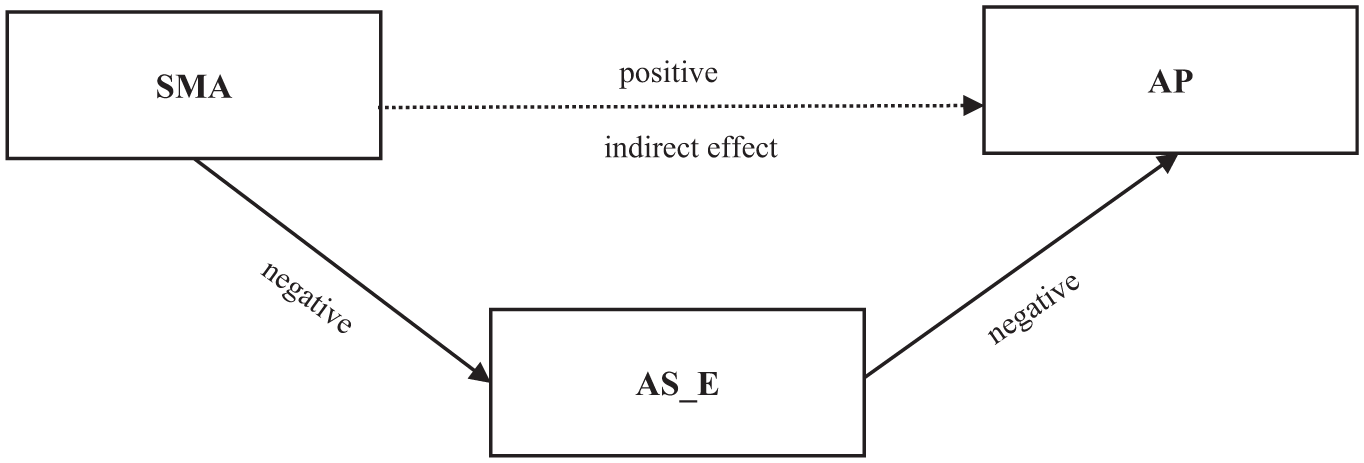
Proposed research model.
The present study is based on the assumption that SMA precedes AS_E in time and that AS_E precedes AP in the proposed model. It is also assumed that AS_E plays an indirect mediating role in the relationship between SMA and AP (Jose, 2018). Therefore, SMA is considered as an independent variable (predictor), AS_E as a mediator variable and AP as a dependent variable (outcome). As the present study uses cross-sectional data, the mediation analysis was conducted in such a way that any causality discourse is explicitly avoided. Mediation models can nevertheless provide valuable insights if they are theoretically grounded, supported by previous empirical evidence, and if the interpretation of the relationships between variables is formulated without invoking causality. In this context, the hypotheses developed for this study are presented in the following section.
Research hypotheses:
Methods
Research Design
The purpose of this study is to uncover the structural relationships between SMA, AS_E, and AP in sport science students and to examine the mediating role of AS_E in these relationships. In this study, a correlational design was used to examine the direct or indirect relationships hypothesized to exist between the variables (Creswell & Clark, 2017). Structural equation modeling (SEM) was used to test whether the model created by the data collected in the study could be validated. SEMs are generally divided into two parts: Measurement models, which assess the relationships between observed variables and the corresponding latent variables, and structural models, which are developed based on theoretical hypotheses and assume that latent variables are related to each other (Whittaker & Schumacker, 2022). SEM is a very powerful quantitative analysis method because it considers multiple parameters and uses a conceptual model, a path diagram, and a system of linked regression-like equations to test models that consider flat relationships between variables together (Kline, 2023).
Study Group
The study sample consisted of 1,017 students enrolled in sports science programs at universities in Turkey during the spring semester of the academic year. According to the official statistics program, 81,445 students were enrolled in undergraduate studies in the field of sports science in Turkey during this academic year. A sample size of at least 382 participants is required to achieve a confidence interval of 95% and a margin of error of ±5, as calculated with the Jotform sample size calculator (Jotform, 2024). In addition, the total sample size, calculated using G*Power (version 3.1.9) with parameters f2 = .15, α = .05 and power (1−β) = 0.95, is 107 (Faul et al., 2009).
Table 1 shows the demographic characteristics of the sample group. Accordingly, 58.9% (n = 599) of the students were male and 41.1% (n = 418) were female. A total of 30.9% (n = 314) of the students were between 18 and 20 years old, 33.5% (n = 341) were between 21 and 23 years old, 15.9% (n = 88) were between 24 and 26 years old, 11.0% (n = 112) were between 27 and 29 years old and 8.7% (n = 88) were 30 years old or older. A total of 34.9% (n = 355) of the students were enrolled in the Department of Coach Education, 31.6% (n = 321) in the Department of Sport Management and 33.5% (n = 341) in the Department of Physical Education and Sport. In terms of level of study, 31.8% of students (N = 323) were in their first year, 30.3% (N = 308) were in their second year, 27.1% (N = 276) were in their third year and 10.8% (N = 110) were in their fourth year.
Demographic Characteristics of the Participants.

Measures
The Social Media Addiction Scale—Adult Form (SMAS_AF)
The Social Media Addiction Scale - Adult Form (SMAS_AF) is a psychometric instrument developed by Şahin and Yağcı (2017) to assess social media addiction (SMA) in adults (18 years and older) in a Turkish cultural context, and its validity and reliability have been demonstrated. The original scale consists of 20 items grouped into two factors: virtual tolerance (items 1–11) and virtual communication (items 12–20). Confirmatory factor analysis (CFA) by Şahin and Yağcı (2017) revealed that the standardized factor loadings ranged from 0.65 to 0.79 for virtual tolerance and from 0.62 to 0.82 for virtual communication. The fit indices for the two-factor structure (χ2/df = 3.05, Root Mean Square Error of Approximation (RMSEA) = 0.059, Standardized Root Mean Square Residual (SRMR) = 0.060, Normed Fit Index (NFI) = 0.96, Comparative Fit Index (CFI) = 0.96, Goodness of Fit Index (GFI) = 0.90, Adjusted Goodness of Fit Index (AGFI) = 0.88) were within acceptable limits. The Cronbach’s alpha coefficients were .92 for virtual tolerance and .91 for virtual communication, indicating high internal consistency.
In the present study, only the nine-item “virtual communication” dimension of the SMAS_AF was used. This decision was made because the virtual communication items are most relevant to the assessment of AP behavior, which is the focus of this study. The use of a subscale rather than the full instrument is justified by the theoretical fit of these items with the construct under investigation, as well as by reducing participant burden and increasing response accuracy. However, it is acknowledged that using only part of a validated scale may have implications for the generalizability of the results, and this limitation is discussed in the relevant section.
The original SMAS_AF uses a five-point Likert scale with anchors ranging from 1 (“not at all suitable for me”) to 5 (“very suitable for me”). In line with common practice and to increase clarity for respondents, the response anchors in this study were adjusted so that they range from 1 (“strongly disagree”) to 5 (“strongly agree”). Higher values indicate a greater tendency to rely on social media. Examples of items from the virtual communication dimension are “I cannot do without using social media to keep up to date with current events,”“I am better able to articulate my thoughts and ideas to the people I interact with on social media” and “I use social media over a longer period of time to maintain connections with groups on social media” The minimum score for this subscale is 9 and the maximum score is 45, with higher scores reflecting a higher level of perceived reliance on social media.
Academic Procrastination Scale_short Form (APS_SF)
The APS_SF was developed by McCloskey (2011) to assess procrastination behavior in an academic setting. Balkis and Duru (2021) translated it into a Turkish version and examined its psychometric properties. The scale, which consists mainly of items related to the academic context, is unidimensional and includes five items. The responses are given on a five-point Likert scale ranging from “disagree” (score 1) to “agree” (score 5). The scale includes the following items: “I tend to put off studying for exams or doing my homework until the last minute.”“I am aware that I often put off important tasks that I need to do.” Researchers Balkis and Duru (2021) conducted a CFA to determine the fit of the data model. The result was an excellent fit (χ2/sd = 1.45, RMSEA = 0.04, SRMR = 0.02, GFI = 0.99, CFI = 1, TLI = 0.99, NFI = 0.99, RFI = 0.98) for the Turkish version of the APS_SF. The internal consistency coefficient Cronbach’s alpha, which was calculated to assess the reliability of the APS_SF, resulted in a value of .88.
Academic Self-Efficacy Scale (AS_ES)
The AS_ES was originally developed by Jerusalem and Schwarzer (1981) and subsequently adapted to Turkish culture by Yılmaz et al. (2007) as part of a validity and reliability study. The aim of this adaptation was to determine the self-efficacy of college students in relation to their academic learning. The scale is one-dimensional and consists of a total of seven items. The items of the scale are presented in the form of a four-point Likert scale (applies to me, applies to me, applies to me very little and does not apply to me at all). The first six items of the scale are positive, while the last item (i.e., “I usually don’t know how to cope with the topics I have to learn when preparing for exams”) is negative. Positive items include “I am consistently able to complete the tasks required for my studies,” “I am aware of the steps necessary to achieve academic excellence” and “I cannot think of an exam in which I would not be successful.” In their investigation of the construct validity of the scale, Yılmaz et al. (2007) used factor analysis. The analysis results showed that the data were suitable for factor analysis (Kaiser-Meyer-Olkin (KMO) = 0.83, χ2 = 1,230.09 (p < .05)), with item factor loadings ranging from .500 to.829, total correlation values exceeding .3, and these items together explaining 45% of the total variance under a single factor. To assess the reliability of the scale, the researchers calculated the Cronbach’s alpha coefficient, which yielded an internal consistency of.79.
Data Collection
In order to reduce the time required and reach a larger number of participants, the data for this study was collected via an online survey using Google Forms. The online questionnaire consisted of three sections. In the first section, all participants were informed about the purpose of the study, its potential risks and benefits, the confidentiality of their responses, and the intended use of the data for scientific research. They were also informed of their right to withdraw from the study at any time. The study design minimized the risk of harm to participants by ensuring that all questions were non-invasive, participation was entirely voluntary, and no identifying information was collected. All participants were at least 18 years of age. Those who wished to continue with the subsequent sections were then required to give their consent by approving the consent form mentioned above, while those who did not give consent were excluded from the data collection. In the second section, the questionnaire included four questions on the personal characteristics of the participants. The third section contained items from the SMA, AP, and AS_E scales. To ensure the integrity of the data, the questionnaire was designed in such a way that each participant could only answer once.
Data collection began on January 1, 2024, and ended on April 4, 2024, when the number of participants reached 1,033. This sample size was set to exceed both the minimum required for representativeness (n = 382, calculated for a confidence interval of 95% and a margin of error of ±5) and the minimum required for statistical power (n = 107, calculated with G*Power for f2 = 0.15, α = .05, power = 0.95). After quality control, data from 16 participants were excluded as they did not meet the expected quality criteria, resulting in a final sample of 1,017 students. The study was conducted in accordance with the ethical principles of the World Medical Association’s Declaration of Helsinki (WMA, 2024) and the National Committee for Research Ethics in the Social Sciences and Humanities (National Research Ethics Committees, 2023). The potential benefits of this research, including contributing to the understanding of structural modeling of Turkish sports science students’ addiction on social media and academic procrastination, and the mediating role of academic self-efficacy, as well as informing future interventions or policies, were considered to outweigh the minimal risks involved, as the study posed no physical or psychological harm to participants. Informed consent was obtained electronically from all participants prior to their participation, as they were required to read the consent form and indicate their agreement before proceeding with the survey.
Statistical Analyses
The study data were analyzed using the statistical packages SPSS (version 27) and Jamovi (version 2.3.28.0). The descriptive statistics for all variables and the relationships between the variables were calculated using the Spearman rho test. To test the model (Figure 1), we used the R package lavaan (Rosseel, 2012) in the SEMLj module (Gallucci & Jentschke, 2021) of Jamovi and the R package semPlot in the path diagram creation module (Epskamp et al., 2019).
The data distribution in the model was checked using Mardia’s multivariate normality test. Since the data did not show a multivariate normal distribution as a result of the test (ZKurtosis = 17.12, p < .001) and the data in the study were collected with ordinal scales (Likert type), the diagonally weighted least squares (DWLS) method was used in the SEM analysis. DWLS provides more accurate results with a sample group of more than 200 participants and with ordinal, categorical and/or non-normally distributed variables (Forero et al., 2009). To test the fit of the model, the relative chi-square test (χ2/df ≤ 3), comparative fit index (CFI, >0.95), Tucker–Lewis index (TLI, >0.95), root-mean-square approximation (RMSEA, <0.08), and standardized root-mean-square residual (SRMR, <0.08) were used (Hu & Bentler, 1998). The reliability of the constructs in the model was assessed using Cronbach’s alpha (α) and McDonald’s omega (ω). The convergence validity of the constructs was assessed by extracting the average variance (AVE; Hopper et al., 2008). In all cases, the alpha level for the statistical test was set at 0.05. Following the fit test of the model, the mediation relationship between the variables was then examined.
Results
Descriptive Statistics
The final sample consisted of 1,017 students enrolled in sports science programs in Turkey. As shown in Table 1, 58.9% of the participants were male (n = 599) and 41.1% were female (n = 418). The majority of students were between 18 and 23 years old (30.9% aged 18–20 and 33.5% aged 21–23). Participants were divided into three categories: Coach Education (34.9%), Sport Management (31.6%) and Physical Education and Sport (33.5%). In terms of academic year, 31.8% were first-year students, 30.3% were second-year students, 27.1% were third-year students, and 10.8% were fourth-year students.
The results of the descriptive analysis of the main variables of the study are shown in Table 2, while the results of the correlation analysis can be seen in Figure 2. The mean score for SMA was 20.48 (95% CI [19.96, 21.00], SD = 8.46), for AS_E 15.36 (95% CI [15.09, 15.64], SD = 4.45) and for AP 15.23 (95% CI [14.98, 15.49], SD = 4.11). The minimum and maximum values showed that participants reported near-average SMA and above-average AS_E and AP values. The skewness coefficients of the data obtained from the scales ranged from 0.18 to 1.14, while the kurtosis coefficients ranged from −0.10 to 1.03. As the values for skewness and kurtosis were between +1.5 and −1.5, it can be assumed that the assumption of univariate normality is met (Tabachnick & Fidell, 2021).
Results of Descriptive Statistics.


Correlation matrix.
Since the assumption of multivariate normality was not fulfilled, the relationships between the variables were examined using Spearman’s rho. The correlation matrix is shown in Figure 2. According to this, significant relationships were observed between SMA and AS_E at negative values (r = −.75, p < .001), between AP at positive values (r = .71, p < .001) and between AS_E and AP at negative values (r = −.69, p < .001).
After presenting the correlation coefficients, we perform SEM according to the model proposed in the study (Figure 3). In the model, the DWLS estimation method was used, and the SMA was included as an exogenous variable, the AP as an endogenous variable, and the AS_E as a mediating variable. Figure 3 shows the standardized path diagram of the estimation model, which illustrates the measurement and structural models in conjunction with each other. The factor loadings of the observed variables were clearly between 0.73 and 0.90. The estimated path parameters (Table 3) and the fit index values (χ2 = 297.34, df = 186, p < .05, χ2/df = 1.60, RMSEA = 0.02, 95% CI [0.02, 0.03], SRMR = 0.04, CFI = 0.99, TLI = 0.99) indicated that the fit of the model to the data was satisfactory (Hu & Bentler, 1998). In addition, Hoelter’s critical N was calculated to be 800 (p < .001), confirming that the sample size for the model was sufficiently robust.

Standardized path diagram for the structural equation model.
Reliability Indices and HTMT Ratios.

The results of the analysis of the reliability and validity of the model constructs are shown in Table 3. Accordingly, the internal consistency coefficients for the reliability of the constructs were between .92 and .95 for α, between .90 and .95 for ω, and the AVE values for convergent validity were between 0.60 and 0.74. As Yepes-Nuñez et al. (2021) stated, α and ω values above 0.70 and AVE above 0.50 indicate that the criteria for reliability and validity were successfully met. Although the internal consistency coefficients (α and ω) were very high, indicating excellent reliability, it is important to note that such high values can sometimes indicate the presence of redundant or very similar items within the scales (Streiner, 2003). The items were reviewed and although some content overlap was found, all items were retained to maintain consistency with the originally validated scales and to ensure full coverage of the constructs. In addition, the discriminant validity of the constructs was assessed using the Heterotrait–Monotrait (HTMT) ratio technique. Consequently, all values are below 0.90, which ensures the discriminant validity of the constructs in this model (Henseler et al., 2015).
Since the fit of the model data and the parameter estimates for the SEM were satisfactory, the hypotheses developed according to the model proposed in the study (Figure 1) were tested. No alternative models were tested; the analysis focused solely on the hypothesized model based on the theoretical framework and the study hypotheses. The results of the estimation of the standardized parameters for the model with a 95% confidence interval are presented in Table 4. The test results for the indirect, direct and total effects between the constructs are shown in Table 5. As shown in Table 4, all standardized prediction paths between constructs are statistically significant at the 95% confidence interval. SMA was found to negatively predict AS_E (β = −.57, 95% CI [−0.59, −0.56], p < .001), whereas AS_E negatively predicted AP (β = −.46, 95% CI [−0.49, −0.43], p < .001). In addition, SMA was found to positively predict AP (β = .38, 95% CI [0.35, 0.41], p < .001). The negative predictive relationship between SMA and AS_E and the positive predictive relationship between AS_E and FP (an AP-negative behavioral pattern) support hypotheses H1, H2, and H3 of the study, respectively.
Standardized Path Estimates.

Indirect, Direct, and Total Effects.

As indicated in Table 5, the direct positive predictive power of SMA for AP remained significant when the mediator variable AS_E was included in the model (β = .26, 95% CI [0.24, 0.28], p < 001). In addition, the overall predictive power of SMA increased (β = .64, 95% CI [0.63, 0.66]). The results showed that the 95% confidence interval for the indirect effect of AS_E did not include zero. The SMA explained 33% of the variance in AS_E (R2 = 0.33), while the combined effect of SMA and AS_E explained 55% of the variance in AP. These results suggest that AS_E plays an indirect mediating role in the relationship between SMA and AP, supporting Hypothesis H4.
Discussion
First: The Relationship Between Social Media Addiction and Academic Procrastination
The first finding of this study is the positive relationship between social media addiction (SMA) and academic procrastination (AP) among university students. The results of the SEM analysis show that the data fit the tested model well and a significant positive correlation was found between SMA and AP. This result confirms the first hypothesis (H1: Social media addiction positively predicts academic procrastination) and is in line with recent research highlighting the detrimental effects of excessive social media or internet use on academic behavior, especially procrastination (Avci et al., 2024; Chavez-Yacolca et al., 2024; Çiftçi, 2023; Rizvi & Parihar, 2024; Salari et al., 2025). Studies have shown that university students, especially in demanding subjects, are prone to social media distractions, which can lead to increased procrastination and negatively affect academic performance (Abiera, 2024; Chavez-Yacolca et al., 2024; Mergan et al., 2023; Salari et al., 2025). Moreover, recent findings suggest that SMA mediates the relationship between basic psychological needs and AP, highlighting the complex interplay between digital habits and academic self-regulation (Berte et al., 2021; Karakaya Özyer & Altınsoy, 2023; Kurker & Surucu, 2024; Rizvi & Parihar, 2024).
Beyond summarizing the relationship between SMA and AP, it is crucial to examine the contextual factors that reinforce this relationship in sport science students. The demanding nature of sports science courses—requiring both physical engagement and cognitive effort—may increase susceptibility to digital distractions. Recent studies show that university students in health and sport-related subjects are particularly prone to using social media for both academic and recreational networking, which can blur the boundaries between productive and unproductive screen time (Wiedenman et al., 2024; Yu et al., 2024). The immersive design of social media platforms, with their constant notifications and opportunities for instant feedback, can undermine students’ ability to focus their attention on long-term academic tasks. Moreover, the tendency to seek instant gratification via social media may be at odds with the delayed rewards of academic achievement, further reinforcing procrastination behavior (Wang et al., 2023; Yu et al., 2024). For sport science students, who must often juggle intense training schedules, internships, and coursework, this dynamic may pose an increased risk for self-regulation failure, as digital engagement provides a convenient escape from academic pressures (Wiedenman et al., 2024).
These results underline the need for targeted interventions in sports science education. Approaches such as digital wellbeing workshops, self-regulation training, and structured “digital detox” periods have shown promise in helping students control their online behavior and prioritize academic commitments (Rustamov et al., 2023; Wang et al., 2023; Yu et al., 2024). Integrating digital literacy and time management modules into sports science curricula could empower students to recognize and mitigate the risks associated with excessive social media use. Future research should investigate the effectiveness of these interventions and examine how individual differences—such as resilience, self-control, or prior digital habits—moderate the impact of SMA on AP in sport science contexts (Wiedenman et al., 2024). Understanding these moderating factors will be crucial for the development of tailored support systems that address the specific challenges of sport science students in the digital age.
Second: The Relationship Between Social Media Addiction and Academic Self-Efficacy
The second result is the negative predictive value of SMA for AS_E, which confirms the second hypothesis (H2: social media addiction negatively predicts academic self-efficacy). This finding is consistent with recent studies of sport science students suggesting that excessive social media use undermines confidence in academic ability by fragmenting attention and reducing productive learning behaviors (Alvi et al., 2022; Doğan et al., 2023; Kalınkara & Talan, 2025; Landa-Blanco et al., 2024; Wan Pa et al., 2021; Zhao, 2023b). These studies show that reliance on social media has an increasingly negative impact on students’ AS_E, a trend that is particularly evident in the post-pandemic period. Both Turkish and international studies have shown that excessive engagement with social media platforms not only undermines academic performance, but also affects students’ psychological well-being, problem-solving skills and overall life satisfaction. For example, Aslan and Polat (2024) conducted a comprehensive study with university students in Turkey, which revealed a negative correlation between SMA and AS_E. Their findings indicated that 42.5% of participants spent more than 4 hr per day on social media, and this subgroup reported significantly lower levels of AS_E. Similarly, Kalınkara and Talan (2025) found in their study that SMA significantly impairs AS_E. These findings emphasize the multifaceted nature of SMA and suggest that its impact on AS_E goes beyond mere procrastination.
In his research, Erduran Tekin (2024) defined the concept of academic self-discipline as a partial mediator in the relationship between SMA and academic performance. The study showed that increasing SMA is associated with lower academic self-discipline, which in turn negatively affects academic performance. Similarly, Hou et al. (2019) found that SMA negatively impacts academic performance, with self-esteem mediating this relationship. They emphasize the need for interventions to reduce media addiction and improve mental health and academic performance. These findings are consistent with the results of our research. Recent research increasingly emphasizes the complex interplay between SMA, social anxiety, and academic performance in university students (Alvi et al., 2022; Caramat et al., 2024; Mou et al., 2024; Paul & Paul, 2024; Zhang et al., 2024; Zhuang et al., 2023). Specifically, studies have shown that SMA and academic engagement act as serial mediators in the relationship between social anxiety and academic performance. For example, Zhuang et al. (2023), Mou et al. (2024) found that students with higher levels of social anxiety were more likely to engage excessively on social media platforms, which in turn affected their academic engagement and ultimately their academic performance. This pattern suggests that reliance on social media not only undermines individual academic outcomes, but also disrupts the broader processes of social and academic integration in the university environment (Mou et al., 2024; Zhuang et al., 2023).
In support of these findings, Aslan and Polat (2024) also found in their study that students who spend more time on social media tend to have lower AS_E and life satisfaction and experience higher levels of loneliness and depression. These psychological factors, in turn, exacerbate the negative impact of SMA on academic performance. In addition, Erduran Tekin (2024) emphasized the mediating role of AS_E, stating that students often use social media as a means of escape or entertainment, which distracts them from their motivation and focus on academic tasks.
Overall, the current literature consistently shows that SMA has both direct and indirect negative effects on AS_E and performance (Bishmi & Anto, 2024; Demir, 2024; Erduran Tekin, 2024; Ertural & Altay, 2023; Rad et al., 2025). These negative effects may be even more pronounced for students who have both academic and extracurricular commitments, such as students in sports science programs. This is because high levels of self-efficacy are a strong predictor of academic success for sport science students, as they are more likely to identify with their academic role and manage their time effectively (Şirin et al., 2023). Given these findings, it is crucial for higher education institutions to implement comprehensive interventions that promote balanced social media use and actively support students’ self-efficacy and self-discipline. Such strategies are crucial not only for improving academic performance, but also for students’ overall mental well-being.
Third: The Relationship Between Academic Self-Efficacy and Academic Procrastination
The third result confirms the negative relationship between AS_E and AP, supporting Bandura’s (1977) social-cognitive theory. Recent research has shown that students with higher AS_E are significantly less likely to procrastinate, as they tend to set higher goals, work harder, and maintain structured study routines even when faced with demanding extracurricular or sporting commitments. For example, a large-scale study by Tian and Wang (2024) found that participation in sports—particularly artistic sports—was associated with higher AS_E and lower levels of AP in university students. The authors also identified mindfulness and lower social anxiety as important mediators in this relationship, suggesting that the discipline and focus developed in sport can be transferred to academic contexts, reducing procrastination.
Similarly, Rad et al. (2025) reported a strong negative correlation between AS_E and AP in a sample of university students, emphasizing that self-efficacy components such as effort, talent, and context are significant predictors of procrastination behavior. Overall, these findings suggest that the achievement-oriented environment of sport science courses may facilitate the transfer of self-regulation and discipline from sport science to the academic context, which in turn promotes sustained academic engagement and helps to minimize procrastination. Consequently, interventions that focus on enhancing AS_E and emotion regulation skills may be particularly effective in reducing procrastination and improving academic outcomes.
Bandura’s (1977) social cognitive theory states that beliefs about self-efficacy influence motivation, goal setting, and persistence in the face of challenges. Students with higher self-efficacy are more likely to set challenging goals, persist in the face of difficulty, and use effective learning strategies, which reduces the likelihood of procrastination (Kennedy & Tuckman, 2013; Steel, 2007). In contrast, students with low self-efficacy doubt their ability to successfully complete academic tasks, leading to avoidance behaviors such as procrastination (Klassen et al., 2008; Sirois, 2004). Students who are more confident in their academic abilities are more likely to use effective learning strategies and persevere in the face of challenges (Bishmi & Anto, 2024; Rad et al., 2025). Research has shown that higher AS_E is significantly associated with lower levels of AP, as students who are more confident in their academic abilities are more likely to use effective learning strategies and persevere in the face of difficulty (Bishmi & Anto, 2024; Rad et al., 2025).
Recent research has shown that students with higher AS_E are significantly less likely to procrastinate, as they tend to set higher goals for themselves. Research has further clarified the mechanisms underlying this relationship (Bishmi & Anto, 2024; Rad et al., 2025). For example, Sirois (2021) points out that self-efficacy not only increases students’ motivation, but also improves their ability to regulate negative emotions and manage academic stress, both of which are important in reducing procrastination. In addition, students with high self-efficacy are more likely to use adaptive self-regulation strategies such as planning, time management, and seeking help when needed (Klassen & Kuzucu, 2009; Ragusa et al., 2023). These strategies are particularly effective in preventing procrastination as they help students to break down complex tasks into manageable steps and work consistently toward their goals.
In the context of sports science education, discipline-specific factors such as the practical and performance-oriented nature of the curriculum may influence the strength of the relationship between AS_E and AP. Sport science students often have to balance theoretical courses with practical training, internships, and sporting commitments, which presents a particular challenge for time management and self-regulation. However, students who develop strong AS_E through practical experiences, constructive feedback from instructors, and successful performance in academic and sporting activities are better able to cope with these challenges and avoid procrastination (T. Liu & Taresh, 2024; Şirin et al., 2023; Yildirim & Uslu, 2023). In addition, interventions targeting self-efficacy and self-regulation—such as goal-setting workshops, peer mentoring, and self-regulation training—were found to significantly reduce procrastination in university students, including those in sports science programs. These findings underscore the importance of promoting self-efficacy not only as a means of improving academic performance, but also as a protective factor against maladaptive behaviors such as procrastination (Azizah et al., 2024; Goyal et al., 2024; Salguero-Pazos & Reyes-de-Cózar, 2023).
Cross-cultural research underlines the robustness of this relationship. For example, studies conducted in different educational contexts have consistently found that the negative relationship between AS_E and AP exists across different countries, academic disciplines and student populations (Akyol Güner et al., 2022; Ashraf et al., 2023; Bishmi & Anto, 2024; Carranza Esteban et al., 2024; Cheng et al., 2021; Dwi Yuniarti, 2020; Putra & Soetjiningsih, 2023; Rad et al., 2025; Wulandari & Ardi, 2021). This suggests that the mechanisms linking self-efficacy and procrastination are likely universal, although the strength of the relationship may vary depending on contextual factors such as academic culture, support systems, and individual differences in motivation and self-regulation. To summarize, the results of our study contribute to the growing body of evidence that AS_E is an important determinant of AP.
Fourth: The Mediating Role of Academic Self-Efficacy
The fourth finding of this study is the significant mediating role of AS_E in the relationship between SMA and AP in sports science students. With a mediation rate of 40.63%, this finding emphasizes that AS_E acts as a crucial buffer and mitigates the negative effects of social media use on procrastination. This is in line with previous research (Hou et al., 2019; Li et al., 2020; Mou et al., 2024) and supports the notion that self-efficacy in academic contexts serves as a protective factor by enhancing students’ ability to self-regulate and stay focused despite digital distractions. From a theoretical perspective, this mediating effect can be explained through the lens of self-regulation (Bandura, 1997; Klingsieck, 2024; van Eerde & Klingsieck, 2018). SMA can undermine students’ confidence in their academic abilities, impair their ability to self-regulate, and increase their susceptibility to procrastination (Elizondo et al., 2024; Rozgonjuk et al., 2018). However, the partial nature of this mediation suggests that additional psychological and contextual factors—such as self-control, intrinsic motivation and social support—also influence this dynamic. For example, intrinsic motivation has been shown to strengthen self-efficacy and further reduce procrastination (Bozgün & Baytemiär, 2022; Chen et al., 2025; L. Liu & Cheng, 2018), while strong social support networks correlate with higher AS_E and lower AP (Chen et al., 2025; Lin et al., 2024; Yiming et al., 2023). These findings highlight the multifaceted nature of procrastination.
The unique demands of sports science education—which combines rigorous theoretical study, practical skills development and time-intensive sport commitments (Englert, 2025) —make self-efficacy particularly important in this context. Students with higher levels of AS_E show greater persistence in practical examinations, greater resilience in theoretical courses and better time management skills (Abdolrezapour et al., 2023; Ren et al., 2021). Recent research also distinguishes between general AS_E and domain-specific self-efficacy (e.g., coaching, practice tests) and emphasizes that targeted interventions—such as structured feedback, peer mentoring, and simulations of real-world tasks—can effectively improve students’ confidence in discipline-specific skills (Basileo et al., 2024; Batool & Quratulain, 2023). Promoting self-efficacy and motivation plays a crucial role in strengthening students’ academic performance and resilience in the face of academic challenges (Abdolrezapour et al., 2023; Basileo et al., 2024). Interventions aimed at strengthening AS_E, such as goal-setting workshops, motivational and mindfulness training (Schunk & DiBenedetto, 2020; Sirois & Pychyl, 2022), and digital wellness modules (Gavín-Chocano et al., 2023; Turel & Qahri-Saremi, 2016), have shown promise in reducing procrastination. In addition, the role of instructors and peers in promoting self-efficacy should not be overlooked; constructive feedback and collaborative learning environments have been shown to significantly increase student confidence (Kim et al., 2024; Soumeya et al., 2024).
This study highlights the role of AS_E in mitigating the negative effects of SMA on AP in sports science students. By promoting AS_E through targeted pedagogical strategies, educators can enable students to better manage the dual challenge of academic and sports demands. These findings not only contribute to the broader literature on self-regulation, but also offer insights into improving student support systems in sport science education.
Limitations and Future Studies
Like any research, this study has several limitations that should be taken into account. First, the fact that we relied on cross-sectional data limits the ability to draw definitive conclusions about causality. While we observed significant associations, the design does not allow us to determine the exact direction or trajectory of these associations. Second, the sample consisted exclusively of Turkish sports science students. This specificity may limit the generalizability of our findings to other cultural or educational contexts and underscores the need for more diverse and international samples in future studies to confirm the broader applicability of these patterns. A further limitation arises from the exclusive use of self-assessments, which carry the risk of social desirability bias or inaccurate self-assessments. The inclusion of more objective data sources, such as behavioral observations or physiological indicators, would allow a more comprehensive understanding of the phenomena studied. Furthermore, while the study identified a significant mediating role, the partial nature of this mediation suggests that other psychological and contextual factors play a role that should be explored further. Future research could specifically address how the unique demands of sport training—including participation on teams, demanding competition schedules, and the constant balancing of academic and sport commitments—influence students’ experiences of social media, self-efficacy, and procrastination.
Conclusion
In conclusion, this study clearly demonstrates that academic self-efficacy serves as a significant buffer against the negative effects of social media addiction on academic procrastination among sport science students. The estimated indirect effect of students’ academic self-efficacy on their to procrastinate due to social media addiction is approximately 41%, emphasizing the importance of enhancing students’ self-efficacy for effective mitigation of procrastination. By finding this relationship in a sample of Turkish sports science students, this study extends previous research and emphasizes the need for targeted interventions to strengthen self-regulation skills and reduce procrastination in this unique group. Given the ubiquity of social media, these findings provide valuable insights for researchers and higher education stakeholders to support the development of effective strategies to promote academic self-efficacy and reduce procrastination among students.
Footnotes
Abbreviations
AGFI Adjusted Goodness of Fit Index
AP Academic Procrastination
APS_SF Academic Procrastination Scale_Short Form
AS_E Academic Self-Efficacy
AS_ES Academic Self-Efficacy Scale
AVE Average Variance Extracted
CFA Confirmatory Factor Analysis
CFI Comparative Fit Index
DWLS Diagonally Weighted Least Squares
GFI Goodness of Fit Index
KMO Kaiser-Meyer-Olkin (measure of sampling adequacy)
NFI Normed Fit Index
PE Physical Education
RMSEA Root Mean Square Error of Approximation
SEM Structural Equation Modeling
SMA Social Media Addiction
SMAS_AF Social Media Addiction Scale - Adult Form
SRMR Standardized Root Mean Square Residual
WMA The World Medical Association

Ethical Considerations
The study was approved by the Mardin Artuklu University Scientific Research and Publication Ethics Committee (Ethical Clearance Reference Number: 16/01/2024-128213) on January 16, 2024.
Consent to Participate
All participants provided written informed consent prior to participating.
Author Contributions
Conceptualization, M.E.I., T.S. M.Ö.; formal analysis, M.E.I., T.S.; investigation, M.E.I., A.Y., M.Ö.; writing-original draft preparation, M.E.I., T.S.; writing-review and editing, M.E.I., A.Y., T.S. All authors have read and agreed to the published version of the manuscript.
Funding
The authors received no financial support for the research, authorship, and/or publication of this article.
Declaration of Conflicting Interests
The authors declared no potential conflicts of interest with respect to the research, authorship, and/or publication of this article.