




Abstract
This study developed a serial mediation model grounded in social cognitive theory to examine how three types of supervisory support (academic, emotional, and autonomy) influence academic procrastination among doctoral students in China, emphasizing the sequential mediating roles of research self-efficacy and persistence intention. Utilizing data from 236 doctoral students and employing Partial Least Squares Structural Equation Modeling (PLS-SEM), this research uncovered varied effects of supervisory supports on procrastination. Emotional support showed no direct or indirect influence on procrastination. In contrast, academic support directly reduced procrastination, with this effect being sequentially mediated by research self-efficacy and persistence intention. Autonomy support, while not directly affecting procrastination, had its impact sequentially mediated by research self-efficacy and persistence intention. The findings underscore the importance of different supervisory supports in mitigating academic procrastination via mechanisms of research self-efficacy and persistence intention, offering valuable insights for creating targeted interventions for doctoral students.
Plain language summary
This study examined how supervisor support affects procrastination in Chinese doctoral students. Looking at 236 students, this study analyzed three types of supervisor support: academic, emotional, and autonomy. Using structural equation modeling, it found different impacts for each type of support. Emotional support from supervisors had no effect on procrastination, either direct or indirect. Academic support worked in two ways: it directly reduced procrastination, and it also helped indirectly by first increasing students’ research confidence, which then strengthened their determination to continue. While autonomy support didn’t directly affect procrastination, it helped reduce it by first building students’ research confidence, which then increased their determination to persist. The results highlight how different types of supervisor support can reduce doctoral students’ procrastination by enhancing their research confidence and determination to continue.
Keywords
Introduction
Procrastination refers to the voluntarily and needless delay of an intended task (Rahimi & Hall, 2021). It can occur across different life domains such as medical appointments, shopping, and housework. Researchers have reported that 20% of the general population regularly procrastinate on everyday tasks (Rahimi & Hall, 2021). Procrastination is even more prevalent in educational setting. To illustrate, Peixoto et al. (2021) reported that 95% of university students procrastinate at least one time and 46% frequently procrastinate on academic tasks. In educational settings, procrastination is generally termed academic procrastination, which refers to the unnecessary delay of the start and completion of academic tasks (Rahimi & Hall, 2021). Instead of working on the academic tasks they intend to complete such as writing paper, doing weekly revision, and preparing for exams, students sometimes opt to engage in other activities like sleeping, playing games, watching video or shopping. These delay the start and completion of their academic tasks, which may eventually cause missing submission deadlines, failure in fulfilling academic obligations, impaired academic performance, or even dropout (Kim & Seo, 2015). Apart from these, academic procrastination can also cause mental health problems such as anger, anxiety, and guilt (Rahimi et al., 2023).
Given the fact that academic procrastination is highly prevalent and it can negatively influence student life, it is of importance to identify the factors that cause or inhibit academic procrastination. These inform policy makers and educators on how to effectively inhibit student’s procrastinatory behavior (Rahimi et al., 2023; Rahimi & Hall, 2021). Doctoral students may be particularly susceptible to academic procrastination. Their study is essentially characterized by self-directed learning. It usually does not involve strict submission deadline and expects students to be responsible for setting their own learning timelines and milestones. The absence of strict submission deadline and the self-directed nature of doctoral study may leave students without the impetus for immediate action. Consequently, doctoral students may struggle to maintain consistent learning efforts, leading to a pronounced tendency to procrastinate. Despite its importance, there has been limited research conducted to explore the risk or inhibitory factors specific to the academic procrastination of doctoral students (Rahimi et al., 2023; Rahimi & Hall, 2021). Most existing studies have concentrated on identifying factors that contribute to or hinder academic procrastination among undergraduate students such as negative emotions (Rahimi et al., 2023), fear of failure and task aversiveness (Rahimi & Hall, 2021), self-regulation (Balkis & Duru, 2016), personality and self-efficacy (Y. Wang et al., 2021), parenting styles and perfectionism (Chen et al., 2022), and teaching styles (Codina et al., 2018). These leave a notable gap in understanding of what drives or hinders academic procrastination among doctoral students (Rahimi et al., 2023; Rahimi & Hall, 2021). Research has consistently shown that postgraduate students with low self-efficacy tend to have a weaker intention to persist, as their lack of confidence makes it challenging to sustain effort and remain determined in the face of academic challenges. This low self-efficacy often contributes to procrastination, making it a key factor influencing procrastinatory behavior (Elizondo et al., 2024; Lent et al., 2016; Scheunemann et al., 2022). Conversely, supervisory support has been found to foster self-efficacy and persistence, thereby helping students combat academic procrastination (Affuso et al., 2023; Duan et al., 2024; Ma et al., 2023; L. Wang & Wang, 2024). Given the importance of supervisory support, self-efficacy, and persistence in reducing procrastination, this study examines their roles in academic procrastination among doctoral students in China.
Supervisory Support, Research Self-Efficacy, and Persistence Intention as Mitigating Factors of Academic Procrastination
Academic procrastination has been understood as a form of task avoidance, where students procrastinate to temporarily escape daunting academic tasks and alleviate the associated negative emotions such as anxiety and stress (Rahimi et al., 2023). In doctoral study, students often face numerous daunting tasks such as navigating complex research problem, conducting advanced data analysis, and writing high quality research articles. Due to their inadequate experience, these multifaceted challenges can often be overwhelming and cause a profound feeling of uncertainty (van Rooij et al., 2021). Accordingly, in an attempt to momentarily escape daunting academic tasks and regulate the associated negative emotions such as stress and anxiety, some doctoral students tend to procrastinate on their academic tasks (Rahimi et al., 2023; Rahimi & Hall, 2021). For example, doctoral students starting to write their research articles often face significant challenges. In response to the daunting nature of this task, some may engage in task avoidance by ceasing their writing efforts. Instead, they seek temporary respite by indulging in enjoyable activities, such as playing video games or watching television, as a means to temporarily sidestep the academic challenge (Rahimi et al., 2023).
Recent research underscores the pivotal role of research self-efficacy in academic procrastination of postgraduate students, including doctoral students (Zhang et al., 2023). Research self-efficacy refers to the confidence of doctoral students in their ability to perform research-related tasks and successfully achieve research goals (Ma et al., 2023). According to Social Cognitive Theory (SCT), self-efficacy plays a crucial role in shaping how individuals make choices, how much effort they exert in a given endeavor, and how long they persevere in challenging situations. This theory posits that individuals with high self-efficacy often believe in their ability to successfully complete task and overcome any obstacles along the way, resulting in greater persistence in the face of challenges. They are more likely to actively seek solutions when encountering difficulties. In contrast, those with low self-efficacy often doubt their capabilities and are less inclined to persevere through setbacks. Such individuals may avoid or quickly withdraw from challenging situations (Bandura, 1991, 1997).
Aligned with the core principle of SCT, in classroom setting, Zajda (2023) has argued that students with high academic self-efficacy are generally confident in completing their learning tasks and overcoming obstacles. As a result, they are more likely to exert extra effort to find solutions and persist through difficulties. In contrast, students with low academic self-efficacy often lack this confidence, making them less inclined to persevere in challenging learning situations and more likely to avoid or quickly withdraw from difficult learning tasks. Accordingly, when encountering research challenges, doctoral students with high research self-efficacy are more likely to demonstrate a strong intention or resolve to complete their studies- an attribute known as “persistence intention” (Wollast et al., 2023). Rather than avoiding difficulties, they tend to confront problems head-on and actively seek solutions, which reduces the likelihood of academic procrastination. In contrast, those with low research self-efficacy may lack this intention or resolve, often showing a tendency to withdraw in the face of similar challenges, thereby increasing the likelihood of academic procrastination (Overall et al., 2011).
Evidence from empirical research supports these assertions, indicating that academic self-efficacy positively influences persistence intention (Cherewick et al., 2023; Hsu et al., 2021; Johnson & LaBelle, 2023; Lent et al., 2016; Nemtcan et al., 2022; F. Wu et al., 2020). For examples, Hsu et al. (2021) and F. Wu et al. (2020) have both found that self-efficacy is positively related to the intention to persist among engineering students in United States. Similarly, Cherewick et al. (2023) has found that academic self-efficacy is positively related to persistence intention among adolescents in Tanzania. This enhanced persistence intention, in turn, has been shown to mitigate academic procrastination (Elizondo et al., 2024; Groza et al., 2024; Nemtcan et al., 2022; Scheunemann et al., 2022). For examples, Scheunemann et al. (2022) and Elizondo et al. (2024) have both found that college students with a strong intention to persist are less likely to procrastinate on their learning tasks. They have explained that a strong intention to persist reflects a high level of determination to complete these tasks. Consequently, when encountering obstacles, these students are more likely to invest the necessary time and effort to overcome them instead of postponing their work.
Furthermore, some studies highlight that supervisory support plays a crucial role in the development of research self-efficacy of postgraduate students, including doctoral students (Overall et al., 2011). Supervisory support refers to the supports provided by supervisor to doctoral student, which usually encompass academic support such as offering research guidance, setting clear research expectation, providing timely/constructive feedback and being available to help when difficulties arise. It also includes emotional support such as reassuring students and concerning the well-being of students, and autonomy support such as respecting their perspectives and providing space to make own decisions (Overall et al., 2011).
According to SCT, self-efficacy mainly originates from mastery experience, vicarious experience, and social persuasion. Mastery experience refers to the direct experience of successfully performing a task. Successfully accomplishing a specific task in the past enhances an individual’s confidence and develops the belief in their capabilities to successfully perform in subsequent similar tasks (Bandura, 1997). Supervisor can contribute to mastery experience by providing doctoral students with the autonomy to independently explore and decide what or how to do in their research endeavors. This freedom enables students to learn from their own explorations and choices, gaining valuable hands-on experience in navigating the challenges and successes of research. Also, supervisor can provide student academic supports such as constructive feedback and research guidance. It helps students navigate the complexities of research and achieve successful outcomes. These allow them to accumulate successful research experiences, boosting their confidence and reinforcing their belief in their own research capability (Han et al., 2022).
Vicarious experience refers to the experience gained through observing others perform specific tasks. This observation often informs individuals’ assessments of their own capabilities. When they see others, particularly those perceived as similar to themselves, successfully tackle challenges and accomplish tasks, it can lead them to believe that they also possess the capabilities to succeed in similar tasks. By observing those who successfully navigate a task, individuals can also gather critical information on how to effectively approach problems. These can subsequently be applied in their own tasks, which can not only improve their practical skills but also their confidence in successfully executing their tasks (Bandura, 1991, 1997). To contribute to vicarious experience, supervisor can create opportunities for doctoral students to hear about the success stories of other doctoral students, such as through sharing sessions or seminars. This approach can provide both academic inspiration and emotional encouragement. Academically, students gain valuable insights into how the others have successfully navigated their research tasks. Emotionally, these stories can foster a mindset of “if others can, so can I.” Such initiatives can significantly boost students’ confidence in their research capabilities (Overall et al., 2011).
Social persuasion pertains to the evaluative judgment of an individual’s capabilities made by others. Receiving information that persuades individuals that they possess the capabilities to successfully perform a given task can boost their confidence in their own capabilities, especially when the people who provide this information are deemed credible (Bandura, 1997). Supervisors can facilitate social persuasion through affirmation and reassurance. By providing positive feedback on their research work, such as praising a well-developed research argument or a highly meticulous research approach, supervisors reinforce students’ belief in their research capabilities. Additionally, offering reassurance or expressing faith in students’ research capabilities, particularly during difficult situations, can alleviate self-doubt. These forms of emotional support play a crucial role in boosting students’ confidence in their research capabilities (Gu et al., 2017; Han et al., 2022). Taken together, it is reasonable to suggest that the research self-efficacy of doctoral students can be enhanced through academic, emotional, and autonomy support provided by supervisors. This assertion is supported by empirical studies demonstrating the positive effects of teachers’ academic, emotional, and autonomy support on students’ academic self-efficacy (Affuso et al., 2023; Gutiérrez & Tomás, 2019; Liu et al., 2018). For example, Gutiérrez and Tomás (2019) found that autonomy support is positively associated with academic self-efficacy. Similarly, Affuso et al. (2023) reported that both academic and emotional support are positively linked to academic self-efficacy. More relevant to this study, Overall et al. (2011) and Ma et al. (2023) have shown that supervisors’ academic, emotional, and autonomy support are positively associated with postgraduate students’ research self-efficacy.
Inspired by the notions highlighted above, this study argues that supervisor’s academic, emotional, and autonomy support may mitigate academic procrastination of doctoral students through improving their research self-efficacy and persistence intention. However, previous research mainly focused on examining the direct relationship between teacher’s academic, emotional, and autonomy support and academic procrastination among undergraduate or secondary school students (Opdenakker, 2021; Serrano Corkin et al., 2021). Thus far, the relationship between supervisory support and academic procrastination of doctoral students and the role of research self-efficacy and persistence intention in this relationship have not been explored.
Research Objectives and Hypotheses
A serial mediation model was developed to examine the direct relationship between supervisory support (academic, emotional, autonomy) and academic procrastination and the sequential mediating effect of research self-efficacy and persistence intention in this relationship. As discussed in the previous section, this study posits that supervisory support (academic, emotional, and autonomy) may reduce academic procrastination among doctoral students by sequentially enhancing their research self-efficacy and persistence intention. To test this, hypotheses were developed that include (H1a) academic support is negatively related to academic procrastination, (H1b) research self-efficacy and persistence intention sequentially mediate the relationship between academic support and academic procrastination, (H2a) emotional support is negatively related to academic procrastination, (H2b) research self-efficacy and persistence intention sequentially mediate the relationship between emotional support and academic procrastination, (H3a) autonomy support is negatively related to academic procrastination, and (H3b) research self-efficacy and persistence intention sequentially mediate the relationship between autonomy support and academic procrastination. These are graphically depicted in Figure 1.

Proposed serial mediation model.
Method
Sampling and Data Collection
Doctoral students in China were selected as research population and samples were drawn using convenience sampling method. Self-administered questionnaires were used to collect data from respondents through WenJuanXing, an online Chinese survey platform similar to Survey Monkey. Survey invitation was sent to potential respondents through email or WeChat, along with a cover letter. This letter clarified the goal of this study and assured respondents that their responses would remain anonymous. It also emphasized that their participation was voluntary and they had the freedom to withdraw anytime if they felt uncomfortable with the survey. Electronic informed consent was obtained from those who agreed to participate in the survey. Although there was no research ethics committee at the authors’ institution at the time of data collection, this study adhered to the 1964 Helsinki declaration and its subsequent amendments, or comparable ethical standards, to ensure that ethical practices were maintained throughout the research process.
Based on the procedures highlighted above, 249 samples were collected. However, 10 of them were found to have suspicious response patterns such as diagonal and/or straight-lining responses and 3 samples were identified as outliers based on Mahalanobis d2 test. These cases were discarded and thus only 236 usable samples were left for final analysis. In order to ensure adequate statistical power, the minimum sample size requirement for this study was determined using G*Power software. The output of G*Power revealed that the minimum sample size requirement for this study was 138 with a statistical power level of 95%, effect size of 0.15, and significance level of 5% (Faul et al., 2009). Thus, 236 samples were deemed adequate for this study to generate research findings with good statistical power. In this study, participants consisted of 65.7% females (N = 155) and 33.5% males (N = 79). Additionally, a small portion of the participants, constituting 0.8% (N = 2), reported that they do not align with traditional male or female gender categories, highlighting the presence of non-binary or other gender identities within the cohort. The age distribution revealed that 12.7% were 25 years or younger. The predominant age group, 26 to 30 years, comprised 44.1% of participants, followed by those aged 31 to 40 years at 37.7%. The least represented were participants aged 41 and above, making up 5.5%.
Measures
All constructs in this study were measured using items adapted from well-validated scales. Supervisory support was assessed using the Doctorate-Related Need Support Scale (Van der Linden et al., 2018), with academic support measured by 4 items from the “Structure” subdimension, emotional support by 4 items from the “Involvement” subdimension, and autonomy support by 3 items from the “Autonomy” subdimension. Research self-efficacy was evaluated using 5 items from the Short General Academic Self-Efficacy Scale (GASE; Nielsen et al., 2018), while persistence intention was measured through 6 items from the Intended Doctoral Persistence Scale (Wollast et al., 2023). These items were rated on a 5-point Likert scale ranging from 1 (Strongly Disagree) to 5 (Strongly Agree). Academic procrastination was measured by 3 items adapted from the behavioral subdimension of Behavioral and Emotional Academic Procrastination Scale (BEPS), which were rated on a 5-point Likert scale ranging from 1 (Never) to 5 (Always; Bobe et al., 2022). Minor adjustments were applied to the original measurement items to better fit the context of this research. For examples, to measure academic procrastination of doctoral students, the item “I unnecessarily waste a lot of time before I start completing my study-related tasks” was modified as “I unnecessarily waste a lot of time before I start working on my doctoral research-related tasks.” Similarly, to measure research self-efficacy, the item “I know I can pass the exam if I put in enough work during the semester” was modified as “I know I can successfully complete my doctoral research projects if I put in enough work consistently.”
To confirm the content validity of the measurement scales used in this study, the measurement items were preliminarily assessed for their relevance by two educational psychology experts with extensive experience in doctoral supervision. The feedback confirmed that all the measurement items were relevant for evaluating the intended constructs. Given that the targeted population for this study was Chinese doctoral students and some of whom may have limited English proficiency, the original English measurement scales were translated into Chinese. This translation was intended to ensure clarity and ease of understanding for all participants, potentially increasing the likelihood of participation and reducing the risk of participants responding inaccurately due to misinterpretation of the questions or hastily selecting answers without properly understanding the questions (Sekaran & Bougie, 2016). To ensure questionnaire translation did not change the meaning of questions, forward-back translation approach was employed in this study. Specifically, one bilingual translator competent in both Chinese and English translated the original English questionnaire into Chinese (i.e., forward translation). Another translator without prior knowledge of the original questionnaire subsequently translated the questionnaire in Chinese back to English (i.e., back translation). Following these, an expert with extensive social science research experience and proficient in both English and Chinese was invited to judge the vocabulary equivalence between the original questionnaire and back-translated questionnaire. These procedures found that the meaning of all items remained consistent across both the original and back-translated version of questionnaires, confirming that the translation process did not alter the intent or content of the questions.
Furthermore, to verify whether the employed measurement scales can function as intended among doctoral students in China, these scales were pretested with five doctoral students. The feedback from these students indicated that while most of the content was clear, a few terms were identified as ambiguous. Based on their suggestions, these ambiguous terms were revised to enhance overall clarity. The revised scales were then reassessed by these students, and the feedback confirmed that all questions were unambiguous and well-understood. These outcomes suggested that no further modifications to the scales were necessary.
Common Method Variance
Common method variance (CMV) refers to “variance that is attributable to the measurement method rather than to the constructs the measures represent” (Podsakoff et al., 2003, p. 879). CMV can be a concern when data for all variables (including independent, dependent, mediating) are collected from the same participants at the same time in a survey. This variance can distort the observed relationships between variables, potentially leading to Type 1 or Type 2 errors in hypothesis testing (Miller & Simmering, 2023). Since data for the entire research model in this study was collected simultaneously from the same respondents, CMV can potentially be an issue. With these concerns in mind, following the recommendations of Chang et al. (2010) and Podsakoff et al. (2024), a marker variable (measured on a 7-point scale and further detailed in the following paragraphs) was integrated into the questionnaire. This variable was strategically positioned between the sections measuring independent variables and dependent variables (measured on 5-point scale). The inclusion of such variable was to prompt respondents to “switch gears,” thereby interrupt automatic response patterns where respondents consistently agree or disagree with all items without considering the specific content of each item.
Statistically, to test for CMV, Harman’s single factor test was first performed. This approach involves conducting a factor analysis on all measurement items using the principal component extraction method for a single fixed factor, without employing any rotation method (Podsakoff et al., 2003). If one factor explains over 50% of the variance, it suggests the existence of CMV. This test revealed that the first factor accounted for 40.6% of the variance, confirming that CMV was not a concern in this study. CMV was also examined with measured latent marker variable approach (Chin et al., 2013). Attitude Toward Color Blue (ATCB) was employed as marker variable (Miller & Simmering, 2023). This variable was treated as an exogenous variable predicting each endogenous variable in the model. The R2 of each endogenous variable in model with and without marker variable was compared. Results demonstrated that the R2 change was minor after the inclusion of marker variable. Specifically, R2 value of academic procrastination remains unchanged at .110, research self-efficacy and persistence intention changed from .311 to .340 and .373 to .388 respectively. These changes were far below the recommended threshold of 10% (Chin et al., 2013). These also confirm that CMV was not a concern in this study.
Data Analysis
Through SmartPLS 4.0.9 version, data analysis was conducted using Partial Least Square Structural Equation Modeling (PLS-SEM; Ringle et al., 2022). PLS-SEM was employed in this study for its ability to handle multivariate data analysis without the need for normality assumptions. This approach is often preferred over Covariance-Based Structural Equation Modeling (CB-SEM; e.g., AMOS) in cases where data do not display normality (Hair et al., 2022). To assess the normality of the data, multivariate skewness and kurtosis were assessed. The results indicated a lack of multivariate normality, evidenced by Mardia’s multivariate skewness (β = 6.928, p < .01) and Mardia’s multivariate kurtosis (β = 59.644, p < .01). These findings supported the use of PLS-SEM for the data analysis in this study. Following the suggestions of Anderson and Gerbing (1988), a two-step approach was applied to test the hypothesized model. In the stage of measurement model assessment, the validity and reliability of the measurement scales were first examined. Subsequently, in the stage of structural model assessment, the relationship among variables was examined (Hair et al., 2022).
Results
Preliminary Analysis
This section provides a summary of the mean and standard deviation for each construct examined in this study, which includes academic support (M = 3.61, SD = 0.97), autonomy support (M = 2.43, SD = 0.45), emotional support (M = 3.96, SD = 1.06), research self-efficacy (M = 3.84, SD = 0.73), persistence intention (M = 3.74, SD = 0.68), and academic procrastination (M = 2.60, SD = 0.97).
Measurement Model Assessment
In this study, the convergent validity of constructs was evaluated using Factor Loading (FL), Average Variance Extracted (AVE), and Composite Reliability (CR). Convergent validity is considered adequate when FL of each item is equal/higher than 0.60, AVE for each construct is equal/higher than 0.50, and CR for each construct is equal/higher than 0.70 (Hair et al., 2022). As shown in Table 1, the FLs are all higher than 0.60, AVEs are all higher than 0.50, and CRs are all higher than 0.70. These findings indicate adequate convergent validity. On the other hand, the discriminant validity of the constructs was assessed using Heterotrait-Monotrait (HTMT) criterion. To establish discriminant validity, Henseler et al. (2015) suggests that HTMT should be lower than 0.85. As shown in Table 2, HTMTs are all lower than 0.85. Such findings indicate adequate discriminant validity. Collectively, these validity tests demonstrated that the measurement items employed are both valid and reliable.
Convergent Validity.
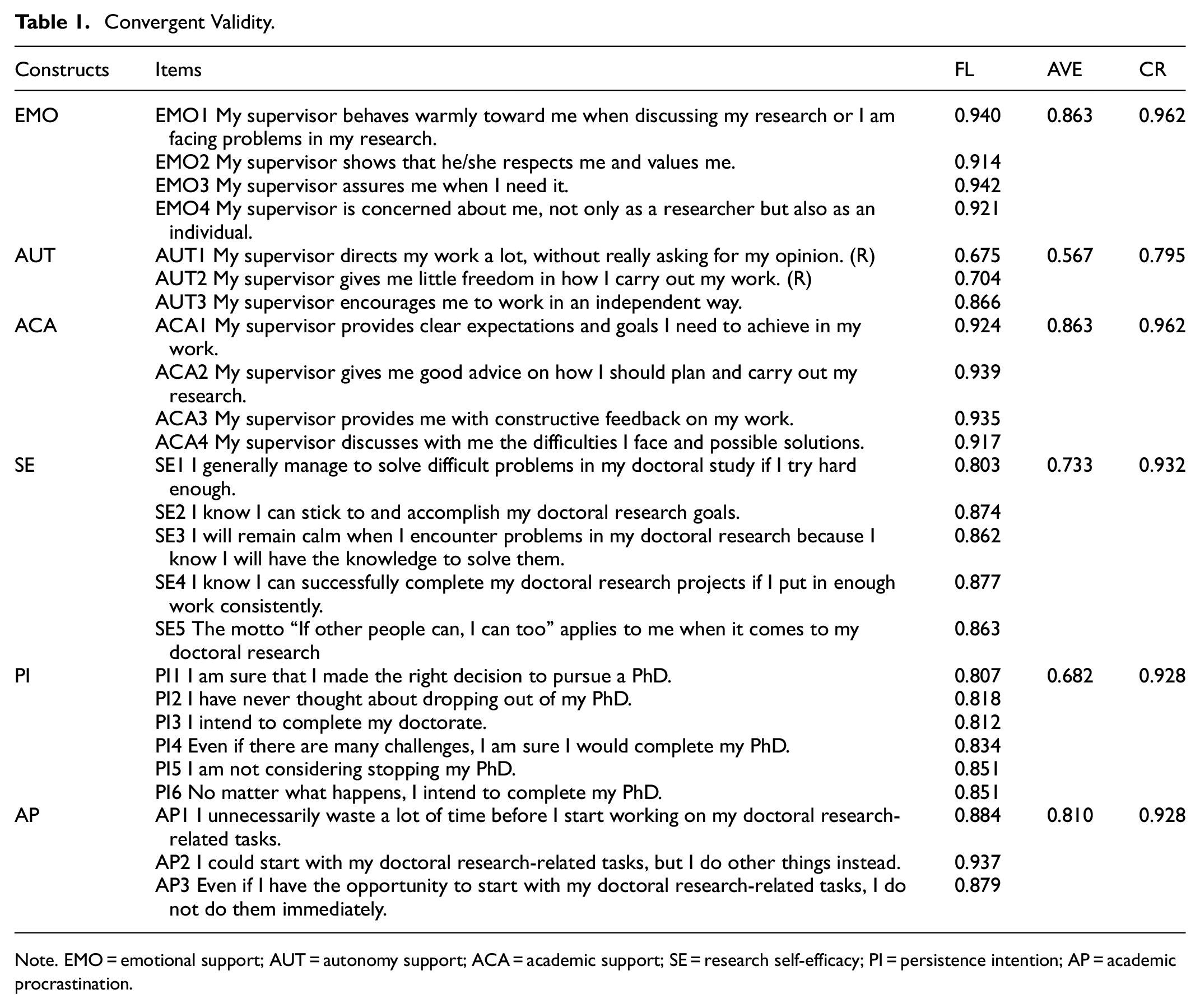
Note. EMO = emotional support; AUT = autonomy support; ACA = academic support; SE = research self-efficacy; PI = persistence intention; AP = academic procrastination.
Discriminant Validity (HTMT).


Structural Model Assessment
Prior to the assessment of structural model, the inner multicollinearity was assessed through variance inflation factor (VIF). It was found that all inner VIF values were below 3.3 (Hair et al., 2022), confirming that multicollinearity was not a concern in this study. Furthermore, as noted previously, the data in this study lacks multivariate normality. Accordingly, following the suggestions of Becker et al. (2023), the path coefficients, standard errors, t-values, and p-values for structural model using a bootstrap procedure with 10,000 resamples were reported. Furthermore, Hahn and Ang (2017) criticized that p-value is not a good criterion for the significance of hypothesis testing and suggested to use a combination of p-value, confidence interval, and effect size. Accordingly, these criterions were used to test the hypotheses of this study.
As shown in Table 3, academic support was found to be negatively related to academic procrastination (β = −.311, p < .01). Thus, H1a was supported. The direct effect of emotional support (β = .202, p > .05) and autonomy support (β = .079, p > .05) on academic procrastination was found to be statistically not significant. Thus, H2a and H3a were not supported. Building on the recommendations of Preacher and Hayes (2008), this study tested mediation hypotheses by bootstrapping the indirect effects. As shown in Table 3, the relationship between academic support and academic procrastination was found to be sequentially mediated by research self-efficacy and persistence intention (β = −.026, p < .05). Thus, H1b was supported. Regarding the relationship between emotional support and academic procrastination, the sequential mediating effect of research self-efficacy and persistence intention was found to be not significant. Thus, H2b was not supported. In the relationship between autonomy support and academic procrastination, the sequential mediating effect of research self-efficacy and persistence intention (β = −.032, p < .05) was found to be statistically significant, Thus, H3b was supported.
Hypothesis Testing.

Note. Coefficients are significant at **p < .01.
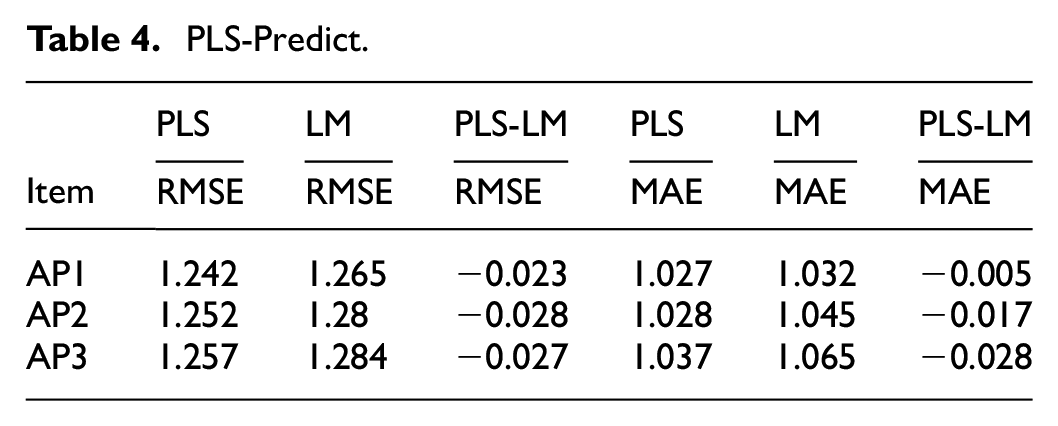
This study assessed its model’s explanatory power for academic procrastination using the coefficient of determination (R2). According to Cohen’s (1988) criteria, an R2 above .26 shows strong explanatory power, .13 to .26 indicates moderate, and .02 to .13 signals weak explanatory power. In this study, with an R2 of .110 for academic procrastination in its model, the explanatory power for academic procrastination was classified as weak. In addition, the predictive power of the model was assessed using PLS-Predict (Shmueli et al., 2019). Shmueli et al. (2019) suggested that strong predictive power is indicated if all item differences (PLS-LM) are negative. If all differences are positive, it suggests the absence of predictive power. Moderate predictive power is inferred when the majority of differences are negative. If only a minority of the differences are negative, the model’s predictive power is considered low. Table 4 reveals that the errors in the PLS model are all lower than those in the LM model, leading to the conclusion that the model in this study possesses strong predictive power.
PLS-Predict.
Discussions
This study examined the relationship between supervisory support, comprising academic, emotional, and autonomy dimensions, and academic procrastination among doctoral students in China. Previous research primarily focused on the direct relationship between teacher or instructor support, including academic, emotional, and autonomy aspects, and academic procrastination at undergraduate and secondary education levels (Codina et al., 2018; Mouratidis et al., 2018; Opdenakker, 2021; Serrano Corkin et al., 2021). Within the scope of existing research, this study appears to be one of the initial efforts to specifically establish a connection between supervisory support and academic procrastination among doctoral students. Additionally, this study also expands the understanding of the relationship between supervisory support and academic procrastination by examining the sequential mediating roles of research self-efficacy and persistence intention. This approach sheds light on the process through which supervisory support influences academic procrastination.
Contrary to initial expectations, this study found no significant direct relationship between emotional support and academic procrastination. Additionally, the sequential mediating effects of research self-efficacy and persistence intention in this relationship was also not significant. These results suggest that emotional support provided by supervisors does not influence academic procrastination. This finding is in contrast to Opdenakker (2021), which indicated that emotional support can mitigate academic procrastination. This surprising finding can reasonably be explained by the hierarchical nature of student-supervisor relationship in China. In this relationship, Chinese doctoral students often maintain an emotional distance from their supervisors, perceiving them primarily as academic advisors rather than personal or emotional mentors. This perception fosters an environment where interactions are predominantly task-oriented. Even when supervisors do offer emotional support, it may not resonate effectively with students due to their perceptions of supervisors’ roles and the emotional distance in student-supervisor relationship (Xu & Liu, 2023). These may partially explain why the emotional support provided by supervisors does not significantly influence the procrastination behaviors of doctoral students in this study.
Consistent with Opdenakker (2021), the findings of this study revealed a direct and negative relationship between academic support and academic procrastination, indicating that academic support can directly mitigate academic procrastination. This finding is particularly relevant to Chinese doctoral students because of the prevalence of passive learning style among them. They are typically habituated to supervisor telling them what and how to do in their research tasks and tend to prioritize their supervisors’ ideas more than their own. As a result, especially when confronted with challenges in their research tasks, the absence of academic support such as clear instructions and structured guidance by supervisor can leave Chinese doctoral students without the direction moving forward and thus result in procrastination (M. Wu & Hu, 2020; Xu & Liu, 2023).
Furthermore, the relationship between academic support and academic procrastination was found to be sequentially mediated by research self-efficacy and persistence intention. This suggests that the impact of academic support on reducing academic procrastination occurs through a chain of influences, starting with enhanced self-efficacy in research, followed by a strengthened intention to persist in their academic tasks. On the other hand, the direct influence of autonomy support on academic procrastination was not found to be significant. However, interestingly, the influence of autonomy support on academic procrastination also follows a similar sequential mediation through research self-efficacy and persistence intention. This suggests that while autonomy support might not directly influence academic procrastination, it still plays a vital role in fostering research self-efficacy and persistence, which in turn can help reduce academic procrastination. These findings highlight research self-efficacy and persistence intention as the mechanism by which the academic and autonomy support of supervisor reduce academic procrastination of doctoral students and provide support to the central tenet of SCT that environmental factors, such as supervisory support, play a crucial role in shaping an individual’s cognitive processes, including beliefs in their own abilities (self-efficacy) and their commitment to goals (persistence intention). These enhanced cognitive attributes, fostered by a supportive environment, are then instrumental in mitigating the likelihood of engaging in maladaptive behaviors such as academic procrastination (Bandura, 1991, 1997).
Conclusion, Limitations, and Recommendations for Future Research
This study found that the academic and autonomy support provided by supervisors can foster research self-efficacy and the intention to persist among doctoral students. These factors can subsequently help reduce academic procrastination. These highlight that providing academic and autonomy support is the key to reducing academic procrastination among doctoral students. This insight is especially useful for doctoral supervisors looking for effective strategies to ensure the successful and timely completion of doctoral study among their students. However, these findings should be interpreted with caution. While this study identifies academic and autonomy support as mitigating factors for academic procrastination, it does not advocate for maximizing these supports without limits. Excessive autonomy or a completely hand-off approach may lead doctoral students to feel lost, potentially causing increased procrastination, especially when they encounter challenging research tasks. On the other hand, providing too much academic support, such as excessive guidance or direct task assistance, can limit their chance to learn through direct experience. Thus, supervisors should strive for a balanced approach that simultaneously provides adequate academic support to keep doctoral students on track in their studies, thereby reducing the likelihood of academic procrastination, and creates an autonomous environment that facilitates “learning-by-doing” and fosters academic growth.
Despite its valuable contribution, this study is not without limitations. First, the R2 value for academic procrastination in this study is 0.110, indicating that the model explains only 11% of the variance in academic procrastination. This low R2 value implies that other significant factors, not included in this model, can potentially better account for variations in academic procrastination. Consequently, future research can contribute to the literature by exploring these alternative antecedents to better understand the factors explaining academic procrastination of doctoral students.
Second, due to the cross-sectional nature of the study, where all data were gathered at a single point in time, the study faced inherent limitations in establishing causality. Specifically, it was unable to determine whether changes in the independent variable (supervisory support) preceded changes in the dependent variable (procrastination), or vice versa. This temporal ambiguity hinders the ability to establish clear causal relationships between the variables (Hair et al., 2019). Future studies could employ a longitudinal design to verify causality, as this approach would allow researchers to track whether variations in supervisory support precede variations in procrastination over time (Hair et al., 2019). Lastly, the sample of doctoral students in this study was exclusively recruited from China using convenience sampling. This method limits the generalizability of the findings to doctoral students in other contexts such as doctoral students in different countries or even to the broader population of doctoral students within China. Future research could contribute to the literature by replicating this study with a more representative sample set, thereby enhancing its generalizability.
